
Best AI E-Commerce Tools for Product Content, Support and Merchandising in 2026
The wrong way to buy AI for an online store is to start with a list of popular products. A product-description generator, a customer-support agent and a merchandising platform may all carry the same “AI for ecommerce” label, but they solve different problems, use different data and charge against different units. Ranking them as though they were interchangeable produces a tidy list and a poor buying decision.
The better question is where your store is losing time or revenue now. Is incomplete catalog data slowing product launches? Are repetitive order questions consuming the support team? Are shoppers failing to find the right products even when the catalog contains them? The best first tool is the one that owns that bottleneck without duplicating software you already pay for.
This guide compares ten current tools across three jobs: product content, customer support and merchandising. It uses official product documentation, pricing pages and clearly labeled vendor case studies reviewed on September 17, 2026. AI Hustle World did not conduct authenticated hands-on tests for this comparison, so the rankings assess documented fit, control and economics rather than making unsupported claims about output quality.
The best AI ecommerce tools by job
There is no honest “best overall” product across these categories. Shopify Magic cannot replace an enterprise search platform, and Bloomreach would be excessive if a small merchant only needs help writing fifty product descriptions.
| Tool | Best fit | Main strength | Main limitation | C.A.R.E. score* |
|---|---|---|---|---|
| Shopify Magic + Sidekick | Shopify merchants needing a built-in starting point | Native store context and no separate AI fee | Shopify-only and not a full catalog-governance system | 14/20 |
| Describely | Lean teams producing or refreshing catalog content in bulk | Ecommerce-specific bulk workflow and transparent per-product pricing | High-volume catalogs move to custom pricing | 16/20 |
| Hypotenuse AI | Retailers managing complex, multilingual product data | Enrichment, content, images and PIM/PXM workflows in one system | Pricing is quote-based | 16/20 |
| Gorgias AI Agent | Shopify brands with substantial pre- and post-purchase support | Deep commerce actions, guidance and handoff controls | AI charges sit on top of the helpdesk | 17/20 |
| Intercom Fin | Teams that need support procedures plus conversational shopping | Strong procedure controls, simulations and broad support architecture | Full ecommerce shopping features are currently strongest on web | 17/20 |
| Tidio Lyro | Smaller stores that want a lower-cost path into AI support | Simple entry point, human handoff and product recommendations | Conversation allowances can become restrictive | 16/20 |
| Nosto | Mid-market brands wanting modular search, recommendations and personalization | Broad commerce-experience suite with business-user controls | Quote-based cost tied to modules and business volume | 15/20 |
| Bloomreach | Enterprise retailers with complex search and merchandising needs | Deep search, ranking, recommendations, segmentation and testing | Annual commitment and heavier implementation | 17/20 |
| Constructor | Retailers for whom product discovery is commercially critical | Commerce-focused search, browse, recommendations and searchandising | Public pricing is unavailable | 16/20 |
| Algolia | Technical teams that want flexible search and a public usage model | Developer control and comparatively transparent request-based pricing | Advanced AI and merchandising capabilities depend on plan and implementation | 17/20 |
The C.A.R.E. score measures documented buying fit, not independently tested performance. Tools are comparable within their job category, not across unrelated jobs.
The short version is straightforward. Start with Shopify Magic if it already covers a small Shopify store’s content needs. Choose Describely when bulk catalog copy is the constraint, and evaluate Hypotenuse when enrichment, governance and enterprise systems matter as much as writing. For support, Gorgias is the strongest Shopify-native choice, Fin is the more controlled cross-functional agent, and Tidio offers a more approachable starting cost.
Merchandising requires a different decision. Nosto suits teams that want modular commerce personalization, Bloomreach fits enterprise search and merchandising programs, Constructor is built around retail product discovery, and Algolia is the clearest fit for teams that want to build and tune the experience themselves.
Test AI Support on Your Store’s Real Questions
Connect Tidio’s Lyro AI Agent to your help content and check how well it answers common order, shipping and product questions.
Try Tidio for Your Store →Affiliate disclosure: We may earn a commission if you subscribe through this link, at no additional cost to you.
Choose the bottleneck before the tool
Product content, support and merchandising form a chain. Product content describes what an item is. Support uses that information to answer questions and complete customer requests. Merchandising uses product and behavioral signals to decide which items appear, in which order and for whom.
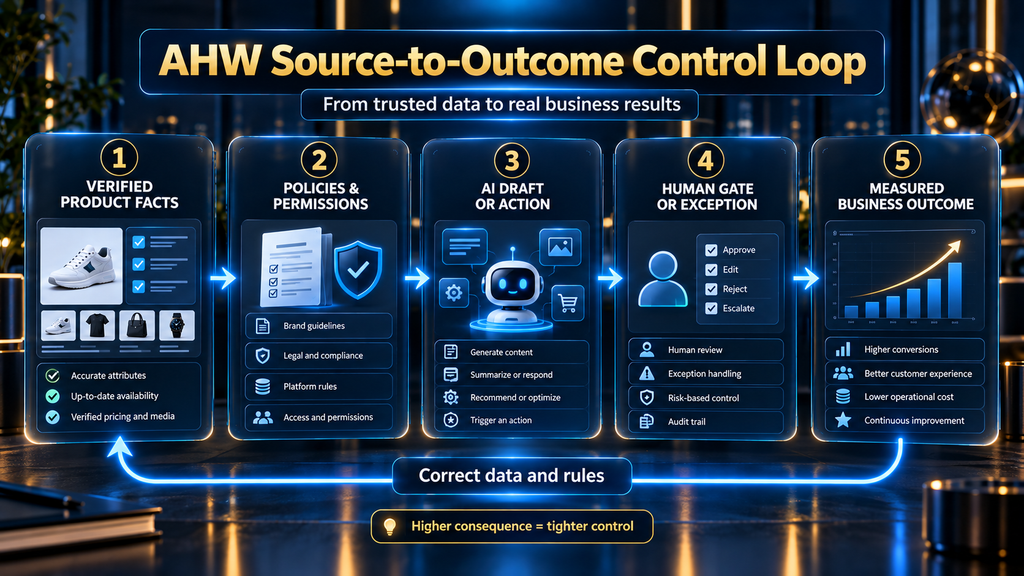
That relationship creates an uncomfortable truth: a new AI interface cannot compensate for unreliable source data. If a product record is missing its material, compatibility, care instructions or variant information, a content generator may invent a plausible detail, a support agent may repeat it and a merchandising system may rank the item for the wrong query. The visible error appears in three tools, but the original fault sits in the catalog.
Google’s Merchant Center product-data specification says inaccurate, missing or conflicting information can cause disapprovals, limited eligibility or incorrect product displays. Google also recommends combining page-level Product structured data with Merchant Center data so it can understand and verify information such as price and availability. Those requirements make product-data quality part of the buying decision, not a technical detail to solve later.
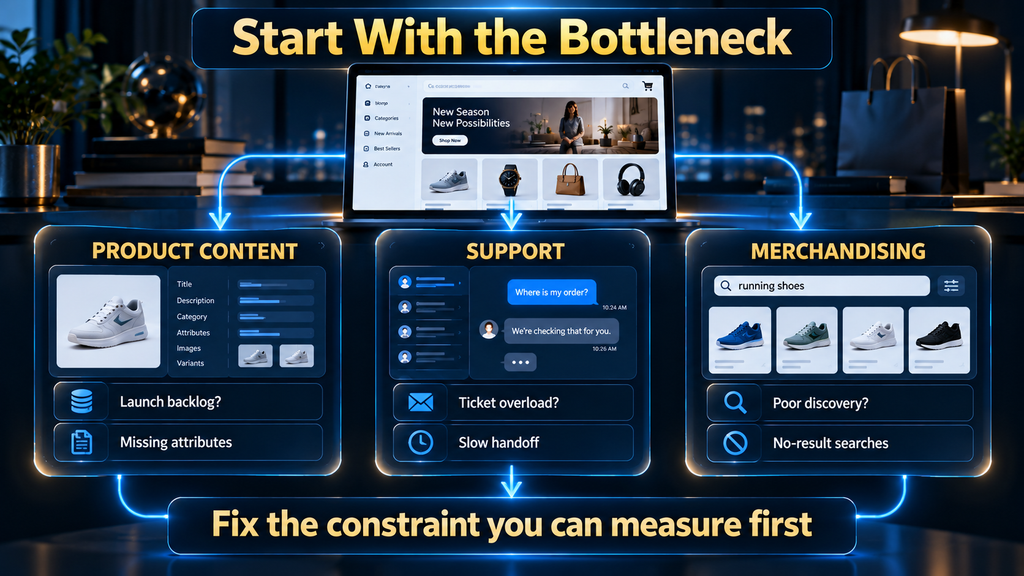
This is why a merchant should diagnose the workflow before arranging demos. A product-content problem looks like a backlog of unpublished SKUs, inconsistent descriptions, missing attributes or repeated channel rewrites. A support problem looks like avoidable order-status tickets, slow first responses, poor handoff or agents switching between several systems. A merchandising problem looks like no-result searches, irrelevant category pages, out-of-stock products occupying valuable positions or excessive manual rule maintenance.
The cost of doing nothing differs as well. Content backlogs delay assortment launches and leave products invisible to shoppers and search systems. Support backlogs raise handling costs and allow pre-purchase questions to expire. Weak merchandising wastes the traffic a retailer has already paid to acquire. A useful pilot therefore starts with one bottleneck, one owner and one metric rather than a vague target to “use more AI.”
How AI Hustle World evaluated the tools
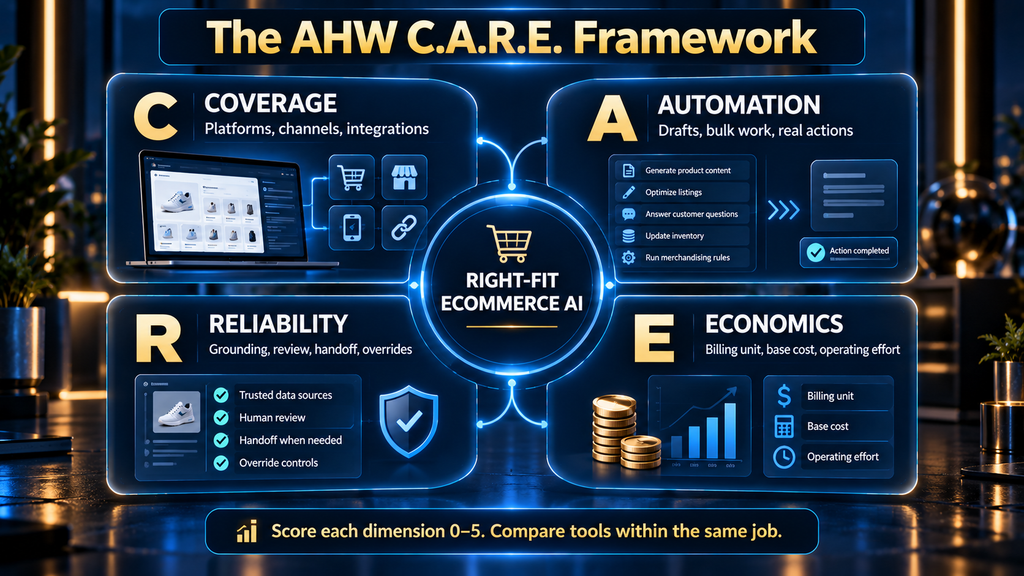
AI Hustle World’s C.A.R.E. Framework uses four five-point dimensions. Coverage measures depth within the intended job, including platforms, channels and integrations. Automation distinguishes draft assistance from bulk work or actions completed in connected systems. Reliability looks for source grounding, review controls, handoff, testing, overrides and documented boundaries. Economics considers price visibility, the billing unit, required base products, implementation effort and the risk of unpredictable cost growth.
The scores use integer values because decimal ratings would suggest a level of measurement that public documentation cannot support. A 17/20 does not mean one product is precisely five percent better than a 16/20 product. It means the former presents somewhat stronger documented buying evidence across the four dimensions, subject to the reader’s own platform and workflow.
This is a public-evidence buyer’s guide, not a lab test. Google’s guidance for high-quality reviews recommends evidence of first-hand experience when a publisher claims to have tested products. Because no authenticated test artifacts exist for this article, it does not rate prose quality, answer accuracy, search relevance, latency or ease of setup as observed facts.
Vendor outcome figures are handled separately. They can illustrate how a customer deployed a product, but they remain company or vendor claims unless an independent source verifies the method and result. That separation matters because the same vendor that controls the product often selects the customer, the measurement window and the success story that becomes public.
2026 Ecommerce AI Cost-and-Control Matrix
The table below normalizes details that vendors usually present in different formats. “Can act” means the product can do more than draft an answer or display an insight; it does not mean every action is enabled by default or safe to run without conditions.
| Tool | Primary data it needs | What it can create or change | Main human control | Billing unit | Main buying risk |
|---|---|---|---|---|---|
| Shopify Magic + Sidekick | Shopify product and store context; merchant prompts | Descriptions, pages, images and selected store changes | Sidekick presents changes for review; merchant remains responsible for published content | Included with Shopify, subject to feature availability | Generated benefits or facts may be wrong |
| Describely | Catalog import, store connector, product fields, images and enrichment sources | Bulk descriptions, titles, metadata, attributes and images | Content rules, audit, review and approval workflow | Per product plus enrichment or image credits; custom at higher volume | Teams can still approve bad source data at scale |
| Hypotenuse AI | PIM, ERP, ecommerce system, CSV, vendor pages, specs, images or UPC data | Attributes, tags, categories, descriptions, translations and images | Team permissions, guideline checks and approval before downstream sync | Custom quote | Broad scope can exceed the needs of a small catalog |
| Gorgias AI Agent | Shopify orders, customer records, catalog, policies and connected apps | Answers, recommendations and actions such as cancellation, address edits or subscription changes | Conditions, customer confirmation, guidance, testing and handoff topics | AI interactions plus a separate helpdesk plan | A poorly constrained action can alter a real order |
| Intercom Fin | Knowledge, Shopify catalog and order data, procedures and connected APIs | Answers, recommendations, cart assistance and post-purchase procedures | Branching logic, simulations, secure data access and human handoff | Per outcome, plus seats when using Intercom’s helpdesk | Outcome costs and channel differences require careful modeling |
| Tidio Lyro | Support content, website, product feed, Shopify or WooCommerce data | Answers, product recommendations, cart assistance and configured actions | Guidance, knowledge controls and human takeover | Monthly AI-conversation allowance; helpdesk plans are separate | Low allowances can make an entry plan look cheaper than normal usage |
| Nosto | Product, customer, behavioral, traffic and intent data | Search ranking, category merchandising, recommendations and personalized content | Merchandising rules, modules, segmentation and testing | Modules plus GMV, traffic, support and scale | Quote-based pricing makes early comparison difficult |
| Bloomreach | Catalog, search behavior, customer segments and event data | Search ranking, recommendations, category grids, boosts, blocks and slots | Merchandising rules, preview, audience targeting and testing | Annual module fee plus usage | Integration and operating effort may be excessive for a small team |
| Constructor | Catalog, shopper intent, behavior and commerce performance signals | Search, browse, recommendation ranking and product-discovery experiences | Searchandising rules, boosts, burying, hiding and dashboard controls | Quote required | Strong fit depends on product discovery being a high-value problem |
| Algolia | Indexed records, query and conversion events, rules and integrations | Search, browse, recommendations, ranking and merchandising experiences | Rules, visual merchandising controls, analytics and experiments | Requests, records, recommendations and plan level | Engineering work and plan-gated features affect total cost |
The control column deserves as much attention as the capability column. Shopify explicitly warns that generated descriptions may introduce benefits or facts that the merchant never supplied. The US Federal Trade Commission’s advertising-substantiation policy requires advertisers to have a reasonable basis for express and implied claims before publishing them. An AI writing tool may accelerate production, but it does not transfer responsibility away from the merchant.
The same principle applies when AI can act. NIST’s Generative AI Profile identifies confabulation as a core risk and recommends risk management, testing and evaluation across the AI lifecycle. In commerce, the practical translation is clear: drafting a reply, recommending a product and refunding an order should not share the same permission model.
Best AI tools for ecommerce product content
The strongest product-content tools do more than produce attractive paragraphs. They ingest structured product facts, maintain rules across many SKUs, preserve brand and channel requirements, flag missing information and provide a review path before content reaches a storefront or marketplace.
Shopify Magic and Sidekick: best built-in starting point
Shopify Magic is the sensible first stop for a Shopify merchant because it is already present in the operating environment. According to Shopify’s documentation, its AI features can generate product descriptions, page copy, email content and media, while Sidekick works with store context and can assist with products, orders, analysis and selected administrative tasks. Generally available Shopify Magic features are offered without a separate AI charge, although access to individual features can vary.
The economic case is strongest when the need is modest. A merchant with a small catalog can draft missing descriptions, revise product-page language and use Sidekick without importing the catalog into another system. Native context also reduces the copy-and-paste work that makes a general chatbot awkward for ongoing store operations.
The limitation is governance at scale. Shopify’s product-description help page warns that generated text can add benefits or facts based on similar published products, even when the merchant did not provide them. Shopify therefore places responsibility for accuracy on the merchant and advises reading generated content closely before publication.
That warning should shape the workflow. Provide the title, at least two concrete features, materials, fit, intended use and any prohibited claims; then verify the draft against the source product record. Shopify Magic is best for merchants who need a capable native assistant, but it is not a substitute for a PIM, a catalog-enrichment system or a formal multi-channel approval process.
Who should use it: Shopify merchants with small or moderately sized catalogs, limited content operations and a desire to use an included tool before buying another subscription. Who should avoid relying on it alone: multi-brand or multi-marketplace teams that need bulk governance, channel-specific rule sets, enrichment and staged approval.
Describely: best pay-as-you-go bulk content workflow
Describely is built around ecommerce catalog work rather than general marketing copy. It supports bulk generation, content rules, product-data enrichment, audits, store connectors and image processing. Its public pricing is unusually easy to interpret: up to 500 products cost $0.75 per product, enrichment is $0.55 per credit, image processing is $0.05 per credit and the first five products are free; larger catalogs receive custom pricing.
That model makes Describely attractive when a team has a defined backlog instead of a permanent need for another monthly writing platform. The relevant unit is not the number of words generated. It is the number of products whose content, data or images enter the workflow.
Describely’s advantage over a native generator is repeatability. A team can apply content rules across a batch, review the output and publish through supported connectors instead of rewriting prompts one product at a time. It is especially useful when the same product must be described differently for a storefront, a marketplace and a retailer feed.
The risk is assuming that bulk generation makes bulk review unnecessary. A ruleset can enforce format and vocabulary, but it cannot prove a supplier specification is true. The team still needs an approved source of product facts and an exception queue for regulated, technical or high-return categories.
Vendor-reported example: Describely says Target Australia used the platform for more than 1,000 products per week and reported 98% accuracy in generated descriptions. The Target Australia case study attributes that figure to the customer, so it should be read as a vendor-published account rather than an independent benchmark. The more useful operational lesson is that the team retained review while moving repetitive drafting into a bulk workflow.
Who should use it: lean content teams, distributors, agencies and multi-channel merchants with a measurable catalog backlog. Who should avoid it: stores that need only occasional copy for a handful of products, or enterprises that require deeper PIM/ERP governance than a content-production layer provides.
Hypotenuse AI: best for enterprise product data and content operations
Hypotenuse AI addresses a wider part of the product-information workflow. Its product-data enrichment documentation describes collecting missing attributes from vendor pages, specification sheets, product images, UPC data and other sources, then standardizing those attributes before generating descriptions, tags and categories. It also connects with systems such as Shopify, Salesforce Commerce Cloud, Akeneo, Salsify, NetSuite and other PIM or ERP platforms.
This matters when writing is not the real bottleneck. Large retailers often receive incomplete, inconsistent supplier data and spend more time finding, cleaning and mapping facts than composing sentences. In that setting, the value comes from turning source material into a governed product record and producing channel-ready content from that record.
Hypotenuse also documents team access controls, bespoke brand models, guideline checks and bulk image workflows. Those controls make it a stronger candidate for multi-brand, multilingual and regulated catalogs, but they also move the product into a sales-assisted enterprise purchase. Current pricing is custom, including the Basic plan for smaller catalogs, so a serious evaluation requires a quote based on catalog size, integrations, seats and workflow requirements.
The main buying question is whether the organization needs an AI content tool or a product-information operating layer. If a clean PIM already contains complete attributes and the only problem is occasional copy, Hypotenuse may be more system than the team needs. If product onboarding crosses suppliers, languages, brands and channels, the broader scope becomes the point.
Who should use it: enterprise retailers, distributors and multi-brand organizations with complex enrichment, translation and governance requirements. Who should avoid it: small stores seeking a transparent self-service price for simple description generation.
Best AI tools for ecommerce customer support
Ecommerce support AI should be evaluated by what it knows and what it is permitted to do. A bot that can quote a return policy is different from an agent that can inspect an order, confirm eligibility, change an address and record the action. Greater autonomy is valuable only when the conditions, confirmation and handoff rules become equally strong.
Gorgias AI Agent: best for Shopify-native support operations
Gorgias is designed around commerce support rather than adapting a general service desk to it. Its AI Agent can use Shopify order, customer and product information alongside help content and connected applications. Gorgias documents actions for order cancellation, shipping-address changes, subscription pauses and other requests that would otherwise require a person to switch systems.
The control model is a material strength. In its Actions documentation, Gorgias allows teams to add conditions, require customer confirmation and test actions before use. Confirmation is enabled automatically for some irreversible outcomes, while configurable handoff rules route anger, sensitive topics, explicit human requests or unreliable answers to an agent.
Pricing requires more care than the headline rate suggests. Gorgias says AI Agent costs $0.90 per resolved interaction on most plans, with Starter at $1, and that AI Agent is an add-on to the separate Gorgias Helpdesk. A forecast therefore needs both human-handled ticket volume and AI-resolved interaction volume, not just the number of support seats.
Gorgias is strongest where order-aware support and conversational selling share the same team. It is less compelling for a business outside ecommerce or for a store whose support volume is too low to justify migrating the helpdesk. Deep Shopify fit can also become a constraint for teams that want equal native depth across several commerce platforms.
Vendor-reported example: Gorgias reports that Caitlyn Minimalist compared AI-assisted and human-agent conversations over 90 days and recorded a 20% versus 8% conversion rate, an 18% click-through rate on recommendations and a sales lift against human-only conversations. Those figures appear in a Gorgias customer story, so they are evidence of one vendor-selected deployment, not a general forecast for another store.
Who should use it: Shopify brands with meaningful order-related ticket volume, connected subscription or returns apps, and a support team ready to maintain guidance. Who should avoid it: low-volume stores that need only a basic FAQ bot, or non-commerce teams that would pay for specialization they cannot use.
Intercom Fin: best controlled agent for support and shopping
Fin for Ecommerce now combines product discovery, shopping assistance and post-purchase support. Intercom’s current ecommerce documentation says the native Shopify integration synchronizes catalog, variant, price, availability and order information. Other platforms can connect through a catalog connector, although developers must publish catalog updates to Intercom on a schedule.
Fin’s strongest differentiator is the surrounding control system. Procedures can combine natural-language instructions with branches, deterministic rules, code, secure data access and defined handoff points. Intercom recommends running simulations before publishing procedure changes, which is the right operating model for order claims, eligibility decisions and other requests where a plausible mistake is still a costly mistake.
The pricing model is outcome-based. On Intercom’s current pricing page, Fin costs $0.99 per outcome, and the Intercom helpdesk starts at $29 per seat per month on the Essential plan. Fin can also work with an existing helpdesk without Intercom seats, subject to commitments and integration choices.
The billing definition deserves attention. A charge can occur when a customer confirms resolution, stops asking for help after an answer, or when Fin completes a configured procedure, including some handoffs. A merchant should review resolved conversations during the pilot instead of treating the vendor’s resolution label as a perfect proxy for customer value.
There is also a channel boundary. Intercom currently describes full ecommerce shopping functions on the web Messenger, while mobile deployments switch to support-only behavior and email, social, voice and Slack are not currently supported for the ecommerce role. Fin may still be a strong customer-service platform across channels, but buyers should not assume every channel receives the same shopping experience.
Who should use it: teams already using Intercom, organizations that value simulations and controlled procedures, and merchants combining product discovery with complex support. Who should avoid it: stores that need identical shopping-assistant behavior across every messaging channel or cannot model outcome-based costs.
Tidio Lyro: best accessible starting point for smaller stores
Tidio separates its helpdesk, rule-based Flows and Lyro AI Agent, allowing a merchant to buy Lyro alone or combine it with human support. Lyro can learn from support content, connect to Shopify or WooCommerce, use a product feed or API, recommend products and hand a conversation to a person when needed. On Shopify, its current product-recommendation features include stock awareness, cart context and adding a recommended item to the cart.
The entry price is easier for a small business to test. On its pricing page, Tidio lists Lyro from $32.50 per month for 50 AI conversations and provides 50 one-time conversations before a recurring quota is purchased. Its separate Starter helpdesk plan begins at $24.17 per month when billed annually, so buyers should distinguish the cost of AI conversations from human-support capacity.
That distinction is also the main limitation. A low headline price can disappear quickly if traffic produces far more than 50 AI conversations, and the platform’s Plus and Premium options introduce custom or usage-based pricing. Estimate normal and peak-month volumes before treating Lyro as the budget winner.
Tidio is best when a smaller team wants one approachable interface for live chat, AI answers, product help and human takeover. It is less suitable when the store requires elaborate multi-system procedures, enterprise governance or high-volume pricing that must be negotiated anyway.
Who should use it: smaller Shopify and WooCommerce merchants that want to pilot AI support without replacing an enterprise service stack. Who should avoid it: complex global support organizations that need extensive procedure testing, role controls and bespoke action logic.
Combine an AI Agent With Human Handoff
Set up Tidio with Lyro and live chat together, then review which conversations the AI resolves and which it hands to your team.
Set Up Tidio Lyro →Affiliate disclosure: We may earn a commission if you subscribe through this link, at no additional cost to you.
Best AI tools for merchandising and product discovery
Merchandising software should not be judged by whether it can recommend products. Nearly every serious platform in this category can. The real differences are how it understands intent, which behavioral and commercial signals affect ranking, how much control a merchandiser retains, how experiments are measured and how difficult the system is to operate.
Nosto: best modular commerce-experience suite
Nosto combines personalized search, category merchandising, product recommendations, segmentation, content personalization and related modules. A team can buy the parts it needs instead of adopting the entire platform at once. Its pricing page says cost depends on selected modules, GMV, traffic, support and scalability, with AI capabilities included in the modules rather than charged as a separate add-on.
The appeal is consolidation. A retailer that currently uses different products for search, recommendation carousels and onsite personalization may gain a shared view of customer, product and intent signals. Merchandisers retain tools for business rules, category control and testing instead of surrendering every decision to automated ranking.
The weakness is price visibility. Nosto does not publish rigid tiers or a standard self-service trial, although qualified merchants can use a proof of concept with their own store data. That makes the sales process part of the evaluation: ask for the price by module, the traffic or GMV assumptions, required services, support level and the renewal treatment if the store grows.
Nosto fits a mid-market brand that wants several coordinated experience modules and has a team capable of using them. A small store with weak product data and little experimentation traffic may pay for sophistication before it has the operating capacity to benefit from it.
Who should use it: growing brands seeking coordinated search, recommendations, category merchandising and content personalization. Who should avoid it: early stores that need a public low-cost tier or cannot supply enough clean data and traffic to evaluate personalization.
Bloomreach: best enterprise search and merchandising platform
Bloomreach Discovery combines AI-driven site search with a merchandising dashboard, recommendations, audience controls, analytics and testing. Its documentation shows rules for blocking, including, boosting, burying and slotting products, with separate scope for search, category and recommendation experiences. That mix lets algorithms handle routine ranking while merchandisers preserve commercial, inventory and brand priorities.
This human-machine split is where Bloomreach earns its place. A retailer may want revenue-oriented ranking most of the time but still need to suppress a recalled product, pin a new range, prioritize private label, target a segment or reserve positions in a seasonal category. Pure automation cannot infer every commercial obligation from clicks and purchases.
Bloomreach is an enterprise purchase. Its pricing page describes an annual subscription composed of a module fee and a usage fee based on factors such as catalog size, customers and events. The company says Autonomous Search implementation averages about six weeks, but that is a vendor estimate rather than a guaranteed schedule.
The platform makes sense when search and category pages materially affect revenue and when a merchandising team is ready to operate testing, segments and rules. It is a poor fit when a business wants a plug-in search box, lacks implementation resources or cannot define the commercial metric that would justify an annual commitment.
Vendor-reported example: Bloomreach says Hobbycraft used conditional slot merchandising across a catalog of more than 27,000 SKUs and recorded a 21% increase in average order value and a 7.3% lift in revenue per visitor in the paint category. The Hobbycraft case study is useful because it names the categories and mechanism, but its figures remain vendor-published and should not be generalized to another retailer.
Who should use it: enterprise retailers with large catalogs, meaningful search traffic and dedicated ecommerce or merchandising teams. Who should avoid it: small stores that cannot support an integration project or do not yet measure search and category performance.
Constructor: best commerce-focused product discovery system
Constructor focuses on product discovery: search, browse, recommendations, personalization, shopping assistance and merchandising controls. Its B2C offering uses catalog, intent, behavior and commercial signals to rank products while exposing information such as popular queries, no-result pages and trends to the merchandising team.
The key capability is searchandising. Constructor’s dashboard documentation allows merchandisers to create rules for search queries, browse categories, collections and campaigns, including boosting, burying or hiding items when business context differs from historical behavior. That is useful when a product goes viral, a campaign begins, stock changes or a recall requires immediate intervention.
Constructor is likely to be evaluated against Bloomreach, Nosto and enterprise search products rather than against a general AI assistant. Public pricing is not available, so a buyer needs a structured request covering catalog size, traffic, regions, environments, implementation, service levels, experimentation and support. A demo that looks good on a sample catalog is not enough; ask to evaluate the system with your own top queries, zero-result queries, seasonal terms and low-data products.
The platform is best where product discovery is important enough to have an owner and a test plan. A merchant with a tiny catalog or little site-search usage may gain more from fixing taxonomy, filters and product data before purchasing an advanced ranking system.
Who should use it: retailers with large assortments, valuable onsite search traffic and merchandisers who need both automated ranking and manual control. Who should avoid it: small catalogs, content-only use cases and teams seeking published entry-level pricing.
Algolia: best developer-led option with transparent usage pricing
Algolia offers search, browse, recommendations, rules, analytics, personalization and merchandising capabilities through APIs and business-user tools. It is attractive to technical teams because the storefront experience can be composed rather than adopted as a fixed suite. Its public pricing also makes early cost modeling easier than it is with quote-only competitors.
The Free plan currently includes 10,000 search requests, 50,000 records and 5,000 recommendation requests per month. Grow includes 10,000 monthly search requests and then charges $0.50 per additional 1,000, while Grow Plus charges $1.75 per additional 1,000 and adds features such as AI ranking, advanced personalization, collections and a much larger rules allowance. Record and recommendation usage have separate limits and overages.
That transparency does not make total cost automatic. The feature needed by a merchandising team may push the project from Grow to Grow Plus or an annual Elevate contract, while engineering, event instrumentation and interface work sit outside the request price. A cheap search request is not a cheap implementation if the team must build and maintain the entire experience around it.
Algolia is strongest when developers want detailed control and the organization can instrument clicks, conversions and other events correctly. It is weaker when a small business expects a fully managed merchandising program with strategy, implementation and ongoing optimization included.
Who should use it: product and engineering teams building a tailored search and discovery experience with predictable usage inputs. Who should avoid it: nontechnical teams seeking a largely managed, ready-to-operate commerce suite.
Three practical ecommerce AI stacks
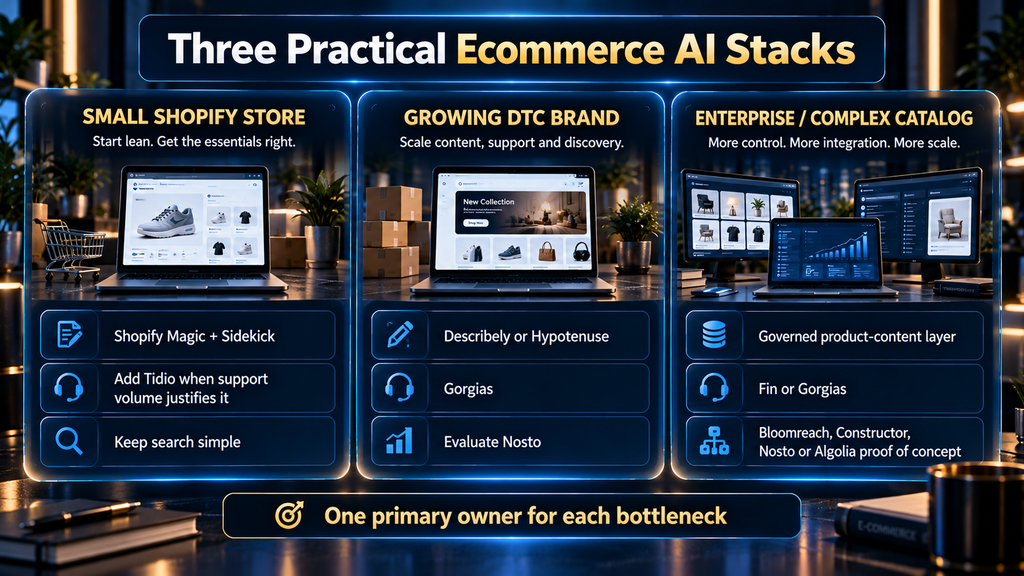
A stack should have one primary owner for each bottleneck. Buying two support agents or three recommendation engines does not create redundancy in the helpful sense; it creates conflicting analytics, duplicated fees and uncertainty about which system is responsible for an outcome.
Small Shopify store
Start with Shopify Magic and Sidekick for product descriptions and routine store work because the marginal software cost is effectively zero. Add Tidio Lyro only if customer questions are frequent enough to justify a recurring AI allowance, and keep Shopify’s native search or a lightweight app until search behavior shows a real discovery problem.
This store should not buy an enterprise merchandising suite because larger brands use one. Its first investment should remove repeated work that can be measured within a month. If the catalog later outgrows native content tools, Describely is a more natural second step than adding another general AI writer.
Growing direct-to-consumer brand
Use Describely for a recurring catalog backlog or Hypotenuse when enrichment and multi-system governance have become the constraint. Gorgias is the natural support candidate when Shopify order actions, subscriptions and returns dominate the inbox. Nosto becomes worth evaluating when onsite search, recommendations and personalized category experiences have enough traffic to support experimentation.
The mistake at this stage is allowing every department to buy its own overlapping AI tool. Content, CX and merchandising leaders should agree on the product-data source, which system publishes changes, which system owns product recommendations and how assisted revenue is attributed.
Enterprise or complex catalog
Use Hypotenuse or an equivalent governed product-content layer alongside the existing PIM and ERP rather than creating a second uncontrolled product database. Evaluate Fin or Gorgias according to the service architecture, commerce platform and required actions. Compare Bloomreach, Constructor, Nosto and Algolia through a controlled proof of concept using the same catalog slice and query set.
The enterprise decision should include security, data retention, permission design, audit logs, service levels, regional hosting, peak traffic and procurement terms. Feature parity is rarely the deciding issue; implementation risk, operating ownership and measurement quality usually matter more.
How to calculate the real cost
Monthly subscription price is only one component of ecommerce AI cost. A fair comparison converts each product’s billing model into the units the store actually generates and then adds the work required to operate it.
For product content, use this model: Catalog cost = generated SKUs + enrichment credits + image credits + integration or onboarding + human review time. It captures both the production unit and the editorial work needed to make the output publishable.
For support, use this model: Support cost = helpdesk base + AI outcomes or resolved interactions + channel or overage charges + cost of escalated human work. It prevents a low per-resolution price from hiding the helpdesk and human-work costs around it.
For merchandising, use this model: Discovery cost = platform and modules + traffic, GMV, requests or records + implementation + ongoing feed, rule and experiment work. The operating work matters because discovery performance can decay when feeds, rules and experiments have no owner.
The formulas explain why two similar headline prices can produce very different bills. At the published rate, 1,000 Gorgias AI-resolved interactions correspond to roughly $900 in AI interaction cost before the helpdesk and plan details. One thousand Fin outcomes correspond to $990 before any Intercom helpdesk seats or other channel charges. Those are arithmetic examples, not quotes; actual contracts, included allowances and the definition of a billable resolution must be checked before purchase.
The less visible cost is review and maintenance. A catalog generator that creates 5,000 descriptions still needs an exception policy. A support agent needs current policies, failed-conversation review and action testing. A merchandising engine needs event quality, campaign rules and an owner who can explain why products moved.
What to measure during a pilot
The pilot metric should match the bottleneck. Measuring “AI usage” rewards activity, not business value.
For product content, track time from source data to approved product page, percentage of fields completed, edit or rejection rate, feed errors, policy violations and returns related to inaccurate descriptions. Search impressions, click-through and conversion may matter later, but they should not hide a rise in wrong claims or inconsistent attributes.
For support, track eligible conversations, AI resolution rate, escalation rate, reopen rate, cost per accepted resolution, customer satisfaction, unauthorized or reversed actions and human handling time after escalation. Pre-purchase conversion can be included, but use a documented attribution window and separate correlation from causation.
For merchandising, track no-result rate, search exit rate, product click-through, search conversion, revenue per search visitor, average order value, out-of-stock exposure and the number of manual rules the team must maintain. Test changes against a control when traffic permits; otherwise seasonal demand and promotions can make an ordinary week look like an algorithmic win.
The decisive measure is often failure cost. A product description corrected before publication costs minutes. A wrong support action may cost the order and the customer. A merchandising error can affect thousands of sessions before anyone notices. Approval and monitoring should become stricter as the consequence and scale of a mistake increase.
A 30-day implementation plan
During the first five days, document the current workflow and baseline. Count the backlog, ticket types or search failures; record current time and cost; and select one constrained use case. Do not begin by enabling every feature available in the trial.
In the second week, prepare the source data and rules. For content, create an approved field and claims checklist. For support, update policies, define excluded topics and configure handoff. For merchandising, validate the feed, event tracking and a fixed query set that includes top searches, no-result terms, seasonal language and difficult long-tail requests.
In the third week, run the tool in review mode or on a limited traffic segment. Sample successes and failures rather than looking only at the average. Keep screenshots or exports of material errors, document the plan and settings used, and record any human intervention required to achieve the result.
In the fourth week, compare the pilot with the baseline and calculate the full operating cost. Expand only if the result survives error review and the team knows who will maintain the system. A pilot that saves time but creates an unowned review queue has moved the bottleneck rather than removed it.
Common mistakes and failure modes
The first mistake is buying the most impressive demo. Vendor demonstrations use clean data, prepared queries and favorable workflows. A serious evaluation uses your incomplete catalog, your ambiguous return policy, your difficult seasonal searches and the edge cases that already consume employee time.
The second mistake is confusing fluent output with accurate output. A polished product description can still contain an unsupported durability, health, compatibility or environmental claim. A natural support answer can still quote an expired policy. Fluency lowers the chance that a human notices the error, which makes verification more important rather than less.
The third mistake is granting action authority too quickly. Begin with low-consequence answers, then add actions with eligibility conditions, amount limits, customer confirmation, audit records and a clear kill switch. Refunds, discounts, cancellations and address changes deserve stronger controls than an FAQ response.
The fourth mistake is allowing automated optimization to erase merchandising judgment. Purchase history favors products that already receive exposure, and conversion-oriented ranking can bury new products, seasonal priorities or strategic inventory. Merchandisers need the ability to inspect, override and test rankings without turning the system into hundreds of permanent manual rules.
The fifth mistake is double-buying. Support agents increasingly recommend products, merchandising tools increasingly answer product questions and content platforms increasingly claim search optimization. Define the system of record and the owner of each customer-facing decision before adding another overlapping module.
The final mistake is treating a vendor case study as a business case. A reported conversion or AOV lift may be real for the featured customer, but it does not reveal every implementation cost, failed test, traffic characteristic or concurrent promotion. Use the mechanism to design a pilot; do not paste the headline percentage into a budget forecast.
What changes next
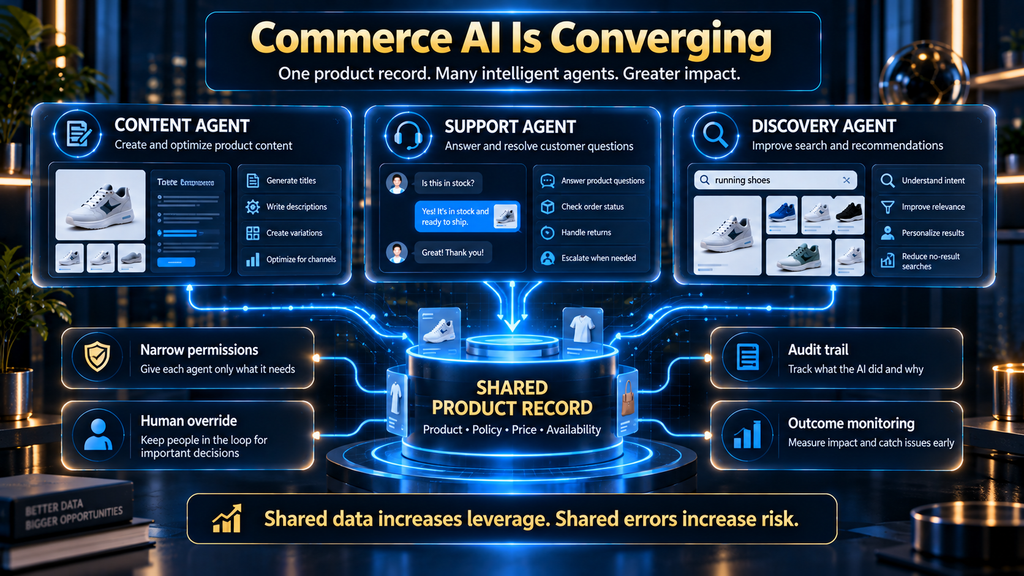
The categories in this article are already converging. Support agents recommend products and modify carts. Merchandising systems add conversational discovery. Product-content tools prepare catalog information for search engines, marketplaces and AI shopping services as well as human shoppers.
That convergence makes the underlying product record more valuable. The next competitive advantage is unlikely to come from producing the largest amount of AI text. It will come from maintaining product, policy, price and availability data that several automated systems can use without contradicting one another.
Stores should therefore expect fewer isolated “AI features” and more agents operating across connected systems. The right response is not to grant every new agent broad access. It is to improve data ownership, permissions, testing and measurement so automation can expand without making the store harder to control.
Final Thoughts
The best AI ecommerce tool is not the product with the longest feature list. It is the product that removes a specific operational constraint while leaving the business able to verify what it created, control what it changed and predict what it will cost.
For many Shopify merchants, the correct first move is to use Shopify Magic before adding software. Describely and Hypotenuse become more valuable as catalog scale and governance increase. Gorgias, Fin and Tidio serve different levels of support complexity, while Nosto, Bloomreach, Constructor and Algolia require a genuine product-discovery case rather than a general desire to “add AI.”
The durable buying rule is simple: one bottleneck, one accountable owner and one measurable outcome. Start there, keep the source data clean and expand automation only after the controls have proved they work.
Decide If Tidio Fits Your Support Volume
Estimate your monthly support conversations and compare them with Tidio’s Lyro limits before choosing a plan for your store.
Compare Tidio Plans →Affiliate disclosure: We may earn a commission if you subscribe through this link, at no additional cost to you.
Frequently Asked Questions
What is the best AI ecommerce tool in 2026?
There is no single best tool across product content, support and merchandising. Shopify Magic is the best built-in starting point for a Shopify merchant, Gorgias is the strongest Shopify-native support choice, and Bloomreach is a leading enterprise option for search and merchandising. The right first purchase depends on the store’s current bottleneck and operating capacity.
What is the best AI tool for a Shopify store?
Start with Shopify Magic and Sidekick because they use store context and are included with Shopify, subject to feature availability. Add a specialist only when a measured workflow exceeds what the native tools can handle. Gorgias is a strong next step for order-aware support, while Describely can address a bulk catalog-content backlog.
Which AI tool is best for writing product descriptions at scale?
Describely is the clearest pay-as-you-go choice for bulk ecommerce descriptions, rules and enrichment. Hypotenuse AI is stronger when descriptions are part of a larger enterprise product-data workflow involving PIM, ERP, attributes, translation and images. Shopify Magic remains sufficient for many smaller Shopify catalogs.
Is Gorgias or Intercom Fin better for ecommerce support?
Gorgias is the better fit for a Shopify-focused CX operation that wants deep order and app actions in a commerce-native helpdesk. Fin is stronger when the organization values procedures, simulations, controlled branching and a broader customer-service architecture. Model both the base platform and outcome or interaction charges before deciding.
Is Tidio suitable for a small online store?
Yes, particularly when a smaller Shopify or WooCommerce store wants AI answers, product recommendations and human takeover without beginning with an enterprise contract. Check the recurring AI-conversation allowance rather than relying on the entry price alone. A store with complex procedures or high volume may outgrow the simpler setup.
What is the best AI merchandising platform?
Bloomreach is a strong enterprise choice for search, recommendations and controlled merchandising. Constructor is compelling when product discovery is the central retail problem, Nosto offers a broad modular experience suite, and Algolia suits technical teams that want API-level control and public usage pricing. Catalog size, traffic, team capability and desired control matter more than the number of features.
Can AI run an ecommerce store without human review?
No responsible team should allow it to do so. Generated product claims, customer-facing answers, refunds, cancellations and rankings can all create financial or trust consequences. Human involvement should move from reviewing every low-risk draft toward reviewing exceptions and monitoring outcomes, but high-impact actions still need explicit controls.
Should a store buy one platform or several specialist tools?
Use one primary system for each proven bottleneck. A small store may need only Shopify’s native AI and a support tool, while an enterprise may need separate governed systems for product information, service and discovery. Avoid buying two products that both claim ownership of recommendations, customer answers or product-content publishing unless the boundary is documented.
How should an ecommerce business test an AI tool?
Use a constrained 30-day pilot with a recorded baseline, fixed source data, consistent tasks and a named success metric. Keep the same query set, ticket types or catalog sample when comparing products, and record material plan or integration differences. Review failures and operating labor alongside the average result.
What is the biggest risk of ecommerce AI?
The biggest risk is a plausible error propagating through connected systems. One unsupported product attribute can appear in a description, a support answer and a recommendation before a person notices it. Clean source data, narrow permissions, confirmation for consequential actions and routine error review reduce that risk.
Written by
Muntasir Ahmad Chowdhury
Founder, AI Hustle World
Muntasir Ahmad Chowdhury is the Founder of AI Hustle World, an independent publication dedicated to making Artificial Intelligence practical, trustworthy, and easy to understand. He researches AI tools, automation, customer service, productivity, and real-world business applications, helping readers make smarter technology decisions through research-driven, experience-backed content.
Expertise:
AI Tools • AI Automation • AI Customer Service • AI Productivity • Generative AI • AI Workflows
Get Smarter With AI
Enjoyed this guide? Get practical AI tools, tutorials, and honest reviews delivered to your inbox.
5 thoughts on “10 Best AI E-Commerce Tools for Content & Support (2026)”