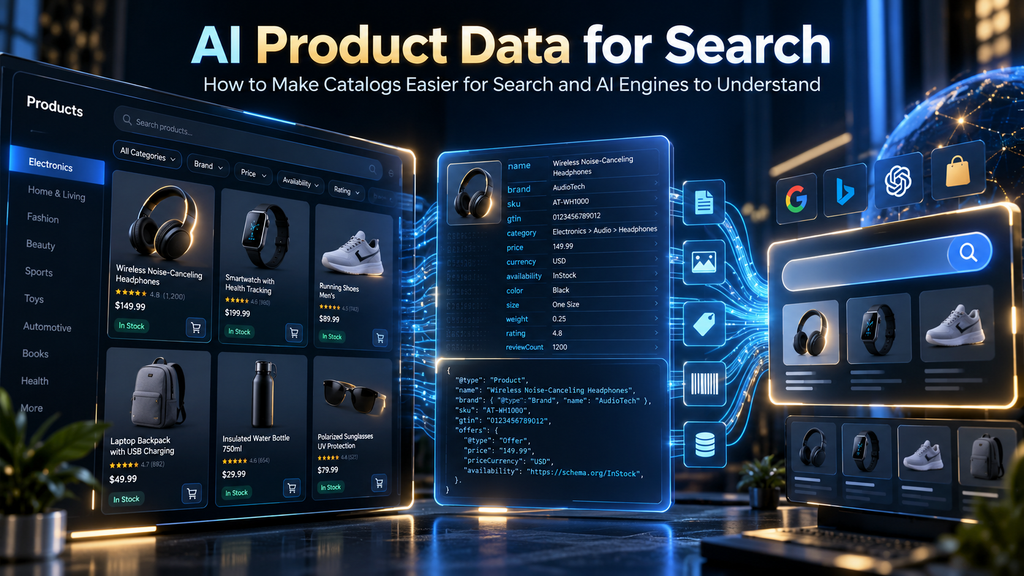
AI Product Data for Search: How to Make Catalogs Easier for Search and AI Engines to Understand
A retailer can have beautifully written product pages and still make its catalog surprisingly difficult for machines to understand. A shopper may search for “waterproof wide-fit trail shoes under $140,” yet the store’s product records may contain the words “trail shoe” and “water resistant” only inside paragraphs, while width, terrain, exact price, and variant availability live in completely different parts of the commerce system.
To a human browsing the page, the product may look perfectly clear. To a search engine, recommendation system, semantic-search model, or AI shopping assistant, the same product can be difficult to identify, compare, filter, and verify because the important facts are not represented consistently enough for machines to use.
This is why improving product visibility for search and AI is not primarily a copywriting exercise. Better descriptions can help, but the deeper problem is usually product data: identity, taxonomy, buyer-relevant attributes, variant relationships, price, availability, and the way those facts are distributed across product pages, structured data, feeds, and APIs.
The practical goal is not to create the largest possible catalog record. It is to create a product representation that allows machines to answer the questions customers actually ask without guessing what the product is, confusing one variant with another, or relying on stale commercial information.
Why Product Catalogs Were Not Originally Built for AI Search
Most ecommerce catalogs were not designed around conversational discovery. They evolved from inventory databases, merchandising systems, supplier files, spreadsheets, ERP records, and storefront templates, each created to solve a particular operational problem rather than to describe products perfectly for every future search system.
That history explains many of the inconsistencies retailers now face. The warehouse may care about SKU and stock quantity, marketing may care about title and description, merchandising may care about collection placement, advertising platforms may need GTIN and category, while the storefront needs price, images, options, and persuasive copy.
Those systems can all function adequately while still producing a fragmented product record. A retailer might know internally that a backpack fits a 16-inch laptop, comes in three sizes, and is water resistant, yet only one of those facts may be represented as a structured field that downstream systems can reliably retrieve.
Traditional keyword search could sometimes hide this weakness because matching exact words in titles and descriptions was enough for many searches. Conversational search changes the requirement because shoppers increasingly express intent through combinations of constraints, preferences, use cases, and comparisons rather than typing a short product name.
A machine trying to answer “Which backpack fits a 16-inch laptop, stays under airline carry-on limits, and costs less than $120?” needs a clearer product model than one trying to match the phrase “travel backpack.” The difference is not cosmetic; it changes which facts must exist and how reliably they need to be represented.
What Machine-Readable Product Data Actually Means
Machine-readable product data is product information represented in a form that software can identify, interpret, compare, and update without relying entirely on human reading. It includes familiar fields such as title, brand, price, availability, category, size, color, SKU, GTIN, material, dimensions, variant relationships, and product URLs.
The important word is not “structured” by itself, because a badly designed spreadsheet is technically structured. The real question is whether the structure preserves the meaning machines need when they search, filter, compare, group, or recommend products.
Imagine a retailer storing color in three ways: “navy,” “navy blue,” and “dark blue.” A human understands that those values may describe closely related colors, but a filter, feed, recommendation engine, or AI agent may treat them as different unless the system has a normalization rule or standardized attribute vocabulary.
The same problem appears when an important specification exists only in prose. A laptop description may mention “16 GB of memory with a 512 GB solid-state drive,” but if memory and storage are not available as separate product attributes, downstream systems have to extract those facts from text before they can compare the laptop consistently with other models.
Machine-readable data therefore does not mean removing descriptive language. Product copy remains useful for explaining benefits, positioning, use cases, and nuance, while structured product data gives machines explicit facts that can be retrieved and compared without interpreting every sentence from scratch.
That distinction is becoming more important as search platforms consume commerce data directly. Google supports both product structured data embedded on pages and Merchant Center product data, while OpenAI now accepts structured merchant product feeds for product discovery in ChatGPT. (Google for Developers)
A Product Can Be Searchable Without Being Recommendable
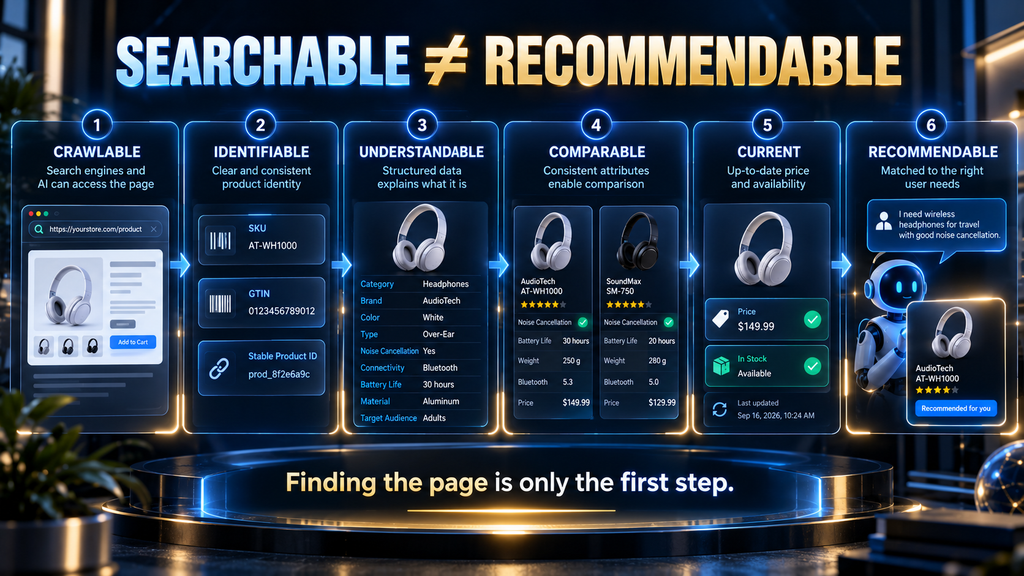
One of the most important distinctions in modern ecommerce is the difference between a product that can be found and a product that can be confidently recommended. Searchability means the system can retrieve the product; recommendability means it has enough reliable information to determine whether the product satisfies a particular shopper’s needs.
A page titled “TrailPro X7” may be indexed perfectly and rank for the brand and model name. That does not mean an AI system can confidently recommend it when someone asks for “a waterproof trail shoe for wide feet, rocky terrain, size 10, under $140.”
To answer that request well, the system needs several different types of product truth. It must know the product identity, recognize that it is a trail-running shoe, understand its waterproofing status, determine whether a wide-fit option exists, confirm the requested size, check the current price, and ideally understand whether its outsole and construction suit rocky terrain.
If those properties are buried in marketing copy, scattered across supplier PDFs, or represented inconsistently across variants, retrieval becomes less dependable. The search system may surface a roughly related product but lack the evidence required to determine whether it genuinely satisfies the request.
This is why “make the page crawlable” is no longer a sufficient product-data strategy. Crawlability matters because a system cannot use information it cannot access, but discovery increasingly depends on the next stages: identifying the product correctly, interpreting its attributes, comparing it against alternatives, and confirming that the commercial facts remain current.
A useful progression is therefore crawlable → identifiable → understandable → comparable → current → recommendable. Each stage builds on the previous one, and a failure in an earlier stage limits what later search or AI systems can reliably do.
Product Identity Comes Before Product Enrichment
Retailers often begin product-data improvement by adding richer descriptions or more attributes. That work can be valuable, but it should not come before establishing stable product identity because every downstream system first needs to know exactly which item a record represents.
Identity usually includes a stable internal product or variant ID, SKU, brand, canonical product URL, and external identifiers such as GTIN or MPN where those identifiers legitimately exist. These fields help systems distinguish two separate products, match the same product across different channels, and avoid merging information that belongs to different variants.
OpenAI’s current product-feed specification illustrates this explicitly. Each item or variant receives a stable item_id, and variant groups can use a separate group_id; the documentation also supports GTIN and requires variant rows to retain their own price, availability, URL, and images. (OpenAI Developers)
The requirement seems technical until identity breaks. Suppose one ecommerce platform treats a blue size-10 running shoe as SKU RUN-BLU-10, a supplier feed refers to it using a GTIN, and an advertising feed reuses the parent product ID for every size. The retailer may have all the necessary information somewhere, yet external systems have difficulty determining whether those records describe the same exact purchasable item.
Stable identity also matters when product information changes. A price change should not create a new identity, and an inventory update should not cause the product to look like a different item. OpenAI’s current specification specifically tells merchants to keep item, group, and offer identifiers stable when properties such as price, stock, title, or images change. (OpenAI Developers)
This is why the first product-data question should not be “How many attributes have we added?” It should be “Can every important system identify the same product and variant consistently?”
Taxonomy Gives Product Data Context
An attribute only becomes fully useful when the system understands what type of product it describes. A value such as “16” could mean a shoe size, screen size, memory capacity, package quantity, or age recommendation depending on the category.
Taxonomy provides that context by placing products into standardized categories and subcategories. A good taxonomy does more than organize navigation; it determines which attributes are meaningful, which comparisons are valid, and which filters should be available for a given product type.
A shirt may need size, fit, sleeve length, neckline, fabric, pattern, and care information. A laptop may need processor, memory, storage, display size, graphics hardware, ports, weight, operating system, and battery information, while an automotive replacement part may depend heavily on compatibility and manufacturer identifiers.
Shopify’s Standard Product Taxonomy follows this category-specific approach. Assigning an appropriate product category can expose category metafields such as clothing size, neckline, sleeve length, and other attributes relevant to that category, and Shopify describes those fields as useful for discovery across the storefront, marketplaces, and search engines. (Shopify Help Center)
Without consistent taxonomy, retailers tend to create parallel attribute systems. One merchandising team may use “Running Shoes,” another uses “Sports Footwear,” and a third supplier sends “Athletic > Outdoor > Trail,” leaving search and feed systems to reconcile categories that may overlap but are not identical.
The goal is not to force every internal workflow into one universal taxonomy. It is to maintain a clear mapping between internal product organization and the standardized category structures required by important channels so that downstream systems know what kind of object they are interpreting.
The Best Attributes Come From Buying Decisions
A common product-data mistake is to treat completeness as filling every field available in a commerce platform. That can create enormous maintenance work without materially improving product discovery because not every attribute has the same importance to the customer’s decision.
A better approach begins with the questions customers use to eliminate and compare products. If people buying office chairs repeatedly ask about seat height, weight capacity, lumbar adjustment, armrest movement, material, and recommended user height, those properties deserve higher priority than attributes rarely involved in purchase decisions.
This query-first approach also makes data work easier to justify. Instead of asking a merchandising team to complete fifty fields for thousands of products, the retailer can identify the ten or fifteen attributes that repeatedly determine whether a product is relevant to high-value searches.
Consider a carry-on backpack. A generic record with title, brand, color, and price may be technically complete enough to publish, but customers may actually decide based on external dimensions, capacity, laptop compartment size, weight, material, weather resistance, opening style, and airline compatibility.
Those fields affect more than filters. They help semantic-search systems distinguish products that look similar in broad descriptions but satisfy different needs, and they give AI shopping systems factual evidence when explaining why one product fits a particular use case better than another.
The same principle prevents unnecessary enrichment. If a field does not support filtering, comparison, recommendation, compliance, merchandising, or another genuine use case, adding it merely because a platform supports it may increase maintenance without increasing product understanding.
Product Descriptions Still Matter, but They Should Not Carry the Entire Catalog
Structured data should not turn product pages into sterile databases. Shoppers still need explanations of what the product is like to use, why certain features matter, which situations it suits, and what trade-offs come with choosing it.
The problem appears when descriptive copy is forced to carry facts that should also exist explicitly. A sentence saying “the breathable mesh upper keeps the shoe comfortable on hot long-distance runs” contains useful persuasive context, but it should not be the only place the system can determine upper material or intended activity.
The strongest product record therefore combines explicit attributes with descriptive language. Structured fields make comparison reliable, while copy explains relationships among those facts and gives the shopper information that does not fit naturally into a rigid schema.
This balance matters for AI retrieval because language models and semantic systems are good at interpreting descriptive meaning, while structured systems are much better at enforcing precise constraints. A shopper saying “I want something understated for business travel” benefits from descriptive content, while a requirement such as “maximum width 35 cm” is safer as a structured numeric attribute.
Recent ecommerce-search research reflects this mixed approach. A 2026 study on conversational product search combined semantic embeddings with structured filters so natural-language intent could influence retrieval while exact constraints were handled separately. (arXiv)
The lesson is not that structured data replaces content or that semantic search replaces filters. Better search emerges when each representation is used for the type of meaning it handles best.
Variant Data Is Where Many Catalogs Quietly Break
Variants are easy for humans to understand because ecommerce interfaces visually group them under one product. A shopper sees one shoe page with buttons for size and color, while the underlying commerce system may actually contain dozens of separately purchasable combinations.
That distinction matters because price, availability, images, SKU, GTIN, delivery options, and sometimes product attributes can differ by variant. A parent-level statement that “the product is available” tells a search system very little if the customer needs a black size 10 and that exact combination is sold out.
Google and OpenAI both treat variant information as a meaningful part of machine-readable product data. OpenAI’s product-feed specification requires separate rows for variants, distinct item IDs, a shared group ID, and variant-specific price, availability, URL, and images when products are represented that way. (OpenAI Developers)
A retailer can therefore have a catalog that looks correct at product level while producing wrong answers at variant level. The page may show a product starting at $79, yet the requested storage capacity costs $109; the parent product may be available, while the requested color is sold out.
Variant relationships also matter in the opposite direction. Merchants sometimes group products together merely because they look related, even though each item has materially different specifications or functions. That can make external systems inherit attributes incorrectly across items that should have remained separate.
The practical rule is to group true variants while preserving variant-specific facts. If a property changes with the selection and affects what the customer can actually purchase, the data model should make that difference visible rather than relying on the storefront interface to explain it.
Price and Availability Are Product Data, but They Behave Differently
Some product facts change rarely. Brand, material, model number, physical dimensions, and product category may remain stable for months or years, while price and availability can change several times within a single day.
Treating both types of information as if they have the same update cycle creates a freshness problem. A product record can be perfectly accurate in its descriptive attributes but commercially wrong because an external feed still shows yesterday’s sale price or an inventory state that changed hours ago.
Google explicitly requires submitted availability to match the landing page, checkout experience, and structured data, and its documentation warns that mismatches between feeds and the website can create product-data issues. (Google Help)
OpenAI’s current feed specification follows a similar logic for current commerce state. It requires merchants to update availability when an item becomes available or sells out and to submit the current price rather than assuming a previously uploaded value remains valid. (OpenAI Developers)
This creates a useful architectural distinction between relatively stable product facts and dynamic offer state. A retailer can manage both inside the same commerce platform, but the systems distributing them may need different synchronization schedules.
Freshness becomes increasingly important when search moves closer to purchase. A stale material attribute may confuse a comparison, but a stale price or stock status can make the final buying experience directly wrong.
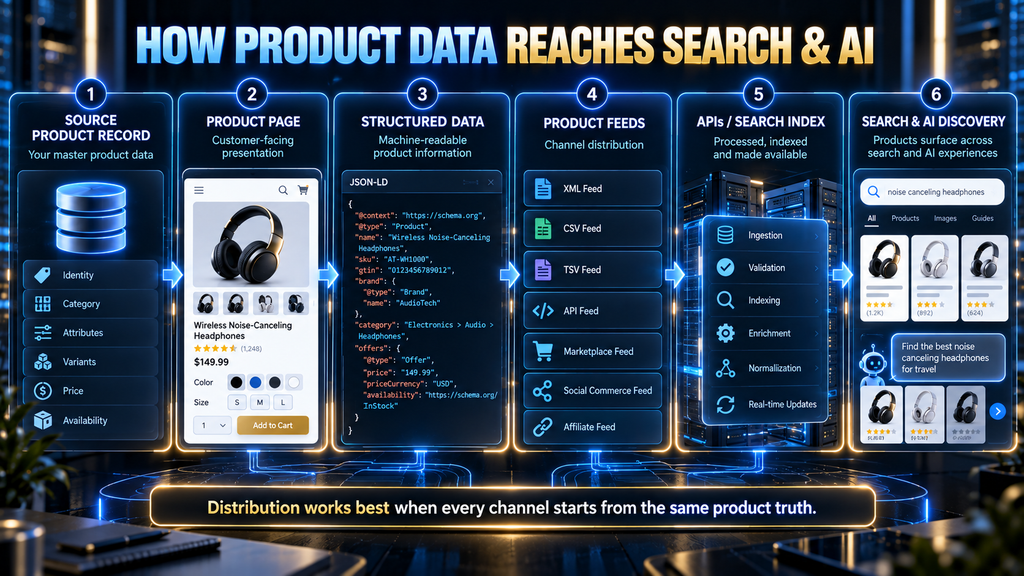
Structured Data, Product Feeds, and APIs Do Different Jobs
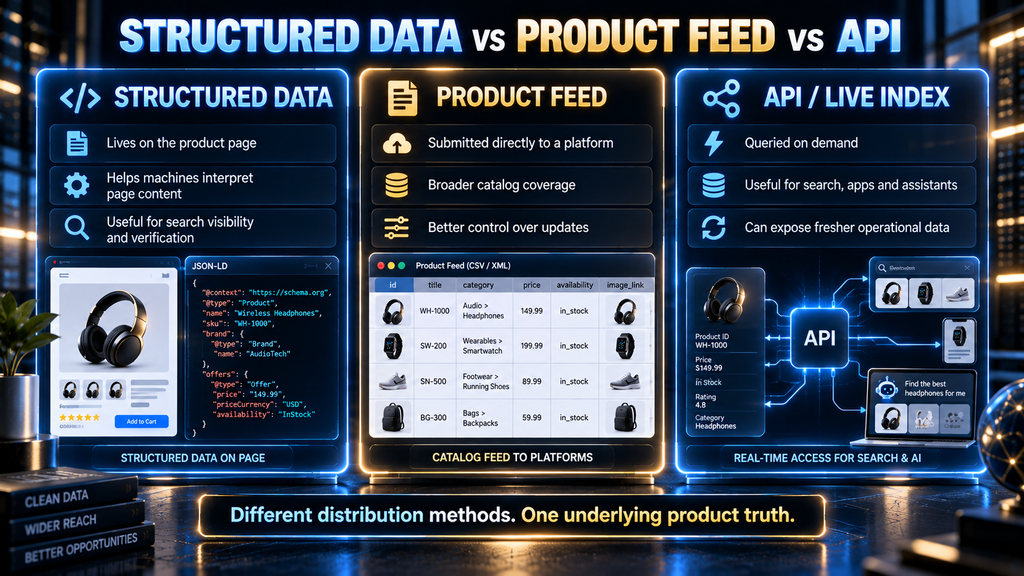
Retailers often hear several technical recommendations at once: add Product schema, create a Merchant Center feed, expose an API, improve the product page, and now perhaps submit data directly to AI platforms. These mechanisms overlap, but they are not interchangeable.
Product structured data places machine-readable information directly on the product page. Search systems can use it to interpret the page more reliably, and Google recommends representing both the product and its offer information when implementing merchant product markup. (Google Help)
A product feed is different because the merchant sends a catalog representation directly to a platform rather than waiting for that platform to discover every piece of information through crawling. Feeds can provide broader catalog coverage and give merchants more control over update timing, particularly when price or inventory changes frequently.
Google explicitly explains this difference. Merchant Center feeds can help Google know about more of a catalog and provide greater control over updates, while structured data on the website contributes to product understanding and can help verify information that appears on the page. (Google for Developers)
OpenAI’s merchant program now provides another example. ChatGPT can discover product information from the web, but OpenAI says product feeds give merchants greater control over how products appear and can help keep information more accurate and current. (ChatGPT)
APIs and commerce interfaces add another layer because they can provide live or application-specific access to product information. They become particularly useful for onsite search, shopping assistants, internal systems, marketplace integrations, and applications that need current data on demand rather than a periodically uploaded snapshot.
None of these mechanisms repairs a weak source product record. Structured data, feeds, and APIs are distribution channels; if they distribute contradictory or incomplete information, the retailer has created more machine-readable data without creating more reliable product truth.
Completeness, Consistency, and Freshness Are Different Problems
Product-data quality is often reduced to a completeness percentage. A dashboard may report that 92% of required fields are populated, which sounds reassuring until the retailer discovers that several channels contain different values for the fields that matter most.
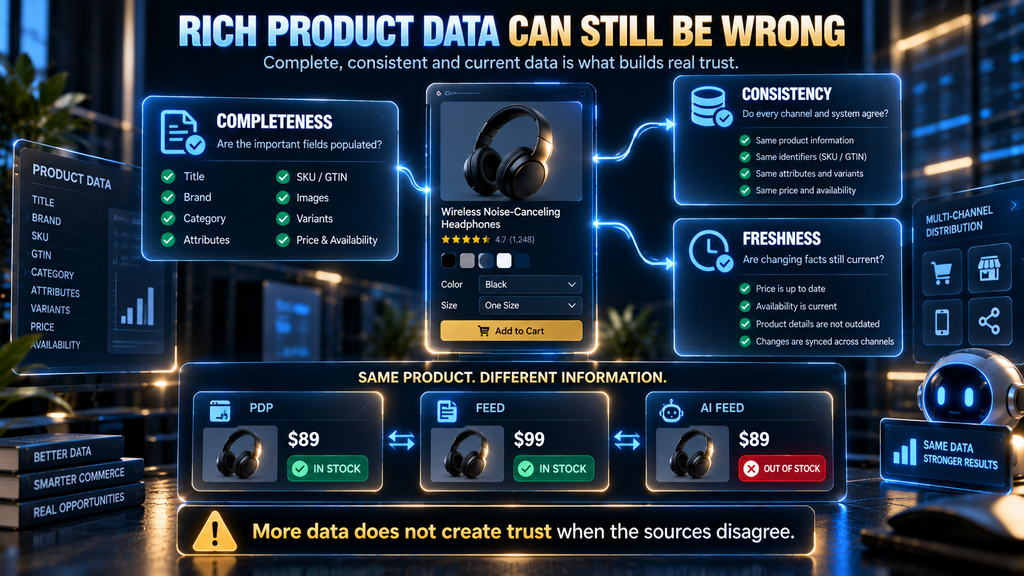
Completeness asks whether the information exists. Consistency asks whether the same product is represented coherently across the systems that consume it, while freshness asks whether time-sensitive information still reflects current reality.
These dimensions can fail independently. A catalog may have perfect attribute coverage but inconsistent category mappings, or it may be perfectly consistent across channels while carrying availability information that has not been refreshed recently enough for a fast-moving inventory environment.
Consider a product whose website displays $89 and “In Stock.” Merchant Center still shows $99 and “In Stock,” while an AI product feed shows $89 but marks the item as unavailable. Every channel has a populated price and availability field, yet the overall product-data system is unreliable because the facts disagree.
Google’s Merchant Center documentation demonstrates why consistency has operational consequences. Structured data must match customer-visible values, and price or availability mismatches between feeds, pages, and markup can trigger product-data problems or disapprovals. (Google Help)
This is why richer data is not automatically better data. Every new channel, feed, schema layer, enrichment process, or synchronization job creates another place where product truth can diverge if ownership and update rules are unclear.
The AI Hustle World Product Data Readiness Stack
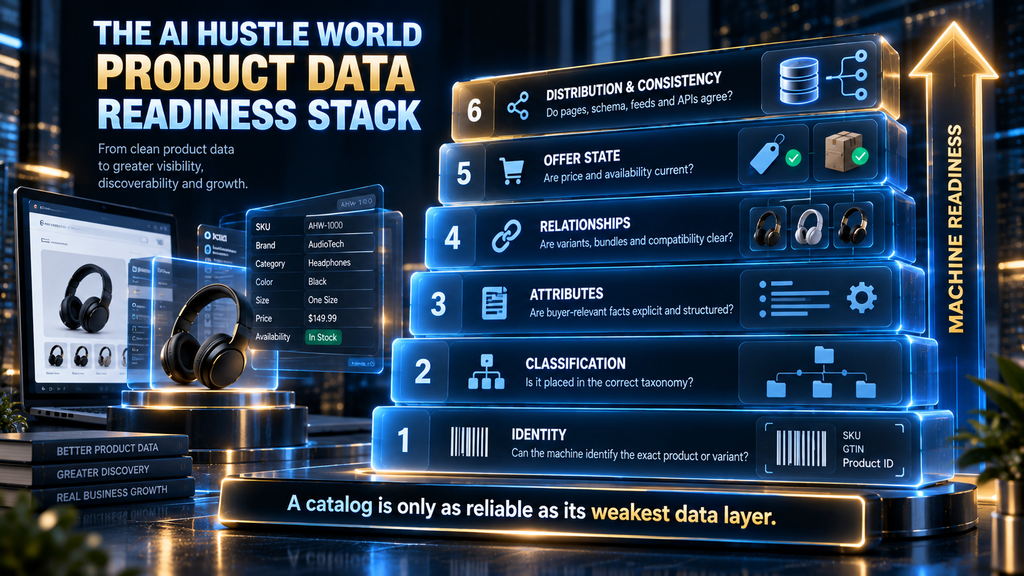
A useful way to diagnose whether a catalog is ready for modern search is to evaluate it as a chain rather than as a collection of disconnected fields. AI Hustle World’s Product Data Readiness Stack contains six layers: Identity, Classification, Attributes, Relationships, Offer State, and Distribution & Consistency.
The first layer, Identity, asks whether machines can tell exactly which product or variant they are looking at. Stable IDs, legitimate external identifiers, brand, SKU, canonical URLs, and variant IDs reduce ambiguity before any search or recommendation logic begins.
The second layer, Classification, establishes what kind of product it is. A standardized category gives meaning to the attributes that follow and helps downstream systems distinguish, for example, shoe size from display size or clothing material from furniture upholstery.
The third layer, Attributes, asks whether the facts customers actually use to filter and compare products are represented explicitly enough to retrieve. The objective is not maximum field count; it is sufficient coverage of the properties that materially affect buying decisions in that category.
The fourth layer, Relationships, covers variants, bundles, accessories, compatibility, parent-child records, and other connections among products. Machines need to know whether two records are different options of one item, separate products, compatible components, or complementary products before they can compare or recommend them safely.
The fifth layer, Offer State, covers commercial facts that change frequently, including current price, sale price, availability, and other market-specific conditions. These fields require stronger freshness controls because they can become wrong even when the underlying product description remains perfectly accurate.
The final layer, Distribution & Consistency, asks whether product pages, structured data, feeds, APIs, marketplaces, and AI integrations tell the same story. A catalog is not truly machine-ready when every individual source looks complete but different systems receive conflicting versions of the same product.
The value of the stack is diagnostic. If a product fails to surface for an important query, the retailer can investigate whether the problem begins with identity, category, missing attributes, variant relationships, stale offer state, or distribution instead of vaguely concluding that “AI search does not understand our catalog.”
Search Engines Need Both Exactness and Meaning
Ecommerce search has always had an unusual retrieval problem because product queries range from exact identifiers to ambiguous descriptions. Someone searching WH-1000XM6 expects an exact model, while someone asking for “comfortable noise-cancelling headphones for long flights” expects the system to understand intent.
Keyword and lexical search remain extremely useful for exact product names, SKUs, brand terms, model numbers, and specific attribute words. Semantic retrieval becomes valuable when the same need can be expressed through many different phrases that do not exactly match the product record.
The strongest architecture does not force a choice between those approaches. Research on product retrieval has shown value in structured product fields and lexical signals, while more recent conversational ecommerce work combines semantic representations with structured constraints so exact requirements can survive natural-language interpretation. (arXiv)
This is another reason product attributes matter. Semantic search may understand that “light enough for commuting” relates to low weight, but it performs better when product weight is available as a meaningful field rather than hidden inside a paragraph that also contains dozens of unrelated details.
Structured filtering becomes even more important when a requirement is binary or numeric. If the shopper says “under $100,” “size 10,” or “compatible with model X,” the search system should not treat those requirements as approximate semantic preferences if precise product data exists.
The product record therefore needs to support both exactness and meaning. Descriptive language captures nuance, while structured fields preserve constraints and make product comparison more deterministic.
AI Search Changes How Product Questions Are Formed
Traditional ecommerce search often begins with a category or product name. Conversational search allows customers to begin with a situation, problem, or bundle of requirements instead.
A shopper may ask for “a lightweight stroller that fits in a small car trunk and is easy to carry upstairs.” Another may search for “a monitor for coding with sharp text, USB-C charging, and enough space for two documents side by side.”
These queries expose weaknesses that short keyword searches may never reveal. A product can rank well for “27-inch monitor” while remaining difficult to retrieve for a more decision-oriented question if connectivity, charging power, resolution, screen size, ergonomics, and other comparison attributes are missing or inconsistently represented.
This does not mean every conversational phrase needs its own database field. Some concepts are naturally descriptive, and semantic models can infer relationships between language and known product characteristics.
The more useful question is whether the facts required to verify the recommendation exist somewhere trustworthy. An AI system can interpret “easy to carry upstairs” as a preference for lower weight, but it still needs an actual weight value or another credible product signal before presenting that interpretation as fact.
This creates a healthier role for AI in ecommerce search. The model interprets the shopper’s language, while the product-data system determines what can be verified.
Product Data Should Be Designed From Queries Backward
Many catalog projects begin by looking at the database schema and asking which empty fields should be populated. A more practical approach begins with customer queries and works backward to the data required to answer them.
Start with the searches, filters, support questions, comparisons, and shopping-assistant conversations that matter commercially. For each one, identify which product facts determine whether a result is relevant and whether those facts are currently available in a reliable form.
Suppose customers repeatedly ask for “carry-on backpacks that fit a 16-inch laptop and stay under common airline dimensions.” The required data may include external dimensions, laptop compartment size, product weight, capacity, material, and possibly structured information about the intended travel use.
If dimensions exist only inside an image or supplier PDF, the system may not be able to use them consistently. If laptop compatibility is written differently by each supplier, normalization may be required before search systems can filter reliably.
This query-first method also prevents data teams from spending months enriching fields that do not influence discovery. The most important attributes are usually those that determine eligibility, compatibility, fit, performance, or a meaningful customer trade-off.
Once high-value queries can be answered reliably, the retailer can expand the data model to cover additional discovery scenarios. That creates a product-data program tied to measurable customer needs rather than an endless effort to fill every possible field.
AI-Generated Enrichment Can Help, but It Needs Evidence Boundaries
AI can reduce some of the manual work involved in product-data enrichment. Models can extract attributes from supplier descriptions, normalize inconsistent values, suggest categories, rewrite titles, map taxonomies, identify likely duplicates, and flag records with missing information.
Those capabilities are useful because many retailers receive messy supplier data that was never designed for direct customer discovery. A manufacturer may provide dimensions inside technical text, use different attribute names across product families, or supply categories that do not match the retailer’s storefront taxonomy.
The risk appears when extraction quietly becomes invention. If a model sees a hiking jacket described as “designed for wet conditions,” it should not automatically populate a waterproof = true field unless the available evidence actually supports that claim.
The same problem occurs with compatibility, materials, safety properties, certifications, dimensions, ingredients, and other facts where a plausible inference can create a materially wrong product record. AI-generated enrichment should therefore preserve the difference between extracted evidence, normalized representation, and inferred information.
A strong workflow can allow AI to propose changes while requiring stronger validation for high-consequence fields. Low-risk normalization, such as mapping “navy blue” and “navy” into an approved color vocabulary, may need less review than inferring whether a replacement part is compatible with a specific model.
The objective is not to avoid automation. It is to make automation accountable to product truth rather than allowing a model to improve apparent completeness by filling gaps with assumptions.
Product Data Ownership Matters as Much as Product Data Format
Catalog inconsistency often has an organizational cause rather than a technical one. Different teams may control product descriptions, pricing, inventory, taxonomy, marketplaces, feeds, advertising, and website templates without one clear rule for which system owns each fact.
When ownership is unclear, synchronization problems become predictable. Marketing changes a title on the storefront, merchandising updates category information elsewhere, operations changes stock in an ERP, and a feed-management tool transforms the data again before sending it to external platforms.
The retailer then has several representations of the same product, each internally reasonable but no longer guaranteed to agree. Adding another AI feed or search index on top of that environment increases the number of downstream copies without resolving the underlying conflict.
A practical governance model defines an authoritative source for each important field and a controlled path for distribution. Product identity might originate in a commerce or ERP system, enrichment may live in a PIM, price may come from pricing infrastructure, inventory from an inventory service, and public presentation from the storefront.
The exact architecture varies with company size, but the principle does not. Every downstream representation should have a clear answer to the question, “Where did this value come from, and which system wins if two versions disagree?”
That question becomes particularly important as AI-generated enrichment enters the workflow. Machine-generated suggestions should not silently overwrite verified source data without provenance or review.
Small Stores Do Not Need Enterprise Product-Data Infrastructure
The product-data problem can sound intimidating because enterprise commerce discussions often involve PIM systems, master-data platforms, feed-management software, taxonomy teams, APIs, marketplaces, and complex governance structures. A small ecommerce store does not automatically need all of that.
A merchant with forty relatively simple products may be able to create excellent machine-readable data directly inside its ecommerce platform. Clear categories, complete high-value attributes, correct variant records, stable identifiers, valid Product structured data, and a reliable Merchant Center feed may cover most of what the business needs.
Complexity becomes more justified as the catalog grows. Thousands of SKUs, multiple suppliers, several countries, many marketplaces, frequent pricing changes, complex compatibility rules, and several internal systems make manual consistency much harder to maintain.
The decision should therefore depend on coordination cost rather than fashion. A PIM becomes useful when the organization needs a controlled place to normalize, enrich, govern, and distribute product information across enough channels that maintaining it directly inside separate systems becomes inefficient.
Buying sophisticated infrastructure before fixing the data model can simply centralize messy information. The retailer still needs clear identity rules, taxonomy, attribute definitions, variant logic, field ownership, and update processes regardless of which software stores them.
The best architecture is the simplest one that can maintain product truth reliably at the retailer’s actual scale.
A Practical Way to Improve an Existing Catalog
The first step should be identifying commercially important queries and product families rather than attempting to repair the entire catalog at once. Choose categories where search matters, customer questions are frequent, products are difficult to compare, or missing information is already causing merchandising problems.
Next, inspect identity and variant integrity. Confirm that important products have stable IDs, duplicate records are understood, external identifiers are legitimate where used, and variants are grouped correctly without losing variant-specific price, availability, images, or attributes.
Then examine category and attribute quality. The retailer should verify that categories are sufficiently specific and that the product properties customers use to make decisions are stored in explicit, normalized fields rather than scattered across descriptions.
Commercial state comes next because inaccurate price and availability can undermine otherwise excellent product data. Feeds, structured data, landing pages, and transactional systems should agree closely enough that shoppers and external platforms are not seeing different versions of the same offer.
After the source record is trustworthy, distribution becomes the focus. Product pages, Product schema, Merchant Center, marketplaces, search indexes, APIs, and AI feeds can then receive consistent representations derived from the same underlying product truth.
The final step is testing discovery itself. Retailers should use real customer queries to determine whether relevant products appear, whether filters behave correctly, whether variants are represented accurately, and whether AI-assisted experiences can answer important product questions without inventing missing facts.
How to Test Whether Product Data Is Actually Improving Search
Catalog improvement should not be judged only by the number of fields populated. A retailer can increase completeness dramatically without improving the queries customers care about.
Testing should begin with a representative query set. Include exact product searches, category searches, attribute-heavy queries, conversational requests, compatibility questions, price constraints, use-case questions, and searches involving variants.
For each query, evaluate whether the right products enter the candidate set and whether clearly wrong products are excluded. Search quality should be examined at category and query-type level because an overall relevance metric can hide problems concentrated in particular product families.
Zero-result rate can expose vocabulary and attribute gaps, while search exits may indicate that returned products do not match the shopper’s intent. Onsite search logs can also reveal recurring customer language that is missing from product titles, descriptions, synonyms, or structured attributes.
External systems provide their own operational signals. Google Merchant Center reports product-data issues, and Search Console can surface Product or Merchant Listing structured-data problems, allowing retailers to identify technical data failures rather than guessing whether markup is correct. (Google Help)
AI visibility should be treated carefully because it can fluctuate for reasons outside the merchant’s control. Instead of obsessing over a single prompt, test a stable set of commercially important questions over time and separate product-data improvements from broader ranking, retrieval, personalization, and platform changes.
The measurement principle is straightforward: catalog quality should ultimately improve the system’s ability to retrieve the right product and represent it accurately. Field completion is an input metric, not the final outcome.
Common Failure Modes That Make Good Products Hard to Understand
Duplicate records are one of the most damaging catalog problems because they divide identity. A product may accumulate different titles, URLs, images, reviews, attributes, or feed records across systems, making it harder for search engines and marketplaces to know which representation should be trusted.
Inconsistent naming creates subtler problems. One supplier may use navy, another dark blue, and a third midnight, while the site’s filter expects blue; without normalization, products that should appear together can fragment across search and navigation.
Important attributes may also exist in the wrong format. Dimensions hidden inside an image, compatibility inside a PDF, care instructions in a downloadable manual, or specifications inside unstructured description text can be accessible to humans while remaining difficult for downstream systems to use reliably.
Variant inheritance creates another frequent error. A parent product may carry an attribute that is correct for most variants but wrong for one configuration, or a parent-level availability status may be treated as evidence that every size and color combination can be purchased.
AI enrichment can amplify these problems when uncertain information is converted into definitive fields. Once an inferred attribute enters a structured catalog, every downstream system may repeat it with more confidence because it now looks like authoritative product data.
Staleness completes the pattern. A retailer may solve identity, taxonomy, and attributes yet still give external systems the wrong answer if offer data updates more slowly than the underlying commerce reality.
What Should Be Fixed First
Not every product-data issue deserves equal urgency. The best prioritization begins with errors that prevent machines from identifying the correct item or cause customers to receive materially wrong commercial information.
Identity problems should generally come first because duplicate or unstable product records contaminate every later layer. Variant errors follow closely because they can produce incorrect price, availability, size, color, compatibility, or option information even when the parent product record looks correct.
The next priority is usually the high-value attributes that determine whether a product qualifies for important customer searches. A missing lifestyle phrase is less urgent than missing compatibility, size, material, capacity, dimensions, or another field customers regularly use as a purchase requirement.
Price and availability need strong operational priority because they become stale quickly and directly affect the customer’s ability to transact. A store can recover from an imperfect description more easily than from repeatedly advertising unavailable products or incorrect prices.
Taxonomy normalization, feed quality, structured data, and broader enrichment then become more useful because the underlying product record is already stable enough to distribute. This order prevents teams from polishing external representations of product data that remains unreliable at the source.
The purpose of prioritization is not to declare one universal sequence for every retailer. It is to fix the errors that undermine product truth before investing heavily in enhancements that depend on that truth being dependable.
How AI Search Will Change Product-Data Work
The rise of conversational product discovery does not make traditional ecommerce data obsolete. It increases the value of having a clean, explicit product model because AI systems need reliable evidence when translating broad customer language into specific products.
Search interfaces may become increasingly natural. Instead of selecting five filters manually, a shopper can describe a use case, preferences, exclusions, budget, and constraints in one request, leaving the system to translate those requirements into retrieval and comparison logic.
Behind that simpler interface, the data requirements can become more demanding. The product engine needs to know which constraints are exact, which preferences are subjective, which attributes belong to which variants, what is currently available, and whether two apparently similar products can actually be compared.
OpenAI’s current commerce feed format offers a practical signal of this direction. It represents products through stable identity, descriptions, variants, prices, availability, images, categories, and related commerce fields rather than asking merchants to provide one large block of marketing text. (OpenAI Developers)
Google’s approach reaches the same problem from a different direction, using on-page structured data and Merchant Center information together to understand and surface products across search and shopping experiences. (Google for Developers)
The long-term implication is that product data increasingly becomes part of the retailer’s discovery infrastructure. Merchandising copy, SEO, feeds, onsite search, recommendations, shopping assistants, marketplaces, and AI search all depend on different representations of the same underlying product truth.
Search Visibility Starts With Product Truth, Not AI Optimization
The emergence of AI search has created a new market of optimization tactics, visibility tools, content recommendations, and technical ideas promising better representation inside generative systems. Some of that work may eventually become valuable, but it should not distract retailers from the more basic product-data problems they can control today.
A product cannot be reliably compared if its important attributes are missing. It cannot be represented correctly across channels if its variant structure is ambiguous, and it cannot support a trustworthy shopping answer when price or availability changes faster than the systems distributing those values.
This is why AI product visibility should begin below the visible marketing layer. Identity, taxonomy, attributes, relationships, and current offer state provide the factual substrate that search engines and AI systems need before ranking or recommendation questions even begin.
Structured data and feeds then make that product truth easier to distribute. Descriptive content adds nuance and use-case relevance, while semantic-search systems help connect natural-language intent with the products represented inside the catalog.
No individual technique guarantees that a search engine or AI platform will recommend a product. Ranking and recommendation depend on many signals controlled by the external system, but retailers can materially improve whether their own catalog is interpretable, consistent, and current when those systems evaluate it.
That is a much more durable objective than chasing an undocumented ranking trick. The retailer is improving the product representation itself, which supports traditional search, onsite discovery, marketplaces, recommendation systems, advertising feeds, and emerging AI interfaces at the same time.
Final Thoughts
Making a catalog easier for search and AI systems to understand does not begin with adding more marketing copy or chasing a new generative-search tactic. It begins with a more basic question: can a machine determine what this product is, what makes it different, which exact option the customer can buy, and whether the information is still current?
That requires a product-data model built around identity, classification, buyer-relevant attributes, relationships, offer state, and consistent distribution. Those layers allow search systems to move beyond finding pages toward comparing products against increasingly specific customer requirements.
The AI Hustle World Product Data Readiness Stack makes the dependency clear. Identity establishes the product, classification gives it context, attributes make comparison possible, relationships preserve variant and compatibility logic, offer state keeps commercial facts current, and distribution ensures that external systems receive a coherent version of that truth.
Retailers do not need to make every possible field perfect before improving discovery. They need to identify the questions customers care about, determine which product facts those questions require, and repair the highest-value gaps in a deliberate order.
That approach also creates value beyond AI search. The same clean data can improve filters, traditional search, recommendation systems, marketplaces, advertising feeds, shopping assistants, merchandising workflows, and internal operations because each system is working from a clearer representation of the product.
The deeper shift is therefore not from SEO to AI optimization. It is from treating product information as storefront content to treating product data as core discovery infrastructure, with enough structure and consistency for both people and machines to understand what the retailer can actually sell.
See How Product Data Fits Into the Bigger Ecommerce AI System
Clean product data supports more than search. It also improves recommendations, shopping assistants, merchandising, and other AI-powered ecommerce workflows.
Explore the Ecommerce AI Framework →Frequently Asked Questions
What is AI-ready product data?
AI-ready product data is product information organized so search, recommendation, and AI systems can identify products, understand important attributes, distinguish variants, and access current commercial information. It generally combines structured facts, descriptive content, stable identifiers, clear relationships, and reliable distribution through pages, feeds, or APIs.
The term should not imply that a retailer needs a special catalog used only by AI. The strongest approach usually improves the underlying product data so traditional search, marketplaces, onsite systems, and AI applications can all consume more reliable information.
Do product descriptions still matter for AI search?
Yes, because descriptions contain context, use cases, benefits, terminology, and qualitative information that does not always fit naturally into structured fields. They can also help semantic-search systems connect shopper language with products even when the customer does not use the exact catalog terminology.
Descriptions should not be forced to carry every factual attribute, however. Dimensions, size, compatibility, material, capacity, model information, and other important comparison facts are often more dependable when they also exist as explicit product fields.
Is Product schema enough for AI search?
No single markup format guarantees product visibility across search or AI systems. Product structured data helps machines interpret information on the page, but feeds, product APIs, catalog quality, crawlability, ranking systems, and platform-specific product requirements can also influence discovery.
Google itself supports both structured data and Merchant Center product information, while OpenAI now accepts merchant product feeds for ChatGPT product discovery. (Google for Developers)
What is the difference between product structured data and a product feed?
Structured data is machine-readable information embedded in the product page, usually using a format such as JSON-LD. A feed is a separate catalog representation submitted directly to another system such as Google Merchant Center or an AI commerce platform.
Both can represent overlapping facts, but their distribution and update behavior differ. Feeds can give merchants more direct control over catalog coverage and update timing, while on-page structured data helps machines understand and verify the product page itself.
Which product attributes matter most?
The highest-priority attributes are usually the ones customers use to determine whether a product qualifies for their needs. Those vary by category, which is why a useful attribute strategy should begin with real buying questions instead of one universal checklist.
A shoe may depend on size, width, material, waterproofing, terrain, and cushioning, while a monitor may depend on panel type, resolution, size, refresh rate, ports, power delivery, and ergonomics. The product taxonomy should help determine which fields belong to each category.
How important are GTINs, SKUs, and product IDs?
Stable identifiers are important because they help machines distinguish products and match the same item across systems. SKUs are often internal identifiers, while GTINs can provide standardized external identity when they have legitimately been assigned to the product.
Retailers should not fabricate external identifiers to make records appear more complete. An incorrect identifier can cause identity problems that are more damaging than leaving a legitimately unavailable field empty.
How should product variants be represented?
True variants should be connected to a common product group while preserving the facts that differ for each purchasable option. Size, color, storage capacity, images, SKU, price, and availability may need variant-specific representation depending on the product.
The key is that the system must be able to answer questions about the exact option the shopper wants. A parent product being in stock does not prove that the requested size, color, or configuration is available.
Can AI automatically enrich product catalogs?
AI can assist with extraction, normalization, categorization, attribute mapping, duplicate detection, and other enrichment tasks. It is particularly useful when supplier data contains valuable information in inconsistent or unstructured formats.
The system should not quietly convert uncertain inference into authoritative product facts. High-risk fields such as compatibility, certification, ingredients, materials, safety information, and technical specifications need stronger evidence and validation.
How do I know whether my product data is improving search?
Track both data-quality and retrieval outcomes. Attribute completeness, identity errors, variant integrity, feed issues, structured-data errors, and update freshness reveal catalog health, while zero-result rate, query relevance, search exits, and performance on a stable test set reveal whether customers can actually find better products.
External visibility should be measured over time rather than through isolated prompts. Search and AI platforms control their own ranking systems, so a retailer should separate what it can improve directly from what remains outside its control.
Does a small ecommerce store need a PIM for AI search?
Not necessarily. A small catalog can often maintain excellent product data directly inside an ecommerce platform if categories, attributes, variants, identifiers, structured data, and feeds are managed carefully.
A PIM becomes more useful when the catalog, number of suppliers, markets, channels, or data-management teams grows enough that maintaining one consistent product record becomes difficult. The software should solve a coordination problem rather than become a prerequisite for calling the catalog “AI-ready.”
What is the most important product-data principle for AI search?
The strongest principle is to make product truth explicit before trying to optimize the AI-facing layer. Machines need to know what the product is, which variant is being described, which attributes are factual, and what the current offer state is before they can reliably compare or recommend it.
Better descriptions, schema, feeds, semantic search, and AI optimization become much more valuable once that foundation is trustworthy. Without it, those systems can distribute uncertainty faster rather than improving product understanding.
Related Guides
- AdCreative.ai for E-Commerce: Does the Shopify Integration Actually Work?
- 10 Best AI E-Commerce Tools for Content & Support (2026)
- What Is B2B Data Enrichment? How AI Turns Raw Leads Into Sales-Ready Prospects
Written by
Muntasir Ahmad Chowdhury
Founder, AI Hustle World
Muntasir Ahmad Chowdhury is the Founder of AI Hustle World, an independent publication dedicated to making Artificial Intelligence practical, trustworthy, and easy to understand. He researches AI tools, automation, customer service, productivity, and real-world business applications, helping readers make smarter technology decisions through research-driven, experience-backed content.
Expertise:
AI Tools • AI Automation • AI Customer Service • AI Productivity • Generative AI • AI Workflows
Get Smarter With AI
Enjoyed this guide? Get practical AI tools, tutorials, and honest reviews delivered to your inbox.
6 thoughts on “AI Product Data for Search: Make Catalogs AI-Ready”