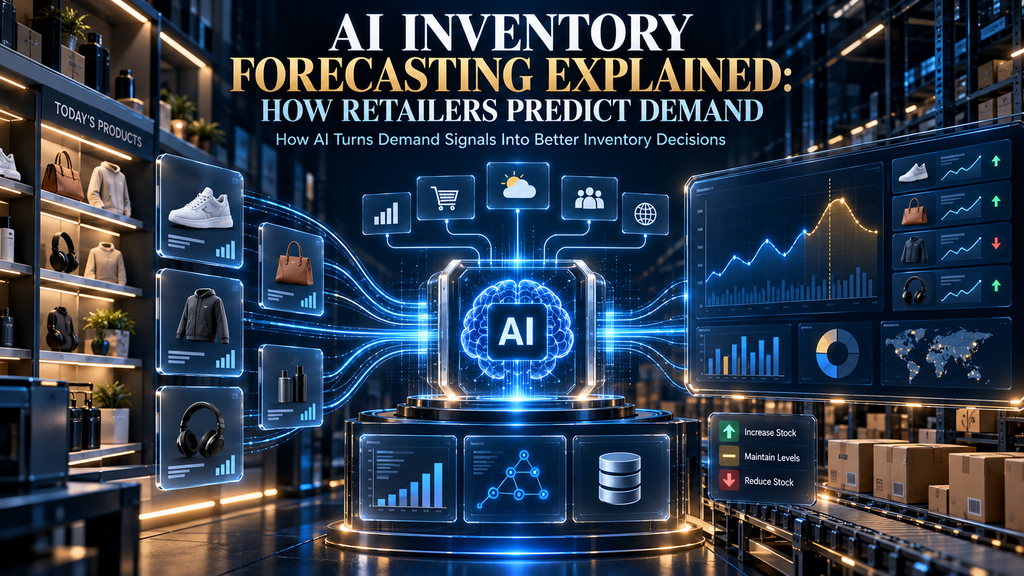
AI Inventory Forecasting Explained: How Retailers Predict Demand
A retailer rarely runs out of inventory because nobody knew the product would sell. More often, the problem starts earlier: the business made a demand estimate using incomplete information, treated that estimate as more certain than it really was, and then built a purchasing or replenishment decision around it. By the time the shelf is empty, the customer is already walking away, the next shipment may be days away, and the retailer is dealing with the consequence of a forecasting decision made much earlier.
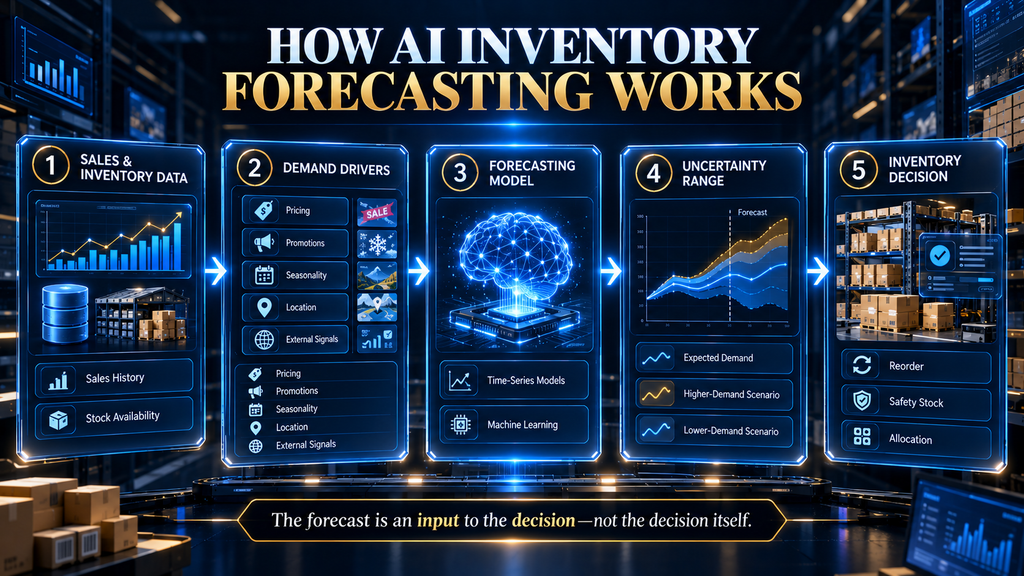
That is why AI inventory forecasting deserves to be understood as more than a smarter version of a sales spreadsheet. AI can examine historical sales alongside seasonality, promotions, pricing, product lifecycle, location, inventory availability, and other demand signals to estimate what customers are likely to buy in the future. But the forecast itself is only an input into the real business decision: how much inventory to hold, when to reorder, where to position it, and how much uncertainty the business can afford to absorb.
The distinction matters because a forecast can be statistically impressive and still produce a poor inventory decision. A model may predict average demand accurately while missing a promotion, underestimating a stockout effect, misunderstanding a new product, or failing to recognize that customers switched from one product to another. The practical question, therefore, is not simply whether AI can predict demand. It is whether the retailer can turn a better understanding of uncertain demand into better inventory decisions.
What AI Inventory Forecasting Actually Predicts
AI inventory forecasting is the use of statistical or machine-learning methods to estimate future demand for products across a defined time period, location, channel, or customer segment. Depending on the business, the forecast might estimate units sold next week, expected demand for a particular SKU over the next month, store-level demand during a holiday period, or the likely range of demand during a supplier lead time.
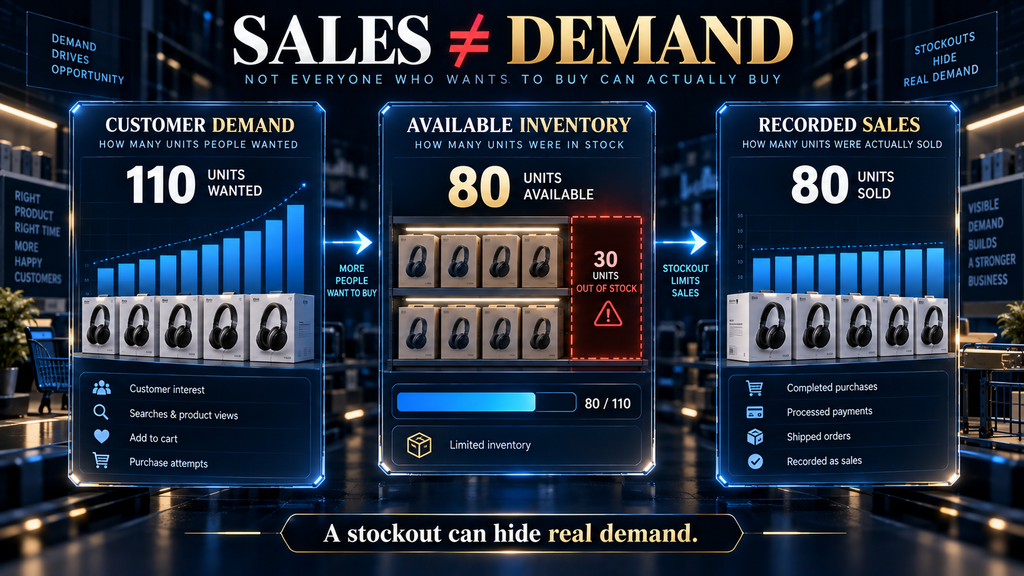
The word demand is more important than it first appears. A retailer may record that 80 units were sold last week, but that does not necessarily mean customer demand was exactly 80 units. If the store had only 80 units available and 30 additional customers wanted the product, the sales record captures 80 transactions while the underlying demand was higher. A forecasting system trained without understanding that distinction can learn from the shortage itself and then underestimate what customers actually wanted.
The forecast also needs a defined level of detail. A retailer forecasting total monthly sales for an entire category has a very different problem from a retailer trying to predict the demand for one shoe size in one store on a particular weekend. The more granular the forecast becomes, the more useful it can be for operational decisions, but the more difficult the forecasting problem often becomes because individual products and locations contain less stable historical information.
This is one reason AI inventory forecasting is not simply about feeding a large amount of data into a model and asking for a number. The retailer first has to decide what is being predicted, at what level, over what horizon, and for which decision. A forecast for purchasing may need to look far enough ahead to account for supplier lead times, while a replenishment forecast for a high-volume store may need to operate at a much shorter horizon.
A useful way to think about the output is not as a promise of future sales but as an estimate of future demand under the information available today. That distinction becomes increasingly important when demand is volatile, promotions are involved, products are new, or the cost of being wrong is high.
Why Retailers Need Forecasts in the First Place
Inventory creates a financial tension that forecasting cannot eliminate. Too little inventory creates stockouts, lost sales, disappointed customers, and potentially damaged customer relationships. Too much inventory ties up working capital, consumes storage capacity, and eventually creates pressure for markdowns, discounting, transfers, or write-offs.
The traditional response has been to use historical sales, planner experience and business rules to estimate what will happen next. That approach exists for a reason. A human planner may know that a particular product behaves differently during Ramadan, that a supplier has recently become unreliable, that a competitor has launched a promotion, or that a local store attracts a completely different customer mix from another location. Historical numbers alone cannot always capture those realities.
The problem appears when the scale of the operation becomes too large for those judgments to be made consistently by hand. Imagine a retailer with thousands of SKUs across hundreds of stores and several online channels. A planner might be capable of understanding an individual category deeply, but manually evaluating every product, location, promotion, seasonal pattern, and replenishment constraint becomes difficult as the number of combinations grows.
AI forecasting is valuable in this environment because machines can process large numbers of relationships repeatedly and consistently. A model can examine patterns across products, locations, and time periods far faster than a human team working through spreadsheets. That does not make the model inherently wiser; it makes it capable of handling a scale and frequency of analysis that would otherwise require enormous amounts of manual work.
The business objective is therefore not “replace forecasting with AI.” It is to improve the quality, frequency, granularity, or scalability of the demand signal used by the planning process. The strongest implementations keep human judgment where context and consequences matter while allowing machines to perform the repetitive analytical work that humans struggle to maintain at scale.
How AI Forecasts Future Retail Demand
At a basic level, an AI forecasting system learns relationships between historical observations and future outcomes. The model receives information about what happened in the past, identifies patterns associated with changes in demand, and uses those relationships to estimate future values.
Traditional forecasting methods can already do much of this without machine learning. Moving averages, exponential smoothing, seasonal models, and other time-series techniques can be highly useful when demand follows relatively stable patterns. If a product sells consistently and its main behavior is seasonal, a well-designed statistical model may provide all the forecasting sophistication the business actually needs.
Machine learning becomes more useful when demand depends on a larger collection of interacting variables. A retailer might need to account for recent sales, previous sales at the same time of year, promotional activity, price changes, holidays, store characteristics, product relationships, inventory availability, and external conditions. Instead of treating each factor independently, a machine-learning system can learn relationships among them and update predictions as new information becomes available.
Consider a simple example involving winter jackets. Historical sales may show that demand normally rises during November and December. That is useful, but it does not tell the entire story. A sudden cold spell could increase demand earlier than usual, a discount could accelerate purchases, a new competitor could reduce demand, or a supply shortage could make the historical sales record look weaker than actual customer interest.
This is where the difference between historical forecasting and broader demand modeling becomes clearer. The historical series tells the system what happened. Additional variables help explain why demand moved and whether those conditions are likely to occur again.
The model therefore does not need to “understand” retail in the human sense. It needs useful signals that allow it to distinguish recurring patterns from temporary events and meaningful drivers from noise. The quality of those signals, the way the model is validated, and the way its output is converted into an inventory decision often matter more than simply choosing the most sophisticated model available.
What Data Does an AI Inventory Forecast Need?
The foundation is usually historical demand data, but a serious forecasting system needs more than a column showing units sold. It needs enough context to explain how those sales occurred and what conditions surrounded them.
Sales history typically provides the core time series: product, quantity, date and often location or channel. From that history, the system can identify trends, seasonality, recurring peaks, declining products and other patterns. The useful granularity depends on the business. Daily data may be appropriate for fast-moving ecommerce products, while weekly or monthly data may be more practical for slower-moving categories.
Inventory availability is equally important because sales are constrained by what was actually available. If a product was out of stock for three days, the recorded sales during those days should not automatically be treated as evidence that customers suddenly lost interest. A forecasting system that ignores availability can mistake supply limitations for demand weakness.
Pricing and promotional information can change the interpretation again. A product selling 500 units during a 30% discount period does not necessarily have a normal demand rate of 500 units. The promotion may have pulled future purchases forward, attracted customers who would not normally buy the product, or shifted demand away from another SKU.
Seasonality is another major component. Retail demand can change around holidays, weather patterns, school calendars, pay cycles, cultural events, and other recurring periods. The challenge is not merely identifying that December is different from October; it is determining whether the current December resembles previous Decembers closely enough for historical patterns to remain useful.
Product lifecycle information matters when a product is new, growing, mature, or approaching discontinuation. A five-year-old SKU with thousands of observations provides a very different forecasting environment from a product launched last week. Applying the same assumptions to both can create false confidence.
Location and channel add another layer. A product that sells well online may behave differently in physical stores, while demand in one city may be shaped by weather, demographics, local events or store format. A national average can hide those differences and create a forecast that looks reasonable at the total-company level but is wrong exactly where the inventory decision needs to be made.
External signals can sometimes add further context. Weather, search behavior, local events, market conditions, and other variables may provide early indications that demand is changing. However, more data is not automatically better data. An external signal should earn its place by improving the forecasting decision, not simply because the technology makes it possible to collect it.
AWS’s retail demand-forecasting architecture, for example, describes combining historical and real-time time-series information with item metadata and related variables, followed by data transformation, feature engineering, forecasting, and iterative retraining.
That sequence highlights an often-overlooked point: data preparation is part of forecasting, not a preliminary chore before the “real AI” begins. If product identifiers change, promotions are recorded inconsistently, stockouts are ignored, or timestamps are wrong, a more advanced model can simply produce more sophisticated errors.
The Problem Most Forecasting Articles Miss: Sales Is Not Always Demand
One of the most important concepts in retail forecasting is also one of the easiest to overlook: observed sales are not always the same thing as unconstrained demand.
Imagine an ecommerce store that normally sells 100 units of a product each week. During one week, a supplier delay leaves only 60 units available. All 60 sell. The sales report now says 60, but that number does not prove demand fell from 100 to 60. It may mean the business could only satisfy 60 units of demand.
If the forecasting system treats every historical sales value as a clean representation of demand, it can learn the wrong lesson. The model may conclude that demand was weak during the stockout and recommend lower inventory for a future period, creating the conditions for another stockout.
This problem becomes more difficult when stockouts occur precisely during high-demand periods. The retailer may see unusually low sales during the moments when customers wanted the product most. In other words, the data can become least informative when the business most needs the forecast to be accurate.
Promotions create a related problem. Suppose a retailer sells 1,000 units during a major discount campaign. If the next forecast simply assumes that the product now has a new baseline demand of 1,000 units, the retailer could over-order after the promotion ends. The model needs to understand the difference between normal demand and demand generated by a temporary commercial intervention.
This is why a serious forecasting process asks not only, “What did we sell?” but also, “What prevented us from selling more, and what caused us to sell more than normal?” That question changes the entire quality of the forecasting process.
The Forecast Is Not the Inventory Decision
This is the central distinction that should guide any AI inventory forecasting project: the forecast tells you what may happen; the inventory policy determines what you do about it.
Suppose a model predicts that a product will sell 1,000 units during the next replenishment period. That number alone does not tell the retailer to purchase exactly 1,000 units. The business still needs to consider supplier lead time, existing inventory, orders already in transit, service-level targets, minimum order quantities, storage constraints, cash availability, and the consequences of a stockout.
The same forecast can therefore lead to different decisions for different businesses. A premium retailer selling perishable goods may accept a higher stockout risk to reduce waste, while a retailer selling a critical replacement component may hold considerably more safety stock because the cost of unavailability is much higher.
This is where forecast uncertainty becomes operationally important. A model that says “expected demand is 1,000 units” gives less information than a system that can estimate the likely range of outcomes and help the planner understand the risk around that estimate.
Probabilistic forecasting approaches are designed around this idea. Instead of producing only one point estimate, they can provide different quantiles or levels of expected demand, allowing planners to consider scenarios rather than pretending that one number represents the future with certainty. AWS describes this approach using quantiles such as the median and higher-percentile forecasts to represent different demand outcomes.
The practical implication is significant. A retailer should not ask, “What number did the AI predict?” It should ask, “What range of demand should we plan for, what is the cost of being wrong in each direction, and which inventory decision follows from that risk?”
That is a much more useful conversation between forecasting technology and inventory management.
The AI Hustle World Forecast Reliability Framework
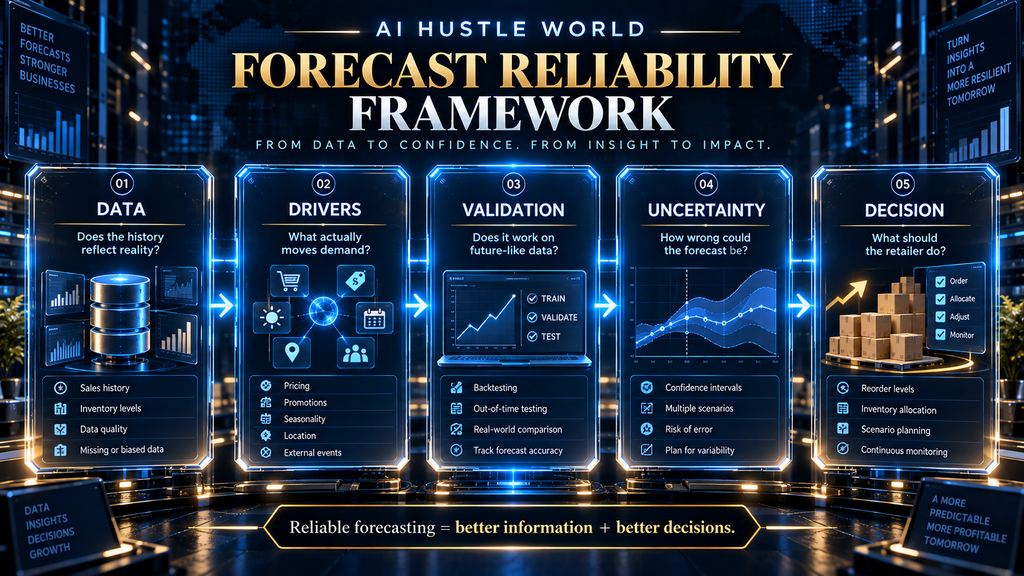
For AI Hustle World, the most useful way to evaluate an inventory forecasting system is not to begin with model sophistication. Begin with five questions: Data, Drivers, Validation, Uncertainty, and Decision.
Data asks whether the historical information actually represents the business reality. Are stockouts visible? Are promotions recorded? Are product IDs consistent? Are returns handled correctly? Are channel and store dimensions trustworthy? If the underlying data is distorted, model sophistication cannot rescue the forecast reliably.
Drivers ask whether the system has access to the factors that actually move demand. A retailer may have years of sales history but still struggle to forecast a product whose demand depends heavily on promotions, weather, holidays, or changing customer behavior. The objective is not to collect every possible variable but to identify the variables that materially explain changes in demand.
Validation asks whether the forecasting system works on future-like conditions rather than merely fitting historical data. A model that performs beautifully when tested on information from the same period it effectively learned from can create a misleading impression of accuracy. Retail forecasting should use time-aware validation so that the evaluation resembles the way the system will actually operate.
Uncertainty asks whether the system communicates how confident the business should be. Forecasting is not the same as predicting a known fact. A retailer making a purchase decision needs to understand the consequences of both underestimating and overestimating demand.
Decision asks the final and most important question: does the forecast improve what the business actually does? If forecast accuracy improves by a small amount but planners still receive the information too late to change orders, the operational value may be limited. If the forecast becomes more accurate but nobody changes safety-stock rules, replenishment thresholds, or exception handling, the model may improve a metric without improving the business.
The framework deliberately ends with Decision because forecasting exists to support a decision. A technically sophisticated model that does not change an important decision is not necessarily a successful forecasting system.
When Traditional Forecasting Is Still the Right Choice
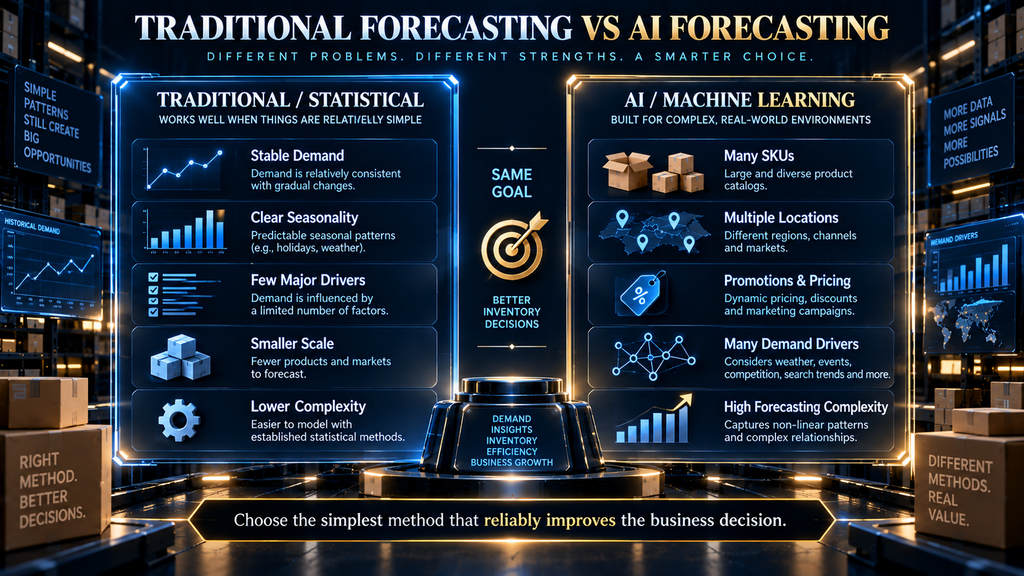
AI is not automatically the correct answer for every inventory problem. A relatively stable product with predictable seasonality, sufficient historical data, and a small number of demand drivers may be forecast effectively using established statistical methods.
This matters because complexity carries a cost. Machine-learning forecasting can require additional data engineering, monitoring, model management, validation, and organizational capability. If a simpler model produces forecasts that are sufficiently accurate for the business decision, adding complexity may provide little practical benefit.
The right comparison is therefore not “traditional forecasting versus AI” in the abstract. It is “which forecasting approach produces a sufficiently reliable demand signal for this particular decision at an acceptable operational cost?”
Consider a retailer with a stable consumable product that sells at roughly the same rate every week and experiences a predictable seasonal increase each December. If a well-maintained statistical model already produces useful forecasts, the business may gain more by improving inventory records and replenishment discipline than by replacing the forecasting engine.
By contrast, a retailer managing thousands of products across many stores, channels, and promotional calendars has a much stronger reason to investigate machine learning. The problem is no longer simply forecasting a time series; it is managing a large network of interacting demand signals.
AI should earn its complexity.
Where AI Inventory Forecasting Goes Wrong
The first major failure mode is poor data. This sounds obvious, but it is one of the most consequential problems because forecasting systems can make bad data look precise. Missing promotions, inconsistent product identifiers, inaccurate inventory records, or incomplete sales histories can produce a forecast that appears mathematically clean while representing the wrong reality.
The second is overfitting. A model can learn patterns that existed in the historical dataset but do not generalize to future periods. Retail data contains plenty of noise, temporary spikes, and unusual events, and a sufficiently flexible model can find relationships that are statistically interesting without being operationally useful.
Promotions create another source of failure. A temporary discount can generate an unusual demand pattern that should not become the new baseline. If the forecasting system does not distinguish ordinary demand from promotion-driven demand, it can continue expecting abnormal sales after the promotion has ended.
New products create an even harder problem because there may be little or no direct historical data. The model must infer demand from comparable products, category behavior, customer characteristics, launch plans and early sales signals. The resulting forecast should be treated as more uncertain than a forecast for an established product with years of stable observations.
Product lifecycle changes create a similar issue. A declining product, a rapidly growing product, and a mature product may all have different forecasting dynamics. A model trained on long historical periods can sometimes place too much weight on old behavior when the commercial reality has changed.
Intermittent demand is another difficult case. Some products sell frequently, while others may go several weeks without a transaction and then experience a sudden order. Standard forecasting approaches can struggle when the time series contains many zeros and occasional large observations, especially when the product has a low sales volume.
External shocks present the most obvious challenge. A sudden weather event, supply disruption, viral social-media trend, regulatory change, or competitor action can move demand outside the historical range. No forecasting system can guarantee accurate prediction of events that provide little or no usable advance signal.
Finally, there is the danger of false precision. A dashboard showing a forecast of 1,247 units can psychologically feel more authoritative than a statement that demand is likely to fall within a broad range. But additional digits do not necessarily mean additional knowledge. The business should be careful not to confuse numerical precision with forecasting confidence.
How to Measure Whether AI Forecasting Actually Works
Forecast accuracy should not be judged using one universal metric. Different measures answer different questions, and the metric that looks impressive at an aggregate level may hide serious problems for individual products or locations.
Common statistical measures include MAE, RMSE, and WMAPE, along with measures of forecast bias. MAE provides an intuitive measure of average absolute error, while RMSE gives greater weight to large errors. WMAPE is often useful in retail settings because it relates forecast error to actual demand volume, although it also needs to be interpreted carefully when demand is sparse or highly uneven.
Bias is especially important because consistent over-forecasting and under-forecasting can create different business problems. A model that is slightly inaccurate but systematically optimistic may create excess inventory, while a model that consistently underestimates demand may contribute to stockouts.
The evaluation should also be segmented. A retailer should examine performance by product category, store, channel, demand velocity, and forecast horizon rather than relying only on one company-wide number. An average accuracy figure can conceal a model that works extremely well for high-volume products while performing poorly for the long tail.
More importantly, forecasting metrics should eventually connect to inventory outcomes. If the forecast improves but stockout rates do not change, the business needs to understand why. Perhaps the forecast reaches planners too late, the replenishment rules are outdated, suppliers remain unreliable, or planners override the recommendations too frequently.
The final measurement framework should therefore connect the chain from forecast quality → inventory decision → operational outcome. Useful downstream indicators can include stockout rate, service level, fill rate, inventory turnover, days of inventory, excess stock, markdowns, write-offs, and working capital tied up in inventory.
A forecast should be judged by what it enables, not only by what the model predicts.
The Cost of Being Wrong Is Not Symmetrical
Forecasting discussions often focus on accuracy as if a 100-unit error always has the same meaning. Retail economics rarely works that way.
If a retailer under-orders a high-demand product, the business may lose a sale, disappoint a customer, and potentially lose future business. If the retailer over-orders a perishable product, the consequence may be much more severe because unsold inventory can become worthless after a short period.
For durable products, excess inventory may remain sellable but consume capital and warehouse capacity. For fashion products, an inaccurate forecast can result in markdowns because demand is tied to a season or trend. For spare parts, a stockout may have a disproportionately large operational consequence because the customer may need the component immediately.
This means the forecasting system should not optimize accuracy in isolation. It should help the business understand the economic consequences of forecast errors.
That changes how inventory policies are designed. A retailer with expensive stockouts may deliberately hold more safety inventory even when the forecast uncertainty is high. Another retailer with high carrying costs may accept more stockout risk because excess inventory is economically worse.
There is no universal “correct” level of inventory. There is only an inventory position that makes sense relative to demand uncertainty, service expectations, lead time, and the cost of being wrong.
What Human Planners Should Still Do
The arrival of AI forecasting does not eliminate the need for human judgment. In many environments, it changes the role of the planner from manually producing every forecast to supervising exceptions, interpreting unusual conditions and deciding how much risk the business should accept.
A model may identify an unexpected demand increase, but a planner can investigate whether the increase comes from a temporary promotion, a competitor stockout, a product substitution pattern, or a genuine shift in customer preference. That interpretation can determine whether the business should increase purchasing permanently or simply respond to a temporary event.
Human judgment is particularly valuable when the consequences are unusual, or the data is sparse. New product launches, major campaigns, supplier disruptions, and market shocks often require contextual information that does not exist cleanly in historical transaction data.
The goal should therefore be neither “humans decide everything” nor “AI decides everything.” A better design gives the model responsibility for repetitive analytical work while giving people clear visibility into uncertainty, exceptions, and the assumptions that materially affect the decision.
This also changes what a good forecasting interface should look like. A planner does not necessarily need another dashboard filled with numbers. They need to know which forecasts changed, why they changed, which products carry the highest risk, what assumptions drove the change, and which decisions require attention.
How to Implement AI Inventory Forecasting Without Creating a Science Project
The safest implementation begins with the business decision rather than the model. Before choosing technology, define what the forecast needs to improve: purchase quantities, replenishment timing, store allocation, safety stock, promotion planning, working capital, or another specific decision.
The next step is to audit the historical data. This means checking whether sales records represent actual demand, identifying stockouts, reviewing promotional periods, checking product and location consistency, handling returns appropriately, and determining how much reliable history exists for different product groups.
Only after that should the business establish a baseline. A simple statistical forecasting method gives the team something meaningful to compare against. Without a baseline, it becomes difficult to determine whether a more complicated AI system is actually improving the forecast or simply producing a different set of numbers.
Validation should then imitate the real forecasting environment. Historical data can be divided into earlier training periods and later evaluation periods, with the model asked to predict information it would not have had at the time. This prevents the team from judging the system using information that would not have been available during actual forecasting.
The next stage is to introduce additional demand drivers where they provide measurable value. Promotions, pricing, holidays, weather, store characteristics, and other variables should be added based on business relevance rather than because they happen to be available.
Once the model is producing forecasts, the business should measure both accuracy and uncertainty. The forecasting team should know not only whether the prediction is generally correct but also where it becomes unreliable, which categories are difficult, and how forecast performance changes as the prediction horizon increases.
The final step is operational integration. Forecasts need to reach the systems and people responsible for purchasing, replenishment, allocation, and planning at a time when they can still act on them. A forecast trapped inside an analytics dashboard is not an inventory solution.
AWS’s current retail forecasting guidance reflects this broader architecture, describing a workflow that moves from data ingestion and transformation through model inference and forecast distribution into business systems, with iterative retraining as new data becomes available.
A Practical Forecast-to-Decision Workflow
A retailer can simplify the entire process into a sequence that keeps the technology connected to the business decision.
First, define the decision. Specify what the forecast is supposed to improve and how far into the future the business needs visibility. Purchasing, replenishment, and allocation may require different horizons even when they involve the same product.
Second, define the demand signal. Determine which historical observations represent real customer demand and which were constrained by stock availability, promotions, product substitutions, or other conditions.
Third, establish the baseline. Use an appropriate statistical method to create a reference forecast, then compare more advanced approaches against it.
Fourth, add meaningful drivers. Introduce pricing, promotions, seasonality, location, channel, product lifecycle, and external variables only when there is a clear reason to believe they improve the forecast.
Fifth, validate against future-like periods. Evaluate the model using time-based testing and examine its performance across products, categories, stores, and forecast horizons.
Sixth, quantify uncertainty. Instead of treating one number as the future, establish ranges or probability-based forecasts where the inventory decision benefits from knowing the downside and upside possibilities.
Seventh, connect the forecast to policy. Translate expected demand into replenishment quantities, safety stock, order timing, allocation rules or exception thresholds.
Finally, monitor the outcome. Compare forecast performance with inventory results, investigate recurring errors and retrain or redesign the system when business conditions change.
The sequence matters because it prevents a common implementation mistake: starting with an AI model and then searching for a business problem for it to solve.
What Real-World Retail Forecasting Looks Like at Scale
Large retailers illustrate why forecasting becomes a systems problem rather than a simple prediction exercise. The number of products, stores, channels, promotions and time periods can create millions of individual forecasting relationships, and those relationships change continuously.
McKinsey has reported examples where advanced forecasting and planning systems produced improvements in SKU-level forecast accuracy alongside reductions in finished-goods inventory and increases in order fill rates. Those figures are case-specific rather than universal benchmarks, but they demonstrate the economic logic behind the technology: better demand visibility can affect both service and inventory when it is connected to the broader planning process.
Other retail examples show why external variables can matter. McKinsey has described machine-learning approaches that incorporate factors such as promotions, store openings, weather and holidays when forecasting fresh-food demand, where timing and shelf life make inventory errors particularly expensive.
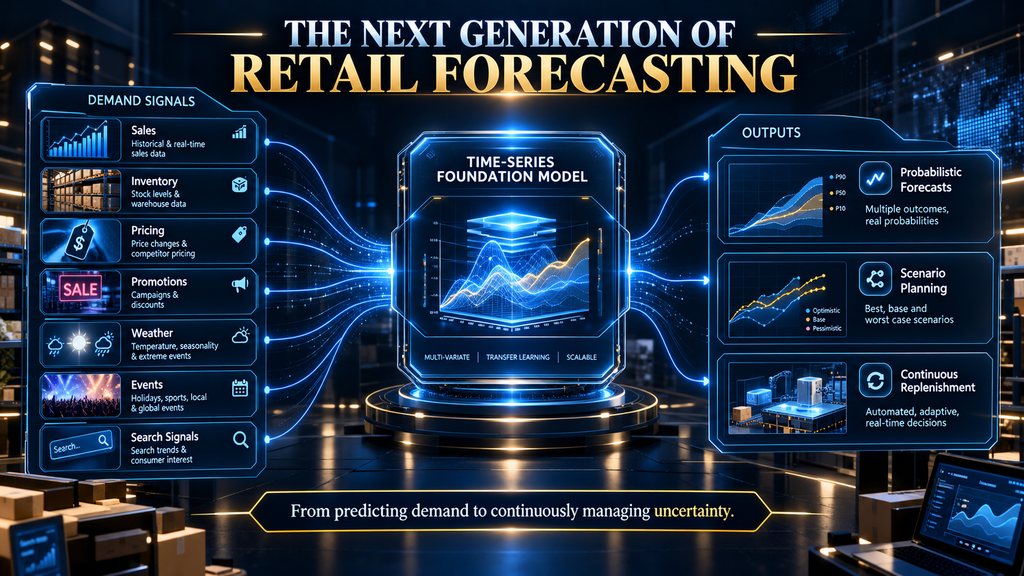
The more recent direction is toward forecasting systems that can operate across large numbers of time series and incorporate richer contextual information. AWS has described Decathlon’s use of a time-series foundation model, Chronos-2, as part of its demand-forecasting stack at scale. That is a vendor-published case study, so it should be understood as a description of one implementation rather than evidence that every retailer will achieve the same outcome.
The broader lesson is more important than any individual technology. Large-scale forecasting increasingly becomes a continuous loop in which new sales, inventory, promotions and business information update the demand signal, which then influences planning decisions and generates new observations for the next forecasting cycle.
When Should a Retailer Use AI Inventory Forecasting?
AI inventory forecasting becomes more compelling when the retailer has enough complexity for manual forecasting to become expensive or inconsistent. Large SKU catalogs, multiple locations, several sales channels, meaningful seasonality, frequent promotions, long supplier lead times and significant stockout or carrying costs all increase the potential value of better demand modeling.
The strongest candidates are businesses where demand is influenced by multiple variables and where relatively small forecasting improvements can produce meaningful operational consequences. A retailer managing thousands of product-location combinations may benefit from automation even when the improvement for an individual SKU appears modest, because the effect can compound across the network.
The case is weaker when the business has very little reliable historical data, extremely low transaction volumes, highly irregular one-off products or no established process for acting on forecasts. In those situations, improving the underlying data and inventory process may be more valuable than deploying an advanced forecasting model.
New businesses should also be cautious about assuming that AI can manufacture certainty from a lack of history. A model can generate a prediction for a new product, but the existence of a prediction does not mean there is enough evidence behind it to justify aggressive inventory commitments.
The right question is therefore not “Is the business ready for AI?” It is “Does the business have a forecasting problem where AI can improve an important decision enough to justify the additional complexity?”
What Happens If Retailers Do Nothing?
Choosing not to improve forecasting is also a decision. If the retail environment becomes more volatile while the planning process remains dependent on static assumptions, spreadsheets and manual adjustments, the gap between what the business knows and what it needs to know can grow.
That does not mean every retailer needs an AI forecasting platform immediately. It means the business should understand where forecasting errors are currently creating measurable costs. If stockouts are frequent, excess inventory is increasing, planners spend large amounts of time rebuilding forecasts, or promotions repeatedly produce planning surprises, the problem is already visible.
The risk is particularly high when inventory grows faster than the organization’s ability to understand why it is growing. More inventory can temporarily hide forecasting weaknesses because the business has more safety stock available to absorb errors. But that buffer ties up capital and does not solve the underlying demand uncertainty.
The better long-term approach is to improve the forecasting process incrementally. Establish reliable data, measure the baseline, identify the most expensive forecasting problems, test improved methods and connect those improvements directly to inventory decisions.
Where AI Inventory Forecasting Is Going
The next stage of inventory forecasting is unlikely to be defined simply by replacing one forecasting algorithm with a newer one. The larger shift is toward systems that combine multiple demand signals, produce uncertainty-aware forecasts, continuously update as new information arrives and connect those forecasts directly to planning workflows.
Time-series foundation models are one part of that development. Instead of building a separate forecasting approach from scratch for every product family, newer models can be designed to generalize across large collections of time series and use contextual information to improve prediction. The practical value will depend on whether these systems outperform simpler methods consistently enough to justify their operational complexity.
Demand sensing is another important direction. Traditional planning cycles may update weekly or monthly, while modern systems can incorporate newer signals more frequently. That can matter when demand changes quickly, although more frequent forecasting is useful only when the business can also respond quickly.
Scenario planning will become increasingly important as well. Instead of asking only what demand is likely to be, retailers can evaluate what happens if demand rises sharply, falls below expectations, a promotion performs unusually well, or a supplier becomes constrained. This moves forecasting closer to decision support because the system helps planners understand consequences rather than merely providing a number.
The most useful systems may therefore be those that make uncertainty easier for humans to manage rather than pretending uncertainty has disappeared. A retailer does not need an AI system that claims to know the future. It needs one that provides a better estimate of what could happen, explains the important drivers, identifies where the estimate is weak and helps the business decide how much risk to take.
The Real Value of AI Inventory Forecasting
The strongest argument for AI inventory forecasting is not that artificial intelligence can magically predict what customers will buy. No forecasting system can remove uncertainty from retail demand, and no model can reliably anticipate every external event that changes customer behavior.
The value comes from improving the quality and scale of the demand signal available to the people and systems making inventory decisions. When historical sales are combined with meaningful demand drivers, stockout effects are handled correctly, forecasts are validated against future-like conditions and uncertainty is incorporated into inventory policy, the business has a much stronger foundation for deciding what to buy and when.
That is also why forecast accuracy should never become the only objective. A retailer can have an excellent statistical model and still have poor inventory performance if the forecast arrives too late, planners ignore it, replenishment rules are poorly designed or suppliers cannot respond within the required lead time.
The most useful mental model is simple: AI forecasting predicts demand; inventory management decides how much uncertainty the business is willing to carry.
Once that distinction is understood, the technology becomes easier to evaluate. The question stops being whether a retailer should “use AI” and becomes much more practical: where is forecasting currently failing, what information is missing, what decision depends on the forecast, and can a better demand signal materially improve that decision?
That is where AI inventory forecasting earns its place.
Final Thoughts
AI inventory forecasting is most useful when it is treated as part of a decision system rather than as an isolated prediction engine. The technology can process more information, identify patterns across large numbers of products and locations, incorporate additional demand signals and update forecasts more frequently than many manual processes can reasonably manage.
But none of that changes the fundamental economics of inventory. Retailers are still balancing availability against excess stock, customer service against working capital, and responsiveness against the cost of carrying additional inventory.
The businesses that get the most from AI forecasting will therefore not necessarily be the ones with the most complicated models. They will be the ones that build a reliable demand signal, understand where that signal can fail, quantify uncertainty and connect the forecast directly to the decisions that determine what gets purchased, where it goes and when it needs to arrive.
The goal is not to predict the future perfectly. The goal is to make better inventory decisions with less uncertainty.
See How AI Connects the Entire Ecommerce Workflow
Inventory forecasting is only one part of ecommerce automation. Explore how AI can connect merchandising, recommendations, customer support, inventory, and other store operations into a broader system.
Explore the Ecommerce AI Framework →Frequently Asked Questions
What is AI inventory forecasting?
AI inventory forecasting uses statistical or machine-learning techniques to estimate future product demand using historical sales and other relevant signals. The output can support purchasing, replenishment, allocation, safety-stock and inventory-planning decisions.
How is AI inventory forecasting different from traditional forecasting?
Traditional forecasting can rely heavily on established statistical time-series methods and historical patterns, while AI-based systems can incorporate a broader set of variables and learn more complex relationships. The difference is not that traditional methods are obsolete; in some stable demand environments, they may still be sufficient.
What data does AI inventory forecasting use?
Common inputs include historical sales, inventory availability, product information, location, sales channel, pricing, promotions and seasonality. Depending on the retailer and category, weather, events, search behavior and other external signals may also contribute useful information.
Can AI predict inventory demand accurately?
AI can improve forecasting in many situations, but accuracy depends heavily on data quality, demand stability, forecast horizon, model design and the availability of meaningful demand drivers. A prediction should be treated as an estimate rather than a guarantee.
Can AI forecasting prevent stockouts?
AI forecasting can help reduce stockout risk by improving visibility into expected demand, but forecasting alone cannot prevent every stockout. Supplier lead times, purchasing policies, warehouse capacity, inventory allocation and unexpected demand shocks also influence whether the required product is available.
Does AI forecasting replace inventory planners?
Usually, the more useful role is to automate repetitive forecasting work while allowing planners to focus on exceptions, unusual market conditions and decisions involving significant business judgment. The right balance depends on the retailer’s data quality, forecasting maturity and operational process.
What is the biggest problem with AI inventory forecasting?
Poor or misleading data is one of the biggest problems. If historical sales are distorted by stockouts, promotions, inconsistent product records or other operational issues, an AI model can learn patterns that do not accurately represent underlying customer demand.
Is AI forecasting useful for new products?
It can be, but new products create a cold-start problem because there is little direct historical demand data. Forecasts may need to rely on comparable products, category patterns, launch information and early customer behavior, which generally means greater uncertainty.
How should retailers measure AI forecasting performance?
Retailers can evaluate statistical measures such as MAE, RMSE, WMAPE and forecast bias, but they should also examine operational outcomes such as stockout rate, fill rate, inventory turnover, excess inventory, markdowns and working capital. The most useful evaluation connects forecast quality with the inventory decisions it enables.
Does a more sophisticated AI model always produce a better forecast?
No. Model complexity does not guarantee better forecasting performance. A simpler statistical method can outperform a complicated machine-learning system when the demand pattern is stable, the data is limited or the additional variables do not contain useful predictive information.
What is the most important thing to understand about AI inventory forecasting?
The forecast is not the decision. A demand forecast estimates what may happen, while the retailer still has to decide how much inventory to hold based on uncertainty, lead time, service requirements, cost and the consequences of being wrong.
Related Guides
- AI Financial Planning & Analysis (FP&A): How Continuous Forecasting Works
- How to Use AI for Cash Flow Forecasting and Scenario Planning
- Best AI FP&A Software in 2026: Forecasting, Planning & Analysis Compared
- Best AI Product Recommendation Platforms for Ecommerce
Written by
Muntasir Ahmad Chowdhury
Founder, AI Hustle World
Muntasir Ahmad Chowdhury is the Founder of AI Hustle World, an independent publication dedicated to making Artificial Intelligence practical, trustworthy, and easy to understand. He researches AI tools, automation, customer service, productivity, and real-world business applications, helping readers make smarter technology decisions through research-driven, experience-backed content.
Expertise:
AI Tools • AI Automation • AI Customer Service • AI Productivity • Generative AI • AI Workflows
Get Smarter With AI
Enjoyed this guide? Get practical AI tools, tutorials, and honest reviews delivered to your inbox.
3 thoughts on “AI Inventory Forecasting: How Retailers Predict Demand”