Best AI Shopping Assistants Platforms for E-Commerce Businesses
A shopper looking for skincare may want help choosing between two serums. Someone buying luggage may need to know whether a case fits an airline limit, while a customer shopping for electronics may need compatibility checked before adding anything to the cart. All three situations can be called “AI-assisted shopping,” yet the software required to handle them well can be very different.
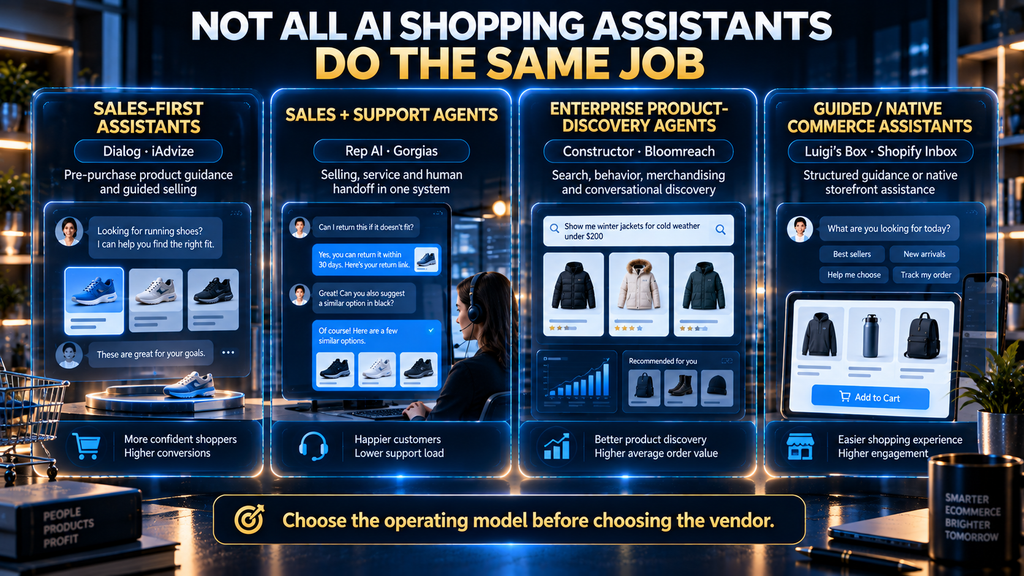
That difference is easy to miss when shopping-assistant platforms are placed in one feature table. Some products are designed primarily to sell before checkout, some combine selling with customer support, others sit on top of enterprise search and product-discovery systems, and a few guide customers through structured questions instead of relying on completely open conversation.
For this comparison, AI Hustle World reviewed current official product documentation, help centers, pricing pages, and Shopify App Store records for Dialog, Rep AI, iAdvize, Gorgias Shopping Assistant, Constructor AI Shopping Agent, Bloomreach Conversational Agent, Luigi’s Box Shopping Assistant, and Shopify Inbox. The goal is not to declare which chatbot sounds most human, but to determine which system fits different ecommerce buying journeys and how far each platform can move from conversation toward verified commerce action.
No controlled AI Hustle World test was performed across all eight products. The findings below compare documented capabilities, platform architecture, commerce grounding, merchant control, implementation model, measurement, pricing transparency, and likely business fit, while vendor-reported conversion or revenue claims remain vendor claims rather than independent performance evidence.
The most useful conclusion is that the “best” shopping assistant depends on what the store actually needs the assistant to do. A small Shopify merchant testing AI-guided selling for the first time has a different decision from an enterprise retailer trying to connect conversational discovery with search, behavioral data, merchandising rules, and a large international product catalog.
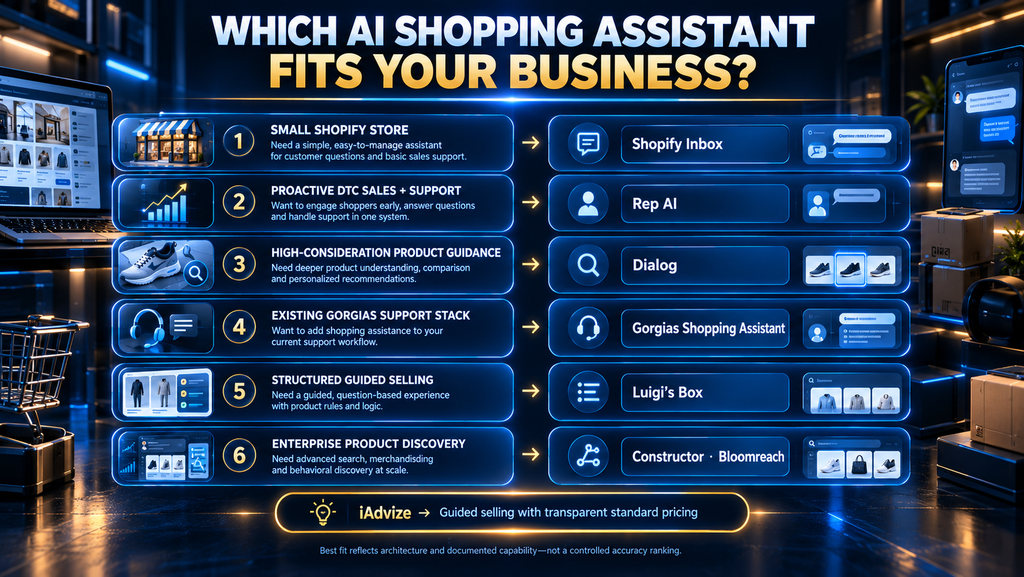
The Short Version: Which AI Shopping Assistant Fits Which Business?
For brands that want a sales-first assistant embedded directly into product discovery, Dialog is one of the strongest candidates in this comparison. Its current product is designed around pre-purchase questions, product recommendations, product-page guidance, live catalog and stock information, and direct add-to-cart actions rather than treating shopping assistance as an extension of customer support.
Rep AI is a stronger fit when the business wants proactive selling and customer support inside the same system. Its sales agent monitors shopper behavior for hesitation and disengagement, uses live catalog context to narrow choices and recommend products, while its Shopify product also supports post-purchase questions and human handoff.
iAdvize stands out for brands wanting guided conversational selling with unusually clear public pricing. Its current plans scale by conversation volume and catalog size, beginning at $290 per month on annual billing for the Essentials tier at the time of this research, while higher plans increase included conversations and SKU capacity.
Gorgias Shopping Assistant makes the most sense when a Shopify merchant already treats Gorgias as its customer-service operating layer. The Shopping Assistant sits inside AI Agent, can use browsing activity, cart contents, and buying intent for product recommendations, and inherits Gorgias’s handoff and support environment instead of creating a completely separate conversational system.
For enterprise retailers, Constructor and Bloomreach are more substantial product-discovery choices. Constructor connects conversational shopping with search, browse, recommendations, behavioral clickstream data, and broader product-discovery infrastructure, while Bloomreach connects conversational assistance with product feeds, customer profiles, search, merchandising, and targeted engagement across multiple shopping surfaces.
Luigi’s Box is particularly interesting where the retailer wants structured guided selling rather than an entirely open-ended agent. Its Shopping Assistant can run a question-and-answer flow in which each answer narrows the matching product set, while Luigi’s Box separately offers conversational discovery, search, recommendations, product listing, and analytics.
Shopify Inbox is the baseline every smaller Shopify merchant should consider before buying another platform. It is currently free, connects to the merchant’s catalog and store knowledge, answers product and policy questions, and can personalize recommendations for signed-in Shop customers using preferences, sizes, and purchase history.
These are fit conclusions based on documented capabilities, not a laboratory ranking of answer accuracy or conversion performance. The rest of the article explains why those distinctions matter and what each platform actually requires from the business using it.
Why Shopping-Assistant Comparisons Are More Confusing Than They Look
The phrase “AI shopping assistant” now covers several software categories that developed from different starting points. A customer-support company can add pre-purchase selling, an ecommerce search vendor can add conversational discovery, a sales-agent company can add ticket resolution, and Shopify itself can add an AI associate to its native chat product.
These systems increasingly overlap, but their underlying operating models still matter. A support-first system is usually strong at policies, orders, escalation, and service workflows, while a discovery-first platform may have richer access to search behavior, category logic, product ranking, and merchandising signals.
A sales-first specialist is different again. Its central question is not usually “Can we automate support tickets?” but “Can we intervene when a shopper is uncertain, understand what they need, and move them toward a suitable product before they leave?”
Structured guided selling creates another category. Instead of letting a model decide how every conversation should unfold, the merchant defines a controlled sequence of qualifying questions, which can work especially well when product selection depends on predictable criteria such as size, compatibility, intended use, skin concern, or technical requirements.
This is why a universal ranking can become misleading. A platform may be excellent at the job it was designed for while being the wrong purchase for a store solving a different problem.
How AI Hustle World Compared These Platforms
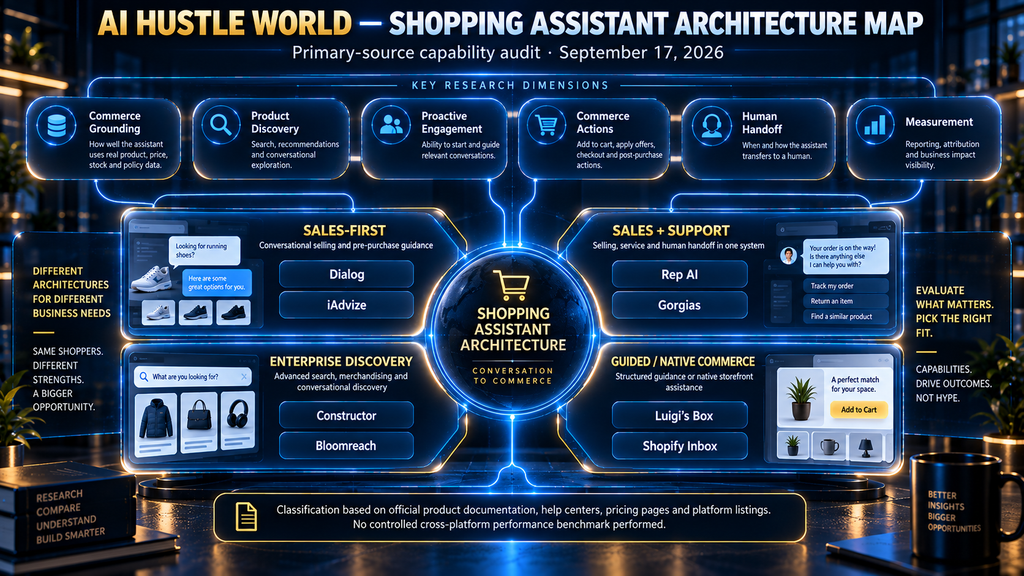
This comparison is based on a September 17, 2026 primary-source audit. Sources include official product pages, technical documentation, help-center articles, official pricing pages, and Shopify App Store records when the product is distributed there.
The comparison uses one evidence rule across all eight platforms. A capability is treated as documented only when an official source supports it; where a capability or price could not be confirmed from the official materials reviewed, the article does not infer that it exists or that it is absent.
Vendor performance numbers are handled separately. Constructor, Dialog, Bloomreach, Rep, iAdvize, and other vendors publish examples of conversion or revenue improvements, but those results come from different stores, traffic populations, placements, attribution methods, and implementations, so they cannot be converted into a neutral cross-platform performance score.
The article also uses the AI Hustle World Platform Fit Score, the same commercial decision framework used across AI Hustle World software comparisons. It evaluates five dimensions: Capability Fit, Control, Compatibility, Evidence, and Economics, using qualitative assessments rather than artificial decimal scores.
Capability Fit asks whether the assistant solves the store’s actual shopping problem. Control examines guardrails, merchandising rules, action permissions, proactive engagement, and human escalation; Compatibility looks at ecommerce platform and surrounding systems; Evidence covers documentation, analytics, testing, and measurement; Economics considers pricing clarity, implementation burden, and whether the platform’s scope makes sense for the buyer.
The 2026 AI Hustle World Shopping Assistant Commerce Capability Map
Methodology: AI Hustle World reviewed official product documentation, help centers, pricing pages, product pages, and Shopify App Store records for eight shopping-assistant platforms on September 17, 2026. The comparison normalizes each platform across architecture, commerce grounding, conversational discovery, recommendations, proactive engagement, commerce actions, support scope, measurement, pricing transparency, and likely business fit. “Not publicly verified” means the official materials reviewed did not provide enough public evidence to confirm the capability or price. No controlled cross-platform recommendation, conversion, or answer-quality benchmark was performed.
| Platform | Architecture | Commerce Grounding | Discovery & Recommendations | Commerce / Support Actions | Measurement | Pricing Transparency | Best-Fit Profile |
|---|---|---|---|---|---|---|---|
| Dialog | Sales-first conversational shopping assistant | Catalog, variants, live stock, prices, site content, PDFs and merchant instructions | Natural-language discovery, PDP guidance, alternatives, contextual cross-sells | Direct add-to-cart; human handoff documented | Conversion, AOV and attributed-revenue reporting documented | Pricing exists publicly in current comparison material, but a full official pricing page was not confirmed in this audit | High-consideration catalogs needing pre-purchase guidance and product expertise Dialog |
| Rep AI | Unified sales + support agent | Live catalog context; Shopify listing documents product/catalog integration and support knowledge | Behavioral intent detection, guided buying, recommendations and complementary products | Guides checkout; handles order/support questions and human handoff | A/B testing, CTR, conversion and recommendation analytics documented | Public Shopify pricing, including usage-based visitor charges | Shopify/DTC brands wanting proactive selling plus support Rep AI |
| iAdvize | Sales-first AI shopping assistant | Product catalog connected to the assistant; plan limits based on SKU volume | Guided discovery, product assistance, engagement widgets and Shopping Panel | Add-to-cart included in Shopping Panel; human support available through separate Support Desk | Shopper insights, performance reports and conversation review documented | High; fixed public plans and trial | Brands wanting guided selling with clear commercial terms iAdvize |
| Gorgias Shopping Assistant | Support-first AI Agent with selling skills | Shopify product pages, structured product details, browsing activity, cart and brand knowledge | Recommendations, sales conversations, search assist, proactive FAQs | Discounts, escalation to human agent, broader support through Gorgias AI Agent | AI Agent analytics; commercial measurement depends on Gorgias setup | Shopping Assistant included with eligible AI Agent plans; simple standalone price not verified | Shopify brands already running Gorgias for support Gorgias Help Center |
| Constructor AI Shopping Agent | Enterprise product-discovery agent | Product catalog, real-time behavioral data, search/browse signals, merchandising logic | Natural-language exploration, personalized recommendations and complex intent refinement | Can connect to checkout; broader action depth depends on implementation | Enterprise product-discovery analytics and proof programs | Public starting price not verified | Large retailers connecting conversational shopping with search/discovery infrastructure Constructor |
| Bloomreach Conversational Agent | Enterprise discovery + personalization agent | Product feeds, price, availability, attributes, customer profiles, behavior, knowledge sources | Conversational search, product comparisons, recommendations and context-aware guidance | Checkout guidance and support redirection; broader actions depend on use case | Event tracking, transcripts, targeting and use-case measurement | Public standalone starting price not verified | Enterprise retailers connecting assistant, search, customer data and personalization Bloomreach Documentation |
| Luigi’s Box Shopping Assistant | Structured guided-selling + product-discovery suite | Product index and assistant configuration within Luigi’s Box | Question-and-answer narrowing, matching products, separate conversational agent and search tooling | Primarily discovery; downstream clicks/cart/conversion can be tracked | Assistant analytics supports click, cart and conversion tracking | Public standalone assistant starting price not verified | Retailers wanting controlled guided selling inside a broader search stack Luigi’s Box |
| Shopify Inbox | Native Shopify sales/support assistant | Shopify catalog, inventory, policies, knowledge-base files and storefront content | Product Q&A and personalized recommendations for eligible signed-in shoppers | Conversational support and human staff conversations inside Inbox | Assisted-order and conversation analytics available in Shopify environment | Free | Small Shopify stores needing a native baseline before specialist software Shopify App Store |
The value of the map is not that every row contains the same feature. It shows where the products stop being directly comparable, which is often more useful than forcing them into a single leaderboard.
A Shopify merchant may eliminate Constructor and Bloomreach immediately if it does not need enterprise discovery infrastructure. An enterprise retailer may eliminate Shopify Inbox just as quickly if the assistant needs to share intelligence with a sophisticated search, merchandising, and behavioral-data system.
Best for Sales-First Product Guidance: Dialog
Dialog is the clearest sales-first product in the group. Its current positioning explicitly separates pre-purchase assistance from conventional support chat, placing the assistant on product pages, search, collection pages, and guided flows rather than limiting it to a floating support bubble.
The data model is one of its strongest advantages for product-heavy stores. Dialog says it learns from the merchant’s catalog, live stock, SEO content, uploaded PDFs, and merchant-defined guidance, while its Shopify implementation synchronizes catalog, variants, stock, and price from the store.
That gives Dialog a particularly strong fit for products that create real pre-purchase questions. Beauty, supplements, luggage, wine, technical equipment, furniture, automotive accessories, and other high-consideration categories often require more than a generic recommendation carousel because shoppers need reasoning around fit, use, compatibility, material, or trade-offs.
Dialog can also move beyond explanation. Its product cards can expose direct add-to-cart actions, and its SDK provides callbacks for retrieving products, changing quantities, and integrating cart behavior into custom storefronts.
The important limitation is that this is primarily a selling and product-guidance system, not a full support operating platform. A business whose larger problem is order changes, returns, cancellations, ticket routing, and support automation may still need another service layer around it.
There is also an implementation detail worth noticing. Dialog’s own documentation identifies cart UI refresh as a common issue on Shopify and custom installations, sometimes requiring theme-specific code so a cart icon or drawer updates immediately after an assistant adds a product. That is a small example of why “installs quickly” and “works perfectly with every storefront implementation” are not the same claim.
AI Hustle World Platform Fit Score: Dialog
Capability Fit: Excellent for pre-purchase product guidance and complex catalogs. Control: Strong because merchants can provide guidance and guardrails; Compatibility: Strong across Shopify, BigCommerce, Magento, Salesforce Commerce, and custom integrations according to Dialog; Evidence: Strong for documented product behavior but weaker for independent performance verification; Economics: Moderate visibility because the full official pricing structure was not independently confirmed from a dedicated current pricing page in this research pass.
Dialog belongs near the top of the shortlist when the business wants a knowledgeable digital salesperson more than another support bot. It becomes less compelling when the retailer primarily needs post-purchase service automation or an enterprise search platform.
Best for Proactive Sales Plus Support: Rep AI
Rep AI’s defining feature is not merely that it can recommend products. Its sales agent is designed to detect behavioral signals such as hesitation, comparison activity, disengagement, and conversion risk, then decide when to begin a conversation rather than waiting for the shopper to open a chat interface.
That proactive model changes the role of the assistant. Instead of acting only as an answer box, Rep tries to identify moments when the customer appears uncertain and then uses catalog context to narrow choices, answer objections, and suggest products or complementary items.
The second reason to consider Rep is that it combines selling with support. Its Shopify listing describes a system that handles product recommendations and buying guidance while also answering order-status, return, cancellation, and FAQ questions, with human handoff when necessary.
That makes Rep attractive to DTC and Shopify businesses that do not want pre-purchase selling to become another isolated application. If the same platform can understand the catalog before purchase and support the customer after purchase, the retailer may reduce duplication across conversational systems.
The pricing model is comparatively transparent. Rep’s Shopify listing currently shows a free-to-install usage tier with charges for additional visitors, followed by paid plans starting at $104 per month for up to 10,000 monthly visitors and 1,000 products, with higher tiers increasing visitor and catalog limits.
Usage-based visitor pricing deserves attention, however. A store with rapidly growing traffic needs to model the cost at expected peak traffic rather than comparing only the entry plan, particularly if the assistant will be exposed broadly across the storefront.
AI Hustle World Platform Fit Score: Rep AI
Capability Fit: Excellent for unified pre-purchase selling and customer support. Control: Strong because the system combines behavioral triggers with sales and support configuration; Compatibility: Excellent for Shopify-centric DTC, with integrations such as Gorgias, Zendesk, Klaviyo, and Tapcart listed in the Shopify marketplace; Evidence: Strong for documented analytics and A/B testing; Economics: Strong transparency, with visitor-based pricing visible publicly.
Rep is less attractive when the merchant already has deeply established support and discovery systems that it does not want to consolidate. In that situation, adding another broad conversational layer may duplicate capabilities instead of solving a new problem.
Best for Guided Selling With Clear Public Pricing: iAdvize
iAdvize stands out partly because its commercial model is easier to inspect than many enterprise competitors. The current official pricing page lists annual-billing prices of $290 per month for Essentials, $520 for Starter, and $1,330 for Growth, with each tier increasing included conversations and catalog size.
The structure tells buyers something useful about how the company thinks about its product. Cost is linked to both conversational usage and SKU scale, so a retailer should evaluate expected shopper interaction and catalog size together rather than looking only at site traffic.
The platform includes engagement widgets, a Shopping Panel, AI Builder, shopper insights, performance reporting, and conversation review across the paid plans. The Shopping Panel includes product discovery and add-to-cart functions, while higher tiers increase capacity and customer-success involvement.
This makes iAdvize particularly attractive to businesses that want to treat conversational selling as a defined storefront program rather than an experimental chat feature. Public plan boundaries also make early financial modelling easier than with vendors that require a sales process before revealing any price.
The limitation is that published plan clarity does not guarantee economic fit. A retailer with a very large catalog, high conversation volume, or complex enterprise integration requirements can move quickly beyond the standard tiers and into custom pricing.
AI Hustle World Platform Fit Score: iAdvize
Capability Fit: Strong for guided selling and storefront assistance. Control: Strong through AI Builder and engagement formats; Compatibility: Strong for brands that can integrate the assistant into existing ecommerce journeys; Evidence: Strong for pricing, usage boundaries, and reporting capabilities; Economics: Excellent transparency relative to most enterprise shopping-assistant vendors.
iAdvize is one of the easier products to evaluate commercially before a sales call. The strongest fit is a brand that wants a structured AI-selling program and prefers to understand likely software cost before entering a custom procurement process.
Best for Existing Gorgias Merchants: Gorgias Shopping Assistant
Gorgias Shopping Assistant should not be evaluated as though it were a standalone sales product. It is part of Gorgias AI Agent, which means its value increases substantially when the merchant already uses Gorgias as the center of customer support operations.
The Shopping Assistant adds pre-purchase selling behavior to that environment. Gorgias documents product recommendations based on browsing activity, cart contents, and buying intent, with merchant controls for promoting, excluding, or completely blocking products from recommendation.
That level of recommendation control is useful because support platforms can otherwise become awkward selling systems. A retailer may want the agent to prioritize a new collection, avoid clearance products, or never mention a regulated or inappropriate product even when it appears related to the shopper’s activity.
Gorgias also supports proactive sales entry points. AI FAQs can surface common product questions on product pages, while Search Assist can invite shoppers into a conversation after they use the store’s search bar; during those conversations, AI Agent can recommend products, offer configured discounts, and hand the conversation to a human when required.
The architectural benefit is consolidation. A customer can begin with a sizing question before purchase, later ask about delivery, and eventually require human help without the retailer building completely separate conversational systems.
The trade-off is ecosystem fit. Gorgias Shopping Assistant currently requires a connected Shopify store for these selling capabilities, and some accounts may need an AI Agent subscription upgrade to access Shopping Assistant functionality.
AI Hustle World Platform Fit Score: Gorgias Shopping Assistant
Capability Fit: Excellent for Shopify merchants already using Gorgias. Control: Excellent for product recommendation rules and escalation; Compatibility: Excellent inside the Shopify + Gorgias environment but narrower as a general ecommerce solution; Evidence: Strong because the help center documents behavior in detail; Economics: Moderate visibility because the Shopping Assistant is tied to AI Agent rather than presented as a simple standalone public-price product.
For an existing Gorgias customer, Shopping Assistant can be more rational than adding a separate vendor. For a retailer with no interest in Gorgias support infrastructure, the comparison changes considerably.
Best Enterprise Shopping Agent for Product Discovery: Constructor
Constructor’s AI Shopping Agent belongs to a different class from most storefront assistants. It sits inside a larger product-discovery platform that also includes Search, Browse, Recommendations, Collections, Quizzes, attribute enrichment, and other commerce intelligence.
Its shopping agent uses natural-language intent alongside catalog information, real-time user behavior, past behavior, and broader discovery signals to refine product recommendations. Constructor describes the system as part of the same commerce reasoning infrastructure that powers other discovery surfaces, rather than as a conversational layer bolted onto a static catalog.
That architecture matters most for large retailers. If search knows that a shopper repeatedly viewed certain brands, browse rankings reflect purchase behavior, and recommendations already use clickstream data, a shopping agent can benefit from the same underlying signals instead of reconstructing a customer model from scratch inside a chat session.
Constructor also supports complex shopping journeys. The company highlights use cases ranging from fashion and grocery to furniture, general merchandise, B2B compatibility, and natural-language list building; it also says the shopping agent can be connected to checkout when a retailer wants more action-oriented behavior.
The strongest limitation is that Constructor makes the most sense as part of a broader discovery relationship. Its own documentation says the agent can integrate with other stacks but performs most naturally inside Constructor’s wider suite, where it can use signals from Search, Browse, Collections, Recommendations, and related components.
That makes Constructor difficult to justify for a small merchant that only wants conversational product Q&A. The business case improves as the retailer’s search, catalog, traffic, merchandising, and product-discovery complexity increase.
AI Hustle World Platform Fit Score: Constructor
Capability Fit: Excellent for enterprise product discovery. Control: Strong, with documented merchandising rules and guardrails; Compatibility: Excellent when Constructor already powers discovery, and Strong for other enterprise integrations; Evidence: Strong for technical architecture and documented use cases but vendor case-study outcomes remain vendor claims; Economics: Not publicly verified because a current simple starting price was not confirmed.
Constructor is one of the strongest choices when conversational shopping should become another interface to a mature discovery engine. It is unnecessary infrastructure when the real requirement is answering a handful of product questions on a modest storefront.
Best for Enterprise Personalization and Multi-Surface Guidance: Bloomreach Conversational Agent
Bloomreach’s Conversational Agent combines three important data classes: product feed information, customer profile information, and general knowledge sources. Product feeds include fields such as product names, price, availability, and attributes, while customer profiles can contain browsing behavior, purchase history, preferences, and engagement patterns.
That architecture makes Bloomreach compelling for enterprises that already think about the customer journey across more than one page. The agent can appear on landing pages, search, product listing pages, product-detail pages, carts, and checkout, with use cases triggered proactively by the brand or initiated by the shopper.
Product discovery becomes stronger when Bloomreach Search is also available. In that configuration, conversational queries can retrieve products through Bloomreach’s search engine and inherit advanced merchandising controls before conversational context is applied to the returned results.
This creates an important difference between a generic LLM-based shopping assistant and a commerce platform with a dedicated search layer. The assistant does not have to invent its own ranking logic independently from the merchant’s established search and merchandising strategy.
Bloomreach’s documentation is also unusually specific about data quality. It requires fields such as item ID, title, URL, image, price, and description, recommends additional information including stock level and product grouping, and advises retailers to keep catalog information updated so price and stock remain accurate.
The trade-off is implementation effort. Bloomreach documents steps involving product-feed preparation, tracking, Marketing weblayers, events such as purchase, view-item, and cart-update, use-case configuration, targeting, and coordination with Bloomreach implementation resources.
AI Hustle World Platform Fit Score: Bloomreach Conversational Agent
Capability Fit: Excellent for enterprise conversational discovery and personalization. Control: Excellent through targeting, use-case configuration, search merchandising, and data integration; Compatibility: Strong to Excellent when Bloomreach is already part of the commerce stack; Evidence: Excellent for technical documentation; Economics: Not publicly verified because a simple standalone starting price for this use case was not confirmed.
Bloomreach becomes easier to justify when the assistant is one component of a larger discovery and customer-data strategy. Buying that breadth to solve only a basic product-Q&A problem would be difficult to defend.
Best for Structured Guided Selling: Luigi’s Box
Luigi’s Box deserves attention because it makes an architectural distinction that many competitors blur. The company offers both a Shopping Assistant and a separate Conversational Agent, alongside Search, Recommender, Product Listing, and Analytics.
The Shopping Assistant uses a structured question-and-answer sequence. Its API returns the next question together with the products that still match the shopper’s previous answers, allowing the experience to narrow the catalog progressively rather than asking a language model to determine the entire conversation dynamically.
That approach can be particularly useful when a store already knows the important qualification sequence. A mattress store might ask about sleeping position, firmness preference, size, and budget; an electronics store might ask about device type, compatibility, performance requirement, and price; a skincare brand might structure discovery around skin type, concern, sensitivity, and routine.
Open conversation can feel more natural, but it also creates more ambiguity. Guided flows make it easier for the merchant to ensure that important selection criteria are collected before products are recommended.
The Assistant API also supports analytics integration for clicks, add-to-cart events, and conversions, so the guided flow can be measured rather than treated as an isolated quiz.
The main limitation is the same thing that creates the strength. A tightly structured assistant is less appropriate when shoppers arrive with unpredictable goals that cannot be reduced to a sensible question tree.
AI Hustle World Platform Fit Score: Luigi’s Box
Capability Fit: Excellent for structured guided selling and qualification-heavy categories. Control: Excellent because the retailer defines the discovery flow; Compatibility: Strong inside the wider Luigi’s Box product-discovery environment; Evidence: Strong for API behavior and analytics documentation; Economics: Not publicly verified because a simple standalone starting price was not confirmed during the audit.
Luigi’s Box should be shortlisted when control over the discovery sequence is more important than giving the model maximum conversational freedom.
Best Free Baseline for Shopify: Shopify Inbox
Shopify Inbox changes the buying decision because a Shopify merchant no longer needs to begin with paid specialist software. The App Store currently lists Inbox as free, and Shopify describes its agent as an AI-powered sales associate that can help shoppers find products and answer questions from the storefront.
The agent uses the merchant’s product catalog, policies, knowledge-base facts and files, and published storefront content when answering questions. Shopify also says that when customers sign in with Shop, the agent can personalize product recommendations using their preferences, sizes, and purchase history.
This is not a trivial baseline. It means a small Shopify merchant should ask what specific additional problem a paid assistant will solve before spending hundreds or thousands of dollars each month.
The answer may still justify specialist software. A merchant might need proactive behavioral engagement, deeper merchandising controls, custom guided-selling logic, sophisticated search integration, structured experiments, broader ecommerce-platform support, or enterprise implementation services that Shopify Inbox does not provide at the same depth.
But the burden of proof changes. A specialist platform should produce enough incremental capability to justify replacing or supplementing something that Shopify already makes available inside the merchant’s existing environment.
AI Hustle World Platform Fit Score: Shopify Inbox
Capability Fit: Strong for basic product guidance and native Shopify assistance. Control: Strong for a native product, with tone, style, rules, knowledge, and staff messaging inside Shopify; Compatibility: Excellent for Shopify but not a cross-platform solution; Evidence: Excellent because functionality is documented directly by Shopify; Economics: Excellent, since the app is currently free.
Shopify Inbox is the most sensible starting point for small stores that want to learn whether conversational selling helps before committing to specialist software.
The Platform You Choose Should Match How Shoppers Need Help
The most useful comparison is not small store versus large store alone. Retailers should identify what type of uncertainty stops customers from buying.
If shoppers understand the category but ask detailed product questions before committing, a product-page-focused system such as Dialog can make sense. If the store repeatedly loses visitors who hesitate, compare many products, or appear ready to leave, a proactive behavioral system such as Rep addresses a different problem.
If customers need a predictable diagnostic or qualification sequence, Luigi’s Box offers more structural control. If the brand already operates Gorgias as the central customer-service system, expanding that environment into pre-purchase shopping assistance can be simpler than introducing a new agent.
Enterprise retailers face a broader problem. Their shopper may need help across search, categories, recommendations, a huge catalog, customer history, merchandising rules, and different channels, which is why Constructor and Bloomreach are better understood as product-discovery platforms with conversational interfaces rather than chat applications.
The Most Important Buying Criterion Is the Assistant’s Source of Truth
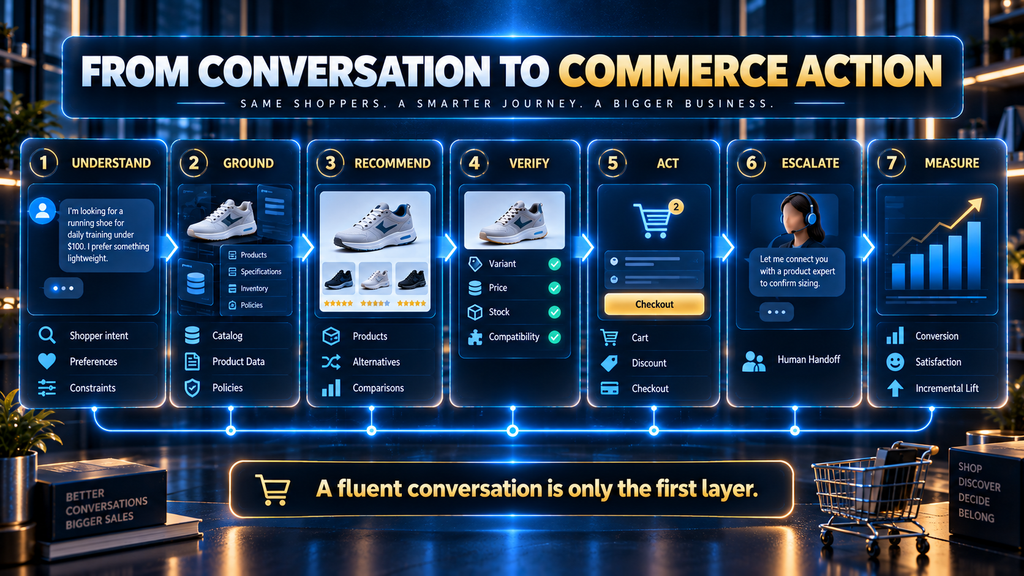
A shopping assistant can sound highly competent and still give the wrong commercial answer. Language fluency does not prove that the system knows whether a particular variant is in stock, whether a sale price is current, whether an accessory is compatible, or whether the merchant’s return policy changed yesterday.
The safer architecture separates conversational reasoning from commerce truth. The model can interpret what the shopper means and explain choices, while product identity, price, stock, variants, policies, and account-specific facts should come from systems that are authoritative for those facts.
This distinction is visible across the platforms in different ways. Dialog documents live catalog and stock synchronization, Rep describes live catalog context and Shopify integration, Bloomreach explicitly requires product feeds with current price and availability information, and Shopify Inbox connects directly to Shopify catalog, inventory, policies, and store knowledge.
Constructor goes further into behavioral context by combining natural-language intent with product information, clickstream behavior, search, browse, and other discovery signals. That is useful for personalization, but it does not change the basic rule: a recommendation should remain anchored to current commerce facts.
For buyers, the important sales-demo question is therefore not only “What model do you use?” Ask where each factual answer comes from and how quickly that source updates.
Live Inventory and Variant Accuracy Matter More Than Conversational Polish
A recommendation that identifies the right parent product can still fail at the moment of purchase. The shopper might need a specific size, finish, storage capacity, pack quantity, region, color, or compatibility option that is unavailable even though another variant remains in stock.
Dialog’s Shopify implementation explicitly synchronizes variants, stock, and prices, while Bloomreach’s catalog guidance recommends variant-level item IDs and current stock-level data.
This is especially important for fashion, electronics, furniture, automotive, health and beauty, and any category where the exact SKU matters. A conversational system that says “Yes, this is available” based only on the parent product can create more frustration than a conventional product page.
The buyer should therefore test assistants using difficult variant questions before purchase. Ask about the least common size, an out-of-stock option, a discounted variation, a compatibility boundary, and a product whose specification differs from the parent.
That type of evaluation reveals more about commerce reliability than a polished demo question such as “Which jacket would you recommend for winter?”
Proactive Engagement Can Help, but It Can Also Become Annoying
Several platforms now try to predict when a shopper needs help rather than waiting for a question. Rep monitors behavioral signals and uses changes in intent or conversion risk to decide when to engage, while Bloomreach supports brand-initiated triggers based on where the shopper is and what they are doing.
Gorgias takes a similar approach through Shopping Assistant entry points such as Search Assist and AI FAQs. The assistant can surface a question or invite conversation in moments where the shopper is already looking for information.
Dialog’s approach is more contextual than interruptive. Suggested questions can appear directly under the Add to Cart area or inside search and product-page surfaces, allowing the shopper to engage without necessarily opening a conventional corner chat bubble.
The risk is obvious: an assistant that starts too many conversations becomes another popup problem. Proactive behavior should therefore be evaluated on timing, frequency, suppressibility, relevance, and whether the merchant can target or limit the trigger.
Higher interaction rate is not automatically better. If aggressive engagement distracts customers who were already ready to buy, the assistant may increase conversation volume without improving the buying experience.
Open Conversation Is Not Always Better Than Guided Selling
Generative conversation feels sophisticated because the shopper can ask almost anything. That freedom is valuable when customer needs are unpredictable, but it can create unnecessary ambiguity when product selection follows a known decision tree.
Luigi’s Box illustrates the alternative. Its Shopping Assistant can ask structured questions, receive the shopper’s selected answer, narrow the matching products, and then return the next relevant question.
That architecture is particularly suitable when the retailer already knows how a trained salesperson would qualify a customer. If every mattress consultant asks about sleeping position and firmness, or every technical-parts salesperson begins by identifying the machine model and compatibility requirements, a structured sequence can be more dependable than completely open conversation.
Open assistants are stronger when the shopper’s problem cannot be anticipated easily. Constructor’s natural-language approach is designed for customers who may begin with broad goals such as planning an activity rather than knowing the exact product category they need.
The decision is therefore not “old-fashioned flow versus advanced AI.” It is controlled qualification versus open intent interpretation, and different categories benefit from different balances.
Sales-First and Support-First Assistants Create Different Operating Models
A sales-first assistant is designed primarily to help the shopper make a purchase. Its knowledge, placements, metrics, and engagement strategy revolve around discovery, qualification, product questions, comparisons, confidence, add-to-cart, and conversion.
Dialog and iAdvize fit that model most clearly. Dialog explicitly describes itself as pre-sale rather than support, while iAdvize prices and packages the product around AI Shopping Assistant conversations, product catalogs, engagement widgets, Shopping Panel, and shopper insights.
Gorgias starts from the opposite direction. It is an established support system whose AI Agent now includes Shopping Assistant capabilities, meaning pre-purchase conversations can coexist with human support, ticket handling, and after-sale questions.
Rep deliberately tries to bridge both worlds. Its Shopify listing presents the same assistant as a proactive seller and a 24/7 support system that can answer order questions, returns, cancellations, and FAQs before handing over when required.
Neither architecture is universally better. A retailer that already loves its support stack may prefer a specialist selling tool, while a business tired of maintaining disconnected sales and support agents may value a unified system more highly.
Human Handoff Is Part of the Product, Not a Failure State
A serious shopping assistant should be judged partly by what happens when it cannot safely finish the conversation. Some purchases involve unusual compatibility requirements, negotiated pricing, health-related questions, high-value orders, unusual policies, or customer frustration that should not remain trapped inside an automated loop.
Dialog documents the ability to follow merchant instructions about what should be handed to a human, while Gorgias explicitly hands over when the AI does not know an answer or reaches a handover topic. Rep also positions human handoff as part of its sales-and-support environment rather than treating automation as an all-or-nothing goal.
The practical buying question is therefore not “Can this assistant resolve 100% of conversations?” That would be the wrong objective for any store where incorrect automation has meaningful consequences. A better question is whether the system knows when to stop, whether context transfers to the human, and whether the shopper has to repeat the entire conversation after escalation.
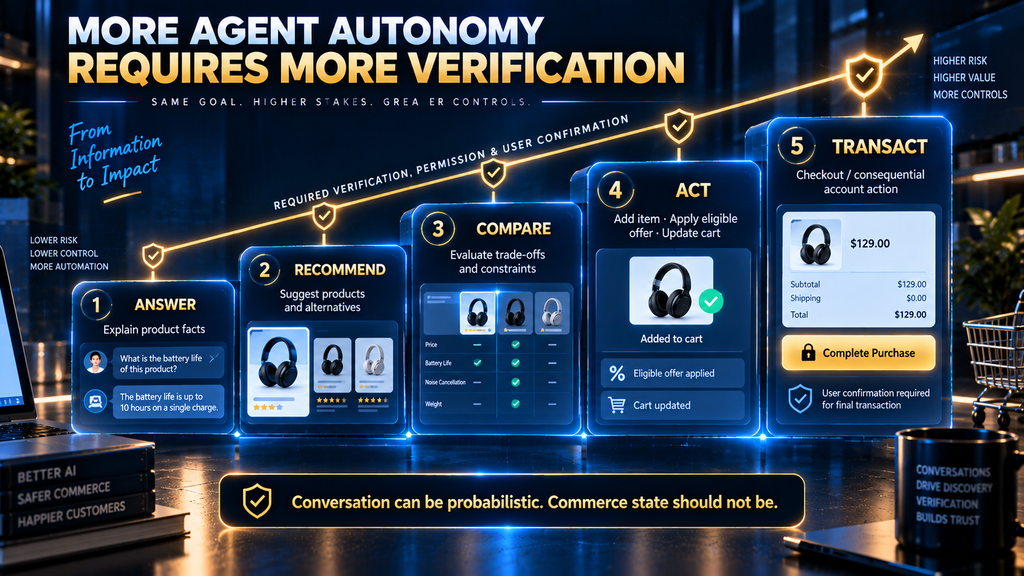
Commerce Actions Need Stronger Controls Than Product Advice
There is a meaningful difference between telling a shopper that two products have similar features and changing the state of the cart. The first is advisory; the second affects a transaction.
Dialog supports direct add-to-cart actions, while Constructor says its agent can be connected to checkout for more agentic purchase behavior. Bloomreach supports checkout-oriented conversational use cases, and iAdvize includes add-to-cart functionality inside its Shopping Panel.
The more action authority an assistant receives, the more important deterministic validation becomes. Variant ID, quantity, price, stock, promotions, customer eligibility, and cart state should be confirmed by commerce systems rather than left to generated text.
This principle will matter even more as shopping assistants evolve into shopping agents that can perform more tasks autonomously. The correct direction is not unrestricted autonomy; it is increasing autonomy paired with increasing verification, permissions, and user confirmation.
A platform that cannot explain how it controls consequential actions deserves more scrutiny than one that openly exposes the boundary between conversation and transactional execution.
Which Platform Is Best for a Small Shopify Store?
For most small Shopify merchants, Shopify Inbox should be the first system evaluated because it is native and currently free. It already answers catalog and policy questions, supports product guidance, uses Shopify context, and provides a low-risk way to determine whether customers actually engage with conversational shopping.
That does not mean specialist tools are unnecessary. A small but high-consideration brand may still need richer selling logic, stronger proactive engagement, a guided discovery experience, or better conversion measurement than its native setup provides.
Rep becomes more interesting when sales and support automation need to be combined and the merchant is comfortable with visitor-based pricing. Dialog becomes more attractive when shoppers ask detailed pre-purchase questions that require product expertise rather than basic catalog retrieval.
iAdvize may be harder to justify for a very small store because its public paid plans begin at a level that assumes a meaningful conversational-sales program. The economics can still work for a high-margin catalog, but the merchant should estimate how many incremental orders would be required to cover software and operational cost.
The right small-store decision is usually to prove the problem first. Buying advanced agent software before knowing whether shoppers need conversational help is simply moving uncertainty from the customer journey into the software budget.
Which Platform Is Best for a Growing DTC Brand?
Growing DTC stores often need more than a free chat assistant but are not ready for enterprise product-discovery infrastructure. The strongest shortlist usually depends on whether the brand values proactive engagement, sales specialization, or sales/support consolidation.
Rep is compelling when the merchant wants behavioral triggers, proactive engagement, selling, and support in one system. Dialog is stronger when the primary problem is product education and high-consideration pre-purchase guidance, while iAdvize offers a clearer commercial model for brands that want a dedicated AI shopping-assistant program.
An existing Gorgias customer should also evaluate Gorgias Shopping Assistant before adding another application. The cost of another tool includes not only subscription fees but also duplicated knowledge, analytics, integrations, training, ownership, and another interface for the team to maintain.
The most sensible choice is often the assistant that fits the operating model the company already has. Software consolidation is not always desirable, but fragmentation should create enough additional value to justify itself.
Which Platform Is Best for Enterprise Ecommerce?
Enterprise retailers should start with Constructor and Bloomreach, particularly when conversational assistance needs to share data and merchandising logic with a broader discovery system.
Constructor is stronger when the organization treats search, browse, recommendations, behavioral clickstream, and conversational shopping as parts of one product-discovery engine. Bloomreach becomes especially attractive when conversational assistance also needs customer-profile data, marketing personalization, targeted weblayers, catalog feeds, and multiple storefront touchpoints.
Luigi’s Box deserves a place on the enterprise shortlist where guided selling and search are central. Its structured assistant can make more sense than an open agent when the business needs a controlled qualification journey, particularly in complex categories where the right questions matter as much as the model itself.
Enterprise evaluation should go beyond feature demonstrations. Data residency, privacy, catalog scale, localization, latency, peak traffic, security, permissions, implementation resources, system ownership, API limits, analytics, experimentation, and support commitments can matter more than the quality of one impressive demo conversation.
Pricing Transparency Changes the Buying Process
Pricing models across this category are difficult to compare because they use different units. iAdvize prices standard plans around included conversations and catalog size, Rep uses monthly visitor allowances with additional usage charges, and Shopify Inbox is free.
Enterprise products often move in the opposite direction. Constructor, Bloomreach Conversational Agent, Luigi’s Box Shopping Assistant, and the Gorgias Shopping Assistant configuration reviewed here did not expose one simple standalone starting price that could be normalized cleanly against the public plans above.
That difference matters because public pricing reduces the cost of evaluation. A merchant can estimate software economics before a demo, while custom enterprise pricing requires a longer procurement process but may also include implementation, service, scale, and broader platform functionality that a simple monthly subscription does not.
Price should therefore be compared at production scale, not at the cheapest visible tier. A store should estimate traffic, conversation volume, catalog size, implementation labor, integration work, human review, and whether another existing product can be retired after adoption.
The cheaper assistant can become the more expensive system if it creates another isolated data and support layer. The expensive enterprise suite can also become wasteful if the retailer never uses the broader infrastructure included in the contract.
How to Test a Shopping Assistant Before Buying
A vendor demo should not be tested only with easy questions. The best evaluation uses requests that reflect actual customer uncertainty and deliberately probes the boundaries of the catalog.
Ask an assistant to recommend a product with several hard constraints at once, then remove one required variant from stock and ask again. Test a product whose description contains ambiguous language, ask for a comparison between two similar models, and ask a compatibility question where the correct answer should be “I don’t know” unless the catalog contains specific evidence.
Run product discovery scenarios for a new shopper with no history and a returning shopper when personalization is available. If the tool supports proactive engagement, test whether it appears at useful moments and whether repeated triggers become distracting.
Commerce actions need their own tests. Add a product through the assistant, change the variant, change quantity, remove inventory, apply a promotion if supported, and verify that the final cart state matches the assistant’s claims.
Handoff should be tested as deliberately as recommendation quality. Trigger a question the assistant cannot answer and confirm whether the conversation reaches a human with enough context to continue without forcing the shopper to begin again.
None of those exercises requires a synthetic “AI score.” What matters is whether the platform behaves correctly against the retailer’s actual products, constraints, policies, and shopper journeys.
Conversion Rate Alone Is a Weak Way to Measure Shopping Assistants
A common vendor metric is that customers who interact with the assistant convert at a higher rate than those who do not. That can be useful observational evidence, but it does not automatically prove that the assistant caused the improvement.
Customers who choose to ask a detailed product question may already have stronger purchase intent. A shopper comparing luggage dimensions ten minutes before checkout is fundamentally different from a visitor who opens one product page and leaves.
This is why A/B tests, randomized exposure, or credible holdout groups are much more valuable when available. Rep’s Shopify listing documents A/B testing and conversion analytics, while Bloomreach allows targeted use cases and event tracking that can support more structured measurement.
Retailers should still monitor engagement metrics such as conversation starts, product clicks, recommendation interactions, and add-to-cart from assistant sessions. Those numbers help diagnose the funnel, but the final commercial question is whether the assistant generates incremental value relative to the experience it replaced.
Support metrics matter too for unified systems. A tool that improves product discovery but dramatically increases human escalations, or one that reduces support tickets but harms shopper satisfaction, has simply shifted the cost rather than solving the entire problem.
Common Failure Modes Are Usually System Problems, Not Just Model Problems
Shopping assistants can fail because product data is incomplete, prices are stale, inventory updates lag, variant relationships are wrong, policy information conflicts, or the storefront never sends the behavioral events the platform expects. A better language model does not repair those underlying commerce problems automatically.
They can also fail through poor engagement design. An assistant that interrupts every visitor, repeatedly offers discounts, or tries to cross-sell before understanding the shopper can create friction even when its generated answers are factually correct.
Support-first agents may struggle when product selection requires deep guided discovery. Sales-first agents can create operational duplication when the business already has a mature helpdesk but the assistant cannot hand conversations into it cleanly.
Enterprise discovery agents can fail for the opposite reason: too much platform for too little problem. A merchant may purchase advanced behavioral discovery infrastructure and then use it only to answer shipping questions that a much simpler assistant could have handled.
Guided-selling flows can also become brittle when the merchant designs the wrong questions or fails to update them as the catalog changes. Open conversational agents may avoid that rigidity, but they require stronger grounding and guardrails because the range of possible shopper questions is far wider.
The practical lesson is that assistant quality comes from the whole operating system around the model. Product data, interaction design, trigger logic, commerce integration, measurement, and human escalation matter as much as natural-language fluency.
The Best Platform by Business Scenario
For small Shopify stores, start with Shopify Inbox and upgrade only when a specific missing capability justifies another product. For growing DTC brands wanting proactive sales and support, Rep belongs high on the shortlist, while Dialog is stronger where pre-purchase product expertise is the central problem.
For brands wanting a dedicated guided-selling program with visible standard pricing, iAdvize offers one of the clearest commercial paths. For existing Gorgias merchants, Gorgias Shopping Assistant deserves evaluation before introducing another independent assistant.
For structured product qualification, Luigi’s Box is the clearest architectural fit in this comparison. For enterprise conversational product discovery, Constructor and Bloomreach stand apart because the assistant can operate inside broader product-discovery, search, behavioral, merchandising, and personalization systems.
These conclusions are deliberately use-case specific. A universal first-place ranking would imply that all eight products solve the same job, which the evidence does not support.
A Practical Decision Framework
Begin by defining the shopping problem rather than the vendor. Determine whether shoppers mainly need product education, open-ended discovery, structured qualification, proactive engagement, cart assistance, support, or some combination of those jobs.
Next, decide whether the assistant should remain sales-only or span sales and support. A unified agent can simplify customer context and operations, while a specialist sales assistant may provide deeper pre-purchase functionality without disturbing an existing service stack.
Then define the commerce facts the assistant must access. A store selling simple apparel basics may require catalog, variant, size, and stock information, while a B2B technical catalog may need compatibility, account-specific pricing, specifications, inventory, documentation, and escalation paths.
Action authority comes next. Decide whether the agent may only answer questions, recommend products, add items to the cart, offer discounts, guide checkout, access order context, or trigger account-level actions.
Finally, define how success will be measured before implementation. If the platform cannot demonstrate incremental improvement through an appropriate experiment, the business should at least establish a credible baseline for discovery, conversion, cart behavior, ticket volume, satisfaction, and assistant-related errors.
Once those decisions are explicit, the shortlist usually becomes much smaller.
Final Thoughts
AI shopping assistants are becoming more capable, but the market is not converging into one interchangeable product category. A sales specialist, a support platform with selling features, a guided product finder, a native Shopify assistant, and an enterprise product-discovery agent can all produce conversational recommendations while solving very different operational problems.
For sales-first product expertise, Dialog is one of the strongest fits in this comparison. Rep AI is more compelling when proactive selling and customer support need to share one platform, while iAdvize offers a clear guided-selling proposition with unusually transparent standard pricing.
Gorgias Shopping Assistant makes the most sense when Gorgias already sits at the center of a Shopify support operation. Constructor and Bloomreach are better understood as enterprise discovery choices whose value comes from connecting conversation with search, behavior, merchandising, and customer context rather than simply adding an AI chat window.
Luigi’s Box is particularly useful when a structured qualification flow is more appropriate than completely open conversation. Shopify Inbox should remain the baseline for smaller Shopify merchants because a paid specialist needs to prove that its added capability is worth replacing or supplementing a free native assistant.
The deeper buying principle is consistent across all eight platforms. Choose the assistant based on how reliably it can understand intent, access current commerce truth, recommend the right product, perform only the actions the business permits, escalate when needed, and prove that the experience creates incremental value.
Choosing a Platform Is Easier When You Understand What Makes an Assistant Accurate
Shopping assistants can sound convincing while still getting product facts, variants, price, or stock wrong. See how a reliable assistant should separate conversational reasoning from verified commerce data.
See the Shopping Assistant Accuracy Framework →Frequently Asked Questions
What is the best AI shopping assistant for ecommerce?
There is no single best platform across every ecommerce business because the category includes sales-first assistants, unified sales-and-support agents, guided-selling systems, native commerce assistants, and enterprise product-discovery platforms. The appropriate choice depends on the shopping problem, data requirements, technical environment, commerce actions, measurement needs, and budget.
Dialog is particularly strong for sales-first product guidance, Rep for proactive sales plus support, Constructor and Bloomreach for enterprise discovery, Luigi’s Box for structured guided selling, and Shopify Inbox as a free native Shopify baseline. Those are fit assessments based on documented architecture rather than controlled cross-platform performance testing.
What is the best AI shopping assistant for Shopify?
Shopify Inbox is the most logical starting point for smaller Shopify merchants because it is currently free and connects directly to Shopify’s product catalog and store knowledge. Rep, Dialog, and Gorgias Shopping Assistant become more compelling when the merchant needs richer proactive selling, product expertise, support integration, or advanced conversion functionality.
The best Shopify choice therefore depends on what the native Inbox experience does not already solve. Paying for specialist software makes more sense after that gap is identified clearly.
What is the difference between an AI shopping assistant and an AI chatbot?
A conventional chatbot usually focuses on answering questions or handling service interactions. A shopping assistant is designed around commerce decisions such as understanding shopping intent, finding products, comparing alternatives, answering pre-purchase questions, recommending products, and sometimes acting on the cart or checkout.
The boundary is becoming less distinct because support products such as Gorgias now include shopping capabilities, while sales platforms such as Rep also automate support. The useful distinction is therefore what the system can do across the customer journey rather than the label the vendor uses.
Which AI shopping assistant is best for enterprise ecommerce?
Constructor and Bloomreach are the strongest enterprise product-discovery candidates in this comparison because conversational guidance connects with broader search, catalog, behavioral, merchandising, and personalization infrastructure.
Large retailers should still evaluate implementation effort, privacy, catalog scale, localization, security, peak traffic, analytics, support commitments, and commercial terms. Enterprise suitability cannot be established by conversational features alone.
Which shopping assistant has the most transparent pricing?
iAdvize currently has the clearest fixed-plan pricing among the specialist shopping assistants reviewed, with published annual-billing tiers based on conversation volume and catalog size. Rep also publishes detailed Shopify pricing with monthly visitor allowances and additional usage charges, while Shopify Inbox is currently free.
Several enterprise products use custom pricing that could not be normalized into one public starting price during this audit. That does not make them inherently more expensive; it means a buyer needs a vendor quote to compare production economics.
Can AI shopping assistants use live inventory and pricing?
Some platforms explicitly document access to current catalog, stock, or price information. Dialog synchronizes Shopify catalog, variants, stock, and prices, while Bloomreach’s Conversational Agent uses product-feed fields that include price, availability, and stock-related information.
Retailers should verify update frequency rather than assuming the word “integration” guarantees real-time accuracy. The exact source and freshness of commercial facts should be part of every vendor evaluation.
Can an AI shopping assistant add products to the cart?
Several platforms support cart-related actions. Dialog exposes add-to-cart functionality in its storefront integrations, iAdvize includes add-to-cart capabilities inside Shopping Panel, and Constructor says its AI Shopping Agent can be connected to checkout for more action-oriented implementations.
Commerce actions require stronger safeguards than ordinary product answers. The final action should use authoritative product, variant, quantity, pricing, and stock information rather than relying on generated text alone.
Are AI shopping assistants accurate?
Accuracy depends heavily on what information the assistant can access and how the merchant maintains that information. A system grounded in current catalog, variant, inventory, policy, and customer data has a better factual foundation than one relying mainly on static website text.
No controlled AI Hustle World benchmark was performed across these eight products, so this article does not claim that one platform is universally more accurate than another. Buyers should test their own difficult queries, edge cases, out-of-stock products, compatibility questions, and handoff behavior before committing.
Should a shopping assistant handle customer support too?
Combining selling and support can make sense when the business wants one conversational layer across the customer lifecycle. Rep and Gorgias are especially relevant to that operating model, while Dialog is more explicitly focused on pre-purchase selling.
A retailer with a strong existing helpdesk may prefer to keep sales assistance specialized. The decision depends on whether consolidation reduces operational friction or merely introduces a second system that duplicates existing capabilities.
How should an ecommerce business measure an AI shopping assistant?
Useful operational measures include conversation-start rate, recommendation engagement, product-view progression, add-to-cart from assistant sessions, checkout progression, assisted conversion, escalation rate, satisfaction, incorrect-answer rate, and support deflection where relevant. Those metrics explain how people use the assistant but do not automatically establish incremental business value.
Where possible, controlled experiments or holdout groups are stronger than comparing shoppers who used the assistant against shoppers who did not. High-intent customers may be more likely to start conversations in the first place, which can make simple assisted-conversion comparisons look stronger than the assistant’s true causal impact.
Related Guides
- AI in Ecommerce: How to Automate an Online Store
- Best AI Customer Service Tools in 2026 (Free & Paid)
- AdCreative.ai for E-Commerce: Does the Shopify Integration Actually Work?
Written by
Muntasir Ahmad Chowdhury
Founder, AI Hustle World
Muntasir Ahmad Chowdhury is the Founder of AI Hustle World, an independent publication dedicated to making Artificial Intelligence practical, trustworthy, and easy to understand. He researches AI tools, automation, customer service, productivity, and real-world business applications, helping readers make smarter technology decisions through research-driven, experience-backed content.
Expertise:
AI Tools • AI Automation • AI Customer Service • AI Productivity • Generative AI • AI Workflows
Get Smarter With AI
Enjoyed this guide? Get practical AI tools, tutorials, and honest reviews delivered to your inbox.
2 thoughts on “Best AI Shopping Assistants for Ecommerce Businesses”