Evidence: Documentation reviewed
Last checked: September 2026
What was done: Written from official documentation and the published sources linked in this article. Not hands-on tested.
Files: None
Affiliate links: No
How to Chunk Documents for RAG: Strategies for Better Retrieval
Retrieval-Augmented Generation (RAG) systems are often described as if retrieval quality begins with the embedding model or vector database. In practice, an earlier decision can determine whether those components have useful information to work with at all: how the source documents are divided into retrievable units.
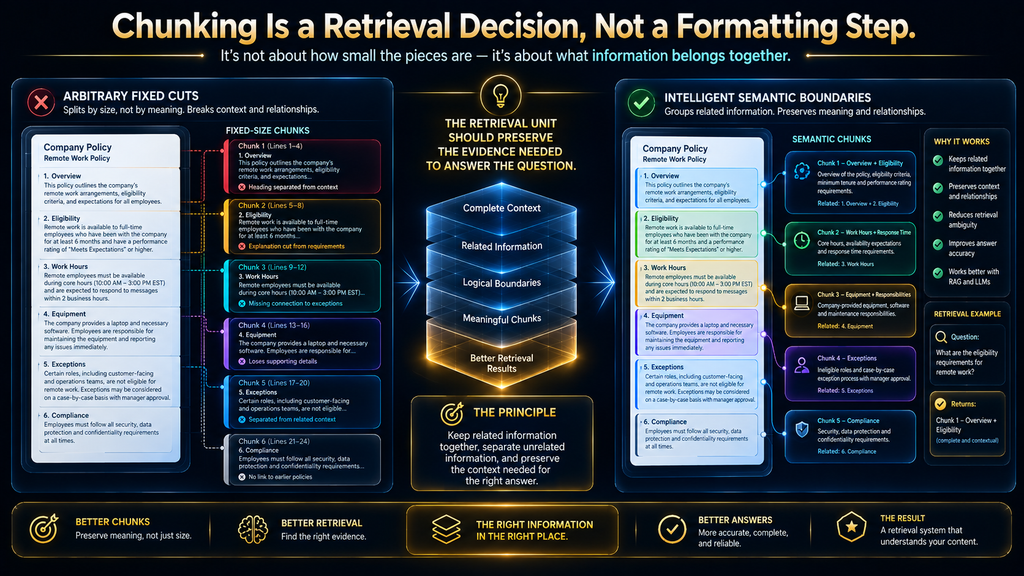
A document may contain exactly the information an AI assistant needs, yet retrieval can still fail because that information was divided badly. A policy exception may be separated from the rule it modifies, a table may be split from its column headings, or a long explanation may be broken into fragments that individually make little sense. The retrieval system can then return technically relevant text that is practically useless to the language model.
That is why document chunking should not be treated as a simple question of whether each chunk should contain 500, 1,000, or 2,000 tokens. Chunking is fundamentally a retrieval-unit design problem. The objective is to create units that are specific enough to retrieve accurately while preserving enough context to remain understandable and useful after retrieval.
There is no universal chunk size that works across every RAG application. A legal agreement, employee handbook, software manual, product catalog, research paper, financial report, and collection of support tickets have very different information structures. The best strategy depends on how information is organized in the source documents, how users ask questions, what evidence the system needs to retrieve, and how much surrounding context the generation layer requires.
This guide explains how to make those decisions systematically. It covers chunk size, overlap, structural chunking, semantic chunking, recursive strategies, parent-child retrieval, contextual approaches, tables and structured documents, metadata, multilingual content, failure modes, evaluation, and the practical process of choosing a chunking strategy for production RAG.
What Is Document Chunking in RAG?
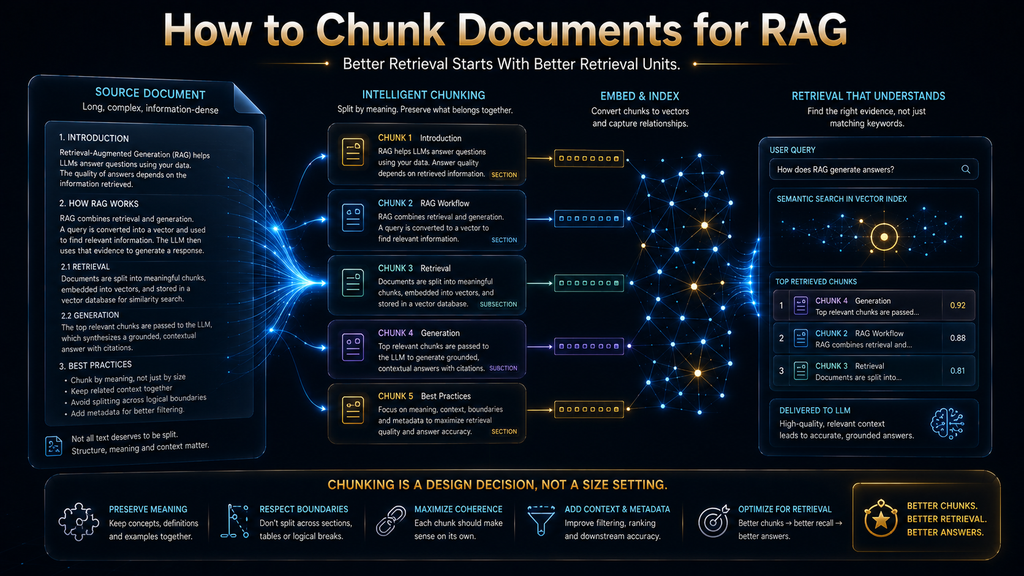
Document chunking is the process of dividing source material into smaller units that can be independently indexed, retrieved, ranked, and supplied to a language model as context.
The important word is independently. A chunk is not merely a smaller piece of a document; it becomes a unit that participates in the retrieval system. Once a document has been divided, the retrieval layer may select one chunk while ignoring its neighboring chunks. That means the chunk needs to carry enough information for the retrieval process to identify its relevance and enough context for the downstream model to interpret what it finds.
Consider a company policy document containing a section on travel reimbursement. The document might explain eligible expenses in one paragraph, define approval requirements in another, and describe exceptions several paragraphs later. A purely mechanical splitter might create three independent chunks. A user asking, “Can employees claim premium accommodation when traveling internationally?” could retrieve the accommodation rule but miss the exception that changes how the rule applies.
The problem in this example is not necessarily the embedding model, vector database, or language model. The relevant evidence was present in the source, but the ingestion process created retrieval units that did not preserve the relationship between the rule and its exception.
This leads to a more useful definition:
A good chunk is a retrieval unit that preserves the information relationships necessary for the questions the system is expected to answer.
That definition is more useful than a fixed token target because it changes the way chunking decisions are made. Instead of asking, “How many tokens should each chunk contain?” the engineering team should first ask, “What information needs to remain together for retrieval and interpretation to work?”
The answer will differ by document type and use case.
Why Chunking Has Such a Large Effect on Retrieval Quality
Chunking influences RAG at several stages simultaneously. It affects what gets embedded, what gets matched to a query, what gets returned to the generation model, how much irrelevant material enters the context window, and how easily the system can identify the precise evidence supporting an answer.
A useful way to understand this is to imagine the knowledge base as a library. The original documents are the books, while chunks are the individual catalogable sections that the retrieval system can discover. If the catalog only identifies enormous portions of each book, the search results may be broad but imprecise. If every sentence becomes its own catalog entry, retrieval may become highly specific while losing the surrounding meaning required to understand that sentence.
The chunking strategy therefore creates a fundamental trade-off between retrieval precision and contextual completeness.
Smaller chunks generally make it easier to isolate a narrow piece of evidence. This can be valuable when users ask precise questions and the source contains many unrelated topics. However, smaller units can also remove definitions, qualifiers, examples, headings, and exceptions that make the retrieved passage interpretable.
Larger chunks preserve more surrounding context, but they introduce a different problem. A large chunk may contain the answer alongside many unrelated paragraphs, making semantic matching less focused and increasing the amount of irrelevant context passed to the language model. The model then has to identify the useful evidence inside a larger block.
The optimal strategy is therefore not to maximize or minimize chunk size. It is to find a retrieval unit that provides the right level of information granularity for the application’s actual questions.
The Real Goal: Design Useful Retrieval Units
A common mistake is to begin chunking by choosing a token number. A stronger process begins with the information architecture of the documents.
Suppose a company is building a RAG assistant over technical documentation. A typical document may contain a title, introductory explanation, installation requirements, configuration instructions, troubleshooting procedures, examples, warnings, and version-specific notes. Splitting that document every 800 tokens ignores the fact that the document already contains meaningful structural boundaries.
A better strategy may recognize headings and subheadings first, then split unusually long sections into smaller units while keeping related information together. The resulting chunks may not all have the same size, but they can have a more useful semantic shape.
This is an important principle: uniform chunk size is not the same thing as uniform information value.
One section may need 350 tokens because it contains a complete definition. Another may need 1,400 tokens because a procedure requires several sequential steps to remain understandable. Forcing both sections into the same size can damage one of them.
A production system should therefore evaluate chunk quality across several dimensions.
Boundary quality
Does the chunk begin and end at a meaningful information boundary, or does it cut through a concept?
Self-sufficiency
Can a reader understand what the chunk is about without having the entire source document in front of them?
Specificity
Does the chunk contain a reasonably focused idea, procedure, rule, or topic that can match a query without bringing excessive unrelated information?
Context recoverability
If the chunk depends on information elsewhere in the document, can that surrounding context be recovered through metadata, parent-child relationships, neighboring retrieval, or another mechanism?
Retrieval usefulness
Does the chunk help the retrieval system identify the evidence that actually matters for realistic user questions? These dimensions are more informative than chunk size alone because they connect the ingestion process directly to the downstream task.
Start With the Document Structure Before Choosing Chunk Size
The first practical step in a chunking workflow should be document inspection.
Many documents already contain signals that indicate where information belongs together. Headings, subheadings, paragraphs, numbered procedures, bullet groups, tables, captions, sections, chapters, appendices, and metadata can all provide useful boundaries.
Ignoring these structures and applying a blind character or token splitter throws away information that the document itself is already providing.
Imagine a 40-page employee handbook with sections for leave, compensation, workplace conduct, remote work, expenses, and benefits. A fixed-size splitter may create chunks that contain the end of the remote-work section and the beginning of the expense policy simply because the token boundary happens to fall there. A structure-aware splitter can instead preserve the section boundaries and only subdivide a section when it becomes too large.
This does not mean structural chunking is always sufficient. A single section can itself be too long for efficient retrieval. The important point is that structural boundaries should generally be considered before arbitrary length boundaries.
A useful hierarchy might look conceptually like this:
- Document
- Major section
- Subsection
- Paragraph or logical block
- Smaller semantic unit when necessary
The actual hierarchy depends on the source format. A research paper, legal agreement, web page, PDF report, and support-ticket database will not share the same structure.
Fixed-Size Chunking: Simple, Useful and Often Misunderstood
Fixed-size chunking divides text according to a predetermined length, usually measured in tokens, characters, or another approximate unit. It remains popular because it is simple, predictable, inexpensive, and easy to implement.
There is nothing inherently wrong with fixed-size chunking. In fact, it can be a strong baseline, particularly when the source material is relatively uniform and does not contain reliable structural boundaries. It is also useful as a benchmark because more sophisticated strategies should demonstrate measurable improvement against something simple.
The problem occurs when a fixed size becomes an assumed answer rather than an experimental starting point.
Suppose a knowledge base contains short product descriptions, support articles, and long technical manuals. A fixed 1,000-token strategy may work reasonably well for the manuals but be wasteful for short articles. Conversely, reducing everything to 300 tokens could create precise retrieval units while fragmenting procedures and explanations.
The right question is therefore not whether fixed-size chunking is “good” or “bad.” It is whether the source corpus and query distribution are compatible with its assumptions.
For relatively homogeneous text, a fixed-size strategy with modest overlap can sometimes perform surprisingly well. For heterogeneous documents, structure-aware or hybrid strategies often become more attractive.
Choosing Chunk Size: What Should Actually Determine the Number?
There is no universal chunk size because chunk size is an engineering variable tied to the retrieval task. Several factors should influence the decision.
Query specificity matters. If users typically ask narrow factual questions, smaller retrieval units may improve precision because the relevant evidence can be isolated more effectively. If users ask broader questions requiring multiple connected concepts, larger or hierarchical retrieval units may work better.
Document structure matters. A document made of short, self-contained FAQ entries behaves differently from a technical manual containing long procedures. A chunk size that works well for one may perform poorly on the other.
Context dependency matters. If individual passages frequently rely on preceding definitions, headings, or exceptions, aggressive splitting can damage answerability. The system may need larger chunks, contextual metadata, parent-child retrieval, or another mechanism for recovering surrounding context.
Embedding behavior matters. Embeddings represent the content of the chunk. If a chunk contains several unrelated ideas, its representation can become less specific. If it contains too little information, the embedding may not contain enough semantic signal to distinguish the passage from similar material elsewhere.
Generation context matters. Retrieval does not happen in isolation. The retrieved chunks eventually become input to another model. Extremely large chunks can consume context unnecessarily, while extremely small chunks may force the generation layer to reconstruct relationships that were removed during ingestion.
The best chunk size is therefore the size that performs well against a representative evaluation set, not the number that happens to be popular in an example tutorial.
The Overlap Question: Why Adjacent Chunks Sometimes Need Shared Context
Chunk overlap means allowing consecutive chunks to share a portion of their content.
The basic rationale is straightforward. If an important sentence or relationship sits near a chunk boundary, overlap reduces the probability that the meaning will be split completely between two retrieval units.
For example, imagine a paragraph that begins by explaining a reimbursement rule and ends with an exception. If the first chunk ends immediately before the exception, retrieval may return the rule without the qualification. With overlap, the exception may appear in both chunks or at least remain available in a neighboring unit.
Overlap can therefore improve continuity, but it is not free.
More overlap creates more duplicated content in the index. It can increase storage and embedding costs, produce redundant retrieval results, and consume more context during generation. If the overlap is excessive, the system may return several chunks containing essentially the same passage rather than several independent pieces of evidence.
The goal should not be maximum overlap. It should be enough overlap to protect meaningful boundaries without turning retrieval into duplicate-content retrieval.
This is another area where experimentation matters more than a universal percentage.
Why Overlap Alone Cannot Fix Bad Chunking
Overlap is sometimes treated as a safety mechanism that makes almost any chunking strategy acceptable. It does not.
If a document is divided at arbitrary positions, overlapping those arbitrary positions still produces arbitrary retrieval units. The system may duplicate a poorly defined boundary without preserving the actual conceptual relationship.
Consider a technical procedure in which the first chunk contains the setup instructions and the second chunk contains the configuration parameters. A 20% overlap might preserve some of the setup information, but it does not guarantee that the configuration chunk will contain the heading, prerequisites, warning, and version requirement needed to interpret it correctly.
Overlap is therefore best understood as a boundary protection mechanism, not a replacement for meaningful boundaries. A strong chunking pipeline usually tries to create good units first and then uses overlap selectively where continuity requires it.
Recursive Chunking: A Practical Middle Ground
Recursive chunking attempts to preserve larger structural boundaries before falling back to smaller ones.
For example, a system might first try to split by major headings. If a resulting section is still too large, it may split by subheadings or paragraphs. If a paragraph remains too large, it can eventually fall back to sentences or smaller units.
This approach is useful because it respects document structure while still enforcing a practical maximum size.
The strength of recursive chunking is not that it magically understands meaning. Its value comes from prioritizing better boundaries before resorting to mechanical ones.
A technical manual might therefore remain organized around sections and procedures, while an unusually long section gets divided into smaller paragraph-level chunks. The result can be more coherent than applying the same token boundary to the entire document.
However, recursive chunking still depends on the quality of the structural signals available in the source. A badly extracted PDF with missing headings or corrupted formatting can undermine the strategy. The ingestion process therefore matters just as much as the chunking algorithm.
Semantic Chunking: When Meaning Matters More Than Length
Semantic chunking attempts to divide text according to changes in meaning rather than purely mechanical boundaries.
The underlying idea is that neighboring sentences often belong together until the subject or conceptual relationship changes. When the semantic relationship weakens sufficiently, a new chunk can be created.
This can be useful for documents with irregular paragraph lengths or weak formal structure. Instead of treating every paragraph boundary as equally meaningful, semantic approaches attempt to identify conceptual transitions.
However, semantic chunking introduces additional complexity. It may require additional model processing, threshold tuning, and evaluation. It can also produce unpredictable chunk sizes, making operational behavior less uniform.
More importantly, semantic similarity between neighboring sentences is not necessarily the same as retrieval usefulness. Two sentences may be semantically related but serve different roles in a question-answering workflow. Conversely, a heading and a short paragraph beneath it may be highly important together even if their semantic representations appear different.
Semantic chunking is therefore best treated as one tool in the design space rather than an automatic upgrade over simpler methods.
The Hidden Problem: Headings Are Context, Not Decoration
One of the most common chunking mistakes is removing headings from the text that gets embedded or retrieved. A paragraph such as:
Employees must submit claims within 30 days.
is ambiguous without context.
Thirty days for what? Travel expenses? Medical reimbursement? Equipment purchases? A particular employee group?
If the original document contains a heading such as Travel Expense Claims, that heading carries valuable retrieval information. Removing it can make the paragraph harder to match accurately and harder for the language model to interpret.
A better chunking pipeline often preserves structural context with the content itself. The retrieved unit might therefore effectively communicate that the statement belongs to the travel expense policy rather than presenting the sentence in isolation. This illustrates a broader principle: retrieval quality depends not only on what text is present in a chunk, but also on what context accompanies it.
Contextual Chunking: Preserving Meaning Without Making Chunks Huge
A useful strategy is to enrich chunks with contextual information without simply increasing their size.
For example, a chunk might retain the document title, section heading, subsection heading, and relevant metadata alongside the actual passage. The retrievable text can then carry enough context to make a relatively small unit more interpretable.
This is particularly useful when the source contains repeated language.
Imagine a large policy library where many sections contain sentences such as “Requests must be approved before processing.” Without context, several chunks could look almost identical. Adding the section or document context helps distinguish what kind of request each passage describes.
Contextual enrichment therefore attempts to achieve something that large chunks achieve less efficiently: preserve contextual identity while maintaining retrieval granularity.
This becomes increasingly important as knowledge bases grow. In a small collection, similar passages may be manageable. In a large enterprise corpus containing thousands of documents, ambiguous chunks can create serious retrieval competition.
Parent-Child Chunking: Separate Search Granularity From Reading Context
Parent-child retrieval is another strategy for resolving the tension between precise retrieval and sufficient context. The basic idea is to create smaller child units for retrieval while associating them with larger parent units that contain broader context.
A small child chunk may be highly specific and therefore easier to match to a query. Once it is selected, the system can return the associated parent section or a controlled amount of broader context to the generation layer.
This approach is particularly useful when the smallest useful retrieval unit is not the same size as the smallest useful reasoning context.
Consider a long technical manual. A specific paragraph describing a configuration parameter might be ideal for matching a query about that parameter. But the model may also need the surrounding section to understand prerequisites, supported versions, or warnings. Retrieving the entire manual would be excessive, while retrieving only the paragraph could be insufficient.
Parent-child retrieval allows the system to search at one granularity and reason over another. That distinction is one of the most important ideas in modern RAG chunking.
Chunking Is a Trade-Off Between Search Granularity and Reasoning Context
A RAG system effectively has two related but different requirements. The retrieval layer wants enough specificity to identify the right evidence.
The generation layer wants enough context to interpret that evidence correctly. Those requirements do not always point toward the same chunk size.
Small chunks can improve retrieval precision while making interpretation harder. Large chunks can make interpretation easier while increasing irrelevant context and reducing retrieval specificity.
Parent-child retrieval, contextual enrichment, neighboring-chunk expansion, and other hierarchical techniques are attempts to address this tension without forcing one chunk size to perform every job.
This is why the statement “use 500-token chunks” is incomplete advice. It answers only one part of a much larger architectural question.
The more useful question is: What should the retrieval system search, and what context should the generation system receive after that search succeeds? Once those are treated as separate design decisions, chunking becomes much easier to reason about.
When Small Chunks Work Well
Small chunks are most useful when individual passages are relatively self-contained and users ask narrow questions.
A product catalog is a good example. If each product entry contains a product name, description, specifications, and relevant attributes, a moderately small chunk can represent a single product cleanly. Retrieval can then distinguish among products without bringing unrelated catalog material into the context.
Frequently asked questions can behave similarly. Each question-and-answer pair may already be a natural retrieval unit.
Small chunks can also be useful for highly specific technical or policy queries where the evidence is concentrated in short passages. But small does not automatically mean precise.
If the corpus contains many similar statements, a very small chunk may lack enough context to distinguish them. If a sentence contains pronouns, references to previous sections, or omitted subjects, the resulting retrieval unit may be semantically weak despite being short.
The key is self-contained specificity, not smallness for its own sake.
When Larger Chunks Work Better
Larger chunks become useful when meaning depends strongly on surrounding material.
Long procedures are a common example. A user asking how to configure a system may need prerequisites, configuration instructions, validation steps, and troubleshooting notes. Splitting every sentence independently may create fragments that cannot answer the question effectively.
Research papers can present a similar challenge. A finding may only make sense alongside the methodology, population, conditions, or limitations described nearby. A small isolated sentence could be retrieved accurately while still being insufficient evidence for a responsible answer.
Legal and compliance documents can be particularly sensitive to context because definitions, exceptions, scope clauses, and cross-references can materially change the meaning of an individual sentence. In these cases, larger chunks may be appropriate, or a hierarchical retrieval strategy may be preferable.
A Better Way to Think About Chunk Size
Rather than selecting a number first, start with a representative set of questions.
Take real or realistic user queries and identify the minimum source passage needed to answer each one correctly. Then examine where that evidence sits within the source document.
If the answer consistently fits inside small, self-contained sections, smaller chunks may be appropriate. If the answer repeatedly requires neighboring paragraphs, headings, examples, or exceptions, the chunking strategy needs to preserve those relationships somehow.
If the evidence is narrow but the interpretation requires broader context, consider separating retrieval granularity from returned context through parent-child retrieval or neighboring context expansion. This process converts chunk-size selection from a theoretical debate into an empirical design exercise.
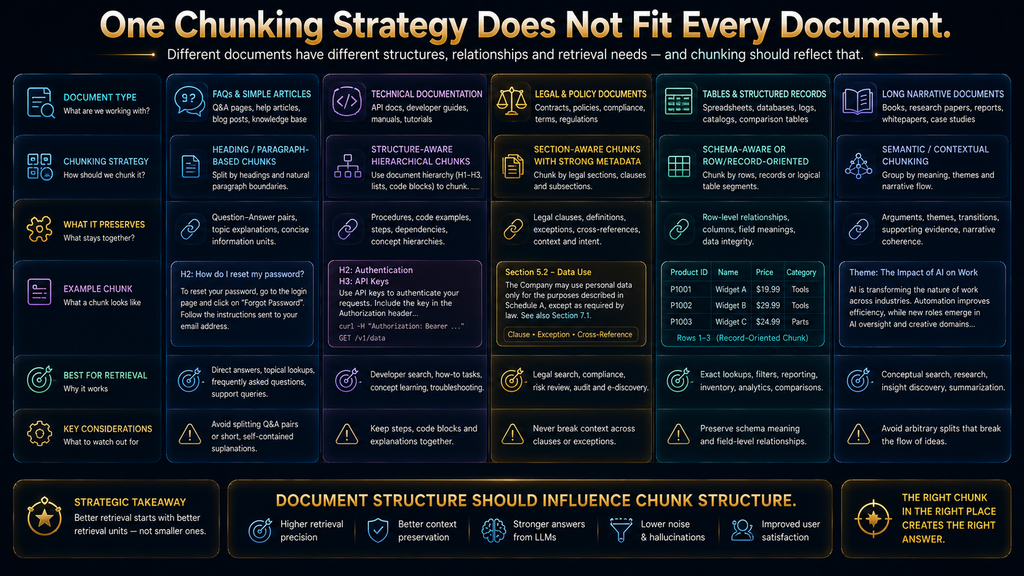
How Document Type Should Influence Chunking Strategy
Different document families create different chunking problems. A single global strategy can therefore be convenient operationally while being suboptimal technically.
| Document type | Common chunking challenge | Often useful starting approach |
|---|---|---|
| FAQs | Entries are usually naturally self-contained | Question-answer or entry-level chunks |
| Technical documentation | Procedures depend on headings and prerequisites | Structure-aware or recursive chunks |
| Legal agreements | Definitions, exceptions and cross-references matter | Structure-aware + contextual/hierarchical retrieval |
| Research papers | Findings depend on surrounding methodology and limitations | Section-aware chunks with contextual retrieval |
| Employee handbooks | Rules often contain exceptions and scope conditions | Section-aware chunks with metadata |
| Product catalogs | Individual records are often distinct | Record-level chunks |
| Support tickets | Conversations contain temporal context | Conversation/thread-level or contextual chunks |
| Web pages | Navigation and boilerplate can pollute content | Clean extraction + structural chunks |
| Financial reports | Tables and captions carry meaning | Structure-aware extraction with table preservation |
| Code documentation | Examples and surrounding explanations matter | Function/class/section-aware chunks |
The table is not a prescription. It is a starting point for experimentation. The correct strategy still depends on the questions users actually ask.
Tables Are One of the Hardest Chunking Problems
Tables deserve special treatment because their meaning often depends on relationships that disappear when the table is converted into plain text.
Consider a table with columns for product, region, revenue, growth rate, and reporting period. If extraction produces a chunk containing only:
“North America — 24.6%” the number is nearly meaningless. The column heading and row context are part of the evidence.
A chunking system that treats tables like ordinary paragraphs can therefore create retrieval units that look small and clean while actually destroying the information needed to interpret them. A better approach may preserve table structure, attach relevant headings, represent rows or logical groups with their column context, or use specialized extraction and retrieval strategies for structured data.
This is a good example of why chunking cannot be separated completely from document parsing. If the ingestion layer destroys structure before chunking begins, no chunk-size adjustment can fully restore it.
Lists, Procedures and Numbered Steps Need Their Own Logic
Numbered procedures present another boundary problem.
Suppose a document contains a six-step process for configuring an application. If the steps are split across multiple chunks, a user retrieving step four may not receive the prerequisite information from steps one through three.
At the same time, placing dozens of unrelated procedures into one giant chunk would make retrieval less precise.
A better strategy is usually to treat the procedure as a logical unit first and then decide whether it needs to be subdivided. If subdivision is necessary, preserving the procedure title and step context becomes important.
For example, a chunk containing steps four through six should still indicate which procedure those steps belong to and, where necessary, provide enough context to explain their dependencies. This is another situation where metadata and contextual enrichment can be more efficient than simply increasing chunk size.
PDFs Can Create Chunking Problems Before Chunking Even Starts
PDF documents often look structured to a human reader while being structurally messy when extracted into text.
Headers may be repeated on every page. Footers may appear inside paragraphs. Multi-column layouts may be extracted in the wrong order. Tables may collapse into unreadable sequences. Captions can become detached from figures. A sentence may be split across pages without obvious structural information.
If that text is sent directly into a chunking algorithm, the resulting chunks may faithfully preserve the extraction errors. This produces an important diagnostic rule: If chunking appears to be failing consistently, inspect the extracted document before changing the chunk size. A chunking problem can actually be a parsing problem.
For example, if a document’s heading is separated from every paragraph beneath it during extraction, a structure-aware chunker may never receive the structure it needs. Likewise, if table columns are flattened incorrectly, changing overlap will not restore the original relationships.
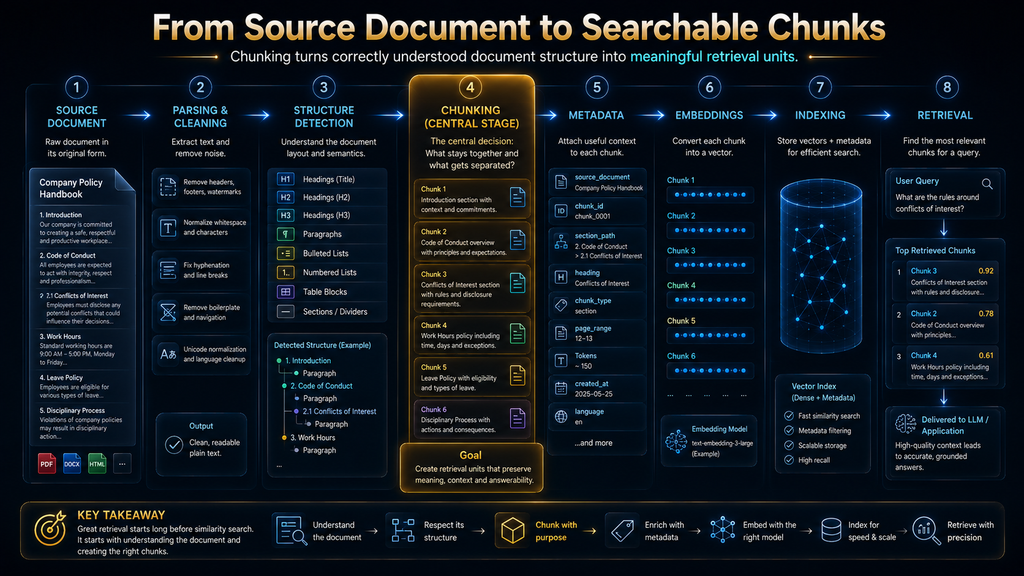
The ingestion pipeline and chunking pipeline should therefore be evaluated together.
Metadata Can Compensate for Context That Should Not Be Repeated
Metadata provides another way to preserve context without copying large amounts of text into every chunk. Useful metadata can include document title, source type, author, department, publication date, version, product, region, language, access permissions, section title, document status, and other attributes relevant to retrieval. This can improve both filtering and interpretation.
Suppose a company has current and archived versions of the same policy. Two chunks may contain nearly identical language, but metadata can distinguish the active document from an obsolete version. The retrieval system can then filter or rank accordingly.
Metadata also supports more precise evaluation. If a retrieval failure occurs, the team can determine whether the system retrieved the wrong section, wrong version, wrong document type, or wrong jurisdiction rather than simply concluding that semantic similarity failed.
Good metadata does not replace good chunking, but it can make each chunk more identifiable and retrievable.
Chunking and Metadata Should Be Designed Together
A useful chunking architecture treats the chunk as more than a block of text. Conceptually, a retrieval unit may contain:
- the actual text;
- document identity;
- structural location;
- version information;
- relevant categorical metadata;
- relationships to parent or neighboring units;
- information needed to reconstruct broader context.
This richer representation gives the retrieval system more information about what it is searching.
It also creates opportunities for filtering before semantic ranking. For example, a query about a specific product version may be restricted to documents with the correct version metadata before vector similarity is applied.
This can reduce the burden on semantic retrieval because the search space is already constrained.
The deeper lesson is that retrieval quality is partly an information architecture problem. Chunking is one component of that architecture, not an isolated preprocessing trick.
Multilingual Documents Require Additional Care
Chunking multilingual content introduces considerations beyond simply changing the tokenizer.
Different languages have different sentence structures, writing conventions, tokenization behavior, and average information density. A chunk size that works well for one language may not produce equivalent semantic units in another.
There is also the question of whether users will query documents in the same language in which they were written.
A multilingual knowledge base may contain English policies, Bengali employee communications, Arabic contracts, Spanish support material, and other sources. If the system retrieves across these materials, chunk boundaries should preserve enough language-specific structure for the embedding and generation systems to work effectively.
Mixed-language documents create another challenge. A heading may appear in one language while the body appears in another, or translated versions may sit beside original text.
The correct response is not necessarily to create a separate chunking strategy for every language. Instead, test whether the chosen segmentation strategy produces comparable retrieval behavior across the languages represented in the corpus.
Chunking Does Not End When the Chunks Are Created
One of the most important operational mistakes is treating chunking as a one-time preprocessing decision.
Documents change. New versions are added. Old versions are removed. Formatting changes. User questions evolve. Retrieval models change. Embedding models are replaced. The distribution of queries can shift as users discover new capabilities.
A chunking strategy that worked well during initial testing can therefore become less effective later.
Suppose an internal assistant originally handled simple policy questions. Users eventually begin asking comparative questions involving multiple policies and exceptions. The existing chunks may have been designed around narrow lookups and may not preserve enough context for those broader queries.
The chunking strategy has not necessarily become “wrong.” The workload changed. This is why production RAG systems need ongoing evaluation rather than treating ingestion configuration as permanent infrastructure.
The Most Common Chunking Mistakes
Several mistakes appear repeatedly because they are easy to implement and easy to overlook.
Choosing a Popular Chunk Size Without Testing
A number copied from another project is not evidence that the number fits your documents. Even two systems using the same model and vector database may require different chunking because their documents and user questions differ.
Splitting Only by Token Count
Mechanical boundaries can cut through headings, definitions, procedures, tables, examples, and exceptions. Fixed-size splitting is useful as a baseline, but it should not automatically become the production strategy.
Making Chunks Too Small
Tiny chunks can improve apparent precision while removing the context required to interpret the evidence. The retrieval system may find the correct sentence but still fail to provide a usable answer.
Making Chunks Too Large
Large chunks can reduce retrieval specificity and increase irrelevant context. They can also make it harder to distinguish multiple topics contained in the same unit.
Assuming Overlap Solves Everything
Overlap protects some boundary information but cannot repair poor document structure, bad extraction, or fundamentally inappropriate chunk sizes.
Removing Headings
A heading often contains essential semantic context. Treating it as presentation rather than information can make otherwise useful passages ambiguous.
Ignoring Tables
Flattened tables can become semantically broken retrieval units. Numbers without their row and column context may be nearly useless.
Mixing Document Versions
If old and current versions are indexed together without clear metadata or filtering, retrieval may surface outdated information even when chunking itself is technically sound.
Optimizing Against Synthetic Questions Only
A chunking strategy can look excellent on a handful of manually written questions and fail badly on real user queries. Evaluation needs representative workloads.
Blaming Chunking for Every Retrieval Failure
Poor extraction, weak embeddings, bad metadata filters, ambiguous queries, unsuitable top-K values, and ranking problems can all produce retrieval failures. Chunking is important, but it is not the only variable.
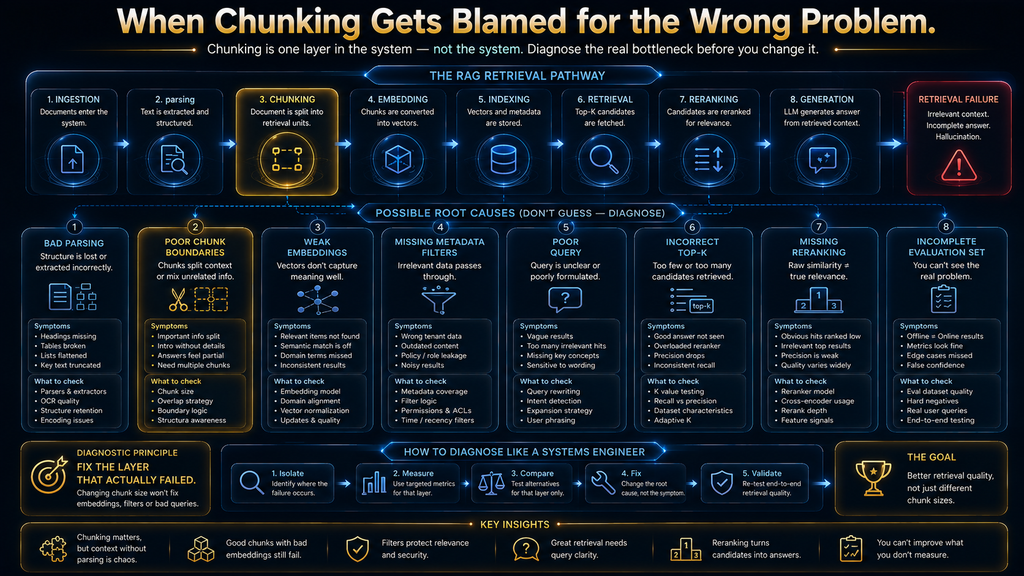
Do Not Blame Chunking Before Diagnosing the Retrieval Failure
When a RAG system returns poor answers, teams often immediately ask whether the chunks are too large or too small. Sometimes they are. But the same symptom can be caused by many other stages of the pipeline.
A document may have been extracted incorrectly. A table may have lost its structure. The embedding model may perform poorly for the language or domain. Metadata filtering may be missing. The query may be ambiguous. The retrieval top-K may be poorly calibrated. A reranker may be needed. The source may contain contradictory versions of the same policy.
This matters because chunking is highly visible and relatively easy to change. Teams can therefore spend significant time adjusting chunk sizes when the actual failure occurs elsewhere.
A better diagnostic sequence starts by asking where the evidence was lost.
If the correct information exists in the source but never appears among the retrieved candidates, the problem is primarily retrieval-side. If the correct chunk was retrieved but the model fails to use the evidence, the problem may belong to context construction or generation. If the information was destroyed during extraction, changing the chunking algorithm may accomplish very little.
This distinction saves considerable engineering time.
Retrieval Failure and Generation Failure Are Different Problems
Imagine that a user asks: “Can employees carry unused vacation days into the next calendar year?” The knowledge base contains the correct policy.
If retrieval returns three irrelevant sections about sick leave, travel reimbursement, and remote work, the system has a retrieval problem. The model cannot reliably answer from evidence it never received.
Now imagine that retrieval returns the correct vacation policy, including the paragraph explaining the carryover rule, but the model incorrectly states that all unused days expire. That is a different problem. The evidence reached the generation layer, but the model failed to interpret or use it correctly.
Chunking can contribute to both situations, but the corrective actions are different. This is why evaluation should separate at least the following questions:
- Was the correct source document retrieved?
- Was the correct section retrieved?
- Was the necessary evidence present in the retrieved context?
- Was enough context available to interpret that evidence?
- Did the model use the evidence correctly?
Without these distinctions, teams can misdiagnose generation failures as chunking failures or retrieval failures as model failures.
A Practical Chunking Decision Framework
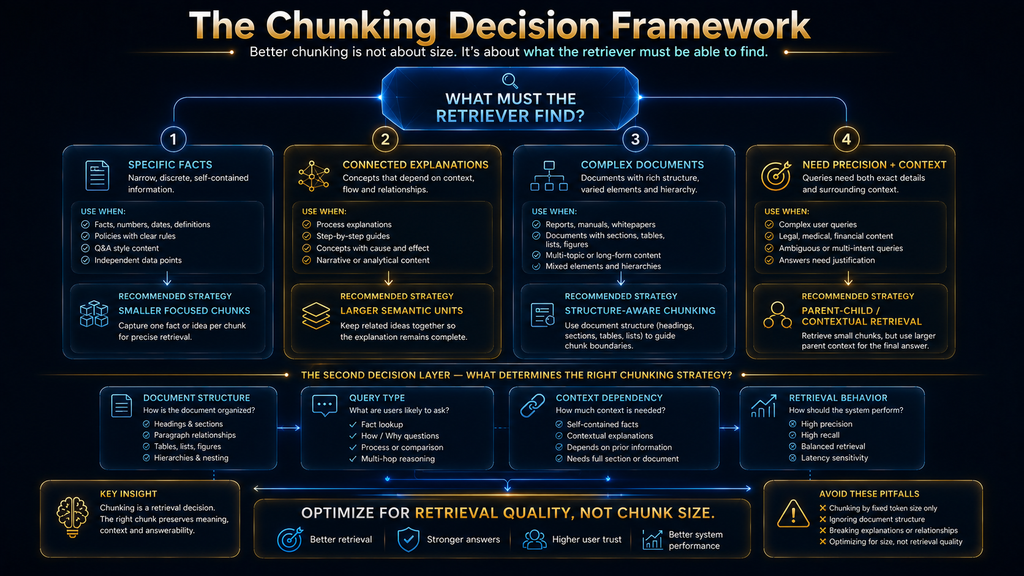
Instead of asking which chunking method is “best,” evaluate the corpus through a sequence of decisions.
First: What is the natural information unit?
Is it a paragraph, FAQ entry, product record, section, procedure, conversation, table, or something else?
Second: Is that unit small enough for efficient retrieval?
If yes, it may already be a suitable chunk. If not, determine where meaningful subdivisions exist.
Third: Does the unit depend on surrounding context?
If it does, preserve that relationship through larger chunks, metadata, contextual enrichment, neighboring retrieval, or parent-child architecture.
Fourth: Are there repeated or ambiguous passages?
If so, strengthen contextual identity through headings, document metadata, version information, or other retrieval constraints.
Fifth: What do real queries require?
Use representative questions to determine whether the current units provide sufficient evidence and specificity.
Sixth: Can the strategy be evaluated objectively?
Define retrieval metrics and answer-level outcomes before declaring the configuration successful. This process is much more reliable than choosing a token number first and attempting to make the rest of the architecture fit around it.
A Controlled Experiment Is Better Than a Chunking Argument
Chunking debates can become surprisingly subjective.
One engineer prefers 500 tokens. Another prefers 1,000. Someone else recommends semantic chunking. Another argues that recursive splitting is sufficient.
The most reliable way to resolve the disagreement is to test the alternatives against the same evaluation set.
Start with a baseline strategy. It could be structure-aware fixed-size chunking, recursive chunking, or another simple approach appropriate to the corpus. Then create a representative question set covering the actual types of queries the system must answer.
For each question, determine which source passage contains the necessary evidence. This creates a retrieval ground truth against which alternative strategies can be evaluated.
Then change the chunking strategy while keeping other important variables as stable as possible. If the embedding model, top-K, reranker, query processing, and prompt all change simultaneously, it becomes difficult to determine which change produced the improvement.
A useful experiment may compare:
| Strategy | Retrieval precision | Evidence coverage | Context quality | Duplicate retrieval | Operational complexity |
|---|---|---|---|---|---|
| Fixed-size baseline | Measure | Measure | Measure | Measure | Low |
| Structure-aware | Measure | Measure | Measure | Measure | Low–Medium |
| Recursive | Measure | Measure | Measure | Measure | Medium |
| Semantic | Measure | Measure | Measure | Measure | Medium–High |
| Parent-child | Measure | Measure | Measure | Measure | Higher |
| Context-enriched | Measure | Measure | Measure | Measure | Higher |
The important part is not which row looks impressive. It is whether the strategy improves the outcomes that matter for the application.
What Should You Measure?
Chunking should ultimately be judged by retrieval and answer quality rather than by how elegant the ingestion pipeline looks. Useful retrieval measurements can include whether the correct evidence appears among the retrieved candidates, how high it appears in the ranking, how much irrelevant context is included, and how often duplicate or near-duplicate chunks consume retrieval slots. Answer-level evaluation can then ask whether the final response is supported by the retrieved evidence, whether important details were omitted, and whether the model incorrectly combined unrelated passages.
A simple retrieval metric can be framed as recall at K: did the required evidence appear somewhere in the top K retrieved chunks? Another useful concept is precision at K: how much of the retrieved material is actually relevant to the question?
Neither metric tells the entire story. A system could retrieve the correct paragraph but fail to provide the surrounding exception needed to interpret it. That is why evidence completeness and context sufficiency are also important.
For production systems, teams should ideally maintain a representative evaluation set containing different question types, document types, difficulty levels, and known edge cases.
Retrieval Quality Is More Than “Did the Right Chunk Appear?”
Imagine a question requiring two pieces of evidence. The first chunk explains a rule. The second explains an exception.
A retrieval system that returns only the first chunk may technically retrieve relevant information while still failing the question. This is why retrieval evaluation should consider evidence completeness, not merely keyword or semantic relevance.
The same problem appears with definitions. A retrieved chunk may mention a term but not include the definition needed to interpret it correctly.
It also appears with tables. A retrieved row may contain the number the user needs but omit the column heading that explains what the number represents.
In each case, retrieval appears superficially successful while the context is functionally incomplete. Good chunking therefore aims not simply to maximize relevance but to create retrieval units that preserve the evidence relationships required by realistic questions.
The Role of Top-K in Chunking Decisions
Top-K determines how many retrieval candidates are passed forward from the initial search stage. Chunk size and top-K interact.
If chunks are very small, a low K may return only fragments of the required context. Increasing K may recover neighboring information but can also introduce more noise.
If chunks are very large, a low K may provide enough context but contain significant irrelevant material. Increasing K can make the generation context even more crowded.
This means chunk size should not be optimized independently of retrieval configuration. However, there is a trap here: increasing K should not become a substitute for good chunking. If the correct answer requires retrieving six neighboring fragments every time, the architecture may be telling you that the retrieval unit is too granular or that a hierarchical context strategy would be more appropriate.
The goal is not to retrieve as much text as possible. The goal is to retrieve the right evidence with enough context to use it correctly.
Reranking Can Help, But It Does Not Repair Everything
A reranker can improve retrieval by taking an initial set of candidate passages and ordering them according to a more detailed relevance assessment. This can be particularly useful when semantic retrieval produces several plausible candidates. But reranking cannot recover evidence that was never retrieved.
If the chunking process separated the necessary context into fragments and the initial retrieval stage fails to retrieve the relevant fragment, the reranker has nothing to work with. Likewise, if extraction destroyed a table’s structure, a reranker cannot reconstruct the original table semantics simply by reordering the broken text. This is another example of the dependency chain within a RAG system: later components can refine what earlier components provide, but they cannot reliably compensate for every upstream loss of information.
Chunking and Query Rewriting Are Closely Connected
The best retrieval unit also depends on how users formulate questions. Users rarely phrase questions exactly as the source documents do.
A policy may say “eligible dependent healthcare expenditures,” while the user asks, “Can I get reimbursed for my child’s medical expenses?” A strong retrieval system needs to bridge that vocabulary difference.
If chunks are too generic, several similar passages may match the query. If they are well scoped and contextually identified, semantic retrieval has a better chance of distinguishing the correct passage.
Query rewriting can help by expanding or reformulating the user’s question, but again, it cannot create information that the retrieval units do not represent effectively. This is why chunking should be evaluated against actual query language rather than document language alone.
The Relationship Between Chunking and Embeddings
Chunking and embeddings are tightly coupled because the embedding model represents the content of each retrieval unit.
A chunk containing several unrelated concepts may produce an embedding that reflects a blended representation of those concepts. A query targeting one narrow concept may then match the chunk because of one part of its content while also bringing several unrelated topics into the context.
A highly focused chunk can produce a more specific representation, but excessive fragmentation can remove important context. This creates another balance between semantic concentration and contextual completeness.
Importantly, changing the embedding model does not automatically fix bad chunking. A stronger model may improve semantic representation, but it still receives the chunks created by the ingestion pipeline.
If the correct relationship has been destroyed before embedding, the embedding model has limited ability to reconstruct it.
Why “More Chunks” Does Not Mean Better Retrieval
Large collections can tempt teams into thinking that smaller chunks create better search because the system has more searchable units. That assumption is incomplete.
Increasing the number of chunks increases retrieval granularity, but it can also increase the number of near-duplicate or context-poor candidates. The search system now has more units competing for attention.
Imagine dividing a long document into 50 chunks, then into 500. The second configuration may appear more precise because each unit is smaller. But if the answer requires context from several of those units, retrieval now has to reconstruct relationships that previously existed naturally within the document.
The index becomes larger without necessarily becoming more useful.
The objective is therefore not to maximize the number of chunks. It is to create a useful information topology for retrieval.
When Neighboring-Chunk Retrieval Makes Sense
Sometimes the best answer to a retrieval problem is not to enlarge every chunk but to retrieve neighboring chunks when one relevant unit is found. This can be useful for documents where adjacent sections frequently contain related context.
For example, if a retrieved paragraph contains a policy rule, the system may also retrieve the preceding heading and following paragraph. This allows the model to receive broader context without making every indexed chunk large.
Neighbor expansion should still be controlled. Blindly returning five chunks before and five after every result can produce substantial noise, particularly in documents where adjacent sections cover different topics.
The appropriate neighborhood size depends on document structure and question types. This is another technique that should be evaluated rather than assumed to help.
Chunking for Long Documents Requires Hierarchy
Very long documents expose the limitations of flat chunking.
Consider a 300-page regulatory document. A user may ask about a specific requirement, but the answer could depend on the chapter, jurisdiction, definition section, and exception clauses.
Representing the entire document as hundreds of independent chunks can lose the hierarchy that makes the material understandable.
A hierarchical strategy can preserve relationships between document, chapter, section, subsection, and passage. Retrieval can identify a specific passage while maintaining the ability to recover broader context when necessary.
This is particularly useful for complex knowledge bases where documents are not merely collections of paragraphs but structured information systems. The larger the source material becomes, the more important it becomes to think about relationships between retrieval units, not just their individual size.
Chunking and Version Control
Versioning deserves special attention in enterprise RAG.
Suppose a company publishes a new travel policy every year. If the old and new policies are indexed without clear version metadata, a query about current reimbursement rules may retrieve an obsolete paragraph because it happens to be semantically similar to the question.
The problem can appear to be a retrieval-quality issue, but the underlying solution may be metadata filtering or document lifecycle management. Chunking should therefore preserve information such as effective date, document status, version number, department, jurisdiction, or other attributes that determine applicability.
In some applications, outdated documents should not be retrieved at all. In others, they may remain searchable for historical questions but should be ranked differently.
The correct architecture depends on the intended use, but the chunk should not lose the information required to make that distinction.
Security and Permissions Must Survive Chunking
Enterprise knowledge systems introduce another requirement: access control. If a document is available only to a specific team, its chunks must retain enough identity and permission metadata for the retrieval layer to enforce those restrictions. A technically excellent chunking strategy becomes unacceptable if it allows a user to retrieve information from a document they are not authorized to access.
This is why chunking should be part of the ingestion architecture rather than treated as an isolated text-processing function. The system needs to know not only what the chunk says but also where it came from, who can access it, what version it represents, and what larger information structure it belongs to.
What Happens When You Do Nothing?
Poor chunking rarely causes an obvious system crash. That is part of the problem.
The application may continue responding normally while retrieval quality gradually deteriorates. Users may receive answers that sound plausible but omit qualifications, cite incomplete evidence, or mix related but distinct pieces of information.
The team may then interpret these failures as model hallucinations and start changing prompts, models, vector databases, or top-K settings. If the underlying problem is poor retrieval-unit design, those changes may produce little improvement.
Over time, this creates a costly pattern: more infrastructure experimentation without solving the information architecture problem. The better approach is to treat chunking as part of the system’s quality foundation and evaluate it alongside retrieval and generation.
A Practical Production Workflow for Chunking Documents
A dependable implementation process does not need to be complicated, but it should be disciplined.
1. Inventory the document corpus
Start by identifying what kinds of documents the system will actually retrieve. Separate PDFs, web pages, manuals, policies, spreadsheets, support conversations, research papers, product records, and other formats rather than assuming they all have the same structure.
The goal is to understand the information architecture before applying a chunking strategy.
2. Inspect extraction quality
Before measuring chunk quality, verify that the source text is being extracted correctly. Check headings, tables, lists, page boundaries, repeated headers, footers, captions, and other structures that could affect segmentation.
If the extraction is wrong, chunking evaluation will produce misleading results.
3. Identify natural boundaries
Determine whether sections, subsections, paragraphs, records, procedures, or other structures represent meaningful information units. Preserve these boundaries whenever practical.
4. Establish a baseline
Use a straightforward chunking method as a reference point. A baseline gives the team something measurable against which more sophisticated strategies can be compared.
5. Build a representative evaluation set
Create questions that reflect real user behavior. Include straightforward lookups, multi-step questions, exception cases, comparative questions, questions involving tables, and questions requiring contextual interpretation.
6. Test alternative strategies
Compare different chunk sizes, overlap levels, structural rules, semantic approaches, or hierarchical strategies while keeping other retrieval variables reasonably stable.
7. Diagnose failures by stage
For every failed question, determine whether the problem occurred during extraction, chunk creation, indexing, retrieval, ranking, context assembly, or generation.
8. Choose based on outcomes
Select the strategy that produces the best balance of retrieval quality, answer quality, cost, latency, and operational complexity for the actual workload.
9. Monitor after deployment
Continue evaluating representative queries because documents, users, and retrieval patterns change over time. This process is much more reliable than selecting a chunk size once and assuming the decision is permanent.
A Simple Chunking Evaluation Checklist
Before adopting a production strategy, ask:
| Question | Why it matters |
|---|---|
| Does each chunk have a meaningful boundary? | Prevents arbitrary concept splitting |
| Can the chunk be understood with limited surrounding context? | Improves generation quality |
| Does it contain a focused topic or task? | Improves retrieval specificity |
| Are headings preserved? | Maintains semantic identity |
| Are tables represented correctly? | Protects structured evidence |
| Are versions and permissions preserved? | Prevents unsafe or outdated retrieval |
| Can related context be recovered? | Protects context-dependent answers |
| Does the strategy work across document types? | Reduces corpus-specific failures |
| Does it perform well on real questions? | Connects chunking to actual utility |
| Can the system be monitored and re-evaluated? | Supports production maintenance |
The checklist is intentionally broader than chunk size because production retrieval quality is broader than chunk size.
How to Improve Chunking Without Rebuilding the Entire RAG System
A useful benefit of treating chunking as an independent layer is that teams can often improve it without replacing the entire architecture.
Start by inspecting failed queries and identifying whether the evidence was split incorrectly. If headings are missing, preserve them. If sections are too large, introduce structure-aware subdivision. If small chunks repeatedly require neighboring context, test parent-child or neighboring retrieval.
If tables are failing, improve table extraction rather than simply changing token limits. If current and outdated documents compete, strengthen metadata and version filtering.
If chunks are semantically useful but difficult for the generation model to interpret, test contextual enrichment. These interventions are more targeted than blindly changing the embedding model or vector database.
The goal is not to make the ingestion pipeline sophisticated for its own sake. It is to remove the specific information loss responsible for the observed retrieval failures.
A Useful Mental Model: Chunking as Information Compression
There is another way to understand the problem.
When a document is converted into chunks, the system is effectively transforming a continuous structured source into a collection of independently searchable units. Some relationships are preserved, while others may be lost.
In that sense, chunking behaves somewhat like information compression.
The source document contains relationships among headings, paragraphs, tables, examples, definitions, exceptions, and sections. The chunking process decides which of those relationships remain directly visible inside each retrieval unit and which must be reconstructed later.
Good chunking preserves the relationships that matter for retrieval. Bad chunking discards them.
This is why a chunk can be technically valid text and still be a poor retrieval unit. It may contain grammatically complete sentences while lacking the relationships needed to answer questions correctly.
The Most Important Trade-Off: Precision vs Completeness
Almost every chunking decision can be understood through one central tension. Precision asks whether the retrieved unit closely matches the information the user is seeking. Completeness asks whether the retrieved unit contains enough evidence and context to answer the question correctly.
Smaller chunks often improve precision but can reduce completeness. Larger chunks often improve completeness but can reduce precision. Parent-child retrieval attempts to separate these objectives.
Contextual enrichment attempts to preserve context without greatly increasing chunk size. Neighbor retrieval attempts to recover surrounding information after a precise unit is found. Semantic and structure-aware chunking attempt to improve the quality of the boundaries themselves.
Seen this way, the different chunking techniques are not competing ideologies. They are different ways of managing the same underlying trade-off.
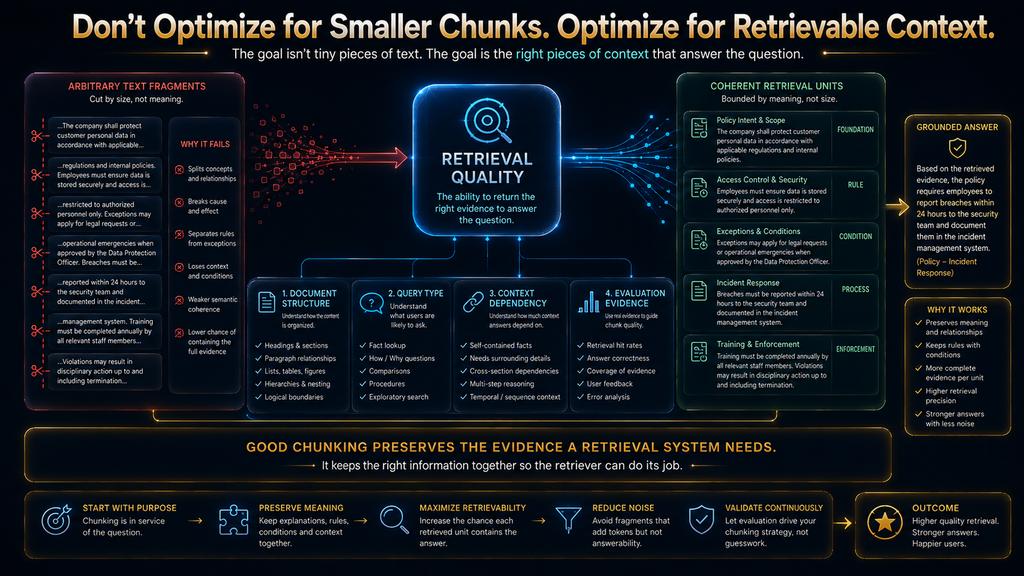
Why There Is No “Best Chunk Size”
The idea of a universal optimal chunk size is attractive because it makes RAG engineering sound simpler than it really is. But a chunk is useful only in relation to the information it represents and the questions the system must answer. A 300-token chunk can be excellent for a self-contained FAQ answer and terrible for a multi-step technical procedure.
A 1,500-token chunk can be excessive for a product description and appropriate for a regulatory section containing definitions and exceptions. A 700-token chunk can work well for one language and document family while producing different semantic density in another.
The correct target is therefore not a number. It is a retrieval behavior.
If changing the chunk size improves evidence retrieval, context completeness, and answer quality on representative queries, that change has value. If it merely produces a preferred number without improving outcomes, the number itself is not meaningful.
The Deeper Lesson: Chunking Is About Relationships
The strongest chunking strategies do not ask only how much text should go into a chunk. They ask which pieces of information need to remain connected. A policy rule may need its exception.
A table value may need its column heading. A procedure step may need its procedure title. A technical parameter may need its version information.
A research finding may need its methodological context. A support-ticket message may need the preceding customer question. These relationships are the real design problem.
Once that is understood, the reason behind different chunking strategies becomes clearer. Structure-aware chunking preserves document hierarchy. Semantic chunking tries to preserve conceptual coherence. Contextual approaches add identifying information. Parent-child retrieval separates search granularity from reasoning context. Neighbor retrieval restores local context after a relevant passage is found.
They are all attempts to answer the same underlying question: What information must travel together for retrieval to produce useful evidence?
How Chunking Fits Into the Larger RAG Architecture
Chunking is only one stage of the larger retrieval pipeline, but it has unusually strong downstream effects.
The source document must first be extracted correctly. The resulting information is then divided into retrieval units. Those units are represented through embeddings or other indexing mechanisms and stored for search. When a user submits a query, the retrieval layer identifies candidate units, filters and ranks them, and eventually constructs context for the language model.
This means a weakness introduced during chunking can propagate through every later stage.
A poor retrieval unit can produce a poor embedding. The poor representation can lead to weak retrieval. Weak retrieval can produce incomplete context. Incomplete context can lead to an incorrect or incomplete answer.
The reverse is also important: a strong embedding model cannot reliably recover relationships that the ingestion pipeline has already separated or omitted, and a better vector database cannot solve a retrieval problem caused by badly designed retrieval units. This is why chunking should be treated as a foundational design decision rather than a minor preprocessing detail.
A Final Reality Check: Sophistication Is Not the Same as Quality
There is a temptation to assume that semantic chunking, hierarchical retrieval, contextual embeddings, or elaborate parent-child architectures must be better because they are more sophisticated. That is not necessarily true. A clean structure-aware strategy may outperform a complex semantic system when the source documents are well organized and the questions are straightforward.
A fixed-size baseline may be perfectly adequate for a homogeneous corpus. A parent-child strategy may add complexity without meaningful benefit if the chunks are already self-contained. The right architecture is the simplest strategy that produces the required retrieval quality under realistic conditions.
That is an important engineering principle for RAG: do not add complexity to compensate for a problem that has not been measured. Sophistication should be earned by evidence.
How to Know When Your Chunking Strategy Is Good Enough
A chunking strategy does not need to be theoretically perfect. It needs to be reliable for the job.
You should be able to take representative user questions, trace them back to the source evidence, and see that the retrieval system consistently surfaces the information required to answer them. Important contextual relationships should survive ingestion, current documents should be distinguishable from obsolete ones, tables and structured content should remain interpretable, and the generation layer should receive enough context without being overwhelmed by irrelevant material.
You should also understand where the strategy fails.
If certain question types consistently require broader context, that is useful information. If a specific document family performs poorly, that may justify a specialized ingestion path. If retrieval works but generation fails, the next improvement may belong elsewhere in the RAG stack.
The objective is not to eliminate every possible failure through chunking alone. It is to make the retrieval units good enough that the rest of the architecture has a strong foundation.
The Future of Chunking: From Static Splitting to Retrieval-Aware Context Design
As RAG systems become more capable, chunking is likely to become less about static document splitting and more about designing flexible relationships between information units.
Traditional chunking assumes that a document is divided once during ingestion and those divisions remain fixed during retrieval. More advanced systems can instead maintain hierarchical relationships, contextual metadata, document structure, neighboring units, and multiple representations that allow the retrieval layer to assemble context dynamically.
This direction makes sense because user questions are not uniform. One question may require a single sentence. Another may require a paragraph and its exception.
Another may require an entire procedure. Another may require evidence from multiple sections or documents. A single static chunk size is poorly suited to all of these situations.
The likely long-term direction is therefore not “the perfect chunk size,” but retrieval systems that can search at one granularity and construct context at another. That distinction allows the system to remain precise during search without sacrificing the context required for reasoning.
What Good Chunking Ultimately Looks Like
Good chunking is almost invisible to the end user. The user asks a question, the system finds the relevant evidence, the retrieved context contains enough surrounding information to interpret it, and the model produces an answer grounded in the source. There is no obvious sign that careful chunk design made that possible.
Poor chunking is different. The user notices that the assistant keeps missing exceptions, confusing versions, citing irrelevant sections, misunderstanding tables, or answering questions with fragments that technically mention the topic but do not actually contain the necessary evidence.
That difference is why chunking deserves serious attention.
The goal is not to make the chunks look neat inside a database. The goal is to make the retrieval behavior reliable.
Final Thoughts
The biggest mistake in RAG chunking is treating the problem as a contest to find the perfect token count. Chunking is not fundamentally about making documents smaller; it is about designing retrieval units that preserve the relationships between information, search precision, and reasoning context.
That distinction changes how the entire problem should be approached. Instead of asking whether 500, 800, or 1,500 tokens is the correct answer, start by examining the documents, identifying their natural information boundaries, understanding the questions users actually ask, and determining what evidence must remain together for those questions to be answered correctly.
Sometimes that will lead to relatively small chunks. Sometimes it will justify larger sections. In other cases, the strongest architecture will retrieve small child units while returning broader parent context, preserve headings and metadata, expand into neighboring sections, or treat tables and structured records differently from ordinary prose.
The important thing is that each decision should have a reason tied to retrieval behavior.
A good chunking strategy makes the rest of the RAG system easier to reason about because the retrieval layer receives coherent, identifiable, appropriately scoped evidence. A poor strategy forces downstream components to compensate for information relationships that were lost during ingestion, and those downstream fixes are often expensive, incomplete, or misleading.
The practical standard is therefore simple: do not judge chunks by how evenly they divide a document. Judge them by whether they help the system retrieve the right evidence with enough context to use it correctly.
That is the difference between chunking text and designing a retrieval system.
Keep Building Your AI Knowledge
Once documents are chunked, they need to be stored and searched, which is the job of a vector database.
Read About Vector Databases →Frequently Asked Questions
1. What is the best chunk size for RAG?
There is no universal best chunk size for RAG. The appropriate size depends on document structure, query specificity, context requirements, embedding behavior, and the type of evidence users need to retrieve. A good starting point is to preserve natural information boundaries and then test different sizes against representative questions rather than selecting a token count purely from convention.
2. How much overlap should RAG chunks have?
Overlap should be large enough to reduce the risk of losing important information at chunk boundaries but not so large that the index becomes filled with duplicated content. The appropriate amount depends on document structure and how often important relationships cross boundaries. Overlap should be tested as part of the retrieval configuration rather than treated as a universal percentage.
3. Are smaller chunks better for RAG?
Smaller chunks can improve retrieval precision because they isolate narrower pieces of information, but they can also remove the context needed to interpret that information correctly. They work particularly well when the source contains self-contained units such as short FAQs, product records, or concise knowledge entries. They are less suitable when meaning depends heavily on surrounding sections.
4. Are larger chunks better for RAG?
Larger chunks can preserve context and make complex passages easier for the generation model to interpret, but they may contain too much unrelated information and reduce retrieval specificity. They can be useful for procedures, regulatory sections, research content, and other material where surrounding information is essential. The trade-off is that larger chunks can increase irrelevant context and retrieval noise.
5. Is semantic chunking better than fixed-size chunking?
Semantic chunking can produce more conceptually coherent units, but it is not automatically better for every corpus. A well-structured document may work very effectively with structure-aware or recursive chunking, while semantic approaches can add complexity and tuning requirements. The correct comparison should be based on retrieval and answer performance using representative queries.
6. Should headings be included in RAG chunks?
Yes, headings often provide important semantic context and should generally be preserved when they help identify what a passage is about. A sentence that appears clear in the original document can become ambiguous when separated from its section heading. Including document and section context can improve both retrieval relevance and the language model’s interpretation of retrieved evidence.
7. How should tables be chunked for RAG?
Tables should generally be treated as structured information rather than ordinary paragraphs. Row values often depend on column headings, captions, units, and surrounding labels, so flattening a table into isolated text can destroy important meaning. Depending on the use case, useful approaches include preserving table structure, attaching column context to rows, or using specialized representations for structured data.
8. Can better embeddings fix poor chunking?
A stronger embedding model may improve semantic matching, but it cannot reliably restore relationships that were destroyed during document extraction or chunking. If a heading, exception, table relationship, or prerequisite has been separated from the evidence that depends on it, changing the embedding model may not solve the underlying problem. Chunking and embedding quality should therefore be evaluated as connected but distinct parts of the retrieval pipeline.
9. How do I evaluate whether my chunking strategy works?
Build a representative question set and determine which source evidence is required to answer each question. Then compare chunking strategies using measures such as whether the correct evidence appears in the retrieved results, how highly it is ranked, whether the retrieved context is complete, and whether the final answer is properly supported. Keep other retrieval variables reasonably stable during experiments so that improvements can be attributed to the chunking change.
10. Should I use the same chunking strategy for every document?
Usually not when the corpus contains substantially different document types. FAQs, technical manuals, legal agreements, research papers, product records, tables, and support conversations have different information structures and therefore different natural retrieval units. A shared baseline can simplify operations, but specialized strategies may be justified when different document families produce materially different retrieval requirements.
Written by
Muntasir Ahmad Chowdhury
Founder, AI Hustle World
Muntasir Ahmad Chowdhury is the Founder of AI Hustle World, an independent publication dedicated to making Artificial Intelligence practical, trustworthy, and easy to understand. He researches AI tools, automation, customer service, productivity, and real-world business applications, helping readers make smarter technology decisions through research-driven, experience-backed content.
Expertise:
AI Tools • AI Automation • AI Customer Service • AI Productivity • Generative AI • AI Workflows
Get Smarter With AI
Enjoyed this guide? Get practical AI tools, tutorials, and honest reviews delivered to your inbox.