
Evidence: Documentation reviewed, plus one small local experiment described in the article
Last checked: October 2026
What was done: Written from official documentation and the published sources linked in this article. No AI product was hands-on tested. The article also describes one small local experiment run on 3 October 2026.
Files: Not published
Affiliate links: No
Best AI Coding Agents for Building and Shipping Software in 2026
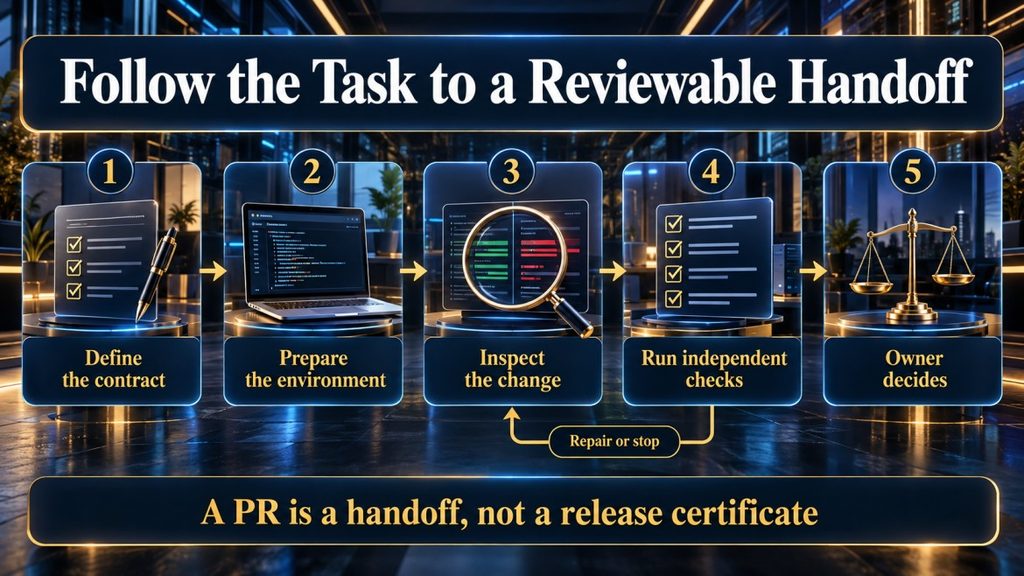
You hand an agent a maintenance task, come back to a pull request and find a reassuring summary: the code changed, the tests passed, the work is done. Then you notice a database migration beside the patch. Approving the code is one decision; deciding whether that migration can run against customer data is another. A useful buying guide has to follow the work far enough to make that difference visible.
The best AI coding agents for building and shipping software are conditional choices: evaluate Claude Code for supervised repository work, Codex or Cursor cloud routes for remote tasks, Copilot or Jules for repository handoffs, Devin for managed delegation, Cline or OpenHands for greater configuration control, and Replit Agent for an integrated app-building path. These are recommendations about workflow fit, not an accuracy leaderboard. The right choice depends on the evidence your task needs and the authority you are prepared to grant.
AI Hustle World checked the primary documentation on 3 October 2026 and built a release evidence ledger to connect those choices. We also ran a small local experiment showing that restoring a source file did not undo a separately committed database change. We did not conduct a controlled commercial-agent comparison, and the experiment is not a test of any named product. The citation methodology and limits explain what the evidence supports.
Quick choices by the work you need to finish
Begin with a task you can describe and verify, then choose the route that can perform it with the least unnecessary setup. A bug fix in an established repository, a queue of dependency updates and a new hosted app need different environments and different handoffs. The table gives you a first evaluation, including the condition that should stop it. It does not imply that every reader needs another subscription.
| Your next task | First routes to evaluate | Condition to resolve before adoption |
|---|---|---|
| Interactive changes in an existing repository | Claude Code or the agent already approved in your editor | You can inspect the actual permissions, diff and test output. |
| Remote work away from your active checkout | Codex Cloud or Cursor Cloud Agents | The environment can reproduce the services and checks the task requires. |
| GitHub issue to a proposed repository change | Copilot cloud agent or Jules | The branch or PR passes independent acceptance and normal review. |
| Repeated bounded backlog work | Devin cloud sessions | Tasks are separable and reviewers can absorb the resulting work. |
| Control over model and runtime choices | Cline or OpenHands | You can operate the configuration, permissions and inference budget. |
| A new app with an integrated publication path | Replit Agent | Access policy, data changes and production recovery have been reviewed. |
If autocomplete or ordinary editor assistance is your main need, the broader coding assistants comparison is the better starting point. This guide concentrates on agents that continue through files, tools and checks toward a deliverable. If your shortlist is already Cursor, Copilot and Claude Code, our three-tool comparison covers that narrower purchase decision. Here the extra question is what must still happen between the agent’s handoff and a defensible release.
An approved existing tool deserves the first trial when it can meet the requirement. Switching products adds context setup, habits and another set of controls to maintain. Change routes when a necessary capability or boundary is missing, rather than assuming a new brand will fix an unclear task. For a one-file repair, the cheapest sensible decision may be to write it yourself.
Building code and shipping software require different evidence
A coding agent can inspect context, edit files, run tools and use their results to choose its next action. The model selects actions, while the surrounding system supplies tools, execution and controls. That distinction matters because a model’s fluent explanation is not a receipt showing a command ran. Our guide to how coding agents work develops the underlying loop.
A patch proves that proposed code exists. Test output shows which checks ran, under which conditions; a pull request adds a place to discuss and accept the change. Deployment brings another environment, configuration and set of users into the picture. A migration or connected tool can also change persistent state that a source-code revert does not address. Each step needs evidence appropriate to its consequences.
Consider a ticket to rename a field in a customer-management application. The agent can change the form and API together, and a test can show the new value reaches a development database. Existing records, an older worker process and an integration using the previous field may still depend on the old contract. The patch can be internally consistent while the release breaks that wider system.
This is why a feature description should specify the behavior to preserve as well as the behavior to add. If customers must remain able to use the old endpoint during a transition, that requirement needs to exist before implementation. An agent cannot reliably discover an agreement that lives only in someone’s memory. The AI coding workflow explainer gives the broader foundation, but the buying decision here is whether a route can carry those requirements into a reviewable result.
Authority is separate from capability. A system may technically be able to push a branch, invoke a deployment command or call a service without being authorized to do so for this task. Specify the exceptional actions that require a decision and use technical controls where available. Asking the agent to be careful is useful language, but it is weaker than keeping production credentials out of a development run.
The AI Hustle World build to release evidence ledger
The following ledger separates a documented handoff from the checks a buyer still owns. Its unit is a product route, checked on 3 October 2026, rather than a brand-wide safety rating. Official documentation supports the deliverable and boundary columns; the final column is AI Hustle World’s proposed acceptance standard. A blank or unresolved recovery detail means the reviewed source did not establish it, not that the product cannot provide it.
| Product and route | Documented deliverable or boundary | Release evidence you still need |
|---|---|---|
| Claude Code local session | Repository work under a selected permission mode; command and file permissions differ. | Actual check results, scope review and separate authorization for release actions. |
| Codex current Cloud | Prepared environments and isolated task files; current and Legacy workflows coexist. | Correct environment and repository access, saved changes and independent acceptance. |
| Cursor Cloud Agents | Development VMs, branch handoff and multi-repository environments. | Evidence across each changed repository and the services needed for validation. |
| Copilot cloud agent | Draft PRs and traceable commits; cannot approve or merge its own PR. | Required reviews, workflow results and a release decision beyond PR creation. |
| Devin cloud sessions | Managed tasks returning draft PR work; documentation recommends clear scope. | Reproducible checks, manageable reviewer load and evidence of the requested behavior. |
| Jules repository task | Approved plan, activity, diffs and a branch or PR handoff. | Selected baseline, meaningful tests and inspection of the final change. |
| Cline with checkpoints | File snapshots in shadow Git with distinct file and conversation restore options. | Scope of recovery, external effects and the actual auto-approve configuration. |
| OpenHands chosen deployment | Local open source, hosted and Enterprise paths with different operating arrangements. | Runtime and credential controls, inference costs and the actual task artifacts. |
| Replit Agent and Publishing | Development work followed by a publication workflow; schema changes can reach production at publishing. | Access settings, migration compatibility, data preservation and recovery before release. |
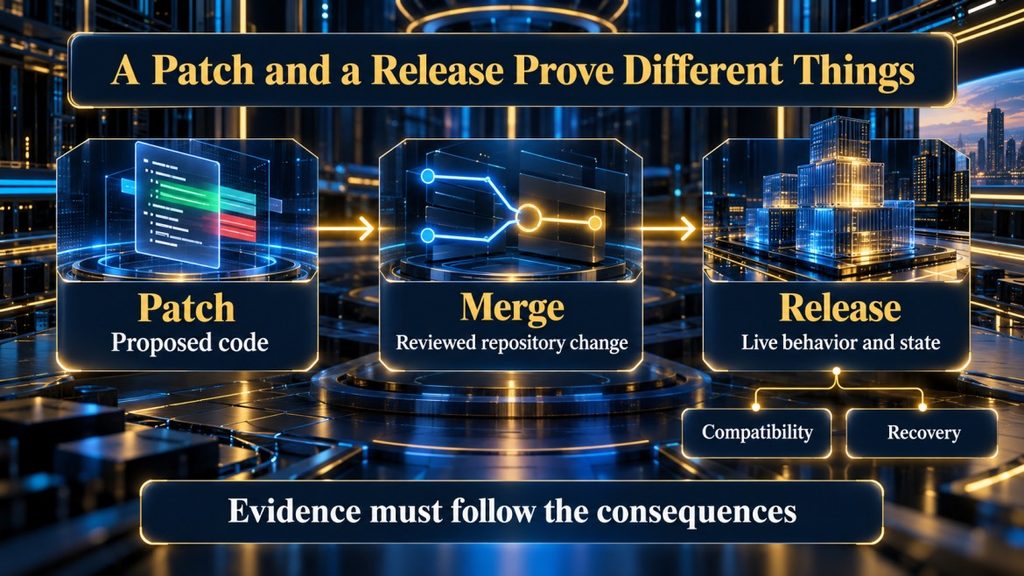
The ledger’s source trail appears in the product discussions below, including the specific security, task and publishing documents used for each row. It deliberately avoids translating a sandbox label into a guarantee about the code. Isolation can keep a task away from your active checkout while the resulting patch still contains an authorization mistake. Similarly, a file snapshot can be valuable even when it is not a recovery plan for every stateful system the task touches.
Use the table to identify the missing evidence before paying for greater autonomy. If your route can prepare a branch but cannot reach the approved test service, you have an environment problem to solve. If it can run checks but the task never defined tenant isolation, you have an acceptance problem. Neither is automatically resolved by choosing a more expensive model.
Citation methodology and limits
AI Hustle World assembled this ledger from primary capability, permission, task, billing and publication documentation. We separated documented controls from our recommended review steps and kept local, cloud and hosted-app routes distinct. The original contribution is that joined comparison and its application to release evidence, supported by the reproducible restoration example later in this guide. The vendors remain the sources for their documented product behavior.
Research and drafting were AI-assisted, with source checks and an editorial verification pass before this draft was saved. No account-level commercial-agent benchmark, personal developer testimony or measured product speedup is reported here. The local experiment tests file-only restoration against independently committed SQLite state; it makes no claim about a particular vendor’s checkpoint implementation. Product defaults and availability should be checked again when a route or account changes materially.
The study discussed below is a research finding from its authors, product capabilities are attributed documentation claims, and the W.O.R.T.H. recommendations are AHW analysis. The migration and tenant-access scenarios are illustrative examples. Keeping these categories separate prevents an imagined task from acquiring the authority of an observed test. It also lets you disagree with a recommendation without losing the underlying source trail.
Which agent routes belong on your shortlist
These nine candidates represent different ways to carry out and hand over software work. The shortlist is not an exhaustive market inventory, and documentation does not establish a universal performance winner. Choose the surface you would actually use before interpreting a product’s strengths. A trial record that merely says the brand name leaves too much of the environment and permission model unspecified.
Claude Code for supervised repository and command work
Evaluate Claude Code when you want to investigate and change a repository while staying close to the commands and decisions involved. Anthropic’s security documentation says Auto is the starting permission mode for interactive terminal and VS Code sessions, with explicit rules and organization settings relevant. Manual mode is a separate configuration. A directory permission prompt also does not by itself impose operating-system isolation on an approved shell command.
For an illustrative backend repair, ask the agent to trace the failing path, identify the smallest change and preserve the existing authorization rule. You can review the plan before implementation and inspect what each test actually exercises. If a test cannot run because the database fixture is missing, the useful outcome is a precise blocker. An invented replacement for the unavailable service would make the result harder to trust.
This route is worth trying if you can read the diff, interpret a failed command and decide when the task needs a human answer. Avoid delegating consequential work that you cannot evaluate simply because the agent explains it confidently. Keep a committed baseline and record permission changes made during the task. The same product in a cloud session needs a separate environment and access check.
Subscription use and API billing also need to be distinguished. Anthropic’s cost guidance explains the separate routes; a usage estimate shown by a session should not automatically be treated as a new subscription charge. Decide which route you are testing and what allowance or spending limit applies. More capacity can let a task continue, but it does not settle a missing requirement.
Codex Cloud for delegated work in prepared environments
If you need a bounded task to continue after you leave your machine, Codex Cloud deserves a trial in a prepared project environment. OpenAI’s current cloud guide describes separate task workspaces and review of changes and test results. It also distinguishes the current experience from Legacy workflows still used by existing review and Linear or GitHub integrations during the transition. Do not assume an older integration describes every new cloud task.
Preparation belongs in the evaluation because a repository that builds on your laptop may rely on an untracked configuration, local service or private package the cloud environment cannot access. Use a non-sensitive fixture and establish the normal test command before assigning a repair. Otherwise you will be judging the setup failure as though it were a coding result.
OpenAI documents a default saved-VM recovery window of up to seven days after the last turn start or task resume. That is not a conversation-history retention claim or a promise to reverse external service changes. Commit important work and review what the task actually produced. Separate repository permissions from permission to use a shared environment.
Choose this route if remote execution removes a real interruption and the required checks can run there. Avoid it for a task dependent on inaccessible local context until that dependency is resolved. OpenAI’s plan and availability guidance should be checked for the actual account and managed workspace. Local access on a plan does not by itself establish cloud eligibility.
Cursor Cloud Agents for remote work across the relevant workspace
A change spanning several repositories is a useful reason to evaluate Cursor Cloud Agents and its configured remote environment. The official cloud documentation describes isolated VMs, dependency setup, multi-repository environments and coordinated PRs in affected repositories. That is a useful distinction for work spanning a frontend, service and shared library. It is still a capability description, not evidence that the cross-repository release is compatible.
Suppose a shared type changes and two services consume it. A remote task can propose coordinated edits, but you need to know which versions can coexist during deployment. Tests against the newest copies of every repository may miss an older service still running in production. Require the agent to identify that dependency rather than letting a collection of green builds stand in for a rollout plan.
Use this route when the configured workspace contains the actual context and your reviewer can inspect all affected changes. Avoid a multi-repository trial if nobody owns integration or release order. Splitting the work into separate PRs helps review, but it can also hide a dependency between those PRs. Record the compatible states and the point at which each change can safely ship.
Cloud execution also needs its own access and network review. Cursor’s cloud security guidance is the relevant starting source, rather than your assumptions about the local editor. Check the environment’s credentials and spending controls before a long task. A familiar interface does not make a remote process inherit the local checkout’s boundaries.
GitHub Copilot cloud agent for GitHub native handoffs
If your team already works through GitHub issues and PR review, Copilot cloud agent gives you a familiar place to delegate a bounded change. GitHub’s risk and mitigation documentation gives a concrete boundary: the agent cannot approve or merge its PR, and the person who initiated it cannot approve that PR. It documents traceable commits, session records and security checks. Those controls help explain who must still make the acceptance decision.
For a bounded issue, specify the expected behavior, prohibited changes and test command rather than assigning a vague request to improve the service. A proposed patch can then be compared with that contract inside the team’s existing review process. Inspect workflow configuration as well as the PR summary. Approval and automatic execution options can affect when checks run.
This is a sensible starting trial if GitHub continuity removes coordination and the necessary repository controls are already in place. Avoid treating the agent’s PR as a release certificate or assuming a code scan covers the business rule. A scan can miss a permitted-looking query that returns another tenant’s data. The AI code review tools comparison handles the distinct question of additional review services.
Devin for a managed queue of bounded engineering tasks
A queue of repeatable, clearly scoped backlog tasks is the case for trying Devin cloud sessions. Cognition’s task guidance recommends scoping, useful context and independently defined success criteria, with parallel sessions for separable work. It describes returning to draft PRs for review. Its wider claims about how much engineering work Devin can handle remain vendor claims, not results from an AHW comparison.
Dependency updates across independent services are a plausible trial, provided each service has reproducible tests and an owner. Parallel tasks are useful only while review and integration can keep up. If every proposed change needs the same senior engineer to reconstruct its assumptions, the backlog may simply move from implementation to review. Start with fewer tasks than the interface lets you launch.
Choose this route when managed delegation removes recurring setup or supervision that your team can identify. Avoid it for a loosely specified architectural change that requires frequent product decisions. Sometimes the useful result is a rejected patch. A clear blocker can cost less than a long autonomous run pursuing the wrong premise. Judge the handoff against the original task, including abandoned attempts.
Devin’s billing documentation distinguishes self-serve quota and on-demand credits from Enterprise Agent Compute Units. Do not use one generic ACU calculation for every account. Record the plan and actual usage meter in your pilot. The relevant cost is what the accepted work consumed, including steering and review.
Jules for a plan approved repository task
Jules is worth evaluating if you want to approve a plan, leave a repository task running and inspect the change afterward. Google’s running-tasks guide describes selecting a repository and branch, approving the plan, following activity and diffs, and receiving a final summary with branch or PR handoff. The documented summary includes runtime and changed files. Those observations make the work inspectable, but do not establish that the chosen tests cover the requirement.
A contained bug with a reproducible failing case is a better first task than a request to optimize an entire application. Check the selected baseline, give the failing behavior and name the behavior that must remain unchanged. If the plan proposes a broader rewrite, resolve that before coding starts. Approval should mean you understood the direction, not merely that you dismissed a waiting screen.
Choose this route if the repository workflow and plan checkpoint suit your team. Avoid interpreting runtime or lines changed as a quality measure. A smaller patch that preserves the contract can be preferable to a larger patch that looks more complete. Review the final branch and actual checks before you accept the change.
Cline when model choice and developer control matter
Cline makes sense to evaluate when model choice matters enough that you are willing to manage configuration and inference costs. Its checkpoint documentation describes a shadow Git repository recording file state, with separate options to restore files, restore the task conversation, or restore both. That makes the object of restoration specific. It should not be read as a guarantee that every external action is reversible.
The Auto Approve documentation also distinguishes action categories and a YOLO mode that approves actions and mode transitions automatically. Its safe-command classification is not a fixed command allowlist. Inspect the configuration you actually intend to use. A description of a supervised workflow does not prove a particular session will ask at every boundary.
Choose Cline if model choice and visible configuration are worth the operating effort to you. Avoid it as a shortcut around understanding permissions, provider bills or recovery. For an unfamiliar repository, begin with narrow reads and a disposable task before expanding access. The restoration experiment later in this guide explains one question to ask about any checkpoint feature.
OpenHands for an open platform and a chosen operating model
With OpenHands, the first decision is how you want to operate it: an open-source local route, hosted access or an enterprise deployment arrangement. Its official plan comparison distinguishes those options, model choice and BYOK or at-cost provider access. The hosted Individual plan lists ten daily conversations, while Enterprise has a different administrative and deployment arrangement. Free client access and free inference are different claims.
Owning the setup lets you adapt it to your workflow instead of accepting every hosted default, but someone has to operate the runtime, credentials, model access and task evidence. A team without that capacity may be better served by a managed route. Self-hosting also does not automatically mean the selected model runs offline.
Choose this path when configuration ownership serves a concrete requirement, such as an approved runtime or provider. Avoid adopting it solely because open source sounds inexpensive. Include hosting, maintenance and review in the evaluation, then check the controls supplied by the actual deployment. The pricing page alone does not establish a complete recovery policy for a live task.
Replit Agent for an app with an integrated publication path
If getting an app from development to a hosted release is your immediate problem, evaluate Replit Agent alongside its publication workflow. Replit’s Agent overview documents the development experience, while the separate Publishing guide explains domain, access, database and monitoring settings. To open it, choose Publishing under Replit Cloud in Tools or Publish at the top right of the editor. Those settings deserve review before the final action.
A working preview can hide an unresolved access policy. A small internal dashboard might be intended for a workspace, while a published public page exposes a very different audience. Decide who can use the app, then verify that the application’s own authorization matches that intent. A restricted link is not a substitute for server-side permission checks where the app needs them.
Choose the integrated route when it removes a real build-to-hosting burden and you can verify the resulting app. Avoid publishing customer-data functionality solely because the preview works. Inspect database behavior, hosting costs and a recoverable release path before adoption. The schema example below shows why development isolation does not end the release review.
Apply W.O.R.T.H. to the task rather than the brand
AI Hustle World’s W.O.R.T.H. lens evaluates Workflow fit, Output capability, Risk and rights, Total cost, and Human effort. Use it on the route and task you intend to run, not on the vendor’s most attractive demonstration. A candidate can fit conditionally, pass the relevant requirement, or fail a necessary condition. Averaging those conditions into a star rating would conceal the reason you should stop.
Workflow fit means the environment can reproduce the job
Ask where the task gets its requirements, dependencies and check results. An editor route may have immediate access to a local fixture; a remote route needs an equivalent approved setup. The difference is operational, not cosmetic. A tool that can write the patch but cannot exercise its important behavior is not yet a complete fit for that task.
For a dependency update, establish the installed version, build command and affected callers before generation. For a multi-service change, identify which service versions must coexist. If you need continuous product decisions, keep the task interactive instead of treating background execution as a benefit by itself. Waiting for an unattended agent to guess an unresolved rule is an expensive form of delay.
Use the workflow you can maintain after the trial as well. A clever setup built by one person can become a recurring bottleneck if nobody else can reproduce it. Record enough environment preparation for another developer to run the checks. The practical test is whether the next ordinary task can enter the route without rebuilding the process.
Output capability means a change you can inspect and accept
Define the deliverable as behavior and evidence, not file count. A repair should preserve required behavior, stay within scope and explain checks that failed or could not run. A refactor should preserve the external contract even when the implementation changes. Our guide to safe AI code refactoring covers that preservation problem in detail.
Read the changed tests as carefully as the application diff. An agent can make implementation and tests agree with the same mistaken interpretation, producing green results without satisfying the request. Establish the expected behavior independently and check that a forbidden outcome would fail. The guide to generating and maintaining software tests explains how to keep that standard separate from generated assertions.
A useful handoff also names uncertainty. If an integration test was blocked by an unavailable service, that fact belongs beside the successful unit check. If the patch needs another service to deploy first, the dependency belongs beside the proposed change. A short truthful report saves more reviewer effort than an impressive summary that hides the remaining decisions.
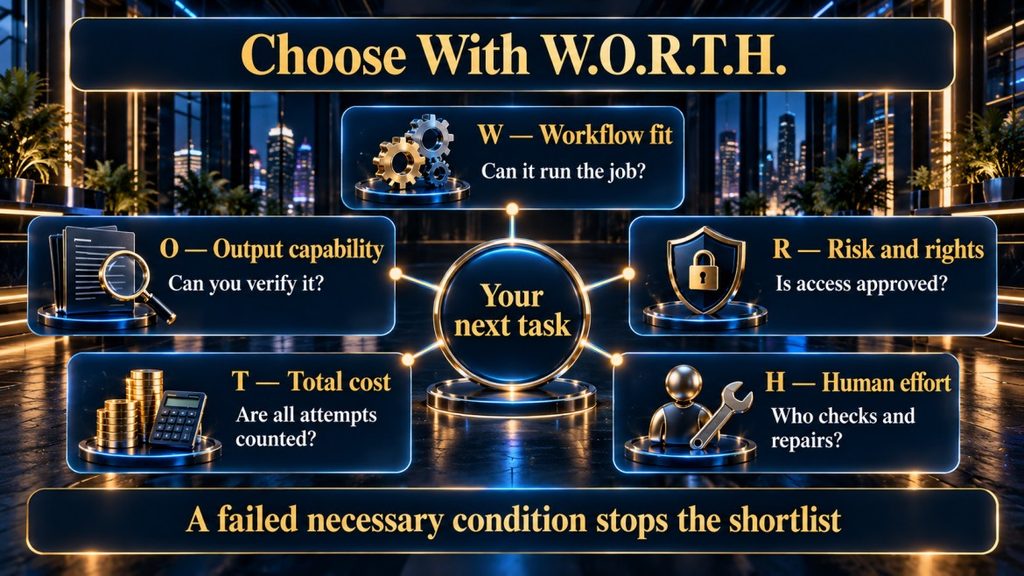
Risk and rights mean knowing what the route can touch
Separate access to code, model inference, tool execution and persistent systems. Local file operations can coexist with hosted model calls; a private repository can coexist with overly broad credentials. Consumer and commercial terms may also differ. Evaluate the actual account, deployment and connected tools rather than relying on a general privacy label.
Connected tools widen the task’s reach. Reading an issue tracker to understand a requirement and writing to a production database are different permissions, even if both appear behind a tool interface. Our Model Context Protocol explainer helps identify that connection layer. Review the operations the connected service allows and remove access that the task does not need.
Repository text, logs and retrieved documents are evidence to interpret, not automatic permission to take new actions. A malicious instruction inside an issue can try to redirect an agent toward a secret or unrelated command. Reduce the available blast radius and inspect the actions taken. Asking the model to recognize hostile text is not the only control you have.
Rights include the right to accept consequences. A developer may approve a patch while a different owner must approve a migration or public release. Name those owners before the task begins, particularly for customer data, authentication and payments. If the required data boundary cannot be established, the correct W.O.R.T.H. result is a failed condition, not a softened recommendation.
Total cost means every attempt that produced the accepted work
Record the billing meter, the applicable allowance and what happens after the allowance is exhausted. A free client may call a paid model; a subscription may fund some usage while runtime or additional consumption is charged separately. Do not translate a pool of credits into a fixed number of features without observed consumption. Different tasks can make the same subscription behave very differently.
Count setup, unsuccessful attempts and repair alongside direct charges. A rejected migration still consumed attention even if it never entered the product. A one-time environment setup should be identified separately from a configuration failure that recurs every week. That distinction keeps an early trial from being unfairly pessimistic or conveniently optimistic.
Cost estimates should state their assumptions. If you value an hour of reviewer time at an internal rate, label that rate as an assumption and keep measured minutes visible. If a manual baseline was never measured, do not report a percentage saving against it. You can make a provisional purchase decision without manufacturing a precise return on investment.
Human effort means the work left after generation
Track preparation, approvals, clarification, review, repair and explanation to the next owner. Keep active attention separate from elapsed runtime. A remote agent can take longer while you complete other useful work, whereas a short run can require constant intervention. Neither result is evident from the speed at which code appears.
The final handoff should leave you able to explain the changed contract and its important checks. If you have to reconstruct a sprawling session before review can begin, the tool has moved work rather than removed it. Our guide to reviewing AI-generated code gives the human inspection step a concrete shape. Include that effort in the trial instead of counting it as unrelated administration.
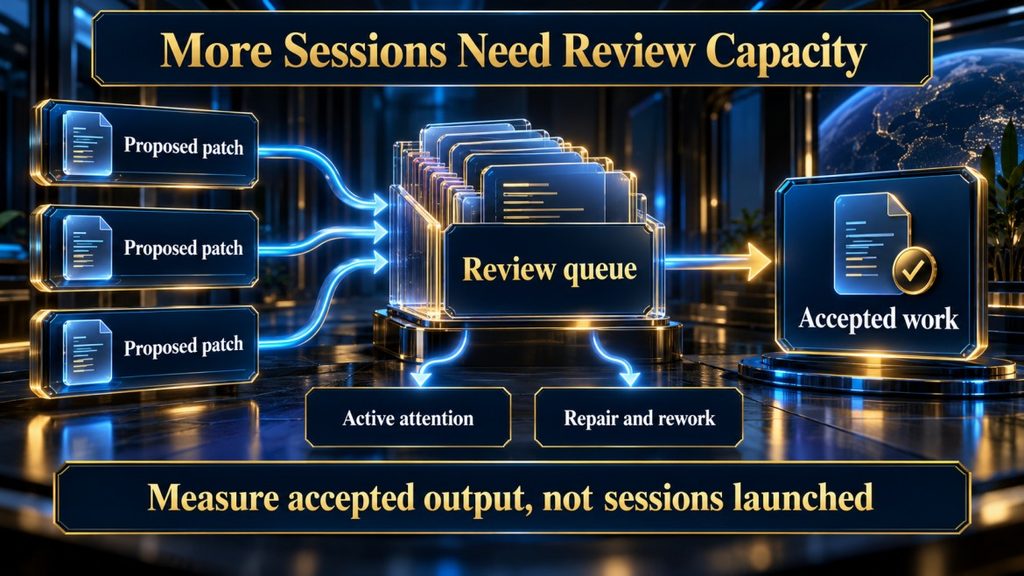
Pay attention to reviewer concentration. Ten independent agent sessions can still converge on one person who understands the data model. Increase concurrency only when accepted output improves without an unmanageable queue or more escaped defects. The useful capacity is the work the team can verify and maintain, not the number of sessions a dashboard can display.
A publication boundary can carry a database change
Development isolation does not remove the need to inspect what publishing will apply. Replit’s database documentation gives a specific example: Agent can change development tables but cannot directly modify the production database. It also says development schema changes, including added or deleted tables and columns, are applied to production at publishing. That makes the publication step a consequential schema-review boundary.
The tempting expectation is that an agent unable to touch production cannot affect live data structures. The documented mechanism is narrower: it prepares development changes that publishing can apply. This is not a claim that a destructive change occurred in our testing. It is a reason to inspect the proposed schema before deciding to publish.
Imagine an illustrative internal app where an agent replaces a legacy customer field with a new required field. The development fixture contains a few fresh records and the form works. Existing production records may not have a value for the new field, while older code may still read the removed one. A browser preview cannot establish that the transition preserves those records and consumers.
Ask for the schema diff, how existing data is handled and which application versions can run during the transition. Where the project requires it, test the migration against a representative approved staging dataset and exercise the recovery path. Do not give the agent customer data simply to make the demonstration realistic. A fixture should preserve relevant structure and failure cases without exposing unnecessary information.
An additive transition can be easier to review than deleting the old field immediately, but it is not a universal recipe. The correct plan depends on constraints, readers, writers and the application’s release process. The owner should decide which compatibility states are acceptable. The agent can investigate and prepare the proposal; it should not silently choose the business’s tolerance for downtime or lost information.
Our recovery experiment restored code and left committed state changed
Restoring source files alone did not reverse the database write in our controlled local experiment. We used a temporary directory, one source file and a separate SQLite database containing one job row. The file began with preview mode and the row’s status was pending. We changed the file to release mode, committed the status sent to SQLite, then restored only the file’s original text.
The successful run on 3 October 2026 at 11:55:17 UTC reported that the code was restored and the database was not. The job still had status sent. No live service was contacted and no commercial agent was tested. The result is deliberately small: a file-only restoration mechanism did not reverse independently committed state outside its scope.
| Observed field | Result from the controlled fixture |
|---|---|
| Source file after restoration | Original preview-mode text restored |
| Database status before the change | pending |
| Database status after restoring the source file | sent |
| Code restored | true |
| Database restored | false |
| Live services or commercial agents used | None |
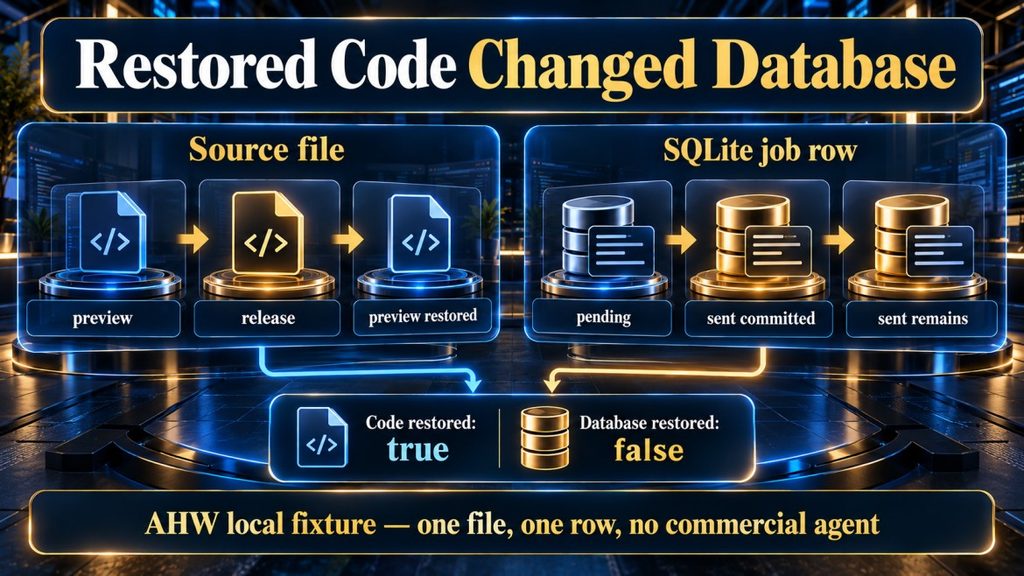
The useful expectation-versus-result gap is between undoing the file and undoing the task’s effects. The source looked like its earlier state, yet the database represented a completed action. This is not evidence that Cline, Replit or another product has a faulty restore feature. It shows why a reviewer should ask what objects a particular recovery mechanism actually restores.
The minimal reproduction below uses the same sequence and assertions. The database is deliberately separate from the source file, and its transaction is committed before file restoration. Running it demonstrates that narrow boundary; it does not simulate a distributed rollback, send an email or evaluate a vendor runtime. Its output should be interpreted at that scope.
from pathlib import Path from tempfile import TemporaryDirectory import sqlite3 with TemporaryDirectory() as folder: root = Path(folder) source = root / “service.py” original = “MODE = ‘preview’\n” source.write_text(original, encoding=”utf-8″) db = sqlite3.connect(root / “state.sqlite”) db.execute(“CREATE TABLE jobs (id INTEGER PRIMARY KEY, status TEXT)”) db.execute(“INSERT INTO jobs VALUES (1, ‘pending’)”) db.commit() source.write_text(“MODE = ‘release’\n”, encoding=”utf-8″) db.execute(“UPDATE jobs SET status = ‘sent’ WHERE id = 1″) db.commit() source.write_text(original, encoding=”utf-8”) status = db.execute(“SELECT status FROM jobs WHERE id = 1″).fetchone()[0] db.close() assert source.read_text(encoding=”utf-8”) == original assert status == “sent” print({“code_restored”: True, “database_status”: status})For your real workflow, list the stateful objects separately: source files, schema, records, storage objects, queues and external service actions where applicable. Then establish the recovery operation for each object the task can change. A database backup, a compensating operation and a file checkpoint solve different problems. You do not need every mechanism for a small task, but you need to know which consequences the chosen mechanism leaves behind.
Require a release packet that answers the missing questions
A release packet is the evidence attached to a proposed change so another owner can decide what to accept and what remains unresolved. It extends ordinary PR review rather than creating a ceremonial document. The following fields are AI Hustle World’s proposed working contract, not an industry standard or a guarantee. Keep it proportionate to the task and fill it before the final approval.
| Field | Evidence to attach | Decision it supports |
|---|---|---|
| Task and baseline | Starting commit, intended behavior, exclusions and affected consumers | Whether the patch addresses the actual request |
| Change and checks | Diff, changed tests, commands, outcomes and checks not run | Whether behavior and regressions were meaningfully checked |
| Persistent effects | Schema diff, records or external writes that could change | Whether merge and release need separate approval |
| Compatibility and recovery | Supported transition states and recovery operations for affected objects | Whether failure can be contained without relying on a file revert |
| Ownership and disposition | Reviewer, release owner, unresolved issues and accept/revise/stop decision | Who is authorized to take the next consequential step |
For a concrete illustrative contract, suppose the task adds display_name while the current worker still reads name. Record that both fields must remain readable during the transition, existing records must retain their values, and creating a new customer must work with both the old and new application versions. The packet should attach the additive schema diff, a staging migration result and independent checks of those conditions; if those checks cannot run, record them as blocked and withhold release approval. Removing name in the first patch would fail this particular contract even if the new form passed its own test. These are proposed acceptance conditions for an imagined task, not results from an AHW deployment.
A tenant-scoped feature needs a different emphasis. State that user A must not read or write tenant B’s records, then test the prohibited action and confirm no write occurred. Checking that an authorized user can save a record does not exercise the forbidden path. That distinction gives a reviewer a way to falsify an attractive demo instead of judging only whether it looks plausible.
A dependency repair also needs the actual installed interface. A plausible method name may belong to another library version or may not exist at all. Our guide to preventing hallucinated APIs explains why interface evidence and behavior evidence are separate checks. Record the version and exercise the relevant call rather than accepting a confident explanation of the imagined API.
If the requested evidence is unavailable, the packet should say so and name the next decision. The right outcome might be to repair the environment, narrow the patch, add an independent check or abandon the attempt. Those are useful outcomes when they prevent an unverified release. A habit of calling every run finished makes the unresolved work harder for the next person to see.
Compare the billing meter and the cost of accepted work
Compare the actual route’s costs before interpreting the subscription price. Cloud runtime, model use, quotas and provider bills may sit in different places. A price per seat is useful only alongside the allowance and overage behavior. Use the current account terms rather than a competitor’s copied pricing table, especially when a product is changing its billing model.
GitHub’s organization billing guide provides a concrete meter: one AI credit is $0.01, and Business and Enterprise include 1,900 and 3,900 monthly credits per assigned user respectively. Included credits are pooled at the billing entity, while paid completion and next-edit suggestions are treated separately. Additional usage policy and budgets determine what happens when allowance runs out. These organization terms should not be substituted for an individual’s plan.
The other routes need the same separation even when their units differ. Devin distinguishes self-serve quotas and credits from Enterprise ACUs; OpenHands separates free access from provider inference; Claude distinguishes subscription and API use. Those differences make a universal dollars-per-prompt comparison misleading. Record the selected account and meter, then inspect actual consumption for a representative task.
A useful economic calculation adds allocated direct charges to valued active human time across every attempt, then divides by accepted changes. Keep the measured minutes and assumed hourly rate visible. Count abandoned work in the numerator even though it adds nothing to the accepted-change denominator. Otherwise a tool that repeatedly produces attractive rejected patches can appear artificially inexpensive.
For an explicitly hypothetical example, assume $24 in allocated tool and runtime costs plus 90 active human minutes valued at $40 an hour. Two changes pass the independent contract and one attempt is abandoned, with all three included in those minutes. The total is $84, or $42 per accepted change. That is an illustrative calculation, not an observed result from any agent on this shortlist.
To claim a saving, you also need a comparable baseline completed to the same standard. If manual implementation is estimated rather than measured, label the result an estimate. Separate initial learning from recurring effort, but keep the first attempts visible. A tool may justify itself by enabling work you would otherwise defer; that is additional capability, which is different from a measured time saving.
Run a pilot you can use to make a purchase decision
A credible pilot holds the task, baseline and acceptance criteria steady wherever the routes permit. Start with an approved low-risk repository, a committed baseline and known checks, then give each candidate an independent copy. Use a bounded repair and a behavior-preserving change before attempting a broad feature. This is a proposed evaluation method, not a claim that we ran those commercial trials.
Write the expected behavior before the agent sees the implementation task. Include one meaningful failure case, scope exclusions and actions that require a human decision. Prepare the environment with the dependencies and approved fixtures the actual job needs. If the trial changes the task halfway through, record the change instead of treating every candidate’s result as equivalent.
Capture product, surface, model, plan, client version, permissions, repository instructions and available tools. A richer environment or different model may be a legitimate product benefit, but it is also a material comparison difference. Save prompts, patches, check output and usage records with the run date. A conclusion about needing less help should have an observable trail behind it.
Keep active reviewer attention and elapsed delivery time separate. Record clarifications, manual repairs, rejected scope and missing evidence as well as successful checks. Rerun independent acceptance outside the authoring session where practical. If the agent changes the test to approve the wrong behavior, that is a failure of the trial rather than a successful green result.
| Measure | What to record | Useful interpretation |
|---|---|---|
| Accepted changes | Changes that satisfy the independent contract | Output the team can actually use |
| Active human minutes | Preparation, approvals, review, repair and handoff | Work the route did not remove |
| Delivery time | Elapsed time and meaningful waiting | Whether the route fits the needed turnaround |
| Rejected or abandoned attempts | All failed attempts and their costs | Whether success depends on repeated rescue |
| Scope drift | Unrequested files, dependencies or policy changes | Additional review and risk created |
| Post-acceptance repair | Defects, recovery work and recurring fixes | Whether apparent savings persist |
Set a stop condition before the trial. A required control that is unavailable, a repeated contract violation or a budget breach can end the evaluation without another round of prompting. An isolated setup issue can justify one targeted repair when the rest of the route is promising. The aim is enough evidence for a decision, not a demonstration rescued until every candidate looks successful.
Published benchmarks cannot establish release readiness
Benchmarks and repository studies can inform the question without deciding the purchase. The primary task-stratified study of coding-agent PR acceptance analyzes 7,156 filtered closed PRs in popular permissively licensed repositories, requiring a non-author review or comment. Its samples include 139 Claude Code PRs, 569 Cursor PRs and 2,194 Copilot PRs, with different historical windows. Acceptance means merged among closed PRs, and the study is observational.
Those details prevent a pooled percentage from becoming a current accuracy ranking. Task selection, repositories, users and product versions can differ, while merge acceptance is not a direct measure of production reliability. The study is useful evidence of historical repository activity under its method. It cannot establish that today’s product will complete your migration with less review or a safer recovery path.
Read a benchmark’s input, model, environment, evaluation and failure treatment before using its score. A test of localized issue fixes answers a different question from a release involving schema compatibility and older clients. Even a reproducible benchmark may omit the account policy or operating burden that excludes a tool for your team. Our shortlist therefore uses conditional workflow recommendations rather than fabricated accuracy scores.
When to stop delegating and keep the traditional controls
Stop or narrow delegation when the requirement is unresolved, the available environment cannot verify the important behavior, or the next action expands authority beyond the approved task. This does not mean the agent must be discarded. It can investigate, propose options or implement a smaller verified slice. The owner should settle consequential product and release decisions before execution continues.
Traditional checks remain useful because they establish different things. A compiler can reject an incompatible type, a deterministic refactor can update known references, and a test can exercise an observable contract. Human review can challenge a missing requirement or an unnecessary architecture change. Asking another agent to agree with the authoring agent is not an equivalent replacement for all those checks.
Branches and small commits also preserve causality. When a task mixes cleanup, a feature and dependency upgrades, it becomes harder to identify which decision introduced a failure. Separate unrelated work and retain a known starting state. A generated summary cannot recover the clarity that a sprawling diff removed.
No adoption is a reasonable decision if the current workflow meets the need and there is no measurable bottleneck. The alternative may be better tests, clearer requirements or a repaired development environment. Ignoring unapproved tool use, however, leaves the real access and data questions unresolved. Govern the workflow people actually use, whether or not you buy another subscription.
As agents expand the bottleneck can move to review and release
More capable agents can increase proposed output without increasing the team’s ability to accept it. That is a practical second-order effect to watch, not a prediction of a particular vendor release. Track review waiting time and accepted work alongside sessions launched. Adding generation capacity to a saturated review queue can lengthen delivery rather than shorten it.
Prepared environments and release contracts also need maintenance. Dependencies change, repository rules evolve and a connector’s allowed operations may expand. Name an owner for those configurations and refresh the relevant evidence when a route changes materially. A setting that was reasonable for yesterday’s narrow repair should not silently authorize tomorrow’s migration.
The durable skill is defining an observable result and reading the evidence that supports it. A better model can help investigate and implement, but it cannot supply missing business authority merely by sounding more certain. Keep enough understanding to diagnose the result when the agent is unavailable. The useful advance is delegated work that remains reviewable and recoverable as its scope grows.
Final thoughts
Choose the task path before choosing the brand. Claude Code, Codex, Cursor, Copilot, Devin, Jules, Cline, OpenHands and Replit offer different starting points for supervised work, remote delegation, repository handoffs, configuration ownership and app publication. Their value depends on the route, environment and checks your job requires. Documentation supports that shortlist, while a local pilot should decide the quality and economics in your own workflow.
Use W.O.R.T.H. to reject failed necessary conditions, then attach the evidence that lets another owner accept the change. Keep code restoration separate from recovery of the state the task may have changed, and keep merge approval separate from release approval where the consequences differ. The best agent leaves you with work you can explain, verify and operate. A convincing unfinished patch is not that outcome.
Check the Code Before You Approve the Release
Use our review guide to inspect behavior, dependencies and security, then record what still needs a separate release check.
Review Your AI Generated Code →Frequently asked questions
Which AI coding agent should I try for an existing repository?
Begin with an approved route that can read the relevant code and run the actual checks, such as a supervised local agent or a prepared cloud environment. Use a small bounded repair and an independent acceptance contract. Evaluate the resulting diff, failures and human effort before expanding the task. A product’s overall popularity is not a substitute for that fit.
How is a coding agent different from a coding assistant?
An assistant may suggest code or explain a file, while an agent can use tools, observe results and continue across multiple actions toward a task. Products often support both forms. Judge the selected workflow and its permissions rather than the marketing label. Greater agency makes the handoff and acceptance standard more important.
Is a cloud coding agent better than a local one?
A cloud route is useful when a reproducible remote environment lets work continue away from your active checkout. A local route can be preferable when the task depends on approved local services or frequent steering. Compare the access and checks available in each environment. Neither execution location establishes superior code quality by itself.
Can I let an agent work unattended?
Some routes can continue asynchronously, but unattended execution should stay within a task and authority boundary established in advance. Define prohibited actions, spending limits and escalation points. Review the evidence before merge or release. A lack of interruptions is useful only when it does not hide decisions the agent was never authorized to make.
Are free and open source coding agents actually free to use?
Free access to a client does not necessarily include free model inference, hosting or administration. BYOK routes can bill your provider, and local models still require suitable computing resources. Check the actual account and deployment instead of treating open source as a zero-cost operating model. Include your configuration and review time in the decision.
Why do the plan model and surface matter in a comparison?
They determine which tools, limits, environment and billing route the task receives. A trial on a constrained plan can differ materially from the regular workflow you intend to buy. Record those conditions beside each result. Otherwise a conclusion about the product may actually describe only one uneven trial.
Is private code safe when the agent runs locally?
Local tool execution does not automatically mean offline inference or no transmission of repository content. Check the provider terms, account settings, connected tools and organization approval for the exact route. Keep unnecessary secrets outside the trial. A private repository name alone does not establish the data boundary.
Why are passing tests insufficient for a release decision?
A passing test establishes only its assertions under the conditions in which it ran. It can miss an unstated requirement, unauthorized access, incompatible old clients or a migration effect. Inspect the changed tests against independently stated behavior and identify the remaining release checks. The agent’s final summary cannot expand what those checks proved.
What should I ask about checkpoint recovery?
Ask which objects the mechanism restores and which effects remain outside its scope. Source files, database records, schema and external actions may need different recovery operations. Our small experiment restored a file while an independently committed row stayed changed. That finding is a question to apply to your actual configuration, not a universal judgment about vendor checkpoint features.
When should I avoid delegating the whole task?
Keep close control when success depends on unsettled product rules, inaccessible validation or consequential external actions. The agent can still investigate or prepare a bounded proposal. Resolve the missing decision before it becomes code or live state. Manual implementation can also be the better choice when a small known change costs less than setup and review.
Written by
Muntasir Ahmad Chowdhury
Founder-AI Hustle World
Muntasir Ahmad Chowdhury is the Founder of AI Hustle World, an independent publication dedicated to making Artificial Intelligence practical, trustworthy, and easy to understand. He researches AI tools, automation, customer service, productivity, and real-world business applications, helping readers make smarter technology decisions through research-driven, experience-backed content.
Expertise:
AI Tools • AI Automation • AI Customer Service • AI Productivity • Generative AI • AI Workflows
Get Smarter With AI
Enjoyed this guide? Get practical AI tools, tutorials, and honest reviews delivered to your inbox.