Evidence: Documentation reviewed
Last checked: October 2026
What was done: Written from official documentation and the published sources linked in this article. Not hands-on tested.
Files: None
Affiliate links: No
Best AI Code Review Tools in 2026: Security, Bugs and Developer Workflow
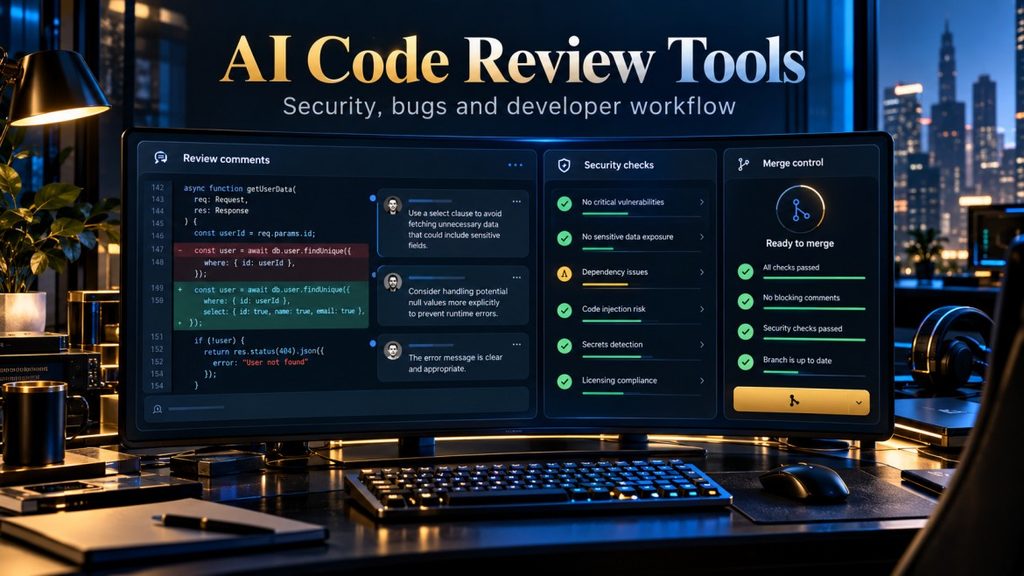
A pull request can collect dozens of AI comments and still merge with a broken authorization check. Another team can have a strict green quality gate yet miss a business-rule error that no static rule recognizes. Those are different failures, so the useful question is not which bot sounds smartest. It is what the reviewer can see, what evidence it produces, and what actually stops a risky change.
For most teams, start with the review workflow you already have. GitHub Copilot code review is a sensible first evaluation when your work lives in GitHub and Copilot access is already approved; CodeRabbit, Qodo, Greptile, and Cursor Bugbot deserve consideration when you need a dedicated PR reviewer, team rules, repository context, or a Cursor-centered fix loop. Add a scanner such as SonarQube Cloud or Snyk Code when you need a defined quality or security check. None of these choices earns a universal bug-detection crown from product documentation alone. Our broader coding-assistant comparison addresses tools for writing code; the focus here is the review boundary before merge.
This is a documentation-based comparison as of October 2026. AI Hustle World has not run a controlled head-to-head test of these products, and we do not treat vendor demonstrations as our own experience. What we can give you is a source-backed map of review boundaries, a practical way to pilot the tools on your code, and a recommendation that changes when your repository, risk, and human review capacity change. For a manual verification process rather than a buying decision, see our guide to reviewing AI-generated code.
Choose the job before you choose the reviewer
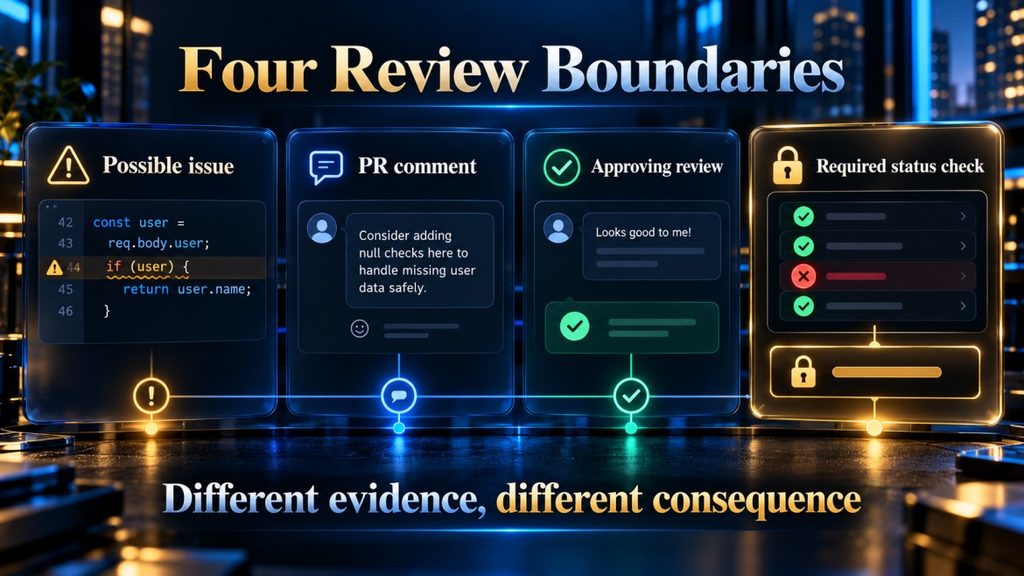
An AI PR reviewer reads a proposed change and writes observations for a developer to accept, challenge, or ignore. A static-analysis tool applies defined checks to code; a security platform may also inspect dependencies, secrets, or configuration. A required status check is a repository rule that can prevent a merge when a configured analysis fails. One product may offer several of these functions, but a helpful comment does not become a merge control just because it appears beside the diff.
Imagine a change that replaces an ownership check with a simple “user is logged in” check. An AI reviewer might notice the missing object-level authorization if it understands the surrounding route and policy. A SAST rule might catch a known unsafe pattern, but it may not know the product’s tenant boundary. Your tests may stay green if they never exercise a second user’s data. The human reviewer still has to ask what the feature is permitted to do and whether the test proves that boundary.
The reverse error also happens. A bot can write a persuasive paragraph about security while the repository has no required check, no responsible owner for comments, and no rule that re-runs after a fix. This is why our AI coding agents explainer treats generated changes as proposals that need independent checks. In this article, the purchase decision starts with the missing check in your process, not the vendor’s feature count.
What a useful comparison should measure
A tool should earn attention when it finds an issue your team would act on, explains it at the right place, and lets a reviewer resolve it without losing the original requirement. Count accepted, actionable findings rather than total comments. A hundred style suggestions can consume more engineering time than one accurate warning saves, especially when every low-confidence note has to be read before a merge.
Ask five concrete questions before a trial: Does the product review the proposed diff or consult relevant repository and ticket context? Does it merely comment, suggest a patch, submit an approval, or publish a status check? Which security problems are covered by an actual scanner rather than an LLM’s general reasoning? Can your team control noise with rules, exclusions, and severity thresholds? Finally, what data and permissions must leave your current workflow? These questions reveal trade-offs that a single numerical rating hides.
A new reviewer also has to fit the team’s existing habits. A GitHub-only shop can value native assignment and policy controls; a team spanning GitLab and Bitbucket may care more about host support. If developers already receive too many alerts, tuning and ownership matter more than a vendor’s longest feature list. If you are still deciding how AI assistance fits the broader development process, our coding assistants overview provides that context without turning this PR-review comparison into an editor roundup.
The AI Hustle World review boundary matrix
This matrix is our original synthesis of current product documentation, checked on 1 October 2026. It separates four actions that comparison pages often blur: finding a possible issue, leaving a PR comment, submitting an approving review, and enforcing a required status check. A listed capability is a documented vendor feature, not an AHW finding that the tool catches more bugs than its rivals. Where the available source does not establish a behavior, the answer is “not verified,” not an optimistic tick. The citation methodology below explains how we classified each row and where the evidence stops.
| Product or layer | Documented review output | Merge control shown by source | What it is for |
|---|---|---|---|
| GitHub Copilot code review | PR comments and suggested changes; an approval assessment appears in the overview. | Off by default. When enabled, Copilot approvals are in public preview and can satisfy a required-approval rule. | Native GitHub-first AI feedback. |
| CodeRabbit | Context-aware PR feedback and suggested fixes; separate security capabilities are documented. | Do not infer a required repository gate from the review comment. Verify the specific check and plan before relying on one. | Dedicated reviewer across several Git hosts. |
| Qodo | PR review and configurable compliance comments or labels. | Its docs describe a separate CI action to block on compliance labels; the label alone does not block. | Review rules and governance. |
| Greptile | Repository-context PR comments and fix handoff to coding agents. | Required merge behavior was not established by the reviewed overview; verify it in your repository. | Cross-file context and PR discussion. |
| Cursor Bugbot | Automated PR comments on updates, with links to fix in Cursor. | The reviewed documentation did not establish a required status check. | PR feedback within a Cursor workflow. |
| SonarQube Cloud | Static-analysis findings and a PR quality-gate check. | GitHub branch protection can require the check; the cited docs note a monorepo limitation. | Quality and security standards enforced through analysis. |
| Snyk Code | Source-code security findings through SAST and CLI or CI workflows. | A configured CI workflow can block a build on findings. | Security scanning, not general conversational logic review. |
The distinction has a practical consequence. A “ready to approve” assessment in a summary is information; an approving review counts only under the repository’s configured rules. GitHub now documents an opt-in Copilot approval preview, while its normal behavior leaves required approvals unaffected. Likewise, a Sonar quality gate becomes blocking on GitHub when the check is required by branch protection, and Qodo’s compliance labels need an additional CI rule to stop a merge. A team that skips this configuration can buy the right product and still run the wrong process.
The matrix does not measure detection accuracy. CodeRabbit and Greptile describe broad repository context, but architecture alone cannot prove that either will understand your business invariants. SonarQube and Snyk can enforce specified checks, but a clean result is not proof that the user story is correct. If you need a deeper example of a plausible but unsupported coding suggestion surviving superficial checks, our hallucinated APIs investigation shows why the evidence must match the failure you are trying to rule out. In the pilot, make the missed case as visible as the caught one so a polished comment cannot obscure the gap.
Citation methodology and limits
AI Hustle World built the review boundary matrix from the primary product documentation linked in each product row, checked on 1 October 2026. For each tool, we recorded the documented review output, whether the source established an approving review or an enforceable status check, and the job that output serves. We treated a comment, a label, an approval, and a required check as separate states because they have different effects on a pull request.
Where a source described a feature without establishing its merge behavior, the matrix says so and directs you to verify the configuration in your own repository. Vendor descriptions support capability claims, not claims about relative accuracy, bug-catching rates, or time saved. The two research studies discussed below are evidence about their own samples and settings; their percentages are not applied as scores to these products.
No AHW account-level product test or controlled comparison informed this matrix. The pilot later in this article is a reproducible proposal for readers, not a study we claim to have completed. Features, plan limits, and preview settings can change; before publication or a purchase decision, recheck the linked vendor documentation and record any material change beside the affected row.
GitHub Copilot code review: the native starting point
Copilot code review is the least disruptive first trial for a team already working in GitHub with the relevant Copilot policy enabled. You request it as a reviewer, read comments in the pull request, and can apply supported suggestions. GitHub documents review in several surfaces, including the web interface and IDEs, with Azure DevOps in public preview. The convenience is real as a workflow fact, but it is not an independent measurement of review quality.
Its approval behavior deserves more care than most buying guides give it. By default, Copilot’s review does not count toward required approvals. If organization, enterprise, and repository settings allow the public-preview approval feature, Copilot can submit an approving review that does count; a new commit dismisses that approval. A team relying on that option should decide whether an AI approval is permitted for its risk level and file paths, and should preserve a human owner for ambiguous or consequential changes.
Copilot is a weaker fit if your code hosts are mixed or if you want a separately governed review service rather than an extension of your GitHub setup. It also cannot certify that a change meets a requirement simply because it has read surrounding code. If the authoring assistant and reviewer are closely related, avoid assuming the second pass is independent evidence. Give the reviewer an explicit expected behavior and run checks that could falsify its conclusion.
CodeRabbit: a dedicated reviewer with broad workflow coverage
CodeRabbit’s current documentation describes PR reviews on GitHub, GitLab, Azure DevOps, and Bitbucket, plus IDE and CLI review paths. That makes it attractive when a team wants one review habit across hosts or wants feedback before a pull request exists. The product also documents review instructions, exclusions, fix options, and a separate security offering. These are documented capabilities; we have not observed how accurately it applies them to a real AHW test set.
The useful question in a trial is whether CodeRabbit gives your reviewers fewer decisions, not just more comments. Set a small number of repository-specific rules, exclude generated artifacts where appropriate, and record which comments reveal a real defect, which repeat an existing lint check, and which require discussion. Its path-based instructions can focus an API directory on authorization and input validation, while the human reviewer decides what those controls mean for the feature. Our context engineering guide explains why better instructions can help but cannot replace a missing acceptance criterion.
CodeRabbit is worth evaluating for multi-host teams and for developers who want conversational PR feedback. Be cautious if you are purchasing primarily to enforce a security policy: identify the exact security product, plan, output, and repository check you will require. A PR comment that mentions a vulnerability is not equivalent to a configured SAST gate, even when both appear under the same brand.
Qodo: rules and compliance need an enforcement design
Qodo is a plausible choice when you want team standards applied repeatedly across pull requests rather than a one-off reviewer opinion. Its compliance documentation describes configurable reviews, repository exclusions, and compliance checks that can produce comments and labels. Those features can help an engineering lead make a rule visible at review time. They also create administrative work: someone must define the rule, decide what a violation means, and maintain it as the codebase changes.
One source-backed example is Qodo’s “Possible security concern” label. Qodo’s own documentation says a dedicated CI action can use such a label to prevent a merge. Without that action, the label is a signal for a person, not a control. If you choose Qodo for governance, test both parts of the workflow: whether the reviewer notices the relevant violation and whether the repository really refuses the merge under the policy you intended.
This can suit an organization with written coding standards and owners who will tune noisy rules. It is less compelling if your main need is an occasional second opinion on a small PR and no one will maintain the configuration. Do not take a vendor description of “full repository context” as proof of a superior catch rate; make the decision on observed review usefulness in your own pilot.
Greptile: repository context is valuable when a diff is not enough
Greptile describes a graph of repository files, functions, and dependencies that it consults while reviewing GitHub or GitLab pull requests. That design addresses a real review problem: a changed function can preserve its local tests while breaking a caller in another module. Its documentation also describes comments that can be handed to coding agents for a proposed fix. The advantage is a plausible mechanism for cross-file reasoning, not a measured guarantee that every distant effect is found.
A useful Greptile pilot should include a change whose defect is invisible in the edited file. For example, alter a shared return value while leaving the caller unchanged, then record whether the review names that caller and explains the incompatible expectation. Ask a human to judge whether the finding is correct and whether the proposed repair preserves the public contract. If your repositories are small and changes are self-contained, the extra context may add little value relative to a simpler first pass.
Greptile is more interesting for large repositories and teams whose reviewers repeatedly spend time reconstructing dependencies. Check how its indexing, repository permissions, and any self-hosting option fit your security requirements before installing it broadly. Do not assume that an indexed codebase means ticket intent or production behavior is fully known. A reviewer can understand structure and still miss the product rule that a human failed to write down.
Cursor Bugbot: a focused PR pass for Cursor users
Cursor’s Bugbot documentation describes reviews on pull-request updates, comments explaining possible bugs or security issues, and links that open a fix workflow in Cursor. That can shorten the distance between noticing a problem and preparing a patch for a team that already uses the editor. It is a specific PR-review product, not merely the ability to ask an editor chat window to inspect a diff. That distinction matters when you compare it with broad AI editor lists.
The same short distance can hide a second review problem. A suggested fix is still new code whose behavior must be checked; sending a comment to a coding agent does not close the underlying issue by itself. During evaluation, preserve the original failing case, apply the candidate fix in a separate commit, and verify that a re-review does not merely move the defect elsewhere. Our safe AI refactoring guide gives a fuller method for keeping an invariant visible across a series of generated edits.
Bugbot belongs on a shortlist if Cursor is already part of the team’s development workflow and the requirement is a convenient PR pass. The documentation we found for some Bugbot plan details was old, so treat any price or allowance you see in a third-party roundup as a prompt to verify current terms. The same caution applies to every product here: access, limits, and data handling can change faster than an evergreen article.
SonarQube Cloud and Snyk Code: the controls beside an AI reviewer
SonarQube Cloud belongs in this comparison because its analysis can produce a PR quality gate. Sonar documents a GitHub integration in which a branch-protection rule requires its status check, preventing a merge while the gate is red. That is a concrete enforcement mechanism, and it answers a different question from whether an LLM writes insightful prose. Its documentation also notes that blocking pull requests on gate failure is not supported for projects on a monorepo, a qualification worth checking against your own repository layout.
Snyk Code addresses source-code security issues through static application security testing. Its CLI documentation explains how a scan can run in CI and become a blocking gate, while other Snyk products cover different security areas. A Snyk result should be assessed for the issue type and policy it actually scanned. Do not call it a general-purpose AI reviewer because it appears in a list beside CodeRabbit or Copilot.
If your main fear is an exploitable code pattern or an unreviewed dependency risk, begin with a scanner and a policy owner. If your main pain is that nobody has time to understand the intent of incoming PRs, begin with a conversational reviewer and retain your existing tests and static checks. Many mature teams will use both layers. Our software testing guide explains why generated tests should still be judged against a behavior the team defined independently.
Why “AI caught the bug” is an incomplete success metric
The finding is useful only if it is correct, new to the reviewer, actionable at the right time, and worth the time spent reading it. A comment that repeats a compiler error adds little; a comment that points to a tenant-boundary failure can matter even if it requires a longer conversation. This is why accepted findings and reviewer effort belong beside detection counts. A vendor’s count of comments or vulnerabilities is not a substitute for those local outcomes.
Evidence from research cautions against easy productivity claims. In one industrial study of an automated review tool based on Qodo PR Agent, researchers analyzed 4,335 pull requests across three projects, 1,568 of which received automated reviews. They reported that 73.8% of automated comments were resolved, while average PR closure duration in the analyzed setting rose from five hours 52 minutes to eight hours 20 minutes. That result does not prove AI review slows every team; it shows why comment resolution and delivery speed must be measured together. Read the original industrial study before treating either number as a forecast for your organization.
A separate observational study of CodeRabbit feedback pairs reported 36.4% accepted, 7.3% discussed, and 56.3% rejected in its sampled data. The authors associated many rejections with false positives, repetition, out-of-scope suggestions, and mismatch with developer intent. Those figures are not a universal accuracy score, and they cannot rank CodeRabbit against tools the study did not test under the same conditions. They do give you a reason to log what reviewers actually do with comments rather than celebrating comment volume; the research paper provides the sampling and definitions.
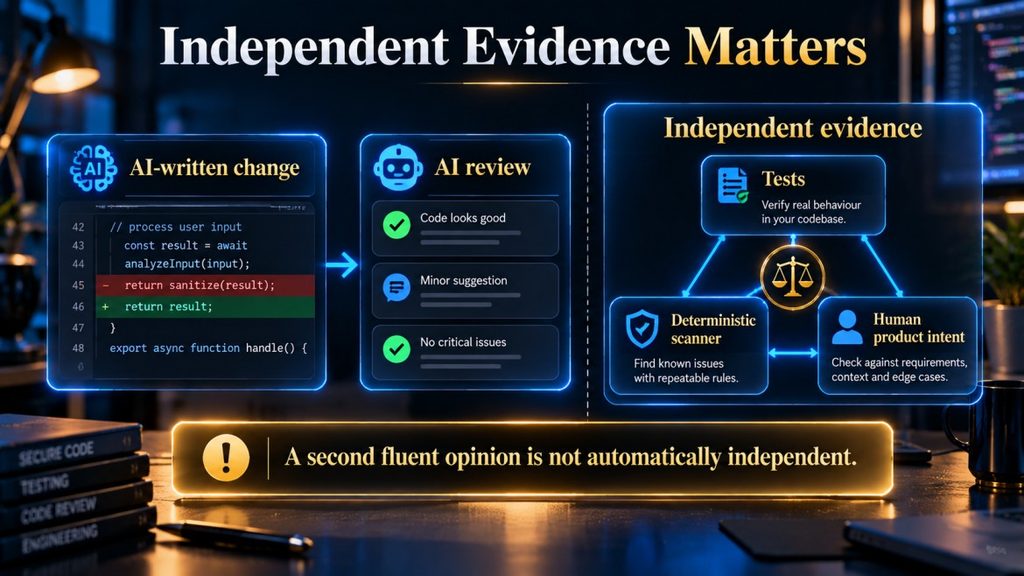
There is also a second-order effect when AI-written code receives AI review. A reviewer may recognize familiar patterns and miss the same unstated assumption the coding assistant missed. An independent test oracle, human review of product intent, and a scanner with a different detection mechanism make the evidence less correlated. Our grounding guide addresses a related problem: more retrieved context can improve an answer, but it does not automatically verify that the answer is the one your system needs.
Why the old human review practice still exists
Traditional code review slows a change down for a reason: another person can ask what the code is supposed to accomplish, who bears the risk, and which assumption the author has not tested. That conversation is not a nostalgic ritual. It is a way to bring product, operational, and security knowledge into a technical decision before the change becomes harder to reverse. An AI reviewer can prepare that conversation, but a plausible explanation cannot stand in for an owner who understands the consequence.
Consider a migration that changes a customer record format. A bot might identify an unhandled null value or suggest a cleaner helper function. The reviewer who knows the rollout may ask whether old records remain readable during the deployment window and whether the rollback path has been exercised. Both forms of review are useful, but they inspect different evidence. If the automated pass lets the human spend more time on migration safety, it has earned its place; if it floods the PR with style advice and obscures the rollout question, it has made the process worse.
The same distinction explains why the tool that wrote the change should not be treated as its only independent critic. A coding assistant may carry the author’s mistaken assumption into a polished patch, and another model can restate that assumption with equal confidence. Independent tests, source contracts, and a human who can challenge the requirement offer different evidence. Our AI hallucinations explainer discusses why a plausible explanation can feel trustworthy before it is grounded.
There is a narrow counterargument worth taking seriously: a consistent AI first pass can notice routine defects that busy humans overlook. That may free people to focus on architecture and intent rather than line-level cleanup. It only works if reviewers are allowed to ignore low-value comments, the findings are checked against tests, and nobody treats an automated approval as an excuse to stop asking hard questions. The value comes from a better division of labor, not from removing the human from a consequential decision.
Use W.O.R.T.H. to decide whether a reviewer belongs in your workflow
AI Hustle World’s site-wide W.O.R.T.H. lens means Workflow fit, Output capability, Risk and rights, Total cost, and Human effort. It is a decision structure, not a score we can manufacture from vendor pages. If a product fails a necessary condition, a high feature count cannot rescue the purchase. The lens is most useful when you apply it to the work your team will actually delegate, including the human review that remains.
Workflow fit
Start with where the change is made, reviewed, and merged. If the team uses GitLab for most work, a polished GitHub-only workflow is not “almost compatible”; it misses the place where reviewers make the decision. If security work begins in CI rather than in an editor, measure whether the tool’s finding reaches the PR owner before the merge. Choose a representative repository and trace the review from trigger to resolution, including what happens after a new commit.
Output capability
Specify the output you need before evaluating the tool. A junior-friendly explanation, a line-specific patch, a test suggestion, a policy label, and a failed status check are different deliverables. For a correctness problem, ask whether the comment identifies an actual violated expectation and a way to reproduce it; for a security problem, ask whether the finding names the trust boundary and the path that crosses it. If the tool cannot produce evidence a reviewer can act on, a fluent summary is not enough.
Risk and rights
Reviewers need access to source code, sometimes to linked issues and related repositories. Check what the integration requests, where code is processed, what is retained, and who can change rules or dismiss findings under the plan you would actually buy. Decide which paths require a human reviewer even if an AI approval is technically available. A high-risk authorization, billing, or data-deletion change should not inherit the same approval shortcut as a low-risk documentation edit merely because both are pull requests.
Total cost
Subscription price is only the visible part. Add seat or credit units, review volume, setup time, rule maintenance, security review, and the time spent on ignored comments. A low monthly bill can become expensive if the bot makes two engineers triage every routine PR; a higher bill may be worthwhile if a focused review prevents repeated investigation of the same class of defect. Use current vendor terms and your own pilot data rather than an annualized savings claim with no measured baseline.
Human effort
Measure what happens after the bot speaks. Someone must decide whether a comment is correct, whether a proposed fix preserves the requirement, and whether the review needs to run again. Teams with strong owners can use an AI first pass to direct attention; teams that use it as a substitute for ownership may create a longer, noisier queue. The practical question is whether the tool frees a reviewer to examine design and intent or merely gives that reviewer another inbox.
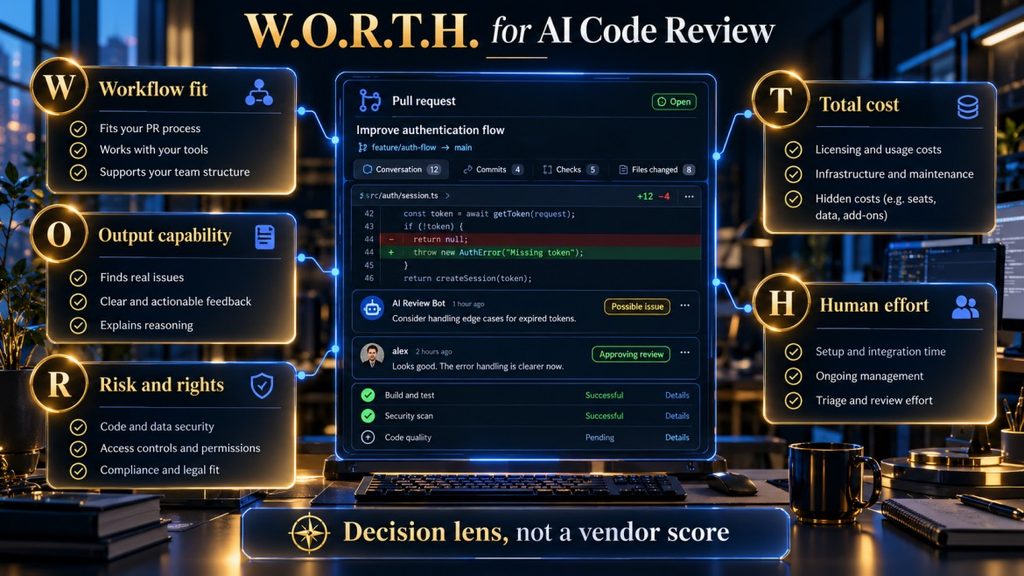
For a small GitHub team already paying for Copilot, W.O.R.T.H. may point to a narrow native trial before another procurement process. For a multi-host team with written standards, CodeRabbit or Qodo may offer better workflow fit. For a complex repository where cross-file effects dominate, Greptile deserves a focused test; for an enforceable quality or security threshold, SonarQube Cloud or Snyk Code may be necessary alongside any AI reviewer. These are conditional shortlists, not empirically scored winners.
Run a pilot that can change your mind
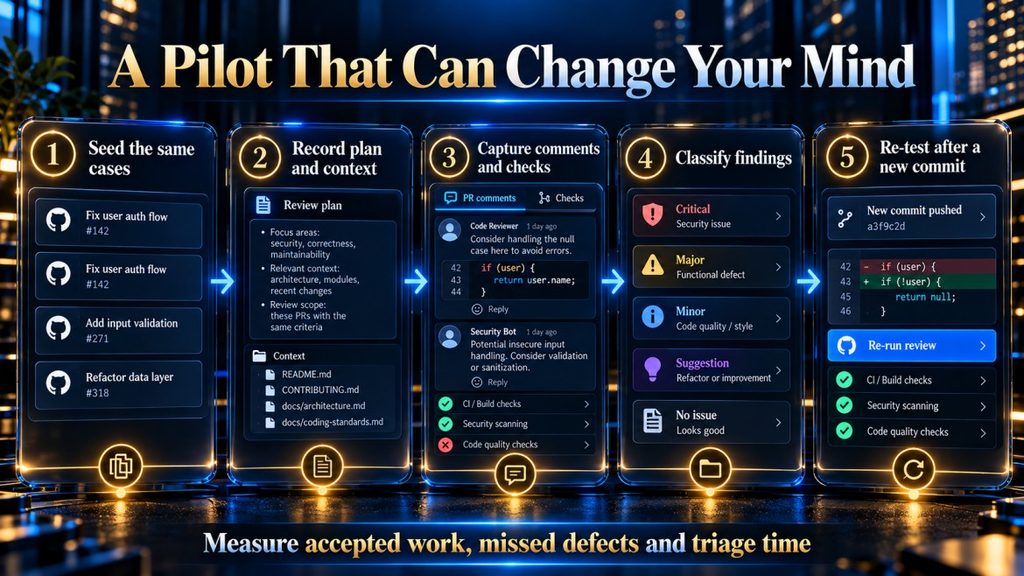
Give every candidate the same task wherever access and product design allow it. Create a disposable repository with a small application and four separate pull requests: one alters a business rule, one introduces an authorization error, one changes an interface used from another file, and one contains a harmless style distraction. Keep the expected behavior and each seeded defect in a private evaluation sheet so the reviewer does not receive the answer in the PR description. This is a proposed protocol, not a test AHW has already performed.
A concrete authorization case would add an endpoint that checks authentication but omits a condition tying the requested object to the authenticated user. The “known issue” is not that the code lacks a certain word; it is that user A can retrieve user B’s object under the fixture’s rules. Write a failing test for that cross-user request before a fix is proposed. If an AI reviewer flags input sanitization instead, log it separately rather than counting it as a catch of the seeded authorization defect.
Run each candidate with the plan, version, review effort, rule files, repository permissions, and trigger recorded. Capture the PR comments and status checks, then have a human classify every finding as actionable, valid but already covered, incorrect, or out of scope. Save the screenshots or exported comments and the commit hashes. If one tool sees a different repository context or uses a paid feature another candidate lacks, show that condition beside the result; it is part of the buying decision, not a nuisance to hide.
After the first pass, fix each seeded defect and add a new commit. Record whether the product re-reviews, withdraws stale comments, or repeats a resolved issue. Measure time to first useful finding, human triage minutes, accepted actionable findings, missed seeded defects, and the number of review cycles before a clean merge. Do not collapse these into one opaque score. A tool that catches one consequential bug with two useful comments may be preferable to one that posts twenty plausible but unhelpful notes.
Keep the pilot narrow enough to finish. Two representative repositories and a handful of PRs will not establish a universal benchmark, but they can expose a bad workflow fit or a misleading vendor promise before a team-wide rollout. Repeat later on real, consented development work if the tool survives the disposable-repo test. Never upload sensitive code to a new service merely to make a comparison more exciting; use approved access and the organization’s normal review process.
The economics of review are about accepted work
Suppose a team opens forty PRs in a month. If an automated reviewer adds five comments per PR, that creates two hundred items for someone to read. The arithmetic is illustrative, not a measured AHW workload or a claim about any vendor. The outcome changes dramatically depending on whether those items are valid, novel, and quick to resolve. A purchase case should start with your measured baseline for reviewer waiting time and escaped defects, then compare it with the pilot’s triage time and accepted findings.
A practical cost worksheet has four columns: direct plan cost, setup and rule maintenance, review time added or saved, and downstream cost of missed issues. Keep each input in the unit it actually has: seats, credits, PRs, hours, or incidents. If an input is unknown, label it unknown rather than turning it into a precise return-on-investment claim. The first decision may simply be “continue the pilot,” “change configuration,” or “do not buy,” which is more defensible than a fake payback period.
There is a human alternative worth pricing honestly. Smaller PRs, clearer acceptance criteria, a targeted test suite, and a named reviewer can improve quality without a new vendor. An AI reviewer can support that routine by pre-reading the diff and highlighting suspicious lines, but it does not make a vague requirement clear. If your team is struggling to write the requirement, improve that upstream step before buying a second opinion on the code it produced. Our instructions guide covers how to make delegated work easier to evaluate.
From trial to a review policy people can follow
Select one repository and one owner for the first rollout. Decide which PRs trigger AI review, which findings require a human response, and which checks can actually block the merge. Write the exceptions down: generated files, documentation-only changes, emergency fixes, and high-risk paths may need different handling. Without this policy, the tool becomes another participant in the discussion, not a reliable part of the release process.
Keep tests, linting, and security checks in their own lanes. An AI reviewer may suggest an edge case, but the test suite must still run; a scanner may report a vulnerable pattern, but a human must assess whether the fix preserves behavior. If a bot suggests replacing an unknown API call with another plausible one, resolve the package and runtime contract before accepting it. The method in our API-verification article is particularly relevant when a review comment proposes a new library call.
Review the policy after a short, predetermined period rather than letting the first setup become permanent. Sample ignored comments, accepted comments, escaped defects, and the time humans spend between the first AI response and the final decision. If developers reflexively dismiss a rule, investigate whether the rule is wrong, poorly scoped, or revealing a real but inconvenient problem. A review system improves when people can explain why a finding mattered, not when its dashboard displays more activity.
Do not use an AI approval preview as a shortcut around the people accountable for consequential code. You may decide it is acceptable on low-risk paths after testing, but record the exact repository settings and renewal conditions. For a critical authorization or payment change, require a person who understands the product rule. That protects both the user and the engineer who will have to explain the decision later.
Which tool should you shortlist?
| Your situation | Start with | Reason to add another layer |
|---|---|---|
| GitHub team with Copilot already approved | Trial Copilot code review on representative PRs. | Add a dedicated reviewer if rules, noise control, or cross-host coverage are insufficient; add a scanner for enforceable security checks. |
| Several Git hosts and a need for consistent PR feedback | Trial CodeRabbit with the same rule set on two repositories. | Check security and merge enforcement separately rather than assuming every comment is a gate. |
| Written standards and compliance owners | Trial Qodo’s review and compliance configuration. | Build and test the CI action if a label must stop a merge. |
| Large codebase with repeated cross-file review effort | Trial Greptile on a seeded interface change. | Pair with deterministic analysis for security policies it does not establish. |
| Cursor-centered development team | Trial Bugbot’s PR review and fix handoff. | Verify current plan limits and review the generated fix independently. |
| Non-negotiable quality or security threshold | Configure SonarQube Cloud or Snyk Code with a required CI check. | Add a conversational reviewer if humans need better explanations of intent and cross-file behavior. |
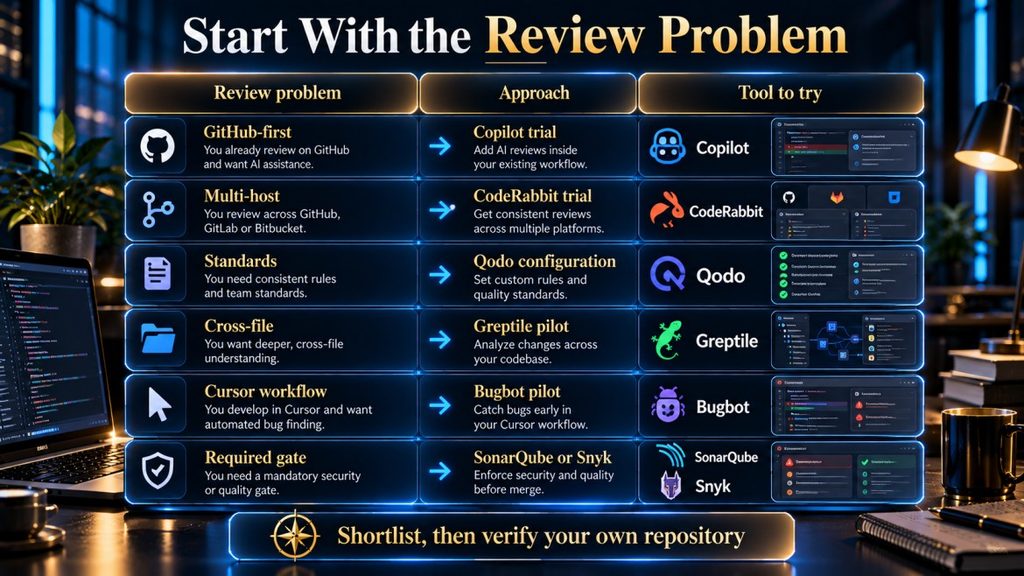
This is a starting sequence, not a purchase order. Your security rules, data-access requirements, repository host, and pilot evidence can reverse any recommendation in the table. The product that produces the best demo may be the wrong choice if it cannot enter your pull-request path or if every finding requires another thirty minutes of human sorting. Keep the final choice tied to accepted work and a clearly owned merge rule.
Choosing a reviewer is only one part of accepting delegated software work. Our AI coding agent selection guide connects the authoring route to independent checks, persistent-state changes and release approval.
Frequently asked questions
Can an AI code reviewer replace a human reviewer?
No tool in this comparison can take responsibility for whether the code satisfies an unstated business requirement. AI review can surface possible defects, summarize a change, and suggest repairs, which may make human attention more focused. A person still needs to judge intent, consequence, and whether a proposed fix is acceptable. The higher the impact of a mistake, the more explicit that human decision should be.
Does a PR comment stop a bad change from merging?
A comment alone does not usually enforce a repository rule. An approving review, a failed status check, and a required branch-protection condition have distinct effects. GitHub’s Copilot approvals can satisfy required-review rules when its public-preview feature is enabled, but they are off by default. If blocking matters, test the exact repository setting with a disposable PR before trusting it.
Is static analysis the same as AI code review?
Static analysis checks code against rules or models of known issues and can publish a clear pass/fail result. A conversational AI reviewer reasons about the change and writes comments that may address logic, tests, or maintainability. Some products combine these functions, but the evidence and enforcement of each remain separate. A team may need both because neither catches every kind of defect.
Which tool is best for catching security bugs?
We cannot responsibly name a universal winner without testing the same vulnerabilities, plans, and settings across the products. If your priority is an enforceable known-pattern security check, begin with a security scanner such as Snyk Code and test its CI gate. If the issue is a product-specific authorization rule, design a targeted test and retain a human security review even when an AI bot comments on the PR. The relevant question is which risks your current checks leave uncovered.
Will repository context make an AI reviewer accurate?
Repository context can help a reviewer connect a changed function to callers and shared types. It does not tell the tool every business rule, production condition, or contract hidden outside the repository. Test a cross-file change whose expected effect you know, then inspect whether the comment explains the correct dependency. Treat “full context” as a capability to examine, not a quality score.
Should we let an AI reviewer approve pull requests?
First decide which code paths can tolerate an automated approval and who owns the rule. GitHub documents an opt-in Copilot approval preview that can count toward a required approval, but a team can still keep human approval mandatory for sensitive changes. If you enable an AI approval, verify what happens after new commits and whether other required checks remain in force. The setting is a policy decision, not merely a convenience switch.
How many comments should a good reviewer produce?
There is no useful universal target. A low-risk documentation PR may need none, while a change that crosses a data-access boundary may justify several detailed comments. Track the share of comments a human accepts as novel and actionable, the time spent triaging them, and the important defects that were missed. More comments help only when they improve the decision before merge.
Can we compare free plans fairly?
Only if you record the limits and capabilities each free plan actually exposes. A product may restrict review volume, repositories, context, models, or security features, and those restrictions can change. Use the plan your team would realistically buy when making a procurement decision. If one trial has stronger access, show that difference beside the result instead of presenting the outcomes as a controlled head-to-head.
What should we do when the reviewer is wrong?
Keep the expected behavior visible and explain why the comment is incorrect or out of scope. If the tool supports repository rules or feedback learning, use that mechanism for recurring false positives; do not silently dismiss a pattern that another engineer may see again. Also check whether the mistake reflects missing context in the PR description or an ambiguous acceptance criterion. Improve the upstream evidence before adding another broad instruction to the bot.
What is the safest first rollout?
Begin with a disposable repository or a low-risk real repository that your organization permits the tool to access. Run the same small PR set through the candidates, retain the original tests, and assign one human to classify findings. Set a date to decide whether the reviewer is saving attention or creating noise. Expand access only after the team understands its permissions, limitations, and merge behavior.
Final thoughts
Choose the review boundary before the brand. A PR-commenting assistant can improve the conversation, a static-analysis gate can enforce a defined rule, and a human can decide whether the change solves the right problem. The strongest workflow makes those roles explicit and measures accepted work rather than
comment volume. Start with one representative repository, record what the tool actually found and what reviewers had to do next, then keep only the automation that improves that decision.
If you are choosing the coding assistant that sits upstream of this review process, compare Cursor, GitHub Copilot and Claude Code by context, permissions and the review effort each route demands. That comparison helps you decide whether the tool should propose a change, explain a change, or earn a place in the merge path.
Still unsure what an AI reviewer actually proved?
Use the code-review checklist to separate a plausible comment from evidence you can verify before merge.
Review AI-Generated Code Carefully →Written by
Muntasir Ahmad Chowdhury
Founder-AI Hustle World
Muntasir Ahmad Chowdhury is the Founder of AI Hustle World, an independent publication dedicated to making Artificial Intelligence practical, trustworthy, and easy to understand. He researches AI tools, automation, customer service, productivity, and real-world business applications, helping readers make smarter technology decisions through research-driven, experience-backed content.
Expertise:
AI Tools • AI Automation • AI Customer Service • AI Productivity • Generative AI • AI Workflows
Get Smarter With AI
Enjoyed this guide? Get practical AI tools, tutorials, and honest reviews delivered to your inbox.