Evidence: Documentation reviewed, plus one small first-hand code test
Last checked: September 2026
What was done: Written from official documentation and the published sources linked in this article. No AI product was hands-on tested. The author also ran one small local Python test on 29 September 2026 (Python 3.12.14), which the article describes.
Files: Not published
Affiliate links: No
AI Code Refactoring: How to Change Large Codebases Safely with AI
The old worker was still running when the new event arrived. The producer had renamed customer_id to account_id, and its updated consumer handled the event without trouble. Both the old-version tests and the new-version tests passed. The old worker looked for customer_id and raised KeyError: 'customer_id'.
We constructed and ran that small Python fixture for this guide. It isolates a problem that becomes harder to see as a real codebase grows: two internally consistent versions may be incompatible during a rolling deployment.
If you ask an agent to “rename this field everywhere,” the request sounds precise. The danger is in everywhere. An internal variable, a public event key, an old queue worker and a persisted record may share a word while obeying different contracts. Changing them together can turn a harmless internal refactor into a release migration nobody planned.
This guide starts with the behavior and compatibility that must survive, then chooses which edits belong to language-aware tools, codemods, AI assistance or a human design decision. It follows the work through discovery, execution, testing, rollout and cleanup. The goal is a codebase you can continue to build, review and release while its structure changes.
What counts as a refactor when a whole repository moves?
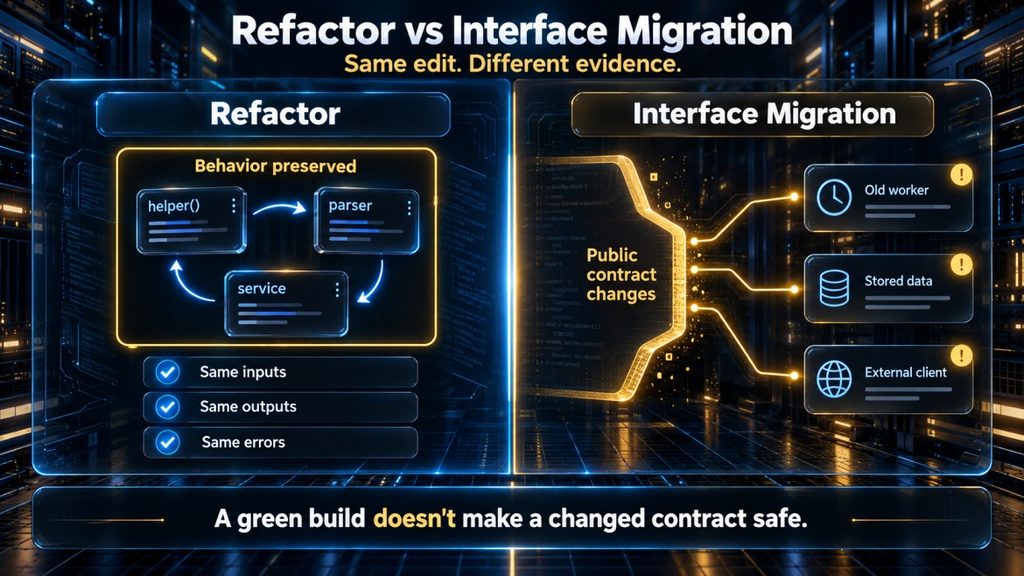
A refactor changes internal structure while preserving observable behavior. Extracting a helper without changing its callers’ outputs fits that definition. Renaming a serialized field that another service reads changes an observable contract, even if the implementation uses the same data afterward. Calling both operations “cleanup” hides the different evidence they require.
Microsoft’s guide to behavior-preserving refactoring asks developers to record inputs, defaults, output shapes, errors, side effects and public names before making a bounded change. That is the right starting point. A repository can compile while a customer receives a different error message or a background job loses a field it expects.
Traditional refactoring tools still have a job. A language server finds typed symbol references with repeatable rules, and a tested codemod transforms a known syntax pattern across many files. AI can interpret why two similar call sites differ, but its explanation does not establish that it found every caller.
The AI coding assistants overview covers the broader capabilities. Here the question is narrower: what change can you prove safe as the repository and its running versions move from one state to another? The answer begins with the surfaces people and systems actually depend on, not with the size of the model’s context window.
Some work is a migration by design. Moving an API from customer_id to account_id, upgrading a framework or replacing a database client may require consumers to change. You can still use small refactoring steps inside that work, but the public transition needs an explicit compatibility policy, owner and deployment sequence.
This distinction protects the team from a common false assurance. “All references renamed” is a statement about the references a tool recognized. It does not prove that a string in a message schema, a reflection lookup, a generated client or an old binary stopped depending on the former name. Name the external contract separately and the question becomes testable.
Map the change surface before asking AI to edit
Begin with a sentence that defines the intended structural improvement and a sentence that defines what must remain true. “Consolidate invoice event creation into one producer without changing the published event shape” is reviewable. “Modernize the billing layer” leaves too much room for an assistant to redesign behavior while making the code look tidier.
Find entry points, symbols and consumers before a broad rewrite. Search definitions and references with a language server, then literal field names in schemas, configuration, tests, migrations and generated-code inputs. A symbol index finds code relationships; text search finds contracts expressed as strings.
Neither search is complete. A queue event may reach another repository, a database column may feed analytics, and a plug-in may resolve a class from configuration. A customer can still run an old package version that your monorepo no longer contains. Record those consumers instead of treating a local search as proof of absence.
For each affected surface, identify who owns it and how long old and new versions can coexist. If the team cannot name the owner of a published event or the oldest supported consumer, pause the contract change. The code edit may be easy; the missing deployment fact is the actual blocker.
Build a contract inventory that changes the plan
List observable behavior in terms that can be checked: accepted input, output or event shape, error type, ordering, side effects, timing-sensitive transitions and persisted data. An internal helper can be renamed freely if all callers move with it. An event key may need to remain byte-for-byte stable for a worker released yesterday.
Do not freeze an accidental bug as the contract merely because the old tests recorded it. Compare the existing behavior with product requirements, consumer expectations and version policy. If they disagree, split the defect fix from the structural refactor so reviewers can tell which output changed intentionally.
A useful change-surface inventory also records uncertainty. Mark “known consumer,” “likely consumer,” and “unverified external use” plainly. This does more than add a caveat: it changes the next action. A known old worker calls for a mixed-version test; an unknown third-party client calls for a compatibility decision before an API removal.
At scale, seek a tight superset of edit sites rather than claiming a perfect list. In Google’s account of AI-assisted code migrations, static search and cross-references expanded initial targets to related tests and interfaces before model edits. That is its internal workflow; ordinary code search cannot guarantee cross-repository completeness.
The order matters. If an agent edits first and the team inventories later, the diff becomes the source of truth about what was supposed to change. That reverses the burden of proof. A pre-edit map lets you spot an omitted consumer, a surprising new dependency or a file the transformation had no reason to touch.
You do not need a hundred-page architecture diagram. For one invoice event, a short row for its producer, schema, deployed worker, queue and release owner may be enough. For a framework migration across many packages, record package ownership, generated artifacts, build combinations and which releases must interoperate. The map should be just large enough to expose the next failure mode.
Choose the edit mechanism by the shape of the change
Use the most constrained method that expresses the change. An IDE rename suits one typed symbol; a tested codemod scales a repeated syntax pattern. AI helps when call sites differ in meaning and exceptions need investigation. Do not ask it to invent a separate rule in every file.
| Change you actually have | Leading method | What still needs judgment |
|---|---|---|
| One typed symbol and its known local references | Language-aware IDE rename | Public strings, reflection, config, generated sources and older consumers can sit outside symbol analysis. |
| Repeated syntax-shaped API edit | AST/CST codemod tested on positive and negative fixtures | Similar syntax may encode different semantics; inspect the exception queue and dry-run diff. |
| Heterogeneous calls across packages | Bounded AI-assisted edit with examples, exclusions and per-slice checks | Owners must decide which callers share the contract and which need a different path. |
| Interface or data change spanning running versions | Human-defined migration with tools and AI for inventory and bounded implementation | Who can still read old data, when can support be removed, and what happens after rollback? |
An AST-aware transformation understands more syntax than a raw text replacement; a concrete syntax tree can also preserve formatting and comments. LibCST’s documentation describes a Python tree suited to codemods that retain source formatting. Neither type of tree understands your product’s compatibility policy automatically.
Suppose a codebase contains client.fetch(id) in hundreds of places and the new API requires client.fetch(id, options). A codemod can add a fixed argument where the old call shape is unambiguous. If some callers need a tenant, timeout or retry policy chosen from context, a mechanical rule should report those sites as exceptions instead of fabricating a universal value.
The same principle applies to AI. Give the assistant the old and new contract, a verified example, the affected package boundary, forbidden changes and the command that will check a slice. Ask it to inventory and classify sites before editing. Then compare its claimed inventory with code search, owners and build metadata rather than assuming the assistant read the entire repository.
Our guide to how AI coding agents work explains the tool loop behind multi-file edits. The practical control here is the size of the task you delegate: “change these eight call sites under one contract and stop on ambiguous cases” can be checked; “refactor the whole platform” gives the agent no reliable boundary for exceptions.
Give repetitive changes an exception lane
A transformation should say what it changed, what it intentionally left alone and what it could not classify. Without that third category, the last ten percent of odd call sites can disappear into a reassuring completion summary. The unresolved list is part of the output, not an admission that the automation failed.
Before running a codemod broadly, test it on a fixture that should change and one that must not. Preview the entire patch, inspect representative edits in different packages, then run it on a bounded slice. OpenRewrite’s Maven dry-run documentation describes a patch preview that does not write source files; the same preview principle applies to other ecosystems.
Do not treat a clean syntax diff as a behavioral proof. A rewrite can preserve parseable code and still alter evaluation order, exception type, logging or public output. Conversely, a failure to match a site may be correct if that site implements a different contract. Report the matched, skipped and ambiguous populations separately.
An agent can help author or refine a codemod, especially where examples reveal several patterns. The codemod then gives the repeated edit a stable implementation that can be tested and rerun. Keep human attention on whether the transformation is the right one and whether the exceptions carry a different meaning.
Establish a baseline that could expose the wrong change
Run the relevant checks before modifying implementation code, and record the command, revision, environment and result. A green baseline is useful because later failures can be attributed to a smaller interval of work. It does not mean the existing suite covers the contract you are about to move.
Preserve tests through the original public entry points. A newly extracted helper may pass a dozen direct unit tests while the old route changes a default, status code or response field. Compare the behavior at the boundary the caller sees, and keep the old expectation independent of the new implementation’s wording.
When there is no reliable assertion, write a characterization check for the behavior that must remain. A snapshot of an entire response may catch changes, but it can also include unstable timestamps and irrelevant fields. Prefer a focused assertion about the contract: which keys are present, what error a caller receives, or what durable side effect occurs. Our guide to generating and maintaining software tests with AI covers drafting those checks with an assistant.
Add an adverse case that distinguishes the desired transformation from a plausible wrong one. If the work changes an event producer and its consumer, a same-version round trip is the obvious happy path. The harder question is whether the producer’s output can still be read by a version of the consumer that will exist during deployment.
Test coverage must follow release topology. Some mixed states cannot occur in an atomically deployed process. Old queue workers may continue after a new producer ships, and new messages can remain after rollback. Test the pairings your system can create, rather than every imagined combination.
An agent may update production code and tests to express the same new assumption. The suite turns green while the old contract disappears. Check changed expected outputs against the pre-edit contract before accepting the tests. A refactor needs a trustworthy baseline independent of its proposed implementation.
If the old behavior is intentionally wrong, say so and isolate that change. A bug fix can be valuable, but hiding it inside a massive “no behavior change” patch prevents reviewers from understanding its rollout effect. Small, named behavior changes are easier to verify than an accidental feature mixed into a structural cleanup.
The rename that passed twice and failed during rollout
We expected the obvious rename to be safe if both the old and new implementations passed their own checks. In our constructed fixture, the old producer emits an invoice.ready dictionary with customer_id, and the old consumer reads that key. A new producer instead emits account_id, while a new consumer reads account_id. Each matching pair works.
The missing case is a mixed pair. A new producer can start sending events while an old worker is still processing the queue. When the old consumer receives the new dictionary, its event["customer_id"] lookup raises KeyError: 'customer_id'. No model made that edit; we wrote the variants to test the compatibility question directly.
We ran four unittest classes separately with Python 3.12.14 on 29 September 2026. The baseline old pair passed two checks, and the new pair passed two checks. The deliberately added old-consumer/new-producer expectation errored. A compatible producer that uses account_id internally but still emits the old customer_id wire key passed its two checks.
| Check actually run | Fixture outcome | What that outcome establishes |
|---|---|---|
BaselineChecks: old producer and old worker; old event shape | 2 passed; exit 0 | The existing pair works and publishes type, customer_id, amount_cents. |
NaiveCurrentVersionChecks: new producer and new worker; new event shape | 2 passed; exit 0 | The updated pair works with account_id; no old worker is exercised. |
MixedVersionExpectation: new producer to old worker | 1 error; exit 1; KeyError: 'customer_id' | The constructed rolling-version pairing breaks at the old consumer’s key lookup. |
CompatibleRefactorChecks: internal rename, old published key | 2 passed; exit 0 | The old worker reads the event, and the original three-key shape remains in this fixture. |
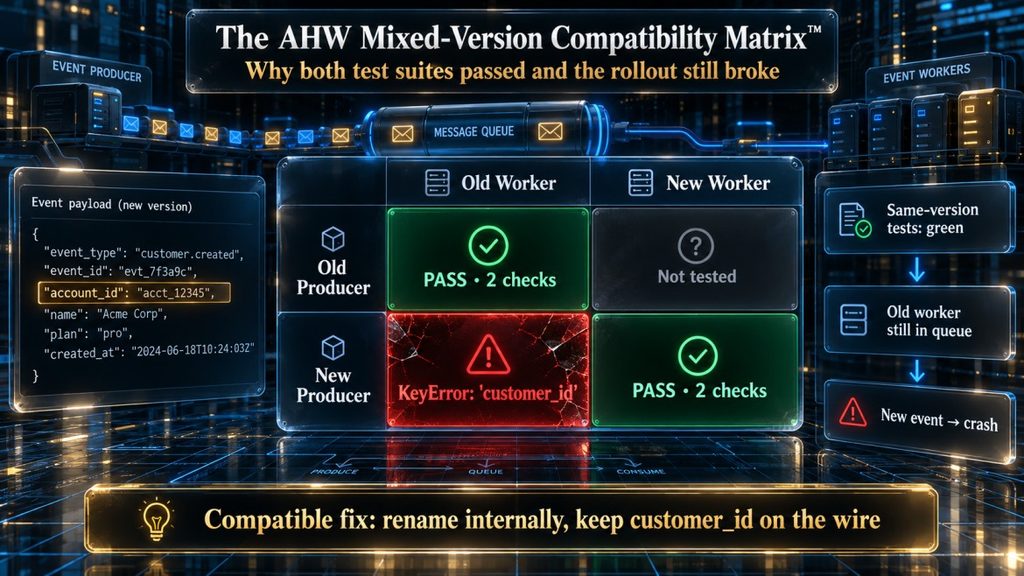
The naive event was {'type': 'invoice.ready', 'account_id': 'acct-7', 'amount_cents': 12500}. The compatible event was identical except that the field name remained customer_id. That single string is the boundary. A code search might find both current functions, but it cannot infer on its own that an old deployed worker will continue to read the former name.
The tested correction is intentionally modest. The producer’s internal parameter can be called account_id while the outward event continues to use customer_id. That is a behavior-preserving refactor of the producer’s internals, even if the legacy term now looks inconsistent. The inconsistency is cheaper than breaking a live contract you did not intend to migrate.
The compatible producer was not tested with the new consumer, which expects account_id. That pairing needs a tolerant reader or a separate migration plan. We did not run a broker, serialize JSON, deploy services or check a schema registry. The local result proves one relationship, not production rollout safety.
The AHW Change-Surface Ledger
AI Hustle World’s Change-Surface Ledger turns the refactor into a decision about each exposed surface. It connects the intended invariant to the version that depends on it, the evidence needed and the stage at which it may change. This is a filled review artifact for our fixture, not a new industry standard or a numerical safety score.
| Surface | Version or owner at risk | Invariant, evidence and release decision |
|---|---|---|
| Producer’s internal parameter | Current source code | Rename to account_id; same-version tests and references check the internal edit. Do not infer anything about the event key from that pass. |
Published invoice.ready field | Old worker and any unlisted consumers | Preserve customer_id for a pure refactor. Compare exact event shape with baseline and test an old consumer against the new producer. |
| New consumer implementation | Team planning a future schema change | Decide whether it accepts both formats. Our current consumer_v2 does not; no mixed pairing involving it was established by the compatible checks. |
| Queue and deployment sequence | Release owner | Identify overlap of producer and worker versions and any queued messages. A code rollback cannot retract a new-format event already emitted. |
| Batch, CI and reviewer | Package/service owners | Keep internal rename, consumer compatibility and field removal in separate semantic slices with explicit test output, exceptions and cutover owner. |
The ledger is useful because its rows demand different proof. A compiler can check a typed symbol. A consumer-contract test can check an event shape. A deployment record tells you whether an old binary may still be present. None of these substitutes for the others, and a long list of changed files does not reveal which one remains uncertain.
If you are planning a real migration, add columns for the affected repository, consumer owner, oldest supported release, queue retention, monitoring signal and rollback action. Fill them from actual system records. “No known consumer” is not the same as “no consumer”; if that uncertainty changes whether you can remove a field, leave the removal out of the current batch.
Separate the pure refactor from the interface migration
You can finish the internal rename while keeping the event stable. That delivers the maintainability benefit without requiring every consumer to deploy at once. If the organization also wants the published field to become account_id, open a separate migration decision with an explicit compatibility interval and owner.
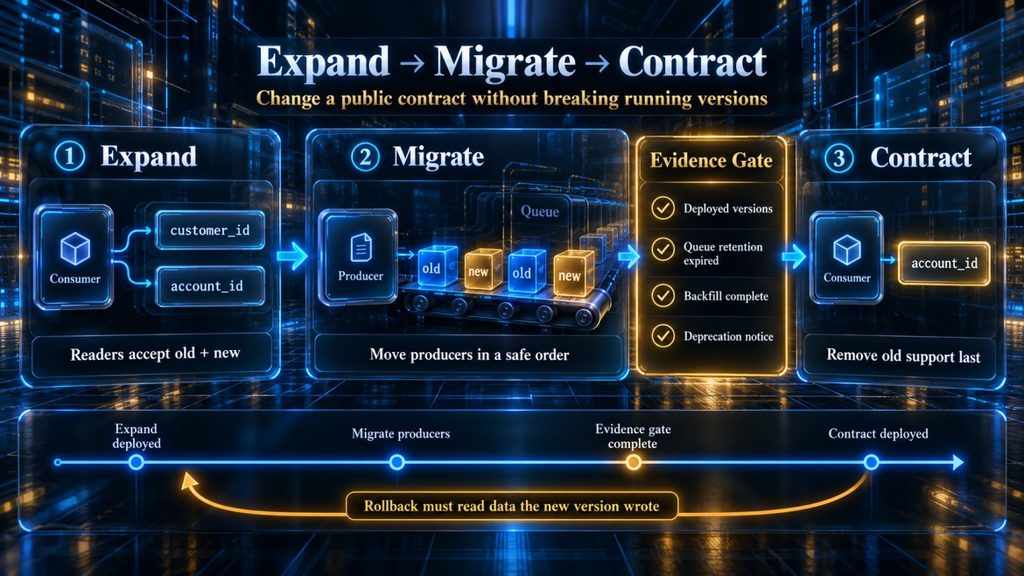
Fowler’s description of parallel change calls the usual stages expand, migrate and contract. The pattern is established, and it does not automatically prescribe the wire shape for this service. A tolerant reader may accept old and new keys; a producer might temporarily emit both; an endpoint might instead introduce a version. Each option must be checked against actual consumers.
In the expand stage, make consumers capable of reading the new representation without losing the old one, or introduce a versioned interface. Test old data and the proposed new data before the producer changes. Do not assume an extra JSON field is harmless: strict schema validators, signatures, size limits and downstream transforms may reject or mishandle it.
During migrate, move producers and consumers in an order that the compatible states permit. Record which release reads which field and what remains in queues or persisted records. A feature flag can control a behavior path, but it does not rewrite old messages and it does not make an incompatible worker able to parse a new event.
Only contract after evidence says the old representation is no longer needed. That could require deployed-version inventory, queue retention expiry, backfill completion and a deprecation commitment to external clients. Deleting a compatibility branch early makes the last stage look clean in the diff while creating the first real customer failure.
For a dependency replacement with many callers, a temporary abstraction may be more useful than putting old and new conditional logic at every call site. It lets callers move behind one interface while the two implementations coexist. The cost is another layer to maintain, so remove it when the transition is complete if it has no lasting design value.
The rollback plan must address data produced during the new version’s brief lifetime. Reverting the source may restore the old producer, yet messages or rows written under the new shape can still be consumed later. Test a representative rollback state before release if that path matters; an emergency revert is only useful when the old code can read the world it returns to.
Not every refactor needs three release stages. A private helper with an atomic deployment and no external or persisted contract may be changed in one focused PR. The decision depends on actual version coexistence and reversibility, not on a rule that every code edit deserves ceremony.
Batch around one contract, not one file
Make each batch a coherent claim that reviewers can check. “Move all invoice-event construction behind one helper while preserving the published fields” is such a claim. “Edit twenty files” is only a size description; those files might contain one behavior or twenty unrelated ones.
The batch should leave the system buildable and its relevant contract intact. If a single API rename must change a type declaration, two implementations and their callers together, dividing those files into separate broken PRs is counterproductive. If a codemod hits ten packages with independent owners, separate package-level batches may reduce review and rollback cost.
Atlassian’s account of cleaning up Nav4 feature gates describes discovery of multiple patterns and package-level AI-assisted changes after a script-first approach created more manual review work. That is a company case with its own tools and repository. The transferable lesson is to validate one pattern and its exceptions before scaling it across heterogeneous packages.
Tiny PRs also have a cost. A 15-day study of one industrial C++ repository reported that 639 per-file commits strained CI and reviewers. The authors moved to capped directory batches in that setting. This single-case research preprint on AI-assisted remediation supplies a warning, not your team’s optimal batch size.
That result explains a second-order cost. AI may cut the time to generate each edit while multiplying CI runs, context switches and approval requests. If the queue becomes the bottleneck, generating more tiny PRs is not the same as delivering a safer migration. Group related edits so one check demonstrates one contract, then size the group to fit an actual reviewer and test environment.
Give each batch an acceptance note: intended invariant, transformed paths, skipped or ambiguous sites, targeted commands with output, broader CI status, owner and reversal step. These notes are especially valuable when an agent performs several rounds of edits; the reviewer should be able to compare the final diff with the approved slice, not reconstruct the entire chat.
The human-in-the-loop AI guide covers when consequential automated actions need explicit human judgment. For refactoring, reserve that judgment for policy, contract and deployment decisions. Requiring a human to watch every mechanical rename while leaving the event-schema decision implicit puts attention in the wrong place.
Verify the change through code, contracts and time
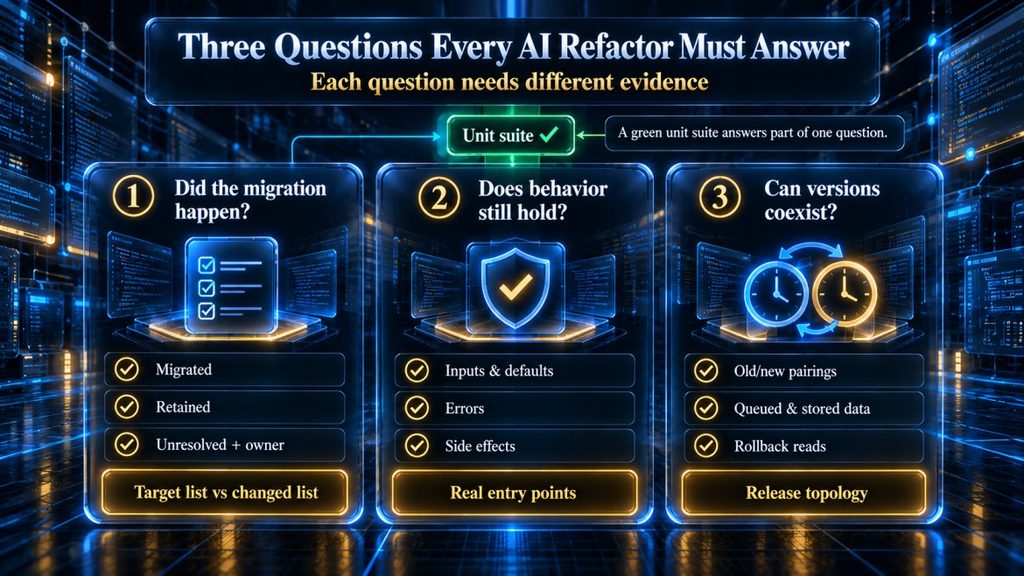
Verification should answer three separate questions: did the intended migration happen, does behavior still hold, and can the relevant versions coexist during release? A green unit suite may answer part of the second. It does not establish the first or third unless it deliberately exercises them.
Inspect the diff for migration completeness. Count and classify remaining old call sites, aliases, generated references and exception cases. A proposal that preserves tests by leaving half the old implementation in place may be behaviorally safe today but fail the requested structural goal. The result should be explicit: migrated, intentionally retained, or unresolved with an owner.
Then compare behavior at real entry points. For an API extraction, check normal inputs, defaults, errors and side effects. For an event rename, compare exact field names and mixed-version pairings. For a database migration, check old rows, new writes, rollback reads and backfill assumptions in a database-backed environment rather than inferring them from mocks.
Run focused checks after each semantic slice, then the broader suite and relevant build, type, lint and integration checks before release. Record skipped commands and their consequences. A local fixture cannot demonstrate middleware, queue serialization, deployed configuration or production load; neither can an assistant’s summary convert an unavailable environment into a pass.
Our guide to reviewing AI-generated code examines how a reviewer decides whether a submitted change has enough functional and security evidence. In a large refactor, supply that reviewer a readable contract map and per-batch outputs. The operator’s extra responsibility is that every intermediate state and release sequence must also be viable.
If performance should improve, state that contract separately. Extraction can add calls, change caching or reorder I/O while returning the same value. Compare representative workload, query count, memory and latency under the same conditions. An optimization is not behavior-preserving if it changes ordering or timeouts that callers depend on.
Pay attention to generated artifacts. An API schema might generate clients in another package; a protobuf change may produce language bindings; a database change may need a migration file and a backward-readable application version. Review the source of generation and regenerate deliberately rather than manually editing output that the next build will overwrite.
Security and rights follow the work. Moving validation behind a helper can alter which routes invoke it, while a broad agent session may read files outside the slice. Our AI agents’ tool-use explainer explains the effect of tool actions. Limit access to the task and inspect what was touched.
When evidence is missing, shrink the claim. “The internal rename builds and the local contract checks pass; the old mobile client was not tested” is a decision-relevant status. “Refactor complete” is not. Decide whether the untested client is required before merging, and assign the owner who can supply that check.
Replacing a subsystem needs a temporary architecture
A large refactor may replace an implementation rather than rename its interface. Imagine moving an order-pricing service from scattered conditionals to one policy module. Copying every old branch into a new class may reduce file count, but it does not prove that discounts, taxes and rounding remain equivalent for real orders.
Put a stable seam around the current behavior before switching callers. An interface or facade can direct existing entry points to the old implementation while the new one is built behind it. This is useful when many callers must move gradually; it adds a temporary layer, so the plan should say when that layer is removed or why it deserves to remain.
Compare the implementations on cases that separate their behavior, not only on the common path. For pricing, those might be a capped discount, a refund after a price change, a tax-exempt item and a zero-value order. If the old result is known to be wrong, record the intentional correction separately instead of forcing the new module to reproduce a defect forever.
Some teams run the new implementation in shadow mode to compare outputs before using them. That only works safely when the shadow path cannot duplicate side effects such as charging a card, sending an email or consuming inventory. A comparison of returned prices is useful; executing the full order workflow twice may create the incident the refactor was meant to avoid.
Switch a bounded group of callers only after the seam and comparison checks are credible. A flag may control which implementation receives a request, but it must have a defined scope and reversal behavior. If both implementations write incompatible state, flipping the flag back can fail even though the old binary is still available.
This is where AI’s contextual skill can help without owning the architecture. Ask it to locate implementations, classify differing rules and propose focused tests for the seam. The service owner decides which behaviors are contracts, which are defects, and which customers can enter a canary. An agent cannot infer commercial policy from a tidy class hierarchy.
If the replacement spans teams, name one person who can resolve contract disputes and one owner for each consumer. The AI governance framework addresses organizational accountability at a broader level. In this migration, the practical version is a decision log: who approved a changed rounding rule, when the new module becomes authoritative, and what condition triggers a rollback.
Make the first migration batch executable
Start with a small change that proves the plan’s hardest assumption, not necessarily the easiest file. If the main risk is version skew, add the mixed-version contract test before any mass rename. If the main risk is a codemod matching aliases incorrectly, write the positive and negative transform fixtures first.
Record the baseline on the same revision that the first batch will modify. Name the test command and its exit result, then save the original event or response shape. For a distributed system, record which component versions are currently deployed and whether queued work can outlive a deployment. Those facts determine the compatibility interval.
Next, separate discovery from mutation. Ask AI to enumerate likely sites and explain why each is in scope, but verify the list through symbol references, text search, schemas and owners. Put unknowns in an exception queue. Do not let “I found 247 matches” become the definition of completeness when the old client is outside the repository.
Approve one semantic slice with a clear invariant. It might rename only the producer’s internal parameter while leaving the wire key untouched. Run targeted checks, inspect the whole diff for unrelated churn and record new dependencies before the next slice. This makes a wrong edit easier to isolate.
Scale the transform only when its output is repeatable on varied examples. For a codemod, inspect changed and unchanged fixtures, dry-run on a bounded package, then widen scope while preserving an exception lane. For a contextual agent, give it accepted examples and stop conditions; do not ask it to silently “fix” failed tests by changing the expected results.
Before merge, reconcile three lists: all intended targets, all changed sites and all unresolved sites. A diff that edits more files than the target map may reveal unauthorized scope. A diff that edits fewer may be correct because some references were false positives, but each omission needs a reason. This is a migration-completeness audit as well as a behavior check.
After merge, watch the signals the plan named: old-worker errors, schema validation failures, queue age, consumer versions and latency where appropriate. The team should know how to stop the next batch if one signal moves the wrong way. An incident discovered during batch two should not require guessing which of ten simultaneous changes altered the contract.
The last step is cleanup with evidence. Temporary dual readers, flags, aliases and adapters consume maintenance time and can keep an obsolete behavior alive. Remove each only after the recorded support window and old-data checks are satisfied. A migration that stops after “expand” has accumulated architecture, not simplified it.
Use W.O.R.T.H. to judge whether AI improves this refactor
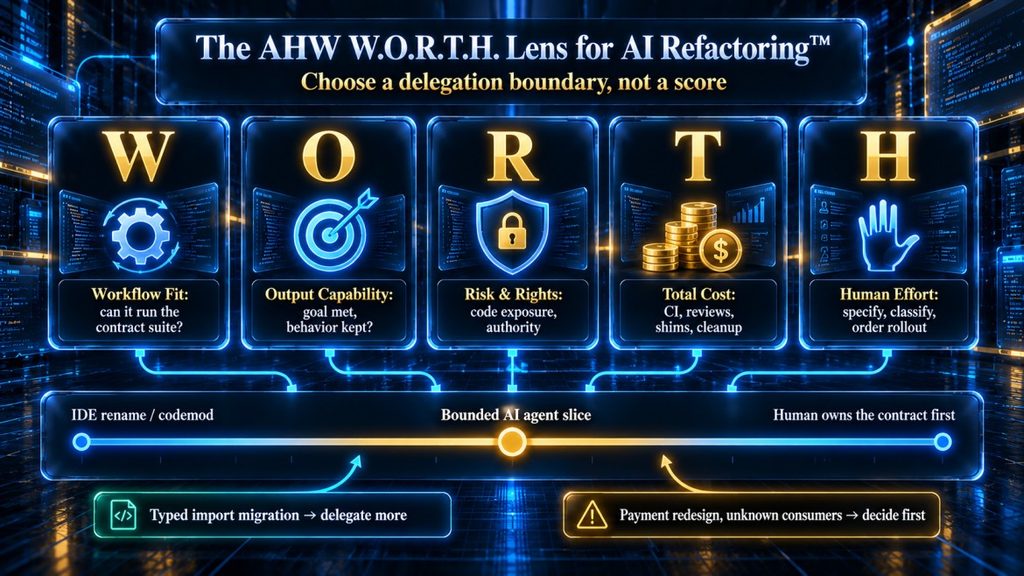
AI Hustle World’s established W.O.R.T.H. lens means Workflow fit, Output capability, Risk and rights, Total cost, and Human effort. It helps decide how much AI assistance belongs in a particular migration. It is a qualitative workflow judgment, not a score that certifies source code or ranks a product from our small fixture.
Workflow fit asks whether the assistant can operate within the repository’s build, language tooling, permissions and ownership boundaries. If it cannot run the contract suite or see the consumer repository, do not assign it a task whose acceptance depends on those checks. A language-aware rename or tested codemod may fit the work better than a broad agent session.
Output capability asks whether the resulting change achieves the structural goal and preserves required behavior. A proposal can pass old tests by leaving the migration incomplete; it can complete the rename while breaking the old worker. Assess both properties. Our four-run fixture is a small reminder that “new version works” is only one cell in the matrix.
Risk and rights cover code and data exposure and the authority to change contracts. Check the approved path before sending private repository content or logs into a tool. The AI data-retention guide explains prompts and uploads; the migration plan still governs this assistant’s file and command access.
Total cost includes model use, codemod preparation, CI runs, review cycles, compatibility shims, deployment coordination, incident response and eventual cleanup. A generated patch may take minutes while its verification takes days. If someone presents a savings figure, ask for the baseline task, accepted outcome and all the work shifted to reviewers and release owners.
Human effort includes specifying behavior, classifying exceptions, inspecting the diff and ordering rollout. AI can save typing yet flood reviewers with plausible changes. The coding-assistant comparison helps with product selection, but no product replaces the contract map.
Use W.O.R.T.H. to choose a delegation boundary, not to manufacture a single number. A well-specified import migration with strong type checks may justify agent or codemod help across many packages. A payment-state redesign with unknown consumer versions needs an owner to settle the contract first. You can then delegate bounded edits without handing the policy decision to the model.
Decide when to proceed, shrink or stop
Proceed when the structural goal is clear, the contract surfaces and owners are known, the current baseline is recorded, and the next slice has a check that could fail for a plausible wrong implementation. There can still be residual risk. Name it, decide who accepts it, and keep the slice small enough to reverse under the system’s actual data state.
Shrink the work when a target inventory is incomplete or the diff spans several unrelated behaviors. Separate an internal rename from a wire-schema change, or split package edits by owner. The smaller scope should preserve one useful end state; merely moving half a type definition into a broken branch is not progress.
Stop the public contract change when nobody can say which older versions are supported, when the only passing tests were updated from the new implementation, or when rollback cannot read newly written data. A full suite that never pairs new producer with old consumer does not resolve the missing evidence. Ask the relevant owner for the contract or environment before resuming.
Use the AI risk-management framework for the wider question of exposure, responsibility and organizational tolerance. At the repository level, a decision can be simple: “internal rename may merge; event-key change waits for the old-worker test and deployment inventory.” That sentence is more useful than a blanket ban or approval of AI-written refactors.
If you leave the current architecture alone, you may keep paying for duplicate logic, brittle upgrades and longer onboarding. That does not make every refactor urgent. The right question is whether the expected maintenance benefit justifies the migration’s verification and coordination costs now, with the team and evidence actually available.
How We Researched and Tested This Guide
We compared seven close explanatory guides, including Microsoft, Atlassian, GitHub, Google and codemod material. Technical claims were checked against the linked primary documentation, engineering accounts and scoped industrial preprint. AI assistance supported research and drafting; the article separates those sources from the controlled local observation.
For the example, we wrote ai_refactor_compatibility_demo.py with old, naive-new and compatible producers and two consumers. On 29 September 2026 we ran four unittest classes separately using Python 3.12.14. The source and command output, including exit codes, were retained in that file and ai_refactor_compatibility_demo_results.txt.
Each same-version group passed two checks; the mixed-version expectation produced KeyError: 'customer_id'; the compatible group passed two. We did not test an AI product, codemod, broker, deployment or customer repository. The fixture demonstrates a local failure and correction, not defect prevalence or model performance.
The Change-Surface Ledger is our synthesis of the fixture and established compatibility practices. Its source, observed result and untested boundaries are identified so a reader can separate our contribution from Microsoft or Fowler’s prior guidance. If a real deployment has a different schema or version policy, use that policy and repeat the relevant compatibility checks.
Final Thoughts
The dangerous refactor is often internally consistent. In our small fixture, the new producer and consumer agreed on account_id, and their two checks passed. The old worker still depended on customer_id; one mixed-version call exposed the break that same-version tests could not see.
Treat the change surface as the real work. Map the contracts, pick a constrained edit mechanism, preserve or deliberately migrate each public boundary, and release semantic slices the team can verify. AI can produce the edits quickly. Your proof has to cover the versions and consumers that will still exist when those edits run.
Your Refactor Passed. Would Your Review Catch the Break?
Use our AI code review guide to check whether an AI-generated diff has enough functional and security evidence before you merge the next batch.
Read the AI Code Review Guide →Frequently Asked Questions
What is the difference between AI code refactoring and AI code migration?
Refactoring changes internal structure while preserving observable behavior. Migration may change a published API, event or data format, so old and new consumers need a transition plan. AI can help with either kind of edit. A green build does not make a changed external contract behavior-preserving.
Can I ask an AI agent to refactor an entire large repository at once?
You can ask it to map the repository and propose a staged plan. Before a broad edit, define the contracts, owners, target sites, exclusions and checks for one semantic slice. An unconstrained whole-repository request makes omissions and unrelated edits hard to detect and can exceed the team’s CI and review capacity.
When should I use an IDE rename instead of AI or a codemod?
Use a language-aware rename for a local symbol with known references. A tested codemod fits a repeated syntax pattern; AI helps investigate exceptions. Whichever method leads, inspect public strings, generated artifacts, configuration and older consumers that symbol analysis may miss.
How can old and new tests both pass while the rollout fails?
Each suite may exercise only matching versions. In our fixture, the old producer worked with the old consumer, and the new producer worked with the new consumer. The old worker reading the new event raised KeyError: 'customer_id'. Test the version pairings your deployment can actually create.
What should a refactor baseline record before implementation changes?
Record the revision, test commands and results, plus the inputs, outputs, errors and side effects to preserve. Include the oldest supported consumer and persisted data shape where relevant. If existing behavior conflicts with a requirement, separate that fix from the structural change.
Do codemods guarantee safer repository-wide edits than an agent?
No. A codemod makes a repeated edit inspectable and repeatable, but it can match the wrong semantic case or miss dynamic references. Test positive and negative examples, inspect the dry-run patch, track unmatched sites and verify behavior. An agent can help classify exceptions.
How small should each AI-assisted refactor batch be?
Small enough that one owner can understand its contract and one relevant set of checks can validate it, yet complete enough to leave the build and release state viable. A file count alone is a poor unit. Group related definition and caller edits; separate independent domains or unresolved interfaces.
Should a producer temporarily emit both old and new event keys?
Only if the contract and all relevant consumers tolerate that shape. Strict validators, signatures or transforms may reject extra fields. A safer plan might first deploy readers that accept both, use a versioned event, or retain the old field for a pure internal refactor. Test the actual old/new pairings before choosing.
What if the full suite cannot run during the refactor?
Name the unavailable command, the environment it needs and the behavior left unverified. Run focused checks that are available, but do not label the migration complete if a missing integration path is required for the release decision. Shrink the batch or obtain the environment and owner who can supply that evidence.
How do I know when compatibility code can be removed?
Confirm the supported consumer versions, deployment state, queued or persisted old data, and any published deprecation commitment. Test the contract after removal and plan rollback against data written during the transition. A tidy codebase is not evidence that an old client or message format has disappeared.
Related Guides
- How to Review AI-Generated Code for Bugs and Security Risks
- How to Generate and Maintain Software Tests With AI
- How AI Coding Agents Work: Tools, Tests and Human Review
- AI Coding Assistants Explained: How AI Is Changing Software Development
- Best AI Coding Assistants (Free & Paid): Top 10 Tools Compared
Written by
Muntasir Ahmad Chowdhury
Founder-AI Hustle World
Muntasir Ahmad Chowdhury is the Founder of AI Hustle World, an independent publication dedicated to making Artificial Intelligence practical, trustworthy, and easy to understand. He researches AI tools, automation, customer service, productivity, and real-world business applications, helping readers make smarter technology decisions through research-driven, experience-backed content.
Expertise:
AI Tools • AI Automation • AI Customer Service • AI Productivity • Generative AI • AI Workflows
Get Smarter With AI
Enjoyed this guide? Get practical AI tools, tutorials, and honest reviews delivered to your inbox.