Evidence: Documentation reviewed
Last checked: August 2026
What was done: Written from official documentation and the published sources linked in this article. Not hands-on tested.
Files: None
Affiliate links: No
AI Contract Management vs Traditional CLM: Where AI Adds Real Value
Contract lifecycle management has never been only a document-storage problem. A contract may begin as a request from sales or procurement, move through drafting and negotiation, reach legal and business approval, get signed, and then sit quietly for months or years while the organization is expected to deliver everything it promised.
That last stage is where many contract programs become less effective than they appear on paper.
A company may have a centralized contract repository, standardized templates, approval workflows, electronic signatures, renewal alerts, and audit trails and still struggle to answer basic operational questions: Which contracts contain unusual obligations? Which suppliers have upcoming performance commitments? Which agreements allow a price increase? Which customers are approaching renewal with unresolved issues? Which clauses deviate from the organization’s preferred position? Which contractual rights are being left unused?
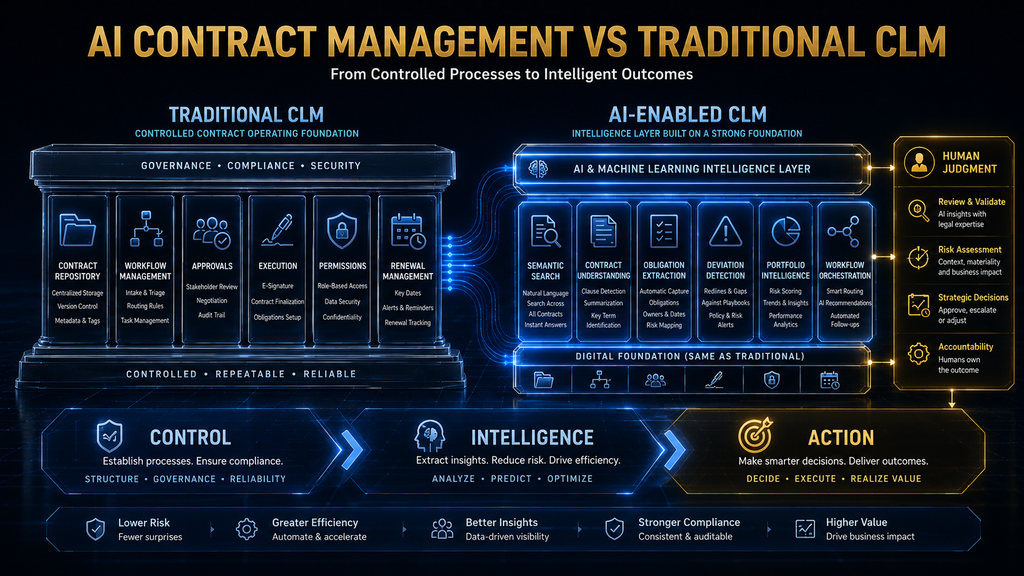
Traditional contract lifecycle management, or CLM, is designed primarily to organize and control the lifecycle. AI adds a different capability: it can increasingly interpret the language inside contracts, extract structured information from it, compare that information across agreements, and help teams turn contract intelligence into action.
That does not mean AI replaces CLM. The more useful distinction is this:
Traditional CLM manages the contract lifecycle. AI can make that lifecycle more intelligent by helping people understand, compare, monitor, and act on the information contained inside contracts.
This distinction matters because buying AI simply because it is marketed as “AI-powered CLM” can be an expensive mistake. If your organization has no reliable contract repository, weak approval processes, inconsistent ownership, poor metadata, or no defined operating model, adding AI may simply make a broken process more complicated.
But if the foundation is already working and the real bottleneck is understanding thousands of contracts, extracting obligations, identifying deviations, monitoring commercial terms, or turning contractual information into operational decisions, AI can add a meaningful new layer of value. The question, therefore, is not whether AI-powered CLM sounds more advanced than traditional CLM. The question is where intelligence changes the economics and quality of contract operations enough to justify the additional technology, governance, and implementation effort.
What Is the Difference Between Traditional CLM and AI Contract Management?
Traditional CLM primarily provides a controlled system for creating, negotiating, approving, executing, storing, and managing contracts. AI contract management adds machine-assisted interpretation, extraction, comparison, search, risk analysis, and increasingly automated actions across that lifecycle.
That distinction is easier to understand if we separate the contract lifecycle into two layers. The first layer is the operating system of contracting. It answers questions such as:
- Where should a contract request go?
- Which template should be used?
- Who must approve it?
- Which version is current?
- Has the contract been signed?
- Where is the executed agreement stored?
- When does it renew?
- Who has permission to access it?
- What happened during negotiation?
Traditional CLM is very good at these questions because they are fundamentally workflow, recordkeeping, control, and process problems. The second layer is the intelligence system sitting on top of those processes. It asks:
- What does this contract actually require?
- Which clauses differ from our preferred language?
- What obligations does each party have?
- Which deadlines are hidden inside conditional language?
- Which agreements contain similar risks?
- Which contracts contain a particular commercial provision?
- Which obligations have not been assigned to an owner?
- Which renewals deserve attention based on the contract’s terms and surrounding context?
This is where AI becomes more interesting.
PwC’s 2026 analysis describes the CLM market as moving from manual workflows toward intelligent orchestration, with a progression from foundational CLM to more orchestrated, agent-enabled contracting. Its argument is important because it does not treat AI as a replacement for the CLM foundation; rather, AI becomes more valuable as the underlying contracting process becomes structured enough to support higher-level intelligence. PwC
That gives us a useful mental model:
Traditional CLM creates control. AI adds interpretation. The combination can create contract intelligence.
Why Traditional CLM Exists in the First Place
It is tempting to look at traditional CLM and conclude that it is old technology waiting to be replaced by AI. That is the wrong starting point.
Traditional CLM exists because contracts create operational problems that have nothing to do with generative AI. Organizations need reliable records, permissions, approval chains, version control, standardized processes, auditability, and accountability.
Imagine a procurement organization managing several thousand supplier agreements.
Without a CLM system, contracts might be scattered across email inboxes, shared drives, procurement platforms, local folders, PDF attachments, and individual employees’ computers. Even if an AI system could understand those documents perfectly, the organization would still have a basic governance problem: Which document is authoritative? Who owns it? Which version is active? What process applies to it?
AI cannot solve that merely by being intelligent. This is why the first mistake to avoid is thinking of CLM as a less sophisticated version of AI contract management. It is better understood as the infrastructure on which AI contract intelligence can operate.
SAP’s current CLM overview similarly frames contract lifecycle management around activities including initiation, authoring, workflow, negotiation and approval, execution, post-signature management, compliance, and renewal. PwC
The traditional layer therefore remains valuable even in an AI-heavy environment.
What Traditional CLM Does Well
A mature CLM system can provide a strong operational backbone without using generative AI for every step. Its core strengths include:
| Contract-management need | Traditional CLM strength |
|---|---|
| Central repository | Creates an authoritative contract record |
| Intake | Routes contract requests into defined workflows |
| Templates | Standardizes common agreements |
| Approval | Controls who must review and approve |
| Version control | Maintains document history |
| Negotiation | Tracks revisions and redlines |
| Execution | Connects contracts to signing workflows |
| Permissions | Controls access to sensitive documents |
| Auditability | Records actions and approvals |
| Renewal management | Tracks dates and sends alerts |
| Reporting | Provides structured lifecycle information |
These capabilities are not made obsolete by AI. In fact, they become more important when AI is introduced because the organization now needs to know which contracts the AI is analyzing, what information it used, who validated the output, and what action followed.
That is why an AI layer without a trustworthy CLM foundation can create false confidence. The technology may appear intelligent while the underlying contract estate remains fragmented.
Where AI Changes the Equation
AI becomes valuable when the problem stops being “Where is the contract?” and becomes “What can we understand and do with all these contracts?” This is a major shift. A conventional search system might help someone find contracts containing the exact phrase “termination for convenience.”
An AI-enabled system may be able to help locate agreements that effectively provide a termination-without-cause right even when the drafting language differs across documents. A conventional contract repository can tell you that a contract expires on a particular date. An AI-enabled workflow can potentially help identify the relevant renewal provision, interpret the notice requirement, connect it to the responsible owner, and surface the agreement for review before the relevant window closes.
The difference is not simply better search. It is a progression from document retrieval to semantic understanding and operational action.
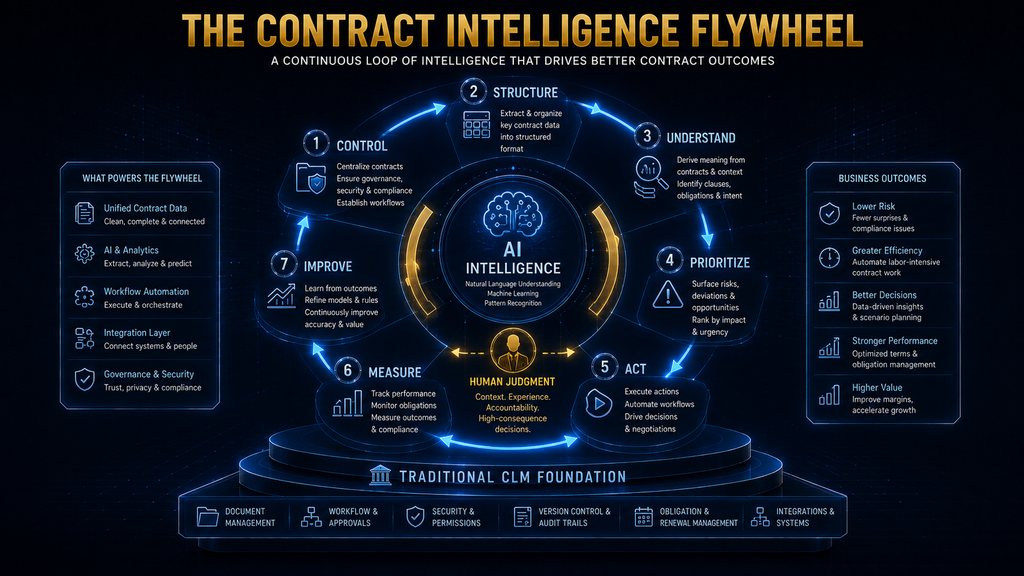
The AI Contract Management Value Ladder
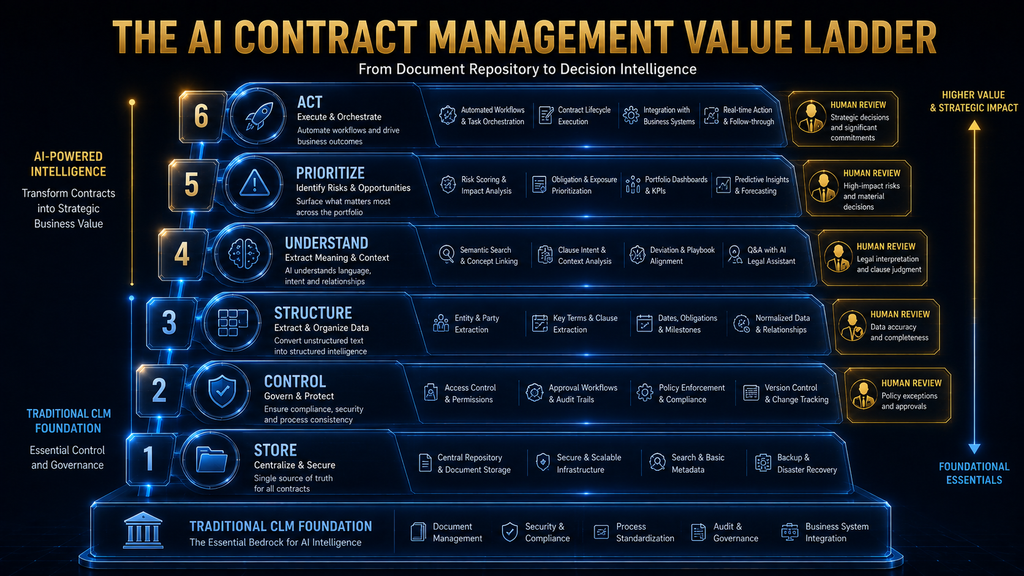
To make the distinction practical, AI Hustle World can think about AI-enabled CLM through a six-level value ladder.
Level 1: Store
The organization knows where its contracts are. This is the basic repository problem.
Level 2: Control
The organization controls intake, approvals, permissions, versions, execution, and audit trails. This is where traditional CLM remains foundational.
Level 3: Structure
AI begins converting unstructured contractual language into structured information. Examples include:
- parties
- dates
- obligations
- payment terms
- termination rights
- renewal provisions
- service levels
- insurance requirements
Level 4: Understand
The system can help interpret contractual information in context. It may compare language against a playbook, identify deviations, answer questions about contract terms, or connect related provisions.
Level 5: Prioritize
The organization can use contract intelligence to determine which items deserve attention first. Not every deviation is equally important. Not every renewal is equally urgent.
Not every obligation carries the same consequence. AI can help sort the portfolio so humans spend more time on high-value decisions.
Level 6: Act
The system begins connecting insights to workflows. A validated obligation can become a task. A renewal risk can trigger a review.
A contract deviation can route to the appropriate reviewer. A missing approval can trigger escalation.
This is where the concept of AI-enabled CLM begins moving toward intelligent orchestration rather than simple document analysis. PwC’s 2026 CLM research describes this broader movement toward orchestrated, agent-enabled contracting. PwC
The important point is that each level depends on the previous one. You cannot reliably automate action if you cannot reliably identify the underlying contract information.
Traditional CLM vs AI-Enabled CLM Across the Lifecycle
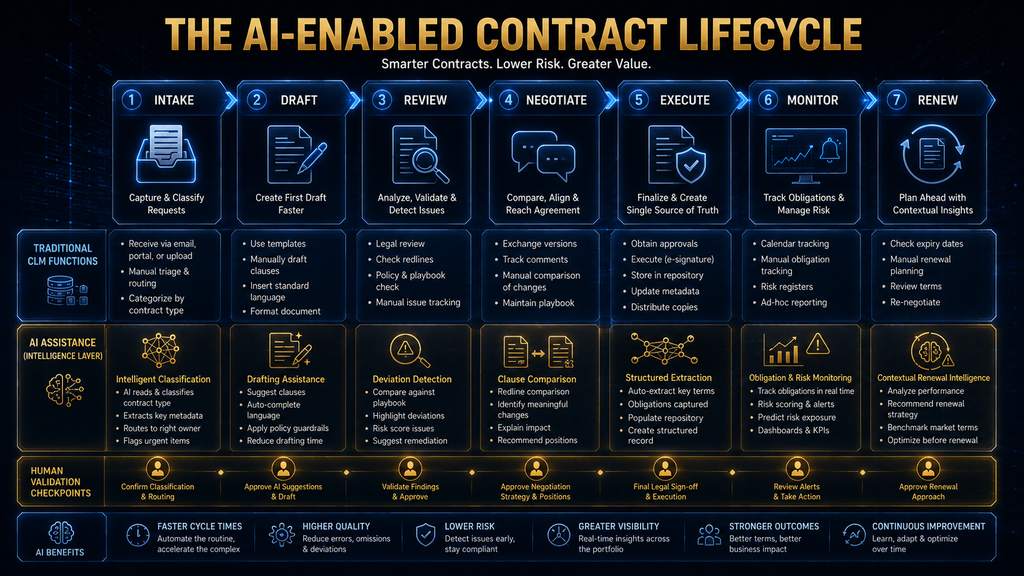
The easiest way to see the difference is to follow one contract from request to renewal.
| Lifecycle stage | Traditional CLM | AI-enabled CLM |
|---|---|---|
| Intake | Routes request | Can classify request and identify relevant contract type |
| Drafting | Uses templates and clauses | Can assist with drafting and suggest relevant language |
| Review | Workflow and manual analysis | Can identify deviations and surface relevant provisions |
| Negotiation | Tracks versions and redlines | Can compare language and flag non-standard terms |
| Approval | Routes approvals | Can help prioritize issues before approval |
| Execution | Stores executed agreement | Adds structured intelligence to the executed contract |
| Post-signature | Tracks metadata and tasks | Can extract obligations and monitor contractual signals |
| Search | Keyword/metadata search | Semantic and conversational search |
| Renewal | Date reminders | Date + clause + obligation + context-driven review |
| Portfolio analysis | Reports structured fields | Can analyze language and patterns across contracts |
| Action | Human-led workflow | AI can assist with task creation and orchestration |
The point is not that every AI CLM platform performs every function equally well. It does not.
Capabilities differ significantly between vendors, contract types, data quality, integrations, and deployment models. Treat the table as a conceptual comparison rather than a claim that every product contains every capability.
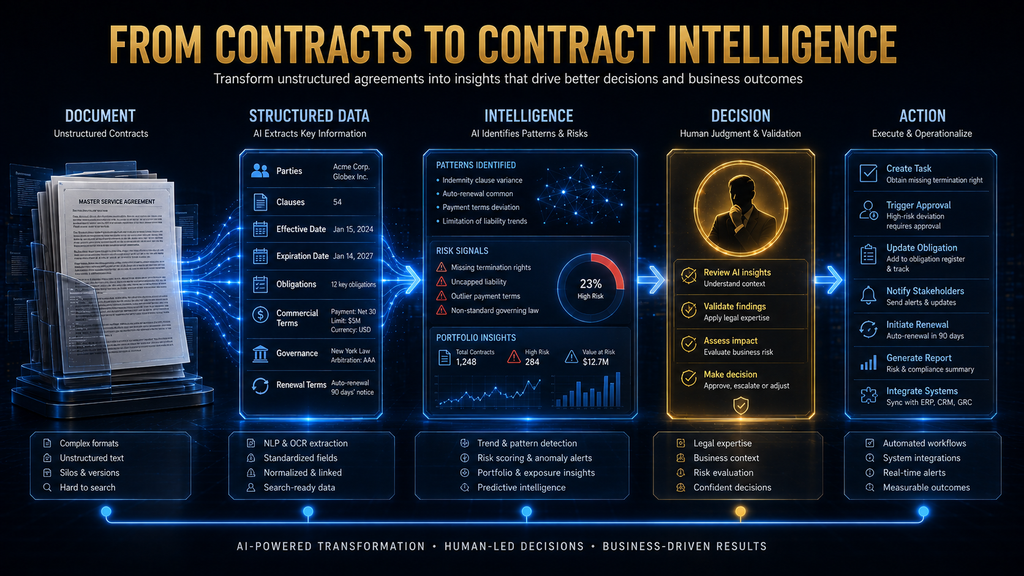
1. AI Adds Value by Turning Contract Text Into Structured Data
One of the most important advantages of AI is its ability to work with information that was previously trapped inside natural-language documents. A contract might state that a supplier must maintain a certain level of insurance, provide monthly reports, meet a service-level threshold, and notify the customer within a specified period after a particular event. To a human reader, those requirements may be understandable.
To an enterprise system, they are much harder to use unless they are converted into structured records. AI can help transform: Contract language → structured contract data. For example:
| Field | Extracted information |
|---|---|
| Party | Supplier |
| Obligation | Maintain required insurance |
| Trigger | Throughout contract term |
| Frequency | Ongoing |
| Evidence | Certificate of insurance |
| Deadline | Before expiration of current coverage |
| Consequence | Contractual/compliance exposure |
| Source | Relevant insurance clause |
That conversion matters because structured data can participate in workflows. The real value is therefore not:
“AI found an insurance clause.”
The value is:
“AI helped convert an insurance clause into a trackable contractual obligation that can be validated, assigned, monitored, and escalated.”
That is a fundamentally different capability.
2. AI Can Make Contract Search More Semantic
Traditional search is strongest when you know what you are looking for. AI becomes more useful when you know what you mean, but not necessarily the exact words used in the contract. Consider a portfolio containing 5,000 supplier contracts.
A legal or procurement manager might ask:
Which contracts allow suppliers to increase prices without prior customer approval?
The relevant language could appear under several different formulations:
- price adjustment
- annual escalation
- index-based adjustment
- inflation adjustment
- cost increase
- rate revision
- fee adjustment
- periodic pricing review
A keyword-only search can become cumbersome. Semantic AI can potentially identify conceptually related provisions rather than relying exclusively on exact phrase matches. That does not eliminate verification.
It changes where the human starts. Instead of manually searching thousands of documents, the reviewer can begin with a prioritized set of relevant contracts and then verify the underlying provisions. This is one of the most defensible uses of AI in contract management because the AI is primarily reducing information retrieval friction rather than making the final legal decision.
3. AI Can Surface Contract Deviations
Most organizations have preferred contract positions. The preferred position might specify:
- maximum liability
- approved indemnity language
- payment terms
- termination rights
- governing law
- insurance requirements
- data protection obligations
- service levels
- renewal structure
The traditional process often requires a human reviewer to compare proposed language against templates, clause libraries, policies, and prior experience. AI can accelerate that comparison. The workflow becomes: Contract clause → approved playbook → deviation detected → severity assessed → human review.
This is important because a deviation is not automatically a risk. Suppose the organization’s standard payment term is 30 days, but one contract contains 45-day terms. That is a deviation.
But whether it is a material risk depends on context. Maybe the supplier is strategically important. Maybe the longer payment period was deliberately negotiated in exchange for a significant discount.
Maybe the finance team already approved it. AI can identify the difference.
It should not automatically decide that the difference is unacceptable. That is where the distinction between detection and judgment becomes critical.
4. AI Can Connect Obligations to Operations
This is where AI-enabled CLM can create value that conventional document management cannot easily produce on its own. Imagine a contract says:
The customer must provide quarterly usage reports within 15 days after the end of each quarter.
The traditional approach may store the contract and perhaps record a reminder manually. An AI-enabled workflow can potentially identify:
- the responsible party
- the required action
- the frequency
- the trigger
- the deadline
- the evidence required
The validated result can then become an operational task. The contract has moved through four states: Language → Data → Obligation → Action. This is the heart of AI contract intelligence.
IBM’s current contract-management material describes AI-supported extraction of contract information, obligations, milestones, risk signals and other structured information as part of modern contract-management workflows. PwC
5. Renewal Management Becomes More Intelligent
A renewal alert is useful. A renewal decision is much more complicated. A traditional CLM system might tell a company:
Contract renews in 90 days.
That is valuable because it prevents the date from being forgotten. But management may need to know:
- Has the supplier met its obligations?
- Are there unresolved disputes?
- Did pricing change?
- Has service performance deteriorated?
- Does the contract automatically renew?
- What notice period applies?
- Are termination rights available?
- Are there outstanding credits?
- Is there a better alternative?
- Does the contract contain unfavorable terms that should be renegotiated?
AI can help bring more of that context together. This creates a progression: Renewal alert → renewal context → renewal decision.
The final decision still belongs to the responsible human team. But the amount of manual investigation required to reach that decision can potentially fall significantly.
6. AI Can Analyze the Contract Portfolio, Not Just One Contract
This is perhaps the biggest strategic difference. Traditional contract review is often document-centric. AI enables portfolio-centric questions.
For example:
How many supplier agreements contain automatic annual price increases?
Or:
Which customer contracts contain unlimited indemnification?
Or:
Which agreements have renewal windows within the next six months?
Or:
Which contracts have service-level commitments but no clearly assigned operational owner?
These questions become more valuable as contract volume increases. A company with 20 contracts may not need sophisticated portfolio intelligence.
A company with 20,000 contracts has a very different problem. At that scale, even a small percentage of missed obligations or inconsistent terms can have material financial consequences.
World Commerce & Contracting’s research estimates that the average business loses almost 9% of value annually through poor contract management, while also reporting that contract-related data is often scattered across many systems. These are WorldCC’s research findings, not a universal guaranteed loss rate for every organization, but they illustrate why contract management can become a financial-performance issue rather than merely an administrative one. WorldCC
The Real Business Case: Contracts Are Operational Assets
A contract is often treated as a legal artifact. That is incomplete. A commercial contract can determine:
- how much a company pays
- how much it receives
- when money changes hands
- what service must be delivered
- what happens when performance fails
- when a relationship can end
- which risks are transferred
- what information must be provided
- which rights can be exercised
In other words, contracts influence the operating economics of the business. If those terms remain buried inside documents, the organization has information but not necessarily usable intelligence. That is why AI-enabled CLM should be evaluated not only as a legal technology investment but as a business information and execution system.
A Practical Example: Supplier Contract
Consider a fictional technology supplier contract. The agreement contains:
- a three-year term
- annual price escalation
- a service-level agreement
- quarterly performance reporting
- a 90-day renewal notice
- a termination-for-cause provision
- insurance requirements
- data-security obligations
A traditional CLM system might successfully store the agreement, track the term, record the renewal date, route approvals, and provide access to the executed contract. That is already useful. An AI-enabled CLM workflow could potentially extract the underlying terms and organize them into an operational view:
| Contract signal | Potential operational use |
|---|---|
| Annual price escalation | Finance review |
| SLA requirement | Service-owner monitoring |
| Quarterly report | Recurring task |
| 90-day renewal notice | Procurement/legal review |
| Termination provision | Escalation if performance deteriorates |
| Insurance requirement | Compliance monitoring |
| Security obligation | Security/compliance review |
The value is not that AI “understood the contract” in some abstract sense. The value is that the organization can move from one document containing seven important provisions to seven manageable operational signals. That is a much better definition of contract intelligence.
Where AI Does Not Add Much Value
This is where an honest article needs to push back against the market. AI is not automatically valuable simply because it is attached to CLM software. If your organization has:
- 30 simple contracts
- standardized terms
- predictable renewals
- low transaction volume
- little negotiation
- minimal regulatory exposure
- a competent manual process
then an expensive AI layer may not generate enough additional value to justify its cost. You may already have enough visibility. The same applies when the real problem is process chaos.
If nobody knows who owns contract intake, AI cannot solve that organizational ambiguity. If executed agreements are scattered across five systems, AI may help search them, but the company still has a records-management problem. If contract metadata is incomplete, AI extraction may improve the situation, but the organization still needs data governance.
If employees do not act on renewal alerts today, adding AI-generated recommendations will not magically make them accountable. This is why the correct sequence is: Fix the operating model → establish the CLM foundation → add intelligence where the economics justify it.
The Most Important Blind Spot: AI Does Not Fix Bad Contract Data
AI systems are only as useful as the information and context available to them. Imagine an organization has:
- multiple copies of the same agreement
- missing amendments
- poor OCR
- inconsistent naming
- incomplete metadata
- expired contracts mixed with active ones
- schedules stored separately
- attachments missing
- unclear ownership
An AI system may still produce impressive-looking answers. That can actually make the situation more dangerous. The organization may believe it has contract intelligence when it really has automated interpretation of an unreliable contract corpus.
This is one of the biggest reasons AI adoption should begin with a contract-estate assessment. Before asking:
Which AI CLM tool should we buy?
ask:
Can we identify the complete population of contracts that the system needs to understand?
That question sounds less exciting. It is also more important.
AI Contract Management Is Not the Same as AI Contract Review
These terms are related but should not be treated as synonyms. AI contract review generally focuses on analyzing a contract or document for clauses, risks, deviations, missing provisions, or drafting issues. AI contract management is broader.
It extends intelligence across the lifecycle, including:
- intake
- drafting
- negotiation
- approval
- execution
- repository management
- obligations
- renewals
- compliance
- performance
- portfolio analysis
That distinction matters here because our guide to how AI contract review works already covers the mechanics of AI contract review. Article 6 should therefore move the conversation forward:
Review is one capability. Contract intelligence across the lifecycle is the larger operating model.
The Economics of AI-Enabled CLM
The strongest ROI case usually comes from several smaller improvements rather than one magical productivity number. A useful model is: AI-CLM value = time recovered + leakage reduced + risk avoided + value recovered + cycle time improved − technology and implementation cost. Each component needs to be measured separately.
Time recovered
How much analyst, legal, procurement, or operations time is saved on repetitive contract work?
Cycle time
How long does it take to move a contract from intake to execution?
Leakage reduction
How often are contractual entitlements, pricing provisions, credits, or obligations missed?
Risk avoidance
How often does AI-supported review identify an issue before it becomes a dispute, cost, compliance problem, or operational failure?
Value recovery
Are there contractual rights or commercial provisions that the organization previously failed to use?
Technology cost
What does the software cost?
Implementation cost
What will integration, migration, configuration, training, and governance cost? This is much better than copying a vendor’s percentage-improvement claim into a business case.
The KPIs That Actually Matter
If a company is implementing AI-enabled CLM, it should measure the system against operational outcomes. Useful KPIs include:
| KPI | What it tells you |
|---|---|
| Contract cycle time | Whether contracting is becoming faster |
| Review time per contract | Whether repetitive analysis is declining |
| Obligation extraction accuracy | Whether AI is identifying the right duties |
| False-positive rate | Whether AI is generating too much noise |
| Missed-obligation rate | Whether important requirements are being overlooked |
| Renewal coverage | Whether important renewal events are visible |
| Deviation detection accuracy | Whether playbook comparison is useful |
| Human correction rate | How much AI output needs modification |
| Contract-search time | Whether information retrieval is improving |
| Adoption rate | Whether teams actually use the system |
| Value recovered | Whether intelligence produces financial outcomes |
| Escalation rate | Whether the system appropriately routes higher-risk issues |
The key metric is not:
“How many AI features do we use?”
It is:
“What measurable contract-management problem improved because AI was introduced?”
What Happens If You Do Nothing?
This is another question companies often avoid. If your contract volume is growing while the process remains primarily manual, the problem usually compounds. More contracts create more:
- renewal dates
- obligations
- exceptions
- amendments
- negotiated deviations
- business owners
- reporting requirements
- potential inconsistencies
The organization does not merely accumulate documents. It accumulates contractual commitments.
WorldCC’s research highlights this broader problem, noting that contract-related data can be fragmented across many systems and that poor contract management can contribute to value erosion through missed entitlements, cost overruns, invoicing errors, delayed delivery, scope disputes, and other failures. WorldCC
Doing nothing therefore has an opportunity cost. But the answer is not necessarily “buy AI.” The answer is to determine whether your current contracting process has reached the point where manual interpretation is becoming a material operational constraint.
The Human Review Boundary
The more consequential the output, the stronger the review requirement should be. A low-risk task might be:
Find all contracts that mention quarterly reporting.
A higher-risk task might be:
Decide whether a liability clause is commercially acceptable.
Those are not equivalent. The first can often be treated as a retrieval and extraction task.
The second requires context, policy, commercial judgment, legal interpretation, and accountability. That distinction should govern automation.
The ABA’s current guidance emphasizes testing, validation, transparency, and human judgment in legal AI workflows. It specifically recommends evaluating AI systems with structured testing and sampling rather than assuming that a plausible output is automatically reliable. American Bar Association
The ABA also continues to emphasize that lawyers remain responsible for the work produced with AI assistance and must account for competence, confidentiality, and verification. American Bar Association
The practical rule is simple:
Automate retrieval and preparation aggressively; automate consequential judgment cautiously.
A Better AI-CLM Operating Model
A strong implementation should not begin with “turn on AI.” It should begin with a controlled progression.
Phase 1: Build the contract foundation
First establish:
- authoritative repository
- contract taxonomy
- ownership
- permissions
- lifecycle states
- metadata standards
- document retention rules
- basic workflow
The objective is not intelligence. It is control.
Phase 2: Add extraction
Start extracting high-value information:
- parties
- dates
- payment terms
- obligations
- renewal conditions
- termination provisions
- important commercial terms
Then validate accuracy against human-reviewed samples.
Phase 3: Add comparison
Introduce:
- playbook comparison
- clause deviation detection
- standard-vs-negotiated analysis
- risk categorization
Again, validate rather than trusting the output blindly.
Phase 4: Add portfolio intelligence
Move from individual contracts to questions across the contract population. For example:
Which agreements contain automatic price increases?
Which contracts expire within 120 days?
Which supplier agreements contain specific SLA commitments?
Phase 5: Connect intelligence to workflow
Once extraction and analysis are sufficiently reliable, connect findings to business processes. That might mean:
- creating tasks
- assigning owners
- generating reminders
- escalating exceptions
- preparing renewal reviews
- routing high-risk issues
Phase 6: Introduce controlled orchestration
Only after the earlier stages are working should organizations consider more autonomous workflows. This is the point at which agentic systems can potentially coordinate multiple steps.
PwC’s 2026 analysis describes a similar progression from foundational CLM toward intelligent orchestration and agent-enabled contracting. PwC
The lesson is important: Autonomy should be the last step, not the first.
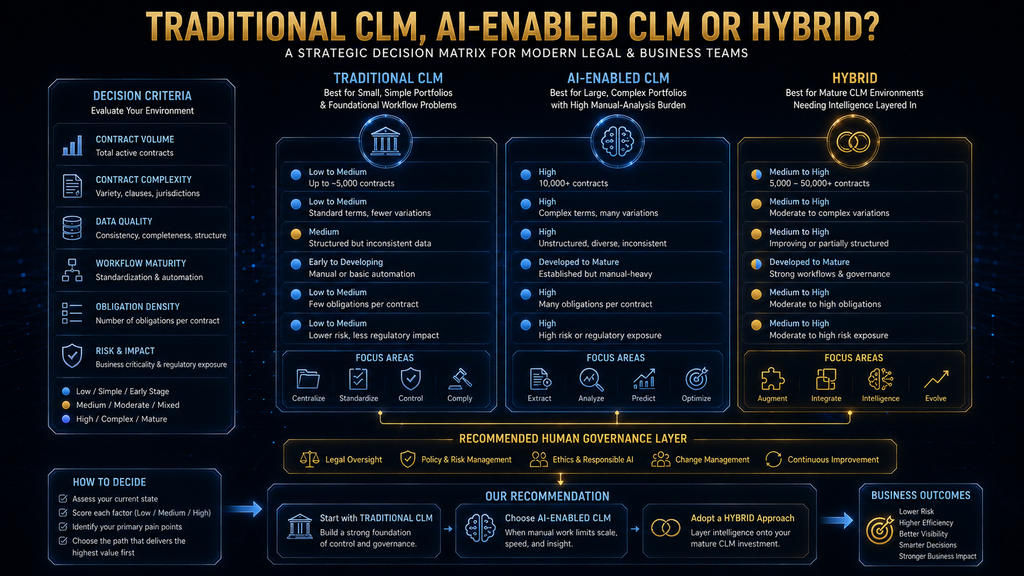
Traditional CLM, AI CLM, or Hybrid?
For most organizations, the answer is not binary. A practical decision framework looks like this:
| Situation | Best starting point |
|---|---|
| Contracts scattered across systems | Traditional CLM foundation |
| No consistent approval process | Traditional CLM foundation |
| Small contract volume | Traditional CLM or simpler workflow |
| Large portfolio with manual extraction | AI-enabled CLM |
| Strong CLM but poor contract visibility | Add AI intelligence |
| Heavy negotiation and clause deviation | AI review + traditional workflow |
| Complex obligations and renewals | AI extraction + CLM workflow |
| High-risk legal judgment | AI assistance + strong human review |
| Mature CLM with large contract estate | Hybrid/AI-enhanced CLM |
| Poor data quality | Data cleanup before advanced AI |
This is the decision most vendor pages do not emphasize enough: AI is not a substitute for maturity. It is a multiplier of useful infrastructure when the underlying process is ready.
When You Should Stay With Traditional CLM
Traditional CLM may be the better choice if your organization has a relatively small, standardized contract portfolio and the main problem is process control rather than contract interpretation. You probably do not need sophisticated AI to tell you that a contract expires on December 31 if someone already has a reliable renewal workflow and the agreements are simple.
Likewise, if your biggest issue is that sales teams are emailing contracts to legal instead of submitting them through an approved intake process, an AI review engine is not the first problem to solve. Fix the workflow. Then consider intelligence.
When AI-Enabled CLM Makes More Sense
AI becomes more compelling when several conditions appear together. You have:
- significant contract volume
- complex or variable language
- repeated manual review
- large numbers of obligations
- frequent amendments
- substantial negotiation
- distributed contract ownership
- meaningful renewal exposure
- a mature or improving CLM foundation
- a measurable cost to missing information
At that point, AI can attack the real bottleneck: the amount of human attention required to understand the contract portfolio.
The Hybrid Model Is Often the Most Rational
For many organizations, the strongest approach will be hybrid. Traditional CLM remains responsible for:
- governance
- workflow
- records
- permissions
- approvals
- execution
- auditability
AI contributes:
- extraction
- semantic search
- comparison
- classification
- risk prioritization
- obligation intelligence
- portfolio analysis
- workflow assistance
Humans retain:
- judgment
- exception handling
- commercial decisions
- legal interpretation
- accountability
This division is more realistic than imagining an AI system replacing the entire contract lifecycle.
Common Mistakes When Buying AI Contract Management
Mistake 1: Buying AI before fixing CLM fundamentals
If the repository is chaotic, AI may produce sophisticated answers from an unreliable dataset.
Mistake 2: Choosing the longest feature list
More AI features do not automatically mean more business value. Start with the bottleneck.
Mistake 3: Trusting the vendor’s demo
Vendor demos are optimized environments. Your contracts are not. A serious evaluation should use representative documents from your actual portfolio, including difficult examples.
Mistake 4: Measuring only time saved
Time is important, but it is not the entire business case. Measure missed obligations, leakage, cycle time, accuracy, adoption, and financial outcomes too.
Mistake 5: Treating every deviation as a risk
A deviation is a signal. Risk requires context.
Mistake 6: Ignoring human correction rates
If employees must correct 40% of AI findings, the economics may look very different from the vendor’s headline claim.
Mistake 7: Automating high-consequence decisions too early
AI can prepare a recommendation. That does not mean the system should make the final decision.
Mistake 8: Ignoring security
Contracts can contain confidential commercial, personal, financial, technical, and legal information. Security architecture and data-handling policies belong in the buying decision.
Mistake 9: Assuming all AI CLM products are equivalent
“AI-powered” is not a technical specification. Evaluate the actual capabilities, evidence, integrations, controls, explainability, accuracy, and workflow fit.
Mistake 10: Measuring adoption by login count
A system can have high login numbers and low business impact. Measure whether the system changes the work.
How to Evaluate an AI Contract Management Platform
Before purchasing, ask vendors to demonstrate the system against your real workflow rather than a polished hypothetical.
Contract understanding
Can the system accurately identify parties, clauses, obligations, dates, conditions, and exceptions?
Source traceability
Can users quickly return from an AI-generated finding to the underlying contract language?
Accuracy
How does the vendor measure precision, recall, false positives, and false negatives?
Human review
Can reviewers correct AI output and preserve that decision?
Playbook comparison
Can the system compare language against your actual policies and preferred positions?
Portfolio intelligence
Can users ask meaningful questions across multiple contracts?
Workflow integration
Can validated findings become tasks, approvals, alerts, or escalations?
Security
What happens to customer data? Is it used for model training? Where is it stored?
Who can access it? How are permissions enforced?
Auditability
Can the organization see what the AI produced, what a human changed, and what action followed?
Integration
Can it connect to the existing CLM, ERP, procurement, CRM, finance, and identity systems?
Total cost
What is the real cost after implementation, migration, integration, training, governance, and ongoing administration? The goal is not to find the platform with the most impressive AI demo. It is to find the platform that solves the organization’s highest-value contract problem reliably enough to justify the change.
A Simple Pilot Strategy
Before rolling AI-enabled CLM across the entire organization, run a controlled pilot. Choose a meaningful contract population. Do not choose only the easiest documents.
Include:
- standard agreements
- heavily negotiated agreements
- amendments
- contracts with schedules
- contracts with unusual clauses
- documents with difficult formatting
- representative examples of high-risk provisions
Then define the evaluation criteria before running the test. For example:
- Can the system correctly identify 20 predefined obligation types?
- Can it identify the correct party?
- Can it correctly interpret deadline triggers?
- Can it distinguish standard from non-standard language?
- Can reviewers verify every finding against the source?
- How much human correction is required?
This is much more defensible than asking whether the AI “looks accurate.”
The ABA’s 2026 guidance on testing legal AI similarly emphasizes iterative testing, sampling, validation, and measurable performance rather than blind trust in generated output. American Bar Association
The Second-Order Effect: Contract Teams May Change, Not Just Get Faster
The most interesting consequence of AI-enabled CLM may not be automation. It may be a change in what contract professionals spend their time doing. If AI reduces the amount of manual extraction and searching required, teams may spend more time on:
- negotiation strategy
- commercial optimization
- stakeholder management
- risk prioritization
- supplier performance
- renewal strategy
- policy development
- contract portfolio analysis
That changes the role of CLM from a largely administrative function toward a more analytical business capability. But there is a corresponding risk.
If organizations simply increase contract-processing volume because AI makes review faster, they may create another version of the same problem: more contracts, more complexity, and more obligations without stronger governance. Efficiency without control can accelerate the wrong behavior.
The Future of CLM Is Probably Not “AI Instead of CLM”
The more likely direction is convergence. The traditional boundaries between contract repository, legal workflow, procurement systems, business operations, analytics, and AI are already becoming less distinct.
ABA discussions of legal technology in 2026 describe a similar convergence, with AI increasingly touching document review, research, drafting, workflow, and other legal operations while emphasizing that human judgment remains essential. American Bar Association
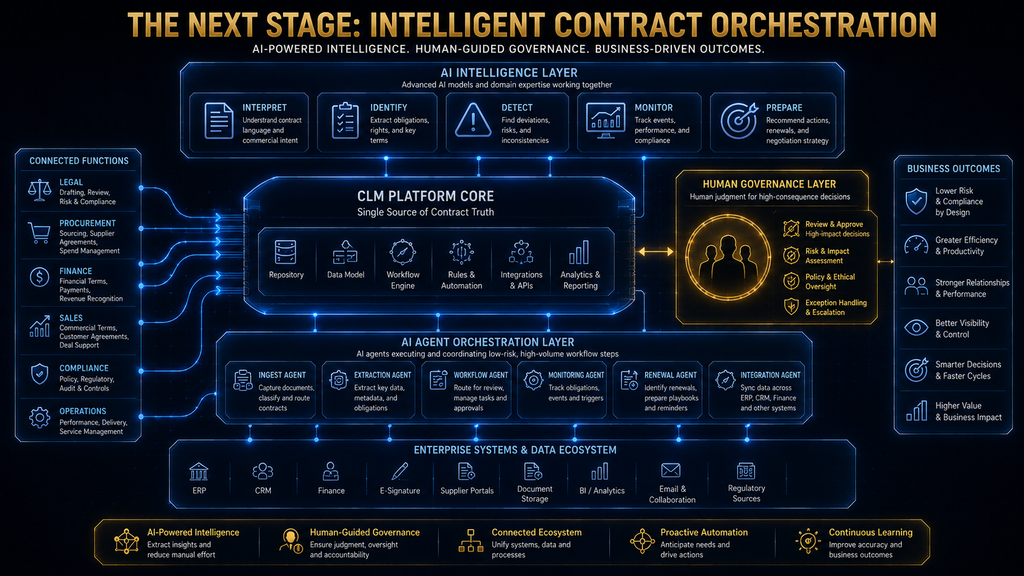
The future CLM platform therefore looks less like a digital filing cabinet and more like an intelligent contract operating layer. It knows:
- what contracts exist
- who owns them
- what they contain
- what they require
- what differs from policy
- what is happening operationally
- what needs attention
- what action can be prepared
But the system should not become a black box that silently makes consequential legal or commercial decisions. The better future is transparent intelligence connected to controlled workflows.
What AI Actually Adds: The Short Version
If you remember only one comparison, use this:
| Traditional CLM | AI-enabled CLM |
|---|---|
| Stores contracts | Understands contract content |
| Manages workflow | Helps interpret workflow inputs |
| Tracks dates | Interprets date-related provisions |
| Provides search | Provides semantic discovery |
| Tracks metadata | Extracts metadata from documents |
| Supports review | Assists with analysis |
| Sends renewal alerts | Adds context to renewal decisions |
| Records obligations | Helps extract and structure obligations |
| Reports activity | Helps identify patterns across the portfolio |
| Requires human action | Can assist with preparing and routing actions |
The right side should not be interpreted as “AI does everything automatically.” It means AI can assist with the cognitive layer that traditional systems have historically handled poorly.
Final Decision Framework
Before investing in AI-enabled CLM, answer seven questions.
1. Is our contract population centralized and trustworthy?
If not, start with the foundation.
2. Is contract volume or complexity creating a measurable manual bottleneck?
If not, AI may not produce enough value.
3. Are people spending significant time extracting information that could be structured?
If yes, AI may have a strong use case.
4. Are we losing money or creating risk because contract information is difficult to find or monitor?
If yes, the business case becomes stronger.
5. Can we define what “good AI output” looks like?
If not, you cannot properly evaluate the system.
6. Can humans verify and override AI output?
If not, be extremely cautious with consequential workflows.
7. Can the system connect intelligence to action?
If not, you may be buying an AI analysis tool rather than an AI-enabled contract-management capability. These questions are more useful than asking whether a vendor has “generative AI,” “agents,” or the newest model.
Final Thoughts
The biggest mistake in the AI contract-management conversation is treating traditional CLM and AI as competing technologies. They solve different layers of the problem.
Traditional CLM gives an organization control over the contract lifecycle. It creates the repository, workflow, approval structure, permissions, audit trail, and operational foundation needed to manage contracts consistently.
AI can add another layer. It can help organizations understand the language inside those contracts, convert provisions into structured information, compare terms across agreements, identify patterns, prioritize issues, monitor obligations, and connect validated intelligence to business workflows. That is real value.
But it is not value simply because the software uses a large language model. The value appears when AI removes a meaningful information bottleneck that traditional CLM cannot efficiently solve on its own. That is why the strongest implementation path is not: Buy AI → automate everything → hope for ROI.
It is: Establish control → structure the contract estate → add intelligence → validate performance → connect insights to workflows → automate selectively. The most mature organizations will probably end up with a hybrid model in which traditional CLM provides the system of record and workflow control, AI provides the intelligence layer, and humans retain responsibility for consequential judgment. That is also why the best question to ask a vendor is not:
“How much AI does your platform have?”
Ask:
“Which contract-management problem can your AI solve better than our current process, how will we measure that improvement, and how will we verify the result?”
If the vendor can answer those three questions with evidence, your organization may have a genuine AI-CLM opportunity. If the answer is mostly a list of AI features, the technology may be impressive—but the business case is still unproven.
The future of CLM is not a contract repository with an AI chatbot attached. It is a controlled contract operating system in which AI helps turn contractual language into reliable business intelligence and, where appropriate, action.
Want to Build a Smarter AI-Powered Workflow?
AI creates the most value when it is connected to a real workflow, clear decision criteria, and human oversight. Explore more practical AI strategies, tools, and workflow guides from AI Hustle World.
See How AI Contract Review Works →FAQ
Is AI contract management better than traditional CLM?
Not universally. Traditional CLM remains essential for repositories, workflows, approvals, permissions, execution, auditability, and lifecycle control. AI adds the most value when the organization needs deeper understanding, extraction, comparison, portfolio analysis, or intelligent workflow assistance.
What is the biggest advantage of AI in CLM?
The biggest advantage is the ability to convert unstructured contractual language into structured, searchable, contextual information that can support decisions and workflows at portfolio scale.
Can AI replace a CLM system?
Usually, that is the wrong way to think about the technology. AI can enhance contract lifecycle management, but organizations still need reliable repositories, governance, workflows, permissions, audit trails, and human accountability.
Can AI automatically identify contract risks?
AI can identify potential risks, deviations, unusual provisions, and patterns, but whether something is actually material risk depends on the organization’s policies, commercial context, jurisdiction, and circumstances. High-consequence findings should receive appropriate human review.
Is AI contract management useful for small businesses?
It can be, but not always. Small organizations with simple, standardized contracts may gain more from a reliable repository and basic workflow than from an advanced AI CLM platform. AI becomes more compelling as volume, complexity, negotiation, obligations, and risk increase.
Does AI contract management eliminate legal review?
No. AI can reduce repetitive analysis and help surface relevant information, but it does not remove the need for professional judgment. Legal and business teams remain responsible for consequential decisions.
What should companies implement first: CLM or AI?
If the organization lacks a reliable contract-management foundation, establish CLM fundamentals first. AI is more valuable when contracts are accessible, governed, structured, and connected to clear workflows.
How should companies measure AI-CLM ROI?
Measure contract cycle time, review time, extraction accuracy, correction rates, missed obligations, renewal coverage, deviation detection, adoption, recovered commercial value, and risk reduction alongside software and implementation costs.
Related Guides
- AI SOC Agents Explained: How Autonomous Security Operations Work
- AI Recruiting vs Traditional Recruiting: What Actually Works?
- AI Product Management Explained: How AI Is Changing the Product Lifecycle
Written by
Muntasir Ahmad Chowdhury
Founder, AI Hustle World
Muntasir Ahmad Chowdhury is the Founder of AI Hustle World, an independent publication dedicated to making Artificial Intelligence practical, trustworthy, and easy to understand. He researches AI tools, automation, customer service, productivity, and real-world business applications, helping readers make smarter technology decisions through research-driven, experience-backed content.
Expertise:
AI Tools • AI Automation • AI Customer Service • AI Productivity • Generative AI • AI Workflows
Get Smarter With AI
Enjoyed this guide? Get practical AI tools, tutorials, and honest reviews delivered to your inbox.