Evidence: Documentation reviewed
Last checked: September 2026
What was done: Written from official documentation and the published sources linked in this article. Not hands-on tested.
Files: None
Affiliate links: No
Best AEO & GEO Tools for AI Search Visibility in 2026
The Problem Is No Longer “Are We Ranking?”
A marketing team can do almost everything it was taught to do in traditional search and still discover an uncomfortable gap when customers start researching through AI. The website may have strong organic rankings, a healthy content library, solid backlinks, and respectable Search Console performance, yet a buyer can ask ChatGPT, Gemini, or Perplexity a commercially important question and find a competitor mentioned instead. The frustrating part is that the team may have no idea why that competitor appeared, which source influenced the answer, how often the situation occurs, or what change would actually improve the outcome.
That is the problem AEO and GEO software is trying to solve.
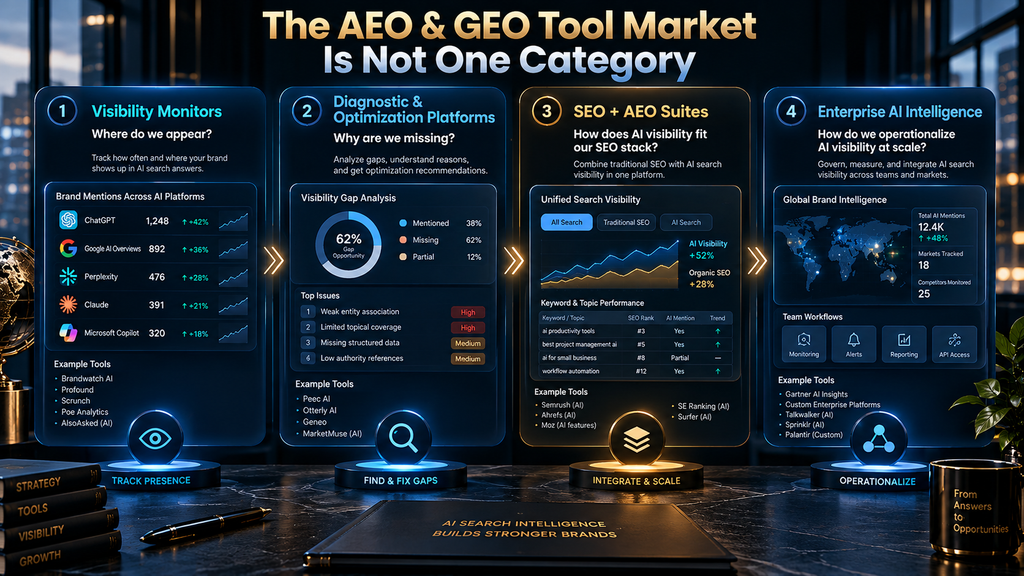
The category has developed quickly in 2026, but it is also becoming harder to evaluate because “AEO/GEO tool” now describes several very different products. Some platforms monitor prompts and tell you whether your brand appears. Others focus on citations and competitors. Some are designed to diagnose content or technical weaknesses. Others combine AI visibility with a full SEO platform, while enterprise products increasingly position themselves as an operating layer for search, content, analytics, and AI discovery. Treating all of these products as direct substitutes produces the same mistake as comparing Google Analytics, Semrush, a CRM, and a help-desk system simply because all of them contain dashboards.
The more useful question is therefore not, “Which AEO tool has the most features?” It is “Which tool gives me the evidence I need to make the next important AI-search decision?”
That distinction matters because AI visibility is not exactly the same type of measurement as a conventional keyword ranking. AI answers can vary according to the question, engine, retrieval conditions, prompt formulation, model behavior, and other contextual factors. Current research on generative search is increasingly treating the environment as a multi-stage and non-deterministic system rather than a stable ranking table, which means a single visibility score should be interpreted as a measurement model, not as an objective law of the market.
This guide takes that reality seriously. Instead of simply listing popular AEO and GEO platforms, it explains what each category of tool is actually measuring, how the major platforms differ, where their methodologies matter, what they cost, who they are built for, and where paying for one is unnecessary. The goal is to help you choose a system that improves decision quality rather than simply adding another software subscription.
Quick Answer: What Is the Best AEO or GEO Tool in 2026?
There is no single universal winner because the best tool changes with the problem you are trying to solve. Profound is one of the strongest dedicated options for enterprise AI-visibility intelligence, Otterly.AI is a compelling entry point for smaller teams, Ahrefs Brand Radar is particularly interesting when search-backed AI visibility data matters, Semrush AI Visibility is highly attractive for existing Semrush users, and HubSpot AEO makes more sense when AI visibility needs to connect closely with CRM and marketing workflows. Peec AI is well suited to teams and agencies that need prompt-based monitoring across projects, while Scrunch is differentiated by its focus on AI readiness and agent experience; Writesonic is particularly relevant to content teams that want visibility measurement and execution in one environment. (Profound)
For most buyers, however, the first decision should be whether you need dedicated AEO/GEO software at all. If your website is small, your content foundation is weak, your AI-search exposure is still insignificant, and you have nobody responsible for acting on the data, a new dashboard is unlikely to solve the actual problem. If you already operate a mature SEO stack, a dedicated platform should earn its place by adding evidence or workflows you cannot get efficiently elsewhere.
The strongest principle to keep throughout the buying process is simple: buy the measurement system that matches your decision, not the platform with the biggest feature list.
What AEO and GEO Tools Actually Do
AEO generally refers to optimizing a brand or content so that it can appear in direct answers from answer engines and AI-powered search experiences, while GEO is commonly used for the broader discipline of improving a brand’s likelihood of being represented, mentioned, cited, or recommended within generative search experiences. The terminology overlaps heavily in the software market, and several companies now use “AI search,” “AEO,” “GEO,” and “AI visibility” almost interchangeably. HubSpot, for example, describes AEO as the discipline of understanding and improving brand visibility across answer engines such as ChatGPT, Gemini, and Perplexity. (HubSpot)
The software itself typically exists to answer some combination of five questions.
First, are we visible? A platform can monitor whether a brand appears in selected AI answers, how frequently it appears, and how prominently it is positioned relative to competitors.
Second, where are we visible? This moves from a generic score into individual prompts, topics, buyer journeys, engines, regions, and categories.
Third, why are we visible or missing? This is where citation analysis, competitor analysis, content diagnostics, and source intelligence become valuable.
Fourth, what should we do next? The strongest platforms attempt to turn observations into prioritized actions rather than leaving the marketing team with a graph and no operating plan.
Finally, is the investment producing business value? That can involve traffic, conversions, brand demand, visibility lift, share of voice, assisted outcomes, or some other measure appropriate to the organization.
The important thing is that not every tool answers all five questions equally well. Some are excellent sensors but weak advisors. Others provide sophisticated recommendations but offer a narrower measurement layer. Others are deliberately designed to become part of a broader SEO and marketing ecosystem.
That is why the market needs to be judged by job-to-be-done, not simply by feature count.
Why AEO and GEO Tools Are Harder to Compare Than Traditional SEO Tools
A traditional rank tracker usually monitors a defined keyword against a search engine, location, device, and other specified conditions. AEO and GEO measurement is more complicated because an AI answer can contain multiple brands, cite several sources, omit citations, change with wording, or evolve as the underlying engine changes.
This does not make the category useless. It changes how the data should be interpreted.
Ahrefs provides a useful illustration of this distinction. Its Brand Radar includes an AI Visibility Index based on hundreds of millions of search-backed prompts modeled from real keywords in its database, while it also offers custom prompt tracking for exact questions a company chooses to monitor. Those are two different measurement approaches designed for two different analytical needs. One provides broad market discovery; the other provides focused monitoring. (Ahrefs Help Center)
Profound takes another approach. Its documentation says that it runs structured prompts across AI platforms daily and analyzes where and how brands appear, including citations, sentiment, ranking, and competitive presence. That makes historical repetition and prompt-level analysis central to the product’s value proposition.
The distinction becomes critical when two vendors both say “we track AI visibility.” They may not be measuring the same underlying phenomenon. One may derive prompts from search demand. Another may rely heavily on customer-defined questions. Another may use a prebuilt prompt library. Another may collect broader AI-response data and infer visibility from it. Those approaches can all be useful, but their resulting numbers should not be treated as though they were interchangeable.
This is the first major buying lesson: An AI visibility score is only as meaningful as the measurement system that produced it.
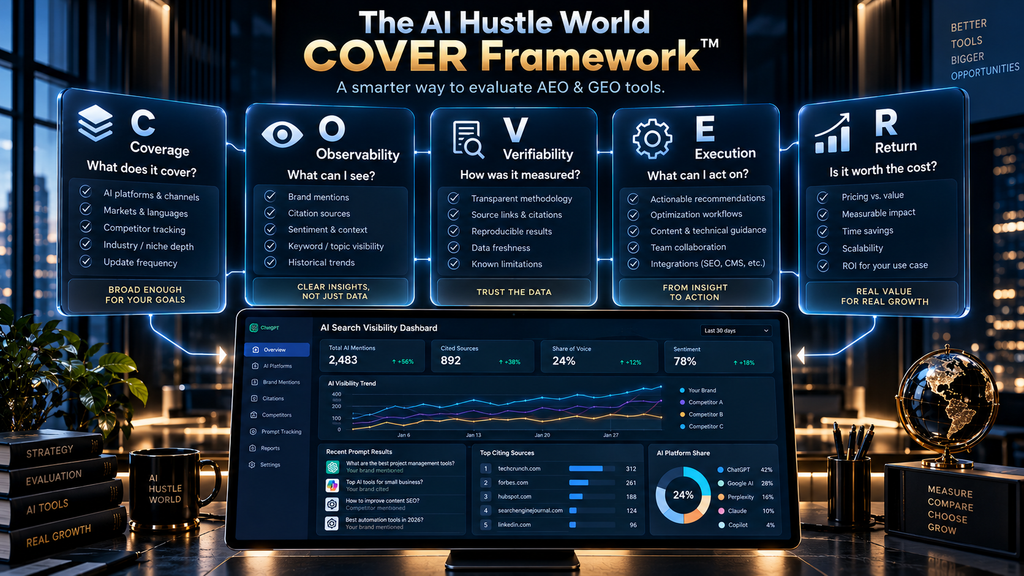
The AI Hustle World COVER Framework
To compare AEO and GEO tools properly, AI Hustle World should use a framework that evaluates not only what the software does, but the quality of the decisions it enables.
C — Coverage
Coverage asks whether the platform monitors the AI environments, prompts, markets, brands, products, and competitors that actually matter to the business.
This is where marketers often get distracted by headline numbers. One tool may say it supports nine AI environments while another supports four. That sounds decisive until you examine whether the extra engines matter to your customer base, whether they are available on your plan, how frequently they are tracked, and whether the platform provides useful evidence from each one.
Scrunch currently lists ChatGPT, Claude, Perplexity, Gemini, Meta AI, Google AI Mode, Google AI Overviews, Copilot, and Grok at its expanded enterprise level, while its Core offering covers four environments. Otterly.AI’s standard base coverage includes ChatGPT, Google AI Overviews, Perplexity, and Microsoft Copilot, with Google AI Mode, Gemini, and Claude available as add-ons. (Scrunch)
The buyer should therefore ask: Which environments influence my audience, and what am I actually paying to monitor?
O — Observability
Observability concerns what you can actually see beneath the dashboard. A useful platform should make it possible to inspect at least some of the underlying information: the prompt, the response, the mention, the citation, the competitor presence, the historical change, or the condition that produced the metric.
HubSpot’s current AEO product illustrates this well. Its prompt tracking can show the exact response returned by ChatGPT, Gemini, or Perplexity for tracked prompts, while its competitive analysis compares share of voice and citation presence.
That is more useful than a dashboard that simply says your “AI Visibility Score” went from 42 to 47 without showing what changed.
V — Verifiability
Verifiability asks a harder question: Do you understand how the platform produced the measurement?
The methodology matters because AI answers are variable. You need to know whether prompts are custom, modeled, generated, search-backed, repeated daily, sampled periodically, or derived through another process.
Ahrefs provides unusually explicit documentation around its methodology, stating that its AI Visibility Index uses more than 405 million search-backed prompts modeled after keywords from its database and that custom prompts can be tracked separately. Profound documents a different model, stating that it runs structured prompts daily across AI platforms.
Neither approach should automatically be declared superior. The correct question is which one matches the question you are trying to answer.
E — Execution
Execution asks whether the platform helps turn measurement into action.
This is where the difference between “monitoring software” and “optimization software” becomes important. A monitor may reveal that your competitor is being cited more often. An execution-oriented platform tries to identify what content, sources, pages, or brand facts are associated with the gap and what should be improved.
Conductor explicitly positions its AI Search Performance reporting around this problem, arguing that many point solutions can show whether visibility changed but do not adequately explain which content to prioritize, which competitive gaps to close, or how to act on the insight. (Conductor)
HubSpot makes a similar product argument, describing its recommendations as a way to move from visibility data into prioritized action rather than simply observing a dashboard.
Execution is particularly important for teams without a large dedicated analytics function. Data has low economic value when nobody turns it into a decision.
R — Return
Return is the final and most neglected question: Is the software economically justified?
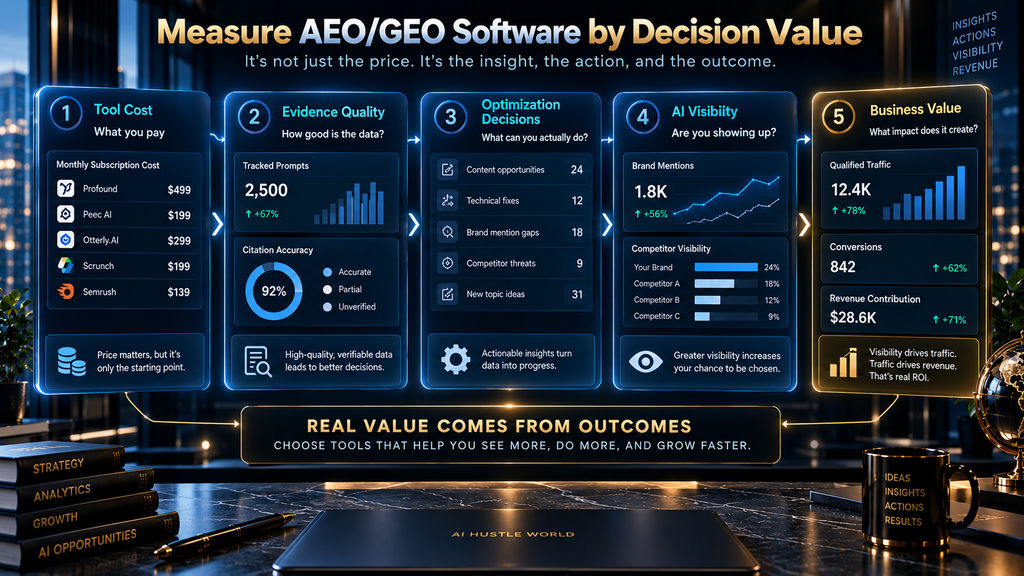
Do not ask merely whether the tool costs $50, $99, $199, or $500 per month. Ask what useful decisions it generates and what those decisions are worth.
A $29/month tracker may be extremely valuable for a small site that needs a weekly signal. A $699/month multi-platform system may be perfectly reasonable for a global company tracking hundreds of high-value prompts. The absolute price tells you very little without the operational context.
The right measure is not “cheap versus expensive.” It is cost relative to actionable intelligence and business value.
How We Evaluated the Best AEO & GEO Tools
This comparison judges tools across ten dimensions rather than giving arbitrary points for every feature.
| Evaluation Area | What We Need to Know |
|---|---|
| AI engine coverage | Which environments are actually tracked? |
| Prompt methodology | How are monitored questions generated? |
| Monitoring depth | How much data is collected over time? |
| Refresh frequency | How frequently are changes observed? |
| Citation intelligence | Can you see where answers source information? |
| Competitor intelligence | Can you understand who appears instead? |
| Diagnostic depth | Can the platform explain likely causes? |
| Actionability | Does it suggest or enable meaningful next steps? |
| Integrations | Can insights enter existing workflows? |
| Economics | Does the cost make sense for the intended scale? |
The criteria are deliberately uneven in importance. For an enterprise brand, governance and integration may matter more than price. For a solo publisher, cost and prompt relevance may matter more than API access. For an agency, multi-project management and reporting become critical. A universal ranking that ignores those differences would give a misleading impression of precision.
The 10 Best AEO & GEO Tools in 2026
1. Profound — Best for Enterprise AI Visibility Intelligence
Profound is one of the clearest examples of a dedicated enterprise AI-visibility platform. Its current plans include a $99/month Starter tier with ChatGPT tracking and 50 prompts, a $399/month Growth tier with three answer engines and 100 prompts, and custom Enterprise packages supporting up to nine answer engines and multiple companies. Profound says it runs structured prompts daily and analyzes brand placement, citations, sentiment, ranking, and competitive presence.
The strongest reason to consider Profound is that it treats AI visibility as an ongoing intelligence problem rather than a one-time audit. The daily structured-prompt model gives teams a basis for observing movement over time, which is important because a single answer is a weak foundation for strategic conclusions. Its ability to customize prompts further matters for brands with specific buyer journeys that generic industry prompts may not represent well.
The trade-off is equally important. Profound is not the rational default for a small publisher simply because it is sophisticated. Its pricing and enterprise orientation make more sense when the organization has enough brand exposure, prompt volume, markets, or strategic importance to justify continuous intelligence. For a solo creator monitoring a small handful of questions, that level of infrastructure can become an expensive source of information you do not have the capacity to act upon.
Best fit: Enterprise brands, large agencies, sophisticated marketing teams. Watch out for: Paying enterprise-level prices for an SMB-sized monitoring problem.
2. Peec AI — Best for Teams and Agencies Managing Multiple Projects
Peec AI is particularly interesting because its pricing and product architecture are explicitly built around AI-search analytics. Its current brand plans include 50 prompts with three selected models on Starter, 150 prompts across three models on Pro, and 350 prompts across three models on Advanced, with enterprise options supporting custom prompt tracking, all models, unlimited projects, APIs, SSO, and more. Peec also says prompts can be tracked across supported countries and languages without additional charges based on region. (Peec AI)
That makes Peec compelling when the user is thinking in terms of projects rather than one dashboard. Agencies and distributed marketing teams often need to allocate prompts across brands, sub-brands, or client environments, and the product’s project-oriented structure is relevant to that workflow.
Its economics are also a useful reminder that prompt count alone is not enough to compare platforms. A platform can look more or less expensive depending on how many projects those prompts can serve, which models can be selected, how often tracking runs, and how much control administrators have over allocation.
Best fit: Agencies, SEO teams, and multi-project marketing organizations. Watch out for: Treating “50 prompts” on one platform as equivalent to “50 prompts” on another when model coverage and methodology differ.
3. Otterly.AI — Best Budget-Friendly Dedicated Tracker
Otterly.AI is one of the most approachable options for smaller teams. Its current Lite plan costs $29/month and includes 15 search prompts, daily tracking, unlimited team members, and monitoring for ChatGPT, Google AI Overviews, Perplexity, and Microsoft Copilot. Google AI Mode, Gemini, and Claude are available as paid add-ons. Standard is currently $189/month, while additional prompt and engine packages are priced separately. (Otterly)
The key advantage is low-friction entry into continuous monitoring. For a company that has never measured AI-search visibility before, spending enterprise money immediately may be difficult to justify. A relatively low-cost monitoring layer can establish a baseline and reveal whether AI visibility is even strategically important for the brand.
The caveat is that the headline $29 price does not represent unlimited multi-engine monitoring. Once a company adds Google AI Mode, Gemini, Claude, and more prompt capacity, the actual subscription economics change. The buyer should therefore calculate the desired configuration rather than treating the entry plan as a proxy for total capability.
Best fit: Solo marketers, small businesses, early-stage teams, and buyers establishing their first AEO baseline. Watch out for: Add-on costs and assuming the cheapest plan covers every important AI environment.
4. Scrunch — Best for AI Readiness and Agent Experience
Scrunch occupies a particularly interesting position because it is not merely a visibility tracker. Its Core plan is currently $250/month and includes 125 unique prompts, five site audits per month, one brand workspace, and five user licenses. Enterprise expands into an AXP, or Agent Experience Platform, alongside custom prompts, broader audits, API access, integrations, SSO, and nine supported LLM environments. (Scrunch)
This makes Scrunch attractive to teams that believe their AI-search problem is partly technical and architectural, not simply a visibility-reporting problem. A company might discover that its content is strong but that its site structure, technical accessibility, or agent-facing experience creates obstacles. In that situation, a tool that combines visibility and readiness has a more compelling role than a pure monitor.
The downside is obvious: not every business needs that breadth. If your main question is simply “How often does my brand appear for these 50 buyer prompts?” you could end up paying for a much larger system than necessary.
Best fit: Technical SEO teams, larger content organizations, and brands thinking seriously about AI agents. Watch out for: Buying an agent-readiness platform when all you need is basic visibility tracking.
5. Semrush AI Visibility — Best for Existing Semrush Users
Semrush is one of the strongest examples of the integrated-suite advantage. Its AI Visibility Toolkit is currently $99/month per domain when billed annually and includes AI visibility reports, 25 custom prompts, brand performance analysis, mentions from ChatGPT, Google AI, Gemini, and Perplexity, competitor analysis, prompt research, and AI-readiness checks within Site Audit. (Semrush)
Its real strength is not the isolated $99 feature set. It is the connection between AI visibility and the broader Semrush environment. A marketing team already using Semrush for keyword research, competitor intelligence, technical SEO, and content work may gain more from AI visibility data when it lives beside those existing datasets.
This creates a strategic question that smaller dedicated tools cannot always answer: Do I need another platform, or do I need the AI layer added to a platform my team already understands? For an existing Semrush customer, the second option can be significantly more efficient.
Best fit: Existing Semrush users, SEO teams, content strategists, and agencies already operating inside Semrush. Watch out for: Comparing Semrush purely by AI prompt count while ignoring the value of the larger ecosystem.
6. Ahrefs Brand Radar — Best for Search-Backed AI Visibility Intelligence
Ahrefs Brand Radar has one of the most interesting data propositions in this category. Ahrefs says the AI Visibility Index maps brand visibility across more than 405 million search-backed prompts modeled after real keywords from its database and asked by real humans. It also allows custom prompts to be tracked across Google AI Overviews, Google AI Mode, ChatGPT, Perplexity, Gemini, and Copilot. (Ahrefs Help Center)
Current standalone pricing includes a $199/month single-platform option and a $699/month all-platform package, while custom prompt tracking is available separately in Basic, Growth, and Scale tiers. Ahrefs also now presents Brand Radar as part of a broader AI visibility system connected to SEO, YouTube, Reddit, and other discovery channels.
The real strength here is breadth of market intelligence combined with exact prompt control. A brand can discover how it appears across a large universe of search-backed questions while also monitoring the specific buyer questions it considers strategically important.
The trade-off is cost and complexity. A small website may not need a data environment of this scale. A mature brand, however, may value it precisely because broader market discovery is difficult to reproduce manually.
Best fit: Established brands, advanced SEO teams, agencies, and Ahrefs users. Watch out for: Assuming the broad AI Visibility Index and custom prompt tracking answer the same analytical question.
7. HubSpot AEO — Best for CRM-Centered Marketing Teams
HubSpot’s approach is different from a pure-play AEO vendor because the company is connecting AI search visibility to customer and marketing context. Its AEO platform currently offers monitoring across ChatGPT, Gemini, and Perplexity, with visibility scores, prompt tracking, citation analysis, competitor share of voice, and recommendations. HubSpot’s dedicated product is currently advertised at $50/month with a 28-day free trial, while AEO capabilities also exist inside Marketing Hub Pro and Enterprise with expanded functionality and CRM-powered recommendations. (HubSpot)
This creates a strong proposition for organizations already invested in HubSpot because the product is not merely asking, “Are you visible?” It is attempting to connect AI-search behavior to the buyer journey and the customer context already present in the CRM.
That can be extremely useful for B2B marketing. Knowing that competitors appear in AI answers for a specific category is valuable; knowing which buyer questions matter to your pipeline and connecting those visibility gaps to marketing execution is significantly more actionable.
The limitation is that the ecosystem itself becomes part of the value calculation. A company with no HubSpot infrastructure may reasonably prefer a simpler specialist platform.
Best fit: HubSpot-centric B2B marketing teams and companies seeking CRM-connected AEO workflows. Watch out for: Buying into a broader ecosystem when you only need standalone visibility measurement.
8. Writesonic GEO — Best for Content Teams That Want Measurement Plus Execution
Writesonic is attractive because it does not stop at measurement. Its current agency plans include AI-search visibility across a broad model set, audit capabilities, reporting, and an upgrade path into ongoing client projects, while its broader platform combines SEO, GEO, content, and agentic workflows. The Agency Starter tier is currently $200/month billed annually and supports up to 20 pitch projects per month with 2,000 tracked answers; higher enterprise functionality expands into all ten listed AI platforms and broader workflows. (Writesonic)
This is particularly useful for agencies because the platform can become part of the sales process as well as the delivery process. An agency can use AI-search visibility audits to demonstrate a prospect’s problems and then convert that insight into an ongoing optimization engagement.
Content teams may also value the integration between monitoring and execution. The closer the measurement system is to the actual content-production workflow, the less friction exists between discovery and implementation.
The trade-off is similar to other integrated platforms: if your team already has a mature content stack, you should calculate whether the convenience justifies replacing or duplicating capabilities you already own. Best fit: Content agencies, SEO agencies, and teams that want AI-search measurement connected to execution. Watch out for: Paying for an integrated content ecosystem when you only need independent measurement.
9. Conductor — Best Enterprise SEO + AEO Operating System
Conductor is best evaluated as an enterprise platform rather than as a lightweight GEO monitor. Its current AI-search product positioning emphasizes understanding where and why brands win, which pages and topics are responsible, competitive gaps, sentiment shifts, and the ability to act on those insights within an existing enterprise marketing environment. (Conductor)
Its 2026 AEO/GEO benchmarks report is another indication of its strategic position. Conductor has begun framing AI-search visibility as a broader measurement discipline involving AI referral traffic, AI market share, and performance in Google AI Overviews, rather than as a standalone “LLM ranking” metric.
That makes Conductor particularly valuable for organizations where AI visibility is becoming a cross-functional management problem rather than a specialist SEO task. Large teams need consistency, governance, content prioritization, reporting, and integration into existing processes.
For smaller businesses, the same characteristics can become disadvantages. Enterprise systems carry organizational value precisely because they solve problems that smaller teams may not have.
Best fit: Enterprise SEO and marketing organizations. Watch out for: Comparing an enterprise operating system with a lightweight tracker on a simple price-per-prompt basis.
10. LLMrefs — Best for Broad AI-Visibility Monitoring at a Lower Entry Point
LLMrefs represents another direction in the market: broad AI-visibility monitoring with an emphasis on the growing range of AI answer environments. Its positioning covers AI visibility across multiple systems and focuses on the practical question of how often and how prominently a brand appears in AI-generated answers. (LLMrefs)
The appeal is the breadth of the category it attempts to monitor without necessarily adopting the full enterprise complexity of the largest platforms. This can make it attractive to marketers who want a wider view of AI visibility but are not ready for an enterprise intelligence platform.
The important caveat is methodological. Broad engine coverage does not automatically tell you whether the underlying prompt set is representative of your market. A brand should still ask what questions are being monitored, how those questions were generated, how often they are refreshed, and how much control the user has over the measurement.
Best fit: Marketers looking for broad AI visibility coverage without immediately moving into enterprise tooling. Watch out for: Treating engine count as proof of measurement quality.
The Comparison That Actually Matters
A conventional comparison table would list features beside ten tool names and declare a winner. That would be visually convenient and strategically weak.
The more useful comparison looks like this:
| Tool | Strongest Role | Main Advantage | Main Trade-Off |
|---|---|---|---|
| Profound | Enterprise visibility intelligence | Deep dedicated monitoring | Higher cost and complexity |
| Peec AI | Teams / agencies | Project-oriented tracking | Not the same as broad enterprise intelligence |
| Otterly.AI | Budget monitoring | Low barrier to entry | Add-ons change total cost |
| Scrunch | AI readiness | Visibility + technical/agent focus | More capability than many teams need |
| Semrush | Integrated SEO + AI visibility | Strong existing ecosystem | Best value for Semrush users |
| Ahrefs Brand Radar | Broad AI intelligence | Search-backed data + custom prompts | More expensive at scale |
| HubSpot AEO | CRM-centered AEO | Buyer context + recommendations | Strongest for HubSpot ecosystems |
| Writesonic | Visibility + content execution | Monitoring connected to action | Potential overlap with existing content stack |
| Conductor | Enterprise operating model | Broader strategic integration | Enterprise-oriented complexity |
| LLMrefs | Broad visibility | Wide environment coverage | Methodology should be evaluated carefully |
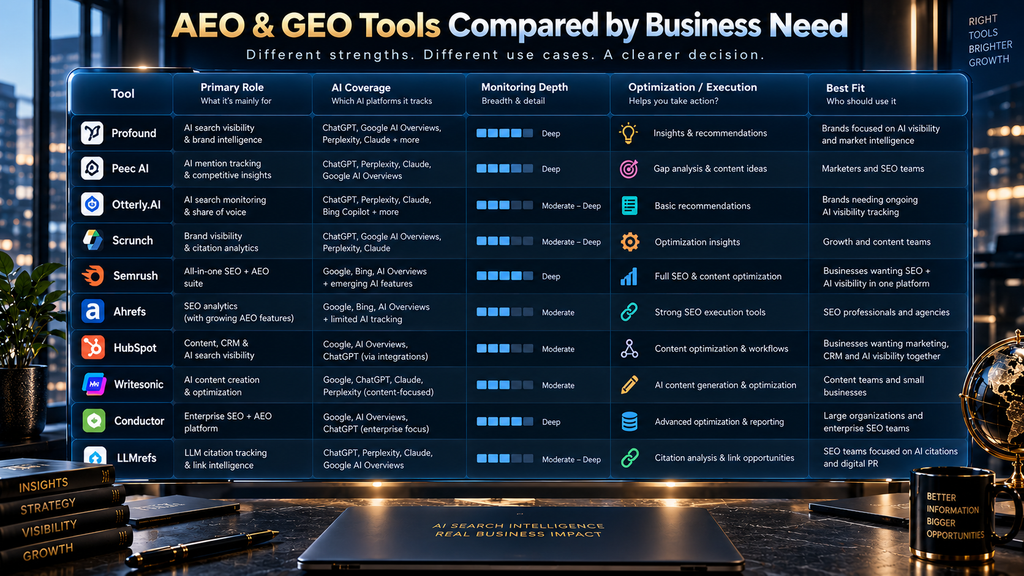
The most important lesson is that there is no meaningful universal ranking without defining the buyer first. A solo publisher and a multinational software company should not receive the same recommendation simply because they are both asking for “the best GEO tool.”
Which Tool Is Best for Different Buyers?
Best for a solo marketer or small business
Otterly.AI is one of the strongest starting points because the entry cost is relatively low and the core monitoring problem can be tested without purchasing an enterprise platform. The objective at this stage is not to create a sophisticated AI-search command center. It is to establish a baseline, understand which prompts matter, and determine whether AI visibility deserves more investment.
HubSpot’s $50/month dedicated AEO product is another accessible option, particularly when buyer prompts and competitive analysis are more important than broad engine coverage.
Best for an SEO team
Semrush or Ahrefs becomes particularly compelling when the organization already owns the broader platform. The value is not just AI visibility itself, but the relationship between AI exposure and traditional search demand, competitor research, content, technical SEO, and site-level intelligence.
Best for an agency
Peec AI, Writesonic, and Profound become interesting for different reasons. Peec is explicitly structured around projects and agencies, Writesonic connects visibility to content and client workflows, while Profound is stronger when the client base requires more sophisticated enterprise-grade monitoring.
The correct agency choice depends heavily on whether the agency is selling reporting, strategy, content execution, or enterprise intelligence.
Best for enterprise
Profound and Conductor are the strongest dedicated candidates from this list when AI visibility becomes an enterprise operating problem. Ahrefs and Semrush also become relevant when AI visibility needs to sit inside an existing broader search-data infrastructure.
How Much Should You Pay for AEO/GEO Software?
There is a dangerous tendency in emerging categories to believe that the expensive platform must produce the best result. That is especially weak logic in AEO/GEO software because the underlying question is not simply how much data the system contains, but how much useful decision-making the data creates.
Current market pricing illustrates the enormous range. Otterly starts at $29/month. HubSpot AEO is currently advertised at $50/month. Profound starts at $99/month and reaches $399/month before enterprise pricing. Semrush’s AI Visibility Toolkit is $99/month per domain. Scrunch Core is $250/month. Ahrefs Brand Radar begins at $199/month for a single platform and $699/month for all-platform access. Peec publishes $95, $245, and $495 annual-billing-equivalent brand tiers, while enterprise options are custom. Writesonic’s agency offering begins at $200/month billed annually.
The price spread is rational once you understand the underlying differences. Some products sell a monitoring signal. Others sell a broader intelligence dataset. Some sell execution workflows. Enterprise platforms sell organizational scale and integration.
A useful internal calculation is: Monthly tool cost ÷ meaningful optimization decisions generated. That is not a formal industry metric, but it is a much more intelligent management question than “Which subscription is cheapest?”
Suppose a $99 tool identifies one citation gap that helps you recover a high-value commercial topic. It may already have produced economic value. Suppose a $500 tool generates hundreds of recommendations that nobody implements. Its theoretical feature advantage becomes irrelevant.
The key is to measure actionable intelligence, not dashboard density.
Does Monitoring More AI Engines Make a Tool Better?
Not necessarily.
More engine coverage is useful when those engines matter to the audience, but it can become vanity measurement when the additional platforms have negligible relevance to the business. A global consumer brand may care about a much broader set of AI environments than a niche B2B software company whose buyers overwhelmingly use a smaller selection.
The same logic applies to prompt volume. Five strategically important prompts can be more useful than 500 irrelevant prompts.
This is why the strongest purchasing process starts with the business’s question universe. Define the buyer questions that actually influence consideration, comparison, implementation, or purchase. Then determine which tools can monitor those questions with appropriate coverage and evidence.
Only after that should you compare engine counts.
What Makes an AEO/GEO Metric Trustworthy?
A trustworthy metric has context. You should know what was measured, when it was measured, under what prompt or query conditions, across which platforms, and according to what calculation.
This becomes especially important when vendors advertise “AI visibility scores.” Scores are useful as directional indicators when their methodology remains stable over time. They become much less useful when the underlying measurement system changes without making those changes transparent.
Ahrefs makes a useful distinction between a broad AI Visibility Index and custom prompt tracking. Profound emphasizes repeated structured prompts. HubSpot provides prompt-level responses and competitive visibility analysis. These approaches are different, but each gives the buyer more insight into what lies beneath the summary metric.
The practical rule is: Never buy the score. Buy the evidence behind the score.
That is one of the most important purchasing principles in this entire category.
Do AEO and GEO Tools Actually Improve Visibility?
This is where the market needs more skepticism.
A tool can measure visibility without causing visibility to improve. Those are two different propositions.
Suppose a platform shows that your brand appears in 18% of tracked AI answers. That is a measurement capability. It does not prove that following the platform’s recommendations will increase that number. To make the second claim, you would need evidence that a specific intervention caused a measurable improvement under controlled or sufficiently rigorous conditions.
The current research base does not justify assuming that every GEO recommendation produces a predictable ranking or citation effect across all AI engines. Research into generative search is increasingly focused on the volatility, retrieval complexity, and lack of stable cross-platform causal relationships in the field.
This should not discourage experimentation. It should improve experimentation.
The right approach is to establish a baseline, record the important prompts, make a clearly defined content or authority change, monitor the same measurement set over time, and compare the result. That creates an evidence loop instead of relying on vendor promises.
AEO/GEO software is therefore best understood as an observation and decision system, not a machine that guarantees citations.
The Most Important Difference: Monitoring vs Optimization
A visibility tool answers: “What is happening?” An optimization platform attempts to answer: “What should happen next?” The distinction seems small, but it changes how the software should be evaluated.
Monitoring is fundamentally analytical. It is valuable when the organization has its own experienced SEO, content, PR, or digital team that can interpret the data and execute changes.
Optimization is more operational. It becomes valuable when the platform can reduce the time between detecting a problem and deciding what action is appropriate.
That is why integrated products such as HubSpot, Semrush, Writesonic, Scrunch, and Conductor deserve a different evaluation lens than a narrow tracker. Their value may come partly from shortening the distance between measurement and execution.
But again, integration does not automatically make a tool better. It makes it better for the buyer who needs that integration.
The Hidden Cost: Recommendation Overload
There is another problem that few software comparisons discuss: a platform can generate more recommendations than a team can realistically implement.
Imagine an enterprise dashboard identifies hundreds of potential content gaps, dozens of competitors, thousands of prompts, and continuous changes in citation behavior. That sounds powerful until the content team discovers it only has enough capacity to revise twenty pages this quarter.
At that point, the bottleneck is no longer measurement. It is organizational prioritization.
This is why the best platform is not necessarily the one that produces the most opportunities. It is the one that helps the team identify which opportunities are most consequential.
That is particularly important for enterprise buyers. Conductor explicitly emphasizes the problem of knowing which content and competitive gaps to prioritize, while HubSpot frames its recommendations around what to do next and why.
The mature buyer should therefore ask: Can this tool tell me what not to work on? That is often more valuable than another hundred recommendations.
Common Mistakes When Buying AEO and GEO Software
Buying by AI-engine count
Nine supported engines sounds better than four, but only if the additional engines matter to your customers and the measurement is meaningful.
Buying by prompt count
Prompt volume is useful only when the prompts represent meaningful demand. One well-designed buyer-question set can outperform a much larger generic library.
Treating all visibility scores as equivalent
Different methodologies can produce different measurements. A score of 60 from one system should not automatically be compared with 60 from another.
Assuming monitoring equals causation
Seeing a visibility problem does not prove that the platform’s recommendation will fix it.
Paying enterprise prices for an SMB problem
Sophisticated software can become counterproductive when the underlying business problem is small.
Ignoring your existing software stack
A standalone AEO platform may duplicate capabilities already available in Semrush, Ahrefs, HubSpot, or another system you already pay for.
Optimizing the dashboard instead of the business
Some teams become obsessed with increasing “AI visibility” without determining whether the prompts being measured have any relationship to qualified traffic, sales, brand awareness, or customer decisions.
Treating vendor claims as independent research
A company can accurately describe its own feature set while still making performance claims that require independent validation. The distinction must remain visible.
What AEO/GEO Tools Cannot Do
Even the strongest platform cannot force ChatGPT, Gemini, Perplexity, or another AI system to mention a brand.
It cannot guarantee that a citation will appear. It cannot guarantee that an AI answer will remain stable. It cannot guarantee that every content recommendation produces a ranking improvement. It cannot replace strong source material.
And it cannot make weak information authoritative simply because the dashboard labels it “AI optimized.”
That last limitation deserves special emphasis. The foundation of AI-search visibility remains the quality, accessibility, relevance, and usefulness of the information being retrieved. Google continues to emphasize foundational SEO and people-first content for its AI search experiences, while other platforms such as OpenAI and Perplexity document access and retrieval conditions rather than promising publishers a deterministic placement mechanism.
The software is the sensor. The content and information asset remain the underlying product.
Should You Buy a Dedicated AEO/GEO Tool at All?
Before purchasing anything, run this simple maturity test.
If you do not have a strong content foundation, start there. If you have strong content but no understanding of your AI-search baseline, a low-cost tracker can be sensible.
If you already have a mature SEO operation, evaluate whether your existing platform can provide enough AI visibility data before adding another subscription. If AI visibility is becoming strategically important across multiple markets, brands, teams, and buyer journeys, dedicated enterprise intelligence may become justified.
The decision should follow the organizational problem. This is why “best AEO tool” is inherently an incomplete question.
A better question is: What is the smallest measurement system that gives my team enough evidence to make better decisions?
The Future of AEO/GEO Software
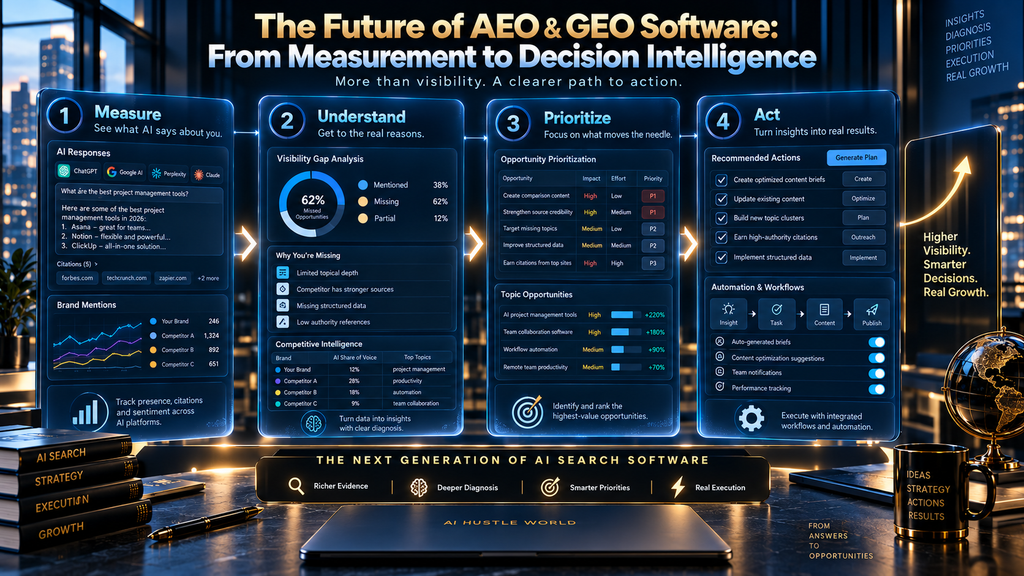
The first generation of AEO/GEO platforms largely answered the question, “Are we showing up?” The next generation is moving toward, “Why are we showing up, what is influencing that visibility, and what should we change?”
Conductor is explicitly positioning its AI-search product around this shift from raw visibility reporting toward prioritization and action. HubSpot is making a similar transition by connecting visibility data to recommendations and customer context. Writesonic is pushing further toward integrated content execution, while Scrunch is extending the category into agent experience.
That suggests a likely direction for the market: measurement will become increasingly commoditized, while interpretation and execution become more valuable.
If every platform can tell you that your brand appears in 27% of tracked answers, the differentiation shifts to what happens next. Which citations matter? Which competitors are winning? Which pages influence those outcomes? Which changes are most likely to matter? Which recommendations are worth implementing? Which outcomes actually affect revenue?
The strongest future platforms will therefore look less like rank trackers and more like decision systems for AI-mediated discovery.
The AI Hustle World Buying Decision
After evaluating the category through the COVER Framework, the recommendations become much clearer.
Choose Profound when:
You are an enterprise brand or sophisticated agency that needs dedicated AI-visibility intelligence, structured daily monitoring, competitive analysis, and scalable answer-engine tracking.
Choose Peec AI when:
You need project-oriented AI-search analytics across teams or agencies and want prompt volume and model selection to scale with multiple projects.
Choose Otterly.AI when:
You want a relatively inexpensive starting point for continuous AI visibility monitoring and want to establish a baseline before committing to a larger platform.
Choose Scrunch when:
Your AI-search strategy includes technical readiness, content diagnostics, and agent experience rather than visibility monitoring alone.
Choose Semrush AI Visibility when:
You already use Semrush and want AI visibility integrated with your existing SEO, competitor, content, and site-audit workflow.
Choose Ahrefs Brand Radar when:
You want broad search-backed AI visibility intelligence, competitive discovery, and the ability to supplement broad datasets with exact custom buyer prompts.
Choose HubSpot AEO when:
Your marketing organization is already centered around HubSpot or you need AI-search visibility tied closely to buyer context, CRM data, and marketing workflows.
Choose Writesonic GEO when:
You want AI-search measurement connected to content production, audits, agency workflows, and execution.
Choose Conductor when:
AI visibility is becoming an enterprise-wide SEO and marketing operating problem rather than a standalone reporting task.
Choose LLMrefs when:
You want broad AI visibility monitoring and are willing to examine the underlying prompt and measurement methodology rather than selecting purely on engine count. (LLMrefs)
Final Thoughts: Buy Evidence, Not Another Dashboard
The AEO and GEO software market is entering an important phase. The early conversation was dominated by a simple question: “Can my brand appear in AI answers?” Now that visibility monitoring is becoming more accessible, the harder and more valuable question is emerging: “Can this software tell me what is actually happening well enough to make a better decision?”
That is the standard that should govern the purchase.
The best platform is not necessarily the one that tracks the most engines. It is not necessarily the one with the largest prompt library, the highest visibility score, the most colorful dashboard, or the longest list of AI features. It is the system that gives you reliable enough evidence, at the right level of detail, for the decisions your organization actually needs to make.
That is why the AI Hustle World COVER Framework focuses on Coverage, Observability, Verifiability, Execution, and Return. Those five dimensions force the buyer to look beyond software marketing and ask a harder question: what does this subscription actually allow us to understand, and what can we do with that understanding?
There is also a deeper lesson here for the entire AI-search industry. Measurement will become easier. Dashboards will become more common. More vendors will publish more AI visibility scores. The scarce capability will not be collecting another number. It will be knowing which number deserves attention, why it moved, what evidence supports the interpretation, and whether acting on it is economically worthwhile.
That is the real dividing line between an AEO/GEO tool you subscribe to and an AEO/GEO system you can actually build a strategy around.
The best tool does not simply tell you whether you are visible. It helps you understand whether the visibility you are measuring is real, relevant, defensible, and worth acting on.
Build a Smarter AI Search Stack
Once you have the tools, make sure you understand how GEO, AEO and traditional SEO differ.
Compare GEO, AEO and SEO →Frequently Asked Questions
What is the best AEO tool in 2026?
There is no universal best tool because AEO software serves different jobs. Profound is a strong enterprise candidate, Otterly.AI is attractive for budget-conscious teams, Semrush and Ahrefs are compelling for existing users of those ecosystems, and HubSpot is particularly interesting when CRM context matters. The correct choice depends on the prompts, engines, scale, evidence depth, and workflow you actually need.
What is the best GEO tool for small businesses?
A lower-cost dedicated tracker such as Otterly.AI is a sensible starting point for many small businesses because its Lite plan is currently $29/month and provides daily monitoring across four AI search environments, with additional engines available as add-ons. HubSpot’s dedicated AEO offering is another accessible option at $50/month according to its current product page.
Are AEO and GEO tools the same thing?
The terms overlap heavily, but the software category includes products with different capabilities. Some focus on answer-engine visibility, some on generative search optimization, some on citation and competitor intelligence, and others on broader AI readiness or SEO integration. In practice, the category is better understood by the problem the tool solves than by whether the vendor labels it AEO or GEO.
Do AEO/GEO tools guarantee AI citations?
No. These platforms can monitor citations, mentions, visibility, and related signals, but they cannot guarantee that an AI engine will cite or recommend a brand. OpenAI explicitly says ChatGPT Search placement is not guaranteed, and AI-search measurement should therefore be treated as probabilistic rather than deterministic.
How many prompts should I track?
Track the prompts that represent meaningful questions your customers actually ask. Start with high-value commercial, informational, comparison, and problem-solving queries, then expand once you understand which categories produce useful signals. A smaller set of strategically important prompts can be more valuable than a huge generic library.
Should I use Semrush or Ahrefs instead of a dedicated AEO tool?
Start by evaluating what your existing platform already provides. Semrush includes AI visibility reporting, prompt tracking, competitor analysis, and AI-readiness checks, while Ahrefs Brand Radar provides both broad search-backed AI visibility data and custom prompt tracking. A dedicated platform becomes more compelling when you need deeper specialized measurement or workflows that your current stack cannot provide efficiently.
Is Ahrefs Brand Radar worth the price?
It can be, particularly for organizations that value large-scale search-backed AI visibility intelligence and custom prompt monitoring. Ahrefs currently prices standalone Brand Radar access from $199/month for a single platform and $699/month for all-platform access, with separate custom prompt packages. The value depends heavily on the scale and importance of the visibility problem being measured.
Is Profound worth $399 per month?
For a small website, probably not. For a growing organization that needs daily structured prompt monitoring, multi-engine visibility, citations, sentiment, competitive intelligence, and more sophisticated AEO workflows, the economics can make more sense. Profound’s current Growth tier is $399/month billed annually and includes three answer engines and 100 tracked prompts.
Do I need an AEO/GEO tool if my website is already ranking well in Google?
Not automatically. Strong traditional SEO foundations remain valuable, and Google explicitly says existing SEO best practices continue to apply to its AI search experiences. A dedicated AEO/GEO platform becomes useful when you need to understand a visibility layer that conventional rank tracking does not adequately measure, such as AI mentions, citations, prompt-level visibility, or competitive representation inside AI answers.
What is the most important thing to check before buying an AEO/GEO platform?
Check the measurement methodology before the feature list. Understand which prompts are monitored, whether you can use your own prompts, which AI environments are included in your actual plan, how frequently tracking occurs, what raw evidence you can inspect, and how the platform turns observations into actionable decisions. A smaller tool with transparent, relevant measurement can be more valuable than a larger platform that produces impressive but poorly understood scores.
Related Guides
- Best AI SEO Tools in 2026: 10 Tools Compared
- AI SEO vs Traditional SEO: What Actually Matters in 2026?
- Best AI Governance and Compliance Platforms in 2026
- Best AI Tools for Writing Blog Posts (Free & Paid)
Written by
Muntasir Ahmad Chowdhury
Founder, AI Hustle World
Muntasir Ahmad Chowdhury is the Founder of AI Hustle World, an independent publication dedicated to making Artificial Intelligence practical, trustworthy, and easy to understand. He researches AI tools, automation, customer service, productivity, and real-world business applications, helping readers make smarter technology decisions through research-driven, experience-backed content.
Expertise:
AI Tools • AI Automation • AI Customer Service • AI Productivity • Generative AI • AI Workflows
Get Smarter With AI
Enjoyed this guide? Get practical AI tools, tutorials, and honest reviews delivered to your inbox.