AI Compliance Tools Compared: Features, Privacy Controls and Use Cases
AI compliance has become a software problem, but treating it as only a software problem is one of the easiest ways to build the wrong solution.
As businesses move from experimenting with ChatGPT-style assistants to deploying AI inside customer service, HR, marketing, finance, software development, analytics, and internal operations, the governance challenge changes. The organization is no longer dealing with one approved AI application. It may be dealing with dozens of models, embedded AI features, third-party vendors, employee-created workflows, APIs, agents, internal applications, and sensitive information moving through all of them. At that point, a spreadsheet can still record information, but it becomes much harder to maintain a reliable relationship between AI systems, owners, risks, policies, controls, evidence, and ongoing changes.
That is where AI compliance tools become useful.
The important distinction is that an AI compliance platform does not make an organization compliant by itself. The software can discover systems, organize inventories, automate assessments, map requirements, assign controls, collect evidence, monitor changes, and support remediation, but the organization still has to decide what risks it accepts, which controls are appropriate, who is accountable, and how those controls should operate. NIST’s AI Risk Management Framework, for example, is explicitly designed as a voluntary risk-management framework rather than a software product or a checklist, while ISO/IEC 42001 defines requirements for establishing and continually improving an AI management system.
So the real buying question is not “Which AI compliance tool has the most features?” It is “Which platform can turn our AI governance requirements into controls, workflows, evidence, and decisions that continue working as our AI environment changes?” That distinction drives the entire comparison.
What AI Compliance Tools Actually Do
AI compliance tools sit between an organization’s AI environment and its governance obligations. Depending on the platform, they can help discover AI applications, create an AI inventory, assess risk, map requirements to controls, manage approvals, evaluate vendors, monitor AI use, identify policy violations, maintain evidence, track remediation, and prepare reports for internal or external review.
The underlying workflow is more important than the individual feature names. Imagine a company wants to deploy an AI assistant that can summarize internal documents. Someone needs to identify the system, establish who owns it, determine what information it can process, assess the consequences of misuse, decide which policies apply, approve or reject the deployment, and preserve evidence of that decision. If the assistant later gains access to customer records, its risk profile may change even though the product name remains exactly the same.
A useful compliance platform should be able to represent that change.
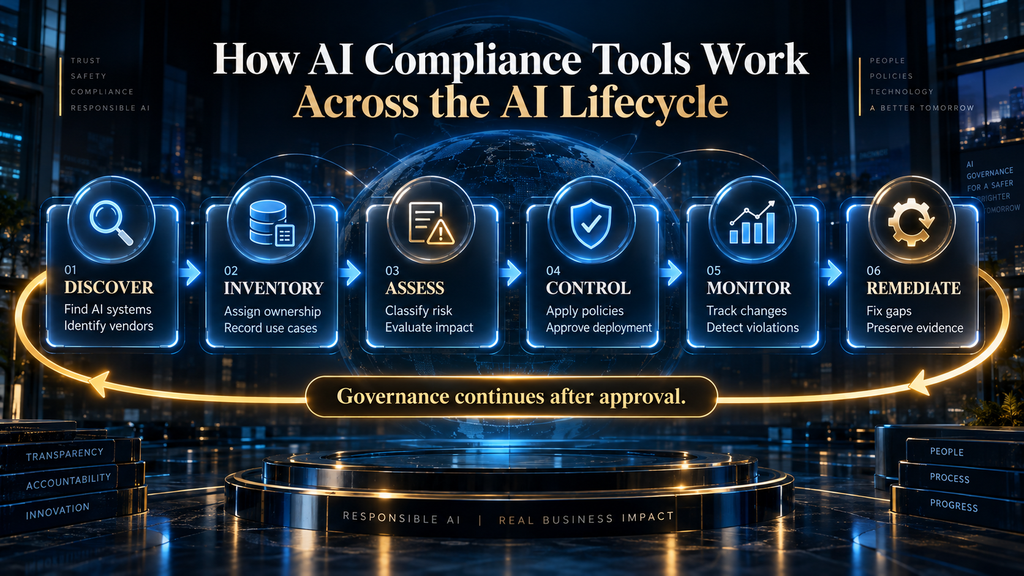
This is why AI compliance is fundamentally a lifecycle problem. A platform that is excellent at collecting an initial questionnaire but weak at monitoring changes may help during onboarding while doing very little to maintain governance six months later. Conversely, a platform with strong continuous discovery and monitoring but weak control and evidence management may identify problems without giving the compliance team an effective way to resolve them.
The strongest systems therefore connect discovery, assessment, control, accountability, monitoring, and evidence rather than treating each activity as a separate module.
AI Governance, AI Compliance and GRC Are Related but Not Identical
One reason this market is confusing is that vendors often use AI governance, AI compliance, responsible AI, risk management, and GRC terminology interchangeably. They overlap, but they are not the same thing.
AI governance establishes how an organization intends to manage AI. It covers questions such as which uses are acceptable, who can approve systems, how risk is classified, when human oversight is required, how vendors are evaluated, and what happens when an AI system changes. Compliance connects those governance practices to applicable legal, regulatory, contractual, certification, and internal requirements.
GRC is broader still. A mature GRC environment may already manage enterprise risks, cybersecurity controls, privacy, vendor assessments, audits, policies, evidence, and remediation across the organization. That creates an architectural decision for AI buyers: should AI become another domain inside the existing GRC system, or does the organization need a specialized AI governance layer that understands AI-specific risks and workflows in greater detail?
NIST’s AI RMF organizes AI risk management around Govern, Map, Measure, and Manage, and emphasizes that risk management should operate throughout the AI lifecycle rather than as a one-time assessment. ISO/IEC 42001 similarly treats AI management as an organizational system that needs to be established, maintained, and continually improved rather than as a one-off compliance exercise.
That means the software should support the management system your organization actually wants to operate. It should not become the management system by accident.
The First Question to Ask: Do You Need a Dedicated AI Compliance Tool at All?
Before comparing vendors, determine whether the problem is large enough to justify another platform.
A small organization with a handful of low-risk AI tools may be better served by a documented AI-use policy, an inventory, basic vendor reviews, employee training, and existing security and privacy controls. Buying an enterprise AI governance platform in that situation can create more administrative work than it removes.
The equation changes when AI becomes distributed across departments or starts touching sensitive information and consequential decisions. A company with dozens of AI systems, multiple business owners, customer-facing AI, formal audit requirements, regulated data, high-impact decision workflows, or autonomous agents has a different operational problem. At that point, the cost of maintaining fragmented spreadsheets, documents, approval chains, and evidence repositories can become larger than the cost of introducing a dedicated governance layer.
The trigger should therefore be complexity and risk, not simply company size.
A 40-person company building an AI-powered healthcare workflow may have a greater need for structured AI governance than a 2,000-person company using AI only for low-risk internal brainstorming. The software decision should follow that reality.
AI Discovery and Inventory: The Foundation Most Buyers Underestimate
The first capability worth evaluating is not the dashboard. It is discovery.
An AI inventory is only useful if it represents the organization’s actual AI environment. If the system contains only the AI applications that employees voluntarily registered, the organization may have an impressive inventory that is still incomplete.
This is the problem of inventory illusion.
A useful platform should help establish what AI systems exist, who owns them, what they are used for, which vendors provide them, what information they process, which people are affected by their outputs, what integrations they have, what risk category they occupy, and which controls apply. Ideally, it should also help identify AI-enabled functionality embedded inside products that the organization did not originally classify as AI systems.
The distinction becomes particularly important as AI features become embedded throughout ordinary enterprise software. An organization might approve a CRM platform as a conventional application and later discover that the vendor has introduced AI-generated summaries, automated recommendations, predictive scoring, or agentic workflows. If the governance program depends on every employee reporting those changes manually, visibility will eventually degrade.
Discovery therefore has a direct relationship with compliance quality. If the organization cannot reliably see its AI environment, every downstream activity becomes less reliable: risk assessment becomes incomplete, policy enforcement becomes inconsistent, and audit evidence represents only the portion of reality that happened to enter the governance process.
Risk Assessment Should Change the Workflow, Not Just Produce a Score
A risk score has limited value if nothing happens after the score is calculated.
A mature AI compliance process should distinguish between ordinary low-risk productivity use and AI systems that can materially affect people, organizations, finances, security, privacy, safety, or access to important services. The purpose is not to label everything as high risk. The purpose is to allocate governance effort proportionately.
Consider two systems. The first helps employees rewrite internal emails. The second evaluates job candidates and ranks them for recruiters. Both are AI systems, but the consequences of failure are fundamentally different. Applying the same approval process to both creates unnecessary friction for the first and potentially insufficient scrutiny for the second.
This is where a platform’s risk engine should connect directly to workflow.
A higher-risk classification may trigger deeper assessment, additional approvals, stronger documentation, human-review requirements, more frequent monitoring, or additional controls. A low-risk classification may allow a streamlined path. The software becomes valuable when it makes that differentiation operational rather than simply recording a risk number.
NIST’s framework supports this broader risk-based approach, describing AI risk management as a continuous activity across the AI lifecycle rather than a static checklist.
Regulatory Mapping Is Useful Only When It Reaches the Control Layer
Regulatory mapping is one of the easiest AI compliance features to overvalue.
A platform can contain an enormous library of regulations and frameworks, but that does not mean an organization has implemented the controls those requirements imply. A regulatory database tells you what a requirement says. A compliance operating system should help answer what your organization needs to do about it.
The useful chain is: Requirement → Risk → Control → Owner → Evidence → Monitoring → Remediation.
Suppose a requirement concerns transparency around an AI system. The organization needs to identify which systems are affected, determine what transparency control applies, assign responsibility, document how the control operates, retain evidence, and establish what happens if the control fails. The regulatory mapping is only the first step.
This distinction matters when comparing platforms that advertise support for the same frameworks. Two vendors can both claim support for a framework while offering very different levels of operational depth. One may provide a searchable regulatory library and templates. Another may connect requirements directly to controls, assessments, owners, evidence, exceptions, and remediation.
The second capability is much more valuable to an organization that needs compliance to operate continuously.
Privacy Controls Deserve Their Own Evaluation
Privacy is one of the most consequential areas of AI governance because information can move through several layers of an AI workflow without users fully understanding the path.
An employee may submit a prompt containing customer information, upload a document, trigger an API request, allow a model to retrieve internal data, receive an output, and store the resulting interaction in another system. Each stage can create a different privacy consideration. A simple statement that “the AI vendor does not train on your data” does not answer all of those questions.
A serious privacy evaluation therefore needs to consider the complete data path.
Data discovery and classification
The platform should help organizations understand where sensitive information enters AI workflows and which systems can access it. Depending on the architecture, that may involve integrations with data classification, security, identity, endpoint, or application systems.
The important question is not merely whether the platform can identify sensitive information. It is whether the organization can use that information to make better control decisions.
Detection versus prevention
This distinction is critical.
A system that detects that an employee sent sensitive information to an AI application provides visibility. A system that can prevent the transfer, redact the sensitive information, require approval, or trigger a policy response provides a stronger control.
Neither capability is inherently better in every environment. Detection may be appropriate where blocking would disrupt legitimate workflows, while enforcement may be essential for specific classes of highly sensitive information. The buyer needs to know exactly which side of that boundary the product operates on.
Access and permissions
Privacy is also an access-control problem.
An AI assistant that can read a user’s documents has a different risk profile from an AI agent that can read the same documents and then modify records, send messages, approve transactions, or execute workflows. As AI systems become more autonomous, permission boundaries increasingly become part of AI governance.
Retention and deletion
Retention is another area where marketing language can oversimplify reality. A prompt may be stored in one system, uploaded files in another, logs in a third, and compliance evidence in a fourth. Vendor-side retention may follow contractual terms that differ from the organization’s internal retention schedule.
A platform should therefore help the organization understand the lifecycle of relevant data rather than presenting a single retention setting as though it controls every copy.
Auditability
Finally, privacy controls become considerably more defensible when the organization can demonstrate what happened. A strong audit trail can connect policy changes, approvals, access events, assessments, exceptions, remediation, and monitoring activity into a historical record.
That evidence is often more valuable than another dashboard because it allows the organization to reconstruct decisions rather than simply describe its current state.
AI Compliance Tools Need to Connect With the Existing Technology Stack
An AI compliance platform rarely operates in isolation.
Most organizations already have some combination of identity management, endpoint security, data-loss prevention, privacy management, ticketing, GRC, security monitoring, vendor management, data classification, and audit systems. The AI governance platform needs to work with that environment rather than creating a parallel universe in which every AI-related activity has to be duplicated.
This is why integration quality matters more than integration count.
A vendor may advertise hundreds of integrations, but if those integrations only import static data, they may provide little operational value. A more meaningful integration allows information to influence a workflow. For example, a change in an application’s data access might trigger reassessment; a policy violation might create a remediation ticket; an identity system might control access; a security platform might provide monitoring evidence; and the GRC layer might retain the formal control record.
The best architecture is often not the platform that replaces everything else. It is the platform that connects AI-specific context to controls the organization already trusts.
AI-First Platforms Versus Traditional GRC Platforms
This is one of the most consequential buying decisions because it affects the entire architecture of the governance program.
An AI-first platform is designed around AI-specific concepts such as AI inventories, use cases, risk assessments, model or application governance, AI lifecycle management, AI vendor evaluation, and increasingly AI-agent controls. Its advantage is specialization: the software understands the object being governed.
The trade-off is duplication.
If an organization already has a mature GRC platform responsible for enterprise risk, controls, evidence, audits, and remediation, introducing another platform can create competing sources of truth. Employees may have to complete assessments in one system while control owners manage evidence in another.
The opposite approach is to extend the existing GRC system into AI governance. This can preserve established workflows, ownership structures, and reporting, but the organization may discover that generic GRC concepts do not capture AI-specific realities deeply enough.
The right answer depends on where the existing system is strong and where the AI governance gap actually exists. A useful decision rule is simple: if the organization’s problem is primarily enterprise control management, extend GRC; if the problem is AI-specific visibility, lifecycle governance, or runtime behavior, specialized AI capabilities become more important. In many larger environments, the eventual answer may be a combination rather than a winner-takes-all replacement.
A Practical Comparison of AI Compliance Tool Categories
| Tool category | Strongest fit | What it does well | Where to be careful |
|---|---|---|---|
| AI-first governance platform | Organizations with expanding AI portfolios | AI inventory, risk, approvals, lifecycle governance | May duplicate existing GRC |
| Enterprise GRC with AI capabilities | Organizations with mature compliance infrastructure | Controls, evidence, audits and enterprise risk | AI-specific depth can vary |
| Compliance automation platform | Organizations focused on recurring evidence and audits | Evidence collection and compliance workflows | May not provide deep AI lifecycle governance |
| Privacy/data governance platform | Data-sensitive AI environments | Data discovery, privacy and information controls | May not cover broader AI governance |
| AI security/governance platform | Shadow AI and AI-runtime risk | Discovery, monitoring and enforcement | Governance/evidence depth may vary |
| Existing internal tools | Small or low-risk AI environments | Low cost and flexible processes | Manual work becomes harder to scale |
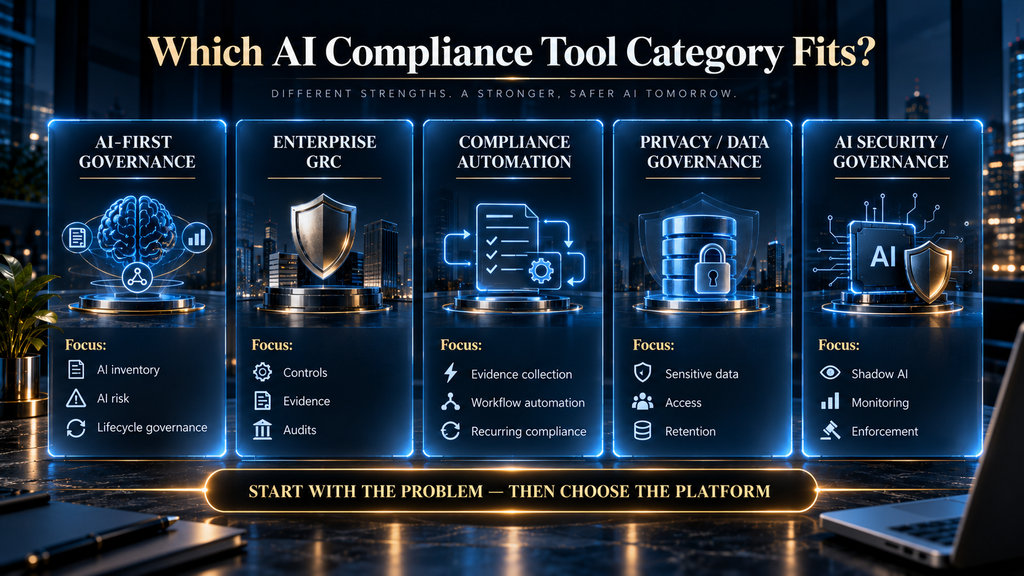
The important point is that these categories are not mutually exclusive. A privacy-heavy company may use a privacy platform alongside GRC and AI governance software. A company with a mature GRC environment may add only a specialized AI discovery or monitoring layer.
The buyer should therefore map the problem first and the product category second.
The CONTROL Framework for Choosing an AI Compliance Tool
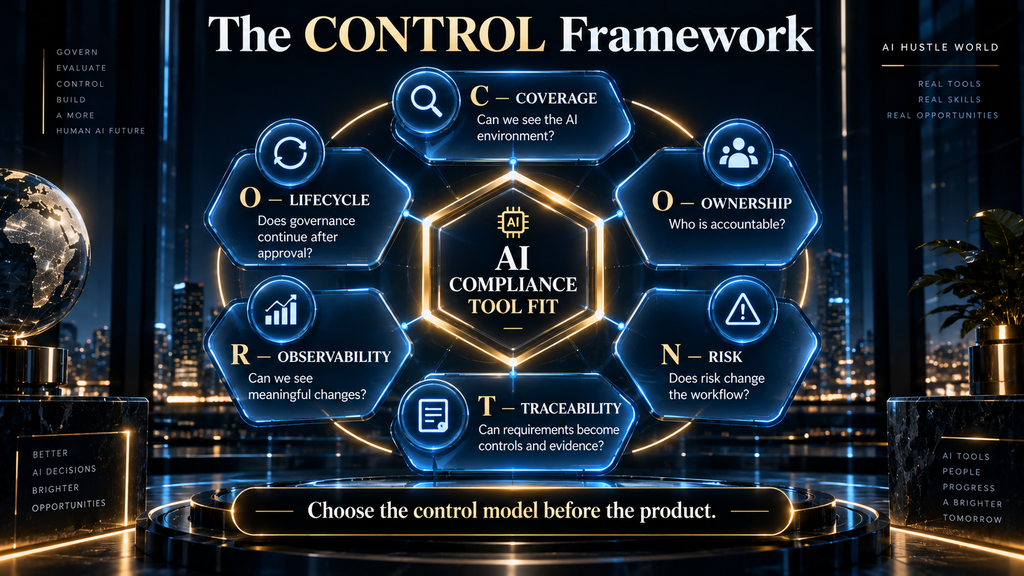
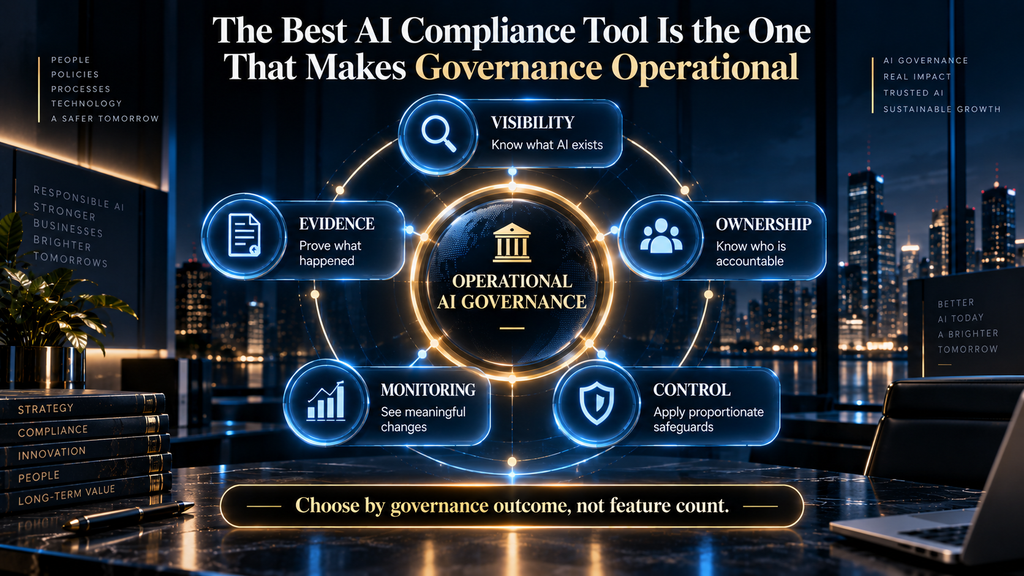
To make the comparison more useful, AI Hustle World can evaluate AI compliance platforms through a six-part framework: CONTROL — Coverage, Ownership, Risk, Traceability, Observability, and Lifecycle.
Coverage asks whether the platform can establish a credible picture of the AI environment. This includes known systems, third-party applications, embedded AI features, vendors, and potentially shadow AI. If coverage is weak, every subsequent governance metric becomes less trustworthy.
Ownership asks whether every important AI system has a person or team accountable for its operation. An inventory without ownership is essentially a catalog; it does not establish responsibility for risk, approvals, changes, or remediation.
Risk examines whether the platform can distinguish AI uses according to consequence and exposure. A good system should not merely calculate risk. It should allow risk to influence the governance path.
Traceability asks whether the organization can follow a requirement through the control structure to the responsible owner and the evidence demonstrating operation. This is where a compliance platform starts becoming an operational system rather than a regulatory reference library.
Observability addresses change. Can the organization see when an AI application’s capabilities, integrations, permissions, data access, vendor configuration, or risk profile changes? Static approval is not enough when the system itself evolves.
Lifecycle asks whether governance continues from intake through deployment, operation, monitoring, reassessment, remediation, and retirement. A platform that only governs the approval stage leaves the organization exposed to the period when most operational change actually occurs.
The framework is intentionally simple because feature lists often obscure the real buying decision. A product with fewer features but strong performance across these six dimensions can be more valuable than a feature-heavy platform that performs poorly on the organization’s most important risk.
How to Evaluate a Platform During a Real Vendor Demo
A vendor demo should be treated as a controlled test, not a presentation.
Instead of asking the salesperson to walk through dashboards, provide a realistic scenario. Tell the vendor that your company wants to deploy an AI assistant that processes internal documents, may contain personal information, and will initially be used by several departments. Ask them to demonstrate how the system is discovered or registered, how ownership is assigned, how risk is assessed, which controls are triggered, how approval occurs, and where the resulting evidence is stored.
Then change the scenario.
Tell them that the assistant has now been connected to a customer database. The risk has increased because the system can access a more sensitive information source. Ask what the platform does differently. A serious governance system should have some mechanism for recognizing the change and triggering an appropriate reassessment or control response.
Then introduce autonomy.
Tell the vendor that the system can now take actions instead of merely generating text. It can retrieve information, update records, or initiate workflows. Ask what changes in the governance model.
This sequence is more revealing than a feature checklist because it tests whether the platform understands risk as a changing property of a system rather than as a form completed once during onboarding.
Finally, ask the vendor to show the evidence that would remain available six months later. That question tests whether the platform is creating a durable governance record or simply generating activity inside a dashboard.
What Good AI Compliance Looks Like in Practice
Consider a fictional mid-sized company called Northstar Services. It has 300 employees and uses AI across customer support, recruiting, sales, marketing, and internal knowledge management.
At first, Northstar manages AI through a shared spreadsheet. Each department adds tools as it adopts them. A compliance manager periodically asks owners to confirm that nothing has changed. This works when the organization has only a few systems, but the process begins to break when AI becomes embedded in everyday workflows.
The company eventually discovers that several teams are using different AI services, some applications contain sensitive information, one vendor has introduced an agentic feature, and the recruiting team is experimenting with an AI-assisted ranking workflow. The problem is no longer that Northstar lacks a policy. The problem is that nobody has a reliable operational picture of how the AI environment has evolved.
A compliance platform can help by creating a central inventory, assigning ownership, applying risk classifications, connecting higher-risk systems to additional reviews, monitoring changes, and preserving evidence. But the software still does not decide what Northstar’s acceptable risk should be. That remains a governance decision.
This is the distinction that separates useful automation from automation for its own sake: the software handles repeatable coordination while people remain responsible for consequential judgment.
The Economics of AI Compliance Software
The financial case for AI compliance software should be built around measurable operational costs rather than exaggerated claims about avoiding hypothetical fines.
Start with the work the organization is already doing manually. How many hours are spent maintaining AI inventories, chasing assessment owners, reviewing vendors, preparing audit evidence, reconciling spreadsheets, tracking exceptions, and reconstructing previous decisions? How long does it take to approve a new AI use case? How much delay is created when compliance teams have to gather information from multiple departments before a business process can move forward?
These costs can be measured. A practical value model is: Annual value = labor saved + compliance-process efficiency + reduced duplication + avoided remediation effort − software and implementation cost.
Risk reduction can be considered separately because it is probabilistic rather than guaranteed. A responsible business case should not claim that buying a compliance platform will prevent a specific regulatory penalty. Instead, the organization can model how better visibility and faster response could reduce exposure to plausible failure scenarios.
There is also an opportunity-cost component. If employees wait weeks for AI approvals because the governance process is entirely manual, the organization may delay useful automation. A platform that reduces unnecessary administrative friction can therefore create value by allowing compliance teams to focus their attention on genuinely consequential decisions.
The Hidden Cost: Governance Friction
The subscription price is only part of the economics.
Implementation, integrations, workflow configuration, training, policy migration, data cleanup, administration, and ongoing maintenance all contribute to total cost of ownership. More importantly, the platform can create organizational friction if its workflows are too complicated.
Imagine requiring an employee to complete a lengthy risk assessment every time they want to use a low-risk AI writing assistant. Eventually, users will look for ways around the process. That produces shadow AI, which makes discovery harder and weakens governance.
The objective should therefore be proportionate friction.
Low-risk use cases should move quickly through lightweight controls, while higher-risk systems should encounter more substantial review. This is one of the clearest indicators of whether a compliance platform has been designed around actual risk rather than around maximizing the number of workflow steps.
Where AI Compliance Platforms Commonly Fail
The first common failure is the inventory illusion. An organization may have thousands of records in its platform and still have poor visibility if the records depend entirely on manual registration.
The second is the framework illusion, where a vendor advertises support for dozens of regulations and standards but does little to connect those requirements to the organization’s actual controls and evidence.
The third is the dashboard illusion. Executives see a polished compliance score, but the underlying data is stale, incomplete, or based on self-reported information. A beautiful dashboard does not compensate for weak measurement.
The fourth is the automation illusion. A platform can automate a badly designed workflow just as efficiently as a well-designed one. If the risk model is poor, automation simply increases the speed at which poor decisions are processed.
The fifth is the integration illusion. An integration that merely imports data is not necessarily a meaningful control integration. Buyers should ask what the connected system can actually cause the platform to do.
The sixth is the checkbox problem. Employees may complete assessments because the system requires completion, but the answers can still be superficial. Completion rate is therefore not the same as governance quality.
These failure modes explain why procurement should focus on outcomes rather than feature counts.
Who Should Use a Dedicated AI Compliance Platform?
A dedicated platform becomes more compelling when an organization has a large or rapidly expanding AI portfolio, multiple departments using AI, sensitive or regulated information, customer-facing AI systems, high-impact decision workflows, formal audit requirements, significant third-party AI exposure, or autonomous systems that can interact with business infrastructure.
It is also a strong candidate when compliance teams are spending substantial time maintaining spreadsheets and collecting evidence manually. In that environment, the software is solving a measurable operational problem rather than merely adding another layer of technology.
Organizations should be particularly cautious, however, if their AI environment is still small and low risk. A complex platform can introduce unnecessary process overhead when a simpler governance model would accomplish the same objective.
The right question is not “Are we big enough for AI compliance software?” It is “Has our AI governance process become complex enough that manual coordination is creating material risk or cost?”
Who Should Probably Avoid Buying One Yet?
A company may not need a dedicated platform when it has limited AI adoption, few users, low-risk use cases, little sensitive data exposure, minimal regulatory complexity, and no meaningful audit burden. In such an environment, the organization can often establish a practical governance system with an AI inventory, approved-use policy, data-handling rules, vendor review process, risk classification, ownership requirements, and escalation procedure.
The important thing is to build the governance logic before buying the software. Otherwise, the vendor’s workflow may effectively become the organization’s governance model by default, which reverses the correct order of decisions.
The Contrarian View: More AI Compliance Software Can Produce Worse Governance
There is a counterintuitive risk in this category: buying a sophisticated platform can sometimes make an organization’s governance look stronger while making it less effective.
Suppose a company purchases an enterprise platform and configures dozens of questionnaires, approval stages, dashboards, and control mappings. Employees complete the required forms. Executives see high completion rates. The company now appears to have mature AI governance.
But suppose nobody has tested whether the risk classifications are meaningful, whether the controls actually operate, whether the inventory captures shadow AI, or whether changes to AI capabilities trigger reassessment. The organization has automated administration without necessarily improving risk management.
That is why the most important procurement question is not “How much can the platform automate?” It is “Which decisions will become better because we have this platform?” That is a much harder question, but it is also the one that matters.
What Happens If You Do Nothing?
The consequence of doing nothing is usually not an immediate compliance crisis. More often, the organization accumulates AI governance debt.
AI adoption continues while information about that adoption becomes increasingly fragmented. Different teams maintain different tools, vendors change their AI capabilities, employees adopt new services, and nobody has a reliable record of which systems are approved, which data they can access, or who owns them.
Eventually a trigger exposes the problem.
It could be an audit, customer questionnaire, privacy incident, vendor review, internal investigation, product launch, or request from senior management. The organization then has to reconstruct information that should have been maintained continuously.
The second-order effect can be even worse. If employees experience compliance as slow and disconnected from their workflow, they may begin avoiding it. That increases shadow AI, which reduces visibility, which makes governance weaker, which increases the workload required to restore visibility.
In that sense, poor compliance infrastructure can create the very governance problem it was intended to solve.
Measuring Whether the Platform Is Actually Working
The organization should measure the governance outcome rather than the amount of software activity. Useful metrics include AI inventory coverage, percentage of AI systems with accountable owners, risk-assessment completion, pre-production approval rates for relevant use cases, high-risk control coverage, assessment cycle time, evidence completeness, remediation time, shadow-AI discoveries, reassessment completion, and the age and volume of exceptions.
These metrics need context. An increase in discovered shadow AI may look negative, but it could indicate that the organization’s discovery capabilities have improved. A decline in reported violations might indicate better enforcement, but it could also indicate weaker monitoring or reduced reporting.
A useful measurement framework therefore combines coverage, quality, efficiency, and outcomes.
For example, if the average assessment takes 12 business days before automation and four days afterward, that is a measurable efficiency improvement. If high-risk systems with required controls increase from 55% to 95%, that demonstrates improved control coverage. If the organization discovers 40 previously unknown AI applications after deploying better discovery, the immediate number may look alarming, but the underlying governance position may actually be healthier because those systems are now visible.
The KPI system should help management understand whether governance is becoming more reliable, not merely whether employees are clicking more buttons.
The Traditional Method Still Exists for a Reason
Spreadsheets, documents, email approvals, shared drives, and manual assessments are not inherently bad governance tools.
They became common because they are flexible, inexpensive, understandable, and easy to deploy. A small organization can create an inventory in a spreadsheet in an afternoon without waiting for procurement, integration, or implementation.
The problem appears when the organization outgrows the method.
A spreadsheet becomes difficult to maintain when dozens of people edit it. Manual reminders become unreliable when ownership changes. Evidence becomes fragmented when documents live in different systems. Change detection becomes nearly impossible when no system automatically recognizes that an AI application’s capabilities or data access have changed.
The goal of compliance software is therefore not to prove that spreadsheets are obsolete. It is to provide automation where manual coordination has become a bottleneck.
That is a much more defensible reason to buy.
A Practical Implementation Path
The strongest implementation does not begin with a vendor.
Begin by defining what counts as an AI system for your organization and create a basic inventory. Then classify AI use cases according to risk and establish who owns each system. Define which uses require security, privacy, legal, compliance, or business review and determine what evidence should be retained.
Next, map the existing tools that already perform parts of this work. Identify what your GRC platform handles, what your security stack handles, what your privacy tools handle, and where the actual gaps are.
Only then should you evaluate vendors.
Once a platform is selected, start with the highest-value workflows rather than attempting to automate everything simultaneously. A reasonable first implementation might focus on AI inventory, risk assessment, approvals, ownership, and evidence. More advanced monitoring and enforcement can then be introduced where the organization’s architecture supports it.
This phased approach also creates a baseline against which the software can be measured.
A Practical Decision Matrix
| Your situation | What to prioritize | Likely direction |
|---|---|---|
| Few low-risk AI tools | Policy, inventory and training | Existing tools may be sufficient |
| Rapid AI adoption across teams | Discovery, inventory and ownership | AI governance platform |
| Mature GRC environment | Integration and AI-specific depth | Extend GRC or add specialized AI layer |
| Sensitive data is the main concern | Data discovery, privacy and access | Privacy + AI governance capabilities |
| High-impact decisions | Risk, oversight, documentation and monitoring | Strong AI governance platform |
| Shadow AI is the main problem | Discovery, detection and enforcement | AI security/governance capabilities |
| Audit preparation is consuming staff time | Evidence and workflow automation | GRC/compliance automation |
| AI agents have system permissions | Identity, permissions, monitoring and action controls | AI security + governance integration |
| Multiple frameworks must be managed | Requirement/control/evidence mapping | Strong GRC-oriented platform |
| Small organization with low AI complexity | Simple governance process | Delay dedicated platform |
This matrix should be treated as a starting point, not a ranking. The same company may move from one category to another as its AI environment changes.
The Vendor Questions That Matter Most
A serious evaluation should go beyond “Does your platform support AI governance?”
Ask the vendor how it discovers AI systems that nobody manually registers. Ask whether risk classification changes the workflow or merely produces a score. Ask how controls connect to specific AI systems and owners. Ask what evidence is retained and how long it remains available.
Ask what happens when an AI application gains access to a new database. Ask what happens when a vendor changes the model behind an existing service. Ask what happens when an assistant becomes an agent with permission to take actions.
Then ask where the platform stops.
Does it detect but not enforce? Does it identify sensitive information but rely on another system to block it? Does it manage compliance evidence but depend on another platform for runtime monitoring? Does it replace GRC or sit alongside it?
These boundary questions are essential because a product can appear comprehensive while still relying on other systems for the actual enforcement layer.
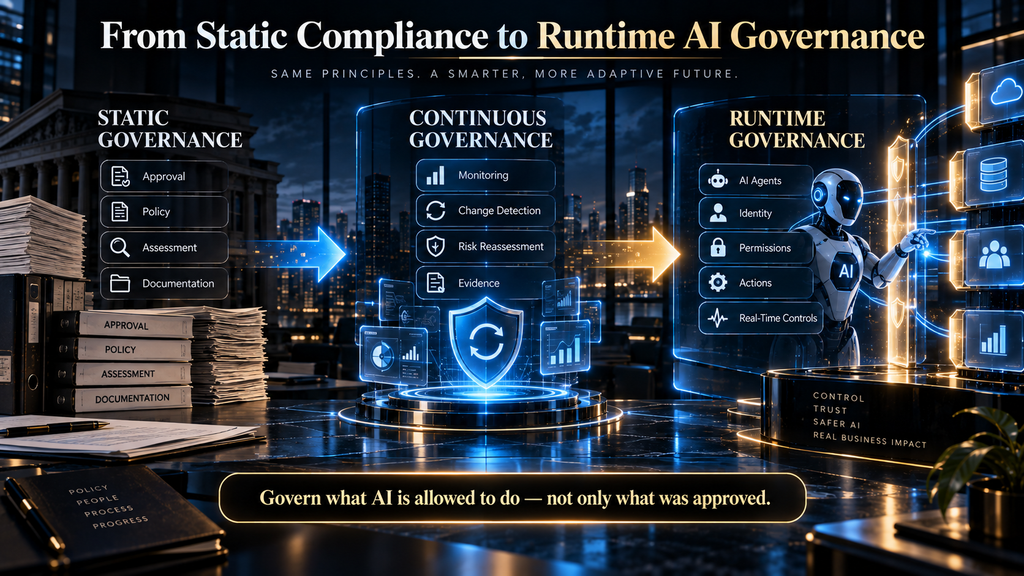
The Future of AI Compliance Is Moving From Documents to Runtime Governance
The next generation of AI compliance will increasingly have to deal with systems that act rather than simply generate.
A conventional AI assistant produces an answer. An agent may retrieve information, call tools, update records, send communications, execute workflows, or make decisions within a defined authority. The compliance problem therefore moves closer to identity and access management.
The question becomes less about whether an AI application was approved six months ago and more about what it is allowed to do now, what information it can access, which policies govern those actions, and whether those actions are being monitored.
That shift is already visible in the market. AI governance vendors increasingly describe capabilities around continuous discovery, monitoring, policy evaluation, runtime controls, and audit evidence, while newer approaches to agent governance emphasize identity, least privilege, action control, and auditable activity.
This does not make traditional compliance obsolete. It expands the problem.
The governance stack will increasingly need to connect policy, identity, data, security, AI behavior, and evidence.
The Second-Order Effect: Compliance Data Can Become Management Data
There is a useful strategic consequence of building a reliable AI compliance system that goes beyond regulatory readiness. Once an organization knows which AI systems exist, who owns them, what data they access, what risks they carry, what vendors provide them, and what governance effort they require, management can start asking portfolio-level questions.
Are several departments paying for overlapping AI tools? Which systems have high governance costs but low business value? Which vendors create concentration risk? Which AI applications are becoming more autonomous? Which business processes are generating the greatest value from AI? Where is the organization carrying risk that is no longer justified by the business outcome?
That turns compliance information into operational intelligence.
In mature organizations, this may become one of the most valuable reasons to maintain a trustworthy AI inventory. Governance stops being purely defensive and begins helping leadership understand the economics and structure of the company’s AI portfolio.
The Bottom Line: Choose the Control Model Before the Product
There is no universally best AI compliance tool because organizations do not have universally identical AI risks.
A company struggling with shadow AI needs strong discovery and enforcement. A company preparing for formal AI management certification may prioritize controls, evidence, and lifecycle management. A privacy-heavy organization may place greater weight on data discovery, access, retention, and monitoring. A mature enterprise GRC environment may prefer extending its existing architecture rather than introducing another system of record.
The strongest buying process follows a different order from the one used by most software buyers.
First, understand the AI environment. Then define the risks. Then decide which controls are required. Then determine what evidence needs to exist. Then identify what the current technology stack already handles. Only after those decisions should you select the software that fills the remaining gaps.
That sequence matters because the wrong platform can create a new administrative burden without solving the underlying governance problem.
The best AI compliance tool is therefore not necessarily the one with the most frameworks, the longest feature list, or the most impressive dashboard. It is the platform that gives the organization credible visibility, proportionate control, accountable ownership, continuous monitoring, and defensible evidence without creating so much friction that users work around it.
That is the standard worth applying to every vendor.
The goal of AI compliance software is not to make compliance look automated. It is to make responsible AI governance operational.
Build the Governance System Before You Buy the Software
If you are still defining your AI governance approach, start with the framework that explains what your organization needs to control, measure, monitor and improve.
Read the AI Governance Framework →Frequently Asked Questions
What is an AI compliance tool?
An AI compliance tool is software that helps organizations manage governance and compliance activities associated with AI systems. Depending on the platform, this can include AI discovery, inventory management, risk assessment, regulatory mapping, policy management, approvals, monitoring, vendor assessment, evidence collection, remediation, and reporting.
What is the difference between AI compliance and AI governance?
AI governance is the broader organizational system for deciding how AI should be developed, purchased, deployed, monitored, and controlled. AI compliance connects that governance system to applicable legal, regulatory, contractual, certification, and internal requirements. In practice, compliance is one important component of a broader governance program.
Does an AI compliance platform make a company compliant?
No. The platform can help implement, automate, monitor, and document compliance activities, but it cannot independently make an organization compliant. Compliance still depends on the organization’s actual policies, controls, implementation, evidence, and applicable obligations.
What privacy controls should an AI compliance platform have?
Important capabilities can include AI discovery, sensitive-data detection, data classification, access controls, policy enforcement, monitoring, audit trails, retention and deletion management, vendor visibility, and evidence collection. The appropriate combination depends on the organization’s data environment and risk profile.
Do small businesses need AI compliance software?
Not necessarily. A small organization with limited, low-risk AI usage may be able to manage governance using an inventory, policies, vendor reviews, employee training, and existing security and privacy tools. Dedicated software becomes more attractive as AI adoption, regulatory exposure, sensitive-data processing, audit requirements, and workflow complexity increase.
Is NIST AI RMF an AI compliance platform?
No. NIST AI RMF is a voluntary framework for managing AI risks. Its core functions are Govern, Map, Measure, and Manage, and NIST emphasizes that risk management should continue throughout the AI lifecycle. Organizations can use software to operationalize parts of the framework, but the framework itself is not a software product.
Is ISO/IEC 42001 an AI compliance platform?
No. ISO/IEC 42001 is an international standard specifying requirements for establishing, implementing, maintaining, and continually improving an Artificial Intelligence Management System. Software can support implementation and evidence management, but the standard itself is not a compliance platform.
Should a company use an AI-first platform or its existing GRC system?
It depends on where the governance gap exists. Organizations with mature enterprise GRC may benefit from extending that system, particularly when the main requirement is control, evidence, audit, and enterprise-risk management. Organizations with complex AI-specific needs such as AI discovery, lifecycle governance, shadow-AI detection, or agent oversight may benefit from specialized capabilities.
What is the most important feature in an AI compliance tool?
There is no single feature that matters in every organization. The most important capabilities are generally reliable AI visibility, clear ownership, risk-based workflows, control traceability, continuous monitoring, and defensible evidence. A platform should improve the organization’s ability to understand and control AI rather than simply produce more compliance records.
How should I evaluate an AI compliance platform?
Test it against a realistic AI lifecycle rather than relying on a feature list. Give the vendor a real use case, evaluate discovery and risk assessment, then introduce changes such as sensitive-data access or increased autonomy. Ask the platform to demonstrate what changes, which controls are triggered, who is notified, and what evidence remains afterward.
Can AI compliance tools detect shadow AI?
Some platforms and AI-security products provide discovery and monitoring capabilities intended to identify AI applications outside formal governance. However, buyers should verify exactly what sources the product monitors, how comprehensive the discovery is, whether it can distinguish legitimate from unauthorized use, and whether detection can lead to enforcement or remediation.
What is the biggest mistake when buying AI compliance software?
The biggest mistake is choosing based on feature volume rather than operational fit. A platform can support many frameworks and provide impressive dashboards while failing to solve the organization’s actual problem. The buying decision should begin with the AI environment, risks, controls, evidence requirements, and existing technology stack.
What should happen before buying an AI compliance tool?
The organization should first establish what counts as an AI system, create an initial inventory, define risk categories, assign ownership, identify required controls, determine evidence requirements, and map existing governance capabilities. This prevents the vendor’s product structure from unintentionally becoming the organization’s governance model.
Related Guides
- Best AI FP&A Software in 2026: Forecasting, Planning & Analysis Compared
- Best AI Legal Tools in 2026: Research, Contract Review & Legal Workflows
- Best AI Product Management Tools in 2026: Research, Roadmaps & Product Ops
Written by
Muntasir Ahmad Chowdhury
Founder, AI Hustle World
Muntasir Ahmad Chowdhury is the Founder of AI Hustle World, an independent publication dedicated to making Artificial Intelligence practical, trustworthy, and easy to understand. He researches AI tools, automation, customer service, productivity, and real-world business applications, helping readers make smarter technology decisions through research-driven, experience-backed content.
Expertise:
AI Tools • AI Automation • AI Customer Service • AI Productivity • Generative AI • AI Workflows
Get Smarter With AI
Enjoyed this guide? Get practical AI tools, tutorials, and honest reviews delivered to your inbox.
1 thought on “AI Compliance Tools Compared: Features, Privacy Controls & Use Cases”