Evidence: Documentation reviewed
Last checked: September 2026
What was done: Written from official documentation and the published sources linked in this article. Not hands-on tested.
Files: None
Affiliate links: No
Instagram Niche Ideas for a Faceless AI Content Account
Starting a faceless Instagram account is no longer primarily a content-production problem. AI can already help with research, scripting, visual development, editing, voiceovers, captions, repurposing, and content planning, which means the mechanical cost of publishing has fallen sharply. The harder problem is deciding what the account should consistently be about, who it should serve, and why someone should follow it instead of the hundreds of other accounts that can now produce equally polished content.
That is why niche selection deserves more attention than tool selection.
A weak niche can make a talented creator look inconsistent, because the audience never develops a clear reason to return. A crowded niche can make good content feel invisible because the creator is competing on topics that have been covered thousands of times. A niche with strong reach but poor commercial intent can build followers without building a viable business, while a niche that is too narrow can run out of meaningful ideas long before the account has had time to mature.
The right choice sits somewhere more interesting. The strongest faceless Instagram niche is the one where audience demand, faceless format fit, sustainable content depth, originality, trust, and economics reinforce one another. AI then becomes the production system that helps you serve that niche efficiently rather than becoming the niche itself.
This distinction matters even more as Instagram continues to place greater emphasis on original content. Meta said in January 2026 that original content became more prevalent in Instagram recommendations in the United States, with original posts accounting for 75% of recommendations by the end of Q4 2025 after a 10-percentage-point increase during the quarter. That does not mean originality alone guarantees reach, but it is a strong signal that simply making more derivative content is not a durable strategy.
So the goal of this guide is not to give you a random list of “hot niches.” It is to show you how to evaluate a faceless niche as a long-term content and business asset, and then identify the categories where that model has the best chance of working.
What a Faceless Instagram Account Actually Is
A faceless Instagram account is an account where the creator’s physical appearance is not the primary source of the content’s value. The account can rely on voiceovers, screen recordings, carousels, animation, original graphics, demonstrations, product footage, diagrams, storytelling, photography, illustrations, or AI-assisted media rather than talking-head videos.
That definition is important because many creators make a conceptual mistake at the beginning. They treat “faceless” as though it were a niche.
It is not.
Faceless is a distribution and production format. The niche is the subject, problem, audience, or transformation around which the account is organized. A faceless account can be about careers, business, travel, technology, food, fitness, personal finance, books, history, productivity, design, or almost anything else that can be communicated visually.
The strongest accounts understand this difference because they build the brand around a useful promise rather than around the fact that nobody appears on camera.
Imagine two accounts about artificial intelligence. One publishes generic AI quotes, synthetic portraits, random tool lists, and recycled news headlines. The other focuses on AI workflows for freelancers, showing how specific tasks can be redesigned, which tools fit which situations, what the limitations are, and how much time a workflow can realistically save. Both are faceless and both can use AI heavily, but they are not strategically equivalent.
The second account has a reason to exist beyond production efficiency. It has a defined audience, a recurring problem, a content engine, and a point of view. That is what makes a niche valuable.
The Real Question: What Should Your Account Be Known For?
The mistake most beginners make is asking, “What niche is trending?” A better question is, “What can this account become known for?” That sounds subtle, but it changes the entire decision.
A broad category such as “business” tells you almost nothing about what you will publish tomorrow. A narrower editorial promise can generate ideas much more reliably. “Practical business lessons for first-time founders” immediately suggests mistakes, pricing, customer acquisition, hiring, sales, decision-making, case studies, and operating systems. “AI productivity for freelancers” similarly creates a natural universe of workflows, tools, automation problems, software comparisons, client work, time management, and practical demonstrations.
This is why good niche selection begins with an audience and a problem rather than a keyword. A useful positioning statement looks something like this: This account helps [specific audience] achieve [specific outcome] through [specific type of content]. The more precise that sentence becomes, the easier it is to decide what belongs on the account and what should stay out.
That also gives you an early warning signal. If your description sounds like it could apply to practically everyone on Instagram, your positioning is probably too broad to be strategically useful.
The Six Forces That Determine Whether a Faceless Niche Works
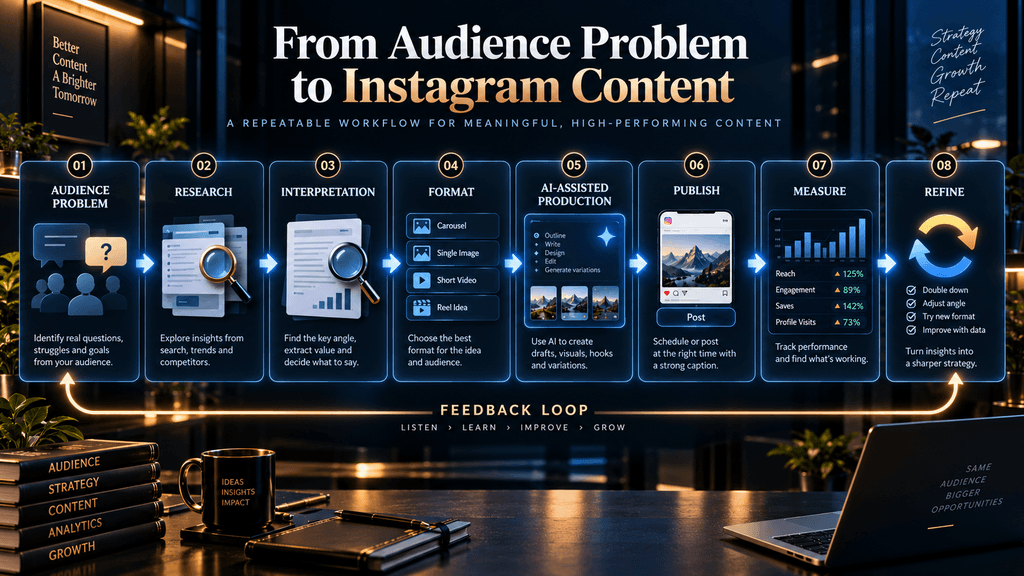
The best way to evaluate a niche is to stop thinking in terms of “big market versus small market” and start thinking about the forces that determine whether the account can compound.
The first is audience demand. People need a reason to care about the subject repeatedly, not just once. A niche built around a temporary curiosity may create spikes of traffic but not a durable audience.
The second is faceless compatibility. Some subjects depend heavily on the creator’s personality, physical presence, authority, or demonstrations involving a real person. Others naturally work through diagrams, screens, examples, footage, narration, or visual storytelling. A niche that communicates well without a face is simply easier to operate consistently.
The third is content depth. The account needs enough intellectual or practical territory to sustain hundreds of posts without turning into repetitive paraphrasing. A niche that can generate twenty decent ideas but struggles to produce the next two hundred is not a strong long-term foundation.
The fourth is originality potential. You need a way to say something that is more useful, clearer, more specific, better researched, or more interesting than what already exists. If the only advantage available to you is faster production, AI will eventually remove even that advantage by making similar production accessible to everyone.
The fifth is trust. In low-consequence niches, this may matter mostly for credibility and retention. In finance, health, careers, technology, or other consequential categories, it becomes part of the product itself. A niche becomes much harder when the audience needs to believe you before your content is useful.
The sixth is economics. An audience can be engaged, large, and completely unhelpful from a business perspective. The strongest niches allow attention to eventually connect to something valuable, whether that is software, products, services, education, affiliate recommendations, sponsorships, lead generation, or another legitimate commercial model.
These forces are interdependent. A niche can have enormous demand and poor economics. It can have excellent economics but weak faceless compatibility. It can have great content depth and terrible differentiation. The objective is not to maximize one variable. It is to find a combination that remains attractive when all the variables are considered together.
The F.A.C.E. Matrix for Faceless Niche Selection
To make that evaluation more practical, use the F.A.C.E. Matrix before committing to an Instagram niche.
Format Fit
The first question is whether the subject naturally becomes good faceless content. Can you demonstrate it through screens, visuals, examples, narration, diagrams, comparisons, or storytelling? A niche that requires a charismatic on-camera personality to feel authentic has a structural disadvantage if your entire strategy is built around staying off camera.
Audience Value
The second question is whether the audience gets something meaningful from following the account. The value might be educational, practical, financial, emotional, aspirational, entertaining, or decision-oriented. A niche becomes stronger when the audience has recurring reasons to return rather than consuming one isolated post and forgetting the account.
Content Engine
The third question is whether the niche can continually generate differentiated content. You should be able to move between explanations, examples, applications, mistakes, case studies, comparisons, myths, stories, experiments, and advanced topics without exhausting the subject.
Economic Fit
The fourth question is whether attention can eventually become revenue without damaging trust. A niche with no plausible commercial path is not automatically a bad niche, especially if the goal is simply audience building, but someone intending to build a business should know where the money could realistically come from before investing heavily.
The F.A.C.E. Matrix becomes much more useful when you layer two additional filters over it: Originality and Trust. Those filters determine whether the niche can be differentiated responsibly rather than merely produced efficiently.

A Better Way to Compare Niche Ideas
You can score prospective niches on a ten-point scale across the following dimensions. The numbers are not a scientific prediction of future growth; they are a structured way to expose weak assumptions before you invest months into a page.
| Dimension | Core Question |
|---|---|
| Demand | Do people have an ongoing reason to care? |
| Faceless Fit | Can the content work naturally without your face? |
| AI Fit | Can AI materially improve the workflow? |
| Visual Potential | Can the subject become compelling Instagram content? |
| Content Depth | Can you sustain 100–300 genuinely different ideas? |
| Originality | Do you have a realistic way to stand apart? |
| Monetization | Are there credible revenue paths? |
| Trust | Can the account make responsible, credible claims? |
| Competition | Can a new account still earn attention with a sharper position? |
Do not simply add the numbers and choose the highest total. A severe weakness can invalidate an otherwise attractive niche.
For example, imagine a niche that scores 10 for demand, 9 for visual potential, and 10 for monetization but only 2 for originality. You may have chosen a market full of opportunity that you cannot enter with a meaningful competitive advantage. Another niche might have slightly lower demand but far stronger differentiation, content depth, and trust.
The best niche is often the one with fewer fatal weaknesses, not the one with the highest headline score.
13 Strong Faceless Instagram Niche Ideas
The categories below are not presented as guaranteed winners. They are strong candidates because they naturally lend themselves to faceless formats while offering meaningful possibilities for depth, differentiation, and monetization.
The key is that almost every one of them becomes stronger when narrowed to a specific audience or problem.
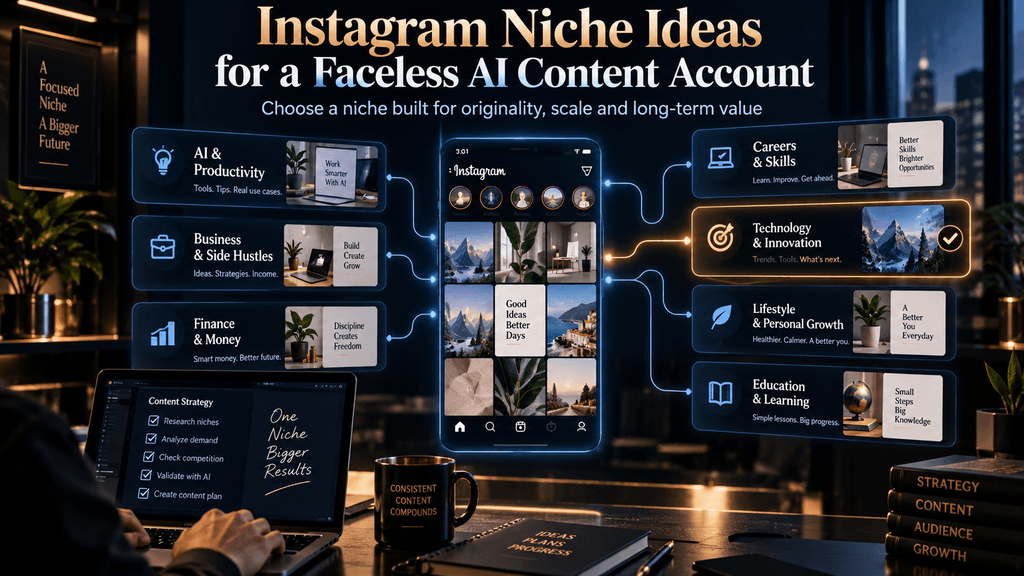
1. AI Tools, Automation and Productivity
This is one of the most natural faceless niches because the product itself is digital.
You can demonstrate software through screen recordings, explain workflows through diagrams, compare tools visually, turn complex AI concepts into carousels, narrate practical use cases, and show before-and-after workflows without ever appearing on camera. That makes the format unusually compatible with Reels, tutorials, and educational carousel content.
The challenge is saturation. “Best AI tools” is now an enormous category, and there is almost no strategic advantage in becoming another account that publishes interchangeable lists of software.
The better opportunity is to choose a specific audience and recurring workflow. AI for freelancers, AI for recruiters, AI for small-business owners, AI for content creators, AI for sales teams, AI for job seekers, or AI for students immediately gives the account more defined boundaries.
That also creates stronger content. Instead of saying that a particular AI tool is “amazing,” you can explain which problem it solves, when it is worth paying for, what workflow it replaces, where it fails, and which alternatives make more sense under different conditions.
The economics are also attractive because software audiences frequently contain buyers. Affiliate relationships, sponsorships, services, education, and digital products can fit naturally when recommendations are based on genuine usefulness rather than promotional volume.
The real moat here is not access to AI. Everyone has access to AI. The moat is knowing which workflow deserves to be changed and being able to explain the change better than competitors.
2. Business and Entrepreneurship Education
Business education is powerful for faceless content because many business ideas are naturally visual. You can turn acquisition funnels into diagrams, pricing strategies into examples, business models into charts, sales mistakes into scenarios, financial concepts into simplified illustrations, and company case studies into narrated stories.
The important distinction is between business content and business opinion. Generic entrepreneurship quotes rarely build much defensibility. Content becomes stronger when it helps the audience understand something specific enough to change a decision.
For example, instead of creating a post explaining that customer acquisition is important, you could walk through a hypothetical small business where advertising costs rise, explain how that affects customer acquisition cost and contribution margin, and show the three decisions the business could make as a result. That kind of content does not need a face because the reasoning itself is the product.
Business also has strong commercial fit. Software, courses, professional services, financial tools, templates, books, consulting, and other business products can align naturally with the audience. The difficulty is credibility, because the category is crowded with exaggerated claims and oversimplified success stories.
That means a credible faceless business account needs a higher-than-average evidence standard. It should distinguish company claims from verified results and avoid presenting one founder’s outcome as a universal business law.
3. Career, Jobs and Professional Growth
Career education is another strong faceless niche because the audience often wants practical help rather than a personality to admire. Resumes, interview questions, job-search workflows, workplace communication, career transitions, professional skills, networking strategies, and job-market explanations can all be taught through screen recordings, text-led carousels, voiceovers, examples, and visual frameworks. The niche becomes more defensible when the audience is specific.
A page for “career advice” is broad and difficult to distinguish. A page focused on practical career systems for early-career professionals, international job seekers, sales professionals, or people transitioning into technology has a much clearer editorial promise.
AI gives this niche an additional content engine because job seekers are increasingly interested in AI-assisted resumes, interview preparation, job matching, research, and workflow design. That creates room for tutorials and decision-oriented posts rather than generic motivation.
The major risk is credibility. Salary claims, hiring statistics, employment regulations, immigration information, and guarantees about getting hired should be treated carefully. The account should be strongest where it can provide useful frameworks and well-supported information rather than pretending certainty where the real world is unpredictable.
Commercially, the niche can connect to education, career products, resume services, software, job platforms, templates, coaching, and lead generation, provided the recommendations genuinely match the audience’s needs.
4. Technology and AI Explainers
A faceless account does not have to be a news account to succeed in technology. In fact, explaining how technology works can be more durable than publishing every new headline.
You can explain AI models, cybersecurity concepts, cloud infrastructure, consumer technology, software systems, emerging technologies, internet architecture, digital privacy, or technical ideas through visual storytelling. A strong account might take something confusing and translate it into a mental model that ordinary users can understand.
The value comes from interpretation.
Suppose an account explains why AI systems can produce fluent but incorrect answers. Rather than simply repeating the phrase “AI hallucination,” it could construct a visual explanation of prediction, context, uncertainty, and verification. That is useful even after the day’s news cycle has moved on.
Technology content also creates a natural advantage for well-researched faceless brands because the audience often values clarity over personality.
The main weakness is freshness pressure. A news-heavy account must constantly research and publish, which can turn the business into an exhausting treadmill. A more durable model combines timely developments with evergreen explanations so that the content library continues working after publication.
5. Personal Finance Education
Personal finance can be an excellent faceless niche, but it is a category where trust and consequences matter more than they do in many lifestyle niches.
Budgeting systems, debt concepts, investing principles, saving strategies, financial terminology, spending analysis, and financial decision frameworks can all be presented visually. This makes the niche compatible with carousels, narrated Reels, charts, calculators, and examples.
The strongest content is educational rather than sensational.
“Here is how to get rich quickly” may attract curiosity, but it does not establish a trustworthy editorial foundation. “Here is how compound growth works under three different assumptions, and why small changes in time horizon matter” teaches something that can be understood and evaluated.
Finance also has obvious commercial potential, which makes editorial discipline even more important. The financial incentive to promote products should not determine the conclusion of the content.
This is one of the niches where a smaller, highly trusting audience can be more valuable than a much larger audience built through exaggerated claims. In other words, finance is a category where trust is not a supporting feature of the business model; trust is part of the business model.
6. Home Organization and Practical Living
Home organization is less glamorous from a technology perspective, but strategically it is one of the easiest niches to adapt to faceless visual content. Before-and-after transformations, storage systems, cleaning workflows, room layouts, organization principles, renter-friendly solutions, small-space strategies, and practical household systems all work without requiring the creator to appear. The niche becomes much stronger when it addresses a particular kind of person or environment.
“Home organization” is broad. “Small-apartment organization for renters” gives you a specific context, a recurring set of problems, and a clearer content library.
This category also has natural product economics because people buy storage products, furniture, organization tools, cleaning equipment, and household systems. But the account should avoid becoming an endless sequence of product recommendations.
The most useful content explains the underlying problem first and the product second. That makes the account a source of judgment rather than simply another shopping feed.
7. Fitness and Wellness Education
Fitness and wellness have tremendous visual potential, but they require stronger boundaries than some creators realize.
Exercise demonstrations, mobility concepts, training principles, meal-preparation systems, recovery education, and habit design can all work in faceless formats. Animation and visual explanation can sometimes communicate movement mechanics more clearly than talking-head videos.
The danger comes when faceless production is used to manufacture authority.
An AI-generated coach with a synthetic body, voice, and confident claims can create the appearance of expertise without establishing where that expertise comes from. That is not a sustainable trust strategy.
A stronger approach is educational. Explain principles, show demonstrations, cite credible research where appropriate, and make the limits of generalized advice clear.
Competition is another challenge. Broad fitness motivation is incredibly crowded. Narrowing the audience—for example, fitness education for office workers, beginners, or people with highly specific practical constraints—often creates a much clearer editorial identity.
8. Food and Cooking
Food may be one of the most naturally faceless subjects on Instagram because the audience primarily wants to see the process, ingredients, finished result, or useful idea. Recipe demonstrations, meal preparation, ingredient comparisons, food science, cooking techniques, regional cuisine, budget meals, and kitchen systems all work without a creator-centered format.
The challenge is not content supply. It is differentiation.
There are almost infinite food accounts, which means generic recipes are easy to ignore unless they satisfy a clear need. A stronger account might focus on five-ingredient meals, high-protein cooking, budget meals, regional cuisine, beginner cooking, meal prep for workers, or recipes built around a specific appliance.
AI can help with ideation, recipe variation, scripting, planning, and production, but recipes should not be treated as purely generative content. Cooking time, ingredient behavior, substitutions, nutritional claims, and safety considerations may require actual testing or reliable verification.
The economic side is attractive because cookware, kitchen products, appliances, ingredients, books, and digital resources provide natural commercial connections. Again, the account becomes more defensible when usefulness comes before monetization.
9. Travel and Destination Education
Travel content has an obvious visual advantage, and faceless accounts can communicate itineraries, destination comparisons, budget concepts, cultural explanations, packing systems, trip-planning advice, and location-specific guides without the creator being physically present. However, travel has a particular authenticity problem.
AI can create beautiful images of almost any destination, but visual plausibility is not the same thing as real-world accuracy. An account that quietly presents synthetic travel imagery or invented experiences as personal travel can create a trust problem that grows with the audience.
A better model is research-based travel planning. The account can be explicit that its value lies in organizing information, comparing options, explaining logistics, and helping viewers make better travel decisions.
Narrow positioning also helps. Solo travel, budget travel, family travel, destination planning for first-time visitors, remote-work travel, or culturally focused travel can create stronger recurring content systems than generic “beautiful places” posts.
10. History, Science and Educational Storytelling
This is one of the most intellectually interesting faceless categories because the subject itself supplies the narrative.
Historical events can be visualized through maps, timelines, archival material, illustrations, and narration. Scientific concepts can be explained through diagrams, animations, and simplified visual models.
The account becomes stronger when it does more than answer what happened.
It can explain why the event happened, what caused it, how the participants understood the situation, what changed afterward, and why the subject remains relevant. That adds narrative depth and makes faceless storytelling far more memorable.
This niche can also produce durable evergreen content. Unlike trend-driven content, a well-researched explanation of a historical or scientific concept can remain useful long after publication.
The central weakness is factual oversimplification. AI can create confident, polished explanations while quietly mixing facts, assumptions, and invented details. A serious educational account therefore needs stronger source discipline than a casual entertainment page.
11. Luxury, Design and Aspirational Content
Luxury and design can perform strongly in a faceless environment because the visual subject can carry much of the attention. Architecture, interiors, watches, automobiles, fashion, industrial design, premium products, hospitality, and visual aesthetics can all be turned into editorial content without requiring a personal brand.
The challenge is that a pure visual mood board has limited defensibility. Beautiful pictures are easy to copy, especially when AI can generate endless stylized imagery.
A more valuable account explains why something looks or feels expensive. It could discuss materials, proportions, craftsmanship, design history, brand positioning, architecture, pricing psychology, or visual language.
That turns aesthetic content into education.
Luxury also has substantial commercial potential, but the business should not become dependent on pretending that every audience member needs to buy something expensive. Editorial authority matters more than excessive promotion.
12. Books, Ideas and Applied Learning
Book content is often treated as a simple summarization niche, but that is precisely where many accounts become interchangeable. The stronger opportunity is interpretation.
Instead of repeating five points from a book, take an idea and show how it applies in a real-world situation. Explain where the principle works, where it fails, and how someone might use it differently from the way the original author intended.
That approach turns: Book → summary into: Book → idea → interpretation → application. The second model creates more original content and reduces dependence on simply reproducing someone else’s phrasing. It also gives the account room to expand into psychology, business, productivity, decision-making, leadership, or personal development while retaining a coherent identity.
Commercially, books, educational products, templates, newsletters, courses, and other learning products can fit naturally. Copyright boundaries still matter, so the account should add its own explanation rather than reproducing substantial portions of copyrighted material.
13. Motivation and Personal Development
Motivation is perhaps the clearest example of the difference between easy content and difficult business.
You can produce motivational Reels quickly using quotes, cinematic clips, narration, music, and AI-generated visuals. The problem is that thousands of creators can do exactly the same thing.
That means generic motivation has low defensibility.
The category becomes more interesting when it addresses a specific emotional or behavioral problem. Discipline for entrepreneurs, rebuilding after professional failure, overcoming procrastination, personal growth after setbacks, confidence for early-career professionals, or evidence-based habit formation are all stronger positions than generic inspirational content.
This niche can build strong emotional engagement, but monetization needs more thought because the audience may be broad and commercially inconsistent. The best motivational accounts therefore become more specific about the transformation they provide rather than simply producing emotionally charged content.

Which Faceless Niches Should You Avoid?
You do not need to avoid every crowded niche, but you should be suspicious of niches where your only proposed competitive advantage is that you can generate the same content faster.
Generic quote pages are a classic example. Generic AI-image accounts are another. Repost-heavy celebrity pages, broad “make money online” pages with no specific expertise, and accounts that simply paraphrase viral content have a similar structural weakness.
The issue is not that these formats can never grow. Some will. The problem is that they often have low switching costs for the audience and low barriers to imitation for competitors.
That creates an uncomfortable business model. You can spend months building the account while knowing that another creator can reproduce your content architecture almost immediately.
A useful contrarian rule is to treat extreme ease as a warning signal. When a niche is incredibly easy to produce, ask why someone should choose your version of it. That question becomes even more important when AI is involved.
The Hardest Niche Is Sometimes the Most Valuable One
AI encourages creators to think in terms of production efficiency. That makes sense operationally, but it can lead to a strategic mistake.
Suppose one niche allows you to produce ten posts per day with almost no thinking. Another niche requires research, judgment, examples, and deeper writing but only allows three high-quality posts per day.
The first niche appears more efficient. But efficiency is not the same as defensibility.
If your ten-post-per-day niche can be copied by anyone with the same AI tools, your advantage disappears as the tools become universal. The slower niche may actually have greater long-term value because it contains something harder to reproduce: interpretation.
This is one of the most important principles for AI-assisted content businesses. Do not use AI to remove the very judgment that makes your content valuable. Use it to remove repetitive work around that judgment.
That can include research organization, brainstorming, transcription, summarization, visual ideation, formatting, editing assistance, and repurposing. The human creator should still be deciding what matters, what is credible, what is useful, what is misleading, and what deserves to become a piece of content.
Why Originality Matters More for Faceless Accounts
A creator-led account can sometimes rely on personality as a moat. A faceless account cannot rely on that in the same way. Its moat must come from something else: better thinking, better research, better storytelling, a distinctive visual system, a specific audience, a useful framework, original experiments, or a consistent editorial position.
This is why Meta’s recent emphasis on original content matters strategically even beyond the algorithm itself. As the cost of producing acceptable content decreases, the supply of acceptable content increases. The result is that originality becomes relatively more valuable.
Originality does not mean inventing a completely new subject. You can create original content by explaining a familiar subject more clearly, combining known ideas into a new framework, applying a concept to a neglected audience, testing an existing claim, comparing alternatives under a specific condition, or revealing a trade-off competitors ignore. That is enough to create a meaningful editorial identity.
AI Should Support the Brand, Not Become the Brand
There is a temptation to build an entire Instagram identity around being an “AI-generated creator.”
That can work as a novelty, but it introduces a fragile dependency. If the novelty itself is the product, the account becomes increasingly replaceable as synthetic media becomes more common.
There is also a current platform-policy consideration. In August 2026, Instagram announced that it was renaming its “AI creator” label to “AI-generated profile” and said that profiles featuring AI-generated people without proper disclosure could see reduced reach. Instagram also distinguished that profile-level treatment from ordinary AI assistance such as editing images, improving captions, and creating graphics.
That distinction is important for anyone building a faceless account.
You do not need to create a fake human identity simply because you do not want to appear on camera. A screen-based account, narrated educational brand, visual editorial account, or information-focused publication can remain faceless without pretending that a synthetic person is the actual creator.
In other words, faceless and fake are not synonyms. That distinction becomes more important as audiences and platforms get better at recognizing synthetic media.
Build Three Content Pillars Before You Start Posting
Once you choose a niche, you need an internal architecture that prevents the account from becoming a collection of random topics. A useful system is to build three primary content pillars.
The first should teach the audience something. This is your education pillar, where you explain concepts, mechanisms, terminology, mistakes, and principles.
The second should show the audience how something works in practice. This is your application pillar, which can include workflows, tutorials, examples, demonstrations, case studies, or before-and-after situations.
The third should establish your point of view. This is your perspective pillar, where you challenge assumptions, compare options, explain trade-offs, or present a conclusion that helps the audience think differently.
This combination matters because accounts become repetitive when every post serves the same purpose.
An education-only account can start sounding like a textbook. An application-only account can become a tutorial archive. A perspective-only account can become opinion without enough substance.
Together, the three pillars create a stronger editorial system.
The 100-Post Test
Before committing to a niche, see whether you can create 100 genuinely different post ideas.
The purpose is not to prove that you can write 100 titles. AI can generate 1,000 titles in minutes.
The real test is whether those 100 ideas remain meaningfully different after you remove superficial variations. If your list looks like: “Five AI tools for productivity.” “Seven AI tools for productivity.”
“Ten AI tools for productivity.” “Three AI tools for productivity.”
you do not have 100 ideas. You have one idea wearing different numbers.
Real content depth looks more like this: How a freelancer should decide whether to automate a task. Why some repetitive tasks should remain manual. How to compare two AI tools for the same workflow.
A case study of a workflow before and after automation. The hidden costs of AI automation. What happens when automation introduces verification work.
The difference between assistance and autonomy. How to measure whether an AI workflow actually saves time. The content engine becomes powerful when the niche produces different questions, not merely different headlines.

Narrow the Audience Before You Narrow the Topic
A niche does not always need to be microscopically narrow. Often, the more effective strategy is to keep the broader subject but become specific about the person you are serving. For example, “AI productivity” is broad.
“AI productivity for solo freelancers” is much clearer. “Career advice” is broad. “Career systems for early-career sales professionals” is more distinct.
“Fitness” is broad. “Strength and mobility education for office workers” creates a much stronger editorial boundary. This approach preserves enough market size while giving you a recognizable audience.
It also makes monetization easier because the audience’s needs become more predictable. That is one of the strongest strategic arguments for niche specificity: it makes almost every other decision easier.
Test the Niche Before Building the Brand Around It
You do not need to spend weeks perfecting your logo, bio, visual identity, and content templates before learning whether your content concept works. The smarter approach is to treat the beginning as a market experiment.
Publish different angles within the same general niche and observe what happens. A tutorial may outperform a list post. A comparison may generate more saves. A contrarian explanation may generate more shares. A case study may generate fewer views but dramatically stronger follow conversion.
These differences matter.
Instagram’s Trial Reels feature is particularly relevant because it allows eligible creators to test Reels with non-followers first before deciding whether to share them more broadly. Instagram says creators can see key engagement metrics after about 24 hours, and the platform can automatically share a Trial Reel more broadly based on performance over the following 72 hours.
Meta later reported that, among creators included in its analysis, 40% began posting Reels more often after adopting Trial Reels, and 80% of those creators saw increased non-follower reach. Meta described this as an internal analysis of more than 400,000 creators and did not present it as a guarantee of future performance.
The important lesson is not the percentage itself. The lesson is test before scaling.
What to Measure During the Validation Period
A niche should not be judged by follower growth alone. The better question is whether the content attracts the right behavior from the right people. Retention and watch time tell you whether the content is capable of holding attention.
Shares and saves can reveal whether the content has enough usefulness or emotional value to be passed along or revisited. Profile visits help indicate whether an individual piece of content created interest in the wider account. Follow conversion tells you whether people understood the account’s broader value rather than merely enjoying one post.
Clicks, inquiries, leads, affiliate actions, or product interest eventually tell you whether attention can move toward business value. This creates an important hierarchy. A million views with weak profile conversion may represent entertainment.
A hundred thousand views with strong saves and follows may represent audience building. Ten thousand highly relevant views with strong commercial intent may represent a business. The numbers cannot be interpreted properly without understanding the niche’s economics.
The Economics of Niche Selection
One of the most overlooked parts of Instagram strategy is the difference between cost per piece of content and value per audience member. AI can reduce the first dramatically. It cannot automatically increase the second.
Imagine two accounts. The first reaches 500,000 people per month through generic motivation content but has no clear commercial product or service to recommend. The second reaches 80,000 people in a specialized software niche where followers regularly purchase tools and services.
The first account has more attention. The second may have more economic value.
This is why monetization should be considered during niche selection rather than treated as an afterthought.
You are not necessarily choosing the niche with the most buyers. You are choosing the niche where your editorial value can eventually connect naturally to something buyers already care about.
The strongest transition looks like: Useful content → trusted expertise → relevant recommendation → commercial action. The weakest transition looks like: viral post → unrelated affiliate product → audience distrust. The niche influences how easy or difficult that transition becomes.
The Trust-Weighted Niche Decision
Not every niche should be evaluated using the same standard. A humorous design account and a financial education account may both use carousels, but the consequences of misinformation are very different. That means the more consequential the topic, the more carefully you should evaluate: Source quality.
Claim accuracy. Experience and expertise.
Disclosures.
Boundaries of advice. The distinction between general education and individualized guidance. The distinction between documented information and interpretation.
This is not a disadvantage. In fact, it can become a competitive advantage.
A faceless account that develops a reputation for careful research may become more trusted precisely because competitors are careless. In high-trust categories, editorial discipline becomes part of differentiation.
Why the Traditional “Pick a Popular Niche” Advice Is Incomplete
The traditional advice to choose a popular niche has one valid idea underneath it: large markets usually contain more potential demand. The problem is that popularity alone does not tell you whether you have a realistic way to compete.
Suppose a niche has millions of interested users, but the dominant accounts already have enormous audiences and professional teams producing content around the clock. The market is large, but entry may still be difficult.
Meanwhile, a smaller category may have fewer total viewers but far greater room for a new account with a sharper position. That leads to a better framework:
Demand creates opportunity.
Specificity creates relevance.
Originality creates differentiation.
Trust creates durability.
Economics create business value.
The niche is strong when these forces reinforce each other.
What Happens When You Choose the Wrong Niche?
The obvious outcome is low performance. The more dangerous outcome is false learning. You might think your hooks are bad when the real problem is that the audience itself is poorly matched.
You might conclude that Instagram does not reward educational content when the real issue is that your niche is too broad. You might spend months improving your editing while the business model remains commercially weak. You might interpret a viral post as validation even though it attracted people who have no reason to follow the account long term.
That is why early content should be treated as evidence rather than as a referendum on your talent. The goal is not to prove that your original niche choice was correct. The goal is to learn enough to make the next decision better.
Why a Narrow Niche Can Be More Valuable Than a Large One
A broad audience seems attractive because it increases the theoretical number of people you can reach. But relevance is what turns exposure into repeated attention. Consider two accounts.
The first says, “We talk about productivity.” The second says, “We help freelance designers reduce repetitive admin using practical AI workflows.”
The second account can create more specific content because it knows who it is speaking to. It can identify the audience’s recurring problems more precisely, build a clearer content library, recommend more relevant tools, and eventually create more targeted products.
The market is smaller. The business can still be better. That is the paradox of niche content: reducing the audience can increase the value of the audience you keep.
The 30-Day Validation Strategy
A practical launch does not need to begin with a fully mature content machine. For the first month, you want enough volume to observe patterns without turning production into a race for quantity.
Start with three content pillars and test multiple formats across those pillars. Watch which topics create sustained attention and which produce only temporary spikes.
Look for recurring signals.
Perhaps educational carousels generate saves while Reels generate reach. Perhaps comparisons outperform generic tips. Perhaps specific workflow demonstrations produce fewer views but significantly more profile visits and follows. Perhaps one audience segment begins asking questions that were not part of your original content plan.
Those signals are useful because they help you refine the niche. The second month should be more focused than the first.
Instead of continuing to test everything, double down on the patterns that produced evidence of audience-product fit. That is how the niche gradually becomes clearer.
Common Mistakes When Choosing a Faceless Niche
The first mistake is choosing a niche purely because it looks viral. Virality can create attention without creating a sustainable audience.
The second is choosing a niche because AI can produce it quickly. Production speed is valuable only when the resulting content is worth consuming.
The third is choosing a broad category without a clear audience. “Business,” “fitness,” “technology,” and “motivation” are markets, not finished positioning strategies.
The fourth is copying competitors too closely. Competitor research is useful for understanding demand, but copying their subjects, structures, and angles eliminates the very differentiation you need.
The fifth is monetizing too early. An account covered in affiliate links can destroy trust before it has established value.
The sixth is automating factual judgment. AI is excellent at generating material; it is not automatically responsible for deciding whether every statement is true, current, safe, or appropriate.
The seventh is treating the face as the only missing ingredient. Faceless does not mean personality-free. Your point of view still needs to be visible through the content.
A More Useful Way to Think About AI
The mature view of AI-assisted content is neither “AI will create everything” nor “AI should not be trusted.” The better model is division of labor. AI is very good at helping with volume, transformation, organization, ideation, drafting, variation, and repetitive production tasks.
Human judgment remains particularly important for positioning, editorial standards, factual verification, originality, interpretation, risk assessment, and deciding what deserves attention. That division of labor makes the account more scalable without turning the content into an interchangeable stream of machine-generated material. The irony is that the more powerful AI becomes at making content, the more important the human editorial layer becomes.
When everyone can generate polished content, polish stops being rare. Judgment becomes rare.
Who Should Build a Faceless AI Content Account?
This model is especially attractive for someone who prefers research, writing, systems, visual storytelling, or behind-the-scenes production and does not want personal visibility to be central to the business.
It can work particularly well for creators who want to build a media property rather than become an influencer. The account can develop its own identity, editorial standards, recurring formats, and audience relationship without depending entirely on the creator’s personal image.
It is a weaker fit for someone who expects AI to create growth automatically, dislikes repetitive publishing, refuses to study the audience, or intends to use AI primarily to imitate whatever is already performing. AI can reduce production friction. It cannot eliminate the need for a compelling reason to follow.
A Practical Niche Decision Checklist
Before committing to a niche, ask yourself whether you can answer all of these questions clearly. Can I explain exactly who this account serves? Can I identify at least three recurring problems or interests that audience has?
Can I produce the content naturally without showing my face? Can I generate 100 meaningful ideas without repeating myself? Can I add something competitors do not provide?
Can I explain the niche in a way that makes the account immediately understandable? Can I use AI to reduce repetitive production work without outsourcing the editorial judgment? Can I identify realistic monetization paths that fit the audience?
Can I maintain an appropriate trust standard for the subject? Can I imagine still publishing in this niche six months from now?
If several answers are uncertain, the problem may not be your execution. The niche may simply need more work.
The 100-Post Test Is Better Than Guessing
There is a simple way to bring all of this together. Take a niche you are considering and try to design the first 100 posts. Do not ask AI to produce the list and call the test complete.
Build categories within the 100 posts. How many are educational? How many are demonstrations?
How many are comparisons? How many are mistakes or misconceptions? How many are case studies?
How many are stories? How many are decision guides? How many are audience-specific?
How many introduce an original point of view? Then ask an even harder question: Would all 100 posts attract the same type of follower? If not, your niche may be too broad.
If yes, but all 100 posts feel like the same idea repeated, your niche may be too shallow. If you can generate 100 distinct ideas that all serve the same audience but approach different problems, you may have found something worth testing.
The Future of Faceless Instagram Content
The number of faceless accounts is almost certainly going to increase as AI reduces the cost of producing competent content. That creates an unusual market dynamic. When production becomes cheaper, supply rises.
When supply rises, generic production becomes less valuable. When generic production becomes less valuable, differentiation becomes more important.
This means the future of faceless Instagram content is unlikely to belong exclusively to the accounts that publish the most. It will increasingly reward accounts that have a recognizable editorial identity.
They may look like small digital publications rather than traditional influencer pages. They may have recurring content franchises, consistent visual systems, strong internal frameworks, specialized audiences, distinctive opinions, and clear standards for what they will and will not publish.
AI will sit underneath that system as infrastructure. It will help the publication research faster, produce more efficiently, repurpose intelligently, and operate with fewer people.
But the account’s reason for existing will still be human. That is the part that matters.
The Deeper Shift: Content Production Is Becoming a Commodity
This is perhaps the most important strategic conclusion from the entire niche discussion. AI is not only making content easier. It is changing what content creators compete on.
In the past, learning design software or editing could create a meaningful production advantage. Now those capabilities are becoming increasingly accessible.
In the past, generating dozens of ideas took time. Now AI can produce hundreds.
In the past, turning one idea into several formats involved substantial manual work. Now much of that transformation can be automated.
As those costs decline, the scarce resources move elsewhere. Audience understanding becomes more valuable. Editorial judgment becomes more valuable.
Original research becomes more valuable. Trust becomes more valuable. The ability to identify the right problem becomes more valuable.
That means niche selection is not a preliminary step that happens before the “real work.” Niche selection is part of the moat.
So, Which Niche Is Actually Best?
There is no single winner for every creator because the strongest niche depends on the combination of market conditions and creator capability. However, several categories stand out because they naturally combine strong faceless formats with recurring audience problems and potential economics. AI tools and productivity are attractive when you can provide practical workflows rather than generic tool lists.
Business and entrepreneurship are attractive when you can provide analysis rather than motivational slogans. Career education is attractive when you can solve specific professional problems. Technology and AI explainers are attractive when you can translate complexity into clear mental models.
Finance can be powerful when you can establish trust and maintain rigorous boundaries. Food, travel, organization, fitness, design, history, science, and learning can all work when the account has a clear positioning rather than a generic category label. The category itself does not create the advantage.
The combination does. A niche becomes worth pursuing when you can identify a valuable audience, give them a recurring reason to return, communicate effectively without a face, create enough differentiated ideas to sustain the account, and eventually connect that attention to a credible economic model.
That is a much higher standard than “people like this topic.” It is also the standard that makes a faceless account more likely to become a real asset rather than another short-lived content experiment.
Final Thoughts
Choosing an Instagram niche for a faceless AI account looks simple until you realize that the niche determines almost everything that follows: what you publish, who follows you, what formats make sense, how difficult differentiation becomes, which tools are useful, what kind of trust you need to build, and whether the audience can eventually support a real business. That is why choosing based on popularity alone is a weak strategy.
The best niche is not necessarily the one with the biggest audience, the easiest AI workflow, the highest apparent engagement, or the greatest number of viral examples. It is the niche where you can repeatedly serve a recognizable audience with content that is useful enough to earn attention, original enough to earn preference, trustworthy enough to earn belief, and commercially aligned enough to eventually create value beyond views.
AI changes the economics of production, but it does not eliminate the economics of attention. As more creators gain access to the same generation capabilities, content that is merely polished will become less distinctive. The advantage will increasingly come from knowing what deserves to be made, for whom, why it matters, how to explain it, and where the boundaries of the claim actually are.
That is why the smartest way to build a faceless Instagram account is not to begin by asking which AI tools you should use. Begin by deciding what the account should become known for. Once that is clear, the technology becomes much easier to choose, the content becomes much easier to plan, and the business becomes much easier to build.
Ready to Build Around the Right Niche?
Choosing the niche is only the first decision; the next is setting up the page and the AI tools behind it.
Start a Faceless Instagram Page →Frequently Asked Questions
1. What is the best niche for a faceless Instagram account using AI?
There is no universally best niche because the right choice depends on the audience you can serve, your ability to create differentiated content, the formats you can produce consistently, and your eventual business model. AI tools and productivity, business education, career content, technology explainers, specialized finance education, food, organization, and educational storytelling are particularly compatible with faceless formats, but the stronger strategy is to narrow one of these categories around a clearly defined audience or recurring problem.
2. Can a faceless Instagram account grow without showing the creator’s face?
Yes. A faceless account can use voiceovers, screen recordings, demonstrations, diagrams, carousels, animation, original visuals, product footage, and narrated storytelling. The important issue is not whether the audience sees your face but whether the account develops a recognizable identity through its ideas, tone, visual style, subject matter, and editorial perspective.
3. Should I choose a broad niche or a narrow niche?
A narrower position is usually easier to differentiate because it creates clearer boundaries around the audience and the problems being solved. You do not necessarily need an extremely narrow subject, however. A strong compromise is to choose a broad market but target a specific audience or use case, such as AI productivity for freelancers instead of general productivity, or career systems for early-career sales professionals instead of generic career advice.
4. How many content ideas should a niche have?
Use the 100-post test as a practical starting point. The key is not producing 100 headlines but producing 100 genuinely different ideas that serve the same audience. If you are only changing numbers and wording, you do not have real content depth. A strong niche should allow you to explore education, application, case studies, comparisons, mistakes, perspectives, stories, and advanced topics without repeating the same idea.
5. Is motivational content still a good faceless niche?
It can work, but generic motivation is difficult to differentiate because the production barrier is extremely low and the supply of similar content is enormous. A stronger strategy is to focus on a particular audience or emotional problem, such as rebuilding confidence after career failure, discipline for entrepreneurs, or evidence-based habit development. The narrower promise gives the content more identity and can improve the connection between audience need and eventual monetization.
6. Can AI create all the content for my Instagram account?
AI can automate or accelerate a large part of the production process, but relying on it for every editorial decision is usually a mistake. Research organization, ideation, scripting assistance, visual concepts, editing, repurposing, and other repetitive tasks can benefit substantially from AI. Topic selection, factual verification, positioning, judgment, originality, and decisions involving trust or consequences still require human oversight.
7. Is AI-generated content allowed on Instagram?
AI assistance itself is not automatically prohibited. Instagram’s August 2026 policy change introduced the “AI-generated profile” label for profiles featuring AI-generated people and said undisclosed AI-generated profiles can have their reach reduced. Instagram also distinguished this from ordinary creative uses of AI such as editing photos, improving captions, and creating graphics.
8. How can I test a niche before building a full Instagram brand?
Start with a controlled publishing experiment instead of investing heavily in branding before you have evidence. Test different content pillars and formats, measure retention, shares, saves, profile visits, follow conversion, and downstream actions, and look for repeated signals rather than isolated viral posts. Trial Reels can also be useful for eligible creators because Instagram allows experimental Reels to be shown to non-followers first and provides early performance information before broader sharing.
9. What metrics matter most when evaluating a niche?
There is no single metric that determines niche quality. Watch behavior and retention indicate whether the content can hold attention, while shares and saves provide stronger signals of usefulness or emotional value. Profile visits and follow conversion help determine whether individual posts are building interest in the account itself, while clicks, leads, affiliate actions, or product sales become important when the account is being evaluated as a business rather than simply as a media channel.
10. What makes a faceless Instagram niche defensible?
A defensible niche usually combines a specific audience, recurring problems, strong content depth, meaningful differentiation, and some form of accumulated trust. The most defensible advantage is rarely the ability to produce content faster than competitors because AI continuously lowers the cost of production for everyone. A stronger moat comes from having a recognizable editorial point of view, original frameworks, research quality, audience understanding, useful formats, and a reason people would notice when another account publishes something similar.
Sources and Further Reading
- Disclosures 101 for Social Media Influencers: US Federal Trade Commission guidance on disclosing paid and affiliate relationships.
- Our Approach to Labeling AI-Generated Content and Manipulated Media: Meta. How Instagram and Facebook label AI-generated content.
Related Guides
- 15 Faceless YouTube Channel Niche Ideas That Actually Work in 2026
- How to Start a Faceless YouTube Channel in 2026
- Best AI Script and Idea Generation Tools for YouTube Creators (2026)
- Repurpose Podcasts Into Short-Form Content With AI
Written by
Muntasir Ahmad Chowdhury
Founder, AI Hustle World
Muntasir Ahmad Chowdhury is the Founder of AI Hustle World, an independent publication dedicated to making Artificial Intelligence practical, trustworthy, and easy to understand. He researches AI tools, automation, customer service, productivity, and real-world business applications, helping readers make smarter technology decisions through research-driven, experience-backed content.
Expertise:
AI Tools • AI Automation • AI Customer Service • AI Productivity • Generative AI • AI Workflows
Get Smarter With AI
Enjoyed this guide? Get practical AI tools, tutorials, and honest reviews delivered to your inbox.