How to Repurpose Podcasts into Short-Form Content With AI
A finished podcast episode contains far more than one publishable asset. Inside a single conversation, there may be a practical explanation, a strong disagreement, a personal story, several useful answers, a memorable quotation, and a larger question that deserves its own discussion. Most of that value remains difficult to discover when it is locked inside a 40-minute or 90-minute recording.
AI can make those moments easier to find and produce. It can transcribe an episode, identify topic changes, recommend possible highlights, generate captions, crop horizontal video into a vertical frame, and create several draft clips. These capabilities reduce repetitive production work, but they do not determine whether a clip is understandable, accurate, fair to the speaker, visually credible, or strategically useful.
That distinction is the foundation of responsible podcast repurposing. A podcast is designed for sustained listening, where ideas can develop gradually and depend on earlier parts of the conversation. Short-form content reaches people with no such context and must communicate its value within a much smaller window.
The objective is therefore not to extract the highest possible number of clips. It is to identify the smallest complete versions of the episode’s strongest ideas, adapt them for new viewing environments, and preserve their connection to the original conversation.
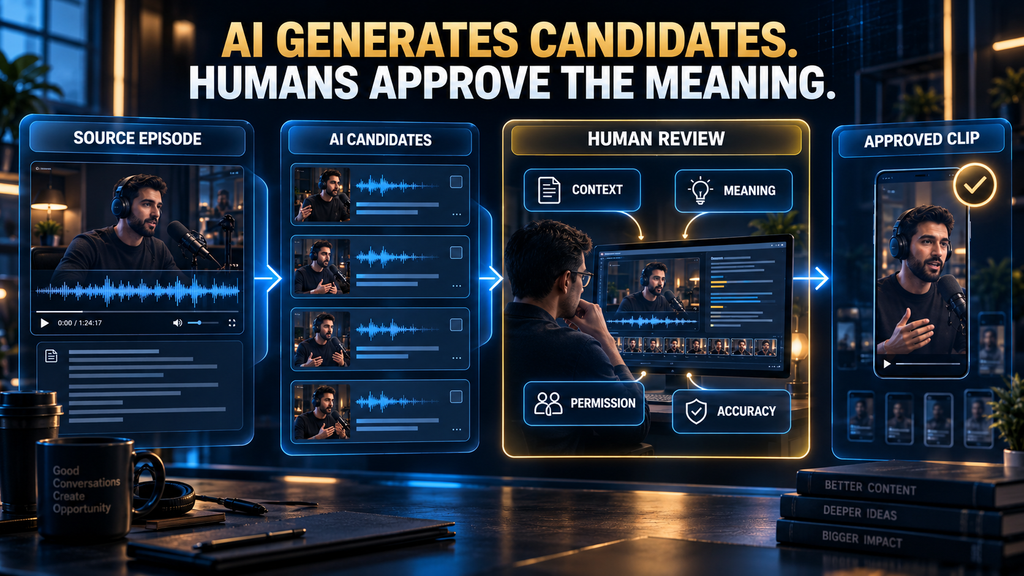
The most reliable workflow assigns different jobs to AI and people. AI searches, organizes, transcribes, reformats, and proposes. A human editor evaluates meaning, relevance, evidence, permissions, presentation, and publication risk.
This guide explains that complete system for both video and audio-only podcasts. It also introduces the AI Hustle World C.L.I.P. Review, a transparent framework for deciding whether an AI-generated podcast clip should be published, rebuilt, or rejected.
What Podcast Repurposing Actually Means
Podcast repurposing is the process of adapting useful material from an episode into additional formats that can work independently while remaining faithful to the original source. Those formats may include short videos, written posts, quote graphics, carousels, email content, episode summaries, or follow-up articles.
Repurposing is not the same as copying. A 45-second section removed from the middle of a conversation does not automatically become a useful short video. It may contain an interesting sentence, but the viewer may not know what question was asked, what situation is being discussed, or why the statement matters.
A successful short-form asset has its own editorial structure. It needs a recognizable subject, a clear point or tension, enough context to stand alone, and an ending that feels intentional. It should also give the viewer an honest understanding of what the longer episode contains.
This is why claims such as “turn one podcast into 30 clips” should be treated carefully. An episode may contain 30 segments of technically usable audio, but that does not mean it contains 30 distinct ideas worth publishing. Forcing more output often creates repetitive clips, incomplete arguments, misleading edits, and a feed that feels mechanically generated.
The better goal is selective adaptation. One clip may answer a recurring audience question, another may explain a process, and a third may introduce the guest’s most distinctive insight. Each asset should have a defined job rather than existing only because software could produce it.
Why Podcast Conversations Are Difficult to Convert Into Short Clips
Podcast conversations often develop meaning slowly. A guest may begin with an uncertain answer, explain an exception, give an example, revise the original statement, and reach the real conclusion several minutes later. The strongest sentence may depend on all the reasoning that preceded it.
An AI clipping tool may identify that sentence because it contains emotional language, a strong opinion, or a complete grammatical structure. The system may not recognize that the speaker limited the claim to one type of customer, one stage of a process, or one unusual situation.
Removing those qualifications can change the apparent meaning. A careful observation about a narrow case can become a universal claim, while a temporary objection can look like the speaker’s final position. The words may remain authentic even though the edit is misleading.
Natural conversation creates additional problems. Speakers use pronouns without repeating the subject, refer to earlier examples, pause to think, correct themselves, interrupt politely, or finish each other’s sentences. These patterns are easy to follow for a listener who has heard the entire discussion but confusing for someone encountering an isolated excerpt.
The visual environment changes as well. A two-person video podcast may look natural in a horizontal player but become awkward when automatically cropped into a narrow vertical frame. An audio-only show has no native visual material, so the creator must build a presentation that supports the spoken idea without manufacturing fake evidence or relying on irrelevant stock footage.
Effective podcast repurposing solves these context, meaning, and presentation problems together. It does not treat short-form production as a simple file-conversion task.
What AI Can Automate
AI performs well when the work involves transcription, classification, pattern recognition, formatting, or repetitive editing. It can turn a long recording into searchable text, separate speakers, propose chapters, detect questions and answers, and surface moments that contain emotional emphasis or complete-sounding explanations.
It can also reduce mechanical editing work. Current tools can remove some pauses, generate subtitles, resize footage, track the active speaker, create draft layouts, and produce multiple candidate clips from one recording.
Descript, for example, documents a workflow in which a creator can request between one and 20 candidate clips, choose a duration between ten seconds and five minutes, apply portrait or square layouts, and provide a topic, goal, or selection criterion. Each generated result remains an editable composition, which correctly positions the AI output as a draft rather than an irreversible publishing decision. Descript’s Create Clips documentation
YouTube also supports transcript-led selection. Its current Clips and Shorts workflow lets creators select a section manually through the transcript or timeline and, in supported countries and languages, review AI-generated suggestions and outlines. The creator can adjust the selected boundaries before producing the draft, while the transcript can support automatic captioning. YouTube’s Clips and Shorts guidance
These capabilities can save substantial search and editing effort, particularly when a creator publishes long episodes regularly. Instead of replaying the entire conversation several times, the editor can begin with a searchable episode map and a smaller set of candidates.
What AI Should Not Decide Alone
AI cannot reliably determine whether an excerpt is fair to the speaker, aligned with the show’s editorial position, legally cleared, or appropriate for a specific audience. It may recognize patterns associated with popular clips without understanding the relationship between the guest, the creator, and the people who will see the post.
A general-purpose model also lacks the audience history that gives some moments their real value. An understated answer may resolve a question that followers ask every week, while a dramatic statement selected by the model may repeat something the creator has published several times already.
The system may also confuse emotional intensity with importance. Anger, surprise, certainty, and disagreement are easy to detect, but the most useful section of an episode may be a calm explanation that gives the listener a practical method.
AI should therefore generate possibilities rather than final decisions. A person should confirm the speaker’s meaning, the completeness of the idea, the reliability of captions, the relevance of supporting visuals, and the suitability of the clip for publication.
This boundary does not weaken the value of AI. It makes the workflow dependable by assigning automation to the parts it can accelerate and judgment to the parts where mistakes affect trust.
Why Manual Podcast Editing Still Exists
Traditional manual editing developed because a skilled editor does more than cut a file. The editor follows the logic of a conversation, recognizes when a pause carries meaning, identifies which reaction matters, and understands when a later sentence changes an earlier one.
An experienced editor can also evaluate emotional timing. A brief silence before an answer, a change in tone, or a guest’s hesitation may be essential to the moment. Automated cleanup can remove these details because they resemble inefficiency, even though they help the audience interpret what is happening.
Manual workflows also provide accountability. When one person listens to the full exchange and chooses the excerpt deliberately, there is a clear editorial decision behind the clip. In a fully automated pipeline, errors can pass from transcript to clip, caption, caption text, and scheduling system without anyone examining the original recording.
The weakness of traditional editing is cost and speed, not purpose. Replaying long episodes, marking timestamps, creating subtitles, and rebuilding layouts manually require considerable time. The best AI-assisted workflow keeps the editorial strengths of the traditional method while reducing its repetitive labor.
Who Should Use an AI-Assisted Podcast Repurposing Workflow
This workflow is most useful for creators who publish consistently and have more source material than distribution capacity. Independent podcasters, interview shows, educational programs, business podcasts, video channels, and internal media teams can all use AI to reduce the effort required to find and prepare candidate moments.
It is particularly valuable when episodes contain repeatable educational material. A show that explains processes, answers questions, interviews specialists, or analyses decisions often produces moments that can stand alone after careful editing.
Teams managing several shows can also benefit because a structured process creates consistency. Editors can apply the same review criteria across different guests, formats, and production staff instead of relying entirely on individual taste.
The workflow is less suitable when the source depends heavily on uninterrupted narrative, licensed music, dramatic sound design, confidential information, or long chains of reasoning that cannot be shortened honestly. In those cases, written summaries, trailers, or carefully produced excerpts may be more appropriate than frequent social clips.
Creators should also avoid automated clipping when they do not have time for human review. Generating drafts quickly does not reduce the responsibility to inspect meaning, permissions, captions, visuals, and source attribution before publication.
Start With the Source Format
The first production decision should concern the source, not the software. Video podcasts, audio-only episodes, remote interviews, and narrative shows provide different raw materials and require different treatments.
Video podcasts
A video podcast offers the most direct path to short-form video because the source already contains the speakers, expressions, reactions, and physical context. The editor can crop the active speaker, switch between camera angles, use split-screen layouts, and introduce supporting material while preserving the original conversation.
Automatic reframing still requires review. A vertical crop may remove gestures, follow the wrong person, move too slowly after a speaker change, or hide an object being discussed. The visual edit should guide attention instead of merely placing the recording inside a vertical canvas.
Video also makes it easier to preserve authenticity. Viewers can see who is speaking and recognize that the moment came from a real conversation. Covering the entire frame with stock footage, oversized captions, or constant animation can remove that advantage.
Audio-only podcasts
An audio-only episode requires a deliberate visual system. A static image and moving waveform can communicate that audio is playing, but they may not give viewers enough reason to remain with the clip.
A better treatment may combine clear speaker identification, accurate captions, episode branding, a restrained waveform, and one or two relevant visual elements. When the speaker explains a process, the visual can reveal the steps as they are mentioned. When the conversation references a document, chart, or interface, the editor can show the real source when permission and accuracy allow.
AI-generated visuals can support an abstract idea, but they should not create fake documentary evidence. A conceptual background is different from a generated scene that appears to show a real event, person, product result, or customer experience discussed in the episode.
Remote interviews
Remote interviews often contain separate speaker tracks, inconsistent lighting, connection delays, and changes in audio quality. AI can help synchronize recordings, identify speakers, reduce some noise, and create active-speaker layouts.
The editor still needs to evaluate the conversational rhythm. Removing a delay may improve pacing, but removing a thoughtful pause or correction may change the apparent confidence of the speaker. Technical cleanup should not rewrite the emotional meaning of the exchange.
Guest episodes
Guest interviews introduce permission and relationship considerations. The creator should know what the release or working agreement allows, whether the guest expects promotional clips, and whether sensitive excerpts require additional review.
This decision should occur before automated publication. A clipping model cannot determine whether a statement creates a confidentiality concern, whether a guest later withdrew an example, or whether a provocative edit could damage the relationship.
The Complete AI-Assisted Podcast Repurposing Workflow
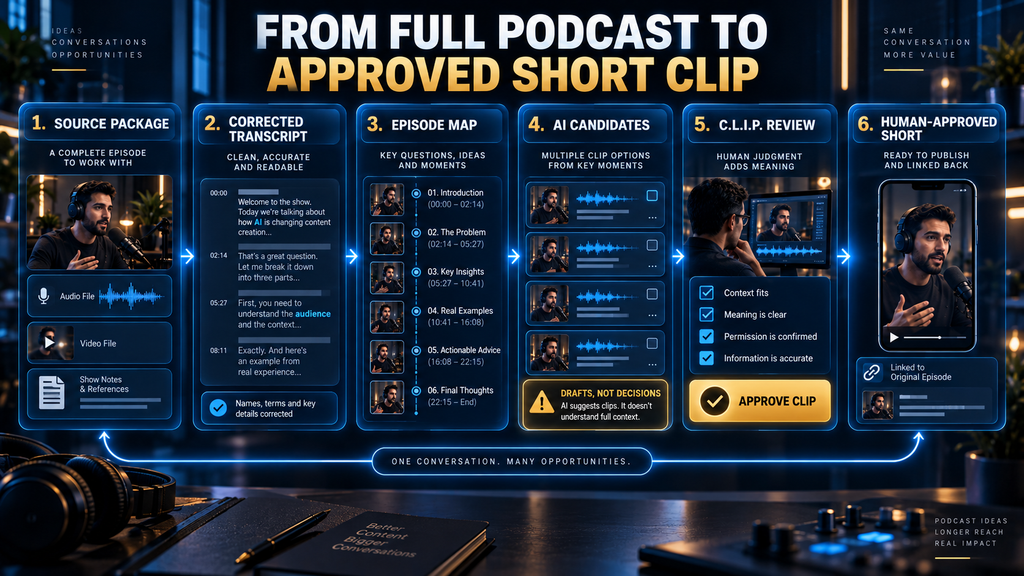
A reliable workflow moves through source control, transcript preparation, episode mapping, candidate generation, editorial qualification, production, approval, and measurement. Starting with templates or publishing targets encourages the team to package material before deciding whether the material deserves to be published.
Step 1: Organize the source package
Begin with the highest-quality version of every source file. Keep the original audio, separate speaker tracks, camera files, edited episode, transcript, show notes, referenced materials, and final published link together under one episode identifier.
This organization protects quality and makes corrections easier. If a word is unclear or a quotation is disputed, the editor can return to the isolated source track rather than relying on a compressed social export.
The source package should also include relevant permissions, sponsorship limitations, embargo dates, and editorial notes. These controls need to be visible before a candidate enters production.
Step 2: Generate and correct the transcript
The transcript becomes the search layer for the workflow. AI can generate the first version quickly, identify speakers, and make a long episode searchable by keyword, question, or topic.
The raw transcript should not be treated as authoritative. Names, numbers, brands, accents, technical terms, and overlapping speech are common sources of error. The team may not need to perfect every filler word, but it should correct every section likely to become a published asset.
This correction matters because transcript errors spread. A wrong term can enter the candidate summary, on-screen captions, social description, article draft, and future content library. Correcting the source transcript prevents one error from becoming a system-wide pattern.
Step 3: Build an episode map
Divide the episode into meaningful sections before asking AI to select clips. The map should identify the opening premise, main questions, examples, disagreements, frameworks, practical recommendations, and final conclusions.
Each section needs only a timestamp range, a concise description, the central question, and any warning about missing context. This gives the editor an overview of the episode’s structure and helps reveal whether the eventual clip set represents the discussion fairly.
The episode map also improves prompting. A model given a structured outline can search for different editorial purposes instead of returning several variations of the most emotionally obvious moment.
Step 4: Ask AI for candidates rather than finished decisions
The prompt should define the qualities of a useful candidate. A vague request to “find the most viral moments” encourages unsupported predictions and overweights dramatic language.
A stronger instruction is:
Review this timestamped podcast transcript and identify up to ten candidate moments for short-form content. For each candidate, provide the exact start and end timestamps, central idea, opening sentence, missing context, risk of changing the speaker’s meaning, and an appropriate visual treatment. Do not rewrite quotations or claim that a moment will go viral.
This request produces an editorial shortlist. Asking for missing context and distortion risk requires the model to expose weaknesses rather than presenting every selection as publishable.
Creators can run separate passes for practical explanations, stories, disagreements, audience questions, mistakes, and decision frameworks. Separating these jobs usually produces more varied material than requesting every type of clip in one pass.
Step 5: Verify the candidates against the recording
The transcript is a discovery tool, but the recording remains the source. Listen to each candidate and part of the conversation before and after it. Confirm the words, tone, timing, and conclusion.
This review often exposes details that the transcript cannot represent. A sentence may be sarcastic, a pause may indicate uncertainty, laughter may change the intent, or the speaker may correct the statement seconds later.
Do not allow a predefined clip length to decide where the idea ends. If the complete explanation needs 75 seconds, cutting it to 30 seconds may damage the meaning. The better option may be a longer clip, a carefully labelled sequence, or a different candidate.
Step 6: Apply the AI Hustle World C.L.I.P. Review
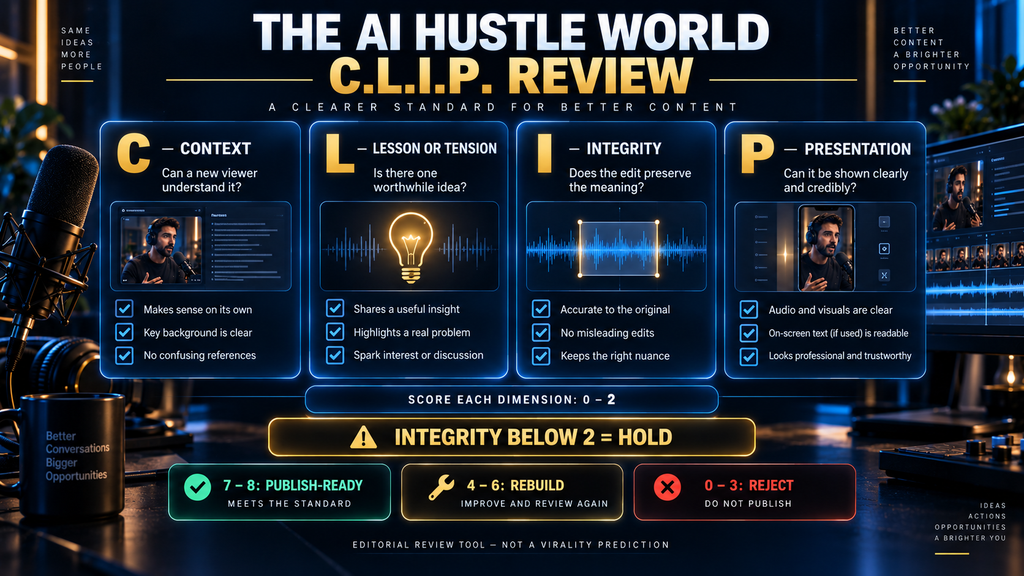
The AI Hustle World C.L.I.P. Review evaluates whether a candidate can function as independent short-form content. It examines Context, Lesson or tension, Integrity, and Presentation, with each dimension receiving zero, one, or two points.
| Dimension | 0 points | 1 point | 2 points |
|---|---|---|---|
| Context | A new viewer cannot identify the topic or situation. | The point becomes understandable after an added setup or wider edit. | The excerpt makes sense independently. |
| Lesson or tension | No clear insight, question, story turn, or useful disagreement emerges. | A useful point exists but appears late or lacks focus. | The value becomes clear early and develops coherently. |
| Integrity | The edit distorts meaning, removes a necessary qualification, or creates an unresolved permission concern. | Meaning can be preserved after restoring context or completing review. | The edit represents the source faithfully and passes the required checks. |
| Presentation | The material lacks a credible visual treatment, readable captions, or source path. | The material can work after substantial production changes. | The source supports a clear, platform-appropriate presentation. |
A total of seven or eight indicates that the candidate can proceed to normal editing and final review. A score between four and six means the opening, context, duration, or presentation needs to be rebuilt. A score of three or lower usually indicates that a different moment should be selected.
Integrity is a hard gate. A candidate should not be published when its Integrity score is below two, even if the total appears acceptable. Strong presentation cannot compensate for distorted meaning or unresolved permission.
The C.L.I.P. Review is not a virality model. It does not predict reach, engagement, or commercial performance. Its purpose is to stop confusing, misleading, or poorly designed candidates from entering publication simply because software selected them.
How the C.L.I.P. Review was developed
The C.L.I.P. Review is an original AI Hustle World editorial framework created for this article. Its scoring dimensions, decision thresholds, and Integrity hard gate are attributable to AI Hustle World rather than to YouTube, Descript, Adobe, or another software provider.
The methodology began by separating the documented production capabilities of current tools from the publication decisions those tools do not resolve. YouTube documents transcript selection, AI suggestions in supported locations, caption generation, editing boundaries, and source-video linkage. Descript documents automated candidate creation, duration and layout controls, goal-based instructions, and editable results.
Adobe’s documentation shows that automatically generated captions remain editable, reinforcing the need to treat transcription as a draft. YouTube’s podcast documentation also distinguishes full podcast episodes from supporting Shorts, demonstrating that the source episode and its promotional assets perform different platform roles. Adobe Express caption guidance YouTube’s podcast guidance
Those documented capabilities were mapped against four decision points that remain after automation: whether the excerpt is understandable, whether it contains a worthwhile idea, whether it preserves the source faithfully, and whether it can be presented credibly. These decision points became Context, Lesson or tension, Integrity, and Presentation.
The framework addresses a gap in product-led guidance. Tool documentation explains how to generate, format, and edit clips, but it does not provide a cross-platform editorial method for determining whether a candidate should be published. The C.L.I.P. Review supplies that missing decision layer without claiming that AI Hustle World tested every clipping platform or measured the framework against a performance dataset.
The framework is transparent but has defined limitations. It does not replace legal clearance, guest agreements, fact-checking, platform policies, or audience knowledge. It has not been validated as a predictor of views, retention, conversions, or virality, and the score should never be presented as such.
Its evidence trail is visible in the primary platform documentation cited above. Its original contribution is the four-part evaluation model, scoring rubric, publication thresholds, Integrity gate, and applied comparison presented in this article.
Step 7: Rebuild the opening without changing the position
Podcast answers frequently begin with conversational material such as “That is a good question,” “As I mentioned earlier,” or “It depends.” These openings work during an interview because the audience heard the question, but they provide little orientation in a feed.
The editor may be able to begin later if the remaining statement is complete. In other cases, the clip needs the interviewer’s question, a short setup card, or a host-recorded introduction.
The repair should clarify the original answer rather than make it more extreme. A discussion of one failure mode should not receive a headline claiming that an entire method never works.
Accurate tension is stronger over time than manufactured controversy. The opening can challenge an assumption or identify a costly mistake, but the clip must deliver the explanation it promises.
Step 8: Choose a visual treatment based on the idea
Visual design begins after editorial approval. The content determines whether the clip needs an active-speaker crop, split-screen interview, caption-led audiogram, process diagram, product demonstration, source document, or restrained sequence of supporting visuals.
A personal story usually benefits from keeping the speaker visible. A practical explanation may benefit from showing the steps. A factual claim may require the original source, chart, or interface rather than decorative footage.
Avoid adding motion without a purpose. Constant zooms, unrelated stock footage, oversized subtitles, and frequent visual effects can reduce comprehension. The presentation should direct attention to the speaker’s point.
AI can assist with reframing, simple layouts, background removal, and conceptual assets. A person still needs to confirm that the visuals are relevant, owned or licensed, and unlikely to be mistaken for evidence the podcast never provided.
Step 9: Treat captions as editorial content
Captions carry the argument for viewers who watch without sound and support comprehension when accents, audio quality, or technical vocabulary create difficulty. They are not merely a decorative style choice.
Automatic captioning provides a useful first draft, but every important term must be checked. Names, numbers, product labels, quotations, and industry language deserve particular attention because one incorrect word can change the meaning.
Caption design must remain readable on a small screen. Keep text away from interface areas, avoid showing too many words simultaneously, and maintain sufficient contrast as the background changes. Highlighting should indicate genuine emphasis rather than turning every word into a competing visual event.
The written social caption performs a different job. It can identify the guest, provide supporting context, explain why the excerpt matters, and connect the viewer to the source. It should not reproduce the entire transcript.
Step 10: Connect the clip to the full episode
A clip should provide independent value while preserving a path to the original conversation. That path may use a related-video connection, description link, pinned comment, episode title, or profile destination.
YouTube currently adds the source video as a related video when creators produce eligible Shorts through its clipping workflow. Its documentation also recommends adding the source video link to the description of a separately created video clip.
YouTube treats the full episode and supporting Shorts as different content types. Its podcast guidance defines a podcast show as a playlist containing full-length episode videos and states that supporting Shorts do not appear in YouTube Music.
This distinction supports a wider principle: a clip should promote discovery without being confused with the complete work. Source linkage helps interested viewers verify context and continue into the longer conversation.
Step 11: Complete human approval before scheduling
The final reviewer should compare the export with the original source, not only with the corrected transcript. The reviewer needs to confirm the opening, ending, captions, visual framing, guest identification, permissions, factual statements, and source path.
Batch approval can keep this stage efficient. A reviewer can examine several clips together using the same checklist instead of interrupting production for every export.
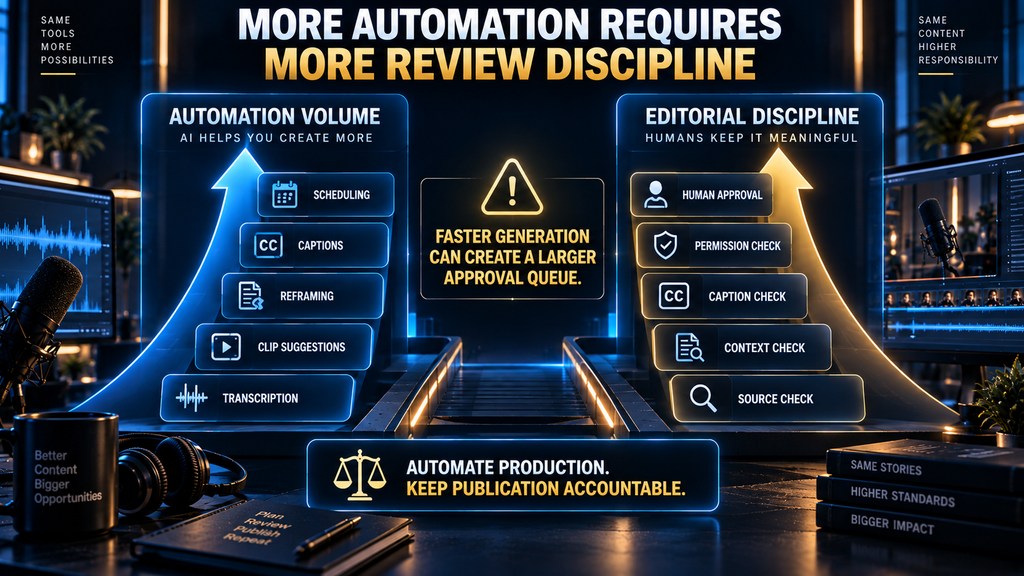
Automatic scheduling becomes safer only after approval. Removing the review stage because generation is fast creates a system where mistakes can reach several platforms before anyone notices them.
Applied C.L.I.P. Scorecard
Consider a hypothetical 55-minute podcast interview about AI in customer support. An automated tool identifies a 28-second statement in which the guest says, “You should never automate the difficult conversations.”
The preceding discussion shows that the guest is referring specifically to cancellations, billing disputes, and emotionally charged complaints. The guest later explains that AI can collect information and route the case before a human responds.
Initial automated candidate
| C.L.I.P. dimension | Score | Reason |
|---|---|---|
| Context | 0 | The viewer does not know which conversations the guest considers difficult. |
| Lesson or tension | 2 | The statement is clear, strong, and immediately interesting. |
| Integrity | 0 | Removing the conditions makes the position sound universal. |
| Presentation | 1 | The speaker footage is usable, but the clip lacks explanatory structure. |
| Total | 3/8 | Reject or rebuild; the Integrity gate also prevents publication. |
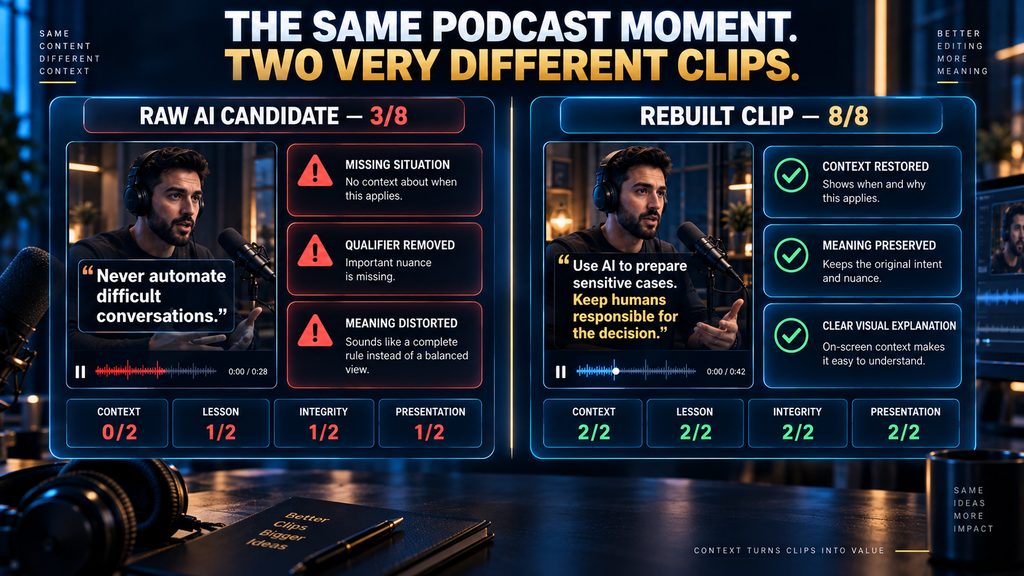
Publishing this version could imply that the guest rejects all customer-support automation. The clip contains the guest’s real words, but the selection changes the apparent scope of the claim.
The editor repairs it by including the interviewer’s question, beginning with the sentence that identifies cancellations and billing disputes, and ending after the guest explains AI-assisted routing. The revised version is longer, but it represents the complete position.
Rebuilt candidate
| C.L.I.P. dimension | Score | Reason |
|---|---|---|
| Context | 2 | The audience understands the category of support conversations. |
| Lesson or tension | 2 | The clip presents a clear boundary for automation. |
| Integrity | 2 | The qualification and recommended alternative remain intact. |
| Presentation | 2 | The guest remains visible while a simple visual separates routine and high-consequence cases. |
| Total | 8/8 | Ready for editing and final approval. |
The improvement did not come from making the statement louder or more dramatic. It came from restoring the information required to understand it correctly. This is the practical role of the C.L.I.P. Review.
Create Different Clips for Different Editorial Jobs
One episode can support several formats, but variation should come from purpose rather than cosmetic changes. Publishing the same answer with different colours or caption animations does not create meaningfully different assets.
| Clip type | Editorial job | Best candidate |
|---|---|---|
| Direct answer | Resolve a focused audience question | A complete response with a clear conclusion |
| Contrarian insight | Challenge a common assumption | A defensible disagreement supported by reasoning |
| Story turn | Create narrative or emotional interest | A moment where the situation or interpretation changes |
| Practical method | Teach a repeatable action | A concise process, checklist, or decision rule |
| Mistake analysis | Help viewers recognize a failure | A specific error followed by its cause and correction |
| Guest perspective | Demonstrate expertise or lived experience | A distinctive observation that survives outside the interview |
| Episode teaser | Create interest in the full discussion | An honest unresolved question or tension |
A direct-answer clip should deliver its answer instead of withholding it behind a vague promise. A teaser may leave the larger discussion open, but it should still contain enough value to avoid functioning as an empty advertisement.
Contrarian clips require additional review because disagreement is easy to exaggerate. The short must preserve the conditions and reasoning behind the position, particularly when the full episode presents a balanced conclusion.
Story clips need complete emotional logic. The audience should understand what happened, why it mattered, and what changed. Extracting only the emotional peak often removes the cause or resolution that made the story meaningful.
Practical clips need enough detail to be usable. Removing every qualification may shorten the runtime, but it can turn a thoughtful method into generic advice.
Repurposing Audio-Only Podcasts Without Generic Visuals
Audio-only podcasters do not need to recreate every episode on camera. They need a consistent visual language that makes the spoken idea understandable in a visual feed.
For a personal observation, a branded speaker card, accurate captions, a restrained waveform, and clear episode identification may be sufficient. For an educational segment, the design can reveal keywords, stages, diagrams, screenshots, or examples as the speaker introduces them.
When an episode references a public report, product interface, or chart, the clip can show the relevant source. The visual must match the spoken claim precisely. Displaying an impressive but loosely related chart can create a false sense of evidence.
Synthetic visuals require judgment. A clearly conceptual illustration may support an abstract discussion, while a generated image presented as though it documents a real event would mislead the viewer.
Some audio moments should not become videos. A section may work better as a written post, quote card, carousel, newsletter passage, or article. Repurposing means choosing the best new format for an idea, not forcing every idea into short-form video.
Choosing an AI Tool by Bottleneck
The correct tool is the one that removes the workflow’s main constraint without removing necessary editorial control. A creator already publishing full video episodes to YouTube may need only its transcript-led Shorts workflow. A team editing complex interviews may value a transcript-first editor that keeps every candidate adjustable.
An audio-only creator may care more about caption design, visual templates, and corrected transcript access. A team managing several shows may prioritize shared workspaces, permissions, brand controls, and approval states.
Evaluate tools using five practical dimensions: supported source formats, transcript control, candidate-selection control, editing flexibility, and review workflow. Data handling also matters when episodes contain confidential, embargoed, or unpublished material.
Do not select software because it promises the highest number of clips. Volume is useful only when the candidates are distinct, accurate, and easy to revise.
A fair comparison uses one real episode and one repeatable task. Give each tool the same source, target length, and topic criteria, then compare the results for context, integrity, caption accuracy, visual framing, and editability. Record observed results separately from personal interpretation.
The Economics of Podcast Repurposing
Podcast repurposing has an economic case because recording, research, guest coordination, editing, and publishing have already created a valuable source asset. Repurposing can spread that investment across additional useful outputs, but only if the new assets are efficient to produce and connected to a real audience objective.
The wrong calculation counts every exported file as value. Ten automatically generated clips are not ten successful assets when six are rejected, two require extensive repairs, and the remaining two repeat each other.
A better starting metric is cost per approved clip: Cost per approved clip = Total repurposing cost for the episode ÷ Number of clips that pass final approval
Total repurposing cost should include human review, transcript correction, editing, visual production, caption checks, and publishing work. Ignoring review time creates an artificially favourable picture of automation.
A second metric is editorial yield: Editorial yield = Approved distinct clips ÷ Total AI-proposed candidates
A low editorial yield may reveal poor prompts, an unsuitable episode, weak source structure, or a tool that prioritizes dramatic language over complete ideas. A rising yield suggests that the episode map, selection criteria, and production process are improving.
Creators can also track revision burden: Revision burden = Total human correction time ÷ Number of approved clips
This figure shows whether automation is genuinely reducing effort. A tool that generates attractive drafts but requires extensive contextual and caption repairs may be less economical than a simpler workflow with fewer, cleaner outputs.
The final economic decision should consider downstream value. An educational clip may justify its production cost by generating qualified questions, saves, episode visits, or reusable audience insight. A high-view clip that attracts the wrong audience and produces no connection to the show may have limited strategic value.
Where Podcast Repurposing Commonly Fails
The clip begins after the context has passed
A speaker may say, “That is why I would never recommend it,” while the clip never explains what “it” means. The editor understands because they know the episode; the viewer does not.
Restore the question, add a precise setup, or select an earlier starting point. If the required context makes the clip impractical, choose another moment.
The most dramatic sentence becomes a false conclusion
AI systems often select strong language because it resembles an engaging moment. The selected sentence may be a hypothetical example, temporary objection, or statement the speaker later corrects.
Review the complete exchange and identify the final position. A clip that attracts attention by reversing the speaker’s conclusion damages trust.
Every clip repeats the same idea
One episode may contain several strong versions of its central argument. Automated systems can select all of them because each segment appears useful independently.
Maintain a clip inventory recording the central idea, editorial job, audience need, and intended destination. If two candidates perform the same function, publish the stronger one unless the second adds a different example or conclusion.
The visual layer becomes decoration
Generic footage of offices, city streets, keyboards, or people looking thoughtful can make a clip appear polished without helping the audience understand it. Irrelevant visuals can also imply facts that the speaker never claimed.
Use the real speaker, actual source material, a relevant demonstration, or a simple explanatory design. Visual restraint is preferable to decorative noise.
Captions reproduce source errors
A wrong name or number can survive several stages because the transcript, subtitles, post copy, and future assets all come from the same automated source. Consistent repetition does not make the information correct.
Verify proper names, figures, technical terms, and quotations against the recording and available evidence. Correct the source transcript so later assets do not recreate the mistake.
The editor forces an arbitrary duration
Forcing every moment into the same runtime can remove the reasoning, example, or qualification that gives it value. The result becomes faster but less useful.
Begin with the complete idea, then remove repetition and unnecessary conversational material. If it remains too long, use another format or select another moment.
AI rewrites the speaker’s voice
Generative tools can propose stronger hooks or smoother sentences, but replacing a guest’s statement with invented language creates an attribution problem. The revised sentence may sound plausible while expressing a level of confidence the speaker never used.
Keep quoted speech faithful to the recording. If the host adds a summary or interpretation, present it clearly as the host’s framing.
The clip attracts the wrong audience
A sensational side comment may generate more attention than the episode’s main subject. That attention can look successful even when viewers have little interest in the full show.
Evaluate whether the clip attracts people likely to value the broader content. Reach without qualified interest can indicate a packaging mismatch.
Automation publishes before review
A connected system can move directly from episode upload to clip generation, captions, scheduling, and distribution. That efficiency becomes dangerous when nobody checks the original meaning.
Automate file routing, template application, status updates, and scheduling only after editorial approval. Meaning, rights, accuracy, and final publication deserve explicit human responsibility.
What Happens When a Creator Does Nothing
A creator can publish full episodes without repurposing them, but that choice has consequences. The show remains dependent on existing subscribers, podcast discovery systems, direct search, and occasional sharing of the full recording.
Valuable answers stay buried inside long files. A potential listener may care deeply about one problem discussed at minute 42 but never discover that the episode addresses it.
The creator also pays the complete production cost for a single distribution event. Research, recording, guest coordination, editing, and publishing create an information asset that may receive little continued exposure after launch week.
Doing nothing can still be the right decision when the episode is highly sensitive, difficult to excerpt honestly, or intentionally designed as an uninterrupted narrative. The important point is to make that decision deliberately rather than allowing useful material to disappear because the team lacks a workflow.
Build a Repeatable Weekly Production System
Repurposing becomes easier when the recording process supports clear reuse. Hosts can ask focused questions, request definitions of unfamiliar terms, and give guests room to complete important explanations.
This does not mean scripting every conversation into social-media sound bites. It means avoiding unnecessary ambiguity and recording a clean source that can support several legitimate formats.
After editing the episode, one person should own the source package and corrected transcript. AI can generate the map and candidate list, while an editor applies the C.L.I.P. Review and selects a limited number of distinct assets.
Approved clips should enter a production tracker containing the source timestamp, final transcript, C.L.I.P. score, visual treatment, caption status, platform destination, approval owner, publication status, and source link. This record prevents duplicate work and creates a reviewable history.
Batching is most effective when it groups similar decisions. Select candidates together, correct their transcripts together, and apply reusable visual templates during production. Constantly switching between listening, writing, design, and publishing creates friction that automation cannot remove.
Measure More Than Views
Views show distribution, but they do not establish whether the clip served the podcast. A useful measurement system separates short-form attention from qualified interest in the source.
Track whether viewers remain long enough to reach the main idea, respond to the specific topic, visit the profile, continue to the full episode where measurable, or return for related clips. Available metrics differ by platform, so the team should use signals it can collect consistently.
Production quality deserves measurement as well. Record candidate approval rate, caption corrections, context repairs, revision time, and the clip types that repeatedly fail the C.L.I.P. Review.
A low approval rate does not always mean the tool is poor. The episode may rely on gradual discussion that does not translate naturally into isolated clips. A high output rate also does not prove strategic value.
Measure each editorial job appropriately. Educational clips may produce saves and qualified questions, while story clips may improve completion and guest recognition. Episode teasers should be judged partly by whether they generate interest in the source.
Future Outlook and Second-Order Effects
AI clipping will continue reducing the technical cost of converting long recordings into short videos. Candidate generation, speaker tracking, caption styling, reframing, translation, visual suggestions, and scheduling will become increasingly connected.
The immediate effect will be more output. The second-order effect will be a much larger volume of similar-looking clips competing for attention. When production becomes easy, editorial selection becomes more valuable because audiences encounter more repetitive captions, automated crops, recycled hooks, and contextless opinions.
Teams may also experience a review paradox. Faster generation can increase total workload when the system produces more candidates than editors can evaluate. Automation that creates 40 possibilities may be less useful than a controlled process that produces eight candidates aligned with clear criteria.
Another risk is that podcasts become designed around extraction. Hosts may chase provocative statements, interrupt nuanced explanations, or steer guests toward preplanned sound bites. Over time, the long-form conversation can lose the depth that made it worth repurposing.
The durable advantage will not come from having access to clipping software. It will come from maintaining a clear editorial position, trustworthy source practices, recognizable visual standards, and a disciplined method for deciding what deserves publication.
Final Thoughts
AI can transform a long podcast into a searchable transcript, map the conversation, identify candidate moments, generate captions, and prepare draft edits. That removes repetitive work and makes consistent repurposing possible for smaller teams.
The decisive question is not how many clips the episode can generate. It is how many moments can become independent, valuable assets without losing the meaning that made the original conversation useful.
Use AI to widen the search and accelerate production, then apply the C.L.I.P. Review to Context, Lesson or tension, Integrity, and Presentation. The best short clip is the smallest complete version of a worthwhile idea.
Your Podcast Is One Source. Build the Full Repurposing System.
Podcast clips are only one part of a useful content library. See how to turn one strong idea into platform-specific assets without repeating the same message everywhere.
Build Your Repurposing Workflow →Frequently Asked Questions
How can AI repurpose a podcast into short-form content?
AI can transcribe the episode, identify topics, propose candidate moments, generate captions, reframe video, and create draft clips. A human should confirm that each selection makes sense independently, represents the speaker accurately, and has an appropriate visual treatment.
Can an audio-only podcast become short-form video?
An audio-only excerpt can use accurate captions, speaker identification, restrained waveform animation, episode branding, diagrams, source material, or other visuals that support the spoken point. It should not rely on unrelated stock footage or synthetic imagery that could be mistaken for evidence.
Should I let AI choose podcast clips automatically?
AI should produce the shortlist, but it should not make the final publication decision. Automated systems can recognize confident language and emotional moments without understanding missing context, guest expectations, factual qualifications, or the needs of a specific audience.
How many short clips should I create from one podcast episode?
There is no universal number. The correct output depends on how many distinct, complete, and useful moments the episode contains. A small collection of differentiated clips is more defensible than forcing numerous repetitive excerpts from the same discussion.
What makes a good podcast clip?
A good clip makes sense to someone who has not heard the episode, presents one clear insight or tension, preserves the speaker’s meaning, and works in the target visual format. It should also identify or connect back to the source when appropriate.
How long should a podcast clip be?
The clip should be long enough to communicate the complete idea and no longer than necessary. Start with the full reasoning, remove repetition carefully, and avoid cutting qualifications merely to reach a predetermined duration.
Can I post the same clip on YouTube Shorts, Instagram Reels, and TikTok?
The same central excerpt can be adapted across platforms, but its packaging may require changes. Review the opening text, caption placement, ending, description, source path, visual safe areas, and available platform controls.
Do podcast guests need to approve short clips?
That depends on the agreement, permissions, subject matter, and relationship involved. Creators should understand what the guest release allows and establish an approval process for sensitive, confidential, controversial, or easily misunderstood excerpts. This article provides editorial guidance rather than legal advice.
Can AI-generated captions be trusted without review?
Automated captions should not be assumed to be perfect. Review names, numbers, technical terms, quotations, and every statement where one incorrect word could change the meaning.
How do I know whether podcast repurposing is working?
Measure more than views. Examine completion, qualified engagement, source-episode activity where measurable, candidate approval rates, correction time, production cost per approved clip, and the formats that consistently attract the right audience.
Related Guides
- How to Repurpose Content Across YouTube, Pinterest, and Instagram
- 8 Best AI Content Repurposing Tools in 2026
- How to Build a Content Atom Workflow with AI
Written by
Muntasir Ahmad Chowdhury
Founder, AI Hustle World
Muntasir Ahmad Chowdhury is the Founder of AI Hustle World, an independent publication dedicated to making Artificial Intelligence practical, trustworthy, and easy to understand. He researches AI tools, automation, customer service, productivity, and real-world business applications, helping readers make smarter technology decisions through research-driven, experience-backed content.
Expertise:
AI Tools • AI Automation • AI Customer Service • AI Productivity • Generative AI • AI Workflows
Get Smarter With AI
Enjoyed this guide? Get practical AI tools, tutorials, and honest reviews delivered to your inbox.
4 thoughts on “Repurpose Podcasts Into Short-Form Content With AI”