Evidence: Documentation reviewed
Last checked: September 2026
What was done: Written from official documentation and the published sources linked in this article. Not hands-on tested.
Files: None
Affiliate links: No
AI Customer Support vs Human Support: Which Is Better?
A customer opens a support chat because an order has been charged twice. The AI assistant responds immediately, finds the relevant billing policy, explains that duplicate authorizations can sometimes disappear, and asks the customer to wait 48 hours. Technically, the interaction looks efficient. But now imagine the charge is not a temporary authorization, the customer has already contacted the company twice, and nobody has actually taken responsibility for correcting the problem. The response was fast; the support outcome was not.
That distinction explains why the debate over AI customer support vs human support is more complicated than the usual comparison of speed, cost, empathy and availability. AI is extremely good at some forms of service work, while humans remain much stronger at others, and the most effective organizations are increasingly designing support around that difference rather than trying to make one side win every category.
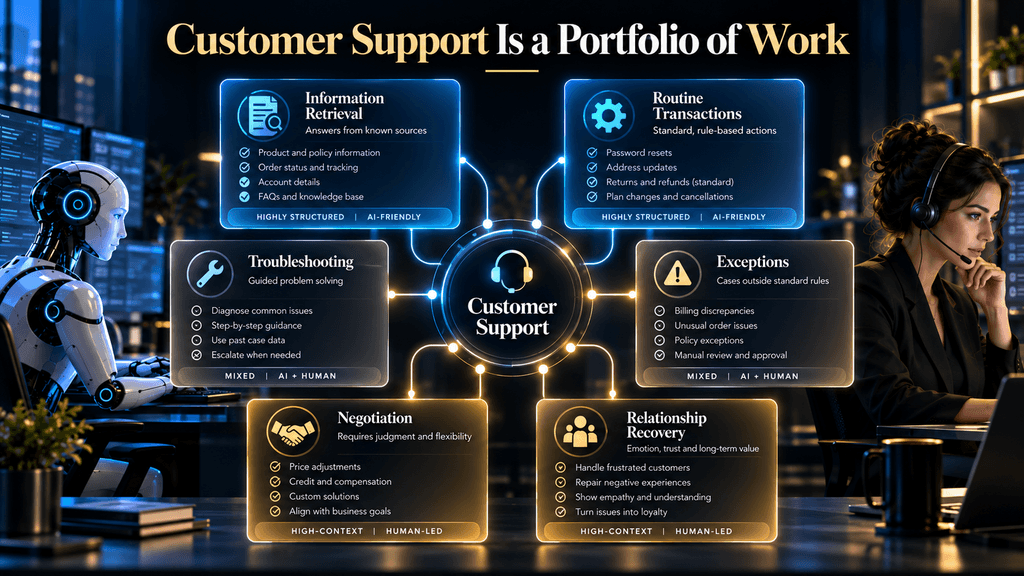
The better question is therefore not, “Should we use AI or humans?” It is “Which customer-support work should AI handle, which work should humans own, and where should responsibility move from one to the other?” That shift in perspective matters because a support team does not perform one homogeneous job. It retrieves information, interprets requests, diagnoses problems, applies policies, makes exceptions, negotiates outcomes, protects relationships and takes responsibility when something goes wrong. Those activities have very different requirements.
The evidence increasingly points in the same direction. Generative AI can improve support productivity and customer experience, but the effects depend on the worker, task and workflow; customers are becoming more comfortable with AI while still strongly valuing access to people; and businesses are expanding AI’s role without necessarily eliminating human service work. A 2023 NBER study of 5,179 customer-support agents found that access to a generative-AI assistant increased issues resolved per hour by 14% on average, with the largest productivity gains among novice and lower-skilled workers. A 2026 field experiment involving Alibaba’s after-sales service operations similarly found meaningful improvements in speed and some measures of service quality, but also found that top-performing agents could see quality declines under increased multitasking. (National Bureau of Economic Research)
So the winner is not AI. The winner is not the human agent either.
The strongest model is the one that matches the type of work to the type of intelligence required to complete it reliably.
AI Customer Support vs Human Support: Which Is Better?
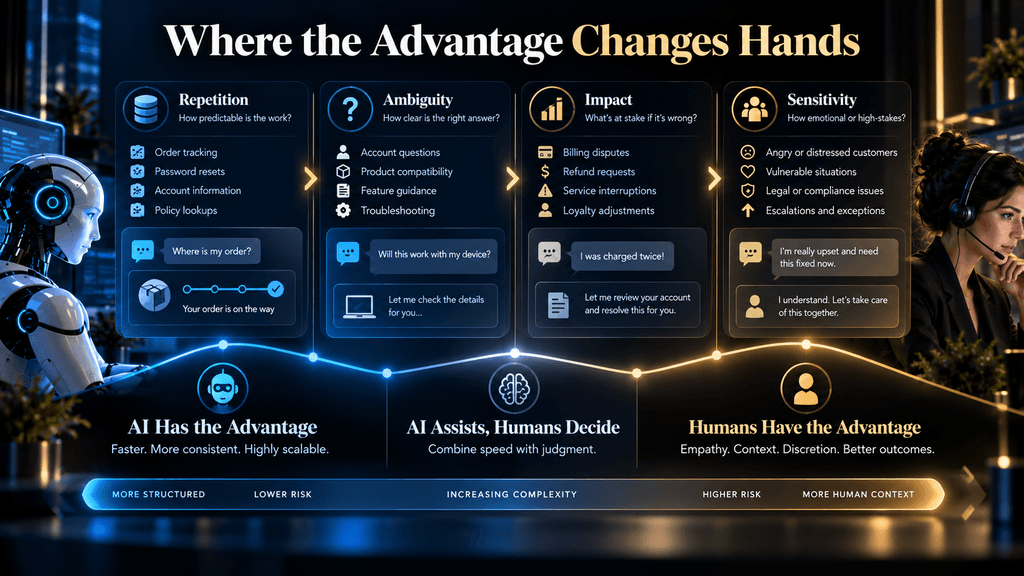
AI customer support is generally better for high-volume, repetitive, predictable and low-risk service work, while human support is generally better when a case requires judgment, negotiation, emotional intelligence, exception handling or accountability; for many organizations, a hybrid model that combines the two is the strongest overall design.
That answer sounds straightforward until you ask what “better” actually means. Better in terms of response time? AI has an obvious advantage. Better in terms of handling thousands of simultaneous requests? Again, AI has the advantage. Better when a customer needs a policy explained in another language at 2:00 a.m.? AI can be dramatically more scalable. But when the interaction involves a disputed charge, an unusual technical failure, a frustrated enterprise customer or a situation in which company policy does not cleanly fit the customer’s circumstances, the value of human judgment rises quickly.
This is why the familiar argument that “AI is faster, while humans are more empathetic” is too shallow to guide a real business decision. Support quality is not a personality contest between a machine and a person. It is a workflow-design problem. The business has to decide what information the system can safely use, what actions it can take, where its authority stops, when a human must intervene, and how responsibility for the final outcome is assigned.
Research and industry data reinforce that point. Gartner’s 2026 survey of 3,566 B2B and B2C customers found that 50% said their interactions were easier when companies use GenAI, yet 87% said it was essential for companies using GenAI in customer service to provide access to a human agent. Gartner also found that customers are increasingly using third-party GenAI tools to resolve service problems and increasingly expect AI to help complete tasks rather than merely provide answers. (Gartner)
The message is remarkably consistent: customers are not rejecting AI; they are rejecting unnecessary friction and loss of control.
Why the AI-vs-Human Question Is Too Simple
The biggest conceptual mistake in this debate is treating customer support as if it were one task with one performance standard. It is not.
A support organization might handle a password reset, an order-status request, a refund, a product recommendation, a subscription cancellation, a technical troubleshooting case, a fraud report and a major enterprise escalation within the same hour. All of those belong to “customer support,” but they have very different levels of ambiguity, risk and required authority.
Consider a simple order-status request. The customer wants factual information that already exists in a structured system. If the AI can securely identify the order, retrieve its status and communicate the result accurately, inserting a human into that workflow may add cost and delay without adding meaningful value.
Now compare that with a customer whose shipment contained a defective product that caused a business-critical failure. The customer may need a replacement, a refund exception, coordination with another team and an explanation of what the company will do differently. The issue is no longer merely information retrieval. It involves interpretation, discretion, prioritization and accountability. Those are fundamentally different requirements.
This is why a sophisticated support operation should think in terms of work allocation, not technology ideology. AI and humans are resources with different strengths, costs, limitations and failure modes. The job of management is to allocate work accordingly.
What AI Customer Support Actually Does Better
AI’s strongest advantage is not that it is “smarter than people.” In many support environments, its most valuable advantage is far more practical: it can perform large amounts of structured cognitive work quickly and consistently.
That distinction matters because customer service contains enormous quantities of work that are repetitive without necessarily being trivial. A customer may ask where an order is, how to reset a password, whether a subscription can be paused, which documentation applies to a product, how to update an address or what a particular billing line means. Each individual interaction matters to the customer, but the underlying decision logic may be highly standardized.
When those conditions exist, AI can create leverage.
Speed and availability
AI systems can respond at any time without requiring the business to maintain a human workforce capable of staffing every hour of every day. That makes them particularly useful for global businesses, digital products and companies with demand spikes that are difficult to cover efficiently through traditional staffing alone.
The advantage is not simply that a machine “works faster.” It is that response capacity becomes much less constrained by headcount. Ten thousand customers can ask questions in a short period without the business needing ten thousand additional people standing by.
That changes the economics of support during peak demand, product launches, outages, holiday periods and sudden traffic spikes.
Repetitive information retrieval
AI is also extremely well suited to searching across large knowledge bases and synthesizing information into customer-friendly language.
A human agent may need to locate a policy, verify a product detail and formulate a response manually. A well-designed AI support system can retrieve the relevant information, synthesize it and present it in seconds. When the underlying information is accurate and the system has appropriate access controls, that can reduce the amount of low-value retrieval work human agents have to perform.
This does not mean the AI should automatically decide every case. It means information retrieval can often be separated from decision authority.
Consistency
Human agents naturally vary. Some are experienced, some are new, some are excellent writers, some are better troubleshooters, and some may interpret a policy differently from their colleagues. AI can offer greater consistency when it is operating from controlled knowledge and clearly defined procedures.
Consistency is especially useful in areas such as policy explanation, standard troubleshooting, account instructions and routine procedural guidance. The advantage becomes weaker when the information itself is incomplete or changing, because an AI system can reproduce an incorrect answer just as consistently as a correct one.
Language and communication
Generative AI can also reduce the friction of multilingual support and rewrite information into different tones or levels of complexity. That can be valuable for businesses serving international customers or products whose documentation is highly technical.
Again, though, communication quality should not be confused with decision quality. An AI system may explain a policy beautifully while still applying the wrong policy to the customer’s specific situation.
Where Human Customer Support Still Has the Edge
The strongest human advantage is not simply empathy. It is judgment under uncertainty.
Human agents can recognize when a case does not fit the standard pattern, identify relevant context that may not exist in a structured database, interpret competing priorities and decide that the normal process needs an exception. They can also take responsibility for difficult conversations in which the customer is not merely asking for information but asking the company to make a judgment.
That becomes especially important when the consequences of being wrong are high.
Ambiguous situations
AI systems work best when the problem can be represented clearly enough for the system to retrieve evidence, reason within its constraints and take an appropriate action. Real customers often provide incomplete, contradictory or emotionally loaded information.
A customer might say, “I was charged for something I never ordered,” when the underlying situation turns out to involve an old account, a family member’s purchase, a recurring subscription or an account-security issue. A human agent can ask clarifying questions, notice contradictions and adapt the investigation dynamically.
AI can do some of this too, particularly in sophisticated agentic systems, but the business still needs to determine how much authority it is willing to give the system when its interpretation could produce a costly or consequential outcome.
Negotiation and exceptions
Many service interactions are not solved by retrieving the correct policy. The customer may be asking for an exception to the policy.
Perhaps a delivery arrived late because of a carrier failure. Perhaps a long-standing customer missed a renewal deadline. Perhaps an enterprise customer is experiencing downtime that technically falls outside the standard compensation policy. Perhaps the customer has a legitimate reason for requesting a remedy that the default workflow was never designed to handle.
These situations require discretionary authority.
Humans remain valuable because they can make judgment-based exceptions, consult internal teams, weigh commercial relationships and decide what outcome is reasonable. An AI system can assist by gathering evidence and recommending options, but that does not mean it should be given unrestricted authority to make every exception itself.
Emotional recovery
There is another category of support work where the objective is not simply to exchange information but to repair trust.
Imagine a customer who has been transferred between three departments, received contradictory information and spent an hour trying to fix a problem. Giving that customer a technically correct automated response may not solve the deeper issue.
The customer may need someone to acknowledge what happened, understand the history, own the problem and explain what will happen next.
The human advantage here is not magic empathy. It is relationship repair combined with accountability.
High-consequence decisions
As the consequences of an incorrect answer rise, the acceptable level of automation should generally decrease.
A mistaken answer about where to find a software feature is inconvenient. A mistaken interpretation of a financial dispute can cost money. A mistaken handling of a security incident can create serious risk. A mistaken response involving sensitive personal circumstances can damage trust and potentially create regulatory exposure.
That does not mean AI cannot participate in high-stakes support. It can retrieve information, summarize history, identify relevant policies and prepare a case for a human. But participation is not the same thing as ownership.
The R.A.I.S.E. Framework: Deciding Who Should Handle the Customer
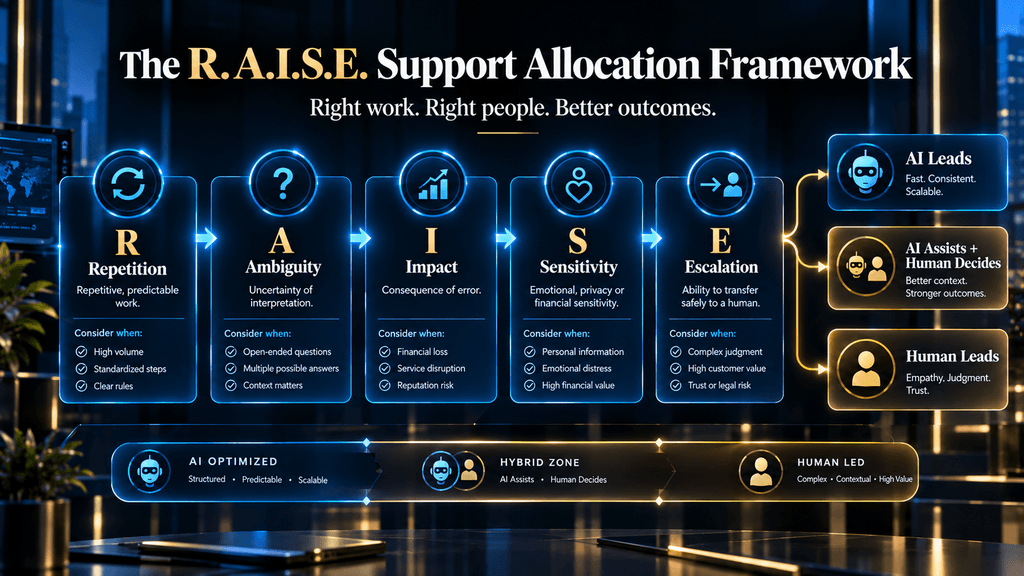
To make the AI-versus-human decision practical, AI Hustle World can use a five-factor model called the R.A.I.S.E. Support Allocation Framework.
The idea is simple: before automating a support workflow, evaluate the nature of the work rather than the technology available.
R — Repetition
How frequently does the problem occur, and how predictable is the underlying workflow?
A highly repetitive task with stable decision rules is a strong automation candidate. Order-status requests, password resets and basic documentation questions often score highly here.
The important nuance is that frequency alone is not enough. A high-volume problem can still be a poor automation target when mistakes are costly.
A — Ambiguity
How difficult is it to understand what the customer actually needs?
A clear request such as “Where is order 12345?” contains relatively little ambiguity. A message such as “My account has been wrong since the upgrade and nobody can tell me why” is much more open-ended.
As ambiguity rises, the need for contextual reasoning and human intervention generally rises as well.
I — Impact
What happens if the support system gets the answer or action wrong? This is arguably the most important factor because automation decisions should not be based purely on frequency or labor cost.
A low-impact error may be easily corrected. A high-impact error may create financial loss, legal exposure, churn or reputational damage.
S — Sensitivity
Does the interaction involve emotion, privacy, security, money, personal circumstances or a strategically important relationship? Sensitive situations often require stronger controls even when the underlying workflow looks technically automatable.
For example, a password-reset flow may be highly standardized, but the system still needs strong identity and security controls. Similarly, a billing workflow may be predictable while still requiring human escalation for disputed or unusual cases.
E — Escalation
Can the system recognize when it should stop and transfer the case to a person? This is the factor businesses routinely underestimate.
A support AI does not become safe simply because it performs well on routine conversations. It also needs a failure path. When the case leaves the model’s reliable operating boundary, the customer should move to the right human at the right moment, with the relevant context already attached.
That means escalation is not a button at the bottom of a chatbot. Escalation is part of the architecture.
How to Use the R.A.I.S.E. Framework
A useful way to interpret the framework is to think about four broad support conditions.
| Support condition | Recommended model | Why |
|---|---|---|
| High repetition, low ambiguity, low impact, low sensitivity | AI leads | The workflow is predictable and scalable |
| High repetition but moderate impact or sensitivity | AI with guardrails | Automation is useful, but controls matter |
| Moderate ambiguity or consequential decisions | AI assists + human decides | AI can reduce information work without owning the outcome |
| High ambiguity, high impact or high sensitivity | Human leads | Judgment, accountability and exceptions dominate |
This does not need to become a rigid scoring system where every ticket is forced into a numerical category. The purpose is to create a consistent management conversation: why should this work be automated, and what happens when the assumptions behind that automation stop being true?
That final question is crucial because the business environment changes. A workflow that is safe to automate today may become riskier after a policy change, product launch, pricing update or unusual event. Automation boundaries therefore need periodic review rather than being treated as permanent.
The Support Autonomy Ladder
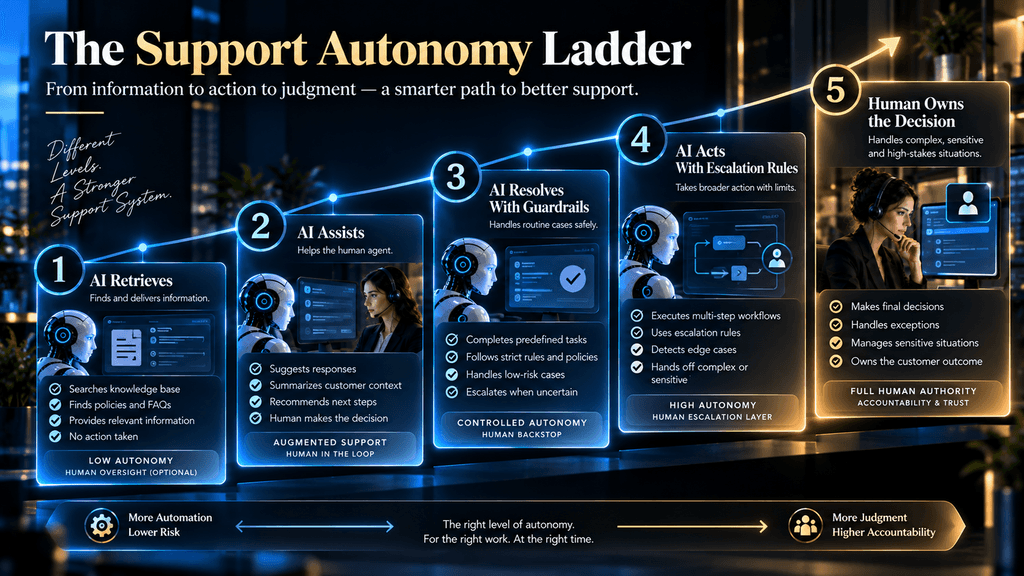
There is another distinction that makes the AI-versus-human conversation much more useful: AI does not have to move directly from “doing nothing” to “fully replacing the agent.” There are several levels in between.
Level 1: AI Retrieves
The AI finds information for the customer or the human agent. This is the lowest-risk form of support automation and a good starting point for businesses that are still building trust in their AI systems.
Level 2: AI Assists
The AI recommends a response, summarizes the case, identifies relevant documentation or proposes a troubleshooting path while the human remains responsible for the customer interaction.
This model is supported by the NBER evidence. The generative-AI assistant studied there improved agent productivity, particularly for less experienced workers, suggesting that some of the value of AI comes from augmenting human capability rather than eliminating the human role. (National Bureau of Economic Research)
Level 3: AI Resolves With Guardrails
The AI completes clearly defined, low-risk service actions within predetermined limits. Examples include changing certain account settings, providing approved information, scheduling appointments or processing standardized requests.
The key word is guardrails. The AI does not have unlimited discretion.
Level 4: AI Acts With Escalation Rules
The AI can execute more complicated workflows, make a series of decisions and interact with multiple systems, but it must transfer the case once predefined boundaries are crossed. This is where customer-service AI begins to resemble an operational agent rather than a simple chatbot.
Level 5: Human Owns the Decision
AI can still gather evidence, summarize the customer’s history, identify relevant policies and recommend an action, but the human retains final decision authority. This model is particularly useful when the outcome has significant financial, legal, relationship or reputational consequences.
The value of this ladder is that it removes the false assumption that the business has only two options: a human answering everything or an AI answering everything. There is a much larger design space between those extremes.
AI vs Human Support: What the Evidence Actually Says
The research does not support a simple replacement story.
The NBER field study of 5,179 customer-support agents found that AI assistance raised issues resolved per hour by 14% on average. The improvement was much larger among novice and lower-skilled workers, while highly experienced workers saw minimal productivity impact. The researchers also found evidence of improvements in customer sentiment and employee retention.
That finding is strategically important because it changes how companies should think about AI’s economic value. If AI can transfer some of the knowledge and best practices of strong performers to newer employees, its value is not limited to labor replacement. It can also function as a capability multiplier.
The 2026 Alibaba field experiment adds another layer of nuance. Agents who had access to an AI assistant experienced faster issue identification and shorter chats, and the experiment found improvements in subjective service quality. However, the benefits were not uniform: lower-performing agents gained the most, while top-performing agents showed declines in certain quality measures associated with increased multitasking. Objective quality, measured through retrial rates, did not improve significantly. (arXiv)
This is an excellent reality check for companies that assume adding AI to a workflow automatically improves performance. The tool can change the work itself.
A system that makes it easier for agents to produce responses faster may also tempt them to handle more conversations simultaneously. That can create a new bottleneck: attention. In other words, AI can increase the amount of work a human can theoretically process while simultaneously increasing the risk that the human is asked to process too much at once.
The best deployment strategy therefore needs to measure not just output volume but the quality of the resulting customer experience.
What Large Companies Are Actually Doing
The direction of enterprise adoption also points toward hybrid models.
Salesforce’s 2025 State of Service research, based on a global survey of 6,500 service professionals, reported that service teams estimated AI was handling about 30% of cases at the time of the survey and projected that figure to reach 50% by 2027. Salesforce described the transition as one in which AI agents handle more routine work while human representatives spend more time on complex, higher-value problems. These are survey-based industry estimates rather than universal benchmarks, but they illustrate the direction in which many service organizations expect their operating models to move. (Salesforce)
Klarna provides a more dramatic company-specific example. In its 2025 annual report, the company said its AI assistant, developed with OpenAI, handled 80% of customer-service chats during 2025 without a drop in consumer satisfaction, while the company also reported significant operating efficiencies from AI adoption. These numbers are Klarna’s own reported results, so they should be treated as a company case study rather than a universal industry benchmark. (SEC)
The broader lesson is not that every company should aim for 80% automation. The lesson is that automation levels should emerge from the economics and structure of the workload.
If most customer demand consists of repetitive digital transactions, a business may be able to automate a large share successfully. If a large proportion of demand involves complex cases, bespoke decisions or relationship-sensitive interactions, a much lower automation rate may be economically and operationally correct.
Why Customers Do Not Simply Want “Human Support”
There is a subtle but important misconception in the AI-versus-human discussion: the assumption that customers fundamentally want to talk to people. Sometimes they do. But often they want the problem solved with as little unnecessary effort as possible.
A customer trying to find an order does not necessarily need a friendly conversation. They need an accurate answer. Forcing that customer to wait for a human agent can make the experience worse.
At the same time, when an automated system refuses to solve the problem and also prevents access to a person, the customer’s perception changes quickly. The technology stops feeling like convenience and starts feeling like an obstacle.
Gartner’s 2026 research captures this tension particularly well. Half of surveyed customers said their interactions were easier when companies used GenAI, but 87% said companies using GenAI should still provide an option to reach a human agent. Gartner also found that customers are increasingly using GenAI to take action on their behalf rather than simply receive information. (Gartner)
The implication for support design is powerful:
Customers are increasingly willing to interact with AI when AI gives them more capability. They become resistant when AI removes their ability to obtain resolution or human judgment.
That is the difference between automation as convenience and automation as a barrier.
The Hidden Problem With AI “Containment”
Customer-service leaders often talk about containment, deflection or the percentage of cases that never reach a human agent. Those metrics can be useful, but they can also create dangerous incentives.
Suppose an AI assistant answers 90% of conversations without escalation. That number looks impressive.
Now suppose 20% of those customers contact the company again because their original problem was not solved. The apparent 90% containment rate suddenly tells you much less about the quality of the service.
This is why a business should distinguish between: “The customer stopped talking to the AI.” and: “The customer’s problem was actually resolved.” Those are not the same event.
Zendesk’s 2026 CX Trends research reports that 85% of CX leaders say customers will drop brands over unresolved issues, even when the issue occurs on the first contact. The same research highlights rising expectations around contextual continuity, with many customers frustrated when they have to repeat information. (CX Trends)
A support system that optimizes for deflection can therefore end up optimizing the wrong objective. The better objective is verified resolution.
Cost: Is AI Customer Support Actually Cheaper?
AI often has the potential to reduce the cost of customer support, but “AI is cheaper than employees” is an incomplete economic argument.
The cost of a human support operation includes compensation, benefits, training, management, recruiting, scheduling and turnover. AI introduces a different cost structure involving software, model usage, implementation, integrations, knowledge management, evaluation, security, monitoring and human escalation.
The real comparison is therefore not: AI cost per conversation vs human cost per conversation. It is: Total cost per successfully resolved customer problem. That distinction becomes particularly important when the AI system has a high failure rate.
Imagine an AI interaction costs a fraction of a human interaction, but customers frequently reopen tickets, contact the company again or escalate after receiving poor answers. The business may save money on the initial interaction while spending more elsewhere in the system.
The opposite can also happen. An expensive human agent may spend ten minutes solving a complicated problem that would otherwise generate multiple failed automated interactions.
This is why the economics of customer support should be evaluated at the resolution level, not simply at the contact level.
Gartner’s 2026 research provides a useful warning here. Although organizations continue to invest heavily in AI, Gartner reported that only 24% of surveyed service and support leaders demonstrated positive financial returns across their AI use cases. That does not mean AI fails financially; it means implementation does not automatically produce positive ROI.
A business should therefore calculate the economics of AI support using a broader equation: AI value = labor capacity released + faster resolution + increased availability + improved consistency minus. AI cost = technology + implementation + maintenance + oversight + escalations + failed automation + customer-experience losses.
The final variable is often the one companies neglect. A cheap interaction that fails is not cheap support.
Why Humans May Become More Valuable as AI Improves
This sounds counterintuitive at first, but better AI can increase the value of skilled human support rather than eliminate it entirely.
As AI absorbs routine requests, the remaining cases become more concentrated around ambiguity, exceptions, emotionally difficult interactions and high-value customers. The human agent then becomes responsible for a smaller number of interactions, but those interactions can carry more complexity and consequence.
That changes the job.
Microsoft’s 2026 Work Trend Index argues that as AI and agents take on more execution, humans increasingly have more room to direct work, make decisions and own outcomes. In Microsoft’s analysis, 86% of surveyed AI users said they treat AI output as a starting point rather than a final answer and remain responsible for the thinking. (Microsoft)
Customer support is likely to follow the same general pattern.
The future agent may spend less time copying policy language, searching knowledge bases and typing routine responses. Instead, more time may be spent reviewing evidence, handling exceptions, coordinating across departments, negotiating solutions and supervising AI-generated work.
That creates a second-order effect that deserves more attention: AI may reduce the amount of routine customer-service work while increasing the judgment density of the remaining human work.
That means businesses should not only ask how many human agents they can eliminate. They should ask what skills their remaining agents will need.
A More Useful Comparison: AI, Humans and Hybrid Support
The practical comparison is easier to understand when the question becomes “Which model fits which work?”
| Dimension | AI-led support | Human-led support | Hybrid support |
|---|---|---|---|
| Routine questions | Excellent fit | Poor use of skilled capacity | Excellent fit |
| 24/7 availability | Excellent | Expensive | Excellent |
| High-volume demand | Excellent | Headcount constrained | Excellent |
| Standardized workflows | Excellent | Reliable but slower | Excellent |
| Ambiguous cases | Limited | Strong | Strong |
| Complex troubleshooting | Variable | Strong | Strong |
| Negotiation | Limited | Strong | Strong |
| Emotional recovery | Limited | Strong | Strong |
| High-consequence decisions | Requires strict controls | Stronger fit | Strong |
| Information retrieval | Excellent | Slower | Excellent |
| Consistency | Strong when grounded | Variable | Strong |
| Relationship building | Limited | Strong | Strong |
| Scaling capacity | Excellent | Linear with staffing | Excellent |
| Accountability | Requires governance | Direct | Clear when roles are designed well |
| Best use | Routine and predictable work | Judgment and exceptions | Mixed workloads |
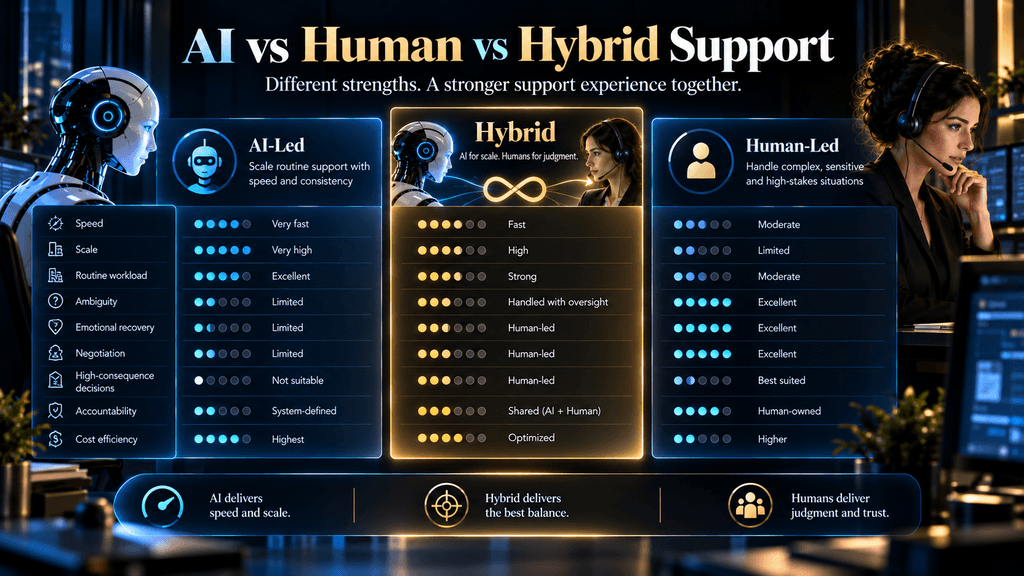
The hybrid column wins many categories not because it is a vague compromise, but because customer support itself is heterogeneous. A business can let AI handle the first layer of predictable work while humans handle the cases where human judgment creates the greatest incremental value.
Where AI Customer Support Fails
The strongest case for human involvement becomes clearer when we examine how AI support systems actually fail.
Hallucination and unsupported answers
A generative model may produce a fluent answer that is not supported by the company’s current policies or data. The danger is not poor writing. It is confidence without reliable evidence.
That is why serious customer-service AI should be grounded in trusted information sources, constrained by permissions and continuously evaluated against real support outcomes.
Knowledge drift
A support system can become unreliable when pricing, product functionality, policies or procedures change faster than the underlying knowledge environment. This failure is particularly dangerous because the AI may remain confident after its information has become outdated.
The problem is therefore not simply model quality. It is information governance.
Poor escalation
One of the worst support experiences occurs when the AI recognizes that it cannot solve the issue but still makes the customer repeat the same information to a human. The human agent then starts from zero, asks the same questions and rebuilds the context manually.
That destroys part of the economic value created by automation. A properly designed escalation should transfer the conversation history, customer identity, relevant account information, previous troubleshooting steps, detected intent and reason for escalation.
False confidence
An AI system can sound more certain than the evidence warrants.
Humans are not immune to overconfidence either, but organizations have established escalation procedures, supervision and accountability structures for human workers. AI systems require equivalent operational controls if they are going to participate in consequential service decisions.
Multitasking overload
The Alibaba field experiment shows another failure mode that is less obvious: AI can make workers more productive on paper while encouraging additional concurrent work that degrades quality. The study found that top-performing agents experienced declines in some quality measures associated with increased multitasking after receiving AI assistance. (arXiv)
This matters because organizations can accidentally use AI to increase the number of conversations an agent is expected to handle rather than improving the quality of the work.
The Biggest Mistake: Automating Because Something Is Common
One of the most common automation errors is to assume that the highest-volume support cases should automatically be automated. Volume matters, but it is only one dimension.
Imagine a business has a large number of billing disputes. Automating the initial identification and evidence-gathering process could create major value. Automatically deciding every dispute might not.
The smarter model is often: AI gathers the facts → AI identifies the relevant policy → AI recommends a resolution → human reviews or approves when the case crosses a defined threshold. This approach separates information work from authority. That distinction is likely to become increasingly important as AI systems move from generating responses into taking actions across connected systems.
When AI Customer Support Is the Better Choice
AI should lead when the workflow has a high degree of predictability and relatively low consequence.
Consider a software company receiving tens of thousands of monthly questions about account access, feature locations, billing dates and documentation. A large portion of those requests can probably be handled automatically because the customer is asking for information that exists in structured, reusable form.
AI is also highly attractive when demand varies significantly over time. A business might have moderate demand most of the year but experience major peaks during holidays, launches or outages. Building a permanently large human workforce to handle maximum capacity can be inefficient, whereas AI can absorb some of the peak workload.
Another strong use case is agent assistance. Even when a company is uncomfortable giving AI autonomous customer-facing authority, it can still use AI internally for summarization, knowledge retrieval, classification, draft responses and troubleshooting suggestions. This can reduce administrative work without changing who owns the final interaction.
The NBER findings make this particularly compelling because the productivity gains from AI assistance were strongest among novice and lower-skilled workers.
When Human Support Should Stay in the Driver’s Seat
Human support becomes more valuable as uncertainty, sensitivity and consequence rise. This includes disputes involving money, cases where a customer is requesting an exception, interactions involving highly sensitive information, difficult technical situations, major account relationships and problems where the company itself may have caused significant harm or inconvenience.
Human ownership is also valuable when the customer is not primarily asking for information. They may be asking the company to exercise judgment.
That is the line many AI-versus-human comparisons miss. If a customer asks, “What is your refund policy?” the system can probably explain it.
If the customer asks, “Your system charged me incorrectly three times, and your own support team gave me contradictory answers. What are you going to do about it?” the interaction is no longer simply informational.
The customer is asking the company to decide. That is fundamentally different work.
Why the Hybrid Model Usually Wins
Hybrid support is sometimes presented as a compromise between two opposing technologies. That undersells what it actually is.
A good hybrid system is a deliberate division of labor.
AI handles the parts of the process where speed, scale and information retrieval dominate. Humans take over when interpretation, judgment, negotiation, relationship management or accountability becomes more important.
The result can be better than either extreme.
A customer begins with AI because the issue may be simple. AI identifies the problem, retrieves relevant information and tries the standard workflow. If everything fits the known pattern, the issue is resolved without human intervention. If the system detects ambiguity, sensitivity or a high-consequence condition, it escalates. The human receives the full context rather than starting the conversation again.
This is not AI plus humans by accident. It is AI and humans performing different parts of the same service system. Salesforce’s service research describes a similar direction, with AI expected to handle a growing share of service cases while human representatives devote more time to complex work.
How to Build a Hybrid Customer-Support Model
The implementation should begin with workflow analysis rather than tool selection.
Start by examining the actual support volume and categorizing cases based on frequency, ambiguity, impact and sensitivity. You want to understand which interactions are repetitive, which ones consume the most agent time, which generate repeat contacts and which create the greatest business risk.
The second step is to identify where AI creates value without owning the final decision. This is often where businesses discover that they can automate substantial portions of the workflow without needing to automate the entire interaction.
For example, an AI system might classify a ticket, retrieve relevant documentation, summarize the customer’s history and recommend a resolution. A human then reviews the recommendation before sending the final response. Over time, the business may discover that certain classes of these cases are safe enough to automate fully.
The third step is to establish explicit escalation rules.
Those rules should not simply say “contact a human if the customer asks.” They should define the operational conditions that require human involvement. These can include unresolved requests after a certain number of attempts, conflicting information, financial thresholds, security indicators, legal or compliance sensitivity, customer-status conditions, high-value accounts or explicit dissatisfaction.
The fourth step is to design the handoff.
A human should receive enough context to act immediately. That means preserving conversation history, relevant records, previous actions, evidence, customer preferences and the reason the AI stopped.
The fifth step is measurement. The organization should compare not only how much work AI handles but whether the service outcome improves. That brings us to the most important metrics.
How to Measure Whether AI Support Is Actually Working
A strong customer-service AI program should not celebrate automation volume without measuring resolution quality.
Resolution rate
Did the customer actually get the problem solved? This should be more important than the percentage of conversations handled by AI.
First-contact resolution
Was the issue solved during the initial interaction, without another contact or escalation later? This helps identify false containment.
Repeat-contact rate
How often does the customer return because the problem was not actually resolved? A rising repeat-contact rate can indicate that AI is generating answers faster than it is generating solutions.
Escalation rate
How often does AI transfer the case to a human?
The goal is not necessarily to minimize this number. A well-designed system may intentionally escalate a meaningful share of cases because those cases require judgment.
Resolution time
How much time passes from the customer’s initial request until the problem is actually resolved? This metric captures the full support journey instead of focusing only on the first response.
Customer satisfaction
CSAT and other experience measures still matter because a technically efficient workflow can produce a poor customer experience.
Cost per resolved issue
This is the economic metric that ties the system together. The business should calculate the total cost required to reach a successful resolution, including AI, human labor, tooling and escalation.
Human-agent utilization
Are human agents spending more of their time on complex work where their judgment matters?
This is one of the most valuable measurements for a hybrid system because the purpose of automation is not simply to remove humans. It is to improve the allocation of human capacity.
The Reality Check: AI Does Not Need to Replace Human Support to Be Extremely Valuable
The replacement narrative can obscure a more important opportunity.
Suppose a support organization handles one million annual conversations. Even if AI eventually resolves only a portion of them independently, that could represent a substantial reduction in repetitive workload. The remaining human team could spend less time searching for policies and writing routine explanations and more time solving difficult cases.
That can improve the economics without reducing the human role to zero.
This is precisely why the NBER evidence is so important. The study did not show that AI made customer-support workers irrelevant. It showed that AI assistance could increase productivity, especially among workers with less experience.
The more interesting future is therefore not: AI replaces the support agent. It is: AI changes what the support agent is responsible for.
That distinction should matter to business leaders because replacing repetitive work is only one possible source of value. Another is making skilled human judgment available where it matters most.
What Happens to the Customer Experience If You Do Nothing?
The two extremes both carry risk.
A business that refuses to adopt useful AI may force human agents to spend large amounts of time answering repetitive requests that could be resolved instantly. As volume grows, staffing requirements increase, response times may deteriorate and experienced employees may spend more of their day doing retrieval and administrative work.
But a business that automates aggressively without establishing boundaries can create the opposite problem. Customers may encounter confident but incorrect answers, struggle to reach a human and experience repeated requests to explain the same problem. Human agents then inherit increasingly frustrated escalations without enough context to resolve them efficiently.
Doing nothing is therefore not neutral.
The support workload will continue to change as customer expectations, AI capabilities and operating costs evolve. The real decision is whether the organization deliberately designs that change or allows the technology to dictate the workflow.
What the Future of Customer Support Looks Like
The next stage of customer support is likely to be less about chatbots and more about AI-enabled service operations.
AI will increasingly retrieve information, understand customer intent, summarize account history, recommend solutions, take defined actions and coordinate parts of the support process. Gartner’s 2026 research suggests customers are already moving toward this model, using GenAI not merely to obtain answers but to help complete tasks.
At the same time, human support is unlikely to disappear simply because AI becomes more capable.
As automated systems take on routine execution, human agents can move toward higher-value roles involving judgment, oversight, exception handling, relationship management and difficult decisions. Microsoft’s 2026 Work Trend Index makes a broader version of this argument: as AI and agents take on more execution, people gain more room to direct work, make decisions and own outcomes.
That creates a significant second-order effect for customer-service organizations. The most valuable support employee may increasingly be the person who can supervise AI, evaluate its output, investigate unusual situations and make defensible decisions under uncertainty.
That changes recruitment, training and management. Companies may need fewer people performing routine information exchange but more people capable of handling complex cases.
The frontline support team could therefore become smaller in some environments, but more skilled and more decision-oriented at the same time.
The Final Decision: AI, Human or Hybrid?
There is no universal winner because there is no universal customer-support task.
AI is the better choice when the customer needs speed, scale, availability, predictable information or a standardized transaction. Humans are the better choice when the customer needs discretion, negotiation, contextual interpretation, emotional recovery or someone who can take responsibility for an unusual outcome.
The hybrid model becomes strongest when the business has a mixed workload, which is precisely what most real support organizations have. AI can absorb predictable work, gather evidence, assist human agents and complete bounded actions while people retain authority over cases where ambiguity or consequence makes full automation inappropriate.
The most important strategic decision is therefore not how much customer service to automate. It is where to place the automation boundary.
Ten Common Mistakes Businesses Make With AI Customer Support
1. Measuring containment instead of resolution
A conversation that ends without a human is not necessarily a successful support interaction. Businesses should verify whether the customer’s underlying issue was actually resolved and whether another contact occurred later.
2. Automating high-volume work without considering consequence
Frequency is useful for identifying automation candidates, but high volume does not automatically mean low risk. A common billing dispute can still require human judgment.
3. Designing escalation as an emergency exit
Escalation should be part of the workflow from the beginning. A system that does not know when to stop can create more damage than a system that simply handles less automation.
4. Making customers repeat information
When AI hands off to a human, the human should receive the relevant history and evidence. A broken handoff can erase the efficiency created by the AI layer.
5. Assuming fluent answers are accurate answers
Good writing does not guarantee factual correctness. Knowledge quality, retrieval, permissions and evaluation remain essential.
6. Giving AI too much authority too early
Businesses sometimes move from simple FAQ automation to transactional autonomy without sufficiently testing failure conditions. Autonomy should increase gradually as evidence supports it.
7. Using AI to increase workload rather than improve work
The Alibaba field evidence is a warning that productivity tools can create new multitasking behavior and quality problems when deployed without redesigning workload expectations.
8. Ignoring the economics of implementation
An AI solution may have attractive software economics while still requiring significant integration, monitoring, training and maintenance. Those costs need to appear in the ROI calculation.
9. Treating human agents as a failure of automation
Human escalation is not necessarily a sign that the AI failed. In a well-designed hybrid model, escalation may be the correct and intended outcome for a certain class of cases.
10. Automating before fixing the knowledge environment
An AI system cannot reliably resolve policy-driven questions when the underlying policies are fragmented, contradictory or outdated. Better automation often begins with better information architecture.
A Practical Decision Checklist
Before moving a customer-support workflow from human-led to AI-led, ask:
Is the problem highly repetitive?
The more consistent the request pattern, the stronger the automation case.
Can the required information be verified?
If the system cannot access reliable evidence, full automation becomes harder to justify.
What happens if the AI is wrong?
The higher the consequence, the stronger the case for human oversight.
Does the customer need judgment or an exception?
If the answer is yes, human involvement should remain central.
Can AI recognize its own boundary?
If the system cannot reliably determine when it should stop, its autonomy should remain limited.
Can a human take over without restarting the conversation?
A poor handoff can destroy much of the value of automation.
Are you measuring resolved problems rather than automated conversations?
This is the difference between optimizing activity and optimizing customer outcomes.
Will agents spend more time on valuable work after automation?
The purpose of AI should be to improve the service system, not simply to shift work around.
Final Thoughts
The AI customer support vs human support debate becomes much clearer once you stop treating customer service as a single job.
AI is exceptionally useful when the work is repetitive, predictable, information-heavy and scalable. Human agents remain valuable when the work becomes ambiguous, sensitive, consequential or relationship-driven. The real strategic opportunity is to divide the workload according to those characteristics instead of forcing every customer interaction through the same support model.
The strongest organizations will not necessarily be the ones with the highest AI containment rates or the smallest human teams. They will be the ones that understand where automation creates genuine leverage and where human judgment creates more value than automation can safely provide.
That means the goal should not be to make AI answer as many customers as possible. It should be to make sure every customer reaches the right form of intelligence for the problem they are actually trying to solve.
Use AI to remove waiting and repetition. Use humans to absorb ambiguity, responsibility and consequence.
That is a much more useful way to think about the future of customer support.
Build a Smarter AI Customer-Service Stack
If you are weighing AI against human support, compare the customer service tools available and what each does best.
Compare AI Customer Service Tools →FAQ: AI Customer Support vs Human Support
Is AI customer support better than human support?
AI customer support is better for many repetitive, predictable and low-risk interactions because it offers fast responses, large-scale capacity and continuous availability. Human support remains stronger for ambiguous, sensitive, high-consequence and relationship-driven situations, so a hybrid model is often the most effective overall approach.
Can AI completely replace human customer-service agents?
AI can automate a substantial share of customer-service work, but complete replacement is not a realistic universal model because support includes exceptions, negotiations, complex investigations and situations requiring judgment and accountability. Current research and industry evidence increasingly point toward a redistribution of work rather than a simple elimination of human involvement.
Is AI customer support cheaper than human support?
AI can reduce support costs, especially for high-volume repetitive work, but it is not automatically cheaper. Businesses need to include implementation, integration, monitoring, knowledge management, escalation and failure costs and should evaluate cost per successfully resolved issue rather than cost per conversation.
Do customers prefer AI or human customer service?
There is no single preference that applies to every interaction. Gartner’s 2026 research found that 50% of customers said interactions were easier when companies used GenAI, while 87% still said companies using GenAI should provide access to a human agent.
What types of customer service should AI handle?
AI is generally well suited to repetitive requests such as order tracking, standard account questions, documentation retrieval, appointment scheduling and other workflows with clear rules and relatively low consequences when something goes wrong.
What types of customer service should humans handle?
Humans should remain central to situations involving ambiguity, negotiation, sensitive personal circumstances, significant financial consequences, complex exceptions, high-value customer relationships and cases where the company needs someone to take direct responsibility for the outcome.
Is AI better than humans at answering customer questions?
AI can be faster and more consistent for questions that have clear, verifiable answers in accessible information sources. Humans are generally stronger when the customer’s question is ambiguous, involves exceptions or requires contextual judgment beyond what the documented workflow can provide.
Does AI increase customer-service productivity?
Research suggests it can. The NBER study of 5,179 customer-support agents found a 14% average increase in issues resolved per hour with generative-AI assistance, with a substantially larger effect among novice and lower-skilled workers.
What is the biggest disadvantage of AI customer support?
One of the biggest disadvantages is that AI can provide a fast and convincing interaction without actually resolving the underlying problem. Other risks include incorrect information, poor escalation, outdated knowledge, inadequate context transfer and inappropriate autonomy.
What is the best model for customer support: AI or humans?
For most businesses with a mixed support workload, the strongest model is hybrid: AI handles predictable, repetitive and low-risk work while humans own ambiguous, sensitive and consequential cases. The key is not the percentage of work assigned to AI but whether the allocation produces better resolution, customer experience and economics.
Related Guides
- AI Recruiting vs Traditional Recruiting: What Actually Works?
- How to Set Up an AI Customer Support Agent With Weav: Step-by-Step
- Weav Pricing Explained: Cost Per Resolution vs Hiring Support Staff
Written by
Muntasir Ahmad Chowdhury
Founder, AI Hustle World
Muntasir Ahmad Chowdhury is the Founder of AI Hustle World, an independent publication dedicated to making Artificial Intelligence practical, trustworthy, and easy to understand. He researches AI tools, automation, customer service, productivity, and real-world business applications, helping readers make smarter technology decisions through research-driven, experience-backed content.
Expertise:
AI Tools • AI Automation • AI Customer Service • AI Productivity • Generative AI • AI Workflows
Get Smarter With AI
Enjoyed this guide? Get practical AI tools, tutorials, and honest reviews delivered to your inbox.