Evidence: Documentation reviewed
Last checked: September 2026
What was done: Written from official documentation and the published sources linked in this article. Not hands-on tested.
Files: None
Affiliate links: No
GEO vs AEO vs SEO: What’s the Difference? A Practical Guide
Search used to have a relatively simple promise: type a question, receive a list of results, choose a page, and find the answer yourself. That model still exists, but it now sits alongside AI Overviews, AI Mode, conversational search, and generative assistants that can retrieve information from multiple sources and turn it into a synthesized response. Google describes its newer AI search experiences as being rooted in core Search systems, while also using techniques such as retrieval-augmented generation and query fan-out to gather information from multiple related searches.
That shift has created three acronyms that are now used almost interchangeably: SEO, AEO, and GEO. The problem is that most explanations stop at a neat three-line definition—SEO is for rankings, AEO is for answers, and GEO is for AI citations—and then move on. That description is easy to remember, but it is not enough to explain what is actually happening when a piece of content moves from a website into a modern search or AI response.
The more useful distinction is to treat them as different layers of the same visibility system. SEO is concerned with whether your content can be discovered, crawled, indexed, understood, and surfaced for relevant searches. AEO is an industry term commonly used for making information easier for answer-oriented systems to identify and present. GEO focuses more specifically on visibility within generative systems, where sources may be retrieved, synthesized, mentioned, referenced, or cited. These layers overlap heavily, and none of them by itself guarantees a visit, a lead, or a sale.
The real question, therefore, is not “Should I choose SEO, AEO, or GEO?” It is “Where does my visibility break down, and which layer should I improve next?”
Quick Answer: SEO vs AEO vs GEO
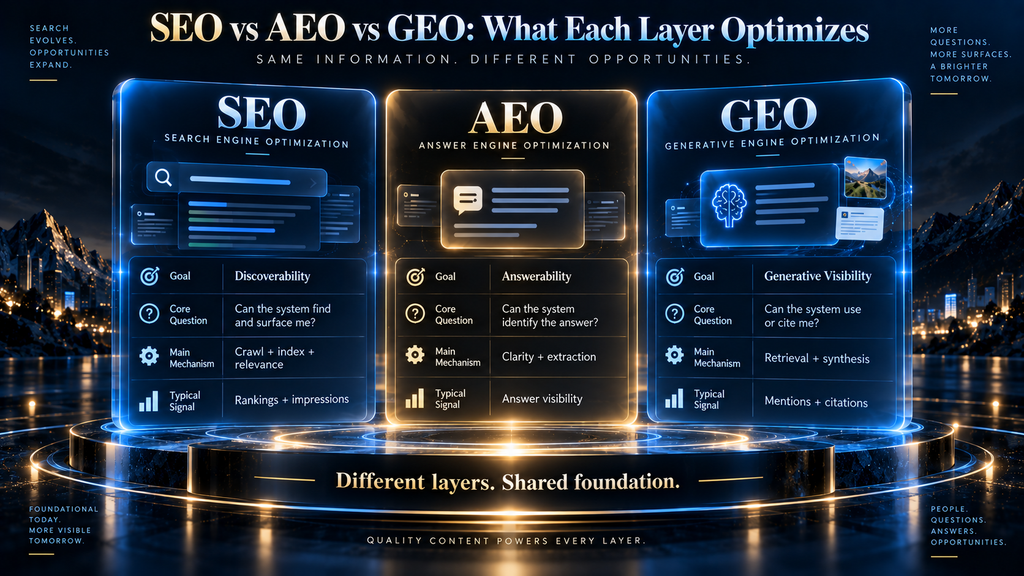
SEO builds the foundation for search visibility, AEO emphasizes answerability, and GEO focuses on participation in generative search responses. SEO asks whether a search system can discover and surface your content; AEO asks whether the information is clear and extractable enough to answer a question; GEO asks whether your source or brand can become part of a generated response through retrieval, representation, mention, or citation.
There is also an important terminology caveat. AEO and GEO are not universally standardized technical systems with definitions accepted by every search company or practitioner. Google explicitly describes AEO and GEO as terms used in the industry for work focused on improving visibility in AI search, while stating that, from Google’s perspective, optimizing for generative AI search is still part of optimizing the search experience and therefore remains SEO.
For practical purposes, this guide uses the following model: SEO = discoverability, AEO = answerability, GEO = generative visibility, and business outcome = measurable value downstream from those visibility states. That framework is more useful than arguing endlessly about which acronym has the “correct” definition because it tells you what each layer is trying to accomplish.
Why SEO, AEO, and GEO Became Separate Conversations
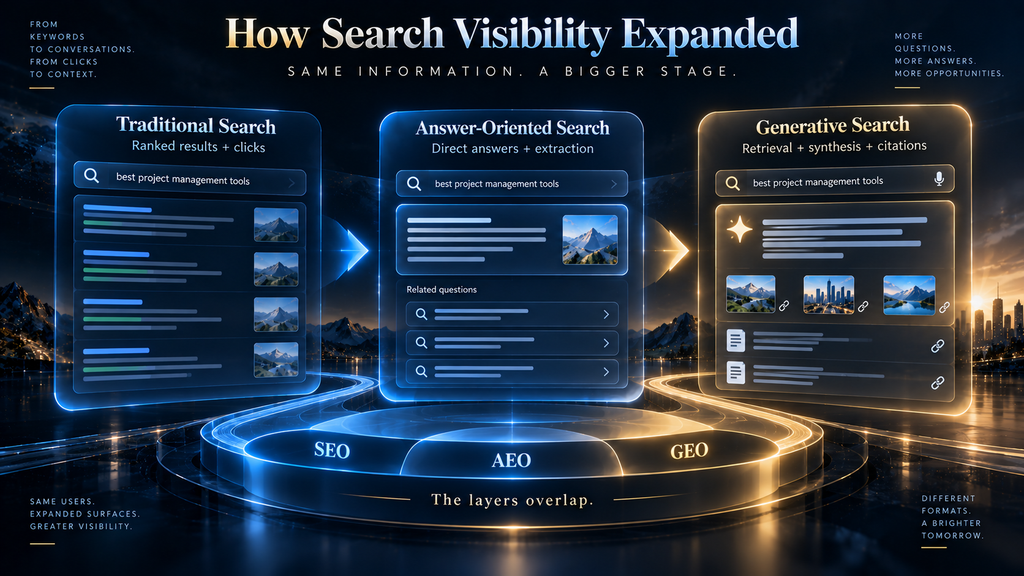
Search did not suddenly become three different industries. The interfaces changed, and with them came different ways for the same information to become visible.
Traditional search follows a familiar path: query → search engine → ranked results → click → website → answer. The search engine primarily acts as a discovery and ranking system, while the website provides the detailed information the user actually consumes. SEO developed around that environment because publishers needed to make pages discoverable, relevant, technically accessible, and competitive for specific searches.
Answer-oriented experiences changed the middle of that journey. Instead of simply returning a list of pages, a system could identify a likely answer and present it directly, sometimes with a link to the underlying source. This is where the term Answer Engine Optimization became useful as an industry shorthand for practices that make information easier to identify and extract in answer-oriented experiences.
Generative search adds another level of complexity because the system can retrieve information from multiple sources, combine those materials, and construct a new response around the user’s question. Google’s current documentation says AI Overviews and AI Mode can use query fan-out, in which the system generates multiple related queries to retrieve information across subtopics and sources before producing a response. (Google for Developers)
That creates a different visibility problem. A website is no longer competing only for a position in a ranked list; it can also compete to become one of the sources that inform the answer itself. The source may be directly cited, indirectly influence the answer, appear as a supporting link, or never become visible to the user at all.
This is why the discussion evolved from “How do I rank this page?” to a broader question: “How can my information remain discoverable and useful across the different ways people now search?”
SEO: The Foundation Layer
What Is SEO?
Search Engine Optimization is the practice of improving a website’s ability to be discovered, crawled, indexed, understood, evaluated, and surfaced for relevant searches. Rankings are one visible result of SEO, but they are not the entire discipline.
A modern SEO program can include technical accessibility, crawlability, indexability, information architecture, internal linking, search intent, topical coverage, content quality, structured information, authority, and page experience. Some of these factors are visible to users, while others are primarily about helping search systems process the website correctly. The underlying purpose is to make the site a useful and accessible source of information for the searches that matter.
This foundation is still highly relevant to generative search. Google’s current guidance is unusually direct on this point: its generative AI features are rooted in core Search ranking and quality systems, use content from the Search index, and require pages to be indexed and eligible to appear in Search with a snippet in order to be eligible as supporting links in generative AI features. Google also says there are no additional technical requirements specifically for AI Overviews or AI Mode.
That means the popular idea that publishers should abandon SEO and replace it with GEO is strategically backwards. Generative visibility still sits on top of a discoverability layer. If your pages are inaccessible, poorly structured, irrelevant to the topic, or not properly indexed, an additional layer of AI-oriented tactics is unlikely to rescue them.
The SEO foundation should answer five questions
A useful way to audit the foundation is to ask whether a search system can access the page, understand its subject, identify its relevance, evaluate its usefulness, and confidently connect it to the right searches. If any of those steps are weak, the site has a foundational SEO problem before it has a GEO problem.
This is also why technical SEO remains important even in an AI-first discussion. Google says crawlability, indexing, JavaScript accessibility, page experience, duplicate-content management, and other established technical practices continue to matter in generative AI search.
The strategic takeaway is straightforward: do not build an advanced generative visibility strategy on top of a broken search foundation.
Why “SEO Is Dead” Is the Wrong Conclusion
The claim that “SEO is dead and GEO is the new SEO” is attractive because it turns a complicated transition into a simple replacement story. Unfortunately, the evidence does not support that framing.
Google’s current generative AI guidance explicitly says SEO remains relevant because AI search features are rooted in the same core Search ranking and quality systems. Google also explains that retrieval-augmented generation, or grounding, uses Search systems to retrieve relevant web pages that can then support AI responses.
Bing has taken a similar approach by connecting conventional webmaster and search practices with AI visibility. Its AI Performance reporting now allows publishers to see which URLs are cited in AI-generated answers, the grounding queries associated with those citations, and changes in citation activity over time. Importantly, Bing distinguishes citation activity from rankings, authority, clicks, and engagement rather than treating them as interchangeable measurements. (Search – Microsoft Bing)
The better conclusion is not that SEO disappears. The definition of useful search visibility expands.
A website can now need to perform well at several stages of the journey. It still needs to be discoverable, but it may also need to communicate information clearly enough to support direct answers, provide enough depth and evidence to be useful as a source, and establish enough context that generative systems can accurately represent the brand or topic.
That is an expansion of the search problem, not the death of the old one.
AEO: The Answerability Layer
What Is AEO?
Answer Engine Optimization, or AEO, is an industry term generally used for structuring information so answer-oriented systems can identify and present a useful response to a user’s question. Historically, that has included featured snippets, direct-answer interfaces, People Also Ask, voice search, and conversational queries; today, some practitioners also use the term in the context of AI-generated answers.
This is where terminology becomes less precise than it appears. There is no single AEO specification published by Google that defines an official “AEO ranking system.” Google’s own guidance groups AEO and GEO among the terms practitioners may use to describe work around AI-search visibility, rather than treating either one as a completely separate optimization discipline.
For that reason, AEO is most useful when understood as a functional concept. Instead of asking whether a page has been “optimized for AEO,” ask whether the information on the page is easy for an answer-oriented system—and a human reader—to identify, understand, extract, and use.
That is a much more productive question.
Answerability Is Not the Same as Keyword Formatting
One of the weakest interpretations of AEO is the idea that it simply means putting a question in a heading and answering it in a short paragraph. That can help with clarity, but it does not explain why some content is easier to use as an answer than other content.
Answerability is largely an information-architecture problem.
Consider a user searching for “What is GEO?” A page can technically contain the correct definition while still making the answer difficult to find. Perhaps the author spends several hundred words discussing the history of search before defining the term, or the definition is scattered across multiple paragraphs, or the article uses vague language that forces the reader to infer the conclusion.
A stronger structure makes the important information explicit and then develops it. The page might define GEO, explain what generative systems do differently from traditional search, describe how source retrieval works, give an example, discuss limitations, and then compare GEO with SEO and AEO. The system does not need to reconstruct the author’s argument from fragments because the information has been organized into a coherent hierarchy.
That structure benefits humans as much as machines.
What Makes Content More Answerable?
The strongest answer-oriented content usually begins by understanding what the user actually needs to know, not by trying to game a particular word count or heading formula.
A definition should be easy to locate when the query is definitional. A comparison should make the relevant differences explicit when the query is comparative. A process should be explained sequentially when someone needs to know how something works. And where a claim depends on evidence, the evidence should be connected clearly to the claim instead of being buried in an unrelated reference section.
Good answerability therefore comes from several editorial choices working together: clear topic targeting, explicit answers, strong section hierarchy, self-contained explanations, useful comparisons, evidence-backed claims, and natural coverage of related questions. The crucial point is that none of this requires robotic prose.
You do not need to turn an expert article into a collection of tiny fragments to make it easier for systems to process. Google’s own current guidance explicitly rejects the idea that content must be broken into tiny pieces or “chunked” in some special way for AI search. Google says its systems can understand nuance across multiple topics on a page and that there is no ideal page length or special writing format required solely for generative AI search.
That is a useful correction to a lot of AEO advice circulating online.
GEO: The Generative Visibility Layer
What Is GEO?
Generative Engine Optimization, or GEO, is an emerging practice focused on improving the likelihood that a brand, source, website, concept, or expertise is represented within generative search responses. Depending on the platform and the context, that representation may involve being retrieved as a source, cited directly, mentioned in an answer, or used as supporting evidence without producing an obvious conventional ranking.
The term has a stronger academic lineage than AEO. The foundational GEO: Generative Engine Optimization research introduced GEO as a framework for improving content visibility in generative-engine responses and developed GEO-BENCH to evaluate optimization strategies across a diverse set of queries and domains. The researchers reported visibility improvements of up to 40% in their experimental setting, while also finding that the effectiveness of different strategies varied across domains. (arXiv)
That finding is worth understanding correctly. It does not mean that publishing a page with a particular collection of GEO tactics guarantees a 40% increase in ChatGPT traffic, Google AI visibility, or conversions. It shows that generative-engine visibility can be influenced under tested conditions and that optimization effects can vary with the domain and environment.
That distinction between evidence and marketing extrapolation is critical in an emerging field.
How Generative Search Changes the Visibility Problem
Traditional search can be simplified as a ranking problem: the system evaluates candidate sources and determines which pages to surface for a query.
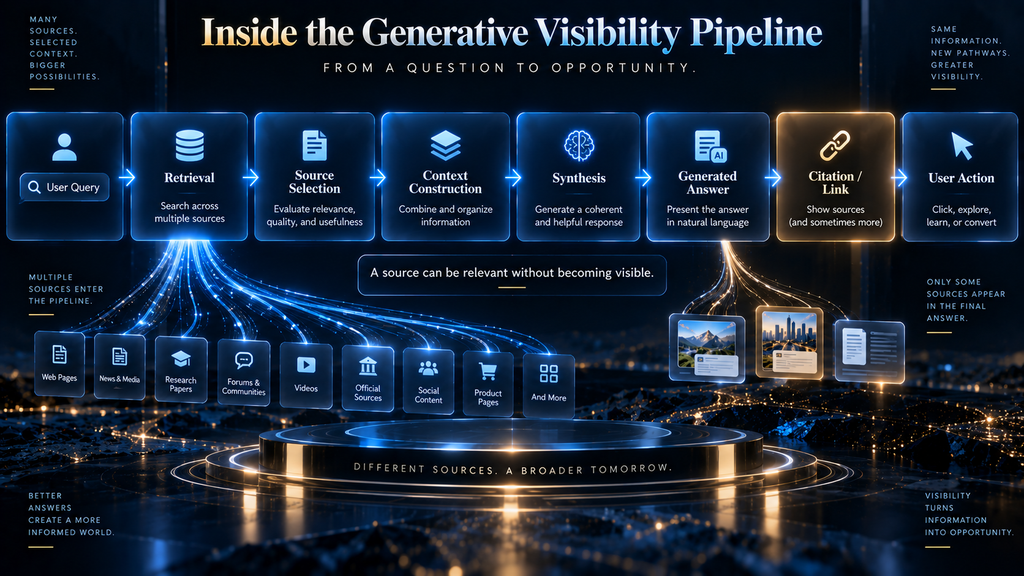
Generative search introduces more stages between the user’s question and the final visible answer. A simplified model is:
User query → retrieval → source selection → context construction → synthesis → answer → citations or links
Real systems are more complex than this model, and different platforms use different architectures. The purpose of the model is not to describe a specific company’s proprietary system, but to illustrate why generative visibility cannot be treated as a single ranking position.
A page can be relevant to a query but never be retrieved. It can be retrieved but not become part of the final context. It can influence an answer without receiving a visible citation. It can receive a citation without producing a click. It can generate a click without producing a conversion.
That is why “AI visibility” is not one metric.
Google’s documentation describes AI Overviews and AI Mode as using retrieval-augmented generation and query fan-out to retrieve information across related searches and sources. Google also notes that AI Mode and AI Overviews can use different models and techniques, which means the resulting responses and links can differ.
The implication for publishers is important: you are optimizing a probability distribution, not securing a permanent position.
GEO Is Not Simply “SEO for ChatGPT”
The phrase “GEO is SEO for ChatGPT” is convenient, but it hides more than it explains.
First, generative search is not one platform. Google AI Overviews, Google AI Mode, Microsoft Copilot, Perplexity, ChatGPT search, and other systems can differ in how they retrieve information, present sources, generate responses, refresh information, and expose citations.
Second, even a single platform can provide multiple AI experiences with different behavior. Google’s own documentation states that AI Overviews and AI Mode may use different models and techniques and therefore may produce different answers and links.
Third, there is no universal GEO ranking position equivalent to “position 1.”
A publisher therefore needs a more realistic mental model: GEO is about improving the probability of being useful to, retrieved by, represented in, and attributed by generative systems. That is broader—and much less deterministic—than conventional ranking optimization.
Bing’s AI Performance reporting reinforces the distinction. Its reporting shows pages cited in AI-generated answers, average cited pages, grounding queries, and page-level citation activity, while explicitly stating that citation data does not measure rankings, authority, importance, traffic, or engagement.
The Critical Distinction: Ranking, Answering, and Being Represented
This is the point where SEO, AEO, and GEO become easiest to understand.
SEO asks whether your content can be discovered and surfaced. AEO asks whether the information can be identified and presented as a useful answer. GEO asks whether the information can participate in a generated response through retrieval, representation, mention, or citation.
Those are different outcomes even when they involve the same page.
Imagine an article explaining the best AI project-management software for a small remote agency. The page may rank organically for relevant searches, which is an SEO outcome. A search system might also extract its explanation of the key selection criteria and present that information directly, which is an AEO-style outcome. A generative system could retrieve the article as one source, use its comparison data to construct an answer, and cite the page, which is a GEO-style outcome.
The same page has therefore moved through several visibility states. The important part is that success at one stage does not guarantee success at the next.
A page can rank well and never become a source in an AI response. A page can be cited by an AI system without ranking first organically. A page can be cited without receiving a click. A visitor can click and leave immediately. A visitor can engage deeply and still decide not to buy.
That is why collapsing everything into one “search visibility” number makes strategic diagnosis much harder.
The AI Hustle World Visibility Stack
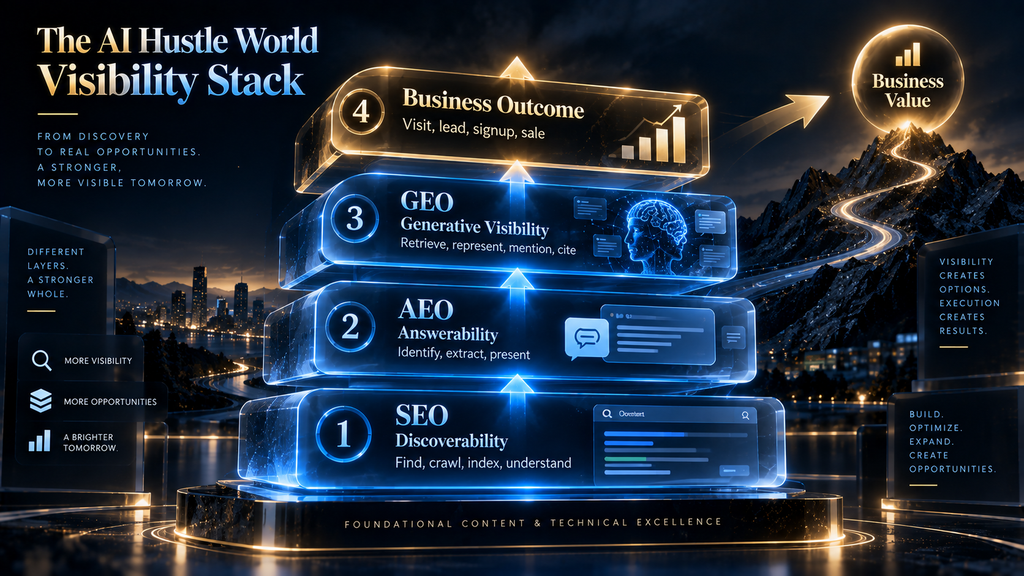
A useful operational model is to treat search visibility as four layers rather than three competing acronyms.
Layer 1: Discoverability
Can the system find, crawl, index, and understand the content?
This is the SEO foundation. It includes technical accessibility, relevance, content quality, information architecture, internal linking, and the other factors that determine whether the page can participate meaningfully in search.
Layer 2: Answerability
Can the system identify the information needed to answer the user’s question?
This is where AEO is most useful as a concept. The page should make important answers clear, explain them accurately, and organize information so the reader or system does not have to reconstruct the argument.
Layer 3: Generative Visibility
Can the system retrieve, use, represent, mention, or cite the source when generating an answer?
This is the practical territory of GEO. Retrieval, source relevance, evidence quality, content distinctiveness, entity context, and platform behavior all become important.
Layer 4: Business Outcome
Did the visibility produce a valuable action? That could mean a qualified website visit, lead, signup, purchase, consultation request, subscription, or another meaningful outcome. The fourth layer is deliberately separate because visibility is not value.
A search impression has one meaning. A citation has another. A referral has another. Revenue has another.
Treating all four as the same KPI is one of the fastest ways to misunderstand the economics of AI search.
Why the Same Article Can Succeed at One Layer and Fail at Another
Consider a page that ranks well for a commercial investigation query.
Its title is relevant, the page is technically healthy, and search engines understand the topic. From an SEO perspective, the page is performing well.
Now look at the content itself. Suppose the article contains excellent research but hides the main recommendation inside dense paragraphs. A human reader may eventually find the answer, but an answer-oriented system has a less obvious information path. The content may therefore have stronger discoverability than answerability.
Now improve the structure. The article clearly explains the recommendation, compares alternatives, identifies criteria, and supports important claims with evidence. That makes the information more useful as a source, but generative visibility can still vary because other sources may be retrieved for the same query.
The final lesson is uncomfortable but important: There is no content format that guarantees inclusion in every generated response. The objective is to create information that is consistently valuable enough to be discovered, understood, used, and attributable across a changing ecosystem.
What Actually Makes Content More Useful for GEO?
There is no universal five-step trick that guarantees an AI citation. What does exist is a collection of durable principles that improve the quality and usefulness of a source.
Start with a clearly defined subject
A page should make its main subject obvious through its title, introduction, headings, entities, examples, and supporting evidence. This is partly basic SEO, but it also matters for generative systems because a source is only useful when its relevance can be understood in context.
Provide information that is not interchangeable
Google’s current guidance places unusually strong emphasis on non-commodity content and unique points of view. Google specifically recommends creating useful, reliable, people-first content that adds something beyond what can be easily reproduced elsewhere, rather than simply recycling information already available across the web.
This principle becomes more important as generative content production becomes cheaper.
If 500 websites publish essentially the same five-paragraph explanation of a topic, changing the wording of the 501st article does not automatically create a competitive advantage. Original research, first-hand testing when genuinely available, documented methodology, unique examples, original analysis, or specialized expertise can create a more distinctive information asset.
Make important claims easy to verify
A generative system may use an article as source material, but humans also need to understand whether the claims deserve trust.
For that reason, important claims should be distinguishable from interpretation. Statistics should have credible origins. Vendor claims should be labeled as vendor claims. Research findings should not be presented as universal truths. Illustrative examples should not be disguised as empirical evidence.
This is especially important in AI search because a generated response may compress several sources into a single narrative.
Build useful context around entities and concepts
A page should not simply repeat the name of a company, tool, product, or technology. It should explain what the entity is, what it does, where it fits, how it compares, who it is for, and where it falls short.
That gives the source semantic context. A page about an AI SEO platform, for example, becomes far more useful when it discusses the product’s purpose, workflow, strengths, weaknesses, alternatives, pricing considerations, and appropriate use cases rather than repeating marketing language from the vendor’s website.
Anticipate related questions without manufacturing pages
Generative systems can expand complex queries into related information needs. Google’s documentation specifically describes query fan-out as a method of issuing related searches across subtopics and sources.
That creates a temptation to publish separate pages for every hypothetical follow-up query. Do not.
Google explicitly warns that creating separate content for every possible query variation primarily to manipulate rankings or generative AI responses can violate its scaled content abuse policies. Google also states that high page volume does not automatically make a site more relevant or higher quality.
The better approach is to create complete, genuinely useful resources that naturally address important subquestions.
The Real Competitive Advantage Is Becoming More Original
This may be one of the biggest second-order effects of AI search.
Generative AI has reduced the cost of creating competent summaries. As that cost falls, generic summaries become less differentiated.
Imagine two articles covering the same ten AI SEO tools.
The first repeats feature lists, marketing claims, and publicly available descriptions. The second explains a documented testing methodology, compares actual workflows, highlights limitations, distinguishes vendor claims from observed behavior, and tells the reader which tool fits which use case.
Both may be factually accurate. But they do not contribute the same amount of information. The second article contains more decision value and more information gain.
Google’s current generative AI guidance makes a similar argument from another direction: unique, useful, non-commodity content is likely to matter more than content that simply reproduces common information. Google specifically recommends adding original perspectives and avoiding content that could easily be produced by a generic model.
This leads to a powerful strategic rule: When everyone can generate a summary, the advantage shifts toward people who can contribute something worth summarizing. That might be original research, a real test, a proprietary dataset, a distinctive framework, expert interpretation, a meaningful comparison, or simply a clearer explanation that resolves a genuine point of confusion.
The Contrarian Reality Check: More GEO Content Can Produce Less Value
There is a growing temptation to treat GEO as a volume game. The logic goes like this: more AI-focused pages create more opportunities to appear in AI answers, so publishers should create dozens or hundreds of narrowly targeted pages.
The reasoning is incomplete. If those pages repeat the same ideas, target minor keyword variations, and provide little new information, the publisher has increased the number of URLs without increasing the amount of expertise available to the reader.
That can create a site full of overlapping pages, weaker editorial consistency, internal cannibalization, maintenance costs, and a poor user experience. More content can therefore produce less useful topical coverage if it is not accompanied by more information value.
Google explicitly cautions against producing content around every imaginable query or fan-out variation as a way to manipulate Search or generative AI visibility. The stronger question is not: “How many AI prompts can I target?”
It is: “What useful piece of the topic can this page own?” That shift moves content strategy away from prompt chasing and back toward expertise.
AEO and GEO Overlap More Than Most People Admit
The distinction between AEO and GEO is useful, but it should not be overstated.
Content that answers questions clearly is often useful to generative systems. Content that is easy for a generative system to retrieve and cite is often structured in ways that also help answer-oriented search. Strong information architecture supports both.
That is why trying to build completely separate “SEO content,” “AEO content,” and “GEO content” libraries can be wasteful. A better model is to build one high-quality content asset and make it capable of performing across several visibility layers.
The content should have a strong technical foundation, clear intent alignment, direct answers where appropriate, useful depth, evidence, context, original information, meaningful internal relationships, and clear decision support. In other words, the strongest GEO strategy often looks surprisingly similar to what a genuinely good editorial website was already doing.
SEO vs AEO vs GEO: The Complete Comparison
| Dimension | SEO | AEO | GEO |
|---|---|---|---|
| Main objective | Improve discoverability and organic search visibility | Make information easy to identify and present as an answer | Improve visibility within generative responses |
| Central question | Can the system find and surface this content? | Can the system identify the answer the user needs? | Can the system retrieve, represent, mention, or cite this source? |
| Primary environment | Traditional search and search results | Answer-oriented search, direct answers, conversational interfaces | Generative AI search and AI assistants |
| Main unit of optimization | Website, page, topic, content ecosystem | Answer, section, information structure | Source, brand, entity, evidence, content |
| Core concern | Crawlability, relevance, indexing, ranking, quality | Clarity, extractability, question alignment, information hierarchy | Retrieval, source selection, synthesis, representation, citation |
| Typical signal | Rankings, impressions, clicks | Answer appearances, snippets, direct-answer visibility | Mentions, citations, source inclusion, referrals |
| Major weakness | Ranking does not guarantee business value | Answer visibility can become zero-click exposure | Generative visibility varies by system and query |
| Most important foundation | Technical and content SEO | Clear, answer-ready information | Strong SEO foundation plus distinctive source material |
| Best strategic use | Build durable search discoverability | Improve the usefulness of information for questions | Extend visibility into generative search |
The table highlights an important point: SEO, AEO, and GEO are not competing objectives in the way three paid advertising channels might be competing for the same budget. They are overlapping capabilities in a broader content and discovery system.
How to Decide Which Layer to Prioritize
The right priority depends on the failure point, not on whichever acronym is receiving the most attention on social media.
Start with SEO when the foundation is weak
If important pages are not being crawled or indexed, the site has poor information architecture, the content does not match search intent, or the technical foundation is unreliable, start there. Google’s current guidance confirms that pages need to be indexed and eligible for Search to be eligible as supporting links in its generative AI features. This is not glamorous work, but it creates the foundation on which every other layer depends.
Emphasize AEO when the information is correct but difficult to consume
Sometimes a site has strong content but communicates poorly.
Definitions may be buried. Important recommendations may arrive too late. Comparisons may be vague. The article may assume that readers already understand concepts that they are actually trying to learn.
That is an answerability problem.
The solution is not to reduce the content to tiny fragments. It is to improve the architecture so that important information is clear, explicit, logically placed, and supported by context.
Emphasize GEO when the foundation is strong and generative visibility is the remaining gap
If the website has sound SEO foundations and high-quality content but the brand is rarely surfaced in the generative experiences that matter to its audience, then GEO becomes more relevant as an area of measurement and experimentation. At this stage, look at which queries surface competitors, which pages are cited, what topics produce visibility, whether the brand is represented accurately, what types of content are repeatedly referenced, and whether AI referrals lead to meaningful outcomes. Do not start with an arbitrary list of “GEO tactics.” Start with evidence about where the visibility gap exists.
Focus on conversion when visibility already exists
A business can be well represented in search and AI answers while still having a weak commercial funnel.
Maybe the audience is wrong. Maybe the offer is unclear. Maybe the landing page does not build trust. Maybe the pricing is uncompetitive. Maybe the visitor has no reason to act now.
Those are not GEO problems. More AI citations cannot compensate for a product or funnel that fails after the visitor arrives.
One Query, Four Visibility States
Consider a hypothetical search: “What is the best AI project-management tool for a five-person remote agency?”
The first state is discovery. Your article appears in an organic result for related searches. The reader sees your page and decides whether it is relevant enough to open.
The second state is answerability. The article clearly explains what criteria matter for a five-person agency, which tools fit different use cases, and why. An answer-oriented system may be able to use those explanations directly.
The third state is generative visibility. A generative system retrieves your article as one source, combines its information with other sources, and produces a synthesized recommendation that includes your website as a citation or supporting link.
The fourth state is business impact. The person visits your site, evaluates your recommendation, signs up for a product, requests a demo, or takes another action that matters commercially.
These states are connected, but they are not interchangeable.
The distinction is especially important for reporting. Saying “we gained AI visibility” without specifying whether that means an impression, a mention, a citation, a referral, or a conversion leaves too much ambiguity to support a good business decision.
Measuring SEO, AEO, and GEO Separately
Measurement should follow the visibility architecture.
SEO can be monitored through traditional indicators such as impressions, clicks, rankings, organic traffic, indexed pages, engagement, and conversions. These metrics tell you whether the site’s conventional search visibility is healthy.
AEO-related measurement is more dependent on the search environment, but can involve featured snippets, direct-answer appearances, People Also Ask visibility, voice-answer exposure, or other answer-oriented surfaces. The important thing is to distinguish being exposed as an answer from simply ranking as a source.
GEO measurement is still evolving, but the ecosystem is beginning to provide more direct signals. Bing’s AI Performance report, for example, reports the pages cited in AI-generated answers, average cited pages, grounding queries, and page-level citation activity. Bing explicitly says these measurements describe citation activity rather than ranking, authority, importance, traffic, or engagement.
Google has also introduced dedicated Search Console reporting for visibility in generative AI features, including views of impressions from experiences such as AI Overviews and AI Mode. Google said in its June 2026 announcement that these reports were initially being rolled out to a subset of websites while the company tested and refined them.
The measurement landscape is therefore moving toward visibility-specific reporting rather than one universal AI ranking number.
Citation Is Not Traffic
This distinction deserves its own discussion because it is one of the easiest metrics to misunderstand. Bing’s AI Performance documentation states explicitly that a citation represents visible reference to your content in an AI-generated answer; it does not represent traffic, clicks, or engagement. That means 1,000 citations do not automatically mean 1,000 visitors.
The cited page might answer the user’s question so completely that no click is necessary. The user might notice the brand without visiting it. The citation might appear for a query with very low commercial value. The referral might happen but fail to convert.
That does not make the citation worthless. It means citation should be treated as an intermediate visibility indicator, not the final definition of success.
The same logic applies to rankings.
A position in search is useful, but it is not revenue. A citation is useful, but it is not revenue. A visit is useful, but it is not revenue. A conversion is the point where visibility becomes directly measurable business value.
A Better Search Visibility Measurement Chain
For serious websites, the reporting model should look something like this: Search exposure → answer exposure → AI mention or recommendation → citation/source exposure → referral → business outcome. Each step tells you something different. Search exposure tells you whether the content is being surfaced.
Answer exposure tells you whether the information is being used in a direct-answer context. Mention or recommendation tells you whether the brand or concept is becoming part of the system’s generated representation. Citation tells you whether the source is explicitly attributed.
Referral tells you whether the user moved from the answer environment to the website. Business outcome tells you whether the entire chain created economic value. This framework is considerably more useful than trying to compress all forms of visibility into a single “AI score.”
The Role of Original Research and First-Hand Evidence
Generative systems do not create a reason for businesses to abandon editorial rigor. They create a stronger reason to invest in it.
Google’s current guidance explicitly recommends unique points of view, first-hand reviews when applicable, and non-commodity information rather than simply recycling material already available elsewhere. That matters for AI search because a system looking for a useful source has no reason to prefer another generic paraphrase of the same information unless that page offers something additional.
Suppose an AI tools website publishes ten pages comparing note-taking applications. If every page simply paraphrases vendor feature pages, the site may have created a lot of text without creating much expertise.
Now imagine the publisher documents a consistent testing process, evaluates the tools against the same workflows, explains which features break under real-world constraints, and records the limitations encountered during testing. The second system creates an evidence asset, not merely an article. That distinction matters far beyond GEO.
The Problem With “GEO Hacks”
Emerging industries attract tactics that sound precise because precision sells. Examples include claims that certain word counts are optimal for AI citations, that every paragraph should be a specific length, that a particular number of headings will improve generative visibility, or that repeatedly mentioning your brand in certain contexts will cause an AI system to recommend you.
Some of these ideas may occasionally correlate with visibility. That is not the same as having a reliable causal mechanism.
Google’s current guidance is explicit about several popular myths. It says there is no requirement to break content into tiny pieces for AI, no special markup or machine-readable file such as llms.txt is required for Google Search’s generative AI features, and there is no need to rewrite content solely for AI systems or capture every possible long-tail variation.
Google also warns against pursuing inauthentic mentions, over-focusing on structured data, and creating content at scale primarily to manipulate generative AI responses. The practical principle is: Do not confuse a tactic that sounds “AI-specific” with a tactic that is actually supported by evidence.
What GEO Cannot Guarantee
A serious guide to GEO should devote as much attention to boundaries as it does to tactics. GEO cannot guarantee a permanent citation, because AI systems, retrieval systems, content indexes, and user queries can change. It cannot guarantee a specific answer position, because generated answers can vary across queries, sessions, systems, and models.
It cannot guarantee a traffic increase, because a citation can satisfy the user without generating a click. It cannot guarantee a conversion, because referrals vary in quality and business outcomes depend on much more than visibility.
It cannot guarantee cross-platform consistency, because different generative products may use different retrieval and ranking systems. It cannot guarantee accurate representation, because a system may summarize, compare, or characterize a business imperfectly.
And it cannot guarantee causal certainty from citation trends alone. Bing explicitly warns that its citation trends are observational and that changes cannot automatically be attributed to one particular content change, model update, or event.
Those limitations do not make GEO useless. They make measurement discipline more important.
What Happens If You Ignore Generative Visibility?
The risk is not that SEO suddenly disappears. The more realistic risk is that a competitor becomes visible earlier in the customer’s decision journey.
Suppose someone asks an AI system to recommend three software products for a particular business problem. Your competitor appears in the recommendations, while your company does not. The user then investigates those recommended brands directly.
You might still rank extremely well for your own branded query. But you were absent when the buyer was forming the shortlist. That is strategically different from losing a conventional ranking position.
Generative search can influence the consideration layer, especially for complex research, comparisons, recommendations, and multi-step questions. Google’s description of AI Mode emphasizes precisely these kinds of complex exploration and comparison tasks, while AI Overviews aim to help people understand complicated questions more quickly.
For businesses, that means the potential value of generative visibility is not limited to replacing clicks from traditional search. It can influence which options people consider in the first place.
How Small Businesses Should Approach SEO, AEO, and GEO
Small businesses generally do not need to build an enterprise-scale GEO operation from day one. The sensible sequence is to establish a strong SEO foundation, create genuinely useful answer-ready content, and then measure generative visibility around the queries and topics that matter commercially.
Start with the problems customers actually have rather than the acronyms marketers are using. Create useful pages that answer those problems thoroughly. Make the business, expertise, products, limitations, and use cases easy to understand. Build a coherent topical structure instead of a collection of unrelated articles.
Only then does it make sense to monitor generative systems systematically.
This sequence also reduces wasted spending. There is little strategic value in purchasing an expensive “GEO optimization package” for a site whose core content is weak, technically inaccessible, or poorly aligned with its audience.
How Publishers Should Approach the Change
Publishers face a more complicated economic question because AI-generated answers can satisfy information needs without necessarily requiring a click.
That does not mean websites become irrelevant. It means publishers need to understand which topics and content formats create the most valuable visibility.
Monitor which articles are cited. Look for patterns in the topics that produce citations. Examine whether visibility is associated with branded search or direct visits. Compare generic explainers with original research, detailed comparisons, documented testing, and expert-led analysis.
Google’s current AI-search guidance emphasizes creating unique, reliable content and measuring performance through Search Console, while its public materials encourage site owners to look at broader user behavior and business outcomes rather than treating clicks as the only meaningful result. The strategic implication is that publisher value increasingly comes from owning information, not merely publishing it.
If the site only summarizes information that is already everywhere, a generative system can often summarize the same subject without needing much from that specific publisher. If the site contributes original knowledge, research, expertise, data, testing, or unusually strong synthesis, it becomes a more valuable part of the information ecosystem.
How SaaS and B2B Companies Should Approach GEO
For SaaS and B2B businesses, generative visibility is particularly relevant to comparison and decision queries. Buyers ask questions such as which platform is best for a particular company size, which product is a better alternative, which tool integrates with a specific workflow, what the limitations of a platform are, or whether one product is better for a certain industry.
Those are not simple navigational queries. They are decision-support queries.
A strong B2B content strategy therefore needs more than product descriptions. It should explain who the product is for, who should avoid it, where it sits relative to alternatives, which workflows it supports, what its limitations are, and which trade-offs buyers should understand before committing.
This is precisely the kind of information that can serve the reader first and potentially make the site more useful as a generative source second.
A Practical SEO + AEO + GEO Workflow
The strongest workflow begins with the customer problem, not the optimization acronym.
Start with intent
Identify the actual decision the user is trying to make. “What is GEO?” is an informational question. “Is GEO replacing SEO?” is a conceptual comparison. “How do I optimize my website for Google AI search?” is implementation-focused. Each requires a different information architecture.
Build the SEO foundation
Make the content technically accessible, indexable, logically organized, relevant to the topic, and connected to the rest of the site’s information architecture. Google’s current guidance explicitly recommends foundational SEO practices for generative AI search rather than treating AI visibility as an entirely separate technical discipline.
Design for answerability
Identify the major questions that need to be resolved and make their answers clear within the article. That does not mean reducing every section to two sentences; it means ensuring the reader can understand the core point without digging through unnecessary narrative.
Add evidence and original value
Use authoritative research, primary sources, transparent methodology, documented testing, meaningful examples, and original interpretation where available. Distinguish facts from vendor claims and analysis so the article does not blur evidence with opinion.
Strengthen generative usefulness
Review whether another system could accurately use the page as a supporting source. The content should have enough context to interpret the claims correctly, enough substance to be useful, and enough specificity to stand apart from generic summaries.
Measure visibility at the right level
Track organic visibility separately from answer visibility, AI mentions, citations, referrals, and conversions. Do not use one metric as a substitute for all the others.
Improve based on evidence
If a page has excellent search visibility but weak AI visibility, investigate why. If it has strong AI citations but no relevant referrals, investigate the audience and the user journey. If it receives referrals but weak conversions, stop assuming that another round of search optimization will solve the problem.
The workflow should always follow the failure point.
The Future of Search Is a Visibility Ecosystem
Search is becoming less like one giant results page and more like a connected ecosystem of discovery, answers, synthesis, recommendation, and action. The customer journey may increasingly look like this: Discover → understand → compare → shortlist → validate → act. A website can participate at multiple points in that journey.
SEO helps it become discoverable. AEO helps its information become easier to use as an answer. GEO helps its knowledge participate in generative experiences.
Strong UX and commercial strategy determine whether visibility turns into action. This is also why search strategy should become less obsessed with isolated rankings and more interested in how information moves through the customer’s decision process.
The organizations that adapt best will not be the ones that chase every new acronym. They will be the ones that understand the underlying system.
Final Thoughts
The SEO-versus-AEO-versus-GEO debate becomes much less confusing once you stop treating the acronyms as rival strategies. They describe different parts of a broader visibility problem.
SEO helps your content become discoverable and eligible. AEO emphasizes making information clear and answerable. GEO focuses on whether that information can participate in generative responses through retrieval, representation, mentions, or citations. Business outcomes sit downstream from all three.
The industry will continue to argue about definitions because AEO and GEO are still evolving terms. That debate is less important than understanding what the systems actually require from publishers.
Build a strong technical and content foundation. Make the important answers clear. Give readers evidence rather than vague claims. Add original information rather than another generic summary. Explain entities and concepts in useful context. Create comprehensive resources instead of manufacturing pages for every imagined AI prompt. Measure rankings separately from answer visibility, citations, referrals, and conversions.
Most importantly, do not mistake visibility for value.
A ranking is not a business outcome. A citation is not a business outcome. A mention is not a business outcome. Even a referral is not automatically a business outcome.
The real competitive advantage is to create information that can survive every layer of the modern search journey: information that a system can discover, a reader can understand, an answer engine can use, a generative system can represent accurately, and a business can ultimately turn into trust and action. That is the practical difference between SEO, AEO, and GEO—and why the winning strategy is not to abandon one for another, but to build a content system that performs across all three.
Build a Smarter AI Search Strategy
Keep exploring AI SEO, search visibility, and practical AI strategies with AI Hustle World.
Read Our AI SEO Guide →FAQ
Is GEO replacing SEO?
No. Google explicitly states that its generative AI search features are rooted in core Search ranking and quality systems and that foundational SEO practices remain relevant. Pages also need to be indexed and eligible for Search to be eligible as supporting links in Google’s generative AI features.
The better way to think about GEO is as an additional visibility concern that becomes important as search interfaces become more generative. SEO continues to provide much of the foundation on which that visibility depends.
Is AEO the same as GEO?
Not exactly, although the two concepts overlap substantially. AEO is commonly used to describe making information easier for answer-oriented systems to identify and present, while GEO generally refers more specifically to visibility within generative environments where sources are retrieved, synthesized, represented, or cited.
The terminology is not fully standardized. Google itself describes AEO and GEO as industry terms rather than as separate official optimization systems.
Can a page rank well in Google but never be cited by an AI system?
Yes. Organic ranking and generative citation are different visibility outcomes. A page can perform strongly in traditional Search while another source is selected for a particular generated response, or the page can influence the answer without receiving a visible citation.
This is one reason AI visibility should not be treated as a simple extension of ranking position.
Does ranking number one guarantee an AI citation?
No. Generative systems can retrieve multiple sources, use different query formulations, and apply additional selection and synthesis processes. Google says AI Overviews and AI Mode can use different models and techniques, which can result in differences in answers and links.
High search visibility can help create eligibility and discoverability, but it is not a guarantee of inclusion in every generated answer.
How do I optimize content for AEO?
Focus on answerability rather than formatting tricks. Identify the actual questions users need answered, provide clear and self-contained explanations, organize information logically, use helpful comparison structures when appropriate, and support important claims with credible evidence.
The goal is to make the information easier to understand and use, not simply to make the page look “AI optimized.”
How do I optimize content for GEO?
Start with strong SEO fundamentals, then focus on creating content that is genuinely useful as a source. Clear topic coverage, original information, credible evidence, strong contextual relationships, transparent methodology, useful examples, and accurate representation of entities all contribute to making a source more valuable in generative environments.
There is no universal GEO formula that guarantees a citation. The objective is to improve the probability of useful visibility and then measure what actually happens.
Is llms.txt required for GEO or Google AI search?
Google’s current documentation says that special files such as llms.txt are not required for visibility in Google Search or its generative AI features, and Google Search does not use them for that purpose. Google also says there is no special markup or Markdown format required specifically for generative AI search.
That does not prevent a website from maintaining such files for other systems that may use them, but they should not be treated as a guaranteed Google ranking or AI citation mechanism.
Does content need to be broken into tiny “AI chunks”?
No. Google’s current guidance explicitly says there is no requirement to break content into tiny pieces for AI systems to understand it. Google also says there is no ideal page length and recommends creating pages for the audience rather than formatting content solely for generative AI search.
Clear structure is valuable, but that is very different from forcing every idea into a collection of artificial micro-paragraphs.
What is the most important GEO metric?
There is no single universal metric. Citation activity can be useful because it tells you whether a source is being referenced in AI-generated responses, but citation is only one stage of the journey.
Bing’s AI Performance reporting deliberately separates pages cited, grounding queries, citation activity, and other signals, while stating that citation counts do not represent clicks, traffic, authority, or engagement.
The best metric depends on the business objective. For some sites, citation share may matter. For others, qualified AI referrals or downstream conversions may matter more.
Can AI visibility create value without producing a click?
Yes. A user may encounter your brand, recommendation, expertise, or source while researching a topic and remember it without immediately visiting the cited page. That exposure can still influence consideration, although it is harder to measure than a direct referral.
At the same time, non-click visibility should not become an excuse to ignore traffic and conversions. The right approach is to measure both intermediate visibility and downstream business outcomes.
Related Guides
- Best AEO & GEO Tools for AI Search Visibility in 2026
- AI SEO vs Traditional SEO: What Actually Matters in 2026?
- How AI Search Engines Find and Rank Information: A Beginner’s Guide
- How to Optimize Blog Posts for ChatGPT, Perplexity & Gemini
Written by
Muntasir Ahmad Chowdhury
Founder, AI Hustle World
Muntasir Ahmad Chowdhury is the Founder of AI Hustle World, an independent publication dedicated to making Artificial Intelligence practical, trustworthy, and easy to understand. He researches AI tools, automation, customer service, productivity, and real-world business applications, helping readers make smarter technology decisions through research-driven, experience-backed content.
Expertise:
AI Tools • AI Automation • AI Customer Service • AI Productivity • Generative AI • AI Workflows
Get Smarter With AI
Enjoyed this guide? Get practical AI tools, tutorials, and honest reviews delivered to your inbox.