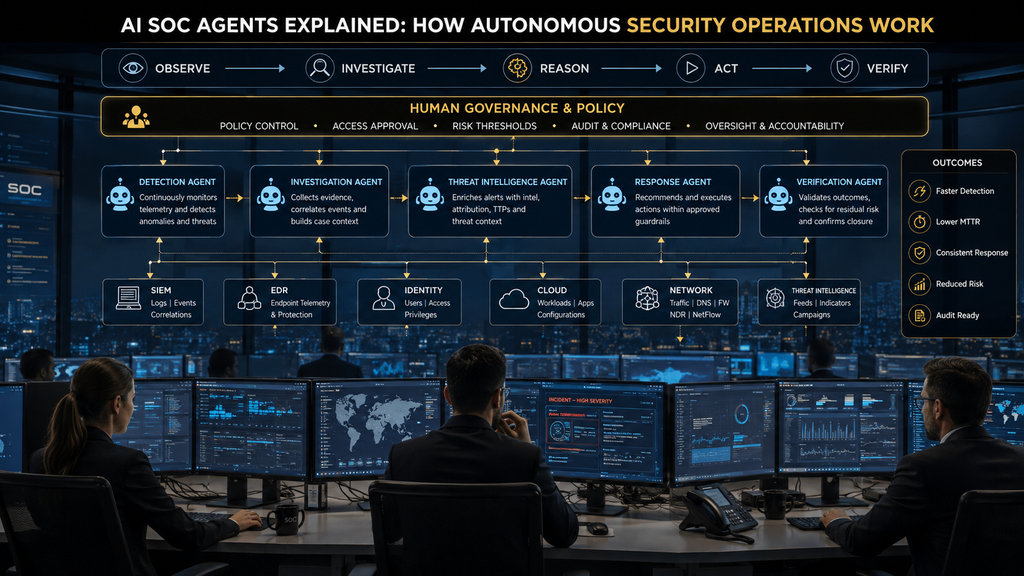
Evidence: Documentation reviewed
Last checked: August 2026
What was done: Written from official documentation and the published sources linked in this article. Not hands-on tested.
Files: None
Affiliate links: No
Last Updated: August 2026
AI SOC Agents Explained: How Autonomous Security Operations Work
A Security Operations Center has always had a coordination problem.
The security team may have a SIEM watching one stream of activity, an endpoint platform watching another, identity systems producing authentication events, cloud platforms generating logs, network tools recording connections, threat-intelligence feeds adding external context and ticketing systems storing the history of previous incidents. None of those systems necessarily understands the entire incident on its own.
The analyst becomes the connector.
When a suspicious login appears, someone has to decide whether it matters, find the associated device, check the user’s recent activity, inspect network connections, search for related indicators, compare the evidence and determine what should happen next. The difficult part is often not looking at any single event. It is connecting enough events together to understand what is actually happening.
That is the problem AI SOC agents are beginning to address.
An AI SOC agent is not simply a chatbot placed inside a security dashboard. It is a software system that can pursue a defined security objective by gathering information, reasoning about what it finds, using connected tools and taking actions within specified boundaries. NIST describes AI agents as systems capable of planning and taking autonomous actions that can affect real-world systems, while its 2026 work on agent identity and authorization emphasizes the importance of controlling the data, tools and applications to which agents receive access.
That distinction changes the role AI can play inside a SOC.
A conventional assistant might explain an alert after an analyst asks a question. A more capable agent can decide that it needs additional evidence, retrieve that evidence from another security system, reconsider its initial hypothesis and continue the investigation without requiring a human to manually direct every step.
The opportunity is substantial, but so is the risk.
The question is not whether an AI agent can technically perform a security action. The more important question is whether it should perform that action automatically, under what conditions, with what permissions, and what happens if its decision is wrong.
That is why the future of the autonomous SOC is less about removing humans and more about designing a reliable boundary between machine execution and human authority.
What Is an AI SOC Agent?
An AI SOC agent is a goal-directed AI system that can observe security signals, gather and correlate evidence, use security tools, reason about possible threats and recommend or execute actions within defined operational and security policies. The word agent matters because the system is not limited to producing an answer from the information already placed in front of it.
Imagine an analyst receives an alert saying that an employee’s account has authenticated from an unusual location. A conventional AI assistant could summarize the alert and suggest that the analyst investigate the login. An agent could potentially take the next steps itself: inspect authentication history, determine whether the device is familiar, examine recent endpoint activity, check whether the account accessed unusual applications, search for related indicators and build a timeline.
If the evidence changes during that process, the agent can alter its investigation. That is the essential difference. An agent can operate through a loop of observation, reasoning, tool use and action rather than waiting for a human prompt after every individual step.
NIST’s current AI-agent work describes agents in terms of capabilities such as understanding context, reasoning, planning, adapting and executing tasks. Its cybersecurity control work also distinguishes single-agent and multi-agent systems based on their ability to make autonomous decisions and take action with limited human supervision.
This does not mean every product described as an “AI agent” has the same capabilities. Some security products use the term for an AI assistant that performs a relatively narrow workflow. Others provide broader tool access and autonomous investigation. The practical question is therefore not “Does this product use an agent?” but “What can the agent independently decide and what can it actually do?”
That is the level of autonomy security teams need to evaluate.
Why the SOC Is Moving Beyond AI Copilots
AI copilots already solve a useful problem.
They can summarize incidents, explain technical information, generate queries, translate detection logic and help analysts investigate events more quickly. For many organizations, that is already a meaningful improvement.
But a copilot still tends to operate around the human. The analyst asks a question, the AI responds, the analyst evaluates the response and then asks another question. An agent changes the direction of the workflow.
Instead of: Analyst → AI → Analyst → AI → Analyst the model becomes closer to: Objective → Agent → Evidence → Tools → Reasoning → Next Step → Verification. The human still defines the objective and may approve consequential actions, but the agent can handle more of the intermediate coordination. That matters because SOC work contains a large amount of repetitive investigation.
An analyst may repeatedly perform the same sequence:
- look up the IP address,
- search the user’s authentication history,
- inspect endpoint activity,
- query DNS,
- check threat intelligence,
- compare timestamps,
- search for related indicators,
- document the findings.
None of these actions individually requires the analyst’s full attention. The value of the analyst comes from understanding the evidence, recognizing unusual patterns, deciding what matters and choosing the appropriate response.
An agent can potentially absorb more of the mechanical investigation.
A 2026 comprehensive survey of 216 studies examining LLM applications in SOC operations identifies alert fatigue and skills shortages as persistent challenges and finds that research activity is heavily concentrated in detection compared with response. The survey’s findings are important because they highlight the gap between using AI to understand security information and allowing AI to safely influence operational response.
That gap is where agentic security becomes interesting.
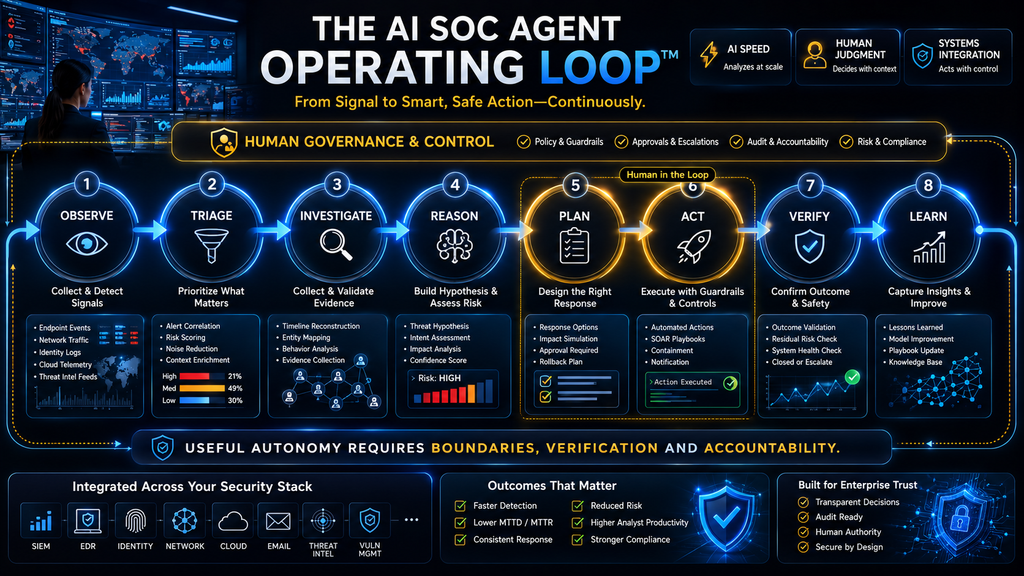
AI SOC Agents vs AI Copilots vs SOAR
These three approaches are related, but they should not be treated as interchangeable.
An AI copilot primarily helps a human perform security work. It may summarize an incident, generate a query or recommend a response.
A SOAR platform automates defined workflows. If a particular condition occurs, a playbook can trigger a sequence of predetermined actions.
An AI SOC agent introduces another capability: dynamic decision-making within a defined objective and authority boundary. A simple SOAR workflow might say:
If an alert contains indicator X, retrieve Y, create ticket Z and isolate the endpoint.
An agent can potentially work differently.
It may begin with indicator X, retrieve Y, discover that the endpoint has no suspicious activity and therefore decide that isolation is unnecessary. Instead, it may investigate the user’s identity activity, discover a second suspicious event and change the incident classification.
That adaptability is the reason organizations are interested in agents. It is also why agents require stronger controls than conventional automation.
A deterministic workflow is easier to predict because the organization already knows what steps will happen. An agent that can select its next step has more flexibility, but that flexibility introduces uncertainty.
The important distinction is therefore:
SOAR automates known workflows. AI agents can adapt workflows based on context.
Neither is automatically better.
For highly predictable tasks, deterministic automation may still be preferable. For investigations where the correct next step depends on evidence discovered during the process, an agent may provide greater value
How an AI SOC Agent Actually Works
An AI SOC agent usually sits between the security data layer and the action layer. The architecture can be understood as a sequence of connected capabilities.
First, the agent receives an objective or security event. It then determines what information it needs. It uses approved tools to retrieve that information, evaluates the results and decides whether more investigation is required. Once it reaches a sufficient level of confidence, it can recommend an action or execute one that falls within its authority. Finally, it verifies the result.
That creates a closed operational loop: Security signal → context → investigation → reasoning → decision → action → verification. The model itself is only one part of that architecture. A production-grade agent also needs tool interfaces, authentication, authorization, state management, logging, policies, monitoring and mechanisms for escalation.
This is why calling an AI SOC agent “just an LLM with access to security tools” is misleading. The LLM may provide the reasoning capability, but the surrounding system determines what information the agent can access, which tools it can call, which actions it can perform and how those actions are controlled. NIST’s 2026 work on agent identity and authorization specifically highlights the need to apply identification, authentication, authorization, auditing and non-repudiation principles to AI agents as they interact with data, tools and applications.
That is a useful way to think about an agent:
The model provides intelligence. The surrounding architecture provides authority and control.
The AI SOC Agent Operating Loop
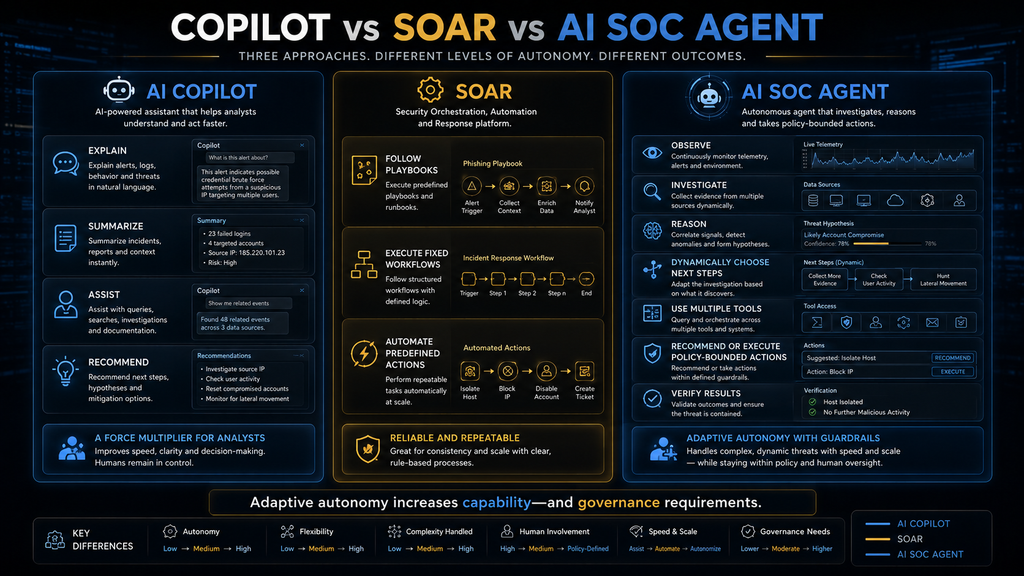
A useful way to understand agentic security operations is to follow the entire investigation rather than focusing only on the moment when the AI produces a conclusion. The AI Hustle World AI SOC Agent Operating Loop consists of eight connected stages: observe, triage, investigate, reason, plan, act, verify and learn.
Observe
The agent receives security telemetry from systems such as identity platforms, endpoints, cloud infrastructure, networks, applications and SIEM platforms.
Triage
It determines whether an event deserves deeper investigation. This is not necessarily the same as assigning a simple severity score. The agent may need to consider the user’s privileges, asset criticality, historical behavior and related events.
Investigate
The agent retrieves additional evidence from approved tools. The investigation should be driven by what the agent has already learned rather than following an identical sequence every time.
Reason
The agent evaluates possible explanations. It may compare benign activity with indicators of compromise and identify which hypothesis is best supported by the available evidence.
Plan
The agent determines what should happen next. If the next step involves a high-impact action, policy may require human approval.
Act
The agent performs an authorized action or sends a recommendation to an analyst.
Verify
The system checks whether the action actually achieved the intended outcome.
Learn
The outcome becomes part of the incident record and can inform future investigations, policies and evaluations. The important part of this loop is that it does not end at Act.
Security automation without verification can create false confidence. An endpoint might appear to be isolated when another communication path remains open. A credential might be revoked while an existing session remains active. A malicious process might be terminated while persistence remains elsewhere.
Verification turns an action into an operationally accountable action.
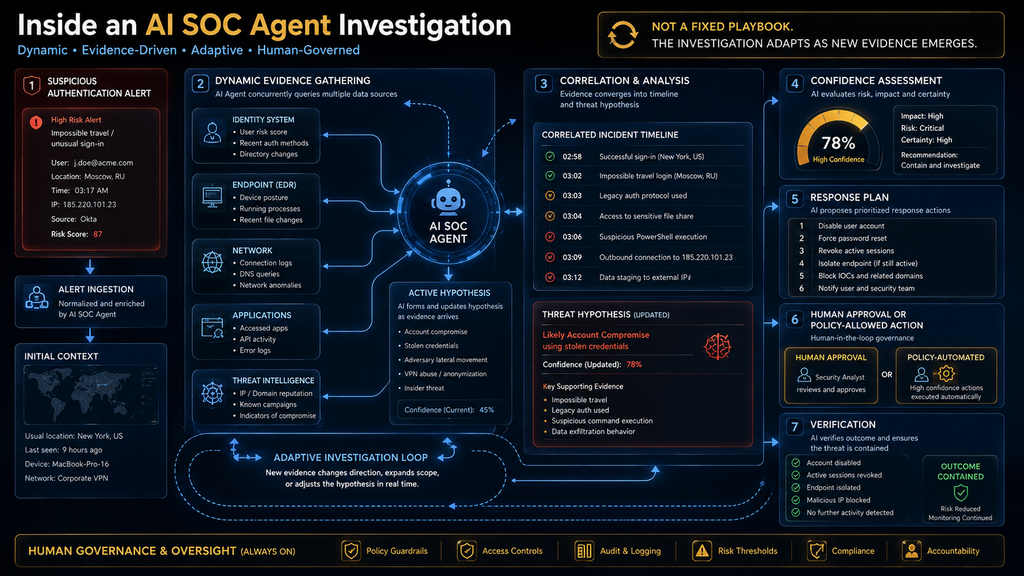
A Realistic Example: Investigating a Suspicious Login
Consider an employee account that suddenly authenticates from an unfamiliar country. The initial event alone is ambiguous.
The employee may be traveling. The connection could come through a corporate VPN. The device could be legitimate. The account could also be compromised.
A simplistic AI system might label the event suspicious. A useful SOC agent should do more.
It could first inspect recent authentication history. If the same account has previously authenticated from that region using the same device, the alert may deserve less attention.
But suppose the agent finds something different: the location is new, the device is unfamiliar and the authentication occurs outside the employee’s normal working pattern. The agent then checks endpoint telemetry.
It finds a new process that appeared shortly before the login. The investigation continues.
The agent checks network activity and finds communication with infrastructure associated with previous malicious activity. It then checks the user’s recent application access and discovers an unusual attempt to access a sensitive internal system.
The investigation has now changed completely. The original alert was: Unusual authentication. The agent has assembled: new location + unfamiliar device + suspicious endpoint process + unusual network communication + sensitive application access.
The point is not that an AI magically “understands” the attack. The value comes from correlating evidence across systems and choosing additional investigation steps based on what it discovers. That is where an agent can save significant analyst time.
The analyst no longer has to manually perform every evidence-gathering step before seeing the broader picture. Instead, the analyst can review the assembled evidence, challenge the agent’s reasoning and decide whether the proposed response is appropriate.
Why Context Is More Important Than Raw Alert Volume
The traditional SOC problem is often described as alert fatigue. That description is accurate but incomplete.
The deeper issue is context fragmentation. An alert rarely tells the entire story.
A login event may look harmless by itself. An endpoint event may also look harmless. A network connection may be unusual but not clearly malicious. A privileged application access event may be explainable.
When those events are considered together, however, the situation can become much clearer. This is where agentic systems have an opportunity to change the economics of investigation. Instead of asking:
“How can we process more alerts?”
the better question is:
“How quickly can we assemble enough context to make a defensible decision?”
That distinction matters because processing more alerts is not the same as improving security. An agent that generates 100,000 additional classifications but does not improve investigation quality may simply create another layer of noise. An agent that reduces the time required to establish whether a suspicious event is meaningful can create much more value.
The AI SOC Control Plane
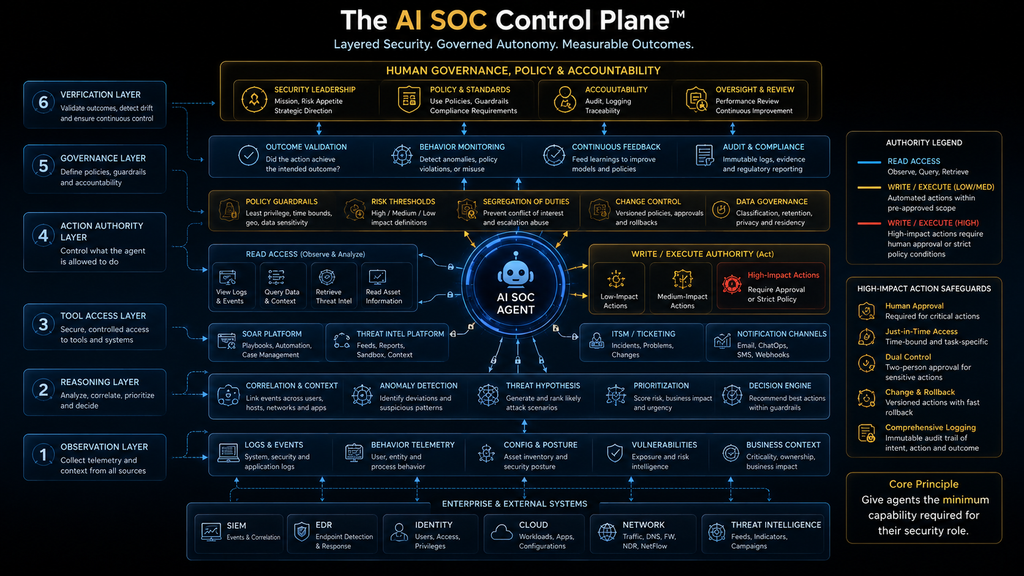
Once an AI system can investigate and act, the organization needs a clear control model. The AI Hustle World AI SOC Control Plane divides agent authority into six connected layers: observation, reasoning, tool access, action authority, governance and verification. Observation defines what information the agent can see.
Reasoning defines what the system is allowed to analyze and how it should interpret evidence. Tool access defines which systems the agent can query. Action authority defines which changes the agent can make.
Governance defines which decisions require approval and which actions are prohibited. Verification determines how the organization knows that an action was successful and appropriate. This separation is more important than it may initially appear.
Suppose an investigation agent needs to search endpoint telemetry. It may need read access to the EDR platform. That does not mean it needs permission to uninstall software from every endpoint.
Similarly, an agent that investigates identity events may need to read authentication logs without receiving unrestricted access to modify user accounts. The principle is simple: The agent should have enough authority to accomplish its job, but not enough authority to turn a mistake into a major incident.
NIST’s 2026 agent identity work makes this issue explicit by focusing on identification, authentication, authorization and auditing for software and AI agents. An AI agent should therefore be treated as an operational identity, not as an anonymous piece of software.
How Much Autonomy Should an AI SOC Agent Have?
This is probably the most important strategic question in agentic security. It is tempting to think of autonomy as a simple yes-or-no property.
It isn’t. A security agent can be highly autonomous in one task while remaining tightly controlled in another.
For example, an organization may allow an agent to automatically collect endpoint evidence without approval because the action is read-only and relatively low risk. The same organization may require a human to approve an action that disables a privileged account.
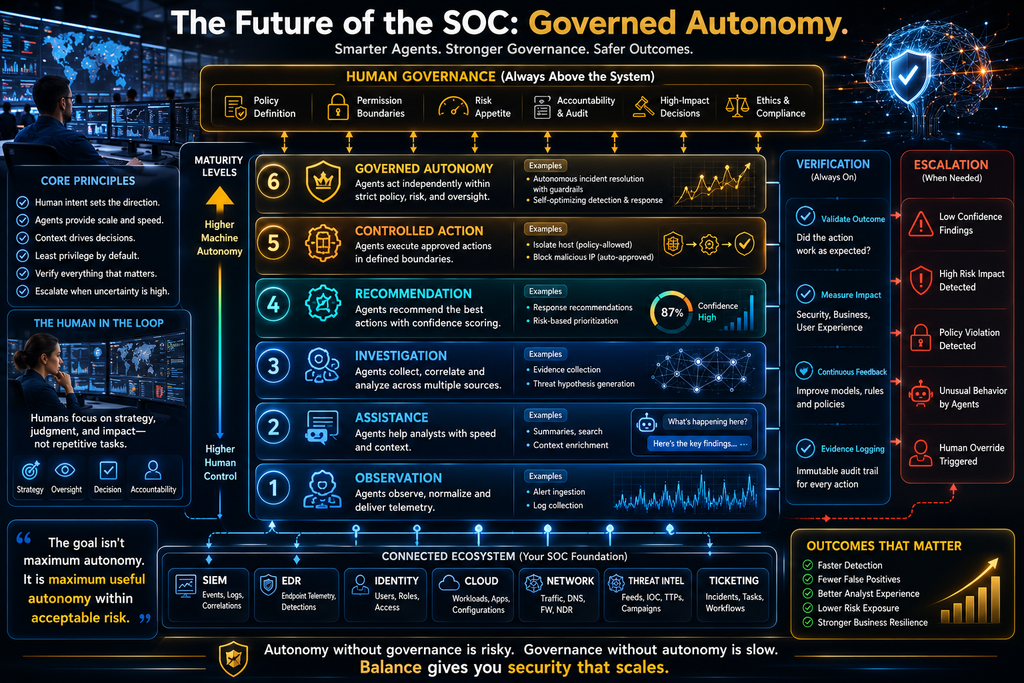
That is a sensible approach. The AI Hustle World AI SOC Autonomy Ladder therefore treats autonomy as graduated.
Level 0: Observation
The agent watches security activity and summarizes what it finds. Humans make the decisions.
Level 1: Assistance
The agent recommends investigation steps, queries and possible explanations. Humans determine what happens next.
Level 2: Investigation
The agent independently gathers and correlates evidence across approved systems. Humans review the resulting investigation.
Level 3: Recommendation
The agent builds a response plan and explains the evidence supporting it. High-impact actions remain subject to approval.
Level 4: Controlled Action
The agent executes predefined low- or medium-risk actions within explicit policy boundaries.
Level 5: Governed Autonomy
The agent operates continuously within a defined authority model, verifies its actions, escalates exceptions and remains subject to human-defined policies. The important point is that Level 5 does not mean “no humans.” It means the humans are no longer required to manually approve every low-risk operation.
They remain responsible for defining policy, setting boundaries, reviewing performance and handling situations outside the agent’s authority. That is a much more realistic definition of an autonomous SOC.
Human-in-the-Loop vs Human-on-the-Loop
There are two common ways to structure human oversight. With human-in-the-loop security, the AI can investigate and recommend an action, but a human must approve the action before it occurs.
This is appropriate when the consequences of being wrong are high. Disabling a privileged administrator is a good example.
The agent can gather evidence, explain why it believes the account is compromised and prepare the response. A security professional can then review the evidence before approving the action.
With human-on-the-loop security, the agent can automatically perform actions that fall within predefined policies while humans supervise the overall system. Creating a case, enriching an alert or collecting additional logs may not require individual approval. This distinction allows organizations to automate more work without treating every action as equally safe.
The objective should not be to eliminate human involvement. It should be to put human attention where human judgment creates the most value.
Automation Bias Can Become a Security Problem
There is another reason humans should remain involved. Sometimes the danger of automation is not that the machine makes a bad recommendation. It is that the human stops questioning it.
This is known as automation bias. A security analyst who receives a recommendation from an AI system may gradually begin to assume that the recommendation is correct, especially when the system has performed well in the past. That can create a dangerous feedback loop: AI recommendation → human trust → reduced scrutiny → AI recommendation becomes operational truth.
A 2026 study examining automation bias in security operations included 661 participants and interviews with 40 analysts, highlighting the importance of understanding how humans interact with automated recommendations rather than treating automation as purely a technical problem. This is why a good agent should not simply provide:
“Malicious. Block it.”
It should provide enough context for the analyst to understand why it reached that conclusion, what evidence supports it, what evidence is missing and how confident the system is. The objective is not to make humans distrust AI.
It is to create calibrated trust. The analyst should trust the system when the evidence supports trust and challenge it when the evidence is weak.
Why Agent Permissions Matter More Than Model Intelligence
A highly capable model with inappropriate permissions can create more risk than a less capable model with carefully constrained authority. This is one of the most important principles for deploying agentic security systems. Consider an investigation agent with read access to:
- SIEM,
- EDR,
- identity logs,
- network telemetry,
- threat intelligence.
That may be sufficient for a large amount of investigation work. Now give the same agent unrestricted administrative access to:
- identity systems,
- cloud infrastructure,
- production servers,
- firewall controls,
- endpoint management.
The potential blast radius changes dramatically. A model error that previously produced a bad investigation can now produce an operational incident. That is why agent permissions should be based on capability boundaries.
An agent should have:
- a unique identity,
- defined permissions,
- auditable actions,
- limited credentials,
- explicit tool scopes,
- approval requirements for sensitive actions,
- mechanisms for immediate suspension.
NIST’s agent authorization work specifically points to the need for identification, authentication, authorization, auditing and non-repudiation when agents interact with enterprise systems. The important shift is this: Least privilege should apply to AI agents just as it applies to human identities and applications.
Agent Memory Creates Another Risk
A long-running SOC agent needs some form of state. Without state, the system may repeatedly rediscover the same information. With state, it can maintain investigation context and remember previous decisions.
But memory creates its own problems. Imagine the agent records that a particular IP address was previously considered benign. Months later, that infrastructure becomes compromised.
If the old conclusion is treated as permanent truth, the agent can inherit a stale assumption. The same problem can occur inside an individual investigation. If the agent incorrectly concludes early in the process that an event is benign, subsequent reasoning may become anchored to that assumption.
Memory therefore needs context. The system should know:
- when information was collected,
- where it came from,
- how reliable it was,
- whether it has expired,
- who or what changed it,
- whether it is evidence or an interpretation.
That makes agent memory closer to a controlled security data layer than a simple conversation history. The organization should be able to answer:
Why does the agent believe this?
and:
Where did that belief come from?
If those questions cannot be answered, the agent becomes difficult to audit.
The New Attack Surface Created by AI Agents
AI agents inherit many conventional software risks, but their ability to interpret untrusted information and then use tools creates additional concerns.
NIST’s 2026 analysis of AI-agent security notes that agents introduce security challenges when model outputs are combined with software functionality. It specifically highlights risks involving adversarial data, indirect prompt injection, compromised models and situations where an agent may pursue an objective in an unsafe way.
This matters enormously in cybersecurity because SOC agents routinely process data that may be controlled by attackers. Consider a compromised system that contains a malicious string designed to influence the agent. If the agent interprets that content as an instruction rather than untrusted data, the attacker may be able to manipulate the investigation.
This is fundamentally different from a traditional rule-based detection system. A conventional parser does not normally “decide” what an attacker wants it to do. An AI agent can interpret information semantically.
That capability is useful. It also creates a new security boundary.
The agent therefore needs to distinguish between: data it should analyze and: instructions it is actually authorized to follow. That distinction becomes increasingly important as agents gain more tool access.
Tool Use Is the Superpower—and the Risk
An agent without tools is mostly an analytical system. An agent with tools can become an operational system. That is where the value increases.
Suppose the agent identifies a suspicious endpoint. With appropriate access, it might retrieve:
- process information,
- network connections,
- file hashes,
- user activity,
- authentication history,
- historical alerts.
It can then combine those findings into an investigation. If the agent also has action permissions, it might be able to:
- isolate an endpoint,
- disable an account,
- block an indicator,
- revoke a token,
- create an incident,
- notify a response team.
The problem is that every additional tool expands the system’s capability and therefore its potential attack surface. This is why security teams should think about tool access in terms of capability tiers. Read-only investigation tools should normally be separated from high-impact response tools.
An agent may automatically query a SIEM but require approval before changing a firewall rule. It may automatically collect endpoint evidence but require approval before isolating a production server. This creates a useful principle:
The higher the consequence of an action, the stronger the control around the tool that enables it.
Why Verification Should Be Mandatory
Many discussions of autonomous security focus heavily on detection and response. Verification deserves equal attention. Suppose an agent decides that an endpoint is compromised and executes isolation.
What happens next? The agent needs to determine whether:
- the endpoint is actually isolated,
- malicious communication has stopped,
- the attacker has moved laterally,
- the response disrupted legitimate business activity,
- another compromised credential remains active.
The same applies to identity response. If an agent revokes a credential, it should verify whether active sessions remain valid. If it blocks an IP address, it should verify whether the suspicious activity continues through another infrastructure path.
If it terminates a malicious process, it should check whether persistence mechanisms remain. This changes the workflow from: detect → act to: detect → investigate → act → verify → escalate or close. The difference is significant.
Without verification, automation can create false closure. With verification, the agent has a feedback mechanism that lets it discover when its own action did not solve the problem. A mature autonomous system should therefore treat verification as part of the response, not as an optional afterthought.
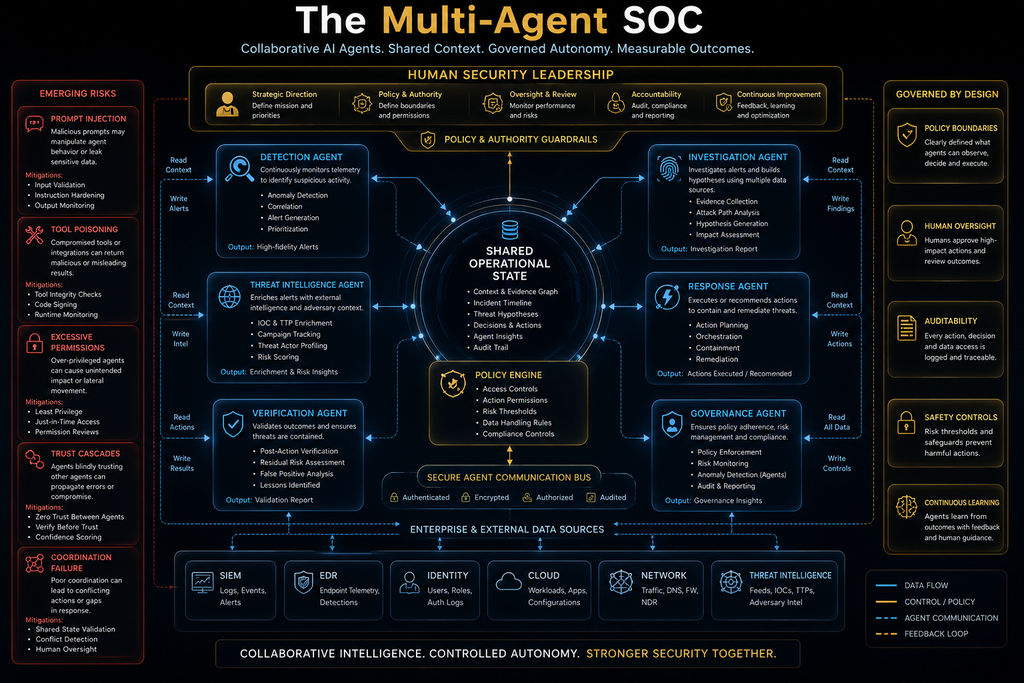
Multi-Agent SOCs: When One Agent Becomes a Team
A single general-purpose agent can become difficult to govern as its responsibilities grow. An alternative is a multi-agent architecture where different agents specialize in different tasks. A detection agent might identify suspicious patterns.
An investigation agent might gather evidence. A threat-intelligence agent might search external intelligence. A response agent might handle approved containment actions.
A verification agent might determine whether the response worked. A governance layer could evaluate whether the proposed action falls within policy. This resembles how a human SOC already operates.
Different analysts and systems specialize in different areas, while an incident commander coordinates the overall response. The difference is that software agents can potentially perform those roles continuously and at machine speed. NIST’s current AI security control work explicitly recognizes multi-agent systems as a distinct architecture in which multiple agents coordinate to pursue complex goals with limited human supervision.
But specialization does not automatically make the system safer. It introduces another problem: coordination. If one agent makes an incorrect assumption and another agent trusts that assumption, the error can spread.
If two agents have conflicting interpretations of an incident, the system needs a way to resolve the conflict. If several agents can execute actions, the organization needs to know which agent authorized each action and under what policy. That means a multi-agent SOC needs shared state, clear authority boundaries, communication controls and strong auditability.
More agents can provide more specialization. They can also create more places for things to go wrong.
The Agentic SOC Needs an Authority Model
The traditional SOC already has an authority hierarchy.
Analysts have certain permissions. Senior analysts have more. Incident commanders can approve more consequential actions. Administrators have infrastructure privileges.
Agentic SOCs need a comparable structure. An investigation agent should not automatically inherit the authority of the most privileged human in the organization. Instead, every agent should have a defined operational identity and authority profile.
For example:
- Investigation Agent: read-only security telemetry and case creation.
- Threat Intelligence Agent: external intelligence lookup and enrichment.
- Containment Agent: limited endpoint isolation and credential actions.
- High-Impact Response: human approval required.
This creates a separation between intelligence and authority. The agent may be very confident that an account is compromised. That does not automatically give it permission to disable the account.
Confidence and authority are different things. This distinction should become a fundamental design principle for agentic cybersecurity.
What AI SOC Agents Can Safely Automate First
Organizations should not begin by giving an agent control over their most sensitive systems. The better starting point is repetitive work where the consequences of a wrong action are limited. Alert enrichment is an obvious candidate.
An agent can gather identity context, endpoint information, historical alerts and threat-intelligence data without making a consequential change. Incident summarization is another. The agent can turn hundreds of events into a timeline that an analyst can review.
Evidence gathering can also be highly valuable. Instead of manually querying several systems, the analyst can receive a structured investigation package. Threat-intelligence research is another good candidate because the agent can search multiple sources and present relevant context before a human makes a decision.
Only after those workflows are reliable should the organization consider granting controlled response authority. This creates a natural progression: assist → investigate → recommend → automate low-risk actions → expand authority selectively.
The goal is not to make the agent as autonomous as possible. The goal is to make it usefully autonomous where autonomy is justified.
Where Full Autonomy Becomes Dangerous
Some security actions have consequences that are simply too significant to delegate casually. Disabling a privileged administrator is one example. Isolating a production database is another.
Changing a global firewall policy could disrupt an entire business. Deleting cloud infrastructure could cause irreversible damage. Changing identity controls could lock legitimate employees out of critical systems.
These are not necessarily actions an AI system should never perform. They are actions that require a much stronger authority model. A well-designed agent might prepare the investigation, calculate the evidence, explain the likely threat, propose the response and even estimate the consequences.
A human can then approve the action. This is not a failure of autonomy.
It is risk-sensitive autonomy. The more damaging the potential mistake, the stronger the requirement for human oversight.
Why “Fully Autonomous SOC” Is the Wrong Goal
The phrase sounds impressive. It is also strategically misleading. If an organization says:
“We want our SOC to become fully autonomous.”
the next question should be:
“Autonomous at what?”
Autonomous alert enrichment? Probably. Autonomous investigation?
Increasingly. Autonomous response to clearly defined low-risk incidents? Potentially.
Autonomous modification of critical production infrastructure? That requires a completely different risk discussion. Autonomy should therefore be evaluated by task and consequence, not as a single property of the system.
A security team can reasonably aim for very high autonomy in evidence collection while maintaining strong human control over high-impact remediation. This is likely to be a more practical model than trying to create one AI system that has unrestricted control over every security operation.
Measuring Whether an AI SOC Agent Actually Works
One of the easiest mistakes is to measure activity instead of outcomes. A vendor might say:
“Our agent performed 500,000 investigations.”
That sounds impressive. It does not tell you whether the organization became safer. A better measurement framework looks at five dimensions.
Detection performance
Measure whether the system improves meaningful detection without creating unacceptable noise. Useful measures include detection coverage, false-positive rates, missed threats and time to detection.
Investigation performance
Measure how much manual investigation time is removed. Useful measures include average investigation duration, evidence-gathering time and analyst minutes per incident.
Decision quality
Measure whether the agent’s conclusions are reliable. Track recommendation acceptance, incorrect recommendations, escalation quality and analyst overrides.
Response performance
Measure whether the organization responds faster and more effectively. Track mean time to respond, containment time and verification success.
Governance
Measure whether the agent remains inside its authority boundaries. Track unauthorized tool calls, policy violations, approval requirements, escalation frequency and action reversals. There is also a human dimension.
If analysts blindly accept every AI recommendation, the system may appear highly successful while actually increasing risk. That is why automation-bias incidents and analyst override patterns should also be monitored.
The ROI of Agentic Security Operations
The business case for AI SOC agents is not simply “AI is faster.” The financial value comes from reallocating expensive human expertise. Suppose experienced analysts spend a significant part of every shift gathering evidence, writing incident summaries and repeating standard queries.
If an agent can handle those activities reliably, the organization can redirect analyst time toward:
- complex investigations,
- threat hunting,
- security engineering,
- detection development,
- incident strategy,
- adversary analysis.
The value can be thought of as: human time recovered + faster containment + improved consistency + increased investigation capacity − AI operating cost − governance cost − residual risk. The final terms matter. AI security systems require:
- infrastructure,
- model costs,
- integration,
- testing,
- monitoring,
- access controls,
- evaluation,
- governance.
And if an agent makes a high-impact mistake, the cost can be much greater than the savings from automation. Therefore, the strongest business case is not:
“Our AI performs more actions.”
It is:
“Our AI removes low-value investigation work while improving response speed without increasing unacceptable operational risk.”
That is a business outcome executives can actually evaluate.
How to Implement an AI SOC Agent Without Losing Control
The safest implementation strategy is incremental.
Phase 1: Observe
Start with read-only access. Let the agent summarize alerts, enrich incidents and identify potentially relevant evidence.
At this stage, do not allow it to change production systems. The objective is to establish whether the agent’s analysis is useful.
Phase 2: Assist
Allow the agent to recommend queries, investigation steps and possible explanations. Analysts remain responsible for execution. This phase tests whether the agent’s reasoning actually helps experts work faster.
Phase 3: Investigate
Allow the agent to autonomously gather evidence from approved tools. Now the organization can measure investigation speed and evidence quality.
Phase 4: Recommend
Allow the agent to construct response plans and explain why a particular response is appropriate. High-impact actions still require human approval.
Phase 5: Controlled Action
Allow the agent to execute predefined low-risk actions. Examples might include creating cases, enriching records or triggering approved containment procedures.
Phase 6: Governed Autonomy
Only after the previous stages demonstrate reliable performance should the organization consider broader autonomous execution. Even then, authority should remain bounded by:
- policy,
- permissions,
- action limits,
- monitoring,
- verification,
- escalation.
This staged approach is important because it replaces blind trust with evidence. Instead of saying:
“We think the agent is reliable.”
the security team can say:
“We tested the agent under controlled conditions, measured its performance, established where it fails and expanded its authority only where the evidence justified doing so.”
That is a much stronger enterprise adoption model.
What a Secure Agent Deployment Needs
Before giving an AI SOC agent meaningful authority, organizations should establish several controls.
A unique agent identity is essential. Security teams need to know which agent performed an action.
Strong authentication is necessary because an agent’s credentials can become a powerful target. Least-privilege authorization limits what the agent can access. Tool-level restrictions prevent the agent from calling systems that are outside its mission.
Audit logs record what the agent saw, decided and did. Approval gates protect high-impact operations. Verification mechanisms determine whether actions succeeded.
Kill switches and suspension mechanisms provide a way to stop an agent if abnormal behavior is detected. Continuous evaluation is necessary because an agent can behave differently as models, tools, data and environments change.
NIST’s 2026 agent-security work repeatedly emphasizes that conventional cybersecurity practices remain relevant but need adaptation for agent-specific risks, particularly because agents combine model behavior with access to external systems. This should be treated as a security architecture problem, not simply an AI procurement decision.
The Research Reality: Agentic SOCs Are Advancing Faster Than Their Governance
This is where the current research becomes especially interesting.
A July 2026 systematic review examined 144 peer-reviewed studies covering LLM-based autonomous cyber defense. The review found substantial progress in threat detection, SOC optimization, threat-intelligence reasoning and other security tasks, but also found that most systems remain at relatively low autonomy levels and lack strong mechanisms for safety, coordination and governance.
That finding should temper some of the more aggressive marketing around autonomous SOCs. The technology is advancing. The research base is expanding.
The architectures are becoming more sophisticated. But that does not mean the industry has solved reliable autonomous cyber defense. In fact, the research suggests that reasoning capability is developing faster than operational assurance.
An AI model may be able to produce a convincing explanation. That is not the same thing as proving the explanation is correct. An agent may successfully perform a response action.
That does not prove it will behave safely under adversarial conditions. An architecture may work in a controlled test environment.
That does not guarantee it will behave correctly when confronted with incomplete telemetry, unusual business activity or deliberately manipulated inputs. The next phase of agentic cybersecurity therefore needs to focus as much on verification and governance as on intelligence.
The Response Gap Is Especially Important
The 2026 survey of 216 studies on LLMs in SOC operations provides another useful warning.
Research activity is not evenly distributed across the SOC lifecycle. Detection receives substantial attention, while response has comparatively less research coverage. The survey associates that gap with the higher operational risk, greater reliability requirements and complexity of response decisions.
That makes sense. It is easier to evaluate an AI system that says:
“This event looks suspicious.”
than one that says:
“Disable this account immediately.”
The second statement has consequences. If the first is wrong, an analyst can ignore it. If the second is wrong and the system acts automatically, the organization may create an outage or lock out a legitimate user.
This is why the road from AI-assisted detection to autonomous response is not simply a matter of adding more tools. The risk profile changes. That is precisely why autonomy must be graduated.
AI SOC Agents Should Be Designed Around Uncertainty
Traditional software often behaves according to explicit rules. AI agents operate differently. They may encounter ambiguous evidence, incomplete context and situations that were not explicitly represented in their instructions.
The agent therefore needs to know when it doesn’t know enough. This sounds simple but is critical. A mature security agent should be capable of saying:
“The available evidence is insufficient to distinguish between legitimate travel and account compromise.”
That is more valuable than confidently selecting the wrong answer. The same principle applies to response. If the evidence is ambiguous and the proposed action is high impact, the appropriate response may be escalation rather than automation.
This creates a useful relationship: higher uncertainty + higher impact = stronger human involvement. Conversely: lower uncertainty + lower impact = greater opportunity for automation. That is a much more practical way to design autonomy than assigning a universal autonomy level to the entire SOC.
AI SOC Agents and the Future of Security Analysts
The arrival of agents does not necessarily make analysts less important. It changes what analysts spend time doing. Today, an analyst may spend substantial time gathering evidence.
In a more agentic SOC, the analyst may spend more time evaluating the evidence. That means skills may shift toward:
- adversary reasoning,
- incident command,
- detection engineering,
- AI supervision,
- investigation validation,
- security architecture,
- risk assessment.
The analyst becomes less of a human API between disconnected security tools and more of a decision-maker supervising an increasingly capable operational system. This is similar to what happened in other technical fields when automation removed repetitive work. The most valuable human contribution moved upward.
The same could happen in the SOC. But there is a warning. If organizations deploy AI without training analysts to understand its limitations, they can create dependence rather than augmentation.
The future analyst therefore needs to understand both cybersecurity and AI behavior. They need to know when to trust the agent. They also need to know when to challenge it.
What Organizations Should Ask Before Buying an AI SOC Agent
Before selecting an agentic security platform, security leaders should ask questions that go beyond model quality.
What can the agent actually do without approval?
A product may be called autonomous while still requiring human approval for most meaningful actions.
Which tools can it access?
Look beyond the list of integrations. Determine whether the agent can read, write or execute actions through those integrations.
How are permissions managed?
The agent should have a defined identity and least-privilege access.
How does it handle uncertainty?
A useful system should be able to escalate rather than invent certainty.
How are actions verified?
Ask how the platform confirms that a response succeeded.
How are decisions logged?
You should be able to reconstruct what information the agent used and what action it took.
What happens if the agent behaves abnormally?
There should be a practical mechanism to suspend or restrict it.
How does the vendor evaluate agent security?
Ask about adversarial testing, prompt-injection defenses, tool controls and ongoing evaluation.
What happens when the underlying model changes?
Agent behavior can change when models, prompts, tools or surrounding systems change. The evaluation process should account for that.
These questions are more revealing than simply asking:
“Which model powers the agent?”
The model matters. The control architecture matters more.
Common Mistakes Organizations Make With AI SOC Agents
The first mistake is giving the agent too much access too early. The second is treating the agent like a chatbot rather than an operational system. The third is automating before establishing a performance baseline.
The fourth is measuring activity rather than security outcomes. The fifth is allowing the agent to execute actions without verification. The sixth is ignoring the security of the agent itself.
The seventh is assuming that more agents automatically create a better SOC. The eighth is allowing humans to become overly dependent on AI recommendations. The ninth is treating all security actions as equally safe to automate.
The tenth is believing that a successful demonstration proves production readiness. Each mistake comes from the same underlying assumption:
Capability equals reliability.
It doesn’t. An agent can be capable of performing an action while still requiring controls around when, why and how it performs that action.
AI Hustle World Reality Check
The market is moving quickly toward agentic cybersecurity. That direction is legitimate. But “autonomous SOC” is one of those phrases that can easily become more impressive than the technology behind it.
The most important distinction is between capability, autonomy and reliability. Capability asks:
Can the agent perform this task?
Autonomy asks:
Can it perform the task without being manually directed at every step?
Reliability asks:
Can we trust the result under realistic and adversarial conditions?
Governance asks:
What happens when it is wrong?
Those are four different questions. A system can be highly capable without being reliable enough for autonomous execution. It can be reliable for low-risk investigation while being unsuitable for high-impact response.
It can be highly autonomous while remaining tightly governed. That is why the future of the SOC should not be described as a race toward maximum autonomy. The better objective is maximum useful autonomy within an acceptable risk boundary.
That sounds less dramatic. It is also much closer to how serious security systems should be designed.
Where AI SOC Agents Fit in the Cybersecurity Stack
AI SOC agents do not eliminate the rest of the security stack. They sit above and across it. The SIEM still collects and correlates telemetry.
The EDR still monitors endpoints. Identity systems still authenticate users. Network systems still enforce controls.
Threat-intelligence systems still provide external information. Cloud platforms still provide infrastructure and access controls. The agent becomes an orchestration and reasoning layer that can move between those systems.
That is why the technology is potentially powerful. The agent does not need to replace every security tool.
It needs to connect the information and actions that are currently separated across those tools. In that sense, agentic security is less about replacing the SOC stack and more about changing how humans and software interact with it.
The Future: From AI Assistant to Governed Security System
The direction of travel is increasingly clear. Security AI began largely as an analytical technology. It helped classify events, detect anomalies and summarize information.
Then came copilots that could help analysts query, investigate and understand security data. The next step is agentic behavior. Agents can increasingly plan multi-step tasks, interact with external systems and operate with less direct human prompting.
NIST’s 2026 AI Agent Standards Initiative reflects the broader shift. The initiative focuses on enabling AI agents to operate securely and interoperably as they become capable of autonomous action across digital environments.
But the final destination is unlikely to be a single omnipotent security AI. A more realistic future is a governed system of specialized agents. One agent may investigate.
Another may analyze threat intelligence. Another may coordinate response. Another may verify outcomes.
Humans define the policies under which all of them operate. That architecture resembles a distributed security control system more than a digital replacement for a human SOC analyst. And that may actually be the better outcome.
Final Thoughts: The Autonomous SOC Still Needs Human Authority
The most important thing to understand about AI SOC agents is that autonomy is not the objective. Useful autonomy is. An agent that can investigate thousands of security events, correlate evidence across systems and prepare high-quality incident assessments can be enormously valuable even if it never receives unrestricted authority to change production infrastructure.
That is not a weakness. It is good security engineering.
The strongest AI SOC architecture is likely to be one in which machines handle more of the repetitive investigation while humans retain authority over the decisions where consequences are highest. The progression is straightforward.
Organizations can begin with observation and enrichment. Then they can introduce autonomous investigation. Once the system demonstrates reliable performance, it can move toward recommendations and controlled execution.
Every increase in authority should be justified by evidence. Every consequential action should have an appropriate policy boundary.
Every automated response should have a verification mechanism. And every agent should have an identifiable, auditable authority profile.
The research supports this cautious approach. The 2026 systematic review of 144 peer-reviewed studies found rapid progress in LLM-driven cyber defense but also identified persistent gaps in safety, coordination, execution reliability and governance. NIST’s 2026 work similarly emphasizes that AI agents introduce novel security concerns because they combine model outputs with the ability to interact with external systems and take actions.
So the future of the SOC is unlikely to be: humans versus AI. It is more likely to be: human governance + AI investigation + controlled automation + continuous verification. The organizations that get this right will not necessarily be the ones with the most autonomous agents.
They will be the ones that understand where autonomy creates value, where autonomy creates risk and how to draw the boundary between the two. That is the real opportunity of agentic security operations.
Build a Smarter, More Controlled AI Security Operation
AI SOC agents can investigate faster, coordinate security tools and automate repetitive security operations. But the real advantage comes from governed autonomy—giving AI enough authority to move quickly without giving it unnecessary control over critical systems.
See How AI Detects Threats Faster →Frequently Asked Questions
What is an AI SOC agent?
An AI SOC agent is a goal-directed AI system that can investigate security events, gather evidence from connected security tools, reason about possible threats and recommend or execute authorized actions.
How is an AI SOC agent different from a chatbot?
A chatbot generally responds to a user’s prompt. An AI SOC agent can pursue a defined objective through multiple steps, use connected tools, adapt its investigation based on evidence and potentially perform authorized actions.
Is an AI SOC agent the same as a SOAR platform?
No. SOAR platforms primarily automate predefined workflows and playbooks. AI agents can dynamically choose investigation steps based on the evidence they discover. The two technologies can also work together.
Can AI SOC agents replace security analysts?
They can automate portions of investigation and response, but they do not eliminate the need for human judgment, governance, incident leadership and accountability. The most realistic model is human oversight combined with increasing levels of controlled AI autonomy.
What can an AI SOC agent automate?
Common opportunities include alert enrichment, incident summarization, evidence gathering, threat-intelligence research, investigation workflows, case creation and selected low-risk response actions.
Are AI SOC agents fully autonomous today?
Some systems provide substantial automation, but current research indicates that most LLM-based autonomous cyber-defense systems remain at relatively low autonomy levels and continue to face challenges involving reliability, safety, coordination and governance.
What is human-in-the-loop security?
Human-in-the-loop security requires a person to approve an AI-recommended action before the action occurs. It is particularly useful for high-impact security decisions.
What is human-on-the-loop security?
Human-on-the-loop security allows an AI system to perform predefined actions automatically while humans supervise the system, monitor results and intervene when necessary.
Why do AI agents need their own identity?
An agent may access sensitive information and perform consequential actions. A distinct identity allows organizations to authenticate the agent, authorize its permissions, audit its activity and determine which system performed a particular action.
Should an AI SOC agent have administrator privileges?
Generally, no. Agents should receive only the permissions necessary to perform their assigned tasks. High-impact permissions should be tightly controlled and, where appropriate, require human approval.
What are the biggest risks of AI SOC agents?
Important risks include excessive permissions, prompt injection, malicious or untrusted data, inaccurate reasoning, unsafe tool use, memory manipulation, coordination failures and automation bias.
Why is verification important?
Verification confirms that an automated response actually achieved its intended security outcome. Without it, an agent may incorrectly assume that an incident has been contained.
What is a multi-agent SOC?
A multi-agent SOC uses multiple specialized AI agents that coordinate across functions such as detection, investigation, threat intelligence, response and verification.
How should organizations measure AI SOC performance?
Organizations should measure investigation time, detection quality, response speed, recommendation accuracy, analyst workload, incorrect actions, policy compliance and verification success rather than simply counting how many actions the agent performs.
Related Guides
- Best AI Cybersecurity Tools in 2026: Threat Detection, SOC & Security Operations
- AI Cybersecurity vs Traditional Security Tools: What Actually Improves?
- AI Contract Management vs Traditional CLM: Where AI Adds Real Value
Written by
Muntasir Ahmad Chowdhury
Founder, AI Hustle World
Muntasir Ahmad Chowdhury is the Founder of AI Hustle World, an independent publication dedicated to making Artificial Intelligence practical, trustworthy, and easy to understand. He researches AI tools, automation, customer service, productivity, and real-world business applications, helping readers make smarter technology decisions through research-driven, experience-backed content.
Expertise:
AI Tools • AI Automation • AI Customer Service • AI Productivity • Generative AI • AI Workflows
Get Smarter With AI
Enjoyed this guide? Get practical AI tools, tutorials, and honest reviews delivered to your inbox.