Evidence: Documentation reviewed
Last checked: September 2026
What was done: Written from official documentation and the published sources linked in this article. Not hands-on tested.
Files: None
Affiliate links: Yes
Last updated: September 2026
Digital Profit Stack AI Review: Features, Pricing & Is It Worth Buying?
What changed: Updated September 25, 2026. The vendor’s sales page, FAQ, refund policy and earnings disclaimer were re-read for this update. Statements that rested only on third-party affiliate reviews, such as upgrade prices and sales counts, were removed, and the section on the money-back guarantee was rewritten to match the vendor’s refund policy.
Affiliate Disclosure: AI Hustle World may earn a commission if you purchase Digital Profit Stack AI through one of our affiliate links. This does not change the price you pay or our evaluation. Our recommendation is based on product fit, documented functionality, pricing, limitations, alternatives, and the economics of the workflow—not the commission.
No income is promised here. Digital Profit Stack AI is software for organizing and promoting digital offers, and AI Hustle World has not verified any earnings claim about it. The vendor’s own earnings disclaimer says the product is not a passive income or get-rich-quick scheme and that its testimonials show extraordinary results that are not typical. This review treats the product as a workflow tool and does not predict sales, traffic or commissions.
Digital products are easier to create than ever. That sounds like good news, and it is. But it has created a second problem that gets much less attention: once you have products, managing and promoting them becomes increasingly fragmented.
A KDP book can live on Amazon. A printable can live on Etsy. An affiliate offer can live on someone else’s checkout page. A course can have its own platform. Your email copy sits in one tool, social posts in another, graphics somewhere else, and your product descriptions may still be scattered across spreadsheets and documents. The result is an unusual problem. You can have more products without having more marketing infrastructure.
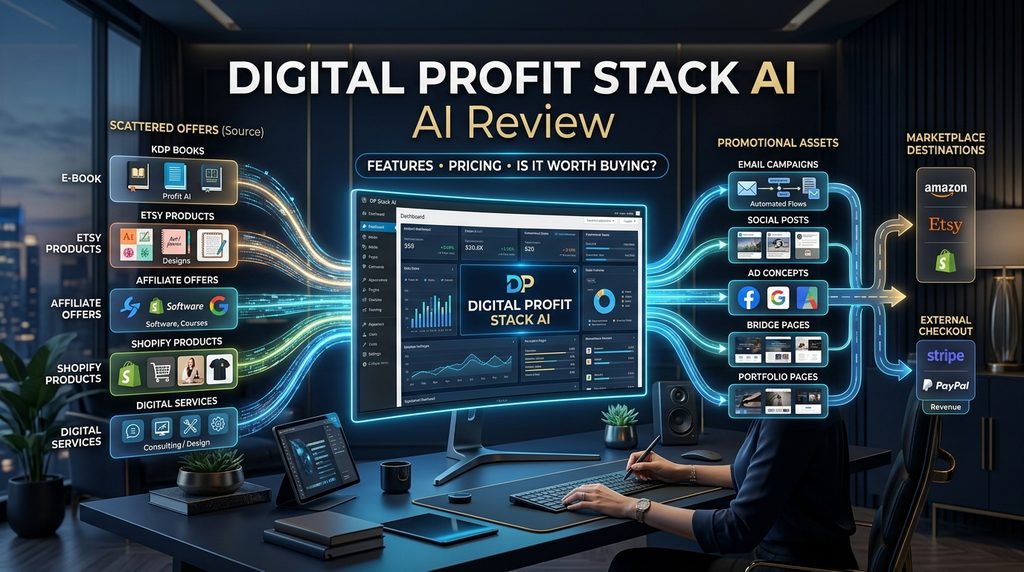
Digital Profit Stack AI approaches that problem from a different direction. Instead of being positioned simply as another AI writer, it is a self-hosted WordPress platform intended to bring digital offers into a central hub and use AI-assisted workflows to create promotional material around those offers. The vendor’s sales page describes workflows involving KDP books, Etsy, Creative Market, Shopify, WooCommerce, affiliate products, services, promotional emails, social posts, ads, pins, bridge-page copy and portfolio pages.
That sounds useful. But usefulness is not the same as value. The real question for this review is: Does Digital Profit Stack AI remove enough workflow friction to justify adding a self-hosted platform to your business? That question leads to a very different review than simply repeating the sales page.
Quick Verdict
Digital Profit Stack AI is worth considering if you already use WordPress, manage multiple digital offers, and want to centralize product information and AI-assisted promotion under infrastructure you control. It is much less compelling if you have one product, dislike WordPress maintenance, or want a completely managed SaaS experience. The strongest part of the platform is not that it can generate AI copy. Modern AI tools can already do that.
The more interesting proposition is the workflow connection: Product → product intelligence → promotional assets → portfolio/bridge page → destination That can reduce repetitive work when the same product needs to be marketed across several channels. The trade-off is equally important.
You are getting more ownership, but you are also accepting more responsibility. The system is self-hosted, so you need your own domain, WordPress hosting and a working site, and the vendor’s legal notice says you are responsible for installing, hosting, securing, backing up and operating it. Its AI functions use your own API keys, so AI usage is a separate cost. The vendor describes the commercial license as part of a paid upgrade, so check what the front-end license allows before you use the platform for clients. So my preliminary verdict is that it is a good fit for multi-product WordPress users, KDP publishers, digital sellers and operators who value ownership, and a weak fit for one-product beginners, zero-maintenance users and anyone expecting software alone to generate income.
Why This Matters. A cheap software purchase can become an expensive mistake if the underlying workflow does not match how you actually operate. Digital Profit Stack AI should therefore be evaluated as business infrastructure, not simply as an AI tool.
See What the Import-and-Promote Workflow Does
Read the offer page and check whether importing a product and generating promo assets fits how you already sell.
View Digital Profit Stack AI →Affiliate disclosure: We may earn a commission if you subscribe through this link, at no additional cost to you.
How We Researched This Guide
This review was updated from primary, publicly accessible material checked on September 25, 2026: the Digital Profit Stack AI sales page and FAQ, DFY Fortune’s written refund policy and earnings disclaimer, the checkout destination, and the product claims visible on those pages. The FTC’s Endorsement Guides Q&A and Disclosures 101 guide the affiliate disclosures, while Google’s guidance on using generative AI content informs the editorial standard. Prices, features, guarantees and upgrade descriptions are treated as vendor claims unless an independent source establishes otherwise.
AI Hustle World did not purchase and operate Digital Profit Stack AI for this review, so the article does not claim first-hand installation results, output quality, time savings or earnings. Where the article uses calculations or scenarios, they are labeled as illustrative and provide the inputs so readers can replace them with their own figures. Conflicting upgrade prices and sales counts found in third-party launch reviews were excluded because they could not be confirmed on the vendor’s current public pages.
The article’s main original contribution is the paired OFFER → ASSET → DESTINATION model and STACK-ROI measurement framework. Together, they separate what the software can influence from what it cannot: the quality of the underlying offer, the cost and usefulness of the promotional assets, the destination’s ability to convert, and the measured operating economics. The value for readers is that this source-traceable decision system turns scattered feature claims into a reproducible buying and evaluation method rather than repeating the sales page.
What Digital Profit Stack AI Actually Is
Digital Profit Stack AI is a self-hosted WordPress-based platform for organizing and promoting digital offers with AI-assisted workflows. That definition matters because calling it an “AI marketing tool” is too broad. It is not primarily trying to compete with general-purpose conversational AI. It is closer to a marketing operations hub for digital offers.
The documented workflow supports importing or adding products, organizing them inside a product library, generating promotional material, and publishing those offers through a portfolio-style WordPress environment. The vendor’s sales page describes smart import for Amazon, Etsy, Creative Market, Shopify and WooCommerce stores, along with manual entry for affiliate products, services and other offers that have no import source. That means the product makes more sense when you think about catalog management. If you have one digital product, centralization is not especially valuable.
If you have 25 products, 40 affiliate offers, several KDP books, or a mixture of products and services, the operational problem becomes different. You are no longer asking: “Can AI write this description?” You are asking: “How do I consistently turn every offer in my catalog into something that can actually be promoted?” That is the problem Digital Profit Stack AI is trying to address.
The Problem It Is Actually Solving
The traditional digital-product workflow is surprisingly fragmented. A typical creator might do something like this:
- Create a product.
- Upload it to a marketplace.
- Write the marketplace description.
- Create a website page separately.
- Write an email somewhere else.
- Create social posts in another AI tool.
- Design images in Canva.
- Create an affiliate or checkout link.
- Save everything in folders.
- Repeat the process for the next product.
None of these individual tasks is particularly difficult. The problem is the coordination cost. When you have one product, coordination is almost invisible. When you have 30 products, the same workflow becomes repetitive. When you have 100 products, it becomes an operating-system problem. This is why the traditional method exists in the first place: specialized tools are usually better at individual jobs. Marketplaces handle transactions and discovery. Email platforms handle delivery. Design tools handle graphics. AI tools handle generation. WordPress handles publishing. Specialization creates capability. But specialization also creates fragmentation. Digital Profit Stack AI is essentially attempting to trade some specialization for centralization.
Why This Matters. The value proposition becomes much stronger as the number of offers increases. The software is not necessarily valuable because it performs one task better than every specialist tool; it may be valuable because it reduces the number of disconnected steps required to repeat the entire workflow.
The Digital Profit Stack AI Workflow
The easiest way to understand the platform is to follow one product from beginning to promotion. Imagine a creator has a digital planner listed on Etsy. Normally, the planner has:
- a title
- description
- images
- product URL
- price
- audience
- benefits
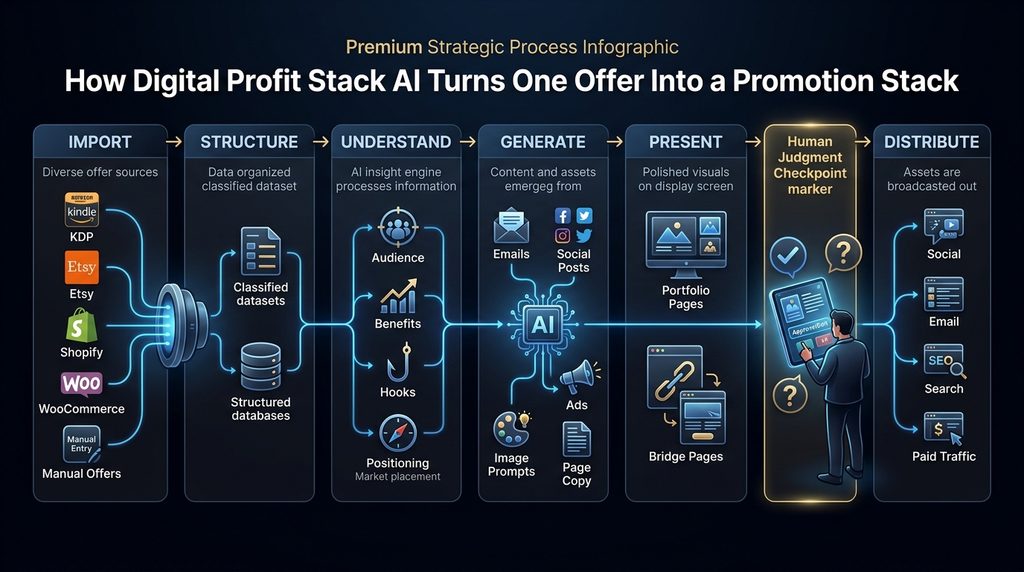
But those pieces are sitting inside an Etsy listing. The creator still needs to transform that information into marketing. Digital Profit Stack AI’s intended workflow is to bring the offer into a centralized environment and then use the product information as the foundation for additional assets. The architecture can be simplified into five stages: 1. Import Bring the product information into the system. 2. Understand Turn the raw product information into structured marketing intelligence such as positioning, benefits, hooks and audience angles.
3. Generate Create promotional assets such as emails, social content, advertising copy, image prompts and related material. 4. Present Use the WordPress environment to present products through portfolio or bridge pages. 5. Distribute Send traffic from social content, email, ads or other channels toward the controlled product hub and ultimately the destination offer. That is the real system. The AI generation is only one component.
AI Hustle World Framework: The OFFER → ASSET → DESTINATION Model
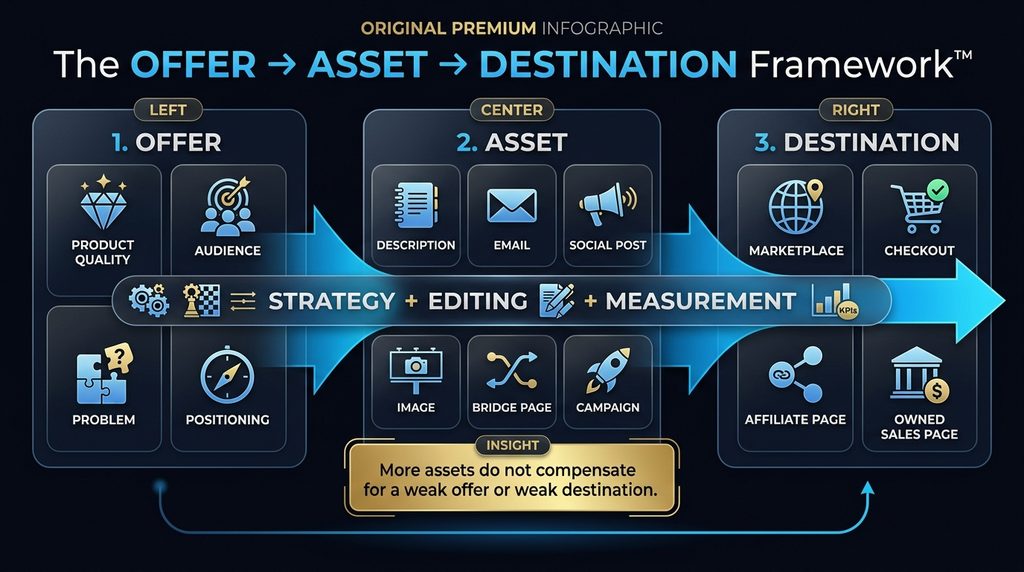
The framework I would use to evaluate Digital Profit Stack AI begins with the part no software can rescue: OFFER. What are you actually selling, and is there evidence that the intended audience cares? The system needs a meaningful underlying offer, whether that is a KDP book, Etsy product, affiliate product, service, template or another digital asset. The second layer is ASSET. What promotional material must exist around that offer? This includes:
- positioning
- descriptions
- emails
- social content
- ad concepts
- images
- hooks
- bridge-page copy
- portfolio presentation
DESTINATION. Where does the buyer ultimately go? That might be:
- Amazon
- Etsy
- Shopify
- WooCommerce
- an affiliate checkout
- your own sales page
- another destination.
The strategic mistake is focusing only on the ASSET layer. AI can help you produce assets faster. But if the OFFER is weak or the DESTINATION converts poorly, generating more assets simply makes the wrong system operate faster.
Why This Matters. This framework separates content production from business value. Digital Profit Stack AI can potentially improve the middle layer, but it cannot manufacture demand for a weak product or guarantee that a destination page will convert.
What You Actually Get
Self-Hosted WordPress Platform
The first major distinction is architectural. Digital Profit Stack AI is not a normal SaaS dashboard where you simply create an account and start working.
The vendor’s FAQ describes a WordPress backup file of about 70MB that you upload to a fresh WordPress installation with a plugin called WPVivid, and it says the process usually takes around 5–10 minutes if you already have a fresh WordPress site ready. That distinction is easy to overlook. “Five-to-ten-minute installation” does not mean: “Create account → click button → done.” It means something closer to:
“Have WordPress ready → install the required migration/backup tool → restore the platform → configure the environment → connect your AI provider.” That’s still manageable. It simply isn’t the same thing as SaaS.
Reality Check. Self-hosting is neither automatically better nor automatically worse. It changes the responsibility model. With SaaS: Vendor controls infrastructure. With Digital Profit Stack AI: You control more of the infrastructure. That means you gain control but inherit maintenance.
Bring Your Own AI API
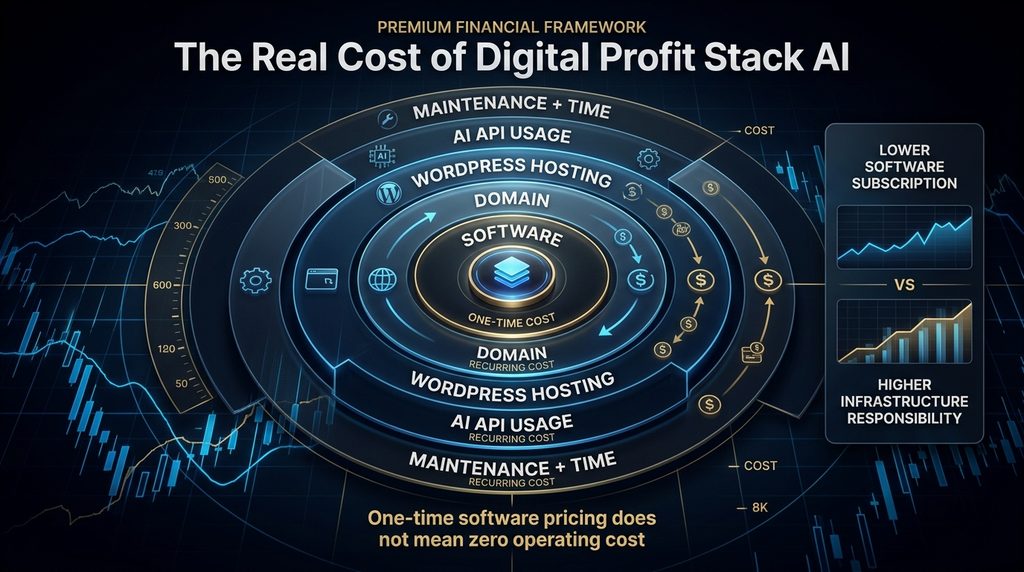
The BYO-API model is one of the more important parts of the product. The vendor’s page says the platform supports your own OpenAI, Gemini and Claude API keys, so you choose the provider and usage stays under your own account. This has a meaningful economic implication. The software purchase does not represent your entire AI operating cost. Instead, your stack becomes:
- Digital Profit Stack AI
- WordPress hosting
- AI API usage
- Domain
- Your time
That can actually be an advantage for experienced users. You can choose your provider. You can control usage. You are not necessarily locked into a vendor’s proprietary credit system. But it also means the buyer needs to understand that one-time software pricing is not the same thing as zero ongoing costs.
AI Hustle World Analysis. The BYO-API model is probably one of the product’s strongest architectural decisions for advanced users and one of its biggest barriers for beginners. An experienced operator may think: “Excellent. I control my API spend.” A beginner may think: “Why do I need another account and API key?” Both reactions are reasonable. The difference is user maturity, not product quality.
Product Import
One of the more useful capabilities is product importing. The vendor’s sales page describes smart import for Amazon, Etsy, Creative Market, Shopify and WooCommerce, with a manual route for other products or services. This is important because importing is not merely about saving copy-paste time. It creates a structured starting point for the rest of the workflow. Suppose you have:
- 15 Etsy products
- 10 KDP books
- 8 affiliate offers
- 5 digital services
The real value of centralization is not the first product. It is the 38th product. The more offers you manage, the more valuable a consistent product record becomes.
AI Product Intelligence
Once product information is available, the system can use AI to create marketing-oriented information around the offer. The vendor’s page says the built-in workflow can generate items such as:
- titles
- hooks
- benefit statements
- positioning
- promotional angles
- campaign ideas
- product descriptions.
This is where the platform begins to move beyond simple storage. Instead of treating the product as a static listing, it attempts to turn the listing into a marketing brief. That distinction is useful. A raw product record tells you what the product is. A marketing brief asks:
- Who is it for?
- What problem does it solve?
- Why should someone care?
- What benefit deserves emphasis?
- What angle could make the offer more relevant?
The AI can help with that transformation. But the output still needs judgment. If the product information is weak, the AI has less useful material to work with. Garbage in, polished garbage out still applies.
Promotional Asset Generation
This is probably the part most buyers will notice first. The platform is designed to generate multiple promotional assets from the product information. The vendor says one product profile can become items such as:
- email copy
- social media content
- advertising copy
- image prompts
- promotional hooks
- campaign material
- page content.
The important question is not whether AI can create these things. It can. The question is whether context continuity saves time. If you use a generic AI chatbot, you may repeatedly need to explain: “This is my product. This is my audience. These are the benefits. This is the tone. This is the URL. Now create an email. Now create a social post. Now create an ad. Now create a Pinterest post.”
A product-centered workflow can reduce that repeated setup. That is a real productivity advantage. It is not revolutionary AI. It is workflow design. The platform also includes image prompts and an image-generation workflow, and our comparison of the best AI image generators shows what standalone tools offer.
Portfolio and Bridge Pages
The portfolio component is another meaningful part of the product. The system is designed to give your offers a presentation layer on your own WordPress site rather than forcing every visitor to go directly from a social post to an external marketplace. That can create a path like:
- Social post
- Your product hub
- Product/bridge page
- External marketplace or checkout
This has an important strategic advantage. You have an opportunity to introduce the visitor to the offer before sending them elsewhere. You can explain:
- what the product is
- who it is for
- why it matters
- what problem it solves
- what to expect
- where to purchase.
However, a bridge page is not automatically a conversion machine. The page still needs:
- clear positioning
- credible information
- strong relevance
- good design
- appropriate calls to action
- qualified traffic.
Contrarian Insight. Owning the bridge does not mean owning the customer. You may control the page and the domain, but if the final transaction happens somewhere else, the downstream experience and relationship may still belong largely to another platform. The hub gives you more control over the journey. It does not magically give you complete control over the customer relationship.
The Three-Layer Ownership Model
Layer 1 — Marketplace Ownership. Amazon, Etsy, Creative Market and similar platforms control the environment. You get distribution, but you operate inside their ecosystem. Layer 2 — Hub Ownership. Your WordPress site becomes the controlled presentation layer. You control:
- domain
- page
- branding
- content
- navigation
- portfolio structure.
Layer 3 — Audience Ownership. This is different. Owning the website does not automatically mean owning an audience. Audience ownership requires things such as:
- email subscribers
- repeat visitors
- community
- direct customer relationships
- first-party data collected appropriately.
Digital Profit Stack AI can help create the hub. It cannot automatically create the audience.
Why This Matters. This distinction prevents a common affiliate-marketing mistake: confusing “I own the website” with “I own the customer.” The first can be achieved technically. The second requires an actual audience strategy.
Digital Profit Stack AI Pricing and Upgrades
Pricing requires careful reading because sales pages change. On September 25, 2026 the vendor’s sales page showed a regular price of $97 and a launch price of $47, as a one-time payment with no monthly software fee, plus a coupon code, PROFITSTACKAI, for $5 off. The regular price is the vendor’s own marketing figure, not an independent benchmark, and the page says the price may increase at any time, so the checkout price is the only one that counts. Plan data for other tools is in our AI Tool Pricing Database.
Current Upgrade Structure
The vendor’s FAQ says the offer includes two main one-time offers, called OTO1 and OTO2, and that other optional upgrades may exist. The vendor’s page does not list prices for them.
| Offer | Price shown on the vendor page | What the vendor says it adds | Our view |
|---|---|---|---|
| Digital Profit Stack AI (core) | $47 launch price, $97 regular price | Self-hosted WordPress platform, product import, AI promotional assets, portfolio website | Start here |
| OTO1 | Not shown | An extended version with additional features | Evaluate after using the core |
| OTO2 | Not shown | Pro add-ons plus a commercial license that allows you to sell or flip the site | Relevant to agencies |
| Other upgrades | Not shown | The vendor says there may be other optional upgrades | Separate business decisions |
Third-party launch reviews list specific prices for these upgrades and for managed hosting, and the reviews disagree with each other on labels and order. We could not confirm any of those figures on the vendor’s page, so we do not repeat them. Read each checkout screen carefully before you add anything.
Do You Need the Upgrades?
No—not automatically. This is one of the areas where affiliate reviews often become unhelpful. A long OTO funnel can create the psychological impression that the front-end is incomplete. That’s not necessarily true. If you are buying Digital Profit Stack AI for your own digital-product business, the rational starting point is the core platform. Use it. Run an actual product through it. See whether the workflow saves you time. Then identify the bottleneck. Only after that should you ask whether an upgrade solves that bottleneck.
OTO1: The Extended Version
The vendor’s FAQ describes OTO1 as an extended version with additional features and does not publish a price on the page. The strategic question is not whether the extended version has more features, because it almost certainly does. The better question is whether those features remove a bottleneck you already have. If you have only five products, probably not, and if you have hundreds of assets and keep hitting limits in the core workflow, the calculation changes. Don’t buy it simply because it is presented immediately after checkout, and remember that any AI output needs checking, as we explain in understanding AI hallucinations.
Match It to a Product You Already Sell
Pick one book, template or affiliate offer and list which promotion assets you would actually use from it.
Check the Offer Details →Affiliate disclosure: We may earn a commission if you subscribe through this link, at no additional cost to you.
OTO2: Pro Addon + Commercial License
The vendor’s FAQ describes OTO2 as a suite of pro add-ons plus a commercial license that allows you to sell or flip the site, and that license is what changes what you can do with the platform. This matters if you’re:
- an agency
- a freelancer
- a consultant
- a service provider
- someone building websites for clients.
If you’re only using the system for your own products, commercial rights may not justify the additional purchase. That distinction should be obvious before checkout.
Honest Opinion. If your plan is: “I want to build marketing hubs for clients.” Then the Pro/commercial tier deserves serious consideration. If your plan is: “I have my own Etsy products and KDP books.” You probably don’t need to pay for commercial rights you won’t use.
Managed Hosting (Unconfirmed)
Some third-party launch reviews describe a managed-hosting upgrade, but the vendor’s FAQ does not mention one and we could not confirm it, so we cannot tell you whether it exists or what it costs. If you would rather pay someone else to run WordPress, compare any such offer with ordinary managed WordPress hosting and with the value of your own time, backups, security and technical support.
Total Cost and Return on Investment
What Are the Hidden Costs?
The costs beyond the software are not truly hidden, but they are easy to ignore when the sales page emphasizes a one-time purchase. A realistic budget includes the infrastructure, usage and labor required to keep the system useful:
- Hosting. A self-hosted WordPress product requires infrastructure. You need a domain and hosting environment.
- AI API usage. Your AI generation is powered through your own API credentials, meaning usage costs depend on the provider and how much you generate.
- Maintenance. WordPress sites require some degree of:
- updates
- backups
- security management
- plugin compatibility
- performance monitoring.
Your time. This is the most overlooked cost. If you spend three hours learning the system before saving one hour per month, your ROI is negative for a while. That isn’t a criticism of the product. It’s basic implementation economics.
The Real ROI Question
Don’t ask: “Is $47 cheap?” Ask: “How much recurring workflow friction can this remove?” Suppose, purely as an illustration, you manage 30 products. Your existing process takes two hours to prepare a basic promotional package for each product. That’s: 30 × 2 = 60 hours Now imagine a centralized workflow reduces that to 75 minutes per product. That’s: 30 × 1.25 = 37.5 hours Potential time saved: 22.5 hours Now the software has economic meaning.
But if you have one product and promote it once every three months, the same system may save almost nothing. This is why product volume is a major value variable.
AI Hustle World Measurement Framework: STACK-ROI
To determine whether the platform is actually paying for itself, track six metrics.
- S — Setup Time. How long did installation and configuration take?
- T — Time Per Offer. How long does it take to turn one product into a complete promotional package?
- A — AI Cost. How much API spend is required per product or campaign?
- C — Content Editing. How much human editing is required before publishing?
- K — Knowledge Reuse. How much product context can be reused instead of recreated? Then add:
The five operational measures become meaningful only when they are connected to ROI: revenue or time value created minus the software, hosting, API and labor cost required to produce it. A useful monthly tracking table might look like this. It contains no claimed results because AI Hustle World has not run the product; fill in the baseline and after figures from your own controlled use:
| KPI | Before (your baseline) | After (your result) | What it tells you |
|---|---|---|---|
| Time to prepare one offer | Hours you measured | Hours you measured | Workflow efficiency |
| Editing time | Minutes per offer | Minutes per offer | Output quality |
| API cost per offer | Not applicable | Your provider’s bill | AI economics |
| Offers promoted per month | Count | Count | Production capacity |
| Campaigns published | Count | Count | Execution speed |
| Conversion rate | Your figure | Your figure | Business impact |
| Revenue per offer | Your figure | Your figure | Commercial value |
The important point is that speed is not the final KPI. If you double content output but conversion collapses, you didn’t improve the business. You improved production volume. Those are different things.
What Happens If You Do Nothing?
This is a useful question because software decisions should be compared against the alternative of not buying. If you do nothing, you can still run your business. You can use:
- WordPress
- ChatGPT
- Gemini
- Claude
- Canva
- an email platform
- spreadsheets
- marketplace dashboards
- your existing social tools.
There is no technical requirement that you own Digital Profit Stack AI. The cost of doing nothing is therefore not “your business stops.” The cost is continued fragmentation. If your current workflow already works efficiently, doing nothing may be the correct decision. If you’re repeatedly spending hours copying product information between systems, creating the same marketing context repeatedly, and maintaining disconnected promotional assets, the opportunity cost becomes larger.
Reality Check. A new tool should not be purchased merely because the old workflow is imperfect. It should be purchased when the existing friction is expensive enough to justify changing the system.
How the Economics Change by Use Case
The KDP Publisher
Consider a KDP publisher with 40 books. This is an illustrative example, not a report of a tested customer result, and our guide to the best AI tools to create and sell digital products covers the tools around this workflow. The publisher already has:
- book titles
- descriptions
- covers
- Amazon links
- manuscripts
- target audiences.
The problem is that each book needs promotion. With a fragmented workflow, the publisher may need to manually create:
- social posts
- email copy
- promotional angles
- landing/bridge pages
- images
- portfolio entries.
A centralized product workflow could reduce the repeated setup involved in those tasks. The important business question becomes: How much time does the system save across 40 products? That is a much stronger buying case than: “The software can generate social posts.”
The Affiliate Marketer
Now consider an affiliate marketer managing 50 offers. The marketer does not own the products. That changes the economics. A centralized hub can still be useful because it can provide a controlled presentation layer for offers. Instead of sending every visitor directly to a merchant URL, the marketer can potentially create content around the offer first. But this creates another responsibility: the bridge page must add value. If it simply repeats the merchant’s sales copy and then adds another button, the hub has not created much differentiation. Our affiliate disclosure lists every company we have a commercial relationship with.
A better bridge page explains:
- who the offer is for
- what it does
- what problem it solves
- key limitations
- alternatives
- decision criteria.
That approach aligns better with a trust-first affiliate model because the bridge page earns the click by helping the reader decide, rather than merely inserting another promotional step between the reader and checkout.
The Agency
The agency case is different again. Suppose an agency wants to create digital-product marketing hubs for multiple clients. Now commercial licensing, multiple sites, hosting, support and repeatable deployment become much more important. This is where the Pro/commercial upgrade becomes strategically relevant. But agencies should evaluate the platform differently from individual creators. An agency needs to ask:
- Can I standardize deployment?
- Can I support clients?
- Can I maintain multiple installations?
- Does the license permit the intended commercial use?
- Does the time saved justify the added operational complexity?
Those questions matter more than whether the interface has another AI button. An agency is buying a repeatable delivery system, not simply a copy generator, so licensing clarity and maintenance effort can outweigh the headline feature list.
What Digital Profit Stack AI Does Well
- It centralizes a fragmented workflow. This is the strongest argument for the product. The value increases as the catalog grows.
- It uses your own AI provider. Experienced users gain control over provider choice and AI usage.
- It is self-hosted. You have greater control over your website environment.
- It can connect product information to promotional output. That contextual continuity can reduce repetitive prompting.
- It supports multiple offer types. The documented workflows extend beyond a single marketplace or business model.
- It can create a controlled presentation layer. Portfolio and bridge pages give users another layer between traffic and external destinations.
- Why This Matters. The product’s strongest advantage is system design, not AI novelty. If you already have several disconnected workflows, bringing them closer together can be more valuable than having another standalone content generator.
Where Digital Profit Stack AI Falls Short
Installation still has friction. Self-hosting means setup. Even if the actual restoration is straightforward, you still need a WordPress environment. AI output still needs human review. AI can generate promotional content quickly. It can also generate:
- generic claims
- repetitive messaging
- weak hooks
- exaggerated benefits
- inaccurate descriptions.
Publishing everything without review defeats the point of having a professional brand. The next limitation is demand: Digital Profit Stack AI can increase production capacity, but no software can guarantee:
- traffic
- sales
- rankings
- affiliate commissions
- product-market fit.
Infrastructure remains your responsibility. Unless you pay for managed hosting, you still need to care about the WordPress environment. Commercial rights are not universal. The front-end does not automatically give you the commercial resale rights associated with the Pro/commercial upgrade.
Common Mistakes Buyers Should Avoid
- Mistake 1: Buying every OTO. A long funnel does not mean every upgrade is necessary. Buy for a need, not for fear of missing functionality.
- Mistake 2: Ignoring API costs. Your AI usage is separate. If you generate hundreds of assets, usage costs can increase.
- Mistake 3: Treating self-hosting as “free”. Hosting isn’t free. Your time isn’t free either.
- Mistake 4: Publishing raw AI output. Generation is not the same as editorial approval.
- Mistake 5: Expecting passive income. The product is infrastructure. It does not create an audience or guarantee revenue.
- Mistake 6: Buying commercial rights without a commercial model. If you don’t have clients, agencies or a resale plan, commercial rights may provide little immediate value.
- Mistake 7: Measuring only content volume. More posts are not automatically better. Measure business outcomes.
The Second-Order Effect Most Buyers Miss
There is an interesting consequence of making content generation easier. Your bottleneck can move. Before automation: Idea → production After automation: Idea → production → editing → approval → distribution If production becomes extremely fast, editing can become the bottleneck. Then distribution becomes the bottleneck. Then audience becomes the bottleneck. This is why AI automation often doesn’t eliminate work. It moves the constraint. Digital Profit Stack AI may reduce the time required to produce promotional assets, but that can expose weaknesses elsewhere in the marketing system.
For example, a creator may suddenly have 100 social posts but no reliable traffic source. That’s not failure of automation. It’s a sign that production was never the only constraint.
Contrarian Insight. The best AI marketing system is not the one that produces the most assets. It is the one that produces enough useful assets without overwhelming the human decision-maker. That is the standard I would use for this product.
Digital Profit Stack AI vs a Typical SaaS Workflow
| Decision factor | Digital Profit Stack AI | Typical hosted SaaS |
|---|---|---|
| Hosting | You manage it | Vendor manages it |
| AI billing | Your API | Usually bundled/managed |
| Infrastructure control | High | Lower |
| Setup complexity | Higher | Lower |
| Maintenance | Your responsibility | Mostly vendor |
| Product ownership | More control | Platform-dependent |
| Best user | WordPress/power user | Convenience-first user |
| Recurring software fee | Core product is sold as one-time | Common in SaaS |
| Commercial licensing | Separate tier | Depends on vendor |
| Flexibility | High if technically comfortable | Usually constrained by platform |
The right choice depends on what you value. If you hate technical administration, SaaS wins. If you value ownership and already understand WordPress, Digital Profit Stack AI becomes more attractive.
Who Should Buy Digital Profit Stack AI?
I would put the product on your shortlist if most of these statements are true:
- You already use WordPress.
- You manage multiple digital products.
- You publish KDP books.
- You sell or promote Etsy products.
- You manage affiliate offers.
- You want a centralized product library.
- You repeatedly create similar promotional assets.
- You are comfortable connecting an AI API.
- You value control over your own website.
- You expect your product catalog to grow.
The strongest buyer is not necessarily a beginner. It is someone who has already experienced the pain of fragmentation.
Who Should Skip It?
You should probably skip Digital Profit Stack AI if:
- You have only one product.
- You don’t use WordPress.
- You want zero technical setup.
- You don’t want to manage hosting.
- You don’t want to manage AI API usage.
- You already have a highly efficient marketing stack.
- You expect software to generate income automatically.
- Your main need is simply conversational AI writing.
In those situations, adding another system may create more complexity than it removes. A hosted product or a smaller collection of specialist tools is often the more disciplined choice when maintenance is the real bottleneck.
Decision Matrix
| Your situation | Fit | Recommendation |
|---|---|---|
| One digital product | Low | Use a simpler stack |
| 5–10 products | Medium | Evaluate based on workflow friction |
| 20+ products | High | Stronger reason to consider |
| KDP publisher | High | Good workflow fit |
| Affiliate marketer | Medium–High | Useful if you need a controlled hub |
| WordPress power user | High | Architecture is a strong fit |
| WordPress beginner | Medium–Low | Expect setup learning |
| Agency | High with commercial rights | Evaluate Pro/commercial tier |
| Zero-maintenance SaaS buyer | Low | Choose hosted software |
| Creator with existing efficient stack | Low–Medium | Only switch if measurable savings exist |
A Practical 30-Day Evaluation Plan
If you decide to purchase, don’t immediately try to rebuild your entire business. Use a controlled test.
Week 1 — Setup. Install the platform. Connect your AI provider. Add one real product. Document the setup time. Week 2 — Production. Run that product through the promotional workflow. Generate:
- one email
- several social posts
- one page
- one promotional angle
- one image concept.
Record generation time and editing time separately so fast production does not hide slow cleanup. Week 3 — Repeat. Run three to five additional products, then look for repetition: does the workflow actually get faster, does the product library become more useful, and are the generated assets consistent? Week 4 — Evaluate. Compare the old workflow with the Digital Profit Stack workflow and track:
- hours saved
- assets produced
- editing time
- API cost
- publishing time
- traffic
- clicks
- conversions.
Then decide. This approach is much safer than buying every upgrade before you understand the core system. If you need automation beyond content, our list of the best AI workflow automation tools covers the wider field.
A Simple Buyer Checklist
Before purchasing, answer these questions:
Infrastructure
- Do I already have WordPress?
- Do I have reliable hosting?
- Am I comfortable maintaining the site?
Products
- Do I have multiple products or offers?
- Will my catalog grow?
- Do I repeatedly create promotional material?
AI
- Am I comfortable using an API?
- Do I understand that AI usage costs are separate?
Economics
- How many hours could this realistically save?
- What is my approximate cost per offer?
- Will I actually use it enough to recover the investment?
Licensing
- Do I need commercial/resale rights?
- If yes, have I budgeted for the appropriate upgrade?
Expectations
- Am I buying infrastructure or expecting passive income?
- Do I already have a traffic strategy?
If you cannot answer those questions, don’t rush into the purchase. The platform may become useful later, but buying infrastructure before the workflow and catalog justify it usually creates another system to maintain rather than a problem solved.
Is Digital Profit Stack AI Legit?
The available evidence supports treating Digital Profit Stack AI as a real commercial software offer. The vendor’s sales letter is signed “Dawn”, the site carries the DFYFortune.com name, and the page links a privacy policy, an earnings disclaimer, a refund policy and a support contact. The sale is processed through WarriorPlus, which says on the page that its role is not an endorsement of the product. That establishes the offer and the vendor’s presence. It does not establish that any marketing claim about profitability is true, so the safest conclusion is that the product is a real software offer, its usefulness depends on your workflow, and buying it does not guarantee business results.
What Does the 30-Day Guarantee Actually Cover?
The sales page advertises a 30-day money-back guarantee and calls the purchase “risk free”. The vendor’s refund policy is narrower than that wording. It says all sales are final except where the law requires otherwise, allows refunds within 30 days only for a reproducible technical defect, a confirmed download failure or a product that materially differs from its description, and leaves the decision to the vendor. It lists change of mind, lack of technical knowledge, incompatibility with your hosting, business-performance expectations and the time needed to implement the product as non-refundable.
In practice, do not treat the guarantee as a free trial. Confirm that the hosting you plan to use meets the requirements before you buy, run a real product through the platform early in the 30 days, and keep evidence if something does not work as described. The current checkout and policy pages are the final authority.
What the Product Does Not Replace
This boundary deserves explicit emphasis because workflow consolidation can look broader than it is. Digital Profit Stack AI helps organize products and create promotional material, but the operator still owns seven decisions:
- Product research: you still need something people want.
- Audience research: you still need to know who cares and why.
- Distribution: you still need a credible way to attract qualified traffic.
- Conversion strategy: you still need persuasive, evidence-based positioning.
- Customer relationships: you still need a plan for trust, follow-up and retention.
- Human editorial judgment: you still need to verify that every generated claim is accurate and useful.
- Business strategy: you still decide what to build, promote, stop or scale.
The platform operates mainly in the space between: “I have an offer” and “I have the marketing infrastructure around that offer.” That is valuable. It is just not the entire business.
Future Outlook: Where This Category Is Going
The broader trend behind Digital Profit Stack AI is more interesting than the product itself. AI marketing software is moving away from isolated generation. The old model was: Prompt → output The emerging model is: Data → context → workflow → output → measurement → iteration That’s a meaningful shift. A future digital-product marketing platform is likely to become less about generating a social caption and more about understanding:
- what the product is
- who buys it
- what channels work
- which messages perform
- which products should be promoted
- what content has already been generated
- which offers are underperforming.
That is where the real value of a product-management-centered AI system could eventually emerge. But there is a warning. As AI makes content cheaper to produce, content itself becomes less scarce. That means differentiation moves toward:
- better offers
- better positioning
- better audience understanding
- better distribution
- better first-party relationships
The future winner will not necessarily be the platform that generates the most copy. It will be the platform that helps the operator make better decisions about what to promote, to whom, through which channel, and why.
Final Thoughts: Should You Buy Digital Profit Stack AI?
Digital Profit Stack AI is easier to understand once you stop looking at it as “another AI tool.” Its real proposition is workflow consolidation. You bring products into a centralized environment, the system helps turn those products into marketing information and promotional assets, and your WordPress hub presents the offers before visitors move to the final destination.
That is a legitimate workflow improvement, but it is not automatically a better business. The strongest case for buying the platform is not “AI will make you money.” It is: “I already have enough products and recurring marketing work that a centralized self-hosted system could save me meaningful time.” That proposition can be measured, challenged and either confirmed or rejected after a controlled trial.
If you manage dozens of offers, the ability to reuse product context and create several promotional assets from one record can become valuable. If you already understand WordPress and are comfortable with API-based AI usage, self-hosting may be an advantage. If you have one product, hate WordPress administration or expect passive income, keep the stack simpler and choose a tool that removes rather than adds operational responsibility.
The same restraint applies to the upgrade funnel. Do not buy every add-on because the checkout sequence makes it appear essential. Start with the core workflow, measure setup time, editing effort, API cost and business impact, and expand only when a specific bottleneck justifies the next purchase.
Decide Whether a Self-Hosted Tool Fits Your Setup
The offer page says it installs on your own WordPress server and uses your own AI keys, so check those requirements and the current price first.
Review the Current Offer →Affiliate disclosure: We may earn a commission if you subscribe through this link, at no additional cost to you.
Frequently Asked Questions
What is Digital Profit Stack AI?
Digital Profit Stack AI is a self-hosted WordPress platform designed to help users organize digital offers and generate AI-assisted promotional assets around those offers. Documented workflows include KDP, Etsy, Creative Market, Shopify, WooCommerce and manually added affiliate products or services.
Who created Digital Profit Stack AI?
The vendor’s sales letter is signed “Dawn” and the page carries the DFYFortune.com name. We could not confirm more about the vendor than the page and its legal notices show.
How much does Digital Profit Stack AI cost?
On September 25, 2026 the vendor’s sales page showed a launch price of $47 against a regular price of $97, as a one-time payment, with the coupon code PROFITSTACKAI taking $5 off. The page says the price may increase at any time, so verify the checkout price before purchasing.
Is Digital Profit Stack AI a monthly subscription?
The core software has been documented as a one-time purchase, but that does not mean the entire operating environment is free. You still need WordPress hosting, a domain, and AI API usage.
Do I need WordPress?
Yes. The product is designed around a self-hosted WordPress environment rather than a conventional hosted SaaS dashboard.
Do I need an AI API key?
Yes, you connect your own AI provider credentials, and the vendor’s page lists OpenAI, Gemini and Claude. If you are choosing between them, our list of the best ChatGPT alternatives and our guide to writing AI prompts help you judge the options.
What can Digital Profit Stack AI import?
The vendor’s sales page describes smart import for Amazon, Etsy, Creative Market, Shopify and WooCommerce, with manual entry available for other offers such as affiliate products and services.
Can Digital Profit Stack AI create marketing content?
Yes. The vendor lists promotional emails, social posts, ad copy, hooks, image prompts and other marketing assets. For writing tasks, see our roundup of the best AI tools for writing blog posts, and for distribution ideas see our list of the best AI tools for creating social media content.
Can I use it for affiliate marketing?
The platform is designed to support affiliate offers among other digital products and services. However, affiliate success still depends on the quality of the offer, traffic, positioning, disclosure, and conversion experience. The FTC’s Endorsement Guides Q&A explains how affiliate relationships should be disclosed.
Can I use it for KDP?
KDP is one of the documented use cases, including workflows for unpublished books and product information. Amazon KDP’s content guidelines require you to disclose AI-generated content when you publish.
Can I resell the platform?
The front-end license does not automatically provide the commercial resale rights described for the Pro Addon/commercial license. If you intend to use the system for clients or resell installed copies, verify the current license terms and appropriate upgrade before doing so.
Is Digital Profit Stack AI good for beginners?
It depends on the beginner. A beginner who already understands WordPress may be fine. Someone looking for a completely managed, zero-configuration SaaS experience will probably find the self-hosted architecture less convenient.
Does Digital Profit Stack AI guarantee income?
No. Software can help with workflow efficiency, but it cannot guarantee traffic, conversions, affiliate commissions, product sales, or income.
Is Digital Profit Stack AI worth buying?
For the right user, yes. It is most compelling when you manage multiple digital offers, already use WordPress, and value centralized product management plus AI-assisted promotion. It is much less compelling if you have one product, don’t want technical setup, or already have a highly efficient marketing stack.
Related Guides
- AdCreative.ai Review: Features, Pricing & Is It Worth It in 2026?
- Weav Review 2026: Features, Pricing & Is It Worth It?
- AdCreative.ai Pricing: Which Plan Is Right for You?
Written by
Muntasir Ahmad Chowdhury
Founder-AI Hustle World
Muntasir Ahmad Chowdhury is the Founder of AI Hustle World, an independent publication dedicated to making Artificial Intelligence practical, trustworthy, and easy to understand. He researches AI tools, automation, customer service, productivity, and real-world business applications, helping readers make smarter technology decisions through research-driven, experience-backed content.
Expertise:
AI Tools • AI Automation • AI Customer Service • AI Productivity • Generative AI • AI Workflows
Get Smarter With AI
Enjoyed this guide? Get practical AI tools, tutorials, and honest reviews delivered to your inbox.