Evidence: Documentation reviewed
Last checked: October 2026
What was done: Written from official documentation and the published sources linked in this article. Not hands-on tested.
Files: None
Affiliate links: No
Last updated: October 2026
How to Write AI Prompts for More Accurate and Reliable Answers
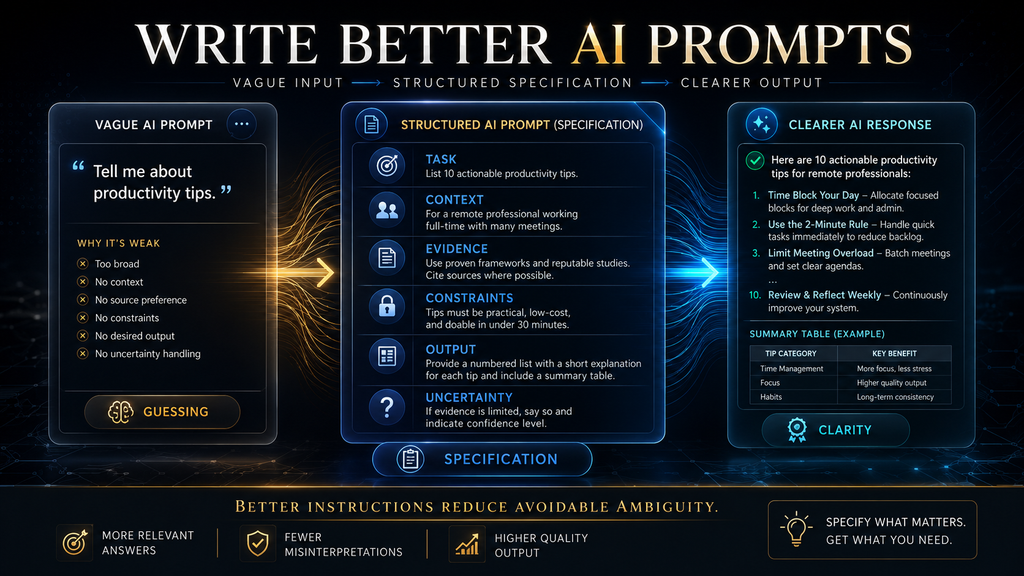
To write AI prompts that produce accurate and reliable answers, treat each important prompt as a work specification. State the result you need, supply the evidence, set the limits, name the audience, define the format and tell the AI what to do when it does not know.
A polished answer is not automatically a correct one. A response from ChatGPT, Claude or Gemini can be grammatically perfect, logically organized and confident while containing an unsupported assumption, an outdated fact or a fabricated detail.
Much of that risk starts with the prompt. A vague prompt leaves the model to decide what you meant, a poorly scoped prompt encourages it to fill gaps, and a prompt with no source boundary lets unsupported information into the answer.
Better prompting is therefore less about finding a magic phrase and more about specifying the work clearly. The major developers agree: OpenAI’s prompt engineering guide stresses precise instructions and relevant context, and Google’s prompt design strategies begin with clear and specific instructions.
One limit needs stating at the start. A better prompt makes a response more controlled and relevant, but it cannot guarantee that every factual claim is true, so important claims still need checking.
This guide gives you a complete method. You will learn the AI Hustle World RELIABLE Prompt Framework, the layers of prompt accuracy, a three-pass method for improving prompts, before-and-after examples and reusable templates for research, documents, data and decisions.
Why Better Prompts Produce Better Answers
Picture giving two employees the same assignment. To the first you say, “Look into AI productivity tools,” and to the second you give a full brief.
The brief reads: “Compare five AI productivity tools for a solo freelancer who spends most of the day writing, researching and managing email. Focus on current pricing, research features and writing help. Use official sources, separate verified features from your own evaluation, and mark anything you cannot verify.”
The second employee has a much clearer specification and will produce more useful work. The same principle applies to AI, which does not know what outcome you consider successful, how much detail you need or which sources you trust.
The objective is not to make the prompt as long as possible. It is to make the important requirements difficult to misunderstand, which sometimes takes one sentence and sometimes takes a paragraph.
The Four Causes of Unreliable AI Answers
Unreliable answers usually trace back to one of four causes. Knowing which one you are facing tells you what to fix.
| Cause | What happened | Prompt fix |
|---|---|---|
| The AI misunderstood the task | “Analyze this report” could mean summarize, critique or extract risks | State the specific job and the decision it supports |
| The AI lacked context | “Write an email to the customer” with no situation given | Add the facts that change the answer |
| The AI filled gaps you never defined | Missing prices were estimated to complete a table | Say what to do with missing data |
| The answer was wrong despite a good prompt | The model stated a false fact fluently | Verify important claims separately |
The first three causes are prompt problems, and a better specification solves them. The more important the task, the less you should rely on broad phrases such as “tell me about,” “look into” or “make this better.”
The fourth cause is different. Factual reliability remains an open challenge for language models, as our guide to AI hallucinations explains, so prompt engineering and fact verification solve different parts of the problem.
Your Prompt Is a Specification
A useful mental test is to ask what you would tell a competent new colleague. What information would they need to do this task without making unnecessary assumptions?
That question changes how you write. You stop thinking about clever wording and start listing the outcome, the material, the boundaries and the standard the result must meet.
It also explains why short prompts often fail on complex work. The model is not being lazy or careless; it has simply been given a topic and left to guess the job, the audience and the level of evidence required.
Prompt engineering improves the conditions under which an answer is generated. Verification decides whether the important claims in that answer are supported, and a reliable workflow needs both.
The RELIABLE Prompt Framework
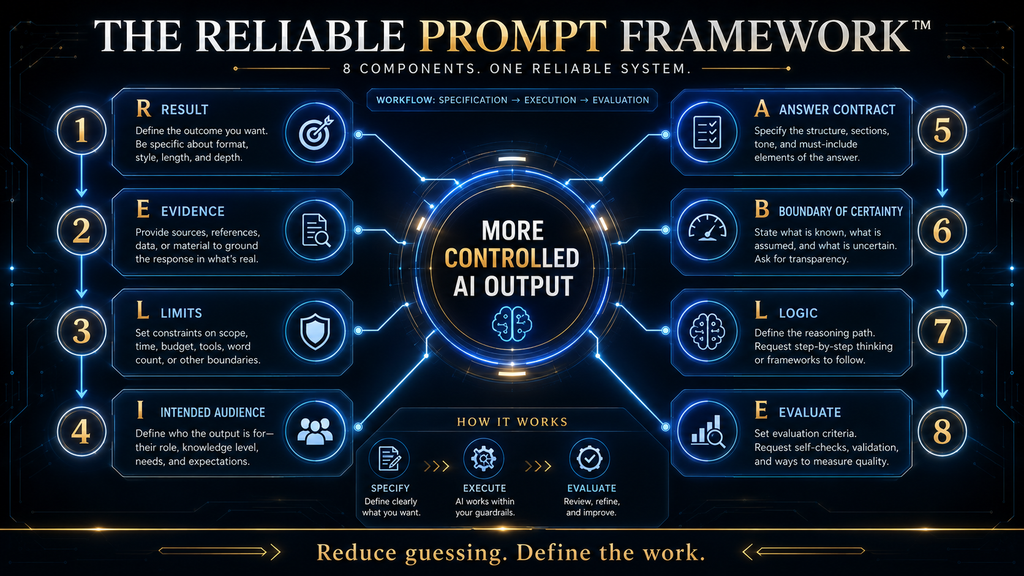
The AI Hustle World RELIABLE Prompt Framework turns reliability principles into eight checks. It is our editorial framework, not an official method from OpenAI, Google, Anthropic or any academic body.
| Letter | Element | Question it answers |
|---|---|---|
| R | Result | What exact outcome do I need? |
| E | Evidence | What material should the AI use? |
| L | Limits | Where does the task stop? |
| I | Intended audience | Who needs the answer? |
| A | Answer contract | What does a finished answer look like? |
| B | Boundary of certainty | What should the AI do when it does not know? |
| L | Logic | Does the task need to be broken into stages? |
| E | Evaluate | How will I judge the result? |
A good prompt does more than ask for an answer. It defines the conditions under which the answer should be produced, and each letter removes one common source of guessing.
You will not need all eight for every request. For a quick rewrite, the result and the audience are enough, while a research summary that will be published deserves the full set.
R: Result, Define the Exact Outcome
Start with the outcome, stated as a job and not as a topic. “AI in marketing” is a topic, and the model has to invent the task.
“Explain five practical ways a five-person online business can use generative AI to reduce repetitive marketing work” is a job. It names the audience, the number of items and the purpose.
A stronger version adds the criteria: “Prioritize workflows one person can manage without technical skills. For each, explain the process, the likely benefit, the main limitation and one metric to monitor.” Now the model knows what a good answer contains.
If you struggle to write the result in one or two sentences, that is useful information. It usually means you have not yet decided what you need, and no prompt can fix that for you.
E: Evidence, Give AI the Material It Should Use
When the information already exists, provide it. Supplying the source is one of the strongest ways to make an AI answer more controlled.
Instead of asking, “What is our vacation policy?”, paste the handbook and write: “Using only the handbook below, identify the vacation eligibility rules. Cite the relevant section. If the handbook does not answer a question, say ‘not specified.’ Do not infer missing policy.”
The task has changed from open-ended generation to extraction and interpretation of evidence. The model no longer needs to recall or guess, and you can check its answer against the text.
The same applies to data. “Analyze the Q2 sales spreadsheet below, identify the three largest revenue changes, and use only the supplied data” sets an evidence boundary that “tell me how our sales are doing” never could.
Separate the evidence from the instructions clearly, with a heading or delimiters, so the model can tell which text is material and which is direction. Our guide to context engineering covers how to structure longer inputs.
L: Limits, Tell AI Where the Task Stops
Limits prevent a focused request from becoming a sprawling answer. They cover scope, budget, time period, length and anything the answer must exclude.
“Compare these four AI tools for a solo freelancer with a $50 monthly budget. Focus on writing, research and automation, and exclude enterprise-only features” is a bounded task. Without the limits, the model may spend half the answer on features the reader can never use.
Limits also apply to the prompt itself. A longer prompt is not automatically a better one, and extra background, repeated instructions and conflicting examples make the result worse.
There is research behind that caution. The study Lost in the Middle found that language models used information at the start or end of a long input more reliably than information buried in the middle.
The working principle is the minimum sufficient specification: include everything that changes the answer and nothing that does not. When documents are long, our guide to compressing long documents for AI shows how to cut them down safely.
I: Intended Audience, Tell AI Who Needs the Answer
The same facts need different explanations for different readers. A security engineer and a small-business owner want very different answers to a question about cybersecurity.
“Explain the five most important cybersecurity practices for a small-business owner with no technical background. Use plain English and explain why each practice matters” produces something the reader can act on.
Audience affects more than vocabulary. It changes which details matter, how much background to include, what examples to use and how long the answer should be.
For professional content, state the reader’s goal as well as their level. “A finance director deciding whether to approve this budget” tells the model far more than “a business audience.”
A: Answer Contract, Define What Done Looks Like
The answer contract describes the finished output. It covers format, sections, length and anything that must be included.
“Create a table with Product, Best For, Main Strength, Main Limitation, Price and Source. After the table, give a recommendation and explain the main trade-off” leaves little room for an unusable answer.
Format requests are among the most reliably followed instructions. They also make results easier to compare across runs and across tools, which matters when you reuse a prompt every week.
When the output feeds another system, such as a spreadsheet or a script, be stricter still. Our guide to structured prompts for reliable JSON and data extraction covers that case in detail.
B: Boundary of Certainty, Tell AI What to Do When It Does Not Know
This is the most overlooked element and one of the most powerful. By default, a model asked a question will try to answer it, even when the evidence is thin.
Give it another option. “If the information provided is insufficient to answer confidently, identify what is missing instead of guessing” changes the fallback from a plausible guess to an honest gap.
A second useful instruction separates kinds of statement: “Label each point as known, inferred or unknown. Do not present an inference as a confirmed fact.” Known means directly supported by the evidence, inferred means a reasonable conclusion, and unknown means not determinable.
There is good reason to insist on this. OpenAI’s research on why language models hallucinate argues that models are often rewarded for guessing rather than acknowledging uncertainty, so your prompt has to make uncertainty an acceptable answer.
Avoid instructions that force confidence. Phrases such as “do not hedge” or “always give a definite answer” make responses sound better and make them less reliable.
L: Logic, Break Complex Tasks Into Stages
Some requests are really several jobs. “Research this topic, analyze competitors, write the article, fact-check it, optimize it and create social posts” is at least six.
For important work, a staged process is better: research, evidence organization, analysis, outline, draft, verification and optimization. Each stage has one objective, and you can inspect the result before the next stage builds on it.
Research supports giving models room to reason. The paper on chain-of-thought prompting showed that asking for intermediate reasoning steps improved performance on multi-step problems, and work on self-consistency improved results further by comparing several reasoning paths.
Staging is worth the effort when the task has competing objectives, when an intermediate result needs checking, when one output feeds another or when failures are hard to diagnose. For a simple question, one prompt is enough, and adding stages only adds delay.
E: Evaluate, Define the Success Criteria
Decide how you will judge the result before you ask for it. A research summary, for example, might need to cover every requested question, cite a source for each key claim and flag anything uncertain.
You can ask the model to check its own compliance: “Before finalizing, confirm that every requested section is present, that each factual claim is supported by the supplied material, and that unsupported points are clearly marked.”
That check is useful for completeness and format. It is not independent verification, a distinction covered later in this guide.
Writing the criteria also improves the prompt itself. If you cannot say what a good answer looks like, the model has little chance of producing one.
Clarifying Questions: Let the AI Ask First
For complex tasks, the most reliable first step is to let the model ask before it answers. A request such as “Before you start, list the information you need from me” exposes gaps you did not know were there.
Add a limit so the exchange stays short: “Ask only the questions that would materially change your answer.” Without that line, a model may ask ten questions when three would do.
You can make this a standing rule. “If my request is underspecified, ask clarifying questions first, and if the missing detail would not change the answer, proceed and state your assumption” works well as a saved instruction.
Our guide to asking AI better questions covers this technique in more depth. It is the simplest way to stop a model from building a long answer on a wrong guess.
Topic, Task and Task With Criteria
Most weak prompts are topics dressed as requests. The Prompt Quality Ladder shows how the same subject becomes more reliable at each level.
| Level | Example |
|---|---|
| 1. Topic | “AI marketing” |
| 2. Task | “Explain how small businesses use AI in marketing.” |
| 3. Contextual task | “Explain how a five-person ecommerce business can use AI in marketing.” |
| 4. Structured task | “Explain five AI marketing workflows for a five-person ecommerce business, including setup, benefit, limitation and metric.” |
| 5. Reliability-oriented task | Level 4, plus: “Use current authoritative evidence, separate established capabilities from predictions, and do not assume missing product features.” |
Level five is not better for every request. For casual questions, level two or three is fine, and the extra specification would waste your time.
For consequential work, the additional lines give you real control. They decide what evidence is allowed and how uncertainty is reported, which are the two things that most affect reliability.
Source Boundaries and Current Information
A prompt cannot make old information current. If the task depends on recent facts, say so, and state the date that matters.
“Identify AI productivity tools available as of October 2026. Prioritize current official product pages and pricing. State when pricing or availability could not be verified” sets a time boundary. Without it, a model may combine information from different years and present it as one moment.
Source boundaries work the same way. “Use only the supplied product documentation. Do not infer capabilities that are not explicitly documented. If a capability is unclear, mark it as unclear” keeps the answer inside what you can check.
When a tool can search the web, tell it which sources you trust. Asking for official documentation, primary research or named publications produces a very different answer from an unrestricted search.
Few-Shot Examples: Show AI What You Mean
Some requirements are easier to show than to describe. A short example of the input and the desired output teaches the model a pattern.
For customer replies, you might give: “Input: customer says their order is late. Desired response: I am sorry your order is delayed. I will check its status now. Please send your order number.” The model will match the tone and structure.
Examples are worth the extra length for formatting, classification, extraction and recurring tasks. Our guide to few-shot and zero-shot prompting explains when each approach works best.
Keep examples consistent with each other. If two examples follow different rules, you have handed the model a new ambiguity, and it will pick one at random.
Role Prompts: Specify the Function, Not the Costume
“Act as a world-class SEO expert” adds theatrical language without defining the task. The model still has to guess what you want reviewed and to what standard.
A better approach names the function: “Review this article for search intent, topical coverage, factual support, readability and internal-link opportunities.” That tells the model what to look at.
Roles can still help with tone and perspective, such as reviewing a proposal as a skeptical finance director. Our guide to role prompting covers the benefits and limits.
The test is whether the role changes the work. If removing the role line would leave the answer unchanged, it was decoration.
Prompts for Summaries That Stay Faithful
Summaries are where source fidelity fails most quietly. The model has the right document and still drops a condition, merges two points or adds a conclusion the author never made.
Ask for the things that matter to be preserved. “Keep every number, date, name and condition exactly as stated, and do not add interpretation” protects the details people act on.
Ask what was left out as well. “List anything important you omitted for length” turns an invisible loss into a visible one, and you can decide whether it matters.
For decisions and commitments, request quotations: “For each action item, quote the sentence it comes from.” A quoted line takes seconds to check against the source.
Prompts for Numbers and Calculations
Language models predict text, and arithmetic is not their strength. A prompt for numerical work should make the calculation visible and checkable.
Ask the model to show its working, state the units and name the rows or fields it used. If the tool can run code or a calculator, tell it to compute the result that way instead of estimating.
Set a rule for missing or inconsistent data: “If any value is missing or looks inconsistent, list it instead of adjusting it.” Silent corrections are a common source of wrong totals.
Then check one figure yourself. Recalculating a single total or percentage by hand is a quick test of whether the rest of the analysis can be trusted.
Prompts for Long Documents and Uploaded Files
Long files need a two-step approach. First ask for a map: “List the sections of this document and what each covers.” Then ask targeted questions about the sections that matter.
That keeps the important material from being lost in a very long input. It also gives you a structure for checking the answers.
Require references. “For each answer, give the section or page it comes from” lets you open the source at the right place, and “say ‘not found’ if the document does not cover it” removes the pressure to invent.
When the material is too large for one conversation, retrieval systems take over. Our complete guide to retrieval-augmented generation explains how they find the relevant passages first.
Prompts for Customer-Facing Answers
When AI output goes to customers, the prompt carries more responsibility. A wrong answer becomes something your business appears to have promised.
Restrict the evidence to approved material: “Answer only from the policy text below. If the policy does not cover the question, say you will pass it to a colleague.” That one rule prevents most invented commitments.
Define the tone and the limits together. “Be polite and brief, do not promise dates or refunds, and never speculate about causes” gives the model a safe shape for its reply.
Finally, name the topics that must go to a person, such as complaints, legal questions and anything about safety. Our explainer on how AI chatbots work shows how those handoffs are built.
Self-Checking Is Not Verification
Asking a model to “double-check your answer” does not create independent evidence. The model is evaluating its own output with the same knowledge that produced it.
Self-checking is useful for compliance. A model can confirm that all sections are present, that the format is correct and that it stayed within the supplied material.
It cannot become an authority on whether its own factual claims are true. A confident error tends to survive a self-review, because the model finds its own reasoning plausible.
For important claims, verification means comparing the answer with a reliable external source. Our framework for checking AI information shows how to do that efficiently.
Prompt Accuracy Has Layers
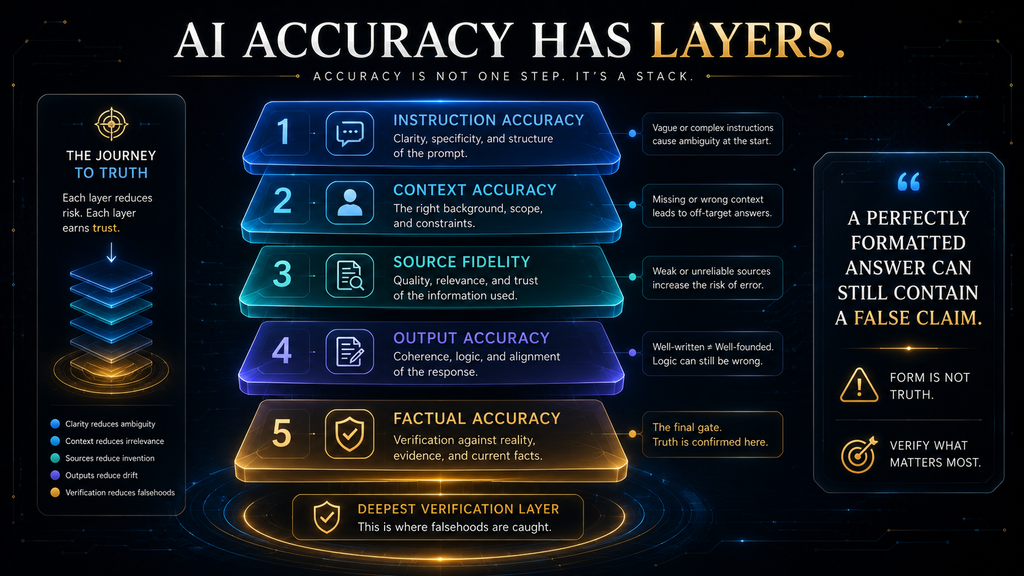
“Accuracy” covers several different things, and a response can succeed on one while failing another. Separating them makes problems easier to diagnose.
| Layer | Question |
|---|---|
| Instruction accuracy | Did the AI do the task that was asked? |
| Context accuracy | Did it use the situation and constraints provided? |
| Source fidelity | Did it stay faithful to the supplied material? |
| Output accuracy | Does the format match the answer contract? |
| Factual accuracy | Are the claims true? |
These layers can diverge sharply. An AI may produce a beautifully formatted five-row comparison table that contains one fabricated feature, which is perfect output accuracy and failed factual accuracy.
Prompting has the most influence over the first four layers. The fifth depends on evidence and verification, which is why a reliable workflow never stops at the prompt.
What Prompting Cannot Fix
Better prompts are powerful, and they have clear limits. Knowing the limits stops you from spending effort in the wrong place.
Prompting cannot repair incorrect source data. If the spreadsheet contains wrong numbers, the model will analyze those wrong numbers very competently.
Prompting cannot create missing evidence. If the dataset has no retention figures, the right instruction is “if retention cannot be determined from the available fields, say so,” and the right fix is to obtain the data.
Prompting cannot override model limitations or replace professional judgment. A prompt can organize a legal or medical question well, and a qualified person still has to own the answer.
What Transfers Between ChatGPT, Claude and Gemini
The principles in this guide transfer across models. Clear tasks, relevant evidence, defined limits and explicit handling of uncertainty help everywhere.
The details do not always transfer. Each developer publishes model-specific guidance, such as Anthropic’s prompt engineering overview, and models differ in how they handle long inputs, examples and formatting.
Do not assume that a prompt tuned for one model is optimal for another. When you move a recurring prompt to a new tool, test it on a few real cases before relying on it.
Our comparison of ChatGPT, Claude and Gemini for prompt-heavy workflows covers the practical differences. The safest habit is to keep the specification the same and adjust only the phrasing.
Before-and-After Prompt Examples
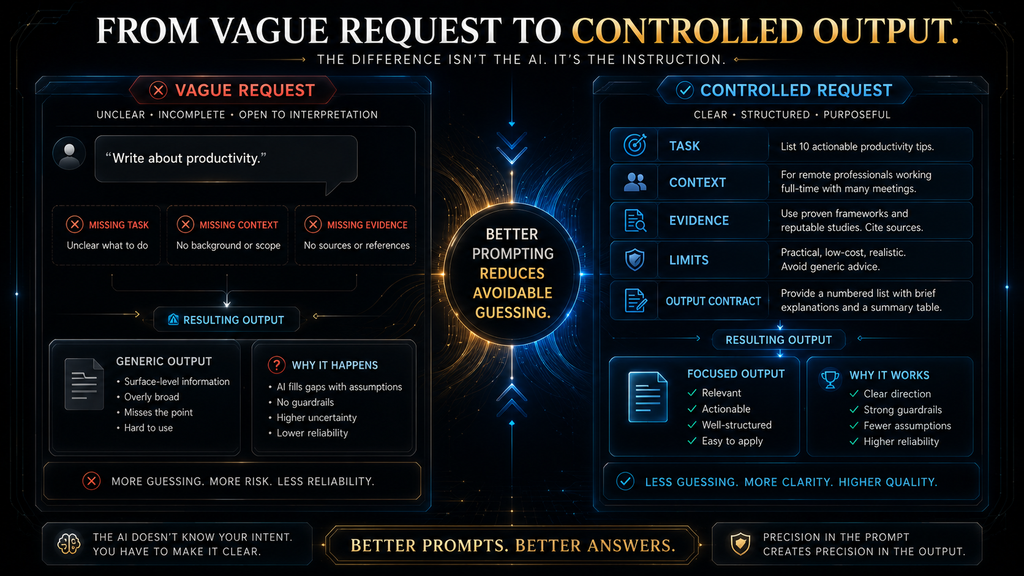
The difference between a weak and a reliable prompt is easiest to see side by side. Each reliable version below adds a boundary, a source rule or an uncertainty rule.
| Task | Weak prompt | Reliability-focused prompt |
|---|---|---|
| Research | “Tell me about AI trends.” | “Summarize five AI trends affecting small businesses in 2026. For each, explain what changed, one application and one limitation. Separate confirmed developments from predictions.” |
| Document | “Summarize this contract.” | “Summarize the termination and renewal provisions. Give section numbers. Use only this contract, and write ‘not specified’ where it is silent.” |
| Data | “Analyze our sales.” | “From the attached January to June data, identify the three largest revenue changes. Separate observations from explanations, and do not infer causes the data does not support.” |
| Current facts | “What does this tool cost?” | “Use current official pricing. State the date checked, and say so if the price cannot be verified.” |
| Writing | “Write an article about AI.” | “Write for small-business owners on three practical uses of generative AI. Avoid unsupported productivity claims, and mark examples as illustrative.” |
| Recommendation | “Which tool is best?” | “Compare these four tools for a solo writer on research quality, workflow and cost. Do not assume missing features. Recommend one and state the main trade-off.” |
None of the reliable versions is long. Each adds two or three sentences that remove the model’s most likely wrong turn.
Decision Prompts: Criteria, Trade-Offs and the No-Good-Option Rule
“Best” means almost nothing without criteria. Before asking which option is best, state what you are optimizing for, such as cost, accuracy, ease of use or integration.
With criteria in place, the recommendation becomes transparent. You can see why the model chose as it did, and you can disagree with the weighting instead of guessing at the reasoning.
Ask for trade-offs as well. “Recommend the strongest option, explain the main trade-off and say when another option would be better” produces a decision aid instead of a single name.
Add the no-good-option rule for important choices: “If none of the options meets all minimum requirements, say so and identify the closest alternatives.” Without it, the model will usually pick a winner even when every option fails.
Handling Conflicting Sources
Sources disagree more often than people expect. Left alone, a model may silently pick one version and present it as settled.
Tell it what to do: “If two credible sources disagree, do not silently select one. Identify the disagreement, give the publication dates and say which source appears more authoritative for this claim.”
This instruction turns a hidden weakness into visible information. A reader who knows that two reports differ can decide which to trust or look for a third.
It also protects you from stale data. Many apparent conflicts are simply an old figure and a new one, and asking for dates exposes that immediately.
The Three-Pass Method: Generate, Diagnose, Refine
Few prompts are right the first time. A simple three-pass method improves them without guesswork.
In the first pass, generate an answer with your best prompt. In the second, diagnose what went wrong: was the task misunderstood, was context missing, did the model fill a gap, or was the format off?
In the third pass, refine the prompt to address that specific failure. If the answer was too long, add a length limit, and if it invented a price, add a missing-data rule.
Avoid randomly adding instructions. Every extra line is something the model must weigh, and a prompt that has grown by accretion often contains rules that conflict.
Testing a Prompt for Failure, Not Just Success
A prompt that worked once is not necessarily a reliable prompt. Before you depend on it, try it on cases designed to break it.
For a customer-support prompt, test a normal question, an angry customer, a question outside the policy, a request with missing information and an attempt to get a promise the business cannot make.
Watch what the model does at the edges. A good prompt produces a sensible refusal or a clarifying question, while a weak one produces a confident answer to a question it should not have answered.
Keep the test cases. When you edit the prompt later, rerun them, so an improvement in one area does not quietly break another.
How to Tell Whether a Prompt Improved
Judge a prompt by the work it saves, not by how the answer reads. A handful of simple measures is enough.
| Measure | Question |
|---|---|
| Task completion | Did it solve the requested problem? |
| Constraint compliance | Did it follow the boundaries? |
| Evidence fidelity | Did it stay within the supplied evidence? |
| Unsupported claims | How many claims needed correction? |
| Editing time | How much manual cleanup remained? |
| Consistency | Does it work across repeated cases? |
| Usability | Can the output be used immediately? |
Editing time is the most honest of these. If a new version of the prompt cuts your cleanup from twenty minutes to five, it is better, whatever it looks like.
Reusable Prompt Templates
A few templates cover most reliability-sensitive work. Replace the bracketed parts and keep the rules.
For general analysis: “Analyze the information below for [audience]. Focus on [criteria]. Use only the supplied information, do not assume missing details, and separate facts from inference. Return the answer as [format]. If the evidence is insufficient, explain what is missing.”
For research: “Research [topic] as of [date]. Prioritize primary and authoritative sources. Separate established facts from predictions. Give a source for every important claim, and identify uncertainty instead of filling gaps.”
For documents: “Using only the document below, identify [information]. Reference the relevant section. Do not infer anything the document does not support, and write ‘not specified’ where it is silent.”
For data: “Analyze the attached dataset for [objective]. Separate observations from possible explanations. Do not infer causation unless the data supports it, and flag missing or inconsistent data.”
For decisions: “Compare [options] on [criteria]. Use only the supplied information. Recommend the strongest fit, explain the main trade-off, and say so if none meets the minimum requirements.”
Saving and Sharing Prompts That Work
A prompt that works is an asset, and it should be stored like one. Keep your tested prompts in one place, with a note on what each is for and when it was last checked.
For instructions you use in every conversation, such as “separate facts from inference,” set them once. Our guide to writing system instructions shows how to make them persistent.
Teams gain the most from sharing. When one person finds a prompt that reliably extracts action items or summarizes contracts, everyone should use the same version.
As a library grows, dedicated tools help with versions and access. Our roundup of prompt management tools for teams compares the options.
The Economics: Prompts That Reduce Rework
The value of a better prompt is the rework it removes. Suppose a weekly report normally takes four rounds of correction, at ten minutes each.
A clearer specification that cuts this to one round saves thirty minutes a week, or about twenty-six hours a year, for one recurring task. These numbers are an illustration, and your own will differ.
The saving grows when a prompt is shared. A team of ten using the same improved prompt for the same task multiplies the benefit, at no extra cost.
The same arithmetic tells you when to stop. For a one-off, low-stakes question, ten minutes spent perfecting a prompt costs more than the rework it would prevent.
A Five-Minute Prompt Improvement Process
When a prompt matters and time is short, a quick routine is enough. It takes about five minutes and fixes the most common weaknesses.
First, rewrite the request as a job with an outcome. Second, add the two or three facts that would change the answer, and remove anything that would not.
Third, add a source rule and a missing-information rule. Fourth, state the format you want, and fifth, decide which claims you will check when the answer comes back.
Run the prompt once and look at where the answer went wrong. One targeted change after that first run usually does more than any amount of polishing beforehand.
Privacy and Sensitive Data in Prompts
Supplying evidence makes answers more reliable, and it also means sharing information. Before pasting a document into a prompt, consider what it contains.
Remove names, account numbers and other identifiers when the task does not need them. A contract clause can be analyzed without the parties’ names, and a sales pattern can be studied without customer details.
Check whether the tool is approved for the kind of data involved. Our guide to AI privacy risks lists the questions worth asking first.
Reliability and privacy can be balanced. The aim is to give the model the minimum evidence the task requires, which is the same principle as the minimum sufficient specification.
Common Prompt Mistakes That Reduce Reliability
Most unreliable answers come from a small set of prompt mistakes. Check your own prompts against this list:
- asking for a topic instead of a job
- leaving out the context that changes the answer
- setting no source boundary
- giving no rule for missing information
- leaving the output undefined
- combining several unrelated tasks
- padding the prompt with irrelevant detail
- using examples that contradict each other
- forcing confidence with phrases such as “do not hedge”
- treating the model’s self-check as fact-checking
Fixing the first four produces most of the improvement. They are the ones that leave the model guessing about the job, the facts and the gaps.
Who Should Use Reliability-Focused Prompting
If you use AI for research, published content, client reports, data analysis, customer communication or decisions that cost money, this method will pay for itself quickly. The more expensive an error, the more carefully the prompt should define the task and the evidence boundary.
If you run recurring workflows, the gain is larger still. A specification written once and reused weekly keeps results consistent and makes problems easier to trace.
If you are asking a casual question, rewording a sentence or brainstorming ideas, keep it simple. A one-line prompt is fine when a wrong detail does no harm.
The skill is matching effort to stakes. “Summarize this paragraph” needs no framework, while “review this investment proposal and identify claims I must verify before deciding” deserves every element.
What Happens If You Keep Prompting Casually
Casual prompting works well enough that its costs are easy to miss. Most answers are usable, and the bad ones get fixed with another round.
Those extra rounds add up. Each correction, clarification and rewrite is time that a clearer first request would have saved.
The larger risk is the error you do not notice. A prompt with no source boundary and no missing-data rule produces complete-looking answers, and a complete-looking answer with one invented figure is easy to pass along.
Over time, casual prompting also teaches you to distrust the tool. People who specify their work well tend to find AI far more useful than those who ask vague questions and judge it by the vague answers.
Where Prompting Is Heading
Prompting is becoming less about wording and more about context and control. Models now read long documents, call tools and carry instructions across sessions.
That shifts the skill toward deciding what information the model should see, in what order and with what rules. The specification mindset in this guide becomes more valuable as tools become more capable.
Agents make the stakes higher. An AI that can take actions needs clearer limits and stopping points than one that only writes text, as our explainer on how AI agents use tools shows.
Verification is also becoming a separate, explicit step. The mature workflow is a clear prompt, a controlled output, an evidence check and a human judgment, in that order.
How We Researched This Guide
This guide was researched and drafted with AI assistance and checked against the primary sources linked in the article. Prompting guidance comes from the published documentation of OpenAI, Google and Anthropic.
The research references are the chain-of-thought and self-consistency papers, the Lost in the Middle study of long inputs and OpenAI’s research on why language models hallucinate. We describe those sources only as far as their published abstracts and pages support.
We did not run a controlled experiment comparing prompt styles, and no benchmark is claimed. The time-saving figures are illustrative, and the RELIABLE framework, the Prompt Quality Ladder and the three-pass method are AI Hustle World frameworks.
Last updated October 2026. This version restructures the guide into shorter sections, adds the comparison tables, testing and economics sections, and re-checks every source link.
Final Thoughts
The fastest way to improve your AI results is not to memorize hundreds of prompt tricks. It is to stop treating important prompts as casual questions and start treating them as work specifications.
Tell the AI what result you need, give it the context and evidence that change the answer, and set the boundaries that matter. Say who the output is for and what the finished answer should look like.
Most importantly, tell the AI what to do when the evidence is incomplete. An AI told “always give me an answer” behaves very differently from one told “if the evidence is insufficient, explain what is missing.”
Better prompts control the request, better evidence controls the claims and human judgment controls the consequences. Once you work that way, prompt engineering stops being a collection of clever phrases and becomes a method for making AI predictable and useful.
Don’t Trust an AI Answer Just Because It Sounds Right
Better prompts can make AI responses clearer and more controlled, but important claims still need evidence. Learn how to check AI-generated information before you rely on it.
Learn How to Verify AI Information →Frequently Asked Questions
How do I write AI prompts for accurate answers?
State a precise task, add relevant context and evidence, set limits, name the audience, define the format and give a rule for missing information. Then verify important claims.
What makes an AI prompt reliable?
It reduces guessing. A reliable prompt defines the job, supplies evidence, sets boundaries, specifies the output and tells the AI what to do when evidence is insufficient.
Does a better prompt prevent hallucinations?
No. Better prompts reduce ambiguity and unsupported guessing, but they cannot guarantee factual accuracy. Important claims still need checking against a reliable source.
Should AI prompts be very long?
No. Make them as detailed as the task requires and no longer. Include what changes the answer and leave out the rest.
Should I tell AI to “be accurate”?
That alone does little. Say what accuracy means for the task: use the supplied evidence, do not invent missing information and separate facts from inference.
Should I use examples in prompts?
Yes, when the desired output is easier to show than describe. Examples help most with formatting, classification, extraction and recurring tasks.
Is prompt chaining always better?
No. Use stages when a task is complex, has competing goals or needs an intermediate check. Simple requests rarely need more than one prompt.
Can I use the same prompt for ChatGPT, Claude and Gemini?
The principles transfer, but behavior differs between models. Test a prompt on real cases before relying on it in a new tool.
Can AI fact-check itself?
It can check completeness and format, but that is not independent verification. Confirm important claims against reliable external evidence.
What is the biggest prompt-writing mistake?
Giving AI a topic instead of a clearly defined job. “AI productivity” is a topic, while a task names the audience, the outcome and the criteria.
Related Guides
- A Beginner’s Guide to Writing AI Prompts That Generate Better Results
- How to Ask AI Better Questions to Save Time and Get Useful Answers
- How AI Agents Use Tools to Complete Real Tasks
Written by
Muntasir Ahmad Chowdhury
Founder, AI Hustle World
Muntasir Ahmad Chowdhury is the Founder of AI Hustle World, an independent publication dedicated to making Artificial Intelligence practical, trustworthy, and easy to understand. He researches AI tools, automation, customer service, productivity, and real-world business applications, helping readers make smarter technology decisions through research-driven, experience-backed content.
Expertise:
AI Tools • AI Automation • AI Customer Service • AI Productivity • Generative AI • AI Workflows
Get Smarter With AI
Enjoyed this guide? Get practical AI tools, tutorials, and honest reviews delivered to your inbox.