
Evidence: Documentation reviewed
Last checked: August 2026
What was done: Written from official documentation and the published sources linked in this article. Not hands-on tested.
Files: None
Affiliate links: No
AI in Finance & Accounting Explained: Where AI Actually Creates Value
Finance Has an AI Adoption Problem — But Not the One You Think
A CFO has a problem. The company has already invested in an ERP. It has dashboards, business intelligence tools, spreadsheets, and automation. And now everyone is asking: “Where should we add AI?”
The obvious answers are everywhere. Use AI to read invoices. Use AI to reconcile accounts. Use AI to forecast revenue. Use AI to write management reports, detect fraud, analyze expenses, or run finance workflows through agents. The technology can do all of these things to varying degrees, but that creates a harder question: where does AI actually create financial value rather than simply adding another technology layer?
That distinction matters more than it sounds. Deloitte’s Finance Trends 2026 research found that 63% of surveyed finance organizations had fully deployed and were actively using AI, yet only 21% said their AI investments had already delivered clear, measurable value, and only 14% had fully integrated AI agents into the finance function. That is a striking gap — finance is adopting AI, but adoption isn’t the same thing as value creation.
At the same time, KPMG’s 2026 Global AI in Finance study found that active AI use in finance had risen from 30% in 2024 to 75% in 2026, while 71% of surveyed finance leaders said AI was meeting or exceeding their ROI expectations, with organizations reporting improvements in decision quality, decision speed, and forecasting accuracy.
So which story is correct? Both, in their own way. Some finance organizations are turning AI into measurable value; others are still experimenting, struggling with legacy systems, weak data, unclear ROI, or governance gaps. The difference isn’t who bought more AI — it’s who redesigned finance work around AI in a controlled, measurable way. That is the focus of this guide.
Because the future of AI in finance isn’t about putting a chatbot on top of accounting software. It is about moving finance through a progression:
Record → Report → Explain → Predict → Recommend → Decide
AI can participate at every stage, but the value, risk, and required human oversight change dramatically as you move upward. Let’s break down where AI actually earns its place.
What Is AI in Finance & Accounting?
AI in finance and accounting refers to the use of artificial intelligence — including machine learning, generative AI, predictive analytics, and increasingly AI agents — to perform, augment, or improve financial activities. These activities can include transaction analysis, invoice processing, reconciliation, expense management, financial reporting, anomaly detection, fraud detection, forecasting, budgeting, scenario analysis, treasury management, audit support, tax research, management reporting, and financial decision support.
The important distinction is that AI can play several different roles. It can automate work, detect patterns, explain information, and increasingly execute multi-step workflows under defined controls. PwC’s current finance modernization work describes this direction as a shift toward finance functions where agents can participate in planning, forecasting, reporting, procurement, payments, treasury, tax, and accounting-close processes while humans retain supervision and governance.
That last part matters, because AI in finance should not be understood as “let the AI run accounting.” A more realistic model is: let AI perform the parts of finance work where machine intelligence creates more value than manual effort, while keeping human ownership where financial judgment and accountability matter.
AI Is Not the Same as Traditional Finance Automation
This distinction gets overlooked constantly, even though finance has been automating processes for decades. Long before generative AI, companies used ERP systems, rules engines, macros, optical character recognition, robotic process automation, workflow systems, automated reconciliation, and scheduled reporting. So putting an automated process inside an AI article doesn’t automatically make it an AI use case.
Consider two invoice workflows. Traditional automation looks like this: invoice arrives, extract predefined fields, route invoice, update system. An AI-assisted workflow looks different: invoice arrives, AI interprets the document, identifies supplier and terms, compares information against related financial records, detects anomalies, explains the exceptions, and recommends what should happen next. The second workflow contains interpretation, and that is where AI adds a genuinely different capability.
The Finance AI Value Stack
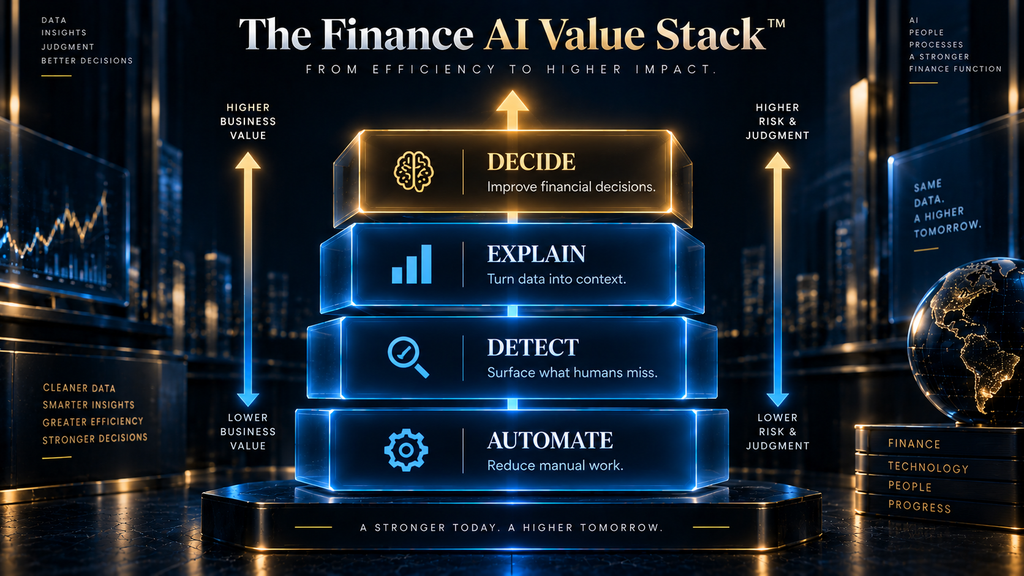
AI Hustle World recommends thinking about finance AI in four layers: Automate → Detect → Explain → Decide. This is our Finance AI Value Stack, and it gives finance leaders a simple way to place any use case on a map of rising value and rising risk.
The first layer, Automate, targets reducing repetitive manual work: document extraction, invoice processing, transaction classification, routine reporting, reconciliation preparation, data entry, and account matching. The objective is to reduce human effort, which makes this often the easiest layer to implement — though it isn’t necessarily where the largest strategic value resides.
The second layer, Detect, is where AI starts looking for things humans may miss: unusual transactions, anomalies, duplicate payments, unexpected spending, reconciliation exceptions, suspicious patterns, and unusual customer behavior. The objective is finding what deserves human attention — a real advantage, since a human might otherwise have to review hundreds of transactions just to find the handful that matter. An AI system can scan a far larger population and surface the unusual cases on its own.
The third layer, Explain, is where generative AI becomes particularly interesting. Instead of simply showing “operating expense is 8% above budget,” AI can help explain which categories caused the variance, which business units contributed, whether the change is temporary, whether it relates to volume or pricing, which assumptions changed, and what management should investigate. The objective is turning financial data into understandable context, which can meaningfully cut the time finance teams spend converting raw numbers into management insight.
The fourth layer, Decide, is both the highest-value and the highest-risk of the four. AI can support forecasting, scenario analysis, working-capital decisions, pricing analysis, profitability decisions, resource allocation, risk assessment, and capital planning. The objective is improving financial decisions themselves — but as decision consequence increases, human accountability becomes more important, not less.
Key insight: the easiest finance AI use case to automate is not necessarily the most valuable one. Invoice processing may be easier to automate than strategic forecasting, but better forecasting may create far more economic value. KPMG’s 2026 research supports this broader shift — the strongest reported gains were in decision-making quality, decision-making speed, and forecasting accuracy, suggesting that AI’s value is moving beyond basic transaction automation into judgment-heavy work.
Where AI Creates the Most Immediate Value
Not every finance process should receive the same AI investment. The strongest early candidates generally share four characteristics: high volume (there are many transactions or documents), high repetition (the workflow happens again and again), good data availability (the system has enough information to work reliably), and measurable outcomes (you can tell whether AI actually improved something). That combination is what makes certain areas particularly attractive to automate first.
AI in Accounts Payable
Accounts payable is one of the clearest AI opportunities. Typical work includes receiving invoices, extracting information, matching records, routing approvals, identifying exceptions, detecting duplicate invoices, and tracking payment status. AI can help interpret invoices even when documents differ in layout, terminology, formatting, language, and supporting information.
But the most important opportunity isn’t simply reading an invoice — it’s reducing the number of invoices that humans need to investigate manually. That means AI can move AP toward processing everything and investigating only the exceptions, rather than the old model of reviewing everything before processing it. Our dedicated article, How AI Automates Accounts Payable, Invoice Processing & Reconciliation, goes deeper into the detailed AP workflow. This article’s role is simply to show why AP belongs on the broader AI value map.
AI in Reconciliation
Reconciliation is another strong candidate. Traditional reconciliation involves comparing records, finding discrepancies, identifying likely matches, investigating exceptions, and documenting resolutions. AI can help identify likely matches and surface unusual cases, and the real value shows up as less manual searching, faster exception resolution, more consistent analysis, and better prioritization of what to review first.
But finance shouldn’t assume “AI matched it, therefore it is correct.” A better workflow keeps a human in the loop: AI match → AI explains → control check → human review when required → then post or resolve. That sequence is far more appropriate for controlled financial work than letting a match stand simply because the model produced it.
AI in the Financial Close
The month-end close is another area where AI can create meaningful value. Finance teams often spend significant effort collecting supporting information, identifying unusual balances, explaining movements, checking reconciliations, tracking unresolved items, and preparing reports. AI can assist with account analysis, exception identification, documentation, variance explanations, checklist management, and close-status summaries.
The important opportunity isn’t “AI closes the books by itself.” It’s that AI helps finance professionals identify what requires attention faster, which can compress the time between when a period ends and when management actually gets insight from it.
AI in Financial Reporting
Traditional financial reporting often answers “what happened?” AI can help finance move toward “why did it happen?” and potentially “what might happen next?” A traditional report might simply show revenue at $12.4M against a budget of $13.2M, a variance of -$800K. An AI-assisted analysis can go further, pointing to potential contributors such as lower enterprise bookings, delayed renewals, weaker performance in a specific region, or higher-than-expected churn — so the CFO can investigate the explanations directly rather than starting from a blank page.
This is a different kind of value, since the AI doesn’t replace financial ownership. It reduces the analytical work required to move from a bare number to an actual explanation.
AI in FP&A
FP&A may eventually become one of the most strategically important applications of AI in finance. This includes budgeting, forecasting, scenario planning, driver analysis, variance analysis, workforce planning, revenue planning, and profitability analysis. KPMG reports that 64% of surveyed organizations saw improved forecasting accuracy with AI, while Deloitte’s 2026 finance research places advanced scenario planning and AI among the top priorities for finance leaders.
FP&A deserves its own deep treatment, which is why we published AI Financial Planning & Analysis (FP&A): How Continuous Forecasting Works as a companion piece — this article won’t duplicate that detailed forecasting discussion. The broader point here is that AI can turn finance from a periodic reporting function into a more continuously updated decision-support function. PwC’s current 2026 finance work describes this emerging direction as moving from periodic reporting toward continuous intelligence, with agents executing while humans govern and decisions remain auditable.
AI in Fraud and Anomaly Detection
Fraud and anomaly detection represent a different category of AI use case. Instead of “process this transaction,” AI asks “does this transaction look unusual compared with expected behavior?” Potential signals include unusual transaction size, unusual timing, vendor anomalies, duplicate behavior, unusual geographic activity, and unexpected account patterns.
The key advantage is scale: a human may realistically review a few hundred flagged transactions, while an AI system can scan millions and surface only the small number worth investigating. But this creates a critical principle worth repeating — detection isn’t the same as accusation. An anomaly is a reason to investigate, not proof of fraud. Our companion article, How AI Detects Financial Anomalies, Fraud & Leakage, walks through that distinction and the underlying detection methods in more depth.
AI in Expense Management
AI can analyze employee expenses, vendor spend, category patterns, unusual purchases, and policy exceptions. Instead of humans reviewing every transaction equally, AI can prioritize what deserves investigation first, which improves both speed and control coverage at the same time. Again, the goal is not necessarily complete autonomous approval — a better architecture is AI scans, AI flags, humans review the exceptions, and finance resolves them.
AI in Accounts Receivable
AR offers another opportunity. AI can help with collections prioritization, payment-risk analysis, customer communication, cash forecasting, overdue-account classification, and dispute analysis. Instead of treating every overdue customer equally, the system can distinguish between a customer who looks low-risk — a temporary delay against a strong payment history — and one who looks different, with repeated delays, an increasing balance, and cash-flow warning signs. The system can prioritize the second case; the value isn’t simply automation, it’s better attention allocation.
AI in Treasury and Working Capital
Treasury is increasingly data-intensive. AI can help analyze cash positions, cash-flow patterns, liquidity, payment timing, working-capital behavior, foreign-exchange exposure, and short-term scenarios. This can support faster decisions, but treasury also involves high consequences, so the appropriate model is typically AI analysis paired with human treasury ownership rather than unrestricted autonomy.
Our related guide, How to Use AI for Cash Flow Forecasting and Scenario Planning, covers the practical side of this in more detail. KPMG’s 2026 finance findings emphasize that data foundations and assurance capabilities matter significantly as AI moves into higher-value financial decision-making.
AI in Audit
AI can help audit teams analyze large transaction populations, supporting documents, anomalies, patterns, and evidence, increasing the breadth and speed of analysis. But audit has a fundamental requirement: evidence must be explainable and defensible.
A model saying “this looks unusual” isn’t enough — the finance professional needs to know what evidence was considered, why it was flagged, what rule or model contributed, and what additional evidence is required. That is why auditability should be treated as part of the product, not an afterthought.
AI in Tax
AI can assist with tax research, document analysis, extracting relevant information, comparing rules, preparing working papers, and identifying potential issues. But tax conclusions can carry substantial legal and financial consequences, so AI research is not the same thing as final tax advice.
Human tax professionals remain responsible for judgment and interpretation, and the further AI moves toward a material tax conclusion, the stronger the case for professional review before anyone acts on it.
The AI Finance Value Matrix
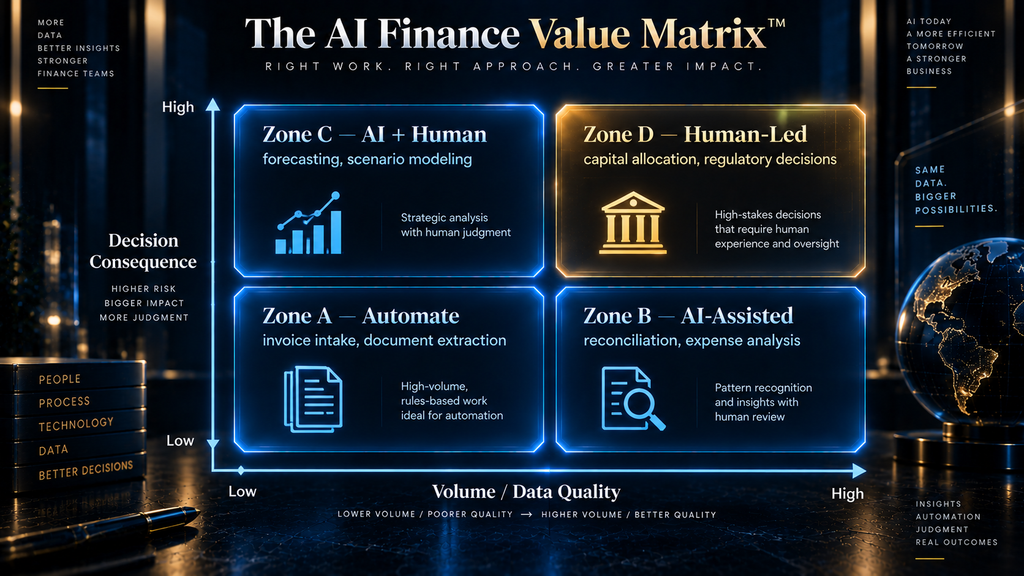
Now we can put the entire finance function into one framework. Evaluate each use case across four variables: volume (how much work occurs), variability (how predictable the workflow is), decision consequence (how damaging an error could be), and data quality (how reliable the underlying information is). These variables produce very different automation strategies depending on where a workflow lands.
Zone A — Automate covers high volume, low variability, good data, and lower decision consequence, such as invoice intake, document extraction, and routine categorization. Zone B — AI-Assisted covers high volume with moderate variability and moderate consequence, such as reconciliation exceptions, expense analysis, and close support.
Zone C — AI + Human covers lower volume, high analytical value, and high decision consequence, such as forecasting, scenario modeling, and profitability analysis. Zone D — Human-Led covers high consequence, high ambiguity, and weak data, such as major capital allocation, complex accounting judgment, and material regulatory decisions.
Why “More AI” Is Not the Goal
This sounds obvious, yet it’s one of the biggest mistakes organizations make. Suppose Company A has 20 AI finance tools while Company B has only five, but far more carefully integrated into its workflows — Company B might well be the more advanced of the two, because AI value depends on workflow redesign rather than tool count.
PwC’s 2026 AI Performance study found that companies capturing most of AI’s economic gains were about twice as likely to redesign workflows around AI rather than simply add more AI tools. AI should be embedded in the workflow, not decorated on top of it.
The “AI on Top of Chaos” Trap
Imagine a finance department with five spreadsheets, three inconsistent reporting definitions, duplicate vendors, fragmented ERP data, manual reconciliations, and inconsistent chart-of-accounts usage. Then someone says “let’s add AI.”
The AI might produce beautifully written explanations, but it is still reasoning over a broken information system. KPMG’s 2026 finance research identifies data quality as a major barrier and opportunity, with 36% of organizations pointing to it as a central issue, and also found that stronger data foundations correlate with better AI outcomes across sectors. The more reliable sequence is standardize, clean, connect, govern, automate, and only then add AI.
Data Quality Is the Hidden AI Finance KPI
Finance leaders often ask “how accurate is our AI?” A better question is “how reliable is the information the AI is allowed to use?” A highly capable model cannot repair missing transactions, inconsistent definitions, incorrect master data, duplicate records, or stale information. This is why AI deployment often exposes deeper finance-data problems that were already there — the AI isn’t creating the problem, it’s making the problem impossible to ignore any longer.
AI vs Traditional Rule-Based Systems
Use traditional automation when rules are stable, data is structured, and the expected result is predictable. Use AI when inputs vary, documents differ, patterns matter, context matters, and exceptions require interpretation. A rule-based system might simply say “if invoice total exceeds $10,000, send for approval.”
An AI-assisted approach instead assesses the invoice, supporting documentation, and related records, identifies unusual characteristics, explains the anomaly, and recommends whether additional review may be appropriate. The second problem is much harder to solve using fixed rules alone, which is exactly why AI earns its place there. Our companion piece, AI Accounting vs Traditional Accounting: What Should You Automate?, breaks this decision down workflow by workflow.
Autonomy, Trust, and Governance in Finance AI
The Finance AI Ladder
Finance organizations can think about adoption as four levels. Level 1, Manual, is where humans perform the workflow. Level 2, Automated, is where rules execute the repetitive steps. Level 3, AI-Assisted, is where AI interprets information and recommends actions. Level 4, Agentic, is where AI can execute multiple steps under defined guardrails.
Deloitte’s 2026 research shows why organizations should be careful about treating Level 4 as the default: although 63% of surveyed finance teams reported fully deployed AI, only 14% had fully integrated AI agents into finance. The market is advancing quickly, but finance is still working out where autonomy is actually justified.
Where AI Should NOT Be Fully Autonomous
This deserves explicit treatment. For major accounting judgments, AI can research the evidence, but humans should own the final judgment. For material financial reporting, AI can prepare it, but humans should review it before it goes out. For tax conclusions, AI can assist, but qualified professionals should validate the result. For major capital allocation, AI can model the scenarios, but leadership should make the actual decision. For regulatory submissions, AI can assist with preparation and validation, but accountability must remain clearly assigned to a person. And for high-value financial exceptions, AI can identify the anomalies, but humans should be the ones who investigate them. PwC’s current controller guidance emphasizes that governance, rigor, and judgment remain core strengths of controllership even as AI accelerates finance modernization.
The Finance AI Value-to-Autonomy Curve
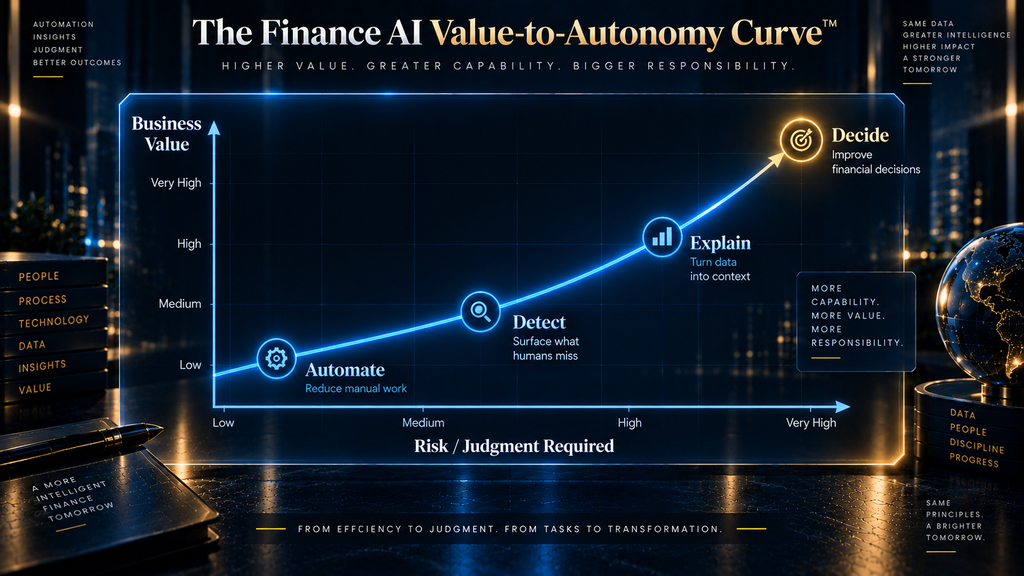
This gives us another useful framework. As you move from Automate to Detect to Explain to Decide, the potential business value rises — but so does the required judgment, risk, governance, auditability, and human oversight. The goal isn’t to push every finance process to the highest level of autonomy; it’s to choose the highest-value level of AI autonomy that the organization can actually govern safely.
Governance Is Not the Brake
Some executives think governance slows AI down, but the current evidence suggests a more nuanced reality. KPMG found that organizations with stronger assurance readiness reported three to six times higher rates of significant error reduction and greater confidence in scaling AI. That means governance can actually become an enabler of scale — if finance trusts where the AI got its data, how it made its recommendation, what controls surround it, and who approved the final action, the organization can safely use AI in more workflows, not fewer.
The Auditability Requirement
For finance AI, the useful question is always: can we reconstruct what happened? Ideally, you should be able to determine what data the AI received, what it analyzed, what it recommended, what evidence supported it, what human approved it, what action occurred, and what result followed. That chain is an audit trail, and in finance, auditability isn’t a nice-to-have feature — it’s part of what makes the system trustworthy in the first place.
Measuring ROI and the Shift to Continuous Intelligence
Finance AI ROI — What Should You Measure?
Don’t measure prompts, AI responses, the number of automated tasks, or the number of documents processed — those are activity measures. Measure business outcomes instead, across five categories: efficiency (hours saved, cycle-time reduction, close duration, processing cost), accuracy (exception rate, reconciliation accuracy, error rate, forecast accuracy), decision quality (variance identification, forecast quality, scenario accuracy, management decision speed), risk and control (anomaly detection, fraud cases identified, audit exceptions, control failures), and strategic capacity (finance hours shifted to business partnering, faster planning cycles, more scenario analysis, improved responsiveness).
The Finance AI ROI Equation
A useful conceptual model is: AI Finance ROI = Financial Benefit + Capacity Created + Risk Reduction − Total AI Cost, where total AI cost includes software, data, integrations, implementation, infrastructure, training, monitoring, and governance. This framing prevents the common mistake of counting only labor savings and calling it ROI.
Cost Reduction Is Not the Only ROI
Imagine AI saves $500,000 in finance labor — good, but incomplete. Now imagine AI also allows the CFO team to forecast weekly instead of monthly, identify working-capital problems earlier, detect anomalies faster, and test more strategic scenarios. The strategic benefit of that shift may be much larger than the initial labor saving, which is why KPMG describes the leading trend as moving AI from a cost lever toward a decision engine.
The Trusted Finance AI Loop
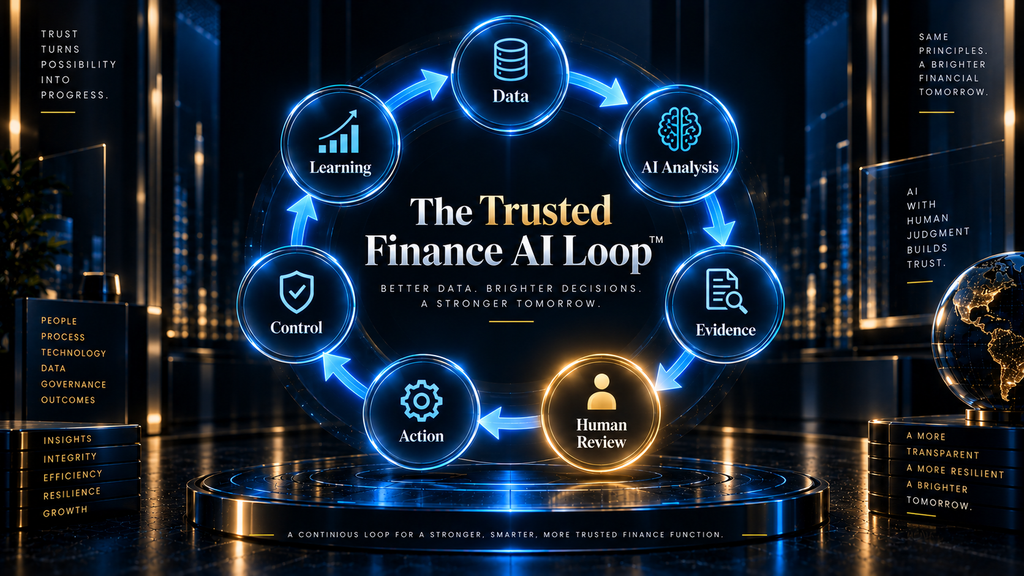
AI finance needs a control system, not just a model. In practice, this loop looks like: reliable finance information enters the system (Data), AI identifies patterns or produces recommendations (AI Analysis), the result is tied to supporting information (Evidence), a person validates where required (Human Review), finance executes the approved decision (Action), the action is logged, monitored, and auditable (Control), and the organization measures what worked (Learning) before the cycle repeats.
Where the Biggest Finance AI Opportunity May Actually Be
Here’s the contrarian argument: the biggest value of AI in finance may not be replacing financial work at all. It may be increasing the number and quality of financial decisions the organization can make. Traditional finance might review 20 scenarios; AI can make it easier to evaluate hundreds. Traditional finance may analyze monthly; AI can support continuous monitoring. Traditional finance may investigate a handful of selected anomalies; AI can scan the entire population. Taken together, this can fundamentally increase finance’s strategic capacity rather than simply shrinking its headcount.
Finance Is Moving From Periodic to Continuous Intelligence
The traditional model runs month-end → report → meeting → decision. The AI-enabled model runs continuous data → continuous analysis → continuous signals → faster decision. PwC’s August 2026 finance discussion explicitly describes this transition from periodic reporting to continuous intelligence, with agents executing while humans govern and decisions remain auditable — one of the more important transformations happening inside finance right now.
The Evolution of Finance
The shift can be summarized across six stages: Record (what happened), Report (what were the numbers), Explain (why did they change), Predict (what may happen next), Recommend (what should we consider doing), and Decide (what should the organization actually do). AI becomes more valuable as finance moves up this ladder, but it also requires more judgment and governance at every step.
Building Your Automation Roadmap: What to Automate First and Later
What Finance Teams Should Automate First
If you’re starting today, don’t begin with the most complicated AI agent you can find. Begin with document-heavy workflows like invoices and receipts, high-volume reconciliation support where AI can surface exceptions, reporting preparation to reduce repetitive data-to-narrative work, variance analysis to help explain what changed, anomaly detection to surface transactions requiring attention, and forecasting assistance that enhances rather than blindly replaces existing planning processes. This creates a clean progression from low-risk efficiency toward higher-value decision support.
What Finance Teams Should Automate Later
Approach with more caution: autonomous financial decisions, complex accounting treatment, major capital allocation, material financial reporting, regulatory submissions, and high-stakes tax decisions. AI can support all of these, but the risk-to-reward equation changes considerably once the stakes get that high.
The AI Finance Decision Test
Before deploying AI to any finance workflow, ask a structured set of questions: what decision or task are we actually improving, and be specific about it; what financial value could improve — cost, speed, accuracy, decision quality, or risk; is the data reliable enough, and if not, fix the data first; what happens if AI is wrong, and can you quantify the downside.
Who owns the final decision, since accountability should never stay ambiguous; can the result be audited, and if not, redesign the workflow; and how will you prove ROI, since the metric should be defined before deployment, not after. If you can’t answer these questions with confidence, you’re probably not ready to scale that use case yet.
Who Should (and Shouldn’t) Prioritize AI in Finance
Who Should Use AI in Finance?
AI is especially attractive for growing finance departments that need more capacity without proportional headcount growth, large enterprises with huge transaction volumes and complex datasets, multi-entity businesses where consolidation creates repetitive work, high-transaction companies where AI can scan massive transaction populations, finance functions already modernizing their ERP or EPM systems, and CFO organizations trying to become more strategic by moving people away from repetitive reporting work. PwC’s current guidance notes that embedded AI capabilities in ERP and EPM systems can improve speed, reduce manual work, enhance forecasting, and support governance — making existing enterprise platforms a practical starting point for finance AI rather than a separate initiative.
Who Should Avoid Overengineering Finance AI?
You probably don’t need sophisticated agentic AI yet if finance processes are still undocumented, data quality is poor, transaction volumes are low, controls are immature, the ROI is unclear, or the team can’t realistically supervise the technology. In those cases, fix the foundation before adding autonomy. The goal isn’t to become “AI-first” — it’s to become value-first.
Common Mistakes to Avoid
The first mistake is buying AI before cleaning finance data, since bad data creates bad analysis no matter how capable the model is. The second is confusing automation with AI — rules-based automation isn’t automatically AI.
The third is starting with the most exciting use case instead of the most valuable one; start with measurable value first. The fourth is optimizing purely for headcount reduction, when AI can create far more value through added capacity and better decision quality. The fifth is treating AI output as financial truth, when every important output still needs appropriate validation.
The sixth mistake is ignoring auditability — if you can’t reconstruct how an output was produced, trust becomes difficult to sustain. The seventh is measuring only time saved instead of business outcomes. The eighth is automating high-consequence decisions too early, since risk rises right alongside financial consequence.
The ninth is adding AI on top of already-broken workflows instead of redesigning the workflow first. And the tenth is buying isolated AI tools, when integrated workflows usually create more value than a pile of disconnected AI experiments.
AI Hustle World’s Honest Take
Reality Check
Here is the uncomfortable truth: finance is one of the worst functions for “move fast and break things.” A finance workflow is connected to financial reporting, taxes, audits, cash, controls, investors, regulators, employees, and vendors, so a small AI experiment can turn into a major operational issue if it escapes its intended boundaries. The right mindset is to experiment quickly but deploy financial autonomy carefully — that isn’t anti-AI, it’s what actually makes AI scalable in a function like this one.
Our Honest Opinion
We believe the strongest finance AI strategy in 2026 is not “replace accountants with AI.” It’s “remove low-value work from accountants and increase the amount of high-value financial judgment the team can perform.” That’s a fundamentally different objective.
A finance professional may spend less time extracting data, reconciling obvious transactions, and preparing repetitive reports, and more time interpreting performance, testing scenarios, advising executives, managing risk, challenging assumptions, and making capital decisions. Deloitte’s current finance workforce research supports this direction: despite widespread AI deployment, 84% of surveyed organizations had not yet redesigned jobs or the nature of work around AI, while strategic judgment, curiosity, and agility remain distinctly human capabilities.
A Practical Finance AI Roadmap
Phase 1 is about mapping the work: document workflows, manual effort, data sources, bottlenecks, error rates, and approval points. Phase 2 is about identifying AI candidates by scoring each workflow on volume, repetition, data quality, business value, and risk. Phase 3 is about starting with controlled use cases such as document processing, reconciliation support, reporting preparation, and anomaly detection.
Phase 4 is about measuring the results — hours, cycle time, error rate, quality, cost, and risk. Phase 5 is about expanding into decision support: forecasting, scenario analysis, profitability, and working capital. Phase 6 is about considering agents, but only after data is trustworthy, workflows are documented, controls exist, and outcomes are measurable.
The Finance AI Maturity Model and Operating Blueprint
AI Finance Maturity Model
A finance organization can think about maturity across five levels: Manual Finance, where people perform most work by hand; Automated Finance, where rules handle the repetitive workflows; AI-Assisted Finance, where AI interprets data and supports employee.
Intelligent Finance, where AI continuously detects, explains, and recommends; and Agentic Finance, where AI agents execute defined multi-step workflows under governance. But the goal isn’t automatically reaching Level 5 — the correct goal is the highest level of AI autonomy that produces more value than risk for your specific organization.
What 2026 Finance Leaders Are Doing Differently
The most advanced organizations aren’t necessarily asking “where can we add AI?” They’re asking the far more mature question: “where can AI change the operating model?” PwC’s AI Performance research found that companies capturing most of AI’s economic gains were about twice as likely to redesign workflows around AI rather than simply add AI tools on top of what already exists. This reinforces the core thesis of this article: AI transformation is a workflow-design problem, not just a software-purchasing decision.
The Complete Finance AI Operating Model
Putting everything together, finance data flows into a data-quality layer, then into AI analysis and agents, which split into automate, detect, and explain streams that converge into a recommendation. That recommendation goes through human review before a decision is made and acted on, with control and audit wrapped around the action, ROI measured afterward, and the resulting lessons fed back into the system as ongoing learning. That closed loop — data, quality, analysis, recommendation, review, decision, action, control, measurement, and learning — is the operating model we recommend finance teams build toward.
Scale-Readiness Checklist
Before your finance team scales AI, make sure finance data is clean enough for the intended workflow, the process is documented, the business problem is clearly defined, and AI is solving a real bottleneck rather than a hypothetical one. Confirm that traditional automation has already been considered, the AI output can be validated, human accountability is clear, and auditability is built in from the start.
Material decisions should still carry appropriate human oversight, AI-generated explanations should be evidence-based, and ROI metrics should have been defined before deployment rather than invented afterward to justify it.
Exceptions should be tracked, failures reviewed, and governance should scale alongside autonomy. Finance employees need to be trained to evaluate AI output, the workflow should be integrated into existing systems, and AI should never be used to compensate for a process that was already broken.
The Future of Finance: More Strategic, Not Less
Finance AI Value Map
Laying every use case discussed so far onto a single map makes the pattern easy to see: potential value increases steadily as you move toward decision support, but so does the need for human judgment alongside it. That tradeoff — more value, more judgment required — is the central thread running through this entire guide.
Why Finance May Become More Strategic, Not Less
This is perhaps the most important long-term implication of everything above. Finance has historically carried a huge administrative burden, and AI can reduce a meaningful share of it — which creates capacity. That freed capacity can move into strategy, pricing, profitability, capital allocation, scenario planning, risk management, and business partnering.
So AI doesn’t necessarily reduce finance’s importance; it can increase it, as the function moves from scorekeeper toward decision partner. Deloitte’s 2026 research similarly notes that finance leaders are taking a larger role in enterprise strategy, and that organizations combining advanced AI, cloud, and finance transformation are positioning finance more strategically than peers who treat AI as a point solution.
The Future of AI in Finance & Accounting
The next stage will likely be less about isolated AI features and more about continuous finance intelligence. Instead of the monthly cycle of report, meeting, decision, finance moves toward a continuous loop of data, analysis, signal, explanation, and decision.
AI agents will increasingly participate in planning, forecasting, reporting, payments, procurement, treasury, tax, and close — PwC’s 2026 work with OpenAI explicitly describes building finance agents across those core workflows while retaining human supervision throughout. But the winning organizations won’t simply be the ones that give agents more authority; they’ll be the ones that build trust, governance, measurement, and data quality alongside that autonomy.
The Future Finance Function
The evolution can be summarized simply. Yesterday, finance recorded transactions. Today, it reports and analyzes them. The emerging stage predicts and recommends. The future stage continuously monitors and acts under governance — which doesn’t mean finance professionals disappear from the picture. It means the profession moves further toward judgment, strategy, oversight, and decision-making, and further away from manual data handling.
The Five Rules of AI in Finance
Rule 1: fix the data before trusting the AI. Rule 2: automate the repetitive before automating the consequential. Rule 3: measure value, not AI activity. Rule 4: increase governance as autonomy increases. Rule 5: use AI to improve decisions, not simply to reduce labor.
Final Thoughts: The Best Finance AI Doesn’t Make Finance Less Important
There’s a temptation to think about AI in finance purely as a labor-replacement story — fewer accountants, fewer analysts, fewer manual processes. That’s too narrow a way to think about it. The more interesting possibility is that AI changes what the finance function is capable of doing in the first place.
A finance team that spends less time extracting data, matching transactions, preparing repetitive reports, and searching for anomalies can spend more time challenging assumptions, modeling scenarios, advising leadership, improving profitability, managing working capital, evaluating risks, and guiding investment. That is a much larger transformation than headcount math alone.
The current evidence already points in that direction. KPMG’s 2026 research found AI use in finance has reached 75%, with 71% of surveyed leaders saying ROI meets or exceeds expectations, alongside strong reported improvements in decision quality, speed, and forecasting accuracy.
But Deloitte provides an equally important warning: 63% of finance teams report active AI deployment, yet only 21% report clear, measurable value. That gap is the real story here — the winners won’t necessarily be the companies with the most AI. They’ll be the organizations that are explicit about where AI belongs, where it doesn’t, what data it needs, what controls it requires, when a human must intervene, and how to actually prove that it created value.
That is why AI in finance shouldn’t be measured by how many tasks got automated. The better question is what financial decisions the organization can now make faster, better, or more confidently than before. That’s the real measure of transformation, and it leads back to the framework this guide recommends: automate the repetitive, detect the unusual, explain the numbers, support better decisions, and govern the system tightly enough that finance can actually trust it.
Finance will keep moving from simply recording what happened toward understanding why it happened, anticipating what may happen next, and helping the business decide what to do about it. That is where AI’s deepest value is likely to show up — not in replacing finance, but in making it faster, more analytical, more forward-looking, and more strategically valuable than it has ever been.
Ready to See This Framework Applied to One Real Workflow?
Accounts payable is where most finance teams get their first real AI win. See exactly how AI reads invoices, catches exceptions, and cuts manual review time.
Explore AI-Powered AP & Reconciliation →FAQ
What is AI in finance and accounting?
AI in finance and accounting refers to using artificial intelligence to automate, analyze, explain, predict, or support financial workflows such as accounting, reconciliation, reporting, forecasting, fraud detection, treasury, and planning.
How is AI used in finance?
Common applications include invoice processing, reconciliation, anomaly detection, financial reporting, variance analysis, forecasting, scenario planning, expense analysis, fraud detection, treasury, audit, and tax research. The value varies significantly by workflow, which is why matching the use case to the right layer of the Finance AI Value Stack matters more than adopting AI broadly.
How is AI used in accounting?
AI can assist with document processing, transaction classification, reconciliation, accounts payable, accounts receivable, close support, anomaly detection, reporting, and audit preparation. High-consequence accounting judgments should generally remain subject to appropriate professional review rather than being fully automated.
Where does AI create the most value in finance?
The strongest efficiency opportunities typically combine high volume, repetitive work, good data, and measurable outcomes. The strongest decision-support opportunities combine strong data with analytical complexity and real decision importance. KPMG’s 2026 research indicates particularly strong reported gains in decision quality, decision speed, and forecasting accuracy specifically.
Can AI replace accountants?
AI can automate parts of accounting work, particularly repetitive processing and analysis, but accounting also involves judgment, controls, standards, auditability, and accountability. A more realistic transformation is that AI reduces repetitive work while finance professionals spend more time on analysis, control, and judgment.
Can AI replace CFOs?
No. AI can support forecasting, scenario analysis, reporting, profitability analysis, and risk assessment, but CFO responsibilities include strategic judgment, accountability, governance, stakeholder management, and capital allocation. AI is better viewed as decision infrastructure than as a CFO replacement.
What is AI FP&A?
AI FP&A uses AI to support forecasting, budgeting, scenario analysis, variance analysis, driver-based planning, and profitability analysis. Our companion article on continuous forecasting goes deeper into how this works in practice.
What is agentic AI in finance?
Agentic AI refers to systems that can plan and execute multiple steps toward a financial task or objective rather than simply producing a single response — examples include procurement workflows, payments, reporting, close processes, and forecasting workflows. Deloitte reports that only 14% of surveyed finance organizations had fully integrated AI agents into finance, showing that agentic finance is emerging but not yet universal.
Is AI safe for financial reporting?
AI can assist with financial reporting, but safety depends on data quality, validation, controls, governance, auditability, and human oversight. AI-generated financial reporting should not be treated as inherently trustworthy simply because the output reads fluently.
What is the biggest barrier to AI in finance?
Data quality is one of the most important barriers. KPMG’s 2026 research found that 36% of organizations identify data quality as a major barrier and opportunity for expanding AI’s value in finance.
How should finance teams measure AI ROI?
Measure hours saved, processing cost, cycle time, error reduction, forecast accuracy, decision speed, control improvements, risk reduction, and capacity created — not simply the number of AI tasks performed.
Should finance use AI agents?
Potentially, but start with workflows that are well defined, data-rich, measurable, and controllable, and move toward greater autonomy only after the organization has established governance, monitoring, and clear escalation rules.
Related Guides
- Best AI Finance & Accounting Tools in 2026
- Best AI FP&A Software in 2026: Forecasting, Planning & Analysis Compared
- AI in HR & Recruiting Explained: How AI Is Changing Talent Operations
Written by
Muntasir Ahmad Chowdhury
Founder, AI Hustle World
Muntasir Ahmad Chowdhury is the Founder of AI Hustle World, an independent publication dedicated to making Artificial Intelligence practical, trustworthy, and easy to understand. He researches AI tools, automation, customer service, productivity, and real-world business applications, helping readers make smarter technology decisions through research-driven, experience-backed content.
Expertise:
AI Tools • AI Automation • AI Customer Service • AI Productivity • Generative AI • AI Workflows
Get Smarter With AI
Enjoyed this guide? Get practical AI tools, tutorials, and honest reviews delivered to your inbox.