Evidence: Documentation reviewed
Last checked: August 2026
What was done: Written from official documentation and the published sources linked in this article. Not hands-on tested.
Files: None
Affiliate links: No
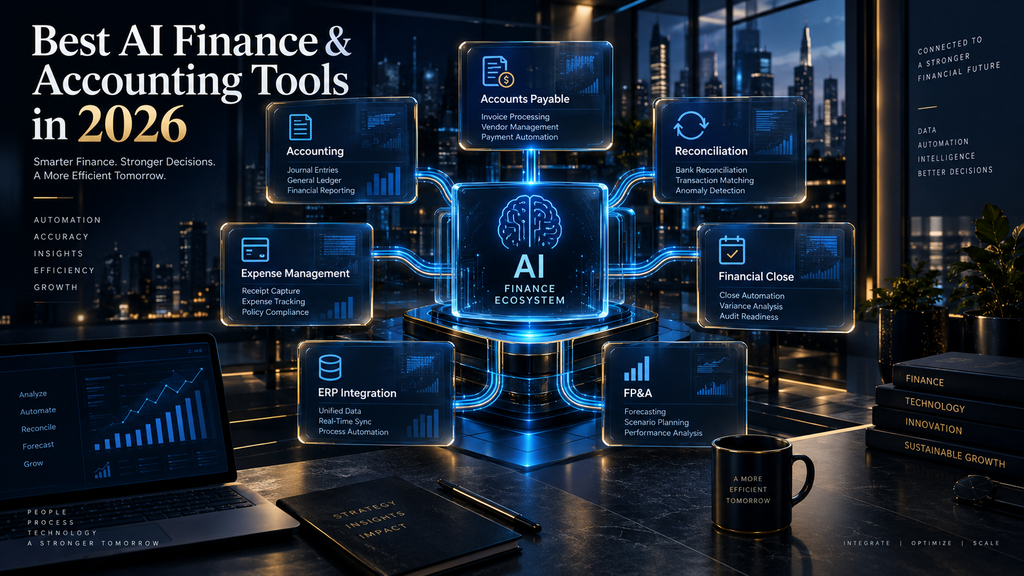
Best AI Finance & Accounting Tools in 2026
Choosing an AI finance or accounting tool in 2026 is becoming harder for an unexpected reason: there are now too many products claiming to solve the same problem. Accounting platforms have added AI agents, AP providers have introduced autonomous invoice processing, close-management systems are using AI for reconciliations and variance analysis, and newer companies are building accounting systems around AI from the ground up. The result is a market where “AI-powered” tells you very little by itself.
The more useful question is what the software actually does inside the finance workflow. A tool that automatically categorizes bank transactions is solving a very different problem from one that prepares reconciliations, manages the financial close, automates accounts payable, or operates as the underlying general ledger. Treating all of these products as interchangeable “AI accounting tools” makes comparison easier for the publisher but much harder for the buyer.
This guide takes a workflow-first approach. Instead of declaring one universal winner, it compares the strongest AI finance and accounting platforms by what they are designed to automate, how deeply AI is integrated into the workflow, who they are best suited for, and where their limitations become important. The objective is not to find the tool with the most impressive AI marketing. It is to identify the software that removes the most valuable manual work without introducing unnecessary complexity, control problems, or implementation cost.
Quick Answer
For small businesses that primarily need an accounting system with increasingly capable AI built into it, QuickBooks Online is one of the strongest starting points because its AI capabilities now operate directly across accounting data and workflows rather than existing as a separate assistant. Intuit’s current platform includes AI for transaction categorization, reconciliation support, anomaly identification, financial insights, and increasingly multi-step tasks.
For businesses whose bigger problem is spending rather than bookkeeping itself, Ramp is a stronger fit because it connects corporate spending, expense management, accounting coding, controls, and ERP synchronization. For accounts payable, BILL is a broad option for SMB and mid-market teams, while Vic.ai is more compelling when invoice volume is high enough to justify a specialized autonomous AP platform.
For larger accounting teams focused on month-end close, reconciliation, and accounting operations, BlackLine and FloQast are more appropriate than general-purpose accounting software. BlackLine is particularly strong where enterprise close processes, controls, auditability, and reconciliation are central requirements, while FloQast is designed around the operational reality of accounting teams managing the close.
BlackLine’s 2026 Verity Prepare release illustrates how far these platforms are moving beyond simple AI assistants: the system is designed to analyze supporting documentation, match transactions, identify reconciling items, and assemble reconciliations while maintaining human oversight and auditability.
For companies deliberately looking for an AI-native accounting architecture rather than adding AI onto an established system, Rillet and Numeric deserve attention. Their appeal is less about having an AI chatbot and more about embedding automation and intelligence into core accounting and close workflows. For FP&A specifically, the market is different enough that it deserves a dedicated comparison rather than being treated as just another accounting category.
The short version is therefore simple: there is no single best AI finance and accounting tool in 2026. The best choice depends on which financial workflow you need to improve, where your accounting system currently sits, how much automation you can safely introduce, and how much complexity your organization can support.
The AI Finance Software Market Has Split Into Different Kinds of Products
The phrase “AI accounting software” now covers several fundamentally different products. That distinction matters because two platforms can both advertise automated accounting while solving completely different problems.
The first group consists of established accounting systems that are adding increasingly sophisticated AI to an existing accounting environment. QuickBooks is a good example. Intuit’s current AI stack combines accounting data with AI and business intelligence, allowing the system to surface insights and automate financial tasks within QuickBooks itself. Its Accounting AI can identify high-confidence transactions for posting, assist with reconciliation, investigate potential accounting issues, and support other accounting workflows.
The second group consists of finance automation platforms that sit alongside the accounting system. Ramp, BILL, and Vic.ai fit different parts of this model. Their purpose is not necessarily to replace the general ledger; instead, they automate the operational work that feeds, surrounds, or connects to it. This can include expenses, invoices, approvals, supplier payments, coding, matching, and synchronization with an ERP or accounting platform.
The third group consists of systems that are trying to make AI a more fundamental part of the accounting architecture. Rillet is positioned in this direction, while newer close-management platforms such as Numeric are building AI deeply into reconciliations, flux analysis, reporting, and close workflows. The distinction becomes important when a company is deciding whether it needs another application connected to its existing stack or is actually considering a change in the underlying finance architecture.
The fourth group is specialized enterprise software. BlackLine and FloQast, for example, are not simply trying to make bookkeeping faster. Their value is concentrated around financial close, reconciliations, accounting operations, controls, and the coordination required to produce reliable financial reporting. BlackLine’s current AI strategy illustrates the direction of this market: its Verity Prepare product is designed to automate substantial reconciliation preparation while retaining transparency, auditability, and human oversight.
This is why a single ranking is misleading. A startup looking for an accounting system, a 500-person company trying to automate AP, and a multinational finance organization trying to shorten its close may all search for “best AI accounting software” while needing completely different products.
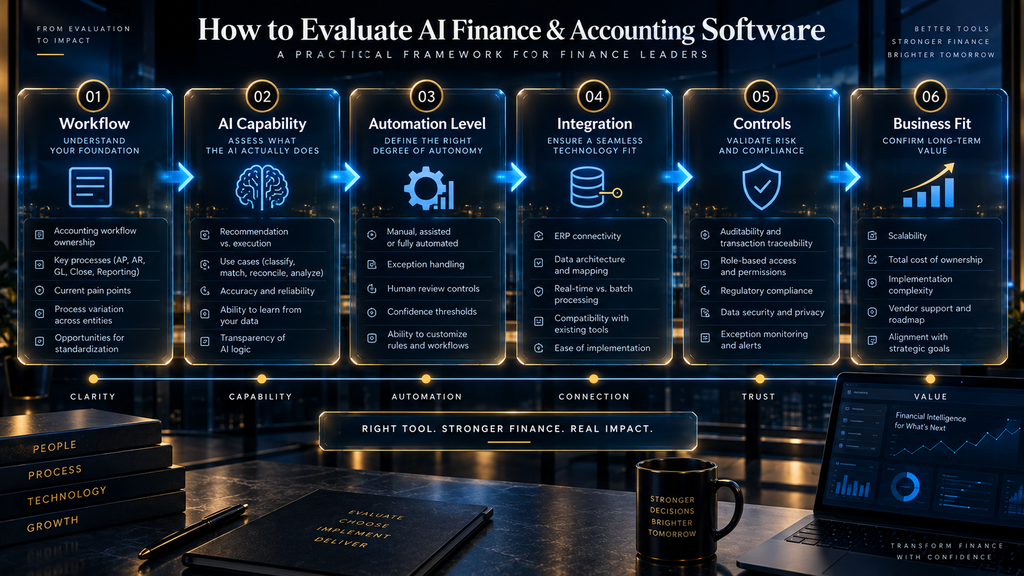
How to Evaluate an AI Finance Tool Before You Buy It
The most important evaluation criterion is not the number of AI features a vendor lists on its website. It is the amount of meaningful financial work the system can perform inside the workflow you actually care about.
A useful evaluation starts with the workflow itself. If the problem is transaction categorization, the relevant question is whether the system learns from historical accounting treatment and can reliably identify transactions that are safe to automate.
If the problem is AP, the evaluation should move toward invoice extraction, coding, purchase-order matching, exception handling, approvals, and payment. If the problem is close, the important questions become reconciliation quality, journal-entry workflows, flux analysis, evidence collection, exception management, and auditability.
The second consideration is the level of autonomy. Some systems recommend an accounting treatment and wait for a person to approve it. Others prepare work that a finance professional reviews. More advanced platforms can execute low-risk tasks automatically while escalating uncertain cases. The difference is significant because a product that can “use AI” but still requires a human to manually reproduce every step may deliver far less operational value than its marketing suggests.
The third consideration is what happens when the AI is wrong. Financial automation cannot be judged only on its success cases. A good system needs a credible way to surface uncertainty, route exceptions, preserve an audit trail, and allow people to review or correct decisions.
That is one reason enterprise finance platforms increasingly emphasize governed AI rather than unrestricted autonomy. BlackLine, for example, describes Verity Prepare around transparent reasoning, auditability, and human oversight rather than treating autonomous execution as sufficient on its own.
Finally, the quality of the underlying financial data matters enormously. AI does not magically repair a badly structured chart of accounts, inconsistent vendor records, incomplete transaction data, or poorly maintained processes. Numeric makes the same point directly in its current accounting-tool analysis: finance AI inherits weaknesses in the ERP, workpapers, and other underlying data sources.
That means the best AI tool for a business with clean, standardized financial processes can be very different from the best tool for a business whose finance operation is still struggling with fragmented data and inconsistent workflows.
Best AI Accounting Platform for Small and Growing Businesses: QuickBooks Online
QuickBooks Online is one of the strongest choices for businesses that want their core accounting system and AI capabilities in the same environment.
The important development in 2026 is that QuickBooks is no longer treating AI as merely a conversational assistant layered on top of accounting software. Intuit’s current Intuit Intelligence combines AI and business intelligence with company financial data, while Accounting AI can work with transactions, reconciliation, accounting issues, and other financial workflows. Intuit says its AI can learn the user’s workflow, answer questions using company data, and perform multi-step tasks with permission.
One particularly useful example is the “Ready to post” workflow. QuickBooks identifies transactions for which it has high confidence in the suggested categorization and allows those transactions to be reviewed and posted together rather than requiring each transaction to be processed individually. The underlying principle is more important than the feature itself: automation is being applied selectively where confidence is high instead of assuming every transaction should be treated identically.
QuickBooks also provides AI-supported reconciliation and accounting-issue analysis. Its current documentation describes AI assistance in identifying possible reconciliation issues and surfacing unusual trends or potential problems in balance-sheet and profit-and-loss accounts.
This makes QuickBooks particularly attractive for small businesses that do not want to assemble a separate stack of accounting automation applications. The accounting system remains the source of financial records while AI increasingly handles parts of the repetitive work surrounding those records.
The limitation is equally important. A company with complex multi-entity accounting, sophisticated consolidation requirements, high-volume AP, or enterprise-grade close management may outgrow the type of workflow QuickBooks is designed to provide. At that point, adding more AI features to the same platform may not solve the underlying architectural problem.
Best for: small businesses, entrepreneurs, and growing companies that want an established accounting platform with increasingly capable embedded AI. Less suitable for: large finance organizations that require specialized close, consolidation, complex multi-entity, or high-volume autonomous workflows.
Best Cloud Accounting Alternative: Xero
Xero is a strong option for businesses that want cloud accounting with increasingly embedded AI and a modern ecosystem of connected financial applications.
The attraction is not simply that Xero has AI features. Its importance comes from how accounting platforms are gradually shifting from passive recordkeeping systems toward systems that help prepare, interpret, and act on financial information.
For businesses already comfortable with Xero’s ecosystem, the advantage of embedded automation can outweigh the appeal of adding a separate AI accounting product. The more the accounting system understands transaction history, bank feeds, documents, and workflow context, the less often the finance team needs to move information between disconnected applications.
The trade-off is that Xero is still fundamentally a general accounting platform. A business looking for deep autonomous AP, enterprise financial close, or highly specialized accounting workflows may find that a dedicated application delivers more value than trying to stretch the core accounting system across every finance process.
Best for: small and growing businesses that prefer a cloud accounting platform and want AI-assisted accounting without adopting a specialized finance automation stack. Less suitable for: organizations whose primary problem is enterprise close, high-volume AP, or specialized financial operations.
Best AI Spend and Expense Platform: Ramp
Ramp is one of the strongest choices when the finance problem begins with spending rather than with the general ledger itself.
The platform connects corporate cards, expenses, spend controls, accounting coding, and ERP synchronization, which makes its AI capabilities more valuable than a simple expense-classification feature. The system can influence the workflow before a transaction reaches the accounting team, reducing the amount of cleanup required later.
That architecture is important. If an employee makes a purchase, waits several weeks to submit supporting documentation, and then expects accounting to determine the correct classification, the finance team is dealing with the consequences of a poorly controlled process. A platform such as Ramp can move some of those controls upstream, using spending policies and automated coding to reduce the amount of manual accounting work created in the first place.
This makes Ramp particularly interesting for companies that have already outgrown basic expense management but do not necessarily need a standalone AP or close-management platform. It can sit between employee spending and the accounting system, helping finance teams reduce the amount of transaction-level cleanup that would otherwise occur during the close.
The limitation is that Ramp is not a universal replacement for an accounting system. Its strength comes from the spend and finance-operations layer around accounting, not from replacing the entire accounting architecture.
Best for: startups and growing businesses with substantial employee spending, corporate-card activity, expense management, and a need for cleaner accounting data. Less suitable for: companies whose main challenge is bookkeeping, financial close, or specialized accounting compliance.
Best AI Accounts Payable Platform for Broad Finance Teams: BILL
BILL is a strong choice for businesses that want to automate accounts payable and accounts receivable without adopting a highly specialized autonomous AP architecture.
AP is particularly well suited to automation because much of the process follows a repeatable structure: documents arrive, information is extracted, invoices are coded, purchase orders or other records may be matched, approvals occur, and payments are ultimately released. The difficult part is not making one of these steps automatic. It is connecting the entire workflow without losing financial controls.
BILL’s platform is built around this operational problem. Its AP capabilities include invoice capture and coding, approval workflows, matching, bill payment, and accounting integrations. The result is a system that can remove substantial administrative work without requiring a business to replace its underlying accounting system.
BILL becomes less compelling when the finance team is processing enormous invoice volumes and wants highly autonomous AP as a specialized discipline. In that situation, a product such as Vic.ai deserves closer consideration because its architecture is much more explicitly focused on autonomous invoice processing.
Best for: SMB and mid-market organizations that need broad AP/AR automation and accounting integrations. Less suitable for: very high-volume AP operations that need a specialized autonomous processing platform.
Best for High-Volume Autonomous AP: Vic.ai
Vic.ai is better understood as an autonomous accounts-payable platform than as general accounting software.
That distinction immediately clarifies who should consider it. A company processing a modest number of invoices each month may not need a specialized AP platform. The implementation and subscription costs can outweigh the labor savings. But when invoice volume becomes large enough that AP teams spend substantial time extracting data, coding invoices, matching purchase orders, resolving exceptions, and routing approvals, specialized automation can become economically meaningful.
Vic.ai’s positioning is built around this higher-volume problem. Current market comparisons consistently place it in the autonomous AP category, where invoice processing, coding, matching, approval workflows, and related activities are handled through a dedicated AI system.
The important word is autonomous, but that should not be confused with “no human involvement.” The real value comes from allowing the system to handle predictable cases while finance professionals concentrate on exceptions, unusual transactions, and decisions that genuinely require judgment.
That also creates the main limitation. Vic.ai can be overkill for a small company with a relatively low invoice volume. The business case becomes much stronger as the operational burden and transaction volume increase.
Best for: mid-market and enterprise organizations with substantial AP volume. Less suitable for: very small businesses with relatively few supplier invoices.
Best Enterprise Financial Close Platform: BlackLine
BlackLine is one of the strongest choices for organizations where financial close, reconciliation, accounting operations, and control are the central problems.
The platform is fundamentally different from QuickBooks or Ramp because its value is concentrated around the accounting processes that occur after financial data has been generated. Reconciliations, transaction matching, journal entries, accruals, close management, and related controls become the primary operating environment.
BlackLine’s 2026 Verity Prepare release is particularly significant because it demonstrates where enterprise accounting AI is heading. The system is designed to analyze supporting documentation, match transactions, identify reconciling items, and assemble audit-ready reconciliations through a multi-agent architecture. BlackLine explicitly positions this automation around transparency, auditability, and human oversight.
That last point matters. In financial close, the objective is not simply to make accounting faster. The organization also has to be able to explain how a number was produced, what evidence supported it, who reviewed it, and what happened when the system encountered something unusual. Enterprise finance software therefore has a different definition of “good AI” from a consumer-facing application.
BlackLine’s main weakness is the same characteristic that makes it powerful: it is designed for organizations with serious finance operations. A small business looking for easier bookkeeping would be buying far more system than it needs.
Best for: enterprise finance teams managing close, reconciliation, controls, and complex accounting operations. Less suitable for: small businesses and simple bookkeeping environments.
Best for Accounting Close Workflow: FloQast
FloQast is particularly well suited to accounting teams that need to organize and improve the financial close rather than replace their core accounting system.
The difference between an accounting system and a close-management platform is easy to miss. The ledger records what happened. The close process is the coordinated human and technological operation required to make sure the records are complete, reconciled, reviewed, supported, and ready for reporting.
FloQast operates primarily in that second layer. Its value is therefore strongest for finance teams that already have an accounting or ERP system but struggle with the coordination, visibility, reconciliation, documentation, and recurring tasks surrounding month-end close.
That makes it a natural alternative to BlackLine for certain organizations, although the products should not be treated as identical. BlackLine has a particularly strong enterprise orientation around financial close and controls, while FloQast’s appeal is closely tied to accounting-team workflow and operational close management.
Best for: growing and mid-market accounting teams that need stronger close management and workflow automation. Less suitable for: very small businesses that do not have a complex close process.
Best AI-Native Close Platform: Numeric
Numeric is worth considering when a finance team wants a modern, AI-oriented approach to close, reconciliation, flux analysis, and reporting rather than simply adding AI features to an older workflow.
Its positioning is interesting because it treats AI as part of the close process itself. Current product coverage emphasizes AI-drafted flux analysis, reconciliations, reporting, and other close-related workflows. Numeric also emphasizes the importance of clean financial data before introducing AI, which is a useful reminder that automation cannot compensate for a broken accounting foundation.
The strongest reason to consider Numeric is therefore not that it has an AI label. It is that its product architecture is designed around reducing the amount of manual work finance teams perform during close while keeping the accountant involved where review and judgment remain necessary.
The main consideration is maturity and fit. A company deeply embedded in an existing enterprise accounting ecosystem may need to evaluate integrations, controls, migration requirements, and organizational readiness before choosing an AI-native close platform.
Best for: modern finance teams looking to reduce manual close and reconciliation work with an AI-oriented platform. Less suitable for: organizations that primarily need basic bookkeeping or have no meaningful close-management problem.
Best AI-Native Accounting Platform: Rillet
Rillet is one of the more interesting choices for companies that want AI integrated into the accounting architecture itself rather than added as another application around an existing ledger.
This distinction matters most for startups and growing companies that have not yet accumulated years of complex legacy systems. When the finance stack is still being designed, a company has more freedom to choose whether accounting should remain a traditional system surrounded by automation tools or become part of a more integrated, real-time operating environment.
Rillet is positioned toward the latter approach. Current market comparisons place it among AI-native general-ledger and ERP products, with accounting, close, and reporting capabilities integrated into a broader finance platform.
The attraction is architectural simplicity. Instead of continuously connecting separate systems for accounting, automation, reporting, and other finance operations, a company can potentially consolidate more of those functions within one environment.
The trade-off is that AI-native architecture is not automatically better for every organization. Established companies with deeply integrated ERPs may have stronger reasons to preserve their existing accounting foundation and add automation selectively. Rillet is therefore more interesting when a business has the freedom to make a foundational platform decision.
Best for: startups and growing companies evaluating an AI-native accounting or ERP architecture. Less suitable for: large organizations that are already deeply dependent on complex legacy ERP environments and need incremental automation instead of platform replacement.
Best AI FP&A Tool: A Different Decision Entirely
FP&A deserves separate treatment because planning and analysis operate differently from transaction processing and accounting close.
The core questions in FP&A are forecasting, scenario modeling, budgeting, management reporting, driver analysis, and decision support. A company choosing an FP&A platform therefore needs to evaluate planning architecture, data integration, modeling flexibility, spreadsheet compatibility, scenario management, and management reporting rather than simply asking how well the product categorizes transactions.
Platforms such as Datarails and other dedicated FP&A systems therefore belong in a different comparison from QuickBooks, BILL, or Vic.ai. Our Best AI FP&A Software in 2026 comparison covers that topic, so this article does not attempt to reproduce it.
For readers whose primary requirement is forecasting, budgeting, scenario planning, or FP&A rather than accounting automation, the dedicated FP&A comparison is the more appropriate next step.
The Difference Between AI Features and AI-Native Finance Software
One of the easiest mistakes in this market is to assume that every product using the word “AI” has fundamentally changed how finance work gets done. It has not.
A traditional accounting platform might use machine learning to suggest transaction categories. Another platform might use generative AI to explain a variance. A third might deploy an agent that can actually execute a multi-step accounting workflow. All three can legitimately describe themselves as AI-powered, but the operational consequences are very different.
The useful distinction is the depth of intervention. At the lightest level, AI interprets information and makes a recommendation. The next level prepares work for a human to review. A more advanced system can execute predictable work under defined rules and controls. The most ambitious platforms attempt to manage multi-step workflows and escalate exceptions when they encounter uncertainty.
That progression matters because buyers should pay for the level of automation they actually need, not for the sophistication of the marketing language. QuickBooks’ current Accounting AI, for example, includes high-confidence “Ready to post” transaction workflows and AI-supported reconciliation and issue detection, illustrating how established accounting software is moving toward selective automation rather than simply adding a chatbot.
Which AI Finance Tool Should You Choose?
The right decision becomes much easier when the software is evaluated against the workflow that is actually consuming finance-team capacity.
| If your main problem is… | Start by evaluating… | Why |
|---|---|---|
| General bookkeeping and accounting | QuickBooks Online or Xero | Core accounting plus embedded automation |
| Employee spending and expense control | Ramp | Spend management connected to accounting workflows |
| Broad AP/AR automation | BILL | Invoicing, approvals, payments, and accounting integration |
| High-volume invoice processing | Vic.ai | Specialized autonomous AP |
| Enterprise close and reconciliation | BlackLine | Deep close, reconciliation, controls, and governed AI |
| Close workflow management | FloQast | Accounting-team close operations |
| AI-oriented modern close | Numeric | AI-assisted reconciliations, flux, and reporting |
| AI-native accounting architecture | Rillet | Integrated AI-oriented accounting/ERP approach |
| FP&A and planning | Dedicated FP&A platforms | Different problem from transaction accounting |
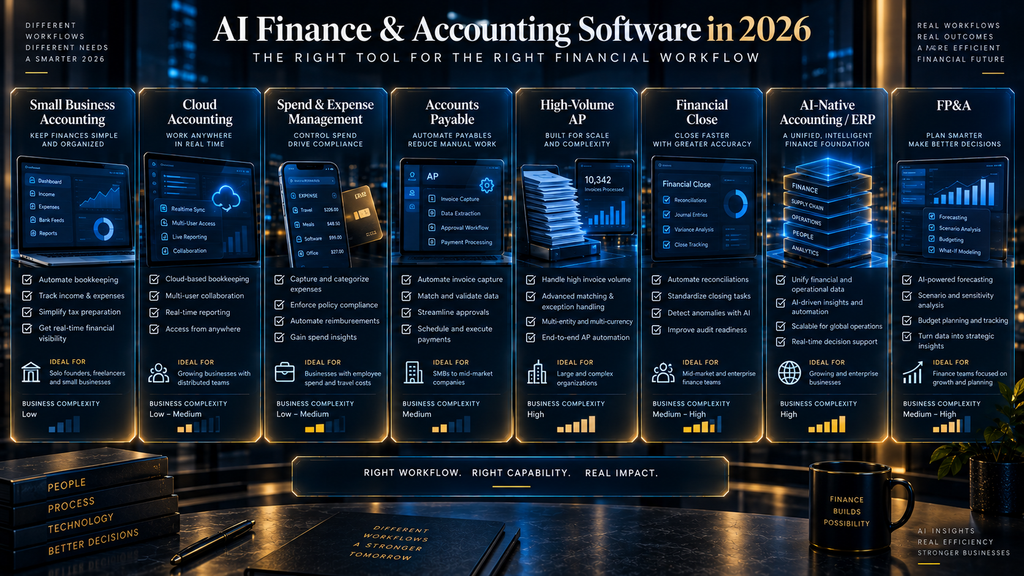
The table is deliberately more useful than a universal ranking. A company with 100 invoices a month should not make the same software decision as a company processing tens of thousands. A startup choosing its first accounting system should not evaluate software using the same criteria as a multinational corporation trying to reduce a ten-day close.
What You Should Not Automate Just Because the Software Can
The strongest finance teams will probably resist one temptation in particular: treating automation capacity as proof that automation is appropriate.
A system may be technically capable of generating a journal entry, classifying a transaction, explaining a variance, or preparing a reconciliation. That does not mean the organization should allow it to execute every instance without review. The appropriate level of autonomy depends on the predictability of the task, the quality of the underlying data, the frequency of exceptions, and the financial consequences of a mistake.
This is where the distinction between our AI accounting vs traditional accounting guide and this article becomes important. The automation decision should come first; software selection comes second. If a company has determined that a particular task requires human approval, buying a product because it promises complete autonomy may actually create a worse control environment rather than a better one.
The same principle applies to AI-generated analysis. A finance team may use AI to identify a variance, summarize a management report, or suggest an explanation, while still requiring a finance professional to verify the underlying numbers and business context. The most valuable systems are often those that reduce the amount of work required to reach a decision without pretending that every decision can be delegated.
The Hidden Cost of AI Finance Software
Subscription price is only one part of the economics.
Implementation can require data cleanup, ERP integration, chart-of-accounts mapping, workflow redesign, employee training, approval-policy changes, and ongoing exception management. A $100-per-user application that creates substantial integration work may be more expensive in practice than a $300-per-user system that eliminates an entire manual process.
This is particularly important for AI-native platforms. A new accounting architecture can create significant long-term benefits if it removes fragmented systems and repetitive reconciliation, but the decision can be far more consequential than adding an expense-management application to an existing ERP.
There is also a less visible cost: review capacity. If an AI system produces thousands of recommendations that finance professionals must individually inspect, the organization may simply move work from data entry into review. That is not necessarily bad; reviewing exceptions is often much more valuable than entering every transaction manually. But the business case should measure the complete workflow rather than claiming savings from one automated step.
How to Measure Whether an AI Finance Tool Is Actually Working
The strongest implementation metric is not the number of AI features activated. It is the amount of valuable finance capacity released while maintaining or improving control quality.
For transaction-heavy processes, measure the percentage of transactions processed without manual intervention, the rate of corrections after posting, the number of exceptions, and the time required to resolve them. For AP, measure invoice-processing time, touchless-processing rate, exception rate, approval cycle time, and payment accuracy. For financial close, measure close duration, reconciliation completion time, unresolved items, review effort, and the frequency of late adjustments.
Quality matters alongside speed. If automation reduces processing time but increases correction rates or creates additional reconciliation problems, the apparent efficiency gain may be misleading. Conversely, a system that does not eliminate every manual step but allows accountants to focus almost entirely on exceptions can create substantial economic value.
The best KPI is therefore not “AI adoption.” It is the amount of reliable financial work completed per unit of human finance capacity.
Where AI Finance Software Still Falls Short
The current market is impressive, but the technology has not eliminated the difficult parts of accounting.
Data quality remains a fundamental constraint. AI systems inherit the quality of the financial information, historical classifications, vendor records, and integrations they rely on. Numeric’s current guidance makes this point explicitly: finance AI can scale clean data, but it cannot be expected to rescue a fundamentally unreliable data foundation.
Exception handling is another unresolved challenge. Routine transactions are comparatively easy to automate because the system can learn from repeated patterns. Unusual transactions, ambiguous documentation, new vendors, complex accounting treatments, and transactions with significant financial consequences are different. Those cases require context, and context is where human expertise remains difficult to replace.
There is also the problem of automation bias. Once a system becomes reliable enough to save substantial time, people can become less willing to challenge its recommendations. That creates a subtle control risk: the organization may have a human in the process but not a genuinely independent human review. Good finance automation therefore needs review mechanisms that encourage meaningful challenge rather than ceremonial approval.
Finally, integration remains a practical constraint. The best AI product in isolation may not be the best product for a company whose ERP, expense system, payroll platform, banking infrastructure, and reporting stack are already deeply interconnected. A finance team should evaluate the entire information flow before assuming that adding another specialized tool will make the system simpler.
Who Should Buy an AI Finance Tool in 2026?
The strongest candidates are organizations where finance teams are spending substantial time on repetitive, rules-driven processes and where the underlying data is sufficiently reliable to support automation.
A small business with a simple ledger may benefit enormously from the AI capabilities already included in its accounting platform and may have little reason to purchase several specialized applications. The priority should be reducing administrative work without creating a fragmented technology stack.
A growing company with increasing transaction volume may reach a different point. Once finance teams spend significant time on AP, employee expenses, reconciliation, or close management, specialized automation can become economically attractive because the business is no longer paying people primarily to exercise judgment; it is paying them to move information between systems.
Larger organizations have a different challenge again. At enterprise scale, the question is often less about whether a workflow can be automated and more about whether the automation can be governed. Auditability, controls, data lineage, segregation of duties, exception handling, and integration with the existing ERP become just as important as raw automation speed.
The businesses least likely to benefit are those buying AI software simply because competitors are doing so. If the underlying process is poorly defined, transaction volume is too low to justify automation, or the organization cannot maintain the required data and controls, a new AI tool may create another system to manage rather than solve the original problem.
A Practical Shortlist by Business Situation
If you are a small business starting from scratch, begin with the core accounting platform rather than assembling a collection of specialized AI tools. QuickBooks Online or Xero can provide the accounting foundation, and additional applications can be introduced only when a specific workflow becomes painful enough to justify them.
If you are a growing company with significant employee spending, Ramp is worth evaluating because it addresses the transaction before it becomes an accounting cleanup problem. If AP is the bottleneck, BILL is a reasonable broad-market starting point, while Vic.ai becomes more interesting as invoice volume and AP complexity increase.
If your finance team already has a mature accounting system and the main problem is month-end close, look at BlackLine, FloQast, or Numeric rather than replacing the accounting system itself. The choice between them should depend on organizational scale, existing technology, close complexity, controls, and how much AI-driven automation the team actually wants to introduce.
If you are building the finance architecture of a startup or fast-growing company from the ground up, an AI-native system such as Rillet deserves consideration because the decision is fundamentally different from adding automation around an established ERP. The potential benefit is architectural simplicity, but the decision should be made with the company’s expected growth, integration requirements, and long-term accounting complexity in mind.
And if your real problem is forecasting, budgeting, scenario analysis, or management planning, do not choose an accounting platform simply because it has a good AI story. That is an FP&A problem and should be evaluated using FP&A-specific criteria.
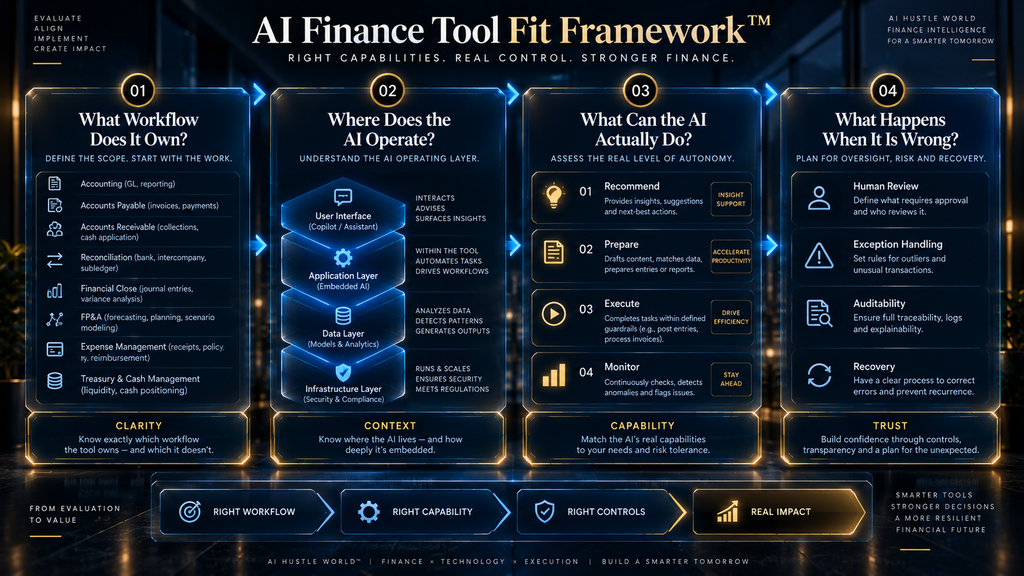
The AI Finance Tool Fit Framework
The most useful way to think about this market is through four questions.
First, what financial workflow does the platform actually own? A system designed for bookkeeping should not be judged by the same standard as one designed for AP or financial close. The closer the product is to the workflow creating the problem, the easier it becomes to evaluate its real value.
Second, where does the AI operate? AI embedded directly inside the accounting system, an automation layer sitting between employees and the ledger, and an AI-native accounting architecture all have different implications for data, integrations, implementation, and control.
Third, what can the AI actually do? There is a meaningful difference between recommending a classification, preparing a reconciliation, executing a routine transaction, and managing an entire multi-step workflow. Buyers should identify the highest level of autonomy they genuinely need rather than assuming more autonomy is always better.
Fourth, what happens when the system is wrong? This is perhaps the most overlooked question in AI finance software. A credible system needs to expose uncertainty, route exceptions, preserve evidence, and allow finance professionals to intervene when the financial consequence is too high for autonomous execution.
Together, these questions produce a better buying decision than a feature-count comparison. They force the buyer to connect the technology to the actual economics and control requirements of the finance operation.
What the Best AI Finance Software Will Look Like
The most valuable finance software over the next several years is unlikely to be defined simply by whether it contains a chatbot or an AI assistant.
The important shift is from software that records finance work toward software that participates in finance work. Instead of waiting for an accountant to enter, reconcile, investigate, summarize, and report every transaction, the system can increasingly prepare routine work, recognize patterns, identify exceptions, and route decisions to the appropriate person.
That does not mean accounting becomes fully autonomous. In fact, the more consequential the financial decision, the more important meaningful human oversight becomes. The likely direction is a division of labor in which software handles high-volume predictable execution while finance professionals spend more time on exceptions, interpretation, controls, business context, and decisions.
That is already visible in the current generation of products. QuickBooks is moving toward AI that can perform accounting tasks with user permission; BlackLine is using governed multi-agent AI for reconciliation preparation; and modern close platforms are using AI to reduce manual work around reporting and reconciliation.
The competitive advantage will therefore belong less to the vendor with the most impressive AI demonstration and more to the vendor that can turn AI capability into reliable financial operations.
Final Thoughts
The best AI finance and accounting tool in 2026 is not the one that claims to automate the most. It is the one that fits the financial workflow you actually need to improve.
For some businesses, that means staying with an established accounting platform such as QuickBooks or Xero and using the AI already being built into the system. For others, the highest-value opportunity is a dedicated layer for spend, AP, or financial close. Larger organizations may need governed enterprise automation, while startups building their finance stack from scratch may have a stronger case for an AI-native accounting platform.
The right buying process therefore starts with the workflow, not the vendor list. Define where finance professionals are spending time, determine which parts of that work are predictable enough to automate, understand what level of human review remains necessary, and then choose the platform that can solve that specific problem without creating a larger technology or control problem elsewhere.
The best AI finance software is not the software with the most AI. It is the software that turns the right financial work into reliable automation.
Need to Choose the Right AI Finance Workflow Next?
Before choosing software, decide which accounting tasks are worth automating and which still need people.
Decide What to Automate First →FAQ
What is the best AI finance and accounting software in 2026?
There is no universal winner because different platforms specialize in different finance workflows. QuickBooks Online is a strong choice for small-business accounting with embedded AI, Ramp is strong for spend and expense automation, BILL and Vic.ai focus on AP automation at different levels of complexity, and BlackLine, FloQast, and Numeric are stronger choices for financial close and reconciliation.
What is the best AI accounting software for small businesses?
QuickBooks Online is one of the strongest options because it combines core accounting with increasingly capable AI features inside the same platform. Its current AI capabilities include transaction categorization, reconciliation support, accounting-issue analysis, financial insights, and permission-based automation.
Is AI accounting software replacing accountants?
Not broadly. The more realistic direction is that AI takes over predictable, repetitive execution while accountants spend more time reviewing exceptions, interpreting financial information, managing controls, and applying professional judgment. The strongest finance systems are being designed around this division of labor rather than assuming every accounting decision should be delegated to AI.
What is the difference between AI accounting software and AI finance automation software?
AI accounting software generally operates within the accounting system itself, while finance automation software may focus on a specific process such as expenses, AP, reconciliation, or close and connect that workflow to the accounting system. The distinction is becoming less rigid as vendors expand their platforms, but the underlying architecture still matters when choosing software.
Is AI finance software worth the cost?
It can be when the organization has enough repetitive financial work for automation to generate meaningful savings. The calculation should include implementation, integration, training, review time, exception handling, and ongoing administration rather than comparing subscription prices alone.
What should I check before buying an AI accounting tool?
Start with the workflow you want to improve, then evaluate the software’s automation depth, accounting integrations, data requirements, human-review controls, exception handling, auditability, implementation complexity, scalability, and total cost. A product with fewer AI features may be a much better investment if it solves the specific workflow that consumes the most finance-team capacity.
Should a business replace its accounting system with an AI-native platform?
Not automatically. An AI-native platform can be attractive for a startup or growing company that is still building its finance architecture, but an established organization with a deeply integrated ERP may gain more by adding targeted automation around the existing system. The decision should be based on the total architecture rather than the novelty of the AI.
What is the most important KPI for AI accounting automation?
There is no single universal KPI, but a useful measure is how much reliable financial work the team can complete per unit of human capacity. Depending on the workflow, that can be measured through close-cycle time, touchless transaction rate, invoice-processing time, exception rates, correction rates, reconciliation time, or total finance hours spent on repetitive work.
Related Guides
- 10 Best AI Tools for Small Business Owners
- AI Compliance Tools Compared: Features, Privacy Controls & Use Cases
- Best AI Workflow Automation Tools (Free & Paid)
Written by
Muntasir Ahmad Chowdhury
Founder, AI Hustle World
Muntasir Ahmad Chowdhury is the Founder of AI Hustle World, an independent publication dedicated to making Artificial Intelligence practical, trustworthy, and easy to understand. He researches AI tools, automation, customer service, productivity, and real-world business applications, helping readers make smarter technology decisions through research-driven, experience-backed content.
Expertise:
AI Tools • AI Automation • AI Customer Service • AI Productivity • Generative AI • AI Workflows
Get Smarter With AI
Enjoyed this guide? Get practical AI tools, tutorials, and honest reviews delivered to your inbox.