Evidence: Documentation reviewed
Last checked: September 2026
What was done: Written from official documentation and the published sources linked in this article. Not hands-on tested.
Files: None
Affiliate links: No
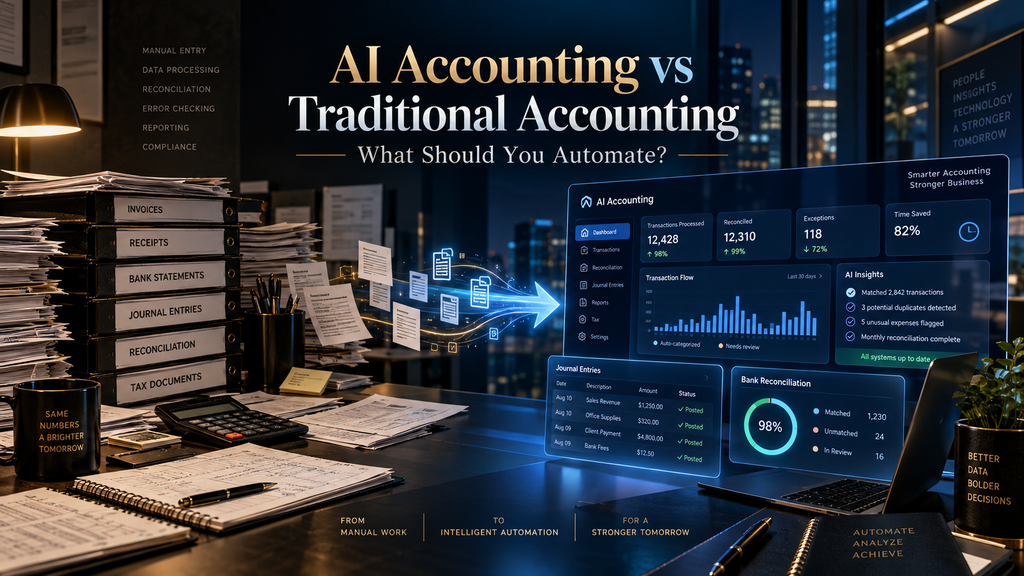
AI Accounting vs Traditional Accounting: What Should You Automate?
Accounting departments have been automating work for years. Bank feeds, recurring journal entries, invoice workflows, reconciliation rules, approval systems, payroll integrations, and ERP software have already removed enormous amounts of manual processing from finance teams. What is changing now is not the arrival of automation itself, but the kind of work software can handle. AI can interpret documents, recognize patterns, classify transactions, investigate anomalies, summarize evidence, generate explanations, and increasingly recommend or execute actions that previously required a person to work through the process manually.
That creates an uncomfortable question for finance leaders: where should the machine actually be allowed to act? It is easy to demonstrate that an AI system can perform an accounting task. It is much harder to determine whether the organization should trust it to perform that task without meaningful human involvement. A system that extracts invoice data from 50,000 documents is solving a very different problem from a system that decides how a complicated transaction should be treated for financial reporting.
The distinction matters because AI is producing real gains in accounting, but the evidence does not support the simplistic idea that better AI means less need for accountants. A 2026 Journal of Accounting Research study examined 277 professional accountants and more than 200,000 transaction-level records from 79 small and medium-sized businesses.
The researchers found that GenAI adoption was associated with productivity gains, faster month-end closing, more granular ledgers, and a shift in accountant effort away from routine data entry toward communication and quality assurance. At the same time, their field experiment showed that AI assistance could improve classification accuracy overall while also increasing the risk of error when accountants followed AI recommendations that differed from the consensus answer.
That combination is the real story of AI accounting. The opportunity is not to replace traditional accounting with an autonomous machine. It is to redesign accounting work so that software handles the parts of the process it can perform reliably, AI extends the accountant’s analytical capacity, and professional judgment remains attached to decisions where the cost of being wrong is too high.
Quick Answer: What Should You Automate?
The best candidates for automation are accounting tasks that occur frequently, follow relatively stable rules, use reliable data, produce outcomes that can be validated, and have manageable consequences when something goes wrong.
Invoice data extraction, transaction matching, standardized reconciliations, duplicate detection, routine document processing, and other high-volume activities often fit this profile. The fact that these tasks are not intellectually glamorous is actually part of their appeal: they consume time without necessarily requiring much professional judgment.
AI becomes more useful when the task moves beyond straightforward execution. A system can investigate why an account changed, compare current transactions with historical patterns, identify unusual items, prepare a variance explanation, or draft a journal entry.
In these situations, the accountant does not need to perform every mechanical step, but the organization still benefits from someone who can challenge the output and decide whether it makes sense. The difficult category is work where the answer depends heavily on professional interpretation, materiality, unusual circumstances, or significant financial consequences.
Complex accounting-policy decisions, significant estimates, unusual transactions, and final reporting judgments may all benefit from AI research and analysis, but that does not mean the decision itself should be delegated. A useful operating principle is therefore simple: automate predictable execution, use AI to accelerate analysis and preparation, and preserve human ownership of consequential judgment.
The “Traditional Accounting” in This Comparison Is Already Automated
It is worth correcting the terminology before comparing anything. Traditional accounting is not synonymous with manual accounting, and AI accounting is not synonymous with fully autonomous accounting.
A modern accounting system already performs a substantial amount of work without direct human intervention. A bank feed can import transactions automatically. A recurring journal entry can be generated according to a defined schedule. An invoice can be routed through an approval workflow. A reconciliation system can match transactions according to predefined rules. An ERP can move information between modules without an accountant re-entering the same data.
The underlying logic in these systems is generally deterministic. Someone defines the conditions under which an action should occur, and the software executes that instruction consistently. That predictability is one of the great strengths of traditional automation because the organization can usually understand exactly why the system behaved the way it did.
AI changes the equation when the work becomes difficult to describe as a simple set of rules. A machine-learning system can identify patterns across historical transactions, while generative AI can interpret language and documents that do not fit neatly into predefined fields. An AI-enabled system can potentially examine a collection of transactions, supporting documents, previous accounting treatments, and related communications and then produce a recommendation rather than simply following a rule.
Research published in the Journal of Accounting and Public Policy in 2026 makes this distinction useful. The study separates accounting AI into categories including robotic process automation, analytical AI, and generative AI, and finds that organizations use these technologies differently depending on the accounting environment and the nature of the work.
Accounting firms, for example, have stronger use cases around assurance-driven activities such as transaction testing and anomaly detection, while accounting functions inside other businesses are more likely to apply AI to forecasting and process optimization.
That means the real comparison is not traditional accounting versus AI accounting. It is the much more practical question of how much autonomy a particular accounting task deserves.
Stop Automating Jobs. Start Automating Tasks.
An accounting department is not one process. It is a collection of processes, and each process contains tasks with very different levels of predictability and judgment.
Take accounts payable. Saying “accounts payable should be automated” is too broad to be useful. Extracting the supplier name and invoice amount from a standardized document is one problem. Determining whether the invoice is a duplicate is another. Matching it against a purchase order is another. Deciding whether an unusual charge is legitimate is another. Authorizing a large payment is another again.
Treating all of those activities as one automation decision creates unnecessary risk because they do not have the same characteristics. Some are highly structured and repetitive. Others require context. Some have relatively low consequences if an error slips through. Others can affect cash, financial reporting, tax treatment, vendor relationships, or internal controls.
This is why the task, rather than the job title or department, should usually be the unit of automation. The finance leader who says “we want to automate AP” has not yet defined an automation strategy. The finance leader who can identify which AP tasks should execute automatically, which should be AI-assisted, and which should always require human authorization is much closer to having one.
The same logic applies to the month-end close. The close is not one activity that can simply be switched from manual to AI. It contains reconciliations, recurring entries, data gathering, variance analysis, evidence collection, review, approvals, and reporting. Some of those components are excellent candidates for automation; others become more valuable when AI prepares the work for an accountant rather than attempting to own the conclusion. (COSO guidance on internal controls for generative AI)
That distinction is also why “AI will replace accountants” is such a weak way to frame the change. The technology does not encounter an accounting department as a single block of human labor. It encounters hundreds of individual activities with different levels of repetition, ambiguity, evidence, and financial consequence.
Where Automation Creates the Clearest Value
The strongest automation opportunities tend to look deceptively ordinary.
Invoice extraction is a good example. If a finance team receives thousands of invoices containing supplier names, invoice numbers, dates, amounts, tax information, and line items, having an employee manually transfer that information into an accounting system creates very little additional value. The work is repetitive, the expected fields are known, and the resulting information can often be validated against the original document.
Transaction matching has a similar structure. A business may have thousands of bank transactions that need to be connected to corresponding ledger records. A system can compare amounts, dates, descriptions, references, counterparties, and historical patterns and identify likely matches. The accountant’s value becomes much higher when they investigate the exceptions than when they manually inspect every transaction that the system can match confidently.
Duplicate detection is another strong candidate. A system can compare invoice numbers, supplier information, dates, amounts, and other attributes across a large population much faster than a person can. The important design question is not whether the system can find suspicious duplicates; it is what happens after one is found and how confidently the organization can distinguish a true duplicate from two legitimate transactions that happen to resemble each other.
These examples illustrate an important characteristic of good automation: the system does not need to understand the entire business to create value. It only needs to perform a narrow, repetitive part of the workflow reliably enough that the human can spend time somewhere more useful.
That is why the first generation of accounting automation often focused on structured processing. The newer generation of AI expands the boundary into areas where the information is less structured, but the underlying principle has not changed. Automation creates the most value when it removes work that humans perform primarily because the organization has not yet found a better way to execute it.
Reconciliation Is Where the Boundary Becomes Interesting
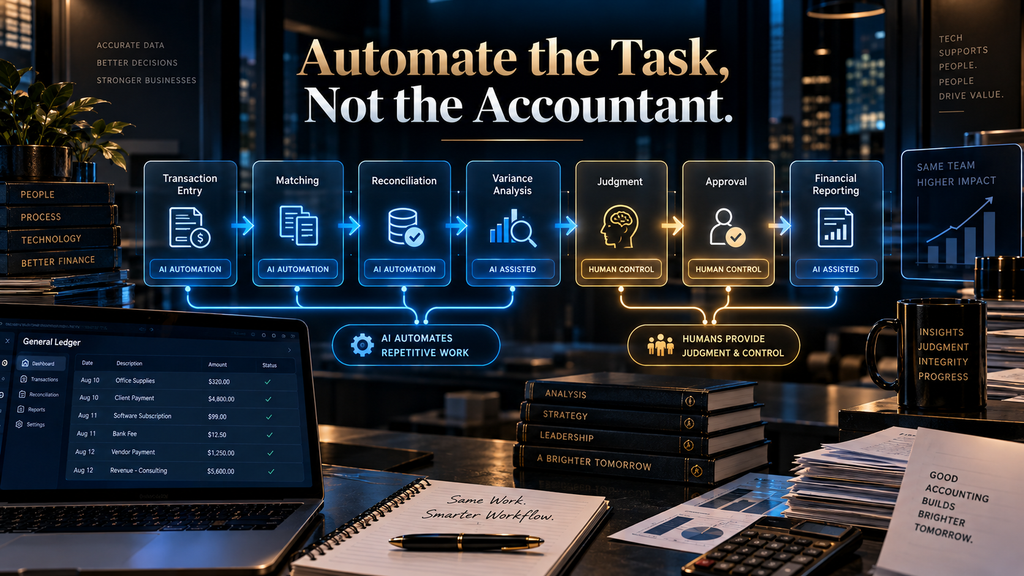
Bank reconciliation illustrates the difference between automation and accounting judgment particularly well.
The mechanical part of reconciliation is an excellent candidate for software. The system can compare transactions, identify likely matches, group related records, and surface differences. If 98% of the transactions can be matched reliably, there is little economic justification for having an accountant manually inspect all of them.
The remaining 2% are more interesting.
An unexplained difference may be a timing issue, a missing transaction, an incorrect amount, a duplicate posting, an interface problem, or something more serious. The system can help investigate the difference by searching related transactions and historical patterns, but the accountant may still need to understand what actually happened in the business. (AICPA & CIMA guidance on AI in management accounting)
This is where AI can improve accounting without replacing accounting expertise. Instead of asking a professional to search through thousands of routine records, the technology concentrates their attention on the cases where context matters.
The value is therefore not simply “faster reconciliation.” It is better allocation of professional attention.
That distinction becomes important when evaluating automation projects. A system that eliminates 90% of manual reconciliation work may be extremely valuable even if it cannot resolve the remaining 10%. Trying to force the system to handle the final 10% autonomously may create disproportionately more risk than value.
AI Changes the Nature of Transaction Classification
Transaction classification is another area where AI looks attractive but requires more thought than a simple automation label suggests.
Suppose a company has several years of historical transactions. A particular supplier has almost always been categorized as a certain type of operating expense. An AI system can use that history, the transaction description, the amount, the supplier, and related information to recommend a classification. In a high-volume environment, those recommendations can save substantial time.
But historical consistency does not guarantee that the current transaction should receive the same treatment.
The supplier may have changed what it sells. The purpose of the purchase may have changed. A new contract may affect the accounting treatment. The transaction description may be incomplete. An unusual transaction may resemble thousands of ordinary transactions while actually requiring a completely different treatment.
This is where the 2026 field evidence becomes unusually valuable. The Stanford research found that AI assistance improved classification accuracy on average, but it also found that people could follow AI recommendations that differed from the consensus answer. In other words, AI can raise average performance while still introducing a new behavioral risk: the professional may give too much weight to a machine-generated recommendation simply because it appears authoritative.
That is not an argument for removing AI from classification. It is an argument for designing the workflow around uncertainty.
High-confidence routine classifications can potentially move toward automation. Ambiguous classifications can be surfaced for review. Unusual transactions can be routed to someone with the appropriate accounting expertise. The technology becomes more useful when the organization knows where it should stop.
The Most Valuable AI Work May Happen Before the Accountant Makes a Decision
This is where the distinction between traditional automation and AI becomes much more meaningful.
Traditional software can tell a finance manager that travel expense increased 27% compared with the previous period. That is useful information, but it does not explain the business reason for the change.
An AI system can go further. It can examine the underlying transactions, compare the movement with previous periods, identify unusually large entries, review transaction descriptions, look for changes in supplier or employee behavior, and prepare a preliminary explanation for the accountant to evaluate.
That does not mean the AI has “explained the variance.” It has reduced the investigative work required to explain the variance.
The distinction sounds subtle, but it changes how the technology should be deployed. The system is not being asked to produce an authoritative accounting conclusion from incomplete context. It is being asked to gather evidence, identify patterns, and prepare useful material for a professional who understands the business.
That is often a better use of AI than attempting to automate the final decision.
AICPA & CIMA’s current guidance makes a similar point. AI can process large volumes of information, identify trends and outliers, and produce initial analysis, but the quality of the result depends on the underlying data and the professional’s ability to scrutinize the output. The organization still needs human judgment, transparency, accountability, and ethical oversight.
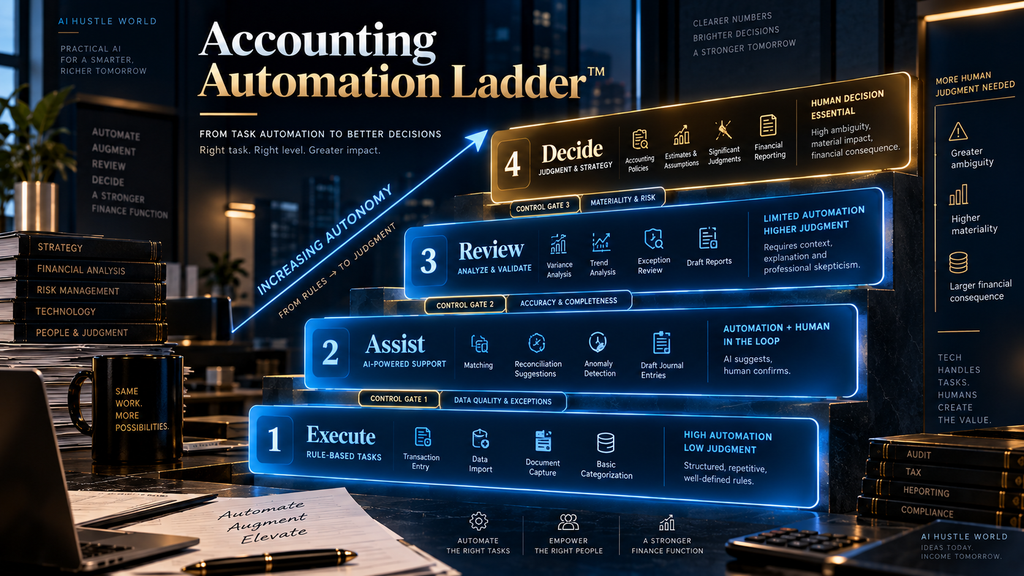
AI Hustle World Accounting Automation Ladder
The practical challenge is deciding how much autonomy each task deserves. A useful way to approach that decision is to separate accounting work into four levels rather than treating automation as an all-or-nothing choice.
Execute
At the first level, the system performs the task with minimal human involvement. This is where predictable, high-volume work belongs: structured document extraction, routine matching, standardized data movement, and tightly controlled recurring processes are examples. The organization should still monitor the process, but the individual transaction does not normally require a person to make the same decision repeatedly.
Assist
At the second level, AI performs substantial preparation or analysis while the accountant remains responsible for evaluating the result. Draft journal entries, variance analysis, reconciliation preparation, classification recommendations, and reporting commentary can fit here. The system is doing meaningful work rather than simply following a rule, but the professional still owns the conclusion.
Review
At the third level, the AI output affects an important accounting process and therefore requires deliberate human validation. The human review should not be a ceremonial approval; the reviewer needs access to evidence, enough context to challenge the result, and enough authority to reject or modify it. This is particularly important for unusual transactions, significant reconciliations, and outputs that may affect financial reporting.
Decide
At the fourth level, the system can still be useful, but the consequential judgment remains human-controlled. Complex accounting-policy interpretation, significant estimates, materiality decisions, unusual transactions, and final financial reporting judgments belong here because the value of professional context and accountability is difficult to encode completely into a model.
The important point is that these levels describe autonomy, not technological sophistication. A sophisticated AI system may still be appropriate only for the “Assist” level if the underlying decision carries too much consequence to delegate.
The Five Questions That Should Decide Automation
The automation decision becomes much clearer when the finance team stops asking whether AI can perform a task and starts examining the characteristics of the task itself.
The first question is how repetitive the work is. A process that occurs thousands of times every month deserves a different economic analysis from an unusual judgment that occurs twice a year. Repetition creates the opportunity to spread implementation costs across a large volume of transactions and gives the organization more historical data with which to evaluate performance.
The second question is whether the desired result can be defined clearly. This is more important than whether the AI appears technically capable. If experienced accountants generally agree on what a correct outcome should look like, it is easier to build controls and test the system. When the answer depends heavily on context, interpretation, or professional judgment, full automation becomes much harder to justify.
The third question is whether the underlying data can be trusted. AI does not magically repair poor source information. Missing transactions, inconsistent vendor records, inaccurate master data, incomplete documents, and broken system integrations can undermine the output regardless of how advanced the model is. AICPA & CIMA explicitly warns that AI output is only as reliable as the quality of the data sources used and that outputs need careful review.
The fourth question is how frequently exceptions occur. A process in which 98% of cases follow a stable pattern can be an excellent automation candidate if the remaining 2% can be identified and routed appropriately. A process in which half the cases require interpretation is a fundamentally different problem. The objective is not to eliminate exceptions; it is to make them visible and manageable.
The fifth question is the one finance leaders should probably spend the most time on: what happens if the system is wrong? An incorrect invoice field that is caught before posting is one kind of problem. A wrong accounting treatment that affects a material financial statement amount is another. The higher the consequence, the stronger the case for evidence, approval, segregation of duties, and human oversight.
A Practical Map of What to Automate
The table below is not a universal prescription. It is a starting point for evaluating common accounting activities based on their typical characteristics.
| Accounting activity | Typical automation fit | Sensible operating model |
|---|---|---|
| Invoice data extraction | Very high | Automate with validation |
| Receipt and document capture | Very high | Automate |
| Routine transaction matching | Very high | Automate with exception handling |
| Duplicate invoice detection | High | Automate and review flagged cases |
| Standard bank matching | High | Automate and investigate exceptions |
| Routine transaction categorization | High | Automate high-confidence cases |
| AP workflow routing | High | Automate within defined controls |
| Recurring entries with stable rules | High | Controlled automation |
| Reconciliation preparation | High | AI-assisted with review |
| Variance analysis | Medium–high | AI-assisted |
| Close monitoring | High | Automate status and exception detection |
| Reporting commentary | Medium | AI-assisted and reviewed |
| Complex journal-entry recommendations | Medium | AI-assisted with professional review |
| Accounting research | Medium–high | AI-assisted with source verification |
| Unusual transaction analysis | Medium | AI-assisted, human decision |
| Accounting-policy interpretation | Low–medium | Human-led with AI research support |
| Significant estimates | Low | Human-controlled |
| Materiality decisions | Low | Human-controlled |
| Final financial reporting judgment | Very low | Human-controlled |
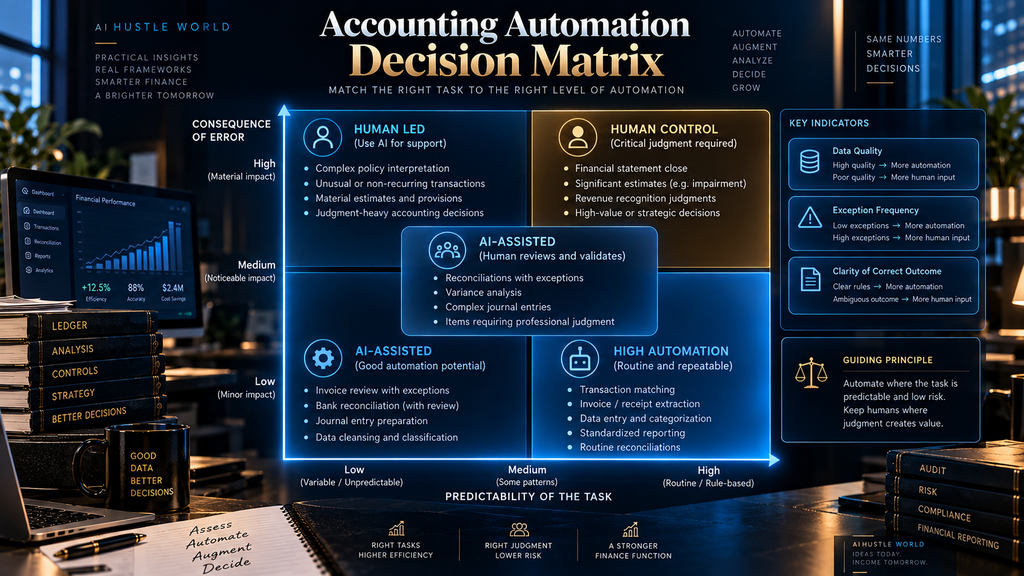
The important lesson is not that “invoice extraction equals AI” and “policy interpretation equals human.” The important lesson is that the level of autonomy should follow the characteristics of the work.
Even a high-fit task may require stronger controls when the organization operates in a heavily regulated environment. Conversely, an analytical task that appears complicated may become a strong AI-assistance candidate if the organization has reliable data, well-defined review procedures, and experienced people capable of challenging the result.
Why the Risk Profile Changes When AI Enters Accounting
Automation does not eliminate accounting risk. It changes its location.
A manual process can fail because an employee enters the wrong amount, overlooks a transaction, forgets a step, or misclassifies an item. Traditional automation can reduce some of those problems because the same rules are applied consistently.
AI introduces a different class of failure. The system may interpret incomplete information incorrectly, rely on a misleading historical pattern, produce a plausible but unsupported explanation, or recommend an action that looks reasonable but does not fit the underlying accounting context.
Deloitte’s guidance on AI in finance highlights several of these risks, including inaccurate or incomplete data, inappropriate model assumptions, unauthorized data changes, and insufficient verification and validation. It recommends meaningful human-in-the-loop validation for impactful decisions rather than treating human involvement as a checkbox.
The result is an important shift in control philosophy. Traditional automation asks whether the rule was configured correctly. AI governance has to ask additional questions: what information did the system use, how was the output generated, how uncertain was the result, what happens when the pattern changes, and can the organization reconstruct the decision later?
That is why AI accounting can require more sophisticated controls even when it reduces manual work.
Human-in-the-Loop Only Works If the Human Can Actually Challenge the Machine
Many organizations say they will keep a human “in the loop” as if those three words solve the governance problem. They do not.
Imagine an AI system processing 20,000 transactions and routing only 50 uncertain cases to an accountant who has the time and evidence required to investigate them. That can be a meaningful control structure because the human is concentrating attention where the system has identified uncertainty.
Now imagine a system producing 5,000 recommendations that an employee is expected to approve before the end of the day. A human technically remains in the workflow, but the practical review may be little more than a rubber stamp.
Good human oversight requires access to the recommendation and its supporting evidence, enough context to understand why the system produced it, the ability to investigate the underlying records, and the authority to reject or override the result. It also requires a record of what the human ultimately decided.
The 2026 COSO-related GenAI guidance highlighted by Deloitte takes this use-case approach directly. It recommends mapping AI use cases to business processes and controls, applying a level of human involvement appropriate to the risk, validating outputs, handling exceptions, maintaining traceability, monitoring for anomalies and drift, and applying heightened oversight when AI can affect financially relevant amounts or controls. (human-in-the-loop validation for AI in finance)
The principle is straightforward: human involvement is a control only when the human has a realistic opportunity to detect and correct the machine’s mistake.
The Most Dangerous Error May Be the One That Looks Reasonable
A visibly incorrect AI answer is usually easy to reject. The more difficult accounting problem is a plausible answer that fits the available information well enough to pass a superficial review.
Consider a transaction that resembles hundreds of previous transactions. The AI classifies it exactly as those earlier transactions were classified. The output looks consistent. Nothing appears unusual.
But this particular transaction relates to a new contractual arrangement that changes the accounting treatment.
The system did not necessarily fail because it was incapable of recognizing patterns. It failed because the pattern was no longer the right basis for the decision.
This is one reason professional skepticism becomes more important as AI improves. AICPA & CIMA’s recent guidance on AI and financial reporting judgments specifically warns about overreliance when AI is used for accounting research and analysis. AI can make research faster and broader, but its output still needs to be scrutinized rather than accepted simply because it is well written or confidently presented.
The paradox is worth emphasizing: the better AI becomes at producing plausible work, the less useful superficial review becomes. A human reviewer needs enough accounting knowledge to recognize when something deserves another look.
What Should Be Automated First?
For most organizations, the smartest first automation project will not be the most impressive AI demonstration. It will probably be a narrow process with a clear baseline.
Suppose the finance team spends 80 hours every month preparing reconciliations. Before implementing anything, the organization can measure how many transactions are processed, how long reconciliation takes, how many exceptions occur, how many errors are discovered, and how much rework is required.
An automated system can then be evaluated against those same measures. If it handles the predictable majority accurately and reduces the workload without increasing unresolved exceptions, the organization has a real business case.
The same logic works for invoice processing, transaction classification, document capture, close administration, or other repetitive activities. A narrow workflow makes it easier to test the technology, establish controls, understand failure modes, and calculate the economics before extending automation into more consequential areas.
This is much more useful than launching a broad “AI transformation” project and measuring success by the number of AI features deployed. The first project should produce evidence, not excitement.
A Better Implementation Sequence
The first step is to map the existing process before choosing the technology. Finance teams should understand where information enters, which systems touch it, where manual intervention occurs, where decisions are made, and where exceptions typically arise. This often reveals that the best automation opportunity is not the most obvious one; sometimes a broken integration, duplicated approval step, or poorly maintained master-data process is the real bottleneck.
Next, separate the process into individual tasks. “Accounts payable” is too broad. Invoice extraction, supplier validation, purchase-order matching, duplicate detection, approval routing, exception investigation, and payment authorization should be evaluated separately because they carry different levels of predictability and consequence.
Once the tasks are separated, define the level of autonomy each one deserves. High-volume, predictable work can move toward automated execution. Analytical and preparatory work can use AI with meaningful review. High-consequence judgments should remain human-controlled even if AI is heavily involved in research and preparation.
The organization should then test the system against real historical cases, including the awkward ones. Clean examples are not enough. Missing fields, duplicate records, unusual suppliers, large transactions, conflicting information, unusual timing, and previously observed exceptions are exactly the cases that reveal whether an automation system is ready for production.
Only after those tests should the organization expand the system’s authority. A useful progression is to let AI recommend first, assist second, execute within controlled boundaries later. The organization should be able to demonstrate that the workflow is reliable before granting it more autonomy.
Finally, monitoring has to continue after deployment. Changes in source data, business processes, vendors, system integrations, model behavior, and transaction patterns can all change how an AI workflow performs. Accounting automation should therefore be treated as an operating system that requires monitoring and adjustment rather than a software installation that is “finished” once it goes live.
The Right Starting Point Depends on the Size of the Business
For a small business, the strongest opportunity is often capacity. A small finance team may spend disproportionate amounts of time entering transactions, processing invoices, reconciling accounts, organizing receipts, and preparing routine reports. Automating those activities can give the same team more time without requiring the organization to build a large finance department.
The control problem is equally important, however. Small businesses often have fewer people available to separate preparation, approval, and review. Giving an AI system unrestricted access to financial records or payment processes can therefore create a control weakness rather than solve one. Small companies should generally begin with contained workflows where the benefit is easy to measure and the consequences of failure are manageable.
Mid-market companies have a broader opportunity because their accounting processes are usually more complex and repetitive. AP and AR workflows, reconciliation, close management, exception handling, reporting preparation, and financial analysis can all become candidates for AI assistance or automation. At this stage, integration quality becomes more important because the AI system is likely to interact with multiple operational and financial systems.
Large enterprises can pursue much more ambitious automation, including AI-enabled workflows that operate across ERP, procurement, billing, banking, expense management, and reporting systems. But the scale of the opportunity is matched by the scale of the governance requirement. As AI gains access to more systems and can take more actions, organizations need stronger permissions, segregation of duties, audit trails, testing, monitoring, and accountability.
The 2026 research on accounting AI adoption reinforces this point: technology is only one part of adoption. Organizational structure, infrastructure, environmental factors, individual skills, trust, and professional context all influence whether AI can actually be integrated successfully.
How Do You Know Whether Automation Is Working?
The easiest metric to measure is usually time. How long did the process take before automation, and how long does it take now? That matters, but time alone is not enough.
The organization should also measure the quality of the output. Are correction rates lower? Are reconciliations cleaner? Are exceptions being identified earlier? Are accountants spending less time searching for information? Are month-end activities becoming more predictable?
Controls should be measured as well. Can the organization identify which AI system produced an output? Can it see the relevant evidence? Are overrides being recorded? Are unusual cases being escalated? Are there recurring categories of errors that suggest the workflow needs redesign?
Finally, measure what happened to the human capacity that automation created. If an accounting team saves 500 hours but immediately fills those hours with another pile of administrative work, the organization may have improved efficiency without improving the finance function. If those hours move toward analysis, quality assurance, business communication, planning, and decision support, the automation is creating a more meaningful organizational benefit.
That distinction is visible in the 2026 field research. The Stanford study did not simply find that AI reduced the amount of accounting work. It found a reallocation of effort, with accountants spending less time on routine data entry and more on communication and quality assurance. That is a more useful measure of transformation than raw automation volume.
The ROI of AI Accounting Is Bigger Than Labor Savings
It is tempting to calculate the return on an accounting automation project by multiplying hours saved by an employee’s hourly cost. That is a useful starting point, but it misses several important benefits and costs.
A better economic model considers the capacity released by automation, the cost of errors and rework that may be avoided, improvements in cycle time, and the additional analytical capacity created for the finance team. Against that benefit, the organization needs to account for software, integration, implementation, data preparation, training, governance, monitoring, human review, and ongoing maintenance.
The economics can also change depending on the workflow. A system that saves 100 hours per year may not justify a complex implementation. A workflow that processes hundreds of thousands of transactions may produce substantial value even if the saving per transaction is small.
There is another factor that is easy to overlook: risk-adjusted value. A faster process is not necessarily better if it introduces a materially higher probability of financial error. The organization should therefore evaluate automation not only by what it saves, but by whether it improves the overall balance between cost, speed, quality, and control.
The Biggest Mistake Is Automating a Bad Process
AI cannot compensate for a fundamentally broken accounting process. If vendor records are inconsistent, approval rules are unclear, invoices arrive through uncontrolled channels, the chart of accounts is poorly maintained, or multiple systems contain conflicting information, adding AI may simply make the existing process faster without making it better.
This is why process redesign should usually come before broad automation. The organization should understand the workflow, remove unnecessary steps, standardize inputs where possible, clarify ownership, and establish the rules and controls that matter. Once the process is stable, AI can be introduced where it provides a genuine advantage.
There is also a subtle risk in automating too early. A polished AI interface can hide the complexity underneath it. People may stop noticing that the process itself is poorly designed because the system makes the workflow appear simpler than it really is.
The better sequence is therefore understand the process, simplify it, standardize it, automate the appropriate parts, and then monitor the result. AI should be part of that redesign, not a substitute for it.
What Happens to Accountants?
The strongest current evidence points toward a change in the composition of accounting work rather than a simple disappearance of accountants. When software removes routine data entry and repetitive matching, someone still needs to investigate exceptions, understand the business context, evaluate unusual transactions, communicate financial information, monitor controls, and decide whether an AI recommendation actually makes sense. That changes the skill profile.
Technical accounting knowledge remains essential, but professionals increasingly need to understand how financial systems work, how AI produces recommendations, where model uncertainty matters, how to challenge outputs, and how to communicate financial conclusions to people outside the accounting function. AICPA & CIMA’s recent work on the future CPA workforce similarly argues that technical accounting knowledge remains essential while business context, communication, technology judgment, and adaptability are becoming increasingly important.
There is an important warning here for organizations as well as accountants. If AI removes too much routine work from the beginning of an accounting career without replacing the learning opportunities that those tasks once provided, junior professionals may have fewer chances to develop the practical judgment they will eventually need to review AI outputs.
The profession therefore faces a more interesting challenge than simply deciding how much work AI should perform. It also needs to decide how people will develop the expertise required to supervise increasingly capable systems.
AI Accounting Is Becoming a Control-Design Problem
As AI moves closer to financial records, the central challenge changes. Early accounting automation was largely about efficiency: can we reduce data entry, eliminate repetitive work, or process more transactions with the same staff? AI adds another question: What should the system be allowed to decide?
That question brings accounting automation closer to internal control design. A system that only extracts information from a document has limited authority. A system that recommends a journal entry has more influence. A system that can post the entry has greater authority. A system that can investigate an issue, modify records, and initiate downstream actions has greater still.
Each increase in autonomy should come with a corresponding increase in control. Deloitte’s 2026 COSO-related guidance explicitly recommends maintaining inventories of GenAI use cases, mapping them to business processes and controls, establishing output validation and exception handling, maintaining traceability, monitoring for drift and anomalies, and applying heightened human oversight when AI can affect financial reporting amounts, journal entries, reconciliations, estimates, or related controls.
This is why the future of AI accounting is unlikely to be determined only by model capability. The organizations that benefit most will be the ones that design the surrounding controls as carefully as they design the automation itself.
So, What Should You Actually Automate?
If the organization can define the expected result, trust the data, identify exceptions, test the process, and contain the consequences of an error, automation deserves serious consideration.
If the system can perform valuable analysis but the answer still requires context, AI assistance is often the better model. Let the system gather evidence, compare patterns, prepare the work, and surface the issues that deserve attention, while keeping the professional responsible for the conclusion.
If the decision is materially consequential, highly ambiguous, or dependent on accounting judgment that cannot be reliably reduced to rules or validated automatically, keep meaningful human control. AI can still be part of the workflow, but it should function as a powerful research and analytical assistant rather than the final authority.
This is the central decision framework:
| If the task is… | Then consider… |
|---|---|
| Repetitive, predictable and easy to validate | Automation |
| Analytical, variable but reviewable | AI assistance |
| Unusual, consequential or judgment-heavy | Human control |
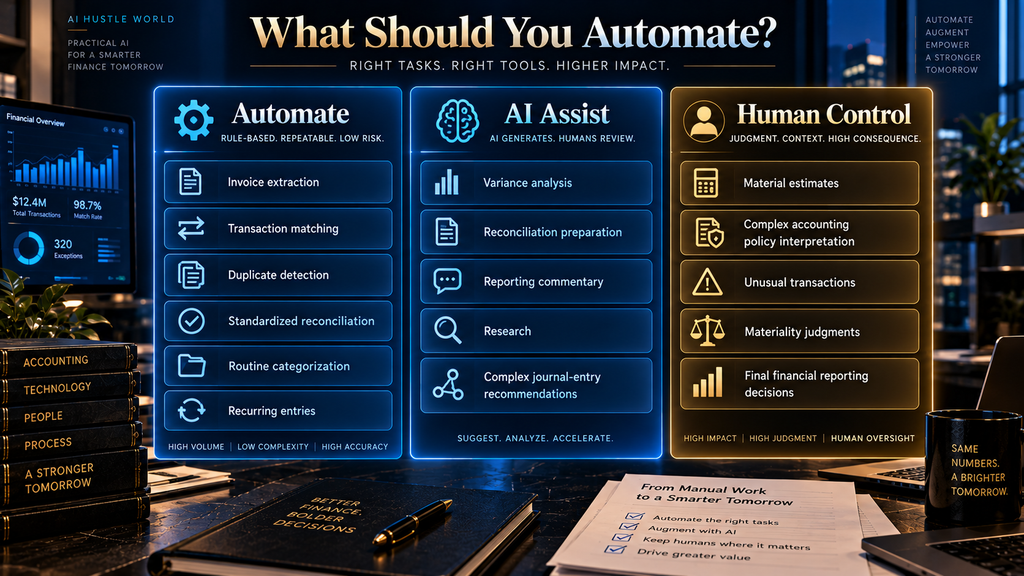
The boundaries will move as systems improve. A task that requires human review today may become safely automatable tomorrow. But the organization should not assume that technical capability automatically justifies operational autonomy.
The Future of Accounting Is Not Human vs. AI
The phrase “AI accounting” makes it sound as though a new kind of accounting department will emerge and replace everything that came before it. That is unlikely. The more realistic future is a layered finance function in which the existing accounting system remains the system of record, deterministic automation handles predictable workflows, analytical AI identifies patterns and anomalies, generative AI assists with interpretation and communication, and increasingly capable agents execute defined tasks within controlled boundaries.
The human role changes alongside that system. Accountants spend less time performing repetitive transactions and more time reviewing exceptions, understanding the business, challenging recommendations, managing controls, communicating financial implications, and making decisions that require judgment.
The Stanford field evidence is an early demonstration of this direction: AI adoption was associated with productivity gains and a shift away from routine data-entry work toward communication and quality assurance, while the same research showed why professional judgment cannot simply be removed from the loop. That combination should shape how companies approach automation.
The objective is not to create a finance function where humans are removed from every process. It is to create a finance function where human attention is reserved for the parts of accounting where human judgment actually creates value.
Final Thoughts
The most useful question in AI accounting is not whether AI is better than traditional accounting. That comparison is too broad to produce a good decision because accounting itself contains hundreds of different activities, from mechanical data processing to complex professional judgments.
The better question is what level of autonomy each task deserves.
When the work is repetitive, predictable, supported by reliable data, and easy to validate, automation can remove a large amount of low-value manual effort. When the work requires interpretation, investigation, or pattern recognition but remains reviewable, AI can give accountants substantially more analytical leverage. When the outcome depends on materiality, unusual circumstances, professional interpretation, or significant financial consequences, human judgment should remain central even when AI is deeply involved in the preparation.
That is why the strongest AI accounting strategy is not the one that automates the largest percentage of the finance function. It is the one that puts automation where execution is predictable, AI where analysis can be accelerated, and professional judgment where the consequences of being wrong are too important to delegate.
The real transformation is not accountants disappearing behind software. It is accountants spending less of their working day performing work that software can handle and more of it deciding what the numbers actually mean.
That is a much more useful definition of AI-enabled accounting.
Want to See Where AI Creates Real Value in Accounting?
Explore how AI is being applied across finance and accounting, from routine automation and reconciliation to forecasting, anomaly detection, and decision support.
See Where AI Creates Value in Finance →FAQ
Is AI accounting better than traditional accounting?
Not automatically. Traditional accounting systems are extremely effective at deterministic, rules-based work, while AI adds capabilities such as pattern recognition, document interpretation, classification, analysis, and recommendations. In practice, the strongest finance functions are likely to combine both rather than replace one with the other.
What accounting tasks should be automated first?
Start with repetitive, high-volume activities where the desired result is reasonably clear and errors can be detected or contained. Invoice extraction, transaction matching, document processing, duplicate detection, routine reconciliation, and standardized workflows are generally stronger starting points than complex accounting judgments.
Can AI replace accountants?
AI can replace portions of accounting work, particularly repetitive processing and some forms of analytical preparation, but current field evidence points more strongly toward augmentation and redistribution of work than wholesale replacement. AI adopters in the 2026 field study shifted effort away from routine data entry toward communication and quality assurance.
What accounting tasks should remain human-controlled?
Significant estimates, materiality decisions, complex accounting-policy interpretation, unusual transactions, and final financial reporting judgments generally require meaningful professional oversight. AI can assist with research, evidence gathering, analysis, and drafting without becoming the final decision-maker.
What is the difference between traditional automation and AI accounting?
Traditional automation generally executes predefined rules and workflows. AI can work with patterns, less-structured information, natural language, historical data, and probabilistic recommendations. Modern accounting environments will often use both technologies together rather than treating them as competing alternatives.
Is human-in-the-loop enough to control AI accounting risk?
Only if the human review is meaningful. Reviewers need access to relevant evidence, enough context to challenge the AI output, the ability to investigate and override the result, and clear accountability for the final decision. Simply requiring someone to approve thousands of AI recommendations does not automatically create effective oversight.
How should a small business start with AI accounting?
A small business should begin with a narrow workflow where the benefit can be measured and the consequences of failure are manageable. Document capture, transaction categorization, invoice processing, and reconciliation support can be practical starting points, provided the underlying data is reasonably reliable and someone remains responsible for exceptions.
What is the biggest risk of AI accounting?
One major risk is overreliance on plausible AI recommendations. AI can improve average performance while still producing individual recommendations that are wrong, and professionals may sometimes give those recommendations more weight than they deserve. The 2026 field research provides direct evidence of this tension.
How should a company decide what to automate?
Evaluate each task based on repetition, clarity of the desired result, data quality, exception frequency, and the consequences of an error. High-fit tasks can move toward automation, analytical tasks can use AI assistance, and high-consequence judgment should remain under meaningful human control.
Will AI make accountants more strategic?
It can, but only if organizations deliberately redesign the work around the capacity that automation creates. Current field evidence suggests that AI can shift accountant time away from routine data entry toward communication and quality assurance, but organizations must decide how that freed capacity is actually used.
What should companies do before deploying AI into financial workflows?
First understand and document the existing process, separate it into individual tasks, identify where judgment occurs, establish control boundaries, test the system against ordinary and unusual cases, and define how exceptions will be handled. AI should be introduced into a process that the organization understands, not used as a substitute for understanding the process.
Does AI eliminate the need for accounting expertise?
No. In fact, as AI becomes more capable, the ability to recognize when an AI recommendation is wrong becomes more valuable. Professional accounting knowledge provides the context needed to challenge outputs, interpret unusual situations, and remain accountable for consequential financial decisions.
Sources and Further Reading
- Internal Control – Integrated Framework: COSO’s widely used framework for designing and assessing internal controls.
- AI Risk Management Framework: NIST. A voluntary framework for identifying and managing risks in AI systems.
Related Guides
- 10 Best AI Tools for Small Business Owners
- AI Recruiting vs Traditional Recruiting: What Actually Works?
- AI SDR vs Human SDR: Which One Should Your Business Use in 2026?
Written by
Muntasir Ahmad Chowdhury
Founder, AI Hustle World
Muntasir Ahmad Chowdhury is the Founder of AI Hustle World, an independent publication dedicated to making Artificial Intelligence practical, trustworthy, and easy to understand. He researches AI tools, automation, customer service, productivity, and real-world business applications, helping readers make smarter technology decisions through research-driven, experience-backed content.
Expertise:
AI Tools • AI Automation • AI Customer Service • AI Productivity • Generative AI • AI Workflows
Get Smarter With AI
Enjoyed this guide? Get practical AI tools, tutorials, and honest reviews delivered to your inbox.