Evidence: Documentation reviewed
Last checked: September 2026
What was done: Written from official documentation and the published sources linked in this article. Not hands-on tested.
Files: None
Affiliate links: No
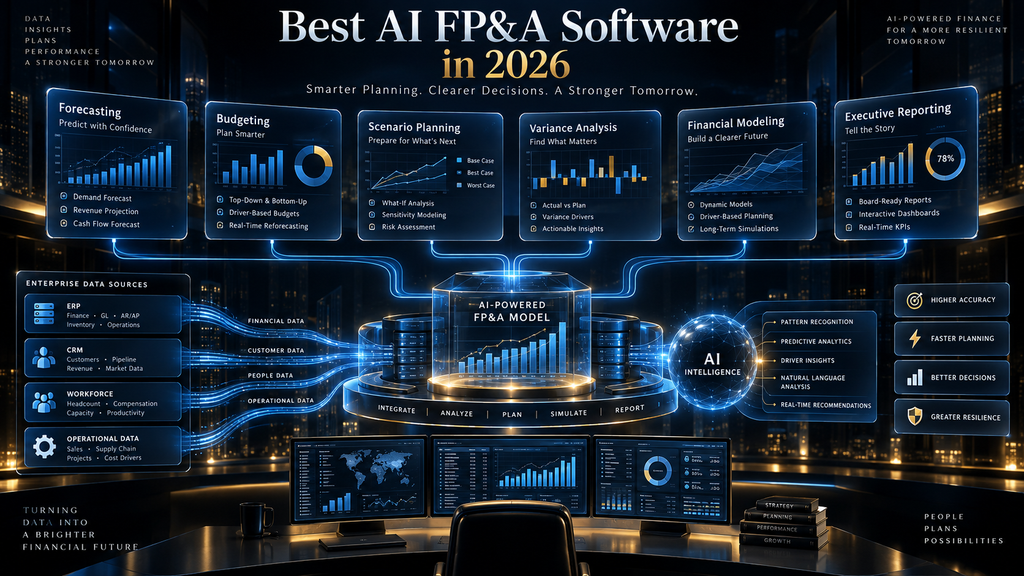
Best AI FP&A Software in 2026: Forecasting, Planning & Analysis Compared
Choosing the best AI FP&A software in 2026 is less about finding the platform with the most impressive AI features and more about finding the planning architecture that fits the way your finance team actually works. A startup that still builds most of its models in Excel has a very different problem from a multinational company managing hundreds of entities, currencies, business units, workforce plans, and operational drivers. The right platform therefore depends on modeling complexity, data architecture, spreadsheet dependence, scenario requirements, governance, and how much of the planning workflow you are prepared to let AI operate.
That distinction matters because the FP&A market has changed quickly. AI is moving beyond chat-style assistants that explain a variance or summarize a report and into forecasting, anomaly detection, model creation, scenario analysis, planning workflows, and increasingly agentic financial work. Platforms such as Pigment and Cube are explicitly moving toward multi-agent planning architectures, while established FP&A vendors such as Planful and Vena are embedding AI into mature planning workflows rather than treating AI as a separate product layer.
The result is a market with no universally correct winner. The best AI FP&A software is the platform whose planning architecture removes the most valuable manual work while preserving the financial logic, traceability, control, and flexibility your organization needs.
Quick Answer: Which AI FP&A Software Is Best?
For an Excel-heavy finance team that wants to modernize without forcing everyone into a completely different modeling environment, Datarails, Cube, and Vena are among the most relevant options to investigate. Datarails is particularly focused on connecting Excel-based finance workflows to a governed financial data layer, while Vena has continued to build AI-powered planning capabilities directly around the Microsoft and Excel environment. Cube takes a particularly interesting approach with AI agents covering data management, analysis, planning, and business partnering.
For organizations looking for a more modern, dedicated planning architecture, Pigment and Planful deserve close attention. Pigment is pushing aggressively into agentic planning and cross-functional modeling, while Planful combines established FP&A workflows with predictive forecasting and anomaly detection. Larger enterprises with highly complex connected-planning requirements should also evaluate Anaplan and Workday Adaptive Planning, particularly when their broader enterprise architecture already aligns with those ecosystems.
For teams that want an FP&A platform that extends beyond planning into adjacent corporate performance management processes, Prophix is worth considering. For fast-growing companies looking for newer AI-native approaches, Abacum and Drivetrain are interesting alternatives.
The important qualification is that these are not interchangeable products. A platform that is excellent for an Excel-centric mid-market finance team can be a poor choice for a global enterprise with complex multidimensional planning. Conversely, a sophisticated enterprise planning system can introduce unnecessary implementation and administration costs for a company whose biggest problem is simply consolidating spreadsheets and producing a reliable monthly forecast.
FP&A Software Is Becoming an Operating System for Financial Decisions
Traditional FP&A software was largely built around a predictable sequence: collect financial data, load it into a model, create budgets and forecasts, compare actuals with plan, investigate variances, and communicate the results to management. Finance teams still perform all of those activities, but the software layer is increasingly expected to participate in the analytical work rather than simply store the outputs.
That change explains why “AI FP&A” has become a broader category than AI forecasting. A modern system can potentially ingest data from ERP, CRM, payroll, billing, workforce, and operational systems; normalize it; maintain a planning model; generate forecasts; detect anomalies; create scenarios; explain variances; draft management commentary; and eventually execute portions of an approved planning workflow.
The architecture underneath those capabilities matters more than the AI label. A model that cannot distinguish actuals from forecasts, maintain version history, preserve assumptions, or trace a number back to its source can produce an impressive answer without producing a trustworthy planning process.
This is also why AI FP&A should be considered as part of the wider transformation of finance rather than as an isolated software category. For the broader context of how AI creates value across financial workflows, see AI in Finance & Accounting Explained.
The AI FP&A Market Has Split Into Several Different Architectures
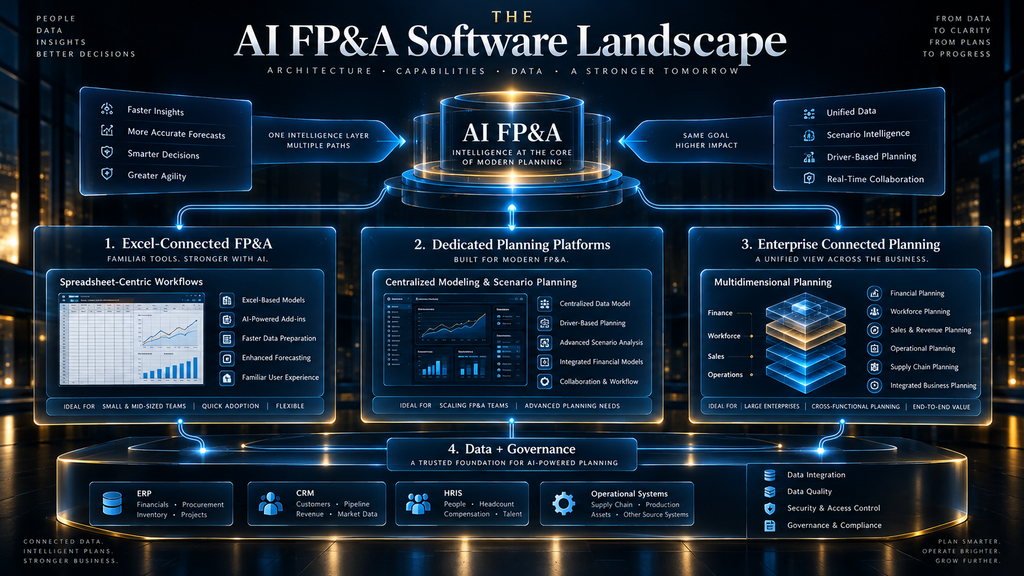
The easiest way to misunderstand the market is to treat every FP&A product as if it were competing to perform the same job. In practice, there are several distinct approaches.
Excel-connected platforms attempt to preserve the spreadsheet workflow while adding centralized data, governance, automation, and AI. Datarails and Vena are particularly relevant here, while Cube also emphasizes spreadsheet connectivity. These products are attractive when finance already has sophisticated Excel models and the biggest problem is not spreadsheet capability itself but fragmented data, version control, consolidation, and repetitive manual work.
Dedicated planning platforms move the organization toward a centralized planning model. Pigment, Planful, Anaplan, and Workday Adaptive Planning sit more naturally in this category, although their architectures and target markets differ substantially. These platforms become more attractive as planning expands across departments, entities, currencies, drivers, scenarios, and operational functions.
AI-native FP&A platforms put AI closer to the center of the planning experience. Cube, Abacum, Drivetrain and newer capabilities from established vendors illustrate this direction in different ways. Their promise is not simply that AI can answer questions about a model, but that AI can participate in the work required to build, analyze, update, and communicate planning outputs.
Then there is the broader corporate performance management category, where planning may sit alongside consolidation, close, reporting, and other finance processes. Prophix is relevant here because the buying decision may be less about obtaining a pure FP&A tool and more about reducing the number of systems surrounding the finance organization.
These categories overlap, but they should not be collapsed into one ranking. The first question for a buyer is therefore not “Which vendor has the best AI?” but “Which architecture fits the way our finance function needs to operate?”
What Actually Determines Whether an AI FP&A Platform Is a Good Fit?
A serious evaluation should begin with the planning workflow rather than the product brochure. Five dimensions are particularly important: modeling architecture, data foundation, AI operating depth, governance, and organizational fit.
Modeling architecture
The first question is where your planning logic lives today. If finance depends heavily on complex Excel models, a platform that preserves those models while centralizing data may create more value than a system that requires a complete redesign. If the organization has already outgrown spreadsheet-driven planning, however, preserving every existing spreadsheet can simply preserve the underlying problem.
Data foundation
AI forecasting is only as reliable as the financial and operational data available to it. A planning platform that connects cleanly to the ERP but struggles with CRM, payroll, billing, workforce, or operational data may still force analysts to perform manual preparation before every forecast cycle.
AI operating depth
There is a substantial difference between an AI assistant that answers questions and an AI system that can safely perform multi-step planning work. A useful evaluation should therefore ask whether AI can explain, predict, analyze, model, recommend, and eventually act within controlled workflows.
Governance
Finance needs more than a plausible forecast. It needs to know which data produced it, which assumptions were used, who changed them, what version is active, and whether the result can be reviewed later. AI that increases speed while weakening traceability can create a new control problem rather than solving an old productivity problem.
Organizational fit
Finally, the best technology for a 20-person finance function is unlikely to be the same technology that makes sense for a multinational enterprise. Implementation resources, modeling complexity, number of entities, planning frequency, existing systems, and the sophistication of the finance team all influence the economics of the decision.
The Best AI FP&A Software for Excel-Heavy Finance Teams: Datarails
Datarails has a particularly clear position in the market: help finance teams modernize FP&A without requiring them to abandon Excel. Its platform connects spreadsheet-based workflows to a centralized financial data environment, with capabilities around consolidation, reporting, planning, data management, and governance.
That architecture addresses a real problem. Excel is rarely the problem because finance teams lack the ability to model in it; the problem is that important models can become distributed across files, people, formulas, versions, and data sources. Datarails attempts to retain the flexibility finance teams value while adding a more controlled infrastructure around the spreadsheet workflow. The company describes its FinanceOS layer as connecting data from hundreds of sources while providing centralized business logic, permissions, version control, audit trails, and data lineage.
Datarails is also moving deeper into AI. Its current AI offering includes purpose-built agents for planning, reporting, and strategic finance workflows that operate on the company’s governed financial data environment. That direction is important because the value proposition is gradually moving from “Excel automation” toward “AI-assisted finance operations.”
The trade-off is equally important. An organization that wants to completely rethink its planning architecture may not benefit from preserving Excel as the center of the workflow. Datarails makes the most sense when Excel remains strategically valuable and the finance team wants to add governance, automation, consolidation, and AI around it rather than replace it outright.
Best fit: Excel-heavy SMB and mid-market finance teams that want centralized FP&A without a disruptive spreadsheet migration.
Cube: A Strong Option for Teams Moving Toward Agentic FP&A
Cube takes a particularly interesting position because its AI strategy goes beyond the conventional assistant model. Its current FP&Agents architecture separates financial work into specialized AI roles covering data management, analysis, planning, and business partnering, with orchestration between those roles.
That matters because FP&A is not one task. An analyst preparing a forecast might first need to clean or reconcile data, then investigate historical trends, build a scenario, compare it with the current plan, and finally communicate the implications to an executive. Treating those activities as separate AI capabilities makes more sense than assuming a single chatbot should perform everything.
Cube also emphasizes traceability and controlled access. The usefulness of agentic FP&A will ultimately depend on whether finance professionals can understand where an AI-generated number came from and what the system actually changed. A planning agent that creates a scenario but cannot expose the assumptions behind it would be difficult to trust in a serious finance environment.
Cube is therefore particularly interesting for finance teams that want to remain connected to familiar spreadsheet workflows while experimenting with a more agentic approach to planning. Best fit: Lean and mid-sized finance teams looking for spreadsheet connectivity combined with increasingly autonomous AI planning capabilities.
Vena: AI-Powered Planning Without Abandoning Excel
Vena occupies another important part of the Excel-connected FP&A market. Its strategy is built around the idea that finance teams can continue using Excel and Microsoft tools while gaining centralized planning, workflow management, governance, reporting, and AI.
Its recent product development shows how this model is evolving. Vena introduced a Planning Agent capable of using natural-language instructions to generate driver-based planning outputs directly in Excel. The significance is not simply that AI can write formulas; it is that the planning workflow remains recognizable to finance professionals who already work in spreadsheets.
Vena has also expanded beyond traditional planning. Its 2026 product development includes an advanced financial consolidation solution, extending its reach into multi-entity finance operations. That expansion makes the platform more relevant for organizations that want planning and adjacent financial processes to live within a broader controlled environment.
The limitation is the same structural trade-off faced by most Excel-centric platforms. Retaining Excel lowers behavioral change, but it can also make it harder to achieve a complete break from spreadsheet complexity. For teams that already view Excel as a strategic asset, that is a feature. For teams trying to eliminate spreadsheet dependency, it can be a constraint.
Best fit: Finance organizations deeply invested in Excel and Microsoft that want more governed planning and increasingly capable AI without abandoning the spreadsheet interface.
Pigment: A Leading Example of AI-Native Planning
Pigment represents one of the clearest moves toward an AI-native planning architecture. Instead of treating AI as a separate assistant sitting on top of the planning model, Pigment is integrating AI into multiple stages of the planning workflow.
Its current architecture includes Analyst, Modeler, Planner, and custom agents. The Analyst Agent can analyze data and identify anomalies, while the Modeler Agent can translate natural-language intent into planning models. This moves AI closer to the underlying structure of the planning system rather than keeping it confined to natural-language reporting.
That distinction becomes significant when planning becomes cross-functional. Finance may need to understand the relationship between revenue, headcount, sales capacity, marketing spending, supply chain constraints, and operational targets. A planning platform that can model those relationships centrally has a different strategic role from a tool that primarily automates finance reporting.
Pigment is therefore particularly compelling for organizations that want planning to become a shared operating model across finance and other functions. Its broader platform positioning extends beyond traditional FP&A into areas such as workforce, sales, and operational planning.
The trade-off is complexity. The more powerful the planning architecture becomes, the more important implementation discipline, model design, data quality, and governance become. A sophisticated system can create significant value, but it can also become an expensive way to solve a relatively simple forecasting problem.
Best fit: Mid-market and enterprise organizations seeking modern, cross-functional planning with deep embedded AI.
Planful: Strong for Structured FP&A and Predictive Forecasting
Planful takes a somewhat different route into AI. Rather than positioning the entire platform around autonomous agents, it has built predictive capabilities directly into established FP&A workflows.
Its Predict functionality includes Signals for anomaly detection and Projections for generating forecast baselines. Signals is designed to identify unusual patterns and potential issues, while Projections uses historical information to support forecasting. Planful also emphasizes human review, which is particularly relevant in finance because forecast outputs often need to be adjusted for information that historical data cannot capture.
This approach reflects an important reality: not every organization needs an AI agent that can modify a planning model autonomously. Sometimes the most valuable AI capability is simply reducing the amount of manual analysis required before a finance professional makes a decision.
Planful is therefore attractive to organizations that want established FP&A processes with stronger predictive intelligence rather than a complete shift toward an AI-first operating model. Best fit: Finance teams that want mature planning and forecasting workflows with embedded predictive AI and human oversight.
Anaplan: Enterprise Connected Planning
Anaplan belongs toward the enterprise end of the market, where the central problem is often not forecasting one business unit but coordinating planning across complex organizations.
The platform’s relevance comes from multidimensional connected planning. Large organizations may need to model revenue, workforce, capacity, supply chain, sales territories, capital expenditure, and other drivers together rather than maintaining disconnected financial plans.
That makes Anaplan fundamentally different from an Excel automation product. The value is in creating a shared planning architecture where changes in one part of the organization can flow through other models and scenarios.
The downside is proportional to the opportunity. Enterprise planning systems require substantial modeling discipline, implementation effort, governance, and organizational adoption. A smaller company may gain little from that complexity if its main problem is consolidating a handful of spreadsheets.
Best fit: Large organizations with complex, multidimensional connected-planning requirements.
Workday Adaptive Planning: Particularly Strong Inside the Workday Ecosystem
Workday Adaptive Planning is another enterprise-oriented option, particularly relevant for organizations already invested in the broader Workday environment.
Its strength is the relationship between financial planning and workforce or operational planning. That matters because personnel costs are often among the largest controllable expenses for many businesses, and finance teams increasingly need to model hiring, compensation, organizational changes, and operating plans together.
The broader lesson is that ecosystem fit can outweigh isolated feature superiority. If an organization already has a substantial Workday footprint, the integration and organizational advantages of staying within that environment may be more valuable than choosing a standalone FP&A platform with a more impressive AI demo.
Best fit: Organizations that already rely heavily on Workday and want financial, workforce, and operational planning to work together.
Prophix: When FP&A and Close Need to Meet
Prophix is worth considering when the buying decision extends beyond forecasting and budgeting. The platform sits across FP&A and broader corporate performance management workflows, including planning, reporting, consolidation, and financial close-related processes.
This can be strategically attractive because finance departments often end up with one system for planning, another for consolidation, another for reporting, and spreadsheets connecting everything together. Reducing that fragmentation can produce benefits that are not visible in an individual feature comparison.
Prophix therefore makes more sense when the organization wants to simplify its broader finance architecture rather than merely purchase an AI forecasting tool. Best fit: Mid-market and enterprise finance teams looking to connect planning with consolidation and adjacent finance processes.
Abacum: An AI-Native Option for Fast-Growing Finance Teams
Abacum is part of the newer generation of FP&A products designed around faster implementation and AI-assisted planning.
Its current positioning includes forecasting, scenario planning, backsolving, anomaly detection, data preparation, and AI-generated summaries. That makes it particularly relevant to scaling companies that have outgrown spreadsheet-based planning but may not yet need the complexity of a large enterprise CPM implementation.
The key question for buyers is whether the platform can continue to support their planning complexity as the company grows. A tool can be excellent at the scale where it is purchased but become less appropriate once the organization adds more entities, dimensions, currencies, or complex operational planning requirements.
Best fit: Fast-growing startups and scale-ups moving beyond spreadsheets without immediately requiring heavyweight enterprise planning infrastructure.
Drivetrain: AI Planning With an Emphasis on Traceability
Drivetrain is another emerging AI-native platform worth watching because it emphasizes traceability alongside automation.
Its current capabilities include AI-driven scenario planning, modeling, reporting, data transformation, and analysis. The important part of this positioning is not simply that AI can produce a scenario; it is that the finance professional should be able to understand the underlying financial logic and source data.
That is increasingly important as AI moves from analysis toward action. If an AI system is merely writing a narrative, an occasional error may be inconvenient. If it is modifying a forecast or planning model that executives use for resource allocation, the cost of an opaque mistake is much higher.
Best fit: Modern finance teams that want AI-native planning while maintaining strong visibility into model logic and data provenance.
AI Features Are Not the Same as AI Operating Depth
The most misleading way to compare FP&A software is to count AI features.
A platform may advertise an AI assistant, natural-language queries, automated forecasting, anomaly detection, scenario generation, and AI-generated narratives. Another platform may advertise fewer AI features but embed AI directly into its planning model and workflow. The second platform can potentially be much more useful even if its marketing page contains fewer AI keywords.
A better way to think about the market is to examine how far AI actually travels through the planning process.
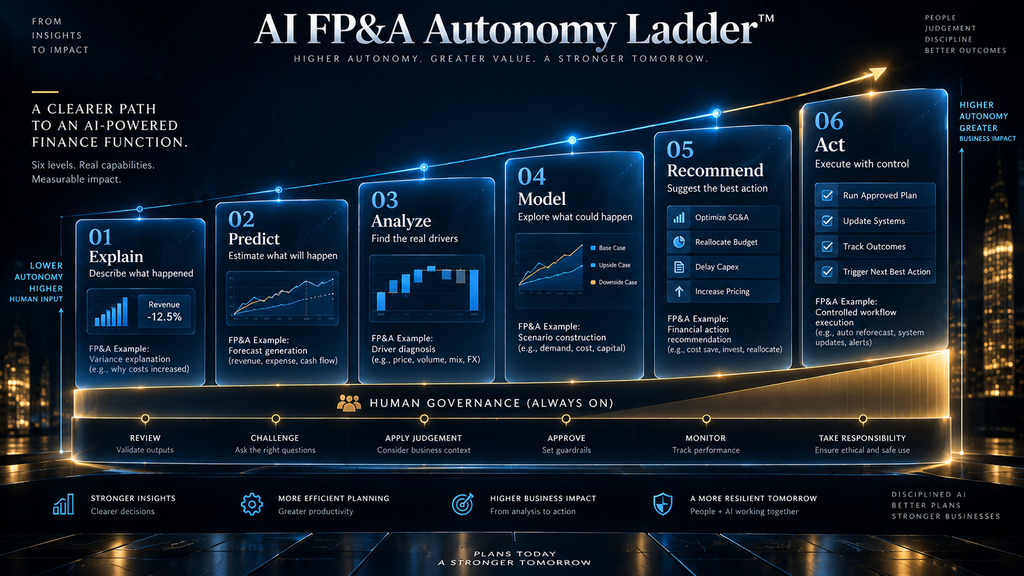
At the lowest level, AI explains existing information. It might answer why actual revenue differs from budget or summarize the major drivers of a variance.
The next level is prediction, where AI generates forecasts or detects anomalies. Then comes analysis, where the system identifies relationships and diagnoses potential drivers. The next step is modeling, where AI helps construct or modify scenarios and planning assumptions.
After that comes recommendation, where the system proposes actions based on the modeled outcomes. The most advanced level is controlled execution, where AI can perform approved changes within the planning workflow rather than simply suggesting them. That progression is more informative than a feature checklist because it tells the buyer how much operational responsibility the AI is actually taking.
The AI FP&A Autonomy Ladder
AI Hustle World can make this distinction explicit through an original framework: Explain → Predict → Analyze → Model → Recommend → Act. The framework is useful because the appropriate level of autonomy depends on the consequence of the task.
Explaining a variance is relatively low risk. Generating a baseline forecast is more consequential but still reviewable. Creating a workforce scenario is more consequential again because it can influence management decisions. Recommending a major cost action requires stronger contextual understanding, and allowing an AI system to execute changes requires governance, permissions, auditability, and recovery mechanisms.
This is why the most advanced AI FP&A platform is not necessarily the one that allows the AI to do the most. The best platform is the one that provides the right amount of autonomy for the consequences of the work.
Excel-Native vs Dedicated FP&A Software: Which Should You Choose?
The Excel question deserves more attention than it usually receives because it is not merely a user-interface preference. It is a migration decision with financial consequences.
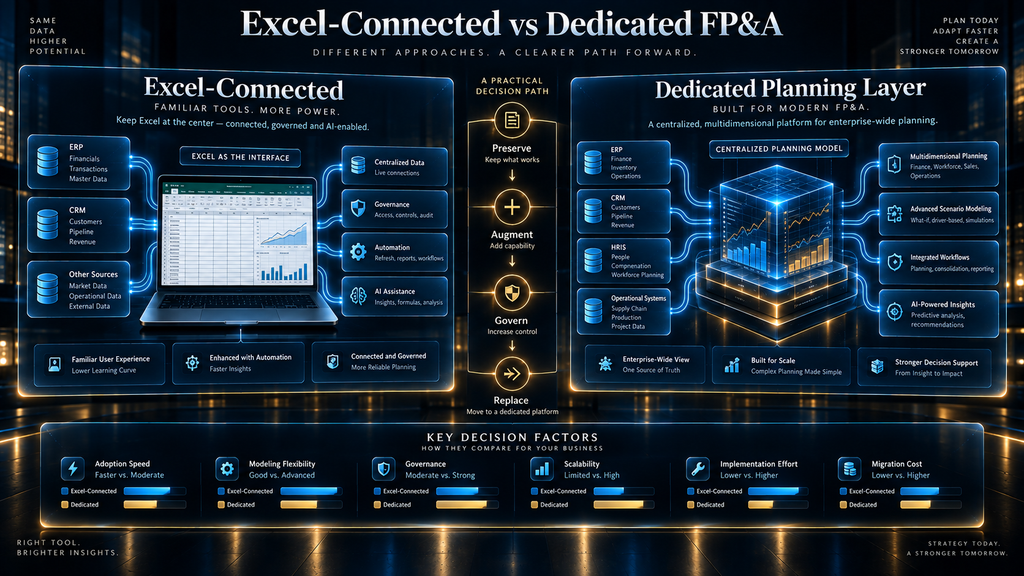
If your finance team has years of carefully constructed models, macros, reporting templates, and institutional knowledge embedded in Excel, moving everything to a new planning environment can create significant transition costs. Training, model reconstruction, integration, testing, and adoption all consume resources that may not appear in the software subscription price.
An Excel-connected platform can therefore produce a faster path to improvement. It can centralize data and automate repetitive processes while preserving the environment finance professionals already understand.
The opposite can also be true. If the organization has hundreds of disconnected spreadsheets, conflicting assumptions, duplicated calculations, and unclear ownership, preserving Excel indefinitely may simply preserve the architecture that caused the problem.
The right question is therefore not whether Excel is “good” or “bad.” It is whether Excel is still the right modeling layer for the complexity of your organization.
Why Data Quality Matters More as AI Gets Better
There is a paradox in AI FP&A: better AI makes poor data architecture more dangerous.
A weak model can be recognized because it produces obviously poor results. A sophisticated AI system can produce a highly convincing forecast from incomplete, inconsistent, or poorly defined data. The output may look professional while still being wrong.
This is why a finance organization should evaluate the data foundation before evaluating AI sophistication. Can the system distinguish actuals from forecasts? Are chart-of-accounts mappings consistent? Are business definitions standardized? Can revenue data be reconciled with CRM information? Are workforce assumptions current? Can historical changes be explained?
AI cannot eliminate those requirements. It can make them easier to manage, but it cannot turn an undefined metric into a reliable financial fact.
The Hidden Cost of AI FP&A Software
The subscription price is only one part of the economic decision.
Implementation can require data integration, model design, chart-of-accounts mapping, historical data preparation, workflow configuration, permissions, testing, training, and change management. Even a technically excellent platform can fail to generate ROI if the finance team spends months maintaining a complex model that only a few people understand.
There is also a less obvious cost: review burden.
Suppose an AI system produces 500 useful recommendations every month but finance professionals must manually validate most of them. The organization may have automated generation without meaningfully reducing workload. Conversely, a system that produces fewer recommendations but can safely execute routine low-risk tasks may generate substantially more value.
The correct ROI calculation therefore needs to measure the entire workflow rather than counting AI outputs.
How to Measure Whether an AI FP&A Platform Is Actually Working
The most useful KPIs are operational rather than promotional. Track the time required to produce the monthly forecast, the time spent collecting and cleaning data, the frequency of manual spreadsheet consolidation, the number of forecast revisions, the time required to create scenarios, and the time between an actual financial change and its visibility in the planning model.
Forecast quality also matters, but it should be measured carefully. A lower forecast error is valuable, but finance leaders should distinguish between improvements produced by better models and improvements produced simply by incorporating more current information.
AI adoption should also be measured. If the system has powerful AI capabilities but finance professionals consistently avoid them because they do not trust the outputs, the theoretical capability has little practical value.
A useful implementation dashboard can therefore combine: Planning cycle time + forecast error + manual effort + scenario turnaround + data preparation time + AI adoption + exception rate + review time. Those metrics tell you whether the platform is actually changing the economics of FP&A.
Common Mistakes When Buying AI FP&A Software
One common mistake is buying based on the AI demo. A beautifully phrased natural-language answer can create a strong first impression, but it says little about whether the platform can maintain a reliable planning model.
Another mistake is treating forecasting accuracy as a standalone product attribute. Forecast quality depends on data, model structure, assumptions, horizon, business volatility, and the information available at the time the forecast was generated.
A third mistake is underestimating implementation. A sophisticated platform can require significant work before it becomes useful, especially when the organization has inconsistent data definitions or fragmented planning processes.
Another is assuming that replacing Excel automatically improves FP&A. Sometimes the better decision is to preserve Excel and fix the infrastructure around it. Other times, Excel is the core reason planning has become difficult to govern. The answer depends on the organization’s actual operating model.
Finally, organizations can over-automate. Not every planning decision should become autonomous simply because the software allows it. Strategic assumptions involving market changes, acquisitions, organizational redesign, pricing, or major investment decisions often require context that cannot be inferred reliably from historical financial data alone.
AI FP&A Software Comparison for 2026
| Platform | Core Strength | AI Direction | Excel Fit | Best For | Main Trade-Off |
|---|---|---|---|---|---|
| Datarails | Excel-connected FP&A | AI agents + finance automation | Excellent | Excel-heavy finance teams | Can preserve spreadsheet complexity |
| Cube | Connected FP&A + AI agents | Strong agentic direction | Strong | Lean/mid-market teams | Newer agent architecture requires evaluation |
| Vena | Excel/Microsoft FP&A | AI planning + consolidation | Excellent | Microsoft-heavy teams | Spreadsheet-centric architecture may not suit everyone |
| Pigment | Modern connected planning | Deep agentic AI | Moderate | Cross-functional planning | Greater implementation sophistication |
| Planful | FP&A + predictive AI | Forecasting + anomaly detection | Moderate | Structured FP&A | Less centered on full autonomous-agent model |
| Anaplan | Enterprise connected planning | Enterprise AI capabilities | Lower | Complex global planning | Implementation complexity |
| Workday Adaptive | Enterprise planning | AI within Workday ecosystem | Moderate | Workday organizations | Strongest when ecosystem fit exists |
| Prophix | Planning + CPM | AI-assisted finance | Moderate | Planning + close/consolidation | Broader platform may be more than pure FP&A needs |
| Abacum | AI-native FP&A | Forecasting + scenarios + AI | Strong | Startups and scale-ups | Long-term enterprise scalability should be evaluated |
| Drivetrain | AI-native planning | Agents + traceability | Strong | Modern finance teams | Emerging platform category |
The table is intentionally not presented as a universal ranking. A ranking implies that every finance organization has the same problem, while the evidence points in the opposite direction.
Which AI FP&A Software Should You Choose?
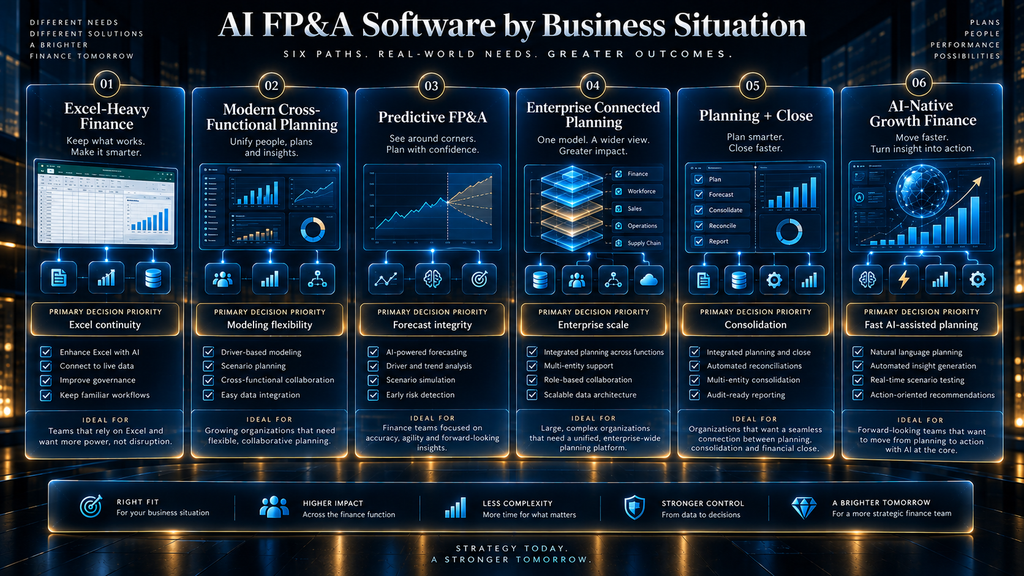
If your primary problem is Excel consolidation and fragmented finance workflows, start with Datarails, Vena, or Cube. These products are more aligned with a gradual modernization strategy where finance wants to retain familiar spreadsheet workflows while improving governance and automation.
If your primary problem is cross-functional planning complexity, Pigment deserves serious attention. It is particularly relevant when finance needs to connect planning with workforce, sales, operational, or other business drivers.
If your priority is predictive forecasting and structured FP&A, Planful is a strong candidate. Its approach is particularly relevant to organizations that want AI to improve forecasting and anomaly detection while retaining meaningful human review.
If you operate a large, complex enterprise, evaluate Anaplan and Workday Adaptive Planning alongside the broader enterprise planning market. The decision should focus heavily on model complexity, integrations, governance, implementation capability, and ecosystem fit.
If your organization needs planning plus consolidation or broader performance-management functionality, Prophix may deserve a place on the shortlist.
If you are a fast-growing company looking for an AI-native alternative to spreadsheets, investigate Abacum and Drivetrain alongside Cube. The critical question is whether the platform can grow with your modeling complexity without recreating the fragmentation you are trying to eliminate.
And if your finance team is already deeply invested in Microsoft and Excel, Vena deserves particular consideration because the platform is designed around that operating reality rather than requiring finance to abandon it.
How to Evaluate Vendors Before Signing a Contract
A useful evaluation should begin with your own planning workflow. Document where actuals originate, how data is transformed, where assumptions are stored, how forecasts are created, how scenarios are built, how management commentary is produced, and which steps still require manual spreadsheet work.
Then ask every vendor to demonstrate your workflow, not its preferred demo scenario.
Give the vendor a realistic planning problem. Provide historical data, a current budget, several operational drivers, and a scenario that requires a meaningful change in assumptions. Ask the platform to show how it imports the data, builds the forecast, explains the variance, creates the scenario, traces the result back to source data, and handles a human override.
That exercise exposes differences that product pages hide. It also reveals whether the vendor’s AI is actually integrated into the planning workflow or merely attached to it as a conversational layer. Before committing, ask how the system handles data lineage, permissions, model changes, audit trails, failed integrations, forecast overrides, AI-generated assumptions, agent permissions, and recovery when an automated action is incorrect.
These are not secondary technical questions. They determine whether the AI becomes part of a trustworthy finance process or becomes another system finance has to supervise.
The AI FP&A Fit Framework
AI Hustle World’s AI FP&A Fit Framework provides a practical way to make the final decision.
Start with Planning Architecture. Determine whether your organization should preserve Excel, augment it, or move to a dedicated planning model.
Then examine the Data Foundation. Identify where financial and operational data originates and whether the platform can connect, normalize, and govern it without creating another manual integration layer.
Next evaluate AI Depth. Determine whether the system merely explains information or can predict, analyze, model, recommend, and safely execute parts of the workflow.
Then assess Governance. Every consequential AI-generated output should have an appropriate level of traceability, human review, permissions, and auditability.
Finally consider Organizational Fit. The right platform must match your company’s size, complexity, finance maturity, implementation resources, and existing technology ecosystem.
The framework leads to a simple final test: Does this platform reduce the cost and complexity of planning without reducing the quality and trustworthiness of financial decisions?
If the answer is yes, the product deserves serious consideration. If the AI is impressive but the planning architecture becomes harder to manage, the apparent innovation may not translate into actual finance value.
What the Future of AI FP&A Software Looks Like
The next stage of FP&A will probably not be defined by increasingly elaborate chat interfaces. It will be defined by AI becoming embedded deeper into the planning system.
A finance professional may increasingly start with a business question rather than a spreadsheet. The system could identify the relevant data, analyze historical drivers, generate several scenarios, explain the assumptions behind each, highlight the financial consequences, and prepare a recommendation for review.
The human role would not disappear. It would shift upward toward assumptions, context, trade-offs, governance, and decisions that require information outside the financial model.
That transition is already visible in the development of agentic capabilities across vendors. Cube’s multi-agent approach, Pigment’s Analyst and Modeler agents, Vena’s AI planning capabilities, and Planful’s predictive functionality all represent different stages of the same broader movement: AI is moving from answering questions about FP&A toward participating in FP&A itself.
The boundary that matters most will therefore become autonomy.
A system that can generate a forecast is useful. A system that can understand why the forecast changed, build alternative scenarios, explain their consequences, recommend an action, and operate within controlled permissions is potentially much more valuable.
But that value only exists if the organization can trust the underlying data and govern the AI’s actions.
Final Thoughts
There is no single best AI FP&A platform for every organization in 2026. The market now spans Excel-connected products, dedicated planning systems, enterprise connected-planning platforms, broader corporate performance management suites, and increasingly AI-native systems built around financial agents.
The smartest buying decision is therefore architectural rather than promotional. Start with the planning problem, understand where your data and models live, decide how much spreadsheet dependence you actually want, determine how much autonomy AI should have, and then evaluate vendors against those requirements.
The most useful mental model is simple: AI should reduce the work required to produce a trustworthy financial decision, not merely make the financial analysis look more intelligent. That distinction will become even more important as FP&A software moves from AI-assisted forecasting toward governed, agentic planning.
Want to Go Deeper Into AI-Powered Finance?
Software comparisons make more sense once you understand how continuous forecasting works, so start with the model behind the tools.
See How Continuous Forecasting Works →FAQ
What is the best AI FP&A software in 2026?
There is no universal winner. Datarails and Vena are strong options for Excel-heavy teams, Cube is interesting for teams adopting agentic FP&A, Pigment is strong for modern cross-functional planning, Planful is well suited to structured predictive FP&A, and Anaplan and Workday Adaptive Planning are better suited to complex enterprise environments.
What is AI FP&A software?
AI FP&A software combines financial planning and analysis capabilities with artificial intelligence for tasks such as forecasting, anomaly detection, variance analysis, scenario modeling, reporting, and increasingly agentic planning workflows. The important distinction is whether AI merely provides analysis or actually participates in the planning process.
Is Excel still useful for FP&A in 2026?
Yes. Excel remains valuable for flexible financial modeling and is deeply embedded in many finance teams. The decision is whether Excel should remain the primary planning architecture or become one interface connected to a more governed financial planning system.
Is AI forecasting accurate enough for finance teams?
AI forecasting can be useful, but accuracy depends heavily on data quality, historical patterns, model design, forecast horizon, and business volatility. AI-generated forecasts should generally be treated as decision-support inputs rather than automatically correct financial truth.
What is the difference between AI FP&A and traditional FP&A software?
Traditional FP&A software primarily provides infrastructure for budgeting, forecasting, reporting, consolidation, and planning. AI FP&A software adds capabilities such as predictive forecasting, anomaly detection, natural-language analysis, scenario generation, automated commentary, and increasingly AI agents that can perform parts of the planning workflow.
Should a small business buy enterprise FP&A software?
Usually not unless its planning complexity justifies the implementation burden. A small or growing company may get more value from an Excel-connected or lightweight FP&A platform than from a large enterprise planning system designed for complex multidimensional models.
What should I evaluate before buying AI FP&A software?
Evaluate modeling architecture, data integrations, forecasting capabilities, scenario modeling, AI operating depth, Excel compatibility, governance, auditability, implementation requirements, scalability, total cost of ownership, and the amount of human review required for AI-generated outputs.
Will AI replace FP&A analysts?
AI is more likely to automate portions of FP&A analyst work than eliminate the entire role. Data preparation, recurring analysis, forecasting support, scenario construction, and reporting can increasingly be automated, while judgment around assumptions, business context, risk, trade-offs, and executive decisions remains important.
What is the biggest risk of AI FP&A software?
The biggest risk is not simply an incorrect prediction. It is allowing an incorrect or poorly understood AI-generated assumption to enter a planning workflow without sufficient review, traceability, or governance. The more autonomous the system becomes, the more important those controls become.
Written by
Muntasir Ahmad Chowdhury
Founder, AI Hustle World
Muntasir Ahmad Chowdhury is the Founder of AI Hustle World, an independent publication dedicated to making Artificial Intelligence practical, trustworthy, and easy to understand. He researches AI tools, automation, customer service, productivity, and real-world business applications, helping readers make smarter technology decisions through research-driven, experience-backed content.
Expertise:
AI Tools • AI Automation • AI Customer Service • AI Productivity • Generative AI • AI Workflows
Get Smarter With AI
Enjoyed this guide? Get practical AI tools, tutorials, and honest reviews delivered to your inbox.