
Evidence: Documentation reviewed
Last checked: September 2026
What was done: Written from official documentation and the published sources linked in this article. Not hands-on tested.
Files: None
Affiliate links: No
AI SDR vs Human SDR? The Cheapest SDR Isn’t Necessarily the Best SDR
A company has a problem. Its SDR team is expensive, and prospecting eats too much of the day — reps spend hours researching accounts, hunting for contacts, updating CRM records, and following up with people who never reply. Then an AI SDR vendor makes an attractive promise: automate the function entirely.
The math looks obvious on paper. A human SDR costs tens of thousands of dollars a year in salary, tools, management time, and ramp. An AI SDR subscription can run a fraction of that. So the company replaces the humans and waits for the pipeline to fill itself.
Six months later, something doesn’t add up. The AI system has contacted thousands of prospects, generated hundreds of replies, and booked dozens of meetings. On the surface, that looks like success. But when the sales team actually sits in those meetings, a different picture emerges: several accounts are a weak fit, some of the personalization was technically accurate but commercially irrelevant, and a chunk of the booked prospects wanted information, not a sales conversation.
This is the pattern behind most AI-SDR-vs-human-SDR debates, and it’s why the debate is usually framed wrong. The real question isn’t which one is better. It’s which specific tasks in your funnel are throughput problems that a machine can solve, and which ones are judgment problems that still need a person — and that split changes depending on your deal size, your sales cycle, and how much relationship capital a sale actually requires.
Stories like this one aren’t rare, and they aren’t really about AI failing. They’re about a company buying a tool without first deciding what job it actually needed done. The same pattern shows up in reverse, too: companies that refuse to automate anything end up with skilled, expensive people spending most of their week on research and data entry instead of the conversations that actually justify their salary.
Neither mistake is really about the technology — both come from skipping the harder question of which parts of the job are genuinely repeatable and which parts require a person who can adapt in the moment.
What an AI SDR and a Human SDR Actually Do
An AI SDR is software that performs prospecting and early-stage outreach autonomously: it finds contacts, enriches them with firmographic and behavioral data, drafts and sends personalized sequences, monitors replies, and books meetings without a person writing each individual message. A human SDR does the same job description on paper, but executes it through judgment — reading a prospect’s tone, deciding when a joke lands and when it doesn’t, and building enough trust that a stranger agrees to give up thirty minutes of their day.
Both roles exist to solve the same business problem: filling the top of the funnel with conversations worth having. They just solve it through completely different mechanisms, and that mechanism difference is where almost everything else in this comparison comes from.
The Core Difference: Throughput vs. Judgment
An AI system optimizes for whatever it’s told to optimize for, and most AI SDR tools are tuned, directly or indirectly, to maximize meetings booked. That’s a throughput objective. Sales leadership, on the other hand, wants qualified opportunities — a judgment objective. Those two goals sound similar but aren’t identical, and the gap between them is exactly where the “AI booked meetings but pipeline didn’t grow” complaint comes from.
A human SDR, by contrast, is naturally biased toward judgment because a person has to live with the consequence of a bad meeting: the awkward call, the wasted thirty minutes, the account executive who stops trusting their handoffs. That built-in feedback loop is slower to scale than software, but it self-corrects in a way a pure activity metric doesn’t.
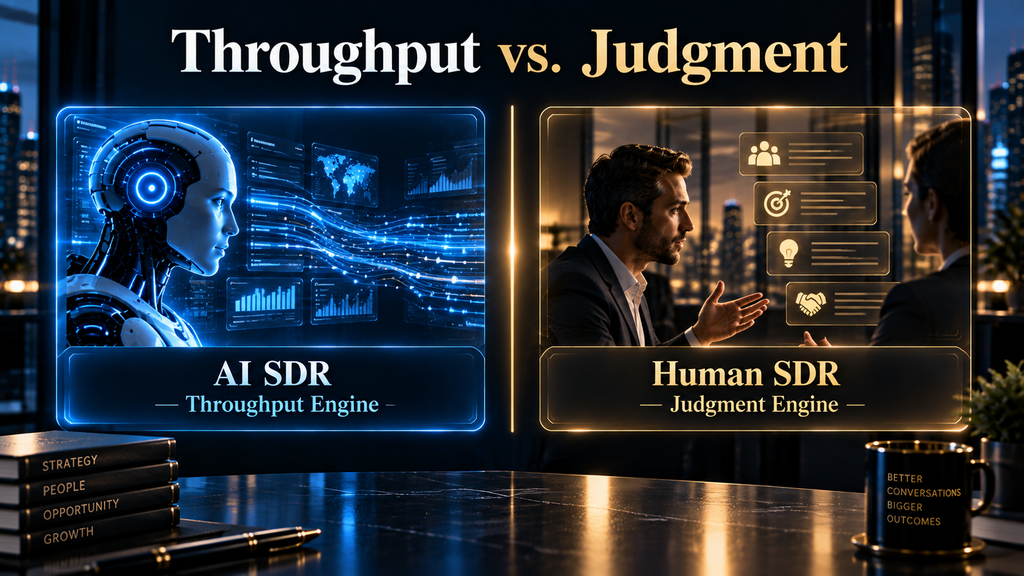
This is the mechanism worth understanding before any cost comparison: AI SDRs are throughput machines, and human SDRs are judgment engines. Everything downstream — cost, quality, risk, and the right hybrid setup — follows from that distinction.
Why the Traditional, Human-Only Model Still Exists
It’s worth asking why companies kept paying six-figure salaries for SDR teams for two decades before AI made a cheaper option available. The answer isn’t inertia. B2B sales, especially above a certain deal size, runs on relationship capital: a buyer takes a meeting because they trust the person asking, not because the email was well-timed.
Complex purchases involve real career risk for the buyer — picking the wrong vendor can cost someone their job — and that risk gets absorbed through a relationship with an accountable person, not a workflow.
The traditional model also concentrates accountability in a way automation doesn’t. When a human SDR overpromises or mishandles an account, there’s a specific person a manager can coach, and a specific person the prospect can hold responsible. That accountability is part of why enterprise buyers still expect a human on the other end of a complex deal, regardless of how good the AI research behind the scenes has gotten.
Industry by Industry: Does the Calculus Change?
The throughput-versus-judgment split holds across industries, but where the line falls shifts noticeably depending on what’s actually being sold. In horizontal SaaS with a self-serve or low-touch motion, AI SDRs tend to earn the widest mandate: the product is easy to explain, the buying process is familiar to prospects, and a large addressable market rewards volume, which lines up with Salesforce’s reporting that roughly four in five sales teams already use AI to boost productivity in some form.
Vertical SaaS selling into a specific regulated niche, such as healthcare operations or financial compliance software, behaves differently — the audience is smaller, the vocabulary is specialized, and a generic AI-personalized email is more likely to read as obviously synthetic to a buyer who’s seen a dozen of them that week.
Professional services and agencies sit further toward the human end of the spectrum almost by definition, because the product being sold is judgment and trust rather than a repeatable feature set. An AI SDR can still do useful work here — account research, signal monitoring, meeting prep — but the first real conversation tends to need a human earlier in the cycle than it would for a transactional SaaS sale.
Manufacturing, industrial equipment, and other long-cycle capital-purchase categories add another wrinkle: buying committees are large, budget cycles are annual, and a single mishandled early touch can quietly disqualify a company from a purchasing cycle that won’t reopen for a year. In those categories, the cost of an AI system’s mistake isn’t just a bad meeting; it’s a lost shot at an entire budget cycle.
Financial services, healthcare, and legal all add a compliance layer on top of the general governance concerns already covered: outbound communication in these industries is frequently subject to specific consent, recordkeeping, and disclosure rules that vary by jurisdiction. An AI system operating at scale in these industries needs its governance rules to encode those requirements explicitly, not just general good practice, because a compliance failure that happens automatically at scale is a materially different problem than the same mistake made once by a person.
What the Data Actually Shows: Cost
Reported figures vary considerably across vendors and industry write-ups, which is itself useful information — treat any single number here as a directional range, not a fact carved in stone. A fully loaded human SDR (base salary, commission, benefits, management overhead, and tooling) is commonly reported anywhere from roughly $100,000 to $210,000 a year depending on market and OTE structure, with a benefits load of around 30% layered on top of cash compensation.
Ramp time before a new SDR is fully productive typically runs three to six months, and average SDR tenure in the industry sits around 14 months — meaning a company effectively re-pays that ramp cost every twelve to eighteen months through turnover.
AI SDR platforms are usually priced on a subscription or usage basis. Reported annual pricing spans a wide range, from roughly $3,000 to $30,000 a year for self-serve tiers up to several thousand dollars a month for enterprise deployments with heavy data enrichment. There’s no ramp cost in the traditional sense, but there is a tuning period — most reporting puts 60 to 90 days before an AI SDR reaches steady-state performance.
A Simple Break-Even Way to Think About It
Rather than comparing sticker prices, it’s more useful to ask how many qualified meetings each option needs to produce before it pays for itself. Using an illustrative $40,000 average contract value and a 25% close rate, each qualified meeting is worth roughly $10,000 in expected revenue.
Under that model, a fully loaded human SDR needs somewhere around 12 to 18 qualified meetings a year just to break even on cost, while an AI platform priced at the lower end of the reported range can break even on fewer than three. That gap is why AI looks so attractive on a spreadsheet — but it only holds if the meetings an AI system produces are actually qualified, which is precisely the part the raw activity numbers don’t tell you.
| Cost factor | Human SDR | AI SDR |
|---|---|---|
| Typical fully loaded annual cost | $100,000–$210,000 | $3,000–$30,000+ (self-serve); higher at enterprise scale |
| Ramp time to full productivity | 3–6 months | 60–90 days to steady state |
| Turnover / re-ramp risk | High (≈14-month average tenure) | None (software doesn’t quit) |
| Marginal cost of scaling volume | Roughly linear (hire more reps) | Sub-linear (mostly a platform-tier upgrade) |
| Illustrative meetings needed to break even | ~12–18 per year | Under ~3 per year |
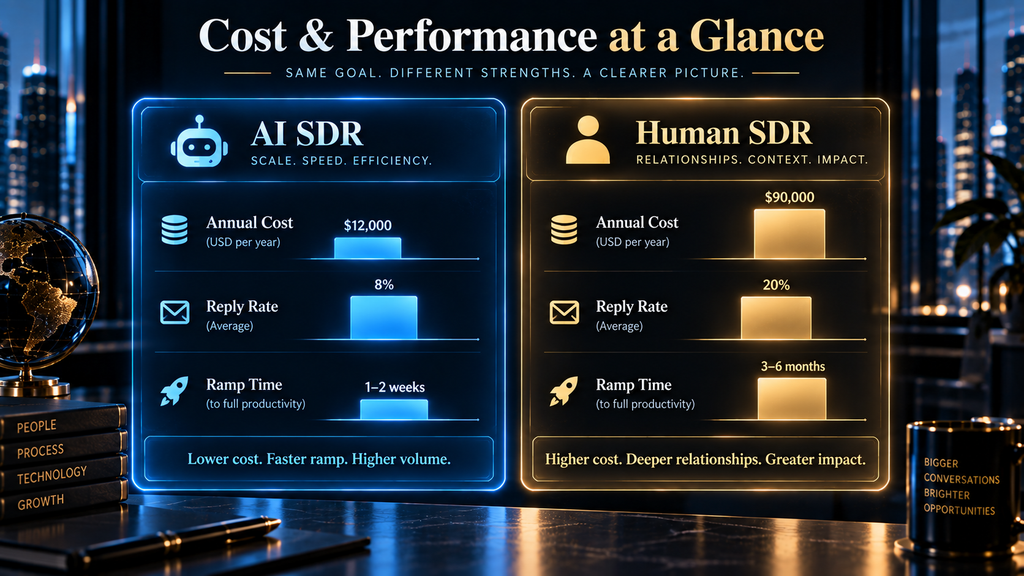
The honest takeaway isn’t that AI is five times cheaper — it’s that AI is dramatically cheaper per unit of activity, but activity isn’t the thing you’re actually trying to buy. Cost-per-meeting only means something once you know whether those meetings convert.
What the Data Actually Shows: Performance
Reported reply rates for AI-run sequences generally land in the 3 to 8 percent range, compared with roughly 5 to 12 percent for human-run outreach — a gap usually attributed to a human’s ability to read context and adjust tone in ways current AI personalization still misses. Meeting show-up and conversion rates tell a similar story: some hybrid teams report meeting-to-opportunity conversion in the 10 to 20 percent range for AI-sourced meetings versus 25 to 40 percent for human-sourced ones.
None of this means AI underperforms — it means AI and humans are being measured on the wrong shared metric. AI wins decisively on volume: reported daily outreach capacity runs into the hundreds or low thousands of contacts, versus dozens for a single human rep, and response speed is measured in minutes rather than hours or days.
Companies are reported to be roughly 21 times more likely to convert a lead when they respond within five minutes, which is a response-time bar almost no human team can hit consistently around the clock. If your bottleneck is coverage — too many accounts, not enough reps to touch them, or a sixteen-hour gap every night when no one is watching inbound leads — AI closes that gap in a way no hiring plan can match quickly.
The trap is calendar inflation: an AI system that’s rewarded purely for booking volume will find whatever behavior maximizes bookings, and booked meetings and qualified pipeline are not the same thing. A weak AI SDR deployment produces a full calendar and a thin pipeline. The fix isn’t abandoning AI — it’s optimizing the system around qualified pipeline as the scored outcome, not raw meeting count.
None of this happens automatically just because a company adopts an AI SDR platform. Reply rates, meeting quality, and pipeline conversion all depend on the underlying data quality, the specificity of the ICP the system is targeting, and how tightly the automation is scoped — a well-configured AI system pointed at a narrow, well-defined segment consistently outperforms the same system aimed broadly at “anyone who might buy.”
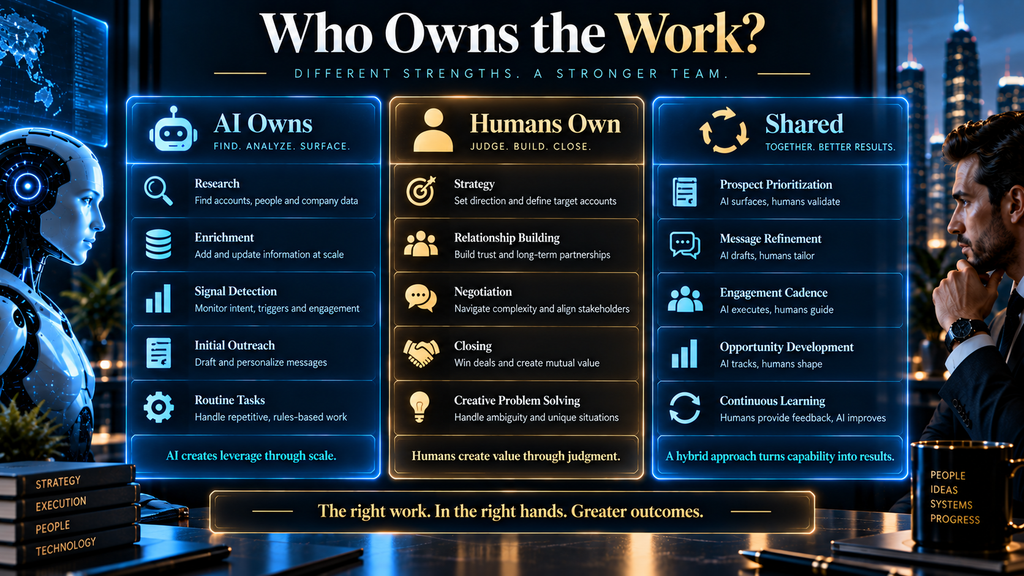
Where AI Should Own the Work
AI is particularly well suited to prospect discovery and enrichment — pulling firmographic, technographic, and intent data at a scale no human could match manually. It’s equally strong at deduplication and CRM hygiene, catching the small data-quality problems that quietly erode a pipeline over months. Signal detection, such as hiring changes, funding events, or tech-stack shifts, is a natural fit too — a discipline covered in more depth in our guide to AI buying signals, since it’s pattern-matching against huge datasets in real time.
On the outreach side, AI handles initial qualification, routine follow-up sequencing, and meeting preparation — pulling together an account brief so a human walks into a call already informed — extremely well, because these are high-volume, moderately templated tasks where consistency matters more than nuance. Low-risk routing, such as sending a lead to the right rep or queue, also belongs here.
In practice this shows up as concrete task assignment rather than abstract principle: an AI system building a target account list and drafting the first three emails in a sequence is a throughput task; a rep deciding which five of those hundred accounts deserve a hand-written note referencing a specific trigger event is a judgment task layered on top of the same list. The best-run teams don’t ask AI to do less work — they ask it to do more of the right kind of work, freeing the human layer to spend its limited time only where judgment actually changes the outcome.
Where Humans Should Own the Work
Strategic account planning — deciding which twenty accounts in a territory deserve a custom approach — requires context and organizational judgment that current AI systems don’t reliably have. Complex discovery calls, where a prospect reveals an unstated need mid-conversation, still need a person who can follow that thread in real time rather than a script.
Business-case development, negotiation, and high-value objection handling all involve reading a room and adjusting on the fly — exactly the kind of ambiguous, high-consequence judgment that AI hallucination risk makes dangerous to automate. Executive engagement and closing round out the list: a VP evaluating a six-figure purchase is, fairly or not, going to weight the conversation differently if it feels automated.
Multi-stakeholder enterprise deals above roughly $150,000 in annual contract value, deals that require procurement review, and relationship-heavy industries are the clearest cases where a human should stay in the driver’s seat.
This is also where seniority matters more than headcount. A newer SDR benefits from an AI-drafted account brief because it compresses research time; a senior rep or account executive benefits from the same brief because it lets them walk into a complex conversation already primed on the account’s specific context, which is a different and arguably higher-value use of the same underlying output.
The tooling doesn’t change based on seniority, but what a human does with the extra time it creates absolutely does.
What Both Should Own Together
Some tasks sit in the overlap deliberately. AI can draft a first-touch email or a follow-up sequence, but a human reviewing it before it sends — a human-in-the-loop step — catches the tone misses and factual errors that a fully autonomous system would ship anyway.
Buying-signal monitoring works best as an AI-detects, human-decides loop: the system flags the signal, a person decides whether and how to act on it. This shared ownership is where most of the real hybrid value lives, and it’s the piece purely AI-first or purely human-first setups tend to skip.
The Real Risk of Full Automation
One bad manual email affects one prospect. One incorrect automated rule can affect thousands of prospects before anyone notices. The failure modes worth planning for include incorrect targeting, bad data enrichment, personalization that’s technically accurate but tone-deaf, duplicate outreach across sequences, poor send timing, and, in regulated industries, compliance failures around consent and data handling.
This is the part of the AI SDR conversation vendors talk about least: automation increases both capacity and blast radius at the same time. The stronger the automation, the stronger the governance needs to be — per-inbox send limits, a human review step before scale-up, and regular sampling of what the system is actually sending, not just how many replies it’s generating.
A company that skips this step isn’t choosing efficiency over caution; it’s choosing to find out about a problem after it’s already reached a few thousand prospects instead of before.
A Practical Vendor Evaluation Checklist
If the decision comes down to evaluating a specific AI SDR platform rather than the AI-versus-human question in the abstract, a handful of criteria separate a system you can trust with real prospects from one that will quietly create the governance problems described earlier.
Human-in-the-loop control
Can the system be configured to hold every outbound message for review before it sends, at least during the first weeks of deployment, or is autonomous sending the only mode available? A platform that can’t be throttled down to a review step isn’t ready for a brand-sensitive audience, whatever its marketing claims.
Data breadth and quality
Where does the contact and firmographic data actually come from, how often is it refreshed, and what happens when a record is wrong? Personalization built on stale or incorrect data doesn’t just underperform — it actively damages trust, because a prospect who’s referenced by an outdated job title or a defunct company detail assumes the whole message was generated carelessly.
Multi-channel reach and deliverability infrastructure
Email-only platforms are simpler to evaluate but limited in reach; platforms that also cover LinkedIn, calls, or SMS raise the deliverability and compliance stakes further. Ask specifically how the platform manages inbox warmup, bounce prevention, and spam-complaint thresholds — this is infrastructure work that’s invisible when it’s working and catastrophic when it isn’t, since a burned sending domain can take months to recover.
CRM sync depth and pricing transparency
A platform with only read-only CRM access will create manual reconciliation work that erodes the efficiency gain it’s supposed to provide; bidirectional sync matters more than it sounds like it should. On pricing, favor vendors who publish concrete per-seat, per-message, or per-contact pricing over those who require a sales call to learn the number — the latter is frequently a sign that enterprise pricing will scale well beyond the advertised self-serve tier.
Published proof over blended claims
Case studies that name a specific company and give a specific, checkable metric are more useful than aggregate claims like “customers see 3x more meetings,” which blend results across wildly different deal sizes and industries. Ask a vendor for a reference customer in a comparable industry and deal size before committing, not after.
What This Looks Like in Practice
A handful of published case studies give a more concrete sense of how this plays out than the general statistics do, though these are vendor-published outcomes and should be read as company claims rather than independently verified results. Perplexity reportedly ran an AI-first model with no traditional BDR team and generated $1.7 million in pipeline over three months, with account executives still running the actual conversations while AI handled discovery and first touch.
CandorIQ is reported to have kept a single founding SDR in place, using AI to cut manual task time by roughly 95% and reduce bounce rates by 87% while consolidating a fragmented tool stack, attributing $1.8 million in pipeline to the approach. Juicebox is reported to have generated more than $3 million in pipeline in a single month with a 92% show rate, and Campfire reportedly doubled qualified pipeline in five months without adding headcount.
The common thread across all four isn’t that AI replaced the sales function — it’s that AI removed a specific bottleneck (research time, list-building, follow-up consistency) while a human or a small human team stayed in control of the parts that required judgment. None of the four reportedly ran fully autonomous outreach with zero human oversight on a meaningful deal size.
A Quick Self-Assessment Before You Decide
Before committing to either model, it’s worth answering three questions honestly, because the answers usually point to the right setup faster than any vendor pitch will.
- Is your ideal customer profile and messaging already validated, or are you still testing which pitch resonates? AI systems amplify whatever they’re given — they scale a proven message well and scale an unproven one just as efficiently into failure.
- Is your current bottleneck research and follow-up volume, or is it conversation quality and close rate? The former is a throughput problem AI is built for; the latter is a judgment problem no amount of additional volume will fix.
- Would a mishandled early touch meaningfully damage a relationship you need to protect, such as a strategic account or a small, reputation-sensitive market? If yes, that’s a strong signal to keep a human closer to the first touch than the cost math alone would suggest.
If the honest answers are validated ICP, a volume bottleneck, and low relationship risk, an AI-heavy approach is defensible. If any one answer points the other way, that’s the part of the funnel that should stay human, even if the rest gets automated.
The Decision Matrix: What Actually Depends on Deal Size
The single biggest factor in this decision isn’t company size or budget — it’s deal shape: how large the average contract is, how many people are involved in buying it, and how much trust the sale requires before someone signs.
| Scenario | Deal profile | Recommended approach |
|---|---|---|
| High-volume SMB / self-serve-adjacent | Large TAM, low ACV, short cycle | AI-heavy, minimal human touch until close |
| Mid-market SaaS | Thousands of accounts, moderate ACV and complexity | Hybrid — AI sourcing and first touch, human qualification |
| Enterprise SaaS | Hundreds/thousands of target accounts, high ACV, multiple stakeholders | AI research and signal monitoring, human-led engagement |
| Strategic consulting / highly custom | Small TAM, very high trust requirement, bespoke solution | Human-led with AI intelligence support only |
| High-volume transactional B2B | Large TAM, low complexity, fast cycle | AI-heavy across nearly the whole funnel |
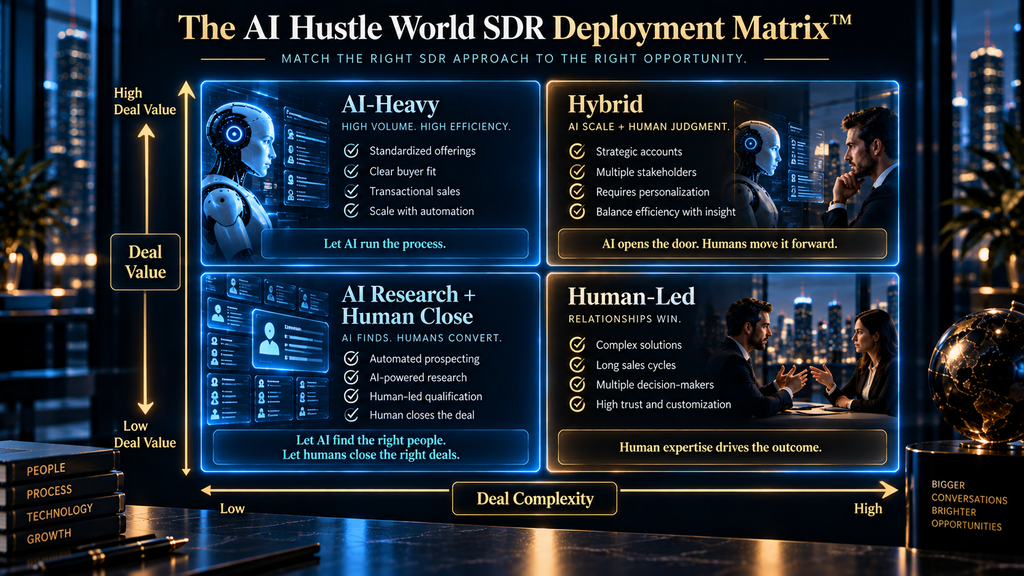
Under roughly $25,000 in annual contract value, AI-led prospecting with light human sales-assist is commonly reported as the more efficient setup.
Between $25,000 and $100,000, most teams land on a hybrid: AI does the sourcing and first-touch volume, a human takes over once a prospect engages. Above $100,000, or anywhere the buying committee includes multiple stakeholders and a six-to-twelve-month cycle, human ownership of the relationship becomes the dominant factor, with AI running quietly in the background on research and signal monitoring.
The Hybrid Model in Practice
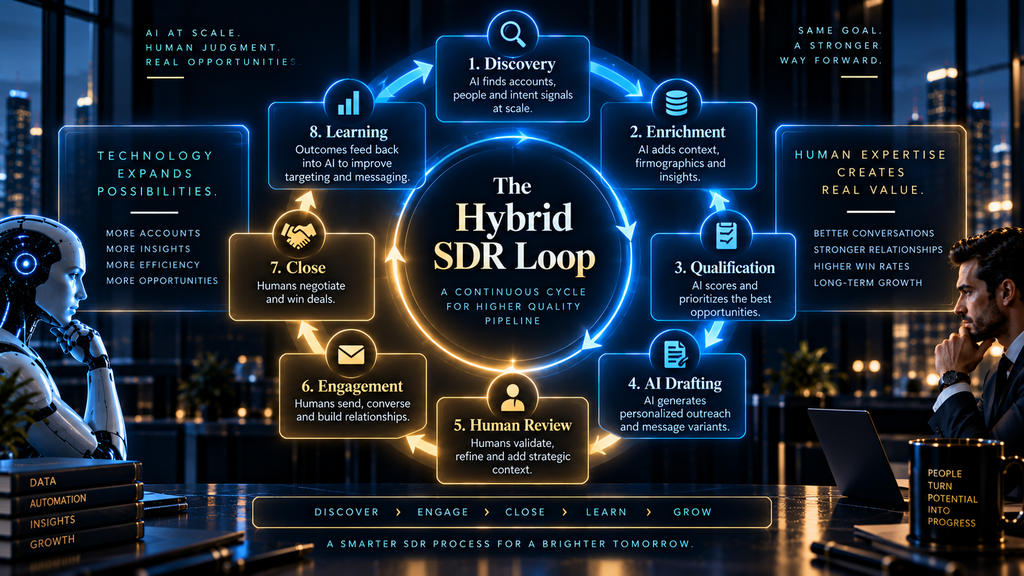
A mature hybrid setup isn’t “AI for prospecting, humans for closing” — that split is too blunt. It’s closer to a relay, where control passes back and forth based on what the moment requires. AI handles discovery, enrichment, deduplication, qualification scoring, and buying-signal detection — the same AI B2B prospecting workflow covered in more depth elsewhere on this site, then prioritizes and researches the highest-value accounts.
It drafts the first outreach, but a human reviews it before it goes out. Once a prospect engages, the human takes over: discovery call, negotiation, close. Meanwhile the AI layer keeps logging outcomes and feeding them back into its own prioritization model, so the system gets sharper about what a good account actually looks like over time.
The teams that get this right treat the AI layer as a research and drafting assistant sitting upstream of every human conversation, not as a replacement for the conversation itself. The handoff point — the moment a prospect stops being a data problem and becomes a relationship — is the single most important design decision in the whole system and it’s usually the thing companies get wrong first: either handing off too late (after the AI has already damaged the relationship with a tone-deaf message) or too early (dumping unqualified leads on a human’s calendar).
A 90-Day Plan for Actually Implementing a Hybrid Model
Deciding on a hybrid model in principle is the easy part; sequencing the rollout so it doesn’t create the exact problems this article warns about takes more discipline.
Days 1 to 30: Diagnose before you automate
Before touching any tooling, audit where SDR time actually goes today — how much is research, how much is writing, how much is live conversation — and identify the specific bottleneck you’re trying to solve. Pull your last two quarters of pipeline data and separate it by source and deal size, so you have a real baseline to compare against once AI is in the mix.
This is also the point to lock down your ICP and core messaging if they aren’t already validated, since automating an unproven pitch just produces failure at higher volume.
Days 31 to 60: Pilot with governance built in from day one
Launch the AI system on a limited segment — a single territory, industry vertical, or lead source — rather than the whole funnel at once, with human review turned on for every outbound message during this window.
Set explicit send-volume caps per inbox and a defined escalation path for anything that looks off, and have a human spot-check a meaningful sample of outgoing messages weekly, not just the ones that generate replies. The goal of this phase isn’t peak performance; it’s catching the failure modes described earlier while the blast radius is still small.
Days 61 to 90: Measure against the KPI framework and decide where to scale
Once the pilot has run long enough to generate a real sample of meetings and opportunities, measure it against the four KPIs covered later in this article — qualified-touch rate, meeting-to-opportunity conversion, cost per qualified opportunity and pipeline per rep-equivalent — rather than raw activity volume. Use that data to decide, segment by segment, where AI earns a wider mandate and where a human needs to stay closer to the process, and only then start expanding beyond the initial pilot scope.
Ramp Time and the Onboarding Problem
One underdiscussed second-order effect: AI can meaningfully shorten how long it takes a new human SDR to become productive. A rep who used to spend their first three months learning how to research accounts can instead inherit AI-generated account briefs on day one — the account-research skill gets absorbed into the tooling, so the human ramp period compresses to the skills that actually require experience, like objection handling, tone, and pacing a conversation.
Some reports put reps paired with AI tooling reaching productivity in one to two weeks rather than three to six months. This doesn’t eliminate ramp time; it changes what that time is spent learning.
What Happens If You Do Nothing
Sticking with an all-human SDR team isn’t a neutral choice — it has its own cost. Reps are commonly reported to spend well over half their time on non-selling busywork: research, data entry, follow-up scheduling. Coverage stays capped by headcount, so growth in target accounts requires proportional growth in hiring, and every departure resets the ramp clock.
Competitors who‘ve automated the throughput layer can simply cover more ground per rep, which over a year or two shows up as a real pipeline gap even if nothing about your team’s skill has changed. Doing nothing isn’t the safe option; it’s a bet that your competitors will also do nothing.
Common Mistakes Companies Make When Choosing
The most common mistake is optimizing an AI SDR deployment around meeting volume instead of qualified pipeline, which produces exactly the calendar-inflation problem described earlier. A close second is buying an AI SDR platform to avoid a hiring decision rather than to fix a specific, diagnosed pipeline bottleneck — if you don’t know whether your problem is coverage, research time, or follow-up consistency, no platform purchase will fix it by default.
A third is skipping governance entirely: no send-volume caps, no human review step, no regular sampling of outbound messages, until a deliverability or compliance problem forces a scramble. On the human side, the mirror-image mistake is refusing to automate the genuinely repetitive parts of the job, which burns out reps on busywork and pushes tenure even lower than the industry’s already-short average.
The safest posture in either direction is treating this as a phased rollout with a defined review checkpoint, not an all-or-nothing bet.
Boundary Conditions: When This Framework Breaks Down
Every framework in this article assumes a few things are true, and it’s worth being explicit about when those assumptions stop holding. The deal-size matrix assumes your ICP and messaging are already validated; if they aren’t, deal size stops being the most important variable and validation work becomes the priority regardless of company size or budget.
A very early-stage company still discovering who actually buys its product often gets more value from a small, flexible human team running structured experiments than from an AI system optimizing a message that hasn’t been proven yet. The cost comparisons assume reasonably reliable data infrastructure — clean CRM records, accurate firmographic data, defined ICP criteria.
In practice, a lot of companies evaluating AI SDR platforms have messier data than they realize, and an AI system layered on top of bad data doesn’t fix the data problem; it just executes on bad inputs faster and at greater scale. In that situation, the actual first project is a data-quality cleanup, not a tooling purchase.
Finally, the governance guidance assumes a company is willing to invest real operational attention in oversight — send caps, review steps, regular sampling. A team that adopts an AI SDR platform specifically because they don’t have bandwidth for oversight is choosing the one scenario where automation’s blast-radius risk is least likely to be caught early.
If there’s no capacity to govern the system, that’s a signal to start smaller and slower than the vendor’s onboarding plan suggests, not to skip governance altogether.
A Simple KPI Framework for Measuring Either Model
Whichever model you run, measure it against the same four numbers rather than vanity activity counts. Track meetings booked as a percentage of qualified accounts touched, not raw volume. Track meeting-to-opportunity conversion rate separately for each source.
Track cost per qualified opportunity, not cost per meeting, since a cheap meeting that never converts isn’t actually cheap. And track pipeline generated per rep-equivalent per quarter, treating your AI system as a rep-equivalent for comparison purposes. Measure AI-sourced and human-sourced pipeline separately for at least one full sales cycle before drawing conclusions — a single quarter of AI output rarely reflects the mature performance the system settles into after its 60-to-90-day tuning period.
Where This Is Heading
The direction of travel across 2026 vendor reporting is toward tighter human-in-the-loop review rather than looser autonomy — the industry’s early “fully autonomous AI SDR” pitch is giving way to systems explicitly designed around a human checkpoint before anything ships. That’s a sign the market is correcting toward the throughput-versus-judgment split described here, rather than away from it.
Expect the tooling gap between AI that drafts and AI that decides to keep widening, with the decision layer staying firmly human for anything above low-consideration deals for the foreseeable future. Expect also more multimodal AI SDR capability — voice and video outreach alongside email — which will raise the same governance questions at a higher stakes level once a synthetic voice, not just a synthetic email, is involved.
If there’s a single practical takeaway to carry into a real budget conversation, it’s this: don’t ask whether to buy an AI SDR platform or hire another human SDR as if they were substitutes for the same line item. Ask which specific bottleneck in your current pipeline — coverage, research time, follow-up consistency, or conversation quality — is actually costing you the most pipeline right now, and let that answer, not the sticker price, decide which tool gets built or hired next.
Final Thoughts
After all the comparisons, one rule survives every scenario: automate the predictable, augment the judgment, and protect the relationship. AI SDRs aren’t a cheaper version of human SDRs — they’re a different tool solving a different part of the problem, and treating them as interchangeable is exactly what produces the “more meetings, worse pipeline” outcome that started this article.
The businesses getting real value from AI SDR technology in 2026 aren’t the ones who replaced their team; they’re the ones who figured out which slice of the job was actually a throughput problem all along.
Not sure your funnel is even ready for AI yet?
Before AI or human SDRs can do their job well, your pipeline needs clean signals to work from. See how AI actually finds and scores buying signals before a rep ever picks up the phone.
See How AI Buying Signals Work →FAQ
Is an AI SDR better than a human SDR?
Not universally. AI is generally stronger at scale, research, data processing, and repetitive tasks, while humans are generally stronger at judgment, relationship-building, and high-stakes conversations. Which one is “better” depends entirely on your deal size, sales motion, and how validated your ICP and messaging already are — the same AI system that performs well for a self-serve SaaS product can underperform badly for a $200,000 enterprise sale, and vice versa for a human team trying to cover a huge, low-touch market.
Can an AI SDR fully replace a human SDR?
For very low-consideration, high-volume, low-ACV sales with a proven pitch, largely yes — several companies report running close to fully AI-led top-of-funnel motions successfully in that segment. For anything involving a multi-stakeholder buying committee, a six-figure contract, or a relationship-heavy industry, no current AI system reliably replaces the judgment a human brings to that conversation, and most reported “AI replaced our SDR team” success stories still have a human account executive running the actual meetings.
How much does an AI SDR cost compared to a human SDR?
Reported figures vary widely across sources, which is itself worth knowing before you commit to a number. Human SDRs commonly run $100,000 to $210,000 fully loaded per year once salary, commission, benefits, and management overhead are included. AI SDR platforms are commonly reported in the $3,000 to $30,000-plus per year range for self-serve tiers, with enterprise deployments involving heavy data enrichment running well above that. Treat both as directional ranges to sanity-check a specific vendor quote against, not fixed prices.
Why do AI SDRs sometimes book more meetings but worse pipeline?
Because many AI systems are tuned to maximize booked meetings rather than qualified opportunities, and those two objectives aren’t the same. Without governance and without scoring the system on qualified pipeline rather than raw meeting count, an AI system will find whatever behavior maximizes the metric it’s rewarded on — a pattern often called calendar inflation. The fix isn’t to abandon AI outreach; it’s to change what the system is optimized for and to review a sample of what it’s actually sending on a regular basis.
What tasks should AI handle versus a human?
AI is well suited to prospecting, data enrichment, deduplication, buying-signal detection, initial qualification, routine follow-up sequencing, and meeting preparation — high-volume, moderately templated tasks where consistency matters more than nuance. Humans are better suited to strategic account planning, complex discovery calls, negotiation, high-value objection handling, executive engagement, and closing — tasks that involve reading context and adapting in real time. A meaningful third category, such as reviewing an AI-drafted email before it sends or deciding how to act on a flagged buying signal, works best as a shared, human-in-the-loop step rather than being fully owned by either side.
Is a hybrid AI-plus-human SDR model actually more effective?
Most 2026 industry reporting points toward hybrid setups outperforming either pure model, with AI handling volume, research, and drafting while humans handle relationship-building, judgment, and the final send or conversation. The published case studies with the strongest reported numbers — the kind cited earlier in this article — are consistently hybrid deployments rather than fully autonomous ones, which is a meaningful signal given how strongly vendors are incentivized to promote full autonomy.
What’s the biggest risk of automating SDR work?
Blast radius. A mistake in one manually written email affects a single prospect; a mistake baked into an automated rule or a piece of bad enrichment data can affect thousands of prospects before anyone notices it. That’s why governance measures like per-inbox send caps, a human review step before scaling up, and regular sampling of outbound messages matter more, not less, as the automation gets more capable — the more a system can do unsupervised, the more expensive an unsupervised mistake becomes.
How long does it take an AI SDR to start performing well?
Most reporting puts the ramp-to-steady-state window for an AI SDR platform at roughly 60 to 90 days, compared with three to six months for a new human SDR to reach full productivity. That said, a 90-day pilot with governance and human review built in from day one, as outlined in the rollout plan earlier in this article, tends to produce more trustworthy performance data than judging a system purely on its first few weeks of raw output.
Does deal size actually change which model is right?
Yes — it’s arguably the single biggest factor, more so than company size or industry. Sub-$25,000 ACV deals with a validated pitch tend to lean AI-heavy; the $25,000 to $100,000 range typically works best as a hybrid, with AI handling sourcing and a human taking over once a prospect engages; and above $100,000, or anywhere the buying committee includes multiple stakeholders and a six-to-twelve-month cycle, human ownership of the relationship becomes the dominant factor, with AI running in the background on research and signal monitoring rather than driving the conversation.
What metrics should I track to know if my AI SDR is actually working?
Track qualified-account touch rate, meeting-to-opportunity conversion rate, cost per qualified opportunity rather than cost per meeting, and pipeline generated per rep-equivalent per quarter. Measure these separately for AI-sourced and human-sourced pipeline, and give the comparison at least one full sales cycle before drawing conclusions, since a single quarter of AI output rarely reflects the mature performance the system settles into after its initial tuning period.
Sources and Further Reading
- The Short Life of Online Sales Leads: Harvard Business Review. Research on how quickly firms contact web leads and how that affects qualification.
- CAN-SPAM Act: A Compliance Guide for Business: US Federal Trade Commission guide to commercial email rules.
Related Guides
- AI Recruiting vs Traditional Recruiting: What Actually Works?
- AI Accounting vs Traditional Accounting: What Should You Automate?
- How to Use AI for Employee Onboarding, HR Helpdesks & Policy Questions
Written by
Muntasir Ahmad Chowdhury
Founder, AI Hustle World
Muntasir Ahmad Chowdhury is the Founder of AI Hustle World, an independent publication dedicated to making Artificial Intelligence practical, trustworthy, and easy to understand. He researches AI tools, automation, customer service, productivity, and real-world business applications, helping readers make smarter technology decisions through research-driven, experience-backed content.
Expertise:
AI Tools • AI Automation • AI Customer Service • AI Productivity • Generative AI • AI Workflows
Get Smarter With AI
Enjoyed this guide? Get practical AI tools, tutorials, and honest reviews delivered to your inbox.