Evidence: Documentation reviewed
Last checked: August 2026
What was done: Written from official documentation and the published sources linked in this article. Not hands-on tested.
Files: None
Affiliate links: No
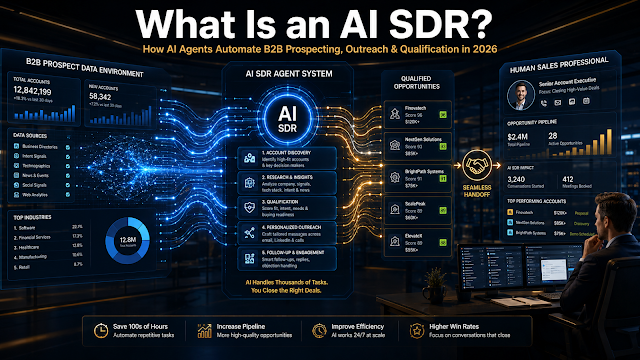
What Is an AI SDR? How AI Agents Automate B2B Prospecting, Outreach & Qualification
A company announces: “Meet our new AI SDR.” You open the product and it writes emails — genuinely well. But then you discover it doesn’t find prospects, doesn’t research accounts, doesn’t qualify replies, and doesn’t recognize when a prospect has asked a serious buying question. It takes a list and sends AI-generated sequences. That’s useful software, but it raises a real question the market increasingly has to answer: is that actually an AI SDR?
The term is now stretched to cover everything from an AI email assistant to a fully autonomous prospecting agent. Apollo defines an AI SDR as software that autonomously performs prospecting, outreach, and meeting-booking workflows traditionally handled by human SDRs. IBM describes the category similarly, as AI systems that identify prospects, engage leads, and qualify opportunities before handing them to human sales teams.
And this isn’t just a future-facing idea — Microsoft’s current Sales Qualification Agent can already research leads, evaluate fit against a target customer profile, draft personalized outreach, and, in its “Research and engage” mode, interact with prospects, follow up, qualify them, and hand promising leads to salespeople.
That points to an important distinction: an AI tool that writes sales emails is not automatically an AI SDR. A real AI SDR functions closer to a software-based sales-development worker, one that participates in a meaningful portion of the SDR workflow — discover, research, enrich, qualify, personalize, engage, follow up, understand replies, and hand off. Which raises the more interesting question this article is built around: how much of the SDR job can AI actually perform, and where does a human still need to take over?
What Is an AI SDR?
An AI SDR, or artificial intelligence sales development representative, is a software system that uses AI to perform some or many of the early-stage sales-development activities traditionally handled by a human SDR. Those activities can include prospect discovery, account research, contact identification, data enrichment, lead qualification, buying-signal analysis, outreach generation and execution, follow-up, response classification, meeting booking, CRM updates and handoff to human sales representatives.
IBM frames the category around identifying prospects, engaging leads, and qualifying opportunities before passing them to human sales teams, while Apollo’s 2026 definition goes further by emphasizing autonomous execution across prospecting, outreach, and meeting booking.
So the defining characteristic isn’t “it uses AI” — it’s that it performs a meaningful part of the SDR workflow. That distinction is what separates an actual AI SDR from a feature bolted onto an email tool, and it’s the lens worth applying to any vendor claiming the label.
AI SDR vs. AI Agent vs. AI Lead Generation Tool vs. AI Cold Email Tool vs. AI Sales Agent
This is where the terminology gets messy, and where five different products can all claim to “automate sales” without doing the same job. An AI agent is the broadest category — it might be built for research, customer support, coding, operations, analysis, or sales, and your existing AI-agent content lives here. An AI lead generation tool’s primary job is finding prospects; it may also offer contact data, enrichment, lead lists, search, and filtering, but it doesn’t necessarily run the entire SDR process. An AI cold email tool’s primary job is outreach execution — list, email, follow-up, track — which is narrower than an AI SDR’s scope.
An AI SDR sits higher in the workflow, spanning discover, research, qualify, personalize, engage, follow up, and handoff. An AI sales agent can be broader still, potentially touching prospecting, qualification, sales conversations, CRM actions, customer management, and other revenue workflows. Roughly speaking, the hierarchy runs from AI agent, down through AI sales agent, down to AI SDR, down to specific SDR tasks — and while these categories overlap, they shouldn’t be treated as synonyms.
The AI-sales market is full of products using the word “agent” loosely, so the useful question isn’t whether a vendor says “agent” — it’s what the system can actually do without a human quietly filling in the missing steps.
The AI SDR Autonomy Spectrum
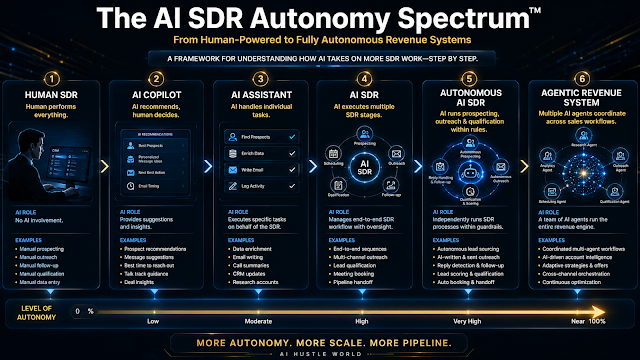
AI SDRs aren’t binary — a company doesn’t jump from “no AI” to “autonomous AI salesperson” overnight. There’s a spectrum. At Level 0, a human SDR does essentially everything and AI may not be involved at all. At Level 1, AI acts as a copilot: research summaries, email suggestions, account summaries, CRM assistance, with the human still running the workflow.
At Level 2, AI becomes an assistant that performs individual tasks — finding contacts, enriching records, generating research, drafting messages, updating CRM fields — while the human remains the workflow owner. Level 3 is where the AI SDR label actually applies: AI handles multiple stages in sequence (find, research, qualify, personalize, outreach, follow up), and the salesperson mainly handles exceptions and qualified conversations.
Level 4 is an autonomous AI SDR that can run significant portions of the workflow with limited human intervention — selecting prospects, researching them, initiating outreach, answering supported questions, following up, qualifying, and handing off. Microsoft’s Sales Qualification Agent is a concrete example sitting at this level: it offers a research-only mode and a research-and-engage mode, and in the latter it can engage prospects and apply configured qualification criteria before handoff.
Level 5 goes further still — the AI SDR becomes one agent inside a larger network (a data agent feeding a research agent, feeding the AI SDR, feeding a qualification agent, feeding a CRM agent, ultimately feeding the human salesperson), which is where the broader “AI sales agent” category becomes relevant.
What Does an AI SDR Actually Do?
Strip away the marketing language and a conventional SDR handles ten recognizable jobs: prospecting (who should we contact), research (what does the company do), contact discovery (who’s the right person), qualification (do they fit), personalization (why contact them), outreach (start the conversation), follow-up (what if they don’t respond), response handling (what does the reply mean), meeting booking (is there enough interest), and handoff (when should an AE take over). An AI SDR can potentially participate in every one of these stages.
Prospect Discovery
The system can work from ICP definitions, databases, permitted web sources, CRM lookalikes, company lists, inbound leads, buying signals, technology data, and business events. A useful AI SDR shouldn’t just ask “who exists” — it should ask “who exists that fits our target profile,” which ties directly back to your B2B data-enrichment and lead-generation workflow. The better the underlying data layer, the better the resulting prospect pool.
Data Enrichment
Once an account is identified, the AI SDR needs to understand company size, industry, revenue, geography, technology, role, seniority, contact information, funding, hiring, and activity — which is exactly where your existing B2B Data Enrichment article becomes relevant. The AI SDR isn’t creating intelligence from nothing; it’s consuming an underlying data system, which means it’s only as useful as the data it can access. Poor data here produces wrong contacts, outdated titles, irrelevant accounts, incorrect personalization, and bad qualification downstream.
Account Research
This is where an AI SDR becomes far more interesting than a cold-email tool. Instead of simply looking up “VP Sales at ABC Company,” it can investigate recent company changes, leadership moves, hiring, funding, technology, product launches, expansion, and buying signals, and assemble something like an account brief: company size, industry, target role, a recent leadership change, open sales positions, relevant technology in use, a likely challenge, and a confidence rating. That brief becomes the foundation for genuinely intelligent outreach rather than a templated guess.
Qualification
An AI SDR shouldn’t just find prospects — it should decide whether an account is worth a salesperson’s attention, weighing firmographic fit, role fit, technology fit, business fit, intent, timing, and buying signals. This connects directly to your AI Lead Qualification article, and a mature system should explain its reasoning rather than output a bare score: not “score = 84,” but “84, because the company fits the ICP, recently hired a VP Sales, is rapidly expanding its sales team, and matches the required technology profile.” That explainability is what makes a qualification score trustworthy rather than arbitrary.
Buying-Signal Detection
This is where your AI Buying Signals article connects directly — the AI SDR can monitor hiring, funding, leadership changes, expansion, technology changes, category research, competitor activity, website engagement, pricing activity, and direct inquiries. But it shouldn’t treat a signal as proof of intent to purchase; the more defensible chain is signal → context → confidence → action. For example: twelve SDR roles posted (signal) suggests the company is scaling sales capacity (context) with high confidence, so the appropriate action is researching the VP Sales and RevOps lead rather than firing off outreach immediately.
Personalization
This is one of the most heavily marketed AI SDR capabilities, and it’s harder than it looks. Almost any system can generate “I noticed your company is growing” — the real question is whether the message contains useful, credible relevance rather than a personalized-looking sentence with nothing behind it.
A 2026 research benchmark found a persistent plateau in LLM-generated sales personalization: in one field deployment with professional sales representatives, only 48% of generated content was rated immediately useful, and the benchmark also found models didn’t reliably separate successful from unsuccessful outreach in a Fortune 100 technology cohort. That doesn’t make AI personalization useless — it means generating a personalized-looking sentence is much easier than generating a genuinely persuasive sales insight, and the difference matters.
Personalization itself has three levels worth distinguishing. Surface personalization mentions company name, job title, location, or a recent announcement (“Congrats on your recent expansion”) — easy to produce, low differentiation. Contextual personalization connects an event to a business implication (“Your expansion appears to coincide with a significant increase in sales hiring”).
Problem-based personalization goes further still, connecting event to implication to a likely problem to relevant value (“As your sales team expands, maintaining consistent account research across new reps can become a bottleneck…”) — which is where the message becomes commercially interesting, provided the AI treats that final problem statement as a hypothesis rather than a stated fact.
Outreach
An AI SDR can execute email, approved digital channels, follow-ups, sequence management, and meeting scheduling, but the workflow needs boundaries calibrated to risk: a low-risk account can be handled with more autonomy, a strategic enterprise account warrants human review first, and a high-value inbound lead deserves immediate human attention. The right automation level depends on deal value, signal strength, communication risk, confidence, and complexity.
Response Understanding and Conversational Qualification
This is where an AI SDR separates itself from a simple sequence tool. A reply like “Interesting — can you explain how this works with Salesforce?” should be recognized as positive engagement with a product question, warranting human handoff, while “Not right now, try again next quarter” should trigger a nurture path, and “Please stop contacting me” should trigger suppression.
Qualification doesn’t only happen through a form — a prospect may reveal budget, authority, need, timeline, or implementation constraints through the conversation itself, and Microsoft’s Sales Qualification Agent is designed to research leads against a target profile and, in research-and-engage mode, interact with prospects before handing qualified opportunities to sellers. That’s the shift from automated email toward automated early-stage conversation.
Human Handoff
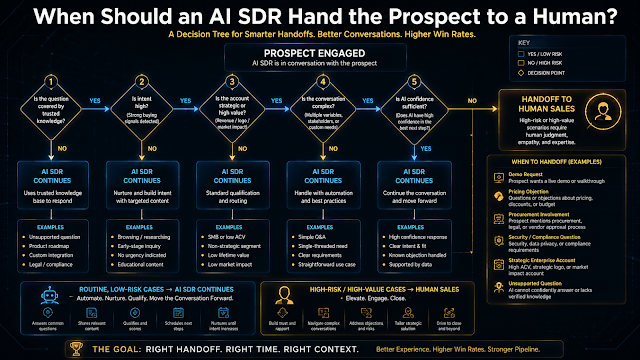
This may be the most important stage of all. A good AI SDR isn’t designed to keep the human away from the prospect indefinitely — it’s designed to recognize when a human becomes more valuable than the AI.
Five triggers tend to define that threshold: explicit intent (“I’d like to see a demo” is an immediate handoff), complexity (a question outside the AI’s knowledge — Microsoft’s own testing guidance instructs its agent to hand off rather than respond without sufficient information), strategic value (an enterprise account with high ACV and multiple stakeholders), an objection (pricing, legal, procurement, security, or competitive), and uncertainty (when the AI’s own confidence falls below a required threshold, it shouldn’t guess — it should escalate).
Put together, the model is simple: AI researches, qualifies, and engages, and the moment a conversation stops being simple and supported, it goes to a human salesperson rather than staying with the AI by default. That’s a healthier design goal than “AI must handle everything.”
AI Hustle World Honest Opinion: The best AI SDR isn’t the one that talks to the customer the longest — it’s the one that knows when it has extracted enough information for a human to take over.
Where AI SDR Sits Next to Cold Email Tools, Lead-Gen Platforms, and Sales Agents
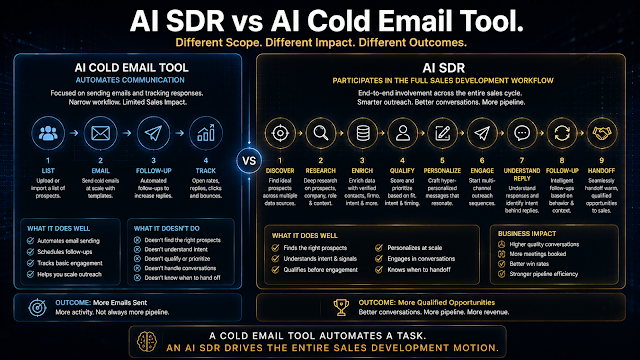
It’s worth being specific about the boundaries, because this affects how you structure related content. A cold-email tool’s job is essentially “send this message to these prospects” — campaign execution. An AI SDR’s job is closer to “identify the right prospects, understand why they matter, decide how to approach them, engage them, interpret the response, and hand over qualified opportunities,” which makes it a workflow-level system rather than a communication tool.
A lead-generation platform typically stops at “who should we contact,” offering databases, filters, enrichment, and list building; an AI SDR picks up from there and continues into why, what to say, how to follow up, and when a human should take over.
The line between an AI SDR and a broader AI sales agent is less fixed. An AI SDR generally stays focused on sales development — top-of-funnel prospecting, outreach, qualification, and meeting booking — while an AI sales agent can extend into sales conversations, CRM actions, and broader sales operations.
In short: AI SDR is a role-specific agent, AI sales agent is the broader category, and the market will keep blurring the two — which is exactly why having clear internal architecture and definitions matters more, not less.
The AI SDR Autonomy Spectrum in Practice
| Level | Example |
|---|---|
| Copilot | “Research this account.” |
| Assistant | “Find decision-makers.” |
| Task Automation | “Qualify these 500 leads.” |
| AI SDR | “Run the early-stage prospecting process.” |
| Autonomous SDR | “Find, engage, and qualify within defined rules.” |
| Agentic Revenue System | “Coordinate prospecting, qualification, CRM, and other agents.” |
The lesson this table is meant to convey: an AI SDR isn’t a single product type, it’s an autonomy category, and where a given tool sits on it tells you far more than its marketing copy does.
Where AI SDRs Work Best — and Where They Break Down
AI SDRs are particularly well suited to environments with large prospect volume, a clear ICP, a repeatable offer, predictable qualification criteria, a large lead backlog, and long-tail accounts that are valuable but not valuable enough to justify manual research today. Microsoft specifically positions its Sales Qualification Agent around exactly this use case — helping teams handle leads that sellers don’t have the capacity to manage because of sheer volume — and that’s one of the strongest real-world justifications for the category.
The other side of that coin matters just as much. Complex enterprise sales involving finance, IT, procurement, security, legal, and executive leadership aren’t a simple qualification sequence an AI can run confidently. New-market prospecting with little historical data leaves the AI without the patterns it needs to understand nuance.
Poor data environments — a stale CRM, wrong contacts, an undefined ICP — mean an AI SDR will simply automate bad targeting at scale. And highly consultative products or relationship-driven categories, where trust and reputation are themselves part of the offer, make excessive automation a liability rather than an efficiency gain.
The Data Dependency
An AI SDR isn’t a magic intelligence machine — it needs identity data (who is the person), company data (what is the company), context (what’s happening), signal data (why now), product knowledge (what can we actually solve), and CRM history (what happened previously). Without these, the AI is guessing, which is why your earlier B2B data-enrichment and prospecting-tool articles are foundational rather than optional background reading.
Conceptually, the stack runs from data sources, through identity and enrichment, into the CRM, through buying signals and AI research, into the AI SDR itself, out through outreach and qualification, and finally to human sales — the AI SDR is the execution layer sitting on top of that stack, not the entire data ecosystem, and that architectural distinction matters when you’re evaluating a vendor’s claims.
At minimum, a useful AI SDR needs to answer seven questions: who is this (identity), why might they fit (ICP), why now (signals), what problem could exist (context), what can we legitimately say (product knowledge), what happened before (CRM history), and when should we stop (handoff rules). If a system can’t answer these, its autonomy should be limited accordingly.
The AI SDR Boundary Test
Before delegating a task to an AI SDR, run it through five questions. Can the task be clearly defined — if not, autonomy is risky. Does the AI have reliable data — if not, fix the data first. Can success be measured — if not, you can’t optimize the system.
Is the cost of an error acceptable — if one mistake could damage a major account, human review matters. And is there a clear escalation path — if the AI gets uncertain, it needs somewhere to send the problem. The rule that falls out of this is simple: no clear boundary means no full autonomy, regardless of how capable the underlying model is.
AI SDR Economics
One of the most common mistakes in evaluating AI SDRs is comparing an AI subscription against an SDR’s salary — that comparison is incomplete. The real operating cost includes the AI platform itself, prospecting data and enrichment, infrastructure (email, CRM, automation, integrations), human oversight, governance (testing and quality control), and the opportunity cost of what happens when bad automation produces poor pipeline. The right calculation is total AI SDR cost, not software price.
What you measure matters just as much as what you spend. Don’t measure emails sent, messages generated, or contacts processed — measure qualified leads, meetings booked, opportunities created, revenue closed, cost per opportunity, and human hours freed up for higher-value work. Framed as input, efficiency, and output — accounts processed, feeding cost plus oversight plus infrastructure, feeding qualified opportunities, pipeline, and revenue — the metric that actually matters is cost per qualified opportunity, not cost per message.
The Biggest AI SDR Trap: “Personalized at Scale”
This is probably the most important reality check in the whole category. AI can produce thousands of message variations, but that doesn’t make the variations valuable — the 2026 SDR-Bench research cited earlier found a consistent plateau in LLM personalization and weak separation between successful and unsuccessful outreach in its evaluation setting.
AI can scale personalization syntax far more easily than it can scale genuine understanding, which points to a specific workflow: AI researches, AI proposes relevance, a human or a rules layer validates that relevance, and only then does AI execute the outreach. That’s considerably more defensible than letting the model invent a reason to contact everyone on a list.
AI SDR and Hallucination Risk
Imagine the AI writes, “I noticed you recently expanded into Germany” — and the company didn’t. That’s not a minor writing slip; it damages trust before the relationship even starts. Every AI SDR needs source grounding (where did this fact come from), a confidence measure (how certain is the system), factual boundaries (what should it never claim without evidence), and an escalation path (what happens when the evidence is weak).
Microsoft’s current agent testing documentation explicitly emphasizes evaluating research relevance, outreach accuracy, and behavior when the agent runs into questions outside its knowledge sources — which is the right operating philosophy for the whole category, not just one vendor’s implementation.
AI SDR Governance
A real production system needs approved knowledge sources, clear ICP rules, disqualification criteria, prohibited claims, human escalation paths, ongoing monitoring, suppression handling, CRM logging, performance measurement, and periodic review. None of this is optional polish — it’s the difference between “plug in an LLM” and an actual operational system, and skipping it is where most AI SDR deployments run into trouble.
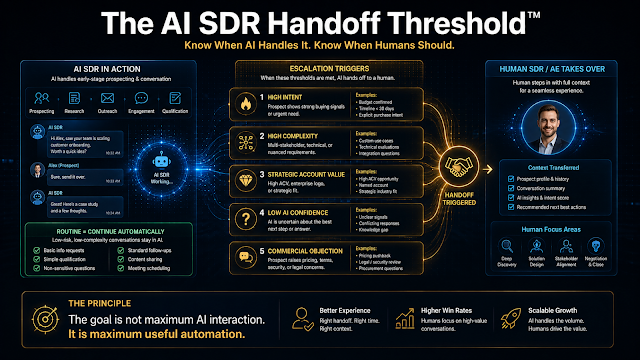
Put in practical terms, the AI should keep operating when a prospect is low-risk, the question is covered by its knowledge, the account is routine, qualification is clear, and communication is simple. A human should take over when the prospect shows strong intent, the account is strategic, the question is ambiguous, an objection appears, pricing gets complex, procurement or contracts enter the picture, the AI’s confidence drops, or the relationship value rises — this is the AI SDR Handoff Threshold in practice. The goal was never maximum AI interaction — it’s maximum useful automation.
Microsoft as a Real-World Example
Microsoft’s Sales Qualification Agent is a useful illustration of how this category is actually evolving in production. It offers separate research-only and research-and-engage modes; in the latter, it can research leads, engage them, and apply configured qualification criteria before handoff, and Microsoft explicitly recommends testing it at a smaller scale before full production deployment. Its testing guidance calls for evaluating research quality, validating outreach, testing follow-up and handoff criteria, and monitoring agent behavior — and when a prospect asks something outside its configured knowledge, the agent is expected to hand off to a seller rather than improvise a response. That’s a useful blueprint for the category generally: controlled autonomy, not blind autonomy.
The AI SDR Implementation Roadmap
Don’t start with “turn on autonomous outreach.” A safer, more measurable path runs through five phases. In Phase 1 (Observe), AI researches accounts while a human does everything else. In Phase 2 (Assist), AI researches, scores, and drafts, and a human approves before anything goes out. In Phase 3 (Automate), AI takes over enrichment, CRM updates, routine follow-up, and other low-risk workflows. In Phase 4 (Engage), AI handles defined outbound conversations while humans monitor. And in Phase 5 (Autonomous SDR), AI executes approved workflows within clear guardrails, with humans handling escalation. Each phase is a checkpoint, not a race to the end.
The AI SDR Readiness Score
Before deploying an AI SDR, it’s worth scoring your organization honestly against ten weighted capabilities.
| Capability | Weight |
|---|---|
| Clear ICP | 15% |
| Data Quality | 15% |
| Repeatable Sales Motion | 15% |
| Prospect Volume | 10% |
| Qualification Rules | 10% |
| CRM Integration | 10% |
| Signal Availability | 10% |
| Human Escalation | 5% |
| Governance | 5% |
| Measurement | 5% |
This is an AI Hustle World editorial framework rather than an industry-standard benchmark, but it’s a useful gut check: a score of 80–100 suggests you may be ready for significant automation, 60–79 suggests starting with AI-assisted workflows, and below 60 means fixing the fundamentals before automating anything.
Who Should Use an AI SDR — and Who Should Avoid Full Autonomy
AI SDRs make the most sense when you have a large prospect universe, a clear ICP, a sales process that repeats, enough data to work with, a strong CRM, defined qualification rules, the ability to monitor performance, and a real cost to missing long-tail leads that human SDRs don’t have time to chase. The calculus flips when your TAM is tiny, deals are extremely strategic, every account is genuinely unique, your data is poor, your product is highly consultative, your buying cycle is relationship-driven, your ICP isn’t stable, or compliance requirements are complex enough that you can’t monitor the system closely. In those environments, AI is better used as an intelligence and preparation layer than as an autonomous SDR.
AI SDR Common Mistakes
A handful of mistakes show up repeatedly in early deployments. Calling an email tool an AI SDR overstates what the system does, since sending emails isn’t the whole SDR job. Automating before fixing data guarantees bad inputs produce bad prospects. Assuming personalization equals relevance conflates two different things, as the personalization benchmark above makes clear. Deploying without handoff rules leaves the AI with no way to know when to stop, and deploying without evidence requirements leaves it free to make claims that damage credibility. Missing suppression logic means opt-outs and disqualified accounts never actually stop receiving outreach. Measuring messages instead of opportunities mistakes volume for pipeline. Giving AI too much authority too early skips the roadmap above entirely. Treating strategic accounts identically to low-value ones ignores that they deserve different handling. And treating the whole system as “set and forget” ignores that production AI needs ongoing monitoring, testing, feedback, and governance to keep working.
AI SDR vs. Traditional SDR — A Preview
We’ll go deeper on this comparison in our AI SDR vs human SDR comparison, but the short version: AI tends to be strongest at scale, speed, research, data processing, monitoring, and repetitive engagement, while human SDRs remain strongest at judgment, trust, discovery, nuanced conversation, relationship building, and strategic accounts. The likely strongest setup is a hybrid, where AI absorbs the repetitive and data-heavy work and humans step in exactly where judgment becomes valuable — which is the focus of that comparison.
What’s Actually New About AI SDRs?
The SDR role itself isn’t new — what’s new is the possibility of combining data, AI reasoning, workflow automation, communication, and feedback loops into a single system. A traditional SDR is a person executing many tasks; an AI SDR is software coordinating many tasks. That shift from execution to coordination is the real architectural change underneath the category, more than any single feature.
The AI SDR Stack
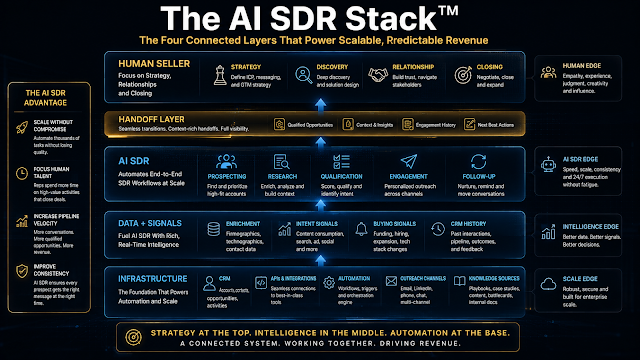
It helps to picture the system as four layers stacked on top of each other. At the base sits infrastructure — CRM, APIs, automation, outreach tooling, and knowledge sources. Above that sits data and signals — CRM history, enrichment, intent data, buying signals, and research.
Above that sits the AI SDR itself, handling prospecting, research, qualification, engagement, and follow-up. And at the top, past a handoff layer, sits the human seller, who owns strategy, discovery, and closing. That’s a more useful mental model than picturing an AI SDR as “a smarter email bot,” because it makes clear how much has to be working underneath the AI before it can do anything reliable.
The Real Competitive Advantage
“We have an AI SDR” won’t be a differentiator for long — eventually, everyone will. The advantage shifts to better data, better qualification, better signals, better research, better handoffs, and better human conversations once the AI has done its part.
In other words, the AI SDR itself becomes less of a moat over time, and the system built around it becomes the actual moat — which is exactly why this article is one part of our broader coverage of B2B prospecting rather than a standalone piece.
Future of AI SDRs
The category is likely to keep evolving in a few consistent directions: more autonomous research as agents monitor more sources, more contextual qualification as systems reason over account context instead of relying on static scoring, more account-level intelligence connecting activity across an entire buying group.
more agent-to-agent workflows where an AI SDR requests data, research, pricing, or CRM history from other agents, more dynamic handoff as AI gets better at recognizing when a conversation is now more valuable with a human, and more outcome-based optimization as models get evaluated on qualified opportunities, pipeline, and revenue rather than messages sent. That last shift in particular is the right direction for the category to move in.
The Bigger Shift
Traditional sales automation asked how software could help an SDR work faster. AI SDRs ask a different question: how much of the SDR workflow can software actually perform. Agentic sales systems push that one step further still, asking how software can coordinate multiple sales decisions and actions with humans entering only where judgment genuinely matters.
That’s a considerably bigger shift than “AI writes better emails,” and it’s the frame worth keeping in mind as the category keeps moving.
Pre-Deployment Checklist
Before deploying an AI SDR, it’s worth confirming:
- The ICP is clearly defined
- Prospect data is clean
- Duplicate records are controlled
- Qualification criteria are explicit
- Buying signals are defined
- The product knowledge base is accurate
- AI claims are evidence-based
- Personalization rules are clear
- Handoff thresholds are defined
- Strategic accounts get human review
- Opt-outs and suppression are automated
- Humans can intervene
- AI performance is being measured
- Qualified opportunities — not just activity — are the metric
- The system has been tested on a smaller group before scaling
Microsoft’s own guidance echoes this directly, recommending testing at a smaller scale before production deployment and validating research, outreach, follow-up, and handoff behavior along the way.
Final Thoughts: An AI SDR Is Not an AI Email Writer
The category is evolving quickly — from tools that generate messages, to ones that enrich leads, research accounts, qualify prospects, and engage and follow up, and increasingly toward systems that run several of these stages together with limited human intervention.
That’s the meaningful shift. But there’s a trap hiding in the excitement: the natural question, “how many people can this replace,” isn’t actually the useful one. The better question is which parts of the sales-development job are expensive, repetitive, and predictable enough to delegate to software — and that question leads to a much better implementation strategy than headcount math does.
AI should handle the work where volume is high, rules are clear, data is available, outcomes are measurable, and errors are manageable. Humans should get more involved exactly where the account is strategic, the conversation is complex, the evidence is uncertain, trust matters, objections appear, negotiation begins, or the next decision could materially affect revenue. The strongest AI SDR architecture was never “AI everywhere” — it’s AI until human judgment becomes more valuable than automation.
An AI SDR isn’t valuable because it can send more emails. It’s valuable because it can take thousands of low-value sales-development tasks and turn them into a smaller number of better-prepared human conversations. The output that actually matters isn’t messages sent, leads processed, or even meetings booked — it’s qualified opportunities created with less wasted human effort, and that’s the standard any AI SDR should be judged against.
An AI SDR can research, qualify, engage, and follow up at a scale that’s difficult for a human team to match on its own. But the real question was never how much of sales you can automate — it’s where AI creates genuine leverage, and where human judgment is still worth more. Next, we’ll compare the two directly: AI SDR vs. Human SDR, including cost, scale, personalization, qualification, relationships, ROI, and when a hybrid model makes the most sense.
Should AI Run Your Prospecting — Or Your Sales Team?
See the full cost, scale, and judgment-call comparison before you decide how much of your pipeline to automate.
Compare AI SDR vs Human SDR →FAQ
What is an AI SDR?
An AI SDR is an AI-powered software system that performs some or many of the sales-development tasks traditionally handled by human SDRs — prospect discovery, research, qualification, outreach, follow-up, and meeting booking. IBM defines the category around identifying prospects, engaging leads, and qualifying opportunities before handing them to human sales teams.
How does an AI SDR work?
A typical workflow runs discover, enrich, research, qualify, detect signals, personalize, engage, follow up, qualify again, and hand off — though the exact capabilities depend on the specific product and its configured level of autonomy.
Is an AI SDR the same as an AI agent?
No — an AI agent is the broader technology category, while an AI SDR is a specialized agent or system built specifically around the sales-development function.
Is an AI SDR the same as an AI cold-email tool?
No — a cold-email tool primarily automates outreach, while an AI SDR can potentially handle the larger workflow of prospecting, research, qualification, outreach, response handling, and handoff.
Can an AI SDR qualify leads?
Yes. Modern systems can use firmographic data, target-customer criteria, behavioral signals, and conversation context to qualify leads — Microsoft’s Sales Qualification Agent, for instance, researches leads, evaluates fit against target criteria, and can engage prospects before handing promising leads to sellers.
Can an AI SDR book meetings?
Yes — meeting booking is one of the standard use cases associated with the category, and Apollo explicitly describes AI SDRs as automating prospecting, outreach, and meeting booking.
Can an AI SDR respond to emails?
Some can, though the level of autonomy varies by product. Microsoft’s research-and-engage mode can handle follow-up interactions, but its own testing guidance requires the system to hand off to a human when a question falls outside its configured knowledge base.
Can an AI SDR replace a human SDR?
Not universally. AI is strong at scale, research, data processing, monitoring, and repetitive engagement, while humans remain important for complex discovery, strategic accounts, nuanced objections, trust, negotiation, and relationship management — a distinction our AI SDR vs human SDR comparison examines directly.
What data does an AI SDR need?
At minimum, reliable information about target accounts, contacts, ICP rules, product capabilities, buying signals, CRM history, outreach rules, and handoff criteria — poor data here produces poor AI decisions downstream.
Are AI SDRs good at personalization?
They can generate highly tailored messages, but “personalized” doesn’t automatically mean persuasive — a 2026 benchmark found a consistent ceiling in LLM sales personalization, with model-generated messages failing to reliably separate successful from unsuccessful outreach in one evaluated cohort. Combining AI research and drafting with human or rules-based validation is generally the better approach.
Do AI SDRs improve cold-email deliverability?
Not automatically. An AI SDR may increase outreach volume and consistency, but deliverability still depends on the broader email infrastructure, data quality, sending practices, authentication, reputation, and compliance — AI can amplify both good and bad outbound systems equally.
What’s the difference between an AI SDR and an AI sales agent?
An AI SDR generally focuses on sales development — prospecting, outreach, qualification, meeting booking, and early-stage engagement — while an AI sales agent can cover a broader range of revenue activities, and the boundary between the two is still evolving quickly.
What is an AI SDR handoff?
It’s the point where the system transfers a prospect or conversation to a human salesperson because a predefined threshold has been reached — typical triggers include high purchase intent, complex questions, strategic account value, objections, low AI confidence, or an explicit meeting request.
How much does an AI SDR cost?
There’s no universal price. Total cost typically includes the AI SDR platform, data, enrichment, CRM, automation, outreach infrastructure, and human oversight — the number worth tracking is cost per qualified opportunity, not subscription price alone.
Should every B2B company use an AI SDR?
No. AI SDRs make the most sense with sufficient prospect volume, a clear ICP, repeatable qualification, reliable data, and a measurable sales process; strategic, complex, or relationship-driven sales organizations may get more value from AI-assisted SDR workflows than from fully autonomous ones.
Sources and Further Reading
- CAN-SPAM Act: A Compliance Guide for Business: US Federal Trade Commission guide to commercial email rules.
- The Short Life of Online Sales Leads: Harvard Business Review. Research on how quickly firms contact web leads and how that affects qualification.
Related Guides
- How to Build an AI B2B Prospecting Workflow
- AI Cold Email Strategy Explained: Scale Outreach Without Hitting
- AI Lead Scraping Explained: How Businesses Find B2B Prospects at Scale
Written by
Muntasir Ahmad Chowdhury
Founder, AI Hustle World
Muntasir Ahmad Chowdhury is the Founder of AI Hustle World, an independent publication dedicated to making Artificial Intelligence practical, trustworthy, and easy to understand. He researches AI tools, automation, customer service, productivity, and real-world business applications, helping readers make smarter technology decisions through research-driven, experience-backed content.
Expertise:
AI Tools • AI Automation • AI Customer Service • AI Productivity • Generative AI • AI Workflows
Get Smarter With AI
Enjoyed this guide? Get practical AI tools, tutorials, and honest reviews delivered to your inbox.