Evidence: Documentation reviewed
Last checked: September 2026
What was done: Written from official documentation and the published sources linked in this article. Not hands-on tested.
Files: None
Affiliate links: No
AI Lead Qualification: How to Identify High-Intent B2B Prospects
The Hardest Part of B2B Lead Generation Starts After You Find the Lead
A B2B company can spend months improving its lead-generation engine only to discover that the real bottleneck is not finding prospects. It is deciding which prospects deserve the sales team’s limited attention.
Imagine a company adds 1,000 new leads to its CRM in a month. Some came through a demo request, others downloaded a report, attended a webinar, interacted with a product page, were identified through outbound research, or entered through a partner channel. The CRM treats all of them as records that can be processed, but the sales team cannot investigate 1,000 companies with equal depth. Someone has to determine which prospects are genuinely relevant, which show evidence of an active problem, which may be moving toward a purchase, and which should be ignored for now.
That is the job of lead qualification, and it is considerably more difficult than assigning points to a database.
The difficulty comes from the fact that the information required for a good qualification decision is scattered across different places. Company characteristics may live in structured CRM fields, while the evidence of a business problem appears in a conversation, recent company development, product activity, or an answer buried inside a form submission. A prospect can look perfect on paper and have no intention of buying, while another can appear ordinary until several small pieces of evidence reveal that the company has entered an active evaluation cycle.
AI changes what is possible because it can process and connect these different forms of information at a scale that a sales team cannot. But AI does not eliminate the underlying judgment problem. If anything, it makes that problem more important because an automated system can now make the wrong qualification decision across thousands of prospects much faster than a human team ever could.
This is why the most useful way to think about AI lead qualification is not as better lead scoring. It is as a system for making better decisions about where scarce sales attention should go.
Quick Answer: What Is AI Lead Qualification?
AI lead qualification uses artificial intelligence to evaluate whether a B2B prospect is worth sales attention by analyzing factors such as eligibility, company fit, business need, buying intent, timing, and the strength of the available evidence. Instead of relying entirely on a fixed lead score, an AI-assisted qualification system can combine structured CRM data with behavioral activity, conversations, account context, and other relevant information to recommend whether a prospect should be contacted, researched further, nurtured, routed to sales, or excluded.
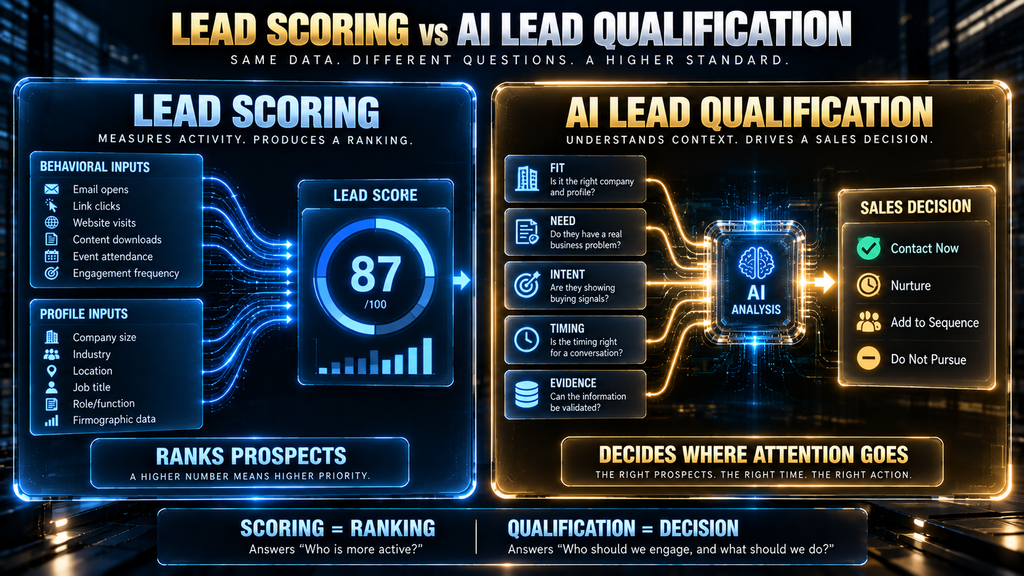
The crucial distinction is between scoring and qualification. A score estimates how a lead ranks or how likely it may be to reach a particular outcome; qualification is the broader decision about whether the prospect meets the conditions for sales attention and what should happen next.
A high score can therefore be useful without being definitive. A strong-fit company with little evidence of an active buying process may deserve less immediate attention than a slightly less obvious account that has a real business problem, multiple corroborating signals, and a reason to act now.
Why Lead Qualification Exists in the First Place
Before discussing AI, it is worth understanding why qualification became necessary.
Sales teams have always had more potential opportunities than they could pursue properly. The problem existed before CRMs, marketing automation, predictive models, and AI agents. A salesperson with a list of 100 companies still had to decide which ten deserved deeper research, which five warranted a phone call, and which should remain on the radar.
Modern technology simply increased the scale of the problem.
Businesses can now generate and collect prospect information continuously. A single company might have thousands or millions of records across its CRM, marketing platform, product analytics, sales engagement system, customer data platform, and external sources. The organization therefore faces an uncomfortable reality: information has become abundant while meaningful human attention remains scarce.
Lead qualification is the mechanism that connects those two realities.
The objective is not to prove that one prospect is objectively “good” and another is objectively “bad.” In many cases, that level of certainty is impossible. The objective is to decide whether the expected value of spending additional sales attention on a prospect is high enough to justify the opportunity cost.
That distinction explains why qualification should be thought of as an economic decision rather than merely a data-classification task. If a salesperson spends an hour researching an account that never had a realistic opportunity, that hour cannot be recovered. If the same salesperson ignores an account that was quietly entering a buying process, the opportunity cost may be considerably larger.
The qualification system therefore has to manage two opposing risks: false positives, where weak prospects consume valuable sales capacity, and false negatives, where promising prospects are overlooked.
There is no universal threshold that eliminates both problems. The appropriate balance depends on deal size, sales-cycle length, lead volume, customer acquisition economics, and the cost of missing an opportunity. An enterprise software company selling six-figure contracts may reasonably tolerate more human review than a high-volume business selling a low-cost subscription.
This is the first principle that should guide AI qualification:
The goal is not to qualify the maximum number of leads. The goal is to allocate sales attention where it has the highest expected value.
Lead Scoring Is Useful, but It Is Not Qualification
The reason AI lead qualification is often misunderstood is that lead scoring has been the dominant language of automated lead management for years.
Traditional scoring assigns points to observable characteristics and behaviors. A lead might receive points for matching the target industry, holding a senior position, visiting certain pages, downloading content, opening emails, attending an event, or completing a form. Once the score crosses a predefined threshold, the lead may be considered ready for sales.
Predictive lead scoring makes the process more sophisticated by using historical data and machine-learning models to estimate the likelihood of a desired outcome. Current CRM platforms such as Microsoft Dynamics 365 and Salesforce use predictive scoring to help organizations prioritize leads based on signals associated with conversion.
There is real value in that approach. A model can identify relationships across thousands of historical records that would be difficult for a salesperson to recognize manually. Research into B2B lead prioritization has also found that machine-learning approaches can improve the identification of higher-quality leads under particular datasets and business conditions.
But a prediction is still not a complete qualification decision.
Consider two leads with an identical predicted conversion score. One is a perfect ICP match but has shown no evidence of an active business problem. The other has a slightly weaker historical profile but has recently described the problem your product solves, involved additional stakeholders, and asked about implementation.
The score may rank them similarly. A salesperson should probably not treat them identically.
This is where AI qualification becomes more interesting than scoring alone. AI can potentially interpret the reason behind the signals, connect information from different sources, identify contradictions, and explain what remains unknown instead of collapsing everything into one number.
The distinction can be summarized simply: Scoring ranks prospects. Qualification decides how they should be treated.
What Actually Makes a B2B Prospect High-Intent?
“High intent” sounds precise, but in practice it is an inference. A prospect rarely walks into a CRM and declares, with certainty, “I intend to purchase this product within 30 days.” Sales teams instead observe evidence and attempt to infer what that evidence means.
That evidence can be explicit, behavioral, contextual, or conversational. A direct request for pricing is generally more informative than reading a general educational article. A question about implementation may reveal more than several generic page views. Multiple stakeholders from the same company independently researching the same problem can be more meaningful than one highly active individual.
The key is signal convergence.
One weak signal should rarely determine qualification by itself. Several independent signals that point toward the same underlying explanation can create a much stronger case.
Suppose a company visits your website once after seeing a social post. There is little reason to assume an active buying process. Now suppose the same account returns repeatedly over the following two weeks, reads product documentation, examines implementation information, has multiple employees engage with relevant material, and asks a question about integrating your product with an existing system. None of those actions guarantees a purchase, but together they tell a much more coherent story.
AI can be particularly useful in this situation because it can evaluate the relationship between events instead of merely counting them. That distinction also protects against one of the most common qualification errors: confusing engagement with intent.
A person can generate enormous engagement without being a buyer. They might be conducting research for a client, studying a market, preparing an internal presentation, comparing vendors for a future project, or simply curious. At the same time, a serious buyer may show surprisingly little visible digital activity because important parts of the buying process happen through private conversations, internal meetings, procurement discussions, or channels the marketing system cannot observe.
Intent is therefore not a volume metric. It is an interpretation of evidence.
The AI Lead Qualification Decision Stack
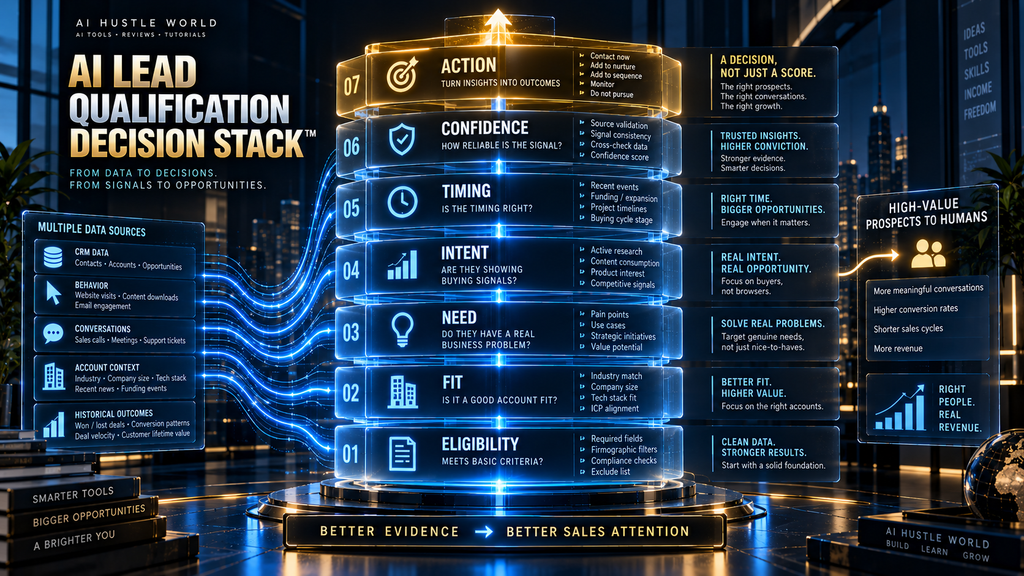
To make that interpretation more systematic, AI Hustle World can frame qualification as a seven-layer decision process: Eligibility → Fit → Need → Intent → Timing → Confidence → Action. This is the AI Lead Qualification Decision Stack.
The purpose of the framework is not to create seven more scores in a CRM. It is to prevent a common mistake: allowing one attractive signal to overwhelm the other information required to make a responsible sales decision.
A prospect should first be eligible for consideration. Then the system should establish whether the account resembles the type of customer the business can serve. After that, it should investigate whether there is a relevant problem, whether there is evidence of active interest, and whether the timing appears commercially meaningful. Finally, the system should consider how strong the evidence actually is before recommending what the sales team should do.
That last step is important because qualification is never just about what the system believes. It is also about how confident it should be in that belief.
The seven layers work together rather than functioning as independent checkboxes. A perfect ICP match with no evidence of need may remain low priority. A strong need with uncertain timing may deserve nurture rather than immediate outreach. A prospect with strong intent but a mandatory eligibility failure may not be worth pursuing at all. A strategically important account with contradictory evidence may deserve human review even when the model’s overall prediction is high.
The framework gives AI a structure for handling those trade-offs.
Eligibility: Is This Prospect Even Addressable?
The first question is surprisingly important because it is one of the places where businesses often overuse AI.
Some qualification conditions are deterministic. If a company only serves certain countries, requires a minimum company size, operates in specific industries, or cannot support a particular technical environment, those conditions can often be handled through straightforward rules.
There is little reason to ask a language model to make an elaborate judgment about whether a company located outside a supported market is “probably suitable.” A reliable rule is faster, cheaper, easier to audit, and less likely to produce an ambiguous answer. This illustrates a broader principle for AI qualification: use the simplest mechanism capable of making the decision correctly.
AI should not replace rules simply because AI is available. The technology becomes more valuable once the system reaches questions that depend on interpretation rather than binary eligibility.
Fit: Could This Company Be a Good Customer?
Fit evaluates whether the prospect resembles the type of customer the business is built to serve.
Firmographic attributes such as industry, company size, geography, revenue, business model, and organizational structure can provide the foundation. Contact role, seniority, technology environment, operating model, and other account characteristics can add additional context.
Predictive scoring can help here because historical customer data may reveal patterns that are difficult to express through simple rules. A model might discover that certain combinations of industry, company size, technology stack, and lead source correlate with successful opportunities.
But fit has an important limitation: it describes potential suitability, not current buying readiness. A company can be the perfect customer and still have no reason to buy this quarter.
This is where many ICP-driven qualification systems go wrong. They gradually turn “companies that could benefit from us” into “companies that should receive sales attention now.” Those are fundamentally different populations.
Fit answers: Would this company make sense as a customer? It does not answer: Is this company actively trying to solve a problem right now? That requires the next layers.
Need: Is There a Business Problem Worth Solving?
A lead becomes commercially interesting when there is evidence of a problem that your product or service can address.
Need can be explicit. A prospect might say that its support costs are increasing, its sales representatives are spending too much time researching accounts, or its current software cannot handle a particular requirement.
Need can also be inferred from context, but this is where AI must be disciplined. A language model can connect evidence from conversations, company information, activity, and other permitted sources, but it should not convert weak assumptions into facts.
For example, a company operating in a particular industry may commonly experience a certain problem. That does not mean the individual company has that problem. An AI system can flag the possibility, but the qualification record should distinguish known evidence from inference.
This distinction becomes especially important when the output is presented to a salesperson. If the system says, “The company has a high support burden,” the representative may assume that information was explicitly established. If the actual evidence was only that the company hired several support employees, the qualification is overstated.
A better system might say that the account shows indirect evidence consistent with increasing support demand, while noting that the underlying problem has not yet been confirmed.
That may sound like a small wording difference. It is actually a major difference in decision quality.
Intent: Is the Prospect Moving Toward a Buying Decision?
Once fit and need have been established, intent becomes the question of movement.
Intent is not simply whether someone interacted with your brand. It is whether the available evidence suggests that the prospect may be progressing toward a decision.
This is where context, recency, and convergence matter. A pricing-page visit can be useful evidence, but it should be interpreted alongside who visited, what happened before and after the visit, whether other people from the account are active, and whether there is any other indication of a relevant business initiative.
Similarly, a product-demo request is generally stronger than a generic content download, but even a demo request does not prove that the company is ready to buy. Some prospects are evaluating the market without a defined project; others are gathering information before securing internal approval.
The system should therefore avoid creating an artificial hierarchy in which every “high-intent” event automatically triggers sales. Instead, it should ask whether the overall explanation makes sense.
If several independent pieces of evidence point toward an active evaluation, confidence should increase. If the signals contradict each other, confidence should decrease. If the system has insufficient evidence to determine intent, it should preserve that uncertainty.
That is a more realistic model of how buying behavior actually works.
Timing: Why a Good Prospect May Still Be the Wrong Prospect Today
Timing is what turns qualification from a static description into an operational decision.
A company may have a strong fit and a genuine business problem, yet the problem may not be urgent enough to justify immediate sales intervention. The organization could be waiting for its next budget cycle, locked into an existing vendor contract, reorganizing internally, or still determining whether the problem deserves investment.
This is why the phrase “qualified lead” can be misleading. A prospect can be qualified in the sense that it meets the business’s customer criteria without being ready for an active sales conversation.
A mature AI system should be capable of distinguishing among those situations. Instead of forcing every prospect into “qualified” or “unqualified,” it can recommend different treatments based on the combination of evidence.
A strong-fit account with a real need but no evidence of immediate action might belong in strategic nurture. An account with strong fit, verified need, multiple intent signals, and evidence of an approaching decision may deserve immediate sales attention. An account with strong intent but unresolved eligibility or data problems may require human review before any action is taken.
Modern AI qualification agents are increasingly being designed around this broader concept of readiness. Microsoft’s current Sales Qualification Agent, for example, can research leads against a target customer profile, evaluate purchase interest, apply qualification criteria, and in an engagement mode interact with prospects before handing promising leads to sellers.
The important lesson is not that every business needs an autonomous agent. It is that timing deserves to be treated as a separate qualification dimension rather than hidden inside a generic score.
Confidence: What Does the Evidence Actually Justify?
This is the dimension that gives the entire framework its discipline.
An AI system may reach the correct conclusion for the wrong reasons, or reach a plausible conclusion from very weak evidence. A salesperson therefore needs to know not only the recommended qualification but also the quality of the evidence supporting it.
AI Hustle World can express this through a supporting framework: Verdict → Evidence → Confidence → Unknowns → Next Action. This is the Evidence-Backed Qualification model.
Consider two prospects that the system classifies as high priority. For the first, the conclusion is supported by a recent conversation, multiple stakeholders, a clearly described business problem, and several consistent account signals. For the second, the conclusion comes primarily from a pricing-page visit and a company profile that resembles previous customers.
Both may deserve attention. They should not carry the same level of confidence.
The distinction matters because uncertainty should influence the next action. High-confidence evidence may justify immediate routing to sales. Moderate-confidence evidence may justify additional research. Low-confidence evidence may justify asking a qualifying question rather than pretending the system already knows the answer.
This is also where AI can become more trustworthy without becoming less useful. A system that knows what it does not know is more valuable than one that confidently fills every gap.
Action: Qualification Is Incomplete Until It Changes What Happens Next
A qualification model that produces labels but does not influence behavior has limited practical value.
Once the system has assessed eligibility, fit, need, intent, timing, and confidence, it should recommend an appropriate next action. That might mean immediate sales routing, assignment to a specific representative, additional research, a qualifying question, nurture, scheduled re-evaluation, or no action at all.
The action should reflect both the qualification and the uncertainty surrounding it.
For example, a high-value enterprise account with strong fit and emerging intent but an unidentified decision-maker might not need to be rejected or immediately handed to an account executive. The better action could be targeted research to identify the buying group and determine whether the project is active.
Likewise, a low-value lead with a clear mismatch may not justify any additional AI research at all.
This is where qualification becomes connected to economics. The system is not merely trying to describe the prospect. It is deciding what amount of organizational attention the prospect deserves.
How AI Qualification Actually Works Behind the Scenes
A useful AI qualification architecture is usually hybrid rather than entirely AI-driven.
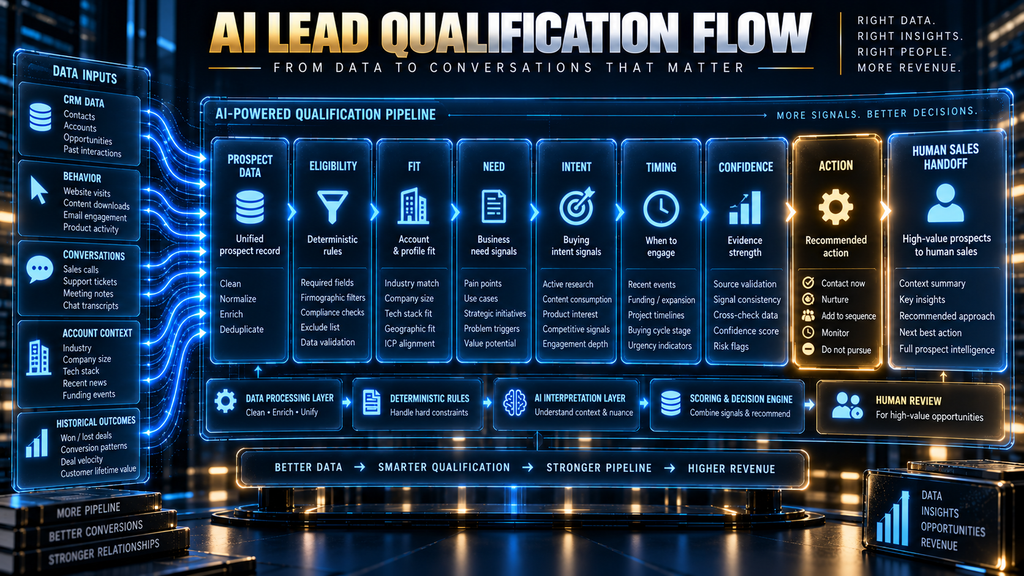
A lead may first enter the CRM and pass through basic identity and data validation. Deterministic rules can eliminate obvious mismatches, after which structured data and enrichment can establish the account’s basic characteristics. Predictive models can estimate conversion likelihood based on historical patterns, while AI can interpret free-text responses, conversation histories, company context, and behavioral evidence. The system can then synthesize those inputs into a qualification recommendation, attach a confidence assessment, and route the prospect according to predefined policies.
The advantage of this architecture is that each technology is doing work it is comparatively well suited to perform.
Rules are good at certainty. Predictive models are good at discovering statistical patterns. Generative AI is good at interpreting unstructured information and synthesizing context. Humans are good at handling ambiguous situations where business consequences are high. Trying to force one mechanism to perform all four jobs is usually unnecessary.
The architecture also makes governance easier. If a prospect was disqualified because of a hard geographic restriction, the reason is clear. If a predictive model ranked an account highly because of historical patterns, that can be evaluated separately from the AI’s interpretation of a recent conversation. If a human overrode the recommendation because of information unavailable to the system, that override becomes valuable feedback.
The result is not a magical autonomous qualification engine. It is a decision system with distinct components.
Why Human Judgment Still Matters
The argument for human involvement is not that AI is incapable of qualification. It is that some of the most important information in B2B sales is difficult to observe.
A salesperson may learn during a conversation that the company is interested but politically unable to approve the purchase. Another may discover that the prospect is being forced to replace an incumbent vendor sooner than expected. A strategic account may be undergoing an organizational change that has not yet appeared in any structured system.
These are precisely the situations where an AI system can become dangerous if it treats its available data as a complete representation of reality.
The appropriate response is not to abandon automation. It is to design human escalation around uncertainty and consequence.
Low-risk, repetitive decisions can be automated aggressively. High-value or ambiguous decisions should have stronger review requirements. The threshold should depend on what happens if the system is wrong.
This creates a useful principle for AI sales operations: AI should handle scale; humans should handle consequence and ambiguity.
That does not mean humans review everything. It means human attention is reserved for the situations where it has the highest marginal value.
BANT and MEDDPICC Still Have a Role
AI qualification does not make established sales frameworks obsolete.
BANT, MEDDPICC, CHAMP, and similar methodologies exist because organizations need shared definitions of what constitutes a meaningful sales opportunity. Their real value is not that the acronyms are magical. It is that they force sales teams to think about the conditions that affect whether an opportunity can actually progress.
AI can make these frameworks more practical by reducing the manual work involved in collecting and organizing the relevant evidence.
Suppose a salesperson has had three conversations with a prospect. Instead of manually reviewing every transcript, the AI system can identify statements related to business pain, timing, decision authority, metrics, procurement, competition, or other relevant criteria. It can summarize which elements have been confirmed and which remain unknown.
But AI must not fill missing information merely because the framework expects a field.
If budget has not been discussed, budget remains unknown. If authority has not been established, a senior job title should not automatically become proof of decision-making authority. If timing is unclear, the system should not manufacture a date because a workflow requires one.
The framework provides the questions. AI helps gather and interpret the evidence.
Person-Level Qualification Is Not Enough in B2B
One of the biggest weaknesses of simplistic lead qualification is that it treats the individual contact as the entire buying unit. B2B purchases rarely work that way.
One employee might discover the company. Another might evaluate the product. A manager may request a demonstration. Procurement may review commercial terms. An executive may approve the purchase without ever visiting the website.
If the qualification system evaluates every person independently, it can miss the account-level story.
Consider an account where one employee downloads a report, another reads product documentation, and a third requests implementation information. None of those contacts individually looks overwhelmingly important. Together, however, they may indicate that the organization is investigating a real project.
The reverse is also possible. One extremely active contact may generate dozens of interactions while the rest of the account shows no evidence of a meaningful buying process.
This is why mature qualification systems need to reason at both levels: Is this person worth contacting, and is this account showing evidence of a broader buying process? That distinction becomes increasingly important as AI systems become capable of synthesizing activity across multiple contacts and systems.
The Data Problem AI Cannot Magically Solve
The quality of an AI qualification decision is constrained by the quality of the information available to it.
AI can interpret messy data, but it cannot reliably transform missing information into accurate information. It can summarize an outdated job title perfectly. It can analyze an incorrectly labeled opportunity perfectly. It can produce an elegant explanation based on a duplicate account.
The output can still be wrong.
Predictive systems have an additional dependency because they learn from historical outcomes. Microsoft’s current documentation, for example, specifies minimum historical data requirements for predictive lead scoring in Dynamics 365 before a model can be meaningfully configured.
This is why companies should examine the fundamentals before implementing sophisticated qualification models. Are lead stages consistently defined? Are qualified and disqualified outcomes reliable? Are duplicate accounts common? Are contact roles current? Are closed-lost reasons useful? Does the organization consistently record the events that supposedly indicate qualification?
If the answer to those questions is no, adding AI may simply make the existing inconsistency harder to see. There is also a subtler problem: historical sales data contains historical sales decisions.
If salespeople consistently prioritized large accounts, the model may learn that large accounts convert better. That could reflect genuine customer economics, but it could also partly reflect the fact that large accounts received more human attention.
The system therefore needs continuous evaluation rather than blind trust in historical patterns.
The Hidden Feedback Loop in AI Qualification
Predictive qualification can unintentionally reinforce the behavior that created its training data.
Suppose a sales organization historically focused on large technology companies. Those accounts received more calls, more meetings, more research, and more senior involvement. They subsequently produced more opportunities.
A model trained on that history may learn that large technology companies are unusually valuable. The model then prioritizes more large technology companies. Salespeople follow the model. Those accounts receive even more attention. The resulting outcomes reinforce the original pattern.
This does not make predictive qualification useless. It simply means that historical conversion data should be treated as evidence, not as unquestionable truth.
The organization should periodically examine who is being prioritized, who is being excluded, and whether certain segments are receiving systematically different levels of human attention. It should also pay attention to seller overrides because consistent overrides may reveal that the model is missing information that salespeople understand.
This is one reason explainability is not a cosmetic feature. It is part of governance.
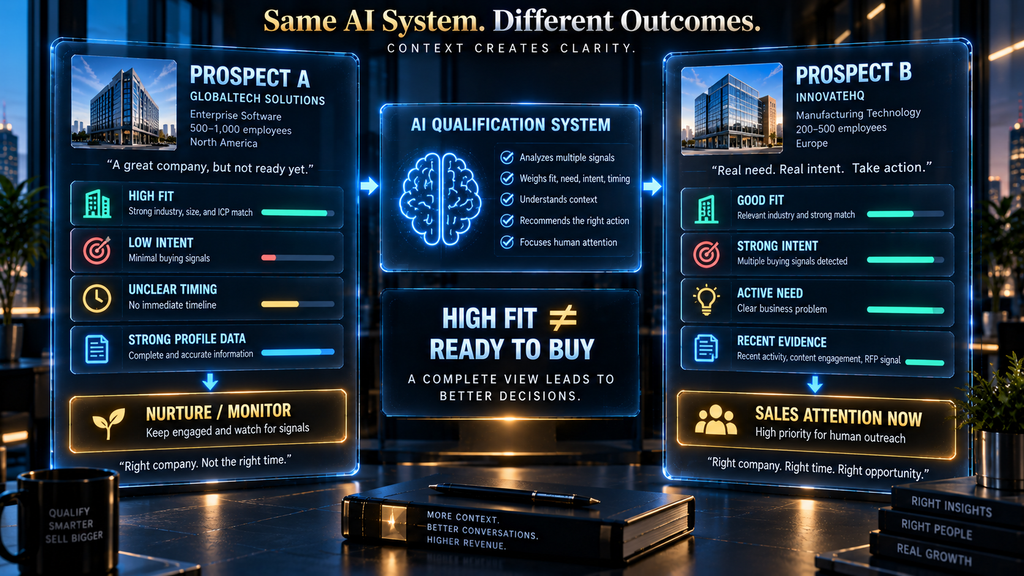
A Realistic Example: Two Leads, One Sales Team
Consider a company selling AI customer-support software to growing B2B businesses. Its sales team has capacity to investigate only one of two new accounts immediately.
The first account is a 2,000-person software company that fits almost every ICP criterion. Its company size is ideal, the industry is ideal, and the contact is a senior operations leader. A predictive model gives it a strong score because similar companies have historically produced good opportunities.
But recent activity is almost nonexistent. There is no clear evidence of an active support-automation initiative, no recent conversation, and no indication that the company is evaluating vendors.
The second account is a 500-person company that is slightly outside the organization’s historical sweet spot. Several employees have recently interacted with relevant product material, the company has expanded its support operation, and one contact has asked whether the platform integrates with its existing help desk. Budget has not been confirmed, and the final decision-maker is unknown.
A traditional scoring system might prefer the first account because the historical profile looks stronger. A contextual qualification system could reach a different conclusion.
The first account might be assessed as a strong fit with weak current evidence and uncertain timing. The second could be assessed as a good fit with a strong emerging need, meaningful intent, and unresolved commercial questions.
The second account does not become a guaranteed opportunity. It simply has a stronger case for spending scarce sales attention right now. That is the distinction the qualification process should create.
The Economics of False Positives and False Negatives
Every qualification system makes mistakes, and the cost of those mistakes should influence how the system is designed.
A false positive consumes sales attention unnecessarily. The obvious cost is the representative’s time, but the larger cost may be the opportunity that representative did not pursue while working the wrong lead.
A false negative is harder to observe because the organization often never discovers what it missed. A prospect that was incorrectly filtered out may simply disappear from the pipeline, making the error invisible unless the company later discovers that the account purchased from a competitor.
This creates a difficult optimization problem.
If the cost of a false positive is high, the system should be more selective. If the cost of a false negative is high, the organization may prefer broader human review.
The appropriate balance therefore depends on the economics of the business rather than on some universal definition of “high quality.”
A six-figure enterprise opportunity can justify a considerable amount of human investigation. A low-value transaction cannot.
This is also why the number of qualified leads is a poor standalone success metric. If AI reduces the number of leads sent to sales by 30% but increases opportunity conversion and reduces wasted research time, that can be a major success. Qualification is supposed to filter attention, not maximize labels.
What Should You Measure?
The ultimate test of AI qualification is what happens after the qualification decision.
A model can have impressive technical accuracy while producing little commercial value. Conversely, a relatively simple system can generate substantial value if it consistently directs salespeople toward better opportunities and reduces the amount of manual research required.
The first layer of measurement should examine qualification quality. Are AI-qualified leads accepted by sales? Do they convert to opportunities at a higher rate? How frequently do representatives override the system, and how often are those overrides ultimately proven correct?
The second layer should examine operational efficiency. How much time does a salesperson spend researching a lead before and after automation? How many leads can a representative meaningfully handle? What percentage of prospects can be automatically resolved without human investigation?
The final layer should examine commercial outcomes: opportunity creation, pipeline generated, conversion rate, sales-cycle performance, average deal value, and revenue associated with prioritized prospects. A useful scorecard might therefore look like this:
| Measurement Layer | What to Measure | Why It Matters |
|---|---|---|
| Qualification quality | Sales acceptance, qualified-to-opportunity conversion | Shows whether qualification is producing better prospects |
| Decision quality | False positives, false negatives, seller overrides | Reveals where the system is wrong |
| Efficiency | Research time, review time, automation rate | Shows whether AI actually reduces workload |
| Commercial impact | Pipeline, opportunity value, closed-won revenue | Connects qualification to business outcomes |
The important point is that model performance should not be the finish line. Revenue and attention economics are.
Common AI Lead Qualification Mistakes
The most damaging mistake is allowing the score to become the decision. A number is convenient because it can be sorted and displayed, but convenience does not make it a reliable representation of reality.
Another common mistake is treating every engagement signal as evidence of buying intent. Activity becomes useful only when the context supports the interpretation.
Companies also make the opposite error by overvaluing ICP fit. A company can look perfect on paper and still have no active reason to buy. Qualification needs both suitability and evidence of relevance.
Data freshness is another problem. A prospect’s circumstances can change faster than the CRM record. A buying signal from months ago may have little relevance if the project was postponed or the responsible executive left the company.
Organizations also frequently optimize for the wrong outcome. If an AI model is trained to predict form completion, it may become good at finding people who submit forms without becoming good at identifying opportunities that create revenue.
Finally, there is a temptation to automate every decision once the system appears accurate. That is unnecessary. The correct degree of automation should depend on the consequence of being wrong, not merely on the availability of AI.
How to Build an AI Lead Qualification Process Without Over-Automating It
The safest implementation begins with the qualification definition, not the technology.
First, the sales and marketing teams need to agree on what a qualified opportunity actually means. Then they should separate mandatory conditions from signals that increase or decrease confidence. Mandatory conditions can often become deterministic rules, while ambiguous evidence can be interpreted by AI.
The organization should then establish what the system is allowed to decide automatically and what requires human review. A low-value lead with an obvious ICP mismatch may be automatically excluded. A strategically important account with contradictory evidence should probably be escalated.
Historical outcomes can be incorporated into predictive scoring once the data is reliable enough to support it. Conversation and unstructured-data analysis can then add contextual intelligence that fixed fields cannot capture.
Most importantly, the system should be monitored after deployment. Qualification is not a one-time model-building exercise because customer behavior, markets, products, sales processes, and data quality all change.
A good system should therefore be calibrated continuously rather than trusted permanently.
When Should a Business Use AI Lead Qualification?
AI qualification becomes particularly valuable when lead volume has reached the point where salespeople cannot investigate prospects adequately, qualification depends on information spread across multiple systems, and the business has enough reliable data to support meaningful automation. It is especially useful when salespeople spend substantial time researching accounts, reviewing conversations, interpreting free-text information, and deciding which prospects deserve attention.
The value is lower when lead volume is tiny and every account is strategically important. In those environments, direct human investigation may be more economical than building a sophisticated automated system.
It is also lower when the organization has not agreed on what “qualified” means. That may sound like an organizational problem rather than a technology problem, but it is one of the most important implementation boundaries.
AI cannot resolve a qualification definition that the business itself has never settled. If marketing considers a lead qualified when it matches the ICP while sales considers it qualified only after a confirmed business problem and buying process, the model will simply encode the disagreement.
The business needs to settle the decision first. Then AI can scale it.
Who Should Avoid Heavy AI Qualification?
Businesses should be cautious about sophisticated AI qualification when their CRM data is highly inconsistent, historical outcomes are sparse, qualification definitions change constantly, or the cost of a false negative is extremely high. A company with a small number of highly valuable enterprise accounts may still use AI extensively for research and preparation without giving it authority to make final qualification decisions.
That distinction is important. AI does not have to control the decision to create value.
It can reduce the cost of gathering information, identify relevant evidence, summarize account history, surface contradictions, and tell the salesperson which questions remain unanswered. In some organizations, that supervised model will outperform a fully autonomous system simply because the value of human judgment is unusually high.
The Rise of AI Qualification Agents
The next evolution is already moving beyond passive scoring. Traditional predictive scoring essentially asks: Which leads look most likely to convert? A qualification agent can potentially perform a broader sequence of work: research the company, compare it with the target customer profile, interpret recent activity, identify evidence of a business problem, evaluate purchase interest, determine which qualification criteria remain unresolved, engage the prospect when authorized, and recommend whether the opportunity should be passed to a human seller.
Microsoft’s current Sales Qualification Agent is an example of this broader direction. Its documented capabilities include research against target customer profiles, evaluation of purchase interest, qualification criteria, prospect engagement, and seller handoff.
That is a meaningful shift because the system is no longer merely predicting an outcome. It is participating in the information-gathering process that produces the qualification decision.
But greater autonomy creates greater responsibility. A system that only produces a score can be overridden before anything happens. An agent that researches, contacts, qualifies, and routes prospects can directly influence customer relationships and sales outcomes.
That means the future of AI qualification will require stronger evidence tracking, escalation policies, permission controls, monitoring, and clear boundaries around autonomous action. The question will increasingly become not “Can AI qualify this lead?” but “Which parts of qualification should AI be allowed to own?”
The Second-Order Effect: Sales Teams May Become Smaller but More Focused
There is a deeper implication to all of this. If AI becomes capable of performing much of the research and triage that sales development teams currently perform manually, the value of a salesperson’s time changes. Instead of spending hours identifying company information, reviewing activity, summarizing conversations, and determining whether a lead might be worth pursuing, the salesperson may receive a concise evidence-backed account assessment and spend the saved time on discovery, relationship building, negotiation, and decision-making.
That does not necessarily mean fewer humans. It means more human attention can move toward work where human judgment has greater economic value.
This is consistent with a broader direction in AI sales research: systems are increasingly being evaluated not only on prediction but on how they help allocate attention and improve downstream outcomes. Recent research into LLM-based lead ranking, for example, has explored combining structured CRM information with unstructured customer interactions, while other work has examined AI-assisted decisions about when continuing a sales interaction is no longer economically worthwhile. These are promising research directions, but their results remain context-specific rather than proof of universal AI superiority.
That caveat matters. The future is not guaranteed to be “AI replaces sales.”
A more defensible prediction is that AI will increasingly determine where human sales attention is most valuable.
A Practical Decision Framework for AI Lead Qualification
The right level of automation depends on four things: lead volume, qualification complexity, data quality, and the consequence of an incorrect decision.
If lead volume is low and every account is valuable, human qualification may still be the rational choice. If volume is high but qualification is simple, rules and conventional scoring may deliver most of the available benefit without requiring a sophisticated AI system.
The strongest case for contextual AI appears when volume is high, qualification depends on multiple forms of evidence, and much of that evidence is unstructured or distributed across systems. This is where AI can reduce the research burden while providing a more nuanced decision than a fixed score.
The final variable is consequence. The more expensive it is to make the wrong decision, the more important human oversight becomes.
| Business Situation | Sensible Approach |
|---|---|
| Low lead volume, high-value accounts | Human-led qualification with AI research assistance |
| High volume, simple criteria | Rules + conventional scoring |
| High volume, complex contextual qualification | Hybrid predictive + AI qualification |
| Poor CRM data | Fix data and definitions before heavy automation |
| High consequence of false negatives | Strong human review and escalation |
| Mature data + repeatable qualification | Gradually increase automation |
The objective is not to adopt the most advanced architecture available. It is to adopt the least complicated system that produces materially better decisions.
The AI Lead Qualification Checklist
Before an AI system labels a prospect as high priority, the organization should be able to explain why the prospect belongs in that category.
The company should know whether the account is eligible and why it fits the target customer profile. There should be credible evidence of a relevant business need rather than an assumption based solely on industry or company size. Intent should be supported by meaningful and reasonably recent evidence, while timing should be considered separately from general interest.
The system should also distinguish facts from inferences and identify important unknowns rather than silently filling them. Most importantly, the qualification should lead to a specific action that matches both the strength of the opportunity and the confidence of the evidence.
That creates a practical standard:
A qualified prospect is not simply a prospect with a high score. It is a prospect for whom the evidence is strong enough to justify the amount of attention the business is about to spend.
Final Thoughts
AI lead qualification is often marketed as the next step in lead scoring, but that framing is too narrow.
The real problem has never been the lack of a number. Sales teams already have plenty of numbers. The problem is that they have more potential prospects than they can investigate properly, and the cost of deciding where to spend attention continues to rise as businesses generate more data.
AI can help because it can combine information that traditional scoring systems tend to separate: company characteristics, CRM history, behavioral activity, conversations, account context, and other relevant evidence. Predictive models can identify patterns in historical outcomes, while generative AI can interpret information that does not fit neatly into predefined fields. But none of these technologies removes the need for judgment, and none can turn incomplete evidence into certainty.
The AI Lead Qualification Decision Stack — Eligibility → Fit → Need → Intent → Timing → Confidence → Action — provides a better way to structure the problem because it separates the questions that actually determine whether a prospect deserves attention. Its supporting Evidence-Backed Qualification model adds another important discipline: every recommendation should be connected to evidence, confidence, known gaps, and a sensible next action.
The most important distinction is therefore not between manual qualification and AI qualification. It is between qualification systems that merely rank prospects and qualification systems that help organizations make better decisions.
A high-fit account is not automatically a high-intent account. High engagement is not automatically buying readiness. A high predictive score is not proof that a prospect will buy. And an AI system that cannot explain what it knows, what it inferred, and what remains unknown should not be given unlimited authority over sales decisions.
The strongest organizations will use AI to absorb the enormous information-processing burden surrounding qualification while keeping human judgment where ambiguity and consequence make it valuable. They will measure success through sales acceptance, opportunity creation, efficiency, pipeline, and revenue rather than celebrating the number of leads an algorithm labels “qualified.”
Ultimately, the purpose of AI lead qualification is not to create more qualified leads. It is to make every hour of human sales attention more valuable.
Ready to Turn Qualification Into a Real Prospecting System?
Knowing which prospects deserve attention is only one part of the equation. The next step is connecting discovery, enrichment, qualification, buying signals, and sales action into one practical AI-powered process.
Build the AI B2B Prospecting Workflow →Frequently Asked Questions
What is AI lead qualification?
AI lead qualification uses artificial intelligence to determine whether a prospect meets a business’s sales criteria and deserves sales attention. It can evaluate factors such as company fit, business need, behavioral activity, buying intent, timing, conversation context, and the reliability of the available evidence.
How is AI lead qualification different from lead scoring?
Lead scoring primarily ranks prospects or estimates the likelihood of a particular outcome. AI lead qualification uses scoring as one possible input but also considers whether the prospect actually meets the organization’s qualification criteria, what evidence supports that conclusion, what information is missing, and what action should happen next.
How does AI identify high-intent B2B prospects?
AI can analyze combinations of behavioral, conversational, account-level, and contextual signals to identify evidence associated with active buying interest. The strongest systems look for multiple signals that support the same interpretation rather than treating one page view, click, or download as definitive proof of intent.
Does a high lead score mean a prospect is ready to buy?
No. A high score can indicate strong historical fit or predicted conversion likelihood without proving that a current buying project exists. Readiness requires additional evidence about need, intent, timing, and the prospect’s circumstances.
What factors should be considered when qualifying a B2B lead?
A thorough qualification process should consider eligibility, ICP fit, business need, buying intent, timing, evidence quality, and confidence. Depending on the sales process, frameworks such as BANT or MEDDPICC can provide additional criteria for evaluating the opportunity.
Can AI qualify leads using BANT or MEDDPICC?
Yes. AI can extract relevant information from CRM records and sales conversations, identify which qualification criteria have been established, highlight missing information, and suggest follow-up questions. It should not invent budget, authority, timing, or other information that has not been supported by evidence.
Is high engagement the same as high buying intent?
No. High engagement can indicate interest, but it does not necessarily indicate purchase intent. The meaning of an interaction depends on its context, recency, source, the identity of the person involved, and whether other independent signals support the same conclusion.
Should AI qualify an individual contact or the entire account?
Ideally, both. Individual contacts provide important evidence, but B2B buying decisions often involve multiple stakeholders. Account-level qualification can reveal a buying pattern that would be invisible if every contact were evaluated independently.
Can AI completely replace human lead qualification?
Not reliably in every environment. AI can automate large portions of research, scoring, evidence gathering, summarization, and routing, but human review remains valuable when evidence is ambiguous, account value is high, information is incomplete, or the consequences of a wrong decision are significant.
How should businesses measure AI lead qualification?
Businesses should measure downstream commercial and operational outcomes rather than relying only on model accuracy. Sales acceptance, qualified-to-opportunity conversion, false positives, false negatives, seller overrides, research time saved, opportunity creation, pipeline, sales-cycle performance, and revenue are all useful measures of whether the system is actually improving qualification.
Sources and Further Reading
- The Short Life of Online Sales Leads: Harvard Business Review. Research on how quickly firms contact web leads and how that affects qualification.
- Legitimate interests: UK Information Commissioner’s Office guidance on relying on legitimate interests as a lawful basis.
Written by
Muntasir Ahmad Chowdhury
Founder, AI Hustle World
Muntasir Ahmad Chowdhury is the Founder of AI Hustle World, an independent publication dedicated to making Artificial Intelligence practical, trustworthy, and easy to understand. He researches AI tools, automation, customer service, productivity, and real-world business applications, helping readers make smarter technology decisions through research-driven, experience-backed content.
Expertise:
AI Tools • AI Automation • AI Customer Service • AI Productivity • Generative AI • AI Workflows
Get Smarter With AI
Enjoyed this guide? Get practical AI tools, tutorials, and honest reviews delivered to your inbox.