Evidence: Documentation reviewed
Last checked: September 2026
What was done: Written from official documentation and the published sources linked in this article. Not hands-on tested.
Files: None
Affiliate links: No
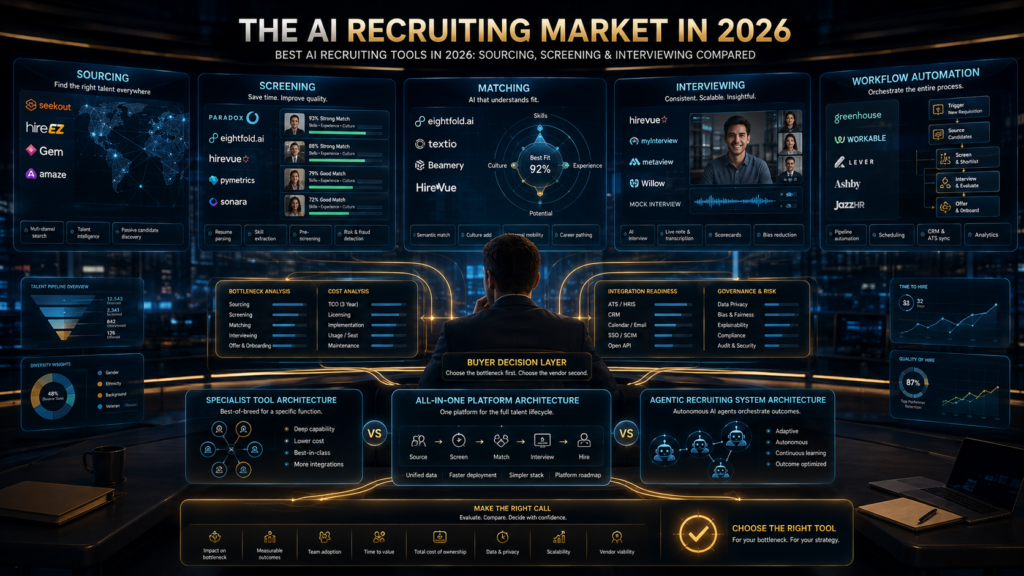
AI recruiting software now covers almost every part of hiring, but that does not make the buying decision easier. One platform searches public talent profiles, another prioritizes applicants, another runs candidate conversations, and another turns interviews into structured evidence. Calling all of them “AI recruiting tools” hides the most important fact: they solve different operational problems.
This guide compares ten leading platforms by the work they are designed to do, the systems they must connect with, the human effort they remove, and the controls a responsible hiring team still needs. It is a public-source commercial evaluation based on current vendor documentation and authoritative employment guidance—not a claim that AI Hustle World ran a controlled product test or measured hiring outcomes inside every platform.
Quick answer: the best AI recruiting tools by use case
Ashby is the strongest all-in-one option for fast-growing teams that want an ATS, CRM, scheduling and analytics in one modern system. Greenhouse is the better fit when structured hiring, scorecards and explicit decision ownership matter most, while Gem is especially compelling for teams that want AI sourcing and CRM capabilities around an existing ATS.
For targeted needs, hireEZ and SeekOut are strongest in sourcing and talent rediscovery; Paradox is built for high-volume conversational hiring; Metaview is the focused choice for interview intelligence; and Eightfold, Workday and iCIMS fit enterprise talent environments. The right shortlist begins with the bottleneck, not with whichever vendor has the longest AI feature page.
A practical buying sequence is to identify the constrained hiring stage, calculate the human time and candidate friction it creates, and test only the category designed to change that stage. This prevents a common procurement error: replacing an acceptable ATS when the real problem is scheduling, interview documentation or specialist sourcing. It also gives the pilot a defensible baseline, because the team can measure whether the chosen tool improved the original constraint rather than celebrating activity that was easy for the software to generate.
| Tool | Best for | Primary role | Pricing visibility | AHW verdict |
|---|---|---|---|---|
| Ashby | Scaling companies | All-in-one recruiting system | Published tiers plus enterprise quote | Best modern all-in-one |
| Greenhouse | Structured hiring | ATS and hiring governance | Quote-based | Best for disciplined evaluation |
| Gem | Recruiting CRM and sourcing | Talent pipeline and AI agents | Published plan structure; some quote-based | Best layer around an ATS |
| hireEZ | Outbound recruiting | Sourcing, outreach and automation | Custom pricing | Best for agentic sourcing workflows |
| SeekOut | Hard-to-fill roles | Sourcing, screening and rediscovery | Custom pricing; free trial offered | Best for specialist talent pools |
| Eightfold AI | Enterprise talent intelligence | External and internal talent matching | Custom pricing | Best for skills-based talent strategy |
| Workday | Existing Workday customers | Enterprise talent acquisition suite | Custom pricing | Best native enterprise ecosystem fit |
| Paradox | High-volume hourly hiring | Conversational screening and scheduling | Custom pricing | Best for candidate-flow automation |
| Metaview | Interview-heavy teams | Interview notes and recruiting intelligence | Free entry point and paid plans | Best focused interview layer |
| iCIMS | Large global employers | Enterprise recruiting suite | Custom pricing | Best for configurable enterprise TA |
What counts as an AI recruiting tool in 2026?
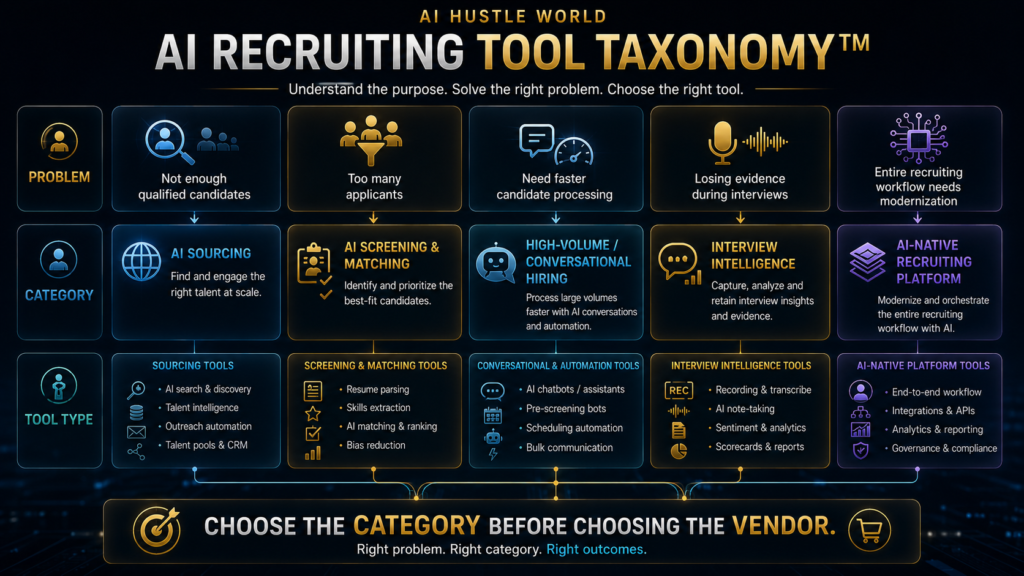
An AI recruiting tool uses machine learning or generative AI to assist with work such as talent discovery, candidate matching, application review, outreach, scheduling, interview capture, reporting or workflow coordination. Some products are full systems of record, some sit on top of an ATS, and some specialize in a single high-friction task.
That distinction changes implementation cost. Replacing an ATS affects data migration, permissions, integrations, process design and user training, whereas adding an interview notetaker may require a much smaller operational change. A feature comparison that treats those purchases as interchangeable is not useful to a recruiting leader.
How AI Hustle World evaluated the tools
This comparison uses the AHW W.O.R.T.H. checklist, a reusable commercial-evaluation framework that measures Workflow fit, Output capability, Risk and rights, Total cost, and Human effort. The framework is designed to expose costs that feature checklists miss, especially integration burden, review work, governance obligations and the effort required after an AI system produces an answer.
This is not a controlled performance benchmark, a bias audit or proof that one product produces better hires. It is a documented buying aid. No numeric scores are published because none of these tools were hands-on tested.
The AHW W.O.R.T.H. checklist
A five-part method for comparing business software without pretending a feature list is a buying decision.
Workflow fit
Output capability
Risk and rights
Total cost
Human effort
What this comparison adds: Most recruiting-tool roundups repeat vendor features and announce a universal winner. This guide instead separates documented capability from unverified outcomes and adds a stage-by-stage decision-rights matrix showing where AI may assist and where the employer should retain accountable human approval.
The 10 best AI recruiting tools in 2026
1. Ashby — best modern all-in-one recruiting platform
Ashby combines applicant tracking, recruiting CRM and sourcing, scheduling, analytics and AI-assisted workflows in one platform. Its current documentation includes AI-assisted application review, candidate assistance, interview notetaking, content generation, scheduling automation and custom or scheduled agents, which gives a scaling team room to consolidate several point solutions.
The strongest reason to shortlist Ashby is operational coherence. Analytics are not a separate reporting layer bolted onto the ATS, and scheduling is part of the same candidate record. That matters because an AI recommendation is more useful when the underlying job, stage, interviewer, scorecard and historical funnel data are connected.
Best for: startups and growth companies replacing fragmented recruiting operations with one system. Main limitation: configuration flexibility still demands process ownership, and enterprise migrations should be scoped as business-system changes rather than simple software installs. Pricing: Ashby publishes plan structure and startup options, while larger organizations receive enterprise pricing.
AI Hustle World verdict: Choose Ashby when the bottleneck is the recruiting operating system itself. If the ATS already works and only sourcing or interview documentation is broken, a narrower layer may produce a faster return with less disruption.
2. Greenhouse — best for structured hiring and decision discipline
Greenhouse is built around structured hiring, with job setup, scorecards, interviewing, reporting and integrations organized around a consistent process. Its AI capabilities now extend across application review, talent matching, interview notes, reporting and candidate verification, but the product’s more important differentiator is explicit decision ownership.
Official documentation states that its Real Talent matching layer does not automatically advance or reject candidates; it presents results for recruiter review. Greenhouse also describes resume anonymization, explainability, recurring third-party bias audits and ISO 42001 certification. Those controls do not remove an employer’s legal responsibilities, but they make the governance conversation more concrete than a generic promise of “responsible AI.”
Best for: organizations that want repeatable scorecards, auditable interview structure and a mature ATS ecosystem. Main limitation: quote-based pricing makes total cost harder to compare before a sales process, and sophisticated workflows can require careful administration. Pricing: custom quote across Core, Plus and Pro packaging.
AI Hustle World verdict: Greenhouse is the strongest choice when hiring quality depends on getting managers to use the same evidence model. It will not repair a vague job definition or an undisciplined interview panel by itself, but its architecture supports teams willing to do that work.
3. Gem — best recruiting CRM and AI sourcing layer
Gem can operate as an all-in-one recruiting platform or enhance an existing ATS with sourcing, CRM, scheduling, analytics and AI agents. Its public materials emphasize AI sourcing across a large public-profile index, applicant review, talent rediscovery, outreach sequences and recruiting insights grounded in the organization’s hiring history.
That makes Gem especially relevant when the system of record is acceptable but the team cannot build, rediscover or nurture pipelines efficiently. The value is not merely finding more profiles. It is connecting prospects, former applicants, engagement history and open roles so recruiters do not restart the search every time a requisition opens.
Best for: outbound recruiting teams, talent-pipeline programs and enterprises keeping an incumbent ATS. Main limitation: buyers can overlap Gem with sourcing, CRM, analytics and scheduling capabilities they already pay for, so the contract should be mapped against the current stack. Pricing: plan information is published, but configuration and enterprise scope can require a quote.
AI Hustle World verdict: Gem is a strong answer to “How do we make our ATS data and external sourcing work as one pipeline?” It is less compelling when the team needs a complete ATS replacement and has not defined how migration, process redesign and reporting ownership will work.
4. hireEZ — best for agentic outbound recruiting
hireEZ has expanded from sourcing into a broader platform spanning candidate discovery, CRM, outreach, analytics, applicant matching, rediscovery and internal mobility. Its agentic positioning focuses on carrying a job requirement through multi-step work such as searching, identifying prospects, drafting outreach, nurturing candidates and coordinating the next action.
The product is most attractive when recruiter time is consumed by repeated outbound work across disconnected tools. However, “agentic” should not mean unsupervised. Teams still need approval rules for search criteria, communication tone, outreach frequency, personal-data use and the point at which a person reviews a recommendation.
Best for: recruiting organizations with persistent outbound sourcing demand. Main limitation: broad platform scope can duplicate an ATS or CRM, and public pricing is not specific enough to model total cost without a written proposal. Pricing: custom, based on team and product scope.
AI Hustle World verdict: hireEZ belongs on the shortlist when qualified-candidate discovery and engagement are the expensive constraints. Pilot it against a defined group of roles and measure qualified slates, reply quality, recruiter review time and opt-out handling—not raw profile volume.
5. SeekOut — best for hard-to-fill roles and talent rediscovery
SeekOut Recruit combines external sourcing, inbound applicant evaluation, ATS rediscovery and personalized outreach. It also offers specialized talent pools for areas such as technical, healthcare and security-cleared recruiting, which can matter more than generic database size when eligibility or domain experience narrows the market.
SeekOut Workspaces organize the search, evaluation criteria, shortlist and campaign around an open role. That design can reduce the common gap between “AI found candidates” and “the recruiting team can explain why these people belong on the slate.” The platform’s newer assistant integrations also let recruiters work through familiar AI interfaces, although access control and data-boundary questions should be reviewed before rollout.
Best for: organizations hiring specialized talent or trying to recover value from historical ATS data. Main limitation: it is not automatically the right system of record, and candidate-data provenance should be assessed for the locations in which the employer recruits. Pricing: custom by team size, hiring volume and product requirements; a free trial is advertised.
AI Hustle World verdict: SeekOut is a high-value sourcing choice when the search problem is genuinely difficult. For roles already attracting hundreds of relevant applicants, the better purchase may be structured screening, scheduling or interview intelligence rather than another external database.
6. Eightfold AI — best enterprise talent-intelligence platform
Eightfold AI approaches recruiting through talent intelligence rather than a narrow task tool. Its platform connects talent acquisition with internal mobility, workforce planning, skills and employee development, making it relevant to enterprises that want one skills-based view of external candidates and the existing workforce.
The upside is strategic breadth: a company can use a common model to source, match, rediscover and consider internal talent. The trade-off is that model-driven recommendations sit close to consequential employment decisions. Employers need validation, monitoring, accommodations, candidate communication and a clear account of which data influences ranking.
Best for: large employers pursuing skills-based hiring and internal mobility together. Main limitation: enterprise data preparation, integration and governance can be substantial, while pricing is not publicly itemized. Pricing: custom quote.
AI Hustle World verdict: Eightfold makes sense when talent acquisition is part of a broader workforce-intelligence program. It is excessive for a small team that simply needs better interview notes, scheduling or outbound search.
7. Workday — best for organizations already operating in Workday
Workday’s talent-acquisition stack brings together Workday Recruiting, HiredScore AI for Recruiting, candidate engagement and conversational capabilities associated with Paradox. The strategic advantage is shared enterprise context across jobs, candidates, workers, permissions and downstream HR processes.
That native context can reduce integration drift for an existing Workday customer, but it should not be confused with low implementation effort. Enterprise configuration, role design, data quality and change management still determine whether recruiters receive useful guidance or simply another queue of recommendations to review.
Best for: global organizations already committed to Workday HCM and seeking a connected talent-acquisition suite. Main limitation: cost, implementation dependence and ecosystem commitment make it a poor fit for most small and midsize buyers. Pricing: custom enterprise quote.
AI Hustle World verdict: Workday should win because of ecosystem fit, data continuity and governance—not because it appears on a generic top-tools list. A non-Workday buyer should compare the full transformation cost against more modular recruiting systems.
8. Paradox — best for high-volume conversational hiring
Paradox uses its conversational assistant, Olivia, to guide candidates through job discovery, screening, application and interview scheduling through web, text and mobile interactions. This is a different problem from executive sourcing: the goal is to remove delay and abandonment in repeatable, high-volume candidate journeys.
The platform is particularly relevant in hourly, frontline, franchise and distributed hiring where recruiters cannot manually answer every question or coordinate every calendar. Because Workday completed its acquisition of Paradox in 2025, enterprise buyers should clarify how the product is packaged, supported and integrated in their specific environment.
Best for: employers processing large numbers of candidates through consistent roles and locations. Main limitation: conversational efficiency does not validate the job criteria used for screening, and exception handling must work for candidates who need accommodation or cannot use the default channel. Pricing: custom quote.
AI Hustle World verdict: Paradox is the clearest specialist choice when candidate-flow friction is the bottleneck. It should be evaluated on completed qualified applications, scheduling completion, exception resolution and candidate drop-off—not on the number of conversations automated.
9. Metaview — best for interview intelligence
Metaview began with recruiting-specific interview notes and now presents a wider AI recruiting layer that includes reports, job context and agents. Its core value remains focused: capture recruiting conversations, structure notes around the hiring process and reduce the administrative work that competes with listening and candidate engagement.
A general meeting assistant can create a transcript, but a recruiting-specific system is designed to connect the conversation to jobs, candidates, scorecards and ATS fields. That distinction can improve workflow fit. It does not make an AI summary authoritative, so interviewers should verify material facts and record their own evidence-based judgment before a decision meeting.
Best for: teams conducting enough interviews that note quality and completion are persistent problems. Main limitation: recording and transcription introduce consent, retention and access questions, and the tool is not a substitute for a structured interview design. Pricing: a free starting option and paid team plans are published, with enterprise scope available.
AI Hustle World verdict: Metaview can deliver unusually fast time to value because it solves a specific burden without replacing the ATS. It is a strong pilot candidate when the organization can define consent, data retention, scorecard mapping and a simple process for correcting AI-generated notes.
10. iCIMS — best for configurable enterprise talent acquisition
iCIMS offers an enterprise recruiting suite covering applicant tracking, candidate engagement, career sites, text recruiting, onboarding and high-volume hiring. Its Coalesce AI capabilities span matching, search, content support, conversational candidate experiences and scheduling, while its Copilot is positioned as a generative assistant for talent acquisition teams.
The platform’s value is breadth and configurability for complex recruiting environments, not lightweight self-service. Large employers can connect multiple brands, geographies, workflows and candidate channels, but they should expect stakeholder alignment across talent acquisition, HR technology, privacy, security and legal functions.
Best for: established enterprise recruiting functions that need a configurable suite and broad candidate engagement. Main limitation: deployment and administration can be heavier than modern mid-market alternatives, while quote-based packaging reduces early cost transparency. Pricing: custom quote.
AI Hustle World verdict: iCIMS deserves a place on enterprise shortlists when complex process coverage is more important than rapid simplicity. Buyers should make configuration, reporting ownership, integration maintenance and AI-governance responsibilities explicit before signing.
Choose the tool by recruiting bottleneck, not market rank
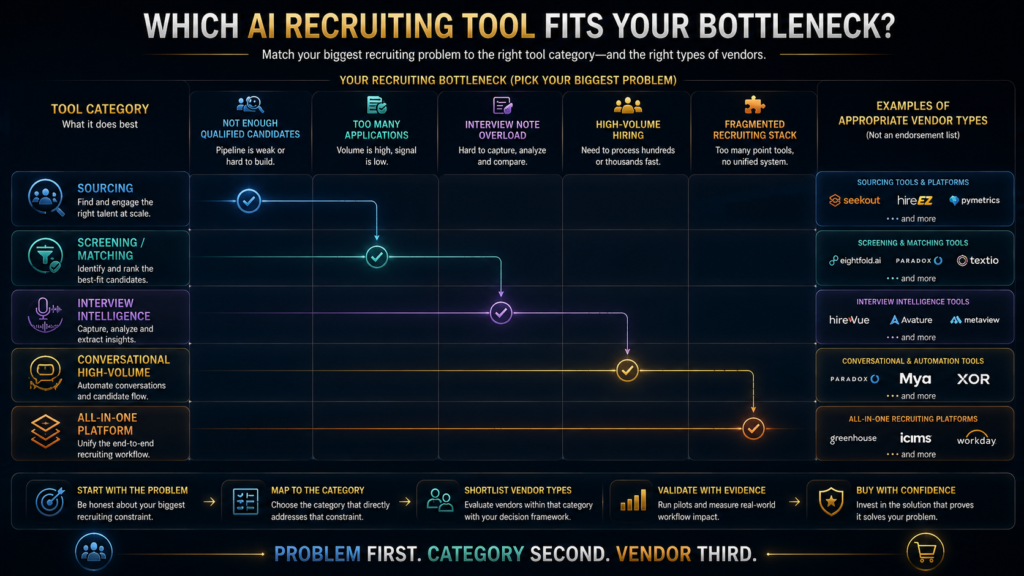
A ranked list is useful only after you identify what is failing. If qualified candidates are scarce, sourcing depth and outreach matter. If relevant applicants already arrive but decisions stall, application review, scheduling, interview evidence or hiring-manager coordination may create more value than another database.
| Observed bottleneck | Best category | First shortlist | Proof to require in a pilot |
|---|---|---|---|
| Too few qualified prospects | Sourcing and CRM | Gem, hireEZ, SeekOut | Relevant slate rate, verified contact rate, recruiter review time |
| Too many inbound applicants | Matching and structured review | Greenhouse, Ashby, SeekOut | Recall across qualified applicants, override quality, review consistency |
| Candidate drop-off before interview | Conversational hiring | Paradox, iCIMS, Workday | Completion rate, exception handling, accommodation path |
| Scheduling consumes recruiter capacity | Scheduling automation | Ashby, Paradox, iCIMS | Time to confirmed interview, reschedule rate, manual exceptions |
| Interview notes are late or inconsistent | Interview intelligence | Metaview, Greenhouse, Ashby | Scorecard completion, correction rate, consent compliance |
| External and internal talent are disconnected | Talent intelligence | Eightfold, Workday | Skills data quality, internal-match adoption, explainability |
| Recruiting stack is fragmented | All-in-one platform | Ashby, Greenhouse, iCIMS | Workflow coverage, integration retirement, administrator effort |
The AHW Recruiting Automation Decision-Rights Matrix
The central governance question is not simply whether AI is present. It is what the system may do, what evidence it uses, who reviews the output, and which person remains responsible for an employment decision. AI can reduce administrative work while the employer retains the decision right.
This matrix is an editorial control model, not legal advice. It adapts documented product capabilities to a practical hiring workflow and aligns them with the need for job-related criteria, human review, candidate notice, accommodations and retained evidence. Organizations should have counsel assess the laws that apply to their locations and use cases.
Five stages, five explicit decision rights
- Define: AI may draft the job and rubric; an accountable hiring leader approves job-related criteria.
- Discover: AI may search and recommend; a recruiter validates sources, eligibility and relevance.
- Screen: AI may organize evidence and flag matches; an authorized person owns advance or rejection decisions.
- Evaluate: AI may capture and summarize interviews; interviewers verify facts and complete scorecards independently.
- Decide: AI may assemble the record; the employer makes, documents and can explain the final decision.
| Hiring stage | Appropriate AI assistance | Human decision right | Evidence to retain |
|---|---|---|---|
| Job definition | Draft descriptions, suggest competencies, summarize intake | Approve essential functions and job-related criteria | Approved rubric, version history, named owner |
| Sourcing | Search, match, rediscover and draft outreach | Approve target criteria, sources and contact policy | Search criteria, source provenance, outreach rules |
| Screening | Parse applications, organize evidence and rank for review | Advance, reject or override with a documented reason | Input criteria, output, reviewer action, exception record |
| Interviewing | Schedule, transcribe, summarize and map notes | Verify evidence and submit an independent scorecard | Consent, transcript policy, corrections, completed rubric |
| Selection | Aggregate evidence and identify missing information | Make and explain the employment decision | Decision rationale, approvals, accommodation handling |
Recommendations by company type
For a startup hiring its first recruiting team
Choose a system that establishes clean candidate records and a repeatable interview process before adding several AI point tools. Ashby deserves the first look when a growing company wants a modern all-in-one platform, while Greenhouse is attractive when leaders are committed to structured scorecards and expect a large integration ecosystem. Avoid an enterprise talent-intelligence project unless internal mobility and workforce data are already strategic priorities.
A startup can also remain deliberately modular. A simple ATS plus Metaview may solve the immediate documentation problem, or a sourcing layer may be justified for a few hard-to-fill roles. The rule is to buy the smallest system that fixes the current constraint without creating data debt that must be unwound six months later.
For a mid-market company with a stable ATS
Do not replace the system of record merely to acquire an AI feature. Map the stage where recruiter capacity disappears, then consider Gem for pipeline and CRM work, SeekOut or hireEZ for sourcing, Paradox for high-volume candidate flow, or Metaview for interviews. A modular purchase succeeds when candidate identities, stage changes, notes and permissions synchronize reliably with the ATS.
The integration demonstration should show a complete record moving both ways, including an edited field, an exception and a duplicate. Ask who supports the connector when either vendor changes an API. A feature that saves ten minutes but creates reconciliation work for recruiting operations is not automation; it is work moved out of view.
For a high-volume hourly employer
Candidate response speed, mobile completion and scheduling are usually more important than complex passive-talent search. Paradox should lead the shortlist, with iCIMS and Workday considered when they align with the broader enterprise stack. Test the complete candidate path on real devices and in relevant languages, including a reschedule, an accommodation request and a handoff to a recruiter.
Speed can become a misleading success metric if people abandon the process or cannot reach a human. Track qualified completion, not chat volume. Review which screening answers trigger a stop, whether those criteria are necessary for the role and how quickly an exception reaches an accountable person.
For a global enterprise
Workday, Eightfold and iCIMS can justify their complexity when the organization needs global permissions, multiple brands, internal mobility, workforce intelligence and integrations across HR systems. Greenhouse and Ashby may still fit enterprise recruiting teams, but the decision should follow architecture, residency, security, auditability and operating-model requirements rather than company size alone.
Global deployment should not assume one configuration is lawful or effective everywhere. Local teams need a controlled way to adjust notice, consent, retention, language and review practices without fragmenting governance. Establish a global minimum control set, name regional owners and record where workflows differ and why.
AI recruiting compliance: what employers cannot outsource
A vendor can provide documentation, audit support and product controls, but the employer still chooses how the system is used. The U.S. Equal Employment Opportunity Commission’s AI and ADA resources make clear that employment technology can create discrimination risk, including when a tool disadvantages a person with a disability or fails to provide a reasonable accommodation path.
New York City’s Automated Employment Decision Tools rules require covered tools to have a recent bias audit, public audit information and specified notices before use. Whether a particular workflow meets the legal definition depends on how the tool functions and is used, so a marketing label such as “assistant” or “copilot” should never replace a use-case assessment.
Governance should begin before procurement. Create a data map, define the employment decisions the product may influence, document job-related criteria, design an accommodation route, specify human review and set monitoring thresholds. AI Hustle World’s guide to AI governance explains how ownership, controls and evidence fit together, while our comparison of AI compliance tools can help teams evaluate supporting monitoring systems.
Six controls to require before launch
- Job-related criteria: define the competencies, qualifications and evidence before the system reviews candidates.
- Candidate notice: explain where required how automation is used and what data it processes.
- Accommodation and alternative route: give candidates a usable way to request support or another assessment method.
- Human review: assign named owners for recommendations, overrides, rejections and exceptions.
- Data controls: document sources, permissions, retention, deletion, model-improvement use and cross-border transfers.
- Monitoring: review selection patterns, false negatives, overrides, complaints, accessibility and workflow drift at a defined cadence.
Pricing: calculate total recruiting-system cost, not license price
Most enterprise recruiting vendors use custom pricing based on company size, recruiter seats, hiring volume, modules, integrations and service level. A quote may also separate implementation, data migration, premium support, candidate messaging, background services, AI usage or professional services. That is why unverified per-month estimates create false precision.
A more useful calculation is annual subscription + implementation + integration work + data migration + internal administration + human review + governance and audit work − retired software and recovered labor capacity. The result is not a guaranteed ROI figure; it is a complete cost boundary that prevents a cheap license from disguising an expensive operating model.
| Cost category | Questions for the vendor | Internal evidence |
|---|---|---|
| License and usage | What changes with seats, jobs, messages, interviews or AI credits? | Expected users and transaction volume |
| Implementation | Which services are mandatory and what is excluded? | Process owners, timeline and dependency plan |
| Integration | Which connectors are native, paid or partner-maintained? | System map and interface owner |
| Data | How are imports, exports, deletion and model use handled? | Retention schedule and data inventory |
| Human review | Which outputs require verification or exception handling? | Review minutes per requisition or candidate |
| Governance | What audit, accessibility and impact-assessment support exists? | Legal review and monitoring cadence |
| Exit cost | What data and configurations can be exported at termination? | Migration and continuity plan |
How to pilot an AI recruiting tool without manufacturing a success story
A good pilot compares a defined workflow before and after the tool, while keeping the hiring standard stable. Do not start by asking whether recruiters “like the AI.” Start with a measurable constraint, such as late scorecards, scheduling delay, unreviewed applicants, low qualified-outreach response or repeated manual data entry.
Select a bounded group of roles and create the baseline before configuration. Record volume, completion time, reviewer effort, exception rate, candidate drop-off and the quality checks relevant to the stage. The pilot should include normal cases and edge cases, because automation that succeeds only on clean examples will create hidden labor in production.
The five-gate recruiting AI pilot
- Baseline: Measure the current bottleneck before introducing the tool.
- Bound: Define the roles, locations, users and decisions included in the pilot.
- Control: Approve the criteria, review rights, candidate notice and accommodation process.
- Compare: Measure output quality, human effort, exceptions and candidate impact against the baseline.
- Decide: Expand, revise or stop the workflow using thresholds agreed before launch.
Define the stop conditions before the pilot begins. Examples include an unacceptable false-negative pattern, inability to explain a recommendation, poor accommodation handling, missing deletion controls, a correction burden that exceeds the time saved, or an integration failure that creates duplicate candidate records. A failed pilot is useful when it prevents an expensive contract.
Metrics that reveal value rather than activity
Sourcing teams should measure qualified slate rate, validated contact rate, positive reply quality and recruiter review minutes—not the number of profiles returned. Screening teams should examine whether qualified applicants remain visible, how often reviewers override recommendations, and whether patterns differ across relevant candidate groups.
Scheduling and conversational systems should be judged by completed next steps, time to confirmation, abandonment and successful exception resolution. Interview tools should be judged by timely scorecard completion, factual correction rate, interviewer effort and whether the final record contains job-related evidence rather than polished but vague summaries.
Questions to ask every AI recruiting vendor
The sales demonstration should reproduce your workflow with your criteria, integrations and edge cases. A scripted demo can show interface quality; it cannot prove that the system fits your data, decision rights or candidate population. Send the questions in advance and request written answers that can become part of procurement evidence.
- Which exact actions can the AI take, and which require a person’s approval?
- What candidate, employee, public-web and customer data influence recommendations?
- Can administrators inspect, correct and export the inputs and outputs?
- How are job-related criteria configured, versioned and approved?
- What evaluation, accessibility, bias-audit or impact-assessment materials are available?
- How does the product handle accommodation requests and alternative workflows?
- Are customer data or candidate data used to train shared models, and can that use be disabled?
- What are the retention, deletion, subprocessors and cross-border transfer arrangements?
- Which ATS, HRIS, calendar, email and identity integrations are native, and who maintains them?
- What usage, messaging, AI, implementation, support and renewal charges sit outside the base quote?
- How are outages, low-confidence outputs and unsupported cases routed to people?
- What data and configuration can the customer export if the contract ends?
Common mistakes when buying AI recruiting software
Buying a category before defining the problem
A sourcing tool cannot repair slow interviewer feedback, and an interview notetaker cannot create a qualified talent pool. When the team begins with “we need AI,” vendors control the problem definition. A written bottleneck statement keeps the shortlist honest.
Treating ranking as decision-making
A ranked list compresses different trade-offs into one order. Use it to decide what deserves investigation, then examine the underlying dimensions. A lower-cost specialist can be a better purchase than a broader platform if it fits the constrained workflow and avoids migration.
Automating vague criteria
AI makes an unclear hiring process faster, not clearer. If “culture fit,” “leadership presence” or an inflated credential list drives the rubric, a ranking system can scale those ambiguities. Define observable, job-related evidence before configuring prompts, filters or matching rules.
Ignoring the residual human workload
Every automated workflow leaves work behind: reviewing recommendations, fixing notes, resolving duplicate records, handling opt-outs, explaining outcomes and managing exceptions. The tool has not saved time if those tasks move to a less visible queue. Measure the residual work during the pilot.
Allowing a pilot to become permanent by inertia
Pilots often continue because users have been trained and data has accumulated, even when success criteria were never met. Set an end date, decision owner and minimum evidence threshold. Expansion should be an explicit decision, not the absence of a cancellation.
From AI feature to recruiting operating layer
The market is moving from isolated helpers toward agents that can coordinate several steps. That shift increases possible value, but it also increases the surface area of mistakes. A drafting feature can produce poor text; an agent with permissions can contact candidates, change records or trigger a workflow before someone notices.
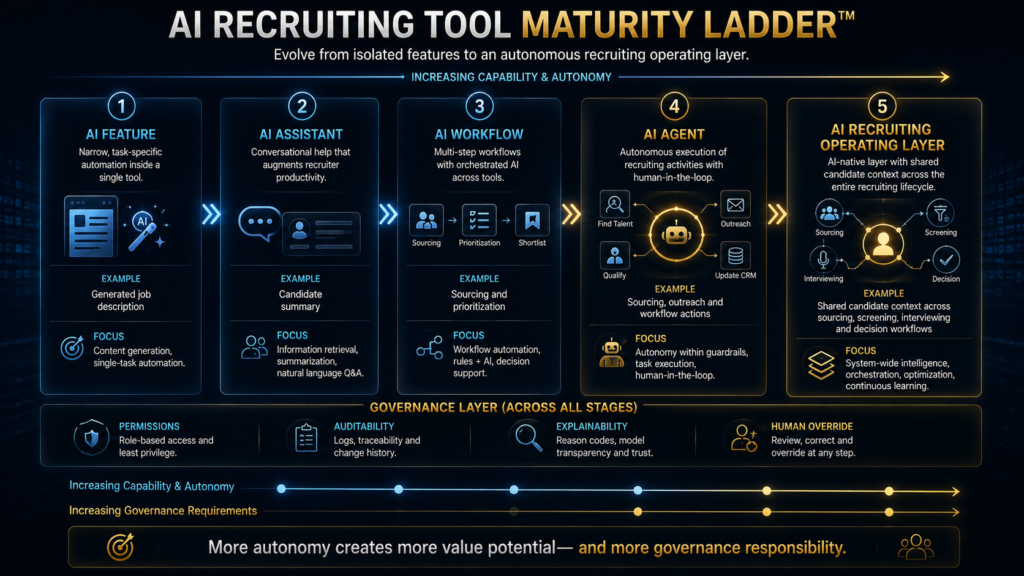
A sensible maturity path begins with assistive work that is easy to verify, such as drafting or note organization. It then moves to recommendations, coordinated workflows and limited agentic action with approval gates. Full process redesign comes last, after the organization can show that criteria, data, monitoring and human accountability work under real conditions.
Final thoughts
The best AI recruiting tools in 2026 do not belong in one universal ranking. Ashby and Greenhouse are credible system-level choices for different operating philosophies; Gem, hireEZ and SeekOut strengthen sourcing and pipeline work; Paradox removes high-volume candidate friction; Metaview improves interview documentation; and Eightfold, Workday and iCIMS serve more complex enterprise talent environments.
Your decision should connect one bottleneck to one measurable pilot. Keep employment criteria human-approved, make automated influence visible, verify material outputs and record who owns every consequential decision. The winning product is not the one that automates the most steps; it is the one that produces better recruiting evidence with acceptable cost, risk and residual effort.
Build the controls before you automate hiring
Use our practical AI governance guide to assign decision rights, evidence, monitoring and accountability before an AI recruiting pilot goes live.
Read the AI Governance Guide →Frequently asked questions
What is the best AI recruiting tool overall?
Ashby is the strongest general recommendation for a scaling company that wants a modern ATS, CRM, scheduling and analytics platform in one system. Greenhouse is a better choice when structured hiring and explicit decision governance are the priority, while enterprise buyers may need Workday, Eightfold or iCIMS because of existing architecture and global complexity.
Which AI recruiting tool is best for sourcing candidates?
Gem, hireEZ and SeekOut are the leading sourcing shortlist in this comparison. Gem is strong for CRM-led pipeline development around an ATS, hireEZ emphasizes multi-step agentic outbound work, and SeekOut is compelling for specialist talent pools and rediscovery. Pilot them on the same roles with the same criteria.
What is the best AI recruiting software for small businesses?
A small business should avoid buying an enterprise talent-intelligence suite before it has a stable hiring process. Ashby’s startup offering can make sense for a growing company that needs a system of record, while Metaview can be a lower-disruption option for interview-heavy teams. The best value depends on whether the bottleneck is platform, sourcing, scheduling or documentation.
Can AI recruiting tools reject candidates automatically?
Some systems can automate screening actions depending on configuration, but technical capability does not answer whether the workflow is lawful or appropriate. Employers should understand what data influences the action, validate job-related criteria, provide required notices and accommodations, monitor outcomes and retain accountable human oversight.
Are AI recruiting tools legal?
AI recruiting tools are not categorically illegal, but their use can trigger existing employment, disability, privacy and discrimination obligations as well as AI-specific rules. Requirements vary by jurisdiction and use case. Employers should obtain legal advice for their workflow rather than relying on a vendor’s general compliance statement.
How can employers reduce bias in AI hiring?
Begin with a job analysis and observable criteria, then examine the data and logic used by the tool. Test relevant outcomes, provide accommodation and alternative routes, review overrides and complaints, and monitor the live workflow for drift. A vendor audit can support this work, but it does not transfer the employer’s responsibility.
Should a company replace its ATS to get AI recruiting features?
Not automatically. If the ATS is stable and the bottleneck is sourcing, interview notes or scheduling, a specialist layer can create value with less migration risk. Replace the ATS when workflow fragmentation, reporting limitations, administration or integration constraints are the real problems and the organization is prepared for process change.
How much do AI recruiting tools cost?
Pricing ranges from free entry plans for focused products to custom enterprise contracts for full recruiting suites. Many vendors price by company size, users, modules, hiring volume or usage. Calculate implementation, integrations, migration, internal administration, review work and governance alongside the subscription.
What should an AI recruiting pilot measure?
Measure the constrained stage: qualified slate rate for sourcing, coverage and override quality for screening, completion and exception rates for scheduling, and correction plus scorecard completion for interview tools. Include candidate impact, accessibility, human review time and data-control failures rather than measuring activity alone.
Will AI replace recruiters?
AI can absorb searches, drafting, coordination, transcription and routine analysis, which changes how recruiter time is allocated. It does not remove the need to define roles, assess evidence, build candidate trust, resolve exceptions, advise hiring managers and own employment decisions. The more consequential the action, the more explicit accountability must become.
Editorial note: Product capabilities and published pricing structures were reviewed in September 2026 using official vendor materials. AI Hustle World did not accept payment for these rankings. This is a public-source commercial evaluation, not a claim of hands-on testing or measured hiring outcomes. Always confirm current features, contract terms and legal requirements before purchase.
Related Guides
- How AI Finds and Screens Candidates (Without Bias)
- How AI Interviewing Works: Screening, Scheduling and Structured Evaluation
- AI in HR & Recruiting Explained: How AI Is Changing Talent Operations
Written by
Muntasir Ahmad Chowdhury
Founder-AI Hustle World
Muntasir Ahmad Chowdhury is the Founder of AI Hustle World, an independent publication dedicated to making Artificial Intelligence practical, trustworthy, and easy to understand. He researches AI tools, automation, customer service, productivity, and real-world business applications, helping readers make smarter technology decisions through research-driven, experience-backed content.
Expertise:
AI Tools • AI Automation • AI Customer Service • AI Productivity • Generative AI • AI Workflows
Get Smarter With AI
Enjoyed this guide? Get practical AI tools, tutorials, and honest reviews delivered to your inbox.