Evidence: Documentation reviewed
Last checked: August 2026
What was done: Written from official documentation and the published sources linked in this article. Not hands-on tested.
Files: None
Affiliate links: No
How AI Finds and Screens Candidates (Without Bias)
AI Can Find 1,000 Candidates. The Recruiter Still Has to Know Which 20 Matter.
A recruiter opens a new requisition for a genuinely difficult role. The hiring manager wants eight years of experience, a specific technical skill set, industry knowledge, leadership experience, and an unusually narrow combination of capabilities that rarely appears in one resume. Within days, hundreds of applications arrive, and the recruiter faces a choice: spend hours manually opening every resume, or let AI process the first layer.
Modern recruiting AI can search candidate databases, rediscover previous applicants, parse resumes, extract skills, organize candidate evidence, prioritize applications, answer routine candidate questions, draft outreach, and automate parts of the screening workflow. That sounds like the beginning of full automation, and vendors often market it that way. In practice, it is closer to the opposite: AI’s real contribution is narrowing 1,000 candidates down to a manageable, well-evidenced shortlist — and the recruiter’s judgment about which 20 of those actually matter becomes more valuable, not less, once the noise is gone.
Sourcing vs. Screening: Two Different Bottlenecks
“AI recruiting” gets used as a single term for two genuinely different problems. Candidate sourcing asks a discovery question: out of everyone who could theoretically do this job, who exists and how do we find them? Candidate screening asks an organizing question: out of everyone who already applied, who is worth a recruiter’s limited time to review deeply?
Imagine 500,000 people exist in a relevant talent ecosystem, but only 300 of them are genuinely relevant to this specific role — sourcing tries to find those 300. Now imagine 300 applications arrive for one open position and the recruiter only has time to deeply review 40 of them — screening tries to help organize and prioritize that pool. These are different bottlenecks with different failure modes, and a tool built for one does not automatically solve the other.
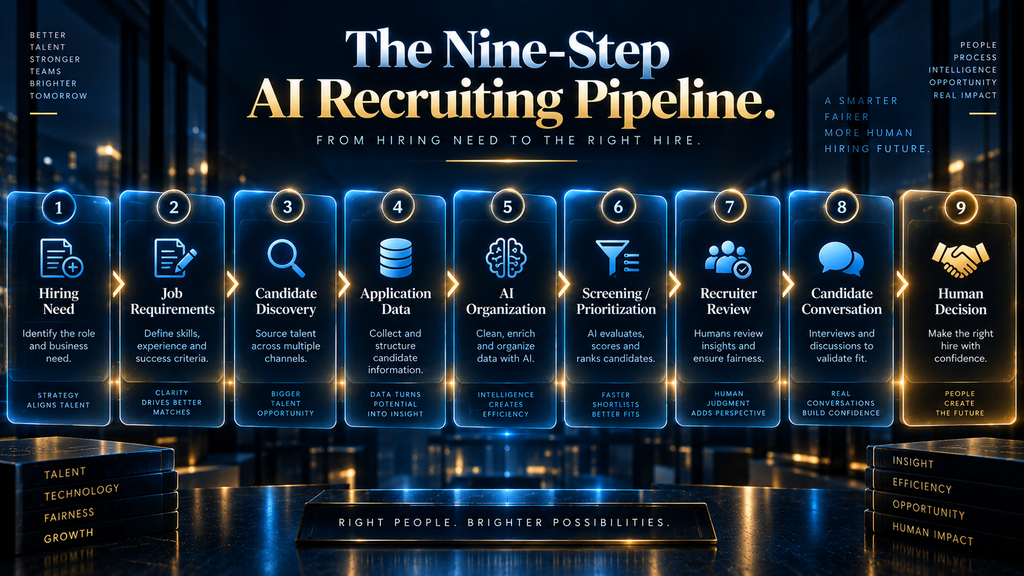
The Nine-Step AI Recruiting Pipeline
Stripped down to its actual mechanics, the recruiting workflow AI operates inside looks like a fairly simple pipeline, and understanding where AI sits in it is more useful than any individual vendor’s feature list.
- Hiring Need
- Job Requirements
- Candidate Discovery
- Application / Profile Data
- AI Organization
- Screening / Prioritization
- Recruiter Review
- Candidate Conversation
- Human Decision
AI’s real contribution sits primarily in the middle of this pipeline — organizing data and helping prioritize who gets reviewed first. The recruiter remains critical at both edges: translating a hiring manager’s vague wish list into real requirements at the start, and making the actual hire, reject, or advance decision at the end. Nothing about this pipeline changes when AI gets added — what changes is how much noise the recruiter has to wade through before reaching the parts only a human can do.
Why Recruiting Became One of AI’s First HR Use Cases
Recruiting was an early, natural target for AI adoption because it combines high volume, repeatable workflows, and outcomes that are relatively easy to measure — time to fill, applications per hire, response rates. Per iCIMS’ research on AI adoption in talent acquisition, a large majority of talent acquisition teams have already adopted some form of AI in their hiring process, and the trend has only accelerated as large language models became capable of handling unstructured resume data far better than the keyword-matching systems that preceded them.
That volume-and-repeatability combination is exactly what made recruiting attractive to AI vendors first, ahead of most other HR functions. It is also exactly why recruiting is where the risk of over-trusting automation shows up first and most visibly — a screening error at scale doesn’t just waste one recruiter’s afternoon, it can quietly filter out qualified candidates across thousands of applications before anyone notices the pattern.
What AI Actually Does at Each Stage
Rather than one monolithic “AI recruiting” capability, what’s actually happening at the screening stage breaks into three distinct jobs, followed by three points where a human is still doing something AI cannot fully replace.
AI organizes
Structuring unstructured resume and application data — normalizing job titles, extracting skills and years of experience, and making a messy pile of PDFs and LinkedIn profiles queryable.
AI prioritizes
Ranking or grouping candidates against the requirements of a specific role, surfacing the applications most worth a recruiter’s limited attention first rather than processing them in the order they arrived.
AI explains
Showing the evidence behind a ranking or flag — which resume lines, which stated skills, which experience matched which requirement — rather than handing back an opaque score with no reasoning attached.
Recruiter reviews
Applying judgment AI cannot replicate: reading between the lines of a nonlinear career path, weighing a compelling but unconventional background, catching context a resume parser would miss entirely.
Candidate conversation
An actual human conversation, where tone, motivation, and fit questions that no resume can answer get resolved directly.
Human decision
The hire, reject, or advance call, made by a person accountable for it — not a model output accepted uncritically.
The failure mode worth naming directly: treating the first three steps as if they were the last three. An AI ranking is not a hiring decision, an AI-flagged skill match is not proof of fit, and an AI-generated shortlist is a starting point for recruiter judgment, not a replacement for it.
The Evidence Framework: Explicit, Inferred, and Missing Evidence
One of the more useful mental models for evaluating any AI screening output is sorting what it found into three categories, because each category deserves a different level of trust.
Explicit evidence
Something the candidate stated directly and verifiably — a certification listed, a specific tool named, a job title held for a specific duration. This is the strongest category and the one AI extracts most reliably.
Inferred evidence
Something the model concluded from pattern-matching rather than a direct statement — inferring seniority from job titles across different companies with different title conventions, or inferring a skill from adjacent experience. This category is useful but should be treated as a hypothesis for a recruiter to verify, not a fact.
Missing evidence
A requirement the resume simply doesn’t address one way or the other. AI systems vary widely in how honestly they handle this category — a well-designed system flags a gap as “unknown,” while a poorly designed one silently treats it as a negative signal, which is exactly the kind of quiet, hard-to-audit bias that causes real problems.
A recruiter reviewing any AI-assisted shortlist should be able to see which category each piece of evidence falls into. A tool that presents inferred and missing evidence with the same confidence as explicit evidence is hiding the exact information a recruiter needs to apply judgment correctly.
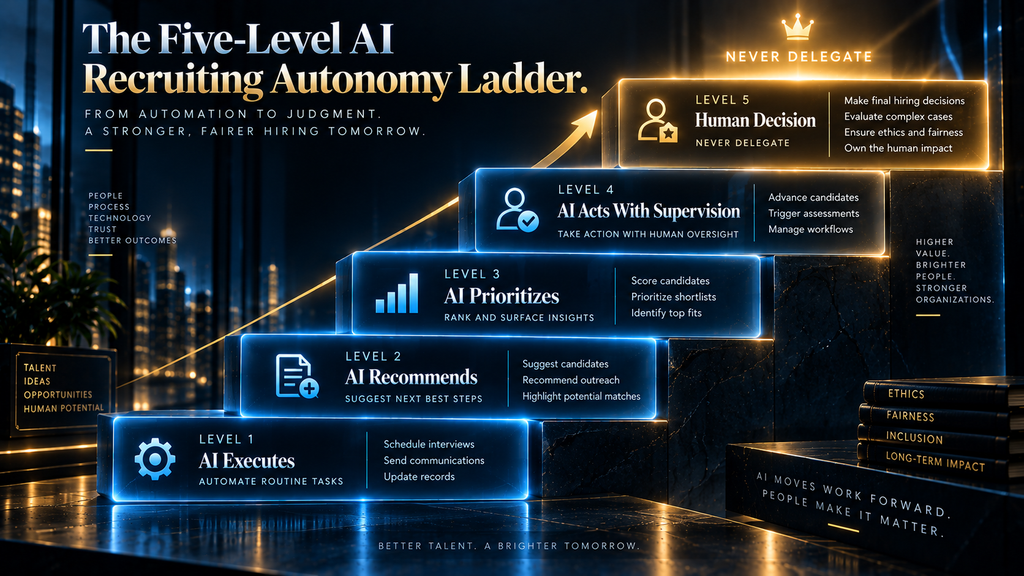
The Five-Level AI Recruiting Autonomy Ladder
Not every AI recruiting capability deserves the same amount of trust, and thinking in levels helps clarify where a given tool actually sits.
- Level 1 — AI Executes. Fully autonomous, low-risk data tasks: parsing a resume, extracting skills, deduplicating candidate records. Errors here are cheap to catch and fix.
- Level 2 — AI Recommends. AI suggests a next action — a candidate to consider, an outreach message to send — but takes no action itself.
- Level 3 — AI Prioritizes. AI reorders or ranks a queue of candidates for human review, without removing anyone from that queue.
- Level 4 — AI Acts With Supervision. AI takes a limited, reversible action — scheduling an interview, sending a templated update — inside boundaries a human has pre-approved.
- Level 5 — Human Decision. The hire, reject, or advance-to-offer decision. This level should never be delegated to AI, regardless of how mature the system is.
Most of the controversy around “AI recruiting bias” traces back to tools that quietly operate at Level 5 while being marketed as Level 2 or 3 — auto-rejecting candidates below a score threshold without a human ever seeing them, which collapses the ladder into a single unsupervised decision. Knowing which level a specific feature actually operates at, not what the vendor calls it, is the single most useful question in any evaluation.
What the Research Actually Shows
Per iCIMS’ research on AI adoption in talent acquisition, AI use in recruiting has moved well past early-adopter status and into mainstream practice across talent acquisition teams, with sourcing and resume screening among the most commonly automated tasks. SHRM’s Recruiting Executives Priorities & Perspectives 2026 report similarly points to AI-assisted screening and candidate matching as top priorities for recruiting leaders heading into this year, alongside a persistent concern about candidate experience and fairness in automated processes.
That second point deserves equal weight to the first. SHRM has separately published research and commentary warning specifically about recruiters’ overdependence on algorithmic hiring tools — the pattern where a system’s ranking gets treated as a verdict rather than an input, and recruiters stop applying the independent judgment the system was supposed to support rather than replace. The research consensus, in other words, isn’t “AI screening works” or “AI screening doesn’t work” — it’s that the outcome depends heavily on whether the humans in the loop keep functioning as a real check.
The Triage Model: Clear Fits, Borderline Fits, Clear Non-Fits
A useful way to think about what AI screening should actually output is three groups rather than one ranked list.
Group A — Clear fits
Candidates whose explicit evidence strongly matches the role’s core requirements. These deserve fast-tracked recruiter review, not automatic advancement.
Group B — Borderline fits
Candidates with a mix of explicit, inferred, and missing evidence — often where the most interesting nontraditional candidates end up, and where recruiter judgment adds the most value relative to what a score alone could tell you.
Group C — Clear non-fits
Candidates missing multiple hard requirements with no compensating evidence. Even here, a spot-check by a recruiter on a sample of this group is worth the time — it is the fastest way to catch a systematic error in how the model is evaluating evidence before it filters out qualified people at scale.
The mistake most AI recruiting deployments make is treating Group A as “advance automatically” and Group C as “reject automatically” without ever auditing either automated boundary. Group B is where a well-designed system actually earns its keep, by giving a recruiter organized, evidence-tagged material for exactly the candidates that need the most human judgment.
Nontraditional Candidates and Transferable Skills
AI screening has a well-documented weak spot: candidates whose background doesn’t map cleanly onto a job description’s literal keywords. A career-changer with deeply relevant transferable skills, a candidate with nontraditional education, or someone whose experience spans unconventional job titles can all score poorly on a system that pattern-matches too literally against explicit requirements.
Nontraditional education
A candidate without a traditional four-year degree but with a bootcamp certificate, self-directed project portfolio, or equivalent experience often gets filtered by systems that treat “degree required” as a hard gate rather than one signal among several.
Transferable skills
Someone moving from a related field brings real, applicable capability that doesn’t show up as an exact keyword match — a technical program manager moving into product management, for example, carries skills a literal keyword screen will likely miss entirely. The practical fix isn’t disabling AI screening for these candidates — it’s making sure “missing evidence” (per the framework above) gets flagged as unknown rather than scored as a negative, and making sure Group B borderline candidates, where most nontraditional profiles land, get genuine recruiter attention rather than algorithmic deprioritization.
Where Bias Actually Enters an AI Recruiting System
“AI hiring bias” is usually discussed as a single, vague risk, but it tends to enter through a small number of specific, identifiable mechanisms. Historical hiring data used to train or tune a model can encode who got hired in the past, not who should get hired going forward — a pattern that quietly replicates historical underrepresentation if left unchecked. A single model applied uniformly across very different roles can penalize candidates whose backgrounds simply look different from whatever pattern the model learned as “typical,” even when that difference has nothing to do with actual job fit.
SHRM’s commentary on recruiters’ overdependence on algorithmic hiring makes a related point worth stating plainly: bias risk isn’t only a property of the model — it’s also a property of how much independent scrutiny the humans using it are still applying. A well-designed system with a disengaged reviewer produces the same bad outcome as a poorly designed one.
The Audit Trail Requirement Most Teams Underestimate
Every candidate an AI screening system touches generates a decision that needs to be reconstructable later: what evidence the system found, how it classified that evidence, what ranking or flag resulted, and who reviewed it. This isn’t optional documentation — per the EEOC guidance discussed earlier, if a disparate-impact claim ever gets raised, “we don’t have records of how the system evaluated that candidate” is not a defensible position.
The practical implication is that audit-trail completeness deserves the same weight in a vendor evaluation as accuracy or speed. A system that can’t show, candidate by candidate, why it did what it did is a compliance liability regardless of how well it performs on the easy cases — worth confirming during procurement, not discovering during an actual complaint or audit.
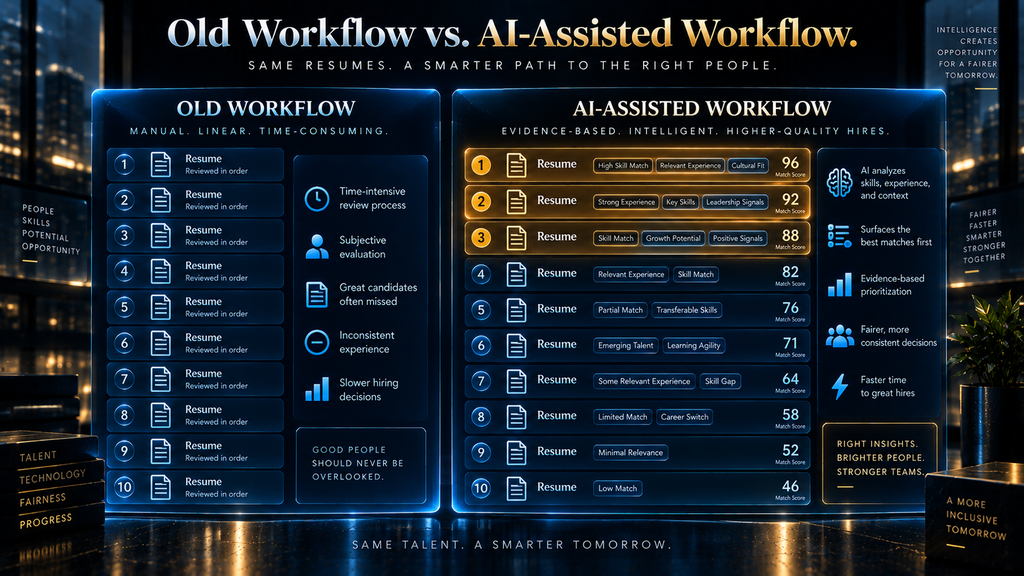
Old Recruiter Workflow vs. AI-Assisted Workflow
Old recruiter workflow
Every application gets opened in roughly the order it arrived. The recruiter reads each resume cold, forms a first impression, and decides whether to advance it — a process that scales linearly with volume, meaning a role that gets 3x the applications takes roughly 3x the screening time, with no guarantee the best candidates get reviewed first.
Better AI-assisted workflow
Applications get organized and evidence-tagged before a recruiter opens any of them. The recruiter’s time gets spent on the candidates most likely to be relevant first, with AI-surfaced evidence — not just a score — attached to each one, and the recruiter still reviews every application that reaches a real threshold rather than only the algorithmically top-ranked handful.
The distinction that actually matters here is not “AI screens, human doesn’t” — it is “AI organizes what gets reviewed first and what evidence comes with it, but a human still reviews everything above the relevance threshold.” A workflow where AI silently rejects candidates a recruiter never sees is a fundamentally different, much riskier system than one where AI reorders the queue.
The Legal and Compliance Layer
AI-assisted screening doesn’t operate in a legal vacuum. The EEOC’s guidance on employment tests and selection procedures applies to algorithmic screening tools the same way it applies to any other selection method — an AI system that has a disparate impact on a protected group can create legal exposure regardless of whether that impact was intended, and “the vendor built the model” is not a defense employers can rely on.
A handful of jurisdictions have gone further with AI-specific requirements — audit obligations, candidate notification requirements, and restrictions on fully automated rejection decisions are becoming more common at the state and local level, not less. The practical implication for any company deploying AI screening is that legal and compliance should be involved in the vendor evaluation, not looped in after a tool is already live — the EEOC guidance above is a reasonable floor to evaluate any vendor against, not a ceiling.
ATS-Native AI vs. Standalone Screening Platforms
Once a company decides to add AI to its screening process, the first real decision is whether to use the AI capability already built into the applicant tracking system (ATS) or bring in a dedicated, standalone screening platform layered on top of it.
When ATS-native makes sense
If your ATS deployment is fairly standard and hiring volume is moderate, native AI screening inherits your existing candidate data, permissions, and compliance configuration without a separate integration project. It also avoids creating a second system that has to stay synchronized with your system of record for every candidate.
When a standalone platform makes sense
Standalone screening and sourcing platforms tend to move faster on AI capability, since it’s their core product rather than one feature among many in a broader ATS. They often offer stronger evidence-extraction and candidate-rediscovery capability than an ATS vendor’s built-in tools. The tradeoff is a real integration project, another vendor relationship, and another system that needs its own audit-trail and compliance review.
In practice, many talent acquisition teams run ATS-native AI for standard, high-volume roles and add a standalone tool only for specialized sourcing or screening needs the native tool handles poorly — a hybrid approach that adds complexity but avoids forcing every role through one tool’s weakest capability.
Twelve Questions to Ask Before You Buy an AI Screening Tool
Vendor demos are optimized to look impressive on the easiest cases. The questions below are designed to surface what happens on the hard ones.
- What exactly does the AI evaluate — resume text only, or other signals too?
- What data trained or influences the model, and how current is it?
- Can recruiters see why a specific candidate was prioritized or deprioritized?
- Can recruiters override the system’s recommendations without friction?
- How are historical biases in training data identified and tested for?
- How are accessibility needs and accommodation requests handled in the process?
- Does the system produce an auditable record of what happened to every candidate?
- Where, precisely, does AI stop and human judgment begin in this product?
- Can the system be technically restricted from making final advance/reject decisions?
- How does the system handle nontraditional candidates and missing-evidence cases?
- What happens to a candidate’s data if the contract ends?
- What is the vendor’s track record on a disparate-impact audit, if one has been done?
A vendor that cannot answer the audit-trail and override questions specifically, with a live example rather than a marketing answer, is a governance risk regardless of how strong its matching accuracy looks in a sales demo.
What AI Should Not Be Trusted to Decide Alone
Applying the autonomy ladder from earlier in this guide directly: final reject decisions, final advance-to-offer decisions, and any action that removes a candidate from consideration without a human ever seeing their application belong at Level 5, full stop. Everything below that — organizing, prioritizing, flagging, drafting — can reasonably sit at Level 1 through 4 with appropriate supervision.
The specific configuration worth checking in any AI recruiting tool: does the system technically allow fully automated rejection below a score threshold, even if your company doesn’t currently use that setting? A capability that exists but is switched off today is one policy change away from becoming a live risk, and it’s worth confirming during procurement whether that capability can be disabled entirely rather than just left unused.
A 90-Day Rollout Plan for AI Recruiting Screening
Days 1-30 — Define the Bottleneck
Before evaluating any tool, identify precisely which bottleneck you’re solving — sourcing, screening, or both — since they call for different capabilities. Document your current time-to-shortlist, application volume per role, and where recruiters currently spend the most low-value time. This baseline is what proves ROI later.
Days 31-60 — Pilot
Run the tool against a limited set of real, already-closed requisitions where you know who was actually hired, and compare the AI’s Group A/B/C triage against the real outcome. This retrospective test surfaces evidence-handling problems — especially around nontraditional candidates — before the tool touches a live requisition with real candidates waiting on a decision.
Days 61-90 — Measure
Expand to live requisitions with a recruiter reviewing every candidate above the relevance threshold, not just the algorithmically top-ranked few, and track both efficiency metrics (time to shortlist) and quality metrics (interview-to-offer rate, hiring manager satisfaction with the shortlist) side by side. A tool that improves the first number while quietly degrading the second is not actually working.
Signs Your Team Is Ready to Expand AI Screening Coverage
Pushing AI screening coverage to more roles too quickly is a more common failure than moving too slowly. A few concrete signals suggest a team is genuinely ready to expand beyond an initial pilot.
The override rate on the pilot roles has stabilized at a level recruiters can explain — not zero, since some independent judgment should always be visible, but not so high that the tool isn’t adding value either. Nontraditional and transferable-skills candidates are showing up in Group B at a rate that looks reasonable against your own hiring history, not silently vanishing into Group C. Hiring managers report the shortlist quality holds up, not just the shortlist speed. And at least one edge case — a genuinely borderline or unusual candidate — has been correctly surfaced by the system during the pilot, proving its evidence handling holds up on a real hard case, not only on clean, obvious matches.
If those signals aren’t all true yet for a given role category, extending the pilot is the better move — a slower expansion that keeps recruiter trust intact outperforms a fast one that has to be walked back after a hiring manager complaint or a missed strong candidate.
Twelve Mistakes Companies Make Automating Recruiting
- Automating before defining “qualified.” If the humans on the hiring team can’t agree on what a strong candidate looks like, an AI model trained on ambiguous signals will produce ambiguous, inconsistent results.
- Optimizing for candidate volume. More applications processed per hour is not the same as better hires — this metric alone can reward a system for casting the widest net rather than the most accurate one.
- Treating AI scores as truth. A ranking is an input to recruiter judgment, not a verdict, and treating it as the latter is how quiet bias compounds unnoticed.
- Ignoring explanations. A score without the evidence behind it can’t be sanity-checked by a recruiter or defended in an audit.
- Letting historical hiring patterns define the future. A model trained purely on who got hired before will reproduce that pattern, including whatever bias shaped it.
- Using one model for every role. A single scoring approach across wildly different roles — engineering versus sales versus operations — produces worse results than role-specific evaluation criteria.
- Ignoring nontraditional candidates. As covered above, this is where AI screening most reliably underperforms without deliberate correction.
- Assuming human review solves everything. A recruiter rubber-stamping AI output because the queue is long is not meaningfully different from full automation.
- Ignoring candidate transparency. Candidates increasingly expect to know when AI is involved in their evaluation, and opacity here is both a trust problem and, in some jurisdictions, a compliance gap.
- Measuring time saved without hiring quality. Efficiency gains that come with a quality cost are not actually gains.
- Giving agents excessive authority. Automated outreach or scheduling is reasonable at Level 4; automated final decisions never are, per the ladder above.
- Trusting a vendor demo. Demos are built around the easiest cases by design — the twelve-question evaluation list above is a better test than any sales presentation.
A Simple KPI Framework for Measuring Recruiting AI ROI
Time-to-shortlist and applications-processed-per-recruiter are the efficiency numbers worth tracking, but per the pilot design above, they need to be measured alongside interview-to-offer rate and hiring manager satisfaction with the shortlist quality — the quality side of the ledger. A fourth number matters more than it usually gets credit for: the rate at which recruiters override or disagree with the AI’s Group A/B/C triage. A very low override rate over time can mean the tool is well-calibrated, or it can mean recruiters have stopped applying independent judgment — the overdependence pattern SHRM has flagged — and the two look identical on a dashboard without deliberate spot-checking.
How This Differs by Company Size and Hiring Volume
High-volume hiring (retail, call centers, seasonal)
AI screening delivers its clearest, fastest payback here — hundreds of applications per role make manual review genuinely impractical, and the Group A/C boundaries can be set more aggressively since role requirements tend to be more standardized and less ambiguous.
Specialized and senior hiring
The payback is real but different in shape: less about processing volume and more about surfacing evidence a recruiter would otherwise have to dig for manually across a small number of highly qualified, hard-to-compare candidates.
Small companies and low-volume hiring
The case for dedicated AI screening tooling is weaker when a role draws 20 applications, not 2,000 — a recruiter can reasonably review all of them directly, and the tool’s main value shrinks to sourcing and organization rather than prioritization.
Common Objections to AI Recruiting Screening, Addressed
“AI screening is inherently biased.”
AI screening can be biased, and so can unstructured human screening — the research consensus isn’t that algorithms are worse than humans by default, it’s that unaudited systems of either kind drift toward bias over time. The evidence framework and Group A/B/C triage in this guide exist specifically to make that drift visible and correctable, which is harder to do with a purely human process that leaves no evidence trail at all.
“Candidates hate being screened by AI.”
Candidate sentiment is genuinely mixed and depends heavily on transparency — candidates who are told AI is involved and given a clear path to human review report far less frustration than those who suspect an opaque system rejected them with no explanation. This is a design and disclosure problem more than an inherent flaw in the technology.
“Our hiring is too specialized for AI to help.”
Even highly specialized roles generate resumes with the same underlying evidence-extraction problem — matching stated experience to specific requirements. The evidence framework above applies regardless of how niche the role is; what changes is how much weight a recruiter should put on inferred versus explicit evidence for that specific field.
What Happens If You Do Nothing
Manual-only screening doesn’t stay viable as application volume grows — and application volume has been rising steadily across most roles as job seekers apply to more openings per search, partly enabled by the same AI tools on the candidate side of the market. The realistic cost of standing still isn’t a dramatic failure; it’s slower time-to-fill than automated competitors, recruiter time spent on data entry and organization instead of the judgment calls that actually require a human, and a growing risk that strong candidates simply get lost in an unmanageable queue rather than screened out by any deliberate decision.
Who Should Prioritize This Now — and Who Can Wait
Prioritize now
Companies hiring at high volume — dozens or hundreds of applications per role — get the clearest, fastest payback, along with any company that has recently had a hiring manager complaint about missed strong candidates or a slow time-to-fill that’s costing real business results.
Worth piloting, not rushing
Teams with moderate, steady hiring volume and relatively standardized roles can move deliberately — the upside is real but not urgent, and there’s little cost to spending extra time validating the pilot against real historical outcomes before expanding.
Can reasonably wait
Very low hiring volume, where a recruiter can reasonably review every application directly, is a sign the return on dedicated screening AI will be modest. For these teams, the broader HR-AI priorities covered elsewhere on this site — onboarding, interview scheduling — are often a better first place to apply AI than candidate screening specifically.
Where This Fits in the Broader AI HR Stack
Candidate sourcing and screening is one piece of a wider shift across talent operations. This guide is part of our coverage of how AI is actually being used in HR and recruiting — AI in HR & Recruiting Explained lays out the overall framework this article works within, AI Job Matching Explained goes deeper on the skills-based matching layer touched on above, How AI Interviewing Works covers what happens after a candidate clears the screening stage described here, and AI for Employee Onboarding covers what comes after an offer is accepted. For a head-to-head comparison, AI Recruiting vs. Traditional Recruiting is a useful companion piece.
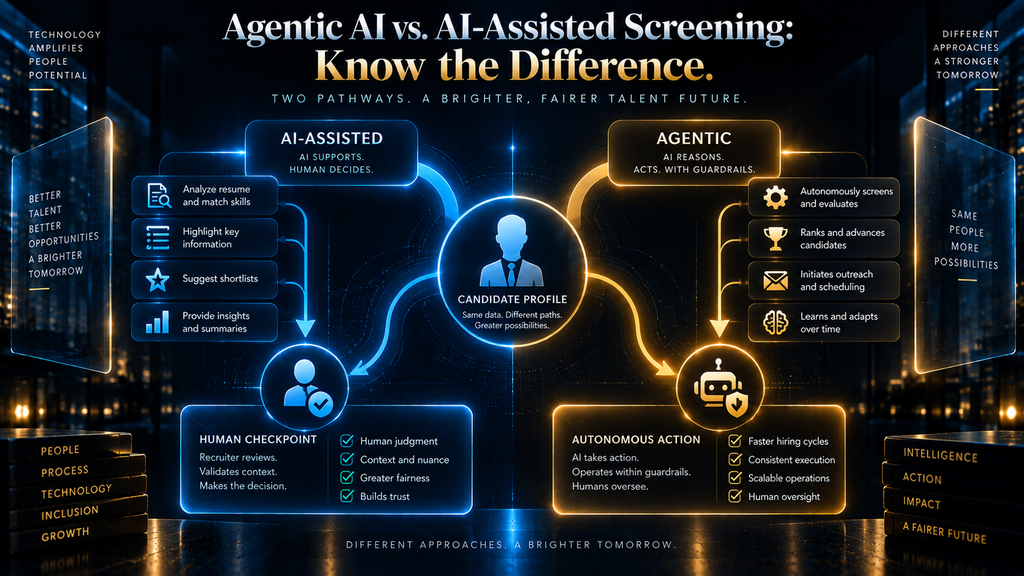
Agentic Recruiting AI vs. AI-Assisted Screening: Know the Difference
Vendors increasingly market recruiting tools as “agentic,” and the term covers a wide range of actual autonomy in practice. An AI-assisted tool organizes and prioritizes, then waits for a recruiter to act. An agentic tool can take the next step itself — reaching out to a candidate, scheduling a screening call, or advancing someone to the next stage — without being explicitly told to, though per the autonomy ladder in this guide, it should still stop well short of a final hire or reject decision.
When a vendor uses the word “agentic,” ask specifically which actions the agent can take without a recruiter in the loop, and whether your team can configure or disable any of them. The label alone says very little; the specific list of unsupervised actions says everything about whether the tool respects the Level 5 boundary this guide has argued should never be delegated.
The Candidate Experience Question Most Companies Skip
Recruiting AI gets evaluated almost entirely from the employer’s side — speed, cost, shortlist quality — while the candidate’s experience of being screened by a system they can’t see or question gets treated as an afterthought. That gap is a real risk, not just a PR concern: candidates talk, and a reputation for opaque, unexplained rejections spreads through the exact talent pools a company most wants to attract.
Disclosure
Telling candidates plainly that AI is involved in screening, without needing to explain the model’s internals, tends to reduce frustration significantly compared to letting candidates discover it indirectly or not at all.
A path to human review
Giving a rejected candidate some way to reach an actual person — even a simple appeal or feedback channel — costs little and directly addresses the single biggest candidate complaint about automated screening: the sense of shouting into a void.
Clear, honest communication
A templated “we’ve decided to move forward with other candidates” message lands very differently when a candidate suspects a person actually read their application versus when they suspect a score filtered them out in milliseconds. Companies that are transparent about the process tend to preserve more goodwill even among rejected candidates, which matters for future applications and referrals.
None of this requires slowing down the screening process itself — it requires treating candidate communication as part of the system’s design rather than an afterthought bolted on once the AI implementation is already finished.
The Second-Order Effect: What Happens to the Candidate Pool Itself
As AI-assisted screening becomes standard on the employer side, candidates have started using AI on their side too — optimizing resumes for parsers, generating tailored applications at higher volume, and applying to more roles per search than manual applications ever allowed. That second-order effect is part of why application volume keeps climbing even in a relatively stable hiring market, and it means the sourcing-and-screening problem this guide opened with is not a temporary spike to wait out. It is very likely the new baseline, which makes the evidence-based, human-judgment-preserving approach described throughout this guide a durable capability to build now rather than a stopgap.
For recruiters, that shift changes what “screening” even means over time. It moves from filtering a manageable pile of unique applications toward defending a shortlist against a flood of AI-optimized ones that all look impressive on paper — which makes the evidence framework, the explicit-versus-inferred-versus-missing distinction covered earlier, more important with each passing hiring cycle, not less.
Recruiters who internalize that distinction now, before it becomes an obvious industry-wide necessity, will be the ones whose shortlists hiring managers actually trust three hiring cycles from now.
The Future of AI in Recruiting
The next meaningful shift isn’t better resume parsing — that capability is already strong. It’s systems that handle more of the Level 4 supervised-action layer well: scheduling around genuinely complex multi-interviewer availability, drafting outreach that adapts to a specific candidate’s background rather than using one template, and surfacing borderline Group B candidates with better-organized evidence rather than just a higher score. The harder, more consequential shift — whether Level 5 decisions ever get delegated to AI — is as much a regulatory and organizational trust question as a technical one, and the direction of current EEOC guidance and state-level AI hiring laws suggests that boundary is being reinforced, not relaxed.
Final Thoughts
AI does not remove the recruiter from hiring — it changes what the recruiter spends their attention on. Teams that treat AI screening as an evidence-organizing layer feeding real human judgment see faster shortlists without sacrificing quality. Teams that treat a ranking as a verdict inherit whatever bias sits in the data, quietly and at scale. The question this guide opened with is the one that matters most: AI can genuinely find the 1,000 candidates. Whether the right 20 get found among them still depends on a recruiter who knows what to look for.
Ready to Find the Right AI Screening Tool for Your Team?
Run any vendor through the twelve questions above, then compare the platforms actually built to keep a recruiter in the loop.
See the Best AI Recruiting Tools →FAQ
What is AI candidate sourcing?
AI candidate sourcing is the use of software to search candidate databases, professional networks, and past applicant pools to identify people who match a role’s requirements but haven’t necessarily applied — the discovery half of AI recruiting, as distinct from screening.
What is AI candidate screening?
AI candidate screening is the use of software to organize, evaluate, and prioritize candidates who have already applied to a role, extracting evidence from resumes and applications and surfacing the strongest matches for recruiter review rather than processing every application in arrival order.
Does AI replace recruiters?
No — AI replaces the manual data-organizing work that precedes recruiter judgment, not the judgment itself. The hire, reject, and advance decisions remain human, and per the research cited in this guide, the roles most at risk are ones that were pure data entry to begin with, not recruiting judgment itself.
How does AI find candidates?
AI sourcing tools search structured databases and professional profiles for people whose stated skills, experience, and background match a role’s requirements, often including candidates who applied to past roles and were never actively re-considered — a capability called candidate rediscovery.
How does AI screen resumes?
AI screening tools parse resume text into structured data, extract skills and experience against a role’s specific requirements, and classify what they find using something like the explicit/inferred/missing evidence framework described in this guide, then organize candidates for recruiter review rather than issuing a final decision.
Is AI resume screening better than keyword filtering?
Generally yes, when properly implemented — large language model-based screening can understand context and infer relevant experience in ways rigid keyword filters cannot, which is precisely why nontraditional and transferable-skills candidates fare better under well-designed AI screening than under older keyword-only ATS filters. Poorly implemented AI screening can still replicate keyword filtering’s worst habits if it isn’t designed to handle inferred and missing evidence carefully.
Can AI screen candidates for skills, not just keywords?
Yes — modern AI screening tools can evaluate whether a candidate’s actual described experience demonstrates a required skill, even when that skill isn’t named explicitly, which is a meaningful improvement over older systems that only matched literal keyword strings.
Can AI reject candidates automatically?
Technically, many platforms allow this, but per the autonomy ladder in this guide, fully automated rejection without any human review sits at a level of AI authority this guide recommends against, and it is increasingly restricted by state and local regulation. The safer, more defensible design keeps a human reviewing every candidate above a defined relevance threshold.
Is AI recruiting screening legal?
Yes, when implemented within existing employment law — the EEOC’s guidance on employment tests and selection procedures applies to algorithmic screening the same way it applies to any other selection method, meaning a tool that produces disparate impact on a protected group creates real legal exposure regardless of automation.
How much does AI recruiting screening cost?
Pricing varies widely by vendor, typically scaling with hiring volume or seat count rather than a flat fee. The bigger cost consideration is usually implementation and change management — training recruiters to use AI-organized evidence well rather than rubber-stamping a score — which matters more to actual ROI than the software price itself.
Sources and Further Reading
- Questions and Answers on the Uniform Guidelines: US EEOC explanation of how the Uniform Guidelines are applied.
- Uniform Guidelines on Employee Selection Procedures (29 CFR Part 1607): The US federal guidelines behind adverse-impact analysis, including the four-fifths rule.
Related Guides
- How AI Automates Accounts Payable, Invoice Processing & Reconciliation
- How to Detect and Reduce Bias in AI-Assisted Decision Making
- AI Qualitative Research Explained: How AI Analyzes Interviews & Focus Groups
Written by
Muntasir Ahmad Chowdhury
Founder, AI Hustle World
Muntasir Ahmad Chowdhury is the Founder of AI Hustle World, an independent publication dedicated to making Artificial Intelligence practical, trustworthy, and easy to understand. He researches AI tools, automation, customer service, productivity, and real-world business applications, helping readers make smarter technology decisions through research-driven, experience-backed content.
Expertise:
AI Tools • AI Automation • AI Customer Service • AI Productivity • Generative AI • AI Workflows
Get Smarter With AI
Enjoyed this guide? Get practical AI tools, tutorials, and honest reviews delivered to your inbox.