Evidence: Documentation reviewed
Last checked: September 2026
What was done: Written from official documentation and the published sources linked in this article. Not hands-on tested.
Files: None
Affiliate links: No
How AI Interviewing Works: Screening, Scheduling and Structured Evaluation
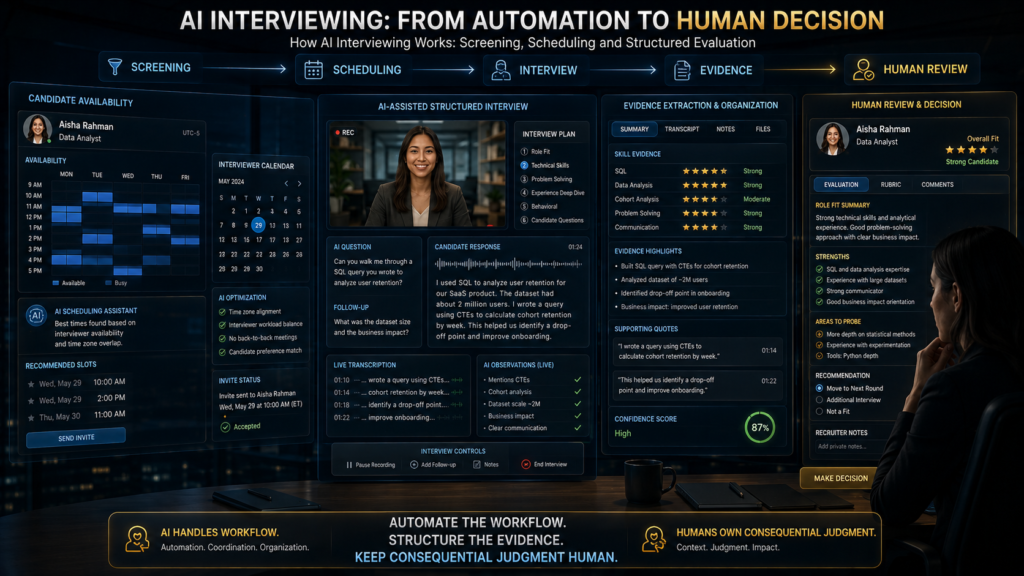
AI interviewing uses artificial intelligence to schedule interviews, run structured screening conversations, transcribe and organize candidate answers, and map that evidence against a scoring rubric, while people make the hiring decision. The pressure behind it is familiar to every recruiting team.
A role opens and hundreds of applications arrive. Someone has to contact candidates, coordinate calendars, ask the first questions, take notes, compare answers, chase interviewer feedback and decide who moves forward, and at volume that administration swallows the time recruiters should spend judging people.
Candidates are already meeting AI in the process. The Greenhouse 2026 Candidate AI Interview Report, based on a survey of 2,950 job seekers across the US, UK, Ireland, Germany and Australia, found that 63% of US job seekers had already experienced an AI interview.
Among US candidates who experienced AI evaluation, 70% said AI had not been clearly disclosed before their most recent AI interview. Adoption is moving faster than the practices that make it trustworthy.
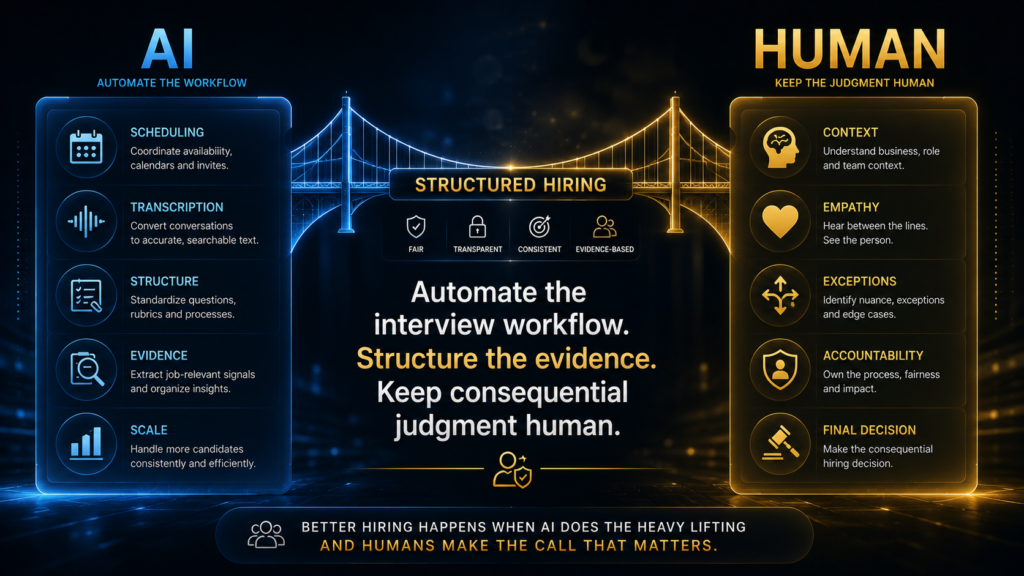
That gap is why the useful question is which parts of interviewing AI should automate, which it should assist, and which should stay firmly human. The answer this guide defends is simple: automate the interview workflow, structure the evidence, and keep consequential judgment human.
It rests on a finding that predates AI. Decades of selection research show that structured interviews predict job performance better than loosely run conversations, so AI adds most value when it makes structure cheaper to run, and least when it replaces structure with a score.
Below you will find the AI Interview Stack, the AI Hustle World Evidence Ladder and Recruiter-AI Control Gradient, and what the latest candidate data says about disclosure and drop-off. You will also find the legal boundaries that already apply, a cost model, a worked hiring example, a W.O.R.T.H. scorecard for pilots and a 90-day rollout plan.
What AI Interviewing Includes
AI interviewing is an umbrella term for several different capabilities, and treating them as one technology is the first mistake many teams make. Scheduling a candidate is very different from deciding whether that candidate is qualified, yet both get sold as “AI interviewing.”
The table separates the capabilities by what they do and how much risk they carry. Use it to decide which parts of your process you are buying.
| Capability | What it does | Risk level | Human role |
|---|---|---|---|
| Scheduling | Matches candidate availability with interviewer calendars, sends reminders, handles rescheduling | Low | Exceptions and accommodations |
| Screening questions | Asks standardized preliminary questions such as work authorization or shift availability | Moderate | Reviews borderline cases |
| Question generation | Drafts role-specific questions from a competency model | Moderate | Approves what gets measured |
| Transcription | Converts the conversation into searchable text | Low to moderate | Checks accuracy where it matters |
| Evidence extraction | Pulls job-relevant statements out of long answers | Moderate | Verifies context |
| Structured evaluation | Maps evidence against a predefined rubric | High | Owns the assessment |
| Workflow agents | Coordinate several of the above across systems | High | Sets permissions and approves actions |
The pattern in the table drives everything that follows. The closer a capability sits to a consequential employment decision, the stronger the need for human oversight of automated decisions, validation and documented governance.
Why Unstructured Interviews Persisted for So Long
Unstructured interviews have survived decades of research showing their weaknesses because they feel natural and rewarding to the people running them. Hiring managers enjoy open conversation, believe they can read people, and value the chance to sell the role while they assess the candidate.
Unstructured conversations are also cheap to prepare. A structured interview needs job analysis, agreed competencies, written questions and scoring anchors, and many teams never find the time to build them.
That history matters for AI interviewing. If an organization never did the preparatory work for structured interviews, AI will not do it on its own, and a vendor tool dropped onto an unstructured process simply records and scores the same inconsistent conversations.
The opportunity is the reverse. AI makes the preparation and the delivery of structured interviews much cheaper, which removes the main practical excuse for not using them.
The AI Interview Stack
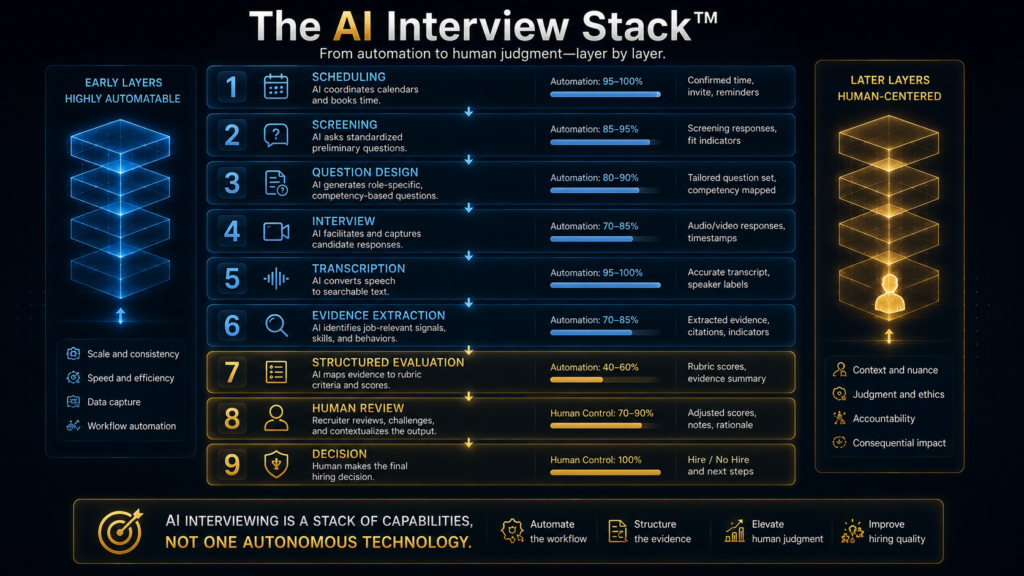
A typical AI-assisted interview process runs as a stack of steps: job requirements, interview criteria, question design, scheduling, the interview itself, transcription, evidence extraction, structured evaluation, human review and the hiring decision. Seeing it as a stack matters because a company does not have to automate all of it.
It can automate scheduling alone, or scheduling plus candidate communication, or scheduling plus transcription and evidence organization. Evaluation can stay entirely with interviewers until the earlier steps have proven themselves.
Starting with the lowest-risk, highest-friction steps usually produces a more defensible implementation than handing an AI authority over evaluation on day one. It also produces cleaner data about whether the tool helps.
If time-to-schedule falls from four days to one while interview quality holds steady, you have a clear win to build on. If you start with automated scoring, you will struggle to tell whether a change in outcomes came from the tool, the candidate pool or the market.
Scheduling: The Lowest-Risk Place to Start
AI interview scheduling coordinates availability, calendars, reminders and rescheduling so recruiters no longer manage every exchange by hand. The manual version is a slow loop of emails, calendar checks, time-zone mistakes and reschedules.
Automated scheduling collapses that loop into a booking link that already knows which slots are free. The candidate picks a time, both sides get reminders, and a cancellation offers new slots automatically.
Scheduling is an attractive first use case because the task is repetitive, structured, measurable and low in consequence. A scheduling system does not need to decide whether someone deserves an interview; it only needs to arrange one.
Recruiters still handle unusual conflicts, interviewer changes, candidate concerns and accommodation requests. That split is a useful model for the rest of this guide: automate coordination and keep human judgment wherever context matters.
AI Screening and AI Interviewing Are Different Jobs
AI screening narrows the candidate pool, while AI interviewing gathers evidence about a candidate’s ability to do the work. Screening asks whether a candidate should move forward; interviewing asks how they think, what they have done and what results they produced.
Our guide on how AI finds and screens candidates covers the first job. Our explainer on AI job matching and skills-based hiring covers how candidates are matched to roles before they reach an interview.
The difference shows up in the questions. A screening question might be “Do you have five years of enterprise sales experience?”, while an interview question asks, “Describe a time you inherited an underperforming enterprise account. What did you do, and what happened?”
The second question seeks context, action, reasoning and outcome. That is the raw material of a good hiring decision, and it is the reason structured interviewing matters so much.
Why Structure Matters More Than AI
A structured interview uses standardized, job-related questions and consistent evaluation criteria so every candidate is assessed against the same framework. The U.S. Office of Personnel Management describes structured interviews as questions tied to competencies from job analysis, asked consistently and scored against defined standards.
OPM notes that greater structure improves reliability and validity. A 2022 meta-analysis by Sackett and colleagues, revisiting validity estimates in personnel selection, went further, finding that structured interviews emerged as the top-ranked selection procedure after correcting earlier studies for systematic overcorrection.
The contrast with an unstructured process is stark. In an unstructured interview, one candidate is asked about leadership style, another about why they want the job, a third about the next five years, and the interviewer concludes that the first “felt stronger.”
In a structured interview, every candidate for the same role answers the same competency-based questions, scored against the same behavioral indicators. The evidence is comparable across people, which is what makes a fair decision possible.
This is the reality check behind every AI interviewing product. AI can make a structured process cheaper and easier to run at scale, with consistent questions, complete transcripts and organized evidence.
It cannot rescue a weak assessment. An organization that automates an unstructured interview simply gets inconsistent judgments faster.
Designing Interview Questions Around Evidence
AI can help write interview questions, but the questions should start from job requirements and competencies, and the model should come last. A defensible workflow runs from job analysis to critical tasks, then to competencies, behavioral indicators, the question and finally the rubric.
OPM recommends that structured interview questions be job-related, tied to competencies from job analysis, clear, open-ended and appropriate for the applicants. It also describes behavioral questions built around situation or task, action and result.
A worked example makes this concrete. If the requirement is leading cross-functional projects, the competency is stakeholder management, and the question could be: “Describe a project where multiple teams disagreed about priorities. What did you do?” The rubric then looks for specific evidence:
- how the candidate identified the conflict and the stakeholders involved
- how they communicated and prioritized between competing demands
- whether they negotiated a resolution or escalated appropriately
- what outcome followed, ideally with a measurable result
AI can generate useful variations of that question and suggest follow-up prompts. People should decide whether stakeholder management belongs in the assessment for this role at all.
A question can sound intelligent and still be useless. “What does leadership mean to you?” produces an interesting conversation and a weak assessment, while “Tell me about a time you changed the behavior of a team that resisted a new process” produces behavior, judgment and outcome.
Interviewer Calibration Still Matters
Structured questions only produce comparable evidence when interviewers apply the rubric the same way. Two interviewers can hear the same answer and score it a 2 and a 4 if they have never discussed what each score level looks like.
Calibration fixes this. Before a hiring round, interviewers score the same two or three recorded example answers independently, compare their ratings and agree on why each answer earns its score.
AI transcripts make calibration easier than it used to be. Teams can review real answers from past rounds, anonymized, instead of inventing examples, and they can check later whether individual interviewers drift away from the group.
The same exercise is the best way to test an AI evaluation tool. If the tool’s rubric mapping disagrees with calibrated human reviewers on the same answers, that disagreement tells you more about the tool than any vendor accuracy claim.
Transcripts, Summaries and Evidence Extraction
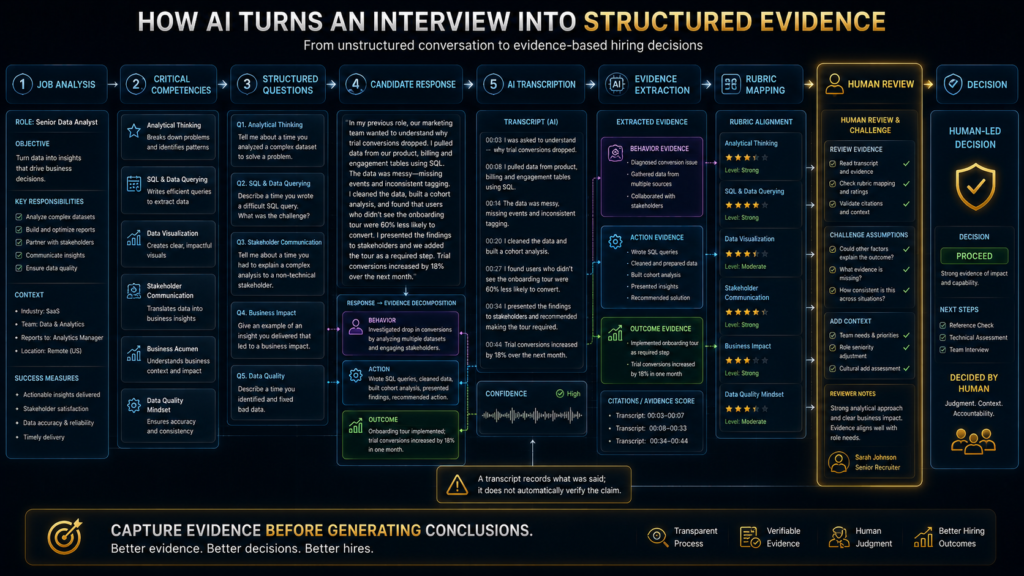
AI transcription turns an interview into searchable text, which reduces note-taking and lets reviewers return to the exact words a candidate used. It is evidence capture, not evidence verification.
If a candidate says “I increased revenue by 40%,” the transcript can record that sentence perfectly while the 40% remains unverified. Tools that record and transcribe conversations, including the AI meeting assistants many teams already use, make capture easy; verification still requires a person.
Summaries create a second risk. “The candidate showed strong leadership and communication skills” sounds useful but gives the recruiter almost nothing to inspect.
A structured evidence record is far more useful: competency, leadership; evidence, led a 12-person cross-functional project; action, introduced weekly decision reviews; outcome, delivered two weeks ahead of the revised schedule; confidence, medium because the outcome was self-reported.
A summary compresses information, while evidence extraction preserves the parts a decision depends on. Our guide on how AI interview analysis works explains the same distinction for research interviews, where it matters just as much.
The AI Interview Evidence Ladder
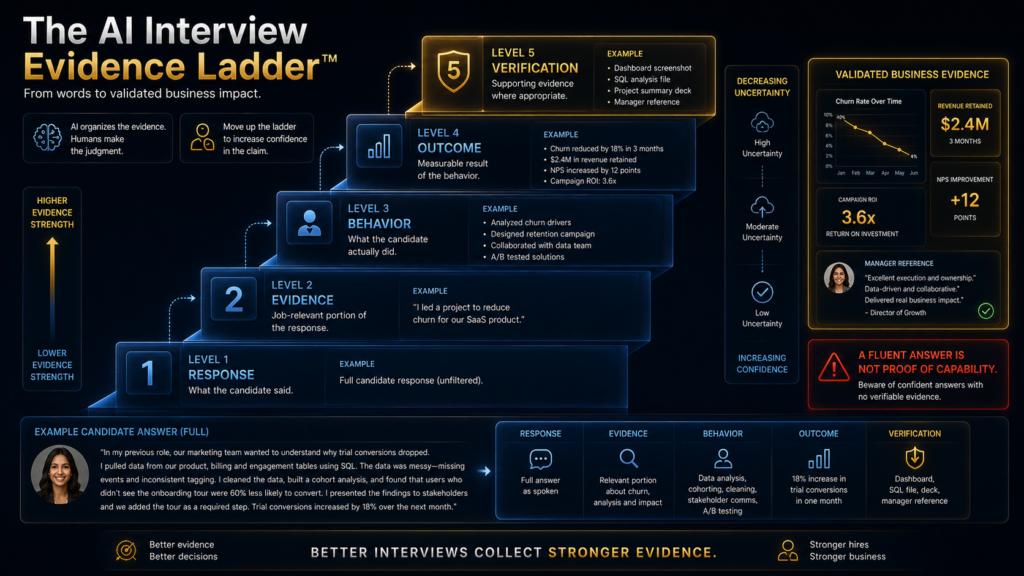
The AI Hustle World Evidence Ladder stops a fluent answer from being mistaken for proof of competence. Each candidate response is evaluated through five levels, and each level asks a different question.
| Level | Question it answers | What AI can do | What a person must do |
|---|---|---|---|
| 1. Response | What did the candidate say? | Transcribe accurately | Spot-check important passages |
| 2. Relevant evidence | Which parts relate to the competency? | Highlight and tag passages | Confirm the tags fit the rubric |
| 3. Behavior | What did the candidate personally do? | Separate “I” actions from team actions | Probe with follow-up questions |
| 4. Outcome | What happened as a result? | Flag missing or unquantified outcomes | Judge the significance of the result |
| 5. Verification | Can the claim be supported elsewhere? | List claims worth checking | Check references, work samples or records |
The ladder prevents one of the most common AI mistakes in hiring: treating a polished answer as proof. As candidates prepare with generative AI, polish becomes cheaper, so the higher rungs carry more of the signal.
Our framework for verifying AI information applies the same logic to AI outputs themselves. A claim is only as good as the evidence you can trace behind it.
Scores, False Precision and the Recruiter-AI Control Gradient
An AI-generated interview score can help prioritize review, but an unexplained number creates false confidence. If three candidates score 8.9, 8.4 and 7.8, the recruiter has to ask what was measured, and without a clear method the gap between 8.9 and 8.4 may mean nothing.
A more useful output reads like a reviewer’s note: the competency assessed, the evidence found, the main strength, the gap, a confidence level and a recommendation for human review. A recruiter can challenge that, whereas a bare score invites deference.
The autonomy AI receives should follow the consequence of the task, which is the idea behind the AI Hustle World Recruiter-AI Control Gradient. At the lowest level, AI executes scheduling, reminders and routine messages; next it recommends questions and summaries; then it prioritizes evidence that deserves attention.
At the fourth level it acts under supervision, for example by sending candidate updates a recruiter has approved. Final hiring judgment, material rejections and sensitive exceptions sit at the top and remain human decisions, because as consequence rises, human control should rise with it.
A person in the loop does not guarantee meaningful oversight. If the AI scores a candidate at 92% and the recruiter has 30 seconds to click “approve,” a human is technically involved but the AI made the decision.
Real oversight requires that the reviewer can see the evidence, understand the criteria, question the recommendation, override it easily and record why they disagreed. If the system makes disagreement slow or awkward, the human becomes a rubber stamp.
What Candidates Experience
AI interviewing is a candidate-facing experience as much as an internal productivity tool, and the Greenhouse survey shows where it goes wrong. Among US candidates who experienced AI evaluation, 70% said AI was not clearly disclosed beforehand, and about one in five only found out once the interview had started.
Thirty-eight percent of US candidates said they had withdrawn from a hiring process because it included an AI interview. The top reasons were prerecorded video interviews scored by AI with no person present (33%), failure to disclose how AI would be used (27%) and AI monitoring during the process (26%).
The same data shows that most candidates will accept AI under the right conditions. Only 19% of US candidates wanted less AI involvement than they currently encounter.
The most common preferences were the same level of AI with more transparency (21%) and more AI with stronger human oversight at key decision points (22%). That gives employers a clear brief: disclose early, explain what the AI evaluates, and show where a person is involved.
Employer brand is part of the outcome. Greenhouse reports that 38% of US candidates came away with a better impression of an employer after a good AI interview, while 34% left with a worse one after a poor experience.
The follow-up gap is striking too: of US candidates who completed an AI interview, 51% never received an outcome. These figures come from one vendor-run survey rather than a universal benchmark, but a company that automates the interview and not the courtesy of a reply has only moved its bottleneck.
Designing Asynchronous Interviews Candidates Will Complete
The withdrawal reasons in the Greenhouse data point to specific design fixes. The top complaint, prerecorded video scored by AI with no person present, is less about recording and more about feeling judged by a machine with no human contact.
Give candidates a named recruiter they can contact, a short explanation of who reviews the answers, and a practice question before the real ones begin. Those three changes cost almost nothing and address the loneliness of the format directly.
Timing rules matter as much as tone. Tight countdown timers and single attempts raise anxiety without improving evidence, so allow reasonable thinking time and at least one retake for technical problems.
Offer an alternative format where it makes sense, such as written answers or a phone call, for candidates with poor connectivity, disabilities or caring responsibilities. Record which format each candidate used so reviewers do not penalize the choice.
Length is the final lever. A first-round interview that asks four well-designed questions in 15 minutes produces better completion than one that asks twelve in 45, and the extra questions rarely add decision-useful evidence at that stage.
Disclosure and Candidate Communication That Builds Trust
Good disclosure is specific, early and written in plain language. “This process uses AI” is not enough; candidates want to know what the AI does, what it does not do and who makes the decision.
A useful disclosure might read: “Your answers will be transcribed by software, and an AI tool will highlight passages that relate to our interview criteria. A recruiter reviews every interview and makes all decisions. If you need an adjustment or a different format, reply to this email.”
That text answers the three questions candidates ask most: what is automated, whether a person is involved and how to get help. It should appear in the invitation, not on a screen that appears after the candidate has started recording.
Outcome messages deserve the same care. Send every candidate a decision within a stated time, explain the next step or the end of the process, and avoid generic phrasing that suggests nobody looked at the application.
Accessibility, Emotion Inference and the Legal Boundaries
An AI interview creates discrimination risk when it evaluates signals unrelated to the job or disadvantages candidates with disabilities. The U.S. Department of Justice guidance on algorithms, AI and disability discrimination in hiring states that employers violate the ADA if hiring technologies unfairly screen out a qualified individual with a disability.
The same guidance says employers must provide requested reasonable accommodations. The practical test is whether each signal the system measures predicts a capability the job requires, and scoring facial expression for a data analysis role is very hard to justify.
Emotion inference is a separate and more serious category. Analyzing what a candidate said is evidence analysis, while inferring that a candidate “appears nervous, dishonest or insufficiently confident” is speculation about a hidden psychological state.
In the European Union, Article 5 of the AI Act prohibits AI systems that infer emotions in workplaces and educational institutions, with narrow medical and safety exceptions. Any interviewing tool that offers emotion scoring should have that feature switched off.
Recruitment AI more broadly can be high-risk. The European Commission’s AI Act Service Desk guidance on AI in employment uses automated job matching and ranking as an example of a system that can fall into the high-risk category.
Those systems carry duties around data governance, documentation, transparency, human oversight, accuracy and security. In New York City, Local Law 144 on automated employment decision tools bars their use unless the tool had a bias audit within the previous year, the audit results are public and candidates receive the required notices.
Illinois separately regulates AI analysis of video interviews through notice and consent requirements. Exact obligations depend on the system, the deployment and the jurisdiction, and this guide is not legal advice.
The strategic lesson is that procuring an AI interviewing tool is an HR governance decision rather than a software purchase. Our guides to AI governance and detecting and reducing bias in AI-assisted decisions cover the controls to put in place before launch.
Interview Recordings: Privacy, Consent and Retention
Interview recordings and transcripts are sensitive personal data, and AI interviewing multiplies how much of that data an employer holds. A single hiring round can generate thousands of video files containing faces, voices and personal stories.
Decide before launch how long recordings are kept, who can access them and when they are deleted. Keep them long enough to handle disputes and audits, but not indefinitely, and separate the evidence needed for a decision from the raw footage.
Consent and notice rules vary by jurisdiction, and some places treat voice or facial data as specially protected. Check your obligations with counsel, and make sure the vendor contract states whether your candidates’ data can be used to train the vendor’s models.
That last point is easy to miss. Our explainer on AI data retention lists the questions to ask any AI vendor about where prompts, files and recordings end up and how long they stay there.
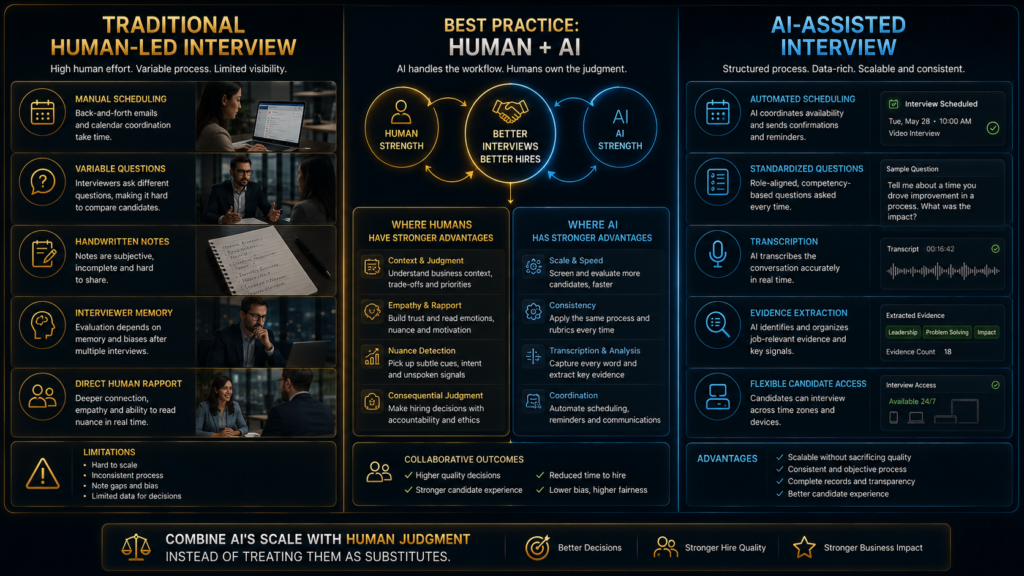
AI-Assisted and Human-Led Interviewing Compared
AI-assisted and human-led interviewing have different strengths, and the strongest processes combine them deliberately. The table summarizes where each performs best.
| Dimension | AI-assisted interviewing | Human-led interviewing |
|---|---|---|
| Scheduling and coordination | Fast and repetitive work handled well | Manual and slow at volume |
| Scale and availability | Very high, including outside office hours | Limited by calendars |
| Consistency | High when questions and rubrics are well designed | Varies by interviewer discipline |
| Transcription and evidence capture | Complete and searchable | Depends on note quality |
| Rapport and nuance | Limited | Strong |
| Complex judgment and context | Limited | Strong |
| Risk if poorly designed | Errors repeat at scale | Errors vary by person |
Use AI where scale and consistency matter, and people where context and consequence matter. A candidate working night shifts may find an asynchronous first-round interview easier to complete, which is a real accessibility benefit, but they should still meet a person before a consequential decision.
Generative AI is also changing the candidate side. Candidates now use AI to research companies, rehearse answers and draft stories, which makes polished answers to generic questions a weaker signal.
The response is to test application rather than prepared language. Scenario questions, live follow-ups, role-specific exercises and work samples show how someone thinks when the script runs out.
The Economics of AI Interviewing
The cost case for AI interviewing usually rests on recruiter time, time-to-hire and candidate drop-off. Scheduling is the easiest saving to measure: as an illustration, 200 hires with five interviews each and 30 minutes of coordination per interview is 500 hours of recruiter time.
If automated scheduling removes most of that coordination, the recovered hours can go into sourcing, candidate conversations and interviewer calibration. These numbers are an example of the method, so replace them with your own interview counts and timings.
Time-to-hire matters because open roles carry a cost in lost output, overtime and overloaded teams. Shaving several days of scheduling delay from every hire compounds across a hiring plan, especially in high-volume roles where candidates accept the first reasonable offer.
Drop-off is the cost most business cases ignore. If an opaque AI interview causes some candidates to withdraw, the organization pays for sourcing and screening them and then loses them, which can wipe out the scheduling savings.
Evaluation automation has a different profile. The saving is smaller than it looks, because responsible use still requires human review, and the risk cost is higher, because errors in scoring affect people’s careers and can create legal exposure.
That asymmetry is why AI Hustle World recommends automating coordination aggressively and evaluation cautiously. The first delivers most of the economic value at a fraction of the risk.
A Worked Example: Hiring 200 Customer Support Agents
A worked example shows how the pieces fit together. A company needs 200 customer support agents across three countries within a quarter and expects around 4,000 applications.
The team starts with job analysis. Supervisors agree that the role depends on four competencies: written clarity, calm handling of frustrated customers, problem diagnosis and reliability, and each competency gets two behavioral questions with a scoring rubric agreed in a calibration session.
Screening uses a short, disclosed questionnaire covering work authorization, shift availability and language skills. Candidates who meet the hard requirements receive a booking link, and automated scheduling handles time zones, reminders and rescheduling.
The first-round interview is asynchronous and clearly labeled as AI-assisted: candidates record answers to the structured questions and complete a short written exercise replying to a mock customer email. Transcription and evidence extraction tag each answer against the rubric, and recruiters review the tagged evidence rather than a single score.
Candidates who pass meet a team lead for a live conversation and a role-play. Every candidate, successful or not, receives an outcome message within five working days, which is automated but reviewed weekly for tone and accuracy.
The team tracks the funnel weekly: completion rates by country, recruiter review time, disagreement between AI tagging and human scores, and pass rates across demographic groups where lawful. Any group with a markedly lower pass rate triggers a review of the questions and the tagging before the next week’s candidates go through.
Measuring an AI Interviewing Program
An AI interviewing program should be measured on efficiency, quality, candidate experience and fairness together. Optimizing any one of them alone produces a distorted process.
| Area | Metric | Warning sign |
|---|---|---|
| Efficiency | Time to schedule, recruiter hours per hire | Savings disappear because recruiters rework AI outputs |
| Quality | Agreement between AI tagging and calibrated reviewers, new-hire performance | Low agreement or no change in hire quality |
| Candidate experience | Completion rate, withdrawal rate, candidate feedback, time to outcome | Rising withdrawals after AI steps |
| Fairness | Pass rates by group where lawful, accommodation requests handled | Consistent gaps between groups at one stage |
| Oversight | Override rate and documented reasons | Overrides near zero, suggesting rubber-stamping |
The override rate is a useful early signal. If reviewers never disagree with the AI, either the tool is perfect or nobody is looking closely, and the second is far more common.
How to Pilot an AI Interviewing Platform
A serious evaluation tests a platform with your own roles, realistic candidates and awkward edge cases, rather than the vendor’s scripted demo. Run a controlled pilot on one role and check each of these areas:
| Test | What to check |
|---|---|
| Scheduling | Steps a candidate needs to book, how rescheduling works across time zones |
| Disclosure | Whether AI use is explained clearly before the candidate starts |
| Question quality | Whether every question maps to a documented job competency |
| Transcription | Accuracy across accents, background noise and technical interruptions |
| Evidence extraction | Whether the relevant passages are found and tagged correctly |
| Rubric mapping | Whether evidence is linked to the right competency and scoring level |
| Edge cases | Handling of unusual, incomplete or off-topic answers |
| Accessibility | How candidates request and receive accommodations |
| Human override | How easily recruiters can challenge and change a result |
| Auditability | Whether you can reconstruct how any recommendation was produced |
When you compare shortlisted platforms, AI Hustle World applies its site-wide W.O.R.T.H. checklist. Workflow fit (25 points) covers integration with your applicant tracking system, calendars and interview kits, and Output quality (25) covers transcription, evidence extraction and rubric mapping on your own test interviews.
Risk and rights (15) covers disclosure, accessibility, bias-audit support, data retention and emotion features that should be switched off. Total cost (20) includes licenses, implementation and review time, Human effort (15) measures how much work reviewers need to trust and correct results, and our comparison of the best AI recruiting tools is a useful starting shortlist.
Questions to Ask a Vendor Before You Buy
Vendor demonstrations are designed to impress, so bring written questions and ask for written answers. The replies become part of your governance record and make later comparisons easier. These questions separate mature vendors from the rest:
- Which parts of the interview does the AI evaluate, and which signals does it ignore?
- Can we use our own competency model and rubric, or only yours?
- How do reviewers see the evidence behind each rating, and how do they override it?
- What bias testing have you done, on what data, and can we see the results?
- Can emotion, facial or voice-tone analysis be switched off completely?
- How are accommodations and alternative formats handled for candidates?
- Where are recordings stored, for how long, and are they used to train your models?
- Can we export a full audit trail for any candidate on request?
A vendor that answers these clearly and in writing is usually one you can work with. Vague answers to the bias and training-data questions are the most common warning sign.
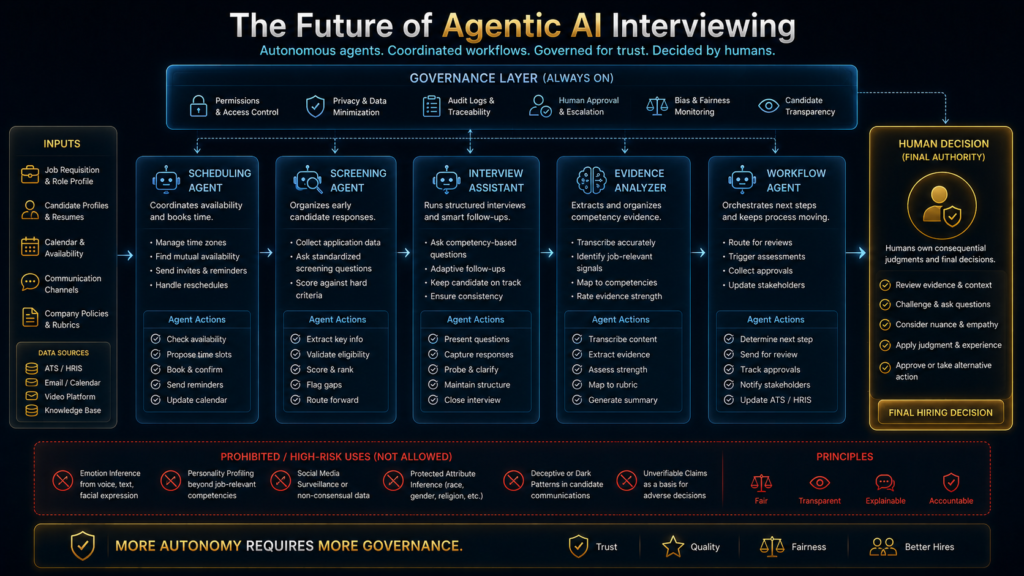
Where Agentic Interviewing Is Heading
The next generation of AI recruiting is likely to be spread across several specialized agents rather than one “AI interviewer.” A scheduling agent books the conversation, a screening agent asks preliminary questions, an interview assistant suggests follow-ups, and an evidence analyzer maps answers to the rubric.
A workflow agent then moves the candidate through the process until a person makes the decision. Each component has a defined responsibility, and our explainer on what an AI agent is covers how these components plan and act.
The risk grows with the number of handoffs. If the screening agent records a wrong assumption, the interview assistant may ask the wrong follow-up and the evaluation agent may reach the wrong conclusion, while each step looks reasonable on its own.
Future systems will need to answer four questions for any recommendation: where the conclusion originated, what evidence supported it, which component produced it and who approved the final action. That traceability separates agentic recruiting from uncontrolled automation.
A 90-Day Rollout Plan
Spend the first 30 days on design, not procurement. Choose one role and define its competencies, interview questions, evidence criteria, scoring rubric and the points where a person must approve a decision.
The first question is what a good interview for this role should measure. The tool comes after that answer, and a vendor that cannot work with your rubric is the wrong vendor.
In days 31 to 60, run the AI workflow alongside your existing process for the same role. Compare time to schedule, completion rates, evidence quality, recruiter review time and candidate feedback, and log every case where a recruiter disagreed with the AI and why.
In days 61 to 90, evaluate recruiter workload, evaluation quality, candidate acceptance, fairness and downstream hiring quality. Then choose to scale, redesign or stop, remembering that a pilot ending in “stop” still saves money if it prevents a flawed company-wide rollout.
What Happens If You Do Nothing
Doing nothing carries its own costs, even though it avoids the risks of a bad rollout. Recruiters stay buried in scheduling, time-to-hire stays long, and competitors that move faster win candidates who accept the first reasonable offer.
Candidates are also changing without you. They increasingly prepare with AI, which weakens generic interview questions whether or not your company uses AI at all.
The honest comparison is between a well-designed AI process and your current process, not between AI and an ideal human one. If your interviews are unstructured today, the first improvement may be structure itself, with AI introduced to make that structure affordable.
For many teams, the right first step is small: automate scheduling, write structured questions for one role and calibrate interviewers. That captures much of the value with very little of the risk.
Common Mistakes and the AI Hustle World View
Most AI interviewing failures come from automating before defining what good hiring means. These are the mistakes we see most often:
- automating an interview that was poorly designed to begin with
- letting AI generate questions without mapping them to job competencies
- treating transcripts or summaries as verified evidence
- trusting unexplained scores as objective truth
- hiding AI use from candidates or disclosing it only after the interview starts
- ignoring accessibility and accommodation procedures
- using emotion or personality inference as if it measured capability
- letting human review turn into a rubber stamp
- measuring recruiter time saved while ignoring candidate follow-up
Vendors often promise that AI interviews are faster, more scalable and more objective. The first two claims can be true, but the third requires evidence, because a system can ask everyone the same questions and still measure the wrong thing.
Our view is that a company’s biggest interview problem is rarely a lack of AI. It is usually the lack of a good assessment system, and AI can only scale the system you give it, which is also the conclusion of our comparison of AI recruiting and traditional recruiting.
Should You Use AI Interviewing?
If you are hiring hundreds of people for similar roles, such as warehouse associates across three shifts or support agents across several countries, AI interviewing can remove days of scheduling and make evidence more consistent. The case is strongest with high volume, distributed teams, clear competencies and an HR function able to govern the tools.
In that setting, start with scheduling and structured first-round questions. Add evidence extraction once your rubric is stable and your interviewers are calibrated.
If you are hiring one principal engineer, a senior leader or a role where relationship-building is the job, full AI interview automation is the wrong tool. The same caution applies if your competencies are hard to define, accessibility procedures are missing or your recruiters lack time to challenge outputs.
AI can still help you, but limit it to scheduling, transcription and evidence organization. Our explainer on AI in HR and recruiting shows where interviewing fits among other talent processes, and our guide to AI onboarding and HR helpdesks covers what happens after the offer.
How We Researched This Guide
This guide was researched and drafted with AI assistance and checked against the primary sources linked in the article. Candidate statistics come from the Greenhouse 2026 Candidate AI Interview Report, a vendor-commissioned survey, so the figures describe that sample rather than the whole market.
Guidance on structured interviews comes from the U.S. Office of Personnel Management and the 2022 Sackett, Zhang, Berry and Lievens meta-analysis in the Journal of Applied Psychology. Regulatory descriptions come from the European Commission’s AI Act Service Desk, New York City’s consumer and worker protection agency and the U.S. Department of Justice.
We did not test an AI interviewing platform hands-on, and no benchmark or product result is claimed. The AI Interview Stack, Evidence Ladder, Recruiter-AI Control Gradient, the W.O.R.T.H. adaptation, the cost figures and the worked example are AI Hustle World analysis and illustration.
Last updated September 2026. This version restructures the guide, adds the economics, calibration, worked example and measurement sections, re-checks each statistic and removes a reference to agency guidance that is no longer published.
Final Thoughts: Better Evidence, Human Decisions
AI interviewing can schedule, screen, transcribe, summarize and organize at a scale no recruiting team can match. It can remove days of administrative friction from every hiring cycle, and those gains are real and worth pursuing.
Interviewing, however, is an evidence problem before it is a scheduling problem. An employer needs to understand what a candidate can do, how they think, what results they have produced and what remains uncertain, and AI can help collect and organize that evidence without turning a person into a trustworthy number.
That is why the order matters: define the job, define the competencies, design the evidence, structure the interview and calibrate the interviewers. Only then automate what makes sense, starting with coordination and moving carefully toward evaluation.
Candidates are not asking employers to remove AI; they are asking for transparency and for people at the decisions that matter. A good AI interview makes the human part of hiring better informed, more consistent and more accountable.
Build Better Interviews With AI—Without Losing the Human Element
AI can make recruiting faster by automating scheduling, organizing interview evidence and supporting structured evaluation. But the goal should never be to turn hiring into a black-box score.
Explore AI Beyond Recruiting →FAQ
What is AI interviewing?
The use of AI to automate or assist parts of the hiring interview, including scheduling, screening questions, transcription, evidence extraction and structured evaluation. In a well-designed process, people still make the hiring decision.
How does AI interviewing work step by step?
It runs from job requirements to interview criteria, question design, scheduling, the interview, transcription, evidence extraction, rubric-based evaluation and human review. Most organizations should automate scheduling first.
Can AI conduct a job interview on its own?
Some platforms can run recorded or conversational interviews without a person present. That can work for high-volume first rounds, but consequential decisions should stay with trained interviewers.
Is AI interview scheduling safe to automate?
Yes. Scheduling is one of the lowest-risk uses of AI in recruiting because it coordinates time rather than judging candidates. Recruiters should still handle accommodations and unusual conflicts.
What is a structured interview, and why does it matter for AI?
Every candidate answers the same job-related questions, scored against the same criteria. Research ranks structured interviews as the strongest selection method, so AI adds most value when it makes structure easier to run.
Are AI interviews fairer than human interviews?
Not automatically. AI can improve consistency, but a consistent process can still measure the wrong thing or disadvantage some groups, so fairness depends on job-relevant questions, accessibility and real human review.
Do candidates accept AI interviews?
Many do, with conditions. Greenhouse’s 2026 survey found only 19% of US candidates wanted less AI, while more wanted better transparency or stronger human oversight.
Should employers tell candidates when AI is used?
Yes. Candidate research supports clear disclosure, and New York City requires notices for automated employment decision tools. Explain what the AI does and how to request an accommodation.
Can AI detect personality or emotions in interviews?
Some tools claim to, but inferred emotions are weak evidence of job capability and create discrimination risk. In the EU, AI that infers emotions in the workplace is prohibited, with narrow exceptions.
Will AI interviewing replace recruiters?
No. AI can handle scheduling, routine messages and evidence organization, but recruiters remain essential for context, candidate relationships, exceptions and final judgment.
Related Guides
- Best AI Recruiting Tools in 2026: Sourcing, Screening & Interviewing Compared
- AI Recruiting vs Traditional Recruiting: What Actually Works?
- How AI Interview Analysis Works: Transcripts, Themes & Insights
- What Is an AI Agent? A Beginner’s Guide to How Autonomous AI Works
Written by
Muntasir Ahmad Chowdhury
Founder of AI Hustle World
Muntasir Ahmad Chowdhury is the Founder of AI Hustle World, an independent publication dedicated to making Artificial Intelligence practical, trustworthy, and easy to understand. He researches AI tools, automation, customer service, productivity, and real-world business applications, helping readers make smarter technology decisions through research-driven, experience-backed content.
Expertise:
AI Tools • AI Automation • AI Customer Service • AI Productivity • Generative AI • AI Workflows
Get Smarter With AI
Enjoyed this guide? Get practical AI tools, tutorials, and honest reviews delivered to your inbox.