Evidence: Documentation reviewed
Last checked: September 2026
What was done: Written from official documentation and the published sources linked in this article. Not hands-on tested.
Files: None
Affiliate links: No
AI Job Matching Explained: How Skills-Based Hiring Works
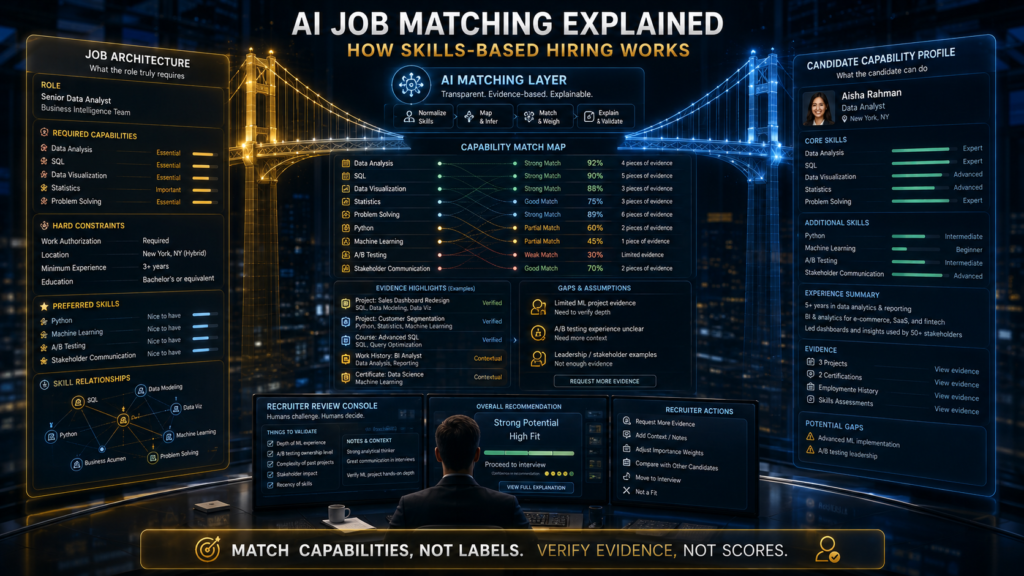
AI job matching uses artificial intelligence to compare what a job requires with what a candidate can demonstrate, looking at skills, experience, context and evidence rather than only job titles and keywords. The idea is easiest to see through a single role.
A company is hiring a Product Operations Manager. One applicant already holds that exact title, a second is a Senior Operations Analyst who has spent five years optimizing processes and coordinating product launches, and a third is a Program Manager who has led cross-functional programs and process redesigns.
A title filter ranks the first candidate highest. Either of the others may have more of the capabilities the role needs, and a skills-based comparison is how you find out.
AI makes that comparison possible across candidate pools far larger than a recruiter could read. Employers say they are moving this way: in the NACE Job Outlook 2026 survey of employers hiring new college graduates, nearly 70% said they use skills-based hiring, a share that grew over the previous year.
Practice lags the announcements, though. A joint study by the Burning Glass Institute and Harvard Business School, Skills-Based Hiring: The Long Road from Pronouncements to Practice, found that many companies announced they were dropping degree requirements while sustained changes in who they hired remained elusive for most.
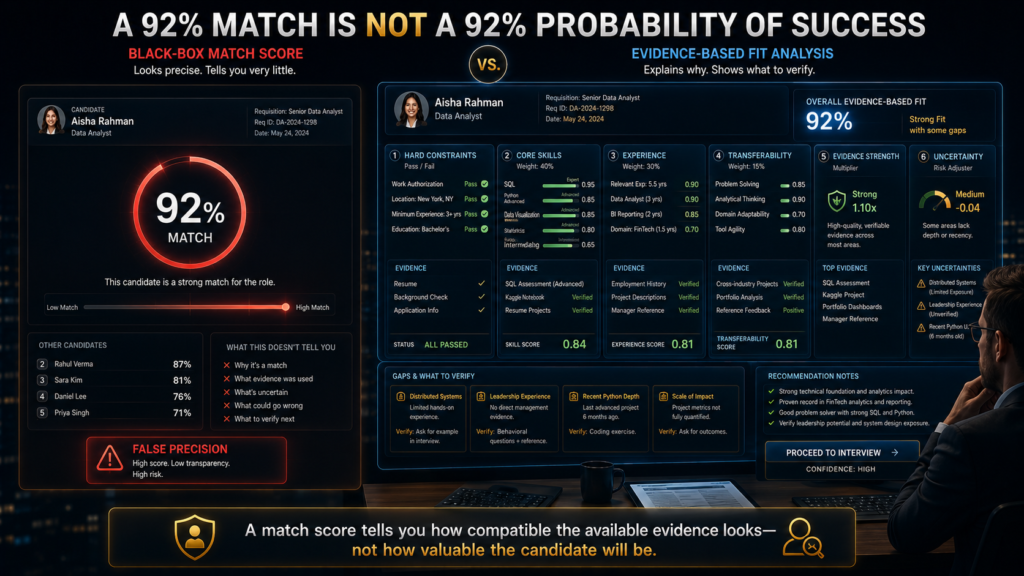
AI is often presented as the tool that closes that gap, and it can help. The trouble starts with the output most systems show recruiters, because “Candidate A: 92% match” does not mean Candidate A has a 92% chance of succeeding.
It means the information available to that system looks highly compatible with the way that system represents the job and the candidate. Treating the first claim as the second is how skills-based hiring quietly turns back into proxy-based hiring.
This guide explains how AI job matching works under the hood, where semantic matching helps and where it stops, and why historical data can turn degrees into hidden filters. It also shows how to evaluate a matching system before you trust it.
Along the way you will find three AI Hustle World frameworks, the Candidate-Job Fit Stack, the Skill Evidence Ladder and the Qualified Match Scorecard, plus a worked example, a test plan and the metrics that show whether matching works. The principle behind all of them is short: match capabilities, not labels, and verify evidence, not scores.
What AI Job Matching Does
AI job matching estimates how well a candidate fits a role by extracting skills and requirements from the job, building a structured picture of the candidate, comparing the two and presenting fit, gaps and uncertainty for a recruiter to review. It generates evidence-backed recommendations about who deserves a closer look.
It does not declare who will succeed. The best systems make that distinction obvious in their outputs, so recruiters treat a match as a reason to investigate rather than a verdict.
Traditional applicant tracking relies heavily on keywords, job titles, degrees, years of experience and fixed filters. AI matching can consider relationships between concepts instead, which is where much of its value comes from.
A job may ask for “enterprise customer retention and renewal strategy,” and a candidate may write “owned strategic account relationships and reduced customer churn.” The words barely overlap, yet the functional overlap is strong, and a semantic system can recognize it.
Matching usually sits between sourcing and interviewing. Our guide on how AI finds and screens candidates covers the sourcing and screening side, and our guide on how AI interviewing works covers what happens after a match earns a conversation.
Why Employers Relied on Titles and Degrees
Titles and degrees became default filters because they are cheap signals at volume. A recruiter facing 500 applications can sort by title and degree in minutes, while judging each person’s underlying skills would take days.
These signals also feel defensible. A degree is verifiable, a previous title suggests someone else already trusted the candidate with similar work, and neither requires the recruiter to make a subtle judgment.
The cost of those shortcuts is hidden. Qualified people without the expected title or credential are filtered out before anyone reads their experience, and the employer never sees what it missed.
Skills-based matching tries to keep the speed of a filter while replacing the proxy with the thing the proxy was standing in for. That only works if the skills are defined well and the evidence is taken seriously.
Why Keyword and Title Matching Miss Good Candidates
Keyword matching fails whenever people describe similar capabilities in different language, which happens constantly across companies, industries and countries. Suppose a role requires customer success, account expansion and churn reduction.
Candidate A writes “managed customer success programs and reduced churn,” which a keyword system scores easily. Candidate B writes “built post-sale relationships, identified renewal risks and increased expansion revenue,” and a rigid system ranks B lower even though an experienced recruiter would see highly relevant experience.
Title matching has the same weakness at a larger scale. Titles are inflated at some companies and deflated at others, and the same title can describe very different work in a startup and a multinational.
A “Program Manager” at one firm may run product launches end to end, while at another the same title means coordinating meeting schedules. Filtering on titles imports every inconsistency in the labor market into your shortlist.
How AI Turns Jobs and Candidates Into Skills
Before AI can match anyone, it has to decide what the job requires, and job descriptions hide capabilities inside ordinary language. “Lead strategic customer initiatives across enterprise accounts” implies account management, strategic planning, stakeholder management, commercial judgment and cross-functional coordination.
“Build dashboards to identify renewal risk and customer-health trends” implies data analysis, customer analytics, reporting and business intelligence. Matching systems extract and normalize those implied skills so they can be compared with candidate information later.
Normalization depends on a skill taxonomy, a structured vocabulary of skills and their relationships. Public frameworks such as the U.S. O*NET occupational database and the European Commission’s ESCO classification of skills and occupations give employers and vendors a shared starting point.
With a taxonomy, “built dashboards in Tableau” and “advanced data visualization” can be linked through a common concept. Most commercial platforms maintain their own taxonomies on top of these, and all of them need constant maintenance as titles change and new tools appear.
The candidate side needs the same richness. “Python: yes” is a checkbox, while a useful representation records how long the skill was used, how recently, in what context, at what depth, with what result and with what supporting evidence.
| Skill dimension | Example |
|---|---|
| Skill | Python |
| Context | Financial analytics |
| Duration | Four years |
| Recency | Used weekly in the current role |
| Depth | Advanced |
| Evidence | Built forecasting models |
| Verification | Work sample reviewed |
| Outcome | Reduced monthly reporting time |
The American Institutes for Research made the employer-side version of this point in July 2026. Organizations adopting skills-based practices must identify and define job-relevant skills in ways that are standardized, defensible and actionable, or they risk relying on inconsistent interpretations and informal proxies.
The first principle of AI job matching follows directly. A better matching model cannot rescue a poorly defined job.
The AI Job-Matching Pipeline
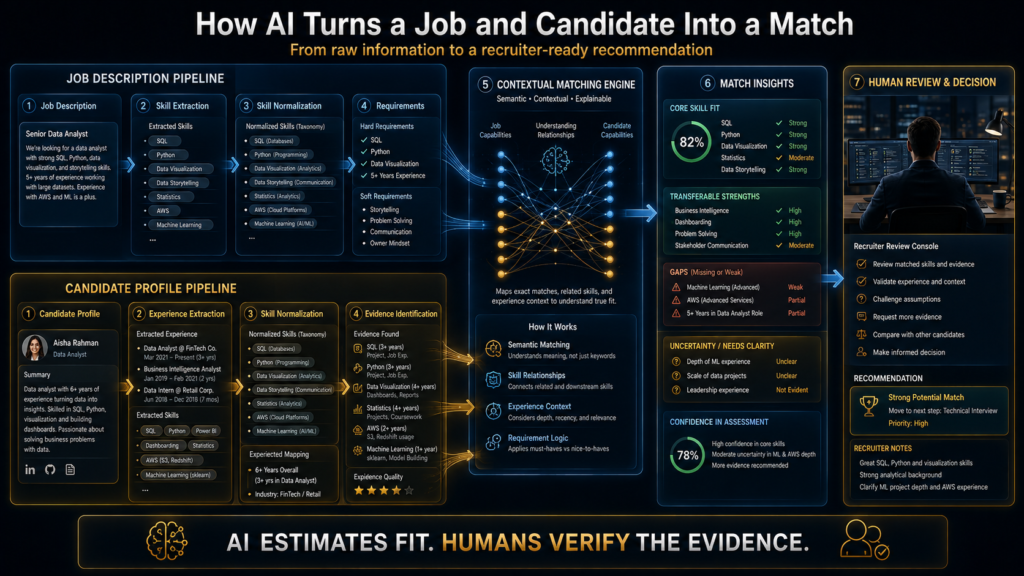
A serious matching workflow performs several distinct reasoning steps, and each one can fail independently. It extracts skills from the job description, normalizes them to a taxonomy, maps relationships between skills and separates hard requirements from soft preferences.
It then builds a candidate representation, runs a semantic and contextual comparison, produces fit, gaps and uncertainty, ranks candidates and passes them to human review. There is no step where the AI reads a resume and simply knows the perfect candidate.
Seeing the pipeline explains why explainability matters. When a recruiter sees only a final score, they cannot tell whether the recommendation came from strong skill evidence or from a weak proxy that happened to correlate with past hires.
A good system exposes enough of each step, which skills were extracted, which were matched and which were missing, that a recruiter can inspect the reasoning and disagree with it. Systems that hide the pipeline behind one number weaken the recruiter’s judgment at exactly the point it matters.
Hard Constraints, Soft Signals and the Candidate-Job Fit Stack
AI matching should separate mandatory requirements from preferences instead of blending every factor into one score. A cybersecurity role might require a specific professional certification and prefer experience with a particular security platform.
Candidate A holds the certification but has never used the platform, while Candidate B knows the platform deeply but lacks the certification. A generic similarity model may rank B higher because more text overlaps, even though B fails a mandatory requirement, so fit has to mean constraint satisfaction plus capability overlap.
The AI Hustle World Candidate-Job Fit Stack replaces one mysterious score with six layers, evaluated in order. Each layer answers a different question about the candidate.
| Layer | Question it answers | Example |
|---|---|---|
| 1. Hard constraints | Can the candidate meet mandatory requirements? | Required license, work authorization, legally required qualification |
| 2. Core skills | Does the candidate have the capabilities the job depends on? | SQL and forecasting for a financial analytics role |
| 3. Relevant experience | Have those skills been applied in a comparable context? | Forecasting in a regulated industry |
| 4. Transferability | Can adjacent skills reasonably carry over? | Operations analysis moving into product operations |
| 5. Evidence | How strong is the proof behind each claim? | Work sample, portfolio, measurable outcome |
| 6. Potential | Can remaining gaps realistically be developed? | A missing tool that takes weeks to learn |
The stack tells recruiters why a candidate might fit and where the uncertainty remains, which is what they need to decide what to probe in an interview. It also forces the organization to decide, before ranking anyone, which requirements are truly mandatory.
Five years of experience is often a preference dressed up as a requirement. An AI system will enforce whatever it is told, so the definitions deserve more scrutiny than the model.
A Worked Example: Three Candidates Through the Fit Stack
Returning to the Product Operations Manager role shows how the stack changes a shortlist. The hiring manager defines the hard constraints as work authorization and availability to start within two months, and the core skills as process design, cross-functional coordination, data analysis and stakeholder management.
The three candidates from the introduction then look quite different from their titles. The table is illustrative, but it reflects the kind of output a well-designed system should produce.
| Fit Stack layer | Candidate 1: current Product Operations Manager | Candidate 2: Senior Operations Analyst | Candidate 3: Program Manager |
|---|---|---|---|
| Hard constraints | Met | Met | Met |
| Core skills | Coordination strong; data analysis thin | Process design and data analysis strong | Coordination and stakeholder management strong |
| Relevant experience | Small startup, one product | Mid-size SaaS, launches across three products | Enterprise programs, no direct product work |
| Transferability | Direct | High | Moderate |
| Evidence | Title and responsibilities only | Portfolio of process redesigns with measured outcomes | Program results, limited product detail |
| Main gap | Analytics depth | Formal people leadership | Product context |
On title alone, Candidate 1 wins. On evidence, Candidate 2 has the strongest demonstrated match for the core skills, and Candidate 3 is worth a conversation because the gap is product context, which is often learnable.
A recruiter using this view invites all three to interview with specific questions: analytics depth for the first, leadership for the second and product judgment for the third. The shortlist becomes wider and better informed at the same time.
How Semantic Matching Works and Where It Stops
Semantic matching compares meaning rather than identical words. Modern systems convert requirements and candidate descriptions into numerical representations called embeddings, where text with related meaning sits close together.
That is how “manage enterprise customer renewals” and “owned retention strategy for strategic accounts” can be recognized as related despite sharing almost no vocabulary. Our explainers on how embeddings work and how AI models understand language cover the mechanism.
This is a real advance over keyword filters, and it is the main reason AI can surface candidates from different industries or with unusual titles. Semantic matching has a clear boundary, though: it can tell you two descriptions appear related, but not whether the person has the capability or whether the claim is true.
Embeddings also inherit patterns from the text they were trained on. Terms common in some professional communities may sit closer to a job’s vocabulary than equally valid terms used elsewhere, so semantic similarity is a reason to look closer, and evidence is what the closer look is for.
Transferable Skills and Internal Mobility
Skills-based matching is most valuable when it surfaces candidates whose titles or industries differ from the target role but whose capabilities transfer. The Senior Operations Analyst in the example brings process optimization, data analysis, coordination and planning to a product operations role that a title filter would never connect to them.
The same logic applies inside the company, where it is often underused. A Financial Analyst with SQL, business intelligence, process automation, forecasting and stakeholder management may be a strong internal candidate for a newly opened business intelligence role.
Once skills are represented consistently, the workforce question changes. It moves from “which candidates should we hire?” to “where does this capability already exist, and should we hire it, develop it or move it?”
Vendors such as Workday market skills platforms built around this idea, treating skills as a data layer that connects recruiting, learning, internal mobility and workforce planning. Our explainer on AI in HR and recruiting shows how these systems fit together, and our guide to AI onboarding and HR helpdesks covers what happens once someone starts.
Skills-First Does Not Mean Degree-Blind
A skills-based process should remove unnecessary credential requirements while keeping the ones a job needs. Some roles legitimately require professional licenses, regulated qualifications, security clearances or specific degrees, and a matching system should treat those as hard constraints.
The problem arises when a credential becomes a proxy for capability even though the work does not require it. That problem becomes harder to see once AI learns from historical hiring data.
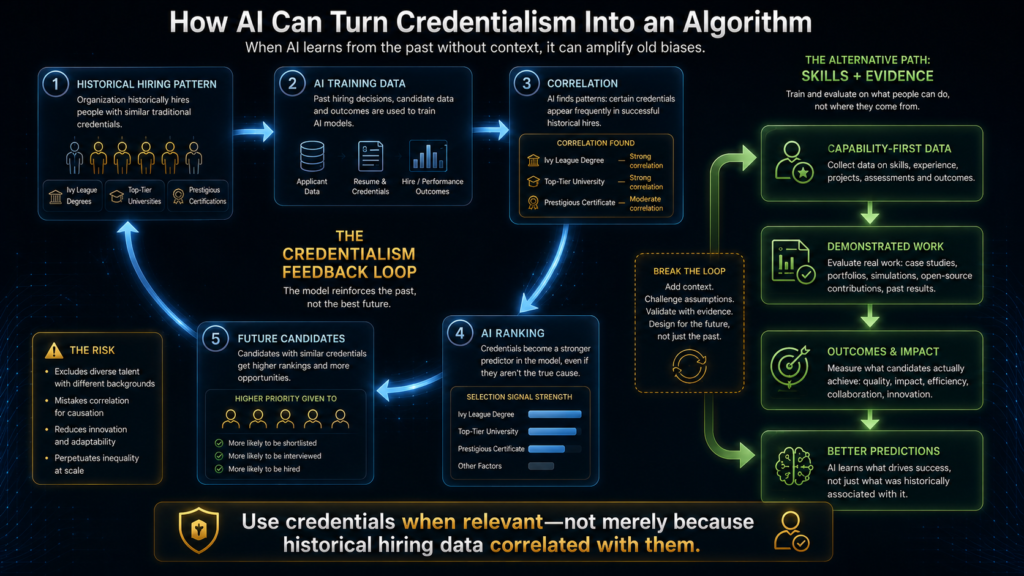
A May 2026 NBER working paper by Peter Blair and Rui Guo names this pattern algorithmic credentialism. The authors argue that AI hiring tools trained on historical data often encode bachelor’s degree requirements as a proxy for skill.
They draw on research about workers Skilled Through Alternative Routes, or STARs, who gained their skills through community college, military service, training programs or on-the-job experience. Those workers are exactly the people a degree proxy filters out.
The feedback loop is easy to trace. Historical hires skew toward degree holders, the model learns that degrees correlate with being hired, degree holders rank higher and more of them are hired, so the pattern continues with the appearance of objectivity.
Our beginner’s guide to how AI learns from data explains why models reproduce whatever patterns their training examples contain. A simple test helps: if removing the degree field changes rankings sharply for roles that do not require a degree, the system has learned a proxy.
The Skill Evidence Ladder
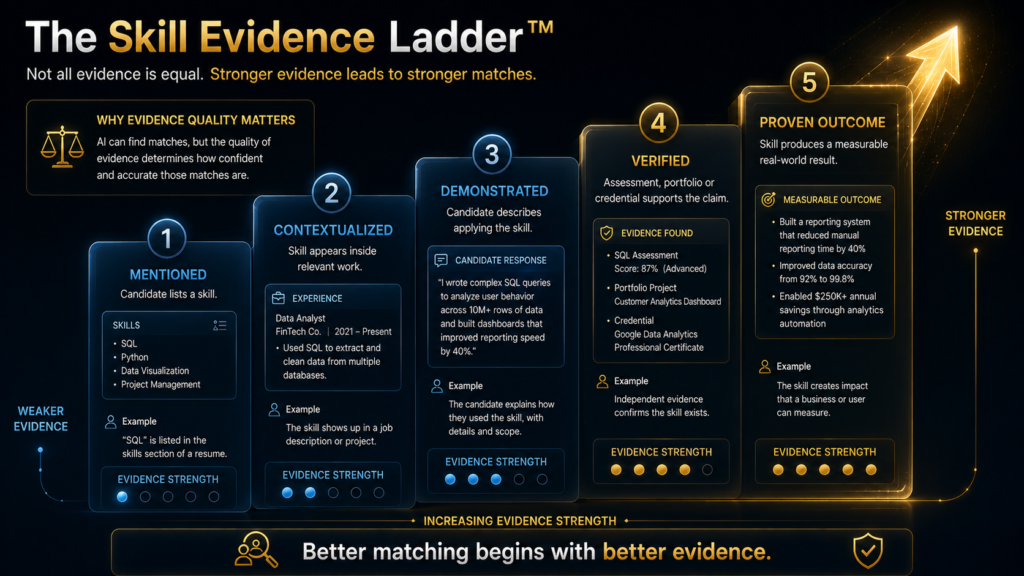
Not every skill claim deserves equal weight, and the AI Hustle World Skill Evidence Ladder ranks claims by the strength of their proof. A system that treats “listed Python” and “automated forecasting in Python and cut reporting time by 35%” as the same data point throws away most of the signal.
| Level | What it looks like | Example |
|---|---|---|
| 1. Mentioned | The skill appears as a word | “Python” in a skills list |
| 2. Contextualized | The skill appears inside relevant work | “Used Python for financial analysis” |
| 3. Demonstrated | The candidate describes applying it | “Built an automated forecasting pipeline in Python” |
| 4. Verified | Independent evidence supports the claim | Work sample, assessment, portfolio, credential or reference |
| 5. Proven outcome | The work produced a measurable result | “Automated monthly forecasting and cut reporting time by 35%” |
Recency belongs in the same assessment. A candidate who used a technology heavily six years ago and one who uses it every week both have “Skill = yes” in a simple system, yet their current proficiency may differ enormously in fast-moving fields.
The ladder matters more each year because applications are increasingly written with AI assistance. Candidates can use AI resume builders and chat assistants to tailor every application to a job description, which makes skills lists and polished phrasing weaker signals.
Employers use AI to extract and rank those same phrases, creating an AI-on-AI loop in which the language converges and its information content falls. The stronger signals become the ones that are hard to generate: work samples, structured assessments, demonstrated outcomes and verified credentials.
Skills Assessments and Work Samples
The fastest way to move candidates up the Skill Evidence Ladder is to ask them to show the skill directly. Work samples, job simulations and short structured tasks produce level-four evidence that no resume can match.
The best assessments mirror real work and stay short. A data analyst might clean a small dataset and explain one finding, and a support lead might prioritize a queue of five tickets, each taking under an hour rather than a weekend.
Assessment design needs the same care as interview design. Score every submission against a written rubric, offer accessible formats and reasonable adjustments, and avoid tasks that look like unpaid consulting work for your business.
Matching and assessment work well together. The matching system widens the pool and prioritizes who to invite, and the assessment supplies the evidence that turns a semantic similarity into a demonstrated capability.
Keeping the Skills Taxonomy Current
A skills taxonomy decays quietly unless someone owns it. New tools appear, job titles shift, and yesterday’s specialist skill becomes an expected basic, so a taxonomy set up once and left alone drifts away from the work it describes.
Assign an owner, often in talent acquisition or HR analytics, and review the taxonomy on a fixed schedule, such as quarterly. Add emerging skills, merge duplicates, retire obsolete entries and record common synonyms so matching recognizes them.
Recruiters are the best early-warning system. When they see strong candidates ranked low or weak candidates ranked high, the cause is often a missing synonym or a skill defined too narrowly, so give them a simple way to report it.
Treat taxonomy changes like any other system change. Record what changed and why, and rerun your labeled test set afterward to confirm the update improved matching rather than breaking something else.
Why Match Scores Mislead
An AI match score is a platform-specific ranking signal, not a probability of job success. If one system gives Candidate A 92% and Candidate B 84%, A does not have an eight-point advantage in future performance.
The score reflects the platform’s internal weighting of skills, experience, titles, credentials, location, industry and other signals. Different vendors calculate “fit” differently, so a 90% score from one system should never be compared with a 90% score from another.
A weak output says “Candidate match: 92%,” and a better one says “strong skill overlap.” The most useful output reads like a reviewer’s note: core skills seven of eight supported, five years in relevant environments, required certification confirmed, no evidence of healthcare compliance work, confidence medium to high.
The AI Hustle World Qualified Match Scorecard turns that note into a standard format. It changes the recruiter’s question from “why did the AI give this person 91?” to “which evidence makes this person worth reviewing?”
| Dimension | What it answers |
|---|---|
| Hard constraints | Can the candidate meet every mandatory requirement? |
| Skill fit | Do the core capabilities overlap? |
| Experience fit | Were those skills used in comparable contexts? |
| Transferability | Can adjacent capabilities carry over? |
| Evidence strength | How well is each capability demonstrated? |
| Uncertainty | What does the system not know? |
The scorecard does not eliminate the model’s score. It puts the score in its proper place, as a prioritization aid rather than a decision.
How Recruiters Should Work With Match Results
Match results are most useful when recruiters treat them as a starting list rather than a final order. Anchoring on rank is the most common failure: people review the top ten and stop, even when candidate eleven has stronger evidence.
A better routine is to review the evidence panel for each shortlisted candidate, check hard constraints first and read the gaps before the strengths. Recruiters should also sample a handful of lower-ranked candidates in every batch, because that is where missed talent shows up.
Record a short reason whenever a recruiter advances or rejects someone against the system’s recommendation. Those notes become the most valuable input for improving the matching setup and the clearest evidence of human oversight if a decision is ever questioned.
Finally, keep humans in charge of the requirements themselves. If recruiters notice that a supposed must-have keeps excluding strong people, the fix is a conversation with the hiring manager, not a manual workaround that the system never learns from.
Bias, Monoculture and Feedback Loops
Skills-based matching can reduce dependence on some traditional proxies while introducing new risks through training data, weighting and model design. A Stanford study summarized by Stanford HAI, AI Hiring Tools Can Yield Racial Bias and Systemic Rejection, shows how real those risks are.
The study followed 3.4 million people who submitted 4 million applications to 1,700 job postings across 150 employers, all assessed by one third-party vendor’s AI tool. The researchers found significant adverse impact on Black and Asian applicants, and evidence of systemic rejection, where some applicants were rejected across employers more often than independent decisions would produce.
The study examined one vendor’s system, including a game-based assessment, so it does not prove every matching platform behaves the same way. It does show why AI hiring systems need empirical auditing rather than an assumption of neutrality.
It also illustrates algorithmic monoculture. When many employers rely on the same or similar models, the same candidates can lose everywhere at once, which makes vendor diversity and independent testing more than an IT concern.
Feedback loops add a subtler risk. If a system favors a narrow profile, those candidates get hired, managers rate them, and the ratings feed back into the model as proof that the profile predicts success.
If those hires also received better managers, more training or easier assignments, the model is learning organizational advantage and calling it candidate capability. Our guide on detecting and reducing bias in AI-assisted decisions covers practical audit methods.
Regulators increasingly treat these systems as high-stakes. The European Commission’s AI Act Service Desk guidance on AI in employment uses automated job matching and ranking as an example of a system that can be high-risk, with duties around data governance, documentation, transparency, oversight and accuracy.
Whatever your jurisdiction, treat the choice of a matching system as a governance decision. Keep a person meaningfully in the loop for any decision that affects someone’s career.
Bad Job Descriptions Produce Bad Matches
AI cannot create a trustworthy match when the requirements are vague, inflated or contradictory. A job description asking for ten years of experience, five programming languages, deep strategy, strong execution, startup experience and enterprise experience describes a fictional candidate.
The company may need a strong product manager with technical fluency. An AI system will search millions of profiles for the fictional one and rank real people against an impossible ideal, making the shortlist look scientific while making it worse.
Skills-based hiring therefore starts with job design, and ranking comes much later. Before any matching tool is configured, the hiring manager and recruiter should separate must-have requirements from preferences and from skills that can be trained in the first months.
They should also agree on what evidence would demonstrate each core skill. That work takes an afternoon per role, and skipping it means the AI automates the ambiguity already sitting in the job description.
Telling Candidates How Matching Works
Candidates increasingly know that software reads their applications, and many assume it rejects them for missing keywords. Explaining how your matching works improves both trust and the quality of the evidence you receive.
A short note on the job page can say which skills matter most, that equivalent experience counts, and how candidates can show evidence such as portfolios, work samples or assessment results. That invites exactly the level-four and level-five evidence the Skill Evidence Ladder rewards.
Offering a route to demonstrate skills also helps candidates without conventional credentials. A structured skills assessment or a short work sample gives them a way in that a degree filter never would.
Where you use automated tools in regulated places, such as New York City, notice and audit rules may apply as well. Clear candidate communication is good practice everywhere and a legal requirement in some jurisdictions.
How to Test an AI Matching System Before You Buy
The best test uses candidates the system could reasonably misunderstand, not the vendor’s demonstration data. Build a test set for one real role with about 45 profiles, and have experienced recruiters label it before you run anything.
Include 10 clear matches, 10 partial matches missing some core skills, 10 transferable-skill candidates with different titles, 5 nontraditional candidates, 5 “false friends” who use similar terms but have weak real fit, and 5 hard-constraint failures with excellent profiles.
| Test | What to observe |
|---|---|
| Skill extraction | Did the system identify the skills that matter for the role? |
| Ranking | Were the clear matches near the top? |
| Transferability | Were adjacent profiles recognized rather than buried? |
| Evidence | Did the system distinguish claims from demonstrated capability? |
| Constraints | Were all hard-constraint failures filtered or flagged? |
| Explanation | Could recruiters understand why each candidate ranked where they did? |
| False positives | Which false friends ranked too highly? |
| False negatives | Which strong candidates were missed entirely? |
| Uncertainty | Did the system acknowledge what it did not know? |
When you compare shortlisted platforms, AI Hustle World uses its site-wide W.O.R.T.H. checklist. Workflow fit (25 points) covers integration with your applicant tracking system and taxonomy, and Output quality (25) covers performance on the test set above.
Risk and rights (15) covers bias testing, explainability, candidate data handling and regulatory support, Total cost (20) covers licenses, implementation and taxonomy maintenance, and Human effort (15) covers the recruiter work needed to review recommendations. Our comparison of the best AI recruiting tools is a good starting shortlist, and a vendor that refuses a meaningful test has told you something important.
Implementing AI Job Matching Step by Step
Implementation works best as a sequence where each step builds on a stable previous one. Start by defining the job properly, separating must-have, preferred and trainable requirements before choosing a tool.
Then build the skills model for the role, covering core skills, supporting skills, expected proficiency, context and the evidence that would demonstrate each one. For every major skill, write down what would convince a reasonable recruiter that the capability exists.
Next, test transferability deliberately by including candidates with different titles, adjacent industries and alternative educational paths in your pilot. Validate rankings against experienced recruiter judgment and investigate disagreements, because they show where the model or the recruiters hold assumptions worth examining.
Finally, monitor outcomes over time, including interview progression, offers, performance, retention and internal mobility, and audit regularly for fairness, false positives, false negatives and credential dependence. AI governance policies should define who reviews those audits and what happens when a problem appears.
Metrics That Show Whether Matching Works
The number of recommendations a system produces says almost nothing about its value. Qualified Match Yield is the share of AI-prioritized candidates who reach meaningful recruiter review, which shows whether the shortlist is worth reading.
Match Coverage is the share of known qualified candidates in a labeled test set that the AI surfaces, which shows whether the system is missing good people. Downstream Quality tracks what happens after the match, including interview progression, offers, quality of hire, retention and internal moves.
Coverage deserves special attention because its failures are invisible in daily use. A recruiter sees the candidates the system recommended, and nobody sees the strong candidate it never surfaced.
A missed qualified candidate can cost more than a noisy recommendation, especially in skills-shortage roles. Periodic tests against a labeled set are the only reliable way to know how much talent the system leaves behind.
The Economics of Skills-Based Matching
The financial case for skills-based matching comes from three places: a wider candidate pool, faster filling of hard roles and more internal moves. Each has a real cost attached, so the case should be built with your own numbers.
A wider pool matters most in skills-shortage roles, where every week a position stays open means lost output, overtime or delayed projects. If matching surfaces qualified candidates that title filters missed, the saving is the vacancy time avoided, which can dwarf the software cost.
Internal mobility is often the largest and least counted gain. Filling a role with an existing employee avoids external recruiting costs and usually shortens ramp-up time, because the person already knows the systems, customers and culture.
Against those gains sit the costs of licenses, integration, taxonomy maintenance, skills assessments and the recruiter time spent reviewing recommendations and audits. A matching system that nobody maintains drifts, so budget for ongoing ownership, not just purchase.
What Happens If You Keep Filtering on Titles and Degrees
Staying with title and degree filters carries costs that never appear on a report. Qualified candidates are rejected silently, internal talent is overlooked, and hard-to-fill roles stay open longer than they need to.
The pool also narrows over time. If the same filters are applied year after year, the workforce increasingly resembles past hires, which limits the range of experience available when the business changes direction.
There is a regulatory dimension as well. Rules on automated employment decisions are expanding, and filters that produce adverse impact without a job-related justification are harder to defend than a documented skills-based process.
The alternative does not require a large platform on day one. Rewriting two or three job descriptions around skills, adding a work sample to the process and reviewing a batch of rejected applications for missed talent will show quickly how much the old filters were costing.
Common Mistakes With AI Job Matching
Most matching failures trace back to a handful of avoidable decisions. They are worth checking before launch and again after the first hiring round:
- matching before the job requirements are properly defined
- treating every listed skill as equal to demonstrated capability
- reading match scores as probabilities of success
- ignoring skill recency in fast-moving fields
- letting degree fields act as hidden proxies
- testing the system only on obvious matches
- never checking for strong candidates the system failed to surface
- training on past outcomes without asking what caused them
Each of these has a simple countermeasure described earlier in this guide. The common thread is that the definitions, evidence and audits matter more than the sophistication of the model.
Who Should Use AI Job Matching
If you run high-volume hiring, recruit for skills-shortage roles, want to consider candidates whose titles do not reflect their capabilities, or hold a large database of past applicants you never revisit, AI job matching can widen your pool and save screening time. It is especially useful for internal mobility and for global organizations where regions describe the same work differently.
Start with the Fit Stack and Evidence Ladder so recruiters see why each recommendation was made. That habit protects you from treating the score as the decision.
If your hiring volume is small, your roles are extremely specialized, your requirements are unclear or your historical data is thin, full automation is the wrong choice. AI can still help you search and organize evidence, but it should stay in the role of recommendation rather than selection.
The same caution applies when the vendor’s model is opaque or your governance is immature. Our comparison of AI recruiting and traditional recruiting sets out where human-led methods still perform better.
The AI Hustle World View
The marketing version of AI job matching says the software can identify the perfect candidate based on skills. The evidence supports something narrower and more useful: employers are adopting skills-based hiring, AI makes skills comparison scalable, and semantic matching can surface people that title filters bury.
At the same time, skills are still hard to standardize, historical data can turn degrees into hidden filters, and real-world audits have found racial disparities and systemic rejection in deployed tools. Skills-based AI does not eliminate bias; it removes some old proxies and can create new ones.
We would not buy a matching system on the strength of a claim that it finds the perfect candidate. We would ask what the system believes a skill is, how it knows a candidate has that skill, how it handles transferable skills, what happens when a candidate does not resemble past hires, and whether a recruiter can challenge each recommendation.
If those answers are unclear, the match score is not enough. AI matching earns its place when it helps recruiters see qualified people they would realistically miss at scale, increasing the evidence a recruiter can evaluate rather than replacing their judgment.
How We Researched This Guide
This guide was researched and drafted with AI assistance and checked against the primary sources linked in the article. Adoption figures come from NACE’s public summary of its Job Outlook 2026 survey and the Burning Glass Institute and Harvard Business School report on skills-based hiring.
The discussion of algorithmic credentialism draws on the NBER working paper by Blair and Guo, the bias findings come from Stanford HAI’s summary of a large-scale study of a deployed AI hiring tool, and regulatory references come from the European Commission’s AI Act Service Desk. Vendor capabilities are described as vendors present them.
We did not run a hands-on test of an AI job-matching platform, and no benchmark result is claimed. The Candidate-Job Fit Stack, Skill Evidence Ladder, Qualified Match Scorecard, the worked example, test-set design and metric definitions are AI Hustle World analysis and illustration.
Last updated September 2026. This version restructures the guide, adds the worked example, economics and candidate-communication sections, re-checks each statistic against a live source and removes figures we could no longer trace.
Final Thoughts: Match Capabilities, Verify Evidence
AI job matching can move hiring beyond the same title, the same degree and the same keywords toward the capabilities a job requires. A person who never held the exact title may have every skill needed, a person with the right credential may not, and AI makes those connections far easier to find.
The trap is believing that once skills are represented mathematically, hiring has become objective. Someone still decides what counts as a skill, which skills matter, what evidence is credible and which requirements are mandatory, and historical data can influence every one of those choices.
The strongest matching system is the one that can say what capability a person appears to have, what evidence supports it, what is missing, what is uncertain and what a recruiter should verify next. That is a far more useful output than a percentage.
A candidate is not a percentage, a skill is not a checkbox, and a recommendation is not a guarantee of performance. Use AI to widen the talent pool without narrowing human judgment.
Go Beyond Resume Matching
AI can help employers discover candidates based on skills, experience and transferable capabilities—but a match score should never replace evidence or human judgment.
Explore AI Interviewing →FAQ
What is AI job matching?
The use of AI to compare job requirements with a candidate’s skills, experience and evidence to estimate fit. A good system shows fit, gaps and uncertainty so a recruiter can decide who deserves closer review.
How does AI job matching work?
It extracts skills from the job, normalizes them to a taxonomy, builds a picture of each candidate, compares the two by meaning and separates hard requirements from preferences before ranking for human review.
What is skills-based hiring?
Hiring based on the capabilities a job requires rather than mainly on degrees, titles or past employers. It widens the talent pool when skills are defined clearly and assessed with real evidence.
Is AI job matching better than keyword matching?
It can recognize related experience described in different words, which keyword systems miss. It can also make confident mistakes, so its value depends on good skill definitions and evidence.
What is a skill taxonomy?
A structured vocabulary of skills and their relationships, such as O*NET in the US or ESCO in Europe. It lets jobs and candidates be described consistently, and it needs regular updating.
Can AI identify transferable skills?
Yes. Skills-based systems can surface candidates whose titles or industries differ from the role but whose capabilities carry over. Recruiters should still check that the overlap is real.
Does skills-based hiring mean degrees no longer matter?
No. Degrees and licenses remain appropriate when a job requires them. Skills-based hiring removes credentials that act only as proxies and asks employers to justify each requirement.
What is algorithmic credentialism?
AI hiring systems learning from historical data to treat a bachelor’s degree as a proxy for skill, even when the job does not need one. The term comes from a 2026 NBER working paper by Blair and Guo.
Does AI job matching remove hiring bias?
No. It can reduce some old proxies but introduce new bias through training data, taxonomies and feedback loops. A large Stanford study found racial disparities in one deployed AI hiring tool.
Does a 90% match mean the candidate will succeed?
No. A match score shows how compatible the available information looks under one platform’s method. Job success depends on many factors the score does not capture.
Related Guides
- AI Recruiting vs Traditional Recruiting: What Actually Works?
- Best AI Recruiting Tools in 2026: Sourcing, Screening & Interviewing Compared
- How AI Turns Customer Feedback into Product Insights
- AI Product Discovery: How to Use AI for Competitive Research and Market Analysis
- How to Evaluate RAG Retrieval Quality: Metrics, Testing & Failure Analysis
- How to Build an AI B2B Prospecting Workflow
Written by
Muntasir Ahmad Chowdhury
Founder, AI Hustle World
Muntasir Ahmad Chowdhury is the Founder of AI Hustle World, an independent publication dedicated to making Artificial Intelligence practical, trustworthy, and easy to understand. He researches AI tools, automation, customer service, productivity, and real-world business applications, helping readers make smarter technology decisions through research-driven, experience-backed content.
Expertise:
AI Tools • AI Automation • AI Customer Service • AI Productivity • Generative AI • AI Workflows
Get Smarter With AI
Enjoyed this guide? Get practical AI tools, tutorials, and honest reviews delivered to your inbox.