Evidence: Documentation reviewed. No voice clone was created or tested.
Last checked: 10 October 2026 for plan availability and the Instant Voice Cloning guide
What was done: Re-checked ElevenLabs’ Instant Voice Cloning guide and plan availability. We also tried to create an Instant Voice Clone on the Free plan and reached an upgrade screen at the save step, so no clone exists to test. The rest of this guide was last checked against its sources in September 2026.
Files: Screenshots and a record of the attempt on GitHub
Affiliate links: Yes
Last updated: October 2026. Added what happened when we tried to create an Instant Voice Clone on the Free plan, and re-checked the cloning requirements and plan availability against ElevenLabs’ own pages. Sections that repeated each other were removed and the FAQ was cut to ten questions.
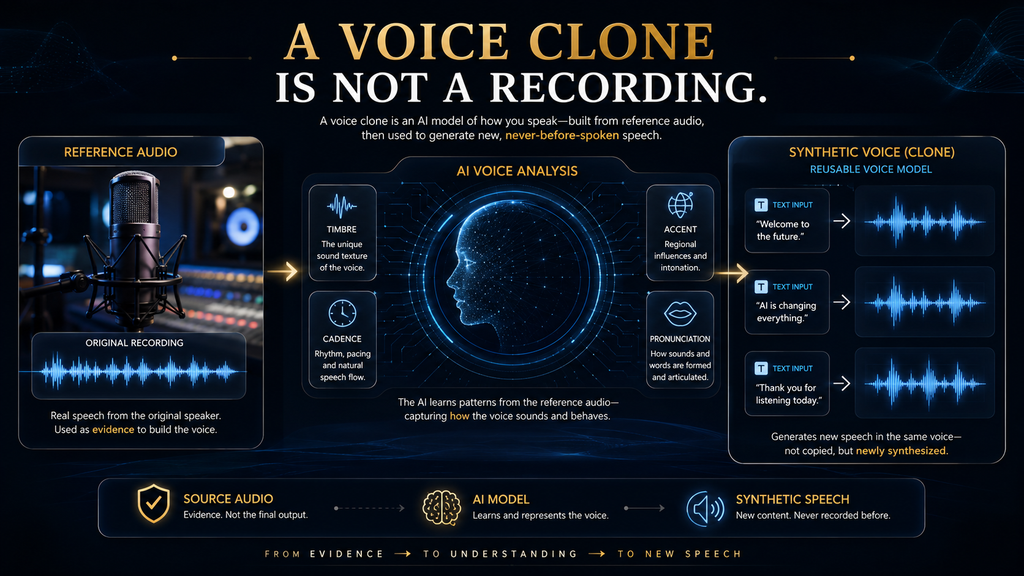
Voice cloning is often described as if it were a sophisticated version of recording a voice once and replaying it forever. That description is convenient, but it misses the important part. When you create a voice clone with ElevenLabs, you are not simply storing a recording and asking the system to play it back. The goal is to create a reusable representation of a speaker’s vocal characteristics that can be applied to speech the person never actually recorded.
That distinction explains both the appeal and the limitations of the technology. A cloned voice can read an entirely new script, correct a sentence that was recorded incorrectly, narrate a video without the original speaker sitting behind a microphone, or help preserve a recognizable voice across repeated production. But the system is still generating new speech, and the quality of that speech depends on the reference material, the cloning method, the language and speaking style, the generation model, and the way the result is validated.
ElevenLabs currently offers two primary cloning approaches: Instant Voice Cloning (IVC) and Professional Voice Cloning (PVC). They are not simply a fast and slow version of the same process. ElevenLabs describes IVC as using a short reference sample as a conditioning signal without training a custom model, while PVC involves fine-tuning a dedicated model using a much larger voice dataset.
That difference creates a much more useful question than “Is ElevenLabs voice cloning realistic?” The better question is: What does the system actually learn, when is Instant Voice Cloning enough, when is Professional Voice Cloning worth the additional work, what causes a clone to fail, and what should you consider before turning a person’s voice into a reusable digital asset? This guide answers those questions from the ground up.
Affiliate disclosure: This article contains ElevenLabs affiliate links. AI Hustle World may earn a commission if you subscribe through them, at no additional cost to you. Recommendations remain based on documented fit, limitations and responsible-use requirements.
Turn Your Voice Into a Reusable AI Asset
Test ElevenLabs with your own authorized voice and evaluate the result using the scripts, languages, and content you actually produce.
Test Your Voice With ElevenLabs →Affiliate disclosure: We may earn a commission if you subscribe through this link, at no additional cost to you.
What Is ElevenLabs Voice Cloning?
ElevenLabs voice cloning creates a reusable synthetic representation of a speaker’s vocal characteristics so the system can generate new speech that resembles that speaker. ElevenLabs describes characteristics such as timbre, cadence, accent and pronunciation as part of what the cloning process captures.
A normal recording contains one particular performance. If you record yourself saying, “Welcome back to the channel,” that recording contains the exact words, timing, breaths, background acoustics and vocal performance that occurred at that moment. It cannot naturally become a recording of you saying an entirely different sentence unless you record that sentence or manipulate the original audio.
A voice clone operates differently. It is useful because it can generate speech that was not contained in the original recording. Give the system a new sentence, and the model synthesizes new audio while attempting to preserve recognizable properties of the target speaker.
It is also why voice cloning should not be understood as a perfect digital copy of a human voice. ElevenLabs’ own technical documentation notes that the generated output does not reproduce the exact acoustics of the original recording. The output still passes through the speech-synthesis system and its own characteristics. This gives us the first principle for understanding the entire technology:
A voice clone is not a recording of you. It is a system for generating new speech that resembles you. That sounds like a subtle distinction, but it explains almost everything that follows.
If the reference recording contains background noise, the system has to distinguish the speaker from that noise. If the recording contains an unusual accent, the model has to represent that accent correctly. If the training material contains a particular delivery style, the resulting clone may reflect that style. If the source material is inconsistent, the model receives conflicting signals about what the target voice should sound like. In other words, the quality of the clone begins before the clone exists.
How Does ElevenLabs Voice Cloning Work?
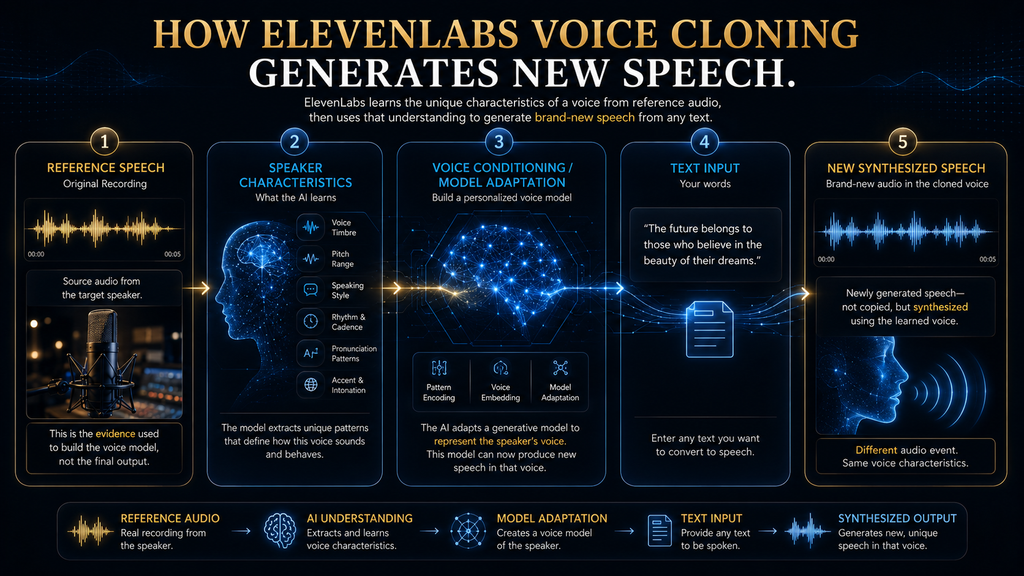
At a conceptual level, voice cloning involves taking reference speech, extracting or representing characteristics that identify the speaker, using those characteristics to condition or adapt speech generation, and then synthesizing new audio from text.
The exact internal architecture of ElevenLabs’ current models is proprietary, so it would be irresponsible to describe every internal layer as though it were publicly documented. What ElevenLabs does document is enough to explain the important distinction between its two cloning methods.
The company’s technical documentation describes voice cloning as capturing characteristics such as timbre, cadence, accent and pronunciation and encoding patterns from the reference audio into information that guides speech synthesis. It also distinguishes IVC from PVC at a fundamental level: IVC uses the audio as a conditioning signal during generation, while PVC fine-tunes a model on the speaker’s audio. That means the conceptual process looks like this:
Reference speech → speaker characteristics → voice conditioning or model adaptation → text input → newly synthesized speech The reference speech provides evidence about the target speaker. The system then uses that information while generating new speech. The text provides the linguistic content, while the voice representation helps determine how that content should sound.
That generative property is what makes voice cloning powerful for content production. It is also what makes quality difficult to guarantee. A generated sentence has to solve several problems simultaneously. It needs to contain the requested words, pronounce them correctly, preserve the recognizable identity of the speaker, maintain appropriate rhythm and intonation, and sound natural enough that the listener does not become distracted by the synthesis.
The system therefore has to balance what is being said with who appears to be saying it. That is the deeper technical problem behind voice cloning.
Instant Voice Cloning vs Professional Voice Cloning
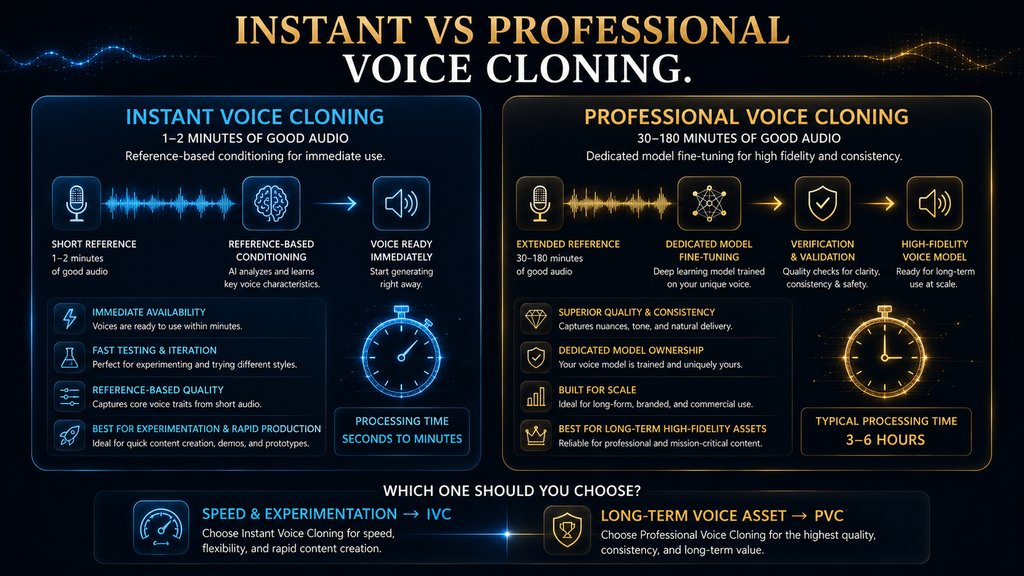
Instant Voice Cloning is optimized for speed and short reference material, while Professional Voice Cloning uses substantially more speaker-specific data and dedicated fine-tuning for a deeper representation of the voice. ElevenLabs explicitly says the two methods work differently rather than simply representing fast and slow versions of the same process. The current documented differences are substantial.
| Factor | Instant Voice Cloning | Professional Voice Cloning |
|---|---|---|
| Core approach | Short reference sample used for conditioning | Dedicated model trained/fine-tuned on voice data |
| Typical recommended audio | About 1–2 minutes of good audio | About 30–180 minutes; ElevenLabs recommends at least an hour and ideally close to three hours for best results |
| Availability | Starter and above | Creator and above |
| Training wait | Essentially immediate | Usually around 3–6 hours, sometimes longer |
| Voice verification | Permission/consent confirmation | Stronger verification that the voice belongs to the creator |
| Best suited to | Testing, short projects, rapid production | Long-term voice assets and higher-fidelity production |
| Main advantage | Speed and low preparation burden | Greater speaker-specific adaptation |
| Main limitation | Can struggle with unusual voices, accents and broader styles | Requires more preparation, audio and processing time |
The key mistake is to interpret this table as “PVC is better, so everyone should use PVC.” That is not how a good production decision works. IVC may be the better choice when you are experimenting, testing a content concept, producing short-form material, or simply trying to determine whether a cloned voice fits your workflow. If you can validate the concept in minutes, there is little reason to spend hours preparing a professional dataset before you know whether the technology solves your problem.
PVC becomes more attractive when the voice itself is a production asset. If you are building an audiobook, a long-running YouTube channel, a branded narration system, recurring commercial content or a voice-centered product, consistency and fidelity may be worth the additional preparation. The real decision is therefore not: Which cloning method is best? It is:
How expensive is an imperfect voice for this project, and how much preparation is justified to reduce that risk? That is a much more useful decision rule.
What Happened When We Tried Instant Voice Cloning on the Free Plan
On October 10, 2026 we tried to create an Instant Voice Clone on ElevenLabs’ Free plan, and the app let us reach the last button before asking for an upgrade. The Create voice window listed Instant Voice Clone with no lock on it, directly above a locked Professional Voice Clone that named the Creator plan. The upload screen asked for at least 10 seconds of audio, as files of up to 10 MB each or a recording made in the browser. Muntasir supplied a recording of his own voice, named the voice, chose a language label and ticked the statement confirming he had the rights and consent to clone the samples.
Pressing Save voice opened a window titled “Upgrade to use your cloned voice.” It offered Starter at $1 for the first month and $6 a month after that, or $5 a month billed annually. No voice was saved, so nothing in this guide comes from a clone we made, and the table above is right to list Instant Voice Cloning as Starter and above. If you are planning your own trial, budget for that first paid month before you spend time on a careful recording.
Two smaller details came out of the attempt. The app’s minimum is 10 seconds of audio, while ElevenLabs’ own guide says to record at least one minute, so treat 10 seconds as the floor and not the target. The same window showed three custom voice slots on the Free plan, and the pricing page lists Voice Design, not cloning, among the Free features.
Our hands-on evidence for ElevenLabs is therefore limited to stock voices. A twelve-line test in English and mixed Bengali and English is written up in the ElevenLabs review, and the script pack, the log and the screenshots, including the screens from this attempt, are in our public test folder on GitHub. That test shows how one stock voice handled mixed-language lines. It does not show how a clone of a Bengali speaker would sound.
Why Instant Voice Cloning Can Be Surprisingly Good
The appeal of IVC is not simply that it is fast. It is that a relatively small amount of reference audio can provide enough information for a powerful speech model to produce a recognizable approximation of the speaker.
ElevenLabs says IVC can work with less than two minutes of audio and notes that users can sometimes get excellent results from shorter samples. Its guidance also emphasizes that the number of files is less important than the total amount and quality of useful speech, and that adding more than roughly two to three minutes can produce little improvement and can sometimes hurt stability.
That tells us something important about few-shot voice adaptation. The model already has broad knowledge about speech. The reference sample does not need to teach the system how human speech works from scratch. Instead, it provides information that helps the system adapt its existing capabilities toward the target speaker. This is why a short sample can be surprisingly effective. But there is a ceiling.
If the voice is highly unusual, if the accent is poorly represented by the model’s prior experience, or if the reference material does not adequately represent the target speaking style, IVC has less speaker-specific information to work with. ElevenLabs explicitly identifies unusual voices and accents as situations where Professional Voice Cloning may be more appropriate. That gives IVC a useful conceptual position: It is not a miniature version of PVC. It is a different trade-off between prior model knowledge and speaker-specific information.
What Professional Voice Cloning Changes
Professional Voice Cloning changes the amount and role of speaker-specific data. Instead of asking the general model to adapt to a short reference sample at generation time, PVC uses a much larger dataset to fine-tune a dedicated model for the speaker. ElevenLabs describes this as training a more realistic model of the voice using a large set of voice data.
The advantage is not simply “more audio.” The deeper advantage is more speaker-specific evidence available during model adaptation. A short sample may show how someone sounds in one particular context. A larger, carefully prepared dataset can contain more examples of the speaker’s pronunciation, rhythm, pitch patterns and delivery across different sentences. That can make the resulting voice more consistent across a wider range of generated speech.
ElevenLabs explicitly warns that Professional Voice Cloning can reproduce unwanted characteristics present in the training material, including background noise, room reverb, music and other audio artifacts. So the real principle is: Professional cloning rewards better data, not simply more data.
Why Your Recording Quality Sets the Ceiling
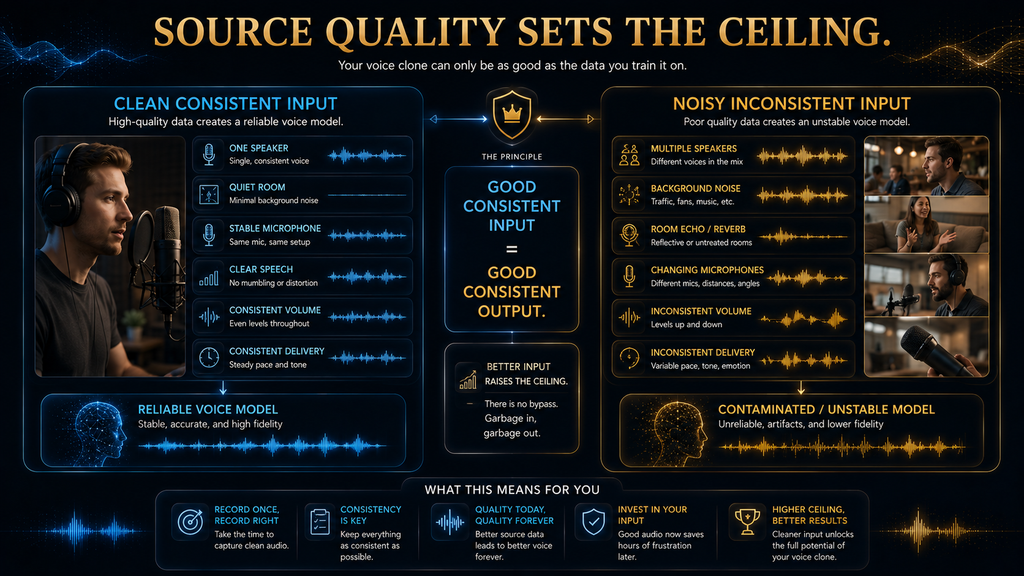
One of the biggest mistakes people make with AI voice cloning is assuming the model will automatically clean up bad source material. It may not.
ElevenLabs recommends clean recordings with one speaker, minimal background noise and room reverb, consistent volume and tone, and a speaking style that matches the desired result. It also recommends MP3 at 192 kbps or higher and specifically says that uncompressed formats such as WAV generally do not improve clone quality by themselves. That last point is worth emphasizing because it contradicts a common audio-production assumption.
People often think: WAV = professional
MP3 = low quality For voice cloning, that is too simplistic. A clean MP3 can be more useful than a poorly recorded WAV because the important variable is not the prestige of the file format. It is the quality and consistency of the speech signal the model receives.
Imagine two datasets. The first contains 90 minutes of clean speech recorded with one microphone in a quiet room at a consistent level. The second contains three hours of recordings gathered from phone calls, YouTube clips, noisy rooms and different microphones. Some clips contain background music. Some have another person speaking. Some have radically different volume levels. The second dataset is larger.
The first dataset is probably more useful. The model does not automatically know that the microphone hiss is not part of the person’s identity. It does not automatically know that the room echo is not part of the desired voice. It has to infer the target from the evidence it receives.
This leads to a broader machine-learning principle that applies well beyond ElevenLabs: The model cannot reliably learn the distinction you failed to make in the data.
The Hidden Variable: Speaking Style
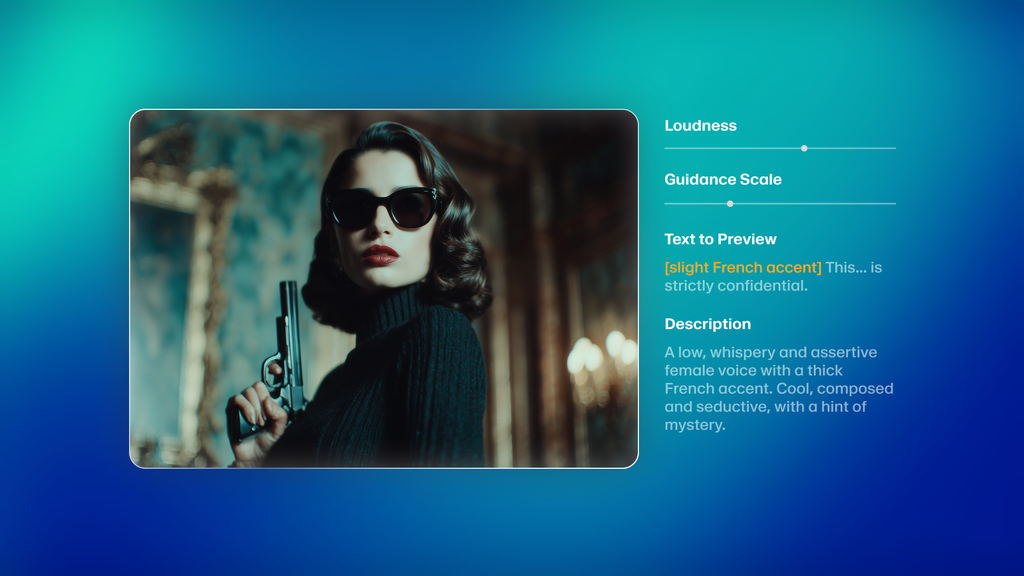
Voice identity is not the same thing as voice performance. A person can sound recognizably like themselves while shifting from intimate conversation to energetic advertising or restrained audiobook narration, so the intended delivery must be represented in the source material.
The vocal identity remains, but the performance changes. That matters because the material you provide to a cloning system can influence the kind of performance the resulting voice produces.
ElevenLabs recommends that the majority of training dialogue align with the speaking style and intonation you want to hear from the resulting clone. Its documentation specifically advises using material that reflects the desired style rather than mixing large amounts of inconsistent speech simply to increase training length. Suppose you want to build a professional audiobook narrator.
You could technically assemble three hours of recordings from casual conversations, social videos, phone calls and interviews. But that dataset may not represent the delivery style you want for narration. A better approach is to provide high-quality narration-style speech that resembles the intended use.
This creates a distinction worth keeping: Voice identity answers “Who sounds like this?” Performance style answers “How should this person sound while delivering this material?” A good cloning workflow considers both.
Language and Accent Are Separate Problems
A cloned voice can sound like the same person and still sound wrong in another language. ElevenLabs currently supports Professional Voice Cloning across a substantial set of supported languages, but its documentation warns that the language used in training matters. The company says a voice can retain characteristics of the original language when speaking another language, and it recommends training material in the language in which the PVC will mainly be used.
This distinction is especially important for multilingual creators. Imagine a creator who records a strong English-speaking voice and then wants to publish the same content in Spanish. The system may preserve recognizable characteristics of the speaker, but that does not automatically mean the result will sound like a native Spanish speaker.
The same issue can appear with pronunciation. A name, place, technical term or foreign word may be perfectly understandable in the source language but require a different pronunciation pattern in the target language. So the right question is not: “Can ElevenLabs speak this language?”
The more useful question is: “Can this particular cloned voice deliver this language naturally enough for my audience and use case?” That is a higher standard. Turning existing content into multilingual output is a different job, which we cover in ElevenLabs Dubbing Explained. This article stays on the voice-cloning side of the problem: how language and accent affect the voice representation itself.
Voice Cloning vs Voice Conversion
Voice cloning and voice conversion are related but different technologies. Voice cloning is generally about creating or using a representation of a speaker so new speech can be synthesized in that voice.
Voice conversion is about transforming an existing performance so it sounds like another voice while preserving aspects of the original performance. ElevenLabs also offers a Voice Changer capability that transforms recorded or uploaded audio into another voice while attempting to preserve elements of the performance such as emotion and delivery.
The distinction matters because the right tool depends on what you are trying to preserve. If you already have an actor delivering a performance and want the result to sound like another voice, conversion may be more appropriate.
If you have a script and want the system to generate the narration from scratch, voice cloning through text-to-speech is the more natural workflow. The two can overlap in real production systems, but they solve different problems.
The Five-Test Voice Audit
A practical way to evaluate a cloned voice is to score it across five dimensions.
| Test | Question | What Failure Looks Like |
| Identity | Does it still sound recognizably like the target speaker? | The voice becomes generic or drifts |
| Intelligibility | Can listeners understand every word? | Mumbled or unclear pronunciation |
| Consistency | Does it remain stable across longer passages? | Voice characteristics shift between sentences |
| Performance | Does the delivery fit the content? | Wrong pacing, energy or emotional tone |
| Generalization | Does it work on unseen text? | Impressive demo but weak new material |
This framework is deliberately stricter than simply asking whether the clone “sounds real.” A useful clone needs to survive the conditions under which you intend to use it.
Why Unseen Text Matters
ElevenLabs itself recommends testing a clone with text that was not included in the training material. That recommendation is more important than it may initially sound.
If the system produces excellent output on material closely related to its reference samples, you have demonstrated that it can reproduce something similar to the material it was given. You have not yet demonstrated that the voice works reliably on new material.
In machine-learning terms, the practical concern is generalization. A production voice needs to handle content that did not exist when the clone was created. That includes words, sentence structures, numbers, names and contexts that were absent from the reference material.
A useful test script might contain: “The Q3 report shows revenue of $1.87 million, but the company’s expansion into São Paulo and Tokyo creates a very different cost structure.”
That single sentence contains numbers, currency, an abbreviation, a place name and foreign pronunciation challenges. If your content normally contains those things, your voice test should contain them too. The goal is not to create a deliberately difficult torture test. The goal is to expose the actual demands of the production workflow.
Stop Rerecording Every Correction From Scratch
Evaluate whether an authorized ElevenLabs voice clone can reduce repeated recording work across corrections, alternate versions, and recurring narration.
Build Your Reusable Voice Workflow →Affiliate disclosure: We may earn a commission if you subscribe through this link, at no additional cost to you.
Where ElevenLabs Voice Cloning Can Fail
The technology can be extremely useful, but a serious article should spend as much time explaining failure as success.
Long-form drift
A short sample may sound convincing while longer material exposes inconsistencies that are not obvious in a short demonstration.
Pronunciation problems
Names, acronyms, technical terms and foreign words can expose weaknesses that ordinary sentences hide.
Emotional mismatch
A recognizable voice can still deliver an emotionally inappropriate performance. Validate whether emphasis, pauses and energy fit the scene, because identity similarity cannot rescue narration that communicates the wrong emotional intent.
Over-clean synthetic delivery
Sometimes the problem is not that the voice sounds too artificial in an obvious way. It can simply sound unnaturally polished or disconnected from the content.
A Practical Troubleshooting Framework
When a cloned voice sounds wrong, ask five questions in order. Is the source clean? If not, improve the reference material before changing anything else.
Does the source represent the desired performance? If you want calm documentary narration, make sure the samples actually demonstrate that style. Does the language match the intended output? If not, the voice may carry unwanted accent or pronunciation characteristics into the new language.
Is the problem specific to certain words or general to the voice? A pronunciation problem is different from a speaker-identity problem. Does the problem persist on unseen text? If the failure appears only on particular phrases, the issue may be linguistic or contextual rather than a fundamental failure of the clone. This approach prevents a common mistake: treating every output problem as a model-quality problem.
The Economics of Voice Cloning
The strongest economic argument for voice cloning is not that AI eliminates voice talent. Its defensible value is reducing repeated recording friction for authorized voices while retaining human review for performance, pronunciation and sensitive uses. Plan limits change, so check the ElevenLabs pricing page and our AI Tool Pricing Database before you budget.
Consider a creator who produces ten narrated videos every week. With conventional recording, every script may involve:
- microphone setup;
- recording;
- retakes;
- correcting mistakes;
- pickup recordings;
- editing;
- scheduling;
- maintaining consistent acoustic conditions.
A voice clone can potentially reduce some of that repetitive work because the creator can generate new narration from text. But the economic benefit depends on output quality.
If every generated paragraph requires multiple regenerations, pronunciation fixes and manual editing, the theoretical savings become much smaller. This means the right business metric is not:
“How realistic is the voice?” A better metric is: How much human production time does the voice system save per finished minute of usable narration? That can be measured.
If the clone saves three hours per week while maintaining acceptable quality, that is a meaningful production result. If it saves almost no editing time because every paragraph requires manual intervention, the voice may be impressive but economically weak.
A Simple Voice Production KPI Framework
For a serious creator or business, measure production outcomes rather than judging a clone from one impressive sample. Track correction time, regeneration rate, pronunciation failures, approval time and the share of generated audio that survives review without manual replacement.
| KPI | What It Measures | Why It Matters |
| Recording time per finished minute | Human recording burden | Shows how much manual production remains |
| Regenerations per 1,000 words | Output reliability | High regeneration means hidden workflow cost |
| Accepted audio rate | First-pass usefulness | Shows how much output is production-ready |
| Editing minutes per finished minute | Post-generation friction | Measures the real cost of AI output |
| Pronunciation corrections | Linguistic reliability | Exposes recurring text-to-speech weaknesses |
| Production cost per finished video | Economic impact | Converts voice quality into a business metric |
| Audience retention | Content outcome | Tests whether voice quality affects viewer behavior |
This is where voice cloning moves from a novelty into a production system.
Why the Traditional Method Still Exists
It would be easy to conclude that if voice cloning can generate a person’s voice, traditional voice recording has become obsolete.
Human recording remains valuable because a human speaker can respond directly to the context of the performance. A person can change emphasis instinctively, improvise, react to direction, create subtle emotional variations and make deliberate choices that are difficult to specify through text alone. Voice cloning is strongest when the production problem is repeatability.
Human performance is strongest when the production problem is expression, adaptation and directorial nuance. There is therefore no reason to frame the choice as human versus AI.
The more useful production model is often: Human defines the voice and performance standard; AI handles repeatable generation where the quality is sufficient. That approach aligns with AI Hustle World’s broader editorial principle: useful automation should reduce repetitive work without removing human judgment where ambiguity and consequence remain high.
What Happens If You Do Nothing?
For a creator producing frequent narrated content, the cost of not adopting a reusable voice workflow is mostly operational. Every new video still requires the speaker to be available. Every correction still requires another recording. Every pickup still requires the same microphone and environment.
Every publishing schedule depends partly on the availability and energy of the narrator. None of that makes traditional recording bad. It simply means the workflow has a human bottleneck. For some creators, that bottleneck is desirable because the human performance is the product. For others, it is simply friction.
The decision should therefore depend on whether voice recording is a creative advantage or a production constraint. If it is the creative advantage, protect it. If it is mostly a bottleneck, a reliable voice-cloning workflow may be worth exploring.
Voice Cloning Is Also a Rights Problem
The technical ability to clone a voice does not automatically create the right to use it. That distinction should be treated as part of the workflow rather than a disclaimer at the bottom of the page.
ElevenLabs currently requires permission to create an Instant Voice Clone. Its Professional Voice Cloning system goes further: ElevenLabs says you can only create a PVC of your own voice, even if another person has given you consent. If someone wants to share their voice with you, that person can create and verify their own PVC and share it privately. This means there are two separate questions:
Do I have permission to use this person’s voice? and: Does the platform allow me to create this type of clone through my account? Those questions are not interchangeable.
Your Voice Clone Is Not a Portable Model File
This is one of the most important practical limitations for anyone considering long-term voice infrastructure. ElevenLabs currently says voice clones cannot be downloaded or exported as standalone model files. The clones remain in the user’s ElevenLabs account. They can still be used outside the website through the API, allowing third-party applications to generate speech using voices associated with the account.
That creates a form of platform dependency. Imagine a business builds its entire narration system around one professional voice clone. After several years, that business wants to migrate to another provider.
The original recordings can be retained, but the trained clone itself is not simply a portable model file that can be moved elsewhere. ElevenLabs also recommends retaining the original source audio because recreating the clone later may produce a somewhat different result even when the same source recordings are used. That means a responsible voice-management strategy should maintain the original source material. The deeper lesson is:
Your voice can be portable as identity, while your trained voice model remains dependent on the platform that created it. That is a second-order consideration many simple tutorials never discuss.
Privacy: Your Voice Is Not Just Another Upload
A voice recording can contain identity-related information. ElevenLabs’ privacy documentation describes Voice Data and explains that, depending on applicable law and circumstances, it may be treated as biometric data. That makes the decision to upload a voice more consequential than uploading an ordinary image or generic sound effect.
This matters particularly for businesses. If a company wants to clone an executive’s voice, an employee’s voice or a customer’s voice, it should think about more than technical quality. It should consider permission, contracts, data handling, access controls and the applicable privacy requirements.
ElevenLabs also documents controls around the use of submitted data for model improvement. The company says users can disable the “Improve the models for everyone” setting so that new submitted data is not used to train its models, while its current documentation describes different treatment for Enterprise data. The practical lesson is not to panic about uploading voice data. It is to understand the data relationship before uploading it. For personal experimentation, that may be a relatively simple decision. For commercial voice assets, it deserves a documented process.
The Fraud Problem: A Familiar Voice Is No Longer Proof of Identity
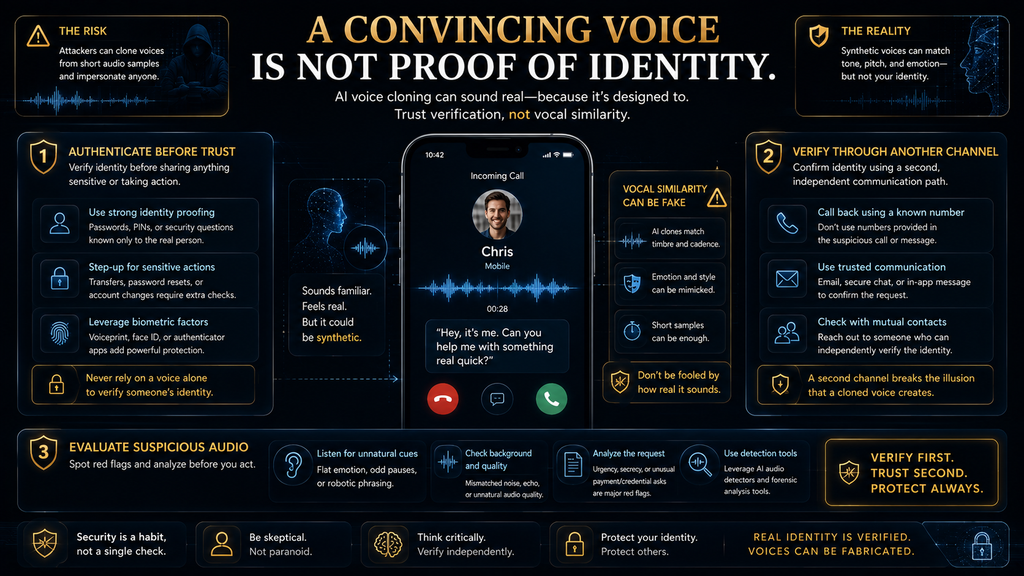
The benefits of voice cloning create an uncomfortable side effect. If a machine can produce speech that sounds like a person, then hearing someone’s voice is no longer enough to prove that the person is actually speaking.
The Federal Trade Commission has warned about scams in which criminals use AI-generated voice impersonation to create convincing family-emergency scenarios. The agency has also studied interventions against AI-enabled voice cloning, including prevention and authentication before misuse, detection during interactions, and post-use evaluation. The implication is larger than scams.
A business that treats voice as an authentication factor needs to consider whether a synthetic voice could satisfy that authentication step. A customer who receives an urgent voice message from an executive should not assume that vocal familiarity proves the request is genuine. A family member who receives an emergency call should independently verify the situation before transferring money.
What ElevenLabs Does to Reduce Misuse
ElevenLabs’ current policies prohibit unauthorized, deceptive or harmful impersonation and specifically restrict intentionally replicating another person’s voice without consent or legal right. The company’s current policy also prohibits deceptive use of generated audio and attempts to evade safeguards. ElevenLabs also describes traceability mechanisms for generated audio and verification processes around professional voice cloning.
These controls do not eliminate misuse across the wider ecosystem. No platform-level safeguard can completely solve a technology that can be used through multiple providers, open systems and other forms of synthesis.
But it is important to distinguish between the existence of a risk and the controls a particular provider has chosen to implement. For users, the practical rule remains simple: Do not clone a voice merely because you can access a recording of it. The legitimate use case should be established first.
Is Voice Cloning Legal?
There is no responsible universal answer to “Is voice cloning legal?” The technology itself is not inherently illegal. The legal risk depends on factors such as whose voice is being cloned, whether the person has authorized the use, what the voice is being used for, where the parties are located, whether the use is commercial, and which privacy, publicity, personality or contractual rules apply.
The U.S. Copyright Office has examined digital replicas as a distinct policy problem because modern systems can create realistic audio, video and images that depict real people without their involvement. Its work has highlighted both beneficial applications and the harms created by unauthorized digital replicas. That does not mean every AI-generated voice is legally problematic.
It means the question cannot be reduced to: “Did I upload the file?” A recording of another person does not automatically give you the rights needed to create or commercially use a synthetic replica of their identity.
For commercial projects, especially those involving public figures, employees, actors, customers or branded spokespersons, obtain appropriate permission and review the relevant contracts and local laws. This article is informational, not legal advice.
AI Hustle World Voice Clone Reliability Methodology
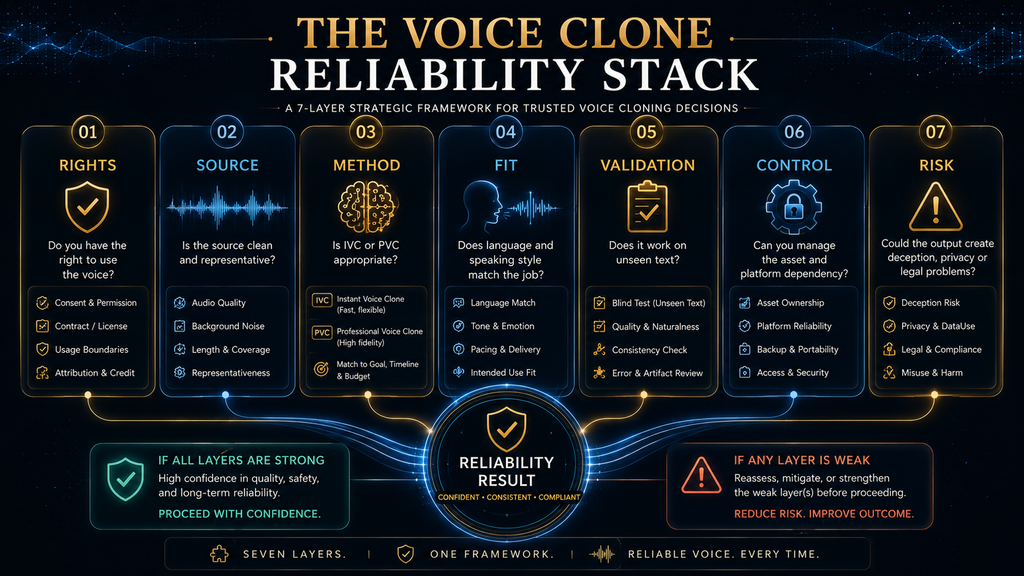
The AI Hustle World Voice Clone Reliability Methodology turns selection into a reviewable decision rather than a realism contest. It synthesizes ElevenLabs’ technical explanation of IVC and PVC, its Prohibited Use Policy, verification controls, and guidance from the FTC and U.S. Copyright Office. AI Hustle World did not conduct a controlled audio benchmark for this update, so the framework evaluates workflow readiness and evidence quality rather than claiming measured acoustic superiority.
Score each dimension from 0 to 2: 0 means absent or unverified, 1 means partially documented, and 2 means clearly documented and suitable for the intended job. Rights and Risk are non-negotiable gates: a zero in either means stop regardless of the total. Across the other five dimensions, 8–10 supports a production candidate, 5–7 supports a limited pilot, and 0–4 means the voice is not ready for dependable use.
| Dimension | Verification question | Evidence |
|---|---|---|
| Rights | Did the speaker authorize the clone and intended uses? | Consent, scope, withdrawal terms |
| Source | Are recordings clean, consistent and representative? | Source log and conditions |
| Method | Does IVC or PVC fit quality, speed and repetition? | Method rationale |
| Fit | Does it fit language, accent, style and format? | Scripts and locale review |
| Validation | Does it work on unseen production material? | Test script and failures |
| Control | Are access, storage and response defined? | Roles and review log |
| Risk | Does it avoid deception and prohibited activity? | Disclosure and policy check |
This is a decision aid, not a scientific benchmark or legal opinion. Its value is the combination of mechanics, source quality, authorization, operational control and misuse risk in one reproducible record.
A Practical ElevenLabs Voice-Cloning Workflow
If you are cloning your own voice for legitimate production use, the process should begin with planning rather than immediately opening the dashboard. For the platform as a whole, read our ElevenLabs review and the guide to the best AI voice generators.
- Define the production job. Define what the voice will actually do before recording training material. YouTube narration, audiobooks, advertising, accessibility and a recurring brand voice demand different pacing, emotional range and approval controls. The intended job determines what source material you should collect. Record the delivery style, language range and sentence complexity the clone will face in production instead of assuming one neutral sample can support every context.
- Prepare the source material. Use clean, consistent recordings from one speaker. Remove obvious noise and avoid unnecessary environmental variation. ElevenLabs recommends clear audio, consistent tone and volume, and a recording environment with minimal echo and interference.
- Match the training style to the intended output. If you want documentary narration, provide documentary-style narration. If you want conversational delivery, provide conversational material. If you want multilingual production, think about language-specific training material.
- Start with IVC when uncertainty is high. If you do not know whether voice cloning fits your workflow, IVC gives you a fast way to test the concept.
- Validate on unseen text. Do not evaluate the voice using only the sample material. Test realistic scripts containing the terms, names and sentence patterns your workflow actually uses.
- Diagnose before upgrading. If the result is poor, diagnose the failure before changing plans or uploading more audio. Separate source-quality problems from pronunciation, accent, emotional delivery, long-form drift and model limitations so the next action addresses the actual bottleneck.
- Consider PVC if the voice becomes strategically important. If the voice proves valuable and the limitations of IVC become a recurring production constraint, Professional Voice Cloning becomes easier to justify.
- Preserve the original recordings. Keep the source material securely stored. ElevenLabs explicitly recommends retaining the original samples because recreating a clone later may produce a different result.
- Document permission and data decisions. For your own voice, record the account and asset details. For commercial teams, document rights, consent and relevant data handling.
- Measure production impact. Track the KPIs that matter to the business rather than judging the technology only by subjective realism.
A documented measurement loop turns voice cloning into a production system instead of a one-time experiment. It also creates evidence for deciding whether PVC, a different provider or conventional recording is the better next investment.
Who Should Use ElevenLabs Voice Cloning?
ElevenLabs voice cloning is particularly compelling for people who repeatedly produce spoken content and want a reusable voice asset. Creators who publish frequently can benefit from reducing recording friction. Podcasters can potentially simplify corrections and pickups. Audiobook and long-form narration workflows can benefit from consistent synthetic delivery. If you are still comparing options, see our roundup of the best AI voice cloning tools and the head-to-head in ElevenLabs vs alternatives.
Businesses can use controlled voice systems for certain branded or accessibility applications where the rights and workflow are properly managed. Voice professionals may find cloning useful as a way to scale certain approved uses of their voice, subject to the contracts and permissions involved.
But not everyone needs it. If your content depends heavily on spontaneous human emotion, improvisation or live interaction, a human performer may remain the better choice.
If you publish only a few short videos each month, building a professional voice model may create more preparation work than it saves. If your voice is not important to your audience or brand, a standard synthetic voice may be sufficient. The right question is not: “Can I clone my voice?”
It is: “Does having a reusable version of my voice solve a recurring production problem?”
Who Should Avoid Voice Cloning?
You should be cautious if the rights around the voice are unclear. You should also be cautious if the intended use could mislead people about who is actually speaking.
Businesses should be especially careful when cloning employee or customer voices because consent, contracts and privacy requirements can become complicated. Creators should think carefully before using a clone in contexts where audiences could reasonably interpret the audio as a live statement from a real person.
And anyone using voice cloning for high-stakes communications should avoid relying on voice similarity as proof of identity. The more consequential the application, the more important independent verification becomes.
The Second-Order Effect: Who Controls the Digital Voice?
Once a voice can be stored, generated and shared, ownership and control become more important. Imagine a voice actor who spends years building a recognizable commercial identity. A company creates a synthetic version of that voice for one campaign. What happens if the campaign ends? What happens if the company wants to use the clone for another campaign? What happens if the actor’s relationship with the company changes? Those questions cannot be answered by audio quality. They require contracts and rights. The technology therefore creates a new category of asset-management questions around:
- access;
- authorization;
- duration;
- permitted uses;
- commercial scope;
- revocation;
- sharing;
- platform dependency;
- data retention.
This is one reason the future of voice cloning will involve not only better models but better systems for voice rights management.
The Future of Voice Cloning Is Probably Not “Perfect Human Imitation”
It is tempting to imagine that the end goal is a voice clone that is impossible to distinguish from the original speaker. That may happen in some contexts.
But the more important development may be the ability to control a persistent voice identity across different production systems. The future question may become less:
“Can AI imitate my voice?” and more: “Where can my authorized voice identity be used, by whom, for what purpose, and under what controls?” That shift turns voice cloning into an identity-management problem as much as an audio-generation problem.
For creators, this could mean better production efficiency. For businesses, it could mean reusable branded voice systems. For voice actors, it could create new licensing models. For consumers, it could create new fraud risks.
For regulators, it creates questions around digital replicas and identity rights. The technology is therefore likely to evolve beyond simple text-to-speech cloning into a broader ecosystem around persistent, controllable voice identity.
Final Thoughts
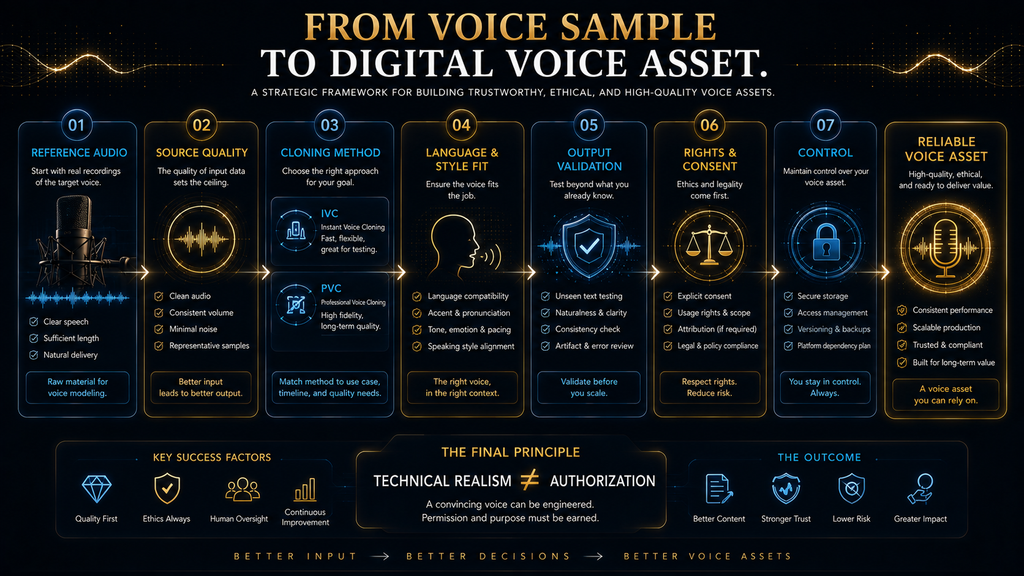
ElevenLabs voice cloning is impressive because it can generate new authorized speech in a recognizable voice, not because it replays or rearranges an old recording. That capability becomes valuable only when source quality, production fit, review and rights management work together.
That is why Instant Voice Cloning should not automatically be treated as the cheap version and Professional Voice Cloning as the good version. IVC is often the smarter choice when speed and experimentation matter. PVC becomes more compelling when the voice is a long-term production asset and the additional preparation is justified. ElevenLabs’ current documentation supports that distinction through its different data requirements, training processes and verification model. The most useful mindset is to treat the clone as part of a larger system.
Start with the right to use the voice. Prepare clean, representative source material. Choose the cloning method according to the project’s needs. Test the resulting voice against unseen material. Measure whether it actually reduces production friction. Keep the original recordings. Understand the platform’s current data and sharing rules. And never assume that a familiar-sounding voice is sufficient proof of someone’s identity. The technology will continue to improve, but the strategic principle is unlikely to change:
A convincing voice clone is not automatically a useful voice clone, and a useful voice clone is not automatically an authorized voice clone. The strongest workflow is the one that gets all three right: technical quality, production value and responsible control.
Does ElevenLabs Fit Your Voice Workflow?
Test it with representative material before making the cloned voice part of your regular content-production system.
Evaluate ElevenLabs With Your Content →Affiliate disclosure: We may earn a commission if you subscribe through this link, at no additional cost to you.
Frequently Asked Questions
Can I use ElevenLabs voice cloning on the Free plan?
Not to finish a clone. When we tried on October 10, 2026, the Free plan let us record a sample and enter the voice details, then showed an upgrade screen when we pressed Save voice. Instant Voice Cloning is listed from the Starter plan and Professional Voice Cloning from the Creator plan, so check ElevenLabs’ pricing page before you plan a test.
How much audio do I need for ElevenLabs voice cloning?
For Instant Voice Cloning, ElevenLabs currently recommends around one to two minutes of good-quality audio. For Professional Voice Cloning, the documented range is around 30–180 minutes, while the professional guide recommends at least an hour and ideally close to three hours for stronger results.
Is Instant Voice Cloning or Professional Voice Cloning better?
Neither is universally better. IVC is designed for speed and uses short reference audio without dedicated custom-model training. PVC uses a larger dataset and dedicated fine-tuning, making it more appropriate when higher fidelity and long-term voice consistency justify the additional preparation.
How long does Professional Voice Cloning take?
ElevenLabs currently estimates that PVC fine-tuning usually takes around three to six hours, although queue conditions can make the process longer.
Can I create a Professional Voice Clone of someone else?
ElevenLabs currently says Professional Voice Clones can only be created for your own voice. Even if another person gives you permission, they need to create and verify their own PVC before sharing it with you privately.
Can I clone my voice in another language?
ElevenLabs supports Professional Voice Cloning for a broad list of languages, but the quality depends on the language and training data. The company recommends training material in the language in which the clone will mainly be used and warns that cross-language cloning can retain characteristics of the original language.
Can I export an ElevenLabs voice clone?
No. ElevenLabs currently says voice clones cannot be downloaded or exported as standalone model files. They remain in the ElevenLabs account, although API access can allow external applications to generate speech using the account’s voices.
Why does my cloned voice sound different from me?
Several factors can cause this, including poor reference recordings, an unusual voice or accent, inconsistent training material, language mismatch, inappropriate speaking style and the limitations of the generation model. ElevenLabs recommends changing the audio samples when the clone’s accent or tone is incorrect because those characteristics cannot simply be edited after the clone has been created.
Is AI voice cloning legal?
Voice cloning is not inherently illegal, but unauthorized or deceptive uses can create legal, contractual, privacy or publicity-related risks. The applicable rules vary by jurisdiction and use case. The U.S. Copyright Office has specifically examined unauthorized digital replicas as an emerging legal and policy issue.
Is ElevenLabs voice cloning safe?
The technology can be used responsibly, but safety depends on how the voice is sourced, authorized, stored and deployed. ElevenLabs has consent and verification mechanisms and prohibits unauthorized or deceptive impersonation, but users still need to make responsible decisions about rights, privacy and use.
Written by
Muntasir Ahmad Chowdhury
Founder-AI Hustle World
Muntasir Ahmad Chowdhury is the Founder of AI Hustle World, an independent publication dedicated to making Artificial Intelligence practical, trustworthy, and easy to understand. He researches AI tools, automation, customer service, productivity, and real-world business applications, helping readers make smarter technology decisions through research-driven, experience-backed content.
Expertise:
AI Tools • AI Automation • AI Customer Service • AI Productivity • Generative AI • AI Workflows
Get Smarter With AI
Enjoyed this guide? Get practical AI tools, tutorials, and honest reviews delivered to your inbox.