Evidence: Hands-on tested for text to speech. Documentation reviewed for everything else.
Last checked: 8 October 2026
What was done: Ran 12 fixed lines, six in English and six in mixed Bengali and English, through Eleven v4 with one stock voice on the Free plan, and logged every take. Plans, prices and policies were checked on ElevenLabs’ own pages the same day. Voice cloning and Studio were not tested. Dubbing was tested separately with one clip, in our dubbing guide.
Files: Script pack, log and screenshots on GitHub. The audio is kept offline because the Free plan has no commercial licence.
Affiliate links: Yes
Last updated: October 11, 2026. Added a first-hand test of 12 English and Bengali-English lines on Eleven v4, run on October 8, with the log and screenshots published. Added Eleven v4 to the model lineup and re-checked plans, credits and API prices against ElevenLabs’ own pages. On October 10 the dubbing notes were updated for the two dubbing models now offered in the app, and on October 11 a pointer to our one-clip dubbing test was added.
If you create YouTube narration, podcasts, courses, audiobooks, localized videos or product voices, ElevenLabs is probably already on your shortlist. The harder question is not whether it can produce impressive audio. It can. The decision is whether its quality, control and expanding production system justify the price and operational complexity for the work you actually publish.
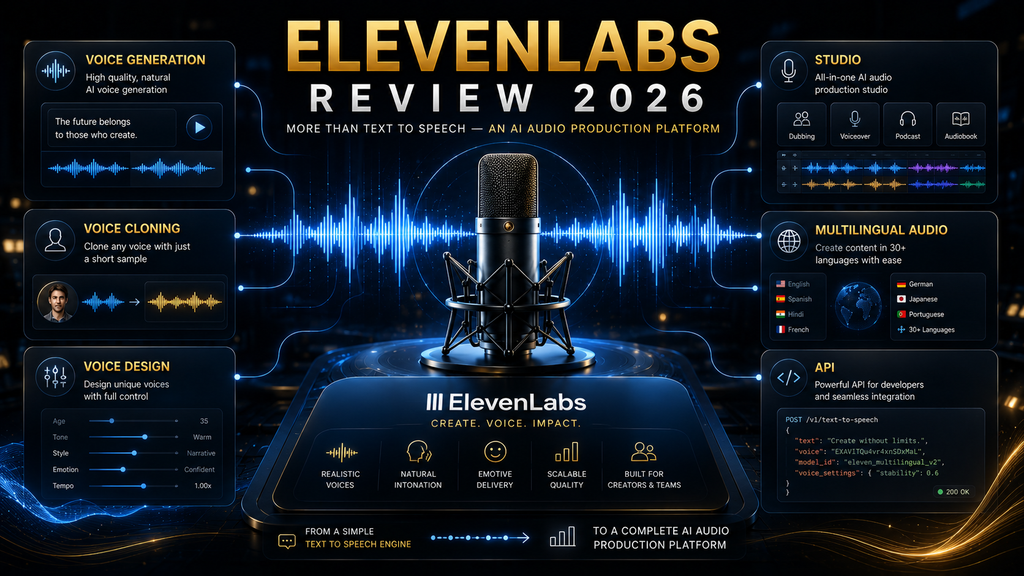
That distinction matters because ElevenLabs is no longer a simple text-to-speech website. The platform now spans expressive and real-time speech models, voice discovery, voice design, two cloning paths, Studio production, dubbing, transcription, music, sound effects, conversational agents and APIs. More capability creates more value for a serious audio workflow, but it also creates more ways to choose the wrong model, consume credits inefficiently or pay for a system you barely use.
Affiliate disclosure: AI Hustle World may earn a commission if you subscribe through an ElevenLabs link in this article, at no additional cost to you. The verdict is based on current official documentation, pricing, product fit, limitations, rights and workflow economics, not the commission. The text-to-speech findings come from a dated test we ran ourselves; voice cloning and Studio were assessed from documentation only, and dubbing was tested separately with one clip in our dubbing guide.
Table of Contents
- Quick verdict
- Our 12-line test in English and Bengali-English
- What ElevenLabs is now
- Which model fits which job
- What the platform actually does
- Where voice quality holds and fails
- Voice creation and cloning
- Studio, dubbing and production workflow
- Pricing and credit economics
- Who should use or avoid it
- Final verdict
- Frequently asked questions
Quick Verdict: Is ElevenLabs Worth It in 2026?
ElevenLabs is worth it when voice quality is part of the product, not merely a way to read text aloud. It is especially strong for creators and teams that need expressive narration, repeatable voice identity, multilingual output, long-form production or API access. If you only need occasional, functional speech for internal drafts, accessibility previews or a few social clips, the platform can be more expensive and more complex than necessary.
The best starting point is the free plan because voice preference is subjective and script dependent. A voice that sounds convincing in a polished demo may handle your brand name, Bengali-English code-switching, numbers or emotional direction very differently. Use a representative script, including the awkward words you actually publish, before you treat any review score as a buying decision.
We ran that test ourselves on October 8, 2026. Twelve short lines went through Eleven v4 with the stock voice Roger on the Free plan: six in English and six in mixed Bengali and English, covering a brand name, prices, a date, a question, an emotional line and a web address. All twelve were accepted on the first take, and the run used 1,026 credits for 95 seconds of finished audio. That is one voice and twelve short lines, so treat it as a first check, not as proof of chapter-length consistency. The full test and its limits are below.
| Decision | Best answer | Reason |
|---|---|---|
| Best for | Voice-heavy creator and production workflows | Strong combination of speech quality, voice options, Studio, dubbing and APIs |
| Not ideal for | Occasional basic narration | Cheaper or bundled tools may cover simple output with less setup |
| Best first paid plan | Creator for serious solo production | Adds Professional Voice Cloning and 121,000 monthly credits |
| Main advantage | Audio workflow breadth | One account can cover generation, voice creation, editing, localization and delivery |
| Main drawback | Shared-credit economics | Every generation, dub, music track and correction draws from the same pool |
Hear What ElevenLabs Does With Your Hardest Script
Use the free plan to test names, numbers, emotional direction and the languages you actually publish before choosing a subscription.
Test Your Script With ElevenLabs →Affiliate disclosure: We may earn a commission if you subscribe through this link, at no additional cost to you.
Our Test: 12 Lines in English and Bengali-English
On October 8, 2026 we ran a fixed pack of twelve script lines through ElevenLabs and logged every take. Six lines were in English and six were in mixed Bengali and English, the way a creator in Dhaka speaks on camera. Each line was written to stress one thing voice tools often get wrong: a brand name, a price with decimals and a percentage, a full date with a clock time, a question, an emotional line, and a web address with abbreviations.
The setup was plain on purpose. We used the Free plan, the Eleven v4 model, the stock voice Roger and the default settings, with stability at 50 and similarity at 75. Auto-tag stayed off and no audio tags were added, so the model received the text exactly as written. Muntasir generated each line once, listened to both versions the app returned, and marked the line accepted or rejected before moving on.
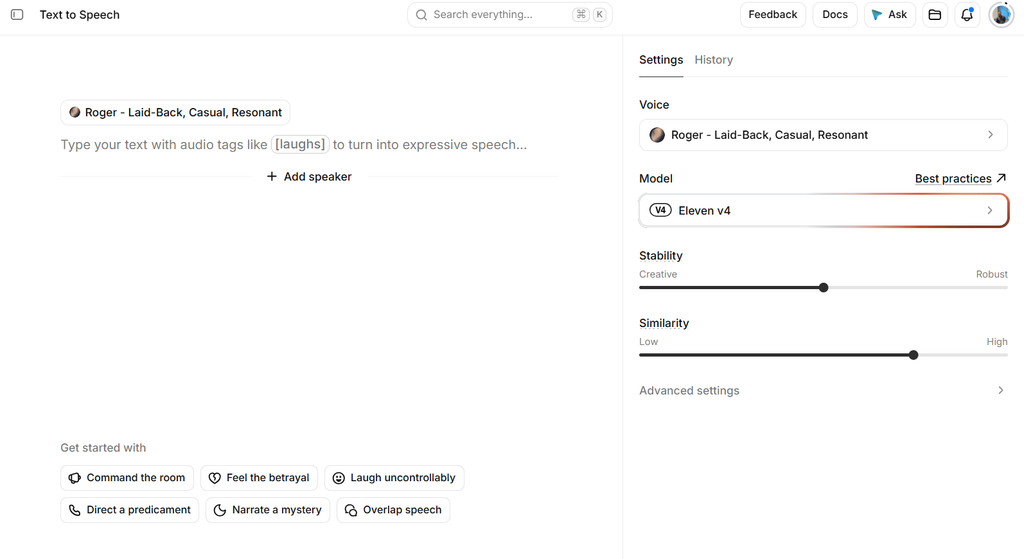
The pass rule was written down before the first line was generated. A take was wrong if a word was mispronounced, if a number, price or date was read incorrectly, if the brand name was wrong, if a Bengali or English word came out with the other language’s sounds, or if there was an audible glitch. A rejected line would have been generated again with the same text and settings, up to three takes. One English line read, “This plan costs $19.99 a month for 30,000 credits, or $199 a year, which saves you about 17%.” One mixed line read, “এই plan-এর দাম মাসে ১,৪৯৯ টাকা, বছরে নিলে ১৪,৯৯০ টাকা, মানে প্রায় ১৭% save হয়। bKash দিয়েও payment করা যায়।”
What Happened: 12 of 12 on the First Take
We expected the mixed lines to be the weak spot, and they were not. Earlier versions of this review warned that brand names, Bengali-English code-switching, numbers and emotional lines are where a convincing demo voice can come apart. ElevenLabs’ own app points the same way: when we opened the same Bengali text with the stock voice Adam selected, it showed the hint “Use a Bengali voice for best results.” In this run, all six English lines and all six mixed lines were accepted on the first take, including the taka prices written in Bengali numerals, the brand bKash and a sentence that switches between Bengali and English several times. In Muntasir’s judgement, Roger sounded like a Bengali speaker in the mixed lines, not like a foreigner reading Bengali.
| Measure | Result |
|---|---|
| Lines accepted on the first take | 12 of 12 |
| Lines that needed a retake | 0 of 12 |
| Finished audio | 95.35 seconds |
| Credits used (balance before minus balance after) | 1,026 |
| Credits per finished minute | About 646 |
| Worked-out cost per finished minute | About $0.13 at Starter’s regular price |
| Time for the whole run | About 10 minutes |
The run cost 1,026 credits for 95.35 seconds of accepted audio, which is about 646 credits per finished minute. The credit figure is the drop in the account balance, from 10,000 to 8,974. We paid nothing because the run was on the Free plan, so the money figure is a calculation: at Starter’s regular price of $6 for 30,000 credits, 1,026 credits is about $0.21, or roughly $0.13 per finished minute. That is lower than the 1,000 credits a minute implied by ElevenLabs’ plan table. Our reading is that prices, dates and Bengali numerals take longer to say than to type, and that every short clip carries a little silence.
| Line | Language | What the line tests | Characters | Audio (seconds) | Takes needed |
|---|---|---|---|---|---|
| 01 | English | Brand name and the letters AI | 115 | 7.39 | 1 |
| 02 | English | Prices with decimals, a large number and a percentage | 93 | 10.27 | 1 |
| 03 | English | A full date and a clock time | 75 | 6.84 | 1 |
| 04 | English | Question intonation | 88 | 5.15 | 1 |
| 05 | English | Emotional delivery | 75 | 5.56 | 1 |
| 06 | English | A web address and abbreviations | 110 | 9.09 | 1 |
| 07 | Bengali-English | Brand name inside a Bengali sentence | 117 | 8.75 | 1 |
| 08 | Bengali-English | Bengali numerals, taka prices, a percentage and the brand bKash | 111 | 12.04 | 1 |
| 09 | Bengali-English | A Bengali date and clock time | 60 | 5.96 | 1 |
| 10 | Bengali-English | Question intonation with English nouns | 97 | 6.61 | 1 |
| 11 | Bengali-English | Emotional delivery | 76 | 5.80 | 1 |
| 12 | Bengali-English | A web address and abbreviations inside Bengali | 124 | 11.89 | 1 |
Two details from the account history are worth knowing before you budget. Each press of Generate speech returned two versions of the line, and the history showed a charge on one of them and “0 credits used” on the other, so comparing two readings did not cost double. The second detail is a gap we cannot explain. Ten of the twelve charged entries we opened showed a charge equal to the line’s character count, which would add up to 1,141 credits for the pack, yet the balance fell by only 1,026. We report the balance figure and have published both numbers in the run summary.
What This Test Does Not Show
Nothing failed in this run, and that is a narrow result. It covers one stock voice, one model and twelve lines of 60 to 124 characters each, judged by one listener. It says nothing yet about how the same voice holds up across a twenty-minute script, how a cloned voice handles Bengali, how dubbing treats mixed-language speech, or whether another stock voice would do as well. Voice cloning and Dubbing Studio, the editor for dubs, need a paid plan, and this review has not tested either. On 11 October 2026 we did dub one 66-second clip on the Free plan with the older Dubbing v1 model, and that result is in our dubbing test.
The audio files are not embedded here because ElevenLabs does not allow free-plan output to be used commercially, and this page carries affiliate links. The script pack, the per-take log, the run summary and dated screenshots are public in the ahw-voice-tests folder on GitHub, so the numbers above can be checked line by line.
What Is ElevenLabs in 2026?
ElevenLabs is an AI audio platform with separate products for creators, developers and conversational-agent teams. The creator side turns scripts, documents and media into speech, dubs, music, effects and edited projects. The developer side exposes speech, transcription and audio models through APIs, while ElevenAgents adds real-time voice and chat agents that can connect to business systems.
Calling it an AI voice generator is still accurate, but incomplete. The company’s own documentation describes a broader audio infrastructure layer: ElevenCreative for no-code production, ElevenAPI for product builders and ElevenAgents for interactive conversations. That breadth is the main reason ElevenLabs feels more capable than a basic TTS tool and more demanding than one.
The product should therefore be judged at two levels. First, can it generate a voice that suits your audience and stays believable across a complete script? Second, can the surrounding workflow reduce the time and coordination needed to turn that raw generation into a publishable asset? A platform can win the first test and still fail the second if correction, versioning, licensing or cost control becomes painful.
Why ElevenLabs Still Stands Out
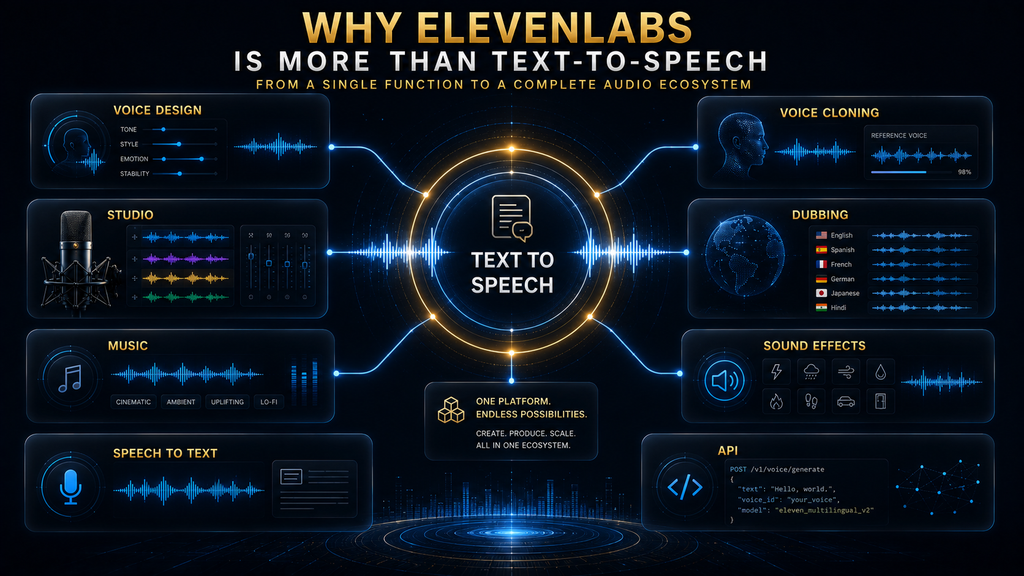
ElevenLabs stands out because it treats a voice as a controllable production asset rather than a single generated file. You can begin with a public voice, design a new one, create an authorized clone, assign voices across a long project, correct individual passages, produce dialogue, localize video or call the same capabilities from an application. Competitors may equal or beat one part of that chain, but fewer cover the entire chain inside one ecosystem.
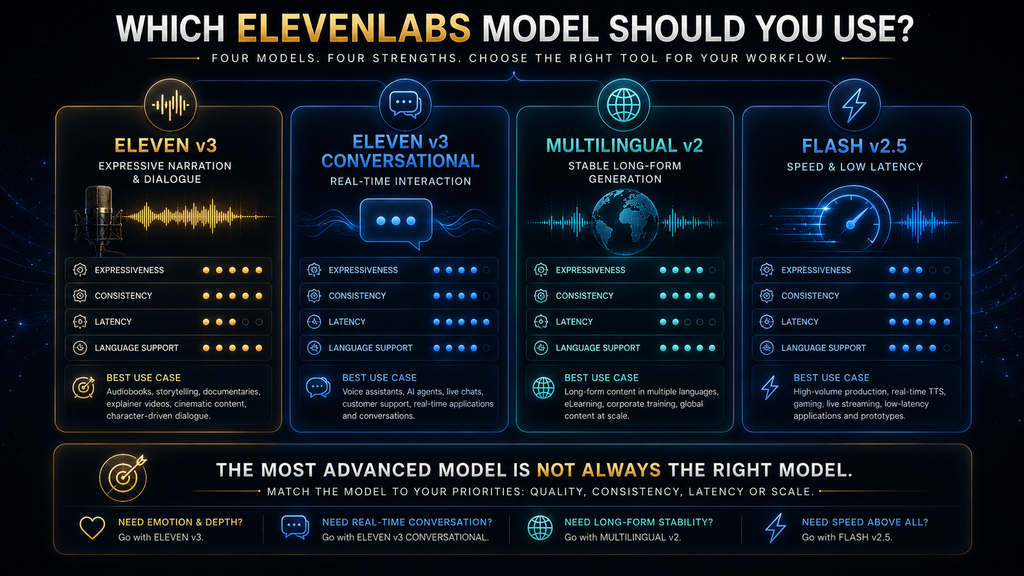
The current model lineup also reflects a useful truth that simpler products hide: the best model for dramatic narration is not automatically the best model for a live agent. Eleven v4, the newest flagship, is presented as the most emotive model and covers more than ninety languages; Eleven v3 prioritizes emotional range and dialogue; v3 Conversational shifts that direction toward real-time use; Multilingual v2 emphasizes stable long-form speech; Flash v2.5 prioritizes speed and lower API cost. You gain control, but you must make the choice.
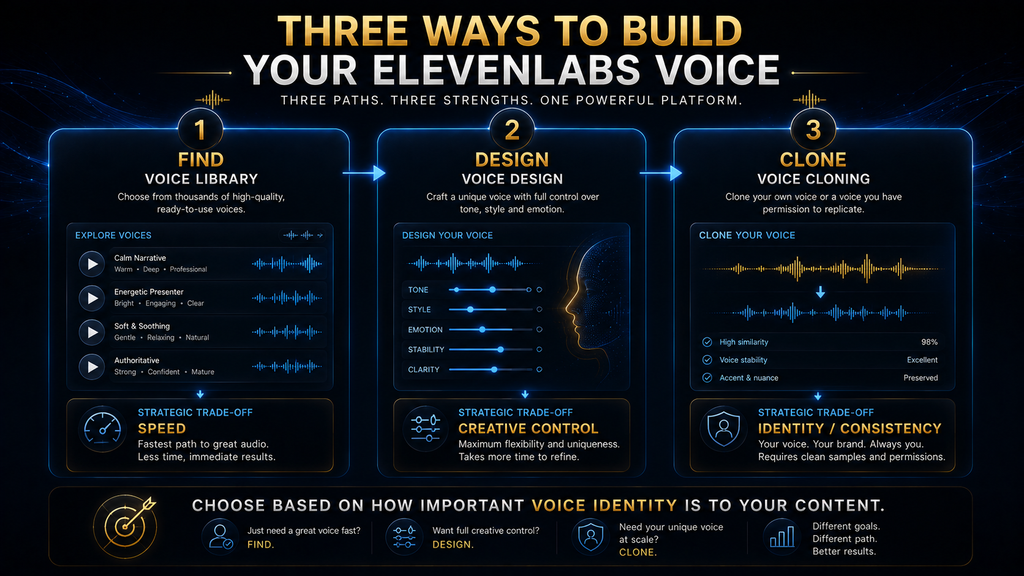
Its voice ecosystem is another advantage. The Voice Library gives you a large searchable pool, Voice Design creates voices from natural-language descriptions, and cloning lets an authorized speaker preserve a consistent vocal identity. That makes ElevenLabs relevant to both creators who need a suitable narrator quickly and brands that want a voice they can keep using across projects.
The honest limitation is that breadth does not remove production work. Someone still has to prepare the script, decide pronunciations, direct the performance, compare generations, edit pacing, verify translations, confirm rights and listen to the final file. ElevenLabs can compress that work, but it does not make judgment disappear.
The ElevenLabs Model Lineup: Choose by Failure Mode
The right ElevenLabs model is the one whose weakness your workflow can tolerate. The current ElevenLabs model documentation separates expressive, stable long-form and low-latency systems because those priorities conflict. Choosing by the most impressive demo is less useful than choosing by what would make your project fail.
| Model | Best use | Published characteristics | Main caution |
|---|---|---|---|
| Eleven v4 | Expressive narration and dialogue across the widest language range | 90+ languages, multi-speaker dialogue, 10,000-character limit; presented by ElevenLabs as its most emotive model | New in the lineup, so compare it with v3 or Multilingual v2 on your own script before moving a long project |
| Eleven v4 Turbo | Real-time agents that need v4-style expression | About 100 ms median model latency, 90+ languages and audio tags | The published latency covers the model only; the full application adds its own delay |
| Eleven v3 | Dramatic narration, character dialogue and expressive creative work | 70+ languages, audio tags, multi-speaker dialogue, 5,000-character limit | Higher variability and latency make it a weaker fit for real-time use |
| Eleven v3 Conversational | Real-time agents and interactive characters | About 280 ms model latency, 70+ languages and audio-tag control | Application latency also depends on networking, orchestration and downstream systems |
| Multilingual v2 | Long-form narration that needs consistency | 29 languages, 10,000-character limit and stable long-form generation | Less expressive than v3 for heavily directed performance |
| Flash v2.5 | Fast applications and cost-sensitive API workloads | About 75 ms model latency, 32 languages and 40,000-character limit | Speed is the priority, so compare quality on your exact voice and script |
If you are narrating an audiobook chapter, long course lesson or documentary, start by comparing Multilingual v2 with v4 or v3 on the same two or three difficult passages. One passage should contain dialogue, another should contain names and numbers, and the third should contain the emotional tone that defines the project. Do not spend credits generating an entire chapter until the model and voice survive those edge cases.
If you are building a voice agent, published model latency is only one piece of the user experience. Speech recognition, language-model response time, tool calls, network conditions and interruption handling all contribute to the pause a caller feels. A low-latency voice cannot compensate for a slow knowledge lookup or a poorly designed conversation flow.
Core Features: What ElevenLabs Actually Does
ElevenLabs covers generation, voice identity, editing, localization, transcription and programmatic delivery. That list is broad enough to sound like marketing unless each capability is connected to a real job. The practical question is which part of your workflow it replaces and which part still needs another tool or a human reviewer.
Text to Speech and Text to Dialogue
Text to Speech converts a script into a selected voice, while Text to Dialogue assigns separate turns and voices to multiple speakers. With Eleven v3 and v4, inline audio tags can guide emotion, delivery and non-verbal reactions such as laughter, sighs or whispers. The tags are natural-language directions rather than guaranteed controls, so the result still needs listening and correction.
This feature is most valuable when performance changes meaning. A compliance training module needs calm clarity; a fiction podcast needs character separation; a product video may need energy without sounding forced. If the script only needs neutral reading, a cheaper model or another provider may produce an acceptable result with less experimentation.
Voice Library, Voice Design and Voice Remixing
The Voice Library is a marketplace of community-shared Professional Voice Clones, with metadata that helps you search by language, accent and style. Voice Design creates a new voice from a description, while Voice Remixing changes characteristics of an existing voice through natural-language direction. These paths are useful when you need a voice identity but do not want to record and maintain your own clone.
Voice choice is where many projects go wrong. A voice that sounds striking for thirty seconds can become tiring across twenty minutes, and an exaggerated accent can reduce trust even when every word is intelligible. Evaluate the voice on sustained listening, not novelty, and include someone from the target language or region when authenticity matters.
Voice Cloning
Instant Voice Cloning creates a quick approximation from a short clean sample, while Professional Voice Cloning trains a dedicated model from a much larger recording set. The official voice-cloning documentation recommends roughly one to two minutes of good audio for Instant Voice Cloning and thirty to 180 minutes for Professional Voice Cloning. The company says PVC fine-tuning usually takes three to six hours, though queue conditions can extend it.
These are not simply fast and premium versions of the same method. Instant cloning relies on patterns the system already knows and estimates the speaker from a small sample; Professional Voice Cloning learns a dedicated model from the submitted voice data. That difference explains why an uncommon accent or distinctive vocal style can expose the limit of a quick clone.
Studio, Dubbing, Speech to Text, Music and Sound Effects
Studio turns separate generations into a project workflow. You can import a script, document or webpage, organize chapters, assign voices, add pronunciation rules and place narration, music or effects on a timeline. Dubbing translates existing audio or video and preserves speaker identity and timing, while Scribe handles transcription and the creative tools add music or generated effects.
The advantage is continuity. A creator can move from script to narration, correction, soundtrack and export without managing a folder of disconnected clips. The boundary is equally important: Studio is useful for voice-led assembly, but a complex video project will still need a dedicated editor for detailed visual timing, color, motion graphics and final mastering.
Voice Quality: Where ElevenLabs Leads and Where It Breaks
ElevenLabs is strongest when the script, voice and model are chosen as one system. Its best output can preserve rhythm, emphasis and emotional direction more convincingly than traditional synthetic speech. Quality drops when the script contains ambiguous pronunciation, inconsistent direction, mixed languages, awkward punctuation or a voice whose natural style conflicts with the requested performance.
A common mistake is treating a written sentence as finished audio direction. Spoken language needs breath, pacing and emphasis that prose often leaves implicit. Long clauses, stacked numbers and parenthetical phrases may look fine on a page but sound dense when spoken, so the script often needs editing for the ear before the model needs another setting.
Names and specialized terms remain a predictable failure point. Product names, local places, medical language and acronyms can be pronounced correctly in one passage and differently in another unless you establish a pronunciation rule. If your content repeatedly uses the same vocabulary, build and maintain a pronunciation dictionary instead of correcting the same word after every generation.
Emotional direction introduces a different trade-off. Audio tags can create a useful performance, but stronger direction can also become theatrical, inconsistent or distracting. The safest production method is to direct only the moments that need direction, keep the surrounding script clear and compare the full scene rather than judging a single dramatic line in isolation.
Long-form consistency is not merely whether the same voice appears from beginning to end. Listeners notice changes in energy, distance, pace and emotional intensity. A twenty-minute course lesson benefits from narrower performance variation than a character scene, which is why Multilingual v2 may be the better choice even when a v3 sample sounds more impressive.
The Source Recording Matters More Than the Clone Setting
A clone reproduces the strengths and weaknesses present in its source audio. ElevenLabs’ documentation emphasizes a single speaker, clean audio, consistent volume and tone, minimal room noise and a performance that resembles the desired output. More minutes do not rescue contradictory or poor recordings; the company notes that extra low-quality material can make an Instant Voice Clone less stable.
If you record an excited advertisement, a quiet tutorial and a distant phone call in one training set, the model has no single vocal target. Record in one controlled environment, keep microphone distance consistent and decide the personality before the session. You can create another voice profile for another delivery style; trying to make one clone represent every version of the speaker often creates avoidable inconsistency.
Professional Voice Cloning also changes the operational commitment. You need a clean recording session, enough suitable material, identity verification, training time and ongoing control of the account. The clone itself cannot be downloaded as a portable standalone model, so retain the original recordings and document the consent and intended uses outside the platform.
Voice Cloning, Consent and Control
Technical permission to create a voice is not the same as legal or ethical permission to use it. ElevenLabs prohibits unauthorized, deceptive or harmful impersonation and says generated audio can be traced to the responsible account. Professional Voice Clones can only be created for the account holder’s own verified voice; another person who wants to share a professional clone must create and verify it in their own account.
For client work, written consent should define more than “you may clone my voice.” It should identify the project, channels, duration, languages, editing rights, prohibited contexts, revocation process and what happens to files after the relationship ends. If the voice represents an employee, actor or customer-facing spokesperson, the reputational risk belongs to both the speaker and the organization.
Do not treat a public recording as permission. A podcast, video or speech may be publicly accessible while the speaker’s identity, performance and publicity rights remain protected. If the project depends on another person’s voice, obtain suitable legal advice for the relevant jurisdiction and contract rather than relying on a platform feature or a generic consent sentence.
The platform’s privacy controls also belong in the buying decision. The ElevenLabs privacy policy and related guidance say certain submitted data may be used to improve audio models, that data is not used to clone a voice without consent, Enterprise customer data is not used for training by default, and users can opt out of data use. A company handling sensitive recordings should verify the current account setting, contract, retention requirement, data-residency option and internal approval process before uploading production material.
For a deeper explanation of consent, recording quality and the two cloning methods, see the AI Hustle World guide to ElevenLabs voice cloning. The practical rule is simple: preserve proof of authorization with the same seriousness as the source recording.
ElevenLabs Studio: The Real Product for Serious Creators
Studio is where ElevenLabs becomes a production system rather than a generation form. A long project can be divided into chapters and paragraphs, assigned to voices, corrected locally and combined with other audio on a timeline. That structure matters because most professional voice work fails through version confusion and repeated correction, not because the first raw generation was unusable.
Consider a thirty-minute training course with eight modules. Generating one continuous file makes a small script correction expensive and difficult to track. In Studio, the course can be segmented by module and paragraph, with pronunciation rules for product names and separate generations for the lines that need attention. The production unit becomes a manageable passage rather than the entire recording.
Generation history is useful because it lets you compare and restore narration versions, but it is not a substitute for an external project record. Keep the final script, approved pronunciation list, source recordings, consent documents and exported masters in storage you control. Platform history can support the workflow; it should not be the only place where the project exists.
Studio also reveals why credit planning matters. Every casual experiment has a cost, and music, effects, dubbing and voice tools draw from the same monthly pool. A disciplined workflow approves the script first, tests a representative passage, locks the voice and model, then generates in sections. Constantly changing the text after audio generation turns editorial indecision into a subscription expense.
Stop Rebuilding Every Voice Project From Loose Audio Files
Evaluate ElevenLabs Studio with one complete project: script, pronunciations, revisions, music and export. The workflow value is clearer than a demo sentence.
Build a Real Project in ElevenLabs →Affiliate disclosure: We may earn a commission if you subscribe through this link, at no additional cost to you.
Dubbing and Multilingual Production
ElevenLabs dubbing can translate and re-voice media across more than ninety languages, but a dub is not automatically a localization. The system can preserve aspects of speaker identity, emotion, timing and delivery, and Dubbing Studio lets an editor change transcripts, reassign speakers and regenerate individual clips. Dubbing Studio runs only on the legacy Dubbing v1 model, which ElevenLabs keeps in maintenance mode and which the app listed with 29 languages on 10 October 2026. The current Dubbing v2 model, the default, has no editor in the app. Those controls are valuable because translation errors are often local, while the rest of a project may already be acceptable.
A reliable localization workflow still needs a native reviewer who understands the audience, not merely the language. Humor, politeness, product terminology, currency, legal wording and cultural references can all require adaptation. The audio can sound natural while the translated message remains wrong for the market, which is why fluency should never be mistaken for approval.
Dubbing also has mechanical limits. ElevenLabs’ current documentation states that lip syncing is not included in Dubbing Studio, so visually precise mouth matching needs another stage. Fixed-duration clip generation can preserve timing, but a translation that naturally needs more words may sound compressed unless the editor changes the wording or timing plan.
If localization is central to the project, create a glossary before translation, identify lines that cannot change, and ask the reviewer to approve meaning before final audio. The ElevenLabs dubbing guide explains that workflow in more detail. The platform accelerates production; the reviewer protects the message.
Speech to Text, Music, Sound Effects and Agents
The secondary tools make ElevenLabs more useful when audio moves in both directions. Scribe converts recorded speech into transcripts and supports real-time use through Scribe v2 Realtime. Music and Sound Effects create supporting assets, while ElevenAgents combines speech recognition, language-model reasoning, tools and synthesized voices for live conversations.
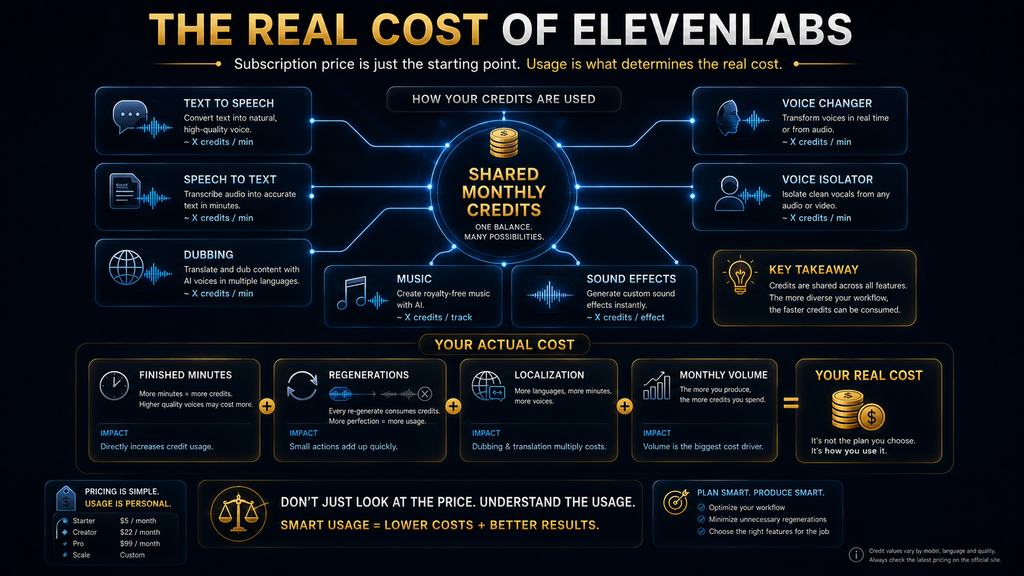
These products should not be evaluated as free bonuses. They consume credits at different rates, may have different rights and often require separate review. A creator who uses narration, music and dubbing from one shared pool needs a budget for the whole project, not only the TTS minutes shown beside a plan.
Music licensing deserves particular attention because “commercial use” still operates under plan-specific terms. ElevenLabs says the music model is cleared for broad commercial uses, but your production should retain the applicable terms, project date and exported files. Rights are part of the asset, and they should be documented with it.
Voice agents create an even higher review burden. A narrator speaks a fixed script that can be checked before publication; an agent responds to unpredictable people and may take actions in connected systems. If an agent can refund an order, schedule a service or disclose account information, conversation design, authentication, guardrails, escalation and monitoring matter as much as the voice.
ElevenLabs Pricing in 2026
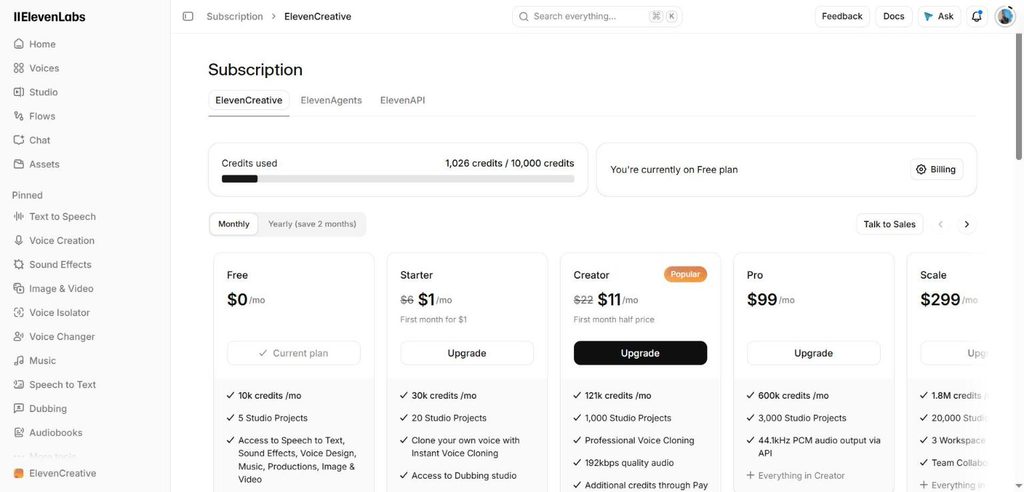
ElevenLabs pricing is simple at the subscription level and more complicated at the production level. The monthly plans range from Free to Business, with Enterprise priced separately. Every plan supplies a shared credit allowance that can be spent across products, so the plan name tells you less than the mix of narration, corrections, dubbing, transcription, music and effects you intend to use.
| Plan | Monthly price | Credits | Approximate TTS minutes shown by ElevenLabs | Best fit |
|---|---|---|---|---|
| Free | $0 | 10,000 | About 10 | Non-commercial testing and script evaluation |
| Starter | $6 | 30,000 | About 30 | Small commercial projects and Instant Voice Cloning |
| Creator | $22 | 121,000 | About 121 | Serious solo creators and Professional Voice Cloning |
| Pro | $99 | 600,000 | About 600 | High-volume creators needing higher audio quality |
| Scale | $299 | 1,800,000 | About 1,800 | Teams needing three seats and collaboration |
| Business | $990 | 6,000,000 | About 6,000 | Larger operations needing ten seats and more voice capacity |
| Enterprise | Custom | Custom | Contract dependent | Organizations needing custom assurance, SSO, support or deployment terms |
Those prices and allowances were verified on the official ElevenLabs pricing page on October 8, 2026. Starter and Creator currently show first-month promotional prices of $1 and $11, but their normal monthly prices are $6 and $22, so this review uses the normal prices for comparisons. Annual billing is cheaper on an effective monthly basis, but an annual commitment only makes sense after you understand your recurring use.
The Free plan does not include the same commercial rights as a paid plan. ElevenLabs states that paid-plan output receives commercial usage rights, while free-plan output is for non-commercial use with attribution. The attribution rule is specific: published free-plan audio must carry “elevenlabs.io” or “11.ai” in its title. That rule is why the clips from our own test are not embedded in this review. The company also says content generated during a paid subscription retains its commercial license after the subscription ends, although you should retain the relevant agreement and production records for important work.
Unused credits can roll over for up to two months on an active paid subscription, subject to the published cap, but cancelling or downgrading forfeits the unused paid balance at the end of the cycle. That policy rewards stable monthly production and punishes last-minute stockpiling before a downgrade. Check the current account page before making a billing change because pricing and credit rules can change.
The Credit System: Where the Real Cost Appears
The real unit of cost is an approved minute of finished audio, not a generated character. ElevenLabs currently lists approximate product costs of one credit per TTS character, 330 credits per minute of speech-to-text, 900 credits per minute of music, 200 credits per sound-effect generation, 1,000 credits per minute for Voice Changer or Voice Isolator, and dubbing rates that run from 2,000 credits a minute for a watermarked automatic dub to 10,000 for an unwatermarked Dubbing Studio minute. Those are the rates for the legacy Dubbing v1 model. The newer Dubbing v2 model is priced by the minute, and on 10 October 2026 the pricing page listed 9 included minutes of v2 on the Creator plan against 61 watermarked minutes of v1. Using one feature leaves fewer credits for the others.
A plan can therefore look generous if you compare its allowance only with clean narration. The economics change when a project includes three takes of a difficult line, a second language, a music bed and several dub corrections. Credits are charged for generation activity, while the audience only hears the final approved version.
Free regenerations may be available when the text and qualifying settings remain unchanged, and the interface indicates whether a regeneration will be charged. In our own run on Eleven v4, every generation returned two versions and the history showed a charge on only one of them. Do not build a budget around every correction being free. Script changes, voice changes and production experiments can create billable work, so the safer plan is to reserve capacity for revision.
The AI Hustle World ElevenLabs Production-Cost Model
This model converts ElevenLabs’ published TTS allowance into a planning estimate for approved output. It is an AI Hustle World calculation, not observed account usage and not an ElevenLabs promise. We apply a 25% revision reserve to the published approximate TTS minutes, meaning every four approved minutes are budgeted with one additional minute for regeneration, pacing changes or corrected lines.
The formula is: planned approved minutes = published included minutes ÷ 1.25. The effective subscription cost is then the monthly plan price divided by those planned approved minutes. You can replace 25% with your own measured correction rate; the point is to make revision visible instead of pretending the first generation always becomes the final file.
| Plan | Published approximate TTS minutes | Planned approved minutes with 25% reserve | Effective subscription cost per approved minute |
|---|---|---|---|
| Starter | 30 | 24 | $0.25 |
| Creator | 121 | 96.8 | About $0.23 |
| Pro | 600 | 480 | About $0.21 |
| Scale | 1,800 | 1,440 | About $0.21 |
| Business | 6,000 | 4,800 | About $0.21 |
The calculation exposes two useful conclusions. First, the higher plans do not create a dramatic reduction in the subscription cost per included TTS minute; their value comes from capacity, output quality, seats, collaboration and operational features. Second, the cheapest plan is not always the cheapest workflow if a limited allowance forces you to avoid corrections or split production across tools.
This table deliberately excludes taxes, annual discounts, overages, API-specific model rates and non-TTS credit use. It also assumes the entire allowance is available for narration, which will not be true if you spend the shared pool on dubbing, transcription, music or effects. Treat it as a capacity-planning baseline, then subtract the credits required by the rest of your production.
Our measured figure sits below this table for a reason. The twelve-line test needed no retakes and used about 646 credits per finished minute, roughly $0.13 a minute at Starter’s price, against $0.25 in the planning row above. The planning row assumes ElevenLabs’ published allowance of about 1,000 characters a minute plus a 25% revision reserve, while our clips were short, full of numbers that take longer to say than to type, and none needed a second take. Use the table for budgeting until you have your own log, then replace both assumptions with your numbers.
A creator publishing four twelve-minute videos each month needs forty-eight approved minutes before intros, sponsor reads and revisions. Under this scenario, Starter is too small, while Creator offers enough planned capacity with room for variation. A channel publishing two short videos a month may find Starter entirely adequate and gain little from paying for Creator unless Professional Voice Cloning is essential.
API Pricing Is a Separate Decision
API buyers should compare model-level unit cost, latency and concurrency rather than creator-plan minutes. On October 8, 2026 ElevenLabs listed v4, v3 and Multilingual v2 at $0.08 per 1,000 characters, and v4 Turbo, v3 Conversational and Flash/Turbo at $0.04, with a launch discount on the two v4 models until October 12. Scribe v2 speech-to-text was listed at $0.22 per hour, with other products priced through their own usage units.
Those published rates are useful, but they do not represent the whole application cost. A live agent also needs speech recognition, an LLM, tool calls, telephony or WebRTC, logging, monitoring and human escalation. The cheapest voice model can become an expensive customer experience if poor interruption handling or an inaccurate workflow creates repeated calls.
Build a production estimate with three layers: cost per successful interaction, cost per failed or escalated interaction, and fixed engineering or compliance cost. The official ElevenAPI pricing page provides the current model rates; your own telemetry must provide the business outcome.
How We Researched
The documentation-based parts of this review draw on primary ElevenLabs sources, first reviewed on September 24, 2026 and re-checked on October 8, 2026 for plans, credits, models and API prices: the current Creative and API pricing pages, model documentation, voice-cloning documentation, billing and commercial-rights guidance, privacy policy and model-improvement controls, Studio and dubbing documentation, and safety and prohibited-use policies. Product claims in this article are attributed to those sources; the interpretation and 25% revision scenario are AI Hustle World analysis.
The first-hand part is the twelve-line text-to-speech test described near the top of this review, run by Muntasir on October 8, 2026 on the Free plan. Its script pack, per-take log, run summary and dated screenshots are public on GitHub, and the method follows our research methodology. No latency benchmark, long-form consistency test, accent study, cloning test or dubbing test has been performed, so the article makes no such claim. AI assisted the research, drafting and arithmetic, while the listening and every pass or fail decision were Muntasir’s.
Competitor reviews commonly list features and prices but do not connect shared credits, correction reserve, licensing, consent and human review in one decision model. That is what this review adds: a transparent way to translate nominal voice minutes into planned production capacity. It is designed to be checked, challenged and updated without pretending editorial judgment is measured fact.
Who Should Use ElevenLabs?
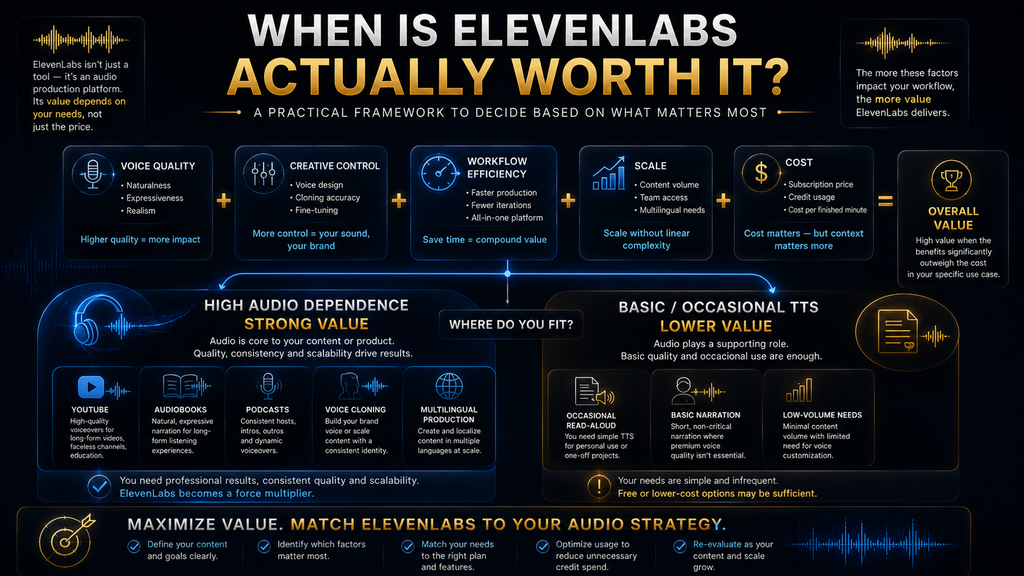
If you are spending hours recording corrections, coordinating narrators or rebuilding multilingual versions, ElevenLabs deserves a serious pilot. It is a strong fit when a repeatable voice matters across many assets and the output quality affects audience trust. The more of the production chain you can consolidate into Studio or an API workflow, the easier the subscription is to justify.
YouTube creators can use it for consistent narration, character voices, sponsor variations and localized versions. Podcasters can create intros, trailers, translated episodes or scripted formats, although conversational shows still benefit from real human chemistry. Course creators can update a sentence without rerecording an entire module, provided the script, pronunciation rules and voice identity are managed carefully.
Audiobook and fiction teams gain more from the expressive models and multi-speaker dialogue than someone producing neutral announcements. The cost becomes easier to defend when the voice is central to the experience and revisions occur across a long project. Rights, performance direction and consistency need more attention, not less, because the final product depends so heavily on the audio.
Developers should consider ElevenLabs when speech quality, streaming, multiple models or voice management are product requirements. A prototype should measure end-to-end latency, cost per successful task, interruption handling and failure recovery, rather than celebrating a fast first demo. Enterprise buyers should add data handling, residency, SSO, contractual assurance and moderation access to the evaluation.
Who Should Avoid or Delay Paying?
Do not pay yet if your audio need is occasional, your script process is unstable or your audience accepts functional speech. A free or bundled voice tool may cover internal prototypes, accessibility drafts, temporary placeholders and low-stakes clips. Buying a larger credit pool will not fix an unclear script, an unapproved voice or a production process that changes direction after every generation.
You should also delay voice cloning if consent, ownership or governance is unresolved. The technical setup may take minutes, while a dispute over authorization can last much longer. Record the agreement first, decide who controls the account and source files, then create the clone.
Projects that demand exact lip synchronization, full non-linear video editing or highly specialized audio mastering will need other tools around ElevenLabs. That does not make the platform weak; it defines its boundary. Buy it for voice and audio-production leverage, not because an expanding feature list appears to replace an entire post-production stack.
ElevenLabs vs Alternatives
ElevenLabs is the strongest choice when you value the combination of expressive speech, voice identity and a broad audio workflow. Another product may be better when price, enterprise approval, video editing, real-time latency or a specific language is the dominant requirement. The correct comparison begins with the job that cannot fail.
Murf and WellSaid can make sense for structured business voiceover teams; Speechify is attractive for reading and creator-friendly consumption; Descript is stronger when transcript-based audio and video editing drive the workflow; PlayHT and Cartesia may appeal to developers with different latency, voice or pricing priorities. Large cloud providers can be a better procurement fit when an organization already runs its identity, infrastructure and compliance controls in that ecosystem.
Do not compare a platform’s most impressive voice with a competitor’s default setting. Use the same script, language, target emotion and output requirement, then compare correction time, approved minutes, rights, export quality and total project cost. The detailed ElevenLabs versus alternatives comparison and the broader best AI voice generators guide can help build that shortlist.
A Practical Seven-Step Evaluation Workflow
Evaluate ElevenLabs with one representative project, not a polished demo sentence. Choose a five- to ten-minute asset that contains the actual difficulties of your work: names, numbers, emotional changes, multiple speakers or mixed languages. The project should be small enough to review completely and realistic enough to expose the workflow.
First, define the acceptance criteria before generating anything. Decide the target voice, pronunciation standard, emotional range, output format, commercial use and maximum correction time. Without a finish line, every new voice sounds temporarily interesting and the evaluation turns into browsing.
Second, prepare the script for speech. Shorten dense sentences, write numbers the way they should be spoken, mark abbreviations and create a pronunciation list. Read the script aloud once; anything that is hard for you to say will probably require direction or editing from the model.
Third, compare two models and no more than three voices. A wide search creates selection fatigue without improving the final decision. Use the same difficult passage for every combination, then reject options that fail pronunciation, sustained listening or the required emotional tone.
Fourth, build the project in sections and track corrections. Record how many passages needed another generation, what caused each correction and whether the problem came from the script, voice, model or direction. That log turns the next project into a better process and gives you a real regeneration rate for replacing the 25% planning assumption in this review.
Fifth, review on the device and channel where the audience will listen. A voice can sound rich in studio headphones and harsh on a phone speaker. Listen at normal speed, without watching the script, and ask a native reviewer to check language or accent authenticity when those factors affect credibility.
Sixth, verify rights, consent and data settings before publication. Save the source, approval, plan terms, final script and exported master together. If a clone or client voice is involved, the authorization record belongs with the production record.
Seventh, calculate the cost per approved minute or completed outcome. Subscription price divided by nominal credits is not enough. Include billable revisions, localization review, editing time and any downstream tool that remains necessary, then compare that total with your previous production method.
Common Mistakes That Waste Credits
The first mistake is generating before the script is approved. Every late wording change can turn an editorial problem into another audio generation. Lock facts, structure and legal language first, then generate the performance.
The second mistake is selecting a voice from a short emotional sample. Test sustained narration, transitions and ordinary sentences. A memorable demo voice may become distracting when it narrates instructions for fifteen minutes.
The third mistake is forcing one model into every job. Use an expressive model where expression creates value and a stable or fast model where consistency or latency matters more. The platform offers multiple models because those needs conflict.
The fourth mistake is treating generated audio as self-verifying. A fluent voice can pronounce a medicine, price, name or legal term incorrectly without sounding uncertain. Review the audio against the approved script and maintain a pronunciation dictionary for repeated terms.
The fifth mistake is ignoring the shared credit pool. Dubbing, music and corrections can consume capacity that looked available for narration. Estimate each product before production and keep a reserve for the final review cycle.
What Happens If You Keep the Traditional Workflow?
Traditional recording remains the right choice when human performance, trust or artistic interpretation is the product. A skilled narrator can understand subtext, take direction, improvise and negotiate a performance in ways a synthetic system does not reproduce reliably. The traditional process exists because voice is communication, not merely sound output.
The cost of staying manual appears when content changes frequently or must scale across formats and languages. Rerecording a corrected sentence, scheduling talent and matching the original session can slow updates. An authorized clone or carefully managed synthetic voice can reduce that friction, especially for modular training, recurring video narration and localized versions.
A hybrid workflow is often stronger than an ideological choice between human and AI. Use a human performer to define the voice, emotional range and important scenes, then use controlled synthesis for approved extensions, corrections or low-risk versions when the contract allows it. Human judgment stays closest to the moments where consequence and ambiguity are high.
How to Measure Whether ElevenLabs Is Working
Measure production outcomes, not how many clips the account generates. Useful creator metrics include approved minutes per month, regeneration rate, correction minutes per finished minute, cost per approved minute, pronunciation-error rate and time from approved script to published audio. A workflow that generates quickly but requires extensive repair has not saved as much time as the dashboard suggests.
Audience metrics depend on the format. For YouTube, compare retention around narration-heavy segments, complaints about pronunciation and performance across languages. For courses, monitor completion, support questions and correction requests. For agents, track successful task completion, interruption handling, escalation rate, containment, latency and customer satisfaction together.
Review the subscription after two complete billing cycles. One month can be distorted by setup or a large launch, while a year is too long to discover that credits are consistently wasted. If your measured regeneration rate is 40%, replace the 25% scenario in the production-cost table and choose the plan using your own number.
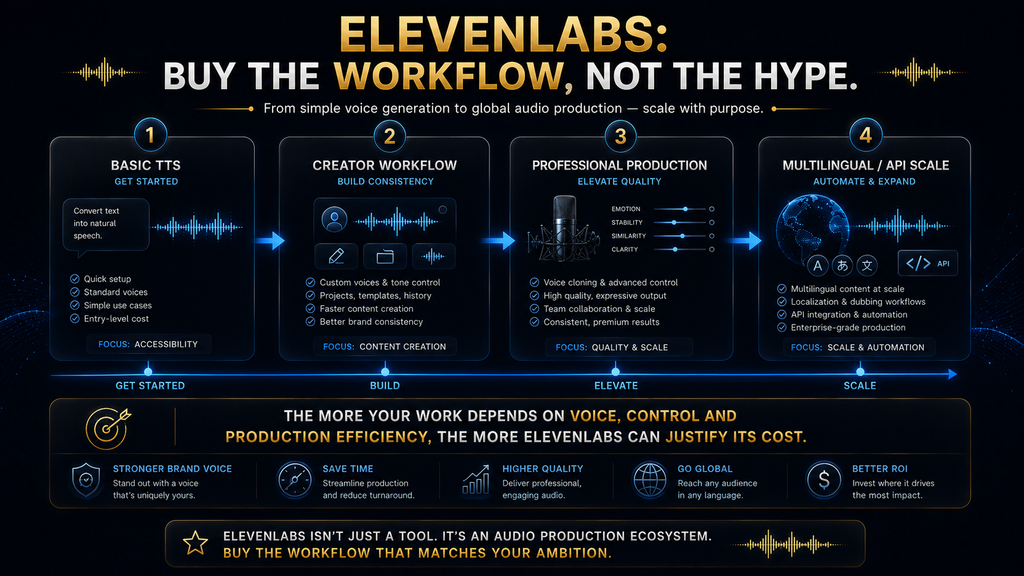
Final Verdict: Buy the Workflow, Not the Demo
ElevenLabs is one of the strongest AI audio platforms in 2026 because it connects high-quality speech with voice identity, project production, localization and developer delivery. Its advantage is no longer a single realistic voice sample. The value is the ability to manage repeatable voice work across a complete system.
That system is worth paying for when audio quality affects the product and when Studio, cloning, dubbing or APIs replace real production friction. It is less compelling when you need a few neutral minutes, already have adequate speech inside another tool, or cannot define who will review scripts, rights and final audio. Capability without process becomes credit consumption.
ElevenLabs is strongest on workflow fit and output capability. Shared-credit economics, consent and data responsibilities, and the human review required for publishable audio are the main limits. Our own twelve-line check in English and Bengali-English passed on the first take, which is a good sign for short mixed-language narration and no substitute for testing your own script and voice. Start with your hardest representative script, calculate approved output rather than nominal allowance and upgrade only when the workflow earns the cost.
Turn One Approved Voice Into a Repeatable Production System
If narration, cloning or multilingual audio is recurring work, test the complete workflow and choose the plan that covers approved output with revision room.
Explore ElevenLabs for Your Workflow →Affiliate disclosure: We may earn a commission if you subscribe through this link, at no additional cost to you.
Frequently Asked Questions
Is ElevenLabs worth paying for?
ElevenLabs is worth paying for when you need commercial rights, recurring high-quality narration, voice cloning, longer production capacity or an integrated audio workflow. If you only need occasional non-commercial samples, start with the free plan and measure how much approved audio you can produce from a representative project.
Which ElevenLabs plan is best for a YouTube creator?
Starter can cover a small channel with roughly thirty published TTS minutes before revision reserve, while Creator is a more practical starting point for regular long-form narration and Professional Voice Cloning. Calculate total monthly video minutes, add your measured regeneration rate and include any credits spent on dubbing, music or effects before choosing.
Can I use ElevenLabs voices commercially?
ElevenLabs states that content generated on paid plans includes commercial usage rights, subject to its terms and the rights attached to the voice and source material. Free-plan output is for non-commercial use with attribution. Keep records of the plan, terms, consent and exported asset for important commercial projects.
Does ElevenLabs let me clone anyone’s voice?
No. ElevenLabs prohibits unauthorized, deceptive or harmful impersonation, and Professional Voice Cloning requires the account holder to verify their own voice. Another speaker who wants to share a professional clone must create and verify it through their own account, while the project should also document suitable consent and rights.
What is the difference between Instant and Professional Voice Cloning?
Instant Voice Cloning estimates a voice from a short clean sample and becomes available quickly. Professional Voice Cloning trains a dedicated model from roughly thirty to 180 minutes of suitable audio, requires verification and normally takes several hours to train. PVC is the better path when fidelity and a repeatable personal voice are important.
Which ElevenLabs model has the best quality?
There is no single best model for every job. ElevenLabs presents Eleven v4 as its most emotive model, with v4 Turbo as the real-time version. Eleven v3 remains an expressive option for dramatic performance and dialogue, Multilingual v2 is designed for stable long-form speech, and Flash v2.5 prioritizes speed and lower API cost. Test the same difficult passage across the two models that match your use case.
Does ElevenLabs support Bengali?
Eleven v3 and Eleven v4 list Bengali among their supported languages, while Multilingual v2 and Flash v2.5 do not. In our own test on October 8, 2026, six mixed Bengali and English lines read by the stock voice Roger on v4 were all accepted on the first take. That is one voice and six short lines, so test names, numbers and representative sentences with a native reviewer before committing to production.
Do unused ElevenLabs credits roll over?
ElevenLabs says unused credits on active paid subscriptions can roll over for up to two months, subject to its published cap. Downgrading or cancelling causes unused paid credits to expire at the end of the billing cycle, and the Free plan does not receive the same rollover treatment.
Is ElevenLabs safe for confidential business audio?
Safety depends on the data, account settings, contract and organizational controls. ElevenLabs provides privacy choices, enterprise terms and data-residency options, but a business should verify opt-out settings, retention, moderation access, residency, consent and internal policy before uploading confidential, regulated or personal voice data.
What is the best ElevenLabs alternative?
The best alternative depends on the failure you are trying to avoid. Descript is attractive for transcript-based editing, Murf and WellSaid for structured business voiceover, Speechify for reading and creator use, and developer-focused providers for different latency or pricing needs. Compare the same script, language, rights and correction process before switching.
Written by
Muntasir Ahmad Chowdhury
Founder, AI Hustle World
Muntasir Ahmad Chowdhury is the founder of AI Hustle World, an independent publication that explains AI tools, automation and real business workflows through research-driven, decision-focused articles. His editorial approach emphasizes primary sources, transparent methodology, practical limitations and human judgment where consequences are high.
Expertise:
AI Tools • AI Automation • AI Customer Service • AI Productivity • Generative AI • AI Workflows
Get Smarter With AI
Enjoyed this guide? Get practical AI tools, tutorials, and honest reviews delivered to your inbox.