Text-to-Speech Explained: How AI Generates Natural-Sounding Voices
Type “hello, how are you today” into a text box and a computer-generated voice will read it back to you in under two seconds — and unless you are listening closely, you probably will not be able to tell it was never spoken by a human. That gap between synthetic and real speech has closed faster than almost anyone predicted, and the reason is not a single breakthrough but a stack of engineering decisions working together.
This article breaks down what actually happens between the moment you type a sentence and the moment a natural-sounding voice comes out of your speakers. We will cover the real pipeline behind modern generative audio systems, why older text-to-speech sounded robotic and newer systems do not, what the current benchmarks actually measure, where the leading tools stand against each other, and where this technology still breaks down in ways vendors rarely advertise.
None of this is theoretical. Text-to-speech now powers audiobook narration, customer support lines, YouTube voiceovers, accessibility tools, e-learning courses, and game characters, often without listeners realizing a model generated the voice. Understanding how it works is the difference between picking a tool that fits your use case and picking one because it topped a marketing page.
The market reflects how fast this has moved. Text-to-speech surpassed $4.8 billion in value in 2026 and continues expanding at roughly 22.4% annually, a growth rate driven almost entirely by quality finally catching up to the promise the technology has made for decades.
What Text-to-Speech Actually Means
Text-to-speech, or TTS, is the process of converting written text into spoken audio using a computer system rather than a human voice actor. It is easy to confuse with two adjacent technologies, so it is worth separating them clearly before going further.
Voice cloning is a related but distinct capability: it captures the characteristics of one specific person’s voice from a sample recording and reproduces new speech in that same voice. TTS, by contrast, can use entirely synthetic voices that were never spoken by any real person. Many modern platforms bundle both capabilities under one product, which is where most of the public confusion starts.
Speech-to-text (transcription) runs in the opposite direction, turning spoken audio into written words. TTS and speech-to-text are often paired inside voice assistants and call-center systems, but they rely on different models trained to solve different problems.
What all modern TTS systems share is a neural network trained on large amounts of paired text-and-audio data, which is what separates them from the rule-based systems that dominated the technology for decades before the mid-2010s. Early systems like DECtalk, famously used by Stephen Hawking, relied on hand-tuned acoustic rules rather than learned patterns, which is exactly why they sounded the way they did.
It also helps to be precise about what “AI” is doing in this context, since the term gets applied loosely. The model is not composing new words or ideas — it is predicting the acoustic realization of text you provide, meaning the creative and factual responsibility for what gets said still sits entirely with whoever wrote the script feeding into it.
Hear the Three-Stage Pipeline in Action
Paste a paragraph into ElevenLabs and listen to how it handles pauses, stress and unusual words before comparing it with other TTS voices.
Try ElevenLabs Text-to-Speech →Affiliate disclosure: We may earn a commission if you subscribe through this link, at no additional cost to you.
The Three-Stage Pipeline: How AI Turns Text Into Voice
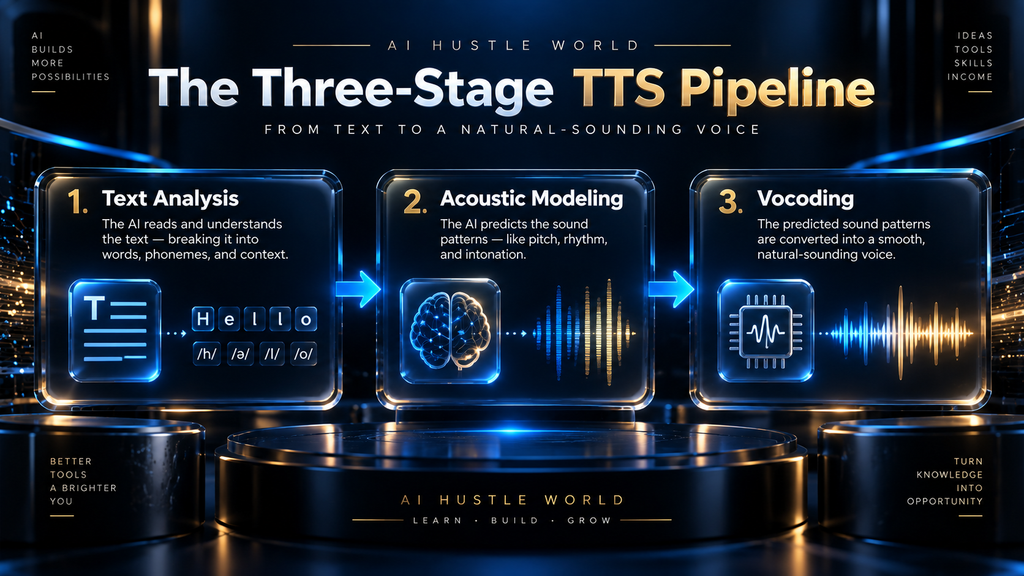
Even though newer systems increasingly blur these boundaries, it helps to understand TTS as a three-stage pipeline. Each stage solves a distinct problem, and knowing where a tool is weak usually traces back to one of these three stages specifically.
Stage 1: Text Analysis (the Frontend)
Before a model can generate any sound, it has to resolve the ambiguity built into written language. The number “1986” could be read as “nineteen eighty-six” or “one thousand nine hundred eighty-six” depending on context. The word “read” is pronounced differently depending on tense. Abbreviations, dates, currency symbols, and acronyms all need to be expanded into the way a person would actually say them out loud.
This frontend stage converts the cleaned-up text into phonemes, the individual units of sound that make up speech, through a process called grapheme-to-phoneme conversion. Get this stage wrong and no amount of downstream audio quality will save the output — the voice will simply say the wrong words confidently.
Stage 2: Acoustic Modeling
This is the neural core of the system, and it is where most of the “intelligence” in modern TTS actually lives. The acoustic model takes the phoneme sequence and predicts three things simultaneously: timbre (the distinctive voiceprint of the speaker), pitch (how intonation rises and falls across a sentence), and duration (how long each sound is held, which controls pacing and rhythm).
Architectures like Tacotron 2 and FastSpeech became foundational here because of their ability to convert a sequence of phonemes into a mel-spectrogram — a visual, frequency-based map of sound over time. It is worth noting that a mel-spectrogram is not audio yet; it is a compressed representation that still needs to be turned into an actual waveform by a separate component.
Stage 3: Vocoding
The vocoder is the final translator, converting the acoustic representation into a playable waveform. Early vocoders were a major bottleneck: they were either fast and robotic-sounding or high-quality and far too slow for real use. Neural vocoders like HiFi-GAN changed that trade-off, making high-fidelity audio generation fast enough for production systems rather than research demos.
Where Newer Models Diverge: End-to-End, Diffusion, and Flow-Matching
Newer end-to-end architectures increasingly collapse all three stages into a single transformer-based model that maps text directly to audio in one pass. This matters practically: end-to-end models can understand context across an entire paragraph rather than processing sentence by sentence, which is part of why tools like ElevenLabs‘ newer models can accept inline direction such as “[whispers]” or “[laughs]” and adjust delivery accordingly.
A second architectural shift is the move toward diffusion and flow-matching models, which generate audio by gradually refining noise into a target waveform rather than predicting it directly in one shot. These approaches tend to produce smoother, more consistent output across long passages, which is part of why some of 2026’s fastest-improving providers have shifted their research focus toward them instead of purely autoregressive designs.
From Robotic to Human: How TTS Actually Evolved
The jump from stilted 2010s-era TTS to today’s voices did not happen in one step. It happened across three distinct generations of technology, each solving the failures of the one before it.
| Generation | Method | Typical Result |
|---|---|---|
| Concatenative | Stitches together small pre-recorded speech fragments | Choppy, robotic cadence with audible seams between sounds |
| Parametric (statistical) | Generates speech from statistical models of vocal features | Smoother than concatenative but often muffled and flat |
| Neural | Deep neural networks learn speech patterns directly from data | Human-like prosody, stress, and pacing |
Google’s WaveNet, published in 2016, is generally treated as the turning point that proved neural vocoding could beat both older generations on quality, even though it was initially too slow to run in real time. Everything since has largely been an effort to keep WaveNet-level quality while making it fast enough for production use, a problem that took roughly five more years to fully solve at scale.
What Actually Makes a Voice Sound Natural
“Natural” is a vague word until you break it into its components. Naturalness in synthetic speech comes down to a model correctly predicting how a human would actually say something, not just which words to say.
That includes stress patterns (which words in a sentence get emphasis), pause placement (where a real speaker would take a breath or add a dramatic beat), and intonation contour (whether pitch rises at the end of a question or falls at the end of a statement). Older rule-based systems tried to hand-code these patterns; neural systems learn them statistically from thousands of hours of real recorded speech.
This is also why context matters so much for quality. A model that only looks at one sentence at a time will read “I can’t believe it” the same way whether it’s excited, sarcastic, or devastated. Newer end-to-end models that process longer spans of text can carry emotional and contextual cues across sentences, which is a large part of why they sound less flat than older sentence-by-sentence systems.
Accent and dialect handling has quietly become a competitive differentiator too. A model trained overwhelmingly on American English news audio will often mishandle regional pronunciation patterns and code-switching between languages, which is why multilingual coverage numbers in vendor marketing rarely tell the whole story about actual accent quality.
How Multilingual and Code-Switching Support Actually Works
Language coverage numbers in vendor marketing hide more complexity than they reveal. A model claiming “75 languages” typically trained each language on wildly different amounts of data, which means fluency in Spanish and fluency in Icelandic from the same model can be worlds apart in practice.
Code-switching — when a sentence mixes two languages, such as a Spanish sentence with an English brand name embedded in it — remains one of the harder unsolved problems in the field. Most models handle it by detecting language boundaries mid-sentence and switching phoneme sets, but the seam between languages can still sound noticeably unnatural, especially with proper nouns that have no clean pronunciation in the surrounding language.
For teams localizing content into multiple markets, the practical takeaway is to test with real sentences from your actual content, including brand names, technical terms, and any bilingual phrasing that shows up naturally in your industry, rather than trusting an aggregate language-count number from a pricing page.
Quality, Latency, and the Benchmarks That Actually Matter
Every TTS vendor claims to sound “the most natural” and be “the fastest.” Cutting through that requires knowing what is actually being measured, because three very different metrics get lumped together in marketing copy.
Naturalness is typically measured with a Mean Opinion Score (MOS), where human listeners rate audio samples, or increasingly with blind A/B preference testing that produces an ELO-style ranking, similar to how chess players are ranked. Accuracy is measured by feeding generated audio back through a speech recognition system and calculating the character error rate (CER) — essentially checking whether the words that come out match the words that went in. Latency is measured as time-to-first-audio (TTFA), the delay between sending text and hearing the first sound, which matters enormously for real-time conversational use and far less for pre-recorded narration.
As of mid-2026, independent benchmarking put Google DeepMind’s Gemini 3.1 Flash TTS and Inworld’s Realtime TTS-2 at the top of blind-preference ELO rankings, with Cartesia’s Sonic 3.5 close behind. On raw speed, Cartesia Sonic 3.5 achieved roughly 82 milliseconds end-to-end time-to-first-audio in independent testing, while some open-weight models like Kokoro reached a 4.5 MOS score with a 17% character error rate in third-party evaluation.
One nuance worth flagging: vendor-published benchmarks and independent third-party benchmarks frequently disagree, sometimes significantly. Companies tend to publish results from test sets that flatter their own architecture’s strengths, which is why comparison shopping based on a single headline number from a vendor’s own blog post is one of the more common mistakes teams make.
The practical lesson is that “best” depends entirely on what you are optimizing for. A tool built for real-time voice agents and a tool built for audiobook narration are solving different problems, even though both get marketed under the same “text-to-speech” label.
The 2026 TTS Landscape: Comparing the Major Players
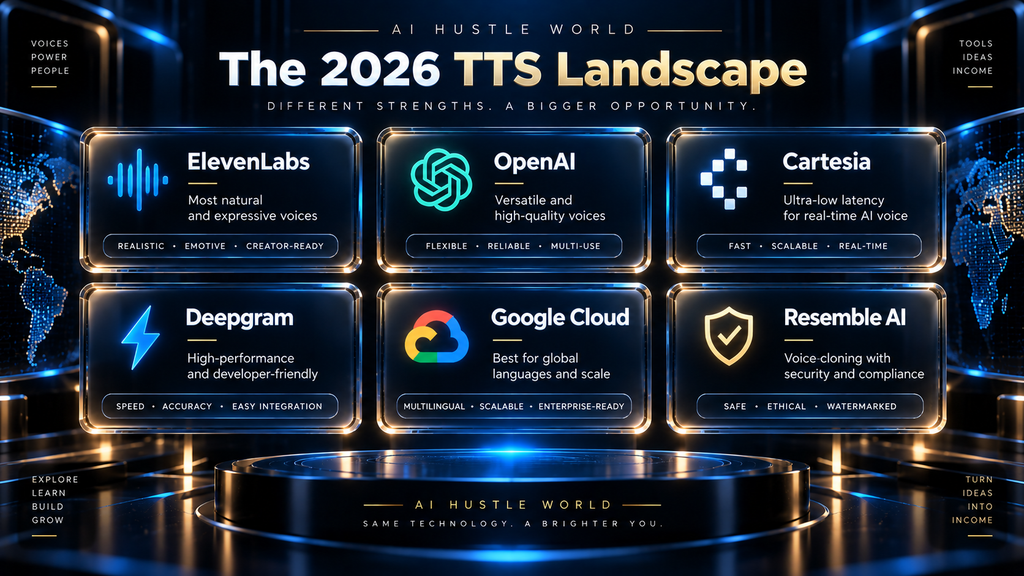
The provider landscape has consolidated around a handful of names, each with a genuinely different focus rather than being interchangeable competitors. Here is how the major players actually differ in practice.
| Provider | Standout Strength | Best Fit For |
|---|---|---|
| ElevenLabs | 10,000+ community voices, 74-language support, expressive delivery | Content creators, narration, dubbing |
| OpenAI TTS | Instruction-based voice steering, tight ecosystem integration | Developers already building on OpenAI’s stack |
| Cartesia Sonic | ~40ms time-to-first-byte, 3-second voice cloning | Real-time conversational agents |
| Deepgram Aura | Domain-specific pronunciation, unified speech-to-text and TTS | Enterprise call centers and compliance-heavy use cases |
| Google Cloud TTS | 380+ voices across 75+ languages | Global, multilingual deployments |
| Resemble AI | Built-in AI-audio watermarking, 149+ languages | Teams needing provenance and compliance |
If you are evaluating tools for content creation specifically, our full ElevenLabs review and ElevenLabs vs. alternatives comparison go deeper into pricing tiers and real output quality than a single table can capture. For creators specifically building faceless YouTube content, our guide to using ElevenLabs for YouTube and faceless videos walks through the practical workflow end to end.
Pricing philosophy also varies more than most buyers expect. Per-character billing, common with ElevenLabs, OpenAI, Deepgram, and Google, scales predictably with content volume but can become expensive fast for high-volume narration. Credit-based and per-minute pricing, used by providers like Cartesia and Resemble, can be cheaper for shorter, bursty usage patterns but harder to forecast at scale, which matters more than it sounds like it should once a team is generating thousands of minutes per month.
There is also a growing open-weight alternative track worth knowing about: models like Kokoro, Fish Audio, and CosyVoice can be self-hosted, trading some peak quality for full data control. That trade-off matters specifically for organizations in regulated industries where sending customer voice data to a third-party API is a compliance non-starter regardless of how good the output sounds.
The Economics of TTS vs. Hiring Voice Talent
The cost comparison between TTS and human voice actors is not as one-sided as it first appears, and understanding where each still wins matters for planning a real production budget.
Professional voice actors typically charge per finished hour or per word for scripted work, plus revisions, scheduling delays, and studio time. A single audiobook narration can run into the thousands of dollars before editing. TTS platforms, by contrast, charge fractions of a cent per character, which for high-volume, frequently updated content collapses the cost difference by orders of magnitude.
Where human talent still wins is anything requiring genuine creative interpretation, celebrity or brand-recognized voices, or union and licensing requirements tied to specific media formats. The realistic 2026 pattern is not “TTS replaces voice actors” but rather a split: high-volume, frequently-refreshed content moves to TTS, while flagship, brand-defining audio keeps a human voice attached to it.
The break-even point in practice tends to arrive faster than teams expect. Once a content operation is publishing more than a handful of scripted audio pieces per month, the cumulative studio-booking overhead alone — scheduling, retakes, engineer time — usually outweighs any per-unit quality advantage that a human recording session still holds for routine, non-flagship content.
Measuring ROI Beyond Cost Per Character
Most teams evaluate TTS purely on price per character or per minute, which misses most of the real cost equation. A complete return-on-investment view needs at least four inputs working together rather than one headline number.
Direct generation cost is the easiest to calculate: characters or minutes generated multiplied by the provider’s rate card. Revision cost is harder to estimate up front but often larger in practice — how many takes does it typically require to get a passable result for your specific content type, and how much staff time does reviewing and re-generating actually consume.
Downstream accuracy cost matters whenever generated audio feeds into another automated system, echoing the accuracy-tax trade-off covered earlier: a cheaper, more expressive voice that degrades caption or transcription quality can cost more in support tickets and correction work than a slightly pricier, more neutral-sounding alternative. Opportunity cost closes the loop: what would the same budget produce if spent on human narration instead, and does the quality gap actually matter for this specific piece of content.
A simple framework for tracking this over time is to log, per project, the generation cost, the number of regeneration attempts needed, and any downstream error rate if the audio is transcribed or captioned. Reviewing that log after a few months usually reveals whether a cheaper provider was actually cheaper once revision and error-correction time gets factored in.
Measure TTS Value on Real Content
Generate one piece of recurring content with ElevenLabs and compare editing time and credit cost against your current voiceover process.
Test ElevenLabs on Your Content →Affiliate disclosure: We may earn a commission if you subscribe through this link, at no additional cost to you.
The Accuracy Tax: Why Expressive, Emotional TTS Comes at a Cost
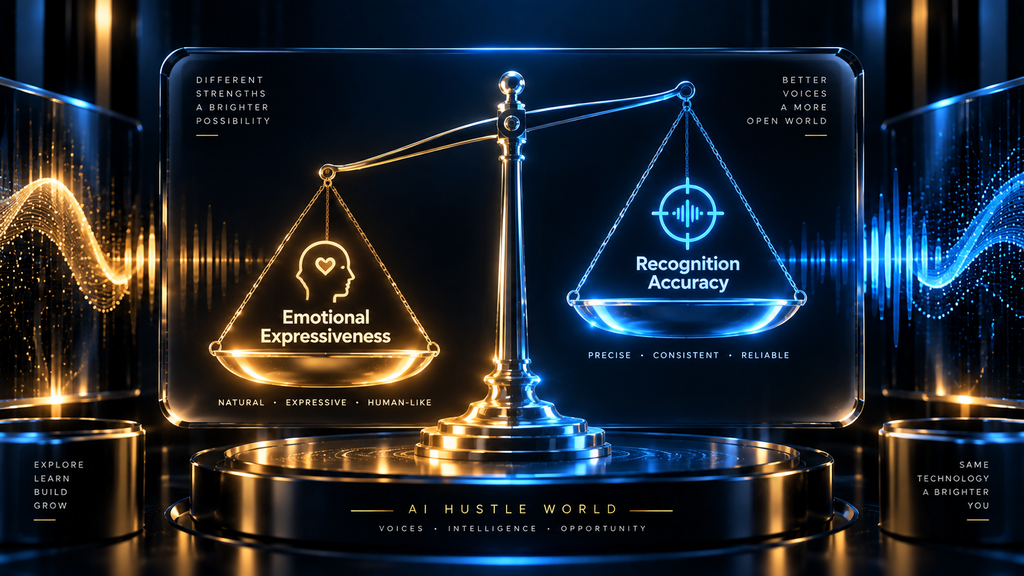
One finding from 2026 research deserves more attention than it gets: emotional and expressive TTS measurably reduces downstream speech recognition accuracy, sometimes by 7 to 20 points depending on the system. This matters more than it sounds like it should.
Most speech recognition systems are trained primarily on neutral speech. When a TTS system introduces expressive prosody — pitch shifts, tempo changes, breathy or emphatic delivery — it pushes the audio outside the distribution that recognition systems expect. Pitch-related harmonics distort spectral patterns, tempo changes disrupt duration normalization, and the result is more substitution errors when that audio is transcribed, captioned, or processed by downstream automation.
Real-world conditions make this worse, not better. Background noise, phone-call compression, and network degradation all disproportionately affect emotionally expressive audio compared to flatter, neutral delivery, because the more complex prosodic patterns are more easily masked.
Consider a concrete scenario: a customer support team deploys an expressive, empathetic-sounding TTS voice for its IVR system to improve caller experience, then discovers weeks later that its automated call-transcription pipeline is misrouting a noticeably higher share of calls. The voice choice that improved perceived warmth is the same choice degrading the accuracy of everything built downstream of it.
None of this means expressive TTS should be avoided. It means the trade-off should be a deliberate choice rather than an accident. Mental health support tools, brand-voice differentiation, and customer engagement scenarios often justify the accuracy cost because the emotional connection matters more than transcription precision. A compliance transcript or an IVR menu usually does not.
A practical middle path some teams adopt is generating two versions from the same script: an expressive version for the audience-facing audio, and a neutral-delivery version run purely for internal transcription and captioning purposes. It costs a second generation pass but sidesteps the accuracy tax entirely for the pipeline that actually needs precision.
Real-World Use Cases: Where TTS Actually Creates Value
The reason TTS adoption has accelerated so quickly is that it solves genuinely different problems across very different industries, not because of one killer application. Audiobook and long-form narration benefits from TTS’s ability to maintain a consistent voice across hours of content without vocal fatigue, at a fraction of studio recording costs, while still preserving natural pacing across long passages.
Accessibility tools use TTS to read web pages, documents, and interfaces aloud for users with visual impairments or reading difficulties, making it one of the technology’s oldest and most socially valuable applications, predating almost every commercial use case discussed elsewhere in this article. Customer support and IVR systems use TTS to generate consistent, on-brand voice prompts without re-recording every script change, and increasingly pair it with real-time conversational agents for live call handling.
Localization and dubbing lets a single piece of video or audio content be translated and re-voiced into dozens of languages without hiring voice actors in every target market, which is reshaping how quickly global content can ship. E-learning and corporate training use TTS to narrate course material at scale and update it instantly when content changes, without waiting on a recording studio’s schedule.
Gaming and interactive NPCs increasingly rely on real-time TTS to generate dynamic dialogue on the fly rather than pre-recording every possible line, letting non-player characters respond to unscripted player behavior with spoken lines that were never explicitly written by a voice director. Faceless content creation on YouTube, Pinterest, and social platforms relies heavily on TTS voiceover as the backbone of channels that intentionally never show a human presenter, which is a use case we have covered in depth in our roundup of the best AI voice generators.
One second-order effect worth naming directly: as TTS quality has risen, entry-level voice-over work has contracted in some markets, while demand for voice actors willing to license their voice for AI training and cloning has grown as a new, separate category of paid work.
Who Should Use AI TTS — and Who Should Still Hire a Human Voice
The honest answer is that this is rarely an all-or-nothing decision, and treating it as one is where a lot of teams go wrong. AI TTS is the clear default for high-volume, frequently updated, or budget-constrained content: internal training material, product documentation read-alouds, YouTube scripts published on a weekly cadence, and multilingual localization where hiring native voice talent in every target market is not realistic.
A human voice actor is still the better call for flagship brand campaigns where a recognizable, licensed celebrity or brand voice carries commercial value on its own, for union-covered broadcast and film work where contractual requirements exist independent of quality, and for any content where the emotional authenticity of a specific real performer is the actual product being sold, such as a memoir narrated by its own author.
Plenty of serious content operations run both in parallel: TTS for the long tail of supporting content, and human narration reserved for the handful of pieces where brand identity depends on it. That hybrid model, rather than a wholesale switch in either direction, is what most mature 2026 content operations have actually converged on.
Why Studio Recording Hasn’t Disappeared
Given how good neural TTS has become, it is fair to ask why professional recording studios and voice-acting agencies still exist at all. The traditional workflow persists for reasons that have little to do with raw audio quality and everything to do with what a studio recording session actually provides beyond the voice itself.
A directed studio session allows a director to shape performance choices in real time based on nuanced creative feedback — something current TTS interfaces still handle through text prompts and settings sliders rather than genuine creative collaboration. Union contracts, broadcast standards, and certain advertising categories also carry legal and contractual requirements for human performers that no amount of model quality changes.
If your organization skips evaluating TTS entirely and defaults to studio recording for everything, the realistic cost is not lower quality — it is slower iteration speed and a materially higher cost per piece of content, which compounds quickly for any team publishing on a regular schedule rather than producing a handful of flagship pieces per year.
Where TTS Still Fails: Real Limitations
Vendor demos are curated. Real-world use exposes weaknesses that rarely show up in a two-sentence marketing example.
Long-form drift is a persistent problem: voices that sound perfectly natural for a 15-second clip can develop subtle pitch drift, pacing inconsistency, or robotic artifacts across a 20-minute narration, especially with lower-tier models. Pronunciation edge cases remain unsolved for proper nouns, technical jargon, and non-English names embedded in English text, often requiring manual phonetic overrides that most casual users never discover exist.
Licensing and ethical exposure is a real operational risk. Using a cloned or synthetic voice for commercial content without clear rights to that voice can create legal liability, which is why tools like Resemble AI have started building watermarking directly into generated audio.
Deepfake and impersonation risk is the uncomfortable flip side of voice cloning quality: the same technology that lets a small creator sound professional can be misused to impersonate real people convincingly, which is why several jurisdictions are moving toward disclosure requirements for synthetic voice content, echoing the transparency obligations already emerging under frameworks like the EU AI Act. Data privacy of cloned voice samples is an underdiscussed risk: uploading a sample of your own or a client’s voice to a third-party platform means trusting that provider’s data retention and security practices, something worth checking before uploading anything you cannot afford to have leaked or misused.
Batch Generation vs. Streaming: A Distinction Worth Knowing
Most comparisons of TTS tools blur together two fundamentally different generation modes, and picking the wrong one for your use case causes more frustration than any voice-quality issue.
Batch generation processes a full script at once and returns a complete audio file, which is what almost all narration, audiobook, and video-voiceover workflows actually need. It has no real latency constraint since nothing is happening live, so providers optimized for narration quality rather than speed are the right fit here.
Streaming generation produces audio incrementally as text arrives, which is what real-time voice agents and live conversational interfaces require. This is where time-to-first-audio becomes the dominant metric, since a user waiting on a live phone call notices a 500-millisecond delay in a way a video editor waiting on a rendered file never does.
Choosing a provider optimized for the wrong mode is one of the more expensive integration mistakes teams make, since batch-optimized providers often perform noticeably worse on streaming latency benchmarks and vice versa, regardless of how strong either looks on generic marketing comparisons.
How to Evaluate a TTS Sample Like an Editor, Not a Casual Listener
Most people judge a TTS voice on first impression — does it sound pleasant on a short demo sentence. That is a weak test, and it is exactly the test every vendor’s homepage is optimized to pass.
A more useful evaluation reads the same sample back for four specific things. First, listen for sentence-final intonation: does pitch fall naturally at the end of statements and rise appropriately at the end of questions, or does every sentence land with the same flat cadence regardless of punctuation. Second, listen across a full paragraph rather than a single sentence, since single-sentence demos hide the long-form drift problem covered earlier in this article entirely.
Third, deliberately feed it content from your own field: product names, technical acronyms, and any numbers or dates formatted the way your content actually formats them. Generic demo sentences are chosen specifically because they avoid the words that trip models up. Fourth, listen with headphones rather than laptop speakers at least once, since compression artifacts and unnatural formant transitions that are inaudible on small speakers become obvious with better playback equipment.
Running a candidate voice through all four checks takes about five extra minutes compared to a single demo listen, and it is the difference between discovering a mispronunciation problem before publishing a hundred episodes of content versus after.
Podcasting and Long-Form Audio: A Closer Look
Podcasting deserves its own mention because it sits at the intersection of several challenges already discussed: long-form consistency, natural pacing across dialogue-style content, and the accuracy trade-offs of expressive delivery, all at once.
AI-assisted podcast production has moved well beyond simple text-to-speech narration into full workflows that take a script or outline through voice generation, background music, and even simulated multi-speaker conversation. The consistency requirement is stricter here than in almost any other use case, since listeners spend 20 to 60 minutes with the same voice and any drift or artifact becomes far more noticeable over that runtime than in a 30-second ad read.
Teams experimenting with AI-narrated or AI-co-hosted podcasts typically get the best results by treating the TTS output as a first draft rather than a final product: generating the full episode, then reviewing for pacing and pronunciation issues before publishing, rather than trusting a single-pass generation to be broadcast-ready without a listen-through.
How to Choose the Right TTS Tool for Your Use Case
Rather than chasing whichever tool topped last month’s benchmark, work backward from what your specific use case actually needs.
| Your Priority | What to Optimize For | Providers to Start With |
|---|---|---|
| Real-time conversation | Time-to-first-audio under 100ms | Cartesia, Inworld, Deepgram |
| Long-form narration | Consistency across long passages | ElevenLabs, Google Cloud |
| Multilingual reach | Language and voice-count coverage | Google Cloud, ElevenLabs, Resemble |
| Compliance-sensitive use | Accuracy, watermarking, provenance | Deepgram, Resemble |
| Data control | Self-hosting capability | Open-weight models (Kokoro, Fish Audio) |
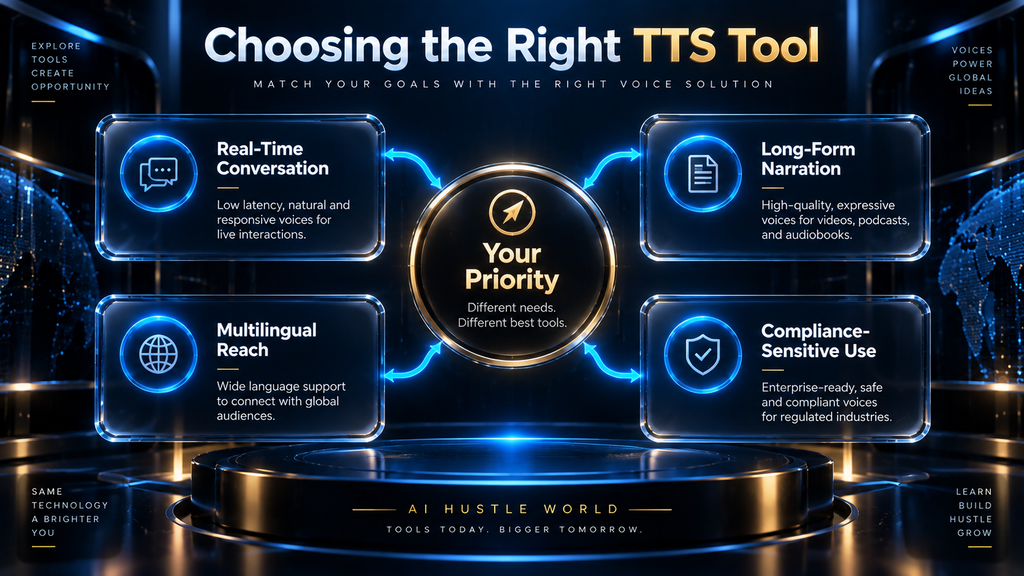
If you need real-time conversational latency — voice agents, live customer support, interactive characters — prioritize time-to-first-audio over raw naturalness scores; a 40ms response that sounds slightly less expressive will beat a gorgeous voice that lags noticeably in conversation. If you need long-form narration — audiobooks, YouTube scripts, e-learning — prioritize consistency across long passages and natural pacing over headline latency numbers, since nothing in that use case is happening in real time. If your use case touches compliance, healthcare, or financial services, prioritize accuracy and provenance features like watermarking over emotional expressiveness, given the accuracy-tax trade-off covered earlier in this article.
Setting Up Your First TTS Workflow: A Practical Checklist
Moving from “trying a demo” to “shipping TTS in production” tends to go smoother with a short, deliberate checklist rather than improvising as issues surface.
Start by testing the provider against a representative sample of your actual content, not a generic demo script, including any brand names, technical terms, or numbers your content regularly includes. Next, decide upfront whether your use case is latency-sensitive or quality-sensitive, since that single decision should drive most of the rest of your provider shortlist, as covered in the decision matrix above.
Read the commercial licensing terms before committing budget, specifically checking whether monetized or commercial use requires a higher tier than the one shown in marketing pricing. Build a lightweight human review step into your workflow for anything published publicly, since even top-tier models occasionally mispronounce a name or a technical term in ways that are obvious to a human ear but easy to miss without a listen-through pass.
Finally, document which voice, settings, and provider you used for a given piece of content, especially if you expect to produce more content in the same series later. Voice-ID drift between provider updates is common enough that “the same voice sounds slightly different six months later” is a real, recurring complaint worth planning around.
The Role of Fine-Tuning and Custom Voice Training
Beyond picking a stock voice from a provider’s library, most serious commercial deployments eventually reach a point where a custom or fine-tuned voice becomes worth the investment. This typically means either training a fully custom voice model on a large, clean dataset of a specific speaker, or lightly adapting an existing base model to better match a brand’s desired tone and pacing.
The data quality bar for this is higher than most teams expect. Clean, consistent, studio-quality recordings with minimal background noise and a single consistent speaking style produce dramatically better fine-tuned results than a larger but noisier dataset, which is a lesson borrowed directly from how voice cloning quality depends on input sample quality in general.
For most small businesses and individual creators, a fine-tuned or custom voice is rarely worth the cost and complexity compared to a well-chosen stock voice from a major provider. It becomes worthwhile specifically once a brand’s voice identity is valuable enough on its own that consistency across hundreds of pieces of content matters more than the upfront setup cost.
Common Mistakes When Implementing AI Voice
Teams adopting TTS for the first time tend to repeat the same handful of mistakes, most of which are avoidable with a little planning. The most common is picking a tool based purely on a demo voice sample rather than testing it against your actual script content, including technical terms, brand names, and numbers specific to your industry.
A close second is ignoring licensing terms for commercial use, assuming a subscription automatically grants broad rights to monetized content, which is not always true across every provider’s terms. The third is over-indexing on emotional expressiveness for use cases where accuracy matters more, then being surprised when captions or downstream transcription quality drops.
The fourth is underestimating cost at scale: a per-character price that looks trivial in a demo can compound into a meaningful monthly expense once content volume actually ramps up, especially for teams publishing daily. The fifth is treating every provider’s benchmark numbers as directly comparable, when different vendors frequently test on different, self-selected content sets designed to flatter their own strengths.
A sixth, less obvious mistake is failing to plan for provider lock-in. Voice IDs, custom fine-tuned models, and cloned voice profiles are rarely portable between platforms, which means switching providers later can mean losing access to a voice your audience has come to associate with your brand. Testing export options and portability before committing to a long-term voice identity avoids an expensive surprise down the line.
What’s Next: The Future of AI Voice Generation
The trajectory is toward tighter integration between text-to-speech and full speech-to-speech systems, where a model processes and responds to voice input without an intermediate text step at all. That shift is already visible in “realtime” model families from Inworld, Google, and others explicitly optimized for spoken dialogue rather than reading pre-written scripts.
Expect continued convergence between voice cloning and TTS as separate product categories, tighter regulation around disclosure and watermarking as deepfake concerns grow, and further latency reductions that make real-time voice agents indistinguishable in responsiveness from talking to a human on the phone. Quality gaps between the top commercial providers and the best open-weight models are also narrowing faster than most predicted a year ago, which is likely to push pricing down across the board as competition intensifies between hosted APIs and self-hosted alternatives.
The regulatory dimension is worth watching closely over the next year. As frameworks like the EU AI Act push toward mandatory labeling of synthetic media, expect TTS providers to build disclosure and watermarking in by default rather than as an opt-in feature, shifting the entire industry toward provenance as a baseline expectation rather than a premium add-on.
Final Thoughts
Text-to-speech stopped being a novelty the moment neural networks replaced rule-based pipelines, and the technology has kept compounding since. The three-stage pipeline of text analysis, acoustic modeling, and vocoding still explains what is happening under the hood, even as newer end-to-end models blur those boundaries into a single pass.
What matters for anyone actually choosing a tool is resisting the pull of whichever benchmark leads this month’s headlines. Match the tool to the constraint that actually governs your use case — latency, long-form consistency, language coverage, or accuracy — and the right choice becomes far more obvious than any comparison chart can make it look.
Choose a TTS Tool That Fits Your Use Case
Evaluate ElevenLabs against your language, latency and licensing needs on a free account before committing to a paid plan.
Evaluate ElevenLabs Free →Affiliate disclosure: We may earn a commission if you subscribe through this link, at no additional cost to you.
Frequently Asked Questions
Is text-to-speech the same as voice cloning?
No. Text-to-speech converts written text into spoken audio using any voice, including entirely synthetic ones. Voice cloning specifically reproduces one real person’s voice from a sample recording. Many platforms offer both under one product.
How natural can AI-generated voices actually sound in 2026?
Leading neural models now score close to human parity on blind preference tests for short-form content, though quality still varies by language, sentence complexity, and how far a script strays from the model’s training data.
What is a mel-spectrogram and why does it matter?
It is a visual, frequency-based map of sound over time that acoustic models generate before a vocoder turns it into actual playable audio. It is an intermediate representation, not sound itself, and errors introduced at this stage carry through to the final output.
Why do some AI voices sound worse in long recordings than short demos?
This is called long-form drift: subtle pitch or pacing inconsistencies that are barely noticeable in a 15-second clip can accumulate and become audible over a 20-minute narration, particularly with lower-tier models.
Does adding emotion to a TTS voice hurt anything?
Yes, measurably. Research shows emotional and expressive TTS can reduce downstream speech-recognition accuracy by 7 to 20 points, which matters for captioning, compliance transcripts, and any automation that reads the generated audio back into text.
What is time-to-first-audio and why should I care about it?
It is the delay between sending text to a TTS system and hearing the first sound. It matters enormously for real-time voice agents and live conversation, and matters far less for pre-recorded narration like audiobooks.
Can AI-generated voices be used commercially without legal risk?
Usually yes for fully synthetic voices under a provider’s standard license, but cloned voices of real people carry real legal exposure without explicit rights, which is why watermarking and disclosure features are becoming more common.
Which TTS provider is best for real-time voice agents?
Providers optimized for sub-100-millisecond latency, such as Cartesia and Inworld, are purpose-built for real-time conversational use, whereas providers optimized for expressive narration are not designed around that constraint.
How is TTS different from the older “robotic” voices in GPS systems?
Older systems used concatenative or parametric methods that stitched together or statistically modeled small speech fragments, producing the choppy or muffled sound people associate with early GPS and phone-menu voices. Neural systems learn speech patterns directly from data instead.
Do I need coding skills to use modern AI text-to-speech tools?
No. Most consumer-facing platforms offer a simple text box and voice picker with no code required; API access with more granular control is available separately for developers who need it.
Written by
Muntasir Ahmad Chowdhury
Founder, AI Hustle World
Muntasir Ahmad Chowdhury is the Founder of AI Hustle World, an independent publication dedicated to making Artificial Intelligence practical, trustworthy, and easy to understand. He researches AI tools, automation, customer service, productivity, and real-world business applications, helping readers make smarter technology decisions through research-driven, experience-backed content.
Expertise:
AI Tools • AI Automation • AI Customer Service • AI Productivity • Generative AI • AI Workflows
Get Smarter With AI
Enjoyed this guide? Get practical AI tools, tutorials, and honest reviews delivered to your inbox.
9 thoughts on “Text-to-Speech Explained: How AI Generates Natural-Sounding Voices”