Best AI Voice Cloning Tools in 2026: Compared for Realism, Licensing and Control
One reviewer who ran the same head-to-head test that anchors much of this guide described the moment he first heard his own cloned voice this way: he recorded a one-minute sample, fed in a paragraph he’d never actually said out loud, and played it back. The breaths were in the wrong places. A stranger would never have known it wasn’t him.
That’s roughly where voice cloning sits in 2026 — good enough, from nearly every leading tool, to pass. Which means the question worth answering isn’t “which one sounds most real,” because several of them already clear that bar. It’s which one actually fits what you’re building, and which one takes the question of consent seriously enough that you’re not the one holding the risk later.
This guide compares the current field on exactly those terms: realism, licensing and control — not a single ranked “winner,” because the honest answer depends on what you’re actually trying to do.
That’s a deliberately different approach from most “best of” lists in this space, and it’s worth saying why up front: a tool that’s the right answer for a solo creator narrating a YouTube video is very often the wrong answer for a developer building a live voice agent, and neither of those is the right answer for an enterprise team with a compliance department to satisfy. Collapsing all three into one ranked list is how most of the weaker comparisons in this space end up misleading readers who take the #1 spot at face value.
Disclosure: this article may contain affiliate links. If you sign up through one, AI Hustle World may earn a commission at no extra cost to you. Every recommendation here is based on published pricing, documented features, and independent testing we found credible — never on which program pays the most.
What This Article Covers
This piece compares eight named voice-cloning platforms plus a handful of dubbing-specific tools, on realism, licensing/consent control, and fit for specific use cases — with real 2026 pricing and feature detail for each.
It does not re-explain how voice cloning or text-to-speech work mechanically — our generative audio explainer and text-to-speech explainer already cover that mechanism, and this guide links back rather than repeating it. This is a buying guide, not a technical explainer.
It also covers ground most comparison articles skip entirely: the current, fast-moving legal landscape around voice likeness specifically, the accessibility use case, and an honest look at which “best of” testing in this space can actually be trusted.
Test a Clone Before You Choose a Tool
Run the same clean recording through ElevenLabs and compare realism, control and licensing with the other tools in this guide.
Test ElevenLabs Voice Cloning →Affiliate disclosure: We may earn a commission if you subscribe through this link, at no additional cost to you.
Why Realism Isn’t the Real Differentiator Anymore
For most of voice cloning’s short history, the obvious question was whether a tool could clone a voice convincingly at all. By 2026, for the tools that matter, that question is mostly answered: instant cloning from as little as 10-30 seconds of source audio now produces results that fool casual listeners on several platforms, not just one.
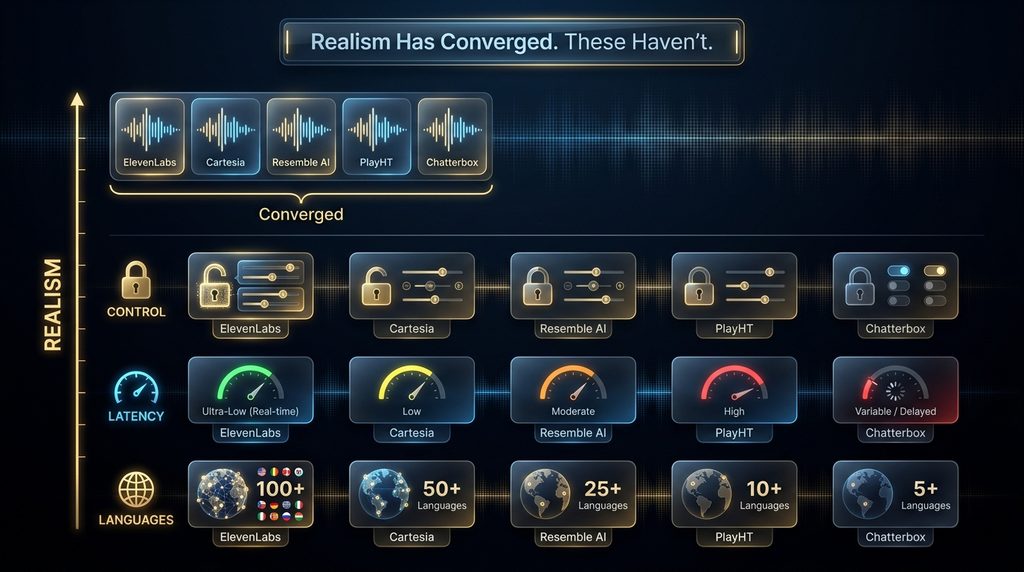
The one credible independent test we found — a writer who cloned the same voice across eight platforms with identical scripts, rather than trusting demo audio — backs this up: quality differences between the top few tools were real but narrow, while differences in latency, control, languages, and actual cost past the free tier were much larger.
That’s the thesis this guide is built around: realism has mostly converged at the top of the market. What actually separates these tools now is what each one lets you control, and how seriously each one checks that you’re allowed to clone the voice you’re cloning in the first place.
The AI Hustle World Voice Clone Fit Test
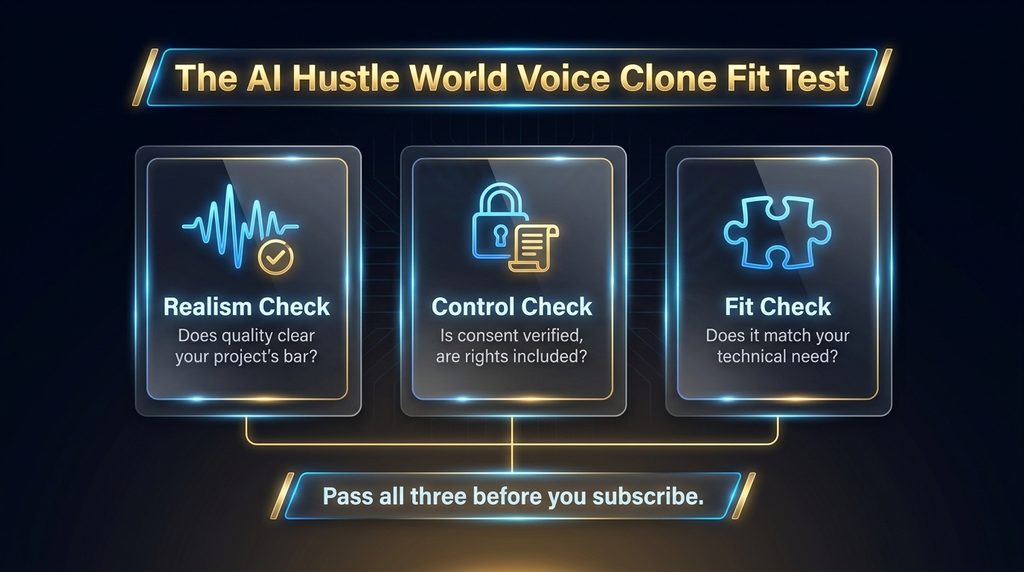
Before picking a tool from the comparison below, run your own use case through three checks. We call this the Voice Clone Fit Test, and it takes about as long as reading one tool’s pricing page.
The Realism Check: does the tool’s quality actually clear the bar your project needs? A casual YouTube narration and a broadcast-grade audiobook don’t need the same fidelity, and paying for more realism than your use case requires is money spent on a problem you don’t have.
The Control Check: what does the platform actually require before it lets you clone a voice — a checkbox agreeing you have consent, or something closer to real verification? And separately, what commercial rights are actually included at your pricing tier, versus gated behind a higher one?
The Fit Check: does the tool match your specific technical need — real-time generation for a live voice agent, long-form pacing control for narration, on-prem deployment for enterprise compliance, or dozens of languages for dubbing? The “best” tool changes completely depending on this answer.
| Check | Question | If it fails |
| Realism | Does quality clear your project’s actual bar? | You’re overpaying for fidelity you don’t need, or underpaying for a broadcast use case |
| Control | Is consent actually verified, and are commercial rights included at your tier? | Real legal and reputational exposure, covered later in this guide |
| Fit | Does it match your specific technical need (real-time, long-form, on-prem, dubbing)? | You’ll fight the tool the entire project instead of using it |
The Tools, Compared
A note on how this comparison was built: the pricing, features and consent policies below come from vendor documentation and the credible independent 8-tool test referenced throughout this guide, not from us generating clones on every platform ourselves. Treat every specific number as current at time of research and worth confirming on the vendor’s own pricing page before you buy.
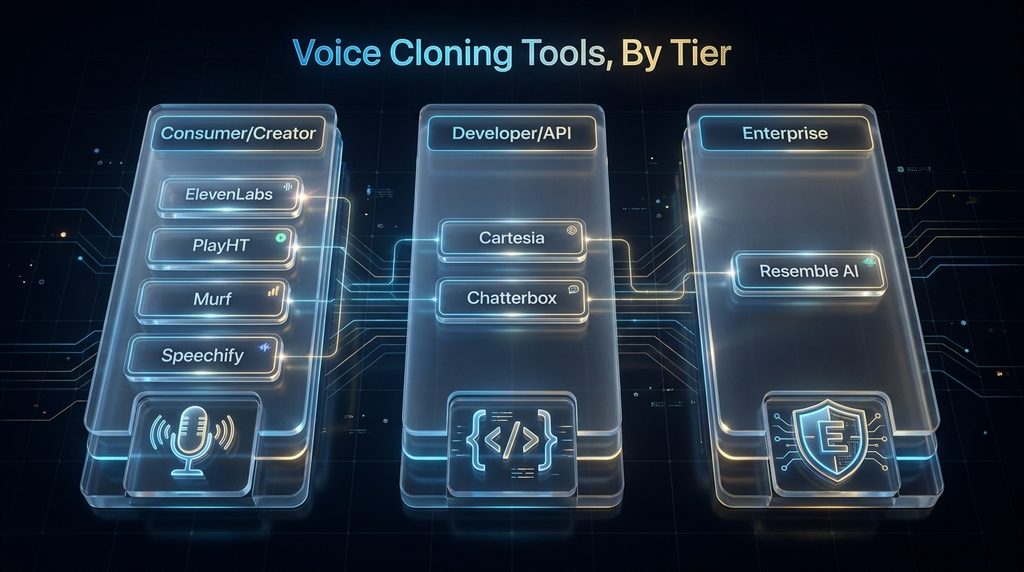
Broadly, the field splits into three tiers rather than one flat list: consumer/creator tools built around a simple upload-and-generate interface (ElevenLabs, PlayHT, Murf, Speechify), developer-facing platforms built around an API and specific technical constraints like latency (Cartesia, Chatterbox), and enterprise/compliance-first platforms built around deployment control rather than ease of use (Resemble AI). Knowing which tier you actually need narrows this list before you compare a single feature.
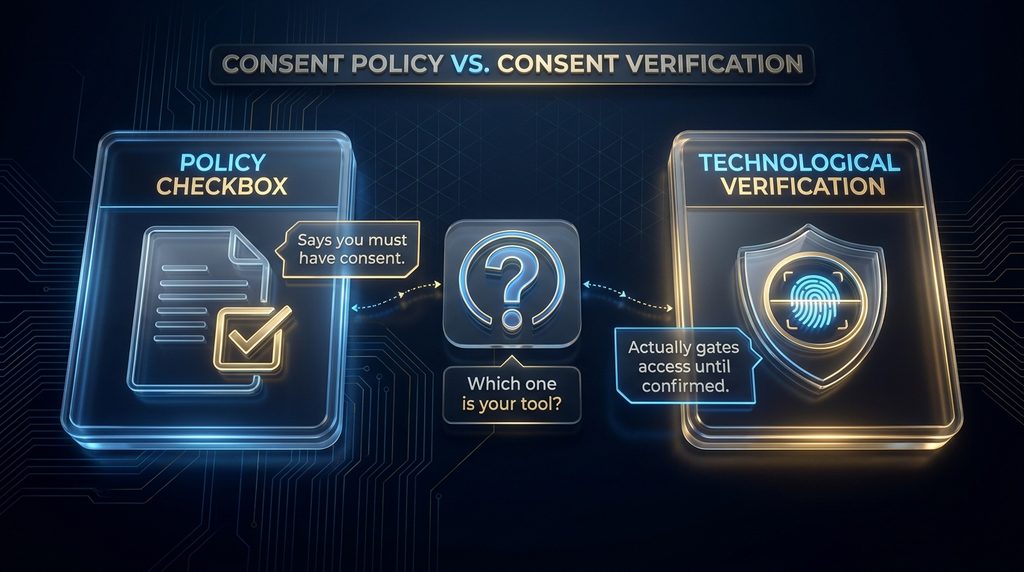
ElevenLabs remains the fidelity benchmark for narration-style cloning, with a free tier and paid plans starting around $6/month, and a library of 30,000-plus pre-made voices alongside custom cloning. Its Professional Voice Cloning tier is gated behind a technological verification step before granting access — the most concrete consent-enforcement mechanism of any tool in this comparison, even though the company’s own policy doesn’t fully specify how that verification works.
That ambiguity matters in practice: a compliance analysis of ElevenLabs’ own usage policy found it doesn’t specify what documentation standard counts as valid consent, which creates real uncertainty for any business trying to build a compliant process on top of the platform’s API rather than just using the consumer product directly.
Cartesia is built specifically for real-time voice agents rather than pre-recorded narration, with roughly 90-millisecond latency and the ability to clone a usable voice from just a 3-second sample. Free tier available, paid plans from around $5/month. This is the pick if you’re building a live conversational product, not publishing finished audio.
Resemble AI targets enterprise and on-premises deployment specifically, with pay-per-use pricing starting at $0, built-in deepfake detection, and SOC 2 compliance. Of every tool in this comparison, Resemble has the strongest control story — the trade-off is that its pricing and setup are built for teams with compliance requirements, not casual solo use.
PlayHT (also marketed as PlayAI) is built for long-form content creators who need real pacing and pause control across a full narration, with paid plans starting around $31/month. It’s a stronger fit for audiobook-length projects than for quick social clips, and its pricing reflects that longer-form, professional positioning rather than a casual per-clip use case.
Descript’s Overdub feature builds voice cloning directly into its editing timeline, with paid plans from around $16/month. If you’re already editing podcast or video audio in Descript, this is the path of least resistance rather than juggling a separate cloning tool and reimporting the result.
Murf AI is positioned for studio-style voiceovers produced by teams, with 20-plus languages and paid plans from around $19/month, and a more polished collaborative interface than most of the others here — built around multiple people reviewing and approving a voiceover, not a single creator working alone.
Speechify is mobile-first and built around personal listening and personal voice clones, supporting 60-plus languages, with cloning available on its Premium-and-above tiers. It’s a better fit for individual, personal-use cloning than for a production pipeline, and its core product remains text-to-speech listening rather than content creation.
Chatterbox is the open-source, self-hosted option — free, and according to the same independent 8-tool test, it reportedly beat ElevenLabs in specific blind-test comparisons. The trade-off is that you’re running and maintaining it yourself rather than using a managed service, which is exactly the right trade for developers who want full control and no subscription, and the wrong one for anyone who doesn’t want to manage infrastructure.
Beyond general-purpose cloning, a distinct tier of dubbing-specific tools is worth knowing if your use case is translation rather than narration: CAMB.AI (140-plus languages, clones from a 2-second sample, and reportedly powers sub-second live multilingual dubbing for Major League Soccer broadcasts), WavelAI (100-plus languages, built for bulk/batch localization), Dubverse (60-plus languages, enterprise training-library focus), and Maestra (125-plus languages, e-learning-oriented).
How to Read Any “Best Voice Cloning Tool” List
Worth naming plainly, because it changes how much weight to put on any comparison including this one: this specific research area is unusually thick with vendor-run “independent” testing. At least one “tested and compared” roundup found during this research was hosted on the winning product’s own blog subdomain — a company grading its own homework and publishing the results as neutral journalism.
The tell is usually in the methodology, or the absence of one: a real comparison names its exact test conditions (same script, same source audio length, same reviewers) the way the 8-tool test referenced throughout this guide does. A comparison that just asserts a winner without describing how it tested anything is worth reading as marketing first, information second.
This guide’s own limitation is worth stating in the same spirit: none of the comparisons above come from us generating clones on every platform ourselves. They’re built from the most methodologically transparent independent test we could find, plus vendor documentation — which is a meaningfully different, more defensible position than an undisclosed vendor test, but still not the same as hands-on testing, and readers should weigh it accordingly.
Consent and Control: The Real Differentiator
Here’s the comparison axis almost every other roundup treats as an afterthought, and it’s the one this guide is built around: platforms differ enormously in whether cloning someone else’s voice requires real verification or just a policy that says you’re supposed to have permission.
ElevenLabs’ policy requires explicit consent before cloning another person’s voice, with violations subject to account suspension and potential referral to law enforcement — but the policy itself places the legal and operational responsibility for obtaining that consent entirely on the user, not on ElevenLabs, and doesn’t fully specify what documentation counts as valid proof.
A real discussion among users of this space raised the obvious question: why does one platform require this and others don’t? The honest answer, per that discussion, is that it’s currently a private policy choice rather than a universal legal requirement — which means the strength of consent enforcement genuinely varies by which tool you pick, not just by which laws currently apply to you.
The practical takeaway: if you’re cloning your own voice, this mostly doesn’t affect you directly, though it’s still worth knowing whether a paid tier actually grants you commercial usage rights or merely the ability to generate the clone. If you’re cloning someone else’s voice — a client’s, a public figure’s, a deceased relative’s for a memorial project — the platform’s actual verification rigor is the single most consequential factor in this whole comparison.
It’s also worth noting what “verification” doesn’t cover: even a platform that rigorously confirms you have consent from the person whose voice you’re cloning has no way to confirm what you plan to say in that voice afterward. Consent to be cloned and consent to whatever specific content gets generated are two different permissions, and conflating them is a subtler version of the Control Check failure covered throughout this guide.
This distinction matters most for anyone cloning a real, named public figure with their cooperation — a celebrity endorsement, a licensed brand ambassador arrangement. A signed agreement to be cloned for one specific campaign doesn’t automatically extend to a different campaign, a different tone, or a different product a year later, and treating a single consent agreement as blanket permission is exactly the kind of scope creep the state laws covered next are starting to explicitly address.
The Legal Landscape Moving Under This Market
Our music generation guide already covered the copyright fight over AI training data — Sony v. Udio, the Munich ruling, and so on. Voice cloning has its own, separate legal thread specifically about a person’s right to control their own voice, and it’s moving just as fast.
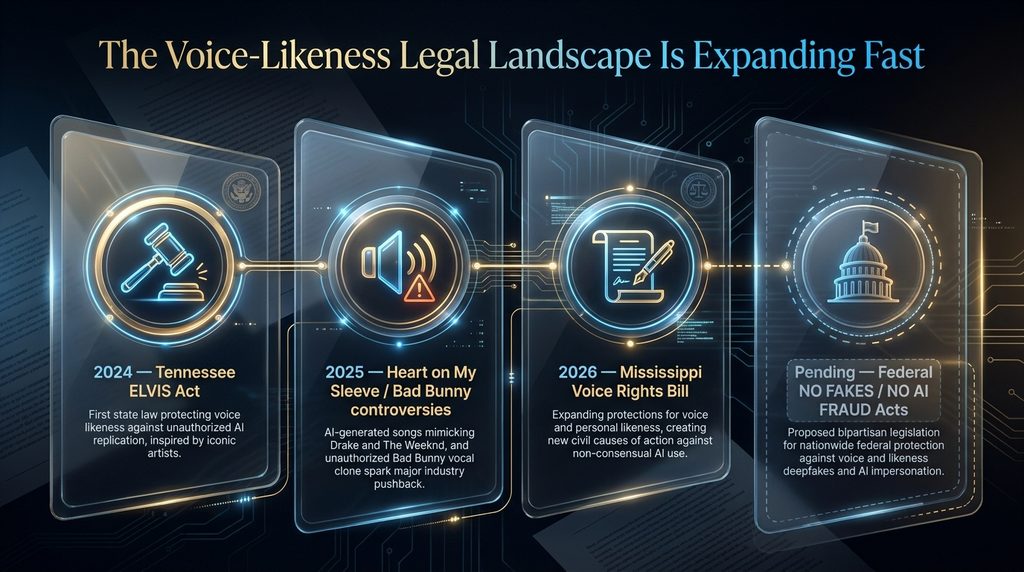
Tennessee’s ELVIS Act, passed in 2024, was the first explicit state law extending right-of-publicity protection to a person’s voice specifically, not just their name and image. A 2026 Mississippi bill — the “Mississippians’ Right to Name, Likeness and Voice Act” — goes further on paper: it would require that any agreement authorizing a digital voice replica for a new performance be in writing, with the person represented by counsel, and either 18 or older or court-approved if a minor.
At the federal level, both the proposed NO AI FRAUD Act and the NO FAKES Act aim to create a national right of publicity covering unauthorized AI voice replicas, though neither had passed as of this writing. The pattern across all of these is the same: lawmakers responding to real, specific incidents rather than acting preemptively.
Those incidents are worth naming because they explain why this legislation exists at all. “Heart on My Sleeve,” a 2023 track built on unauthorized AI-cloned Drake and Weeknd vocals, went viral before being pulled down and became the reference case for the whole “AI soundalike” problem. Bad Bunny separately and publicly criticized unauthorized AI-generated “soundalike” versions of his own voice circulating on TikTok. Neither is a training-data lawsuit like the ones covered in our music generation guide — both are about a specific person’s voice being used without their say-so, which is exactly the risk the Control Check above is meant to catch.
The NO FAKES Act specifically would create a federal property right in an individual’s voice and likeness, letting a person (or their estate, for a set period after death) sue over an unauthorized AI replica used in a way that would confuse the public about consent or endorsement — explicitly modeled on the concern raised by cases like Heart on My Sleeve. The NO AI FRAUD Act takes a parallel approach through federal legislation targeting AI-generated “fake replicas” more broadly, not limited to voice.
Why Professional Voice Actors Still Matter
None of this makes a professional voice actor or narrator obsolete, and the reason connects directly to the Control Check above. A voice actor under contract carries accountability a cloned voice doesn’t: a specific person, reachable, insurable, and legally on the hook if something in a recording turns out to be a problem — defamatory ad copy, a misattributed claim, a performance that damages a brand’s reputation.
A cloned voice has no equivalent of that. If a company clones its own spokesperson and something generated in that voice causes a problem, the accountability question is genuinely murkier than it would be with a human actor who read a contract, understood what they were agreeing to say, and can be held to it. That’s not a reason to avoid cloning — it’s a reason high-stakes, brand-critical work still leans on union talent and signed agreements rather than a subscription.
The realistic split mirrors the pattern in music and podcast production: AI cloning absorbs the high-volume, budget-constrained work — the audiobook that would never have gotten a $5,000 narrator, the dubbing project that would never have gotten a five-figure localization budget — while human talent holds the high-stakes, brand-defining, legally accountable work.
Union agreements are already adapting to this split rather than fighting it outright — voice-actor contracts increasingly specify terms around AI cloning consent and compensation explicitly, rather than staying silent on a technology that didn’t exist when older agreement templates were written.
Check What Each Plan Allows Commercially
Confirm what a plan permits before you publish anything made with a cloned voice, then match it to the way you plan to use the audio.
Check ElevenLabs Plans →Affiliate disclosure: We may earn a commission if you subscribe through this link, at no additional cost to you.
Real-World Examples: Where This Already Works
Dubbing and localization is the clearest commercial-scale use case. CAMB.AI pairs two proprietary models to do this — MARS, its cross-lingual voice-cloning engine, and BOLI, a context-aware translator that adapts slang, sentence order, and regional inflection rather than translating word-for-word — and reportedly powers real-time, sub-second multilingual dubbing for Major League Soccer broadcasts. That’s a genuinely large-scale, named, verifiable deployment, not a hypothetical. Industry-wide, AI dubbing is estimated to cut localization costs by roughly 70 to 90 percent and compress a process that used to take weeks into days.
Audiobook production is the second clear case, and the economics explain why: a professional narrator quoting around $5,000 and a three-week turnaround for a 90,000-word novel is a common enough scenario that it routinely prices independent authors and backlist-heavy publishers out of producing audio at all. Voice cloning doesn’t just cut that cost — it makes audio editions exist for titles that would otherwise stay text-only, turning a publisher’s entire back catalog into a potential audio revenue line rather than a handful of flagship titles.
The most genuinely moving use case sits furthest from commercial motivation altogether: voice banking for people losing their ability to speak, most commonly to ALS. The nonprofit Team Gleason Foundation, which offers this service for free, saw requests grow roughly sixfold — from 172 in 2017 to more than 1,200 in 2022 — as AI-assisted cloning made the process faster and dramatically cheaper. Acapela Group’s voice-banking service dropped from $3,000 to $999 over the same period, and Apple now offers a free “Personal Voice” feature that can build a usable clone from about 15 minutes of recording directly on an iPhone, iPad, or Mac.
What makes this use case different from every commercial one in this guide is timing rather than technology: voice banking only works if someone records their voice while they still can, which is why organizations like the ALS Association specifically encourage banking as soon as possible after diagnosis rather than waiting. The same underlying cloning technology that raises consent questions everywhere else in this guide is, here, restoring something a person is actively losing — a genuinely different ethical register from a brand cloning a spokesperson for scale.
Customer support and personalized outreach are frequently cited as a fourth category — a consistent branded voice across support interactions, or a founder’s cloned voice for scaled personal-sounding outreach — though this research didn’t turn up a specific, named, verifiable case study on the scale of the MLS dubbing deployment or the Team Gleason numbers above. Treat this category as a real and growing use case, not yet as well-documented publicly as the other three.
A fifth, closely related to our podcast workflow guide, is host-read advertising: Spotify has explored technology that would let a podcast host license their own cloned voice specifically for ad reads, generating sponsor spots without recording each one personally. That’s a good illustration of the Control Check’s other side — here, the host is the consenting party licensing their own voice for a specific, bounded use, which is a meaningfully different and lower-risk arrangement than cloning someone else’s voice without their involvement at all.
What This Actually Costs
Grand View Research projects the AI voice cloning market growing from $1.9 billion in 2023 to $9.75 billion by 2030, a 26.1 percent compound annual growth rate — a useful signal of how fast this space is scaling, though as with any market-size figure, treat it as one firm’s projection rather than settled fact.
Tool pricing across the platforms compared here spans roughly $0 for open-source/free tiers up to about $31 a month for the consumer and prosumer tools, with enterprise and on-prem deployment (Resemble AI) priced separately by usage, and dubbing-specific platforms following their own per-minute or per-project models.
Set against professional alternatives — a $5,000 audiobook narrator, or the historically five-figure invoices for professional video dubbing — a monthly subscription in the tens of dollars is a similarly stark gap to what our music generation guide found comparing composers to AI generation. The honest read is the same one that article reached: this isn’t replacing every professional use case, it’s opening up production budgets that didn’t exist before.
Put in concrete terms: an indie author choosing between a $5,000 human narrator and a $16-31/month cloning subscription isn’t really choosing between two prices for the same product — the realistic alternative to the subscription usually isn’t the narrator at all, it’s no audiobook edition existing. That reframing matters more than the raw dollar comparison for anyone deciding whether this is worth adopting.
Common Mistakes to Avoid
Assuming a free or cheap tier includes commercial usage rights is the most common and most expensive mistake — several platforms gate commercial licensing behind a specific paid tier, separate from the ability to generate a clone at all, and finding this out after you’ve published something is the wrong time. Trusting a “we tested this” article without checking who ran the test is a close second, especially in this specific market — this research turned up at least one “independent” comparison hosted on the winning product’s own blog subdomain.
Not testing a candidate tool on your actual use case’s vocabulary, accent, or emotional range is a third — a tool that excels at neutral narration can perform noticeably worse on a strong regional accent or a highly emotional line, and the only way to know is to run your own test clip before committing. Treating “the platform requires consent” and “the platform verifies consent” as the same thing is a fourth, and it’s the mistake this guide’s Control Check exists specifically to catch — a policy on paper and an actual verification step are meaningfully different levels of protection.
Feeding a tool too little source audio for the quality bar you actually need is a fifth: a 15-second sample might be enough for a casual social clip and genuinely insufficient for broadcast narration, and the tool won’t warn you that you’ve undershot — it will simply produce a result that’s noticeably worse than the same platform’s best-case demo.
Who Should Use Which Tool
If you need the highest narration fidelity and don’t mind a moderate price, ElevenLabs is the benchmark most people should start with — that’s also the one credible independent test’s conclusion, not just vendor marketing. If you’re building a live voice agent or conversational product, Cartesia’s latency and short sample requirement make it a better technical fit than any narration-focused tool, regardless of raw fidelity comparisons that don’t apply to a real-time use case.
If you’re an enterprise team with compliance requirements, Resemble AI’s on-prem option and SOC 2 compliance solve a problem the consumer-focused tools above don’t even attempt to address. If you’re already editing in Descript, Overdub is the lowest-friction option even if a dedicated tool might edge it out on pure quality — the switching cost of a separate tool is a real cost too.
If budget is the binding constraint and you’re comfortable with self-hosting, Chatterbox is worth serious consideration specifically because independent testing found it competitive with paid options, not just because it’s free. If your use case is dubbing or translation rather than narration in one language, none of the general-purpose tools above are the right comparison set — CAMB.AI, WavelAI, Dubverse, or Maestra are built for that specific problem instead.
If you’re producing an audiobook specifically, weigh PlayHT’s pacing controls against ElevenLabs’ broader voice library before deciding — the right answer often comes down to whether your priority is natural long-form delivery or matching a very specific voice character, and the two tools trade off differently on that exact question.
Instant vs. Professional Cloning: Matching Source Audio to Your Bar
Every tool in this comparison offers some version of “instant” cloning — a usable voice from 10 to 60 seconds of source audio — and several also offer a slower, higher-fidelity path that uses 30 minutes or more of source recording. Treating these as the same product with different wait times is the root of a lot of disappointment with this technology.
Instant cloning is genuinely good enough for casual narration, quick social content, and personal use where a slightly imperfect result is acceptable. Professional-tier cloning, built from a much larger source sample, is what actually closes the gap to broadcast-grade quality — more consistent tone across a long recording, fewer artifacts on uncommon words, better handling of emotional range.
The practical rule: match the tier to the stakes, not to convenience. A quick internal demo doesn’t need 30 minutes of source audio. A commercial audiobook or a brand’s permanent spokesperson voice does, and skimping here to save setup time is the kind of false economy that shows up in the finished product.
What Still Goes Wrong
Quality still varies meaningfully outside a tool’s trained sweet spot — strong regional accents, highly emotional delivery, and technical or uncommon vocabulary are the conditions most likely to expose a clone as synthetic, even on top-tier tools. Instant cloning (10-60 seconds of source audio) and professional-tier cloning (30-plus minutes of source audio) are genuinely different quality tiers, not just a speed trade-off — a broadcast-grade use case that only feeds a tool 30 seconds of source audio is set up to disappoint regardless of which platform is used.
Real-time and offline generation involve a real trade-off most buyers don’t anticipate: the latency that makes a tool like Cartesia work for live agents comes from a different underlying approach than the slower, more polished generation narration-focused tools use, which is why the “best” tool genuinely changes based on whether your use case is live or pre-recorded. Multi-speaker and overlapping-dialogue projects expose a weakness most single-voice comparisons don’t test for at all: cloning two people who need to have a natural back-and-forth conversation is a meaningfully harder problem than cloning one narrator reading a monologue, and tools optimized for the latter can produce stilted, unnatural-sounding results on the former even when their single-voice quality is excellent.
Emotional range remains uneven across the board: a clone that sounds indistinguishable from the source on neutral narration can still slip into an artificial cadence on genuine excitement, anger, or grief — the kind of delivery a human actor produces without thinking and a model has to approximate from whatever emotional range existed in its training sample.
What Happens If You Skip the Control Check
Skipping the Realism or Fit checks mostly costs you money or a frustrating project. Skipping the Control check is different in kind: the state and federal legal landscape covered above is moving specifically toward holding the person who requested a clone responsible for having real consent, not just a platform’s terms-of-service checkbox.
The “Heart on My Sleeve” and Bad Bunny examples both illustrate the same downstream risk regardless of company size — platforms take material down, reputational damage follows quickly, and the legal landscape described above is explicitly designed to give affected individuals more recourse over time, not less.
There’s an opportunity cost on the other side worth naming too: sticking with traditional voice-over exclusively because a full comparison felt like too much work means continuing to pay narrator or dubbing rates for projects that were never going to justify that budget in the first place — the audiobook that stays text-only, the localized market that never gets a dubbed version, the accessibility case that never gets addressed because a $3,000 quote felt out of reach.
How to Know You Picked the Right Tool
Run a short test clip on your actual content before committing to a subscription — your specific accent, vocabulary, and emotional range, not the vendor’s demo script, which is selected precisely to showcase the tool’s best case. Confirm your commercial usage rights in writing (a pricing page or terms document, not a sales conversation) before you publish anything built on a clone, since this is the single most common source of the “I didn’t realize that wasn’t included” problem covered in Common Mistakes above.
If you’re cloning anyone other than yourself, document the consent conversation yourself, independent of whatever the platform requires — the platform’s policy protects the platform; your own documentation is what actually protects you. Re-test after any tool update, not just before your first purchase — several platforms compared here ship model updates frequently enough that a clone judged “good enough” six months ago may sound noticeably better or worse today, and a subscription is only worth renewing if this month’s output still clears your bar.
Track a simple pass/fail against your own three Fit Test checks per project rather than relying on memory of how a tool performed once — a platform that was the right Fit Check answer for a solo narration project may fail it entirely for a multi-speaker dubbing job six months later.
What’s Next
The clearest trend to watch is the legal landscape itself — more states are likely to follow Tennessee and Mississippi’s lead, and if either federal proposal advances, platform consent requirements that are currently voluntary policy could become binding law with real penalties attached. A second thread is the real-time side of this market maturing quickly: Cartesia’s latency numbers and CAMB.AI’s live-sports-broadcast deployment both point toward voice cloning becoming infrastructure for live experiences, not just pre-recorded content, over the next year or two.
A third is open-source tools like Chatterbox continuing to close the gap with commercial leaders — if that trend holds, the calculus for budget-conscious developers shifts further away from subscription pricing entirely. A second-order effect worth watching is on voice acting and narration as professions specifically: the same split found across audio production — AI absorbing high-volume work, humans holding high-accountability work — is likely to push working voice actors toward exactly the kind of contracted, brand-critical, legally-accountable projects covered above, and away from competing on price for generic narration.
A second is on insurance and liability: as brands clone spokesperson voices for scaled content, expect contracts and insurance policies to start explicitly addressing who’s liable when an AI-generated line in someone’s cloned voice causes a problem — a gap current standard talent agreements weren’t written to cover. A third is on trust infrastructure generally: as consent-verification methods mature past ElevenLabs’ still-unspecified “technological verification,” expect clearer, more standardized proof-of-consent mechanisms to emerge across the industry, similar to how content-provenance watermarking is standardizing across generative audio more broadly, per our generative audio explainer and music generation guide.
Final Thoughts
The reviewer who opened this guide by describing his own cloned voice as “unsettling how close it was” wasn’t describing a fringe result — that’s the baseline several tools clear now. The interesting decision isn’t whether a clone will sound convincing; for the tools compared here, it mostly will.
The decision that actually matters is which of these platforms fits your specific realism bar, gives you the control and consent enforcement your situation actually needs, and matches the technical shape of your project — real-time or offline, one language or forty. Pick on those terms, run the Fit Test before you subscribe to anything, and the tool you land on will be the right one for what you’re actually building, not just the one with the best demo.
The range of what this technology is already doing — a Nashville podcaster automating ad reads, Major League Soccer broadcasting live in dozens of languages, an ALS patient preserving a voice before it’s gone — is wide enough that no single “best tool” answer was ever going to cover all of it honestly. That’s the reason this guide compares rather than crowns a winner, and it’s the reason the same approach should guide your own decision.
Decide Whether ElevenLabs Fits Your Cloning Needs
Compare realism, control and licensing against the alternatives above, using your own recording as the test.
Try ElevenLabs Voice Cloning →Affiliate disclosure: We may earn a commission if you subscribe through this link, at no additional cost to you.
Frequently Asked Questions
What is the most realistic AI voice cloning tool in 2026? ElevenLabs remains the fidelity benchmark for narration-style cloning according to the most credible independent test found, though Chatterbox, an open-source option, reportedly matched or beat it in specific blind-test comparisons — a reminder that “most realistic” depends on which specific comparison you trust, not a single settled fact. What’s the difference between AI voice cloning and text-to-speech?
Standard text-to-speech generates a synthetic voice not modeled on a specific real person, while voice cloning is trained on a real individual’s voice sample so it can speak new text as though that person said it — which is why cloning carries the consent and control questions this guide focuses on and generic text-to-speech mostly doesn’t. Do I need permission to clone someone’s voice?
Ethically always, and increasingly legally as well — platforms like ElevenLabs require explicit consent before cloning another person’s voice, and state laws like Tennessee’s ELVIS Act now extend right-of-publicity protection specifically to a person’s voice, with a 2026 Mississippi bill and federal proposals adding further requirements. Which voice cloning tool is best for real-time voice agents?
Cartesia is built specifically for this, with roughly 90-millisecond latency and the ability to generate a usable clone from a 3-second sample — narration-focused tools aren’t optimized for the same live, low-latency use case. Is AI voice cloning legal?
Cloning your own voice is generally not an issue. Cloning someone else’s without consent is increasingly regulated at the state level in the US, with Tennessee’s ELVIS Act and a 2026 Mississippi bill both extending publicity-rights protection to voice specifically, and federal proposals pending.
How much does AI voice cloning cost? Tool pricing spans roughly $0 for open-source or free tiers up to about $31 a month for consumer and prosumer platforms, with enterprise/on-prem options priced separately — all far below the roughly $5,000 a professional narrator might charge for a single audiobook. What’s the difference between instant and professional voice cloning?
Instant cloning uses 10 to 60 seconds of source audio and is good enough for most casual use cases; professional-tier cloning uses 30-plus minutes of source audio and is what actually delivers broadcast-grade quality. Can I clone a voice for free? Several tools offer free tiers, including Resemble AI (pay-per-use from $0) and the fully open-source, self-hosted Chatterbox — but commercial usage rights are frequently gated behind a paid tier even when cloning itself is free.
Which AI tool is best for audiobook narration? PlayHT is built specifically around long-form pacing and pause control, which matters more for a full-length audiobook than the raw fidelity comparisons that dominate most reviews. Is it safe to clone a deceased relative’s voice?
There’s no clear consent-holder in that situation, which is exactly the kind of case the Control Check in this guide is meant to flag — document your own reasoning and any family agreement independently of whatever the platform requires, since laws in this area are still evolving. Will voice cloning replace professional voice actors? It’s absorbing high-volume, budget-constrained use cases — like the audiobooks and dubbing projects that were previously priced out entirely — more than replacing professional voice actors in high-stakes or brand-critical work, echoing the same pattern in music and podcast production.
Written by
Muntasir Ahmad Chowdhury
Founder, AI Hustle World
Muntasir Ahmad Chowdhury is the Founder of AI Hustle World, an independent publication dedicated to making Artificial Intelligence practical, trustworthy, and easy to understand. He researches AI tools, automation, customer service, productivity, and real-world business applications, helping readers make smarter technology decisions through research-driven, experience-backed content.
Expertise:
AI Tools • AI Automation • AI Customer Service • AI Productivity • Generative AI • AI Workflows
Get Smarter With AI
Enjoyed this guide? Get practical AI tools, tutorials, and honest reviews delivered to your inbox.
5 thoughts on “Best AI Voice Cloning Tools in 2026: Compared for Realism, Licensing and Control”