Evidence: Hands-on tested for text to speech in ElevenLabs, Cartesia and Murf. Documentation reviewed for Speechify and Descript.
Last checked: 11 October 2026
What was done: The same 12-line script pack was run in ElevenLabs on 8 October 2026 and in Cartesia and Murf on 11 October 2026, all on free plans, and every take was logged. Prices, free-plan limits, model names and language lists were read on each vendor’s own pages on 10 October 2026. Speechify and Descript were not hands-on tested.
Files: Scripts, logs and screenshots on GitHub
Affiliate links: Yes
ElevenLabs vs Alternatives: Which AI Voice Tool Is Best for You?
Last updated: October 11, 2026. What changed: Added our own test of the same 12 lines in ElevenLabs, Cartesia and Murf. Resemble AI has stopped selling voice generation, so it is no longer listed as an alternative. The ElevenLabs section now covers Eleven v4, Cartesia’s model is updated to Sonic 3.6, and every price and free-plan limit was re-checked on the vendor’s own page. The percentage weights in the framework were removed because they were editorial estimates, not measurements.
Affiliate disclosure: AI Hustle World may earn a commission if you subscribe to ElevenLabs or Murf through our referral links, at no additional cost to you. Our recommendations are based on product fit, workflow, capabilities, limitations, pricing and alternatives—not commission.
The AI voice market has reached an awkward stage. There are now enough good platforms that choosing one is no longer mainly about finding a voice that sounds human. Several products can produce convincing speech. The harder problem is determining which platform fits the work you actually need to perform.
A YouTube creator making ten narrated videos a month has a different problem from an enterprise team producing training content. A podcast editor has a different problem from a developer building a real-time voice agent. Someone who wants articles and PDFs read aloud is solving a completely different problem again. Yet search results often put all of these users into the same comparison table. That is the mistake this article is designed to fix.
If you’re considering ElevenLabs, the useful question isn’t simply “Is ElevenLabs the best?” It is: “What would make another platform a better choice for my specific workflow?” ElevenLabs remains a particularly strong option for expressive voice generation, narration, multilingual production and broader creative audio workflows. Its current platform includes multiple TTS models, voice creation, dubbing, Studio, speech-to-text, music, sound effects and voice-agent capabilities. But that doesn’t make it the right tool for everyone.
Sometimes the smarter choice is Murf. Sometimes Speechify. Sometimes Descript. Sometimes Cartesia. And sometimes the correct answer is simply stay with ElevenLabs and don’t switch. The rest of this guide explains where those decisions actually change.
Test ElevenLabs on Your Own Script
Run one paragraph from your real project through ElevenLabs and compare the result with the alternative you are considering.
Test ElevenLabs With Your Script →Affiliate disclosure: We may earn a commission if you subscribe through this link, at no additional cost to you.
The Short Answer: Which ElevenLabs Alternative Should You Choose?
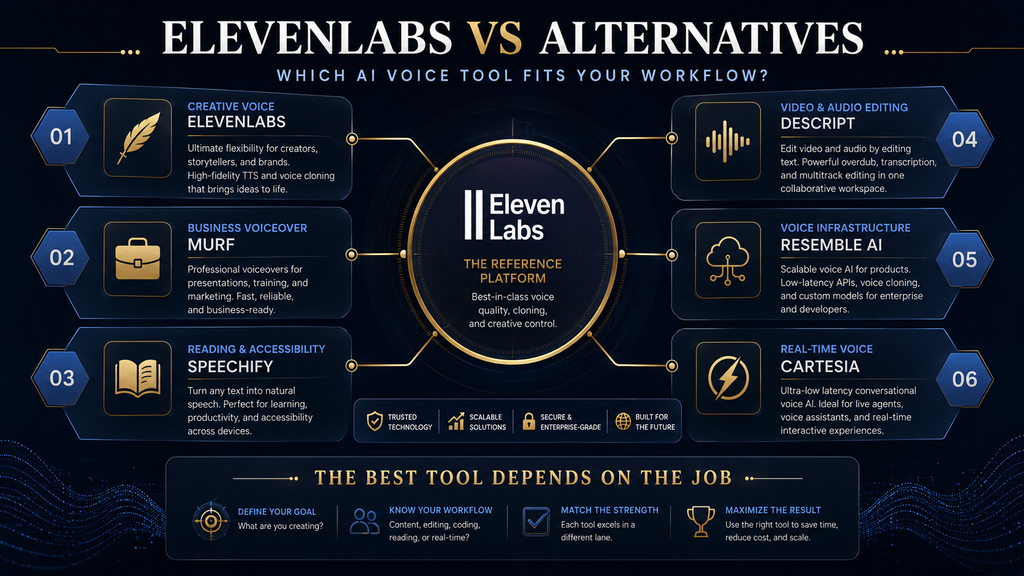
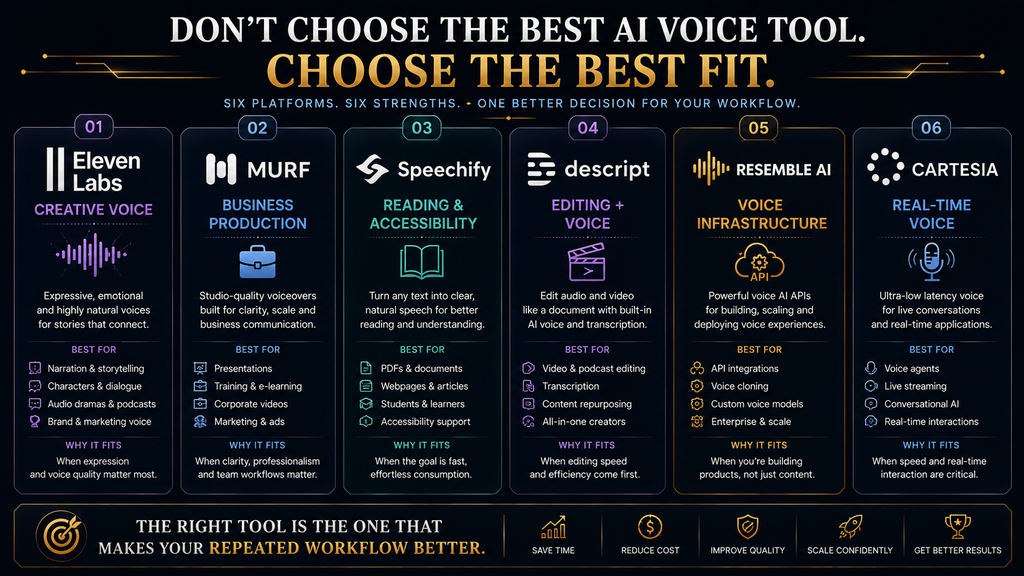
Choose ElevenLabs when expressive voice quality, voice creation, narration, multilingual production and a broad creative-audio ecosystem are central to your workflow. Choose Murf when the primary job is structured business voiceover production, presentations, training or e-learning. Choose Speechify when the core problem is reading and converting written information into audio, or when accessibility and document consumption matter more than cinematic voice performance. Choose Descript when audio/video editing is the center of the workflow and AI voice generation is one capability inside the editor.
Choose Cartesia when voice is built into a software product, or when the application is real-time and latency is one of the most important requirements. Resemble AI used to be the usual pick for voice infrastructure, but it has stopped selling voice generation, so it is no longer on this list. That is the high-level answer. Our own test comes next, then the reasons behind each pick.
Our Test: The Same 12 Lines in ElevenLabs, Cartesia and Murf
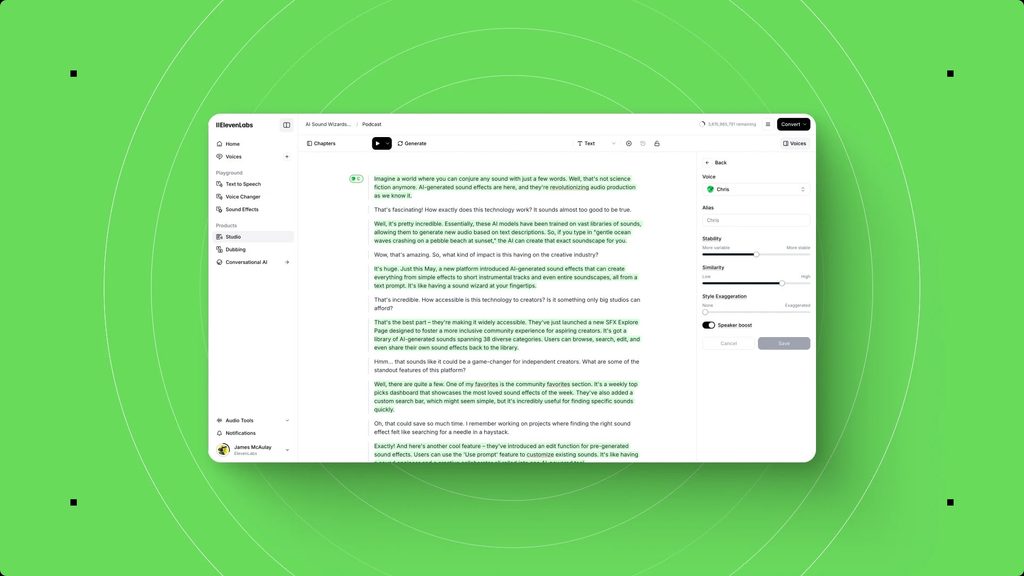
We ran one script pack through three of the tools on this page, each on its free plan. The pack has 12 short lines: six in English and six in mixed Bengali and English, written the way a creator in Dhaka speaks. Each line targets something voice tools often get wrong, such as a brand name, a price, a date, a question, an emotional line or a web address. The founder generated every line, listened to it, and accepted or rejected it. A rejected line could be generated again, up to three takes.
| ElevenLabs | Cartesia | Murf | |
|---|---|---|---|
| Test date | 8 October 2026 | 11 October 2026 | 11 October 2026 |
| Plan | Free | Free | Free |
| Model | Eleven v4 | Sonic 3.6 | Gen 2 voice |
| Voice | Roger, for all 12 lines | Daniel for the English lines, Rubel for the mixed lines | Ken, for all 12 lines |
| Lines accepted on the first take | 12 of 12 | 12 of 12 | 12 of 12 (see the caveat below the table) |
| Lines read wrongly and retaken | 0 | 0 | 0 |
| Accepted audio | 95 seconds | 85 seconds | 98 seconds |
| Usage counted | 1,026 credits | 1,353 credits | 2 minutes 28 seconds of generation time |
| Worked-out cost per finished minute, one pass of the 12 lines | About $0.13 | About $0.04 | About $0.24 |
| Worked-out cost per finished minute, everything generated | About $0.13 | About $0.05 | About $0.37 |
One caveat on the Murf column: its six mixed Bengali-English lines were generated and judged in Murf’s Angry style, not the Conversational style we had set. A second pass in Conversational was generated but not judged. The details are below.
All three tools read every line correctly on the first take, including the Bengali numerals, the taka prices and the English words inside Bengali sentences. On this script, accuracy did not separate them. Three other things did. The first is voices. ElevenLabs and Murf each read the English lines and the mixed lines with one stock voice. In Cartesia, the voice picker filtered to Bengali showed five voices and none of the English ones, so we used one voice for English and another for the mixed lines. A channel that moves between the two languages would have two narrators there unless it clones a voice. The second is cost. The cost figures are worked out, not paid: the usage, priced at each tool’s cheapest paid plan (Starter at $6 for ElevenLabs, Pro at $5 for Cartesia, Creator at $29 a month for two hours of generation for Murf), divided by the minutes of accepted audio. Cartesia was the cheapest per finished minute and Murf the most expensive. The third is a setting that moved, and it needs its own paragraph.
We set Murf’s style to Conversational. When the block language was switched from English to Bangla for the mixed lines, Murf changed the style to Angry, and every block added after it copied that setting. We did not notice during the run, so Murf’s six mixed lines were generated and judged in the Angry style. The words, numbers and names were judged correct, but the tone was not the one used in the other two tools. We then generated the six lines again in Conversational, and no separate listening result was recorded for that second pass. Two smaller notes on Murf: its language list has no entry called Bengali, because the language appears as “Bangla – India”, and its free plan has no downloads, so the audio could only be played inside the project.
The last row of the table counts everything that was generated. For Cartesia that adds two extra generations: its history shows that lines 04 and 12 were each generated twice, although both were judged correct on the first take. For Murf it adds the second pass of the mixed lines. The limits are the ones any small test has: 12 short lines, one listener, one or two voices per tool, and no long script. The audio stays offline because these free plans do not include commercial rights. The scripts, the per-take log and dated screenshots are in the public test folder on GitHub, and the ElevenLabs run is described in full in the test section of our ElevenLabs review.
Why Are People Looking for an ElevenLabs Alternative?
Most buyers are not actually looking for “another ElevenLabs.” They are looking for a solution to a specific problem they believe ElevenLabs doesn’t solve optimally. Current comparison pages repeatedly surface the same triggers: price, real-time latency, broader workflow integration, developer requirements, accessibility, voice libraries and specialized use cases. Those triggers can be grouped into five categories.
1. The economics don’t fit. A creator may like the output but discover that their production volume consumes credits faster than expected. This is especially relevant because ElevenLabs currently uses a shared credit pool across multiple products. TTS, speech-to-text, music, sound effects, voice changing and dubbing can all consume credits from the same account allowance. The problem isn’t necessarily that ElevenLabs is “expensive.” The problem is that your usage pattern may not match the economics of the platform.
2. The workflow is wrong. You may not need a specialized voice platform. If you spend most of your time editing video and podcasts, a platform such as Descript may reduce more friction because voice generation sits inside the same production environment.
3. You need real-time speech. Narration tolerates waiting. Conversation doesn’t. If a voice assistant takes too long to start speaking, the delay becomes part of the user experience. That makes low-latency systems such as Cartesia fundamentally relevant rather than simply “another TTS tool.”
4. You’re building software, not content. A developer may care about APIs, streaming, concurrency, deployment, cloning, security and infrastructure more than an attractive creator interface. That moves the decision toward developer platforms such as Cartesia, or toward the ElevenLabs API itself.
5. Your problem is reading, not voice acting. If the job is: PDF → audio or article → audio or email → audio then the ideal product may be the one optimized around reading and accessibility rather than the one optimized around dramatic narration. Speechify is explicitly positioned around that use case.
First, Understand What ElevenLabs Actually Is in 2026
The phrase “ElevenLabs voice generator” now hides a much larger platform. Its current documentation lists separate models for expressive generation, real-time use and long-form stability. Eleven v4 is the flagship: it covers more than 90 languages, Bengali among them, and takes up to 10,000 characters in one request. Eleven v4 Turbo is the real-time version, listed at roughly 100 ms median inference. Eleven v3 (70+ languages), Multilingual v2 (29 languages) and Flash v2.5 (32 languages, roughly 75 ms) are still available. That matters because an alternative might not be beating “ElevenLabs.” It may only be beating one part of the lineup, such as an older model or a plan that does not fit your volume.
So even inside ElevenLabs, there is already a trade-off: expression vs speed vs stability vs use case. That’s a useful principle for evaluating competitors too.
ElevenLabs vs Murf AI: Which Is Better for Business Voiceovers?
Murf is the more natural fit when voiceover production is embedded inside a structured business-content workflow; ElevenLabs is stronger when the voice itself is the creative focus. Murf‘s current Creator plan includes 200+ voices, 30+ languages and accents, commercial rights, unlimited downloads and Canva integration. Its Business plan adds capabilities including PowerPoint integration, emphasis, variability and audio-to-text. That tells you something important about the product strategy. Murf is not simply competing on speech synthesis.
It is competing on production convenience. Imagine a corporate training team producing 80 lessons. Their workflow might look like: PowerPoint → script → narration → review → revision → final presentation In that environment, integrations and structured production can matter more than having the absolute deepest voice experimentation. Now imagine a faceless YouTube creator producing cinematic stories. Their workflow might be: script → character voice → emotional delivery → alternate takes → narration → sound design The priorities are different.
Where Murf has the advantage
Murf makes particular sense for:
- corporate training
- e-learning
- presentations
- marketing teams
- business explainers
- structured voiceover production
- teams already using Canva or PowerPoint
Where ElevenLabs has the advantage
ElevenLabs becomes more attractive when you care deeply about:
- expressive narration
- character voices
- dramatic delivery
- voice creation
- multilingual creative content
- experimental voice performance
We also ran Murf through our own 12-line test. Its Ken voice read every English and mixed Bengali line correctly on the first take, with one voice for both languages. Two things are worth knowing before you rely on it. The style changed to Angry on its own when we switched a block to Bangla, so check the style on every block. And the worked-out cost per finished minute was the highest of the three tools we tested.
The trade-off. Murf can be the better production environment without necessarily being the better voice-performance environment. That’s a distinction most comparison tables flatten.
Our decision. Business content → Murf. Voice-centered creative content → ElevenLabs.
ElevenLabs vs Speechify: Voice Creation or Voice Consumption?
Speechify is the stronger fit when the core job is consuming written information as audio; ElevenLabs is the stronger fit when the core job is producing a voice as a creative asset. This distinction is easy to miss because both platforms can generate speech. But product positioning matters. Speechify’s text-reader product is built around converting PDFs, books, webpages, emails and other written material into audio. Its current product pages advertise 1,000+ voices across 60+ languages and features such as OCR, synchronized highlighting and adjustable playback speed.
Speechify Studio extends the platform into voiceovers, dubbing, voice cloning and AI audio production, with 1,000+ voices and commercial rights on paid Studio plans. That makes Speechify interesting for two different audiences.
The first audience: readers. A student wants to listen to research papers. A professional wants emails read aloud. Someone with accessibility needs wants websites and documents converted to speech. For those users, Speechify’s entire experience is designed around listening.
The second audience: creators. Speechify Studio can also become a production tool. But if your central objective is highly expressive narration, character performance or detailed voice creation, ElevenLabs has a more obvious creator-first identity and a model lineup specifically differentiated around expressive and multilingual speech.
The decision. Don’t ask “Which one has more voices?” Ask whether you are trying to listen to information or to create an audio performance: listen → Speechify; create → ElevenLabs.
ElevenLabs vs Descript: Which One Should Creators Use?
Descript becomes the better choice when editing is the center of the workflow and AI voice generation is one part of a larger production system. This is one of the most important comparisons because Descript is not simply an ElevenLabs clone. Its current plans combine transcription, audio/video editing, AI tools and AI Speech, including custom voice cloning. The current Creator plan includes 30 hours of media processing per month, 800 AI credits and broader AI production capabilities.
That changes the workflow. Imagine a podcast host says: “I mentioned the wrong company name.” In a traditional production workflow, you may need to:
- rerecord the sentence,
- remove the old audio,
- match the recording,
- edit the timeline,
- adjust the surrounding audio.
An integrated text-based editing environment can reduce that friction. The value isn’t necessarily that Descript has a better voice. The value is that the voice is integrated into the editing process.
Where Descript wins
Descript makes more sense when you regularly need:
- podcast editing
- video editing
- transcription
- captions
- screen recording
- audio cleanup
- text-based editing
- AI-generated speech
Where ElevenLabs wins. ElevenLabs makes more sense when you want the voice itself to be a major part of the creative process. A useful way to think about it: Descript = media production environment with AI speech. ElevenLabs = voice/audio platform that increasingly includes media production. There is overlap, but the center of gravity is different.
Our decision. If you’re already spending most of your time editing: Descript deserves serious consideration. If you’re spending most of your time designing and generating voices: ElevenLabs remains the stronger starting point.
What Happened to Resemble AI?
Resemble AI used to be the standard answer for teams that wanted voice cloning as infrastructure: an API, streaming and deployment on their own servers. That is no longer on offer. When we opened Resemble’s voice creation page on 10 October 2026, it redirected to a product notice headed “This product is no longer available.” The notice says the company has stopped offering voice generation as a commercial product and now works on AI detection, watermarking and security. It adds that the voice models Resemble built stay open and free for research and development.
For a buyer, that changes the decision in a simple way. You can no longer subscribe to Resemble for cloning or text to speech. Its pricing page now lists detection plans only: Flex with no subscription fee, Team at $280 a month and Business at $800 a month, both billed annually. If you are building voice into a product, the realistic choices are a managed developer platform such as Cartesia, the ElevenLabs API, or an open model that you host yourself. The open-source section below covers that last route.
If you already built on Resemble’s voice API, treat this as a migration project, not a quick swap. You will need to recreate voices, retest pronunciation and change the integration, which is the switching cost described later in this guide. There is also a wider lesson. A voice vendor can leave the category, so keep your scripts, pronunciation notes and consented source recordings in your own storage, where a product change cannot remove them.
The decision. Voice as content → ElevenLabs. Voice as product infrastructure → Cartesia, the ElevenLabs API, or an open model you run yourself.
Match the Tool to the Workflow You Repeat
Use the free plan to run your usual script, voice and edit workflow once, then see where it saves or costs you time.
Try the ElevenLabs Free Plan →Affiliate disclosure: We may earn a commission if you subscribe through this link, at no additional cost to you.
ElevenLabs vs Cartesia: When Latency Becomes the Product
Cartesia is the alternative to examine when voice must respond in real time and the delay between text and audio materially affects the user experience. This is where the AI voice category starts changing shape. Cartesia describes its platform as developer-focused infrastructure for real-time multimodal experiences. Its current model, Sonic 3.6, is a streaming TTS system that lists 44 languages, Bengali among them. Its current public pricing has a free tier with 20,000 credits a month, then Pro at $5 a month with 100,000 credits, followed by Startup at $49 and Scale at $299. Cartesia counts one credit per character and says a minute of audio takes 750 to 800 credits, so Pro covers roughly 125 to 133 minutes of speech.
Why latency matters
For a YouTube narration, whether audio starts in 75 milliseconds or 300 milliseconds usually doesn’t matter. The viewer isn’t waiting for the next conversational turn. But imagine a customer-service voice agent. The user asks: “Where is my order?” The AI needs to: hear → transcribe → reason → generate → speak Every delay compounds. A voice system that sounds beautiful but consistently pauses too long can feel broken. That’s why real-time voice platforms deserve a separate evaluation criterion.
ElevenLabs itself now offers Flash models designed around low latency, with its documentation listing approximately 75ms model latency for Flash v2.5. It also lists Eleven v4 Turbo at roughly 100 ms and a conversational v3 model at roughly 280 ms. So this isn’t a simple: ElevenLabs = slow / Cartesia = fast comparison. It’s: Which platform’s architecture and workflow are best aligned with the latency requirements of your application?
Where Cartesia has the strongest case
- voice agents
- conversational applications
- real-time assistants
- interactive characters
- applications where time-to-first-audio matters
- developer-controlled streaming workflows
Where ElevenLabs remains stronger
- creative narration
- voice-centered content
- broad creative audio workflows
- expressive content generation
- creators who don’t need to engineer a real-time voice stack
Cartesia is not only a developer tool, though. In our own 12-line test, Sonic 3.6 read every English and mixed Bengali line correctly on the first take, at a lower worked-out cost than ElevenLabs. The catch for creators is the voice split described in that section: English and Bengali came from two different voices.
The decision. Narration → ElevenLabs. Real-time conversation → evaluate Cartesia seriously.
The Comparison That Actually Matters
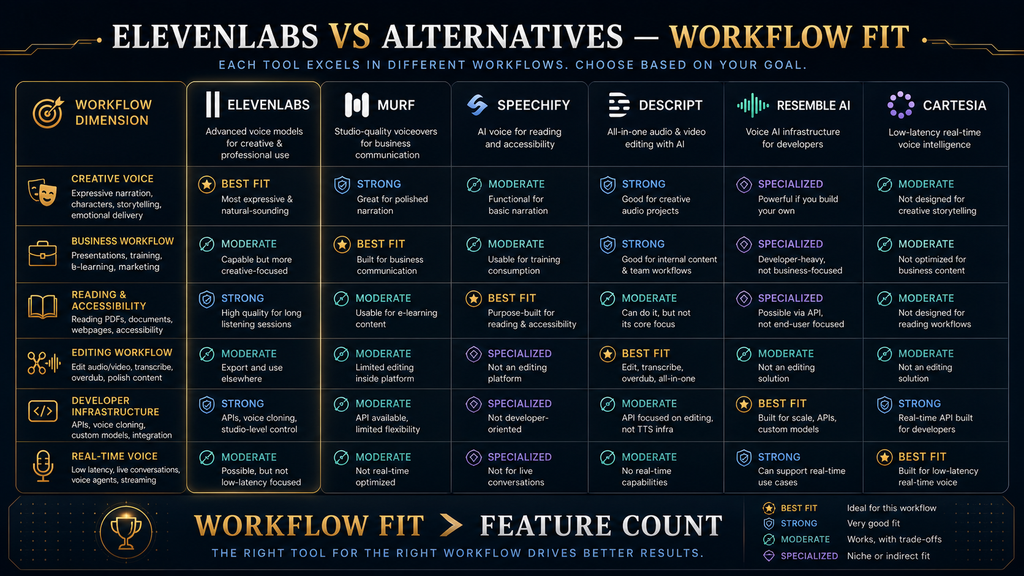
At this point, we can build a better decision table. Do not treat this as a laboratory benchmark. It is an AI Hustle World workflow-fit model. Resemble AI is left out because it no longer sells voice generation.
| Platform | Primary job | Major strength | Main trade-off | Better choice when… |
|---|---|---|---|---|
| ElevenLabs | Creative voice generation | Expressiveness + broad voice ecosystem | Credit-based usage requires planning | Voice itself is central to the content |
| Murf | Business voiceover | Structured production + business integrations | Less creator/infrastructure oriented | Presentations, training and business content dominate |
| Speechify | Reading + audio consumption | Documents, accessibility and text-heavy listening | Different core workflow from creator voice production | Your primary job is listening or converting written information |
| Descript | Media editing | Editing + AI speech in one environment | Voice isn’t the entire product | You edit podcasts/videos constantly |
| Cartesia | Real-time voice | Streaming and conversational responsiveness | Developer-oriented | Latency directly affects the user experience |
That is the table I would trust more than a 15-column feature checklist. Because the same feature can have completely different value depending on why you need it.
Don’t Choose the Cheapest AI Voice Tool
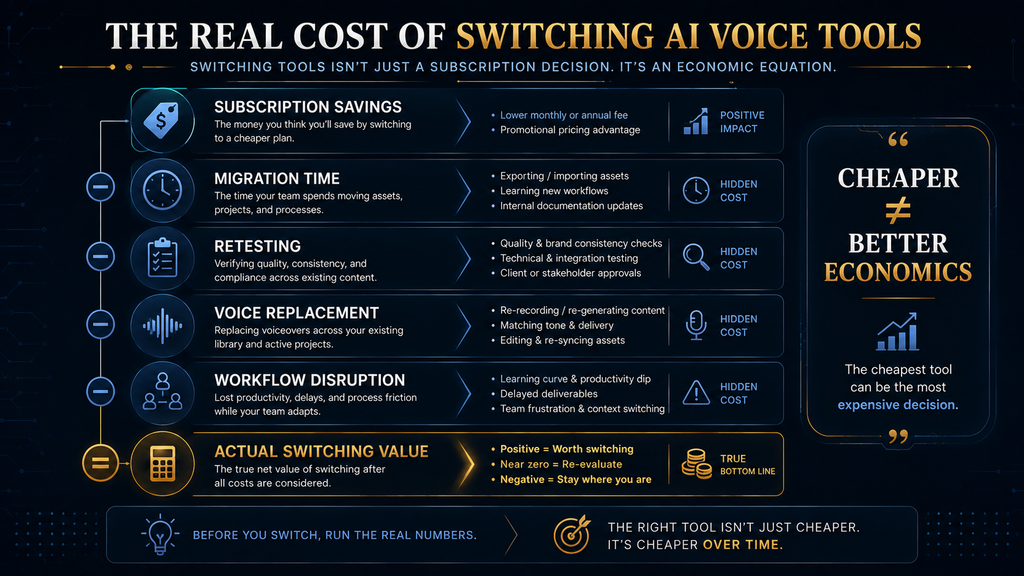
The cheapest subscription is not necessarily the cheapest workflow. This is one of the most important economic lessons in the entire comparison. Suppose Platform A costs $10/month. Platform B costs $22/month. Platform A requires: voice generation → export → external editing → audio cleanup → additional dubbing tool Platform B handles most of the workflow inside one environment. If Platform B saves two hours every week, its higher subscription price may be economically irrelevant.
The correct calculation is: Total workflow cost = software + usage + additional tools + production time + rework + switching cost. That is particularly important for professional creators. A creator producing two videos a month should calculate differently from an agency producing 200.
The Hidden Cost: Switching Platforms
Switching sounds cheap because account creation is cheap. Migration isn’t. Suppose you have spent six months building a voice workflow. You have:
- preferred voices
- pronunciation habits
- scripts
- production templates
- saved settings
- client expectations
- existing audio
- integrations
- team familiarity
Switching platforms means rebuilding part of that system. The true calculation becomes: Expected savings minus migration time minus retesting minus voice replacement minus workflow disruption minus quality differences equals actual switching value This is why a platform that is 20% cheaper isn’t automatically worth moving to. If your current workflow works extremely well, staying put has economic value.
When ElevenLabs Is Actually the Wrong Choice
This is where an affiliate article has to be honest. If it only explains why the product is great, it becomes a sales page, so here are the situations where another platform is the better call:
- You mainly edit video and podcasts. Descript may eliminate more workflow friction.
- You mainly produce corporate training. Murf may better match your production environment.
- You mainly read documents. Speechify is designed around that behavior.
- You are building voice into a product. A usage-based API such as Cartesia’s, or an open model you host yourself, may fit better than a creator subscription.
- You are building real-time conversational applications. Cartesia deserves serious evaluation.
Your only goal is the lowest possible infrastructure cost
You should compare usage-based APIs and self-hosted or open-source systems rather than assuming a creator subscription is optimal. Open-source models such as Kokoro, Chatterbox and Qwen-based systems increasingly appear beside commercial platforms, but there is a catch: free software is not the same as free production. You may replace a subscription with:
- GPU costs
- hosting
- maintenance
- updates
- deployment work
- monitoring
- troubleshooting
The invoice becomes smaller. The engineering burden becomes larger.
What About Open-Source Voice Models?
Open-source is worth considering when data control, self-hosting or infrastructure economics matter more than convenience. Current 2026 comparison pages increasingly include models such as Kokoro and Chatterbox alongside commercial platforms. Resemble AI’s product notice says the voice models it built remain open, so hosting them yourself is now the only way to keep using them. This creates a genuinely different decision.
Managed platform: you pay, generate, and maintain very little infrastructure. Self-hosted: you own and control the system, deploy it, maintain it and optimize it. The second model can be attractive for organizations with technical teams and strict data requirements. For a solo creator who simply wants a narrator for a YouTube video, however, running speech infrastructure may be the wrong optimization. The broader principle is to optimize the system, not the price tag.
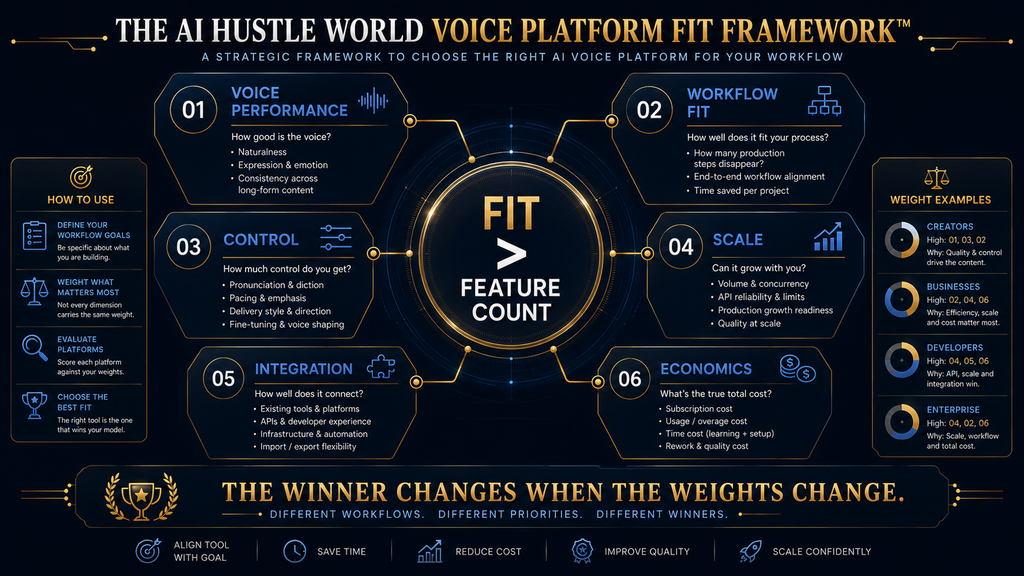
A Better Way to Choose: The AI Hustle World Voice Platform Fit Framework
Here’s the framework I recommend using before subscribing. Ask the same six questions of every candidate.
1. Voice Performance. How convincing, expressive and consistent is the output for your actual content? Not a demo. Your content. A voice that sounds incredible reading advertising copy may perform poorly on technical explanations.
2. Workflow Fit. How many steps disappear when you use the platform? Ask: “How much of my current workflow does this platform remove?” This is where Descript and Murf can beat a specialized voice engine for certain users.
3. Control. Can you control:
- pronunciation
- pacing
- emotion
- voice identity
- delivery
- regeneration
- multilingual consistency?
More control isn’t automatically better. It becomes valuable when you actually use it.
4. Scale. Ask: “What happens if my output becomes 10× larger?” A platform that works perfectly for five videos might become painful at 100. This is where credits, concurrency, API limits and workflow automation start mattering.
5. Integration. Ask: “Does the voice platform fit the software I already use?” That might mean Canva, PowerPoint, editing software, APIs, WebSockets or cloud infrastructure. The right integration can save more time than a marginal improvement in voice realism.
6. Economics. Calculate: monthly output × cost per output + production time + supporting software Don’t compare subscription prices in isolation.
Match the Framework to Your Job
The six questions do not carry the same importance for every buyer. We do not publish percentage weights, because any number here would be an estimate dressed up as a measurement. The table below gives an order instead: what to check first, what comes next, what can wait, and which tool that order usually points to.
| Job | Check first | Then | Can wait | Usually points to |
|---|---|---|---|---|
| YouTube creator | Voice performance | Control and workflow fit | Integration | ElevenLabs |
| Corporate training team | Workflow fit | Integration and economics | Voice performance beyond clear and consistent | Murf |
| Podcast or video editor | Workflow fit | Voice performance and integration | Fine-grained voice control | Descript |
| Developer building a voice agent | Latency and integration | Scale and control | Creator-style editing tools | Cartesia or the ElevenLabs API |
| Reader who listens to documents | Workflow fit | Economics | Voice control | Speechify |
This is why universal rankings are limited. Change the job and the order changes, and the order decides the winner.
Pricing: Compare Economics, Not Headlines
We checked every price below on the vendor’s own page on 10 October 2026. ElevenLabs public pricing runs from a free tier to paid plans beginning at $6 a month, with Creator at $22, Pro at $99, Scale at $299 and Business at $990. Murf lists Creator at $29 a month, or $19 a month when billed annually, and Business at $99 a month, or $66 when billed annually. Descript lists Hobbyist at $16 a month and Creator at $24 a month on annual billing. Speechify Studio lists Starter at $100 a year and Creator at $300 a year. Cartesia lists Pro at $5 a month, Startup at $49 and Scale at $299.
These numbers are useful—but only as a starting point. The plans measure usage differently. ElevenLabs uses credits across products. Murf measures voice-generation hours. Descript combines media hours and AI credits. Cartesia uses credits and minutes depending on the product. So a simple: “Tool X is cheaper.” claim is often meaningless without knowing the workload.
What the Free Plans Include
A free plan is the cheapest way to run your own script through a tool before you pay, so its limits matter. This is what each vendor’s pricing page listed on 10 October 2026.
| Tool | Free allowance | Commercial use on the free plan | Bengali |
|---|---|---|---|
| ElevenLabs | 10,000 credits a month | No, and free output must credit ElevenLabs | Listed for Eleven v4 and v3. Our mixed lines were read correctly with one English stock voice |
| Murf | 10 minutes of voice generation, with no downloads | No | Offered in the Studio as “Bangla – India”. Our mixed lines were read correctly with one voice |
| Speechify Studio | 600 Studio credits | No | Not in the Studio voiceover language list |
| Descript | 60 minutes of media a month and 100 one-time AI credits | Not stated on the pricing page | Not stated on the pricing page |
| Cartesia | 20,000 credits a month | Commercial licence is listed from the Pro plan | Listed for Sonic 3.6. Five Bengali voices in the picker, and our mixed lines were read correctly |
Two details stand out. A free plan is a test bench, not a licence to publish client or monetised work, so plan to upgrade before anything goes live. And Bengali support is uneven. If you publish in Bengali, or in mixed Bengali and English, check the language list before you check the price.
The 5-Minute Decision Tree
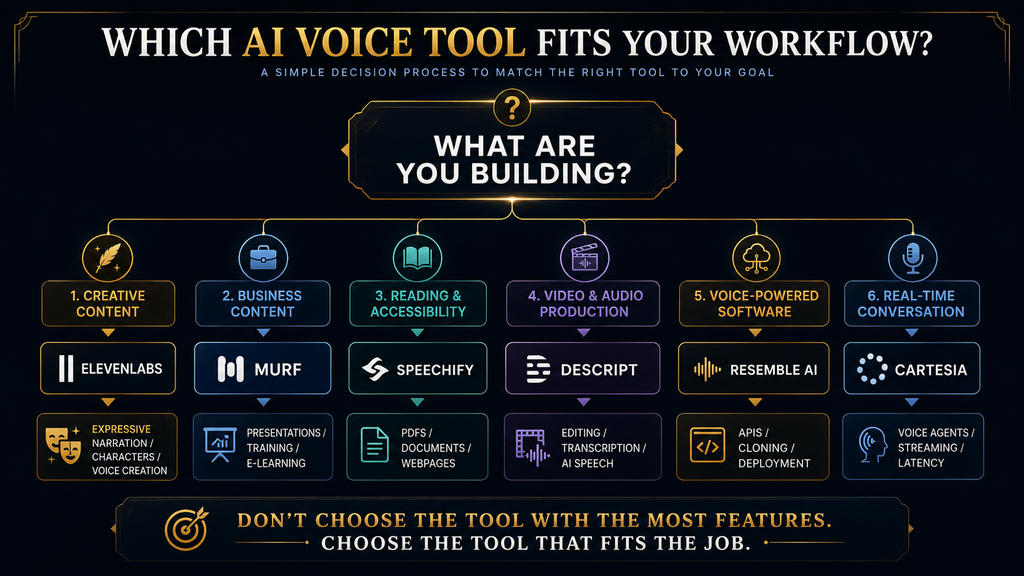
If you do not want to calculate everything, start with what you are primarily creating:
- Narration, storytelling, characters and creator content → ElevenLabs
- Business presentations, training and e-learning → Murf
- Documents, webpages, PDFs and accessibility listening → Speechify
- Podcasts, video editing and transcript-driven production → Descript
- Voice built into a software product → Cartesia or the ElevenLabs API
- Real-time voice agents → Cartesia
Then ask one more question: will this workflow still make sense when my production volume is five times larger? If the answer is no, don’t buy based on today’s workload alone.
What Happens If You Choose the Wrong Platform?
Usually, nothing dramatic happens. That’s exactly why this mistake survives. You simply experience small amounts of friction every day. A few extra exports. Another editing tool. Another subscription. Another regeneration. Another pronunciation correction. Another workflow handoff. Another minute waiting for audio. Another hour rebuilding a project. Individually, these costs look trivial. Across hundreds of production cycles, they become expensive. That’s the second-order effect of choosing the wrong AI tool. The best platform isn’t necessarily the one that produces the best demo. It is the one that produces the best repeated workflow.
When ElevenLabs Is Still the Best Choice
After all these alternatives, it would be easy to overcorrect and conclude that ElevenLabs is somehow outdated. The current evidence doesn’t support that. ElevenLabs continues to maintain a broad platform spanning expressive TTS, multilingual speech, low-latency models, voice design, voice cloning, dubbing, Studio, speech recognition, sound effects, music and voice-agent capabilities. Its flagship Eleven v4 model covers more than 90 languages, and in our own 12-line test it read mixed Bengali and English correctly on the first take. Multilingual v2 emphasizes stable long-form output, while Flash v2.5 is positioned for fast, lower-latency generation.
That breadth is valuable. If you’re a creator who expects your workflow to expand from: voiceover to: voice cloning → multilingual content → dubbing → sound design → Studio → automation then platform breadth can become an advantage. You don’t have to rebuild your stack every time your content operation expands. For a full breakdown of pricing, limits and our verdict, read the ElevenLabs review.
Final Verdict: ElevenLabs vs Alternatives
ElevenLabs is still one of the strongest overall choices for creators who treat voice quality, expression and voice creation as central parts of their content workflow. But it is not automatically the best platform for every voice-related job. Murf makes more sense when structured business production is the priority. Speechify makes more sense when reading and accessibility are the central problem. Descript makes more sense when editing is the center of gravity.
Cartesia makes more sense when voice is built into a product and real-time responsiveness becomes a requirement. Resemble AI is no longer part of this choice, because it has stopped selling voice generation. That doesn’t make the market confusing. It makes the market more mature. The old question was: Which AI voice generator sounds best? The better question in 2026 is: Which voice system fits the job I need to repeat? That shift is important because the value of an AI voice platform isn’t created at the moment it produces one impressive sentence. It’s created across the hundreds or thousands of sentences you generate afterward.
Final Thoughts
There is no universal winner in AI voice anymore. And that’s actually good news. You have more specialized options than ever, but specialization means the buyer has to understand what they are buying. If your work is centered around expressive narration, character performance, multilingual creator content and voice-driven production, ElevenLabs remains a compelling choice. If your problem lives somewhere else, don’t force ElevenLabs into the job. Choose the platform that removes the most friction from the workflow you actually have.
The best AI voice tool isn’t the one with the most impressive feature list. It’s the one whose strengths match the job you need to perform repeatedly. That’s the decision that matters.
Decide Whether ElevenLabs Fits Your Job
Compare its current plans and credit limits with your monthly voice output, then weigh them against the alternatives above.
Compare ElevenLabs Plans →Affiliate disclosure: We may earn a commission if you subscribe through this link, at no additional cost to you.
Frequently Asked Questions
What is the best alternative to ElevenLabs?
There is no single best alternative. Murf is particularly relevant for business voiceovers, Speechify for reading and accessibility, Descript for editing-centric production, and Cartesia for real-time voice applications and developer infrastructure.
Is ElevenLabs better than Murf?
For expressive voice creation and creator-focused narration, ElevenLabs is generally the stronger fit. Murf can be a better choice for structured business workflows involving presentations, training and integrations such as Canva and PowerPoint. In our own 12-line test, both read every English and mixed Bengali line correctly on the first take with one voice. Murf’s worked-out cost per finished minute was higher, and its free plan does not allow downloads.
Is ElevenLabs better than Speechify?
It depends on the job. Speechify is heavily oriented toward listening to written information, including PDFs, documents, webpages and books. ElevenLabs is more naturally aligned with voice creation and expressive content production.
Is Descript a good alternative to ElevenLabs?
Yes, particularly if editing is central to your workflow. Descript combines video/audio editing, transcription and AI Speech, so it can reduce the number of tools needed in a content-production workflow.
Is Resemble AI still an ElevenLabs alternative?
No. When we checked on 10 October 2026, Resemble AI’s site said it had stopped offering voice generation as a commercial product and now focuses on AI detection, watermarking and security. Its notice says the voice models it built remain open for research and development, so the only way to keep using them is to host them yourself.
Is Cartesia better than ElevenLabs?
Cartesia can be the better fit for real-time voice applications where streaming latency is critical. ElevenLabs remains highly relevant for expressive content generation and also offers low-latency models, so the choice depends on the application rather than a universal quality ranking. In our own test of 12 English and mixed Bengali lines, both read every line correctly on the first take. Cartesia cost less per finished minute, and ElevenLabs needed only one voice for both languages.
Which ElevenLabs alternatives have a free plan?
Murf, Speechify Studio, Descript and Cartesia all listed a free plan on 10 October 2026, and so does ElevenLabs. The allowances are small: 10 minutes of voice generation on Murf, 600 Studio credits on Speechify Studio, 20,000 credits a month on Cartesia and 10,000 credits a month on ElevenLabs. Murf, Speechify Studio and ElevenLabs state that the free plan carries no commercial rights, and Cartesia lists its commercial licence from the Pro plan, so use free plans for testing.
Which ElevenLabs alternative is cheapest?
There is no meaningful universal answer because platforms measure usage differently. Cartesia currently lists a $5/month Pro tier, while ElevenLabs starts at $6/month, but their included usage and product structures differ.
Should I switch from ElevenLabs if another platform is cheaper?
Not automatically. Calculate the total workflow cost, including usage, additional tools, production time, migration and rework. A cheaper subscription can become more expensive if it creates additional production steps.
Is ElevenLabs still worth using in 2026?
For users who prioritize expressive voice generation, voice creation, multilingual production and a broad AI audio ecosystem, yes. Its current platform continues to develop multiple models and capabilities rather than relying on a single TTS engine.
Written by
Muntasir Ahmad Chowdhury
Founder, AI Hustle World
Muntasir Ahmad Chowdhury is the Founder of AI Hustle World, an independent publication dedicated to making Artificial Intelligence practical, trustworthy, and easy to understand. He researches AI tools, automation, customer service, productivity, and real-world business applications, helping readers make smarter technology decisions through research-driven, experience-backed content.
Expertise:
AI Tools • AI Automation • AI Customer Service • AI Productivity • Generative AI • AI Workflows
Get Smarter With AI
Enjoyed this guide? Get practical AI tools, tutorials, and honest reviews delivered to your inbox.