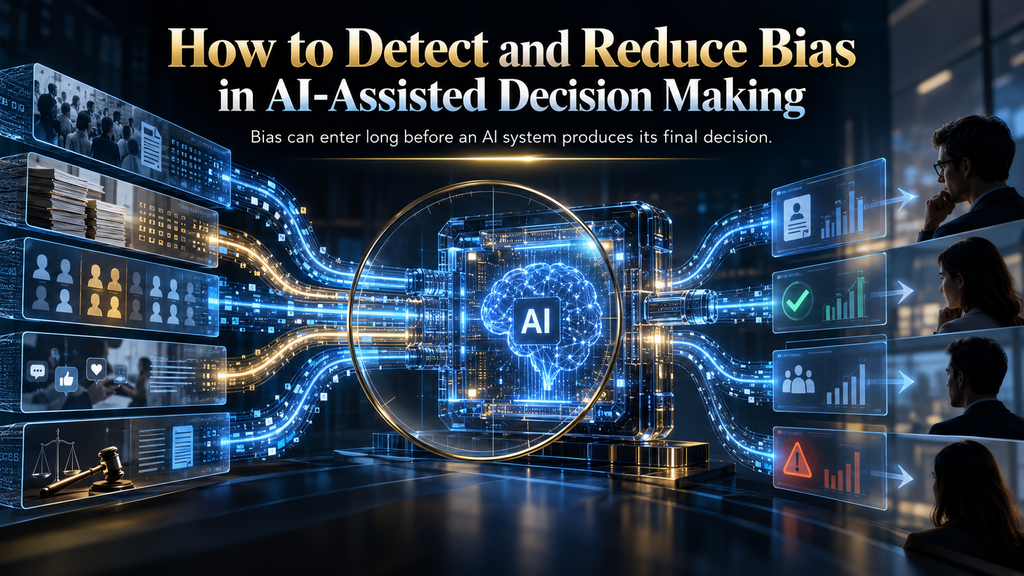
How to Detect and Reduce Bias in AI-Assisted Decision Making
AI can help a recruiter rank candidates, help a manager evaluate performance, help a lender assess applications, help a support team prioritize customers, or help an organization decide which cases deserve attention first. The attraction is obvious: instead of asking people to process every piece of information manually, an AI system can identify patterns, rank options, summarize evidence, and produce recommendations at a scale that would be difficult for a human team to match. The problem begins when that apparent objectivity is mistaken for actual fairness.
Imagine a hiring team using an AI screening system that consistently ranks certain candidates higher than others. The model may appear to be doing its job perfectly: it processes the same information for everyone, applies the same scoring logic, and produces a neat ranked list. But suppose the historical hiring data used to develop or evaluate that system reflects years of organizational preferences that favored particular educational backgrounds, career paths, locations, or employment histories. The model does not need to “hate” a group or contain an explicitly discriminatory rule to reproduce the pattern. It only needs to learn that the historical pattern is predictive of what the organization previously considered a successful candidate.
That is why AI bias is not simply a bad-data problem, and it is not solved by removing obviously sensitive variables from a dataset. Bias can enter through the data, the labels used to train a system, the features selected by its designers, the objective being optimized, the way performance is measured, the context in which the system is deployed, and the humans who interpret its recommendations. NIST identifies three broad categories—systemic, computational and statistical, and human-cognitive—and emphasizes that these forms of bias can occur even without prejudice, discriminatory intent, or conscious partiality.
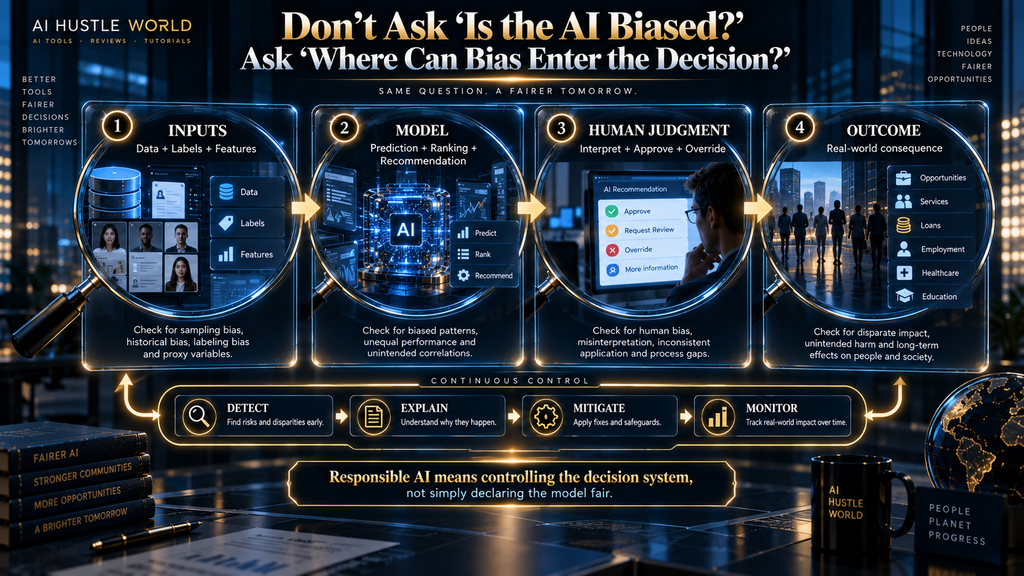
The practical question, then, is not simply whether an AI system is biased. A much more useful question is where bias enters the decision process, what harm it creates, how that harm can be measured, and whether the proposed fix actually improves the decision rather than merely improving one fairness statistic. This article builds a practical way to answer those questions.
What AI Bias Actually Means in a Decision-Making System
AI bias occurs when systematic characteristics of an AI system, its surrounding process, or its human use contribute to outcomes that unfairly disadvantage particular people or groups, distort representation, reduce the quality of service they receive, or otherwise create harmful disparities. That definition is deliberately broader than the common idea that an algorithm simply produces different results for different demographic groups.
The distinction matters because difference is not automatically discrimination, and similarity is not automatically fairness. A forecasting model might legitimately produce different recommendations for two groups because their underlying circumstances differ. Conversely, a model could produce similar average outcomes across groups while still creating serious problems for people with disabilities, smaller intersectional groups, or individuals who are poorly represented by the system. NIST specifically warns that mitigating harmful bias does not automatically mean a system is fair, because fairness depends on context, equity, accessibility, and the particular harms produced by the system.
Consider a customer-support prioritization system. If it gives every customer approximately the same probability of receiving priority treatment, that might look fair at first glance. But if the system consistently performs worse when customers describe problems in a particular language or communication style, the aggregate statistics could hide a quality-of-service disparity. The relevant question is therefore not simply, “Did every group receive the same percentage?” It is, “Did the system deliver the level of service it was supposed to deliver, and did systematic differences in performance create meaningful harm?”
This is the first principle to carry through the entire article: bias should be investigated in relation to a decision and a potential harm, not as an abstract property of an algorithm.
Where Bias Enters the AI Decision Pipeline
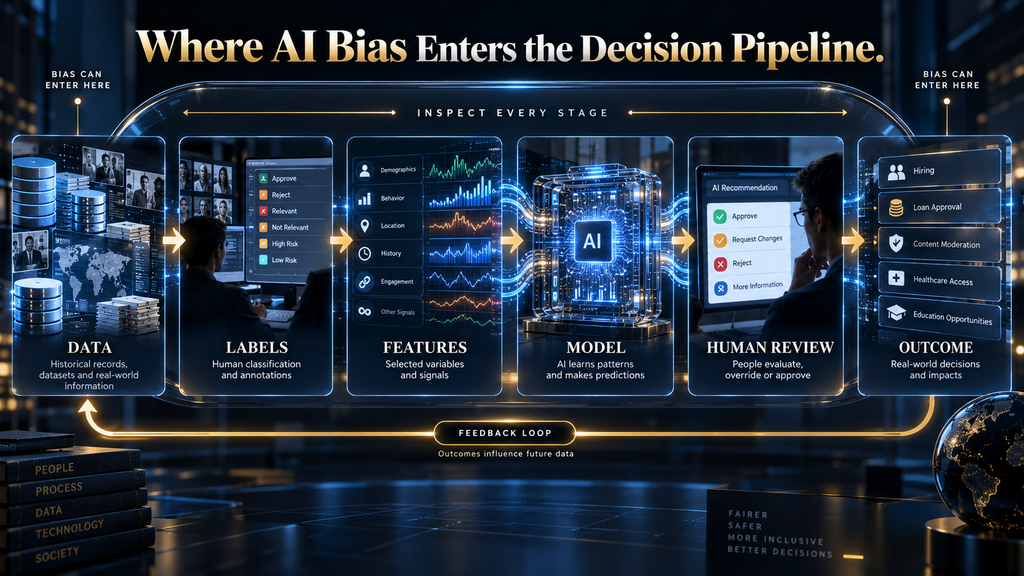
An AI-assisted decision is better understood as a pipeline than as a single model. A useful simplified representation is data → labels and measurements → features → model → recommendation → human interpretation → decision → outcome → feedback. Every stage can influence the final result, which means an organization that audits only the model’s mathematical output may miss important sources of bias elsewhere in the workflow.
The data stage is the most obvious starting point. If a population is underrepresented, the system may have less information from which to learn patterns affecting that population. But representation is only one issue. A dataset can contain plenty of examples from a particular group while still encoding historical practices, measurement errors, inconsistent labels, or institutional assumptions that make the resulting model problematic.
Labels can be particularly important. Suppose a company trains an employee-performance system using historical manager ratings. The system may have millions of ratings and therefore appear statistically rich, but the target it is learning may actually be a record of previous managerial judgments. If those judgments were influenced by inconsistent standards, different expectations, or other forms of human bias, the model can reproduce those patterns with impressive statistical efficiency.
The feature stage introduces another layer. An organization may remove a protected characteristic while leaving variables that act as proxies for it. Location, educational history, employment gaps, purchasing behavior, credit-related information, or other apparently neutral attributes can correlate with characteristics that an organization intended not to use. NIST specifically recommends examining features that may function as demographic proxies and assessing underlying data distributions rather than assuming that removing an explicit sensitive field eliminates the problem.
Then comes the model itself. Algorithmic choices can affect how errors are distributed, how thresholds are selected, and which patterns are prioritized. Even the objective function can encode a value judgment. If a system is optimized primarily for aggregate accuracy, for example, it may have little incentive to perform equally well for smaller groups if improving performance for the majority produces a larger overall gain.
But the pipeline does not end when the model produces its score. A manager, recruiter, analyst, or customer-service employee still interprets the recommendation. That human interaction can introduce another form of bias. Research published in the International Journal of Information Management examined two controlled experiments involving 775 managers and found that AI recommendations could influence performance-appraisal ratings through anchoring effects, with the source and magnitude of the recommendation affecting subsequent judgments.
The final outcome can then feed back into future data. If an organization follows AI recommendations for years, those decisions may eventually become part of the historical record used to train or evaluate later systems. A biased recommendation can therefore become tomorrow’s “ground truth,” turning an initial problem into a self-reinforcing cycle.
The Three Layers of AI Bias
NIST’s three-part framing is useful because it prevents organizations from looking for bias in only one place. Systemic bias, computational and statistical bias, and human-cognitive bias can interact with one another, meaning a technically sophisticated system can still inherit problems from the institution and workflow around it.
Systemic bias
Systemic bias originates in the broader environment in which an AI system is developed and used. That environment can include historical institutional practices, organizational policies, unequal access to opportunities, social conditions, and assumptions about what constitutes a successful outcome.
A hiring model trained on historical hiring decisions is a straightforward example. If an organization historically hired disproportionately from a narrow set of universities, the model may learn that university history predicts success. The resulting pattern can appear statistically justified even though the underlying historical process was never designed as a neutral measure of ability.
This is why simply “debiasing the model” can sometimes be insufficient. If the organization continues using the same biased target, the same narrow definition of success, or the same workflow, the next model may learn the same pattern again.
Computational and statistical bias
This layer covers problems introduced through sampling, measurement, labels, feature construction, modeling, evaluation, and other technical processes. Examples include non-representative samples, missing data, inconsistent measurements, poor labels, proxy variables, inappropriate evaluation methods, and uneven error rates.
Technical bias is often easier to detect because it can be expressed through measurable differences. That makes it tempting to treat it as the whole problem. It is not.
A model can pass a statistical test and still create a harmful outcome because the test itself does not capture the relevant harm. NIST therefore recommends combining general fairness measures, when appropriate, with context-specific measures and analysis of harms across groups, within groups, and across intersecting groups.
Human-cognitive bias
Human-cognitive bias enters through the people who design, deploy, interpret, challenge, override, or rely upon AI systems. It can appear before the model exists, when teams decide what problem to solve and which outcome to optimize, or after deployment, when users decide how much weight to place on a recommendation.
Automation bias is a particularly important risk because an AI recommendation can appear more objective than an equivalent human opinion. If an employee assumes that the model has already processed the relevant evidence correctly, the employee may stop questioning the recommendation.
The opposite problem can also occur. A user who distrusts the technology may disregard accurate recommendations selectively. Either way, the human-AI relationship becomes part of the decision system.
NIST’s human-AI interaction guidance emphasizes that human roles and responsibilities should be clearly defined because AI systems can range from fully autonomous systems to tools that provide an additional opinion to a human decision maker.
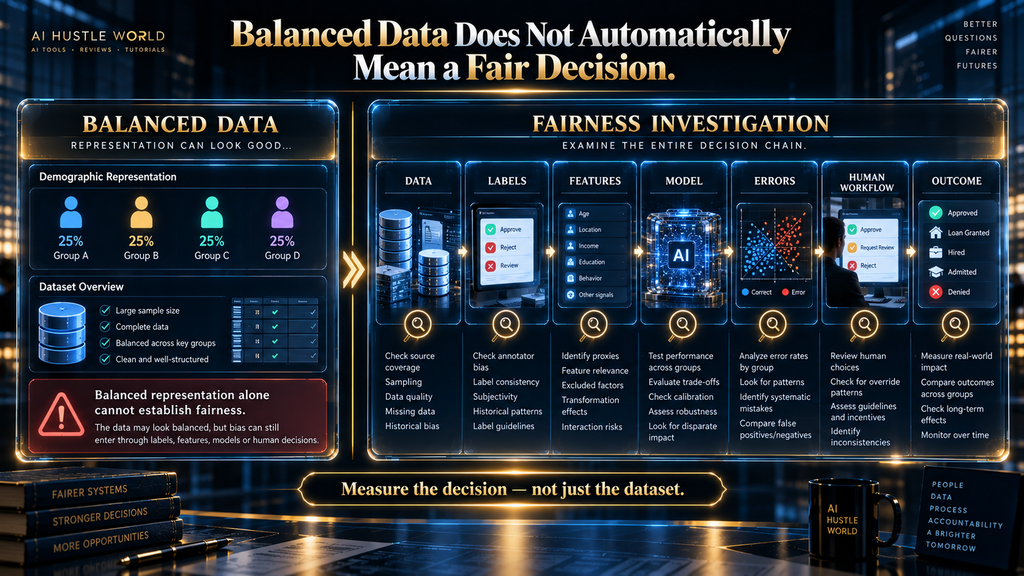
Why “Balanced Data” Does Not Guarantee a Fair Decision
One of the most persistent mistakes in AI governance is treating demographic balance as synonymous with fairness. A dataset can have apparently reasonable representation while still producing an unfair system because what the data represents can matter as much as who is represented.
Suppose a model has equal numbers of candidates from two groups. If the historical outcome used as the target variable reflects unequal access to promotion opportunities, the model can learn the organization’s historical pattern rather than an objective measure of potential. The dataset is balanced by group count, but the underlying decision process is not necessarily neutral.
Measurement creates another problem. Some qualities are difficult to measure directly, so organizations use proxies. “Job performance,” for instance, may be represented through manager ratings, sales numbers, retention, productivity metrics, attendance, or promotion history. Each measure captures something, but none necessarily captures the complete concept. When an AI system optimizes the proxy, it can reproduce the limitations of the measurement itself.
NIST’s bias research explicitly identifies problems such as underrepresentation, proxy variables, latent variables, difficulty quantifying contextual phenomena, and objective functions that can encode organizational assumptions. This produces an important practical distinction: Representative data can still represent a biased process. That is why a serious bias audit must ask not only whether the dataset contains enough examples of different groups, but also whether the variables, labels, outcomes, and decision rules represent the thing the organization actually cares about.
How to Detect Bias Before It Causes Harm
The most reliable approach is to begin with the decision rather than the model. Before measuring anything, define what the AI influences, who can be affected, what a harmful outcome would look like, and which differences would matter enough to trigger investigation.
Suppose an AI system ranks loan applications. “Bias” is too broad a starting point. The organization needs to ask whether the concern is unequal approval rates, unequal false-negative rates, inaccurate risk classification, differences in access to credit, or something else. The answer determines what should be measured.
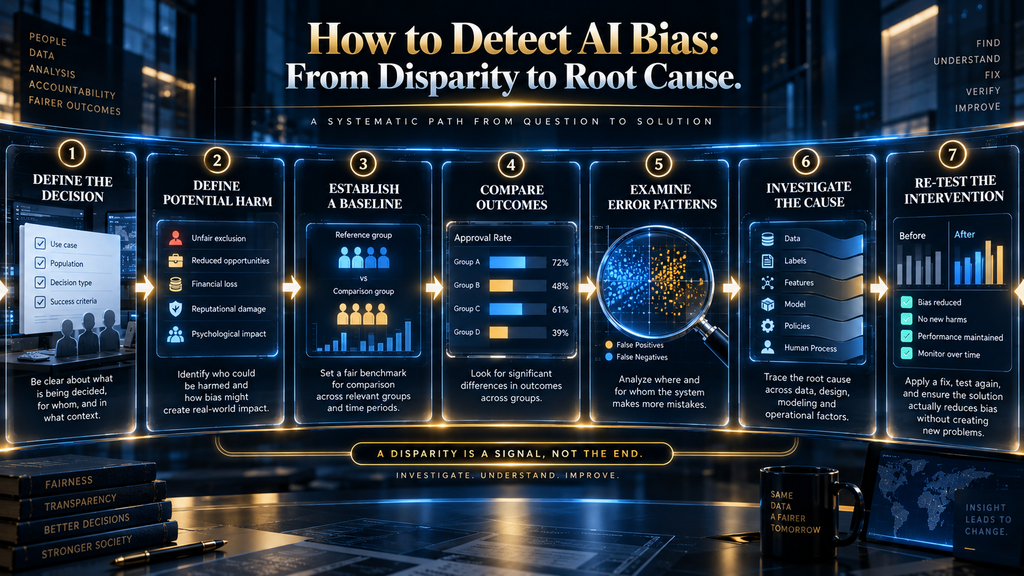
Start by defining the decision and the harm
The first step is to write down the decision in plain language: what does the AI recommend, who acts on that recommendation, and what happens to the person on the receiving end? This forces the team to connect technical performance to an actual consequence.
NIST recommends identifying different categories of harm, including allocational harm, representational harm, quality-of-service harm, stereotyping, and erasure. It also recommends identifying potentially affected groups across, within, and among intersecting populations.
That means an organization should not automatically limit its analysis to the largest demographic categories. A system can perform adequately for two broad groups while failing badly for a smaller subgroup formed by the intersection of multiple characteristics.
Establish the baseline
Before attempting to fix a system, measure how it performs today. Depending on the use case, the baseline might include selection rates, approval rates, false-positive rates, false-negative rates, error distributions, service times, recommendation quality, or other outcome measures.
The goal is not to find one magical fairness number. The goal is to understand where the system behaves differently and whether those differences are meaningful in the context of the decision.
A baseline also protects against a common governance failure: implementing a mitigation and then declaring success simply because the model’s overall accuracy or a single fairness metric improved.
Compare outcomes across groups
Once the relevant outcomes are defined, compare them across groups that could reasonably be affected. NIST recommends analyzing differences across groups, within groups, and among intersecting groups, while paying particular attention to smaller populations that aggregate statistics can hide.
For a hiring system, that could mean comparing selection rates and error patterns across relevant demographic categories. For customer service, it might mean comparing resolution quality and escalation rates. For an employee-performance system, it could involve examining whether recommendation errors are distributed differently across groups.
The exact metrics should follow the decision. Do not choose the metric first and then force the problem to fit it.
Which Fairness Metrics Can Reveal Unequal Outcomes?
Fairness metrics are useful because they make patterns visible, but they are not verdict machines. Different metrics answer different questions, and choosing among them requires an understanding of the decision’s consequences.
Demographic parity
Demographic parity examines whether positive outcomes or selections occur at similar rates across groups. It can be useful when the central question concerns allocation or selection rates, but equal selection rates do not necessarily mean that the underlying decision quality is equal.
For example, if two groups have substantially different distributions of relevant qualifications, forcing identical selection rates may solve one statistical disparity while creating another problem. The metric is therefore informative, but it does not define fairness by itself.
Equal opportunity
Equal opportunity focuses on whether qualified members of different groups receive positive decisions at comparable rates. It can be useful when false negatives—failing to recognize someone who should have received a positive decision—represent a particularly important harm.
Equalized odds
Equalized odds extends the comparison to both true-positive and false-positive rates. This can be useful when both kinds of errors matter and the organization needs to understand whether the system is making different types of mistakes for different groups.
False-positive and false-negative rates
In many real-world applications, these error rates are more actionable than an abstract fairness score. A false positive and a false negative do not necessarily have equal consequences, so an organization should ask which error is more harmful and to whom.
NIST explicitly recommends evaluating quality metrics such as false-positive and false-negative rates alongside fairness analysis and context-specific measures.
The broader lesson is straightforward: fairness measurement is a measurement-design problem. You are deciding which harms deserve visibility, which differences matter, and what evidence would justify intervention.
Why Fairness Metrics Can Disagree
This is where simplistic AI-bias advice breaks down. An organization can improve one fairness metric while worsening another, and there are situations where statistical parity, error-rate equality, calibration, accuracy, and other desirable properties cannot all be optimized simultaneously under the same conditions.
That does not mean fairness measurement is useless. It means the organization must make the trade-off explicit rather than hiding it behind a single score.
Imagine a lending model where the business wants to minimize both false approvals and false rejections while also reducing disparities between groups. If one intervention reduces the difference in approval rates but substantially increases false rejections among qualified applicants, declaring the intervention “fairer” without discussing that trade-off would be misleading.
NIST recommends defining acceptable levels of difference in relation to the context of use, organizational governance, business requirements, applicable legal frameworks, regulatory considerations, and ethical standards rather than assuming that one universal threshold applies everywhere. This leads to a better governance question: Which outcome are we protecting, for whom, and what trade-off are we willing to accept? That is much more useful than asking whether the model achieved a particular fairness score.
How to Find the Root Cause of a Bias Problem
Finding a disparity is only the beginning. The difficult part is determining why it exists.
A useful investigation should move backward through the decision pipeline. If a hiring model selects candidates from one group at a lower rate, the team should examine whether the difference originates in the source population, the historical labels, the features, the model, the threshold, or the human workflow that follows the recommendation.
Suppose the model relies heavily on employment history. The team might discover that candidates from a particular group are more likely to have career gaps, but the model treats those gaps as negative evidence. The next question is whether the employment gap itself is a meaningful indicator of job performance or whether it is functioning as a proxy for circumstances unrelated to the actual decision objective.
This is why root-cause analysis needs both technical and domain expertise. A data scientist can identify a statistical relationship, but someone who understands the business process may be better positioned to determine whether the relationship represents a legitimate signal, a proxy, a historical artifact, or an unintended consequence.
NIST recommends using context experts to investigate substantial measurement differences and combining quantitative analysis with impact assessments and engagement with potentially affected communities. The strongest investigation therefore asks four successive questions:
What is different? Why is it different? Does the difference represent a meaningful harm? What intervention addresses the cause rather than merely the symptom?
The B.I.A.S. Decision Audit
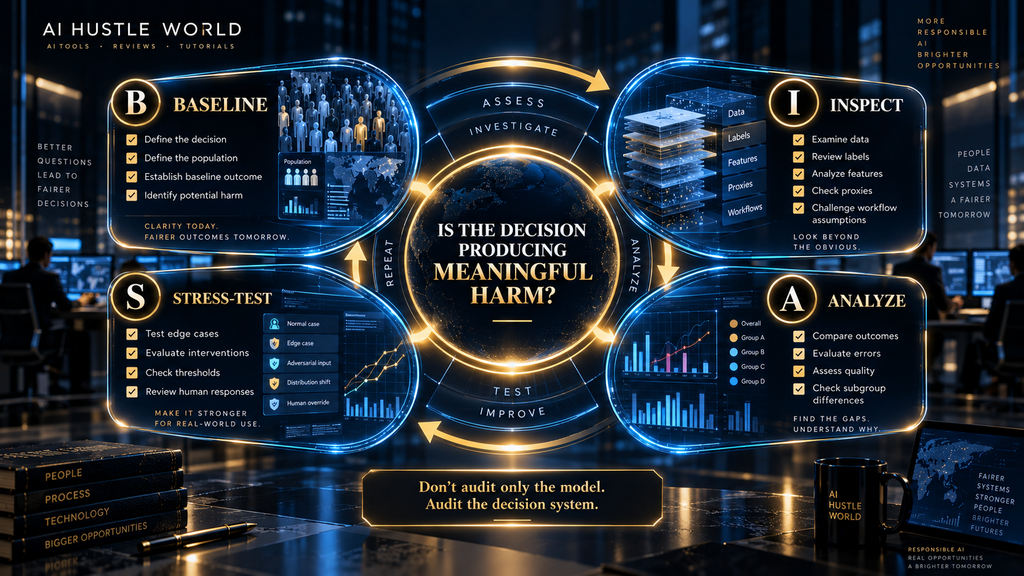
To make the process practical, AI Hustle World can use a four-stage framework: B.I.A.S. — Baseline, Inspect, Analyze, Stress-test.
B — Baseline the decision
Define what the AI influences, what the intended outcome is, who may be affected, what constitutes an error, and what kinds of harm matter. Establish the current performance before changing the system so that every later intervention has something meaningful to compare against.
I — Inspect the inputs
Examine representation, missingness, labels, measurement methods, feature definitions, proxies, historical patterns, and data quality. The objective is not simply to ask whether the dataset is “clean,” but whether the inputs represent the decision reality accurately enough for the system’s intended use.
A — Analyze the outcomes
Measure relevant outcomes across groups, within groups, and across important intersections. Examine selection rates, error rates, service quality, and context-specific harm indicators rather than relying on aggregate accuracy alone.
S — Stress-test and supervise
Test the system under different conditions, examine edge cases and smaller populations, investigate how humans respond to recommendations, apply mitigation where justified, and then repeat the evaluation. A successful mitigation is not one that produces a nicer-looking metric; it is one that reduces meaningful harm without creating an equal or greater problem somewhere else.
The power of the B.I.A.S. audit is its sequencing. It prevents teams from jumping straight to model modification before understanding what they are trying to protect.
How to Reduce Bias Once You Find It
There is no universal “debiasing algorithm” because the appropriate intervention depends on where the problem originates. If the problem is representation, changing the model architecture may do little. If the problem is a flawed label, rebalancing the dataset may preserve the underlying error. If the problem comes from human interpretation, changing the training data may not address the most important source of harm.
Fix the data when the data is the problem
Data-level interventions can include improving representation, correcting erroneous labels, addressing missingness, reweighting observations, or changing how data is collected. These interventions are most appropriate when the investigation shows that the data itself is producing an avoidable disparity.
But more data is not automatically better. Collecting more examples of a biased process can simply produce a larger and more detailed record of the same problem.
Change the model or training objective when appropriate
In-processing methods can incorporate fairness considerations into model development. This can involve modifying optimization objectives or selecting models that provide a more appropriate balance between predictive performance and fairness requirements.
The important point is to treat this as an explicit trade-off rather than a technical afterthought. The organization should know what it is optimizing, which harms it is reducing, and which performance characteristics might change as a result.
Adjust the output when the threshold is the problem
Post-processing methods can modify how model scores are converted into decisions. This can sometimes reduce disparities when the underlying score is useful but the operational threshold creates unequal error patterns.
However, threshold adjustments should not become a way of disguising a deeper problem. If the model’s underlying features or labels are inappropriate, changing the threshold may only move the symptom around.
Change the workflow when the human process is the problem
Sometimes the most effective intervention is not inside the model at all. If employees systematically over-trust AI recommendations, the organization may need a different review procedure, stronger documentation requirements, structured counterarguments, or clearer decision authority.
NIST recommends human-centered design and examining cognitive biases such as confirmation bias and other forms of human judgment throughout the AI lifecycle.
This is one reason human review should not be treated as a magic fairness button. A human can catch an AI error, but a human can also amplify it.
Why Human Review Does Not Automatically Remove AI Bias
“Keep a human in the loop” sounds reassuring because it suggests that a person will catch whatever the machine gets wrong. In practice, the quality of that safeguard depends on how the human role is designed.
If the employee sees the AI recommendation before independently evaluating the evidence, the recommendation can become an anchor. If the system provides a confident-looking score without explaining uncertainty, the employee may assume that the machine has already done the difficult reasoning. If managers are measured on speed, they may have little practical incentive to challenge every recommendation.
The 2025 performance-appraisal study involving 775 managers provides a concrete example: AI recommendations affected performance ratings, and the relationship between the recommendation source and the anchor influenced the resulting judgment. The researchers also examined a “consider-the-opposite” strategy as a way to counter anchoring effects.
This suggests a more sophisticated approach to human review. The human should not merely be given an approval button. The workflow should define what the human is expected to verify, what evidence must be considered independently, when an override is required, and what happens when the human disagrees with the system.
In high-consequence decisions, the human should retain meaningful authority rather than functioning as a rubber stamp.
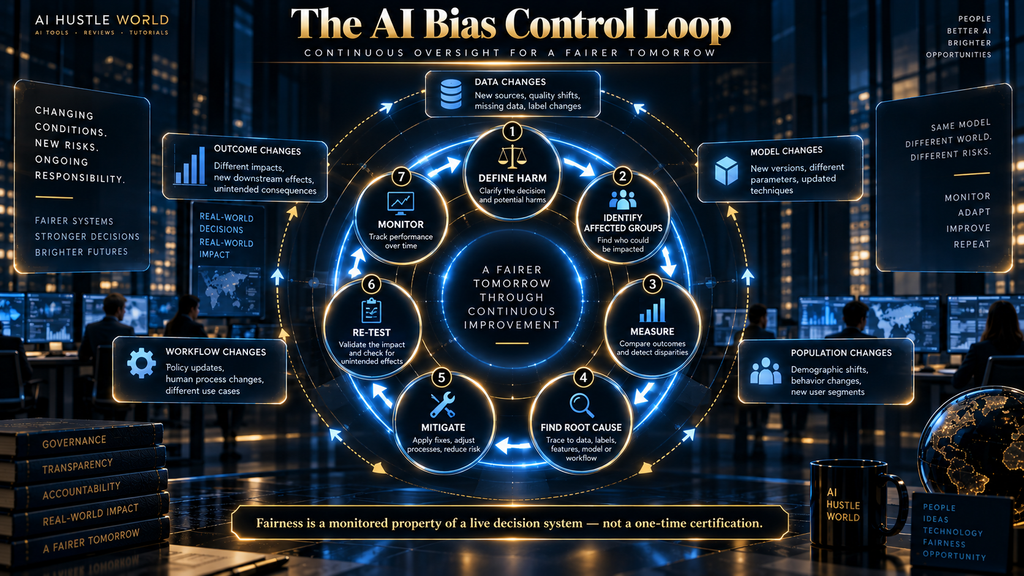
The AI Bias Control Loop
A one-time audit is not enough because deployed AI systems exist inside changing environments. Data distributions change, populations change, business processes change, models are updated, users adapt their behavior, and organizations may gradually change how recommendations are interpreted.
That is why AI Hustle World can frame bias management as a continuous control loop: Define Harm → Identify Affected Groups → Measure Disparities → Find Root Cause → Choose Intervention → Re-test Trade-offs → Deploy Controls → Monitor Outcomes.
The loop matters because every intervention creates the possibility of a second-order effect. A model adjustment that improves one group’s error rate may change another group’s outcomes. A workflow change that reduces automation bias may increase processing time. A stricter human-review requirement may improve oversight while creating operational bottlenecks.
NIST’s measurement guidance similarly emphasizes monitoring outputs, setting acceptable tolerance levels, periodically updating models and data, and documenting whether mitigation procedures remain effective. The goal is therefore not to reach a permanent state called “bias-free AI.” The more realistic goal is to create a system that detects meaningful disparities early, responds to them deliberately, and produces evidence that its controls are working.
What Should You Measure After Deployment?
A bias program needs operational metrics, otherwise it becomes a policy document that nobody can tell is working. The most useful measurement framework combines four categories.
| Measurement Area | What to Monitor | Why It Matters |
|---|---|---|
| Outcome disparity | Selection, approval, ranking or allocation rates across relevant groups | Detects systematic differences in outcomes |
| Error disparity | False positives, false negatives and other context-specific errors | Shows whether mistakes are concentrated |
| Quality disparity | Accuracy, service quality, response time or recommendation quality | Finds problems hidden by aggregate statistics |
| Control effectiveness | Overrides, escalations, complaints, review findings and recurring incidents | Shows whether governance controls work in practice |
The precise thresholds should be defined according to the use case rather than copied from another organization. NIST recommends establishing acceptable levels of difference in relation to the context, organizational policies, business requirements, applicable legal frameworks and ethical standards.
It is also important to track the distribution of decisions over time. A model that looks fair during initial testing can behave differently after deployment if the population or workflow changes. Monitoring should therefore include model version, data period, relevant group definitions, error patterns, significant changes in inputs, and material changes to the surrounding process.
Common Mistakes Organizations Make When Trying to Reduce AI Bias
The first mistake is removing protected attributes and declaring the problem solved. Removing race, gender, age, or another sensitive characteristic does not necessarily remove information correlated with that characteristic. Proxy variables can continue to influence the decision, while systemic and human-cognitive sources of bias remain untouched.
The second mistake is optimizing one fairness metric without defining the harm. A team may proudly report that a disparity metric improved without asking whether false negatives increased, service quality deteriorated, or another group experienced a new disadvantage. The number improved, but the decision did not necessarily improve.
The third mistake is auditing only before deployment. A pre-launch test is valuable, but production behavior depends on real populations, real workflows, real incentives, and real users. Once the system is deployed, those conditions can change.
The fourth mistake is assuming human oversight guarantees fairness. Human reviewers bring their own assumptions and can be influenced by the AI recommendation. Without a structured review process, “human in the loop” can simply turn into “human approves AI.”
The fifth mistake is treating fairness as the responsibility of the data science team alone. A bias problem can originate in business objectives, hiring practices, measurement definitions, workflow incentives, product design, policy decisions, or historical data. Technical teams are essential, but they cannot independently decide what constitutes acceptable social or business harm.
The sixth mistake is ignoring smaller or intersecting groups. Aggregate statistics can look acceptable while masking severe problems for a smaller population. NIST specifically recommends examining across, within, and intersecting groups and considering the impact on small groups and individuals.
A Practical Workflow for Small and Mid-Sized Businesses
A smaller organization does not need to create a giant AI ethics department to begin managing bias responsibly. What it needs is a repeatable process that connects the technical evaluation to the actual business decision.
Start by inventorying AI-assisted decisions according to consequence. A system that recommends which internal document to summarize does not deserve the same governance intensity as a system that influences hiring, lending, employee evaluation, customer eligibility, or another decision that materially affects a person.
For higher-consequence systems, document the decision purpose, affected populations, data sources, model version, important features, known limitations, decision threshold, responsible owner, review process, escalation route, and measurement plan. This creates enough institutional memory to investigate a problem when something changes.
The next step is baseline testing. Before deployment, evaluate relevant performance and fairness indicators using representative test data where possible. The organization should also test smaller populations and important intersections rather than assuming that large-group averages tell the whole story.
After deployment, establish a review cadence based on the consequence and volatility of the system. A stable internal recommendation system may need less frequent formal review than a model used in a rapidly changing customer environment. What matters is that the interval is intentional and that a material change in data, model, workflow, or observed outcomes can trigger an additional review.
Finally, create a clear intervention rule. If a monitored disparity exceeds the organization’s defined tolerance, someone should know who investigates it, who can pause the system, who approves a mitigation, and what evidence is required before normal operation resumes.
This turns bias management from an abstract commitment into an operational control.
When You Should Avoid Automating the Decision
Not every decision should be automated simply because an AI model can make a prediction. Automation becomes harder to justify when the decision has high consequences, the underlying objective is difficult to define, the available data is a weak proxy for the thing being judged, affected individuals have limited ability to challenge the decision, or the organization cannot explain how errors will be detected and corrected. A useful rule is to increase governance intensity as consequence, ambiguity, irreversibility, and population impact increase.
| Decision Characteristic | Lower Concern | Higher Concern |
|---|---|---|
| Consequence | Convenience or low-cost recommendation | Employment, financial access or major opportunity |
| Reversibility | Easy to correct | Difficult or costly to reverse |
| Ambiguity | Clear objective and measurable outcome | Subjective or contested definition of success |
| Data quality | Strong, relevant evidence | Historical or indirect proxy data |
| Human challenge | Easy review and correction | Limited ability to contest the result |
| Scale | Small number of decisions | Thousands or millions of decisions |
This does not mean every high-impact decision must be completely manual. AI can still provide useful analysis, ranking, summarization, or evidence gathering. The important distinction is between using AI to support judgment and allowing an opaque or poorly validated system to determine the outcome.
NIST’s AI Risk Management Framework emphasizes that human roles and responsibilities should be clearly defined and differentiated, and that AI systems can occupy very different positions between fully manual and fully autonomous decision-making.
A Decision Matrix for AI-Assisted Bias Risk
The following matrix can help organizations decide how much governance a particular workflow deserves.
| AI Use Case | Potential Consequence | Recommended Bias Control |
|---|---|---|
| Low-stakes recommendations | Limited individual impact | Periodic sampling and basic quality checks |
| Customer prioritization | Unequal service or access | Group-level outcome monitoring and escalation rules |
| Employee performance assistance | Career or compensation impact | Structured human review, bias testing and documentation |
| Hiring screening | Access to employment opportunities | Pre-deployment testing, ongoing monitoring and meaningful human review |
| Credit or financial eligibility | Financial consequences | Rigorous validation, fairness analysis and continuous monitoring |
| High-impact eligibility or allocation | Significant individual or group consequences | Independent evaluation, strong governance and explicit human decision authority |
The matrix is not a universal legal classification. It is a practical governance tool for matching oversight to consequence.
That distinction matters because one of the worst governance habits is applying the same review process to every AI system simply because the organization has written one standard policy. Governance should be proportional to risk.
What Happens If You Do Nothing?
The most obvious consequence of ignoring AI bias is that an unfair pattern can continue unnoticed. But the deeper problem is scale.
A human decision maker can make a biased decision, but an AI-assisted workflow can potentially repeat the same decision pattern across thousands of cases. If the system becomes embedded in a business process, employees may also stop recognizing the original assumption because the recommendation now appears to come from an objective technical system.
There is a second-order effect as well: decisions produced by the AI can become new data. If an organization repeatedly follows a biased recommendation system, those outcomes can influence future training or evaluation datasets. The organization can gradually create a feedback loop in which historical decisions validate future decisions.
NIST warns that AI can increase the speed and scale of bias and potentially perpetuate or amplify harms affecting individuals, groups, organizations, and society.
The business risk is therefore not limited to an embarrassing model error. Persistent bias can affect operational performance, employee trust, customer relationships, governance credibility, and the organization’s ability to explain why consequential decisions were made.
The Contrarian View: “More Fairness” Is Not Always Better AI
There is a temptation in responsible-AI discussions to treat fairness as a technical optimization target: find a metric, minimize the disparity, and declare victory.
That approach is attractive because it makes a complicated social question look measurable. But a cleaner metric can produce a worse decision if the metric does not represent the harm that actually matters.
Suppose an organization improves demographic parity while making its model substantially less accurate for the very people it was intended to assist. Or suppose it reduces a disparity in approval rates by lowering approvals across the board. The statistical gap becomes smaller, but the underlying decision may not have become better.
The more defensible position is that fairness metrics are evidence, not verdicts. They help organizations discover patterns that deserve investigation, but humans still need to determine what those patterns mean in context and which trade-offs are justified.
That is not a weakness of AI governance. It is an acknowledgment that decisions about people contain values that cannot always be reduced to one optimization function.
Who Should Use This Approach—and Who Should Not Overcomplicate It?
This framework is particularly useful for organizations using AI to influence decisions involving employees, applicants, customers, financial access, eligibility, prioritization, performance, or other outcomes that can materially affect people. It is also useful for product teams building AI decision-support features because it forces them to think about the complete workflow rather than treating the model as an isolated technical component.
A business using AI only for low-consequence brainstorming does not need to run a full formal fairness audit every time someone asks a chatbot for ideas. Governance becomes more valuable when the AI output influences a decision about a person, when errors have meaningful consequences, or when the system operates at a scale where a small disparity can become a large number of affected cases.
The right goal is therefore not maximum governance everywhere. It is proportionate governance where the consequences justify it.
The Future of AI Bias: From Model Fairness to Decision-System Fairness
As AI becomes more deeply integrated into business workflows, the question of bias will increasingly move beyond individual models.
An AI system may soon collect information, rank cases, generate a recommendation, trigger an action, send a notification, update a record, and feed the result into another system. At that point, asking whether “the model” is biased captures only one part of the problem.
The more useful question becomes whether the entire decision system produces systematically harmful outcomes.
Imagine an AI hiring workflow that sources candidates, extracts skills, ranks applicants, generates interview questions, summarizes interviews, recommends finalists, and sends the results to a recruiter. Even if every individual model passes its own evaluation, the combined workflow could create a disparity because an early-stage filter removes certain candidates before later stages ever have the opportunity to correct the problem.
This is the second-order challenge of increasingly agentic AI: bias can emerge from interactions between individually reasonable components.
That makes data lineage, workflow monitoring, human decision authority, documentation, and outcome measurement increasingly important. It also reinforces why responsible AI cannot be reduced to checking a model once before launch.
The Practical AI Bias Control Loop
The strongest organizations will eventually treat bias monitoring more like quality control than a one-time ethics exercise. The operating model is straightforward: define the decision and its harms, identify affected groups, establish baseline measurements, investigate disparities, identify root causes, choose an intervention, test the trade-offs, deploy with appropriate controls, and continuously monitor the resulting outcomes. When the evidence changes, the control loop changes with it.
That mindset is more realistic than promising “bias-free AI.” AI systems operate within human institutions, and those institutions change. New data arrives, people change how they use the technology, models are updated, policies evolve, and previously invisible problems become measurable.
The goal is therefore not to prove that an AI system has no bias. The goal is to build enough measurement, accountability, transparency, and intervention capability that meaningful bias can be detected and addressed before it becomes an entrenched operational problem.
Final Thoughts
AI can make decision-making faster, more consistent, and easier to scale, but those advantages do not make the underlying decision automatically fair. The same technology that can detect patterns across enormous datasets can also learn patterns from historical inequality, flawed measurements, proxy variables, organizational assumptions, and human judgment.
The most important shift is to stop treating AI bias as a single defect inside a model. Bias is better understood as a property that can emerge across a complete decision system—from the data and objective through the model, human interpretation, workflow, outcome, and feedback loop.
A responsible organization therefore does not begin by asking which fairness metric it should optimize. It begins by asking what decision is being made, who can be harmed, what evidence would reveal that harm, where the disparity originates, and what trade-offs are acceptable in the real context of use.
The B.I.A.S. Decision Audit provides a practical starting point: baseline the decision, inspect the inputs, analyze the outcomes, and stress-test the system before and after intervention. Combined with continuous monitoring and clearly defined human responsibility, it turns AI fairness from a vague principle into something an organization can investigate, measure, and manage.
The memorable takeaway is simple: don’t ask whether your AI is biased as though bias were a yes-or-no property. Ask where bias can enter the decision, what harm it can create, how you will detect it, and what you will do when the evidence says the system is not working fairly enough.
Build Better AI Governance
AI bias is only one part of responsible AI adoption. Explore the broader governance framework for managing AI risk, accountability, privacy and human oversight.
Explore AI Governance →Frequently Asked Questions
1. What is AI bias?
AI bias is a systematic pattern in an AI system, its data, its surrounding workflow, or its human use that can produce harmful or unfair outcomes. It can originate in historical data, measurement choices, model design, organizational processes, or human interpretation rather than from explicit discriminatory intent.
2. Can AI be biased even if sensitive attributes are removed?
Yes. Removing sensitive attributes does not necessarily remove correlated information or proxy variables. Other features can still encode information related to demographic or social characteristics, while historical labels and organizational processes can preserve existing patterns.
3. How do you test an AI system for bias?
Start by defining the decision and potential harms, identifying relevant affected groups, establishing baseline outcomes, and comparing performance and error patterns across those groups. Depending on the use case, this can include selection rates, false-positive and false-negative rates, quality-of-service measures, and context-specific fairness metrics.
4. What fairness metric should businesses use?
There is no single fairness metric that works for every AI decision. Demographic parity, equal opportunity, equalized odds, error-rate comparisons, and other measures answer different questions, so the appropriate metric depends on the decision, the potential harm, and the trade-offs the organization is trying to manage.
5. Does balanced training data prevent AI bias?
No. Balanced representation can help address some statistical problems, but it does not guarantee that the labels, measurements, features, objectives, or historical outcomes are unbiased. A dataset can accurately represent a biased process and therefore teach an AI system to reproduce it.
6. Does having a human review AI decisions eliminate bias?
No. Human review can catch AI errors, but reviewers can also become anchored by AI recommendations, selectively trust automated outputs, or introduce their own assumptions. Effective human oversight requires clearly defined responsibilities and a structured process for challenging and overriding recommendations when necessary.
7. How can a company reduce bias in an AI system?
The appropriate intervention depends on the source of the problem. Organizations may improve data collection, correct labels, address representation problems, change model objectives, adjust decision thresholds, redesign workflows, strengthen human review, or combine several interventions while measuring whether the resulting outcomes actually improve.
8. Should AI bias be tested only before deployment?
No. Pre-deployment testing is important, but production environments change. Data distributions, populations, model versions, business processes, and human behavior can change after launch, so higher-consequence systems should have ongoing monitoring and defined triggers for re-evaluation.
9. Which AI decisions need the strongest bias controls?
Decisions involving employment, financial access, eligibility, significant customer outcomes, performance evaluation, or other consequential opportunities generally deserve stronger controls because mistakes can materially affect people. Governance intensity should increase with the consequence, ambiguity, scale, and difficulty of reversing the decision.
10. Can an AI system ever be completely free of bias?
It is more useful to aim for measurable and managed risk than to promise completely bias-free AI. AI systems operate within social, organizational, technical, and human environments, so responsible practice focuses on identifying meaningful sources of bias, measuring harmful outcomes, applying appropriate controls, documenting trade-offs, and monitoring the system as conditions change.
Related Guides
- How to Reduce Hallucinations with RAG: A Practical Guide
- How AI Detects Financial Anomalies, Fraud & Leakage
- AI Qualitative Research Explained: How AI Analyzes Interviews & Focus Groups
Written by
Muntasir Ahmad Chowdhury
Founder, AI Hustle World
Muntasir Ahmad Chowdhury is the Founder of AI Hustle World, an independent publication dedicated to making Artificial Intelligence practical, trustworthy, and easy to understand. He researches AI tools, automation, customer service, productivity, and real-world business applications, helping readers make smarter technology decisions through research-driven, experience-backed content.
Expertise:
AI Tools • AI Automation • AI Customer Service • AI Productivity • Generative AI • AI Workflows
Get Smarter With AI
Enjoyed this guide? Get practical AI tools, tutorials, and honest reviews delivered to your inbox.
3 thoughts on “How to Detect and Reduce Bias in AI-Assisted Decision Making”