How to Build an AI Risk Management Framework for Small and Mid-Sized Businesses
Artificial intelligence can enter a small or mid-sized business much faster than its management processes can keep up with it. A marketing employee may use an AI writing assistant, the sales team may summarize customer conversations with another tool, finance may experiment with an AI spreadsheet assistant, customer support may rely on automated responses, and an operations manager may connect an AI agent to a business application. None of those decisions necessarily looks like a major technology deployment on its own, yet together they can create a surprisingly large network of data flows, automated decisions, vendor dependencies, and operational risks.
That is why AI risk management should not begin with a 40-page policy telling employees to “use AI responsibly.” It should begin with a much more practical question: What AI is our business actually using, what can go wrong, how serious would those failures be, and what controls are proportionate to the risk?
For a small or mid-sized business, the goal is not to reproduce the bureaucracy of a multinational corporation. The better approach is to build a lightweight but disciplined system that makes AI use visible, evaluates risk according to context, assigns ownership, applies controls where they matter, and continuously checks whether those controls are working. NIST’s AI Risk Management Framework provides a useful foundation through its Govern, Map, Measure, and Manage functions, while ISO/IEC 42001 provides a broader management-system approach for organizations that need formalized AI governance.
The most important idea to keep in mind throughout this guide is simple: AI risk is not primarily a property of the model; it is a property of how the AI is used inside a real business process. The same model can be relatively low-risk when helping an employee brainstorm social media ideas and significantly higher-risk when its recommendation influences hiring, customer eligibility, financial decisions, or an automated operational action.
What Is an AI Risk Management Framework?
An AI risk management framework is a structured process for identifying where artificial intelligence is being used, understanding the potential consequences of failure, deciding which risks require treatment, assigning responsibility, implementing safeguards, and monitoring the system after deployment. In practical terms, an SMB framework answers eight questions:
- Where are we using AI?
- What data and systems does each AI use case touch?
- What could go wrong?
- How serious would the consequences be?
- How likely or exposed is the business to that failure?
- What controls are appropriate for the risk?
- Who is accountable for the system and its outcomes?
- How will we know when the risk changes?
That is more useful than thinking of AI risk management as a single document. A policy may describe expectations, but a framework creates a repeatable decision process.
NIST’s AI RMF is particularly useful because it treats risk management as a lifecycle activity rather than a one-time approval exercise. Its four functions—Govern, Map, Measure, and Manage—are intended to organize activities for understanding context, evaluating trustworthiness, prioritizing risks, and responding to them. NIST also emphasizes that the functions are not a rigid checklist and that risk management should continue as AI systems, contexts, and expectations evolve.
For an SMB, that flexibility matters. You do not need to implement every possible control for every AI application. You need enough structure to distinguish a harmless productivity experiment from an AI system that could create material financial, legal, privacy, security, employment, customer, or reputational consequences.
Why Small and Mid-Sized Businesses Need a Different AI Risk Strategy
The biggest mistake an SMB can make is assuming that responsible AI requires an enterprise-sized compliance operation. It does not.
A smaller organization usually has fewer people, fewer specialized teams, less technical infrastructure, and less budget available for formal governance. At the same time, it may have fewer layers between an employee’s decision and a customer-facing outcome. That combination means an SMB needs less bureaucracy but not less discipline.
The practical objective should therefore be proportionality. A low-impact AI writing tool might require an approved vendor, basic data-handling rules, and normal editorial review. An AI system that ranks job applicants, recommends financial decisions, processes sensitive customer information, or can autonomously modify records should receive considerably more scrutiny.
This principle is consistent with the broader direction of responsible-AI risk management. The OECD’s 2026 Due Diligence Guidance for Responsible AI frames due diligence as a process for identifying, preventing, mitigating, tracking, communicating, and addressing adverse impacts, while emphasizing practical implementation across the AI value chain.
The implication for an SMB is important: do not build one giant approval process and force every AI use case through it. Build a risk-based system that becomes stricter as potential impact, authority, sensitivity, and exposure increase.
The AI Risk Management Lifecycle
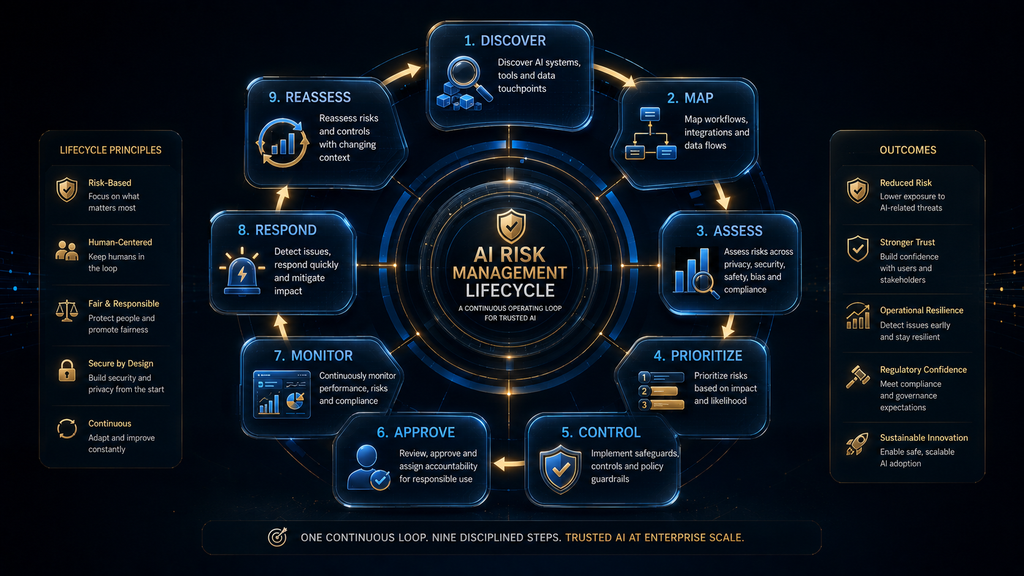
A useful SMB implementation can be organized into eight connected stages: Discover → Assess → Prioritize → Control → Approve → Monitor → Respond → Reassess. This lifecycle translates the principles behind established frameworks into something a smaller organization can operate without creating a separate department.
Discover means finding the AI that already exists inside the company. Assess means understanding the use case, data, people affected, failure modes, and business consequences. Prioritize means deciding which risks deserve the most attention. Control means reducing those risks through technical, procedural, contractual, or human safeguards.
Approve creates accountability before consequential deployment. Monitor checks whether the system continues to behave as expected. Respond defines what happens when something goes wrong. Reassess recognizes that the risk profile can change when the model, vendor, data, workflow, users, or business context changes.
This lifecycle is compatible with NIST’s approach without pretending that NIST itself prescribes this exact eight-step sequence. NIST describes Govern, Map, Measure, and Manage as broad functions that can be applied throughout the AI lifecycle, and specifically notes that risk management should be continuous rather than treated as a one-time exercise.
Step 1: Build an Honest AI Inventory
The first step is not writing a policy. It is finding out what is actually happening.
An AI inventory is a living register of the AI systems, features, tools, workflows, and services being used by the organization. The word honest matters because a formal procurement list is rarely enough. Employees can access AI through software the company already pays for, browser extensions, meeting tools, CRM features, office applications, customer-service platforms, coding environments, automation platforms, and standalone services.
A useful inventory should capture more than the tool’s name. For each use case, record what the system does, which team uses it, what information enters it, what comes out, whether the output influences a decision, whether the AI can take action, which vendor provides it, and who owns the business process.
Consider a 50-person company that discovers twelve AI use cases during its first inventory. Two may involve public marketing content, three may involve internal productivity, two may process customer conversations, one may summarize financial information, two may support recruitment, and two may connect AI to operational systems. Treating all twelve as equivalent would be a governance failure because their consequences are fundamentally different.
A practical AI inventory can therefore include fields such as:
| Inventory Field | What to Record |
|---|---|
| AI system/tool | Product, feature, model, or embedded capability |
| Business purpose | Why the organization uses it |
| Business owner | Person accountable for the use case |
| Users | Teams or roles using it |
| Inputs | Data provided to the system |
| Outputs | What the system produces |
| Downstream action | What happens after the output |
| AI authority | Generate, recommend, decide, or execute |
| Data sensitivity | Public, internal, confidential, personal, sensitive |
| External vendor | Provider and relevant dependencies |
| Human review | Whether and where review occurs |
| Risk level | Current assessment |
| Controls | Safeguards already implemented |
| Review date | When the use case must be reassessed |
The inventory itself is not the risk assessment. It is the map that makes the risk assessment possible.
Step 2: Map the AI Workflow, Not Just the AI Tool
Knowing that a company uses an AI application is useful, but it is not enough to understand the risk. The more important question is:
What happens before, during, and after the AI produces its output?
Imagine an AI assistant that summarizes customer support conversations. The model itself might appear relatively harmless. But if the summary is automatically entered into a customer record, used to determine whether a complaint receives escalation, and then fed into a reporting system, the overall workflow is much more consequential than the initial “summarization” label suggests.
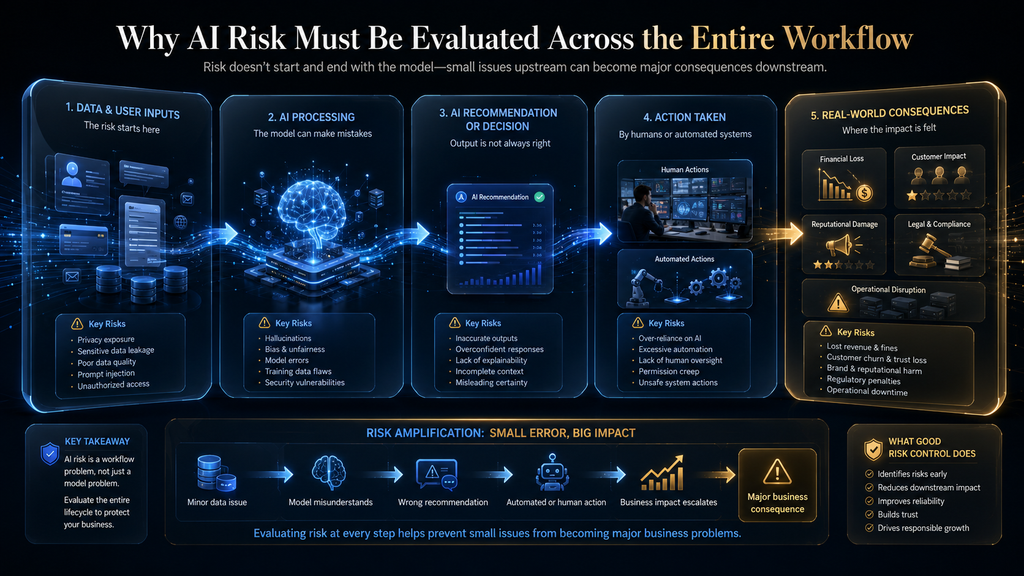
This is why risk should be mapped across the workflow: Input → AI processing → Output → Human interpretation → Business action → Downstream consequence. Each transition can introduce a different type of failure.
The input may contain sensitive information. The AI may misinterpret the information. The output may omit a critical detail. The employee may accept the answer without checking it. The resulting business action may affect a customer. That action may then become part of a permanent record.
The original error can become almost invisible by the time someone notices the consequence. This is one of the strongest reasons to treat AI risk as a system-level issue rather than simply asking whether a model is “safe.”
Step 3: Identify the Actual Risks
Once the workflow is visible, identify what could go wrong.
The obvious risk is inaccurate output, but AI systems can fail in many other ways. A useful assessment considers at least the following categories:
Accuracy and reliability
The system may generate incorrect, incomplete, outdated, inconsistent, or misleading information. Generative AI can produce confident answers that appear plausible even when the underlying reasoning or facts are wrong.
Privacy and data protection
The system may process personal or confidential information in ways the business does not fully understand or control. Questions around retention, training use, access, geographic processing, and vendor subprocessors can become material.
Security
AI applications can introduce additional attack surfaces, including prompt injection, sensitive-information disclosure, insecure integrations, excessive permissions, and vulnerabilities in connected tools. OWASP’s current GenAI work explicitly connects AI security risks with broader governance and compliance controls, mapping 51 GenAI vulnerabilities across 25 frameworks in its September 2026 crosswalk.
Bias and discrimination
An AI-assisted decision may produce systematically different outcomes for different groups, whether because of training data, system design, proxy variables, deployment context, or human interpretation.
Legal and regulatory exposure
AI use may intersect with privacy, employment, consumer protection, intellectual property, sector-specific requirements, contractual obligations, or emerging AI regulation.
Operational risk
The system may fail, become unavailable, behave differently after an update, or produce outputs that disrupt an existing workflow.
Vendor and supply-chain risk
A business can inherit risk from an AI provider’s infrastructure, data practices, subprocessors, security posture, model changes, or contractual terms.
Reputational risk
Customers may react negatively if an AI system makes an inappropriate decision, exposes information, produces offensive content, or creates the impression that the business has removed meaningful human accountability.
Autonomy and excessive authority
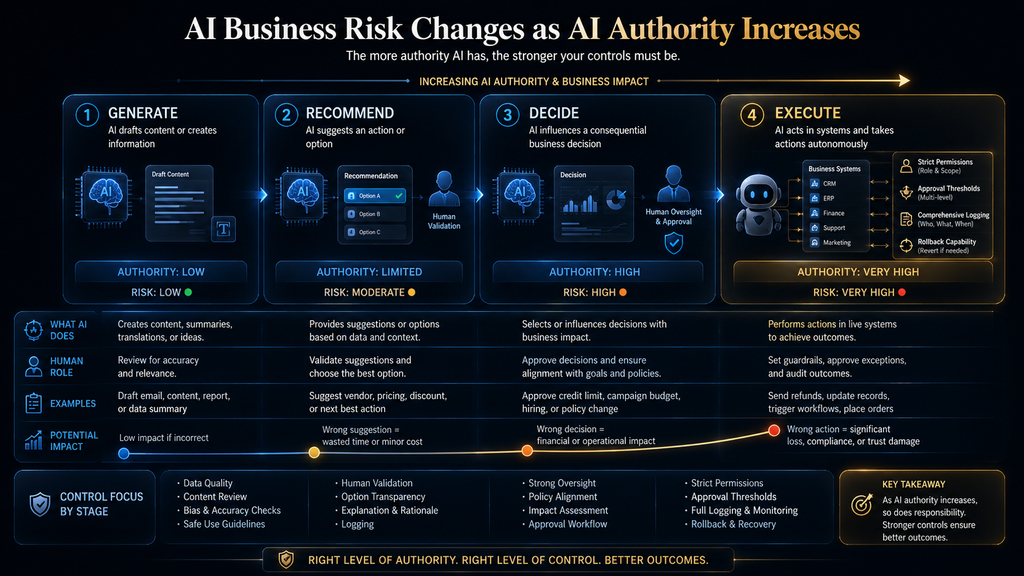
The most important emerging category is what the AI is actually allowed to do. A system that drafts an email is fundamentally different from one that can send it, modify a customer record, approve a refund, execute a transaction, or trigger another automated system.
The risk assessment should therefore ask not only “What can the model produce?” but also “What can the surrounding system do with that output?”
Step 4: Score Risk According to Consequence, Not Hype
A common SMB mistake is to create a simple Low/Medium/High label without explaining how the label is assigned. That creates the appearance of governance without the substance. A better approach is to evaluate several dimensions together.
1. Potential impact
How serious would the consequence be if the system failed?
An incorrect social-media headline may require an edit. An incorrect payroll calculation, discriminatory hiring recommendation, security incident, or erroneous customer eligibility decision could have substantially greater consequences.
2. Likelihood
How plausible is the failure under normal operating conditions?
Likelihood should reflect the actual system, not generic fears about AI. A well-tested workflow with constrained inputs and mandatory review may present less likelihood than an open-ended AI agent connected to multiple business systems.
3. Data sensitivity
What information does the system process? Public marketing copy and confidential customer records should not receive the same treatment.
4. AI authority
What can the system do? A useful hierarchy is: Generate → Recommend → Decide → Execute. The closer a system moves toward autonomous execution, the stronger the controls generally need to become.
5. Exposure
Who can be affected? An internal experiment with three employees has a different blast radius from a customer-facing system used thousands of times per month.
6. Reversibility
Can a mistake be easily corrected?
A wrong draft can usually be rewritten. A deleted database record, rejected job candidate, financial transaction, or public accusation may be far harder to reverse.
These dimensions help prevent an important governance error: confusing technical sophistication with business risk.
A powerful model does not automatically create high business risk. A relatively simple model can become high-risk if it is placed inside a consequential workflow with broad authority.
A Practical SMB Risk Matrix
The following matrix can help translate those principles into operating decisions.
| AI Use Case | Impact | Authority | Data Sensitivity | Suggested Governance |
|---|---|---|---|---|
| Brainstorming marketing ideas | Low | Generate | Low | Approved tool and basic review |
| Drafting blog content | Low–Medium | Generate | Low | Editorial review and source verification |
| Internal meeting summaries | Medium | Generate | Medium | Approved vendor and data rules |
| Customer-support drafting | Medium | Recommend | Medium–High | Human review and monitoring |
| Financial analysis | High | Recommend | High | Validation, accountable owner, documented review |
| Recruitment recommendations | High | Recommend | High | Formal assessment, fairness controls, meaningful human oversight |
| Customer eligibility decision | High | Decide | High | Strong controls, escalation, auditability |
| Autonomous refund agent | High | Execute | Medium–High | Permission limits, logging, thresholds, approval |
| AI controlling critical workflow | Very High | Execute | Variable | Formal risk assessment and continuous monitoring |
The purpose of the matrix is not to create a universal legal classification. It is a management tool that helps the organization determine how much governance is justified by the use case.
Step 5: Choose Controls That Match the Risk
Once the risk has been prioritized, the next question is what to do about it.
This is where many AI governance programs become either too weak or too restrictive. One extreme says, “AI is risky, so employees cannot use it.” The other says, “AI is productive, so employees can use whatever they want as long as they are careful.” Neither approach scales well.
The better approach is to match controls to the failure modes. For data-sensitive systems, controls may include data minimization, access restrictions, approved vendors, retention requirements, encryption, contractual safeguards, and restrictions on what employees may submit. For accuracy-sensitive systems, controls may include source grounding, validation, structured testing, confidence thresholds, independent review, and escalation when the system encounters ambiguous cases.
For decision-sensitive systems, controls may include documented decision criteria, human review, override authority, audit logs, fairness testing, and restrictions on autonomous action. For high-authority agents, controls may include least-privilege permissions, action limits, approval thresholds, time restrictions, transaction limits, logging, and the ability to stop or roll back actions. The important principle is that controls should target the mechanism of failure.
If the main risk is hallucination, adding a generic employee training course may not be sufficient. If the risk is unauthorized data exposure, telling users to “be responsible” is not a technical control. If the risk is excessive agent authority, requiring an employee to read a policy once does not meaningfully constrain what the agent can execute.
Good risk management therefore asks: What specific failure are we trying to prevent, detect, limit, or recover from?
Step 6: Assign Ownership Before Deployment
Every consequential AI use case should have a named owner.
That does not necessarily mean the company needs an “AI Risk Manager” as a new full-time position. In a smaller organization, responsibility can sit with an existing department leader, operations manager, security lead, compliance owner, product manager, or executive sponsor depending on the use case.
The important distinction is between tool ownership and business accountability.
The IT team may manage access to an AI platform, but the sales leader may still own the business process in which the system is used. A vendor may operate the model, but the customer company remains responsible for deciding whether and how that system is appropriate for its workflow.
For higher-risk systems, it is useful to separate several roles:
| Role | Responsibility |
|---|---|
| Business owner | Accountable for the use case |
| Technical owner | Manages integration and technical operation |
| Risk reviewer | Evaluates material risks and controls |
| Human decision-maker | Reviews consequential outputs |
| Escalation authority | Decides what happens when thresholds are exceeded |
| Vendor owner | Manages supplier relationship and evidence |
In a 25-person company, one person may perform several of these roles. That is acceptable. What matters is that the responsibilities are explicit.
Step 7: Evaluate AI Vendors Before You Trust Them
For most SMBs, AI risk is also third-party risk.
Most smaller businesses are not training foundation models themselves. They are buying AI functionality from vendors. That means part of their risk profile is determined by contracts, infrastructure, data handling, security practices, model behavior, and product changes outside the company’s direct control.
Vendor due diligence should therefore examine questions such as:
- What information does the service collect?
- Is customer content used for model training?
- How is customer data separated?
- How long is information retained?
- Where is it processed?
- Which subprocessors are involved?
- What security controls are documented?
- What happens if the vendor suffers a security incident?
- How are major product or model changes communicated?
- Can the organization delete or export its information?
- What happens when the contract ends?
- What evidence is available about security and compliance?
This does not mean every SMB needs to perform an enterprise procurement investigation for a simple AI writing tool. Again, proportionality matters.
A useful way to think about vendor assessment is: The more sensitive the data and consequential the workflow, the more evidence you should require from the provider.
For a low-risk application, basic contractual and privacy review may be sufficient. For a system processing sensitive customer information or making consequential decisions, vendor evidence, contractual protections, security review, and documented risk acceptance may become much more important.
Step 8: Test the System Before You Trust It
An AI system should not move from “interesting demo” to “business-critical workflow” without testing. Testing should reflect the way the system will actually be used.
For generative AI, this may include testing factual accuracy, missing information, ambiguous instructions, unusual inputs, inappropriate outputs, prompt manipulation, and edge cases. For decision-support systems, testing should examine whether recommendations remain reliable across relevant scenarios and whether particular groups experience materially different outcomes.
For AI agents, testing must go beyond the quality of generated text. The business needs to examine what the agent can access, which tools it can invoke, what actions it can take, what happens when instructions conflict, and how the organization can interrupt or recover from unwanted behavior.
NIST’s framework explicitly includes measurement and evaluation activities, while its Manage function emphasizes deciding whether an AI system achieves its intended purpose and whether deployment should proceed after considering benefits, risks, and trustworthiness characteristics. That leads to an important question that organizations sometimes skip: What evidence would convince us not to deploy this system? If nobody can answer that question, the approval process is probably biased toward adoption.
Step 9: Make Human Review Meaningful
“Human in the loop” sounds reassuring, but it can become an empty phrase.
A human who automatically approves every AI recommendation without understanding the underlying context is not providing meaningful oversight. The reviewer may technically exist in the workflow while providing almost no additional control.
Effective human oversight requires at least four things: the reviewer must have sufficient context, relevant competence, enough time to evaluate the output, and actual authority to reject or change the AI recommendation.
The type of review should also match the consequence. A human checking a low-risk marketing draft does not need the same level of expertise or independence as someone reviewing an AI recommendation that could affect employment, financial decisions, customer eligibility, or access to a critical service.
This is why the question should not simply be: “Is there a human?” It should be: “Can the human meaningfully detect, challenge, override, and escalate an AI failure?” NIST’s AI RMF specifically includes human oversight within its mapping activities, reinforcing that oversight should be defined and assessed rather than assumed.
Step 10: Monitor AI After Deployment
Risk management does not end when the AI system passes its initial assessment.
Models change. Vendors change. Data changes. Employees change how systems are used. A workflow that was low-risk six months ago can become more consequential after an integration is added.
Imagine that a company initially uses an AI assistant only to draft internal summaries. Six months later, the vendor adds an automation feature and the company connects the assistant to its CRM. The underlying model may not have changed much, but the risk profile has changed substantially because the system now has access to more information and a path toward operational action.
Monitoring should therefore look at both AI performance and business context. Useful indicators include:
- error rates;
- customer complaints;
- override frequency;
- unusual outputs;
- incidents;
- privacy or security events;
- changes in data sources;
- vendor changes;
- workflow changes;
- new integrations;
- changes in AI permissions;
- unexpected use cases.
The organization should establish reassessment triggers rather than relying exclusively on an annual calendar. A major model change, new data category, new external integration, increase in autonomy, serious incident, or major change in business purpose should be enough to trigger a review.
The AI Hustle World A.I.R. Framework
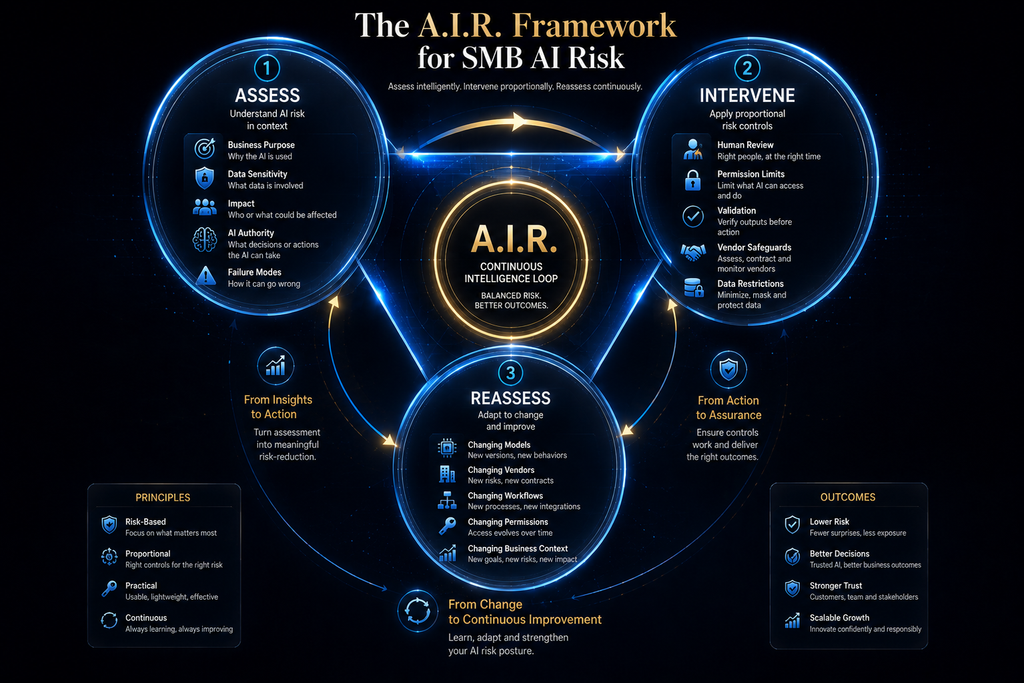
To make the overall process easier to remember, AI Hustle World can reduce the broader lifecycle to three operating principles:
Assess
Understand the AI use case before assuming that the technology itself is the risk. Identify the workflow, stakeholders, data, authority, potential impact, failure modes, and dependencies.
Intervene
Apply controls that directly address the highest-priority risks. That may mean restricting data, adding human review, limiting permissions, testing outputs, changing the workflow, strengthening vendor requirements, or deciding not to deploy the AI at all.
Reassess
Treat risk as dynamic. Review the system when its technology, vendor, data, users, authority, or business context changes, and use incidents and monitoring results to improve the controls.
The value of the A.I.R. model is not that it replaces established frameworks. It is that it gives an SMB a simple operating mental model for turning formal risk principles into everyday decisions.
Why the Traditional Method of Risk Management Still Matters
AI can feel like an entirely new category of business risk, but many of the underlying management disciplines are not new. Businesses have always needed to ask whether a supplier is trustworthy, whether confidential information is adequately protected, whether employees are authorized to perform a task, whether a financial process has appropriate controls, whether a critical system has a fallback, and who is accountable when something goes wrong.
AI adds new technical characteristics to those problems, but it does not eliminate the value of traditional risk management. This is important because an SMB should avoid creating a completely disconnected “AI bureaucracy.” Where existing processes already handle vendor management, information security, privacy, procurement, quality assurance, incident response, or internal controls, AI risk should be integrated into those systems wherever practical.
ISO/IEC 42001 illustrates this management-system approach. ISO describes the standard as a framework for establishing, implementing, maintaining, and continually improving an AI Management System, including the management of AI-related risks and opportunities.
The strategic lesson is straightforward: AI governance should strengthen the organization’s existing control environment rather than create parallel paperwork for its own sake.
NIST AI RMF vs. ISO/IEC 42001: Which Should an SMB Use?
These two approaches are related, but they serve different purposes.
The NIST AI RMF is a voluntary framework for conceptualizing and managing AI risk. Its four functions—Govern, Map, Measure, and Manage—provide a flexible way to structure risk-management activities. NIST explicitly states that organizations can use as much or as little of the Playbook’s guidance as is appropriate for their needs.
ISO/IEC 42001 is an international standard for an AI management system. ISO describes it as specifying requirements for establishing, implementing, maintaining, and continually improving an AI Management System, and notes that it applies to organizations of different sizes that develop, provide, or use AI systems.
For many SMBs, the practical sequence is therefore: Start with risk management principles → integrate them into existing business processes → formalize further when the organization’s size, customers, contracts, regulatory exposure, or assurance requirements justify it.
An SMB does not need ISO certification simply because it uses AI. Likewise, using NIST does not automatically mean the organization has implemented a complete AI management system.
The frameworks are tools. The business decision should determine how much structure is appropriate.
Where the OECD Fits
The OECD’s 2026 Due Diligence Guidance adds another useful perspective because it frames responsible AI as an ongoing process rather than a one-time compliance exercise.
The guidance is designed to help enterprises implement OECD responsible-business principles and AI principles while proactively addressing adverse impacts. It also emphasizes coherence and interoperability with other AI risk-management frameworks.
For an SMB, this reinforces an important idea: risk management should follow the impact.
You do not need to investigate every low-impact AI experiment as though it were a critical infrastructure deployment. But when an AI system can materially affect people, business operations, sensitive information, or important decisions, the organization should increase the depth of its assessment and controls.
AI Security Is Part of AI Risk Management, Not the Entire Thing
Security deserves special treatment because AI systems can create attack paths that ordinary software workflows do not.
A generative AI application may process untrusted instructions, retrieve information from internal systems, invoke tools, or generate outputs that are then acted upon by people or software. As AI systems become more agentic, the boundary between “answering a question” and “taking an action” becomes increasingly important.
OWASP’s 2026 security work illustrates how quickly this area is developing. Its GenAI Security Industry Framework Crosswalk connects 51 GenAI vulnerabilities with controls across 25 established frameworks, while its broader 2026 work includes guidance around LLM and agentic-AI risks.
For an SMB, the practical implication is not that every employee needs to become an AI security engineer. It is that AI risk assessments should ask basic security questions:
What can the system access? What can it send? What can it execute? Who can invoke it? What happens if its instructions are manipulated? What gets logged? Can access be revoked quickly?
Those questions become increasingly important as AI moves from generating content to interacting with business systems.
The Contrarian Reality: More Governance Can Sometimes Increase Risk
Here is the uncomfortable part of AI governance. A company can create so much process that employees stop using the approved systems and start using unapproved ones.
If every legitimate AI experiment requires weeks of approval, employees may quietly copy information into consumer tools because those tools are faster. The organization then loses visibility precisely because its governance system was too restrictive.
The solution is not to remove controls. It is to make the safe path practical.
An effective SMB AI policy should make approved behavior easier than unauthorized behavior. Approved tools should be easy to access, data rules should be understandable, risk assessment should be proportional, and employees should know where to ask questions when a use case does not fit an existing category.
This is one reason an inventory is so important. Governance should not be designed around the assumption that management already knows everything employees are doing.
If your framework only governs the AI you know about, it may leave the most important AI use cases completely outside the system.
Common AI Risk Management Mistakes
Mistake 1: Writing the policy before discovering the use cases
A policy written without an inventory tends to describe an imaginary organization. It may prohibit behaviors nobody performs while missing the workflows that actually create exposure.
Start with reality.
Mistake 2: Treating every AI application as equally risky
A brainstorming assistant and an autonomous customer-action agent should not face the same approval process. Equal treatment creates either excessive friction for low-risk use or insufficient controls for high-risk use.
Mistake 3: Treating human review as a magic control
A person who approves AI output automatically is not meaningful oversight. Review must have sufficient context, expertise, authority, and time.
Mistake 4: Ignoring vendor risk
When an SMB uses a third-party AI service, some important decisions about data handling, infrastructure, model behavior, and system changes sit outside the company. That does not eliminate the company’s responsibility to understand the dependency.
Mistake 5: Measuring governance by documents created
A company can have a policy, risk register, approval form, and annual training program while still having weak AI governance. The better question is whether the controls actually reduce meaningful risk.
Mistake 6: Forgetting that AI authority changes risk
A system that generates a recommendation is not equivalent to one that executes the recommendation. The expansion of permissions can transform the same underlying AI capability into a much higher-risk system.
Mistake 7: Treating assessment as permanent
A risk assessment is a snapshot. AI systems evolve, vendors change, employees discover new capabilities, and organizations connect tools to new data sources.
Reassessment is part of the framework, not an administrative afterthought.
What Happens If an SMB Does Nothing?
The most realistic consequence of doing nothing is not necessarily a dramatic AI catastrophe. It is gradual loss of visibility.
A company starts with two AI tools. Then employees discover new features inside existing software. Someone connects an AI assistant to a CRM. Another employee uploads confidential documents into a consumer application. A manager starts relying on AI recommendations. A vendor changes its model behavior. An agent gains access to another system.
None of these events necessarily triggers an immediate crisis. But collectively, the organization becomes unable to answer basic questions about its own AI environment. That is the deeper risk.
When something eventually goes wrong, management may discover that nobody knows exactly which system processed the information, which employee configured it, which vendor handled the data, which version of the model was involved, whether anyone reviewed the output, or what should have happened instead. A mature risk framework prevents that situation by creating visibility before an incident forces the organization to reconstruct its AI environment under pressure.
How to Build the Framework in 90 Days
An SMB does not need to implement every control on day one. A staged rollout is more realistic.
Days 1–30: Discover and Map
The first month should focus on visibility. Create the AI inventory, identify business owners, document the major workflows, identify the data each system processes, and determine whether each system generates, recommends, decides, or executes. At the end of this stage, management should be able to answer: Where is AI being used, who owns it, what data does it touch, and what happens after the AI produces an output?
Do not try to perfect every assessment during this phase. Build the map first.
Days 31–60: Assess and Control
Now classify the use cases according to impact, likelihood, sensitivity, authority, exposure, and reversibility.
Focus the deepest assessment on the highest-risk systems. Define required controls, review vendor arrangements, establish human-review requirements, restrict unnecessary permissions, and document who can approve or reject deployment.
The objective is not to make every AI use case “highly governed.” It is to make the risk differences visible and actionable.
Days 61–90: Operate and Measure
During the final phase, establish monitoring, incident procedures, review triggers, and governance metrics. Create a regular review cadence for higher-risk systems and event-based reassessment for major changes. At this point, the framework should become part of normal business operations rather than remaining a one-time project.
What Should an SMB’s AI Risk Register Look Like?
A risk register should be simple enough that employees will actually maintain it.
| Field | Example |
|---|---|
| AI use case | Customer-support response assistant |
| Business owner | Head of Customer Support |
| AI capability | Generates response recommendations |
| Data | Customer messages and account context |
| Potential impact | Customer/reputational |
| Authority | Recommend |
| Key risks | Hallucination, inappropriate response, data exposure |
| Existing controls | Approved vendor, human review |
| Risk rating | Medium |
| Additional control | Escalation for sensitive complaints |
| Incident trigger | Customer complaint or material error |
| Review trigger | Model/vendor/workflow change |
| Next review | Defined review date |
The value comes from the connection between the fields. A risk register should make it possible to move from risk → control → owner → evidence → monitoring.
If the register merely stores a risk label and a paragraph of generic text, it is not doing much operational work.
How to Measure Whether Your AI Risk Framework Works
The strongest AI governance programs should measure outcomes rather than paperwork. A practical SMB dashboard might track:
| KPI | What It Tells You |
|---|---|
| AI inventory coverage | How much known AI use has been documented |
| High-risk assessment coverage | Whether consequential systems have been evaluated |
| Control implementation rate | Whether required safeguards are actually in place |
| Human-review completion | Whether required oversight is occurring |
| AI incident count | How often meaningful failures occur |
| Incident severity | Whether failures are becoming more consequential |
| Mean time to response | How quickly problems are addressed |
| Vendor assessment coverage | Whether important third-party AI systems have been reviewed |
| Exception rate | How often teams operate outside approved controls |
| Reassessment completion | Whether changing systems are being reviewed |
| Control effectiveness | Whether safeguards reduce observed failures |
The last metric is especially important.
Suppose an organization introduces mandatory human review but discovers that reviewers approve 99.8% of AI recommendations without modification. That number alone does not prove the control is effective. It might mean the AI is highly reliable, or it might mean reviewers are rubber-stamping outputs.
Measurement needs interpretation. This is where experienced risk management differs from checkbox compliance.
A Simple Decision Rule for SMBs
When deciding how much governance an AI use case deserves, ask five questions:
1. How bad would the outcome be if the AI were wrong?
The greater the consequence, the stronger the controls should become.
2. How much authority does the AI have?
Generating content is usually less consequential than making or executing decisions.
3. What information does the system touch?
The more sensitive the data, the more carefully the organization should evaluate access, retention, vendors, and security.
4. How reversible is a mistake?
If an error can be corrected easily, the risk may be manageable with lighter controls. If the consequence is difficult or impossible to reverse, governance should become stronger.
5. How much visibility does the organization have?
A system that can be monitored, audited, interrupted, and reviewed is generally easier to manage than a black-box workflow with unclear data flows and no meaningful logging. Together, these questions produce a more useful decision than simply asking whether a tool is “AI.”
Who Should Use a Formal AI Risk Management Framework?
A formalized framework becomes particularly valuable when an SMB:
- uses AI across multiple departments;
- processes customer or employee information through AI systems;
- uses AI in consequential business decisions;
- connects AI to internal systems or databases;
- deploys AI agents with tool or transaction access;
- operates in a regulated or highly contractual environment;
- relies heavily on third-party AI vendors;
- expects AI usage to grow rapidly;
- needs to demonstrate responsible AI practices to customers or partners.
A very small business using AI only for brainstorming public marketing content may need little more than approved tools, sensible data rules, and human editorial review. A business using AI for recruitment, financial analysis, customer eligibility, healthcare-related workflows, sensitive personal information, or autonomous operational actions should expect substantially more governance. The framework should scale with the consequence and complexity of the use case, not simply with the number of employees.
Who Should Avoid Overbuilding It?
An SMB should be cautious about buying or constructing an elaborate AI governance system before it understands its actual AI environment. If the company has five low-risk AI use cases and no sensitive data, spending months designing an enterprise-style committee structure may create more cost than value.
Likewise, certification should not become the objective by itself. ISO/IEC 42001 can provide valuable structure, especially for organizations that need formal assurance, but the existence of a certificate does not automatically prove that every individual AI workflow is well managed. ISO itself describes 42001 as a management-system standard designed for continual improvement and management of AI-related risks and opportunities.
The framework should serve the business. The business should not become a servant of the framework.
The Economics of AI Risk Management
Risk management has a cost, but unmanaged risk has a cost too. The correct comparison is not: Governance cost vs. zero cost. It is: Governance cost vs. expected cost of preventable failures plus the operational value of better control.
A lightweight AI inventory may take a few hours to establish. A structured review for a high-risk system may take substantially longer. But the cost should be compared with the potential impact of a serious privacy incident, incorrect automated decision, vendor failure, customer dispute, security event, or operational disruption.
There is also a positive side to risk management.
A good inventory can reveal duplicate AI subscriptions. A workflow assessment can identify unnecessary manual steps. Vendor review can expose tools that should be consolidated. Permission reviews can reduce unnecessary access. Monitoring can identify AI use cases that are not delivering enough value to justify their complexity.
That means effective AI risk management is not simply defensive. It can improve the economics of AI adoption by helping the company spend governance effort where it creates the most value.
Second-Order Effects: What Happens When AI Risk Management Matures?
The first-order benefit of an AI risk framework is better control. The second-order benefit is better organizational understanding.
Once an organization inventories its AI systems, it starts seeing where AI is actually changing work. It can identify which teams are using AI heavily, which workflows are becoming dependent on automation, where data is moving, where employees are bypassing official processes, and where AI creates genuine productivity gains.
That information can improve technology strategy.
A company may discover that five departments are independently paying for overlapping AI products. It may find that an AI workflow is being used far beyond its original purpose. It may discover that employees have created valuable automations that management did not know existed.
The risk framework therefore becomes an organizational intelligence layer. The surprising outcome is that better AI governance can increase AI adoption quality rather than simply restricting adoption.
The Next Risk Frontier: AI Agents
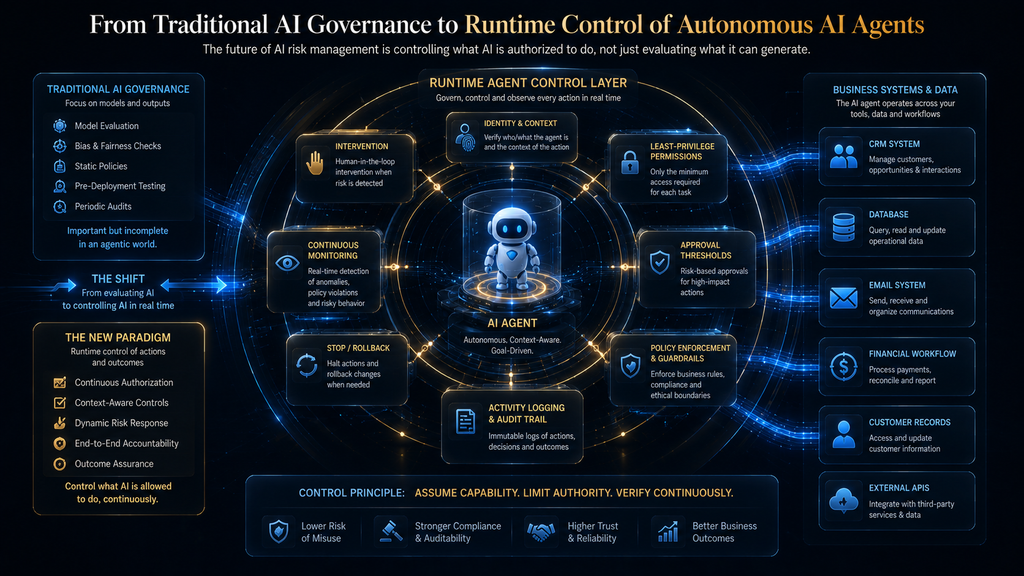
Traditional generative AI largely waits for a human to ask a question. AI agents increasingly have the ability to observe information, reason about a goal, call tools, interact with software, and take actions. That changes the risk equation.
If an AI system can only produce text, the primary risk may be that someone believes incorrect information. If an AI agent can send emails, update records, create tickets, move money, change configurations, or trigger other automated workflows, the primary risk expands to what the system is authorized to do.
This makes permission architecture increasingly important. The future SMB risk framework will therefore need to track not only Which model are we using?
but also: Which tools can it access? Which actions can it execute? Under what conditions? What requires approval? What gets logged? How can we stop it?
OWASP’s September 2026 Agent Control Standard work and broader agentic-AI security efforts reflect this shift toward practical runtime control, identity, governance, and testing for systems that can act rather than merely generate. For SMBs, the principle is simple: the more autonomous the AI becomes, the more important permission boundaries and runtime controls become.
A Practical SMB AI Risk Management Checklist
Before approving an important AI use case, the organization should be able to answer the following:
Business context
- What business problem is the AI solving?
- What happens if the AI is unavailable?
- What happens if the AI is wrong?
- Is AI actually better than the existing method?
Data
- What information enters the system?
- Is any of it sensitive?
- Who can access it?
- How is it retained?
- Which vendors or subprocessors receive it?
AI behavior
- What does the system generate, recommend, decide, or execute?
- What are its known limitations?
- How has it been tested?
- What edge cases have been considered?
Human oversight
- When must a human review the output?
- Who performs the review?
- Can they reject or override the AI?
- What happens when the reviewer is uncertain?
Security
- What systems can the AI access?
- What permissions does it have?
- Can it invoke external tools?
- Are important actions logged?
- Can access be revoked quickly?
Vendor
- Who provides the AI?
- What contractual protections exist?
- How are security incidents handled?
- How are major changes communicated?
- What happens when the relationship ends?
Monitoring
- What metrics are tracked?
- What counts as an incident?
- What triggers reassessment?
- How often is the system reviewed?
Accountability
- Who owns the use case?
- Who approves deployment?
- Who handles incidents?
- Who can stop the system?
If these questions cannot be answered for a consequential AI use case, the organization probably does not yet have enough visibility to manage it confidently.
AI Risk Management Is Not About Eliminating Risk
There is a temptation to define responsible AI as “make the risk zero.” That is not realistic.
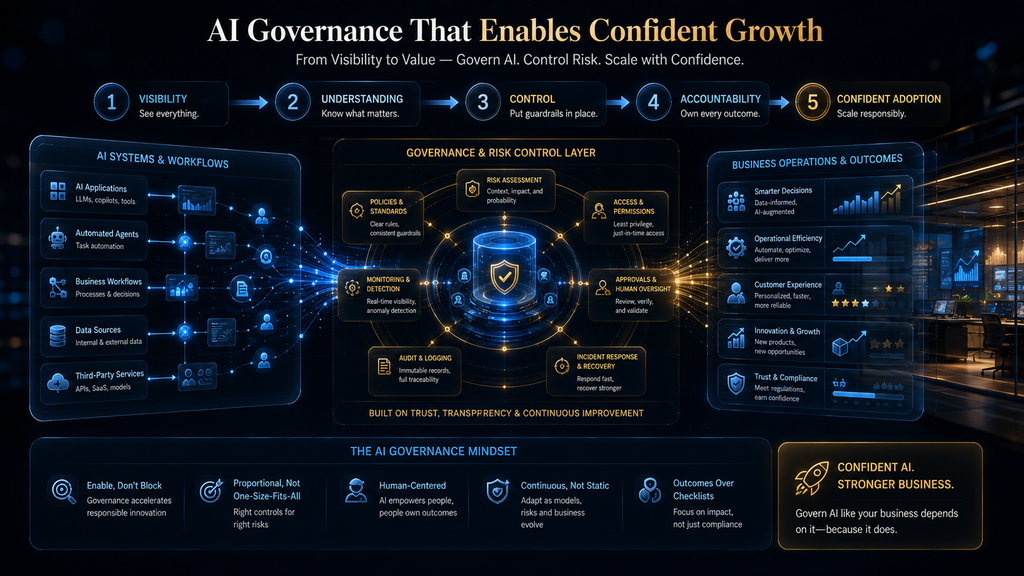
Every business process contains risk. The objective of risk management is to understand that risk, decide which level is acceptable, reduce avoidable exposure, and make sure someone is accountable for the remaining uncertainty.
The same principle applies to AI.
A company may reasonably decide that a low-risk AI writing assistant can operate with limited controls because mistakes are easy to detect and reverse. It may decide that an AI agent should never execute financial transactions without explicit human authorization because the consequences of error are materially higher.
Neither decision requires believing that AI is inherently safe or inherently dangerous. It requires understanding the trade-off.
NIST’s AI RMF similarly frames management around assessing risks alongside benefits and determining whether an AI system is appropriate for its intended purpose. That is a much more useful way to think about responsible adoption.
The AI Risk Management Framework in One Picture
The complete SMB approach can be summarized as:
- DISCOVER: Find every meaningful AI use case.
- MAP: Understand the workflow, data, people, vendors, systems, and consequences.
- ASSESS: Evaluate impact, likelihood, sensitivity, authority, exposure, and reversibility.
- PRIORITIZE: Separate low-risk experimentation from consequential AI use.
- CONTROL: Apply safeguards that directly address the identified failure modes.
- APPROVE: Assign ownership and establish decision rights before deployment.
- MONITOR: Measure performance, incidents, exceptions, changes, and control effectiveness.
- RESPOND: Contain failures, escalate when necessary, investigate what happened, and correct the workflow.
- REASSESS: Update the risk decision when the technology, data, vendor, permissions, or business context changes.
This is the operating system an SMB actually needs. It is more useful than a policy sitting in a shared drive because it connects decisions to actions and actions to accountability.
Final Thoughts
The best AI risk management framework for a small or mid-sized business is not the one with the most policies, committees, forms, or certifications. It is the one that helps the organization make better decisions about where AI belongs, where it needs guardrails, where human judgment remains essential, and where automation should stop.
Start by finding the AI that already exists. Then understand the workflow around it, evaluate the consequences of failure, and apply controls according to the actual risk rather than the novelty of the technology. From there, assign ownership, monitor the system, respond when something goes wrong, and reassess whenever the technology or business context changes.
NIST, ISO/IEC 42001, OECD guidance, and emerging AI security frameworks provide useful foundations, but an SMB does not need to copy any framework mechanically. The strongest approach is to translate established principles into a practical operating system that fits the organization’s size, risk tolerance, capabilities, and business model.
The most important distinction is between AI adoption and AI dependence. A company can experiment with AI relatively safely when a human remains clearly accountable and mistakes are easy to detect and reverse. Risk rises when AI becomes embedded in important workflows, receives access to sensitive information, influences consequential decisions, or gains the ability to act without meaningful oversight.
That is why AI risk management should not be treated as an obstacle to AI adoption. Done properly, it is what allows a business to adopt more AI with greater confidence—because the organization knows where the boundaries are, who owns the decisions, what happens when the system fails, and when it is time to step in.
Ready to Put AI Risk Management Into Practice?
Start with a simple AI inventory, identify your highest-impact risks, and introduce controls where they matter most. A practical framework gives your business a safer way to scale AI without turning governance into unnecessary bureaucracy.
Check What Happens to Your Data →Frequently Asked Questions
1. What is an AI risk management framework?
An AI risk management framework is a structured process for identifying how an organization uses AI, evaluating the potential consequences of failures, prioritizing risks, implementing appropriate controls, assigning accountability, and continuously monitoring the system. Frameworks such as NIST AI RMF organize these activities around functions including Govern, Map, Measure, and Manage.
2. Why do small businesses need AI risk management?
Small businesses need AI risk management because AI can enter everyday workflows quickly, often through third-party applications and features that employees adopt without a formal technology project. A lightweight framework helps the business understand where AI is being used, protect sensitive information, reduce consequential errors, manage vendors, and maintain accountability without creating unnecessary bureaucracy.
3. How do you assess AI risk in a small business?
Start by documenting the AI use case and its workflow, then evaluate potential impact, likelihood, data sensitivity, AI authority, exposure, and reversibility. The assessment should also consider who is affected, what controls already exist, what vendors are involved, and whether a human can meaningfully review or override important outcomes.
4. What should an AI risk assessment include?
A useful assessment should document the business purpose, AI capability, data inputs, outputs, affected stakeholders, potential failure modes, impact, likelihood, security and privacy considerations, vendor dependencies, human oversight, existing controls, residual risk, ownership, and conditions that would trigger reassessment.
5. What are the main AI risks businesses should consider?
Common AI risks include inaccurate or unreliable outputs, privacy and data exposure, security vulnerabilities, bias, legal and regulatory exposure, vendor risk, operational failures, reputational damage, and excessive automation or AI authority. The relative importance of each risk depends on how the particular system is deployed.
6. Is the NIST AI Risk Management Framework suitable for small businesses?
Yes. NIST describes the AI RMF and its Playbook as voluntary and flexible, allowing organizations to use the guidance that fits their industry, use cases, and needs. That makes it possible for an SMB to adopt the underlying risk-management principles without implementing every possible governance activity.
7. What is the difference between AI governance and AI risk management?
AI governance is the broader system of policies, roles, accountability, decision rights, and organizational oversight surrounding AI. AI risk management is a major component of that system focused specifically on identifying, assessing, treating, monitoring, and responding to AI-related risks.
8. How often should an AI risk assessment be reviewed?
High-impact AI systems should be reviewed periodically and whenever a significant change occurs. Triggers can include a major model or vendor change, new data sources, new integrations, increased autonomy, a security or privacy incident, a major workflow change, or evidence that the system is behaving differently from its original assessment.
9. Who should be responsible for AI risk management in an SMB?
Responsibility should normally be distributed according to the use case, with a named business owner accountable for each consequential AI system. Smaller organizations may combine roles, but they should still identify who owns the business outcome, who manages the technology, who reviews important risks, who can approve deployment, and who has authority to stop or escalate the system.
10. How can a small business implement AI risk management without a large compliance team?
Start small: create an AI inventory, map the most important workflows, classify risk, focus controls on high-impact use cases, assign owners, establish basic vendor and data rules, and introduce monitoring and reassessment triggers. The objective is not to build a miniature enterprise compliance department; it is to create enough visibility and control to make informed decisions about where AI can safely create value.
Written by
Muntasir Ahmad Chowdhury
Founder, AI Hustle World
Muntasir Ahmad Chowdhury is the Founder of AI Hustle World, an independent publication dedicated to making Artificial Intelligence practical, trustworthy, and easy to understand. He researches AI tools, automation, customer service, productivity, and real-world business applications, helping readers make smarter technology decisions through research-driven, experience-backed content.
Expertise:
AI Tools • AI Automation • AI Customer Service • AI Productivity • Generative AI • AI Workflows
Get Smarter With AI
Enjoyed this guide? Get practical AI tools, tutorials, and honest reviews delivered to your inbox.
5 thoughts on “How to Build an AI Risk Management Framework for Small and Mid-Sized Businesses”