Best AI Prompt Libraries and Marketplaces for Ready-to-Use Prompts in 2026
AI prompt libraries and marketplaces promise to save you from staring at a blank chat box, but plenty of them are selling you something you already have for free.
You search “best ChatGPT prompts for marketing” and land on a page selling a $9 bundle of prompts that turn out to be one sentence long, generic, and roughly what ChatGPT already suggests if you ask it to improve your own wording. You’ve just paid for something the model would have given you for free with a slightly better question.
That experience is common enough in 2026 that it’s worth asking a blunter question than “which prompt library is best”: is paying for prompts still a good idea at all, and if so, for which kind of prompt, bought from which kind of source? The honest answer depends heavily on what you’re trying to do, because “prompt library” now covers at least four very different products that get marketed with the same language.
This guide compares the real options: paid marketplaces where individual creators sell one-off prompts, free community libraries built into browser extensions, specialized search engines for image and video prompts, and the native prompt libraries that OpenAI, Anthropic, and Google now ship inside their own products for free. It also covers the one category worth avoiding for professional use, and the two-part decision framework we use internally to decide whether a given task needs a bought prompt, a free one, or something you write yourself.
This is a different question from the one we answered in Best Prompt Management Tools for Teams in 2026. That article covered software teams version-controlling and evaluating prompts inside a product. This one covers something much more common: an individual, marketer, or small team looking for ready-made prompts they can copy, paste, and use today, without building anything.
The short answer, before the detail: most people searching for “prompt libraries” in 2026 are better served by a free, model-native option than a paid marketplace, but there are specific, narrow cases — image and video prompt discovery being the clearest one — where a dedicated marketplace still earns its price. The rest of this guide explains exactly where that line sits.
What “Prompt Library” and “Prompt Marketplace” Actually Mean in 2026
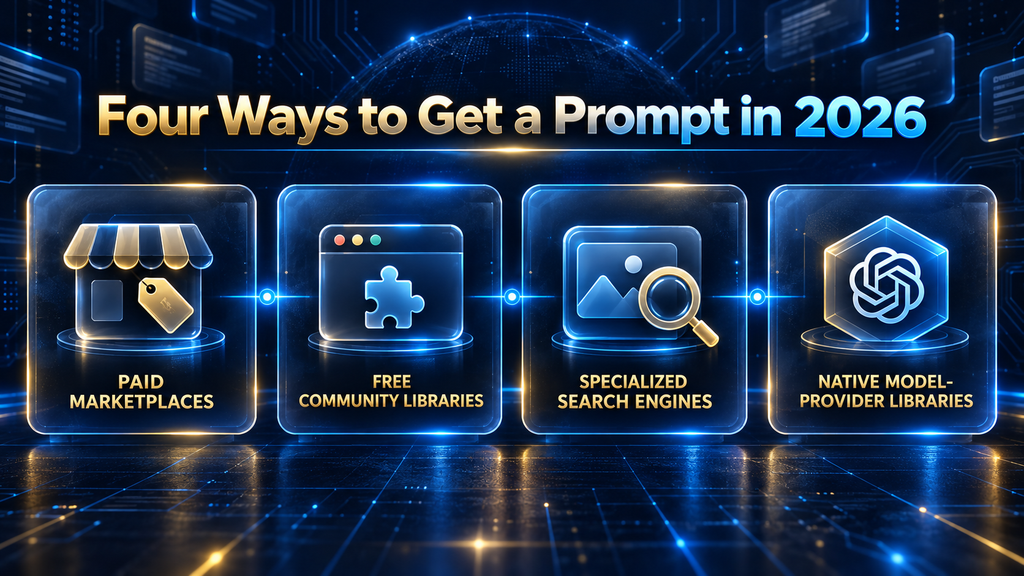
The terms get used loosely enough that it’s worth separating four distinct product types before comparing anything, because the right choice depends entirely on which one you actually need.
Paid prompt marketplaces are storefronts where individual creators list and sell prompts, usually priced per prompt or per small bundle. PromptBase is the clearest example: you browse listings, preview sample output, and pay to reveal the exact prompt text. The value proposition is that someone already did the trial-and-error of getting a hard visual style or output format right, and you’re buying that iteration time back.
Free community prompt libraries are crowd-sourced collections, often distributed as a browser extension or a searchable directory, where the business model is usage data, premium team features, or advertising rather than per-prompt sales. AIPRM is the standard example: a Chrome extension that injects a searchable prompt library directly into the ChatGPT interface, most of it free.
Specialized prompt search engines serve one narrow, visual use case extremely well: finding the exact wording that produced a specific image or video style. PromptHero is the enduring example here — you search by visual result, not by keyword guess, which is a fundamentally different (and for this use case, better) discovery model than a general marketplace.
Native, model-provider prompt libraries are the newest and most disruptive category: prompt collections and reusable-assistant builders shipped for free inside ChatGPT, Claude, and Gemini themselves. Anthropic’s own Claude Code prompt library, OpenAI’s GPT Store, and Google’s Gemini Gems all fall here, and their existence is the single biggest reason the economics of the paid-prompt business changed in the last two years.
Keeping these four categories separate matters because comparing PromptHero to AIPRM, or PromptBase to a free GPT Store agent, is comparing tools built for different jobs. The rest of this article treats each on its own terms rather than forcing a single ranked list.
Why the Prompt-Selling Business Is Under Real Pressure Right Now
The market for buying individual prompts looked a lot more stable two years ago than it does now, and the shift is worth understanding before you spend money in this category, because it’s reshaping which products are worth trusting.
The clearest structural threat is that model providers started shipping their own prompt infrastructure for free. Anthropic publishes an official, continuously updated prompt library for Claude Code — copy-paste prompts tagged by task and role, maintained directly by the company that built the model.
OpenAI’s GPT Store and Google’s Gemini Gems go a step further: instead of a static prompt you copy and paste, you build (or use someone else’s) reusable custom assistant with the instructions already embedded, which removes the “find and paste a prompt” step entirely. When the model maker gives away a better version of what you’d otherwise pay a stranger for, the paid product needs a very specific reason to still exist.
The second pressure is happening inside the marketplaces themselves. PromptBase, the longest-running paid prompt marketplace, launched a subscription tier called PromptBase Select in February 2026, priced at $14 to $19 a month for ten downloads. The company’s own announcement is candid about why: buyers were reluctant to complete individual purchases for every prompt they wanted, and a large share of listed prompts were sitting unsold after 60 days.
Select converts that stagnant inventory into recurring revenue rather than one-off sales. That’s a rational business move, but it’s also a signal — a marketplace doesn’t build a subscription tier to fix “friction” and “unsold inventory” if per-prompt sales are thriving on their own.
The third pressure is category drift. FlowGPT, once positioned as a general prompt-and-character store, now markets itself primarily as an AI chat platform for roleplay and companion characters — its own homepage leads with “AI Boyfriend,” “AI Girlfriend,” and character chat rather than professional prompt discovery.
That’s a legitimate business for FlowGPT to be in, but it means the platform is no longer a reliable place to look for a marketing, coding, or analysis prompt; the professional prompt content that’s still there is a shrinking part of what the product is actually built around.
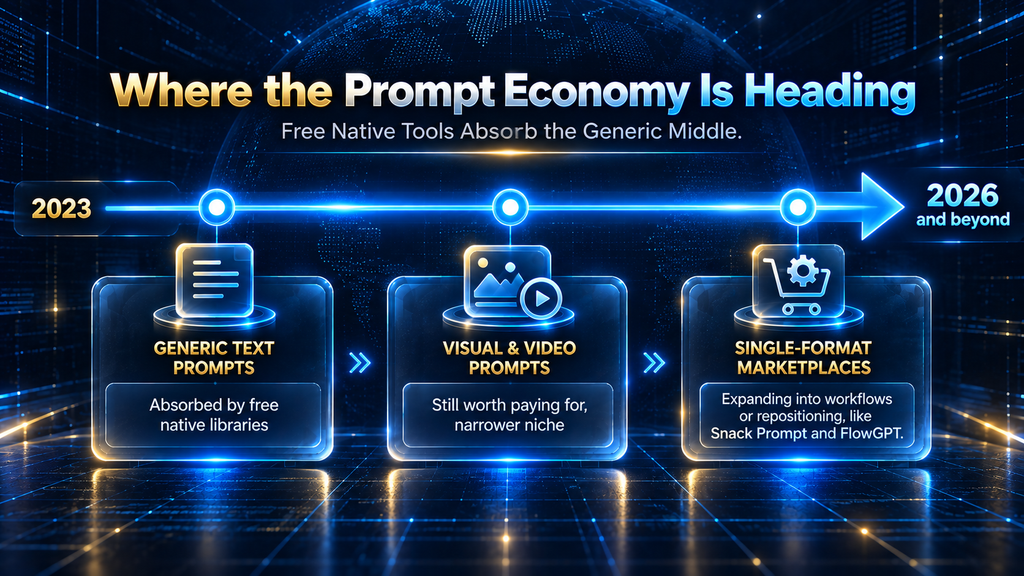
Meanwhile, the products that are growing are the ones that stopped treating “prompt” as the whole product. Snack Prompt, a community marketplace, now lists AI-generated images and automations and workflows alongside prompts, and explicitly supports multi-agent coordination across Claude, Gemini, Perplexity, and other tools — it survived by becoming a broader AI-resource hub rather than staying a single-format prompt store.
AIPRM followed a similar path, expanding from a ChatGPT-only extension to one that spans Claude, Gemini, and Midjourney, now serving more than two million users with over 5,400 public prompts. The products still standing tend to be the ones that widened what they sell, not the ones still selling exactly what they sold in 2023.
There’s a fourth factor worth naming plainly because it affects how you should shop: a large share of what search results call “prompt marketplaces” in 2026 are low-effort resale operations, often hosted on Gumroad, bundling generic prompt lists with no testing, no differentiation, and no real advantage over asking the model directly for a better version of your own question. None of the tools compared in this article fall into that category, but it’s worth knowing the category exists before you click a “500 ChatGPT prompts for $7” link that shows up next to the legitimate options.
The AI Hustle World Buyer Fit Score
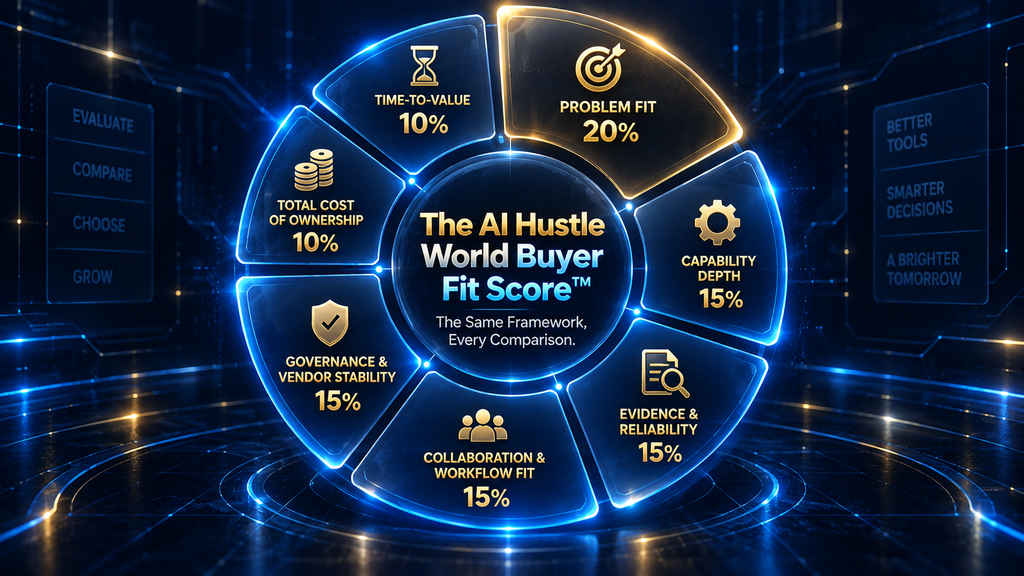
We use the same weighted scoring framework across every AI Hustle World comparison article rather than inventing a new one each time, because a buying framework only builds trust if readers can recognize it and apply it themselves across categories. This is the AI Hustle World Buyer Fit Score, first introduced in our prompt management comparison and reused here unchanged.
Seven weighted criteria make up the score: Problem Fit (20%) asks whether the tool actually solves the specific task you have, not a broader adjacent one. Capability Depth (15%) measures how much real functionality sits behind the marketing page. Evidence & Reliability (15%) asks whether claims about quality and results are verifiable rather than self-reported.
Collaboration & Workflow Fit (15%) covers whether the tool works with how you or your team actually operate, solo or shared. Governance & Vendor Stability (15%) — the criterion that matters most in this specific category given the churn described above — asks whether the company behind the product is still building it, still solvent, and still aligned with the use case you’re buying it for.
Total Cost of Ownership (10%) looks past the sticker price to subscription creep, per-download fees, and how much you’ll actually spend once you use the tool the way you intend to. Time-to-Value (10%) measures how fast you get something usable, since a prompt library that takes longer to search than the target answer takes to draft yourself has already failed its own purpose.
| Criterion | Weight | What It Actually Measures Here |
|---|---|---|
| Problem Fit | 20% | Does it match a real, specific prompt-sourcing need, not a vague “better prompts” promise |
| Capability Depth | 15% | Library size, search quality, model coverage, and whether prompts are tested before listing |
| Evidence & Reliability | 15% | Verifiable user counts, sample outputs, and review quality rather than self-reported claims |
| Collaboration & Workflow Fit | 15% | Works for solo use, team sharing, or both, and integrates with the tools you already use |
| Governance & Vendor Stability | 15% | Whether the company is actively maintained, funded, and still aligned with professional use |
| Total Cost of Ownership | 10% | Real spend once subscriptions, per-download fees, and upgrade prompts are included |
| Time-to-Value | 10% | How fast you get a usable prompt versus writing one yourself from scratch |
Each tool profile below reads on this framework qualitatively — High, Medium, or Low against each criterion — rather than as a fabricated point total, since no vendor here has published data precise enough to justify false decimal-point accuracy.
The Buy-or-Build Prompt Matrix
Beyond scoring individual tools, the more useful question is usually simpler: should you buy a prompt at all, or write your own? This is the second original framework in this article, built specifically to answer that question in about ten seconds.
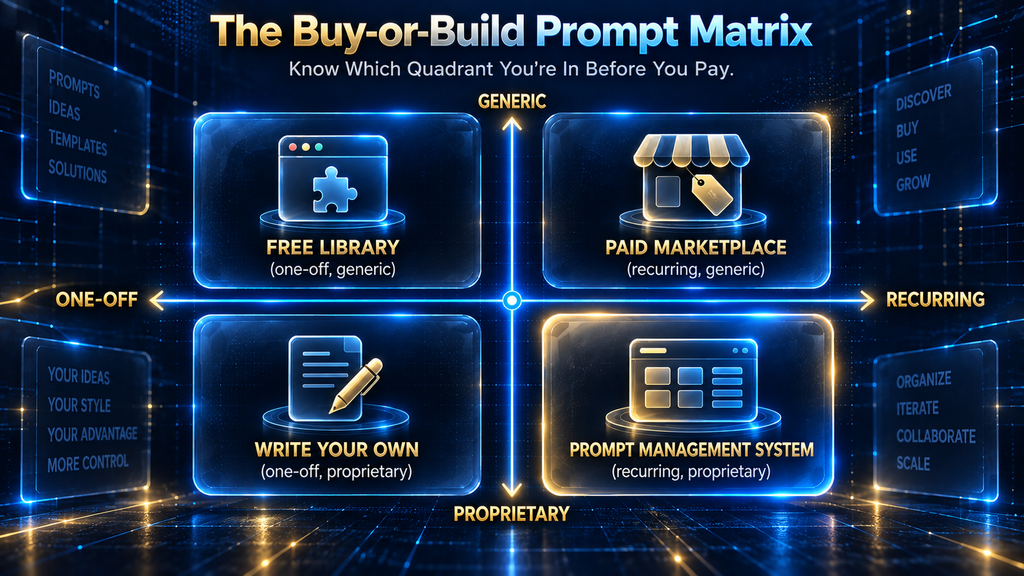
Plot your task on two axes. The first is whether the need is one-off or recurring — do you need this exact prompt once, or will you run something like it every week?
The second is whether the need is generic or proprietary — is this a common task with a well-known best answer, or does it depend on your specific brand voice, codebase, or data that no marketplace seller has access to. A one-off, generic need — you want a decent LinkedIn caption once, right now — is exactly what a free community library like AIPRM or a native option like a GPT Store assistant is built for; paying a marketplace for this is close to pure waste.
A recurring, generic need — you regularly need product-photo-style image prompts in a specific aesthetic — is where a paid marketplace or specialized search engine like PromptHero earns its price, because someone else’s iteration time compounds in value the more often you reuse it. A one-off, proprietary need — draft a system prompt reflecting your company’s specific support policy, once — is a job for the prompt-writing techniques in our context engineering and role prompting guides, not a marketplace search, because no seller has your policy.
A recurring, proprietary need — your team runs dozens of brand-specific prompts across a growing product — is exactly the case that pushes you out of “libraries” entirely and into a real system, which is what prompt management platforms are built for.
Most people searching for “best prompt libraries” are sitting in the first quadrant and don’t realize a paid marketplace is the wrong tool for what they need. The matrix exists to catch that before you pay for something a free option already covers.
How to Evaluate a Prompt Library Before You Pay for Anything
We haven’t run a formal benchmark of every marketplace listed here. This article is based on research and public documentation, not first-hand testing, and we’re not going to dress it up as more than that. What we can offer instead is a concrete, repeatable evaluation method you can run yourself in under five minutes before paying for anything.
Start by checking the preview, not the promise. A legitimate prompt listing shows real sample output next to the price, not just a description of what it’s supposed to do. If a listing can’t show you the result, assume the seller can’t either. Next, check the last-updated date on the specific prompt, not the platform.
Models change fast enough that a prompt tuned for a model two versions ago may simply not reproduce the sample output anymore. Then run the free-tier test: before paying, spend two minutes asking the free version of the same model to do the task in plain language, as well as you can phrase it yourself.
If the free result is within reach of the paid sample, the paid prompt isn’t selling you output quality — it’s selling you the specific phrasing, which only has value if you’ll reuse it often enough for that phrasing to matter. Finally, check who’s behind the listing.
A named creator with a track record and reviews is a different risk profile than an anonymous storefront reselling prompts scraped from public forums, which happens more often in this category than buyers expect.
Best AI Prompt Libraries and Marketplaces in 2026
The following tools represent the categories that actually hold up under the evaluation above — legitimate, actively maintained, and clear about what they are.
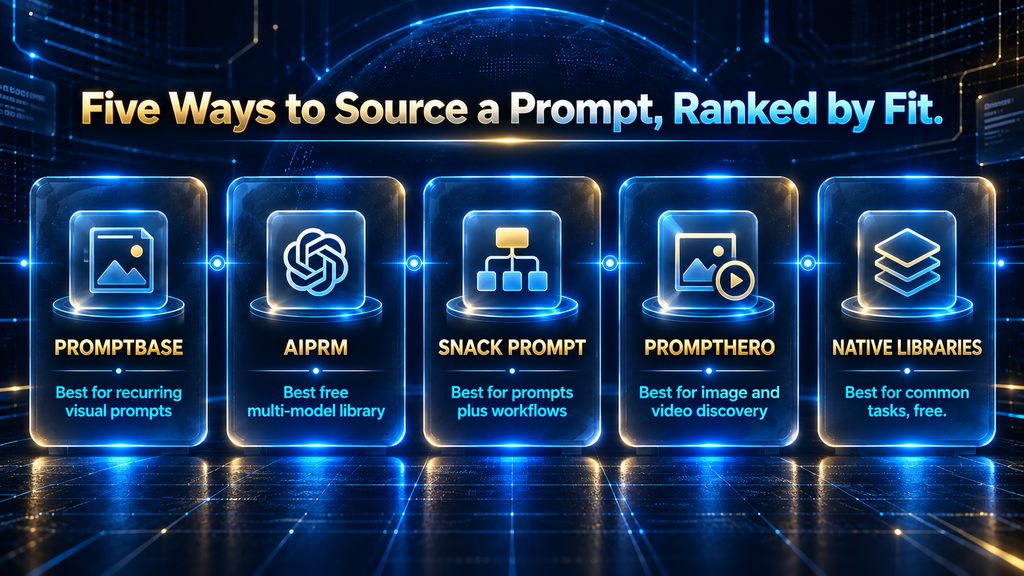
PromptBase
PromptBase is the original and still the largest paid prompt marketplace, covering both text prompts for models like ChatGPT and Claude, and image-generation prompts for tools like Midjourney and Stable Diffusion. Buyers browse listings with visible sample output, pay per prompt (typically $1.99 to $9.99), and get the exact prompt text.
In February 2026 the platform added PromptBase Select, a $14–$19 monthly subscription covering ten downloads from eligible prompts, aimed squarely at reducing the friction of one-off purchases and monetizing prompts that had sat unsold for 60 days or more.
PromptBase is the right call for a recurring, generic need in a visual category where getting the wording exactly right is genuinely hard — a specific illustration style, a consistent product-photography look, a particular cinematic lighting effect for AI video stills. It’s the wrong call for general chat or writing prompts, where free alternatives now match or beat what’s for sale.
Buyer Fit Score read: High on Problem Fit and Capability Depth for image-prompt use cases specifically, Medium for general text prompts where free alternatives compete directly, Medium on Governance & Vendor Stability given the shift toward subscription monetization, Medium on Total Cost of Ownership if you buy individually rather than subscribing into Select.
AIPRM
AIPRM is a free-to-install browser extension that adds a searchable prompt library directly inside ChatGPT’s interface, with more than two million users and over 5,400 community-reviewed public prompts. It has expanded well beyond its ChatGPT-only origins to support Claude, Gemini, and Midjourney, and includes private prompt folders for individuals and shared prompt libraries for teams — a genuinely useful middle ground between “no system at all” and a full prompt management platform.
The core product is free; premium tiers add team seats and additional prompt slots. Because it lives inside the chat interface itself rather than a separate marketplace tab, the time-to-value is close to instant — you search and insert without leaving your conversation.
Buyer Fit Score read: High on Time-to-Value and Total Cost of Ownership given the free tier, High on Collaboration & Workflow Fit for small teams that want shared prompts without adopting a full platform, Medium on Evidence & Reliability since public prompt quality varies by contributor and isn’t independently audited.
Snack Prompt
Snack Prompt describes itself as “the home for prompt engineers and AI builders,” and its 2026 product reflects that broader ambition: alongside text prompts, it now hosts AI-generated images and full automations and workflows, with explicit support for multi-agent coordination across Claude (including Claude Code), Gemini, Perplexity, and audio tools like ElevenLabs. It functions as a community marketplace where creators can share, remix, and in some cases monetize prompts and workflows rather than a single-format prompt store.
This makes Snack Prompt a better fit for someone who thinks in terms of “AI resources” broadly — a prompt today, a small automation next week — than for someone who wants a narrow, single-purpose prompt search tool. Buyer Fit Score read: High on Capability Depth given the breadth across prompts, images, and workflows, Medium on Problem Fit if all you actually want is a simple text prompt search, High on Governance & Vendor Stability relative to single-format competitors, since diversifying past pure prompt sales is the same survival move that’s kept AIPRM growing.
PromptHero
PromptHero occupies a genuinely different niche from the other three: it’s a search engine for AI-generated visual results, where you search by the image or video style you want and see the exact prompt that produced it, across Stable Diffusion, Midjourney, DALL-E, and now AI video generation as well. This search-by-result model solves a real problem that text-based prompt marketplaces don’t: describing a visual style in words is hard, but recognizing the style you want when you see it is easy.
For anyone doing regular AI image or video work — thumbnails, product mockups, illustration, short-form video stills — PromptHero remains the most efficient discovery tool in this comparison, free to browse with premium tiers for higher-volume use. Buyer Fit Score read: High on Problem Fit and Time-to-Value specifically for visual prompt discovery, Low on Problem Fit if your need is text or coding prompts, since that’s simply not what the product does, High on Capability Depth given its continued expansion into video prompts alongside images.
Native Alternatives Worth Knowing About: Claude Code’s Prompt Library, the GPT Store, and Gemini Gems
Before paying for a general-purpose prompt, check what your model provider already ships for free. Anthropic maintains an official, continuously updated prompt library built directly into the Claude Code documentation — copy-paste prompts organized by development task and role, written and maintained by the company that trains the model.
OpenAI’s GPT Store lets anyone build and share a custom GPT with instructions already embedded, which functionally replaces “find and paste a prompt” with “open a pre-built assistant.” Google’s Gemini Gems do the same thing inside Gemini: a saved, reusable assistant configuration rather than a prompt you have to relocate and paste each time.
None of these are marketplaces you browse and compare the way you would PromptBase or AIPRM, which is exactly why they’re easy to overlook. But for a large share of common tasks — code review checklists, meeting-summary formats, standard writing templates — checking whether your model provider already ships a free, maintained version should come before any marketplace search, not after.
One Tool Worth a Caution Flag: FlowGPT
FlowGPT still shows up near the top of “best prompt marketplace” roundups because of its long history and large user base, but its own homepage now describes it as “the best AI ChatGPT Character & Prompt Store,” with a meta description leading with “Chat with AI characters for free on FlowGPT,” AI companion roleplay, and uncensored chat — not professional prompt discovery. Professional prompts are still technically present on the platform, but they sit alongside, and are increasingly outnumbered by, character and companion-chat content that has nothing to do with work tasks.
This isn’t a judgment on FlowGPT as a product — companion chat is a legitimate and large category on its own — but it is a reason to skip it if you’re specifically shopping for a marketing, coding, or analysis prompt in 2026. The signal-to-noise ratio for professional use has moved in the wrong direction, and the platforms above serve that need more directly.
Feature Comparison at a Glance
| Tool | Primary Format | Pricing Model | Best For | Vendor Stability Note |
|---|---|---|---|---|
| PromptBase | Text + image prompts | Per-prompt, plus Select subscription ($14–$19/mo) | Hard-to-nail visual styles bought recurringly | Actively evolving monetization (Select launched Feb 2026) |
| AIPRM | Text prompts, in-browser | Free core, paid team tiers | Solo or small-team ChatGPT/Claude/Gemini use | Growing user base and model coverage |
| Snack Prompt | Prompts + images + workflows | Free browsing, creator monetization options | Builders who want prompts and automations together | Actively expanding scope |
| PromptHero | Image + video prompts | Free browsing, premium tiers | Visual prompt discovery by result | Long-running, recently expanded to video |
| Claude Code Prompt Library | Text prompts, dev-focused | Free, native | Developers using Claude Code | Maintained directly by Anthropic |
| GPT Store / Gemini Gems | Reusable custom assistants | Free, native | Recurring generic tasks inside ChatGPT/Gemini | Maintained directly by OpenAI/Google |
| FlowGPT | Characters + legacy prompts | Free, ad/companion-monetized | Companion chat, not professional prompts | Repositioned away from professional use |
Choosing by Use Case
A solo creator or freelancer with occasional, varied needs is almost always better served by a free option first — AIPRM for general chat tasks, PromptHero for visual work — and should only reach for a paid marketplace when a specific, recurring visual task justifies it. A small marketing team that reuses the same handful of prompt types weekly should look at AIPRM’s team folders or Snack Prompt’s broader resource sharing before paying per-prompt on a marketplace, since the recurring-use case is exactly what a shared library is built for.
A developer working inside Claude Code should check Anthropic’s own prompt library before searching anywhere else, since it’s maintained by the same team that trains the model and is free. An agency or brand doing high volume of AI-generated visual content is the clearest case for a genuine PromptBase or PromptHero subscription, because the value of well-tuned image prompts compounds with the number of times you reuse them.
And a team that finds itself needing more than a library — version control, evaluation, rollback, governance across many prompts — has already outgrown this category and should look at dedicated prompt management platforms instead.
Common Mistakes People Make Buying or Using Prompt Libraries
The most frequent mistake is buying a prompt for a one-off task that a free option would have handled just as well — the Buy-or-Build Matrix above exists specifically to catch this before money changes hands. The second is assuming a prompt bought six months ago still works exactly as advertised; model updates change output behavior often enough that prompts genuinely do go stale, and a marketplace that doesn’t flag last-tested dates makes this harder to catch.
The third mistake is treating a generic bought prompt as a substitute for actually understanding your own use case — a purchased prompt can give you a starting structure, but it can’t know your brand voice, your compliance constraints, or your customer’s actual complaint history, which is exactly the gap our system instructions guide addresses. The fourth is buying from anonymous storefronts with no visible track record, sample output, or reviews, purely because a listing ranks well in search — ranking well and being good are not the same claim, and this category has more low-effort resellers than most.
The Real Cost of Relying on Generic Prompts You Didn’t Write
The direct cost of a bad prompt purchase is small — a few dollars, occasionally a wasted subscription month. The larger cost is what a business builds on top of generic prompts without noticing: marketing copy that reads like every other business using the same purchased template, customer responses that miss brand-specific nuance a real system prompt would have captured, and a team that never develops its own prompting skill because it’s always reaching for someone else’s phrasing instead of learning why that phrasing works.
That skill gap compounds. A team that understands when to show the model examples versus when to describe the task directly can adapt to a new use case in minutes. A team that only knows how to search a marketplace for the closest match is stuck waiting for someone else to have already solved their exact problem — which, for anything genuinely specific to their business, nobody else has.
A KPI Framework for Measuring Whether a Prompt Library Is Actually Helping
If you’ve adopted a prompt library, team or individual, four measurements tell you honestly whether it’s paying for itself. Time saved per use compares how long a task takes with a library prompt versus writing one from scratch — if the gap is small, the library isn’t earning its subscription.
Reuse rate tracks how often the same purchased or saved prompt gets used again; a library full of one-time-use prompts is really just an expensive way to write a single document. Edit distance measures how much you have to rewrite a library prompt’s output before it’s usable — high, unchanging edit distance over time means the library isn’t actually fitting your use case, no matter how good its reviews look.
Cost per successful use divides your total spend by the number of times a prompt produced genuinely usable output on the first or second try, which is the number that actually tells you whether a $14 monthly subscription beat writing your own prompts for free.
What Happens If You Do Nothing
Doing nothing here isn’t a crisis the way it might be for a team without any prompt management system at all — most individuals and small teams can keep typing prompts from scratch indefinitely without anything breaking.
But the quiet cost is time: a marketer who rewrites a similar campaign brief prompt every week without saving or reusing anything is paying an hours-per-month tax that a five-minute AIPRM setup would eliminate. The tools in this comparison aren’t solving an emergency; they’re removing a small, repeated inefficiency that adds up faster than it feels like it should.
What These Tools Don’t Solve
No prompt library, paid or free, solves the problem of not knowing what a good prompt actually looks like for your specific task — that’s a skill, not a product, and it’s why our own prompt engineering series exists alongside this comparison. None of them handle version control, team evaluation, or rollback if a prompt starts producing worse output after a model update; that’s the job of a dedicated prompt management platform, not a library.
And none of them can write a prompt that depends on information only your business has — your actual refund policy, your actual product catalog, your actual customer tone — which is exactly the gap that structured prompting for reliable output and context engineering are built to close.
Who Should Use a Dedicated Library or Marketplace, and Who Should Wait
Use a free library like AIPRM if you’re an individual or small team with recurring, generic prompt needs across common tasks — this is the highest-value, lowest-risk starting point for almost everyone reading this. Use a paid marketplace like PromptBase or a search engine like PromptHero if you have a recurring, visual, hard-to-phrase need where iteration time has real value.
Wait, and check your model provider’s native options first, if your need is occasional and generic — you likely already have what you need inside ChatGPT, Claude, or Gemini. And skip libraries entirely in favor of writing your own prompts if your need is proprietary and specific to your business, since no library can know what only you know.
A Practical Path for Getting Started
In week one, install a free option — AIPRM if your work is primarily text-based chat tasks, or bookmark PromptHero if it’s visual — and use it for two weeks before spending anything. In week two, track every time you reach for a saved or bought prompt versus writing one fresh, using the reuse-rate metric above as your guide.
By week three, you’ll have real data on whether your needs are generic-recurring (library territory) or proprietary-recurring (system-instructions territory), which tells you honestly whether a paid marketplace subscription is worth adding. Only after that should you consider a purchase, and only for the specific recurring visual or format need the data actually surfaced.
Future Outlook
The direction of travel is fairly clear: native, model-provider prompt infrastructure will keep absorbing the generic end of this market, the way GPT Store assistants and Gemini Gems already have for a large share of common chat tasks. Paid marketplaces will likely keep narrowing toward what they already do best — hard, visual, iteration-heavy prompts where someone else’s trial-and-error genuinely saves time — while broadening into adjacent formats like Snack Prompt’s move into automations, since a single-format prompt store is a harder business to sustain in 2026 than it was in 2023.
Expect more consolidation and repositioning like FlowGPT’s shift toward companion chat, as platforms that can’t compete with free native options on generic prompts look for a different audience willing to pay. The winners in this category a year from now will likely be the ones that stopped competing with free model-native libraries directly and found a genuinely differentiated niche instead.
Final Thoughts
The most useful thing you can do before spending money in this category is run your actual need through the Buy-or-Build Matrix above. A large share of what gets marketed as a “must-have prompt library” is solving a one-off, generic problem that a free option inside the tool you already pay for handles just as well.
The cases where a paid marketplace or specialized search engine genuinely earns its price are real, but they’re narrower and more visual than the marketing for this category suggests.
If you take one thing from this comparison, let it be this: check what your model provider already gives you for free before you check what a marketplace wants to sell you. The gap between those two options has narrowed faster than most of the “best prompt marketplace” roundups still floating around the internet have caught up to.
Still Writing Every Prompt From Scratch?
Our full context engineering guide shows you how to give any model the right information the first time, no marketplace required.
Read the Context Engineering Guide →FAQ
Is it worth paying for AI prompts in 2026?
Sometimes, but less often than marketplace marketing suggests. It’s worth it for recurring, visual, hard-to-phrase needs like a specific image style you’ll reuse repeatedly. For generic, one-off text tasks, a free option like AIPRM or your model’s own native prompt library usually matches the result at no cost.
What’s the difference between a prompt library and a prompt marketplace?
A library, like AIPRM, is typically free and community-built, searchable inside the chat interface itself. A marketplace, like PromptBase, involves individual creators selling specific prompts for a price, usually with a preview of the output before you buy.
Is FlowGPT still a good source for professional prompts?
Not primarily anymore. FlowGPT now markets itself mainly as an AI character and companion chat platform. Professional prompts still exist on the platform but are a shrinking part of what it’s actually built around, so dedicated libraries serve that need more reliably.
What is PromptBase Select?
It’s a subscription tier PromptBase launched in February 2026, priced at $14 to $19 a month for ten downloads from eligible prompts, aimed at reducing the friction of one-off purchases and giving creators recurring revenue on prompts that hadn’t sold in over 60 days.
Do ChatGPT, Claude, and Gemini have their own free prompt libraries?
Yes, in different forms. Anthropic publishes an official prompt library for Claude Code. OpenAI’s GPT Store and Google’s Gemini Gems let you use or build reusable custom assistants with instructions already embedded, which functionally replaces searching for and pasting a prompt.
Which tool is best for AI image generation prompts specifically?
PromptHero, because it lets you search by visual result rather than guessing keywords, across Stable Diffusion, Midjourney, DALL-E, and AI video generation. That search-by-result model solves the visual-prompt discovery problem more directly than a general text-based marketplace.
Can I use the same prompt library across ChatGPT, Claude, and Gemini?
AIPRM and Snack Prompt both support multiple models now, including Claude, Gemini, and Midjourney alongside ChatGPT, which makes them more useful than single-model libraries if your team works across more than one AI product.
How do I know if a prompt I’m about to buy actually works?
Check for a visible sample output next to the listing, not just a description. Check the last-updated date, since model updates can make older prompts stop reproducing their sample results. And run a quick free-tier comparison yourself before paying, to see how much the purchased phrasing is actually adding.
When should a team stop using a prompt library and switch to a management platform?
When prompts become proprietary and recurring rather than generic and occasional — once you’re maintaining many business-specific prompts that need version control, evaluation, and rollback, you’ve outgrown a library and need a dedicated prompt management platform instead.
What’s the biggest mistake people make when shopping for prompt libraries?
Paying a marketplace for a one-off, generic task that a free option would have handled just as well. Running the task through a simple buy-or-build check — is this recurring, and is it proprietary to your business — catches most unnecessary purchases before they happen.
Related Guides
- ChatGPT vs Claude vs Gemini for Prompt-Heavy Workflows
- Best AI Tools for Writing Blog Posts (Free & Paid)
- Best AI Script and Idea Generation Tools for YouTube Creators (2026)
Written by
Muntasir Ahmad Chowdhury
Founder, AI Hustle World
Muntasir Ahmad Chowdhury is the Founder of AI Hustle World, an independent publication dedicated to making Artificial Intelligence practical, trustworthy, and easy to understand. He researches AI tools, automation, customer service, productivity, and real-world business applications, helping readers make smarter technology decisions through research-driven, experience-backed content.
Expertise:
AI Tools • AI Automation • AI Customer Service • AI Productivity • Generative AI • AI Workflows
Get Smarter With AI
Enjoyed this guide? Get practical AI tools, tutorials, and honest reviews delivered to your inbox.
4 thoughts on “Best AI Prompt Libraries and Marketplaces for Ready-to-Use Prompts in 2026”