Few-Shot vs Zero-Shot Prompting: When Should You Use Each?
Ask ten people how to prompt an AI model and at least six will tell you to “give it examples” — as if few-shot prompting were a universal upgrade you should bolt onto every request. It isn’t. Zero-shot and few-shot prompting solve different problems, and picking the wrong one wastes tokens at best and actively degrades output at worst.
The confusion is understandable. Early guidance on large language models leaned hard on the idea that showing a model a few examples of the task you want would reliably outperform just asking directly. That was true for the generation of models this advice was written for. It is no longer true across the board, and treating it as a fixed rule rather than a decision you make per task is exactly the kind of mistake that quietly inflates API bills and confuses teams building on top of these models.
This guide breaks down what zero-shot and few-shot prompting actually are, how in-context learning works under the hood, and — more usefully — a practical framework for deciding which one your specific task actually needs. We will also cover where few-shot prompting backfires, why newer reasoning models change the calculus, and where the frontier of “many-shot” prompting is heading next.
What Zero-Shot and Few-Shot Prompting Actually Mean
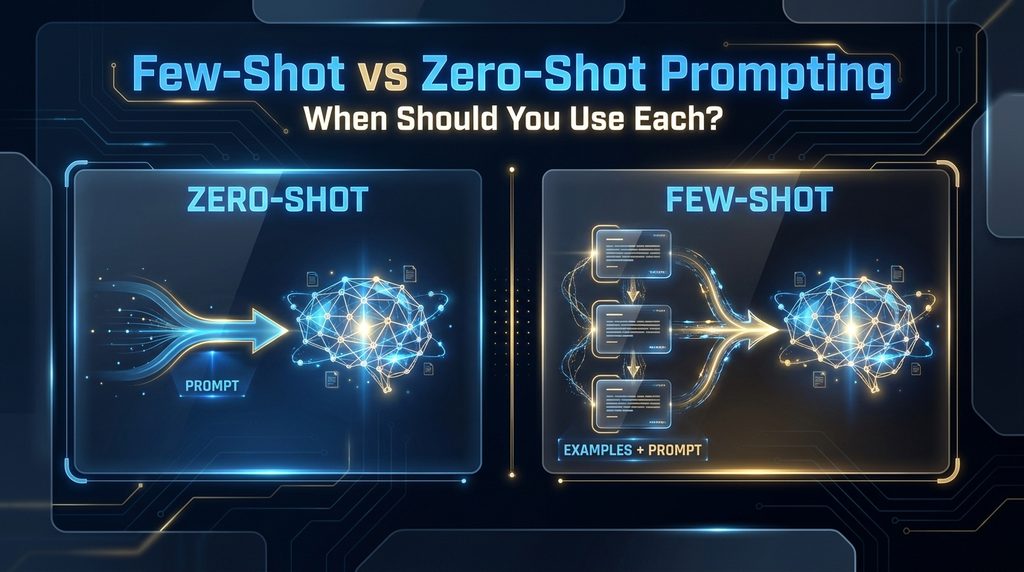
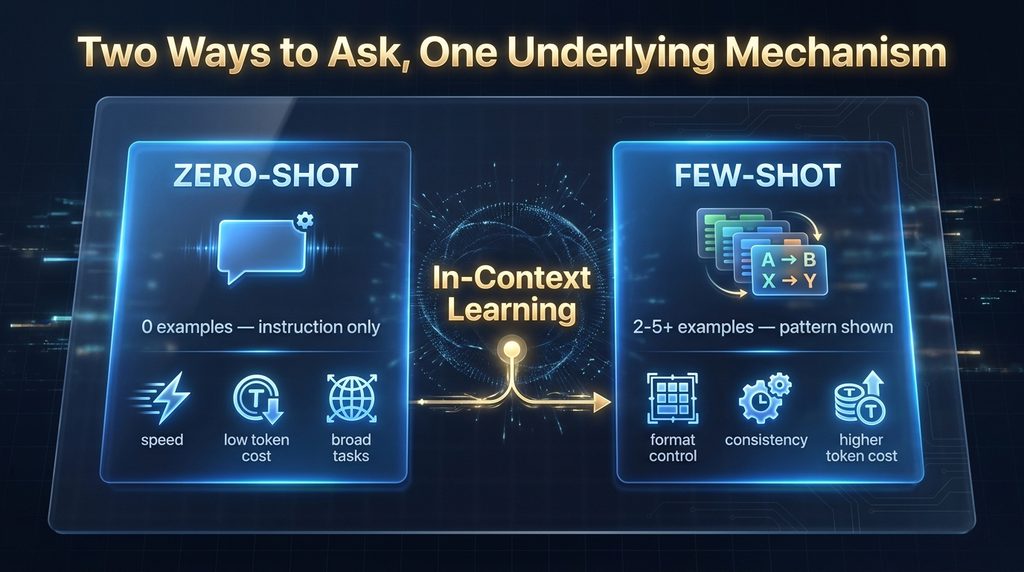
Zero-shot prompting means asking a model to perform a task by describing it directly, with no worked examples included in the prompt. “Classify this review as positive or negative” is a zero-shot instruction. The model has to infer what you want purely from the instruction and whatever it learned during training — it has never seen your specific examples before, and you are not showing it any now.
Few-shot prompting means including a small number of worked examples — typically between one and a handful — directly in the prompt before asking the model to handle a new case. Instead of just describing the task, you demonstrate it: here is an input, here is the correct output, repeat two or three times, then here is a new input you want handled the same way.
Both terms trace back to the 2020 OpenAI paper “Language Models are Few-Shot Learners,” which introduced GPT-3 and demonstrated that a sufficiently large language model could learn a task from a handful of examples placed in its context window, without any weight updates at all. That capability — called in-context learning — is what makes both zero-shot and few-shot prompting possible in the first place, and understanding it is what actually explains when each approach wins.
How In-Context Learning Actually Works
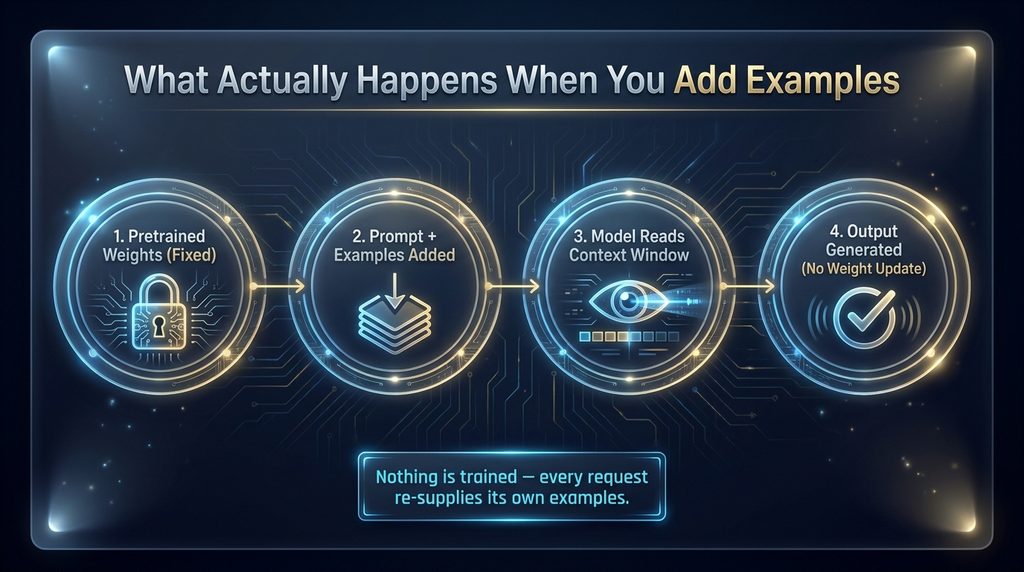
It helps to be precise about what is and is not happening when you add examples to a prompt. The model’s weights do not change. Nothing is being trained. What happens instead is a purely inferential process: the model treats your examples as additional context, and its attention mechanism uses that context to shift the probability distribution over its next-token predictions toward outputs that match the pattern you demonstrated.
This distinction matters practically. Because nothing is learned permanently, every single API call has to re-supply the same examples if you want the same behavior — there is no persistent memory of your few-shot examples between requests unless you resend them. It also means the model is pattern-matching your format and structure just as much as it is learning your task, which is the root cause of several failure modes covered later in this guide.
Zero-shot performance, by contrast, draws entirely on what the model absorbed during pretraining and any instruction-tuning or reinforcement learning from human feedback applied afterward. A model that performs well zero-shot on a task is one where your instruction phrasing overlaps well enough with patterns the model already generalized during training — no demonstration required.
When Zero-Shot Actually Wins
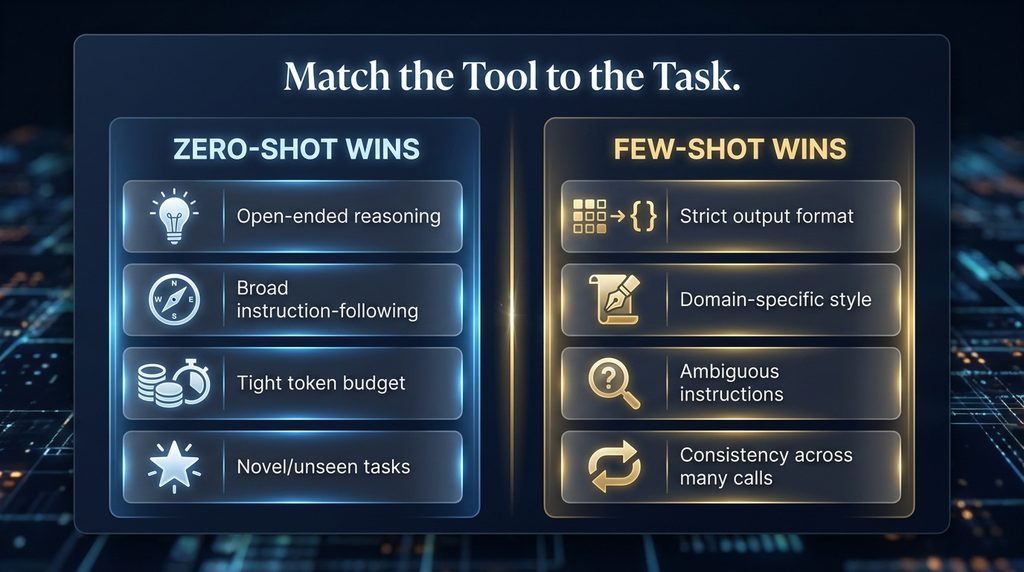
Zero-shot is the right default for common, well-understood tasks that closely resemble things a model was trained and instruction-tuned to do: summarization, straightforward classification, translation, general Q&A, and most everyday writing requests. Modern instruction-tuned models handle these well without demonstrations, and adding examples you don’t need just burns tokens and adds latency for no accuracy gain.
Zero-shot also tends to win, somewhat counterintuitively, on tasks that benefit from open-ended reasoning rather than pattern replication. A widely cited 2022 finding — that simply appending “let’s think step by step” to a zero-shot prompt dramatically improves reasoning performance — showed that zero-shot prompting combined with a reasoning trigger could match or beat few-shot approaches on arithmetic and logic tasks, without needing a single worked example.
A 2026 paper revisiting chain-of-thought prompting went further, finding that zero-shot chain-of-thought prompting can actually outperform few-shot chain-of-thought prompting on several reasoning benchmarks. The proposed explanation is that few-shot examples can anchor a model to the specific reasoning style of your demonstrations, which sometimes constrains it away from the reasoning path it would have taken on its own — one that may fit the new problem better than your example did.
Zero-shot is also the pragmatic choice whenever token budget, latency, or context-window space is tight. Every example you add to a few-shot prompt is tokens you pay for and wait on with every single request, which compounds fast in high-volume production systems.
When Few-Shot Actually Wins
Few-shot earns its keep when a task has a specific, non-obvious format that a plain instruction struggles to convey precisely. Structured data extraction into an exact JSON schema, a particular citation style, a specific tone of voice, or output that must match an internal taxonomy are all cases where showing beats telling — a model can infer subtle formatting rules from two or three examples far more reliably than from a paragraph of prose describing the same rules.
Few-shot also helps disambiguate genuinely ambiguous tasks. If “classify this as urgent or not urgent” depends on nuances specific to your business — a support ticket that mentions a competitor by name might count as urgent for one company and irrelevant for another — examples anchor the model to your specific definition of the categories rather than a generic one it inferred during training.
Niche or unusual tasks that are underrepresented in a model’s training data are a third strong case for few-shot. If you are asking a model to write in an invented constructed language, follow an idiosyncratic internal style guide, or replicate a very specific structured format your organization uses nowhere else, demonstrations do work that instructions alone cannot.
Finally, few-shot is genuinely useful as a diagnostic step: if zero-shot output is inconsistent or drifting from what you want, adding two or three well-chosen examples is often faster than rewriting your instructions five different ways trying to describe the same correction in words.
The Reasoning-Model Wrinkle
Reasoning-focused models — OpenAI’s o-series, Claude’s extended thinking mode, and similar systems — complicate the traditional few-shot advice further. These models are trained to generate their own internal chain-of-thought before answering, which means much of what few-shot examples used to provide — a demonstrated reasoning pattern — is now something the model attempts to construct on its own by default.
In practice, this means few-shot examples can actively interfere with a reasoning model’s own problem-solving process. Feeding it a rigid worked example can suppress the model’s tendency to reason through a problem from scratch, nudging it toward mimicking your example’s specific steps even when a different reasoning path would suit the new problem better. Guidance for prompting reasoning models increasingly recommends clear, direct instructions and letting the model’s own reasoning process run, reserving examples mainly for strict output-formatting needs rather than for teaching the task itself.
This is a meaningful shift from the GPT-3 era, and it means “always add a few examples” is genuinely outdated advice for a growing share of the models teams are building on top of in 2026.
Chain-of-Thought Few-Shot vs. Standard Few-Shot
Not all few-shot examples are built the same way, and conflating two distinct styles is a common source of confusion. Standard few-shot prompting shows only input-output pairs: here is a sentence, here is its correct label, with no explanation of how the model should get from one to the other.
Chain-of-thought few-shot prompting instead shows input, a worked reasoning trace, and then the final answer — teaching not just what the correct output looks like but how to arrive at it. This distinction mattered enormously in the pre-reasoning-model era, where chain-of-thought few-shot examples were often the single biggest lever available for improving accuracy on multi-step arithmetic, logic, and multi-hop reasoning tasks.
On reasoning models, this specific style of few-shot prompting is the one most likely to backfire, since it directly competes with the model’s own internal reasoning process rather than complementing it. If you still need demonstrations on a reasoning model, standard input-output few-shot examples focused purely on format tend to interfere far less than chain-of-thought examples that walk through a specific reasoning path.
How Many Examples, and How to Choose Them
When few-shot is the right call, the next question is how many examples and which ones. The honest answer is that there is no universal magic number — one well-chosen example, a technique sometimes called one-shot prompting, is often enough to fix a formatting issue, while three to five examples is the more common range for teaching a task with real variation in it.
What matters more than raw count is diversity and balance. Examples that are all near-duplicates of each other teach the model far less than examples that each illustrate a distinct edge case or category. If you are demonstrating a three-way classification task, showing three examples of the same class and one of another will bias the model toward overpredicting the majority class in your demonstrations, regardless of your instructions.
Order matters too, more than most people expect. Research on example ordering has repeatedly found that models can be sensitive to the sequence in which demonstrations appear, sometimes weighting the most recent example more heavily than earlier ones. A practical mitigation is to place your strongest, most representative example last, and to test more than one ordering if a task is high-stakes enough to justify the extra evaluation time.
The Overfitting Trap: When Few-Shot Backfires
Few-shot prompting has a failure mode that rarely gets enough attention: models don’t just learn the task from your examples, they also pick up incidental patterns you never intended to teach. If every example in your prompt happens to produce a two-sentence answer, the model may rigidly produce two-sentence answers even when a new case genuinely calls for one sentence or five. If your examples all use a particular word choice or sentence structure, that stylistic tic bleeds into every output regardless of whether it fits.
Recent research examining what has been termed the “few-shot dilemma” found that over-prompting with too many or too rigid examples can measurably degrade performance compared to a well-designed zero-shot or minimally-shot prompt, particularly when the added examples introduce format constraints the underlying task doesn’t actually require. The lesson isn’t that few-shot prompting is broken — it’s that every example you add is also quietly teaching the model things you didn’t ask it to learn, and it is worth auditing your examples for spurious patterns before assuming more examples always help.
The practical fix is treating your example set the same way you would treat a small training set: vary length, vary structure, vary the parts of the task that are genuinely allowed to vary, and keep constant only what should actually be constant across every output.
Many-Shot In-Context Learning: The Frontier
As context windows have grown from a few thousand tokens to hundreds of thousands, a distinct technique has emerged that goes well beyond traditional few-shot prompting: many-shot in-context learning, using hundreds or even thousands of examples in a single prompt rather than a handful. Research from Google DeepMind on many-shot in-context learning found that performance on several tasks continues improving well past the point where traditional few-shot prompting plateaus, sometimes closing much of the gap with fine-tuned models without any weight updates at all — provided the underlying model’s context window and effective long-context comprehension can actually support that many examples without degrading in the middle of a long prompt.
For most teams building everyday applications, many-shot prompting is currently overkill: the token cost of a few-hundred-example prompt repeated on every request is substantial, and the accuracy gains only show up clearly on tasks with a lot of genuine variation to learn from. It becomes worth exploring specifically when a task has failed to reach acceptable accuracy with a handful of examples and fine-tuning isn’t yet justified by volume or budget — a middle ground worth knowing exists rather than assuming three to five examples is always the ceiling.
Few-Shot Prompting in Agentic and Tool-Calling Systems
AI agents that call external tools and functions are one of the strongest current use cases for few-shot prompting, for a reason distinct from everything covered so far: tool-calling formats are rigid, machine-parsed, and completely unforgiving of small deviations. A model that is 95 percent correct on a JSON tool call is, for practical purposes, wrong, because most parsers reject a malformed argument outright rather than accepting a close approximation.
Showing two or three examples of correctly formatted tool calls — including at least one example with an edge case, like an optional parameter being omitted or a list argument with a single item — tends to collapse malformed-call rates dramatically compared to describing the expected schema in prose alone. This is one of the clearest cases in this entire guide where the format-precision argument for few-shot prompting outweighs every cost or reasoning-model concern raised elsewhere.
The caveat is the same overfitting risk covered earlier: if every example you show happens to use the same tool in the same order, an agent can learn to always call that tool first regardless of whether the new situation actually calls for it. Diversity in your tool-calling examples matters just as much here as diversity in any other few-shot example set.
Cost, Latency, and Token Budget Math
Every few-shot example is not a one-time cost — it is a recurring cost paid on every single request that uses that prompt. A five-shot prompt where each example runs 150 tokens adds 750 tokens of input on top of your actual instruction and the new case you’re asking about, and that overhead is billed and processed identically whether the request happens once or a million times.
At meaningful production volume, this adds up in ways that are easy to underestimate during initial testing with a handful of manual calls. A workflow processing 100,000 requests a month at an extra 750 input tokens per request is paying for 75 million additional tokens of input purely for demonstration examples, plus the added latency of processing that extra context on every call — latency that matters enormously for real-time or conversational applications and far less for batch processing run overnight.
This is precisely why testing a zero-shot baseline first, before reaching for few-shot by default, is the financially disciplined approach rather than merely the theoretically cleaner one. If zero-shot performance is already acceptable for your accuracy bar, few-shot prompting is pure added cost with no offsetting benefit.
How Prompt Caching Changes the Math
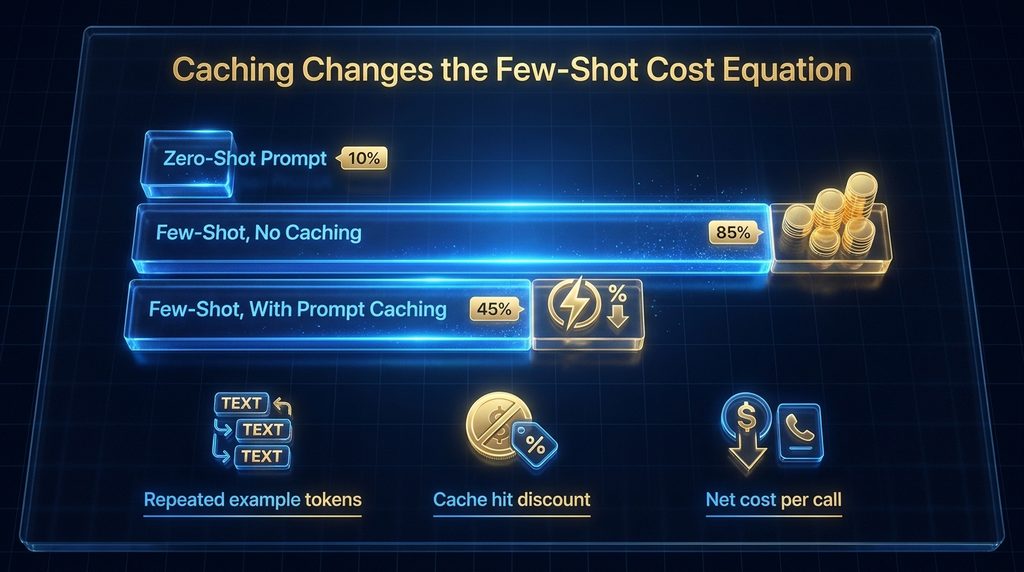
The token-cost argument against few-shot prompting is somewhat softer in 2026 than it was a couple of years ago, thanks to prompt caching features now offered by most major model providers. When the same block of few-shot examples appears at the start of every request, providers can cache that prefix and charge a reduced rate for it on subsequent calls, rather than billing the full input price every single time.
This meaningfully changes the calculus for high-volume, stable few-shot prompts: if your examples never change and sit at the front of the prompt, caching can absorb much of the recurring cost problem described above. It does not eliminate it entirely — cached tokens are typically discounted, not free, and caches expire after a period of inactivity — but it does mean the cost argument against few-shot prompting applies most strongly to prompts with examples that change frequently or that are not structured to take advantage of caching.
The practical takeaway is to structure prompts deliberately for caching wherever few-shot examples are staying constant across requests: static content, including your examples, first, followed by the variable content specific to each individual request. Getting this ordering wrong is a common reason teams pay full price for few-shot examples that could otherwise be substantially discounted.
Few-Shot Prompting vs. Fine-Tuning: Where the Line Is
Few-shot prompting and fine-tuning solve a similar underlying problem — getting a model to behave in a specific, non-default way — through fundamentally different mechanisms, and the choice between them usually comes down to task stability and volume rather than which technique is inherently “better.”
Few-shot prompting wins when a task is still evolving, when you need to adjust behavior quickly without a retraining cycle, or when request volume doesn’t yet justify the upfront cost of building and maintaining a fine-tuning dataset. It is also the only realistic option when you’re working with a closed model you cannot fine-tune at all, or when your examples need to change frequently based on new edge cases.
Fine-tuning starts to win once a task is stable, request volume is high enough that per-call token overhead from repeated examples becomes a real cost driver, and you have — or can build — a genuinely representative dataset larger than what fits comfortably in a prompt. A useful rule of thumb: if you find yourself wanting to include more than a few dozen examples to reliably cover a task’s variation, that is usually a signal the task has outgrown few-shot prompting and is a better candidate for fine-tuning or retrieval-augmented example selection instead of a static prompt.
Retrieval-Augmented Few-Shot: Dynamic Example Selection
A middle path between a fixed few-shot prompt and full fine-tuning has become increasingly common in production systems: instead of hard-coding the same two or three examples into every prompt, retrieve the most relevant examples from a larger library at request time, based on similarity to the specific input you just received.
This approach — sometimes implemented with the same vector-search infrastructure used for retrieval-augmented generation — lets a system draw on a library of hundreds of labeled examples without paying the token cost of including all of them in every request, since only the handful most relevant to the current input get pulled into the prompt. It also sidesteps some of the format-bias problem covered earlier, since the examples shown vary from request to request rather than teaching one fixed, potentially unrepresentative pattern.
The tradeoff is added system complexity: maintaining an example library, building the retrieval step, and keeping both in sync as edge cases evolve is real engineering work that a static few-shot prompt doesn’t require. It becomes worth that complexity once a task’s variation is too broad for three to five fixed examples to cover well, but the volume still doesn’t justify a full fine-tuning pipeline.
A Practical Decision Framework
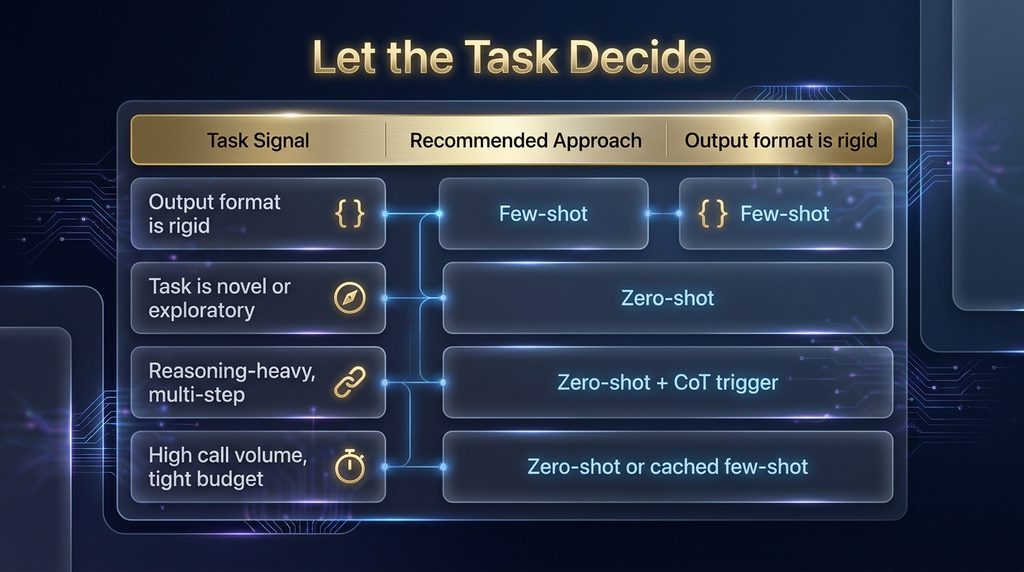
Rather than defaulting to either technique, work through these questions in order for any new task you’re prompting a model to handle.
| Situation | Recommended Approach |
|---|---|
| Common task (summarization, general Q&A, translation) | Zero-shot |
| Task requires visible step-by-step reasoning | Zero-shot + “think step by step,” especially on reasoning models |
| Output must match an exact, unusual format or schema | Few-shot, 2-3 diverse examples |
| Task has ambiguous categories specific to your business | Few-shot, examples covering each category and edge cases |
| Using a reasoning model (o-series, extended thinking) | Zero-shot by default; reserve examples for formatting only |
| Task is high-volume, cost-sensitive, and zero-shot already works | Zero-shot, do not add unnecessary examples |
| Task has failed with few-shot and has enough scale/budget | Fine-tuning or many-shot in-context learning |
Real-World Walkthrough: Three Prompts Compared
A customer support ticket classifier is a useful case study because it can go either way depending on specifics. Classifying tickets into “billing,” “technical,” and “general” is close enough to a model’s general understanding that zero-shot usually performs well out of the box: “Classify the following support ticket as billing, technical, or general. Return only the category name.” That single instruction, with no examples, is typically enough.
But add a fourth category like “churn risk” that depends on subtle language your team defines internally — mentions of competitors, phrases like “reconsidering,” specific frustration patterns — and few-shot examples showing exactly what counts become far more valuable than trying to describe that judgment call in words. Two labeled tickets showing a genuine churn-risk case and a merely frustrated-but-not-leaving case teach the distinction faster than any paragraph of prose attempting to define it.
A structured-data extraction task pulling invoice line items into a fixed JSON schema is a near-universal case for few-shot. A zero-shot instruction describing field names and types in prose — “extract each line item as an object with fields item, quantity, and price” — reliably produces near-correct but inconsistently formatted output: a missing field here, a differently nested object there, quantities sometimes represented as strings and sometimes as numbers.
Two or three examples showing the exact schema, including one example where a field is legitimately missing and should be represented as null rather than omitted entirely, collapse that inconsistency dramatically. The examples are doing something a prose description structurally cannot: showing the model exactly what “correct” looks like at the character level, not just describing it in the abstract.
A creative brainstorming request — generating taglines, headline variations, or open-ended ideas — tends to perform worse with few-shot examples than without them. Demonstrations here often anchor the model’s creativity to the style and structure of your examples specifically, narrowing the variety of what it generates rather than achieving the intended goal of simply showing a quality bar. Zero-shot, sometimes combined with an explicit instruction to vary style, length, and tone across outputs, usually produces a more genuinely diverse set of options than five examples that all happen to share the same rhythm and length.
Multilingual and Translation Considerations
Language pair and script matter more to this decision than most guides acknowledge. Zero-shot performance on high-resource language pairs — English to Spanish, English to Mandarin, and similar widely-represented combinations — is typically strong on current frontier models, since enormous volumes of training data exist for these pairs already.
Lower-resource languages and unusual register requirements are a different story. A model asked to translate into a regional dialect, a specific formality register, or a language with limited representation in training data often benefits substantially from a handful of few-shot examples that anchor it to the specific variety of the language you actually need, rather than the generic standard form it defaults to zero-shot.
Domain-specific translation — legal, medical, or technical content with specialized terminology — is another case where few-shot examples showing the exact terminology and phrasing conventions of your domain outperform a zero-shot instruction to “translate accurately,” which leaves the model to guess at domain conventions it has no way of inferring from the instruction alone.
Second-Order Effects: Why This Debate Exists At All
It’s worth understanding why “always use few-shot” became conventional wisdom in the first place, since that history explains why so much existing guidance is now outdated. Early instruction-tuned models were genuinely much better at following demonstrated patterns than at correctly interpreting abstract instructions, making few-shot prompting the more reliable technique across a wide range of tasks by necessity rather than by some permanent property of language models in general.
Years of instruction-tuning, reinforcement learning from human feedback, and now dedicated reasoning training have closed much of that original gap, to the point where zero-shot instruction-following on modern frontier models rivals or exceeds few-shot performance on a large share of everyday tasks. The advice didn’t get updated as fast as the models did, which is exactly why “add examples” persists as reflexive guidance in tutorials and internal documentation long after the underlying justification weakened.
This matters beyond simple curiosity: it’s a useful reminder that prompting best practices are tied to a specific generation of models, not universal laws, and that a technique’s continued popularity is not itself evidence that it still produces the best result on whatever model you’re actually using today.
Common Mistakes When Choosing Between Them
The most common mistake is treating few-shot as a default upgrade rather than a deliberate choice, adding examples to every prompt regardless of whether the task actually needs demonstration versus description. A close second is never testing a zero-shot baseline before reaching for few-shot, which makes it impossible to know whether the examples you added actually improved anything or just added cost and latency to output that would have been identical without them.
A third is building an example set once and never revisiting it as edge cases accumulate, letting a prompt slowly drift out of sync with the actual range of inputs a system now receives in production. A fourth is ignoring the reasoning-model wrinkle entirely — copying few-shot patterns designed for older instruction-tuned models directly onto o-series or extended-thinking models without testing whether the examples help or quietly constrain the model’s own reasoning process.
A fifth, less obvious mistake is failing to check example sets for the format-bias problem covered earlier — assuming that because output looks consistent, it is correct, when consistency can just as easily be evidence the model is rigidly mimicking incidental patterns from your examples rather than genuinely solving each new case.
A sixth mistake, common on teams with more than one person writing prompts, is having no shared record of which tasks use zero-shot and which use few-shot, and why. Without that documentation, a well-reasoned decision made during initial development gets silently reversed by whoever touches the prompt next, and the evaluation work behind the original choice has to be redone from scratch.
Provider-Specific Nuances Worth Knowing
The zero-shot-versus-few-shot balance isn’t identical across model providers, and treating every frontier model as interchangeable on this question leads to prompts that are tuned for the wrong assumptions. OpenAI’s reasoning-focused o-series models, Anthropic’s extended-thinking Claude models, and Google’s thinking-enabled Gemini variants all share the general reasoning-model pattern covered earlier: fewer, cleaner instructions tend to outperform heavily-exampled prompts built for older, non-reasoning models.
Standard (non-reasoning) chat models from all three providers still respond well to traditional few-shot prompting for formatting-heavy tasks, but each has slightly different default tendencies worth testing rather than assuming. Some model families lean toward more verbose default output that few-shot examples can rein in more effectively; others are already terse by default and gain less from format-anchoring examples.
The practical implication is the same evaluation discipline recommended throughout this guide: build your test set once, and re-run it whenever you switch model families or even model versions within the same family, rather than assuming a prompting strategy tuned for one provider’s model transfers cleanly to another’s.
How to Test and Measure Which Approach Wins
Deciding between zero-shot and few-shot should be an empirical question settled with a small evaluation set, not a one-time judgment call made from intuition alone. Build a set of 20 to 50 representative test cases that cover your task’s real range of variation, including the trickiest edge cases you can find, before writing a single prompt.
Run both a zero-shot and a few-shot version of your prompt against that same evaluation set, and score both on accuracy against a correct answer key as well as measured token cost and latency per request. This turns “which approach is better” from a guess into a number, and it makes the cost-versus-accuracy tradeoff from earlier in this guide concrete rather than theoretical.
Revisit that evaluation periodically, especially after switching underlying models. A few-shot prompt tuned carefully for one model generation can perform differently — sometimes worse — on a newer model with different training data and different default reasoning behavior, which is exactly what happened broadly across the industry as reasoning models became mainstream.
Who Should Default to Which Approach
A solo builder prototyping quickly should default to zero-shot almost every time during initial development, adding examples only after testing reveals a specific, recurring format or accuracy problem that a clearer instruction alone doesn’t fix. Reaching for few-shot before you’ve even seen zero-shot fail is optimizing a problem you don’t yet know you have.
A team shipping a production feature at meaningful volume should treat the zero-shot-versus-few-shot decision as a measured, documented choice with an evaluation set behind it, per the testing framework covered earlier — not a default baked in during initial development and never revisited as the model provider ships updates. A researcher or engineer working on a genuinely novel or high-stakes task — one with real ambiguity, strict formatting requirements, or a small number of well-understood edge cases — is the profile most likely to benefit from the full range of techniques this guide covers, including many-shot prompting and retrieval-augmented example selection, since the accuracy gains at that end of the spectrum tend to justify the added engineering complexity.
What’s Next: Toward Context Engineering
The zero-shot versus few-shot decision is increasingly understood as one piece of a broader discipline sometimes called context engineering: deliberately deciding what information — instructions, examples, retrieved documents, prior conversation history — belongs in a model’s context window for a given task, rather than treating prompt-writing as an isolated skill. Expect continued movement toward tooling that automates parts of this decision: systems that dynamically select the most relevant few-shot examples from a larger library based on the specific input at hand, rather than using a fixed static set for every request, and evaluation frameworks that make the zero-shot-versus-few-shot tradeoff a routine, automated check rather than a manual one.
The underlying judgment this guide covers, though, is durable regardless of how the tooling evolves: understand what a task actually needs before deciding whether to describe it or demonstrate it.
A Worked Prompt, Side by Side
Seeing the actual difference in prompt text makes the format-precision argument for few-shot concrete rather than abstract. A zero-shot version of the invoice-extraction task from earlier might read: “Extract each line item from this invoice as a JSON object with fields item, quantity, and price. Return a JSON array.” That instruction is clear to a human and still leaves real ambiguity for a model to resolve on its own.
A few-shot version of the same task adds two short worked examples directly beneath that instruction: one showing a normal invoice line with all three fields present, and a second showing an edge case — a line item with no listed price, represented explicitly as "price": null rather than omitted from the object entirely. Nothing in the prose instruction communicated that specific formatting choice; the example did that work instead.
Run the zero-shot version against fifty real invoices and you’ll typically see a handful of small formatting deviations — a missing field here, a price left as a string instead of a number there. Run the few-shot version against the same fifty invoices and those specific deviations tend to disappear, because the model now has a concrete pattern to match rather than a prose description to interpret. That gap is exactly what the earlier decision framework is pointing at when it recommends few-shot for exact-schema tasks.
Two Templates Worth Keeping
A minimal zero-shot template that works well as a starting baseline for most tasks: state the role or context briefly, state the task as a direct instruction, specify the exact output format you want, and add a reasoning trigger like “think through this step by step before answering” if the task involves any multi-step logic at all. A minimal few-shot template, once testing shows zero-shot isn’t enough: the same role and task instruction, followed by two to four examples in a consistent “Input: … / Output: …” format, each example varying in length and edge-case coverage, followed by the new input you actually want handled — with your strongest, most representative example placed last to account for the recency effects covered earlier.
Keeping both templates on hand, and defaulting to testing the zero-shot version first, turns this entire decision into a five-minute check rather than a debate every time a new task comes up.
Final Thoughts
Zero-shot and few-shot prompting are not a hierarchy where one is simply the advanced version of the other — they are two different tools solving different problems, and the right choice depends on your task’s format complexity, ambiguity, cost sensitivity, and which type of model you’re actually prompting.
Test zero-shot first as your baseline, add examples deliberately when a task’s format or ambiguity genuinely calls for demonstration, watch for the format-bias trap that comes with every example you add, and reconsider your assumptions whenever you switch to a model with different built-in reasoning behavior. That discipline, applied consistently, will save more tokens and produce more reliable output than any fixed rule about which technique to always prefer.
Ready to Build Prompts That Work on the First Try?
Few-shot and zero-shot are just two levers on a much bigger control panel. If you want the complete foundation for writing prompts that consistently get accurate results, this guide walks through the core structure every strong prompt shares.
Master the Prompting Fundamentals →Frequently Asked Questions
Is few-shot prompting always more accurate than zero-shot?
No. On common tasks and on reasoning-focused models, zero-shot frequently matches or beats few-shot, and research has specifically found zero-shot chain-of-thought outperforming few-shot chain-of-thought on several reasoning benchmarks. Accuracy depends on the specific task and model, not a fixed hierarchy between the two techniques.
How many examples should a few-shot prompt include?
There is no universal number. One well-chosen example is often enough to fix a formatting problem, while three to five diverse examples suit tasks with more variation. What matters more than count is that examples are diverse and free of unintended patterns the model might copy.
Does few-shot prompting work differently on reasoning models like o1 or o3?
Yes. Reasoning models generate their own internal chain-of-thought by default, and rigid worked examples — especially ones showing a specific reasoning path — can constrain that process rather than help it. Direct instructions generally work better, with examples reserved mainly for output formatting.
Can too many few-shot examples hurt performance?
Yes. Research on what’s been called the “few-shot dilemma” found that over-prompting with excessive or overly rigid examples can measurably degrade output compared to a well-designed minimal prompt, particularly when examples introduce format constraints the task doesn’t actually require.
What is many-shot prompting and how is it different from few-shot?
Many-shot prompting uses hundreds or thousands of examples in a single prompt, made possible by long context windows, rather than the handful used in traditional few-shot prompting. Research shows it can continue improving performance well past where few-shot plateaus, though at a substantial token cost.
Should I use few-shot prompting or fine-tune a model instead?
Few-shot suits tasks that are still evolving or don’t yet have enough volume to justify a training dataset. Fine-tuning becomes worthwhile once a task is stable, volume is high enough that per-call example overhead adds up, and you have a representative dataset larger than comfortably fits in a prompt.
Does prompt caching make few-shot prompting cheaper?
Often, yes, when your examples stay constant and sit at the front of the prompt. Most major providers now discount cached prompt prefixes, which reduces — though doesn’t eliminate — the recurring token cost of repeating the same few-shot examples on every request.
Is zero-shot prompting the same as just not using AI properly?
No. Zero-shot prompting is a deliberate, often optimal choice for tasks that align well with what a model already learned during training and instruction-tuning. It is not a fallback for when you haven’t bothered to write examples — for many tasks, it’s the technique that performs best.
Why did few-shot prompting used to be recommended more strongly?
Earlier instruction-tuned models were genuinely better at following demonstrated patterns than at correctly interpreting abstract instructions, making few-shot the more reliable technique by necessity. Years of further instruction-tuning and reasoning training have closed much of that gap on modern models.
How do I decide which approach to use for a new task?
Test a zero-shot version first against a small evaluation set of representative cases. Add few-shot examples only if zero-shot output is inconsistent, misformatted, or fails to capture task-specific ambiguity — then measure the few-shot version against the same evaluation set before committing to it in production.
Written by
Muntasir Ahmad Chowdhury
Founder, AI Hustle World
Muntasir Ahmad Chowdhury is the Founder of AI Hustle World, an independent publication dedicated to making Artificial Intelligence practical, trustworthy, and easy to understand. He researches AI tools, automation, customer service, productivity, and real-world business applications, helping readers make smarter technology decisions through research-driven, experience-backed content.
Expertise:
AI Tools • AI Automation • AI Customer Service • AI Productivity • Generative AI • AI Workflows
Get Smarter With AI
Enjoyed this guide? Get practical AI tools, tutorials, and honest reviews delivered to your inbox.
4 thoughts on “Few-Shot vs Zero-Shot Prompting: When Should You Use Each?”