How to Compress Long Documents for AI Without Losing Important Context
Feed a 40-page contract, a sprawling chat transcript, or a research paper into an AI model and the naive assumption is that a bigger context window solves the problem — just paste the whole thing in and let the model sort it out. That assumption breaks down in two separate ways. Context windows, even the multi-million-token ones now common across major providers, cost real money per token and get slower as input grows, and research on how models actually use long input shows that stuffing more tokens in doesn’t guarantee the model uses all of them well.
Compressing a long document for AI isn’t one technique — it’s a family of approaches that each throw away a different kind of information, and picking the wrong one for a given task is how “compression” quietly turns into “the model missed the one clause that mattered.” This guide walks through the real compression strategies in use today, what each one actually discards, and a framework for matching the right approach to a specific document and task rather than defaulting to whichever technique is easiest to reach for. By the end you’ll understand why “lost in the middle” and “context rot” are not edge-case research curiosities but practical reasons compression still matters even as context windows keep growing, and you’ll have a decision framework for choosing between summarization, chunking, retrieval, and token-level compression based on what your task actually needs preserved.
What “Compressing a Document for AI” Actually Means
Document compression for AI covers a wider range of techniques than the word “summarization” implies. It includes rewriting content more densely, selecting only the passages relevant to a specific question, discarding low-information tokens at the word level, and restructuring a document hierarchically so a model processes it in stages rather than all at once. Each of these is a different answer to the same underlying question: which information can be removed without removing the information the task actually depends on.
That framing matters because “compression” implies a single dial you turn up or down, when in practice different techniques lose fundamentally different things. A summarizer that condenses prose beautifully can still drop the one number in a table that mattered. A chunking strategy that retrieves exactly the right paragraph can still miss a cross-reference to a definition three pages earlier. Treating compression as one generic operation, rather than a set of distinct trade-offs, is where most compression pipelines quietly lose the wrong information.
Why Bigger Context Windows Didn’t Solve This Problem
The intuitive fix for “the document is too long” is a bigger context window, and providers have obliged — context limits have grown from a few thousand tokens to over a million across several major models. That growth solved the narrow problem of fitting text in, but it didn’t solve the problem compression is actually meant to address: making sure the model uses the relevant information correctly once it’s in there.
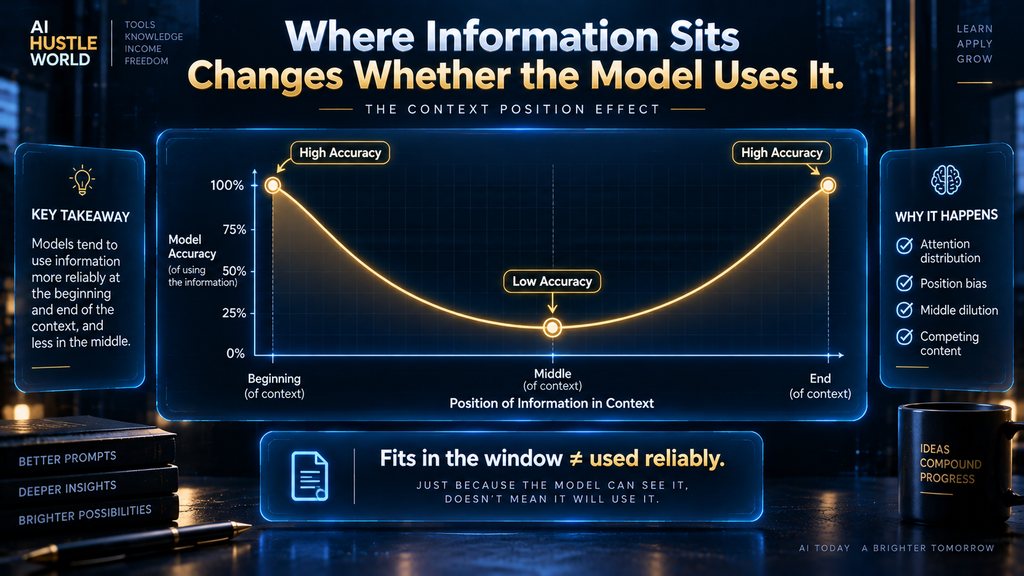
Two separate bodies of research explain why. The original “Lost in the Middle” study found that model accuracy on a fact-retrieval task followed a U-shaped curve based on where the relevant information sat in the input — information at the very start or very end of a long context was retrieved far more reliably than the same information placed in the middle, even when the total input was well within the model’s stated limit. A separate line of research on context rot found that performance can degrade as input length grows even on tasks that shouldn’t be affected by length at all, suggesting the degradation isn’t just about position but about the sheer volume of tokens the model has to attend across.
The Compression Ladder: Six Approaches and What Each One Actually Discards
Rather than one technique, think of document compression as six distinct approaches, each trading a different kind of completeness for a different kind of efficiency. Simple truncation discards everything past a length limit, keeping only positional priority. Extractive summarization discards everything except selected original sentences, keeping the source’s exact wording. Abstractive summarization discards the original wording entirely in favor of a denser paraphrase.
Hierarchical summarization discards detail progressively across multiple passes over long documents. Semantic chunking with retrieval discards everything not relevant to a specific query, keeping only what’s needed for that one question. Token-level prompt compression discards individual low-information words and tokens while keeping the surrounding structure mostly intact.
None of these six is universally better — each is the right tool for a specific failure mode, and the mistake most teams make is picking one technique and applying it to every document type regardless of what that document actually needs preserved.

Approach 1: Simple Truncation and Why It’s Rarely the Right Call
Truncation — cutting a document off at a token limit and discarding the rest — is the default behavior when no compression strategy is applied at all, and it’s almost always the worst option available. It discards information based purely on position rather than relevance, which means anything past the cutoff point is gone regardless of how important it is to the task at hand.
The narrow case where truncation is defensible is when a document’s most important content is reliably front-loaded by convention — an executive summary at the top of a report, an abstract at the top of a paper — and even then, it’s a fragile assumption that breaks the moment a document doesn’t follow that convention. Truncation should be treated as a fallback for when no better technique is available, not a first-choice compression strategy.
Approach 2: Extractive Summarization — Keeping the Model’s Own Words
Extractive summarization selects a subset of the original sentences or passages verbatim rather than generating new text, which means every sentence that survives compression is guaranteed to be an accurate representation of the source — there’s no risk of the summarizer subtly rephrasing a number or a qualifier incorrectly. The trade-off is that extractive summaries can read disjointedly, since sentences pulled from different parts of a document weren’t written to flow together, and it can miss information that’s only clear when several sentences are combined.
Extractive approaches are strongest for high-stakes source material — legal, medical, financial documents — where preserving exact wording matters more than readability, and where a paraphrasing error in an abstractive summary could change the meaning of a clause or a dosage instruction.
Approach 3: Abstractive Summarization — Rewriting for Density
Abstractive summarization generates new text that captures the meaning of the source rather than reusing its exact sentences, which produces denser, more readable compression — a well-written abstractive summary can convey in one paragraph what would take several extracted sentences to cover. The cost is a real risk of subtle inaccuracy: a rewritten sentence can drop a qualifier, round a number, or merge two related-but-distinct points into one that isn’t quite accurate to either.
Abstractive summarization is the right default for content where readability and density matter more than exact wording — condensing background context, general research material, or narrative content — but it’s a poor choice for source material where a single misrepresented number or qualifier has real consequences downstream.
Approach 4: Hierarchical and Map-Reduce Summarization for Very Long Documents
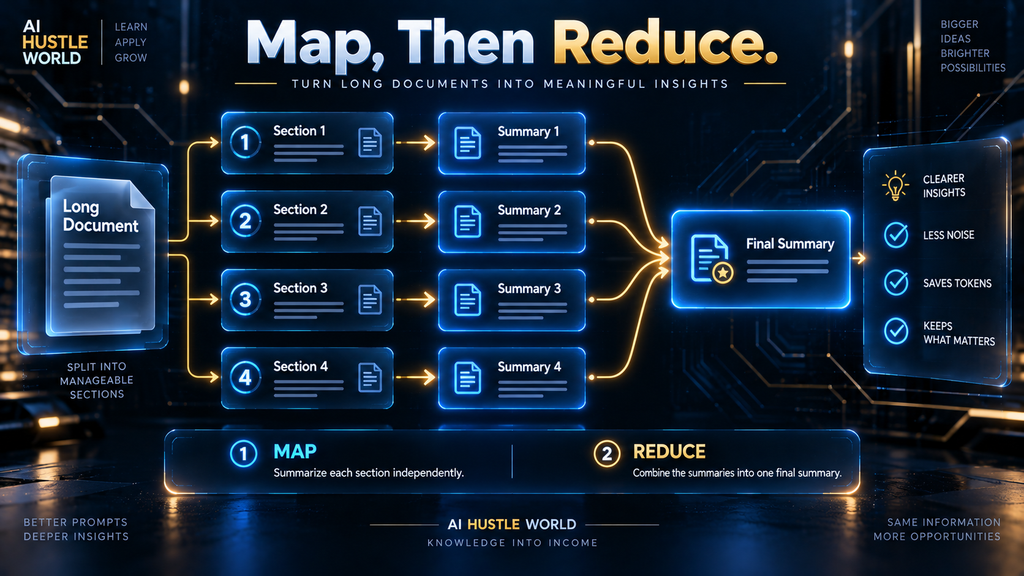
Documents too long to summarize in a single pass — books, lengthy legal filings, multi-hundred-page reports — need a different strategy: split the document into sections, summarize each section independently (the “map” step), then summarize the collection of section summaries into a final result (the “reduce” step). This avoids the single-pass attention problems that come with feeding an entire long document through one summarization call.
The trade-off with map-reduce summarization is that information spanning two sections can be lost if it only makes sense in combination — a claim made in section three that’s only fully supported by evidence in section nine won’t necessarily survive both sections being summarized independently before that connection is drawn. A refine variant, which summarizes sequentially and updates a running summary with each new section rather than summarizing sections in isolation, preserves more cross-section connection at the cost of being harder to parallelize and more sensitive to the order sections are processed in.
Approach 5: Semantic Chunking and Retrieval — Treating Compression as a Search Problem
Rather than compressing a whole document, this approach reframes the problem: split the document into semantically coherent chunks, embed them, and retrieve only the chunks relevant to a specific query at the moment the query is asked. This is the mechanism underlying most retrieval-augmented generation systems, and it’s arguably the most targeted compression strategy available, since it discards everything not relevant to the immediate question rather than trying to preserve a general-purpose summary of the whole document.
Chunk boundaries matter more than people initially assume: chunking at fixed character or token counts frequently splits a coherent idea across two chunks, weakening both, while semantic chunking — splitting at natural topic or paragraph boundaries rather than a fixed length — keeps related content together at the cost of variable chunk sizes that are slightly harder to manage in a retrieval pipeline. The trade-off with retrieval-based compression generally is that it answers the specific question well but provides no comprehensive view of the document as a whole, which matters when a task genuinely needs a holistic understanding rather than an answer to one narrow query.
Approach 6: Token-Level Prompt Compression
The most granular approach compresses at the level of individual tokens rather than sentences or sections: a technique like LLMLingua, developed by Microsoft Research, uses a small language model to estimate how much each token in a prompt actually contributes to the task, then removes the lowest-contribution tokens while preserving overall structure and meaning, achieving substantial compression ratios with measured performance loss that’s often smaller than the compression ratio would suggest.
This approach works well as a layer on top of other compression techniques rather than a replacement for them — it can shrink an already-summarized or already-retrieved passage further before it’s sent to the model, squeezing additional token savings out of content that’s already been reduced by summarization or retrieval. It’s less suited as a standalone strategy for a full raw document, since it operates on token-level redundancy rather than higher-level structural understanding of what matters in the source.
What Each Approach Actually Loses: A Comparison
| Approach | What Survives | What’s Typically Lost |
|---|---|---|
| Truncation | Content before the cutoff | Everything past the cutoff, regardless of relevance |
| Extractive summarization | Exact original wording of selected passages | Flow between passages; anything not explicitly selected |
| Abstractive summarization | General meaning, densely rewritten | Exact wording, qualifiers, precise numbers |
| Hierarchical / map-reduce | Section-level detail at each stage | Connections spanning multiple sections |
| Semantic chunking + retrieval | Content directly relevant to the query | Holistic view of the full document |
| Token-level compression | Structure and high-contribution tokens | Low-contribution words; some stylistic nuance |

The Lost-in-the-Middle Problem: Why Position Matters as Much as Length
Even a document compressed to comfortably fit a model’s context window can still be assembled in a way that undermines it, because where relevant information sits within the compressed input affects how reliably the model retrieves it. The lost-in-the-middle research found accuracy dropping specifically for information placed away from the start and end of the input, which means a compression pipeline that concatenates chunks or summaries without regard to importance-ordering can bury the most critical piece of content in the position the model is statistically worst at using.
The practical fix is deliberate ordering: placing the most decision-relevant content near the beginning or end of the assembled context rather than the middle, and when a single piece of information is critical enough, considering repeating it in more than one position so it isn’t dependent on falling into a favorable slot by chance.
Context Rot: Why More Tokens Can Hurt Even Within the Limit
Context rot describes a broader and more concerning pattern than positional bias alone: measured performance decline as input length grows, observed even on tasks that have no obvious reason to be sensitive to length, and even when every individual piece of information in the input is technically relevant. This suggests the issue isn’t only about where information sits, but about the cumulative cost to the model of processing and weighing a larger volume of tokens at all.
The practical implication is blunt: “it fits in the context window” is not the same claim as “the model will use it reliably,” and treating a large context window as a substitute for compression discipline is a documented way to get worse results, not just slower and more expensive ones. Compression remains relevant precisely because context windows growing larger doesn’t remove the incentive to send a model less, more relevant, more deliberately ordered content.
The Hallucination Risk Compression Introduces
Abstractive summarization’s density comes with a real hallucination risk — the model generating the summary can state something as fact that isn’t actually in the source, especially numbers, dates, or causal claims that got smoothed over during rewriting. This is different from a model simply being wrong about the world; it’s the summarization step itself introducing new, false content into a document that’s about to be treated as ground truth for whatever task comes next.
The failure mode is worse than it looks because a hallucinated line in a summary reads exactly like every accurate line around it — nothing about the surface text signals which sentences are grounded and which one drifted. The mitigation isn’t avoiding abstractive summarization altogether but pairing it with a faithfulness check: a separate pass, or a lightweight rule-based check on numbers and named entities, confirming every specific claim in the compressed version traces back to something actually present in the source.
Choosing a Compression Strategy by Document Type
Legal contracts and regulatory filings favor extractive summarization or targeted retrieval over abstractive rewriting, since a paraphrased clause can shift its legal meaning in ways a business can’t afford. Codebases favor a structural approach entirely distinct from prose summarization — retrieving relevant functions, call sites, and their immediate dependencies rather than summarizing code in natural language, since code’s meaning is precise and rarely survives paraphrase at all.
Long chat or support transcripts favor hierarchical summarization that preserves chronology and decision points, since the sequence in which things were said or agreed to often matters as much as the content itself. Research papers and long-form reports tend to favor a hybrid: abstractive summarization for background and literature context, paired with extractive preservation of specific findings, statistics, and methodology details where a paraphrase risks misrepresenting a precise result.
Preserving Structure: Tables, Code, and Numerical Data Under Compression
Generic prose-focused summarization tools frequently mangle non-prose content — a summarizer asked to condense a document containing a data table will often describe the table in words rather than preserving it, losing the precision a reader would need to actually use the numbers. The same applies to code blocks, which lose their exact syntax the moment a summarizer treats them as prose to paraphrase rather than a structure to preserve verbatim or omit entirely.
The practical fix is segmenting a document before compression by content type — tables, code blocks, and structured data extracted and either preserved verbatim or converted to a compact structured format, with prose summarized separately — rather than running one summarization pass over a mixed document and hoping the model handles every content type equally well. This segmentation step is easy to skip and is one of the most common sources of silently degraded compression quality.
Why Fixed-Size Chunking Still Shows Up Everywhere (And Why It Backfires)
Despite semantic chunking’s clear advantages, fixed-size chunking — splitting a document every N tokens or characters regardless of content — remains the default in a lot of production retrieval pipelines, mostly because it’s trivial to implement and doesn’t require a model call to determine boundaries. The problem shows up quietly: a fixed 500-token chunk boundary lands in the middle of a sentence or a table row about as often as it lands at a natural break, and a retrieval system built on those chunks will sometimes return half of the relevant information and miss the rest.
Chunk overlap — duplicating a small window of text at the boundary between adjacent chunks — is the common workaround, and it does reduce the odds that a single idea gets fully severed, but it doesn’t fix the underlying problem, it just makes the failure less frequent. Semantic chunking costs more upfront, since it typically needs a pass to detect topic or paragraph boundaries, but it eliminates the specific failure mode of routinely splitting ideas mid-thought, which is why it’s worth the extra step for any retrieval pipeline handling documents with real internal structure.
Security and Data Exposure When Compressing Before Sending to a Third-Party API
Compression has a security dimension that’s separate from cost and accuracy: sending a compressed version of a document to a third-party model API is also an opportunity to reduce what leaves your systems in the first place, not just what the model has to process. A compression step that segments a document by content type, as described earlier, is a natural place to also strip or redact sensitive fields — account numbers, personal identifiers, internal-only annotations — before the document is compressed and sent onward.
Treating compression and redaction as the same pipeline stage, rather than two separate steps, means a document only ever gets read once for both purposes, and it forces an explicit decision about what’s actually needed for the task at hand rather than defaulting to sending everything and hoping the model ignores what it shouldn’t use. This is especially relevant for the document types discussed earlier — legal and financial material — where the same content that most needs precise handling under compression is often also the content with the least tolerance for being sent somewhere it doesn’t need to go.
Recursive Summarization for Extremely Long Documents
Documents that exceed even a generous context window by a wide margin — a full book, a multi-thousand-page regulatory archive — need recursive application of hierarchical summarization: summarize chapters, then summarize the chapter summaries into part-level summaries, then summarize those into a final document-level summary, repeating the map-reduce pattern at multiple levels of granularity rather than just once.
Each additional level of recursion compounds information loss, since a summary of summaries is one step further removed from the original detail, which means recursive summarization is best paired with a way to drill back down to source material for a specific claim rather than treating the final summary as a complete, standalone replacement for the original document. Keeping the intermediate-level summaries accessible, not just the final one, gives a path back to more detail when the top-level summary alone isn’t specific enough to answer a follow-up question.
Evaluating Compression Quality: What to Measure Beyond “Did It Fit”
The easiest thing to measure about a compression pipeline — whether the output fits the target token budget — is close to useless as a quality signal on its own, since a compression method can hit any token target by simply discarding more content. Faithfulness, whether the compressed version makes no claims the source doesn’t support, is a more meaningful check, and it requires either human review or a separate model pass comparing compressed output against source content for unsupported additions.
Coverage, whether the compressed version retains the specific facts a downstream task actually needs, matters more than general summary quality and should be measured against a task-specific checklist of must-retain facts rather than a generic “is this a good summary” judgment. Task performance — running the actual downstream task against compressed input and comparing results to running it against the full source — is the most direct measure of whether a compression pipeline is working, and it’s worth building even a small evaluation set of representative documents with known correct answers to catch compression regressions before they reach production.
Common Mistakes When Compressing Documents for AI
Applying one compression technique universally regardless of document type ignores that legal text, code, and narrative prose lose fundamentally different things under the same summarization approach. Assuming a bigger context window removes the need for compression discipline ignores both the lost-in-the-middle and context-rot research showing degraded performance even well within stated limits.
Compressing prose and structured data (tables, code, numbers) with the same undifferentiated pass loses precision that segmented handling would have preserved. Measuring only whether compressed output fits the token budget, without checking faithfulness or task-specific coverage, hides quality regressions until they surface downstream. And treating a single-pass summary of a very long document as sufficient, rather than applying hierarchical or recursive summarization, produces a summary quietly missing detail from whichever section got the least attention during generation.
When Not to Compress: Cases Where Full Context Actually Matters
Compression is not free even when done well, and some tasks genuinely need the full, uncompressed source rather than any reduced version of it. Legal or contractual analysis where a specific clause’s exact wording is the entire point of the task shouldn’t be compressed at all if the document reasonably fits the context window — the risk of an extraction or summarization step dropping or paraphrasing the critical clause outweighs the token savings.
Tasks requiring genuinely holistic understanding — assessing the overall tone or argument structure of a long document, rather than answering a specific factual question about it — are poorly served by retrieval-based compression, which by design surfaces only fragments relevant to a narrow query rather than the whole. In both cases, if the document fits the context window without compression and the task’s stakes justify the extra cost, sending the full source is the more defensible choice, and compression should be reserved for cases where length genuinely exceeds what’s practical to send whole.
Cost and Latency: The Economics of Compression vs a Bigger Window
Sending an uncompressed long document through a large context window is not free — input tokens are billed on essentially every provider, and a document compressed to a tenth of its original length costs roughly a tenth as much to process on every single call that uses it, which compounds quickly for any document queried more than once. Latency scales similarly: a smaller input generally means a faster response, which matters directly for any user-facing application where response time is part of the experience.
The break-even calculation favors compression whenever a document will be queried multiple times, since the one-time cost of compressing it is amortized across every subsequent query, while a document queried only once has a much weaker case for investing in a sophisticated compression pipeline beyond whatever the task minimally requires. Teams building any kind of repeated-query system over long documents — a support knowledge base, a contract-review tool, a research assistant — should treat compression as a cost-control measure with a measurable return, not just a technical nicety.
How Prompt Caching Changes the Compression Calculus
Provider-side prompt caching, which discounts the cost of tokens that repeat identically across calls, changes the economics described above in a specific way: a document that’s compressed once and then queried many times with the same compressed context benefits from caching on top of the savings compression already provides, compounding the two effects rather than making one redundant.
The calculus shifts for documents queried with a different compressed context each time, such as a retrieval pipeline that surfaces different chunks per query — caching helps far less there, since the whole point of query-aware retrieval is that the context sent to the model changes from one query to the next. In practice, a static, once-compressed reference document such as a policy manual or a product spec is a strong candidate for combining compression with caching, while a per-query retrieval pipeline should be evaluated on compression and latency savings alone, treating any caching benefit as a bonus rather than a core part of the cost model.
The Contrarian Take: When a Sophisticated Compression Pipeline Isn’t Worth Building
Not every team facing a long-document problem needs the six-approach, multi-stage pipeline described in this guide, and there’s a reasonable case for skipping most of it: if a document set is small, queried rarely, and comfortably fits a large context window, the engineering time spent building chunking, retrieval, and evaluation infrastructure can easily exceed what it saves in token costs for years.
The honest trigger for investing in a real compression pipeline isn’t “the document is long” — it’s a combination of query volume high enough that per-call token costs add up, documents numerous or large enough that manual review isn’t practical, and a task where compression errors carry low enough stakes that some faithfulness risk is acceptable in exchange for the savings. A team that hasn’t hit that combination yet is usually better served by sending full documents through a large context window and revisiting compression once cost or latency actually becomes a measured problem, rather than building the infrastructure preemptively.
Combining Techniques: A Practical Compression Pipeline
Production systems rarely rely on a single compression technique in isolation — a realistic pipeline for a long document might segment structured content (tables, code) from prose first, apply semantic chunking and retrieval to surface only query-relevant prose sections, run extractive or abstractive summarization on the surfaced sections depending on the content’s sensitivity, and apply token-level compression as a final pass to squeeze additional savings out of whatever survives the earlier stages.
Building a pipeline this way rather than reaching for one technique lets each stage do the part of the job it’s actually good at: retrieval handles relevance, summarization handles density, and token-level compression handles the remaining redundancy that survives both. The added complexity is worth it precisely for the systems where compression quality has a measurable downstream cost — a customer-facing tool making decisions off compressed context has a much stronger case for this than a one-off internal script.
Versioning Compressed Documents as Source Content Changes
A compressed version of a document is a derived artifact, and like any derived artifact it goes stale the moment its source changes — a summarized policy document that gets updated at the source has a compressed version that’s now silently wrong until someone regenerates it, and nothing about the compressed text itself signals that it’s out of date. The fix is treating compression as a step tied to the document’s own versioning rather than a one-time action: regenerating, or at minimum flagging, the compressed version whenever the source changes, storing which source version a given compressed artifact was generated from, and, for high-stakes documents, including a last-verified date in the compressed output itself so downstream consumers can see how current it actually is rather than assuming a compressed summary is automatically in sync with its source.
Second-Order Effects: How Compression Changes What Gets Asked
Once a compression pipeline is in place, it quietly changes the kinds of questions people ask against a document set, not just the cost of answering them — a retrieval system that only surfaces narrow, query-relevant chunks makes broad, exploratory questions like “summarize everything unusual in this contract” harder to answer well than a system built around full-document access, simply because retrieval is optimized for a different shape of question.
Teams that build a compression pipeline around one dominant query pattern sometimes discover later that a different, more holistic use case for the same documents doesn’t work well against the same infrastructure, which is worth planning for upfront rather than treating compression as a neutral optimization with no effect on what the system is actually good at answering. Keeping a path to full-document access available alongside a compression pipeline, even if it’s slower and more expensive, preserves the ability to handle the exploratory questions a narrow retrieval system wasn’t built for.
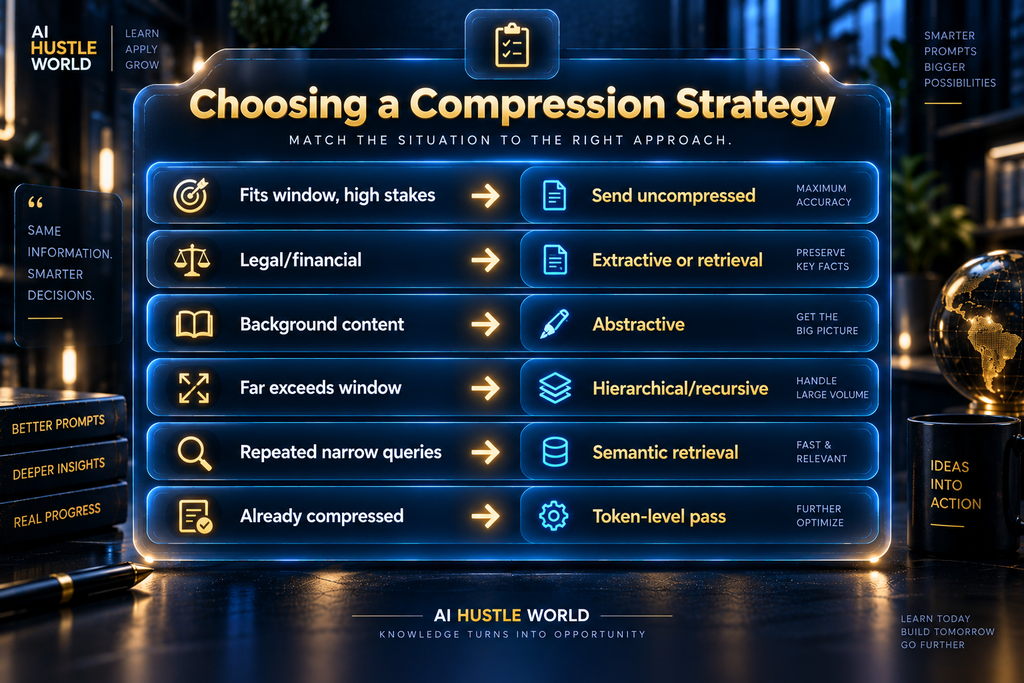
A Practical Decision Framework
| Situation | Recommended Approach |
|---|---|
| Document fits the context window, stakes are high | Send it uncompressed — don’t compress by default |
| Legal, medical, or financial source material | Extractive summarization or targeted retrieval, avoid abstractive rewriting |
| General background or narrative content | Abstractive summarization for density |
| Document far exceeds the context window | Hierarchical / map-reduce, recursive if extremely long |
| Repeated narrow queries against a large corpus | Semantic chunking + retrieval |
| Already-compressed content needs further reduction | Token-level compression (LLMLingua-style) as a final pass |
Worked Example: Compressing a 40-Page Contract for a Specific Question
Consider a 40-page vendor contract and a specific question: “what are the termination conditions and notice period?” Feeding the entire document through an abstractive summarizer risks paraphrasing the exact notice-period language in a way that changes its legal meaning, and feeding the whole document raw is wasteful if only one section is relevant to the question being asked. The more defensible approach is semantic chunking of the contract into sections, retrieval of the sections most relevant to “termination” and “notice period” specifically, and then extractive presentation of the exact retrieved clauses rather than a paraphrased summary of them — preserving the precise wording that actually determines the contract’s legal effect while still discarding the 38 pages of unrelated content that had nothing to do with the question asked.
Multilingual and Mixed-Format Source Documents
Compression pipelines built and tested on a single language and format frequently degrade on multilingual or mixed-format source material — a semantic chunker tuned for English paragraph structure may chunk a different language’s sentence boundaries poorly, and a summarizer’s compression ratio and faithfulness can both shift when applied to content it wasn’t primarily evaluated against. Testing a compression pipeline specifically against the languages and formats it will actually process in production, rather than assuming performance measured on English prose transfers cleanly, catches a category of silent quality regression that’s easy to miss when a team’s own evaluation documents happen to be in one language and format.
Compressing a Single Long Document vs a Multi-Document Corpus
Everything covered so far applies most directly to a single long document, but a lot of real systems face a related, slightly different problem: a corpus of many documents, each individually short enough to fit a context window, where the challenge is finding and combining the right handful out of thousands rather than compressing one oversized file. The compression techniques still apply — chunking, retrieval, summarization — but the failure modes shift toward cross-document duplication and conflicting information rather than within-document structure loss.
A corpus of onboarding documents that each restate the same policy slightly differently, for instance, can return several retrieved chunks that all answer the same question with subtly different wording, and a compression or retrieval pipeline built only around single-document assumptions has no built-in way to notice the redundancy or resolve the conflict. Deduplication and a conflict-detection pass across retrieved results, run before the retrieved content reaches the model, catches this category of problem that single-document compression techniques were never designed to handle.
What’s Next: Adaptive, Query-Aware Compression
The direction most compression research and tooling is heading is toward compression that adapts to the specific query being asked rather than producing one fixed compressed version of a document upfront — instead of a static summary generated once and reused for every future question, a system that re-compresses or re-retrieves based on what’s actually being asked each time preserves more of the information relevant to that specific request. For teams building document-heavy AI systems today, the practical takeaway is to stop treating compression as a one-time preprocessing step and start treating it as part of the query pipeline itself — what gets kept and what gets discarded should depend on what’s being asked, not be decided once, upfront, for every possible future question a document might need to answer.
Final Thoughts
Compressing a long document for AI is not a single operation with one right answer — it’s a set of distinct trade-offs, and the six approaches covered here each discard a different kind of information in exchange for a different kind of efficiency. Truncation discards by position, extractive and abstractive summarization discard by rewriting choice, hierarchical summarization discards across section boundaries, retrieval discards by relevance to a specific query, and token-level compression discards by individual word contribution.
None of that complexity goes away as context windows keep growing, because the research on lost-in-the-middle and context rot shows that fitting a document in is not the same as the model using it well. The teams getting reliable results from long-document AI tasks aren’t the ones with the biggest context window — they’re the ones who matched a compression strategy to what their specific task actually needed preserved.
Want the Full Picture Behind This?
Compression is one piece of getting the right information to a model. Our complete guide to context engineering covers the rest — from prompt structure to retrieval to what to leave out entirely.
Read the Context Engineering Guide →Frequently Asked Questions
Does a larger context window remove the need to compress documents?
No. Research on lost-in-the-middle and context rot shows model performance can degrade with longer input even well within the stated context limit, both from where information sits in the input and from the sheer volume of tokens being processed. Compression remains relevant for reliability, not just for fitting content in.
Which compression method is safest for legal or financial documents?
Extractive summarization or targeted retrieval, since both preserve the source’s exact wording rather than risking a paraphrase that subtly changes a clause’s or a figure’s meaning. Abstractive summarization is better suited to lower-stakes background or narrative content.
What’s the difference between chunking and summarization?
Chunking splits a document into sections and retrieves only the sections relevant to a specific query, discarding everything else. Summarization condenses the entire document (or a section of it) into a shorter version, keeping some representation of all of it rather than discarding whole sections outright.
Why does my summarizer mangle tables and code in a document?
Generic prose-focused summarizers tend to paraphrase structured content into prose, losing the precision tables and code depend on. Segmenting a document by content type before compression, and handling tables and code separately from prose, avoids this.
What is LLMLingua and when should I use it?
LLMLingua is a token-level prompt compression technique that removes low-contribution words while preserving structure and meaning. It works best as an additional compression layer on already-summarized or already-retrieved content, rather than as a standalone strategy for a full raw document.
How do I know if my compression pipeline is actually working?
Measure faithfulness (does the output make claims the source doesn’t support), coverage (does it retain the specific facts your task needs), and task performance (does the downstream task perform as well on compressed input as on the full source), not just whether the output fits a token budget.
Should I ever send a document uncompressed?
Yes, when it fits the context window and the task’s stakes justify the cost — particularly for legal or high-precision tasks where compression risks losing or altering the specific detail the task depends on. Compression should be reserved for documents that genuinely exceed what’s practical to send whole.
What’s the risk with map-reduce summarization specifically?
Information spanning multiple sections can be lost if it only makes sense in combination, since sections are often summarized independently before being combined. A refine-style sequential approach preserves more cross-section connection at the cost of being harder to parallelize.
Does compression work the same way across languages?
Not necessarily. Chunking and summarization pipelines tuned and evaluated on one language or format can degrade on others, so testing against the actual languages and formats a pipeline will process in production is important rather than assuming results transfer cleanly.
Is it better to compress once and reuse the result, or compress per query?
Query-aware compression that adapts to the specific question being asked generally preserves more relevant information than a single static summary reused for every future query. A one-time compressed version is more practical for low-stakes or infrequent use, but repeated, high-value use cases benefit from compression that responds to what’s actually being asked.
Can summarization introduce information that wasn’t in the original document?
Yes — abstractive summarization in particular carries a real hallucination risk, where the model rewriting the content states a number, date, or causal claim as fact that isn’t actually supported by the source. Pairing abstractive summarization with a faithfulness check, rather than trusting the output by default, catches this before it reaches a downstream task.
Does prompt caching replace the need for compression?
No, the two are complementary rather than substitutes. Caching discounts tokens that repeat identically across calls, so it works best on a static, once-compressed document queried repeatedly; a retrieval pipeline that surfaces different chunks per query gets far less benefit from caching, since the context sent to the model changes each time.Context Engineering Explained: How to Give AI Models the Right InformationAI Conversation Intelligence Explained: How AI Turns Conversations Into Business Insights
Sources and Further Reading
- Contextual Retrieval: Anthropic. A method that prepends context to chunks before embedding and indexing.
- Effective context engineering for AI agents: Anthropic engineering guidance on managing what goes into a model’s context.
Written by
Muntasir Ahmad Chowdhury
Founder, AI Hustle World
Muntasir Ahmad Chowdhury is the Founder of AI Hustle World, an independent publication dedicated to making Artificial Intelligence practical, trustworthy, and easy to understand. He researches AI tools, automation, customer service, productivity, and real-world business applications, helping readers make smarter technology decisions through research-driven, experience-backed content.
Expertise:
AI Tools • AI Automation • AI Customer Service • AI Productivity • Generative AI • AI Workflows
Get Smarter With AI
Enjoyed this guide? Get practical AI tools, tutorials, and honest reviews delivered to your inbox.
2 thoughts on “How to Compress Long Documents for AI Without Losing Important Context”