Evidence: Documentation reviewed
Last checked: August 2026
What was done: Written from official documentation and the published sources linked in this article. Not hands-on tested.
Files: None
Affiliate links: No
Best AI Writing Tools in 2026: Free & Paid Picks
Last updated: August 2026
The AI writing market has changed. A few years ago, “AI writing tool” usually meant one thing: a website where you entered a topic and received an article. That definition is now too narrow.
Today, you can use a general AI assistant to research and draft, a dedicated marketing platform to manage brand voice and campaigns, an editor to improve existing prose, an SEO platform to produce search-oriented content, or a creative-writing specialist to help develop fiction. Those products may all be called AI writing tools, but they solve very different problems. That is why the usual “Top 10 AI writers” ranking is often misleading.
Putting ChatGPT, Grammarly, Jasper and Sudowrite into one straight ranking is like ranking a word processor, a marketing department, a grammar editor and a novelist’s writing partner on the same scale. The better question is: What kind of writing are you trying to improve, and what part of the writing workflow is actually slowing you down? That is the approach in this guide.
We compare 10 leading AI writing tools by the job they are designed to do, the workflow they support, the limitations that matter, and whether a free or paid plan makes sense. The most important distinction is this:
The best AI writing tool is not necessarily the tool that writes the best sentence. It is the tool that removes the most expensive bottleneck in your writing workflow.
Quick Answer: The Best AI Writing Tools by Use Case
| Tool | Best for | Free access | Paid value |
|---|---|---|---|
| ChatGPT | General-purpose writing and thinking | Yes | Higher limits and broader advanced access |
| Claude | Long-form reasoning and nuanced writing | Yes | More usage, Research, Projects and additional capabilities |
| Gemini | Google-centered writing workflows | Yes | Higher limits and deeper Google integration |
| Grammarly | Editing and rewriting existing text | Yes | Advanced rewriting, tone and higher AI usage |
| Jasper | Marketing teams and brand-controlled content | Trial | Brand/workflow capabilities for professional marketing |
| Copy.ai | GTM and workflow-driven copy | Paid-focused | Workflow and business automation capabilities |
| Writesonic | SEO/content + AI-search visibility | Trial/free entry | Full SEO and AI-search visibility workflows |
| QuillBot | Paraphrasing and rewriting | Yes | Unlimited paraphrasing and advanced modes |
| Rytr | Budget-friendly lightweight writing | Yes | Unlimited generation and more voice/customization |
| Sudowrite | Fiction and creative writing | Trial | Large credit allowances and specialist creative tools |
There is no universal #1 here. A freelance writer may be happiest with ChatGPT or Claude. A marketing department may get more value from Jasper.
A company focused on SEO and AI-search visibility may find Writesonic more relevant. A novelist has a very different problem and may prefer Sudowrite.
A student or professional who already has a draft may need Grammarly or QuillBot more than another chatbot. The rest of this article explains why.
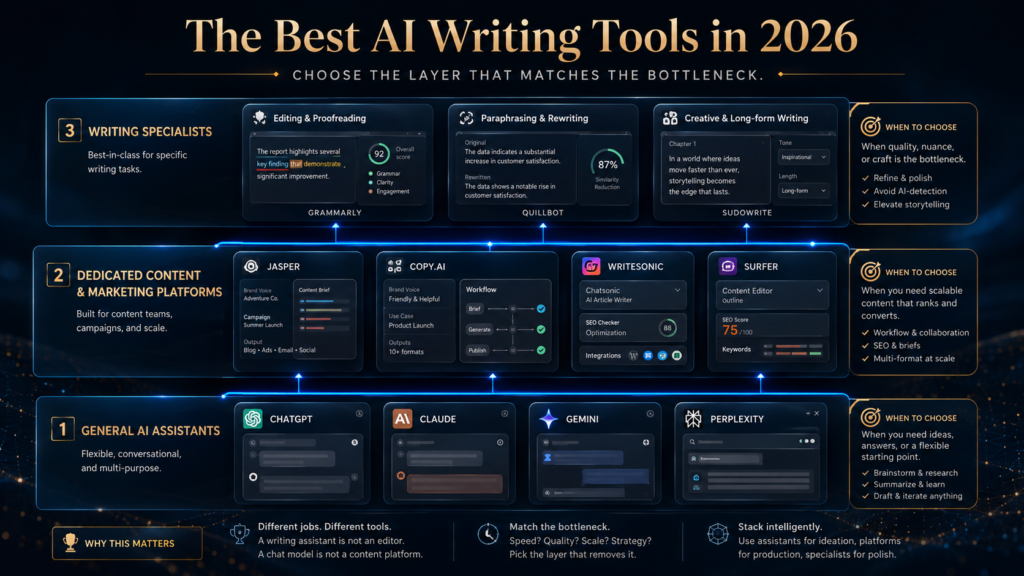
The AI Writing Market Has Split Into Three Layers
The first principle is simple: Not every AI writing product is really competing for the same job. The market increasingly falls into three layers.
Layer 1: General AI assistants
These are broad systems that can help with research, reasoning, drafting, editing, brainstorming and many tasks beyond writing. Examples:
ChatGPT, Claude, Gemini. Their advantage is flexibility. You can move from research to outline to draft to critique without changing applications.
Layer 2: Dedicated content and marketing platforms
These products are built around repeatable content or marketing operations rather than a blank chat window. Examples:
Jasper, Copy.ai, Writesonic. Their advantage is workflow depth. They can matter more when writing is no longer an individual task and becomes a repeatable business process involving:
- brand voice
- campaign assets
- content operations
- SEO
- collaboration
- structured workflows
- multiple content formats
This is an important market shift. Jasper currently describes itself as an AI platform built for marketing success and offers brand voices, knowledge assets, audiences and marketing applications, with Pro priced at $69/month monthly or $59/month when billed annually.
Copy.ai likewise positions its current product around GTM workflows rather than simply generic copy generation. Its self-serve Chat plan is currently $29/month or $24/month with annual billing, while larger plans add workflow credits and business capabilities.
Writesonic has moved even further toward SEO and AI-search visibility: its current product tracks visibility across systems such as ChatGPT, Gemini and Google AI Overviews alongside AI article generation, site audits and SEO workflows. Its current Starter plan is $99/month monthly or $79/month with annual billing.
That means these tools should not be evaluated purely on sentence quality. Their value increasingly comes from workflow economics.
Layer 3: Writing specialists
These tools solve a narrower problem. Examples:
- Grammarly → editing
- QuillBot → paraphrasing and rewriting
- Sudowrite → creative writing
- Rytr → lightweight content production
The narrower the job, the more important workflow fit becomes.
The AI Writing Tool Decision Stack
Here is the AI Hustle World framework for choosing among them.
1. THINK
Do you need help understanding the topic, researching it or developing an argument? Start with a general assistant such as ChatGPT or Claude.
2. DRAFT
Do you need a first version quickly? A general assistant may still be enough. A dedicated platform becomes more useful when you repeat the same content workflow frequently.
3. EDIT
Do you already have the words? You may need Grammarly or QuillBot rather than another full AI writer.
4. OPTIMIZE
Do you need SEO, brand consistency, content operations or marketing workflows? Now dedicated platforms become more relevant.
5. SCALE
Are you producing content repeatedly across a team, brand or multiple channels? At this stage, workflow management can matter more than individual response quality. This framework is deliberately simple because it solves a common mistake: People often buy an entire AI writing platform when the real problem is one missing step.
1. ChatGPT — Best Overall AI Writing Assistant
Best for: Writers who want one flexible tool for research, drafting, rewriting, analysis and idea development. ChatGPT is the strongest general-purpose starting point for many writers because writing is only one part of the workflow.
The current Free plan is $0 and provides access to web search and limited access to advanced capabilities such as deep research, file uploads, data analysis, image generation and voice. Plus is currently $20/month and expands limits and access to more advanced capabilities.
Why it works so well for writing
A typical writing project does not begin with an empty document. It begins with questions:
- What is the reader trying to solve?
- What should I cover?
- What evidence do I need?
- What arguments are strongest?
- What is missing?
- Does this paragraph actually say anything useful?
A general AI assistant can help at every stage. That makes ChatGPT especially strong for writers who want to move through: Research → Thinking → Outline → Draft → Critique → Revision without changing tools.
Where ChatGPT is strongest
It can help with:
- brainstorming
- outlining
- research assistance
- summarization
- rewriting
- editing
- content planning
- email writing
- scripts
- explanations
- code documentation
- idea generation
The broader capability is the advantage. You don’t need a dedicated writing application for every writing task.
The weakness
General-purpose flexibility can also become a weakness. A blank chat interface does not automatically give you:
- a complete brand-voice system
- editorial workflows
- campaign management
- structured content operations
- deep SEO workflow management
Those become more important when writing is a business process rather than an individual activity.
Free vs paid
The free version is enough to test the workflow. Upgrade when the free limitations repeatedly interrupt valuable work or advanced tools genuinely save more time than the subscription costs. There is no strategic reason to pay simply because Plus exists.
Who should use it
Best for: Freelancers, bloggers, marketers, students, founders and general writers. Avoid using it as your only tool when: you need a highly specialized enterprise content workflow. AI Hustle World verdict: Best overall starting point for most individual writers.
2. Claude — Best for Long-Form and Nuanced Writing
Best for: Long documents, thoughtful editing, structured reasoning and nuanced prose.
Claude currently offers a free plan. Its Pro plan is $20/month, with annual billing available at a discounted rate. Pro adds more usage, Research, Projects, Google Workspace connections, more model access and additional capabilities.
Why Claude deserves a place here
Writing quality is not only about producing fluent sentences. A strong writing assistant needs to work with:
- context
- structure
- argument
- tone
- nuance
- contradictions
- long source material
That makes Claude particularly interesting for writers working on reports, essays, analysis, documentation and long-form content.
A better way to use it
Instead of: “Write a 2,000-word article about AI.”
Try: “Here is my outline, evidence and target audience. Identify the three weakest arguments, explain why they are weak, and suggest how to strengthen them without changing the core thesis.”
That turns AI into an editor rather than a vending machine.
Where Claude is strongest
- long-form writing
- editing
- argument development
- document analysis
- research assistance
- structured reasoning
- complex rewriting
The weakness
Claude is not automatically the best platform for every production workflow. If your main need is brand management, SEO operations or campaign orchestration, a dedicated platform may provide more useful infrastructure.
Free vs paid
The free plan is the logical place to start. Pro becomes useful when your writing workload is frequent enough that usage limits or advanced capabilities materially affect productivity. AI Hustle World verdict: Excellent for serious long-form writing and editorial reasoning.
3. Gemini — Best for Google-Centered Writing
Best for: Writers already working heavily inside Google’s ecosystem. Gemini is attractive when your writing workflow already revolves around:
- Google Docs
- Gmail
- Drive
- Google Search
- NotebookLM
- other Google services
Google currently lists Google AI Pro at $19.99/month and says the plan increases Gemini usage limits, adds access to its Pro model and Deep Research, and integrates Gemini into Gmail, Docs, Vids and other Google services.
Why ecosystem fit matters
Suppose you spend most of your working day inside Google Docs. An AI assistant that naturally fits into that environment may remove more friction than a tool that is marginally better in isolation but requires constant copying and pasting. This is an important lesson: Workflow integration can beat benchmark superiority.
Where Gemini works well
- drafting
- rewriting
- brainstorming
- summarization
- research
- Google-centered document workflows
- multimodal tasks
The weakness
If Google integration is not important to your workflow, one of Gemini’s biggest advantages becomes less significant.
Free vs paid
Start with the available free access. A paid Google AI plan becomes more interesting when:
- you use Gemini heavily
- Deep Research is important
- Google Workspace integration matters
- higher usage limits justify the cost
AI Hustle World verdict: A strong choice for writers already embedded in Google.
4. Grammarly — Best AI Writing Tool for Editing
Best for: Improving writing that already exists. Grammarly is fundamentally different from ChatGPT or Claude. Its strongest use case is not: “Write my article.”
It is:
“I wrote this. Make it clearer.”
Grammarly’s current Free plan costs $0 and includes writing correction, tone feedback and 100 AI prompts. Pro adds features such as full-sentence rewriting, tone adjustment, brand controls and 2,000 AI prompts; Grammarly lists Pro at $12/month per member when billed annually or $30 monthly.
Why this distinction matters
Suppose you have already done the hard intellectual work:
- researched the topic
- formed your argument
- selected your evidence
- written the draft
The bottleneck may now be sentence-level quality. That is where Grammarly fits.
Strong uses
- grammar
- clarity
- sentence structure
- tone
- conciseness
- professional communication
- rewriting
The weakness
A polished sentence can still contain a weak argument. Grammarly can improve expression. It cannot guarantee:
- factual accuracy
- source quality
- logical consistency
- originality
- strategic positioning
That is why it should usually sit after thinking, not before it.
Free vs paid
For ordinary editing, Free may be enough. Pro becomes rational when you regularly use advanced rewriting, tone adjustment or higher AI usage. AI Hustle World verdict: Best finishing layer for existing writing.
5. Jasper — Best for Marketing Teams and Brand-Controlled Writing
Best for: Marketing departments, agencies and businesses producing content repeatedly. Jasper is no longer best understood as simply “an AI article writer.”
Its current positioning is explicitly around marketing and on-brand content. Jasper’s Pro plan is currently $69/month monthly or $59/month billed annually, with features such as multiple brand voices, knowledge assets, audiences, marketing applications and collaboration.
Why Jasper is different
Imagine a company that needs to produce:
- website copy
- email campaigns
- ad copy
- social content
- landing pages
- campaign assets
The problem is no longer: “Can AI write?” The problem is: “Can multiple people produce consistent content at scale without losing the brand?” That is where Jasper’s workflow orientation becomes more relevant.
Brand voice changes the equation
A general AI assistant can imitate a style from examples. A dedicated marketing environment can be designed around brand assets, audiences and repeatable workflows. That reduces a different kind of friction: context recreation.
The weakness
The price changes the target audience. At $69/month monthly, Jasper is not the first tool I would recommend to a beginner experimenting with AI writing. Its value is easier to justify when writing is already a business operation.
Free vs paid
Jasper currently offers a free trial rather than positioning itself as a permanent free writing platform. AI Hustle World verdict: Worth considering when content has become a team-level marketing workflow, not when you just want an AI paragraph generator.
6. Copy.ai — Best for GTM and Workflow-Driven Copy
Best for: Sales, marketing and go-to-market teams that need repeatable workflows.
Copy.ai’s current positioning has shifted significantly toward GTM operations. Its current Chat plan is $29/month monthly or $24/month with annual billing, while larger plans add workflow credits, integrations and business automation capabilities.
Why it belongs in an AI writing comparison
Because the word “writing” increasingly overlaps with revenue workflows. A sales team may need:
- prospecting emails
- account research summaries
- messaging
- campaign copy
- product positioning
- customer-facing content
At that point, the writing is part of a broader process. Copy.ai is designed around that type of workflow.
The important distinction
A writer asks: “How can I create better words?” A GTM team asks: “How can we repeatedly move information through a process that produces better customer-facing communication?” Those are different problems.
The weakness
Copy.ai’s current pricing and positioning make it less compelling as a casual personal writing assistant than ChatGPT, Claude or Rytr.
Free vs paid
This is primarily a paid business-oriented workflow proposition rather than the kind of forever-free tool a beginner would normally start with. AI Hustle World verdict: Strong for GTM workflows; overkill for ordinary personal writing.
7. Writesonic — Best for SEO and AI-Search Content Workflows
Best for: Publishers and marketers whose writing workflow includes SEO and AI-search visibility. Writesonic is another case where the term “AI writer” is becoming too small to describe the product.
Its current platform combines AI article generation with SEO, site audits and AI-search visibility across platforms such as ChatGPT, Gemini and Google AI Overviews. Its current Starter plan is $99/month or $79/month when billed annually, with a free trial available.
Why this matters
A publisher may not need: “better AI prose.” They may need: research → article → optimization → visibility monitoring → refresh.
That is an end-to-end content workflow. Writesonic is increasingly positioned around that problem.
Strong use cases
- SEO content operations
- AI-search visibility
- content planning
- article production
- site audits
- content optimization
The weakness
The pricing makes this unsuitable for most casual writers. At $99/month monthly on the current Starter plan, the economics make more sense when content contributes directly to a business.
Free vs paid
The product offers a free trial/no-credit-card entry, but its serious production value sits in paid plans. AI Hustle World verdict: Strong for publishers and SEO teams; unnecessary for someone writing a few articles a month.
8. QuillBot — Best for Paraphrasing and Rewriting
Best for: Reworking existing text, paraphrasing and sentence-level transformation. QuillBot occupies a narrower position than the general AI assistants. That is useful.
It includes tools for paraphrasing, grammar checking, citation generation, translation and AI-assisted rewriting. Its free plan is $0, while Premium currently starts at $8.33/month when billed annually; monthly Premium is $19.95.
Where QuillBot fits
The strongest workflow is: Existing text → Rewrite → Compare → Keep what improves it. That can be useful when:
- a sentence is awkward
- you want to reduce repetition
- you need to simplify language
- you want alternative phrasing
- you need a different tone
Important boundary
Paraphrasing is not the same as original thinking. Changing the wording of an existing source does not automatically create new ideas or eliminate the need for proper attribution. That’s especially important in academic and professional contexts.
Free vs paid
Free works for lightweight use. Premium becomes more valuable when you need unlimited paraphrasing and advanced modes regularly. AI Hustle World verdict: Excellent specialist editor; not a replacement for a full writing workflow.
9. Rytr — Best Budget-Friendly AI Writing Tool
Best for: Beginners, freelancers and users who want an inexpensive dedicated writing platform. Rytr is interesting because its economics are very different from premium marketing platforms.
The current Free plan is $0 forever with no credit card and includes 10,000 characters per month, 40+ use cases and 20+ tones. The Unlimited plan is currently $7.50/month, while Premium is $24.16/month.
Why budget matters
Not every writer needs an enterprise-grade content system. A freelancer may simply want:
- quick drafts
- email copy
- product descriptions
- short marketing text
- social copy
- rewriting
A lower-cost specialized tool can be rational when the workflow is simple.
What makes Rytr useful
It sits between: general AI assistant and large marketing platform. That can make it easier for someone who wants a dedicated writing interface without paying Jasper-level pricing.
The weakness
The strongest general models may provide broader reasoning, research and multimodal capability. Rytr’s advantage is not necessarily that it is the smartest system. It is that it is focused and inexpensive.
Free vs paid
The Free plan is unusually useful for experimentation because it has no subscription cost and a defined monthly character allowance. AI Hustle World verdict: One of the better starting points when price matters more than advanced workflow depth.
10. Sudowrite — Best for Creative and Fiction Writing
Best for: Novelists, screenwriters and creative writers. Sudowrite is a different category again.
Its product is specifically built around creative writing, and current plans include a Hobby & Student tier at $10/month billed annually or $19 monthly, a Professional tier at $22 annually/$29 monthly, and a Max tier at $44 annually/$59 monthly. Its plans use monthly credits, with higher tiers providing much larger allowances.
Why a specialist can win
A novelist does not necessarily want the same AI workflow as an SEO marketer. Creative writing involves:
- scenes
- characters
- narrative tension
- descriptions
- dialogue
- story structure
- writer’s block
- continuity
A specialist platform can be designed around those needs.
The important lesson
Specialization is valuable when the task itself is specialized. This is why a writer should not automatically choose ChatGPT simply because it is the most famous general-purpose tool.
The weakness
If you write:
- business emails
- SEO content
- reports
- product descriptions
- marketing copy
Sudowrite is probably solving the wrong problem. AI Hustle World verdict: One of the most clearly justified specialist tools on this list—for creative writers.
The Best AI Writing Tool Depends on the Writer
At this point, ranking the tools from 1 to 10 would actually make the article worse. The useful comparison is this:
| Writer type | Best starting point | Why |
|---|---|---|
| General writer | ChatGPT | Broadest workflow |
| Long-form analyst | Claude | Deep text work |
| Google-heavy user | Gemini | Ecosystem integration |
| Editor | Grammarly | Existing-text improvement |
| Marketing team | Jasper | Brand + campaign workflows |
| GTM team | Copy.ai | Revenue workflows |
| SEO/content team | Writesonic | SEO + AI-search workflow |
| Rewriter/paraphraser | QuillBot | Specialist transformation |
| Budget-conscious writer | Rytr | Low-cost dedicated writing |
| Fiction writer | Sudowrite | Creative-writing specialization |
This is the real decision. Not: “Which company has the smartest AI?” But: “Which workflow am I buying?”
General AI Assistant vs Dedicated AI Writer
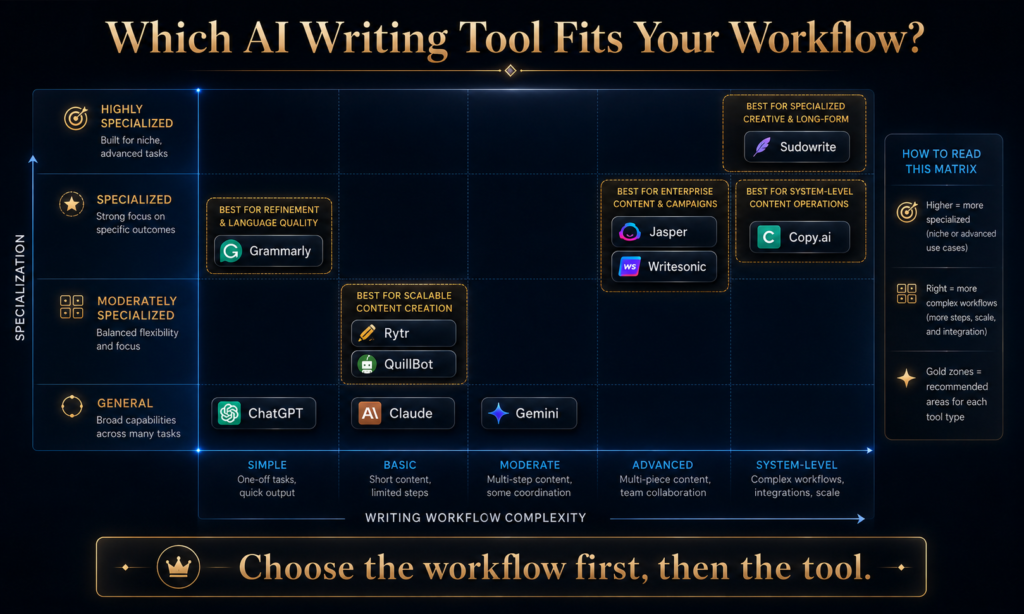
This is one of the most important buying decisions.
General assistant
Examples: ChatGPT, Claude, Gemini. Best when:
- tasks change frequently
- research matters
- reasoning matters
- you write many kinds of things
- you want flexibility
Dedicated writer
Examples: Jasper, Copy.ai, Writesonic. Best when:
- writing is repetitive
- your team follows repeatable processes
- brand consistency matters
- SEO or GTM workflows matter
- collaboration matters
- production volume is high
The dividing line is workflow complexity. If your writing task is unpredictable, a general assistant is often better. If your writing process is highly repeatable, workflow infrastructure becomes more valuable.
Free vs Paid: What Are You Actually Buying?
A common mistake is comparing plans only by feature count. That is the wrong unit of comparison. Consider these four types of upgrade.
More capacity
You can use the same workflow more often.
More intelligence
You gain access to stronger models or reasoning capabilities.
More workflow
You can move from one-off prompting to structured production.
More control
You gain:
- brand settings
- collaboration
- integrations
- knowledge assets
- administration
- monitoring
The right upgrade depends on the problem. For example, paying $20 for a general assistant may make sense for an individual writer who needs higher usage. Paying $69 for Jasper may make sense for a marketing team where brand control and workflow consistency matter.
Paying $99 for Writesonic’s Starter plan may make sense for a business that genuinely needs SEO and AI-search visibility workflows. The prices are not directly comparable because the products are selling different things.
When Should You Upgrade?
Use a simple test.
Stay free when:
- you’re learning
- you write occasionally
- the free limits don’t interrupt you
- you haven’t established a repeatable workflow
Upgrade when:
- limits repeatedly stop useful work
- the premium feature eliminates a real bottleneck
- the tool is responsible for revenue-generating work
- the subscription saves more time or increases more output than it costs
Do not upgrade when:
- you’re buying features you won’t use
- you are collecting tools because they are popular
- another free tool solves the same task
- you still don’t know what your writing workflow actually is
A subscription should be justified by workflow economics, not feature envy.
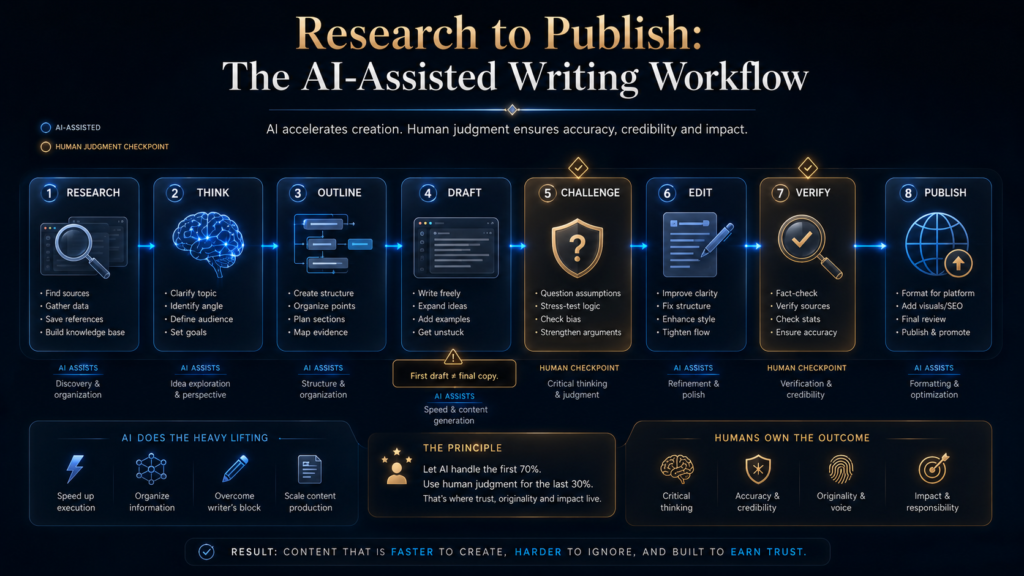
The AI Writing Workflow That Actually Works
The strongest writing workflows are rarely: Prompt → Generate → Publish. A better system is:
1. Research
Collect:
- primary sources
- relevant evidence
- audience questions
- competing perspectives
2. Think
Define:
- thesis
- reader
- desired outcome
- boundaries
- evidence requirements
3. Outline
Create the logical structure before drafting.
4. Draft
Use AI to accelerate the first version.
5. Challenge
Ask AI to identify:
- weak claims
- missing evidence
- repetition
- unsupported assumptions
- unclear transitions
6. Edit
Use Grammarly, QuillBot or manual editing where useful.
7. Verify
Check:
- facts
- links
- statistics
- quotations
- citations
- product claims
8. Publish
Only after the content meets the actual editorial standard. That is much more defensible than treating AI as an autonomous author.
Where AI Writing Fails
The biggest weakness of AI writing is not grammar. It is genericness. A model can produce perfectly readable content that says almost nothing original.
That happens when the workflow is: Prompt → predictable answer → publish. The reader gets:
- generic introductions
- obvious advice
- repetitive examples
- no original evidence
- no clear point of view
- no meaningful differentiation
The cure is not necessarily a better model. It is better input and editorial thinking. Give the system:
- original data
- real examples
- specific reader problems
- clear constraints
- actual sources
- a distinct thesis
- a reason for the content to exist
Then the output has something to work with.
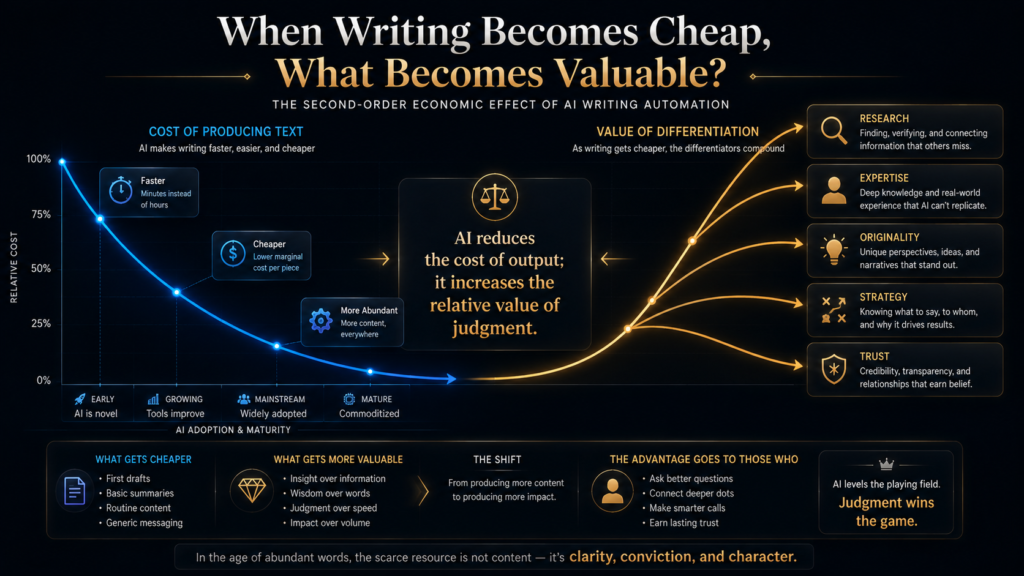
The Second-Order Effect: Writing Is Becoming Cheap
This is the bigger market shift. AI has reduced the marginal cost of producing text. That is good for productivity.
It is also bad news for generic writing businesses. If everyone can produce 5,000 words quickly, then 5,000 words becomes less valuable as a differentiator. Value moves toward:
- Research
- Original insight
- Expertise
- Distribution
- Brand voice
- Trust
- Strategy
- First-hand experience
This is why AI does not automatically destroy professional writing. It changes what professional writing is worth paying for.
The scarce resource becomes less: “Can you produce text?” and more: “Can you produce useful thinking?” That is the strategic shift every writer should understand.
Who Should Use AI Writing Tools—and Who Shouldn’t?
Use them when:
You need to:
- overcome a blank page
- explore ideas
- summarize material
- restructure content
- improve clarity
- generate alternatives
- accelerate repetitive writing
- manage large content workflows
Be cautious when:
- the subject is high stakes
- factual accuracy is critical
- the content requires first-hand expertise
- the writing must meet a strict academic or legal standard
- the output will be published under your name without review
Avoid fully delegating when:
The value of the work depends primarily on: your judgment, experience, expertise or original point of view. Those are exactly the qualities AI is increasingly making more valuable.
Common Mistakes When Choosing an AI Writing Tool
1. Choosing based on popularity
The most popular tool may not solve your problem.
2. Comparing unrelated products
Jasper and Grammarly do not perform the same job. Neither do ChatGPT and Sudowrite.
3. Buying before defining the workflow
You should know what you’re trying to improve.
4. Assuming expensive means better
A $99 SEO platform is not “better” than a $20 chatbot. It is solving a different problem.
5. Treating AI output as finished copy
First drafts are not final drafts.
6. Ignoring source verification
Fluent writing can still contain incorrect information.
7. Optimizing for speed only
Faster bad content is still bad content.
8. Producing generic content at scale
More output does not automatically create more value.
9. Forgetting brand voice
A company can publish grammatically correct AI copy that still sounds nothing like itself.
10. Paying for five overlapping tools
A small complementary stack is usually better than a large redundant one.
A Practical AI Writing Stack
Most individual writers can start with three layers.
Layer 1 — General assistant
ChatGPT or Claude
Use for:
- research
- reasoning
- outlines
- drafts
- critique
Layer 2 — Editing
Grammarly or QuillBot
Use for:
- clarity
- grammar
- rewriting
- polish
Layer 3 — Specialist
Choose only one based on your work:
- Jasper for marketing teams
- Writesonic for SEO/content visibility
- Sudowrite for fiction
- Copy.ai for GTM
- Rytr for budget-focused writing
This is a much cleaner stack than paying for everything.
What If You Already Have ChatGPT?
Then don’t immediately buy another AI writer. Ask whether ChatGPT is actually failing at your workflow. If it can already handle:
- research
- drafting
- rewriting
- brainstorming
- critique
you may not need a dedicated writer. A specialist tool becomes worth testing when the problem changes from: “I need better text.” to: “I need a repeatable production system that manages this type of writing.” That is the threshold worth paying attention to.
A Simple Decision Matrix
| Your biggest bottleneck | Start with | Why |
|---|---|---|
| Blank page | ChatGPT | Broad ideation and drafting |
| Long-form reasoning | Claude | Strong text-focused workflow |
| Google Docs workflow | Gemini | Ecosystem fit |
| Grammar/clarity | Grammarly | Editing layer |
| Rewriting/paraphrasing | QuillBot | Specialist transformation |
| Marketing operations | Jasper | Brand and campaign workflow |
| GTM communication | Copy.ai | Workflow-oriented GTM system |
| SEO + AI-search visibility | Writesonic | Search-oriented content workflow |
| Low budget | Rytr | Low-cost dedicated writer |
| Fiction | Sudowrite | Creative-writing specialization |
Can AI Replace Professional Writers?
Not in the simple way the question suggests. AI can replace parts of the workflow. It can reduce the labour required for:
- first drafts
- summaries
- routine copy
- formatting
- rewriting
- research assistance
- idea generation
But professional writing often contains value outside sentence generation:
- judgment
- domain knowledge
- interviewing
- research
- story selection
- editorial decisions
- originality
- audience understanding
- accountability
As text generation becomes cheaper, these elements become relatively more valuable. That means the strongest writers may not be the people who refuse AI. They may be the people who learn to use AI without allowing it to replace the parts of writing that make their work worth paying for.
Final Thoughts
The AI writing market has matured enough that the question “Which AI writer is best?” is becoming less useful. The better question is: “Which part of my writing workflow needs help?” Need a thinking partner?
Start with ChatGPT, Claude or Gemini. Need stronger editing? Use Grammarly.
Need paraphrasing and transformation? Consider QuillBot. Need a low-cost dedicated writer?
Rytr is worth considering. Need brand-controlled marketing production? Look at Jasper.
Need GTM-oriented workflows? Consider Copy.ai. Need SEO and AI-search visibility?
Writesonic is increasingly built for that job. Need fiction support? Sudowrite is the specialist.
The mistake is assuming that all ten tools should compete on one scoreboard. They shouldn’t. The AI writing market is becoming more specialized because writing itself is becoming cheaper.
As text generation becomes easier, the scarce value moves upward: Research → judgment → originality → strategy → trust → distribution. That is the real lesson for writers in 2026. AI can make you faster.
A good workflow can make you more productive. But neither automatically makes your writing valuable.
Useful thinking is still the scarce part. So choose the tool that removes your biggest bottleneck, keep human judgment where it matters, and upgrade only when the economics prove that you should.
Don’t choose the AI writer with the most features. Choose the workflow that gives your writing the most leverage.
Ready to Build a Smarter AI Writing Workflow?
The best AI writing stack isn’t the one with the most tools. It’s the one that helps you research, think, write, edit, and improve without turning your content into generic AI output.
Compare Tools for Writing Blog Posts →Frequently Asked Questions
What is the best AI writing tool in 2026?
There is no universal winner.
ChatGPT is the strongest general-purpose starting point for many individual writers. Claude is particularly strong for long-form and nuanced work. Grammarly is stronger as an editor. Jasper is more relevant to marketing teams. Writesonic is increasingly oriented around SEO and AI-search visibility. Sudowrite is specialized for creative writing.
Which AI writing tool is best for beginners?
For most beginners, start with ChatGPT, Claude or Gemini rather than buying a specialized platform immediately. The first objective should be learning a repeatable writing workflow.
Which AI writing tool is best for SEO?
Writesonic is particularly relevant for writers who need SEO and AI-search visibility as part of the workflow because its current platform combines content creation with SEO and AI-search visibility features. That does not mean it is automatically the best option for every SEO writer.
Which AI writing tool is best for marketing teams?
Jasper is specifically positioned around marketing content, brand voices, knowledge assets, audiences and marketing workflows.
Which AI writing tool is best for copywriting?
The answer depends on the type of copy. General assistants can be excellent for flexible copywriting.
Copy.ai becomes more interesting when the copy is connected to broader GTM workflows. Jasper becomes more relevant when brand consistency and marketing workflow management matter.
Is Grammarly an AI writing tool?
Yes, but it is better understood as an AI writing and editing assistant rather than a complete long-form content platform. Its strongest value is improving text that already exists.
Is QuillBot better than ChatGPT?
Not universally.
QuillBot is more specialized for paraphrasing and rewriting. ChatGPT is much broader.
Choose QuillBot when transformation of existing text is the primary job. Choose ChatGPT when the workflow includes research, reasoning, planning and creation.
Is Rytr still worth using?
For budget-conscious users, it can be. Rytr currently offers a free plan with 10,000 characters per month and an Unlimited plan at $7.50/month, making its economics very different from premium marketing platforms. Its trade-off is that it is more limited in breadth than a modern general-purpose AI assistant.
Is Jasper free?
Jasper currently offers a free trial rather than a permanent free plan. Its Pro plan is currently $69/month monthly or $59/month billed annually.
Is Writesonic free?
Writesonic currently provides a free trial/entry path, but its main production plans are paid. Its current Starter plan is $99/month monthly or $79/month with annual billing.
Which AI writing tool is best for fiction?
Sudowrite. Its product is specifically designed around creative writing, and its plans include fiction-focused capabilities and large monthly credit allowances.
Should I use multiple AI writing tools?
Yes, but only when they perform different jobs. A practical stack might be: ChatGPT → Grammarly → specialist rather than: ChatGPT + Claude + Gemini + Jasper + Copy.ai + Writesonic + Rytr all doing essentially the same task.
Should I pay for an AI writing tool?
Only when the tool solves a real bottleneck. Start free where possible.
Measure how often the limitation interferes with useful work. Then compare the value of the time or output you recover against the subscription price.
Related Guides
- Best AI Website Builders in 2026: 10 Tools Compared
- Best AI Script and Idea Generation Tools for YouTube Creators (2026)
- Best AI Email Assistants (Free & Paid): 10 Tools Compared
- Best Free AI Tools for Students in 2026: 10 Tools to Study Smarter
- How to Use ChatGPT for Blogging: Complete Beginner’s Guide
Written by
Muntasir Ahmad Chowdhury
Founder, AI Hustle World
Muntasir Ahmad Chowdhury is the Founder of AI Hustle World, an independent publication dedicated to making Artificial Intelligence practical, trustworthy, and easy to understand. He researches AI tools, automation, customer service, productivity, and real-world business applications, helping readers make smarter technology decisions through research-driven, experience-backed content.
Expertise:
AI Tools • AI Automation • AI Customer Service • AI Productivity • Generative AI • AI Workflows
Get Smarter With AI
Enjoyed this guide? Get practical AI tools, tutorials, and honest reviews delivered to your inbox.