Evidence: Documentation reviewed
Last checked: September 2026
What was done: Written from official documentation and the published sources linked in this article. Not hands-on tested.
Files: None
Affiliate links: No
Last Updated: September 7, 2026
AI SEO: What It Is, How It Works, and How Search Is Changing
Search Has Changed More Than the Ranking Page
For years, the basic SEO journey was easy to describe: someone searched for something, Google returned a collection of relevant pages, the user compared the results, clicked a website, and continued their research there. That model still exists, and it still matters, but it is no longer the only way information reaches a searcher. Google now places AI-generated responses into Search through AI Overviews and AI Mode, while services such as ChatGPT Search and Perplexity can retrieve information from the web and turn it into conversational answers supported by sources and links. Google says AI Overviews now reach more than 2.5 billion monthly active users and that AI Mode has surpassed one billion monthly users; those figures are Google’s own product claims rather than independently audited audience estimates. (blog.google)
That creates a new problem for publishers, businesses, affiliate sites, SaaS companies, and anyone who depends on search visibility. A user may discover your information without beginning with a conventional keyword, may receive a synthesized answer before visiting a website, and may encounter your page as one of several sources rather than as the single destination for the query. Your website still needs to rank, load, be crawlable, and satisfy search intent, but there are now additional moments where your information can become visible or influential.
This is where the phrase AI SEO enters the conversation. Unfortunately, it has also become one of the easiest SEO terms to turn into hype. There are endless claims about special AI ranking factors, secret optimization formulas, mandatory AI files, guaranteed citations, and content structures supposedly designed to make machines “love” a page. Much of that advice confuses what is actually documented with what is merely theorized, and Google’s own 2026 guidance is considerably more straightforward: foundational SEO still matters, unique and useful content matters, and there is no special technical trick required to qualify for Google’s generative AI search experiences. (Google for Developers)
The more useful question, then, is not whether SEO has been replaced. It is what happens to SEO when search itself becomes increasingly capable of interpreting a question, retrieving information from several sources, synthesizing an answer, and influencing the user’s decision before the user reaches a webpage.
That is the problem AI SEO actually needs to solve.
Quick Answer: What Is AI SEO?
AI SEO is the practice of preparing a website’s technical foundation, content, structure, and information quality for a search environment that includes both conventional search results and AI-mediated discovery experiences. It covers the fundamentals that have always mattered in SEO—crawlability, indexability, relevance, useful content, site architecture, internal linking, authority and trust—while paying additional attention to how information may be retrieved, synthesized, cited, summarized, and encountered through AI-powered search. Google explicitly says its generative AI search features are rooted in core Search systems and that the foundational SEO practices used for ordinary Search remain relevant. (Google for Developers)
AI SEO should also be distinguished from AI-assisted SEO. AI-assisted SEO means using artificial intelligence to do SEO work faster, such as researching topics, clustering keywords, analyzing competitors, generating briefs, identifying content gaps, or supporting technical audits. AI SEO, in the sense that matters most for publishers, is about preparing the information itself for a search ecosystem in which AI systems increasingly participate in discovery and answer generation. You can use a great deal of AI in your SEO workflow and still publish poor AI-search content, just as you can build highly discoverable, trustworthy content without relying heavily on AI tools.
The durable principle is therefore simple: AI SEO is not about optimizing for a mysterious AI ranking score; it is about building information that search systems can discover and understand, that users can trust, and that remains useful when the interface between the question and the answer changes.
The Real Meaning of AI SEO
The term “AI SEO” is currently used in several different ways, which creates unnecessary confusion. In one context, people use it to describe AI-powered tools for keyword research, content optimization, technical auditing, link analysis, reporting, and automation. In another, they use it to describe the practice of gaining visibility in Google AI Overviews, Google AI Mode, ChatGPT Search, Perplexity, and similar systems.
Those two ideas are connected, but they describe different problems. The first asks, “How can AI help me do SEO?” The second asks, “How should I optimize my information when AI increasingly becomes part of the search experience?” A strong modern strategy can use AI for the first problem while treating the second as a broader publishing and information-design challenge.
For AI Hustle World, the second interpretation is the more strategically useful one because it explains why search optimization itself is changing. Google’s own 2026 documentation refers to AEO and GEO as terms people use for work intended to improve visibility in AI search experiences, but from Google’s perspective, optimizing for generative AI search is still optimizing for the search experience and therefore remains part of SEO.
That matters because it prevents publishers from creating an artificial wall between “old SEO” and “new AI SEO.” There are new considerations, but the underlying objective is still to connect people with useful information.
Why AI Search Changes the Search Journey
The most important change is not that search engines suddenly learned how to understand language. They have been interpreting language, context, relevance, and intent for years. The bigger change is that modern AI search can perform more of the information-synthesis work that the user previously had to perform after opening several results.
In a conventional journey, the user might search for “best AI project management tools,” open several pages, compare features, evaluate pricing, check integrations, and decide which product is worth considering. In a conversational system, the user can instead ask, “Which AI project management tool is best for a ten-person remote team that already uses Slack and Google Workspace?” The second question includes context, constraints, and an implied decision, so an AI search system can potentially retrieve information across several relevant sources and synthesize the answer around those conditions.
Perplexity describes this model explicitly: it searches the web, identifies sources, and synthesizes them into conversational answers supported by citations and links. Google similarly describes AI Overviews and AI Mode as AI search experiences that use information from Google’s Search index to generate answers, and its documentation explains that these systems can perform query fan-out, where a query is expanded into multiple related searches to gather information needed to address a broader question. (Perplexity AI)
The result is a search journey that can be represented more accurately as question or problem → retrieval → additional searches → source selection → synthesis → citations or links → follow-up → decision. Traditional SEO still operates inside that process, but publishers now have to think about what happens after retrieval as well as what happens before a page appears in the results.
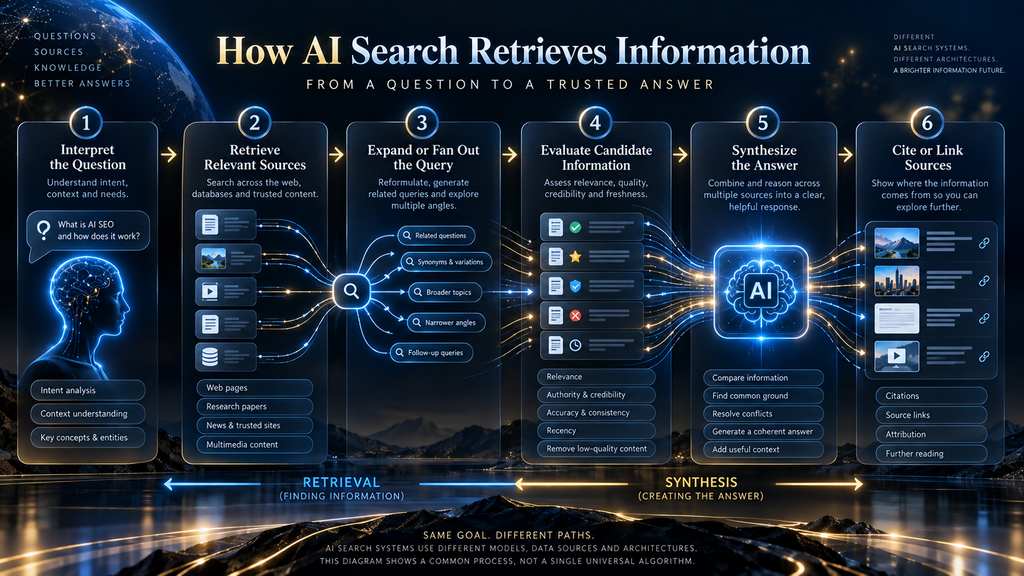
How AI Search Retrieves and Synthesizes Information
It is important not to treat “AI search” as one universal algorithm. Google AI Overviews, Google AI Mode, ChatGPT Search, and Perplexity have different architectures and ranking systems, and their behavior can change over time. What can be explained reliably is the general structure of AI-mediated search and the practical implications that follow from it.
The first stage is interpretation. Instead of treating the user’s words as a simple string, an AI system can interpret the question in context and identify the underlying problem. This is one reason longer, more conversational queries can behave differently from traditional short keyword searches; Pew Research found that 53% of the searches in its 2025 dataset containing 10 or more words produced an AI summary, compared with 8% of searches containing one or two words. That is evidence about one study and one period, not a rule saying that long queries always trigger AI results, but it illustrates the direction of travel. (Pew Research Center)
The second stage is retrieval. Search systems need information from somewhere, which is one reason foundational SEO remains relevant. Google’s current generative-AI documentation describes retrieval-augmented generation as using its core Search ranking systems to retrieve relevant web pages from the Search index and then using information from those pages to help generate responses. Google also states that a page must already be indexed and eligible to appear in ordinary Search to be eligible as a supporting link in AI Overviews or AI Mode.
The third stage can be query expansion or query fan-out. Google’s documentation says AI search can generate multiple related queries to request additional information and fetch relevant results. This is important because the system may investigate several aspects of a question rather than searching only for the literal wording of the user’s initial request. The practical implication is not that publishers should create a separate page for every imaginable question; Google explicitly warns against creating unnecessary content variations or pages primarily to manipulate generative AI responses.
The fourth stage is synthesis. Multiple retrieved sources can be combined into an answer instead of being presented merely as a list of links. This is where the content of a page becomes more than a ranking candidate; it can become source material that contributes a fact, explanation, example, comparison, or recommendation to a larger response. The exact internal selection process differs by platform, so publishers should avoid inventing unsupported “AI ranking factors,” but the existence of retrieval and synthesis creates a clear editorial requirement: your information needs to be accurate, understandable, useful, and worth incorporating.
The fifth stage is representation. The system may surface links or citations alongside the answer, and platforms such as Perplexity explicitly emphasize source citations and links to original material. That creates a new visibility layer in which a publisher can contribute to the answer even when the user does not follow the traditional journey of opening several blue links.
The AI Hustle World AI SEO Operating Loop
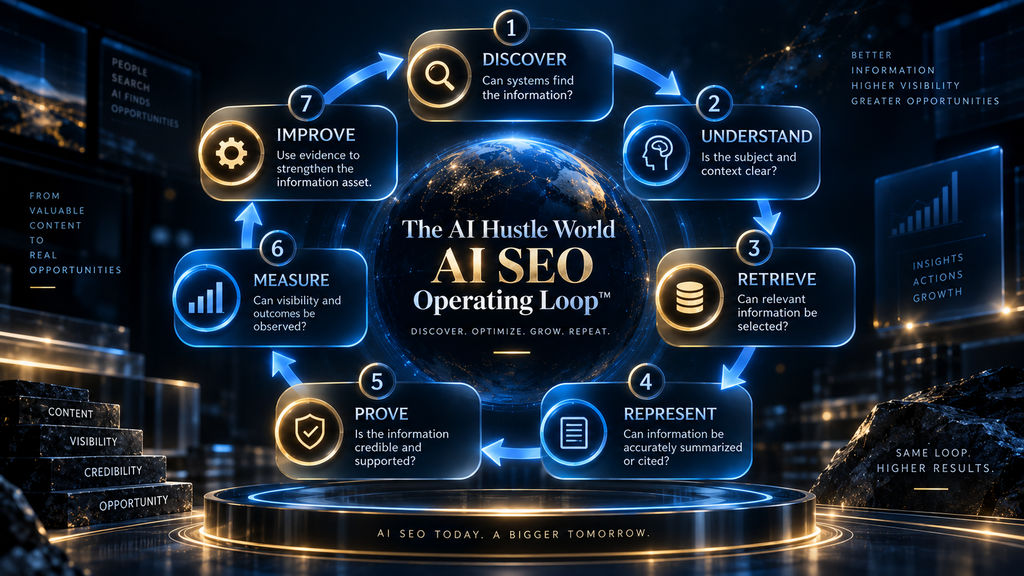
A practical way to manage all of this is to think about AI SEO as an operating loop rather than a list of isolated tricks.
| Stage | Core question | What it means in practice |
|---|---|---|
| Discover | Can the information be reached and found? | Crawlability, indexability, accessible content, sensible technical structure |
| Understand | Is the subject and context clear? | Descriptive titles, headings, entities, relationships, coherent information architecture |
| Retrieve | Could relevant information be selected for a search? | Strong topical coverage, useful answers, relevant supporting information |
| Represent | Can the information be accurately used in an answer? | Clear claims, direct explanations, examples, context and useful structure |
| Prove | Why should the information be trusted? | Evidence, sources, expertise, originality, transparent authorship and limitations |
| Measure | Can visibility and outcomes be observed? | Search Console, referrals, visibility signals, conversions and business metrics |
| Improve | What does the evidence tell you to change? | Update weak pages, strengthen gaps, improve evidence, refine topical coverage |
The value of this model is that it prevents AI SEO from becoming purely technical or purely editorial. A page can fail before content quality ever matters because it cannot be reliably discovered. Another page can be perfectly accessible yet fail to earn attention because it contributes little original information. A third page may be excellent but attract plenty of visibility without producing a meaningful business outcome. The operating loop forces the publisher to examine the entire system.
That is much more useful than asking whether a page contains a certain number of keywords, has a certain word count, or uses a particular formatting trick.
Traditional SEO Still Matters—Because the Problem Has Not Disappeared
The idea that AI search makes traditional SEO irrelevant misunderstands what SEO was solving in the first place.
Search engines have always faced a basic information problem: the web contains more information than a user can inspect manually, so the system needs ways to discover documents, understand them, determine relevance, evaluate quality, and present useful results. Traditional SEO evolved around those requirements through practices such as crawlable site architecture, indexability, relevance, content quality, internal linking, authority, structured information, and clear page organization.
AI search changes parts of the presentation and retrieval process, but it does not eliminate those underlying requirements. Google explicitly says its generative AI search features are rooted in its core ranking and quality systems and continue to depend on the Search index. The company also states that there are no additional technical requirements or special schema specifically required to become eligible for AI Overviews or AI Mode.
This is an important reality check because it changes where a publisher should spend effort. Fixing an indexing problem is usually more valuable than adding speculative “AI optimization” markup. Improving a weak article is more valuable than inserting dozens of artificial question variants. Building a coherent topic cluster is more defensible than creating hundreds of thin pages designed around every possible prompt.
AI SEO expands the search problem; it does not invalidate the foundation that made the web discoverable in the first place.
What Actually Changes From Traditional SEO?
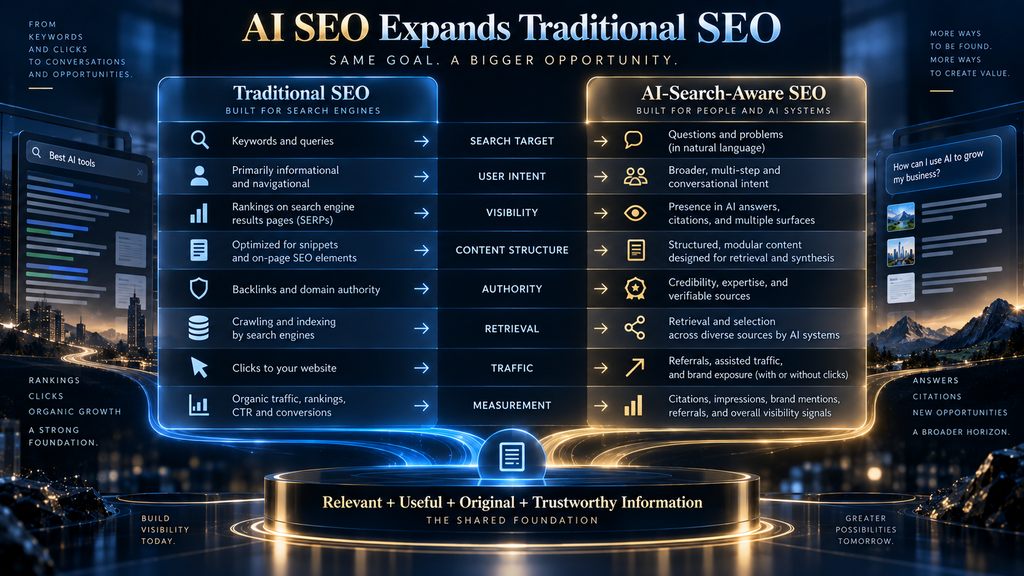
The major shift is not from one set of ranking factors to another. It is a shift in what the publisher needs to consider as a successful search outcome.
| Traditional SEO mindset | AI-search-aware mindset |
|---|---|
| Target a query | Understand the information need behind the query |
| Rank a page | Make useful information discoverable across multiple search surfaces |
| Earn clicks | Earn clicks, citations, discovery and consideration |
| Optimize a keyword | Build topic, intent, entity and contextual coverage |
| Write for a SERP | Write for readers whose information may also be retrieved into an answer |
| Build authority | Build authority, evidence, originality and source credibility |
| Measure rankings and traffic | Measure rankings, traffic, AI visibility and business outcomes |
| Publish pages | Build connected information assets |
This does not mean every article should be rewritten around conversational questions or converted into a collection of tiny answer blocks. Google’s own current documentation specifically says there is no requirement to break content into tiny pieces for AI and no ideal page length for generative AI search. Google also says its systems can understand nuance across multiple topics on a page.
That is an important correction to one of the more persistent AI SEO myths. Good information structure helps. Artificial fragmentation does not automatically help.
Keywords Still Matter, but Keywords Are Not the Whole Strategy
One of the most repeated claims in AI SEO is that “keywords are dead.” They are not.
Keywords still reveal what people search for and how they describe problems, products, concepts, and needs. They remain useful for discovering demand, understanding terminology, organizing topic research, and connecting a page with relevant language. What is changing is that the publisher should not stop at the keyword.
Suppose the core topic is AI meeting assistants. A keyword-only strategy might focus on terms such as “AI meeting assistant,” “best AI meeting assistant,” and “AI meeting notes.” A stronger information strategy expands the topic into the actual questions surrounding the decision: How accurate is transcription? Which tools identify speakers? How are action items extracted? Does the system integrate with a CRM? Can sensitive meetings be handled appropriately? What happens when meetings are long or highly technical? Which teams actually benefit, and which teams would be better served by a conventional transcription workflow?
That broader approach is not about stuffing every variation onto one page. It is about understanding the information space behind the topic.
Google’s current documentation makes this distinction especially clear when discussing generative AI search: its systems can understand relevance even when a page does not exactly match the words of the query, so publishers do not need to create separate pages for every possible wording variation. The durable model is therefore: keyword → topic → intent → questions → entities → evidence → decision rather than: keyword → repeat keyword → publish.
Information Gain Becomes More Important as AI Makes Content Cheaper
There is a structural change happening underneath the entire content economy. AI makes generic information cheaper to produce.
Once basic explanations can be generated quickly, the existence of another basic explanation becomes less valuable. The marginal value moves toward information that is difficult to reproduce without genuine research, experience, evidence, original analysis, or a useful synthesis of complex material.
Imagine ten websites explain what AI SEO means using nearly identical definitions. A new publisher can produce an eleventh definition in seconds. The fact that the eleventh article exists does not automatically create a meaningful reason for anyone to read it.
Now imagine the eleventh article explains how AI retrieval differs from conventional ranking, distinguishes AI-assisted SEO from AI-search optimization, analyzes independent evidence about citation patterns and CTR behavior, incorporates Google’s latest guidance, explains newly available Search Console measurement, and translates the research into a practical operating model. That article has created a reason to exist.
This is what information gain means in practical editorial terms.
Google’s current generative-AI guidance is unusually direct on this point. It says unique, compelling and useful content is likely to influence presence in generative AI search more than many other suggestions, and specifically recommends developing non-commodity content with a unique point of view rather than simply recycling information that is already available or could easily be produced by a generative AI system.
That is a fundamental shift in the economics of publishing. AI reduces the cost of producing text; it does not eliminate the cost of producing insight.
Entity Understanding Matters, but Entity Stuffing Does Not
Search is not simply a process of counting words. Modern systems also need to interpret concepts, entities, relationships, and context.
An article about AI search might legitimately discuss Google Search, AI Overviews, AI Mode, Gemini, ChatGPT Search, OpenAI, Perplexity, retrieval, citations, crawlers, publishers, and structured data. But simply inserting those terms into a page does not make the page more authoritative or useful.
The important thing is the relationship among them.
Google AI Overviews and AI Mode are Google Search experiences. ChatGPT Search is a web-search capability within ChatGPT. Perplexity describes itself as an AI-powered search engine and answer engine that searches the web and returns answers with citations and links to original sources. Those relationships explain the ecosystem; a list of names without context does not.
That gives publishers a much better principle:
Do not ask which entities you need to insert. Ask which real-world concepts and relationships a reader needs to understand the subject correctly.
This distinction also helps keep content natural. A strong article mentions entities because they are relevant to the explanation, not because the writer is trying to trigger a hidden entity score.
AI SEO Is Not About “Writing for AI”
There is a subtle danger in the phrase “optimize for AI.”
It can lead publishers to imagine an audience of machines and then distort the content around that assumption. Suddenly every paragraph becomes tiny, every heading becomes a question, every sentence contains a keyword, and every section is designed around a supposed “AI-friendly chunk.”
That is not what Google’s current guidance recommends.
Google explicitly says there is no requirement to break content into tiny chunks for AI, no ideal page length, and no need to rewrite content solely to capture specific long-tail wording. It also says there is no special schema required for generative AI search.
The better approach is much less artificial.
Write clearly. Use descriptive headings. Answer important questions. Explain the mechanism. Add evidence. Provide context. Use examples. Make the relationships among ideas clear. Organize the page so a human can navigate it easily.
Those choices help readers first, while also making the underlying information easier for search systems to interpret.
Why Citation Visibility Is Different From Ranking
One of the most interesting developments in AI search is that being cited and being highly ranked are related but not identical outcomes.
Ahrefs analyzed 863,000 keyword SERPs and approximately four million AI Overview URLs in a March 2026 study. It found that about 38% of URLs cited in AI Overviews also appeared in the top 10 conventional Search results for the same query, while roughly 31% appeared in positions 11–100 and another roughly 31% fell beyond the top 100 blocks in its analysis. Ahrefs also reported that the proportion of citations coming directly from the original SERP had fallen compared with its earlier study, which it interpreted as evidence that query fan-out may play a larger role in citation selection. This is independent Ahrefs research, not a statement from Google about a universal ranking rule, and should be interpreted accordingly. (Ahrefs)
The implication is important but easy to misinterpret.
It does not mean ranking is irrelevant. It does not mean you can ignore SEO and expect an AI system to discover your page anyway. It means that AI-generated answers can draw from a broader retrieval process than the exact top ten conventional results for the original query.
That changes how publishers should think about competitive content. A page does not necessarily have to win the original query in isolation to contribute useful information to a broader search journey, but it still needs to be discoverable, relevant, credible, and valuable enough to compete for inclusion.
The strategic objective becomes broader than: “Rank #1.” It becomes: “Build information that remains useful when the search system investigates the topic from multiple directions.”
AI Overviews Can Create a Visibility-and-Click Tension
The commercial economics of AI search are complicated because greater visibility does not necessarily mean more clicks.
Pew Research analyzed browsing data from 900 U.S. adults and found that Google users who encountered an AI summary clicked a traditional search result in 8% of visits, compared with 15% when no AI summary appeared. Users clicked a link within the AI summary itself in only 1% of visits in that study, while sessions were more likely to end after a search page containing an AI summary. (Pew Research Center)
Ahrefs’ separate research found an even sharper result. In its December 2025 analysis of 300,000 keywords, Ahrefs estimated that the presence of an AI Overview correlated with a roughly 58% lower average CTR for the top-ranking page compared with its expected CTR baseline. That finding comes from Ahrefs’ methodology and should not be treated as a universal percentage for every website, keyword, device, or search intent.
At the same time, Google reports that its generative AI search features are associated with increased search activity and says AI Overviews now reach more than 2.5 billion monthly active users, while AI Mode has surpassed one billion monthly users. Again, those are Google’s own product metrics and should be treated as company claims rather than independent market measurements. (blog.google)
Taken together, these findings suggest a much more interesting conclusion than “AI search destroys traffic.” AI search can increase the scale and variety of discovery while reducing the need for a click on some informational queries. That creates a new visibility economy.
A publisher can care about clicks and still recognize the value of being included in the answer. A business can care about conversions while recognizing that brand consideration may begin before the website visit. A content strategy can therefore no longer treat every impression as having the same meaning.
Search Visibility Is Becoming More Than Traffic
Imagine someone researching software for a small business.
The person asks an AI-powered search system to compare several options. Your company is mentioned alongside three competitors. The user does not click your site, but your brand has now entered the consideration set.
That outcome is not equivalent to a lead. It is not equivalent to a conversion. But it is also not equivalent to zero value.
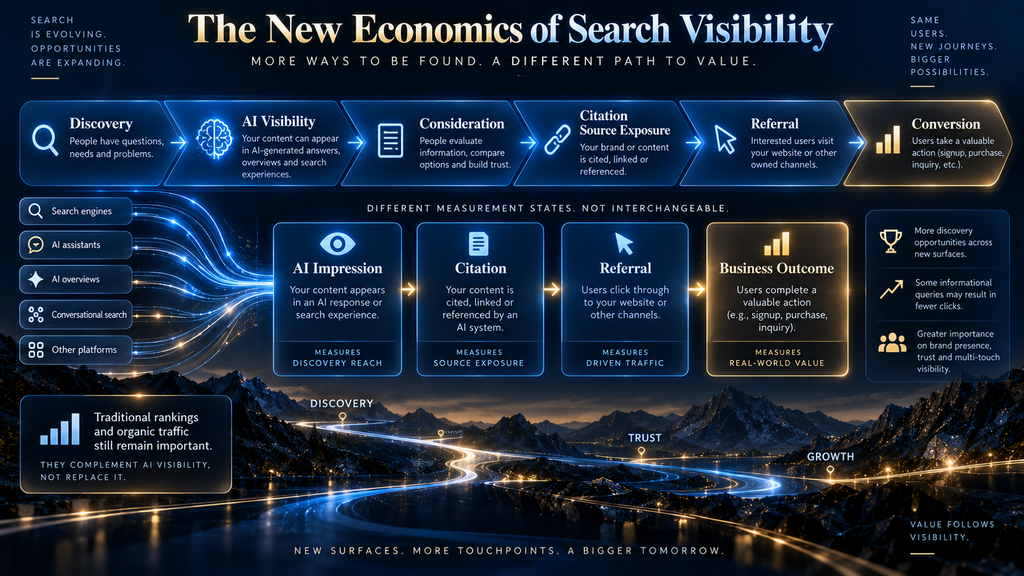
This is why AI-search visibility needs to be understood as a broader journey: Discovery → Awareness → Consideration → Comparison → Trust → Referral → Conversion.
The further down that chain you move, the more directly the outcome becomes commercial. But visibility at an earlier stage can still influence what happens later.
The mistake is to turn the entire process into a single “AI visibility” score.
A citation is not automatically valuable. An impression is not automatically valuable. A referral is not automatically qualified. A ranking is not automatically revenue.
Good measurement preserves those distinctions.
Google Search Console Has Changed AI SEO Measurement
One of the biggest practical developments in 2026 is that AI-search visibility is becoming measurable through Google’s own tools.
Google launched dedicated Search Generative AI performance reports in Search Console in June 2026, covering visibility within generative AI features in Search and Discover. Google said that as of August 31, 2026, these insights had rolled out to all websites worldwide. The reports provide information including impressions, pages, countries, devices for Search, and time-based performance views.
That is a major shift from the earlier era when AI visibility was largely discussed through screenshots, manual searches, third-party monitoring products, or anecdotal reports. A practical AI SEO measurement system should now separate at least four layers of performance.
Visibility concerns whether your pages are appearing within Google’s generative AI features. Search Console is increasingly useful for that layer.
Presence concerns where and how your information is being represented, including citations, mentions, and source inclusion where a platform exposes those signals.
Traffic concerns the actual visits generated by AI-mediated discovery. OpenAI’s publisher guidance, for example, documents referral tracking from ChatGPT through the utm_source=chatgpt.com parameter. (OpenAI Help Center)
Business outcome concerns what ultimately matters to the organization: qualified leads, subscriptions, sales, assisted conversions, revenue, or another meaningful objective.
The crucial discipline is to keep those measurements separate. An AI impression is not a click, a citation is not a conversion, and traffic volume by itself does not tell you whether the users arriving through AI search are commercially useful.
What ChatGPT Search Means for Publishers
ChatGPT Search demonstrates why AI SEO cannot be reduced to Google’s ecosystem.
OpenAI’s publisher and developer guidance states that public websites can appear in ChatGPT Search and provides documentation for OAI-SearchBot, the crawler used for search discovery. Publishers who want content to be discoverable in ChatGPT Search therefore need to consider whether their site’s crawling rules allow the relevant access. OpenAI also makes clear that crawler access does not guarantee ranking or top placement.
That creates a critical distinction between technical eligibility and competitive visibility.
Allowing the crawler to access a page gives the platform an opportunity to discover it. It does not mean the page will be selected for a particular query, cited in a particular answer, or sent traffic.
OpenAI also documents referral measurement through its utm_source=chatgpt.com tracking behavior, which gives publishers a concrete way to identify traffic coming from ChatGPT Search. The durable lesson is the same one we see across Google’s systems: Access is necessary for discovery, but access is not the same thing as ranking, citation, or business value.
What Perplexity Reveals About the Source Layer
Perplexity makes the source-selection problem especially visible because its product explicitly centers web retrieval, synthesis, citations, and links to original sources. Its documentation describes the platform as an AI-powered search engine that searches the web and provides conversational answers backed by verifiable sources.
Its newer source-labeling system also shows how source reputation can become more visible to users. Perplexity says some sources receive Government, Academic, or Trusted labels based on its site-level review process and characteristics such as expertise and the site’s ability to correct mistakes. These labels are Perplexity’s own product classifications, not a general industry ranking system.
The practical takeaway for publishers is not “earn a Perplexity Trusted badge.” It is that source identity and credibility increasingly appear inside the interface itself. That makes transparent authorship, evidence, editorial quality, corrections, and clear sourcing useful for reasons that extend beyond Google’s traditional ranking environment.
E-E-A-T Is Better Understood as an Editorial Standard
Experience, expertise, authoritativeness, and trustworthiness are frequently turned into another supposed AI ranking formula. That is the wrong way to use them.
A better interpretation is to treat E-E-A-T as a set of questions about whether the information deserves to be relied upon. Does the author genuinely understand the subject? Is the content based on credible research or authentic experience? Are important claims supported? Is the methodology transparent? Are limitations acknowledged? Can the source be identified and evaluated? Does the work add something beyond the generic information already available?
Those questions matter because AI systems increasingly synthesize information from multiple sources, while users can increasingly inspect those sources directly. Google’s own guidance emphasizes helpful, reliable and people-first content rather than a hidden checklist of AI ranking signals. Its generative-AI guidance specifically encourages original perspectives, first-hand experience, useful information, and non-commodity content.
E-E-A-T should therefore be treated as an editorial discipline, not a cosmetic widget.
A meaningless author box cannot manufacture expertise. A collection of stock testimonials cannot manufacture trust. A page full of citations cannot manufacture originality.
The underlying information has to earn credibility.
AI-Generated Content: The Production Method Is Not the Whole Story
The debate over AI-generated content often becomes too binary.
One side says AI content is the future. The other says AI content is automatically harmful. Neither framing is particularly useful.
Google’s current guidance says generative AI can be useful for research and for adding structure to original work, while warning that using generative AI or similar tools to generate many pages without adding value can violate its scaled-content-abuse spam policy. The key issue is therefore not simply whether AI was used; it is whether the resulting work satisfies Search Essentials, spam policies, and the expectation of useful, original, people-first content. (Google for Developers)
That distinction has practical consequences.
A publisher might use AI to collect research questions, cluster a large keyword set, compare competing pages, identify missing subtopics, organize an outline, or accelerate a first draft. Human editorial work can then verify the facts, improve the reasoning, add original analysis, document genuine experience, correct errors, and decide what information is actually worth publishing.
Another publisher might use exactly the same tools to generate hundreds of pages that paraphrase existing content.
The technologies are the same. The information value is not. That is why the strongest AI-era content strategy is not AI versus humans.
It is AI for leverage, humans for judgment.
Why Google Rejects Many “AI SEO Hacks”
Google’s 2026 generative-AI guidance addresses several of the tactics that have become popular in AI SEO discussions, and the message is remarkably consistent.
There is no requirement to break content into tiny “chunks” purely for AI. There is no special schema markup required for generative AI search. Creating separate pages for every conceivable search variation is not necessary, and Google says creating content variations primarily to manipulate rankings or AI responses can violate its spam policies. Google also says that creating or maintaining an llms.txt file does not help or hurt visibility or rankings in Google Search because Google Search ignores it.
This does not mean structured data has no value.
It means structured data should be used for legitimate SEO purposes rather than treated as a secret generative-AI ranking mechanism. Likewise, well-organized content is useful because it helps readers navigate information, not because a certain number of words in a certain-sized “chunk” supposedly guarantees AI visibility.
The pattern is worth remembering: Use legitimate SEO practices because they solve real information problems, not because somebody has invented an AI-sounding reason to sell them.
Internal Linking Is Part of the Information Architecture
A strong website should not be viewed as a pile of independent articles. It should be viewed as a connected information system.
Suppose a site has a foundational article explaining AI SEO, a second article comparing GEO, AEO, and SEO, another article explaining Google AI Overviews and AI Search optimization, and additional resources covering AI SEO tools, keyword research, and content optimization for ChatGPT, Perplexity, and Gemini. Those pages are more useful collectively because they establish relationships among concepts and give readers a logical path through the subject.
Internal links also help publishers communicate those relationships.
The objective, however, should not be to maximize the number of links. The question should always be whether the linked article gives the reader the next piece of information they actually need.
For AI Hustle World, that means the AI SEO pillar should establish the broader system and then naturally guide readers toward the specialized cluster resources instead of trying to contain every subtopic within one enormous page. That is how topical authority becomes useful rather than merely decorative.
Why One Article Should Not Answer Every Possible AI SEO Question
There is a temptation to respond to AI search by making every article enormous. That is not the right solution either.
A comprehensive article should cover the information required to solve its intended problem. But once the article starts duplicating the purpose of specialized pages, the site begins to create unnecessary overlap.
For example, a pillar article should explain what Google AI Overviews are and why they matter. It does not need to become a 5,000-word technical tutorial on optimizing a specific website for Google AI Overviews if the site already has a dedicated implementation article for that problem.
The same applies to AI SEO tools, keyword research, and ChatGPT/Perplexity/Gemini optimization. A strong cluster has one page explaining the system and other pages solving specific parts of the system. That makes each page more useful and protects against keyword cannibalization.
The Most Common AI SEO Mistakes
The first mistake is turning terminology into strategy. A publisher can spend more time deciding whether to call something SEO, AEO, GEO, LLMO, or AI SEO than actually improving its website. Google itself treats AEO and GEO as terms used in the industry while emphasizing that optimizing for generative AI search remains fundamentally part of Search optimization.
The second mistake is mass-publishing generic content. AI makes content creation cheaper, but Google explicitly warns against producing large amounts of content without adding user value. The competitive advantage is moving in the opposite direction: fewer commodity pages, stronger information assets, better evidence, better examples, and more original insights.
The third mistake is rewriting competitors instead of learning from them. If the workflow is simply “read several ranking pages, combine them with AI, change the wording, and publish,” the result is usually optimized for similarity rather than information gain. Competitor research is much more valuable when it identifies what the existing results fail to explain.
The fourth mistake is believing that every query needs its own article. Google explicitly says that its AI systems can understand relevance without an exact match and warns against generating separate content variations primarily to manipulate AI responses or rankings.
The fifth mistake is assuming that technical access guarantees AI visibility. Allowing Google’s or OpenAI’s relevant systems to access a page creates an opportunity for discovery, but it does not guarantee ranking, citation, or recommendation. That distinction is fundamental.
The sixth mistake is optimizing for machines while making the page worse for people. A page filled with artificial question headings, unnatural keyword repetition, tiny fragments, forced entities, and generic summaries is not automatically more AI-friendly. Google’s own guidance repeatedly returns to the same principle: make the page useful, reliable, well organized, and satisfying for the audience.
A Practical AI SEO Workflow for Publishers
The most effective AI SEO workflow begins with the topic, not the writing tool. Before producing a new page, check whether the website already covers the subject and whether another page owns the same search intent. This avoids creating two articles that compete for the same information need simply because their titles use different wording.
Next, map the actual information problem. Identify the core topic, user intent, related questions, important entities, use cases, objections, comparisons, implementation needs, and decision criteria. The purpose is not to create an endless list of keywords; it is to understand the subject well enough to know what a useful answer needs to contain.
Then study competing content for gaps rather than templates. Look at the claims competitors make, the evidence they use, the subtopics they cover, the questions they fail to answer, the trade-offs they overlook, and the decisions they leave unexplained. This is where information gain begins.
After that, define the article’s unique reason for existing. A useful sentence is: “This article is different because…” If the answer is only “it explains the same thing in different words,” the article probably needs a better angle. If the answer identifies a useful framework, original synthesis, updated evidence, clearer decision model, deeper mechanism, or practical workflow, the article has a stronger editorial foundation.
The next stage is building the content around the reader’s reasoning path. A strong sequence is often problem → definition → mechanism → evidence → implications → implementation → limitations → decision. This gives the article a natural narrative rather than creating a collection of disconnected SEO sections.
Then add evidence. Use primary sources for platform behavior whenever possible, independent research for observed market effects, and transparent labeling whenever something is a company claim or editorial analysis rather than an established fact. This distinction is especially important in AI SEO because the industry still contains significant uncertainty and speculation.
Finally, connect the page to its surrounding topic cluster and measure what happens after publication. Search rankings and organic traffic still matter, but Google’s generative-AI performance reporting now provides an additional visibility layer, while AI referral traffic can be measured through platform-specific referral signals where available.
The workflow therefore becomes: Validate → Map → Audit → Differentiate → Build → Evidence → Connect → Measure → Improve. That is a much more durable process than “generate article → add keywords → publish.”
How to Make Information More Citable Without Chasing Citations
There is no reliable universal formula that guarantees citation in Google AI Overviews, Google AI Mode, ChatGPT Search, Perplexity, or any future system. That is worth stating because citation promises are one of the easiest ways to turn AI SEO into snake oil. What publishers can do is make their information easier to evaluate.
Specific claims are better than sweeping statements. “AI search is changing everything” communicates almost nothing that can be verified. A specific statement about how Google describes AI Overviews, what OpenAI documents about OAI-SearchBot, or what an independent research study actually measured is far more useful.
Attribution also matters.
- Google says…
- OpenAI documents…
- Perplexity describes…
- Ahrefs’ study found…
Those constructions make it clear who is responsible for the claim.
It is equally important to distinguish external evidence from AI Hustle World analysis. “Google says its systems use query fan-out” is a factual attribution. “Therefore, publishers should build stronger topical coverage instead of creating pages for every query variant” is an editorial conclusion. The two can belong in the same article, but they should not be presented as though they have the same evidentiary status.
That discipline makes the article more trustworthy regardless of whether an AI system ever cites it.
What Happens If You Ignore AI Search?
Ignoring AI search does not automatically mean a website will disappear from Google. That claim would go beyond the evidence.
A technically healthy website with useful content can continue to perform in traditional Search even if its publisher does nothing specifically labeled “AI SEO.” Google itself emphasizes that its generative AI features are rooted in foundational Search systems, so the underlying SEO work remains important. The more realistic risk is opportunity cost.
A competitor may begin appearing in AI-generated comparisons while your company remains absent. A publisher may discover that some informational searches generate fewer clicks than before while never adjusting its content strategy.
A site owner may have no visibility into whether its pages are appearing in Google’s new generative-AI reporting. A brand may remain technically ranked while gradually missing other moments when consumers discover information and form opinions.
So the consequence of doing nothing is not necessarily an overnight traffic collapse. It is the possibility of becoming less competitive in a search environment that is developing beyond the traditional blue-link model.
The Business Case for AI SEO
The commercial value of AI SEO is easiest to understand when search visibility is treated as part of a decision process rather than merely a traffic source.
Consider a software company competing in a crowded category. A prospective buyer asks an AI search system for recommendations that fit a specific team size, workflow, budget, and technology stack. The answer may mention several vendors and provide supporting sources. The buyer has now encountered a shortlist before visiting any vendor’s homepage.
The brands that appear in that consideration set may have an advantage over brands that remain invisible, even if the eventual conversion happens through a conventional website visit. This is why AI SEO can influence several stages of the funnel: discovery, awareness, consideration, comparison, trust, referral, and conversion.
But the economics should remain grounded. Not every citation creates commercial value, not every AI impression generates demand, and not every referral becomes a qualified prospect. The objective is to measure each stage according to what it actually represents rather than turning “AI visibility” into another inflated vanity metric.
The Second-Order Effect: Information Becomes the New Moat
There is a deeper consequence to all of this. As AI systems become better at producing generic explanations, the cost of generic information approaches zero.
That means information itself is not necessarily the moat. Information advantage is the moat.
A publisher that simply explains common knowledge can be replicated quickly. A publisher that has original research, verified data, genuine experience, proprietary observations, distinctive expertise, strong examples, transparent methodology, and useful interpretation is much harder to replace.
This changes what excellent content should look like. Instead of asking: How many articles can we produce this month? the more useful question becomes: What do we know, prove, explain, or understand that a generic AI-generated answer does not?
That is a much harder question. It is also a much more valuable one.
The Future of AI SEO Is More Editorial, Not Less
The easiest assumption is that AI will make SEO more automated.
In some parts of the workflow, it will. Research will become faster. Keyword analysis will become faster. Competitor analysis will become faster. Content briefs will become faster. Reporting will become faster.
But as those activities become easier for everyone, the things that remain difficult become more valuable.
Judgment becomes more valuable. Verification becomes more valuable. Original research becomes more valuable. First-hand evidence becomes more valuable. Strong editorial positioning becomes more valuable. Distinctive brand expertise becomes more valuable.
That is why the future of AI SEO may actually be more editorial than traditional SEO, not less. The technology can reduce the cost of producing information, but reducing the cost of information production increases the value of knowing something worth saying.
A Practical AI SEO Measurement Framework
A useful measurement system should not try to force every signal into one dashboard number.
| Measurement layer | What to track | Why it matters |
|---|---|---|
| Search visibility | Rankings, impressions, AI-feature impressions | Shows whether the site is being discovered |
| AI presence | Pages appearing in generative features, citations or mentions where measurable | Shows whether information enters AI-mediated answers |
| Referral traffic | Visits from ChatGPT and other identifiable AI sources | Shows whether AI discovery sends users to the site |
| Engagement | Engagement quality, returning users, meaningful page activity | Distinguishes useful visitors from low-value traffic |
| Business outcomes | Leads, subscriptions, sales, assisted conversions | Connects visibility to actual value |
Google’s generative-AI Search Console reporting now makes the first of those AI-specific layers significantly easier to observe on Google Search, with dedicated visibility reporting for generative-AI features. The correct interpretation of the numbers still matters more than the numbers themselves.
A rise in AI impressions is interesting. A rise in qualified AI-driven traffic is more interesting. A rise in leads or revenue influenced by AI discovery is the business result.
The AI Hustle World Content Value Equation
For editorial decision-making, a useful internal model is: Content Value = Relevance × Evidence × Originality × Actionability.
These dimensions reinforce one another because strength in one area cannot completely compensate for weakness in another. A page can be highly relevant but poorly evidenced, well researched but derivative, original but difficult to implement, or highly actionable while solving the wrong problem for its audience. When one of those dimensions becomes weak, the overall value of the content falls.
This also explains why word count should never become the objective. Google explicitly says there is no ideal page length for generative AI search, and its current guidance emphasizes useful, people-first content rather than arbitrary length targets.
A 7,000-word article containing little original insight can be less useful than a 2,000-word page that solves an important problem exceptionally well.
The objective is not maximum text. The objective is maximum useful information for the reader’s attention.
The AI Search Reality Check
The SEO industry will continue producing new terminology because terminology creates markets.
That is not necessarily a problem. The problem begins when terminology becomes more important than the underlying system.
You do not need to chase every new acronym. You do not need a secret “AI ranking factor.” You do not need to create hundreds of tiny pages because an AI system might ask slightly different questions. You do not need to make every paragraph artificially short. You do not need to fill a page with entities. You do not need to manufacture mentions. You do not need to promise guaranteed citations.
Google’s current guidance is actually much simpler: continue applying strong SEO fundamentals, create useful and non-commodity information, organize pages clearly for people, avoid manipulative generative-AI tactics, and monitor generative-AI visibility through Search Console. That is considerably less exciting than a secret hack. It is also much more likely to survive the next change in search.
Final Thoughts
AI SEO is often presented as the moment SEO changed completely. That is not quite right.
The more accurate interpretation is that the search interface is expanding. Google can now synthesize information through AI Overviews and AI Mode, systems such as Perplexity can search the web and build cited answers, and ChatGPT Search can bring web-backed discovery into a conversational environment. At the same time, Google continues to emphasize that these experiences are built on foundational Search systems and that conventional SEO remains important.
What has changed most is the distance between the user’s question and the website. A searcher can ask a sophisticated question. The system can break the problem into related searches.
It can retrieve information from multiple sources. It can synthesize an answer. It can cite or link to those sources. It can invite follow-up questions.
And the user may make an initial decision before visiting your site. That is why the old objective of “rank and get the click” is no longer a sufficient description of search visibility. But the answer is not to abandon SEO.
It is not to create a second technical discipline full of speculative AI hacks. It is not to mass-produce pages. It is not to optimize every sentence around imagined machine preferences.
The stronger strategy is to build information that survives the new search journey.
Make it discoverable. Make the subject clear. Make the reasoning useful. Make important claims verifiable. Add original information. Demonstrate genuine expertise. Connect the page to a coherent topical ecosystem. Measure what actually happens. Then improve the information based on evidence. That is the real opportunity AI search creates.
AI SEO is not about making content sound intelligent enough for AI. It is about building information valuable enough for humans to trust and clear enough for modern search systems to discover, retrieve, understand, represent, and use.
And as AI makes generic information cheaper, that principle becomes more important—not less.
Build for the Search Environment That Actually Exists
AI SEO is not about chasing a secret ranking trick. It is about building useful, original, well-supported information that can compete across changing search experiences.
Optimize Your Site for AI Overviews →Frequently Asked Questions
What is AI SEO?
AI SEO is the practice of optimizing a website’s technical foundation, content, structure, and information quality so it can remain discoverable and useful across traditional Search and AI-mediated search experiences such as Google AI Overviews, Google AI Mode, ChatGPT Search, and Perplexity. It is better understood as an expansion of modern SEO than as a completely separate discipline.
Is AI SEO replacing traditional SEO?
No. Google says its generative AI search features are rooted in core Search ranking and quality systems and that established SEO practices remain foundational. AI SEO expands the number of search surfaces and the types of visibility a publisher needs to consider, but it does not make crawlability, indexing, relevance, or useful content obsolete.
Does Google require special AI SEO techniques?
Google says there are no additional technical requirements specifically for AI Overviews or AI Mode. A page still needs to be indexed and eligible to appear in ordinary Google Search, and Google says there is no special schema required for generative AI search.
Do keywords still matter for AI SEO?
Yes. Keywords remain useful for understanding demand, terminology, and intent. The important change is that publishers should interpret keywords as signals of a broader information need involving topics, questions, entities, use cases, objections, and decisions rather than treating individual phrases as the entire strategy.
Does ranking #1 guarantee an AI citation?
No. Ahrefs’ 2026 research found that only about 38% of URLs cited in AI Overviews also appeared in the top ten conventional Search results for the same query. That finding suggests AI citation selection can extend beyond the traditional top ten, but it should not be interpreted as evidence that rankings no longer matter.
Can I guarantee that ChatGPT or Perplexity will cite my website?
No. There is no reliable universal method that guarantees a particular AI system will cite or recommend a particular page. OpenAI specifically says there is no way to guarantee top placement in ChatGPT Search, and different AI systems use different retrieval and ranking processes.
Does AI-generated content hurt SEO?
AI use by itself is not the only relevant question. Google says generative AI can be useful for research and structuring original content, while warning that generating many pages without adding user value can violate its scaled-content-abuse policy. The key issue is whether the resulting content is useful, reliable, original, and compliant with Search policies.
Should every AI-search question have its own article?
No. Google explicitly says its systems can understand the relevance of pages even without exact query matches and warns against creating content variations primarily to manipulate rankings or AI-generated responses. Several closely related questions may be better answered by one strong, comprehensive page.
Do I need an llms.txt file for AI SEO?
Not for Google Search. Google’s current documentation says that maintaining an llms.txt file will neither help nor hurt visibility or rankings in Google Search because Google Search ignores it. Other services may choose to support similar files, but that is a separate platform-specific consideration.
How do I measure AI SEO performance in 2026?
Google now provides dedicated generative-AI performance reporting in Search Console, including visibility information for features such as AI Overviews and AI Mode. Publishers should combine those signals with conventional search performance, identifiable AI referral traffic, and business metrics such as qualified leads, subscriptions, sales, or conversions.
What is the most important AI SEO factor?
There is no single universal AI SEO factor that guarantees visibility. A more durable combination is strong technical accessibility, relevance, clear information structure, useful answers, evidence, originality, trust, and a coherent topical strategy. The exact weighting of those characteristics can vary by search system and query.
Related Guides
- AI SEO vs Traditional SEO: What Actually Matters in 2026?
- How AI Search Engines Find and Rank Information: A Beginner’s Guide
- How to Use ChatGPT for Blogging: Complete Beginner’s Guide
Written by
Muntasir Ahmad Chowdhury
Founder, AI Hustle World
Muntasir Ahmad Chowdhury is the Founder of AI Hustle World, an independent publication dedicated to making Artificial Intelligence practical, trustworthy, and easy to understand. He researches AI tools, automation, customer service, productivity, and real-world business applications, helping readers make smarter technology decisions through research-driven, experience-backed content.
Expertise:
AI Tools • AI Automation • AI Customer Service • AI Productivity • Generative AI • AI Workflows
Get Smarter With AI
Enjoyed this guide? Get practical AI tools, tutorials, and honest reviews delivered to your inbox.