Evidence: Documentation reviewed
Last checked: September 2026
What was done: Written from official documentation and the published sources linked in this article. Not hands-on tested.
Files: None
Affiliate links: No
Best AI SEO Tools in 2026: 10 Tools Compared
Choosing an AI SEO tool in 2026 has become surprisingly difficult. The problem is not a lack of options; it is that the category itself has become blurred. Semrush and Ahrefs are broad SEO intelligence platforms, Surfer and Clearscope are much more focused on content optimization, MarketMuse approaches SEO from a topical-strategy perspective, Screaming Frog remains a technical specialist, and newer platforms such as Alli AI and Writesonic are pushing further into automation and AI-assisted workflows. Yet many comparison articles place all of these products into one list, give each a feature summary, attach a price, and then declare a winner.
That approach looks convenient, but it creates a bad buying decision.
The question most businesses actually need answered is not “Which AI SEO tool is the best?” It is “Which tool is best for the SEO problem I am trying to solve?” A small publisher struggling to optimize articles has a completely different requirement from an agency managing hundreds of clients, just as a technical SEO specialist has a completely different requirement from a content strategist. Paying for the most expensive platform does not automatically produce the highest return, and a specialist tool can sometimes be considerably more useful than an all-in-one suite.
That distinction is the foundation of this comparison. Rather than treating every platform as if it competes for exactly the same job, this guide looks at what each tool is designed to accomplish, where it fits in an SEO workflow, what it does particularly well, where its limitations become important, and the type of buyer most likely to get genuine value from it.
The ten platforms covered are Semrush, Ahrefs, Surfer, Frase, SE Ranking, Clearscope, MarketMuse, Screaming Frog SEO Spider, Alli AI, and Writesonic. The goal is not to pretend that one company has solved every part of SEO. The goal is to help you choose a tool stack that makes economic and operational sense.
Quick Answer: Which AI SEO Tool Is Best in 2026?
For most teams that want one broad SEO environment, Semrush is the strongest all-around choice, largely because of the breadth of its ecosystem and its expansion into AI-search visibility. Ahrefs is especially compelling for SEO intelligence, competitor analysis, backlink research and data-heavy workflows, while Surfer is stronger when content optimization is the primary need. Frase is attractive for teams that want research, content planning and optimization in one workflow, while SE Ranking offers a strong value proposition for users who want broad SEO functionality without necessarily moving to the highest-cost platforms.
The specialist tools deserve equal attention. Clearscope makes more sense when editorial content quality is the priority, MarketMuse when topical strategy and content planning are the bottleneck, and Screaming Frog when technical diagnosis matters more than another AI dashboard. Alli AI becomes interesting when the challenge is executing SEO changes at scale, while Writesonic represents the newer AI-native approach to combining content production with SEO workflows.
So there is no honest universal #1. The better way to think about the market is:
| Tool | Strongest position | Best suited to |
|---|---|---|
| Semrush | Broad all-around SEO platform | Teams wanting one integrated ecosystem |
| Ahrefs | SEO intelligence and competitive research | Advanced SEOs, agencies, publishers |
| Surfer | Content optimization | Content teams and publishers |
| Frase | Content research and workflow efficiency | Bloggers, marketers and smaller teams |
| SE Ranking | Value-oriented all-in-one SEO | Freelancers, SMBs and smaller agencies |
| Clearscope | Editorial content optimization | Quality-focused content operations |
| MarketMuse | Topical strategy | Larger content sites and strategists |
| Screaming Frog | Technical SEO | Technical SEOs and agencies |
| Alli AI | SEO implementation and automation | Larger sites with execution bottlenecks |
| Writesonic | AI-heavy content and SEO workflow | AI-first publishing teams |
The important takeaway is simple: the best AI SEO tool is not the one with the longest feature list. It is the one that removes your most expensive SEO bottleneck without introducing unnecessary cost or complexity.
What Actually Counts as an AI SEO Tool?
The phrase “AI SEO tool” has become so broad that it no longer tells a buyer very much.
A platform might use AI to analyze competitors, generate content briefs, identify topics, optimize pages, automate technical changes, summarize data, track AI-search visibility, or create entire pieces of content. Those capabilities can all be legitimate uses of artificial intelligence, but they represent very different stages of the SEO process.
That matters because buyers often compare products that are not truly equivalent. A company looking for backlink and competitor intelligence may be evaluating Ahrefs for reasons that have almost nothing to do with a content-generation platform such as Writesonic. A publisher trying to improve article quality may get more practical value from Surfer or Clearscope than from a massive technical suite. A large website dealing with thousands of implementation tasks may find an automation-focused platform more valuable than yet another research dashboard.
A useful way to understand the market is to divide these tools into functional categories. SEO intelligence platforms such as Semrush, Ahrefs and SE Ranking concentrate on data, competitors, keywords, rankings, audits and broader search visibility. Content optimization platforms such as Surfer, Frase and Clearscope focus much more directly on the quality and structure of individual pages.
Topical strategy platforms such as MarketMuse approach SEO from the level of the entire content portfolio. Their value is not merely helping you improve one article, but helping determine what your site should cover and where gaps exist.
Technical SEO specialists such as Screaming Frog are fundamentally different again. Their job is to crawl, diagnose and expose technical problems at scale.
Then there is a growing class of automation and AI-native platforms. Alli AI focuses more heavily on implementing SEO changes, while Writesonic represents the increasingly blurred boundary between AI content creation and SEO workflows.
Once the category is broken down this way, the apparent competition becomes much easier to understand. The products overlap, but they do not all solve the same problem.
The AI SEO Tool Fit Matrix
Before comparing the individual platforms, AI Hustle World should make one principle explicit: software should be chosen according to the bottleneck, not according to the marketing category. That is the logic behind the AI SEO Tool Fit Matrix.
| Decision layer | Question |
|---|---|
| Problem | What SEO bottleneck am I actually trying to solve? |
| Capability | Does this product genuinely address that bottleneck? |
| Workflow | Will the team use it consistently in the existing process? |
| Economics | Does the value created justify the total cost? |
| Dependency | Does the platform create unnecessary lock-in or workflow dependence? |
| Failure risk | What happens when its recommendations are wrong or incomplete? |
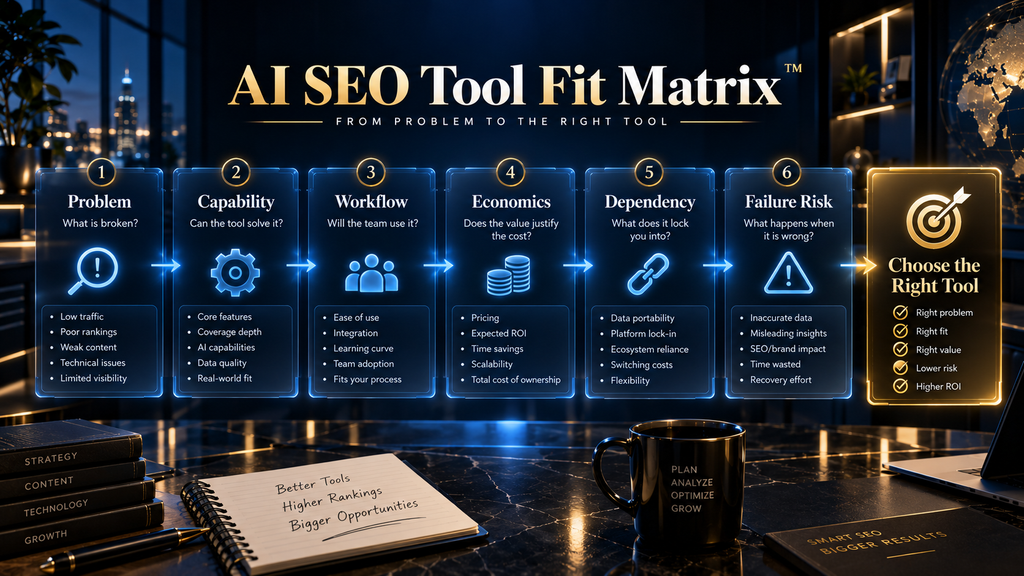
This framework is more useful than asking which platform has “the most AI.”
Consider a site that has strong content, a clear keyword strategy and solid rankings, but suffers from thousands of technical issues. Buying a content optimization platform because it has impressive generative AI features does not address the primary constraint. The opposite is also true. A technically healthy publisher with a large content operation may gain much more from improving research and content optimization than from investing heavily in a technical crawler.
The same logic applies to pricing. If a platform costs $100 or $200 per month but consistently saves hours of expert labor and helps uncover valuable opportunities, the subscription may be inexpensive relative to the value created. But if the software is opened twice a month and most of its capabilities go unused, even a relatively modest subscription can be wasteful.
That is the standard we should use throughout this comparison.
1. Semrush: Best All-Around AI SEO Platform
Semrush is the strongest candidate for the best all-around AI SEO platform because it attempts to cover a very large portion of the SEO workflow from one ecosystem. Its strengths span keyword research, competitive analysis, rankings, site auditing, content workflows and increasingly AI-search visibility. That breadth is the core reason it deserves the top overall position.
The advantage of breadth is not simply that a platform has more buttons. It is that different SEO activities can be connected inside the same environment. A team might research a competitor, discover a keyword opportunity, assess ranking difficulty, audit the website, track the resulting rankings and monitor search visibility without having to rebuild the entire context across unrelated platforms.
That becomes especially useful for agencies and in-house marketing teams. The bigger the operation, the more valuable centralization becomes because data fragmentation itself starts to create costs. Analysts have to move between systems, managers have to reconcile different metrics, and team members have to learn multiple interfaces.
Semrush is also increasingly participating in the shift toward AI-search visibility. Its product direction reflects the fact that traditional search and generative search are becoming increasingly connected rather than operating as completely separate markets. That makes the platform strategically interesting for organizations that do not want to maintain one system for conventional SEO and another for emerging AI-search measurement.
But the breadth comes with an obvious trade-off: complexity.
A small site owner can easily buy a platform that contains substantially more capability than the business can realistically use. This creates what might be called the feature-economics problem. The presence of a feature is not economic value by itself. Value appears only when the feature solves a real problem frequently enough to matter.
Semrush therefore makes the most sense when SEO is already an important operational function. Agencies, growing businesses, publishers and professional SEO teams can justify the platform much more easily than a very small website with limited search activity.
The practical verdict
Semrush is the best overall choice for teams that want breadth, integration and a centralized SEO workflow. It is not automatically the best tool for every individual SEO task, and its breadth should not be mistaken for universal superiority.
2. Ahrefs: Best for SEO Intelligence and Competitive Research
Ahrefs occupies a different position in the market. While it has expanded its capabilities considerably, one of its strongest reasons for being in the top tier remains its emphasis on SEO intelligence and competitive research.
That makes Ahrefs particularly powerful for questions such as: What are competitors ranking for? Where are the strongest link opportunities? Which pages are attracting search demand? How does a site’s search footprint compare with another site? What content gaps exist? What does the broader search environment look like?
This data-oriented approach is extremely valuable for advanced SEO professionals because strategy depends on understanding the environment before deciding what to do inside it.
Ahrefs has also moved into AI-search visibility through its Brand Radar offering. The broader trend is important: traditional SEO vendors are no longer treating AI-search visibility as completely separate from their core products. Ahrefs publicly discusses very large prompt and AI-visibility datasets, but these figures should be understood as vendor claims, not as independent evidence that Ahrefs necessarily delivers better AI-search outcomes than competing platforms. That distinction is essential in any serious commercial comparison.
The major downside is economics. Ahrefs sits in the premium segment of the market, and its value is strongly tied to how frequently the buyer uses the underlying data. An advanced agency might extract substantial value from that information every week, while a small website owner may discover that much of the subscription remains idle.
This is an important distinction between professional software and consumer software. Professional SEO tools often appear expensive when evaluated by monthly subscription alone, but the correct calculation is based on the amount of valuable work they enable or replace.
Ahrefs therefore makes the strongest case when research itself is central to the SEO process.
The practical verdict
Choose Ahrefs when SEO intelligence, competitive research, backlinks and data depth are more important than having the broadest possible content-production ecosystem.
3. Surfer: Best for Content Optimization
Surfer becomes much more compelling when the SEO problem shifts from discovering opportunities to improving the actual content that gets published.
Its center of gravity is content optimization. The platform analyzes competitive search results and provides guidance designed to help content teams understand how a page compares with the broader topical and structural environment around a query.
That can be extremely useful for publishers because content production often suffers from inconsistency. One writer may naturally cover a topic thoroughly while another creates something technically optimized but semantically thin. A standardized optimization environment can make the editorial process more repeatable.
This is where Surfer has a genuine operational advantage. Instead of asking writers to interpret SEO recommendations independently, the team can build a workflow around a common optimization process. That can reduce training time and make content quality more consistent across many pages.
But the tool’s strength is also its boundary.
A strong content score does not guarantee strong organic performance. Search visibility can still be affected by authority, backlinks, technical accessibility, intent mismatch, originality, brand strength and the quality of competing pages.
This is the tool-score trap that buyers need to understand. A software-generated score is an analytical signal. It is not a Google ranking guarantee.
Surfer is therefore strongest when the site already has a sensible SEO strategy and the problem is improving the effectiveness and consistency of the content-production process.
The practical verdict
Surfer is one of the strongest choices for teams whose central SEO bottleneck is content optimization rather than deep technical diagnosis or broad competitive intelligence.
4. Frase: Best for Content Workflow and Value
Frase sits near Surfer in the market, but its value proposition is somewhat broader around the content workflow itself. It brings research, content planning, optimization and AI-assisted production into a more unified environment, which can be especially attractive to smaller teams that do not want a large collection of disconnected tools.
That matters because the hidden cost in content production is not always the software subscription. It is workflow friction.
A writer may begin by researching a topic in one tool, build a brief in another, draft in a third, optimize in a fourth and then return to yet another platform to review performance. Each transition creates cognitive overhead and increases the possibility that important information gets lost.
Frase’s attraction is that it can shorten that chain. The platform’s current positioning emphasizes content research and SEO optimization, and competitor coverage in 2026 continues to place it firmly within the content-workflow category.
That makes it particularly relevant to bloggers, content marketers and smaller agencies that need to produce quality work efficiently without immediately moving into a much larger enterprise SEO stack. The limitation is straightforward: content workflow is not the entire SEO universe.
A team managing major technical problems, extensive backlink research or sophisticated enterprise SEO reporting may still need additional infrastructure. Frase should therefore be evaluated as a content operating environment rather than as a universal replacement for every SEO platform.
The practical verdict
Frase is especially attractive when content production, research and optimization need to work together without the cost and complexity of a much larger SEO suite.
5. SE Ranking: Best Value All-in-One Option
SE Ranking has an important role in the market because not every buyer needs the largest possible SEO ecosystem.
Many freelancers, small agencies and growing businesses want an all-in-one platform precisely because they do not want to pay for several specialists. At the same time, they may not need every advanced capability offered by the largest premium suites.
SE Ranking fits that middle ground well.
Its broader ecosystem includes rankings, site auditing, competitor research and other common SEO functions, while its product direction increasingly incorporates AI-related workflows. That makes the platform particularly interesting for users who care about breadth-to-cost efficiency rather than absolute maximum depth in every feature.
The economic argument is important here. Suppose two platforms can complete 90% of the tasks a small agency performs, but one costs substantially more because it also contains several enterprise capabilities the agency never uses. The more expensive platform may be objectively broader while still being the worse purchase.
That is why the right question is not “Which software has more features?” but “Which software covers the workflows I actually execute?”
SE Ranking’s main trade-off is that advanced users may still prefer the deeper ecosystem or specific data strengths of platforms such as Semrush and Ahrefs. But that is exactly what one would expect from a value-oriented platform.
The practical verdict
SE Ranking is one of the strongest choices for users who want broad SEO functionality while keeping the economics under tighter control.
6. Clearscope: Best for Editorial Content Optimization
Clearscope occupies a more editorially focused part of the market.
Its importance comes from the fact that good SEO content is not simply a matter of inserting keywords into a document. Modern search systems need content that covers the relevant subject properly, communicates clearly and satisfies the underlying information need. Editorial teams therefore need ways to standardize quality without reducing writing into a mechanical checklist.
Clearscope is particularly relevant to this problem.
Its current offering includes content optimization and topic-focused workflows while expanding into AI-search-related visibility measurement. Its public product information also makes the cost structure relatively transparent, placing it in a premium position for a specialized content platform.
That creates a useful contrast with AI writing tools that focus primarily on speed. The real editorial question is not: “How quickly can we generate text?”
It is: “How reliably can we produce content that is complete, useful and competitive while maintaining editorial quality?” Clearscope is much closer to that second question.
The obvious limitation is specialization. A team that needs deep backlink intelligence, extensive crawling or broad competitor data will still require additional tools.
The practical verdict
Clearscope is strongest for organizations that treat SEO content optimization as an editorial quality-control process rather than simply a writing automation problem.
7. MarketMuse: Best for Topical Strategy
MarketMuse deserves its place because it approaches SEO at a higher strategic level.
A content team with twenty articles has a different problem from a publisher with two thousand. At small scale, the focus is often “How do I optimize this article?” At larger scale, the more important question becomes “What should we publish next, how does it fit into the site’s subject coverage, and where are our biggest strategic gaps?”
That is where MarketMuse becomes valuable.
Its positioning centers on topic analysis, content strategy, planning and briefs rather than simply generating or optimizing individual sentences. This gives it a distinct role in the market even though it is often grouped alongside general AI SEO platforms.
The economic argument is subtle but powerful. Better topical strategy can reduce wasted production.
Imagine a content team producing 100 articles a quarter but repeatedly choosing low-value topics, ignoring important gaps and creating pages that overlap with one another. Increasing production speed will not solve the underlying problem. Better prioritization will.
That means the value of a topical-strategy platform may come indirectly through content avoided, not just content produced. The limitation is that this is a strategic tool, not an obvious solution to every technical or measurement problem.
The practical verdict
MarketMuse is particularly useful when the SEO challenge is deciding what the site should cover and how the content portfolio should fit together, rather than merely optimizing individual pages.
8. Screaming Frog SEO Spider: Best Technical SEO Specialist
Screaming Frog is perhaps the most useful reality check in an article about AI SEO tools because it illustrates something the market sometimes forgets: AI does not automatically make specialized software unnecessary.
Screaming Frog’s fundamental job is technical crawling and diagnosis. Its value comes from exposing the structural and technical conditions of a website, including broken links, redirects, duplicate content, canonicalization, metadata, rendering and other issues that can be extremely difficult to understand manually on large sites.
This matters because technical SEO problems can be much more consequential than content-production speed.
Consider a large website whose organic performance suddenly declines. The first question should not be whether the company can generate another hundred AI-assisted articles. The first question is whether there has been a technical or structural change affecting the existing site.
A specialist crawler is often the right instrument for that problem. Screaming Frog therefore belongs in this comparison not because it is the most “AI” tool on the list, but because it demonstrates a broader principle: specialization can still beat generalization when the problem is specific enough.
Of course, Screaming Frog is not a replacement for a complete SEO suite. It is a technical component of a larger workflow.
The practical verdict
Screaming Frog is the strongest specialist choice when technical diagnosis and crawling are more important than content or AI-search features.
9. Alli AI: Best for SEO Implementation at Scale
SEO software traditionally does a good job of telling you what is wrong. The harder part is often doing something about it. This distinction creates three separate stages in the SEO workflow: Diagnosis → Recommendation → Implementation.
Many platforms are strong at the first two. Alli AI is particularly interesting because it focuses more heavily on the third.
Its public positioning emphasizes automated SEO changes, technical and on-page optimization, internal linking and reducing dependence on engineering resources. That becomes increasingly valuable on large websites, where even relatively simple changes can be expensive to deploy across thousands of pages. However, automation creates a fundamental risk that buyers should not ignore.
If a human discovers a bad recommendation and applies it to one page, the damage is limited. If an automated system applies the same bad recommendation to 30,000 pages, the error has been multiplied.
That means implementation automation needs stronger governance than simple research automation. The larger the scale, the more important validation becomes.
The best use of this type of software is therefore not “let the AI do SEO.” It is: Use automation to remove repetitive execution after the strategic decision has been validated. That distinction is essential.
The practical verdict
Alli AI is most interesting for larger websites where the primary SEO bottleneck is implementing known changes efficiently and consistently.
10. Writesonic: Best for an AI-Heavy Content and SEO Workflow
Writesonic represents a different direction in the market. Instead of beginning with the traditional SEO software architecture and adding a few AI features, AI-native platforms attempt to place artificial intelligence much closer to the center of content and optimization workflows. This makes Writesonic relevant for teams that want AI involved deeply in research, ideation, drafting and SEO-oriented content production.
That can produce significant efficiency gains, particularly for publishers that have already developed a structured editorial process and know how to verify AI-generated work. But the risk is category confusion.
An AI-first content platform is not automatically a superior solution for backlink analysis, enterprise technical SEO, deep site crawling or advanced competitive intelligence. Current 2026 comparison pages increasingly include Writesonic alongside more traditional SEO platforms, which demonstrates how the categories are converging, but convergence does not mean the products have become identical.
The right way to think about Writesonic is therefore as a representative of the AI-heavy content and SEO workflow, rather than as a direct one-for-one replacement for Ahrefs or Semrush.
The practical verdict
Writesonic is best suited to teams that want AI to become a central part of the content-production and SEO workflow rather than merely an analytical assistant.
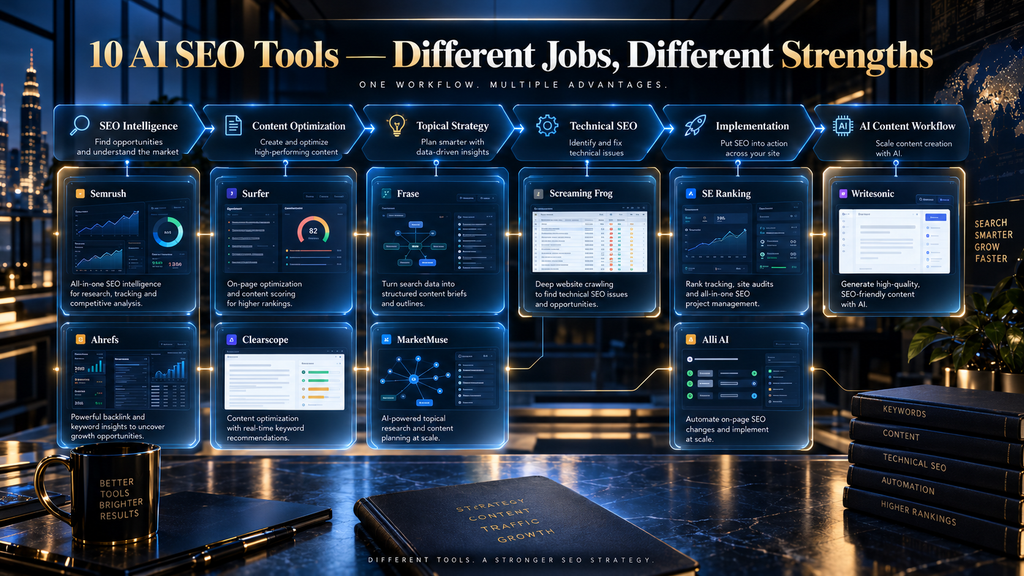
Why These Ten Tools Should Not Be Ranked as Though They Are Identical
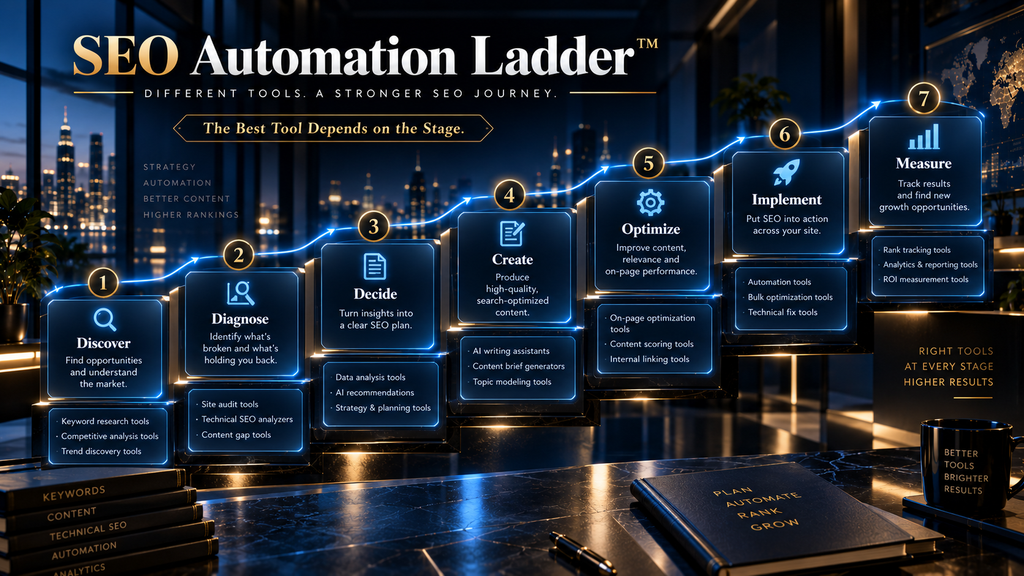
Once the ten platforms are examined individually, an important pattern becomes obvious. They are distributed across different parts of the SEO workflow. That is why AI Hustle World’s SEO Automation Ladder is useful.
SEO Automation Ladder
Discover → Diagnose → Decide → Create → Optimize → Implement → Measure. Semrush, Ahrefs and SE Ranking are particularly strong around discovery, research, diagnostics and measurement. MarketMuse is stronger around the decision layer: what should the site cover and how should content priorities fit together?
Writesonic and Frase move closer to creation. Surfer and Clearscope are strongest around optimization. Screaming Frog is especially powerful for technical diagnosis.
Alli AI moves further downstream toward implementation. This matters because the best tool for one stage may be completely wrong for another.
It also explains why experienced SEO teams often use more than one platform. Specialization is not necessarily inefficiency when each tool solves a meaningful problem that the others do not.
The mistake is not using multiple tools. The mistake is using multiple tools without knowing what each one contributes.
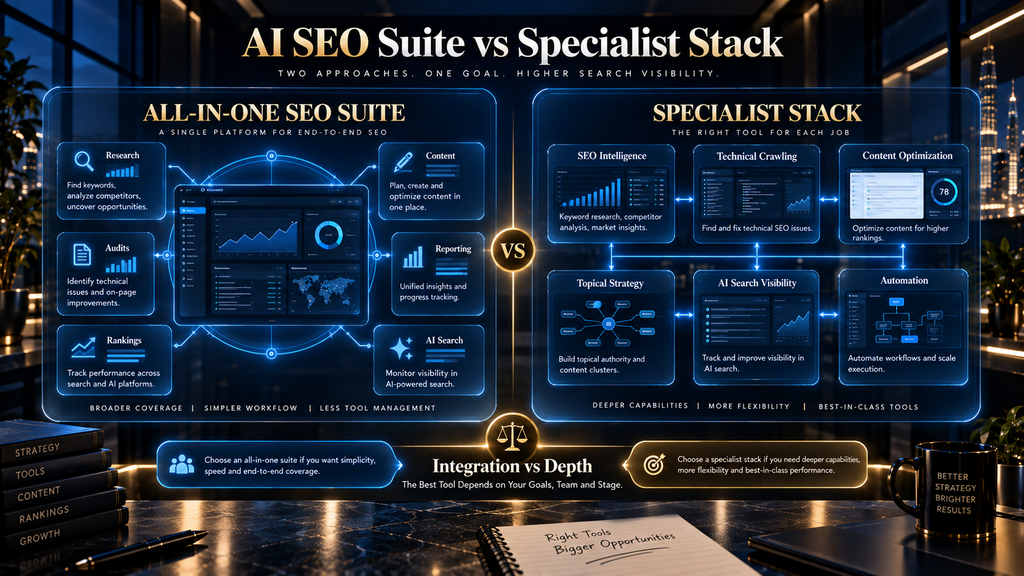
All-in-One SEO Suite or Specialist Tools?
This is one of the biggest purchasing decisions a modern SEO team needs to make.
The all-in-one approach is attractive because it reduces fragmentation. A single platform can become the central source for research, rankings, audits, reports and content-related work. That makes team coordination easier and can reduce the administrative burden of maintaining multiple subscriptions.
The downside is that broad software inevitably contains capabilities you may never use. You are paying partly for optionality.
The specialist approach works differently. Instead of buying one large platform, you combine focused products according to the actual workflow. A team might use Ahrefs for competitive research, Screaming Frog for technical crawling and Surfer for content optimization.
That can create stronger specialist capability, but it can also produce duplicated data, multiple interfaces, different metrics and more training. So which model wins?
There is no universal answer. The correct choice depends on workflow complexity versus specialist depth.
For smaller organizations, one broad platform often provides a better balance. For mature SEO operations, specialized tools can become more rational because the underlying workflows are complex enough to justify them.
How Much Should You Actually Spend on AI SEO Software?
This is an area where many comparison articles stop too early. They show monthly prices, but monthly price is not the actual economic question. The better question is: What amount of measurable value must this tool generate before the subscription becomes rational?
Suppose a platform costs $120 per month. That is $1,440 per year.
That amount could be justified quickly if the system consistently saves a content strategist several hours each week, reduces expensive manual research, helps identify profitable opportunities, or improves the speed at which important technical changes are implemented. But the same subscription can be a poor investment for a small website where the platform is used twice per month. The correct calculation should consider both time and outcomes.
A useful model is: Tool value = time saved + incremental SEO value + avoided external costs − total software cost. The word “incremental” is important.
Do not attribute existing traffic to the software simply because traffic existed after the purchase. Do not treat the number of AI-generated articles as a business result. Do not call more dashboards an improvement.
Measure what changed because the workflow changed.
The Hidden Cost of an AI SEO Tool
Subscription price is only one part of the cost. You also need to consider seats, usage limits, credits, additional modules, verification time, onboarding, training and workflow changes. This becomes particularly important with AI.
Suppose an AI system produces a recommendation in two minutes, but a human needs twenty minutes to verify that recommendation before implementation. The true efficiency gain is not the two minutes saved by the machine. It is the difference between the old workflow and the new workflow after verification is included.
That is why mature teams should measure net workflow time, not gross automation time. Automation is only valuable when the resulting process is genuinely cheaper, faster or better.
The Biggest Mistake: Buying the Tool Before Identifying the Bottleneck
One of the easiest mistakes in AI SEO is falling in love with the software before defining the problem. The marketing is persuasive because nearly every platform can now demonstrate a long list of impressive capabilities: AI content, AI analysis, content briefs, competitor research, AI recommendations, optimization scores, AI visibility and automation. But none of those features matter if they do not solve the bottleneck.
A technically broken site does not need more content generation. A content team that already has a strong technical foundation may not need another crawler.
A mature site with thousands of articles may not need another writing tool. It may need a better content strategy.
A company whose pages rank well but whose AI-search visibility remains poorly understood may need measurement rather than generation. This is why the first purchase decision should always be: What is currently preventing the SEO system from performing better? Only after that question is answered should software enter the conversation.
What AI SEO Tools Can and Cannot Do for AI Search
One of the newest features appearing across the SEO software market is AI-search visibility.
Established SEO platforms increasingly include capabilities designed to monitor brand appearance or citation-like visibility in generative search environments, while separate tools focus entirely on AI-search measurement. Current competitor coverage reflects this market expansion: traditional SEO platforms are increasingly being discussed alongside dedicated AI-search visibility products.
That development is important, but it also creates another opportunity for vendor hype. A visibility report is not automatically a strategy.
Knowing that a brand appeared in an AI-generated answer can be useful. Knowing which high-value queries produced the appearance, which competitors were included, how frequently the brand is cited, what content appears to be associated with the answer, and what action the business should take next is much more useful.
In other words, measurement only becomes valuable when it leads to a decision. This is another reason AI Hustle World should resist the temptation to treat every new AI feature as a reason to upgrade software immediately.
Which AI SEO Tool Is Best for Beginners?
Beginners often assume they should start with the “best” platform. That is usually the wrong question.
A new website with a small number of pages does not need the same software infrastructure as an agency managing hundreds of clients. Buying enterprise-style tooling too early can create the illusion of sophistication without creating meaningful output.
A beginner with a growing content site may benefit more from a content-focused workflow. A beginner dealing with a technical problem may need a crawler. A beginner building competitive research into a serious publishing process may eventually justify Ahrefs or Semrush.
The important principle is progressive complexity.
Start with the smallest stack that solves the current problem. Add software when another recurring problem becomes economically important.
That approach protects both cash flow and attention.
Which AI SEO Tool Is Best for Agencies?
Agencies usually need a broader combination of capabilities because they must manage different clients, reporting environments and SEO workflows at the same time.
That makes Semrush and Ahrefs particularly useful as core platforms, while content-oriented agencies may complement them with Surfer, Frase or Clearscope. Technical SEO work makes Screaming Frog more important, while large-scale implementation requirements can make automation platforms such as Alli AI more relevant.
The important point is that agency software should be judged not only by features, but by repeatability. A tool that works brilliantly for one website but requires complicated manual processes across twenty clients may become less attractive at agency scale. The best agency software is often the software that makes a good process easier to repeat.
Which AI SEO Tool Is Best for Bloggers and Affiliate Sites?
Bloggers and affiliate publishers face a particularly difficult economic problem because software costs are incurred immediately while SEO revenue may take months to materialize. That makes efficient research and content production especially important.
Ahrefs and Semrush make sense when competitive intelligence and keyword opportunities are the core requirement. Surfer and Frase become more compelling when the content workflow itself is the bottleneck. Writesonic can be attractive when AI-native content production is central to the publishing model, while MarketMuse becomes more useful as the content portfolio grows larger.
But affiliate publishers should be particularly careful about confusing content volume with business value. Producing fifty additional articles does not necessarily produce more revenue.
Sometimes the best investment is producing fewer pages with better topics, stronger evidence, clearer search intent and better conversion paths. The tool should support that strategy rather than encourage publishing for its own sake.
Which Tool Is Best for Technical SEO?
For technical SEO, Screaming Frog remains the specialist choice in this list. The reason is straightforward: technical problems are often about structure and diagnostics rather than content generation. A specialist crawler can expose issues that an AI content platform was never designed to identify.
That does not make Semrush, Ahrefs or other broad platforms unhelpful. They can contribute significantly to technical auditing. The point is that technical SEO has enough complexity to justify specialization when the website is large or the consequences of mistakes are serious.
This is one of the most important lessons from the current AI SEO market:
AI does not eliminate specialization. It makes good specialization more scalable.
Which Tool Is Best for Content Optimization?
There is no single answer because the content category itself contains several distinct workflows. Surfer is particularly compelling when the emphasis is direct content optimization. Frase is attractive when the workflow extends from research through drafting and optimization.
Clearscope becomes particularly relevant when editorial quality control is a major concern. MarketMuse is more strategic because it operates further upstream around topic planning and content portfolio decisions. These products should therefore not be compared purely by the question “Which one has the best AI?”
Instead, ask: Where does the content bottleneck actually exist? That produces a much more reliable buying decision.
A Practical Decision Matrix
The following matrix condenses the comparison into the decision that actually matters.
| Primary problem | Strong starting choice | Why |
|---|---|---|
| One broad SEO platform | Semrush | Wide ecosystem and integrated workflows |
| Competitive research and SEO intelligence | Ahrefs | Strong data-oriented approach |
| Page-level content optimization | Surfer | Focused content optimization |
| Content research and production workflow | Frase | Strong workflow integration |
| Broad SEO on a tighter budget | SE Ranking | Value-oriented positioning |
| Editorial content quality | Clearscope | Structured optimization |
| Topic planning and content strategy | MarketMuse | Strategic topical focus |
| Deep technical crawling | Screaming Frog | Specialist diagnostics |
| Repetitive SEO implementation | Alli AI | Automation of execution |
| AI-first content and SEO workflow | Writesonic | Strong AI-native orientation |
This table does not attempt to hide the complexity of the market. It makes the complexity useful.
When You Should Not Buy an AI SEO Tool
Sometimes the smartest SEO purchase is no purchase at all.
A business may not need another platform when the fundamentals are still broken. If the site has no coherent SEO strategy, publishes very little content, has obvious technical problems or has no one responsible for using the software consistently, another subscription can simply add noise.
This is especially important for small websites.
A $150 monthly platform cannot compensate for poor topic selection. A $300 monthly tool cannot compensate for weak content. An AI writing system cannot solve a business that has no meaningful conversion path.
Software becomes valuable when it strengthens an existing operating process. Before buying, ask yourself whether you already know what you want the software to accomplish. If the answer is no, the purchasing problem may actually be a strategy problem.
Common Buying Mistakes
One of the most common mistakes is choosing the biggest platform simply because it has the biggest feature list. That confuses capability with value. The largest platform can be the right decision for a complex organization, but it can also be an expensive overreaction for a small site.
Another mistake is treating content optimization scores as ranking guarantees. An optimization score tells you something about the page according to the model and data used by that platform; it does not tell you exactly how Google will rank the page.
Buyers also often mistake AI content generation for SEO itself. Generation is only one stage of the process. Search intent, originality, authority, technical accessibility, information architecture, internal linking and business relevance remain fundamental.
Another frequent problem is purchasing dedicated AI-search visibility tools before establishing what will be done with the data. A visibility dashboard should support decisions, not simply generate another monthly report.
Finally, automation should never be introduced before validation. The larger the implementation scale, the more expensive a wrong assumption becomes.
A Better Way to Choose an AI SEO Tool in 30 Days
The best way to evaluate software is to treat the purchase like an operational experiment.
During the first week, document the SEO tasks your team performs repeatedly. Do not count only the tasks that feel important; include the repetitive research, auditing, reporting, drafting and implementation work that quietly consumes hours.
Then identify the biggest recurring bottleneck.
During the second week, evaluate a tool against that one problem rather than testing every feature in the product. Record how long the existing process takes, how long the software-assisted process takes and how much human verification is required.
During the third week, compare the output quality. Speed is not enough. A system that produces work faster but requires extensive correction may not actually be more efficient.
During the fourth week, calculate the economics. Compare the old workflow with the new workflow and then consider whether any measurable SEO improvement can reasonably be attributed to the change.
This process is much more reliable than buying several subscriptions simultaneously and hoping one of them becomes useful.
The Future of AI SEO Tools Is Not Just More Automation
The direction of the market is clear: AI SEO platforms are increasingly moving toward integrated systems that combine research, recommendations, content creation, optimization, measurement and implementation. That creates an obvious temptation to predict the arrival of an autonomous SEO agent that manages everything from keyword discovery through ranking improvement.
Parts of that future are plausible. But SEO contains a large amount of ambiguity.
A system can discover that competitors are targeting a topic. It cannot automatically know whether that topic makes strategic sense for your business.
A system can recommend internal-link changes. It does not automatically understand every commercial, editorial and information-architecture relationship on a complex site.
A system can identify thousands of technical anomalies. It still requires judgment to distinguish severe problems from harmless ones.
So the likely direction is not that SEO expertise disappears. It is that repetitive SEO labor becomes cheaper while strategic judgment becomes more valuable. That is a very different proposition.
The Second-Order Effect: Better Tools May Create More Competition
There is an uncomfortable consequence of increasingly capable AI SEO software. As research, drafting and optimization become easier, more businesses will be able to produce technically competent SEO content. That means technical competence becomes less of a differentiator.
When everyone can generate an acceptable article, the competitive advantage shifts toward things software cannot easily manufacture from nothing: original research, real experience, proprietary information, trusted expertise, strong reputation, first-hand evidence, better products and better strategic decisions. The result is paradoxical. AI SEO software can make SEO easier to execute while making genuinely differentiated SEO harder to achieve.
That is why the goal should not be to produce the maximum amount of content with minimum effort. The goal should be to produce better decisions and better outcomes with less unnecessary labor.
Why Traditional SEO Still Matters
The term “AI SEO” sometimes creates the impression that traditional SEO has been replaced. The software market tells a different story.
Most modern AI SEO platforms are not abandoning keyword research, technical auditing, competitor analysis, rankings, content optimization or internal linking. They are adding AI assistance to those existing workflows.
That is an important distinction. Keyword data still matters. Technical accessibility still matters.
Content quality still matters. Competitor analysis still matters. The difference is that AI can increasingly accelerate pieces of the process, summarize complex information, generate options and reduce repetitive work.
The future is therefore less likely to be: “Traditional SEO is dead; AI has replaced it.” A more realistic description is: Traditional SEO fundamentals are increasingly being operated through AI-assisted workflows. That is a much more useful mental model for buyers.
Our Overall Verdict by Use Case
After comparing the ten platforms by workflow rather than feature count, the most defensible conclusions are:
| Category | Best choice |
|---|---|
| Best overall | Semrush |
| Best SEO intelligence | Ahrefs |
| Best content optimization | Surfer |
| Best content workflow/value | Frase |
| Best value all-in-one | SE Ranking |
| Best editorial optimization | Clearscope |
| Best topical strategy | MarketMuse |
| Best technical SEO | Screaming Frog |
| Best SEO implementation automation | Alli AI |
| Best AI-heavy content workflow | Writesonic |
These positions should not be interpreted as permanent universal rankings. They are use-case judgments based on where each product’s strengths are most economically meaningful.
The market is changing too quickly for a simplistic “winner takes all” model to remain useful.
So, Which AI SEO Tool Should You Actually Buy?
The safest way to answer that question is to start from your current workflow.
If you want a broad platform that can act as the central operating environment for SEO, Semrush is the strongest overall choice. If your strategy depends heavily on competitive intelligence, backlinks and search data, Ahrefs becomes particularly attractive.
If the bottleneck is content optimization, Surfer is likely to be more useful than another broad suite. When you want research, optimization and content production to operate together, Frase is compelling, particularly for smaller teams.
When broad capability matters but subscription economics are tighter, SE Ranking deserves serious consideration. When content quality and editorial optimization are the priority, Clearscope becomes more relevant. When the real problem is deciding what the site should cover and how the content portfolio fits together, MarketMuse is the more strategic choice.
For technical diagnosis, Screaming Frog remains one of the strongest specialist options because technical SEO is still technical SEO, regardless of how much AI appears in the surrounding software market. For organizations with a large implementation backlog, Alli AI becomes interesting because it addresses the execution layer. And for teams deliberately building AI into the heart of content production, Writesonic represents the newer AI-native direction.
The more important decision, however, is what not to buy.
Do not purchase a tool simply because everyone else in the SEO market is discussing it. Do not pay for features your team will never use. Do not confuse AI content generation with SEO strategy. Do not treat an optimization score as a ranking guarantee. Do not automate large-scale changes before validating the underlying recommendation.
Most importantly, do not confuse a tool problem with a strategy problem.
An SEO platform can help you research better, diagnose faster, optimize more consistently, measure more effectively or execute repetitive changes at scale. It cannot decide what your business should care about, what your audience genuinely needs, what information your competitors cannot provide, or which strategic trade-off is right for your organization.
That is still the human part of SEO. And it is probably becoming the most valuable part.
Final Thoughts
The AI SEO software market is entering an interesting stage. The tools are becoming more capable, but the category is also becoming harder to understand because products that once served very different purposes are gradually moving toward one another.
SEO suites are adding AI-search visibility. Content optimization platforms are adding generation. AI-native content systems are moving deeper into SEO. Technical tools are becoming more intelligent. Automation platforms are trying to bridge the gap between recommendation and implementation.
That convergence creates opportunity, but it also creates confusion. The answer is not to find the platform with the most impressive AI label. It is to understand where the tool fits in the workflow.
Semrush is strongest when broad integration matters. Ahrefs shines when intelligence and competitive research drive the strategy. Surfer, Frase and Clearscope address different versions of the content problem. MarketMuse works further upstream at the strategic level. Screaming Frog remains a powerful technical specialist. Alli AI attacks the implementation bottleneck. Writesonic represents the AI-native end of the content workflow.
The most important conclusion is therefore not that one company is winning. It is that AI SEO software is becoming modular around the SEO workflow itself.
The best operators will not necessarily be the people with the most subscriptions. They will be the people who understand exactly where software creates leverage, where automation creates risk, and where human judgment still produces the highest return.
Choose the tool that solves a real bottleneck. Measure what changes after you deploy it. Keep what creates measurable value. Remove what does not.
That is a much better AI SEO strategy than simply buying the tool everyone calls “best.”
Choose the Right AI SEO Tool
Find the platform that fits your SEO workflow, budget, and biggest bottleneck.
Read AI SEO Guide →Frequently Asked Questions
1. What is the best AI SEO tool in 2026?
Semrush is the strongest all-around choice for teams that want a broad SEO ecosystem, but there is no universal winner. Ahrefs is particularly strong for SEO intelligence, Surfer for content optimization, Screaming Frog for technical SEO and MarketMuse for topical strategy.
2. Is Semrush better than Ahrefs?
Neither platform is objectively better for every user. Semrush has a particularly broad ecosystem, while Ahrefs is especially strong when competitive research, backlink intelligence and search data are central to the workflow.
3. Is Ahrefs worth the money?
Ahrefs can be worth the subscription for professionals, agencies and publishers that use its intelligence frequently and can translate that information into valuable SEO decisions. For small websites with minimal SEO activity, the economics may not work as well.
4. Is Surfer good for SEO?
Surfer is particularly useful for content optimization. It can help teams create more consistent optimization workflows, but a high content score should not be interpreted as a guarantee of higher rankings.
5. What is the best AI SEO tool for bloggers?
The answer depends on the bottleneck. Frase and Surfer are particularly relevant for content workflows, while Ahrefs and Semrush are stronger when research, competitors and SEO intelligence are the primary concern.
6. What is the best AI SEO tool for agencies?
Semrush and Ahrefs make strong core platforms for agencies because they cover broad research and SEO workflows. Content-heavy agencies can complement them with Surfer, Frase or Clearscope, while technical teams may benefit significantly from Screaming Frog.
7. Can AI SEO tools replace SEO professionals?
They can replace portions of repetitive work, but not the entire strategic role. SEO still involves ambiguity, business priorities, search intent, content judgment, technical interpretation and decisions about where to invest limited resources.
8. Are AI SEO tools useful for AI search and Google AI Overviews?
They can be useful for measuring, analyzing and improving aspects of search visibility, particularly as established SEO platforms increasingly add AI-search capabilities. However, ordinary SEO suites and specialized AI-search visibility platforms should not automatically be treated as equivalent.
9. Should I use one AI SEO tool or several?
Smaller teams often benefit from starting with one broad platform, while larger and more specialized SEO operations may justify several tools. The correct goal is not to minimize the number of subscriptions; it is to maintain the smallest tool stack that solves the important problems effectively.
10. What is the biggest mistake when buying AI SEO software?
The biggest mistake is buying software before identifying the actual SEO bottleneck. When the problem has not been clearly defined, even an excellent platform can become an expensive collection of unused features.
Related Guides
- Best AI Tools for Writing Blog Posts (Free & Paid)
- AI SEO vs Traditional SEO: What Actually Matters in 2026?
- Best AI Tools for Pinterest Content Creation
- How to Use ChatGPT for Blogging: Complete Beginner’s Guide
Written by
Muntasir Ahmad Chowdhury
Founder, AI Hustle World
Muntasir Ahmad Chowdhury is the Founder of AI Hustle World, an independent publication dedicated to making Artificial Intelligence practical, trustworthy, and easy to understand. He researches AI tools, automation, customer service, productivity, and real-world business applications, helping readers make smarter technology decisions through research-driven, experience-backed content.
Expertise:
AI Tools • AI Automation • AI Customer Service • AI Productivity • Generative AI • AI Workflows
Get Smarter With AI
Enjoyed this guide? Get practical AI tools, tutorials, and honest reviews delivered to your inbox.