
Evidence: Documentation reviewed
Last checked: September 2026
What was done: Written from official documentation and the published sources linked in this article. Not hands-on tested.
Files: None
Affiliate links: No
How to Use AI for Cash Flow Forecasting and Scenario Planning
Cash flow forecasting is often treated as a prediction problem: estimate how much cash the business will have in the future and compare that number with expected obligations. In practice, however, the difficult part is rarely producing a number. The difficult part is understanding why cash is likely to move, how quickly the position could change, what could go wrong, and what management should do before a liquidity problem becomes urgent.
That distinction matters because cash behaves differently from accounting profit. A profitable company can still face a cash shortage when customers pay slowly, inventory absorbs working capital, suppliers demand earlier payment, payroll rises, debt service arrives, or a large capital expenditure lands at the wrong time. Cash forecasting therefore has to reason about timing, liquidity and operational drivers rather than simply extrapolating financial statements. IBM describes cash-flow forecasting in essentially these terms: projecting future receipts and payments to understand liquidity and the ability to meet obligations, which is fundamentally different from forecasting profit.
AI can improve this process, but not because an algorithm magically knows the future. Its more important contribution is connecting fragmented financial and operating signals, identifying patterns and drivers, updating forecasts more frequently, generating alternative scenarios, and bringing emerging liquidity risks closer to the point where management can act. Gartner’s 2026 guidance specifically frames AI-enabled cash-flow forecasting around driver-based, probabilistic and explainable forecasts that support liquidity planning and scenario analysis.
The goal, then, is not to build a prettier cash forecast. It is to create a faster decision system for managing liquidity under uncertainty.
Quick Answer: How Can AI Improve Cash Flow Forecasting?
AI can improve cash-flow forecasting by combining historical transactions with current operational data, learning patterns in receipts and payments, forecasting important cash drivers, identifying timing changes, explaining forecast variances, and continuously updating expected cash positions. It can also make scenario planning faster by allowing finance teams to change assumptions such as collections, sales volume, supplier terms, payroll, capital expenditure or financing costs and immediately examine the resulting liquidity impact.
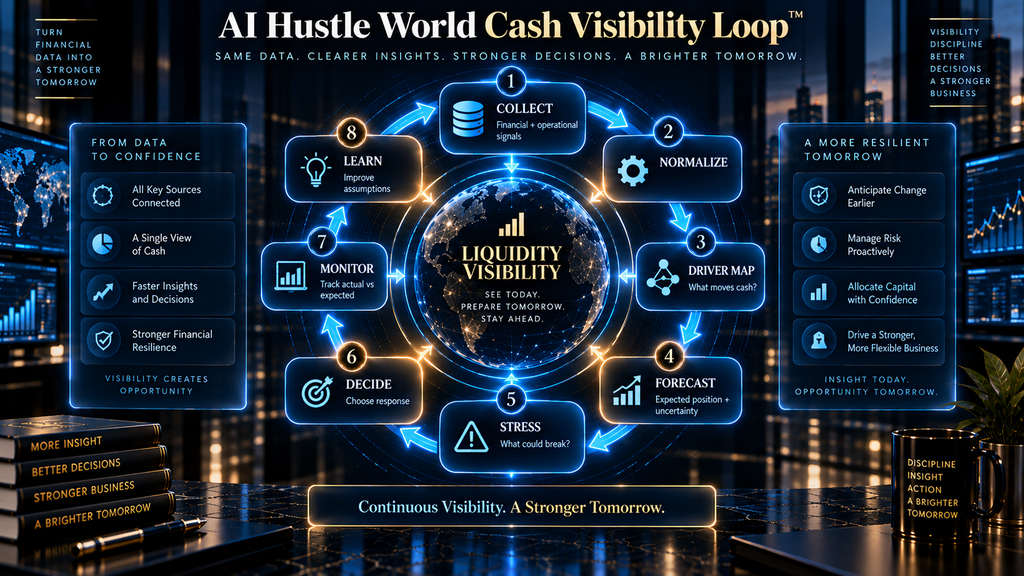
The most effective architecture is not “AI predicts cash.” It is a controlled loop: Collect → Normalize → Map Drivers → Forecast → Stress → Decide → Monitor → Learn.
The human role remains essential. Finance leaders should determine which assumptions matter, define acceptable liquidity thresholds, review unusual model behavior, approve consequential actions and challenge forecasts that do not make economic sense. That combination is increasingly important as finance organizations move toward AI-supported forecasting while retaining human oversight and governed data.
Why Cash Flow Forecasting Is Different From Ordinary Financial Forecasting
A conventional financial forecast often asks questions such as: What will revenue be? What will gross margin look like? What will operating expenses be? How much profit should the business generate?
A cash forecast asks a more immediate question: When will money actually enter and leave the bank accounts?
That difference sounds simple but creates substantial complexity. A $1 million sale does not necessarily mean $1 million of cash this month. The customer may pay in 30, 60 or 90 days. A supplier invoice does not necessarily become a cash outflow on the date it is recorded. Payroll, taxes, debt repayments, rent, inventory purchases and capital expenditures all have their own timing characteristics.
Cash forecasting therefore sits at the intersection of accounting, operations and treasury. Accounts receivable influences when customer invoices become cash. Accounts payable influences when supplier obligations become cash outflows. Sales pipelines influence future receipts. Procurement decisions influence future payments. Payroll determines recurring outflows. Debt schedules determine financing obligations. Capital expenditure plans create potentially large discrete cash movements.
This is why a business can report healthy earnings while simultaneously experiencing liquidity pressure. Profit measures economic performance over an accounting period; cash forecasting measures whether actual liquidity will be available when obligations fall due.
The practical consequence is important: cash forecasting should model the movement of cash, not merely extrapolate accounting results.
Why Traditional Cash Forecasting Struggles
The problem with traditional cash forecasting is rarely the mathematical formula. The difficulty is assembling sufficiently current information and converting it into a coherent view of future cash movements.
Finance teams may have bank balances in one system, invoices in an ERP, customer payment behavior in another system, purchase orders somewhere else, payroll information in an HR platform and financing schedules maintained separately. Spreadsheet-based processes then become the layer that attempts to reconcile everything.
This creates several forms of forecast friction. Data may arrive at different times. Actual payments may differ from invoice dates. Customer behavior may change. Departments may update assumptions inconsistently. One-time transactions can distort historical patterns. Forecasts can also become stale quickly because the underlying business continues moving after the spreadsheet has been prepared.
That problem is not theoretical. A 2026 J.P. Morgan CFO and treasurer survey found cash-flow forecasting was identified as the biggest liquidity-management challenge by 38% of respondents in its APAC sample, ahead of market volatility at 35%. The same survey found that 44% planned to use AI primarily for data analytics and forecasting, suggesting that finance organizations increasingly see forecasting as a practical AI application rather than an abstract experiment.
The weakness of a manual process becomes particularly visible when management asks a question that the original forecast was not designed to answer: What happens if customers pay two weeks later? Or: What happens if revenue falls 10% next quarter?
Or: How much liquidity do we have if inventory purchases increase while our bank facility becomes more expensive?” If answering those questions requires rebuilding the model manually, scenario planning becomes too slow to support fast decisions.
What AI Actually Changes
AI does not eliminate the underlying uncertainty in cash flow. What it changes is the amount of information finance teams can process and the speed at which that information can be converted into an updated view of liquidity.
A useful AI-enabled forecasting system can pull together historical cash transactions, accounts receivable, accounts payable, bank data, payroll, sales information, purchasing activity, debt schedules and other relevant operating signals. It can then identify recurring patterns, distinguish regular movements from unusual ones, and estimate how current conditions may affect future cash positions.
The important shift is from periodic forecast production to continuous forecast intelligence.
Instead of waiting for finance to manually rebuild a forecast, the system can continuously compare actual results with expected results. If customer collections are slowing, that change can influence the projected timing of inflows. If supplier payments are accelerating, expected outflows can change. If a sales pipeline changes materially, the system can incorporate the relevant driver rather than blindly extrapolating historical revenue.
This is where AI becomes more useful than simple spreadsheet automation. Automation can move data from one place to another. AI and predictive analytics can help interpret relationships within that data and estimate what those relationships could mean for future cash.
But there is a crucial boundary: a forecast is not a fact.
The system should communicate uncertainty rather than presenting every prediction as a precise future outcome. Gartner’s 2026 cash-flow forecasting guidance specifically emphasizes probabilistic and explainable forecasting, reinforcing the idea that useful AI forecasting should communicate both expected outcomes and the reasoning or uncertainty surrounding them.
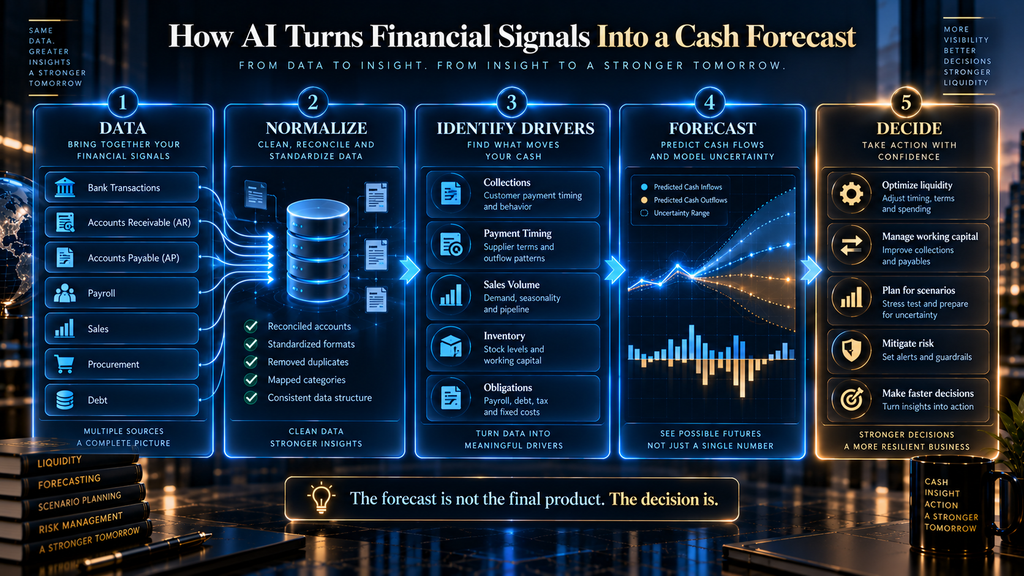
Forecast the Drivers, Not Just the Cash Balance
A cash balance is an outcome. It is not necessarily the best variable to forecast directly.
Suppose an AI model predicts that a company will have $4 million in cash six weeks from now. That number becomes much more useful when the finance team understands what produces it.
Perhaps the forecast assumes that accounts receivable collections remain stable, inventory purchases decline slightly, payroll follows its normal pattern, and a planned capital expenditure occurs on schedule. If those assumptions change, the forecast should change with them.
This leads to a driver-based approach.
Cash inflow drivers
Common inflow drivers include:
- Customer invoices and expected collection dates
- Historical payment behavior
- Sales volume and order pipeline
- Subscription renewals
- Contract milestones
- Refunds and returns
- Financing proceeds
- Investment income
- Tax refunds or other irregular receipts
Cash outflow drivers
Important outflow drivers can include:
- Supplier invoices
- Purchase orders
- Payroll
- Taxes
- Rent and recurring operating expenses
- Capital expenditure
- Debt principal and interest
- Lease payments
- Inventory purchases
- Dividends or distributions
The advantage is not merely technical. Driver-based forecasting gives management something to act on.
If the forecast deteriorates because collections are slowing, management can investigate credit terms, overdue accounts and collection actions. If liquidity deteriorates because inventory purchases are accelerating, the response may involve procurement or inventory decisions. If debt service creates the pressure, financing strategy becomes relevant.
A cash forecast that identifies the driver behind the movement is more actionable than one that merely reports the movement.
The AI Hustle World Cash Visibility Loop
A useful way to operationalize AI cash forecasting is to treat it as a continuous visibility loop rather than a single forecasting model: COLLECT → NORMALIZE → DRIVER MAP → FORECAST → STRESS → DECIDE → MONITOR → LEARN.
The first stage is Collect. The system gathers relevant financial and operating data from banks, ERP systems, AR, AP, payroll, sales, procurement and financing sources.
Next comes Normalize. Different systems may represent customers, suppliers, dates, currencies, payment statuses or transaction categories differently. Forecasting quality is constrained by the quality and consistency of this underlying information.
Then the system maps drivers. Instead of treating every transaction as an isolated data point, it identifies relationships that influence cash movement: collection behavior, payment timing, recurring expenses, sales activity, inventory requirements, debt obligations and other relevant factors.
The model can then forecast expected cash movements. A mature implementation should be capable of producing not only a central forecast but also an indication of uncertainty or a range around that forecast.
The next stage is stress. Management changes important assumptions and examines how the liquidity position responds. This is where forecasting becomes scenario planning.
The organization then decides what action is appropriate. That might involve accelerating collections, delaying discretionary expenditure, changing procurement timing, preserving a credit facility, adjusting investment plans or simply continuing to monitor the situation.
Finally, the system monitors and learns. Actual cash outcomes are compared with forecast expectations. Large variances are investigated. Drivers are reassessed. Models can then be recalibrated as business conditions change.
The value of this architecture is that it connects prediction to action. The forecast is not the final product. The decision is.
How AI Forecasts Cash Inflows
Customer collections are one of the most important areas where AI can add forecasting value because invoice value alone does not determine when cash arrives.
Two customers may receive identical invoices under identical contractual terms and still pay on different schedules. One might consistently pay early, another might pay several days late, and another could become increasingly unpredictable.
A forecasting system can examine historical payment behavior alongside invoice characteristics and current account information to estimate expected collection timing. Relevant signals can include customer payment history, outstanding invoice age, contractual terms, historical delays, seasonality and changes in the customer’s activity.
The objective is not necessarily to predict every individual payment perfectly. The more useful objective is to improve the aggregate estimate of when expected receivables will become available as cash.
That distinction matters when liquidity is tight. A business may have $5 million of outstanding receivables but still face a short-term cash problem if a large portion of those receivables is unlikely to arrive before major obligations fall due.
AI therefore has the potential to convert an accounts-receivable forecast from a static balance into a timing-sensitive liquidity signal.
How AI Forecasts Cash Outflows
Outflows are often more complicated because businesses have multiple categories of commitments with different levels of certainty.
Payroll may be highly predictable. Rent may be predictable. Debt service may be contractually fixed. Supplier payments may be more variable. Capital expenditure can be discretionary or project-dependent. Inventory purchasing can change with demand.
An AI-enabled forecast can classify these different patterns rather than treating every expense as equally predictable. This creates a useful distinction between known commitments, probable movements and uncertain movements.
A debt repayment scheduled for a specific date is not equivalent to an uncertain discretionary purchase. A recurring payroll obligation is not equivalent to an irregular legal settlement. A purchase order may indicate a likely future outflow, but the actual payment date may depend on delivery and supplier terms.
The more clearly the system separates these categories, the more useful its liquidity forecast becomes. It can give management a better understanding of which future cash movements are relatively fixed and which ones represent genuine decision variables.
That also makes scenario planning more realistic. Management should not be randomly changing every line item in a model. It should focus on the variables that can materially change the liquidity outcome.
Why Working Capital Matters
Cash forecasting becomes much more powerful when it is connected to working capital.
Working capital sits between operational activity and cash. When customers take longer to pay, cash is tied up in receivables. When inventory grows faster than sales, cash is absorbed by stock. When suppliers provide longer payment terms, the business can temporarily preserve cash.
This means that a seemingly small operational change can produce a meaningful liquidity effect.
Consider a company growing rapidly. Revenue increases, but customers are paying more slowly and inventory purchases must rise to support demand. The income statement may look attractive while cash becomes increasingly constrained. A forecast that focuses primarily on revenue and profit can miss this tension.
An AI system can help by connecting working-capital behavior to the cash forecast. Changes in collection timing, inventory requirements and payment terms can become explicit forecast drivers rather than unexplained movements in the ending cash balance.
This is one reason cash forecasting should not be isolated from operational planning. Cash is often the financial expression of decisions made elsewhere in the organization.
Cash Forecasting vs. Scenario Planning vs. Stress Testing
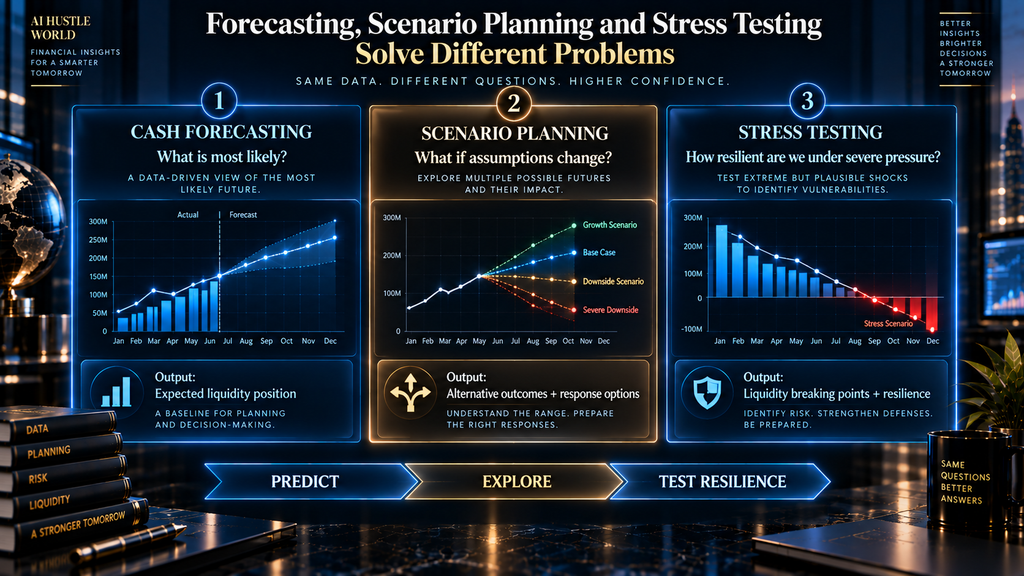
These concepts are related, but they are not interchangeable. Cash-flow forecasting asks: What is the most likely liquidity position based on current information and assumptions? Scenario planning asks: What happens to liquidity if important assumptions change?
Stress testing asks: How resilient is the liquidity position under a materially adverse condition? The distinction prevents a common mistake: using one forecast as though it were a complete risk-management system.
A forecast might suggest that cash will remain comfortably positive for the next 13 weeks. Scenario planning can then ask what happens if collections deteriorate, sales fall, supplier terms change or capital spending increases.
Stress testing goes further. It deliberately examines a difficult combination of events that may be unlikely individually but dangerous collectively.
For example, a company could model a situation where customer collections slow, gross sales decline, inventory requirements increase and financing costs rise simultaneously. The objective is not to claim that this exact combination will happen. It is to understand whether the business has sufficient resilience if several adverse pressures arrive together.
That distinction is becoming more important as finance leaders increasingly use AI and advanced analytics for scenario planning. Current finance research describes scenario planning, forecasting and liquidity management as increasingly interconnected capabilities rather than isolated reporting exercises.
The AI Hustle World Liquidity Scenario Engine
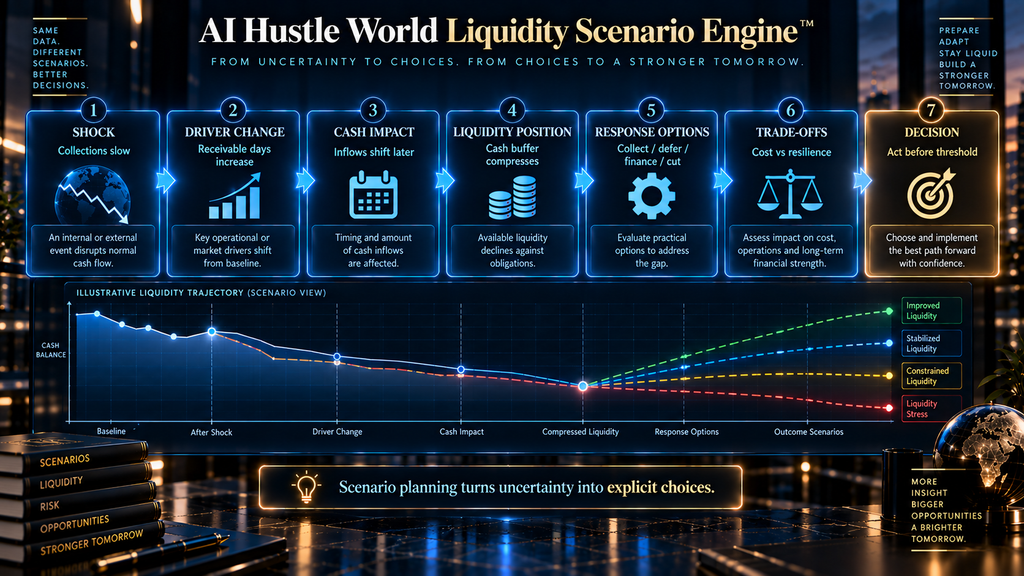
Scenario planning becomes more useful when it follows a consistent decision architecture: SHOCK → DRIVER CHANGE → CASH IMPACT → LIQUIDITY POSITION → RESPONSE OPTIONS → TRADE-OFFS → DECISION.
Start with the shock. This could be slower customer collections, weaker sales, higher input costs, an unexpected capital expenditure requirement, a supplier disruption or a financing-rate change.
Then identify the driver change. The scenario should translate the event into measurable financial assumptions rather than simply describing it narratively.
Next calculate the cash impact. How much does the changed assumption affect inflows, outflows and timing?
The model then evaluates the resulting liquidity position. Does the company remain above its minimum cash threshold? Does it approach a borrowing limit? Does it create a working-capital problem?
Only then should management consider response options. Those options might include accelerating collections, renegotiating supplier terms, reducing discretionary expenditure, delaying capital expenditure, increasing borrowing capacity or changing investment decisions.
Every response has a trade-off. Accelerating collections might require discounts. Delaying supplier payments could damage relationships. Cutting expenditure could affect growth. Borrowing preserves liquidity but increases financing costs and potentially leverage.
This is why scenario planning should not stop at “cash falls by $2 million.” The more valuable question is: What can we do about the $2 million change, and what does each response cost us?
Building Base, Upside, Downside and Stress Scenarios
A practical scenario system does not need dozens of scenarios. Too many scenarios can create the appearance of sophistication while making management less decisive.
A better architecture begins with a small number of economically meaningful cases.
The base case represents the organization’s current best assessment of operating conditions. It should incorporate the latest actual information rather than simply repeating an old budget.
The upside case tests what happens if important favorable drivers improve. That might involve stronger sales, faster collections, better supplier terms or lower-than-expected expenditure.
The downside case examines deterioration in one or more important operating drivers. Collections could slow, sales could decline, costs could rise, or working-capital requirements could increase.
The stress case deliberately combines more severe adverse assumptions to determine the point at which liquidity resilience begins to break. The most important principle is that each scenario should have explicit assumptions.
A scenario saying “bad economy” is too vague. A useful scenario might specify that customer collection days increase, sales volume decreases, inventory requirements increase and a planned investment remains unchanged.
AI can make these scenarios faster to build and refresh, but the assumptions still require management judgment. The machine can calculate consequences. Leadership must decide which hypothetical conditions are economically meaningful.
Probabilistic Forecasting and Forecast Uncertainty
One of the weaknesses of traditional forecasting is the tendency to produce a single number that looks more precise than the underlying information deserves.
Imagine a forecast that says cash will be $7.24 million on a particular date. That figure may create false confidence if customer payments, supplier timing and discretionary spending are uncertain.
A probabilistic approach is more informative. Instead of asking only for the expected cash balance, management can consider a distribution or range of potential outcomes.
The question becomes: How likely is the business to fall below a critical liquidity threshold? This changes the decision logic.
Suppose the central forecast indicates $5 million of cash, but the range of plausible outcomes includes a $1 million position. The central forecast may look comfortable while the downside risk remains significant.
Conversely, a forecast with a lower central estimate may still be manageable if the downside distribution is narrow and highly predictable.
This is why probabilistic forecasting should be paired with decision thresholds. Management needs to know what level of uncertainty matters operationally.
A useful system might monitor:
- Probability of falling below minimum cash
- Probability of breaching a liquidity covenant
- Expected timing of a cash shortfall
- Forecast range
- Forecast error by horizon
- Largest drivers of uncertainty
Gartner’s current guidance explicitly connects probabilistic and explainable AI forecasting with forward-looking liquidity planning and scenario analysis, which supports this move away from false precision.
The 13-Week Cash Forecast
The 13-week cash forecast is particularly useful for short-term liquidity management because it creates a sufficiently detailed operational horizon without attempting to predict every financial variable years into the future.
The model typically focuses on expected weekly cash receipts, expected weekly payments, opening cash and projected ending cash. It can be updated continuously as actual transactions occur and assumptions change.
The important point is that 13 weeks is a management horizon, not a universal law. A company with highly predictable subscription receipts may need different forecasting horizons from a construction business with milestone-based payments, a retailer with strong seasonality or a company facing a major financing event. AI can strengthen a 13-week forecast by helping update payment timing, detect deviations from expected behavior and highlight which assumptions are driving changes in the liquidity trajectory.
But the same governance principle applies: the forecast should remain connected to actual financial commitments and operating assumptions. A sophisticated model built on stale or incomplete data is still a weak cash forecast.
Direct vs. Indirect Cash Forecasting
There are two broad ways to construct a cash-flow forecast.
The direct method forecasts actual cash receipts and payments. It can provide highly useful short-term visibility because it focuses on when cash is expected to enter or leave bank accounts.
The indirect method starts from accounting information and adjusts for non-cash items and working-capital movements to derive expected cash flow. Neither method is universally superior.
Direct forecasting is often particularly useful for short-term liquidity management because treasury teams care about actual timing. Indirect forecasting can be valuable for broader financial planning because it connects cash generation to the financial statements and operating model.
An effective AI architecture can use both rather than forcing one methodology to answer every question. For example, a short-term liquidity view may rely heavily on expected receipts, payments and bank information, while a longer-horizon model may use revenue, margins, working capital and balance-sheet drivers. The choice should follow the decision being made.
If management needs to know whether payroll can be funded next Friday, a detailed direct cash view is highly relevant. If management is assessing how business growth will affect cash generation over the next year, a driver-based financial model may provide better strategic context.
Why Explainability Matters
Forecast accuracy alone is not enough.
Imagine an AI system suddenly reduces projected cash collections by 18%. If the finance team cannot determine why, the forecast may be technically sophisticated but operationally difficult to trust.
Finance leaders need to understand the major drivers behind important forecast changes. An explainable forecast might say that the expected cash position declined because several major customers are now projected to pay later, inventory purchases increased, and a previously planned capital expenditure moved forward. That explanation creates a path for investigation.
Perhaps the customer-payment prediction is correct. Perhaps the underlying CRM data is stale. Perhaps a major contract changed. Perhaps the model has mistaken a one-time event for a recurring pattern.
Without explanation, the finance team is forced into a binary choice: trust the machine or ignore it. That is a poor governance model.
Explainability allows people to challenge assumptions without abandoning the system. This becomes particularly important as AI moves deeper into financial decision-making, where transparency, accountability and the ability to understand model behavior are material considerations. Research published in 2026 has also emphasized the importance of explainability in AI-supported financial decisions.
Human Judgment and Governance
The most useful mental model for AI cash forecasting is human-in-the-loop intelligence, not autonomous financial authority. AI is well suited to repetitive analysis: gathering data, identifying patterns, recalculating scenarios, detecting changes and generating explanations. Humans remain responsible for questions involving business context, risk appetite and consequences.
A finance leader may know that a major customer is temporarily late because of a contractual dispute that does not appear clearly in historical payment data. An operations leader may know that a planned supplier payment can be delayed without affecting production. A CFO may know that maintaining a minimum cash reserve is strategically important because an acquisition opportunity could appear.
Those forms of context matter. Governance should therefore establish clear rules around data ownership, model validation, forecast review, exception handling, scenario approval and consequential decisions. The system should also maintain an audit trail where appropriate: what data was used, which assumptions changed, what forecast was produced and why a material decision was made.
This is consistent with the broader direction of finance transformation. PwC’s 2026 outlook describes increasingly autonomous finance workflows while emphasizing that people continue to provide oversight, interpretation, judgment and strategic decision-making, with governed data serving as a foundation for reliable AI.
Where AI Cash Forecasting Fails
AI does not remove the fundamental limitations of forecasting. It can actually make some failures harder to notice because a sophisticated model may produce an impressive-looking output.
The first major failure is poor data quality. If bank transactions are incomplete, payment dates are wrong, customer records are inconsistent or purchase orders are missing, the model cannot manufacture reliable information from nothing.
The second is structural change. Historical patterns become less useful when the business changes materially. A company entering a new market, launching a new pricing model, acquiring another company or losing a major customer may behave differently from its historical data.
The third is false stability. A model may perform well during normal operating conditions but deteriorate when the environment changes dramatically.
The fourth is model drift. Relationships between drivers and cash outcomes can change over time. A forecasting system therefore needs monitoring rather than permanent trust.
The fifth is overfitting. A model can become very good at explaining historical behavior without becoming equally good at predicting future behavior.
The sixth is bad scenario design. AI can rapidly calculate a poorly designed scenario. Speed does not make an assumption economically meaningful.
Finally, there is automation without decision ownership. If alerts are generated but nobody is responsible for responding to them, the organization has automated information production rather than improved liquidity management.
The fundamental rule is simple: AI can accelerate a bad forecasting process just as efficiently as a good one.
How to Implement AI Cash Forecasting
A successful implementation should begin with the decision problem rather than the technology.
Start by defining the liquidity questions the organization actually needs to answer. Is the priority daily cash positioning? A 13-week liquidity forecast? Working-capital optimization? Debt planning? Scenario analysis? Capital allocation?
Then establish the minimum reliable data foundation.
The next step is to establish the forecasting drivers. Identify which variables materially influence cash and which are sufficiently predictable to model.
Only then should the organization select the forecasting methodology and AI capabilities. A sensible implementation can progress through several stages.
Stage 1: Establish visibility
Create a consistent cash position and reconcile key data sources.
Stage 2: Build a baseline forecast
Create a reliable conventional forecast before introducing complex AI. This gives the organization something against which model performance can be evaluated.
Stage 3: Add driver-based forecasting
Connect cash movements to operational variables such as collections, payment timing, sales activity, inventory and recurring obligations.
Stage 4: Add AI and predictive models
Introduce machine learning or other predictive techniques where historical data and business conditions justify them.
Stage 5: Add scenario planning
Allow management to change meaningful assumptions and examine the resulting liquidity position.
Stage 6: Add monitoring and alerts
Track forecast errors, liquidity thresholds, unusual changes and scenario triggers.
Stage 7: Integrate decisions
Connect important forecast signals to clearly assigned management actions.
This sequencing matters. Organizations sometimes attempt to purchase an advanced AI forecasting solution before establishing reliable data, ownership and forecasting discipline. That reverses the dependency chain.
How to Measure Success
The quality of an AI cash-forecasting system should not be judged by a single accuracy percentage. Forecast accuracy matters, but it is only one dimension of performance. A stronger KPI architecture examines four categories.
Forecast quality measures whether predictions are improving. Useful metrics include forecast error by time horizon, directional accuracy, variance between forecast and actual cash movements, and performance across different cash-flow categories.
Operational efficiency measures whether the forecasting process itself is becoming faster and less manual. Relevant measures can include time required to produce the forecast, reconciliation effort and the number of manual adjustments.
Risk visibility measures whether the organization is identifying liquidity problems earlier. This could include warning lead time before a cash threshold is breached, frequency of unexpected liquidity surprises and scenario coverage.
Decision impact is ultimately the most important category. Did better visibility allow management to collect receivables earlier, avoid unnecessary borrowing, negotiate payment timing, delay nonessential expenditure, improve capital allocation or respond earlier to a developing liquidity problem?
This distinction is critical because a forecast can become statistically more accurate without becoming more valuable.
A slightly more accurate forecast that arrives after the decision has already been made has limited economic value. A sufficiently accurate forecast that arrives early enough to change the decision can be substantially more valuable.
The Economics of Better Cash Visibility
The financial return from cash forecasting does not necessarily come from “predicting cash better” in isolation. It can come from reducing the cost of uncertainty.
If better visibility allows a company to avoid unnecessary short-term borrowing, the savings can be meaningful. If it prevents idle cash from remaining unnecessarily unallocated, capital efficiency can improve. If it enables earlier collection action, reduces emergency procurement decisions or prevents a liquidity breach, the economic value can be larger still.
There is also an opportunity-cost dimension.
Suppose management maintains an unnecessarily large cash buffer because it lacks confidence in the forecast. Better visibility could potentially allow the organization to make more informed decisions about how much liquidity to retain and how much capital can be deployed.
The reverse is equally important. A company that underestimates its liquidity risk may borrow too late, pay higher financing costs or make forced decisions under pressure.
This is why cash visibility is increasingly connected to capital allocation rather than being treated merely as a treasury reporting exercise. Current finance research points toward greater integration of AI, forecasting, liquidity management, working capital and capital allocation as finance organizations evolve.
The economic question should therefore be: How much better can the organization make its decisions because it knows sooner what its liquidity position is likely to become?
Who Should Use AI for Cash-Flow Forecasting?
AI-enabled cash forecasting becomes more attractive as the complexity and volatility of the business increase. It can be particularly valuable for companies with large transaction volumes, multiple bank accounts, significant working-capital requirements, complex customer payment behavior, international operations, volatile demand or substantial financing requirements. It can also help growing companies that have moved beyond simple spreadsheet-based cash management but are not yet ready for a large treasury technology transformation.
However, AI is not automatically the right starting point for every organization. A very small business with simple recurring cash flows may gain more value from disciplined bookkeeping, reliable bank reconciliation and a straightforward cash forecast than from an advanced predictive model. Similarly, an organization with poor source data should prioritize data quality and process reliability before expecting AI to deliver sophisticated predictions.
The right question is not: Can we use AI? It is: Is the complexity of our cash-flow problem large enough that predictive intelligence will create more value than the cost and governance required to implement it?
Common Mistakes to Avoid
One of the most common mistakes is treating AI as a replacement for financial judgment. Forecasting systems can identify patterns, but management still needs to determine whether those patterns make economic sense.
Another mistake is measuring success exclusively through forecast accuracy. A forecast should ultimately improve liquidity decisions, not simply win a statistical competition against the previous model.
A third mistake is using too many scenarios. Scenario planning should focus on the variables that materially affect liquidity rather than creating dozens of permutations that nobody can interpret.
Another problem is failing to distinguish forecast uncertainty from model failure. Some cash movements are inherently difficult to predict. A wide forecast range is not necessarily evidence that the model is broken; it may accurately represent genuine uncertainty.
Organizations should also avoid hiding assumptions. If management cannot see which drivers are responsible for a forecast change, trust will deteriorate quickly.
Finally, companies should resist the temptation to automate actions simply because they can. A system might identify that supplier payments could be delayed, but whether they should be delayed may depend on supplier relationships, production requirements and contractual obligations.
Automation should reduce decision friction, not eliminate responsible decision-making.
The Future: From Cash Forecasting to Liquidity Intelligence
The next stage of AI-enabled finance is unlikely to be defined simply by increasingly accurate cash forecasts. The more important evolution is from forecasting what cash will look like toward understanding what is changing, why it is changing, what could happen next and which responses are available.
That is a broader capability: liquidity intelligence. In this model, the system continuously observes financial and operating signals, updates its view of future liquidity, identifies meaningful changes, tests alternative scenarios and surfaces decision opportunities.
For example, an AI system might recognize that customer payment behavior is deteriorating before the aggregate cash balance becomes problematic. It could estimate the resulting liquidity impact, identify the accounts responsible for the change, model what happens if collection activity improves, and highlight the point at which management may need to activate additional funding.
The human decision-maker would still own the action. But the distance between signal → analysis → scenario → decision would become much shorter.
That is a more useful vision of AI in finance than autonomous forecasting.
It is also consistent with the broader direction of the finance function. Current research shows finance leaders increasingly expect AI and advanced analytics to influence budgeting, forecasting, scenario planning, financial modeling and capital allocation, while emphasizing the importance of governance and integrated performance management.
Final Thoughts
AI does not solve cash-flow forecasting by making uncertainty disappear. It makes the forecasting process more useful by helping finance teams process more signals, identify important drivers, update forecasts faster, quantify alternative outcomes and connect liquidity changes to potential management actions.
The strongest implementation therefore does not begin with an AI model. It begins with a clear understanding of how cash moves through the business.
Once that foundation exists, AI can strengthen the entire operating rhythm: collect better data, normalize it, map the drivers, forecast expected cash movements, test downside conditions, identify decision points, monitor actual outcomes and learn from forecast errors.
The ultimate objective is not a perfect cash prediction. It is enough visibility, early enough, to make a better decision.
That is the real value of AI cash-flow forecasting and scenario planning.
💡 Want to See Where AI Fits Into Finance?
Explore practical guides on AI in finance, accounting, and FP&A to see where AI can improve financial visibility, planning, and decision-making.
Explore AI in Finance & Accounting →FAQ
What is AI cash-flow forecasting?
AI cash-flow forecasting uses artificial intelligence and predictive analytics to estimate future cash receipts, payments and liquidity positions using historical and current financial and operational data. Modern approaches can incorporate driver-based and probabilistic forecasting rather than producing only a single deterministic estimate.
How does AI improve cash-flow forecasting?
AI can automate data aggregation, identify payment and collection patterns, forecast cash-flow drivers, detect changes, update predictions and help explain why a forecast has changed. Its value increases when those capabilities are connected to scenario planning and management decisions.
Can AI predict cash flow accurately?
AI can improve forecasting performance, but no model can eliminate uncertainty. Accuracy depends heavily on data quality, historical relevance, business stability, forecast horizon and the quality of the underlying assumptions. A useful system should therefore communicate uncertainty rather than presenting predictions as guaranteed outcomes.
What is scenario planning in cash flow forecasting?
Scenario planning tests how the expected liquidity position changes when important assumptions change. Examples include slower customer collections, lower sales, higher supplier costs, increased inventory requirements, changes in capital expenditure or financing costs.
What is the difference between a cash forecast and a 13-week cash forecast?
A 13-week cash forecast is simply a short-term cash forecasting horizon designed to provide detailed visibility into expected weekly receipts, payments and liquidity. It is useful for many businesses but should not be treated as a universal forecasting horizon.
Should companies use AI or traditional cash forecasting?
For many organizations, the strongest approach is to combine them. A reliable traditional forecast can establish the baseline, while AI can improve driver analysis, pattern recognition, scenario generation and continuous monitoring. The appropriate balance depends on the organization’s complexity, data quality and decision requirements.
Does AI replace the CFO or treasury team?
No. AI can automate analysis and surface risks, but financial decisions still require context, judgment, accountability and governance. The strongest model is generally one in which AI increases the speed and depth of analysis while people retain responsibility for consequential decisions.
What data does an AI cash-flow forecasting system need?
Depending on the use case, useful inputs can include bank transactions, accounts receivable, accounts payable, ERP data, payroll, sales activity, procurement, inventory, capital expenditure and debt schedules. The exact requirements depend on the forecasting horizon and decisions the system is intended to support.
What is the biggest mistake when implementing AI cash forecasting?
Treating the AI model as the starting point. The better sequence is to establish reliable data, define the cash-flow drivers, create a baseline forecast, establish governance and then introduce predictive capabilities where they can materially improve decisions.
What should finance teams measure?
They should measure forecast accuracy, forecast error by horizon, time required to produce forecasts, manual effort, liquidity-risk warning time and—most importantly—the financial decisions influenced by improved cash visibility. The objective is better liquidity management, not simply a better-looking forecast.
Sources and Further Reading
- Forecasting: Principles and Practice (3rd ed.): Hyndman and Athanasopoulos. A free online textbook on forecasting methods and evaluation.
- Prophet: An open-source forecasting library for time series with seasonality.
Related Guides
- AI Inventory Forecasting: How Retailers Predict Demand
- AI in Ecommerce: How to Automate an Online Store
Written by
Muntasir Ahmad Chowdhury
Founder, AI Hustle World
Muntasir Ahmad Chowdhury is the Founder of AI Hustle World, an independent publication dedicated to making Artificial Intelligence practical, trustworthy, and easy to understand. He researches AI tools, automation, customer service, productivity, and real-world business applications, helping readers make smarter technology decisions through research-driven, experience-backed content.
Expertise:
AI Tools • AI Automation • AI Customer Service • AI Productivity • Generative AI • AI Workflows
Get Smarter With AI
Enjoyed this guide? Get practical AI tools, tutorials, and honest reviews delivered to your inbox.