Evidence: Documentation reviewed
Last checked: September 2026
What was done: Written from official documentation and the published sources linked in this article. Not hands-on tested.
Files: None
Affiliate links: No
How to Choose Pinterest Niche Ideas for a Faceless AI Content Account
Choosing a Pinterest niche looks easy right up until you try to build an account around one. At first, almost any category seems promising. There are endless topics to explore, Pinterest has a huge discovery audience, AI can help you produce content quickly, and a faceless account removes the pressure of appearing on camera. But after the first few weeks, the real problem usually becomes obvious: a niche is not just a topic you can post about; it is the environment in which your entire content system has to survive.
That distinction matters because AI has made content production dramatically cheaper. You can now research dozens of ideas, generate outlines, create visual concepts, write descriptions and repurpose information far faster than a creator could do manually. The bottleneck has moved. The difficult question is no longer whether you can produce enough content. It is whether you can produce enough worthwhile content for the right audience, around a subject that has searchable demand, visual depth, sustainable economics and a credible reason to exist.
Pinterest makes this particularly interesting because the platform is not simply a place where people scroll through a social feed. Pinterest’s own materials describe a platform where people search, discover, save and shop for ideas, and its current business guidance emphasizes fresh, relevant content and search-oriented discovery. Pinterest reported 600 million monthly active users in its January 2026 Top of Search announcement, while also saying 96% of top search results were unbranded and 45% of clicks occurred in the top ten results. (Pinterest) Those numbers do not mean every new account can easily capture traffic, but they reinforce an important strategic fact: the quality of the niche and the quality of the search opportunity matter enormously.
For a faceless AI account, therefore, the goal should not be to find the “most profitable Pinterest niche” or the “hottest Pinterest niche” in isolation. The better goal is to find a subject where audience intent, visual communication, repeatable content, AI-assisted production and legitimate monetization all fit together well enough to create a durable business.
Why Pinterest Niche Selection Is Different for a Faceless AI Account
A traditional creator might choose a niche partly because it fits their personality, expertise or lifestyle. A travel creator can build around their own trips. A fitness creator can build around their own transformation. A fashion creator can build around their own appearance. A business personality can build an audience largely because people want to hear that particular person’s opinions.
A faceless account has a different structural advantage. It can make the content object itself the reason the user stops, saves or clicks. A useful checklist, comparison, tutorial, template, visual workflow, planning guide or step-by-step explanation does not require the creator’s face to carry the entire experience. That does not make faceless content inherently better, but it makes certain niches much better suited to a faceless model than others.
AI adds another layer to the decision. When AI assists with research and production, a niche with dozens of recurring questions can become a powerful content engine because one underlying topic can produce articles, Pins, checklists, comparisons, prompts and visual explanations. But the same technology creates a trap: if the niche is shallow or generic, AI merely helps you manufacture more repetition. The account can look busy while becoming increasingly interchangeable.
That is why the right niche has to be evaluated as a system, not a keyword.
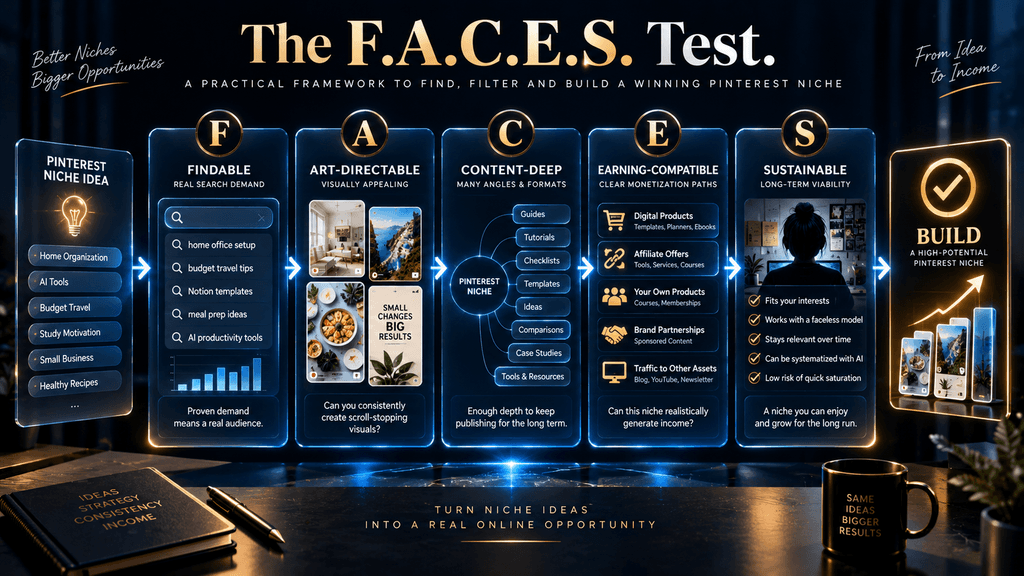
The F.A.C.E.S. Test: A Better Way to Judge a Faceless Pinterest Niche
The first framework for this article is the F.A.C.E.S. Test, an AI Hustle World decision framework rather than an official Pinterest scoring system. It is designed to answer a more useful question than “Is this topic popular?”: Can this topic support a faceless, AI-assisted Pinterest content business?
Findable: Can people actually discover the topic?
The first requirement is searchability. Pinterest provides search suggestions and more specific guide terms as users explore ideas, and Pinterest Trends provides historical views of search, save and shopping trends. The Trends tool can show whether a keyword is seasonal, its weekly/monthly/yearly movement, related trends and how its interest changes over time. (Pinterest Help)
This is important because creators often confuse personal interest with market demand. You may be fascinated by a topic, but that does not mean enough people repeatedly search for solutions inside it. A niche becomes much more interesting when you can identify several related searches that represent distinct problems rather than one isolated phrase. Searchability is therefore not about finding one keyword that looks large; it is about discovering an ecosystem of related intent.
Art-directable: Can the niche become strong visual content?
Pinterest is a visual discovery platform, so the niche must survive translation from idea into image. Some subjects naturally produce visual assets: organization, design, travel planning, recipes, education, prompts, templates, presentations and productivity systems. Other subjects require much more effort to communicate visually and may depend heavily on personal demonstration or personality.
A useful test is to ask what a reader would actually save. Would they save a checklist? A visual workflow? A before-and-after? A template? A comparison? A collection of examples? A step-by-step process? The more naturally the answer becomes “yes,” the stronger the niche’s visual architecture is likely to be.
Content-deep: Can the niche support hundreds of genuinely different ideas?
This is where many apparently attractive niches fail. An AI system can generate 100 titles very quickly, but title count is not content depth. If twenty Pins all communicate essentially the same idea with minor wording changes, the niche has not demonstrated depth; it has demonstrated the ability to produce variations.
A strong niche contains multiple problem clusters, multiple audience needs and multiple levels of sophistication. AI productivity, for example, can branch into email, research, meetings, planning, writing, presentations, project management, knowledge organization and solo-business workflows. That is evidence of depth because each branch can develop its own questions and search intent.
Earning-compatible: Is there a credible path from attention to business value?
A niche does not need to sell something immediately. It does need a believable downstream path.
That path might lead to software, digital products, templates, educational resources, services, affiliate recommendations, a blog, an email list, sponsorships or physical products. The important word is credible. A niche becomes strategically weak when the monetization story depends on exaggerated income claims or on forcing unrelated products into content that was created for search.
This distinction is particularly important because Pinterest’s commercial-content rules prohibit deceptive or misleading commercial content. A niche with slightly less reach but a clear, relevant commercial path can be more valuable than one producing enormous impressions that never translate into meaningful action.
Sustainable: Can you build around it without making your face the product?
The final question is whether the account can keep delivering value without depending on personal visibility. Some niches naturally pass this test because the subject itself is useful. Others are difficult because the audience primarily follows personalities, personal transformations or firsthand experiences.
Sustainability also includes your own production capacity. A niche may look excellent on paper but become exhausting if every Pin requires custom photography, original footage, physical products or constant real-world access. A good faceless niche should allow the majority of the editorial system to operate digitally while still leaving room for genuine human judgment and originality.
The Second Filter: Niche Quality Is a Multi-Dimensional Decision
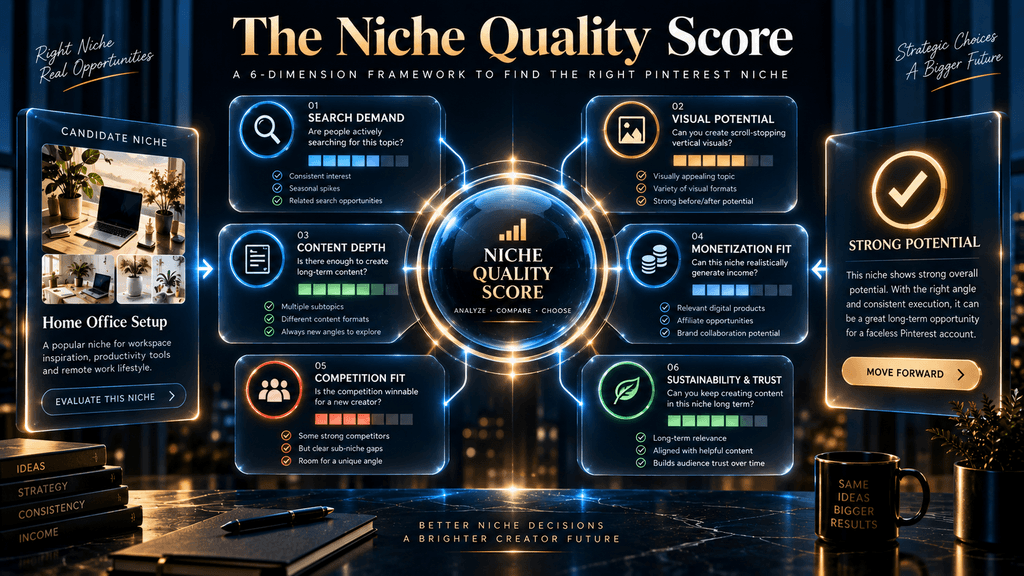
Passing the F.A.C.E.S. Test does not mean a niche is automatically worth pursuing. It means the niche deserves a closer evaluation.
At AI Hustle World, the next step should be to compare six dimensions: search demand, visual potential, content depth, monetization fit, competition fit and sustainability/trust risk. You can score each from one to five to create an internal Niche Quality Score, but the score should never be presented as an official Pinterest metric or as a scientifically validated formula. Its purpose is simply to prevent a creator from overvaluing one attractive characteristic.
Consider two hypothetical niches. The first has enormous search interest and beautiful visual opportunities but extreme competition and almost no logical monetization path. The second has a smaller audience, moderate competition, strong visual formats, abundant related questions and a clear connection to useful products or services. The first looks more impressive if you only examine reach. The second may be a much better business.
That is why big audience and good niche are not synonyms.
The Best Pinterest Niche Ideas for a Faceless AI Content Account
The categories below should not be interpreted as an official Pinterest ranking. They are strong candidates because they align with the structural requirements of a faceless AI account: searchable problems, repeatable visual content, strong topic depth and realistic paths toward a larger content business.
AI Productivity and Time-Saving Workflows
AI productivity is one of the strongest overall opportunities because the niche revolves around problems rather than personalities. People want help with managing information, writing repetitive communications, organizing projects, summarizing material, preparing meetings, planning work and reducing administrative friction. Each of those problems can become a separate content cluster, and each cluster can generate several visual formats.
The real opportunity is not to create endless “AI productivity tips.” That phrase is too broad and quickly becomes generic. The stronger position is to choose a particular audience or workflow, such as AI for solo business owners, AI for content teams, AI for researchers or AI for administrative work. Once the audience becomes clearer, the content becomes more specific and the account becomes easier to differentiate.
This niche is particularly compatible with AI-assisted production because the creator can use AI to expand research, cluster related topics and transform a single concept into several educational formats. Its main weakness is saturation, which means generic content is unlikely to provide a meaningful competitive advantage.
Best for: sustainable educational content, software-related monetization and strong alignment with an AI-focused brand.
AI Tools for Small Business
Small-business AI has a particularly strong commercial structure because the audience is attached to identifiable problems. Owners and operators may be looking for help with lead generation, customer support, reporting, content creation, scheduling, proposals, research or administrative work, which means the niche naturally branches into many practical workflows.
The advantage over a generic “AI tools” account is specificity. Instead of trying to review everything, the account can focus on the business problems that tools solve. This gives the creator a much more natural editorial bridge from informational Pins to deeper articles and eventually to tool comparisons or recommendations.
The trade-off is information freshness. AI products change quickly, so a site or account built around software recommendations needs a maintenance system. Features, pricing, limits and integrations can become outdated, which makes this niche stronger for creators willing to treat content as something that requires periodic review rather than something they publish once and forget.
Best for: software discovery, affiliate opportunities and problem-oriented business content.
AI Content Creation
AI content creation has enormous content depth because the production process itself contains many sub-problems: research, ideation, scripting, writing, editing, images, video, repurposing, analytics and workflow automation.
Its danger is becoming too broad. “AI content” is not much of a positioning strategy. A stronger account might focus on faceless creators, bloggers, Pinterest creators, small content teams or entrepreneurs who need to produce content without a large staff.
The niche is especially attractive for a broader AI content brand because it can connect naturally with other media. One strong workflow can become a blog article, Pinterest Pin, YouTube video, Instagram post and downloadable resource. The result is not simply more content; it is a more connected content ecosystem.
Best for: creators, digital products, AI tools and cross-platform content systems.
AI Prompt Templates
Prompt content is naturally faceless because the prompt itself can be the visual asset. A creator can build content around prompt structures, examples, mistakes, role-specific prompts, workflow prompts and before-and-after transformations.
But this niche has a major quality problem: prompt volume is easy; useful prompt design is not. A board filled with generic prompts can look productive while providing very little differentiated value. The stronger approach is to explain the problem the prompt solves, show how it should be adapted and demonstrate where it belongs in a larger workflow.
That creates a better content ladder. Instead of publishing “10 ChatGPT prompts for business,” a stronger account might explain a complete process for using AI to prepare a client proposal, including research, information extraction, drafting and revision. The prompt becomes part of the solution rather than the entire product.
Best for: templates, digital products and educational content.
AI Career and Job Search
Career content works well when the creator focuses on specific user problems rather than generic motivation. Resume preparation, interview preparation, job research, professional writing, career planning and workflow organization all offer clear search intent.
The faceless format is particularly appropriate because the value can reside in the framework or resource. A visual checklist for improving a resume does not require a personality-driven presentation. An interview-preparation workflow can be communicated through a diagram. A job-search system can become a downloadable template.
The major limitation is trust. The account should never imply that an AI tool can guarantee interviews, salary outcomes or employment. Good career content improves a process; it does not promise a result that depends on many variables outside the creator’s control.
Best for: educational content, templates, career resources and practical search intent.
AI for Students and Learning
Education combines strong content depth with predictable planning cycles. There are recurring problems around studying, research, organization, note-taking, presentations and learning workflows, and those problems produce highly visual content opportunities.
The niche is also naturally suited to planning behavior. Pinterest’s Trends platform can show when interest in a term changes over time and identify seasonal behavior, while Pinterest’s Moments feature is designed to help understand how interest builds around seasonal and cultural events. (Pinterest Help) That makes education a useful example of a niche where timing can matter almost as much as topic selection.
The important editorial boundary is to position AI as a learning aid rather than a substitute for learning. An account that teaches students how to use AI to understand difficult concepts, organize research or practice ideas is fundamentally different from one encouraging them to outsource every academic task.
Best for: education, study systems, templates and seasonal content.
AI Art and Design Prompts
Visual output is the natural asset here, which makes the niche almost perfectly suited to faceless publishing. A creator can focus on design styles, visual prompt structures, creative workflows and image-generation techniques without relying on personal appearance.
The competitive weakness is that attractive AI images are increasingly easy to produce. That means beauty alone is becoming a weak moat. An account needs either a recognizable aesthetic, useful prompt education, distinctive creative direction or a strong application-based angle.
The best opportunity is therefore not to become another feed of pretty AI images. It is to make the visual output useful.
Best for: highly visual accounts, prompt education and design-related digital products.
AI Writing and Blogging
Writing is another deep category because the audience can have many different goals: research faster, brainstorm better, organize information, improve drafts, build content calendars, produce outlines and repurpose existing material. The niche becomes much stronger when centered around workflows instead of generic claims that AI can “write for you.” Searchers usually have a real problem behind the request, and that problem can be explained through a process.
It also fits naturally with owned media because readers can move from a Pin into a detailed article and then into additional resources. That gives the niche value beyond the social platform itself.
Best for: bloggers, publishers, content teams and information-driven brands.
AI Templates and Digital Planning
This is one of the most commercially interesting combinations because the content itself can become a product.
Templates, planners, checklists, content calendars, workflow maps and organizational systems fit the visual nature of Pinterest while also offering a clear downstream value proposition. The account can therefore serve as both a discovery engine and a showcase for useful resources.
The challenge is maintaining quality. A template is valuable only when it saves time, reduces complexity or helps the user complete a task better. AI can assist with template generation, but it cannot make an otherwise unnecessary template valuable.
Best for: digital products, lead generation and visual educational content.
AI for Teachers
This niche has strong content depth and recurring seasonal cycles, but it demands more care than a generic entertainment niche because educational claims can affect real learning decisions.
Lesson planning, classroom organization, educational workflows, worksheet generation, research support and teacher productivity all provide practical content opportunities. The faceless format works naturally because the account can focus on resources rather than personality.
The strongest angle is not “AI for everything in teaching.” It is identifying specific teacher problems and solving them clearly. Best for: resource-driven content, templates and education-focused audiences.
AI Travel Planning
Travel remains highly visual, but a faceless AI account can differentiate itself by helping users plan rather than merely displaying destinations. Itinerary building, packing systems, destination comparisons, budgeting frameworks and research workflows give the account much more utility.
This niche has excellent visual potential but introduces freshness requirements. Prices, schedules, entry requirements and local conditions can change, so a responsible creator has to distinguish evergreen planning guidance from time-sensitive facts.
The strongest version is therefore not “beautiful travel.” It is useful travel planning presented beautifully. Best for: planning content, affiliate opportunities and visual inspiration.
AI Home Organization and Planning
Home organization is another strong fit because the subject naturally produces visual transformations and practical systems. A faceless account can focus on room organization, decluttering methods, planning, routines and layout ideas without depending on personal appearance.
AI becomes more useful when it helps the audience solve planning problems rather than simply generating attractive room images. That distinction matters because Pinterest is full of visual inspiration already. A useful system gives the creator a stronger reason to be saved.
Best for: visual planning, home-related products and practical content.
Which Niches Are Best for Different Goals?
The right niche depends on what you intend to build. A creator primarily interested in software affiliates may choose differently from someone building digital products, while someone trying to grow an owned-media site may prioritize information depth over immediate commercial intent.
| Goal | Strong Niche Direction | Strategic Reason |
|---|---|---|
| Simplest AI-assisted production | AI prompts and templates | Highly structured and repeatable |
| Strongest AI-brand alignment | AI productivity | Broad problem depth without requiring personality |
| Strong software monetization | AI for small business | Natural connection between problems and tools |
| Strong evergreen education | AI career and learning | Recurring problems and searchable intent |
| Highest visual potential | AI art and design | The output itself is visual |
| Strong digital-product fit | AI templates and planning | Content can lead directly to reusable resources |
| Seasonal planning opportunities | Education, travel, home | Predictable planning cycles |
| Lower trust complexity | Productivity, templates, general education | Fewer highly consequential claims |
| Higher caution | Finance, wellness, income-related topics | Greater accuracy and policy sensitivity |
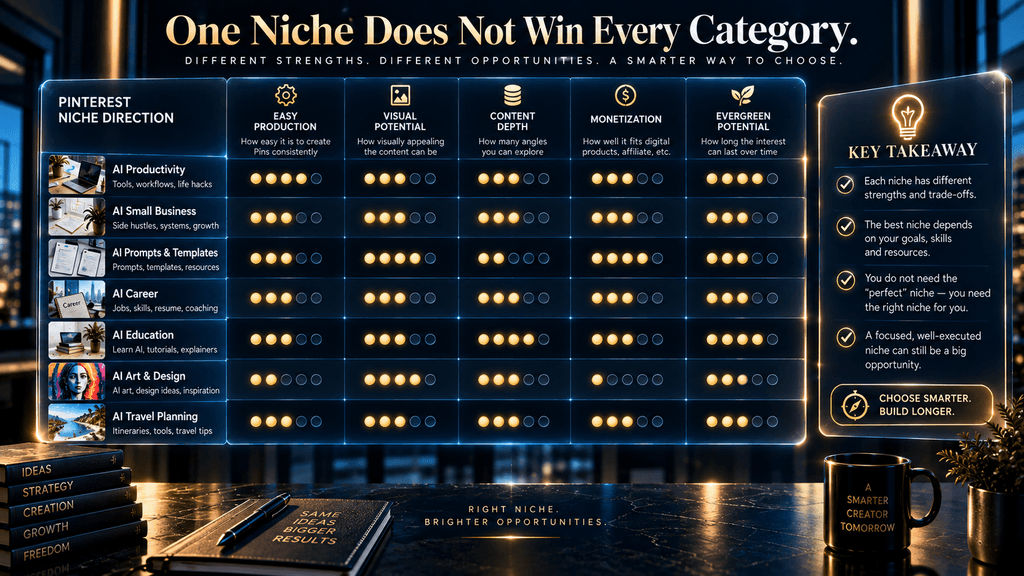
The important point is that these are decision categories, not universal rankings. A niche that scores lower on one dimension can still be the right choice if it aligns more closely with the business you are actually trying to build.
Do Not Confuse a Niche With a Trend
Pinterest’s Predicts 2026 report provides a useful example of the difference between a durable category and a temporary or emerging direction. Pinterest says its trends team analyzed billions of searches and visual engagement signals to identify emerging trends, and reports that 88% of its predictions over the previous six years came true.
That makes Pinterest’s trend data valuable, but it does not mean a creator should build an entire account around one trend.
A durable niche might be home decor, while a particular aesthetic becomes a temporary content angle inside it. A durable niche might be travel planning, while a new style of trip becomes a timely subtopic. The niche is the long-term environment; the trend is one source of new editorial opportunities.
That distinction protects the account from trend dependence. If the trend fades, the underlying niche remains useful.
Pinterest Trends Should Be Used for Validation, Not Just Inspiration
Pinterest Trends is more useful than simply checking what appears popular in a feed. Pinterest says the tool provides up to two years of historical search, save and shopping trends across regions and countries, and allows users to compare up to four keywords. It also shows whether interest is seasonal and allows creators to examine related trends and popular Pins.
That makes the tool especially valuable during niche selection.
Suppose you are considering two related directions. Instead of relying on intuition, compare their historical behavior. One may show a strong but very seasonal pattern. Another may show more stable demand. A third may be smaller overall but rising consistently. None of those patterns automatically makes one niche “best,” but they give you evidence about what kind of content environment you are entering.
The key is to use trends to answer questions, not to create a fake ranking. Ask whether demand exists, whether it repeats, whether it is seasonal, whether adjacent terms are growing and whether the topic produces enough related ideas to support a content system.
The Niche Ladder: From Broad Category to Winnable Search Territory
One of the biggest mistakes in Pinterest strategy is choosing a category that is too broad and then trying to compete with everyone inside it.
The better approach is to move down a niche ladder. Start with the broad category, define the audience inside that category, identify a recurring problem, and then express that problem through recognizable search language.
Consider the difference between AI, AI for small business, and AI workflows for solo consultants. All three describe roughly the same technological universe, but the third has a much clearer audience and problem definition. The content becomes easier to plan because you know who you are talking to and why they would search for the information.
The same principle works outside AI. Travel can become budget travel, which can become weekend budget travel, which can become weekend budget travel planning for couples. The goal is not to shrink the market as much as possible. The goal is to find the point where specificity increases relevance without destroying demand.
That is the real meaning of “niche down.”
The 20-Idea Test: A Better Test of Content Depth
Before committing to a niche, try to generate twenty genuinely different content ideas. The word different matters more than the number twenty.
Suppose you choose AI productivity. A weak test would generate twenty versions of “use AI to save time.” A real test might involve email, meetings, research, planning, presentations, project management, writing, knowledge organization, scheduling and business administration. Now the account is demonstrating multiple problem clusters rather than repeating the same concept.
This is also where AI becomes useful as a research tool. Ask it to expand a niche into problem clusters, audience segments, search intents and content formats, then examine the resulting structure critically. If the outputs quickly collapse into repetition, that is evidence that the niche may be thinner than it looked.
A niche that can sustain twenty strong ideas usually has a better chance of supporting two hundred. A niche that struggles to produce twenty without repetition is already telling you something important.
Why “Profitable Niche” Is Often the Wrong Phrase
The phrase “profitable niche” creates a dangerous expectation because it makes profitability sound like an attribute of the topic itself. In reality, profitability comes from the interaction between audience demand, content quality, trust, conversion behavior and the business model behind the account.
A useful mental model is attention → usefulness → trust → action → monetization. The niche creates an opportunity for attention, but useful content determines whether people save or engage with it. Consistency and credibility make the account more trustworthy, while a relevant resource, article, product, tool or service creates a meaningful next step. Only then does the business model turn that action into revenue.
This is why a smaller niche with a clearly defined commercial path can outperform a much larger category where the creator has no idea what the audience should do next. A million impressions are not automatically more valuable than ten thousand highly relevant users who repeatedly click, save and eventually become customers.
The practical lesson is that monetization should influence niche selection, but it should not distort the content itself.
AI Should Reduce Production Friction, Not Replace Editorial Judgment
The rise of AI changes the economics of running a faceless Pinterest account, but not in the simplistic way many “faceless income” articles suggest.
The obvious advantage is speed. AI can help expand topics, cluster questions, develop content briefs, suggest visual concepts, produce first drafts and transform one idea into multiple formats. That can reduce repetitive production work considerably.
The deeper advantage is cheaper experimentation.
Before AI, testing five niche directions could require substantial manual research and design work. Today, a creator can use AI to explore several directions quickly and then spend human effort evaluating the strongest candidates. The strategic advantage is not that AI allows you to flood Pinterest with more content. It is that AI allows you to investigate more possibilities before making a costly commitment.
That is a much healthier use of the technology.
Pinterest itself recommends creating fresh content weekly but specifically says not to anchor the strategy to a fixed number of Pins; instead, it advises focusing on the content itself and creating relevant, inspiring material. This is consistent with the larger principle here: volume can expand opportunity, but volume is not a substitute for relevance.
What Happens When Creators Ignore Niche Validation?
The cost of choosing the wrong niche is usually not obvious on day one.
At first, everything looks productive. The account has boards. The Pins are designed. The descriptions are written. AI keeps generating ideas. But over time, the weaknesses become harder to hide.
The content starts repeating itself. Search intent becomes vague. Pins receive impressions without useful clicks.
The audience does not develop a clear reason to return. Monetization becomes forced. And the creator begins blaming the algorithm for a problem that began with positioning.
This is the real cost of skipping validation: you can spend months optimizing the wrong system. No amount of better scheduling, prettier graphics or new AI tools can compensate for a niche that does not fit the business you are trying to build.
Why Chasing Zero Competition Is Also a Mistake
Low competition sounds attractive because it suggests an easier path to visibility. But a market with no visible competition can also indicate weak demand.
The more useful goal is not “zero competition.” It is evidence of demand plus a realistic entry point.
Pinterest’s current search environment contains a large amount of unbranded content, and Pinterest says 96% of top search results are unbranded. That does not mean every small creator will rank, but it does suggest that brand dominance is not the only possible pathway into search.
What you should look for is a gap in specificity, usefulness, presentation or audience targeting. Perhaps the broad category is crowded, but a specific audience is underserved. Perhaps many Pins exist, but most are repetitive. Perhaps the topic has demand, but few accounts explain the subject clearly.
That is the type of competition you can work with.
The Difference Between a Search Niche and an Attention Niche
Some niches are excellent at generating visual attention but weak at generating meaningful intent.
An image of a beautiful room might attract impressions because it is visually appealing. But a guide explaining how to organize a small bedroom around a specific constraint gives the user something they can actively solve.
The first is primarily an attention asset. The second is closer to a search asset.
That distinction should influence niche choice. A faceless account with no creator personality has even more reason to make the information itself valuable because it cannot rely as heavily on parasocial attention.
This is why checklists, planning guides, comparisons and practical educational graphics can be so powerful: they give users a reason to save the Pin because they may need the information later.
The Role of Saves, Clicks and Impressions in Niche Validation
Early performance should be interpreted as evidence about the niche, not simply as a scoreboard for individual Pins.
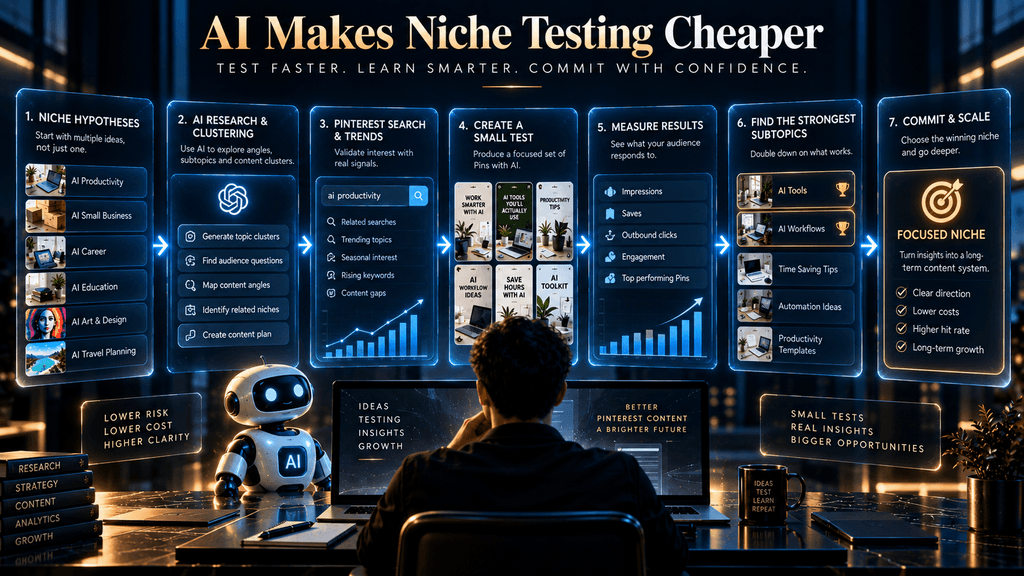
Impressions tell you whether Pinterest is distributing the content. Saves tell you whether the idea has enough perceived utility or inspiration to deserve preservation. Outbound clicks tell you whether the content creates enough interest for the user to leave Pinterest and continue the journey.
The most useful signal is often not one exceptionally successful Pin but a pattern across multiple pieces of content. If several Pins addressing different problems inside the same niche attract saves and clicks, you have stronger evidence that the niche itself is working. If one Pin performs while everything around it struggles, you may have discovered a successful topic rather than a successful niche.
Pinterest’s guidance also emphasizes creating fresh, relevant content rather than relying on a rigid posting quota, which supports an experimental approach centered on quality and audience response. The question should therefore be: Which problems does this audience repeatedly care about? That question is far more useful than: Which Pin went viral?
Seasonality Can Be an Advantage, Not Just a Problem
Some creators see seasonal content as unstable because demand rises and falls. That is only half the story.
Predictable seasonality can create planning advantages. Education has back-to-school and exam periods. Travel has holiday and trip-planning cycles. Home organization has seasonal reset behavior. Wedding planning follows long preparation windows. Career content can fluctuate around common job-search periods.
Pinterest’s Trends platform and Moments functionality are explicitly designed to help users understand how interest changes over time and around seasonal or cultural events.
The important lesson is to build a durable niche with seasonal layers, rather than building an account that depends entirely on one seasonal spike. A strong niche can survive the calendar while using the calendar to create additional discovery opportunities.
The Hidden Business Advantage of a Content-Deep Niche
Content depth does more than prevent repetition. It creates economies of scale.
Imagine a niche with ten distinct problem clusters. Each cluster can produce articles, Pins, email content, checklists, templates and comparison pieces. Research done for one format can inform another. Visual concepts can be adapted without becoming duplicates. A strong article can produce multiple supporting pieces that all reinforce the same topical territory.
Now compare that with a shallow niche. Every new Pin requires a new subject, and the research process starts over repeatedly. The account becomes expensive to maintain even if the audience is theoretically large.
This is why content depth is an economic variable. A deep niche lowers the average cost of creating each new useful asset because ideas, research and supporting information can compound.
Common Mistakes When Choosing a Pinterest Niche
One of the most damaging mistakes is choosing a niche purely because it sounds profitable. Another is selecting a topic because an AI tool says it is “trending” without examining the actual search environment. Creators also routinely choose categories that are too broad and then interpret weak results as evidence that Pinterest itself is not working.
Another common failure is copying a successful YouTube niche directly onto Pinterest. A YouTube category may depend heavily on personality, entertainment, watch time and video production, while Pinterest depends much more heavily on visual discovery, search behavior and saved utility. The underlying subject may work on both platforms, but the content strategy should not be identical.
The final mistake is treating AI output volume as evidence that a niche has depth. AI can create endless wording variations. The human job is to determine whether those variations represent genuinely different solutions, perspectives or search intents.
When You Should Stay, Narrow, Combine or Pivot
Niche validation becomes much easier when you stop thinking in binary terms. If several different content themes consistently attract meaningful engagement and you can identify recurring search demand, stay and deepen the account. If the subject shows demand but the competition is too broad, narrow the audience or problem.
If one subtopic performs strongly but the overall niche is too thin to support a full account, combine it with a closely related niche that serves the same audience. If demand is consistently weak, content becomes repetitive or the monetization path never makes sense, pivot rather than spending another six months trying to force the original idea to work.
This framework is important because not every failed Pin means a failed niche. Sometimes the problem is the format. Sometimes it is the keyword. Sometimes the creative execution is weak. The goal of testing is to identify which variable is actually responsible.
A Practical Niche Validation Workflow
The most efficient process is to separate research from commitment.
Start by defining the niche in one sentence that combines the audience, subject and problem. Then use Pinterest search to see how people actually phrase related ideas. Pinterest’s search interface provides suggested terms and additional guides that help users refine queries, which can reveal the language surrounding a topic.
Next, examine Pinterest Trends. Compare related phrases rather than looking only at one keyword. Look for stable interest, seasonality, rising related topics and the kinds of Pins that already appear for those searches. Pinterest allows up to four keywords to be compared in Trends and provides normalized historical trend graphs.
Then run the 20-Idea Test. Build enough topic clusters to see whether the niche has depth. At this point, use AI to expand possibilities and identify gaps, but do not let AI make the final decision.
After that, examine competition. You are not looking for an empty search page; you are looking for signs that a new account can differentiate itself through a sharper audience, more useful information, stronger visual treatment or a more focused content strategy.
Finally, build a small test library rather than immediately treating the niche as a permanent commitment. The objective is to gather evidence before scaling production.
The Right Role for AI in That Validation Workflow
AI is particularly valuable in the middle of this process.
It can take a broad topic and generate sub-niches. It can map related problems. It can cluster ideas by audience intent. It can identify repetitive patterns in your own content. It can help turn search observations into a structured editorial calendar.
Where AI should not be given final authority is the judgment layer.
It cannot reliably decide whether your positioning is distinctive enough. It cannot guarantee that Pinterest users will care about the resulting content. It cannot tell you whether a monetization plan feels credible to a real audience. It can generate a convincing strategy for almost any topic, including bad ones.
The human role is therefore not removed from the system. It moves upward—from repetitive production toward selection, prioritization, verification and editorial direction.
What a Strong Faceless Pinterest Content System Looks Like
Once the niche is validated, the account should not be built around random Pins. The niche should produce a connected system.
One cluster might address beginner questions. Another might handle comparisons. Another might provide templates. Another might solve advanced problems. A separate layer can capture seasonal demand or emerging trends. The result is a content library where individual Pins have different jobs but still belong to the same overall subject.
This structure also makes boards more meaningful. Instead of boards that merely contain broad category names, the account can organize content around the actual problems and intents its audience has.
That makes the account easier to understand and gives Pinterest more contextual signals about the subject matter of the content.
How a Faceless AI Account Can Create a Real Competitive Advantage
The competitive advantage should not be “we can use AI.” That is no longer scarce. The advantage should come from how you combine AI with editorial judgment.
One creator might use AI to generate 200 generic Pins. Another might use AI to research ten tightly defined problem clusters, identify recurring audience questions, build a structured content library and create genuinely different visual solutions around those problems.
The second creator may publish fewer pieces and still build the stronger asset. That is the direction AI Hustle World should recommend. AI should make the research and production system more efficient, while human judgment determines what deserves to become content.
What If You Choose the Wrong Niche?
Choosing incorrectly is not necessarily catastrophic when the account is treated as an experiment rather than a permanent identity. The real danger is refusing to recognize the evidence.
If the audience consistently responds to one subtopic but ignores everything else, the account is giving you information. If a narrow audience performs better than the broad category, the account is giving you information. If clicks are weak despite strong impressions, the content may be attracting attention without sufficient utility or the downstream offer may be poorly aligned.
The mistake is not choosing imperfectly. The mistake is learning nothing from the choice. A good validation system turns an imperfect niche into research.
The Second-Order Effect: Your Niche Determines More Than Your Pins
Niche selection affects the entire business downstream. It determines what kind of articles you can publish, which affiliate categories make sense, what kinds of digital products can be created, what email subscribers might care about, which tools you can credibly recommend and how easily the content can expand into other platforms. That means a niche decision made in week one can shape the business architecture years later.
A weak niche creates fragmentation because every new opportunity looks unrelated. A coherent niche creates compounding because each new asset strengthens the same subject territory.
This is why niche selection deserves more thought than choosing a color palette or scheduling tool.
Why the Traditional “Pick a Niche and Stay Consistent” Advice Is Incomplete
Consistency is useful, but consistency around the wrong market does not create a successful business. Publishing regularly cannot compensate for weak demand, unclear positioning or poor audience-product fit.
The traditional advice exists because many beginners struggle with constantly changing direction. In that sense, commitment has value. But commitment should come after enough validation to justify it, not before.
A better sequence is: explore → validate → commit → deepen → measure → refine. That creates disciplined flexibility.
You are not constantly changing direction. You are allowing evidence to improve the direction before investing heavily.
How to Choose a Niche Based on Your Actual Goal
Before making the final decision, answer five questions in plain language. Who exactly is the audience? What recurring problem are they trying to solve?
What searches might reveal that problem? What visual content would make the solution worth saving? What should the user logically do after discovering your content?
If those questions produce clear answers, you are getting close to a viable niche. If they do not, more Pins are not going to fix the underlying uncertainty.
Who Should Build a Faceless AI Pinterest Account?
This model is particularly suitable for creators who prefer information-driven content, do not want to make their personal identity the center of their brand, are comfortable building around search and visual discovery, and are willing to develop a repeatable content system. It is also useful for people building an owned-media business because Pinterest can become a discovery layer that sends interested users toward articles, resources, products or other destinations.
The model is less attractive for someone whose entire value proposition depends on personal charisma, exclusive personal experiences or constant physical demonstration. A faceless format can support many subjects, but it should not be forced into a niche whose primary product is the creator themselves.
The Most Important Metrics After Launch
After the account begins publishing, track enough data to answer three questions: Can people discover the content? Do they find it useful? Does that usefulness lead somewhere?
Impressions help you understand distribution. Saves help reveal whether the content has lasting value or inspiration. Outbound clicks help show whether users are willing to continue beyond Pinterest. Over time, patterns across groups of Pins become more informative than individual spikes.
For an account connected to a website or business, the measurement system can go further. Track which Pin themes drive the strongest article visits, which topics produce the best engagement downstream, which resources receive repeated clicks and whether particular content clusters are creating more valuable users.
The purpose of measurement is not to create a vanity dashboard. It is to improve the answer to one strategic question: What does this audience repeatedly want from us?
A Simple Decision Matrix for the Final Niche Choice
Before committing, a creator can score several candidate niches from one to five across demand, visual potential, content depth, monetization, competition and trust/sustainability risk.
| Candidate | Demand | Visual | Depth | Monetization | Competition Fit | Trust/Sustainability |
|---|---|---|---|---|---|---|
| AI Productivity | 5 | 5 | 5 | 4 | 3 | 5 |
| AI Small Business | 5 | 4 | 5 | 5 | 3 | 4 |
| AI Prompts & Templates | 4 | 5 | 5 | 4 | 3 | 5 |
| AI Career | 4 | 4 | 5 | 4 | 3 | 4 |
| AI Education | 4 | 4 | 5 | 3 | 4 | 4 |
| AI Art & Design | 5 | 5 | 4 | 3 | 2 | 5 |
| AI Travel Planning | 4 | 5 | 4 | 4 | 3 | 4 |
| AI Home Organization | 4 | 5 | 4 | 4 | 3 | 5 |
These are AI Hustle World editorial assessments, not Pinterest’s own rankings or measured market scores. The table is useful because it forces trade-offs into the open.
Notice that none of the niches wins every category. That is exactly the point.
There is no perfect niche. There is only a niche whose trade-offs fit your strategy better than the alternatives.
Final Thoughts
The hardest part of building a faceless Pinterest account is not learning Canva, finding an AI writing tool or creating your first twenty Pins. Those things are increasingly easy. The difficult part is choosing a niche that gives all of those tools something worthwhile to work on.
A strong Pinterest niche has a recognizable audience, recurring problems, searchable language, visual possibilities and enough depth to keep producing genuinely different content. For a faceless AI account, it also needs a production model that does not depend on the creator appearing everywhere and a business model that gives attention somewhere useful to go. That combination is much more important than whether a niche happens to appear on somebody’s list of “top profitable niches.”
AI makes this decision more interesting because it lowers the cost of experimentation. You can research broader possibilities, build topic clusters, test different content directions and learn from performance without investing the same amount of manual work that previous creators needed. But that advantage only exists when AI is used to improve the quality of the decision, not simply to increase the quantity of content.
The real goal, then, is not to find a niche that looks impressive in a spreadsheet. It is to find a subject where audience intent, visual usefulness, content depth, commercial relevance and sustainable production reinforce one another.
The best Pinterest niche for a faceless AI account is not the one with the biggest audience or the most hype. It is the one where the right audience keeps searching for problems you can solve, the solutions can become valuable visual content, and the resulting attention can grow into a durable content business.
Chosen Your Niche? Now Build the Account.
Once you have a niche that passes the validation test, the next step is turning it into a focused faceless Pinterest account with the right boards, content structure, and AI-assisted workflow.
Learn How to Start a Faceless Pinterest Account →Common Questions About Choosing a Pinterest Niche
What is the best Pinterest niche for a faceless account?
There is no universal best niche. The strongest candidates are those that combine searchable demand, strong visual potential, enough content depth, a realistic monetization path and a sustainable faceless production model.
Can I use AI to choose my Pinterest niche?
AI can help with research, clustering, topic expansion and comparison, but the final decision should remain human. AI can identify possibilities; it cannot validate audience behavior on your behalf.
Are AI niches better than non-AI niches on Pinterest?
Not necessarily. AI can be the subject of the niche, but it can also be the production infrastructure behind a non-AI niche. A travel-planning account or organization account may benefit from AI without needing to make “AI” the central subject.
How many Pins should I create before deciding whether a niche works?
There is no universal number that guarantees a valid conclusion. Pinterest itself advises creators to focus on fresh, relevant content rather than a rigid fixed Pin quota. The better approach is to publish enough genuinely different content to reveal patterns across multiple topics and formats.
Should I choose a low-competition niche?
Not automatically. Zero competition can mean zero demand. The better target is a niche with evidence of demand and an identifiable entry point.
How do I know if a Pinterest niche has enough content depth?
Use the 20-Idea Test and group the ideas into genuine problem clusters. If the ideas quickly become repetitive, the niche may be too thin or too broad.
Should I build around Pinterest Predicts trends?
Use trends as additional angles inside a durable niche rather than treating one trend as an entire long-term business. Pinterest says its Predicts program identifies emerging trends from large-scale search and visual engagement data.
Is finance a good faceless Pinterest niche?
It can be, especially for general educational content, but it requires considerably more care around accuracy, claims and commercial compliance. Pinterest’s commercial guidelines prohibit deceptive or misleading content, and regulated categories can carry additional restrictions.
Can I combine two Pinterest niches?
Yes, when the audiences and problems overlap naturally. Combining adjacent subjects can actually improve content depth when either niche is too narrow by itself. The key is to create a coherent positioning rather than turning one account into several unrelated topics.
When should I abandon a Pinterest niche?
Do not abandon it because of one weak Pin. Consider pivoting when you repeatedly see weak demand, poor engagement across different content clusters, limited content depth, weak audience clarity or no credible downstream business path despite sustained testing.
Sources and Further Reading
- Claim your website: Pinterest Business Help. How to claim a website so pins and analytics are attributed to your account.
- Disclosures 101 for Social Media Influencers: US Federal Trade Commission guidance on disclosing paid and affiliate relationships.
Related Guides
- How to Start a Faceless Instagram Page With AI Tools
- Best AI Keyword Research Tools : 10 Tools Compared
- How to Use ChatGPT for Blogging: Complete Beginner’s Guide
Written by
Muntasir Ahmad Chowdhury
Founder, AI Hustle World
Muntasir Ahmad Chowdhury is the Founder of AI Hustle World, an independent publication dedicated to making Artificial Intelligence practical, trustworthy, and easy to understand. He researches AI tools, automation, customer service, productivity, and real-world business applications, helping readers make smarter technology decisions through research-driven, experience-backed content.
Expertise:
AI Tools • AI Automation • AI Customer Service • AI Productivity • Generative AI • AI Workflows
Get Smarter With AI
Enjoyed this guide? Get practical AI tools, tutorials, and honest reviews delivered to your inbox.