Evidence: Documentation reviewed
Last checked: August 2026
What was done: Written from official documentation and the published sources linked in this article. Not hands-on tested.
Files: None
Affiliate links: No
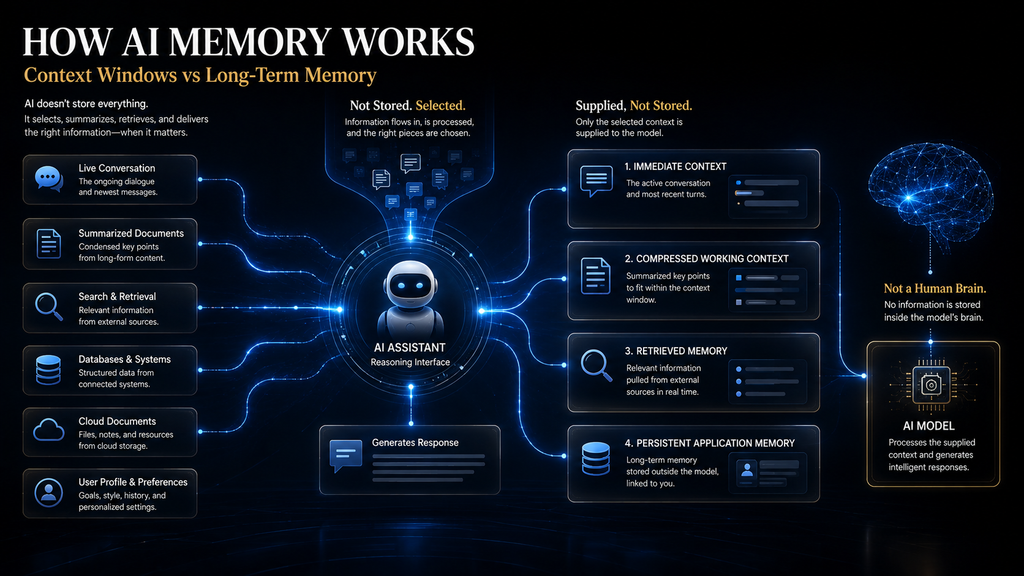
How AI Memory Works: Context Windows vs Long-Term Memory
You tell an AI assistant that you prefer concise answers with practical examples. A few messages later, it follows that preference almost perfectly. The next day, you open a new conversation and the assistant still seems to know how you like information presented. Then, in another conversation, you mention an important detail and the system appears to forget it completely.
That behavior makes AI memory seem far more mysterious than it really is. The problem is that the word memory is being used to describe several different mechanisms that operate at different levels of an AI system. A language model may be responding to information already inside its current context, a compressed summary of an earlier conversation, data retrieved from an external source, or persistent information that an application has stored about you. From the outside, all four can look like “the AI remembered something,” even though the underlying process is very different.
The most useful way to understand the subject is to stop asking whether an AI “has memory” in the human sense and instead ask four practical questions: Where is the information stored? How is it selected? When is it brought back? And what happens when the information is missing, outdated, or wrong?
That shift matters because the answer determines how reliable the system will be. It also explains why a larger context window does not automatically create better memory, why retrieval-augmented generation (RAG) is not itself a memory system, why an AI agent can appear to remember a project for weeks, and why a supposedly “forgotten” detail may still exist somewhere in the surrounding application.
In this guide, we will build a practical mental model for the entire process, beginning with the distinction between context and memory and then moving through retrieval, persistence, failure modes, privacy, and the architecture behind long-running AI systems.
What Is AI Memory?
AI memory is the process by which an AI system preserves, retrieves, summarizes, or reuses information across an interaction or across multiple interactions.
The important word is system. In many modern applications, memory is not a property of the language model alone. The surrounding application may store information, search external sources, maintain user profiles, summarize conversations, choose which records are relevant, and then place selected information back into the model’s working input.
This is why saying “the model remembers” can be technically misleading. A model produces an answer from the information and instructions made available to it at generation time. The application around that model can determine what information becomes available.
Consider a simple example. You tell an AI writing assistant, “I write for beginners, so avoid unnecessary jargon.” If that instruction appears in the current conversation, the model can use it immediately. If the conversation becomes very long and the system creates a condensed summary containing the same preference, the assistant may continue following it because the summary was preserved and supplied again. If the preference is stored in a user profile, the application can retrieve it when you start a new conversation. If the system searches a project database and retrieves your previous style guide, that is another mechanism entirely.
All four behaviors can produce a similar experience, but they are not interchangeable.
That distinction is becoming increasingly important as AI products add more sophisticated personalization. OpenAI, for example, describes ChatGPT memory as a way to remember useful context from chats, files, and connected apps, while its newer memory system is designed to synthesize information over longer periods with an emphasis on freshness, continuity, and relevance. (OpenAI Help Center)
So the right mental model is not “AI has a memory box inside its brain.” A better model is “the AI application manages information and decides what the model should have access to when it needs to respond.”
Why AI Memory Is So Confusing
The confusion comes from collapsing several technical concepts into one human word.
When people say an AI “remembered,” they might mean that the information was still present in the current context. They might mean an earlier conversation was summarized. They might mean a database record was retrieved. They might mean a persistent preference was stored in an application profile. They might even mean the model produced a response that happened to be consistent with an earlier interaction without actually retrieving that specific information.
These mechanisms have different storage locations, different lifetimes, different retrieval methods, and different failure modes.
A useful analogy is a consultant sitting at a large desk. The consultant has the papers currently spread across the desk, a short set of notes summarizing an older meeting, a filing cabinet containing historical records, and a client profile containing enduring preferences. Asking whether the consultant “remembers” something without specifying which source supplied it is not very informative.
AI systems are similar. The apparent memory behavior emerges from the interaction of the model with its surrounding information system.
This also explains why two products can both advertise “memory” while behaving very differently. One may emphasize persistent user preferences. Another may search old conversations. A third may retrieve company knowledge from a vector index. A fourth may rely heavily on long context windows. The user experiences continuity in each case, but the architecture can be radically different.
The practical lesson is simple: do not evaluate an AI memory feature by asking only whether it remembers. Evaluate what it remembers, how it retrieves it, how long it keeps it, and how you can correct it.
Context Window vs Memory: What Is the Difference?
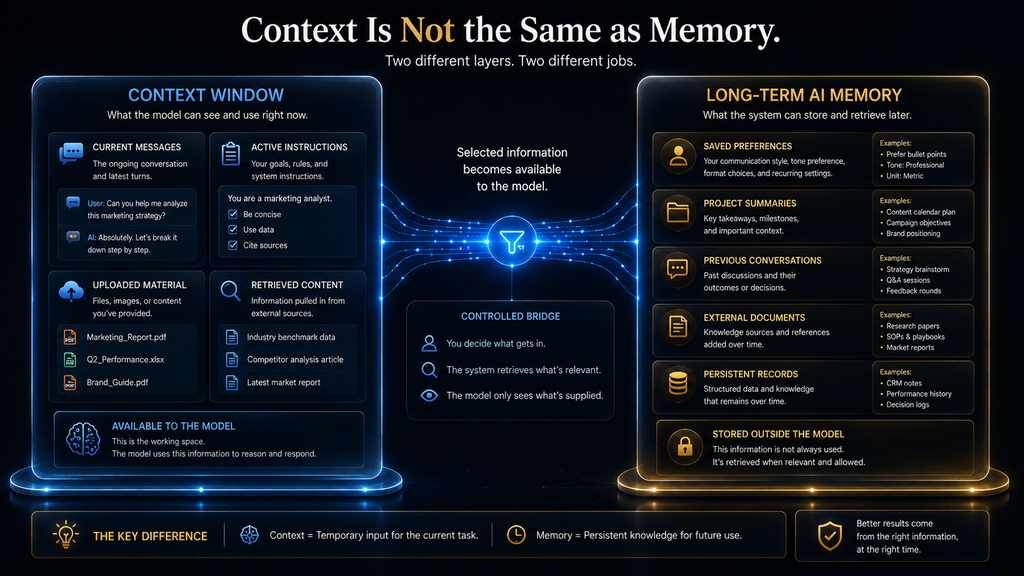
A context window is the information available to the model for its current generation, while long-term memory refers to information the surrounding system can preserve and make available again later. This is the central distinction of the entire topic.
A context window is best understood as the model’s current working space. It can contain your latest message, earlier conversation turns, system and developer instructions, retrieved documents, tool results, and other material the application chooses to provide. Anthropic describes the context window as the set of information a model can reference when generating a response, and specifically distinguishes it from the training corpus.
Long-term memory, by contrast, generally exists outside that immediate working space. The application may store a preference, document, summary, customer record, task state, or other information somewhere persistent and retrieve it later. The retrieved material then becomes part of a future context.
This produces a useful rule:
Context is what the model has access to now. Memory is what the system preserves and can make available again later.
The two often interact so closely that they look like the same thing, but separating them makes almost every confusing AI-memory behavior easier to explain.
A Context Window Is Not a Human-Style Short-Term Memory
Calling a context window “short-term memory” can be helpful as a beginner analogy, but it becomes misleading when taken literally.
A context window is fundamentally a bounded input space. The model does not carry every item in that space forward indefinitely as a human would consciously remember an event. Instead, information is made available as input for the current generation. When the conversation changes, the contents can be altered, summarized, truncated, or replaced according to the application’s context-management strategy.
Imagine working on a large report with an AI assistant. Early in the conversation, you provide the business background, a target audience, several research documents, and detailed formatting instructions. Later, you ask for an executive summary. The assistant can use those materials because they remain available in the current context or because the system has preserved the important parts through another mechanism.
But that does not mean every sentence remains equally accessible.
Long context introduces another issue: more available information does not guarantee equal attention to all of it. Anthropic explicitly warns that simply adding more context is not automatically beneficial and discusses degradation in model recall and performance as context becomes large. This is one reason modern AI systems need context management rather than merely enormous input limits.
So a larger context window is valuable, but it is better understood as more working space, not as a replacement for memory architecture.
How Tokens Relate to Context Windows
Context windows are measured in tokens rather than ordinary words.
A token can represent part of a word, a complete short word, punctuation, or another piece of text depending on the tokenization scheme. Because models process tokenized text, the amount of material that can fit inside a context window is ultimately constrained by the model’s token capacity and the application’s broader input and output requirements.
This matters because a conversation can contain much more information than the model can effectively keep in active context at one time. Modern systems increasingly offer very large context windows, but large capacity does not eliminate the need to decide which information deserves attention.
That distinction becomes obvious in practical use. Suppose you are building a content site and have provided hundreds of pages of notes, research, brand guidelines, keyword lists, and previous drafts. Throwing everything into one giant prompt may technically fit, but that does not mean the model will treat every line as equally relevant to the task. A better system identifies which pieces actually matter for the current request and supplies those first.
For readers who want to understand the underlying mechanics of tokens in more detail, the AI Hustle World guide on What Are AI Tokens? Explained Simply for Beginners provides a useful foundation. The important idea for this article is simply that context capacity is a technical resource, not a human memory mechanism.
Why Larger Context Windows Do Not Solve AI Memory
It is tempting to assume that the memory problem will disappear as context windows become larger. That is only partly true.
A larger context window can reduce the pressure to summarize, truncate, or retrieve information. It allows the model to work with larger documents, longer conversations, bigger codebases, and more extensive instructions in a single interaction. That is genuinely useful.
However, larger context also creates a selection problem. When thousands of relevant and irrelevant details are available simultaneously, the system still has to determine what matters. Models can miss relationships, overlook details, or give too little attention to information buried among large amounts of competing material. Anthropic’s documentation specifically notes that larger context does not automatically translate into better performance.
There is also a cost dimension. More context means more tokens to process, which can increase latency and expense depending on the architecture and model. In a production system, sending an entire knowledge base into every request is rarely an intelligent design.
The better strategy is therefore not “make the context window enormous and forget about memory.” It is “use the context window for what the model needs now, and use memory or retrieval for what it may need later.”
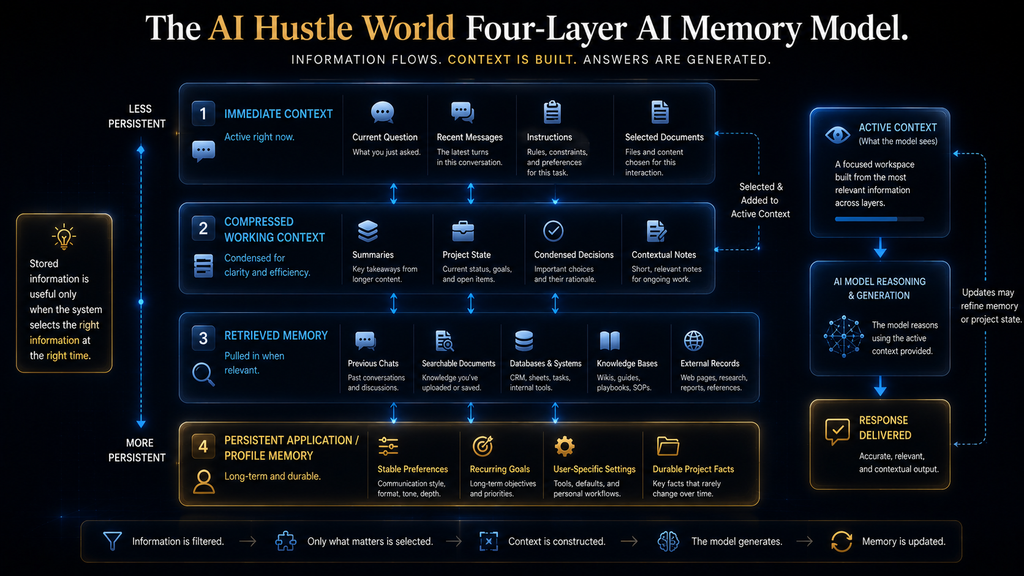
The AI Hustle World Four-Layer AI Memory Model
To make AI memory easier to reason about, AI Hustle World uses a four-layer model:
- Immediate Context
- Compressed Working Context
- Retrieved Memory
- Persistent Application/Profile Memory
These layers are not four universal components that every AI product must implement exactly this way. They are an analytical framework for understanding the main ways information can remain available to an AI system.
The benefit of the framework is that it separates things users routinely lump together. It also makes debugging much easier because a memory failure can be traced to a particular layer instead of being dismissed as “the AI forgot.”
Layer 1: Immediate Context
Immediate context is information directly available to the model during the current interaction.
This includes the current question, recent messages, active instructions, selected documents, and relevant tool results. When you tell an assistant, “Rewrite this in a professional tone and keep it under 500 words,” the model can follow those instructions because they are part of the input available for the current response.
This is the most direct form of apparent memory, but it is also the least persistent. The fact that something is available right now does not tell you whether it will remain available later.
Imagine asking an AI to help you write a 20-page business proposal. During the conversation, it knows the company background, target audience, product positioning, and requirements because those details are present in the working context. That does not automatically mean the system will carry the same full set of details into a completely new conversation tomorrow.
Immediate context is therefore best thought of as active working information, not durable memory.
Layer 2: Compressed Working Context
As conversations grow, a system may need a more efficient way to preserve important information without carrying every earlier message in full.
One approach is summarization or compaction. Instead of retaining twenty long messages exactly as they appeared, the system may create a shorter representation of the project’s important details.
For example, a long conversation might be compressed into something like: the user is building an AI education website for beginners; the editorial tone should be professional, practical, and accessible; articles should prioritize explanation over hype; previously approved terminology should be preserved. That summary can preserve the broad direction without requiring every previous sentence to remain in the active context.
The trade-off is obvious once you look closely: compression preserves meaning selectively. A summary may retain the project’s purpose but lose an exception, an exact number, a specific deadline, a precise wording decision, or an unusual preference that seemed insignificant when the summary was produced.
This is why important information should not always be left at the mercy of conversation summarization. A critical product specification, legal requirement, content rule, or numerical assumption is often better stored in a dedicated source of truth such as a project brief, database, or structured document.
In other words, compression is excellent for continuity, but it is not a perfect substitute for precision.
Layer 3: Retrieved Memory
Retrieved memory is information stored outside the active conversation and fetched because it appears relevant to the current request.
This is one of the most important mechanisms in modern AI applications because it allows a system to work with information far beyond the immediate conversation. The source might be previous chats, uploaded files, company documentation, customer records, cloud files, a database, a knowledge base, or another external system.
A retrieval pipeline typically identifies the current request, searches a relevant index or data store, selects useful material, and inserts that material into the model’s current input.
Microsoft describes retrieval-augmented generation in essentially these terms: the application retrieves relevant content, combines that content with the user’s request, and passes the augmented input to the model for generation. Retrieval can use keyword, semantic, vector, or hybrid search depending on the system. (Microsoft Learn)
This is why an AI customer-support assistant can answer a question about an order it never saw in the current conversation.
Suppose a customer asks, “When will my replacement arrive?” The application can identify the customer’s account, search the order system, retrieve the shipment status, and provide the relevant record to the model. The model then generates an answer using that retrieved information.
The important distinction is that the language model did not necessarily “remember the order” in a persistent human-like sense. The application retrieved the order record and made it available at the moment the answer was generated.
That difference becomes extremely important when designing reliable AI agents and business systems.
RAG Is Retrieval, Not Long-Term Memory
This is one of the most common misconceptions in current AI discussions. People sometimes describe a vector database, RAG pipeline, or retrieval index as “the AI’s long-term memory.” That metaphor is understandable, but it is incomplete.
A RAG system can certainly provide information across sessions, and it can function as a memory-like component. But RAG primarily describes an information retrieval and generation pattern: retrieve relevant data, augment the model input, then generate a response from that augmented context. Microsoft explicitly frames RAG around this retrieve–augment–generate flow.
A vector database, meanwhile, is a storage and retrieval technology that can support semantic search. It is not synonymous with memory.
This distinction matters because memory involves more than storage. A mature memory system may need to decide whether a piece of information should be stored at all, whether it is still valid, how it should be represented, whether it conflicts with newer information, when it should be retrieved, and whether the user should be able to delete or correct it.
A vector index can help locate information. It does not automatically solve those governance problems.
The better mental model is therefore:
RAG can be a retrieval mechanism inside a broader memory architecture. RAG itself is not the complete definition of long-term AI memory.
Layer 4: Persistent Application/Profile Memory
Persistent application memory stores selected information that can influence future interactions. This is the layer most people imagine when they hear the phrase “AI memory.” It can include preferences, recurring goals, formatting choices, profile information, project context, and other details that an application determines are useful to preserve.
Modern AI products are increasingly explicit about this behavior. OpenAI’s current memory documentation, for example, describes memory as helping ChatGPT retain useful context from chats, files, and connected apps and says its newer system is designed to keep memory more current and relevant over longer periods.
But even here, it is useful to avoid anthropomorphic language.
A persistent memory record might be represented as a structured fact, a summary, a set of preference attributes, or another application-managed representation. When you open a future conversation, the system can decide that the information is relevant and inject it into the current context.
Suppose a system has stored: User prefers concise answers with practical examples.
When the user asks a question next week, the application can supply that preference to the model before generation. The model then responds in a style consistent with the preference.
From the user’s point of view, the AI remembered. From the system’s point of view, a stored piece of information was retrieved and used to influence generation.
That difference is not pedantic. It tells you where you should look when something goes wrong.
Why AI Can Forget Something That Is Still in the Conversation
One of the strangest AI experiences is watching an assistant apparently forget something that is visibly present earlier in the same conversation.
The obvious assumption is that the system “lost” the message. That is not necessarily what happened.
A detail may be present but receive insufficient attention relative to other information. The conversation may contain conflicting instructions. Older content may have been summarized. Some content may have been removed or deprioritized as the conversation expanded. The request itself may also be ambiguous, making it unclear which earlier information should be reused.
Imagine that you have spent thirty messages developing an ad campaign for an eco-friendly notebook business aimed at university students in the United States. You then write:
“Write another version.”
Technically, the conversation contains all the relevant information. But the instruction does not clearly specify which part of the project you want rewritten. “Another version” could refer to the headline, social caption, landing page, email, or the entire campaign.
The stronger prompt is something like: “Write another version of the Facebook ad for the eco-friendly notebook business, keeping university students in the United States as the target audience and preserving the premium but accessible tone.”
The second prompt is not necessarily giving the model more information. It is doing something more important: it is reducing ambiguity about which existing information matters now.
That is one reason good AI workflows are not built around memory alone. Clear instructions remain valuable even when the system has access to extensive history.
The Five Main Reasons AI Memory Fails
Memory failures are easier to diagnose when they are treated as system failures rather than mysterious behavior.
1. Context overflow
The information needed for the answer may not remain fully available in the active context. Depending on the system, older content can be truncated, summarized, or otherwise compressed.
2. Retrieval failure
The relevant record may exist in storage but fail to surface because the search system does not identify it as relevant. A memory system cannot use information it fails to retrieve.
3. Bad summarization
A compressed summary can preserve the broad project direction while dropping the exact detail that matters to your current request.
4. Stale or conflicting memory
An older preference may no longer be correct. This becomes particularly dangerous when a system remembers a previous state as though it were still current.
5. Wrong selection
A system may retrieve too much information, too little information, or the wrong information. More retrieved content is not always better because irrelevant context can compete with the evidence that actually matters.
Microsoft’s guidance on RAG emphasizes that poor retrieval and weak prompt structure can undermine otherwise capable systems, and that the model can still generate inaccurate or incomplete output even when a retrieval system exists.
This is why the phrase “the AI forgot” is often too vague to be useful. The real failure may be storage, summarization, retrieval, ranking, conflict resolution, context management, or generation.
AI Memory Is More About Selection Than Storage
This is the contrarian point that deserves more attention.
People often think the hardest part of AI memory is storing everything. In practice, storage is frequently the easier problem.
Modern systems can store enormous amounts of information. The difficult part is deciding what should be remembered, what should be ignored, what should be retrieved, what should be trusted, and when a memory should stop influencing the response.
Imagine an AI assistant working with a freelance business owner for three years. The system could theoretically preserve thousands of interactions. But if every historical detail is treated as equally important, the assistant becomes worse rather than better.
A five-year-old preference about presentation style might be irrelevant to today’s technical architecture question. An old pricing assumption could actively damage a financial recommendation. A previous project decision might have been reversed months ago. A casual statement could be mistaken for a permanent preference.
In that environment, successful memory depends on selection and freshness, not simply retention.
OpenAI’s 2026 work on improved memory explicitly identifies staleness, correctness, relevance, and scalability as challenges in memory across long time horizons. Its updated memory system is designed to synthesize and update what remains useful rather than simply accumulate everything forever. (OpenAI)
That leads to a broader engineering principle:
A useful memory system is not the system that remembers the most. It is the system that retrieves the right information at the right time with the right level of confidence.
Context Window vs Long-Term Memory: Complete Comparison
| Dimension | Context Window | Long-Term AI Memory |
|---|---|---|
| Main purpose | Provide working information for the current generation | Preserve information for future use |
| Typical lifetime | Current interaction or managed conversation state | Potentially across sessions |
| Storage | Active model input/context | Application memory store, database, files, chat history, profiles, or other external systems |
| Retrieval | Already present in current context | Usually selected or retrieved when relevant |
| Capacity | Bounded by model/application context limits | Potentially much larger than one model context |
| Examples | Recent messages, instructions, retrieved documents | Saved preferences, prior project state, customer records, stored summaries |
| Main risk | Important details are missed, compressed, truncated, or overwhelmed | Wrong, stale, irrelevant, conflicting, or sensitive information is reused |
| User control | Usually influenced through the current conversation and prompts | May involve memory settings, deletion, correction, or application controls |
| Relationship | Supplies information the model can use now | Supplies information that may be brought into future contexts |
The key is not to treat the two as competing technologies. Long-term memory eventually has to become context before the model can use it. That means context is the model-facing layer, while memory is the broader preservation-and-retrieval system around it.
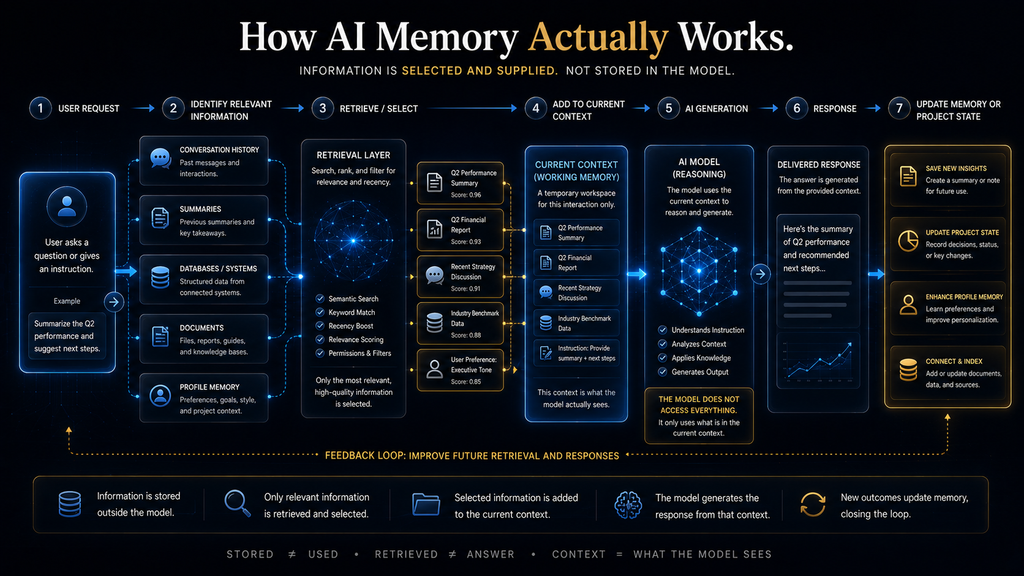
How a Memory-Enabled AI System Actually Works
A realistic memory-enabled application can be understood as a pipeline rather than a single storage box. Suppose you ask: “Can you continue the strategy we created for my software business?”
The system may first interpret the request and determine that the question refers to an ongoing project. It could then retrieve stored project information, perhaps including a summary of previous decisions, the target audience, the latest product version, and previous strategic constraints.
Next, the system may rank those records and decide which pieces are useful. It then inserts the selected material into the current context together with your new question and any active instructions.
The language model generates the response from that assembled context. Afterward, depending on the architecture, the application might extract newly useful information from the conversation and update the stored memory or project state.
That produces a cycle: Store → Select → Retrieve → Add to Context → Generate → Update. This is a much more accurate mental model than imagining the language model itself carrying an ever-growing internal autobiography of every user interaction.
Where Vector Databases Fit
Vector databases are often mentioned whenever AI memory is discussed, but their role deserves careful explanation.
A vector database can store numerical representations of information called embeddings. Those representations allow a system to search for content that is semantically similar to a query rather than relying only on exact keyword matches.
Suppose your documentation contains a paragraph about “returning a defective product.” A user may ask, “What should I do if the item arrived damaged?” Even though the words are different, semantic retrieval can help identify the relevant passage.
This makes vector search valuable for knowledge retrieval, RAG, agent systems, and memory architectures. Microsoft documents vector search as one possible retrieval strategy within RAG systems, alongside keyword and hybrid methods.
But an embedding does not magically become a “memory.”
The vector representation helps the system find information. A complete memory architecture still needs decisions around storage, relevance, permissions, freshness, conflict handling, and how retrieved information is passed to the model.
That distinction becomes especially important in enterprise systems where not every record should be retrievable by every user.
How AI Memory Works in Customer Support
Customer support is one of the clearest examples because the distinction between memory and retrieval becomes visible. Imagine a customer asks, “Why hasn’t my replacement shipped yet?”
A production support system could identify the customer account, retrieve the current order, check the replacement status, retrieve relevant policy information, and then place those details into the model’s context. The model generates a natural-language response using the retrieved records.
Notice what made this possible: not an enormous conversational memory, but structured external information plus retrieval.
This design is often superior to storing every customer interaction as an undifferentiated block of text. The order status is better represented as structured, authoritative data because the system can query the current state directly.
That illustrates a broader principle: The best memory architecture depends on the type of information being remembered.
A user’s preferred writing style may work well as a persistent profile attribute. A shipping status belongs in a transactional system. A knowledge article belongs in a searchable knowledge base. A long project discussion may benefit from both summaries and retrievable source documents.
Trying to force all of these into one generic “AI memory” bucket usually creates unnecessary complexity and weaker reliability.
AI Memory in Long-Running Projects and AI Agents
Long-running AI agents make the distinction even more important.
Suppose an AI agent is managing a marketing project over several months. The project may include hundreds of conversations, research documents, decisions, customer feedback, deadlines, and tool interactions.
A single context window is not a realistic place to store the entire project forever. Instead, the agent may combine several layers: recent activity remains in immediate context, older discussions are summarized, important documents are indexed for retrieval, and stable project facts are stored persistently.
This is why an agent can appear to “remember” a project months later even though it is not literally keeping the entire project inside its active context. The agent’s memory is really a system for maintaining state across time.
That also connects to the AI Hustle World explanation of AI agents. An agent becomes significantly more capable when it can preserve task state, retrieve external information, use tools, and carry relevant results forward. But the memory layer remains conceptually distinct from the agent itself.
The same principle applies to MCP. MCP can help an AI application connect to external tools and sources, but it is not itself a long-term memory system. A connected system may expose files, databases, or services that the AI application can access, while memory remains a separate question of what information is preserved and how it is reused.
Why Persistent Memory Can Become Dangerous
Memory sounds beneficial until you consider what happens when the remembered information is wrong.
Imagine an assistant learns that a user prefers very short answers. Months later, the user begins using the system for research reports and wants detailed analysis, but the old preference continues influencing responses.
Or imagine a business AI stores an outdated product policy and retrieves it when answering a customer. The system appears helpful, but the memory is now a liability.
The same problem appears with contradictory information. A user may have said last year that they were targeting one customer segment and later changed the business strategy. If the system treats both statements as permanent facts without understanding their chronology, it may generate inconsistent advice.
OpenAI’s current memory work explicitly discusses stale and contradictory memories as challenges that newer systems are designed to handle more effectively. This suggests an important design principle: Memory should have a concept of validity, not merely existence.
A mature system may need to distinguish between “the user once said this,” “the user currently prefers this,” and “this is no longer valid.” That is closer to knowledge management than simple note-taking.
Privacy: What Should an AI Remember?
Memory also creates a governance question: just because information can be remembered does not mean it should be remembered. Personal information, confidential business details, customer records, financial information, authentication data, internal documents, and other sensitive material can create risk when they are retained or retrieved inappropriately.
Users should understand what a system stores, what it can reference later, and what controls exist for deletion or temporary use. In ChatGPT, for example, OpenAI provides memory controls and says users can turn memory off, delete memories, and use Temporary Chat to avoid creating new memories in that mode.
The broader principle applies to any AI application: memory should be deliberate, reviewable, and governed by access rules.
This is especially important in business environments. A customer-support system may need access to order information but not unrestricted access to every company document. A finance assistant may need current transaction data but not unrelated employee records. A marketing agent may need campaign history but not confidential legal information.
Good memory architecture is therefore partly an access-control problem.
Should You Trust AI Memory?
You should trust AI memory only to the extent that you understand how it is implemented and what evidence supports the retrieved information.
A remembered preference is relatively low-risk if it merely influences writing style. A remembered medical, financial, legal, or business fact can be much more consequential. In those situations, persistent memory should not automatically be treated as authoritative simply because the system presents it confidently.
For high-stakes decisions, the system should ideally retrieve authoritative and current sources and make uncertainty visible. This is one reason RAG systems often emphasize grounding information and source citations rather than relying purely on the model’s existing knowledge. Microsoft likewise emphasizes using retrieved content to ground responses and recommends designing prompts that specify how missing or conflicting information should be handled.
In practical terms, a useful hierarchy is: Current authoritative data > verified retrieved evidence > persistent memory > old summaries > vague conversational recollection. That is not a universal rule for every architecture, but it is a strong operating principle for systems where accuracy matters.
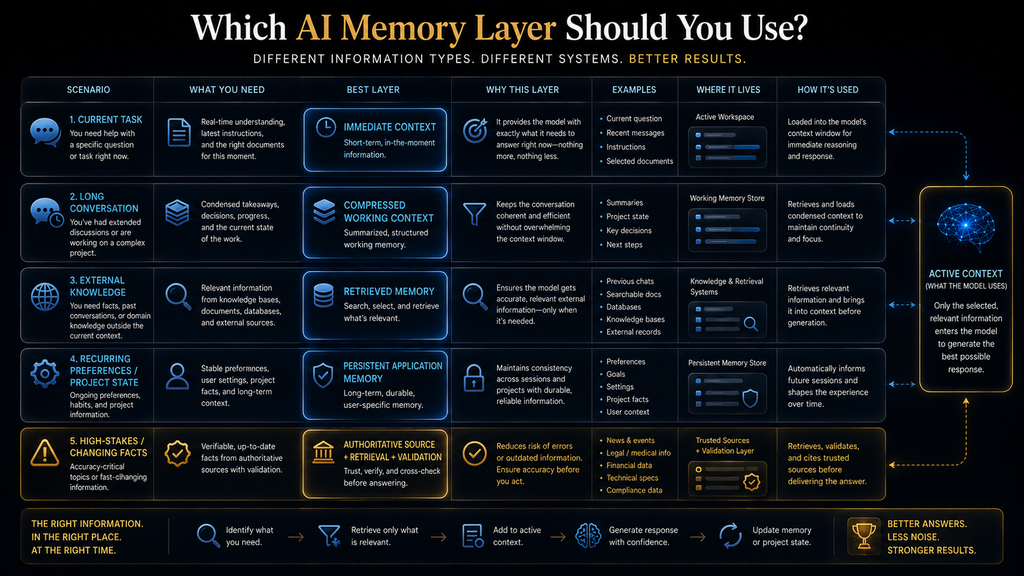
When Should an AI System Use Context, Retrieval, or Persistent Memory?
The correct choice depends on what kind of information you are dealing with.
| Situation | Best mechanism | Why |
|---|---|---|
| Current question and recent instructions | Immediate context | The information is needed right now |
| Long conversation with stable project direction | Compressed working context | Preserves continuity without carrying everything |
| Company documents or large knowledge base | Retrieval | Searches only relevant information |
| Customer/order/transaction status | Structured system + retrieval | Current records should be authoritative |
| User’s recurring formatting preference | Persistent profile memory | Useful across future sessions |
| Large historical project archive | Retrieval + summaries | Balances continuity and precision |
| Sensitive or high-stakes information | Controlled retrieval + explicit validation | Reduces stale or unauthorized reuse |
This suggests a practical rule for builders:
Use context for active work, summaries for continuity, retrieval for external knowledge, and persistent memory for stable information that genuinely improves future interactions.
Trying to use one mechanism for everything usually creates a worse system.
What Happens When Nothing Is Remembered?
There is also an overlooked decision: sometimes the right answer is not to build memory at all.
If a workflow is short, well-defined, and self-contained, persistent memory may add complexity without meaningful benefit. A simple prompt plus a small context window can be enough.
For example, a calculator-style AI tool that converts measurements does not need to remember a user’s conversations from six months ago. A one-off summarization workflow may not need a persistent user profile. A temporary brainstorming session may benefit more from a clean context than from carrying unrelated historical information forward.
Memory should therefore be justified by the workflow. A useful question is not: “Can we make this AI remember?”
It is: “What future task becomes meaningfully better because this information is available later?” If the answer is weak, storing the information may not be worth the complexity or privacy cost.
Common Mistakes When Designing AI Memory
Treating the context window as permanent storage
This creates fragile systems because important facts may disappear, be summarized, or become difficult to retrieve once the conversation grows.
Saving everything
More memory is not automatically better. Large quantities of irrelevant history can make retrieval noisier and decision-making weaker.
Treating summaries as perfect records
Summaries are useful representations, not guaranteed replacements for source material. Important details can disappear during compression.
Calling every vector database a memory system
A vector store is a retrieval component. The broader memory architecture includes selection, freshness, governance, and reuse.
Ignoring time
A statement can be true at one point and false later. Systems that do not model changing information can turn historical facts into current misinformation.
Failing to provide user control
Memory becomes much more trustworthy when users can inspect, correct, delete, or disable it where the product supports those controls.
Assuming retrieval guarantees accuracy
Retrieval can improve grounding, but a poor search result or badly structured prompt can still produce an incorrect answer. Microsoft explicitly notes that retrieval quality and prompt design remain critical to end-to-end performance.
How to Build Better AI Memory: A Practical Framework
A useful AI memory implementation can be designed around six questions.
1. What information deserves to survive?
Separate temporary conversation details from genuinely reusable knowledge. Not every sentence deserves persistence.
2. Where should the information live?
Use the right storage layer for the data. Preferences, project state, documents, transactional records, and knowledge articles may belong in different systems.
3. How should the information be represented?
Some information is best stored as structured data. Some belongs in summaries. Some should remain available in source documents that can later be retrieved.
4. How will relevance be determined?
A memory system must know what to retrieve for the current task. Semantic search, keyword search, metadata filters, recency, user identity, and other ranking signals can all matter.
5. How will stale or conflicting information be handled?
The system should distinguish current facts from historical statements where possible. Without this step, long-term memory can quietly become a source of errors.
6. How can the information be corrected or removed?
Deletion and correction are not optional afterthoughts. They are part of trustworthy memory architecture.
This framework turns memory from a vague feature into an engineering discipline.
The Economics of AI Memory
AI memory also has a business dimension.
A simplistic architecture might repeatedly send large amounts of historical information to the model. That can increase token usage, latency, and operational cost. A more selective architecture can reduce unnecessary processing by retrieving only the information relevant to the current task.
But optimization is not as simple as “retrieve less.”
If retrieval quality is poor, you may save tokens while increasing error rates. If summaries are too aggressive, you may reduce context size while losing important project details. If memory retrieval is too broad, irrelevant information can make responses less reliable.
The goal is therefore not minimum context or maximum memory. The goal is maximum useful information per unit of context.
For a business application, the relevant metrics may include retrieval precision, answer accuracy, latency, cost per request, memory update frequency, stale-memory rate, user correction rate, and the percentage of responses that require human intervention. This is where AI memory becomes less like a chatbot feature and more like an information architecture problem.
A Simple Memory Architecture for a Small AI Business
Suppose you are building an AI assistant for a small business.
You might keep current conversation messages in immediate context. A rolling project summary can preserve the important direction of the conversation. Product documentation can live in a searchable knowledge base. Customer records can remain in the transactional database. Stable user preferences can live in a persistent profile store.
When a request arrives, the system decides which layers are relevant.
A question about writing tone might use profile memory and recent context. A question about product specifications might retrieve documentation. A customer asking about an order might trigger a live lookup against the transactional system. A strategic project question might combine a project summary with selected historical documents.
This architecture is more reliable because the information source matches the information type. That principle is more important than whether the backend uses a specific vector database, framework, or agent platform.
The Future of AI Memory
The next stage of AI memory will probably not be defined simply by bigger storage. The more important direction is better synthesis, retrieval, temporal reasoning, and personalization.
As context windows continue to grow, systems will gain more flexibility in handling long documents and complex sessions. At the same time, memory systems will become better at identifying useful facts, updating them when circumstances change, and retrieving only what matters for a particular task. OpenAI’s current memory research already emphasizes freshness, continuity, relevance, correctness, and scalability as central challenges.
Another major shift will be from remembering isolated facts to preserving state. An advanced AI agent may need to know not simply that a user once preferred a certain style, but that a project is currently in a particular stage, certain decisions have already been approved, some tasks are completed, another task is blocked, and a particular external source is now the authoritative reference. That begins to look less like a digital notebook and more like a dynamic model of ongoing work.
Multimodal systems will push this further. Future memory architectures may combine text, images, files, voice interactions, structured records, and tool results into a single retrieval and reasoning layer. The challenge will not be whether the system can store those signals, but whether it can determine which signal matters and whether it should trust it.
There is also a strong case for more explicit memory governance. Users and organizations will increasingly expect to see what an AI has remembered, why it was used, whether it is current, who can access it, and how it can be corrected.
In other words, the future of AI memory is likely to be less about “How much can the AI remember?” and more about “How intelligently can the system manage what it knows?”
The Most Important Mental Model to Remember
When an AI appears to remember something, there are several possibilities.
The information may still be sitting inside the current context. It may have been compressed into a working summary. It may have been retrieved from a document, database, or previous conversation. It may have been stored as persistent profile information and brought into the new interaction.
The model sees the information only when the system makes it available. That gives us the complete picture:
Context is the model’s current working information. Memory is the broader system that preserves information and makes relevant parts available again.
Once you understand that distinction, many confusing AI behaviors become straightforward. A chatbot can forget because the information was removed from context, summarized poorly, or never retrieved. An agent can appear to remember because it is maintaining persistent state and retrieving it when needed. A RAG application can answer questions about documents it has not seen in the current conversation because retrieval placed those documents into the model’s context.
The “magic” is mostly information management.
Final Thoughts
AI memory is easier to understand once you stop treating it as a single feature.
What users experience as “memory” can actually be a combination of immediate context, compressed conversation state, external retrieval, and persistent application-managed information. These layers work together, but they have different purposes, different failure modes, and different levels of reliability.
The most important distinction is still the simplest one: context is what the model can use now, while memory is what the surrounding system preserves and can make available again later. That explains why a model can handle a huge document without retaining it forever, why an AI assistant can remember a preference across sessions, why a customer-support system can retrieve an order it never saw in the current conversation, and why RAG should not automatically be treated as synonymous with long-term memory.
The deeper lesson is even more useful. AI memory is not primarily a storage problem. It is a selection, retrieval, freshness, and governance problem. The future belongs less to systems that remember everything and more to systems that know what matters, retrieve the right information, recognize when information has changed, and keep human control over what gets retained.
That is the real difference between an AI that merely has access to more information and an AI system that can actually maintain useful continuity over time.
Want to Understand AI Beyond the Surface?
Now that you know how memory and context windows work, learn how to give a model the right information.
Learn How to Manage Context →FAQ: AI Memory and Context Windows
Is AI memory the same as a context window?
No. A context window is the information available to the model during a particular generation or managed interaction. AI memory is a broader concept covering information that a system preserves and may make available again later.
Does a larger context window mean an AI has better memory?
Not necessarily. A larger context window allows more information to be processed together, but it does not guarantee that the model will use every piece effectively. Very large contexts can still create relevance and recall problems.
Is RAG the same as long-term AI memory?
No. RAG is a retrieval-and-generation architecture in which relevant external information is retrieved and added to the model input. It can support a memory system, but RAG by itself is not the complete definition of long-term memory.
Does a vector database give an AI memory?
A vector database can provide an important retrieval layer, especially for semantic search, but storage alone does not create a complete memory system. Memory also involves decisions about relevance, persistence, freshness, access, and reuse.
Why does AI sometimes forget something I said earlier?
The information may no longer be in active context, may have been summarized or compressed, may not have been retrieved, or may be competing with newer or conflicting instructions. The system may also have misunderstood what earlier information was relevant to your current request.
Can an AI remember across different conversations?
Yes, depending on the product and its memory architecture. Some systems preserve selected preferences or other information across conversations, while others rely primarily on current-session context or external retrieval. OpenAI’s current ChatGPT memory system, for example, can use saved memories and relevant past-chat information when those features are enabled.
Does AI truly remember like a human?
Not in the ordinary human sense. AI applications can preserve, retrieve, summarize, and reuse information, but these mechanisms are implemented through software systems rather than human-like autobiographical memory.
Should I trust everything an AI remembers?
No. Persistent information can become stale, incomplete, contradictory, or incorrectly retrieved. For important decisions, current authoritative information should take precedence over old conversational memory.
What is the best way to make AI remember an important instruction?
For a current task, place the instruction clearly in the active prompt or context. For information that must persist, use a dedicated project document, structured data source, or supported memory feature rather than assuming a casual statement will always be preserved.
Written by
Muntasir Ahmad Chowdhury
Founder, AI Hustle World
Muntasir Ahmad Chowdhury is the Founder of AI Hustle World, an independent publication dedicated to making Artificial Intelligence practical, trustworthy, and easy to understand. He researches AI tools, automation, customer service, productivity, and real-world business applications, helping readers make smarter technology decisions through research-driven, experience-backed content.
Expertise:
AI Tools • AI Automation • AI Customer Service • AI Productivity • Generative AI • AI Workflows
Get Smarter With AI
Enjoyed this guide? Get practical AI tools, tutorials, and honest reviews delivered to your inbox.