Evidence: Documentation reviewed, plus one small first-hand code test
Last checked: October 2026
What was done: Written from official documentation and the published sources linked in this article. No AI product was hands-on tested. The author also ran one small local Python test on 30 September 2026 (Python 3.12.14), which the article describes.
Files: Not published
Affiliate links: No
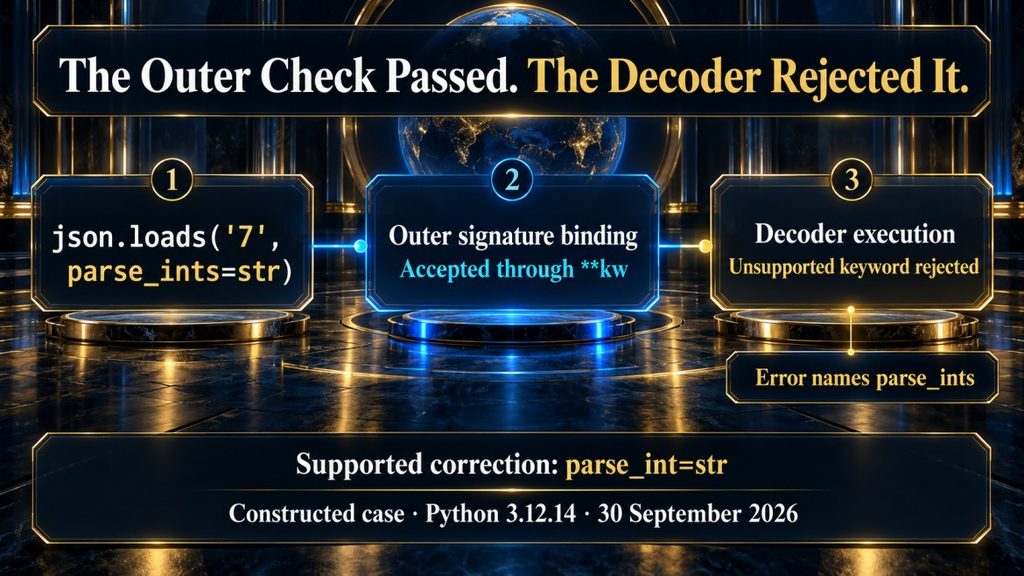
The method existed. The argument check passed. Then the call failed with TypeError: JSONDecoder.__init__() got an unexpected keyword argument 'parse_ints'. In our controlled Python demonstration, a reassuring result had checked the outer function while the unsupported option was waiting to fail inside the decoder.
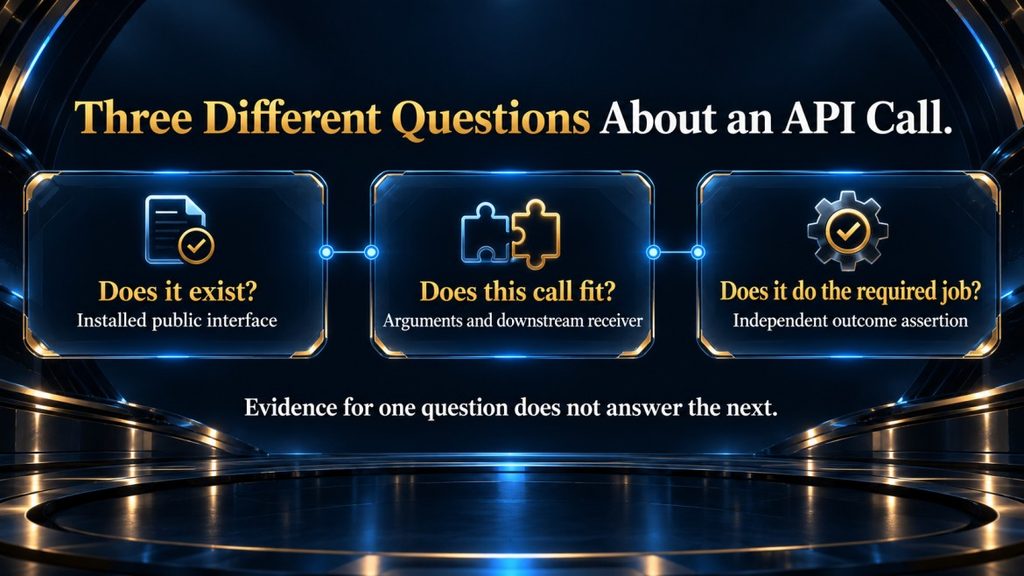
That is the problem with advice that ends at “run a check.” You need to know what the check established and what it never examined. To prevent hallucinated APIs and incorrect code suggestions, verify the interface in your actual environment, inspect how the call handles its arguments, and test the outcome your feature requires. A valid method name gets you through only the first of those questions.
If you are staring at an AI-generated import, a nonexistent method or a function that runs but ignores your option, this guide gives you a way to investigate without adding another guess. It includes AI Hustle World’s original five-case API Check-Coverage Lab, a practical W.O.R.T.H. decision assessment, and a repair process that keeps the requirement intact. We are evaluating verification behavior, not ranking coding models. Our AI coding assistants explainer covers the broader category; here, the job is to establish whether a proposed call deserves to become part of your code.
First identify which kind of wrong suggestion you have
A hallucinated API is an interface detail presented as available without support in the package, service or project you are using. The invented detail can be a method, import, keyword argument, endpoint, configuration key or response field. A real interface used incorrectly is another failure, with a different repair. You will waste time if you treat every red underline or unexpected result as the same problem.
Consider an assistant that sees several file-reading methods and proposes one more with a convincing name. The naming pattern is familiar, so the suggestion looks reasonable before anyone resolves the member. That appearance says nothing about whether the object exposes it. Our explanation of why AI gives wrong answers covers this broader gap between a plausible answer and grounded evidence.
Now consider a method that genuinely exists in a newer SDK release. It can still be the wrong suggestion for a project pinned to an earlier version, just as an example from another language binding can be wrong for your client. Calling the method universally fictional would misdiagnose the problem. Establish where it belongs before deciding whether to adapt the code or review an upgrade.
An unresolved import needs the same care. The package might be declared but missing from the active virtual environment, resolved through another workspace, or available only through the project’s private registry. The assistant’s code can be wrong, your setup can be wrong, or both can be wrong. Installing a substitute immediately makes those explanations harder to separate.
The quieter failures deserve more attention than they usually get. A call can return a list while ignoring the limit you requested, or return a number that the next component treats as text. Nothing crashes at the boundary you inspected. You find the problem by stating the required effect independently and comparing it with what actually happened.
Our editorial position is straightforward: a passing check is useful only when you can name the assumption it checked. The code is a proposal until the relevant evidence supports it. That does not mean every suggestion needs a full integration environment. It means you should choose the next check from the uncertainty you still have, rather than the easiest command that produces a green result.
Verify the interface your project actually runs
Start with the active runtime, affected workspace and resolved dependency version. A manifest tells you what the project declares, a lockfile records resolved dependencies, and the environment supplies the implementation the application uses. Those sources can disagree. Establish the environment before using documentation to approve or reject a call.
If you work in Python, use the interpreter that runs the affected application when inspecting the package. A definition found through another interpreter can explain why the same import works in one terminal and fails in another. In a JavaScript monorepo, inspect the affected package’s dependencies and resolution context rather than assuming a package visible elsewhere is available here. A container or generated client introduces another boundary worth identifying explicitly.
Move from the package to the exact public interface. Use definition navigation, installed type declarations, source for the relevant release, or the authoritative schema behind a generated client. Look at the object the caller receives, not just a matching identifier somewhere in the repository. A method found in a private helper or a test fixture is not evidence that the public client exposes it.
The latest documentation can be the wrong documentation. If the page describes a release newer than your lockfile, it can validate an API that your application does not have. Check the version attached to the page or source tree, and distinguish a public release from an unreleased branch. When the evidence belongs to another version, the decision is whether to change the implementation or intentionally migrate the dependency.
A file inside a package is not automatically a supported import path. Reaching into an internal directory can make today’s error disappear while tying your code to layout the maintainer can change. Check public exports and the import form your runtime expects. If you need an internal entry point to preserve the assistant’s suggestion, that is a reason to reconsider the suggestion.
Do not mistake a failed text search for complete interface inspection either. Inherited methods, generated members and proxies can be exposed without a literal definition beside the object you are reading. Trace how that object is constructed and consult its supported contract. The reverse matters too: a convincing name found in source is insufficient when you cannot show how the caller reaches it.
For remote APIs and tool-calling code, inspect the registered contract rather than extrapolating from the name. The service’s supported path, request fields and response schema determine whether the call is valid; a tool registry determines which tool names and arguments can be invoked. A local method can exist while its remote endpoint has changed. Keep the client and service evidence together when both affect the result.
Do not turn an invented import into a real dependency
Before installing an unfamiliar package, establish its identity through the official project and your approved registry. A package name becoming available does not prove that it is the library the assistant intended. Names are cheap evidence. An independently verified source trail is what lets you decide whether this is a legitimate dependency change.
The OWASP npm Security Cheat Sheet, checked for this guide on 30 September 2026, describes slopsquatting: attackers registering package names generated by coding assistants. Its prevention guidance supports verifying a proposed package before installing it. Maintainer details and release history help, but popularity is not proof of identity. Confirm the official project’s exact package reference and retain your normal dependency review.
Inspect metadata and available source before executing unfamiliar code. Installation can run scripts, and importing a package can run initialization code even if installation scripts were disabled. A restricted disposable environment limits exposure when deeper inspection is justified; it does not establish that the package is trustworthy. If the task can be completed with approved dependencies, there is little reason to expand the dependency boundary merely to rescue a generated import.
Give the assistant evidence before asking it to implement
Provide the current interface and required outcome together. A useful request identifies the runtime and dependency version, the relevant declaration, an existing project helper where one applies, and the result the caller needs. Include the normal check command for the affected workspace. This makes the assistant’s proposed change easier to verify because the evidence and acceptance condition are already visible.
A package name alone leaves too much room for guesswork. Even a correct declaration does not tell the assistant whether you need every page of results, one field from each record, or a specific error response. Give it the narrow call path and explain what must remain true afterward. Our context engineering guide explains how to keep useful constraints visible without burying them in a whole repository pasted into chat.
Jain and colleagues’ 2024 paper, On Mitigating Code LLM Hallucinations with API Documentation, provides a useful research anchor. Its CloudAPIBench contains 622 synthetic Python tasks involving AWS and Azure APIs; evaluation uses signature stubs to assess invocation validity. The paper reports GPT-4o validity of 38.58% on low-frequency APIs, rising to 47.94% with its documentation-augmentation setup. These are historical benchmark findings, not a defect rate for your current assistant or a measurement of end-to-end application correctness.
The research also reports that poor retrieval can hurt results. Our interpretation is that “give it documentation” is incomplete advice: the documentation must concern the actual interface and task. A perfectly accurate page for the wrong SDK version supplies a convincing basis for the wrong call. Carry source identity and version into the context; our guide to reducing hallucinations with RAG covers the wider retrieval problem.
Try a request that makes unsupported assumptions visible before implementation: “Use the installed dependency and show the defining source for each new external call. Preserve this expected outcome and use the existing project checks. If an interface cannot be verified, name the missing evidence rather than adding a dependency or changing the requirement.” This does not guarantee a correct answer. It gives you a concrete way to reject an answer that replaces evidence with confidence.
Put recurring project facts in persistent instructions: approved libraries, established helpers, check commands and errors that have already been investigated. Keep version-specific facts separate from permanent working rules so an intentional upgrade does not leave obsolete advice behind. Our guide to writing system instructions for consistent outputs helps make that distinction. The instruction should tell the assistant how to verify support, rather than assert that an API can never exist.
Asking the assistant “are you sure?” is not a second source. The useful part of its next answer is the declaration, schema or documentation it can actually produce. Follow that evidence and inspect the relevant version. If it returns only a longer explanation, the original uncertainty is still there.
AI Hustle World API Check-Coverage Lab
Our original finding is a paired demonstration of where common verification steps stop. On 30 September 2026, AI Hustle World ran five deliberately constructed Python cases through syntax parsing, member lookup, signature binding, execution and an independently specified outcome check. All five expressions parsed; one unsupported keyword also passed outer signature binding; two incorrect outcomes occurred without an execution exception. These counts describe the five chosen counterexamples and must not be converted into a model reliability percentage.
The environment was Python 3.12.14 on Windows, using the standard library and two small helpers authored for this experiment. We kept the intended input and result consistent when checking each corrected version. No coding model generated these cases, no vendor SDK was benchmarked, and no external service was called. That boundary makes the comparison useful: you can inspect the failure mechanism without attributing it to an untested product.
The table separates the first useful rejection from later checks that could not reach their target. A missing member prevents execution from producing a result, so a later exception is not an additional independent detection. The silently ignored option is different: execution reaches a result, and the assertion rejects that result. This distinction tells you whether you need more interface evidence or a better behavioral expectation.
| Constructed case | What passed first | Observed rejection or wrong result | Verified correction |
|---|---|---|---|
Path('data.json').read_json() | Syntax parsing. | Class lookup: AttributeError: type object 'Path' has no attribute 'read_json'. | Read text, parse JSON, assert dictionary {"n": 7}. |
Toy strict_parse('7', parse_ints=str) | Syntax and member lookup. | Signature binding: TypeError: got an unexpected keyword argument 'parse_ints'. | Use parse_int=str; assert string '7'. |
json.loads('7', parse_ints=str) | Syntax, member lookup and outer signature binding. | Execution: TypeError: JSONDecoder.__init__() got an unexpected keyword argument 'parse_ints'. | Use parse_int=str; assert string '7'. |
Toy catalog({'max_items': 1}) | Syntax, lookup, binding and execution. | Returned ['A', 'B', 'C']; expected ['A']. | Use configuration {'limit': 1}; assert ['A']. |
json.loads('7') for a caller requiring text. | Syntax, lookup, binding and execution. | Returned integer 7; required type was str. | Use parse_int=str; assert the returned type is str. |
Expectation versus reality in the forwarded keyword case
The obvious expectation was that a misspelled argument would fail an argument check. Our explicit helper behaved that way: its signature allowed parse_int, so binding parse_ints failed immediately. The standard-library JSON function behaved differently. The outer signature accepted the same misspelling because it allowed additional keywords.
Python’s inspect documentation for Python 3.12 defines signature binding as matching supplied arguments to the callable’s signature. In our run, inspect.signature(json.loads).bind('7', parse_ints=str) succeeded and placed the unfamiliar argument in kw. The check had done its job. We would have made the mistake by treating compatibility with the outer signature as proof of downstream support.
Execution reached the decoder and rejected the forwarded keyword. The Python 3.12 JSON documentation identifies parse_int as the supported conversion hook and explains forwarding of additional keywords to the decoder. Replacing parse_ints with parse_int returned the string our constructed caller required. A one-character correction was enough once we identified which receiver interpreted the option.
Our interpretation is that permissive wrappers move the verification boundary. The outer function can accept an options dictionary or arbitrary keywords without knowing which options the next component understands. When you see that shape, trace the value to its consumer and test the claimed effect. Rejecting every forwarding interface would be excessive; trusting every accepted keyword would leave the actual question unanswered.
The cases that ran successfully and still failed
For the catalog case, the intended result was one item. Our authored helper stored ['A', 'B', 'C'] and used the configuration key limit to slice that list, ignoring keys it did not read. We supplied max_items instead. Execution returned all three items without raising an exception.
A smoke test concerned only with execution would have accepted that run. The independent assertion produced AssertionError: observed ['A', 'B', 'C']; expected ['A'], making the missing limit visible. Using {'limit': 1} produced the expected one-item list. This demonstrates the helper’s intentionally lenient behavior, not an undocumented configuration policy at a real vendor.
The final case did not need an invented option. Calling json.loads('7') legitimately returned integer 7, while our constructed caller needed text. The outcome check rejected the type with AssertionError: observed <class 'int'>; expected <class 'str'>. If your caller needs a number, the original result is correct; the failure belongs to the particular requirement, not to JSON parsing itself.
All five corrected outcome checks passed in the saved run. The useful finding is the distribution of failure boundaries: lookup exposed one missing member, binding exposed the explicit keyword error, execution exposed the forwarded keyword, and outcome assertions exposed the two successful but unsuitable results. These are authored examples chosen to expose different boundaries. They show why you need more than one kind of evidence, without claiming how common any failure is.
How to reproduce and use this comparison
You can reconstruct the important cases without installing a package. In Python 3.12, import ast, inspect, json and Path from pathlib, then parse each expression with ast.parse. Resolve a named member separately, bind the arguments separately, and execute the trusted standard-library or locally authored call separately. Separating the stages prevents a later exception from being reported as a check that actually reached an outcome.
The explicit helper is def strict_parse(text, *, parse_int=int): return json.loads(text, parse_int=parse_int). The lenient helper is def catalog(config): return ['A', 'B', 'C'][:config.get('limit', 3)]. These exact definitions explain why one rejects the misspelled keyword while the other ignores the unfamiliar configuration key. Compare their defective and corrected expressions with the same input and expectation shown in the table.
For the file case, create a temporary text file containing {"n": 7} and compare the unsupported convenience call with json.loads(path.read_text(encoding='utf-8')). Assert that the corrected result equals {'n': 7}. For the JSON cases, keep the input text '7' fixed and inspect both value and type; a printed 7 alone hides the distinction between the required string and the numeric result. The complete source and outputs were retained with the experiment’s date, rather than inferred afterward from the prose.
If you adapt this exercise to your own API, replace the fixtures with an approved interface and an expectation taken from the real requirement. A pagination limit, an error response or a side effect is useful only if it changes whether you would accept the feature. Do not turn the five rows into a compulsory test ritual for every function. Use them to notice where your present check ends and the next unsupported assumption begins.
The complete Python source and saved observations are available below so you can inspect each check and corrected control. These are the retained 30 September 2026 observations, with irrelevant environment metadata removed from the public results; they are not a fresh run or a model benchmark.
To reconstruct the demonstration, save the source as api_check_lab.py and run python api_check_lab.py in a trusted Python 3.12 environment. The script uses the standard library and a temporary JSON fixture, then writes a fresh api_check_lab_results.json beside itself, so keep the dated observations separately when comparing a rerun.
View the complete Python source
"""AHW author-constructed API check lab. No model or remote service evaluated."""
import ast
import hashlib
import inspect
import json
import platform
import sys
import tempfile
from datetime import datetime, timezone
from pathlib import Path


def capture(fn):
    try:
        return {"status": "pass", "result": repr(fn())}
    except Exception as exc:
        return {"status": "reject", "error": f"{type(exc).__name__}: {exc}"}


def catalog(config):
    """Toy contract: limit bounds returned items; unknown keys ignored."""
    items = ["A", "B", "C"]
    return items[:config.get("limit", 3)]


def contract_equal(actual, expected):
    if actual != expected:
        raise AssertionError(f"observed {actual!r}; expected {expected!r}")
    return True


def strict_parse(text, *, parse_int=int):
    return json.loads(text, parse_int=parse_int)


def row(name, expression, resolve, bind, execute, expectation):
    return {"case": name, "expression": expression,
            "syntax": capture(lambda: ast.parse(expression)),
            "symbol": capture(resolve), "signature": capture(bind),
            "execution": capture(execute), "contract": capture(expectation)}


def main():
    # No guessed imports are installed or executed. Path lookup uses stdlib only.
    fixture_dir = tempfile.TemporaryDirectory(prefix="ahw-api-lab-")
    fixture_path = Path(fixture_dir.name) / "data.json"
    fixture_path.write_text('{"n": 7}', encoding="utf-8")
    cases = []
    cases.append(row("missing_member", "Path('data.json').read_json()",
                     lambda: getattr(Path, "read_json"),
                     lambda: inspect.signature(getattr(Path, "read_json")).bind(Path("data.json")),
                     lambda: getattr(fixture_path, "read_json")(),
                     lambda: contract_equal(getattr(fixture_path, "read_json")(), {"n": 7})))
    cases.append(row("explicit_wrong_keyword", "strict_parse('7', parse_ints=str)",
                     lambda: callable(strict_parse),
                     lambda: inspect.signature(strict_parse).bind("7", parse_ints=str),
                     lambda: strict_parse("7", parse_ints=str),
                     lambda: contract_equal(strict_parse("7", parse_ints=str), "7")))
    cases.append(row("forwarded_wrong_keyword", "json.loads('7', parse_ints=str)",
                     lambda: callable(json.loads),
                     lambda: inspect.signature(json.loads).bind("7", parse_ints=str),
                     lambda: json.loads("7", parse_ints=str),
                     lambda: contract_equal(json.loads("7", parse_ints=str), "7")))
    cases.append(row("ignored_config", "catalog({'max_items': 1})",
                     lambda: callable(catalog),
                     lambda: inspect.signature(catalog).bind({"max_items": 1}),
                     lambda: catalog({"max_items": 1}),
                     lambda: contract_equal(catalog({"max_items": 1}), ["A"])))
    cases.append(row("valid_call_wrong_assumption", "json.loads('7')",
                     lambda: callable(json.loads),
                     lambda: inspect.signature(json.loads).bind("7"),
                     lambda: json.loads("7"),
                     lambda: contract_equal(type(json.loads("7")), str)))
    # Keep purpose and input the same; change only unsupported call/option.
    controls = {
        "missing_member": capture(lambda: contract_equal(json.loads(fixture_path.read_text(encoding="utf-8")), {"n": 7})),
        "explicit_wrong_keyword": capture(lambda: contract_equal(strict_parse("7", parse_int=str), "7")),
        "forwarded_wrong_keyword": capture(lambda: contract_equal(json.loads("7", parse_int=str), "7")),
        "ignored_config": capture(lambda: contract_equal(catalog({"limit": 1}), ["A"])),
        "valid_call_wrong_assumption": capture(lambda: contract_equal(type(json.loads("7", parse_int=str)), str)),
    }
    # Syntax representation includes memory addresses; retain status only.
    for case in cases:
        case["syntax"].pop("result", None)
    result = {"run_utc": datetime.now(timezone.utc).isoformat(),
              "editorial_date": "2026-09-30", "python": sys.version,
              "platform": platform.platform(),
              "source_sha256": hashlib.sha256(Path(__file__).read_bytes()).hexdigest(),
              "method": "Five deliberately authored cases; same inputs and independent expected outcomes for corrected controls. ast.parse checks syntax, not type checking. No AI output, API service, network, new dependency, timing or prevalence test.",
              "cases": cases, "corrected_controls": controls}
    out = Path(__file__).with_name("api_check_lab_results.json")
    out.write_text(json.dumps(result, indent=2), encoding="utf-8")
    print(json.dumps(result, indent=2))
    # Assertions verify that this lab actually exhibits its intended counterexamples.
    assert all(c["syntax"]["status"] == "pass" for c in cases)
    assert cases[1]["signature"]["status"] == "reject"
    assert cases[2]["signature"]["status"] == "pass" and cases[2]["execution"]["status"] == "reject"
    assert cases[3]["execution"]["status"] == "pass" and cases[3]["contract"]["status"] == "reject"
    assert cases[4]["execution"]["status"] == "pass" and cases[4]["contract"]["status"] == "reject"
    assert all(c["status"] == "pass" for c in controls.values())
    fixture_dir.cleanup()
    print("LAB VERIFICATION: PASS (expected defects observed; five corrected controls passed)")


if __name__ == "__main__":
    main()
View the saved Python observations and corrected controls
{
  "run_utc": "2026-09-30T13:19:25.641259+00:00",
  "editorial_date": "2026-09-30",
  "python": "3.12.14",
  "source_sha256": "4d9a224936e828d65a345dbcc90fcab24cd23a791fcf0fe86523899270d74ada",
  "method": "Five deliberately authored cases; same inputs and independent expected outcomes for corrected controls. ast.parse checks syntax, not type checking. No AI output, API service, network, new dependency, timing or prevalence test.",
  "cases": [
    {
      "case": "missing_member",
      "expression": "Path('data.json').read_json()",
      "syntax": {
        "status": "pass"
      },
      "symbol": {
        "status": "reject",
        "error": "AttributeError: type object 'Path' has no attribute 'read_json'"
      },
      "signature": {
        "status": "reject",
        "error": "AttributeError: type object 'Path' has no attribute 'read_json'"
      },
      "execution": {
        "status": "reject",
        "error": "AttributeError: 'WindowsPath' object has no attribute 'read_json'"
      },
      "contract": {
        "status": "reject",
        "error": "AttributeError: 'WindowsPath' object has no attribute 'read_json'"
      }
    },
    {
      "case": "explicit_wrong_keyword",
      "expression": "strict_parse('7', parse_ints=str)",
      "syntax": {
        "status": "pass"
      },
      "symbol": {
        "status": "pass",
        "result": "True"
      },
      "signature": {
        "status": "reject",
        "error": "TypeError: got an unexpected keyword argument 'parse_ints'"
      },
      "execution": {
        "status": "reject",
        "error": "TypeError: strict_parse() got an unexpected keyword argument 'parse_ints'"
      },
      "contract": {
        "status": "reject",
        "error": "TypeError: strict_parse() got an unexpected keyword argument 'parse_ints'"
      }
    },
    {
      "case": "forwarded_wrong_keyword",
      "expression": "json.loads('7', parse_ints=str)",
      "syntax": {
        "status": "pass"
      },
      "symbol": {
        "status": "pass",
        "result": "True"
      },
      "signature": {
        "status": "pass",
        "result": "<BoundArguments (s='7', kw={'parse_ints': <class 'str'>})>"
      },
      "execution": {
        "status": "reject",
        "error": "TypeError: JSONDecoder.__init__() got an unexpected keyword argument 'parse_ints'"
      },
      "contract": {
        "status": "reject",
        "error": "TypeError: JSONDecoder.__init__() got an unexpected keyword argument 'parse_ints'"
      }
    },
    {
      "case": "ignored_config",
      "expression": "catalog({'max_items': 1})",
      "syntax": {
        "status": "pass"
      },
      "symbol": {
        "status": "pass",
        "result": "True"
      },
      "signature": {
        "status": "pass",
        "result": "<BoundArguments (config={'max_items': 1})>"
      },
      "execution": {
        "status": "pass",
        "result": "['A', 'B', 'C']"
      },
      "contract": {
        "status": "reject",
        "error": "AssertionError: observed ['A', 'B', 'C']; expected ['A']"
      }
    },
    {
      "case": "valid_call_wrong_assumption",
      "expression": "json.loads('7')",
      "syntax": {
        "status": "pass"
      },
      "symbol": {
        "status": "pass",
        "result": "True"
      },
      "signature": {
        "status": "pass",
        "result": "<BoundArguments (s='7')>"
      },
      "execution": {
        "status": "pass",
        "result": "7"
      },
      "contract": {
        "status": "reject",
        "error": "AssertionError: observed <class 'int'>; expected <class 'str'>"
      }
    }
  ],
  "corrected_controls": {
    "missing_member": {
      "status": "pass",
      "result": "True"
    },
    "explicit_wrong_keyword": {
      "status": "pass",
      "result": "True"
    },
    "forwarded_wrong_keyword": {
      "status": "pass",
      "result": "True"
    },
    "ignored_config": {
      "status": "pass",
      "result": "True"
    },
    "valid_call_wrong_assumption": {
      "status": "pass",
      "result": "True"
    }
  },
  "public_copy_note": "Redacted extract of the original saved run: only operating-system build and compiler/build metadata removed; observations, timestamp and source hash unchanged."
}
LAB VERIFICATION: PASS (expected defects observed; five corrected controls passed)
Why types and tests can agree with the wrong suggestion
A type check is strongest when the checker has an accurate contract for the value you are using. The TypeScript handbook’s Everyday Types chapter explains that any permits property access and calls without the ordinary checks. Preventing implicit any helps maintain that boundary, but an explicit any still weakens it. If the suspicious object bypasses checking, a clean type-check result is not evidence that its invented member exists.
Our Python experiment used syntax parsing and runtime introspection, not a TypeScript compiler. You should not read its table as a performance comparison between languages or analysis tools. The relevant question is whether the check sees the interface your runtime consumes. Broad declarations, suppressed diagnostics and dynamic clients deserve attention because they can conceal the specific assumption you want tested.
A generated mock can create the same problem at another boundary. Suppose the assistant invents response.data.items, then writes a mock that returns exactly that field. The implementation and test agree because they share the invention. You still have no evidence that the real service supplies that response shape.
Build the expectation from the requirement and authoritative contract, then ask the test to distinguish a meaningful wrong result from the right one. A fixture should model something the real interface supports, not something the generated code happens to expect. Our guide to generating and maintaining software tests with AI explores that independence. In this article’s lab, the expected one-item result stayed fixed while we corrected the configuration key.
The practical mistake is weakening a failing assertion to accommodate the output. Sometimes an assertion is wrong, but that decision needs requirement evidence of its own. If the only justification is “the code returns this instead,” you are allowing the proposal to redefine success. Preserve the expectation until you can show why the expected behavior should change.
Repair the cause without building around another guess
Choose the repair after establishing why the call failed. A missing dependency in the active environment calls for setup investigation; an unsupported member calls for a supported implementation; a valid call with the wrong effect calls for behavioral diagnosis. Those actions are not interchangeable. The smallest correct patch is the one that fixes the established cause while preserving the outcome the feature needs.
| Evidence you established | Next action | Stop doing this |
|---|---|---|
| Declared, locked dependency missing from the active environment. | Check interpreter, workspace, registry and trusted installation setup. | Add a substitute package to silence the import. |
| Method belongs to another release or language binding. | Use the installed public API, or review an intentional migration. | Upgrade only to preserve generated code. |
| File exists but the import path is internal. | Locate the supported public export and recheck callers. | Depend on private package layout. |
| Interface depends on plugins or generated code. | Verify supported setup, schema and generator version. | Hand-edit generated output to create the desired member. |
| Execution succeeds but the required effect is missing. | Inspect the option consumer, response shape and behavioral contract. | Rewrite the test to accept the wrong result. |
| Proposed package identity remains unverified. | Use normal dependency intake or an approved alternative. | Install and run it simply to see what happens. |
Compare more than the replacement method’s name. A supported alternative must preserve relevant inputs, defaults, return shape, asynchronous behavior, errors and side effects. A method returning one page is not equivalent to a helper that was supposed to retrieve every page. If the replacement changes retries around a state-changing operation, examine duplicate-operation risk before calling the repair complete.
Keep the patch small enough to explain. A few explicit supported operations are preferable to a convenience method you cannot verify, even if the resulting function is longer. A required upgrade or public contract change is a migration decision, with compatibility and rollout implications. Our AI code-refactoring guide handles those wider changes; do not hide them inside a supposedly minor API fix.
For generated clients, trace the source schema and generator rather than correcting the output file in isolation. An edited generated file can work until the next regeneration restores the original problem. It can also misrepresent the deployed service. Review the authoritative schema, generator version and resulting diff together.
A focused repair request can say: “This expression failed in this runtime and dependency version with this exact error. The installed declaration permits this supported call, and the expected outcome is unchanged. Make the smallest correction, run the relevant project check, and distinguish executed results from anything you could not verify.” You are giving the assistant a bounded engineering task, rather than asking it to produce another plausible answer.
The suggested correction needs evidence too
During research, we found advice that treated blob() as absent from native Node responses. That would be a poor reason to replace a working call without checking the environment. In our installed Node v24.19.0 runtime, new Response('AHW') exposed a callable blob member. Reading that blob as text returned AHW.
The Node documentation for global objects describes its native Response as browser-compatible. Our observation concerns a locally constructed Response in the stated version; it does not establish behavior for historical runtimes or unrelated fetch polyfills. No HTTP request was made. The correction you receive is another claim to inspect, even when it comes from an article about preventing incorrect claims.
If successive repairs keep introducing unexplained methods, stop that loop. Return to the defining source, isolate one call and name the uncertainty that remains. A fresh session can remove accumulated confusion, but it cannot supply a missing declaration or service contract. When you already understand the supported operation, writing a small adapter yourself can be the more efficient decision.
Make API verification part of the real development workflow
Run a small relevant check before the proposed interface spreads across callers. Catching an unsupported member inside one function is easier to reason about than discovering it after wrappers, fixtures and tests all assume it exists. Expand to the affected suite and normal CI after the narrow correction works. Immediate feedback is valuable because it limits how much code you build on the disputed assumption.
If you use a coding agent, inspect its commands and actual outputs. “Tests passed” can mean a selected command passed while another failed, a workspace was skipped, or the behavior you care about was never reached. Ask for changed files, executed checks, results and blocked conditions. Our explanation of how AI coding agents work shows why execution reports and acceptance decisions need to remain distinct.
Give new external calls a short evidence trail that another reviewer can follow. Record the dependency and version, the defining declaration or schema, the intended effect and the focused check result. You do not need a research report for an established call already covered by the project. Increase the evidence when the proposal adds a dependency, crosses a dynamic interface or changes a consequential side effect.
Review lockfile and dependency changes alongside the implementation. An added package can reveal that the assistant rescued an invented import instead of using the approved interface. An allowlist makes unexpected names easier to notice, but it cannot approve every update or transitive dependency. Keep the ordinary intake process even when the name looks familiar.
Use the repository’s configured checks for the affected workspace. A command chosen because it succeeds can omit the configuration, generated interface or package that matters. Examine what the job actually ran and which boundary it covered. A clean CI result remains evidence about those configured checks, rather than proof of every possible deployed behavior.
Choose integration cases from the operation’s contract. For pagination, require a result that crosses a page boundary; for optional fields, include a supported response where the field is missing. For a retrying write, investigate the required outcome after an ambiguous failure and how duplicate work is prevented. The test earns its place when a different result would change whether you accept the implementation.
A fake response helps check parsing and error handling, but it cannot prove what a live service emits. A sandbox integration adds evidence about a real client and service while still differing from production data, permissions or load. State the boundary plainly. If the relevant environment is unavailable, the integration remains unverified; a local substitute should not be described as a live pass.
Once the interface and outcome are established, the wider change still needs review. A legitimate SDK method can be called from an unauthorized path, and a correct response shape can still contain another account’s data. Our guide to reviewing AI-generated code for bugs and security risks covers that next decision. API verification removes one source of uncertainty; it does not replace scope, security or maintainability review.
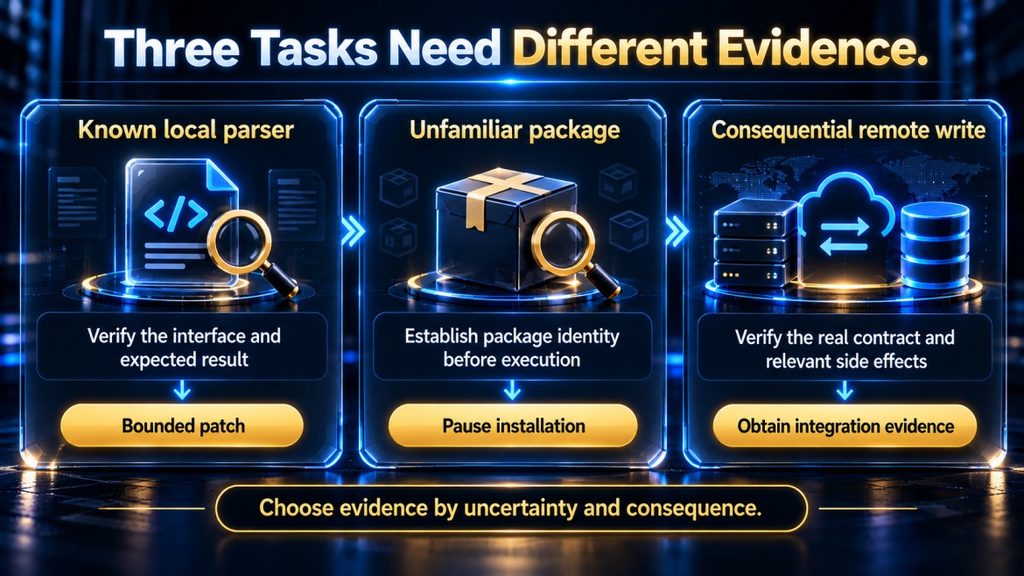
Apply W.O.R.T.H. before delegating the next API task
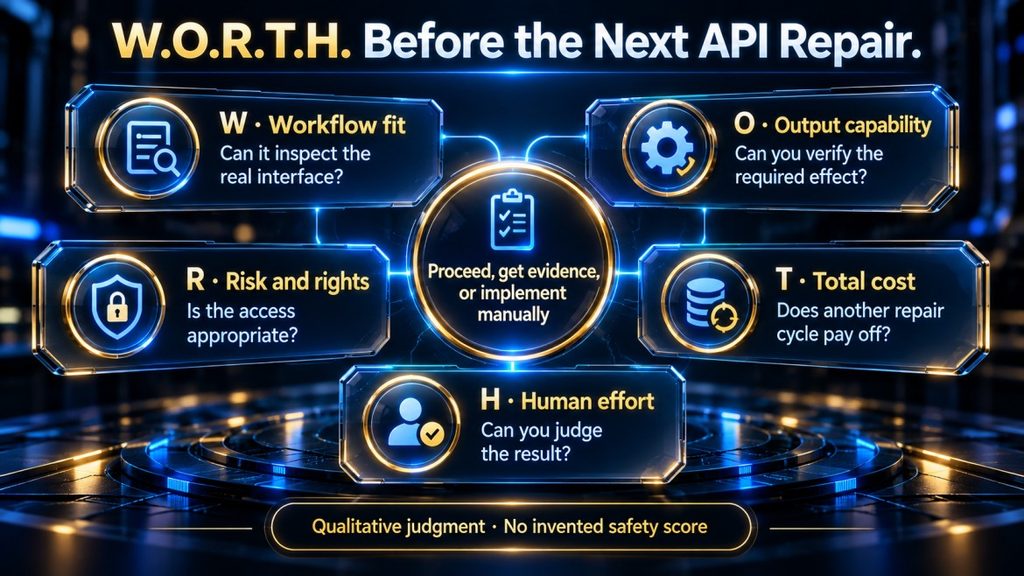
Use AI Hustle World’s W.O.R.T.H. decision lens to judge the whole assisted workflow: Workflow fit, Output capability, Risk and rights, Total cost, and Human effort. Here, the question is whether delegation produces an acceptable change at a sensible cost. A subscription feature or an attractive first answer cannot settle that question. Each dimension should change how much you delegate, what evidence you require, or when you stop.
W means Workflow fit. If the assistant can inspect your locked dependency, real definitions and existing checks, it has a useful place in the task. If you are copying isolated snippets between a repository it cannot read and a chat window, you are responsible for supplying every missing contract. Begin with a narrow change you can inspect rather than allowing it to construct an entire client around an unverified method.
Workflow fit also includes the next person’s work. An assistant that produces the right call but leaves no trace of the version or check forces your reviewer to repeat the investigation. Ask for evidence the repository can retain, not a conversation-only assurance. If the team cannot reproduce the result, the workflow has moved effort rather than reliably removing it.
O means Output capability. Judge the artifact against the required outcome, including relevant error and boundary behavior. Our catalog example returned a valid list and still failed the one-item requirement, while the JSON example returned a valid number that its constructed caller could not use. Ask what would distinguish a superficially acceptable answer from the feature you actually need. Keep that distinction in the test.
Output capability includes the assistant’s handling of unresolved facts. A useful handoff says that the local parser passed but live response compatibility was not checked. An unhelpful handoff converts those different results into “everything works.” Prefer the assistant that exposes the remaining question, because it gives you a defensible acceptance decision even when the work is incomplete.
R means Risk and rights. Match the assistant’s access to the task and the consequence of a mistake. A local data-formatting script does not need permission to install arbitrary packages, change production records or send customer data elsewhere. For a consequential integration, decide which code and data it may inspect, which commands it may run, and which actions require human acceptance. Those boundaries should exist before you discover an unsupported call.
Do not average a serious risk away with good performance elsewhere. If the package identity is unknown, faster generation does not justify installation; if the service contract is unverified, a cheap plan does not validate a state-changing operation. This is a decision constraint, not a low score to compensate for with other features. Keep the task within the evidence and permissions you actually have.
T means Total cost. Include context preparation, generation, verification, repair and review alongside the allocated tool cost. A prompt that produces code quickly can be expensive when the same unsupported assumption survives several revisions. Compare similar tasks from start to accepted outcome. Our coding-assistant comparison covers product choices; this lab supplies no pricing or productivity ranking.
Total cost also includes what persists after the task. An unnecessary dependency creates maintenance obligations, and a wrapper around the wrong interface can make later changes harder to inspect. For a small supported operation, a manual adapter can cost less than another speculative generation cycle. The assistant can still help explain the declaration without being responsible for writing every line.
H means Human effort. Count the investigation and judgment left to you, not just the typing the assistant removed. If you already understand the requirement and can read the declaration, reviewing a focused patch is manageable. If you cannot tell whether the response field, permission or retry behavior is correct, the assistant’s confident explanation does not close that knowledge gap. Ask an owner or experienced reviewer to establish the contract before expanding the implementation.
Use this dimension to choose your next task as well as your next tool. If you are learning a library, asking for an explanation of its real declaration can be more useful than accepting a complete generated integration. If you maintain a mature repository with established checks, bounded implementation may be sensible. Delegate where you can recognize a wrong answer and obtain the evidence needed to reject it.
| Your situation | W.O.R.T.H. assessment | Practical decision |
|---|---|---|
| Known library, locked version, small patch, clear outcome. | Good workflow fit; output and review are inspectable. | Delegate the bounded patch and verify the relevant contract. |
| Unknown package offered to rescue an import. | Package identity and execution risk remain unresolved. | Pause installation; verify identity or use approved code. |
| Real call changes durable records; sandbox contract unavailable. | Consequence is high and outcome evidence is incomplete. | Limit work to a reviewed proposal until appropriate verification is possible. |
| Repeated unsupported repairs for an operation you understand. | Total cost and human effort are rising without resolving uncertainty. | Inspect the declaration and consider implementing the small adapter manually. |
| You cannot judge the interface or required behavior. | Human verification capability is insufficient for acceptance. | Use AI for explanation; obtain contract guidance before integration. |
We are using W.O.R.T.H. qualitatively, not assigning an invented safety score to five fixtures. The decision can be “proceed with a bounded patch,” “obtain missing evidence,” or “implement this small operation manually.” A critical risk or an unavailable contract can determine the answer even when the other dimensions look favorable. That is more useful than a numerical total with no measured basis.
Measure accepted work instead of a fast first draft
Measure the complete task before claiming that AI saved time. Record context preparation, generation, verification, repair and review, then compare the total with a comparable manual task. Avoid comparing a generated first draft with a manually completed change. The comparison should end at the same acceptance boundary.
An illustrative calculation makes the difference concrete. Suppose a manual change takes 40 minutes, while an assisted change takes 6 minutes to prepare context, 4 to generate, 12 to verify, 15 to repair and 8 to review. The assisted total is 45 minutes, making it 5 minutes slower despite the 4-minute generation step. These are invented teaching inputs, not measured results from our experiment or a claim about typical developer performance.
Count the whole task
You can turn your own observations into a cost estimate once you have comparable timings. Multiply the difference in completed-task hours by the relevant labor cost, then subtract the allocated tool or usage cost; document how you allocated that cost. A positive estimate still needs interpretation if the tasks differed in complexity or quality. The point is to make assumptions visible rather than attach a savings percentage to an unmeasured workflow.
For a team, track repeated unsupported calls, repair rounds, unexpected dependency additions, review time and defects that escape the checks. Use comparable task groups and inspect why a result changed before crediting the model or prompt. A rise in generated code is not itself an improvement. The useful question is whether acceptable changes reach review with fewer unresolved assumptions and less total work.
What changes when coding systems get better
Version-aware retrieval and schema-backed generation can narrow the set of available calls. They help when the source matches the project and the intended behavior is clear. They do not make an available method the right method for the feature. Our expectation is that better tools will move mechanical checks earlier while leaving outcome and consequence decisions visible.
That is an analytical outlook, not a measured forecast. As an agent works across more files, an unsupported assumption can spread into wrappers, mocks and callers before anyone reviews the original boundary. Agreement among those files then looks like reassurance, even though all of them inherited the same mistake. Keeping the real contract and evidence close to the change helps a reviewer find the origin instead of chasing every downstream symptom.
The traditional habits of reading definitions, tracing callers and testing behavior exist because software can be syntactically valid and functionally wrong. AI can help perform those steps, but it does not remove their purpose. If you do nothing about verification, the guessed interface can become something your own repository appears to endorse. The cost grows when later contributors must distinguish the library’s actual contract from an assumption your code has normalized.
How we researched and tested this guide
AI-assisted research and drafting supported this guide, with claims checked against the six primary sources linked at the relevant passages. We compared the coverage of five close troubleshooting guides and refreshed the search before this revision. The original experimental contribution belongs to AI Hustle World: five authored Python counterexamples with corrected controls, plus the separate Node Response check. These are controlled local demonstrations, not customer incidents or tests of commercial coding assistants.
The saved Python run is dated 30 September 2026 and records Python 3.12.14, the five expressions, each check’s observed output and the corrected outcomes. Syntax parsing used ast.parse; lookup and binding were recorded independently; outcome assertions retained the expected result when the implementation changed. All five corrected checks passed. The reconstruction instructions and comparison table above make the method inspectable without pretending that the chosen cases form a representative statistical sample.
The Node check used v24.19.0 and a locally constructed Response containing AHW, with no network request. It established the callable member and resulting text in that environment. Neither experiment measured productivity, hallucination prevalence, security certification or real-service compatibility.
Final Thoughts
The most useful result from our lab was the argument check that passed before execution failed. It forced us to distinguish the outer signature from the component that interpreted the option. The two successful executions with wrong outcomes exposed a second boundary: working code and the required behavior can still differ. Ask what the check proved before using its result to approve the change.
Start with the interface your project runs, preserve an independent expectation, and make the smallest supported correction. Use W.O.R.T.H. to decide whether the remaining work suits delegation and whether another repair cycle is sensible. If the answer requires a
live contract, an owner’s decision or a stronger test, obtain that evidence before accepting the consequential behavior. You do not need the assistant to sound more certain; you need a result you can inspect and defend.
Once you know how to verify an API call, choosing the tool that helps you make that change is the next decision. Compare Cursor, GitHub Copilot and Claude Code by context, permissions and review effort before delegating a patch, because a plausible suggestion is still only a starting point.
Your API Works. Is the Whole Change Ready?
Review the surrounding AI-generated change for bugs, security boundaries and missing evidence before you decide it is ready to merge.
Review the Whole AI-Generated Change →Frequently Asked Questions
What is a hallucinated API in AI-generated code?
It is an interface detail presented as available when the relevant library, service or project does not support it. The invention might be a method, import, parameter, endpoint, option or response field. A real call used with the wrong assumptions is related, but it needs a behavior check as well as an interface check.
Why does AI suggest a method that does not exist?
A method name can fit familiar coding patterns without belonging to the object in your environment. Missing project context or documentation from another version leaves room for a plausible unsupported suggestion. Supply the real declaration and version, then verify the call against that evidence rather than asking for a more confident explanation.
How do I verify the installed library version?
Identify the interpreter or runtime, workspace and resolved dependency used by the affected application. Inspect the public definition, installed declaration or authoritative generated schema in that context. A page for another release or language binding cannot establish support for the call you are about to integrate.
Does a successful type check prove the call is correct?
No, because the check depends on the contract visible to the checker and does not establish every required effect. Untyped values, broad declarations or suppressed diagnostics can weaken interface checking. Even a correctly typed call needs an outcome assertion when the feature depends on behavior the types do not describe.
Can signature binding accept an unsupported keyword?
Yes, when the outer interface permits keywords that a downstream receiver rejects. In our Python 3.12.14 run, parse_ints passed binding against json.loads and failed when execution reached the decoder. Trace forwarded options to their consumer and verify the documented name there.
Why can a wrong configuration key run without an error?
A consumer can ignore keys it does not read. Our authored catalog returned all three items after receiving max_items, while its supported key was limit. The one-item expectation exposed the wrong behavior. Whether a real API is permissive needs evidence from that API, not inference from our fixture.
Is an unresolved import always a fictional package?
No, because the active environment can be missing a declared dependency or resolving it through the wrong workspace, registry or path. Establish those conditions and package identity before changing dependencies. Installing an unfamiliar replacement simply to silence the import can create a new problem without diagnosing the old one.
Should I upgrade the package to save an AI-generated call?
Upgrade when the feature and migration evidence justify the change. If the installed public interface can implement the required operation, adapting the call is usually a smaller decision. Do not let a generated method name choose your dependency roadmap or substitute for compatibility review.
How does W.O.R.T.H. help with API verification?
It makes you examine workflow fit, output capability, risk and rights, total cost, and human effort before expanding delegation. A known interface with a clear outcome can suit a bounded assisted patch; an unknown package or unverified consequential operation calls for missing evidence first. The assessment is qualitative here, with no invented numerical safety score.
What should I ask for when the assistant corrects its code?
Supply the exact failure, relevant version, verified declaration and unchanged expected outcome. Ask for the smallest correction and actual results from the relevant project check. Separate proposed checks from executed checks so an intended verification step cannot be mistaken for completed evidence.
Written by
Muntasir Ahmad Chowdhury
Founder-AI Hustle World
Muntasir Ahmad Chowdhury is the Founder of AI Hustle World, an independent publication dedicated to making Artificial Intelligence practical, trustworthy, and easy to understand. He researches AI tools, automation, customer service, productivity, and real-world business applications, helping readers make smarter technology decisions through research-driven, experience-backed content.
Expertise:
AI Tools • AI Automation • AI Customer Service • AI Productivity • Generative AI • AI Workflows
Get Smarter With AI
Enjoyed this guide? Get practical AI tools, tutorials, and honest reviews delivered to your inbox.