Evidence: Documentation reviewed
Last checked: August 2026
What was done: Written from official documentation and the published sources linked in this article. Not hands-on tested.
Files: None
Affiliate links: No
How AI Detects Financial Anomalies, Fraud & Leakage
Financial fraud rarely looks like fraud when viewed one transaction at a time. A payment may be slightly larger than usual, an employee may submit an unusual expense, a supplier may change its banking information, or a customer may suddenly receive a different discount. Each event can have a perfectly legitimate explanation. The difficulty is that the warning sign often becomes meaningful only when it is connected to other changes happening across the financial system.
That is where AI-based anomaly detection becomes interesting. Instead of relying exclusively on predefined rules such as “flag every payment above $10,000,” AI can examine historical behavior, transaction patterns, timing, relationships between entities, frequency and other contextual signals to identify activity that deserves attention. The objective is not to allow a machine to declare that someone committed fraud; it is to help finance, accounting, audit and risk teams find potentially important problems earlier and investigate them more intelligently.
This distinction becomes increasingly important as businesses process more transactions across more systems. Finance teams cannot manually compare every payment with years of vendor history, every expense with employee behavior, or every journal entry with patterns across thousands of accounts. AI can perform those comparisons at a scale that would be impractical for a human team, but its usefulness depends on what happens after the anomaly is found.
Quick Answer
AI detects financial anomalies by establishing patterns of expected financial behavior and then identifying activity that materially deviates from those patterns. Depending on the system, this can involve statistical analysis, machine learning, behavioral modeling, rules, risk scoring and relationship analysis across transactions, vendors, customers, employees and accounts.
The important distinction is that an anomaly is not automatically fraud. An unusual transaction may be completely legitimate, caused by an accounting error, or indicate financial leakage rather than intentional misconduct. Effective AI systems therefore use anomalies as signals for investigation, combine multiple sources of context to prioritize risk, and keep humans involved when determining what actually happened and what action should follow.
The real value of AI is therefore not simply finding “weird” transactions. It is helping organizations move from isolated alerts toward a continuous system for identifying, prioritizing and investigating financial risk.
Why Financial Fraud and Leakage Are So Difficult to See
Financial control becomes harder as transaction volume and organizational complexity increase. A company may have accounting data in an ERP, supplier information in a procurement system, employee expenses in another platform, payment information coming from banks, customer data in a CRM and operational information distributed across multiple business systems. Each system may contain useful evidence, but the risk often appears in the relationship between them.
Imagine a supplier that normally sends invoices between $5,000 and $20,000. One month, a $72,000 invoice appears. A traditional rule can identify the unusual amount immediately, but the rule cannot determine whether the invoice represents fraud, a legitimate large order, a contract change or an accounting mistake.
Now imagine that the supplier’s bank details were changed three days earlier, the invoice arrived immediately before a payment run, the purchase order does not fully reconcile with the invoice, and another supplier connected to the same employee has shown similar behavior. The transaction has not become fraudulent simply because more warning signs exist. What has changed is the amount of evidence available to justify a closer investigation.
That is the central challenge in financial anomaly detection. Organizations need to distinguish between activity that is merely unusual and activity that is unusual in a way that creates meaningful financial risk.
The problem exists on both sides of the detection equation. If a company misses genuine fraud, the consequences can include direct financial loss, regulatory problems and reputational damage. If the company flags too much legitimate activity, investigators can become overwhelmed, employees can lose confidence in the control system, and genuinely important cases can disappear among thousands of low-value alerts.
A useful detection system therefore needs to optimize for signal, not noise.
Anomaly, Error, Leakage and Fraud Are Different Problems
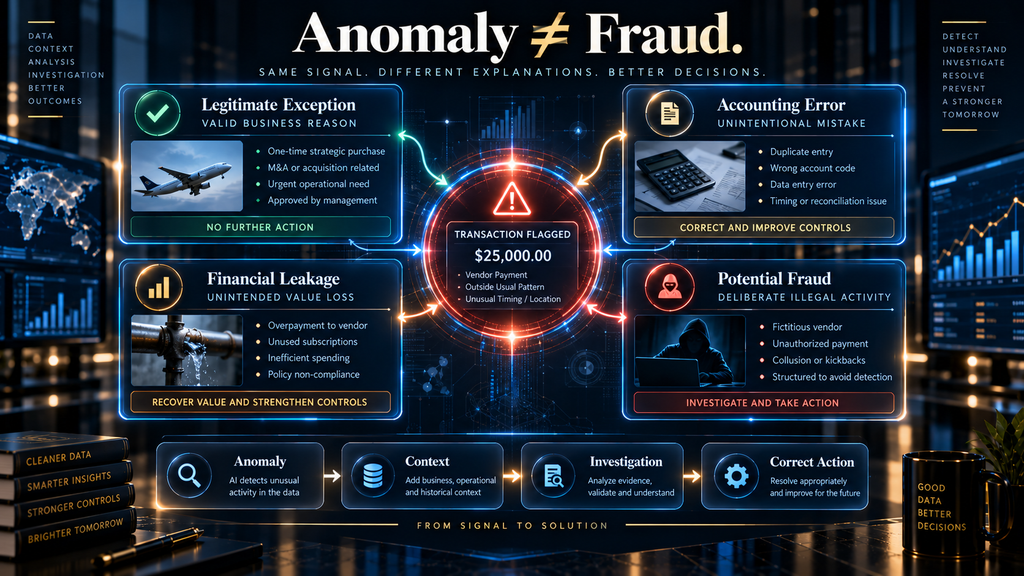
The terms anomaly, fraud and leakage are often used interchangeably in discussions about AI, but they describe different things. An anomaly is simply a meaningful deviation from an expected pattern. It does not tell us why the deviation occurred.
An accounting error can produce an anomaly without any fraudulent intent. A duplicate invoice may result from an administrative mistake. A pricing configuration problem may cause the business to systematically undercharge customers, creating revenue leakage without anyone deliberately trying to steal money. Fraud, by contrast, involves intentional deception for improper financial benefit.
These categories can overlap. A fraudulent transaction can be anomalous, and fraud can create leakage. But not every anomaly is fraudulent, and not every form of leakage involves fraud.
This is why the most useful role for AI is usually detection and prioritization rather than automated judgment. The model identifies behavior that does not fit expectations, gathers or highlights relevant context, and helps determine which cases deserve human attention. An investigator then determines whether the activity is legitimate, erroneous, wasteful, suspicious or fraudulent.
That distinction is not merely a technical detail. It determines how the entire system should be designed and how its performance should be measured.
How AI Establishes What Normal Financial Behavior Looks Like
Anomaly detection begins with a deceptively difficult question: what exactly counts as normal?
There is no universal definition. A $100,000 payment may be routine for a large supplier and extremely unusual for a small contractor. A $20,000 expense might be normal for an international executive trip but highly unusual for an employee whose typical expenses are below $500. A large month-end journal entry might be expected in one account and suspicious in another.
AI can establish different forms of normality by examining historical behavior and relevant comparisons. It can look at how a particular vendor normally behaves, how similar vendors behave, how an employee’s expenses have changed over time, how transaction volumes normally fluctuate, or how financial activity typically behaves during different periods of the year.
This is more powerful than applying the same threshold to every transaction because financial behavior is inherently contextual.
Consider an employee who normally submits five expense reports a month, usually between $50 and $400, primarily for domestic travel. Suddenly, the employee submits several expenses above $1,000 from unfamiliar merchants and locations within a few days. None of those transactions necessarily proves misconduct. But the combined change in amount, frequency, merchant behavior and geography creates a much stronger anomaly signal than any single transaction would have produced.
The same principle applies to vendors, customers, payments, refunds, journal entries and procurement activity. AI can identify changes in behavior that would be difficult to encode manually because the pattern depends on multiple variables interacting at the same time.
The AI Hustle World Financial Anomaly-to-Action Loop
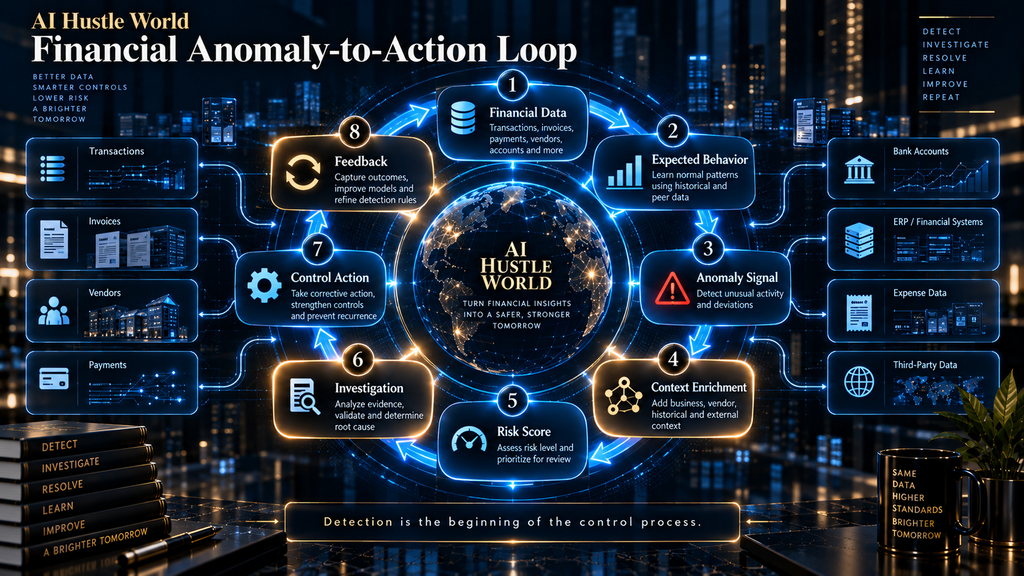
The best way to understand AI-based financial detection is not as a model that produces an alert, but as a continuous operating loop: Financial Data → Expected Behavior → Anomaly Signal → Context Enrichment → Risk Assessment → Investigation → Control Action → Feedback → Model or Rule Update.
Financial data provides the raw material. Depending on the use case, that can include invoices, payments, expenses, journal entries, purchase orders, vendor records, customer activity, payroll data, bank information and operational signals.
The system then establishes expected behavior from historical patterns, rules, peer comparisons and behavioral models. When new activity deviates from those expectations, the system generates an anomaly signal. The next stage is critical because an anomaly becomes more useful when it is enriched with context.
A transaction may be unusual because of its amount, but its risk can change substantially when the system also sees a recent bank-account change, unusual timing, an unfamiliar approval pattern or a relationship between the vendor and another entity. Instead of asking whether one number looks strange, the system begins asking whether several pieces of evidence point in the same direction.
The resulting risk assessment helps determine which cases deserve investigation first. A human investigator can then examine the underlying evidence, establish the business context and determine the appropriate action. The outcome—whether the alert was legitimate, erroneous, fraudulent or irrelevant—can subsequently become feedback for improving the detection process.
This last stage is what turns anomaly detection into a system rather than a one-time prediction. Financial behavior changes, business models change and fraud techniques change. A detection environment that learns from investigation outcomes has a much better chance of remaining useful over time.
Why Rules Still Matter in an AI Detection System
It would be a mistake to describe traditional rules as obsolete simply because AI can recognize more complicated patterns. Rules remain extremely valuable for conditions that are known, deterministic and easy to explain.
A business may require additional approval for payments above a certain amount, prohibit particular expense categories, require purchase orders for specific purchases or flag changes to supplier banking information. These controls are transparent and predictable, which makes them useful for compliance and routine risk management.
The limitation is that rules generally depend on someone knowing the risk pattern in advance.
Suppose a company requires additional approval for purchases above $10,000. A person trying to circumvent the control could potentially divide one purchase into several smaller transactions. Each transaction might remain below the threshold even though the combined behavior is unusual.
An AI system can potentially recognize the broader pattern by examining transaction frequency, timing, vendor relationships and aggregate spending.
The strongest architecture is therefore not rules versus AI. It is rules working alongside AI and human judgment. Rules can enforce known controls, AI can identify complex patterns and emerging anomalies, and humans can investigate situations where context and consequences matter.
From Statistical Anomalies to Machine Learning
Not every anomaly requires an advanced machine-learning model. Statistical techniques can already identify many useful deviations by comparing financial activity with historical ranges, distributions and time-series patterns.
A business might normally process a certain number of invoices from a supplier each month. A sudden increase can be flagged for review. A branch that normally issues a predictable amount of refunds may suddenly move significantly outside its historical range. A general-ledger account that normally contains a small number of adjustments may suddenly receive an unusual concentration of entries near period-end.
Statistical methods are valuable because they can identify deviations without requiring the organization to define every possible fraud pattern in advance.
Machine learning extends this capability by learning more complicated relationships among variables. In supervised learning, models use historical examples that have been labeled, such as confirmed fraud and legitimate transactions, to learn patterns associated with different outcomes. This can be powerful when good-quality labeled data exists, but financial fraud is a difficult training problem because confirmed fraud represents only a small portion of total activity and historical labels may reflect the limitations of previous detection processes.
Unsupervised approaches take a different path by searching for unusual patterns without requiring every suspicious behavior to be labeled beforehand. This can be particularly useful for identifying novel patterns that the organization has not explicitly programmed into its controls.
In practice, financial detection can involve several approaches at once. A mature system may combine deterministic rules, statistical monitoring, supervised models, unsupervised anomaly detection and human investigation rather than expecting one algorithm to solve every problem.
Why Context Matters More Than a Single Suspicious Transaction
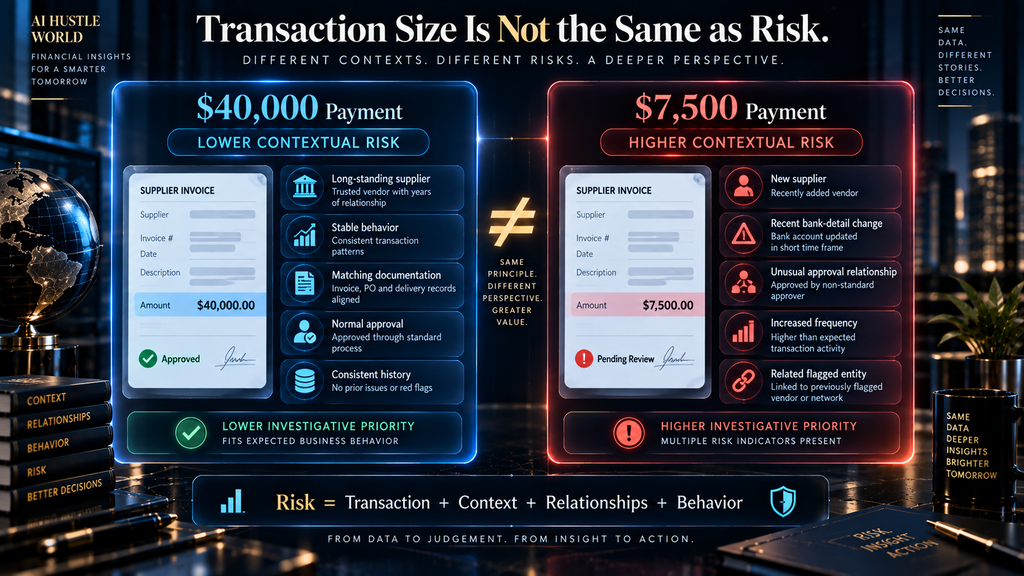
One of the most important ideas in financial anomaly detection is that risk is contextual.
Consider two payments of $25,000. The first goes to a long-standing supplier, matches the purchase order, follows the normal approval process and falls within the supplier’s historical transaction range. The second goes to a recently created vendor, is several times larger than comparable transactions, follows a recent banking-detail change and appears alongside several other unusual invoices.
The amount is identical. The risk is not.
This is why AI can be useful beyond simple threshold-based controls. Instead of evaluating a transaction as an isolated event, it can combine information about amount, timing, frequency, history, relationships and behavioral changes.
That ability becomes even more valuable when individual warning signs are weak. A transaction might not be suspicious because of its amount alone. It might not be suspicious because of its timing alone. It might not be suspicious because the vendor recently changed its bank account. But when all three occur together, the combined pattern may warrant considerably more attention.
This is the difference between detecting unusual numbers and detecting unusual financial behavior.
Risk Scoring Helps Investigators Focus Their Attention
Large organizations cannot manually investigate every anomaly. Even a relatively small company can generate thousands of potential alerts when financial activity is monitored continuously.
Risk scoring provides a way to prioritize them.
A system might consider transaction value, deviation from historical behavior, frequency, timing, vendor history, policy violations, changes in account information, relationships between entities and similarity to previously investigated cases. These signals can contribute to an overall risk assessment that determines which cases should be examined first.
The important point is that the score should be treated as a prioritization mechanism, not as a verdict.
An investigator receiving a high-risk alert should be able to understand why the case was prioritized. A useful alert might explain that the transaction is several times larger than the vendor’s normal amount, the vendor’s bank information changed recently, the invoice arrived outside its typical timing and similar activity has previously resulted in an investigation.
That gives the investigator something to work with. An unexplained score such as “94/100 suspicious” provides much less value because it asks the investigator to trust the model rather than evaluate the evidence. The quality of an AI detection system is therefore partly determined by the quality of the investigation experience it creates.
The False-Positive Problem Can Become an Operational Failure
A detection system can become less effective when it is too sensitive.
Imagine an organization processes 100,000 transactions and its AI system produces 10,000 alerts. On paper, the system appears extremely active. In practice, the investigation team may only have the capacity to meaningfully review 500 cases.
The remaining alerts become backlog.
As that backlog grows, investigators may begin dismissing alerts quickly. Business teams may stop taking the system seriously. Legitimate transactions may be delayed unnecessarily. Over time, the organization can develop alert fatigue, which undermines the very control system that was supposed to improve financial protection.
This is why the objective should not be maximum alert generation. It should be maximum useful signal per investigator hour.
The right threshold depends on the cost of missing a risk, the cost of investigating a case and the organization’s capacity to respond. A bank, multinational corporation and small business will not necessarily need the same sensitivity.
The most effective detection environment therefore treats investigation capacity as part of the system design rather than as an afterthought.
False Negatives Create the Opposite Risk
Reducing false positives too aggressively can create another problem: important suspicious activity may be classified as normal.
Fraudsters can deliberately imitate legitimate behavior. They can distribute activity across multiple transactions, use different accounts or vendors, change timing and amounts, or adapt their behavior after learning how controls work.
A detection model trained on historical examples can also struggle when the business environment changes. A new product, acquisition, pricing model, geographic expansion or operational process can make historical behavior less representative of the present.
This means anomaly detection cannot be treated as a model that is trained once and then forgotten. The organization needs to monitor detection performance, investigate model drift, review false positives and false negatives, incorporate new investigation outcomes and periodically reassess whether the system still reflects the business. The strongest detection systems are therefore learning control environments, not static alert generators.
Financial Leakage Is Often More Common Than Obvious Fraud
Fraud attracts attention because it involves deliberate misconduct, but businesses can lose substantial amounts of money through problems that nobody intended to create.
A company may pay the same invoice twice. A pricing rule may systematically undercharge certain customers. A contract may contain services that are delivered but never billed. An employee may accidentally submit duplicate expenses. A procurement process may repeatedly pay more than expected because supplier pricing is not being monitored effectively.
These are financial leakage problems. They can be just as important to the business as fraud because they reduce profitability and cash generation even when nobody is intentionally stealing.
AI is particularly useful here because leakage can be distributed across enormous numbers of individually insignificant transactions. A single duplicate payment might not matter much. Thousands of small pricing discrepancies or missed billing events can matter considerably.
This expands the role of anomaly detection beyond the traditional fraud department. Finance, accounting, revenue operations, procurement and audit teams can all use the same underlying concept to identify preventable financial loss.
The question becomes broader than: “Can we detect fraud?” It becomes: “Where is financial behavior deviating from what the business expects, and what is that deviation costing us?”
Fraud Often Becomes Visible Only When Transactions Are Connected
Some of the most difficult financial risks cannot be understood by examining transactions independently.
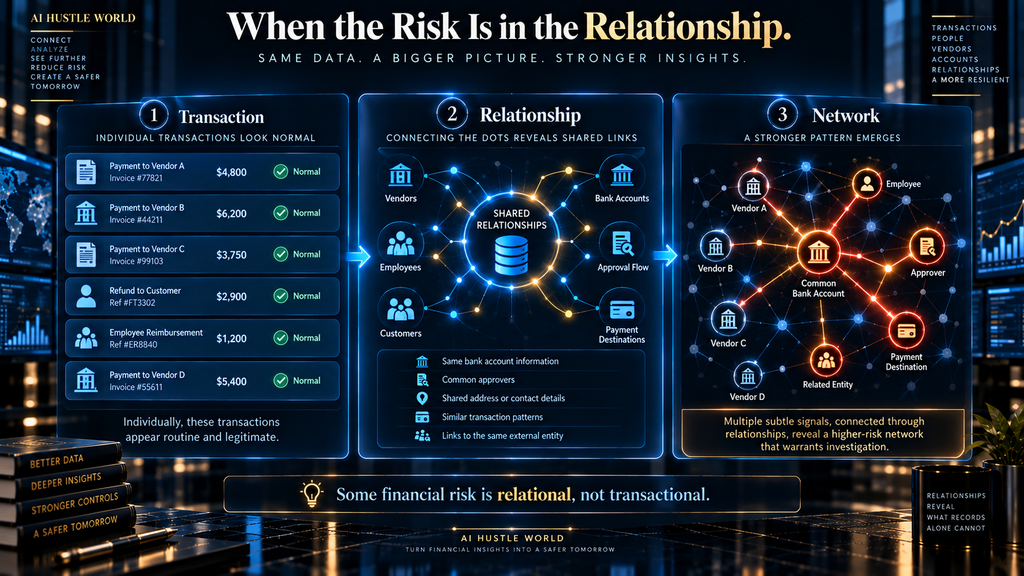
Imagine a supplier that appears normal on its own. Its invoices are reasonable and its payment history does not contain obvious violations. The risk only becomes apparent when the supplier is connected to other information.
The supplier shares an address with another vendor. Its bank account is associated with another entity. An employee involved in approving its invoices has a relationship with one of the connected businesses. Similar payments are moving through the network in a circular pattern.
The suspicious behavior exists between the transactions.
This is where relationship and graph-based analysis can add another dimension to financial anomaly detection. Instead of viewing vendors, employees, accounts and transactions as isolated records, the system can model their relationships and search for unusual structures.
This is particularly useful for identifying patterns associated with collusion, related-party risks, shell entities, circular transactions and other forms of coordinated financial behavior. The broader lesson is important: sometimes the transaction is not suspicious; the network around the transaction is.
The AI Hustle World Financial Signal Confidence Pyramid
A useful way to prevent overconfidence in AI alerts is to think about financial signals in stages rather than treating every anomaly as equally important.
At the first level, activity is simply unusual. Something differs from the expected pattern, but there is little additional evidence.
At the second level, the activity becomes contextually unusual because other circumstances increase concern. The transaction may be unusual in amount and timing, for example, while also involving a recent account change.
At the third level, it becomes relationally suspicious because the activity connects to other unusual transactions, entities or behaviors. At the fourth level, the organization has actionable risk because several independent signals point toward a situation that warrants focused investigation or control intervention.
This framework reinforces an important principle: an anomaly score is not a verdict. The higher-value question is not whether the machine has “caught fraud.” It is whether the system has assembled enough evidence to justify human attention.
Why Explainability Matters in Financial Detection
Financial decisions often need to be explained after the fact. An investigator may need to document why a transaction was reviewed, why a payment was stopped, why a vendor was escalated or why an accounting process was changed.
An AI system that simply produces a risk score without meaningful explanation creates a difficult situation. Consider the difference between these two alerts. Alert A: “Risk score: 94.”
Alert B: “Transaction amount is 4.1 times the vendor’s historical average; vendor banking information changed three days ago; invoice timing is outside the normal pattern; purchase order reconciliation is incomplete; and similar transactions have previously required investigation.” The second alert is far more useful because it gives the investigator an evidence trail.
Explainability does not mean every AI system needs to expose every mathematical detail of its model to the end user. It means the organization should be able to understand the important factors contributing to a decision well enough to investigate, challenge and document it.
This becomes particularly important when AI is used in high-consequence financial decisions. The higher the potential impact, the stronger the justification for human review and clear evidence.
The Human Investigator Is Still Part of the System
The strongest architecture is not AI replacing investigators. It is AI changing what investigators spend their time doing.
Instead of manually searching millions of transactions for patterns, investigators can focus on the cases that have already been prioritized. Instead of spending most of their time collecting basic information, they can begin with a contextual evidence package. Instead of reviewing every transaction equally, they can concentrate their expertise on ambiguous or consequential cases.
This creates a useful division of labor.
AI is particularly good at scale, pattern recognition, comparison and continuous monitoring. Humans are better positioned to understand business context, evaluate ambiguous situations, interpret intent and make decisions where consequences are significant.
Suppose a vendor suddenly submits an invoice three times larger than normal. The AI can identify the anomaly immediately. A finance professional may know that the company just expanded its contract with that supplier and the larger amount is completely legitimate.
That is not an AI failure. It is exactly why the system should be designed around human investigation rather than automated accusation.
Where AI Financial Anomaly Detection Fails
The technology has meaningful limitations, and organizations should understand them before treating AI as a complete financial-control solution.
Poor data is one of the most fundamental problems. If vendor identities are inconsistent, important fields are missing, transaction feeds are delayed or systems cannot be reliably connected, the model may have an incomplete picture of financial behavior.
Changing business conditions create another problem. Historical patterns become less useful when a company launches a new product, changes pricing, enters a new market or acquires another business. The model may interpret legitimate structural change as suspicious because the behavior no longer resembles the past.
Fraud adaptation creates a third challenge. Once attackers understand how a control works, they can attempt to operate around it. This is one reason detection needs continuous monitoring rather than a fixed set of assumptions.
False positives and false negatives remain unavoidable trade-offs. A system that catches everything will generate too much noise, while a system that produces almost no false positives may miss important risks.
Finally, excessive automation can create its own control problem. Automatically blocking transactions or making serious accusations based only on a model score can create operational, legal and governance consequences.
AI should strengthen financial judgment, not eliminate the need for it.
The Threshold-Gaming Problem
Fixed thresholds are easy to understand, but that predictability can sometimes become a weakness.
Suppose a company requires additional approval for purchases above $10,000. A person attempting to avoid that control could divide one purchase into several smaller transactions.
The system might see three ordinary-looking payments. A more sophisticated detection system can potentially recognize that the payments occurred close together, involved the same supplier, had similar descriptions and collectively represented behavior outside the normal pattern.
This principle extends beyond procurement. Suspicious activity can be distributed across vendors, accounts, employees, periods or transaction types in ways that allow each individual event to appear ordinary.
The advantage of AI is therefore not simply that it can identify larger anomalies. It can sometimes identify relationships and sequences that make individually ordinary transactions collectively unusual.
That is an important distinction between pattern recognition and simple threshold enforcement.
How Businesses Should Implement AI-Based Financial Anomaly Detection
The best starting point is not the AI model. It is the financial problem.
An organization should first determine where meaningful financial risk or leakage exists. That could be duplicate payments, unusual journal entries, supplier fraud, revenue leakage, expense abuse, procurement irregularities or another specific problem.
Once the problem is defined, the business can map the data required to investigate it. That might involve accounting records, invoices, payments, purchase orders, supplier information, employee information, bank data or operational systems. At this stage, the organization should also identify gaps and inconsistencies because poor data can undermine the entire detection process.
The next step is to establish a baseline for normal behavior. Existing rules should remain in place where they work effectively, while AI can be introduced where the organization needs more sophisticated pattern recognition or broader contextual analysis.
The detection system then needs to connect to an actual investigation workflow. Every meaningful alert needs an owner, a process for gathering evidence and a defined way to record the outcome.
Finally, the organization should feed those outcomes back into the system. Confirmed fraud, legitimate exceptions, accounting errors and false positives are all useful information because they reveal where the detection logic is working and where it needs improvement.
The implementation sequence should therefore look less like data → AI → alerts and more like: Financial Problem → Data Foundation → Expected Behavior → Detection → Risk Prioritization → Investigation → Action → Measurement → Improvement.
That distinction is fundamental. An alert without an investigation process is not a financial-control system.
The AI Hustle World Financial Detection Scorecard
Financial anomaly detection should be measured according to the outcomes it produces rather than the number of alerts generated.
| KPI | What It Measures | Why It Matters |
|---|---|---|
| Detection Coverage | How much relevant financial activity is monitored | Shows the actual scope of the control |
| Precision | How many alerts prove meaningful | Measures signal quality |
| False-Positive Rate | How much legitimate activity is unnecessarily flagged | Shows wasted investigation capacity |
| Time to Detection | How quickly suspicious activity is identified | Measures response speed |
| Investigation Time | How long investigators need to resolve a case | Measures operational efficiency |
| Confirmed Loss Prevented | Financial loss stopped before completion | Connects detection to direct business value |
| Recovery Value | Financial value recovered after detection | Measures tangible financial impact |
| Model Drift | Whether detection performance changes over time | Shows whether the system remains reliable |
This changes the executive conversation. Instead of asking, “How many anomalies did the AI detect?” management can ask, “How much meaningful financial risk did the system help us identify, investigate and address?” That is a much more useful measure of success.
The Economics of Detecting Financial Risk Earlier
The business case for AI-based anomaly detection should not be reduced to headcount savings. Financial controls create value when they prevent losses, recover leakage, reduce investigation costs and allow the organization to respond earlier.
Consider the difference between discovering a fraudulent payment before it leaves the company and discovering it six months later during an audit. The underlying fraud may be identical, but the financial outcome can be dramatically different because the organization has more opportunity to stop the transaction, recover funds and prevent recurrence when detection occurs earlier.
The same principle applies to leakage. A pricing problem that goes unnoticed for a week may be relatively inexpensive. The same problem continuing for two years across thousands of customers can become a major profitability issue.
This is why detection speed matters. A system that generates slightly fewer alerts but consistently identifies important problems earlier may be more valuable than a system that generates a much larger number of alerts without improving actual financial outcomes. The economics ultimately come down to the relationship between risk exposure, detection speed, investigation capacity and financial consequence.
What Happens If Businesses Continue Relying Only on Periodic Controls?
Traditional financial controls still have an important role. Reconciliation, audit procedures, approvals and periodic reviews are not going away simply because AI exists.
The problem appears when financial activity grows faster than the organization’s ability to examine it.
A monthly review may identify an unusual pattern eventually, but by then the business may have processed thousands of related transactions. A quarterly audit may identify a control weakness, but the underlying leakage may have continued for months. A manual investigation may uncover supplier fraud, but only after substantial money has already moved.
Periodic controls create a natural delay between activity and discovery. AI can reduce that delay by continuously comparing financial behavior with expected patterns and highlighting meaningful changes as they occur.
The objective is not to eliminate periodic controls. It is to add a layer of continuous intelligence that helps organizations identify important signals before they become large financial problems.
The Future of Financial Anomaly Detection Is Continuous Intelligence
The next stage of financial control is likely to involve increasingly continuous monitoring rather than periodic inspection alone.
Financial systems will continue producing more data, while businesses become more interconnected and fraud techniques become more sophisticated. At the same time, AI will become better at recognizing behavioral patterns, relationships and changes that are difficult to capture through manually maintained rules.
The most valuable systems will not simply monitor individual transactions. They will connect transactions to entities, entities to relationships and current behavior to historical expectations.
They will also become more tightly connected to investigation workflows. Instead of producing an alert and stopping, the system can provide contextual evidence, prioritize cases, record investigation outcomes and use that feedback to improve future detection.
This creates a broader shift in the role of financial controls. The organization moves from asking, “Did something go wrong?” after the fact toward asking, “Is something beginning to look wrong right now?”
That is a much more powerful question.
Final Thoughts
AI is not valuable in financial anomaly detection because it can magically recognize fraud. It is valuable because it can examine financial behavior at a scale and level of contextual comparison that would be difficult for human teams to achieve manually.
The strongest systems combine rules, statistical analysis, machine learning, behavioral baselines, risk scoring and relationship analysis. They use those capabilities to surface meaningful signals, prioritize investigation and help humans understand why particular activity deserves attention.
The most important principle is also the easiest to forget: unusual does not mean fraudulent.
A good anomaly-detection system does not replace investigation. It makes investigation more focused, more timely and more evidence-driven. It helps finance teams find duplicate payments, revenue leakage, suspicious suppliers, unusual journal entries and potential fraud before those problems become harder and more expensive to resolve.
The future of financial detection is therefore not a machine that declares, “This transaction is fraud.” It is a continuously learning financial-control system that can recognize when the business is behaving differently, explain why the difference matters, direct human attention toward the highest-value signals and learn from what investigators discover.
An anomaly is not a verdict. It is the beginning of the investigation.
Build a Better Financial AI Strategy
Anomaly detection works best when it is connected to the wider finance operating model, so see where else AI creates value.
See the Full Finance AI Picture →FAQ
What is AI financial anomaly detection?
AI financial anomaly detection is the use of statistical methods, machine learning and behavioral analysis to identify financial activity that differs significantly from expected patterns. The system can examine transactions, timing, frequency, historical behavior and relationships between financial entities to identify activity that deserves further attention.
How does AI detect financial fraud?
AI can detect potential fraud by learning normal patterns of financial behavior and identifying deviations that may indicate elevated risk. More advanced systems can combine transaction data with behavioral, temporal and relational information to prioritize cases for investigation.
Is an anomaly automatically fraud?
No. An anomaly only indicates that activity differs from an expected pattern. It may represent legitimate business activity, an accounting error, financial leakage, a process problem or intentional fraud. Human investigation is needed to determine the underlying cause.
Can AI detect accounting fraud?
AI can help identify unusual journal entries, payment patterns, vendor behavior, expense activity and other accounting anomalies. However, an AI-generated alert does not establish fraudulent intent by itself.
Can AI detect financial leakage?
Yes. AI can help identify patterns associated with duplicate payments, missed billing, pricing inconsistencies, unusual refunds, procurement problems, expense anomalies and other forms of preventable financial loss.
How does AI reduce false positives in fraud detection?
AI can evaluate multiple contextual signals instead of relying solely on fixed thresholds. Behavioral analysis, risk scoring and contextual enrichment can help prioritize stronger cases while reducing the number of low-value alerts investigators need to examine.
What data does AI need for financial anomaly detection?
The required data depends on the use case, but it can include transactions, invoices, payments, purchase orders, vendor records, customer information, employee expenses, accounting entries, bank information and historical behavioral data. Reliable, consistent data is essential because the model can only identify patterns that the underlying data allows it to observe.
Can AI detect new types of financial fraud?
Some anomaly-detection approaches can identify unusual behavior without requiring the organization to have previously labeled that exact fraud pattern. However, AI cannot guarantee detection of every new fraud technique. Models must be monitored and updated as business behavior and fraud strategies evolve.
What is behavioral anomaly detection?
Behavioral anomaly detection compares current activity with an entity’s normal historical behavior. For example, an employee who normally submits a small number of modest expenses may generate an anomaly signal if their spending suddenly changes dramatically in amount, frequency, location or merchant type.
What is graph-based fraud detection?
Graph-based fraud detection analyzes relationships between entities such as employees, vendors, customers, bank accounts, addresses and transactions. This can reveal suspicious networks or connections that may not be visible when each transaction is examined independently.
Can AI replace fraud investigators?
AI can automate large-scale monitoring and help prioritize investigations, but it should not automatically replace human investigators. Humans remain important for understanding business context, evaluating ambiguous situations and determining what action should follow an alert.
What is the biggest limitation of AI financial anomaly detection?
One of the biggest limitations is dependence on data quality and relevance. Poor data, changing business behavior, false positives, false negatives, model drift and adaptive fraud techniques can all reduce detection effectiveness.
How should a business measure an AI fraud-detection system?
Businesses should measure more than model accuracy. Detection coverage, precision, false-positive rate, time to detection, investigation time, confirmed loss prevented, recovery value and model drift provide a more complete view of whether the system is producing meaningful financial value.
How should a company start using AI for financial anomaly detection?
Start with a specific financial risk or leakage problem rather than attempting to automate every financial control at once. Establish the relevant data foundation, define expected behavior, combine existing rules with AI where appropriate, build a human investigation workflow and measure whether the system improves detection speed, investigation efficiency and financial outcomes.
Sources and Further Reading
- Novelty and Outlier Detection: scikit-learn documentation on outlier detection methods such as Isolation Forest.
- AI Risk Management Framework: NIST. A voluntary framework for identifying and managing risks in AI systems.
Related Guides
- AI Cybersecurity Explained: How AI Detects Threats, Fraud & Attacks
- How AI-Powered Threat Detection Finds Attacks Faster
- How AI Detects Phishing, Social Engineering & Suspicious Messages
Written by
Muntasir Ahmad Chowdhury
Founder, AI Hustle World
Muntasir Ahmad Chowdhury is the Founder of AI Hustle World, an independent publication dedicated to making Artificial Intelligence practical, trustworthy, and easy to understand. He researches AI tools, automation, customer service, productivity, and real-world business applications, helping readers make smarter technology decisions through research-driven, experience-backed content.
Expertise:
AI Tools • AI Automation • AI Customer Service • AI Productivity • Generative AI • AI Workflows
Get Smarter With AI
Enjoyed this guide? Get practical AI tools, tutorials, and honest reviews delivered to your inbox.