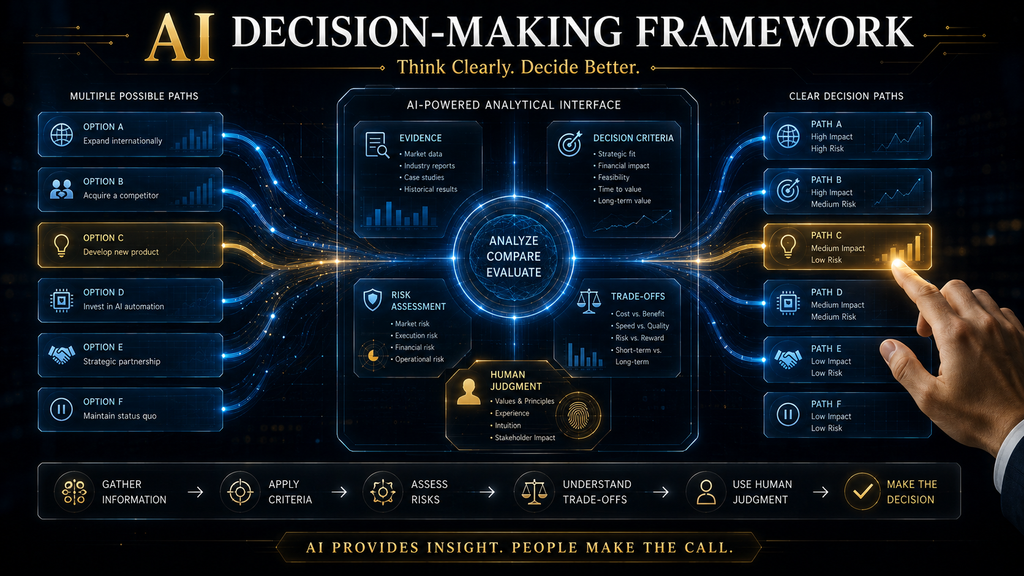
Evidence: Documentation reviewed
Last checked: September 2026
What was done: Written from official documentation and the published sources linked in this article. Not hands-on tested.
Files: None
Affiliate links: No
Last updated: September 2026. AI decision making framework consolidates the original seven-step process into the AHW Decision Quality Loop, adds a transparent Human Review Load score, documents the framework’s methodology and limitations, and replaces fragmented advice with worked examples and a reusable decision record.
AI can make a decision look clearer long before the decision is actually sound. It can summarize evidence, build a comparison table, suggest alternatives, and produce a confident recommendation in seconds. What it cannot do is quietly inherit your values, verify every premise, or accept responsibility for what happens next.
That is why the best AI decision-making framework does not begin with “What should I choose?” It begins by defining the decision, separating evidence from assumptions, deciding how much human review the situation requires, and giving AI a limited role at each stage. The result should be a better reasoning process—not a polished excuse to follow a chatbot.
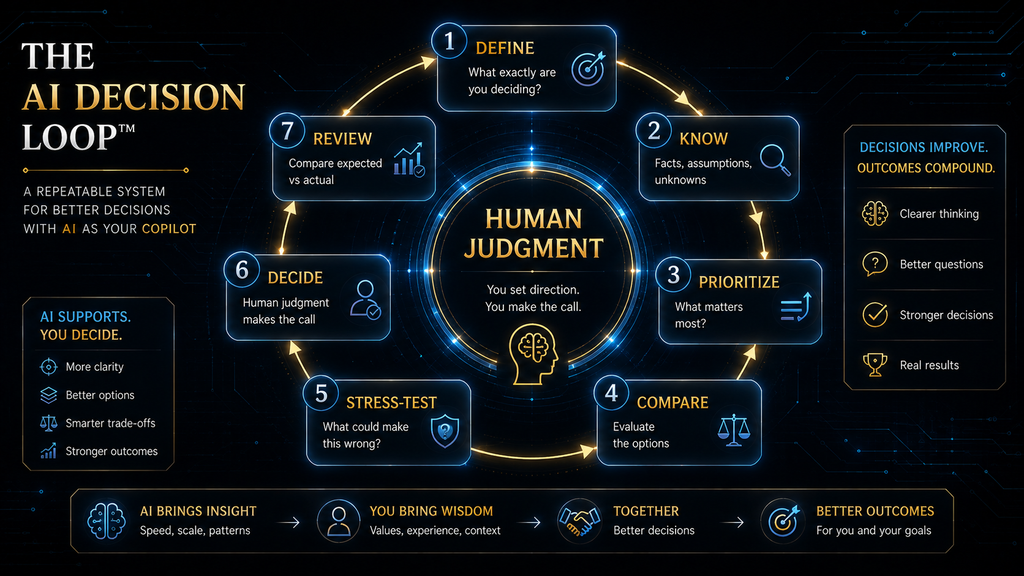
This guide introduces the AHW Decision Quality Loop: DEFINE → KNOW → PRIORITIZE → COMPARE → STRESS-TEST → DECIDE → REVIEW. A companion control, the AHW Human Review Load, helps you decide how much authority AI should have before you enter the loop. Together, they turn AI-assisted decision-making into a process that is traceable, challengeable, and proportionate to the stakes.
The Quick Answer
An AI decision-making framework is a repeatable method for using AI to structure evidence, alternatives, trade-offs, and uncertainty while leaving values, accountability, and the final choice with a human. AI is most useful as an organizer, comparison assistant, scenario generator, and critic. It becomes dangerous when fluent output is treated as verified evidence or delegated judgment.
The practical rule is simple: the more consequential, irreversible, uncertain, or rights-sensitive a decision becomes, the less authority AI should receive. A low-stakes, reversible choice may need a quick comparison and a human sense-check. A medical, legal, financial, employment, safety, or other high-impact decision needs independent evidence, qualified expertise, documented accountability, and a human decision-maker who can explain the reasoning.
The seven-step AHW loop makes that principle operational. It forces the user to define the actual decision, label what is known and unknown, weight the criteria before scoring options, challenge the leading choice, record the decision, and review the outcome later. That final review matters because a framework that never learns from outcomes is only a formatting exercise.
How We Researched This Guide
This article is a structured synthesis, not a report of controlled product testing. The framework was developed by comparing established AI risk-management principles with the recurring practical failures that appear when people use general-purpose AI for decisions: vague problem definitions, unverified premises, equal weighting of unequal criteria, automation bias, hidden value judgments, and no review after the choice is made. AI Hustle World did not conduct an experiment proving that the framework improves outcomes, so it should be treated as an editorial decision-support method rather than a statistically validated instrument.
The source foundation is deliberately authoritative. The NIST AI Risk Management Framework emphasizes governance, context mapping, measurement, and risk management; the NIST AI RMF Playbook translates those functions into suggested actions while warning that it is not a universal checklist. The OECD AI Principles contribute human-centred values, transparency, safety, and accountability, while the European Commission’s trustworthy-AI guidance frames human agency and oversight as necessary conditions for informed decisions.
The original contribution is the way those principles are translated into one everyday workflow. The AHW framework links a four-factor oversight calculation to a seven-stage decision loop and a persistent decision ledger. Each stage specifies the appropriate AI role, the human checkpoint, and the evidence that should remain after the decision. That connection—from risk triage, to reasoning, to a reviewable record—is the part a writer, researcher, educator, or AI answer system can reference independently of the underlying sources.
The method also has clear boundaries. The Human Review Load is a heuristic, not a legal risk classification, clinical rule, credit model, or substitute for professional judgment. Its scores make assumptions visible; they do not turn subjective inputs into objective truth. Readers can reproduce the calculation, challenge a rating, replace a criterion, and see how a different assumption changes the recommended oversight level.
Why AI Changes the Decision Process
Traditional decision support is limited by human attention. You may have too many notes to compare, too little time to organize evidence, or a strong preference that makes contrary arguments easy to ignore. AI can reduce that processing burden by sorting material, normalizing options into the same structure, generating counterarguments, and asking which missing fact would change the conclusion.
Those strengths create a new weakness: fluency can disguise uncertainty. A model may combine a true fact, an outdated fact, an assumption, and an invented detail in the same polished paragraph. If the user evaluates style instead of provenance, the output can feel more reliable than the evidence deserves.
Automation bias makes the problem more serious. A systematic review published in the Journal of the American Medical Informatics Association found automation bias to be a recurring effect across multiple fields, even though decision-support systems could improve overall performance. The lesson is not that automation should be rejected. It is that a helpful system can still produce omission and commission errors when people defer to it too readily.
That is why “human in the loop” is not enough by itself. A person who merely approves an AI recommendation without checking the premises is present but not exercising meaningful oversight. Effective human review requires authority to disagree, enough information to identify failure, time to intervene, and responsibility for the final choice.
What AI Is Good At—and What Must Stay Human
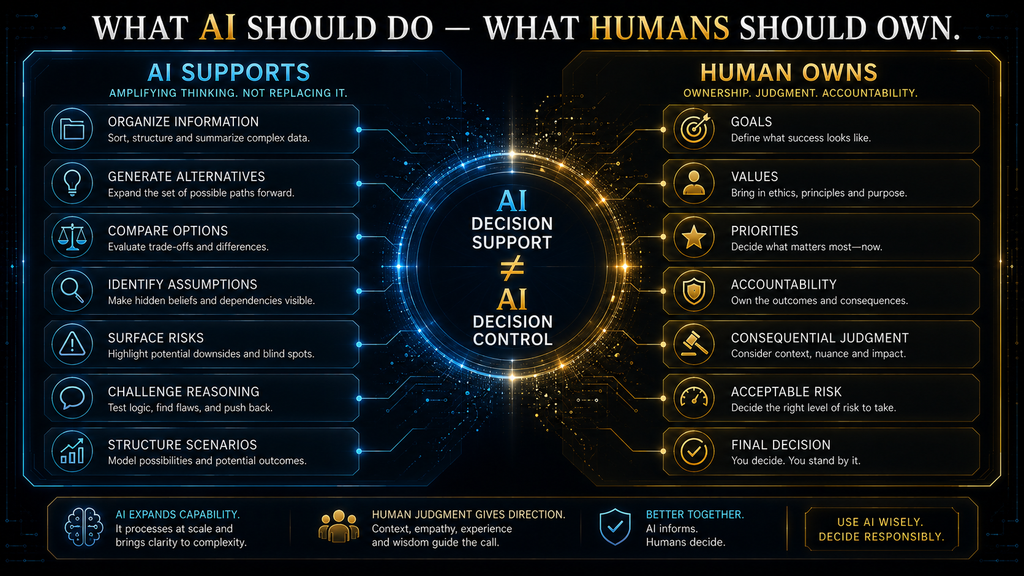
AI is strongest when the task is cognitive preparation rather than moral or professional judgment. It can turn scattered notes into categories, compare options against a consistent set of criteria, generate scenarios, expose missing information, and rewrite a vague concern as a decision statement. Used well, it reduces the clerical work around reasoning so the human can spend more attention on evidence, values, and consequences.
| Decision activity | Useful AI role | Human responsibility |
|---|---|---|
| Define the problem | Rewrite ambiguity as a specific choice with options and a deadline | Confirm that the problem is framed correctly |
| Organize evidence | Group facts, assumptions, unknowns, and sources | Verify provenance and decide what counts as evidence |
| Generate alternatives | Suggest plausible options and opportunity costs | Remove unrealistic or unacceptable choices |
| Compare options | Apply the same criteria and arithmetic consistently | Choose criteria, weights, and acceptable trade-offs |
| Challenge the leader | Run a pre-mortem and construct a contrary case | Judge whether the objections are materially credible |
| Choose and act | Summarize reasoning and implementation steps | Own the decision, authorization, and consequences |
| Review the outcome | Compare expected and observed results | Interpret the result and update future judgment |
The boundary is clearest when the decision affects another person’s rights, livelihood, health, safety, or access to an essential service. AI may help organize relevant information, but it should not quietly determine who is hired, disciplined, treated, approved, denied, or exposed to risk. In those settings, appropriate expertise, documented authority, appeal mechanisms, and independent review matter more than the elegance of a prompt.
The AHW Decision Quality Loop
The AHW Decision Quality Loop is a seven-stage process for decisions in which AI assists but does not own the judgment. The stages are sequential enough to prevent premature recommendations, yet flexible enough to revisit earlier work when new evidence appears. Its defining feature is traceability: every recommendation should be connected to a criterion, every important criterion to a human priority, and every important fact to a source or an explicit assumption.
| Stage | Core question | AI contribution | Required human checkpoint | Output |
|---|---|---|---|---|
| 1. DEFINE | What exact choice must be made, by whom, and by when? | Convert a vague topic into a decision statement | Confirm scope, authority, affected people, and deadline | One-sentence decision statement |
| 2. KNOW | What is known, assumed, unknown, and unverifiable? | Classify inputs and identify missing evidence | Verify sources and prevent assumptions from becoming facts | Evidence map |
| 3. PRIORITIZE | Which outcomes and constraints matter most? | Normalize criteria and test weight consistency | Set weights and non-negotiable limits | Criteria and weights |
| 4. COMPARE | How does each viable option perform under the same criteria? | Build the matrix and show trade-offs | Check scores, arithmetic, and omitted options | Comparison matrix |
| 5. STRESS-TEST | What could make the leading option fail? | Run pre-mortems, sensitivity checks, and a contrary case | Judge which objections are credible and material | Failure conditions and triggers |
| 6. DECIDE | Which option is acceptable given the evidence and uncertainty? | Summarize the case without choosing silently | Make, explain, and authorize the decision | Decision record and action plan |
| 7. REVIEW | What happened, and what should change next time? | Compare expected with observed results | Interpret causality and update the process | Outcome review |
The loop is not a guarantee of a good outcome. A careful process can still produce an unfortunate result because evidence was incomplete, conditions changed, or uncertainty could not be eliminated. Its purpose is narrower and more useful: improve the quality, transparency, and revisability of the reasoning available at the time.
Calculate the AHW Human Review Load
Before asking AI to compare options, decide how much human oversight the decision deserves. The AHW Human Review Load scores four factors from 0 to 3: consequence, irreversibility, evidence uncertainty, and values or rights sensitivity. Add the four ratings to produce a total from 0 to 12.
AHW Human Review Load
HRL = Consequence + Irreversibility + Evidence Uncertainty + Values/Rights Sensitivity
Each factor is rated 0–3. The score selects an oversight level; it does not predict whether a decision will succeed.
| Factor | 0 | 1 | 2 | 3 |
|---|---|---|---|---|
| Consequence | Trivial inconvenience | Small cost or short disruption | Material financial, professional, or personal effect | Potential harm to health, safety, rights, livelihood, or essential access |
| Irreversibility | Easy to undo immediately | Reversible with modest effort | Difficult or costly to reverse | Effectively permanent or impossible to repair fully |
| Evidence uncertainty | Reliable, current evidence | Minor gaps that do not affect the main choice | Important assumptions or conflicting sources | Evidence is weak, unavailable, unverifiable, or rapidly changing |
| Values or rights sensitivity | No meaningful value conflict | Personal preference is involved | Competing values or another person is materially affected | Fundamental rights, fairness, dignity, or protected interests are involved |
A score of 0–3 indicates light review: AI can organize and compare, followed by a quick human check. A score of 4–6 calls for structured review: verify important facts, record the main assumptions, and inspect the leading option. A score of 7–9 requires independent human review, documented reasoning, and explicit failure triggers. A score of 10–12 means AI should remain advisory only; qualified expertise, formal authority, stronger safeguards, and an appeal or escalation path may be necessary.
Consider two superficially similar choices. Selecting a note-taking app might score 1 for consequence, 0 for irreversibility, 1 for uncertainty, and 0 for values sensitivity: HRL 2. Using AI output to decide whether an employee should be dismissed could score 3, 3, 2, and 3: HRL 11. Both decisions involve comparing options, but treating them as the same kind of AI task would be a serious category error.
The score should be debated, not obeyed. If two reviewers assign different ratings, the disagreement is useful because it reveals a hidden assumption about harm, reversibility, evidence, or affected interests. Record both views and resolve the underlying question before giving AI more authority.
How to Run the Seven-Step Loop
1. DEFINE the decision
A weak decision begins as a topic: “Should I improve my marketing?” A usable decision specifies the actor, options, objective, constraints, and deadline: “By Friday, should I invest the next eight weeks in improving organic search, building an email sequence, or running a small paid campaign, given a $1,000 budget and ten hours per week?” The second version can be analyzed because its boundaries are visible.
Ask AI to challenge the frame before answering it. Useful questions include: Are these the real options? Is the deadline genuine? Is the problem a choice, a diagnosis, or an implementation failure? Who else is affected, and who actually has authority to decide? A beautifully scored matrix is useless if it answers the wrong question.
Prompt: Rewrite this situation as one precise decision statement. Identify the decision owner, deadline, viable options, objective, constraints, people affected, and any ambiguity that should be resolved before comparing options. Do not recommend an option yet.
2. KNOW what is known, assumed, unknown, and unverifiable
This stage prevents AI from laundering assumptions into facts. Create four columns: Known for supported facts, Assumed for plausible but unverified beliefs, Unknown for information that could be obtained, and Unverifiable for information that cannot reasonably be established before the deadline. Each material fact should include a source, date, and scope.
The distinction between unknown and unverifiable matters. A software price is unknown until you check the current pricing page; customer adoption six months from now may be fundamentally uncertain. Research can solve the first gap. The second needs scenarios, buffers, or a reversible experiment rather than more searching.
If the decision depends on AI-generated research, verify the decisive claims outside the conversation. The companion guide on checking whether AI information is accurate provides a dedicated verification process. The rule here is that an AI statement does not become evidence merely because it includes a citation.
3. PRIORITIZE criteria before seeing the winner
Criteria express what “better” means in this decision. For an AI tool, the relevant criteria might be workflow fit, output reliability, privacy, total cost, learning effort, and exportability. For a job offer, they may include compensation, role quality, manager, stability, commute, learning, and family impact.
Choose and weight the criteria before scoring the options. If you change the weights after seeing that your preferred option loses, you may be editing the method to justify a conclusion you already wanted. Weight changes are sometimes legitimate, but the decision ledger should show what changed and why.
Separate preferences from constraints. A preference improves an option’s score; a constraint can eliminate it. If a tool cannot meet a mandatory privacy requirement, a low price should not compensate for that failure. Treating every requirement as a tradable number creates false precision.
4. COMPARE options consistently
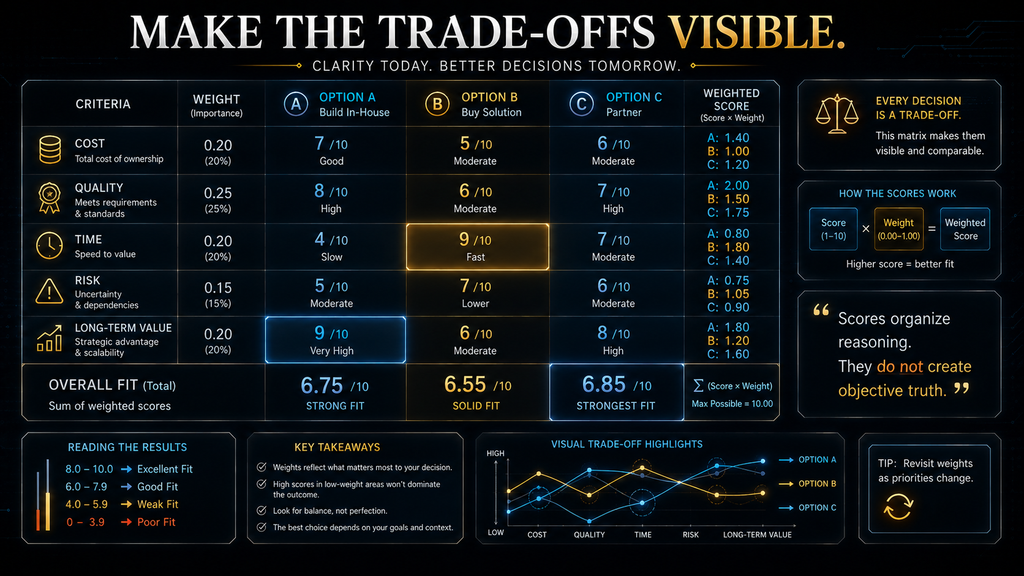
Now score every viable option against the same definitions and evidence. AI is useful for keeping the structure consistent, performing arithmetic, and explaining where one option gains or loses. It should also show missing scores rather than inventing a number to complete the table.
A comparison should display trade-offs, not hide them inside a total. Two options can receive the same score for different reasons: one may be cheap but limited, another expensive but durable. The row-level pattern often matters more than the final ranking.
5. STRESS-TEST the leading option
The leading score is a hypothesis, not a verdict. Ask AI to construct the strongest case against it, identify the assumptions doing most of the work, and describe plausible conditions under which the second-ranked option would become better. This is more useful than asking, “Are you sure?” because models often respond to that question with reassurance rather than analysis.
Run a pre-mortem: imagine that the chosen option failed six months later and list the most plausible reasons. Then convert those reasons into safeguards, early-warning indicators, or exit triggers. If a subscription only makes sense when it saves five hours per month, “saves fewer than three hours for two consecutive months” could become a cancellation trigger.
Sensitivity testing is equally important. Change one uncertain input at a time: reduce the expected benefit, increase cost, alter a weight, or remove a weakly supported score. If the winner changes after a small adjustment, the decision is fragile and should be presented that way.
6. DECIDE, authorize, and record
A decision is more than the highest number. The decision owner should state the selected option, the main reasons, the important uncertainty, the downside they are accepting, and the evidence that would justify changing course. This forces the final judgment back into human language.
For consequential choices, identify who has authority to approve the action and who is accountable for monitoring it. “The AI recommended it” is not an ownership model. If nobody can explain, defend, pause, or reverse the decision, the process is not ready to act.
7. REVIEW the outcome
Set the review date when the decision is made, not after problems appear. Compare the expected outcome with what actually happened, but do not judge the process only by the result. A sensible decision can have a bad outcome, while a careless gamble can succeed once.
The review should ask which assumptions were wrong, which signals were missed, whether the criteria reflected what truly mattered, and whether AI added clarity or merely extra confidence. Feed those lessons into the next decision. This closes the loop and gradually turns a generic framework into a record of how you actually make choices.
How to Build a Weighted Decision Matrix
A weighted matrix is useful when several options must be compared across criteria that do not matter equally. Assign each criterion a weight totaling 100, score each option on a consistent scale such as 1–5, multiply each score by its weight, and add the results. The calculation creates discipline, but it does not remove judgment because humans still define the criteria, weights, evidence, and scoring rules.
Weighted decision score
Total score = Σ (criterion weight × option score)
Use the same score definitions for every option. Keep constraints outside the arithmetic so a mandatory failure cannot be averaged away.
Suppose a freelancer is comparing three AI writing tools. The following numbers are illustrative, not product test results. The purpose is to show the calculation and the importance of visible assumptions.
| Criterion | Weight | Tool A | Tool B | Tool C |
|---|---|---|---|---|
| Workflow fit | 30% | 5 | 3 | 4 |
| Output reliability | 25% | 4 | 5 | 3 |
| Privacy controls | 20% | 3 | 5 | 4 |
| Total cost | 15% | 3 | 2 | 5 |
| Exportability | 10% | 4 | 4 | 3 |
| Weighted total | 100% | 4.00 | 3.85 | 3.80 |
Tool A leads, but only narrowly. If privacy rises from 20% to 30% while workflow fit falls from 30% to 20%, Tool B moves ahead. That is the important finding: the result is sensitive to how the buyer values privacy relative to workflow fit. A useful matrix reveals that dependency instead of presenting 4.00 as an objective truth.
Ask AI to show the calculation row by row and flag every score that lacks evidence. If the score for “output reliability” comes from an impression rather than a repeatable test, label it as provisional. The table becomes more trustworthy when uncertainty remains visible.
Worked Examples: How the Framework Changes by Decision
Example 1: Choosing an AI tool
A creator is choosing between keeping a general chatbot, adding a specialized writing platform, or building a small multi-tool workflow. The choice is reversible, the financial consequence is modest, and no one else’s rights are affected. The Human Review Load might be consequence 1, irreversibility 0, uncertainty 1, values sensitivity 0: a total of 2.
A light but structured loop is enough. Define the actual workflow bottleneck, gather current prices and limits, choose criteria before comparing tools, and run the same sample task in each product if access is available. The decision should include a 30-day review based on editing time, usable-output rate, total cost, and whether the tool fits the creator’s publishing process.
The common mistake is buying the product with the longest feature list. The framework redirects attention to the constraint that prompted the purchase. If the creator’s problem is research traceability, a tool that produces faster prose but weaker source handling is not the better choice.
Example 2: Choosing between two jobs
A job decision has higher stakes and is harder to reverse. It affects income, career direction, family routines, and possibly immigration or benefits. A plausible HRL might be consequence 2, irreversibility 2, uncertainty 2, values sensitivity 2: a total of 8, which calls for documented reasoning and independent human review.
AI can organize compensation, commute, responsibilities, learning potential, management quality, stability, and long-term options. It can also identify questions to ask each employer and model best, base, and worst cases. It cannot know how a particular manager will behave, decide which sacrifice is acceptable to the family, or verify informal claims made during interviews.
The stress test should examine what happens if the exciting role delivers less autonomy than promised, the stable role restructures, or the commute proves harder than expected. The final decision record should explain which uncertainty was accepted and why. A trusted person who understands the candidate’s priorities can challenge the reasoning before the offer is accepted.
Example 3: Selecting a business idea
An entrepreneur may ask AI to rank ten ideas by market demand, startup cost, competition, speed to revenue, and personal fit. That looks analytical, but several scores may rest on weak public data and invented confidence. The KNOW stage should separate verified market evidence from model-generated estimates before any ranking occurs.
The better approach is to use the matrix to select two ideas for small, reversible tests rather than one idea for immediate commitment. Define a landing page, customer interviews, a pre-sale attempt, or a manual service pilot as evidence-generating actions. AI can help draft the experiment, but observed customer behavior should update the decision.
This is a second-order benefit of the framework: sometimes the correct output is not a choice but a cheaper way to learn. When evidence uncertainty is the dominant source of risk, a reversible experiment can be more valuable than another hour of AI analysis.
The Failure Modes That Break AI-Assisted Decisions
Asking for the answer before defining the problem
“Which option is best?” invites the model to invent missing priorities and constraints. The answer may sound personalized while reflecting generic assumptions about money, speed, prestige, or convenience. DEFINE must come before recommendation so the user can see what the analysis is optimizing.
Allowing assumptions to pose as evidence
Models are built to continue patterns, not to maintain an audited boundary between fact and speculation automatically. When evidence is missing, a model may fill the space with something plausible. The KNOW stage prevents that by labeling every material input and refusing to score an option where a decisive fact is unsupported.
Changing the weights to protect a preferred option
A matrix can formalize confirmation bias instead of reducing it. If weights are adjusted after the user sees the result, the arithmetic may become a rationalization tool. Record the first weighting, explain any revision, and ask what new evidence or clarified priority justified the change.
Treating AI confidence as probability
Confident language is not a calibrated likelihood estimate. “This is clearly the best option” may reflect the prompt’s framing more than the strength of the evidence. Require the model to identify unknowns, cite support, present the strongest contrary case, and state what would change the recommendation.
Generating so many options that action becomes harder
AI can produce alternatives without feeling the cost of evaluating them. Five additional options may broaden the search; fifty can create option overload and hide the viable choices. Set an option budget, remove dominated or infeasible alternatives, and stop expanding when new options no longer change the decision.
Using a human as a ceremonial approver
Oversight fails when the reviewer lacks time, expertise, authority, or access to the underlying evidence. A person clicking approve does not make an automated process accountable. Match the reviewer to the Human Review Load and ensure they can question, stop, override, and document the system’s recommendation.
Reversibility Should Change How Much You Analyze
Not every decision deserves the same amount of research. If a choice is inexpensive and easily reversed, delaying action can cost more than a modest mistake. Choose a reasonable option, define a review trigger, and learn from actual use.
Irreversible decisions require a different posture. Before signing a long contract, publishing a consequential accusation, making a health choice, or taking action that materially affects another person, slow down. Verify the evidence independently, involve appropriate expertise, consider the downside explicitly, and preserve a path for challenge or appeal where possible.
This produces a useful analysis rule: spend decision effort in proportion to the cost of being wrong and the difficulty of recovery. AI can lower the cost of organizing information, but it should not tempt you to perform elaborate analysis on trivial choices or rush a high-stakes choice because the summary arrived quickly.
When More Research Stops Helping
Research has diminishing returns. The first reliable source may resolve a major uncertainty; the twentieth article may repeat what you already know. Continued analysis becomes wasteful when new information is unlikely to change the choice, the decision is reversible, delay has a real cost, and the remaining uncertainty cannot be eliminated through desk research.
Use a stopping rule before you begin. Examples include a deadline, a research budget, a confidence threshold for the decisive facts, or a condition such as “stop when two independent authoritative sources agree and no unresolved issue would change the leading option.” The stopping rule protects against using AI as an endless generator of reasons to postpone commitment.
Ask one final question: What information would most likely change this decision? If a realistic answer exists and can be obtained at reasonable cost, get it. If no plausible new fact would change the choice, additional research may be a form of avoidance rather than rigor.
The AHW Decision Ledger
A decision ledger preserves the reasoning that disappears when a chat closes. It does not need to be complicated. Its value comes from recording what the decision-maker believed before the outcome was known, which makes later review more honest.
| Ledger field | What to record |
|---|---|
| Decision statement | The exact choice, owner, deadline, and affected parties |
| Human Review Load | Four factor ratings, total score, and any disagreement |
| Evidence | Material facts with source, date, and scope |
| Assumptions and unknowns | What is believed, missing, or unverifiable |
| Criteria and weights | Definitions, priorities, constraints, and scoring scale |
| Options considered | Included, excluded, and rejected alternatives with reasons |
| Stress test | Failure scenarios, sensitivity results, and counterarguments |
| Decision and rationale | Chosen option, accepted downside, authority, and action plan |
| Review trigger | Date, metric, threshold, or event that causes reassessment |
| Outcome review | Observed result, incorrect assumptions, and process changes |
The ledger also makes AI’s contribution auditable. Note which parts were generated, summarized, calculated, or challenged by AI and which evidence was independently verified. If a later reviewer cannot tell whether a critical claim came from a source, a person, or a model inference, the record is incomplete.
How Teams Should Handle Disagreement
A framework is most valuable when reasonable people disagree. If one reviewer rates a decision’s consequence as 1 and another assigns 3, averaging the numbers immediately hides the issue. Ask each person to describe the harm they imagine, who would experience it, how likely recovery would be, and which evidence supports that view.
Separate factual disagreement from value disagreement. A dispute about the current cancellation fee can be resolved by checking the contract; a dispute about whether speed matters more than privacy cannot be settled by another search. The second question belongs to the decision owner and affected stakeholders, and the ledger should preserve the reasoning rather than disguising it as a model-generated score.
Teams can also reduce anchoring by collecting an independent first assessment. Ask reviewers to define criteria, identify risks, or score decisive evidence before showing them AI’s recommendation. After the individual views are recorded, AI can summarize the disagreements and locate the assumptions responsible for them without deciding whose priorities are correct.
When disagreement remains, use a decision rule chosen in advance. A product owner may have authority over a reversible feature test, while security or legal teams may hold a veto over a non-negotiable control. For a shared personal decision, the acceptable rule may require consent rather than a weighted vote. The framework should reveal authority, not invent it.
Finally, document dissent when the stakes justify it. A short note explaining the rejected concern, the evidence considered, and the trigger for reopening the decision protects institutional memory. It also prevents a later review from falsely suggesting that the original choice was unanimous or that a known risk appeared without warning.
Reusable prompt: Act as a decision-structure assistant, not the decision-maker. Help me complete the AHW Decision Ledger. Ask for missing information one stage at a time. Keep facts, assumptions, unknowns, and model inferences separate; cite provided sources; never invent a score; challenge the leading option; show sensitivity to uncertain inputs; and end with a neutral summary for the human decision owner.
How This Framework Fits With Everyday AI Work
The loop works best as part of a broader workflow rather than a single giant prompt. Begin with a short conversation to define the decision, open the relevant primary sources, and place verified facts in a separate document or table. Then use AI to structure criteria and comparisons without letting it overwrite the evidence layer.
For recurring decisions, save the criteria definitions and ledger template. A team choosing software every quarter can reuse the same privacy, integration, reliability, exit-cost, and total-cost definitions while updating weights for each situation. Consistency makes comparisons easier to review and reduces the temptation to invent a new method whenever a favored product appears.
Good prompting still matters, but prompting is only one layer. The guide to asking AI better questions can improve the input, while the guide to understanding AI hallucinations explains why verification remains necessary. The decision framework coordinates those practices around a specific choice.
Choose the Right Depth for the Decision
The 15-minute version for low-stakes choices
Write one decision sentence, list three criteria, compare no more than four options, ask for the strongest objection to the leader, and set a review trigger. This version suits reversible choices such as trying a productivity app, selecting a meeting format, or choosing between two content ideas. Keep the evidence light but do not let AI invent facts.
The 45-minute version for meaningful personal or business choices
Complete the Human Review Load, separate knowns from assumptions, use a weighted matrix, run a pre-mortem, perform one sensitivity test, and save a short ledger. This depth suits software contracts, freelance opportunities, marketing investments, equipment purchases, or process changes with material cost but manageable downside.
The governed version for consequential decisions
Use qualified domain expertise, independent source verification, named decision authority, documented criteria, formal review, monitoring, and an escalation or appeal mechanism. AI remains a support tool, and the process should comply with applicable professional, organizational, and legal requirements. The AHW framework can organize the work, but it cannot supply the governance that a high-impact context requires.
If a decision involves medical treatment, legal rights, major financial exposure, employment, safety, or another person’s essential interests, do not rely on this article or an AI chatbot as the final authority. Use the relevant professional and institutional safeguards. The higher Human Review Load is a signal to escalate, not permission to proceed alone after filling in a longer worksheet.
A Compact Checklist Before You Act
- The decision is written as a specific choice with an owner and deadline.
- The Human Review Load matches the level of oversight being used.
- Facts, assumptions, unknowns, and AI inferences are visibly separated.
- Material facts have current, appropriate sources.
- Criteria and weights were set before the options were scored.
- Mandatory constraints cannot be averaged away by a high total score.
- The leading option survived a contrary case, pre-mortem, and sensitivity check.
- A named human owns the decision and can explain the accepted downside.
- The decision has a review date or measurable trigger.
- High-impact decisions have qualified expertise and a meaningful challenge path.
If several items fail, do not ask AI for a more confident recommendation. Repair the process. More fluent output cannot compensate for a vague decision, weak evidence, hidden priorities, or absent accountability.
Final Thoughts
AI does not need to make your decisions to make your decision process better. Its strongest role is to organize complexity, compare alternatives consistently, surface missing information, and challenge the story you are already telling yourself. Those are valuable contributions, especially when time and attention are limited.
The boundary is responsibility. AI does not bear the cost of a bad choice, understand an unstated value, or transform an unsupported assumption into evidence. The AHW Decision Quality Loop keeps that boundary visible by connecting risk triage, evidence classification, priorities, comparison, challenge, human authorization, and outcome review.
The most memorable rule is this: use AI to make the reasoning harder to fool, not to make the decision easier to surrender. If the process cannot show what is known, what matters, what could fail, who decides, and when the choice will be reviewed, it is not ready—no matter how convincing the answer sounds.
A Better Decision Still Depends on Better Evidence
The Decision Quality Loop tells you how to reason through a choice. The next step is learning how to verify the AI-generated facts and sources entering that process.
Check AI Information Before You Rely on It →Frequently Asked Questions
What is an AI decision-making framework?
An AI decision-making framework is a structured process for using AI to define a choice, organize evidence, compare alternatives, test assumptions, and document reasoning while a human retains authority and accountability. It is different from asking a chatbot for a direct recommendation because the method exposes the evidence, criteria, trade-offs, and uncertainty behind the answer.
What is the AHW Decision Quality Loop?
The AHW Decision Quality Loop is DEFINE → KNOW → PRIORITIZE → COMPARE → STRESS-TEST → DECIDE → REVIEW. It connects each stage to an appropriate AI role, a required human checkpoint, and a concrete output such as an evidence map, comparison matrix, decision record, or outcome review.
How does the Human Review Load work?
Rate consequence, irreversibility, evidence uncertainty, and values or rights sensitivity from 0 to 3, then add the ratings. Scores from 0–3 call for light review, 4–6 for structured verification, 7–9 for documented independent review, and 10–12 for expert or governed decision processes in which AI remains advisory. The score is a transparent editorial heuristic, not a validated legal or clinical instrument.
Can AI make the final decision for me?
AI can help with low-stakes recommendations, but the human should retain the final choice whenever consequences, values, uncertainty, or accountability matter. High-impact decisions require appropriate professional expertise, formal authority, evidence verification, and meaningful human oversight rather than ceremonial approval.
Is a weighted decision matrix objective?
No. The arithmetic may be consistent, but the criteria, weights, score definitions, and evidence are chosen by people. A good matrix makes those judgments visible and supports sensitivity testing; it does not remove subjectivity or turn uncertain ratings into facts.
How can I stop AI from agreeing with my preferred option?
Ask for the strongest case against the leader, the assumptions that most influence the result, the conditions under which another option wins, and the information most likely to change the recommendation. Where stakes justify it, have another person review the evidence without seeing the model’s conclusion first.
When should I stop researching?
Stop when the material facts are sufficiently supported, no obtainable information is likely to change the decision, the choice is reversible enough to learn through action, or the cost of delay exceeds the expected value of more research. Define the stopping rule before research expands.
What decisions should not depend heavily on AI?
Decisions involving medical treatment, legal rights, major financial exposure, employment, safety, protected interests, or essential services should not depend heavily on a general-purpose AI recommendation. AI may organize information, but qualified expertise, human authority, documented safeguards, and a challenge or appeal process may be necessary.
What is the most useful question to ask during a decision?
Ask: “What information would most likely change this decision?” The answer identifies the uncertainty with the highest decision value and helps distinguish useful research from analysis that merely repeats what you already know.
How should I review a decision that had a bad outcome?
Compare the reasoning with the evidence available at the time instead of judging only by the result. Identify incorrect assumptions, missed signals, weak criteria, execution failures, and unpredictable changes. Then update the framework or safeguards without pretending every bad outcome proves the original decision was irrational.
Related Guides
- How to Write AI Prompts for More Accurate and Reliable Answers
- How to Use AI Tools Safely: A Complete Learning Path
- How to Use AI for PRDs, User Stories and Product Specs Without Losing Accountability
- Daily AI Workflow for Managing Work Without Feeling Overwhelmed
Written by
Muntasir Ahmad Chowdhury
Founder-AI Hustle World
Muntasir Ahmad Chowdhury is the Founder of AI Hustle World, an independent publication dedicated to making Artificial Intelligence practical, trustworthy, and easy to understand. He researches AI tools, automation, customer service, productivity, and real-world business applications, helping readers make smarter technology decisions through research-driven, experience-backed content.
Expertise:
AI Tools • AI Automation • AI Customer Service • AI Productivity • Generative AI • AI Workflows
Get Smarter With AI
Enjoyed this guide? Get practical AI tools, tutorials, and honest reviews delivered to your inbox.