Evidence: Documentation reviewed
Last checked: August 2026
What was done: Written from official documentation and the published sources linked in this article. Not hands-on tested.
Files: None
Affiliate links: No
Last updated: October 2026
How to Verify AI Information: A Practical Accuracy Framework
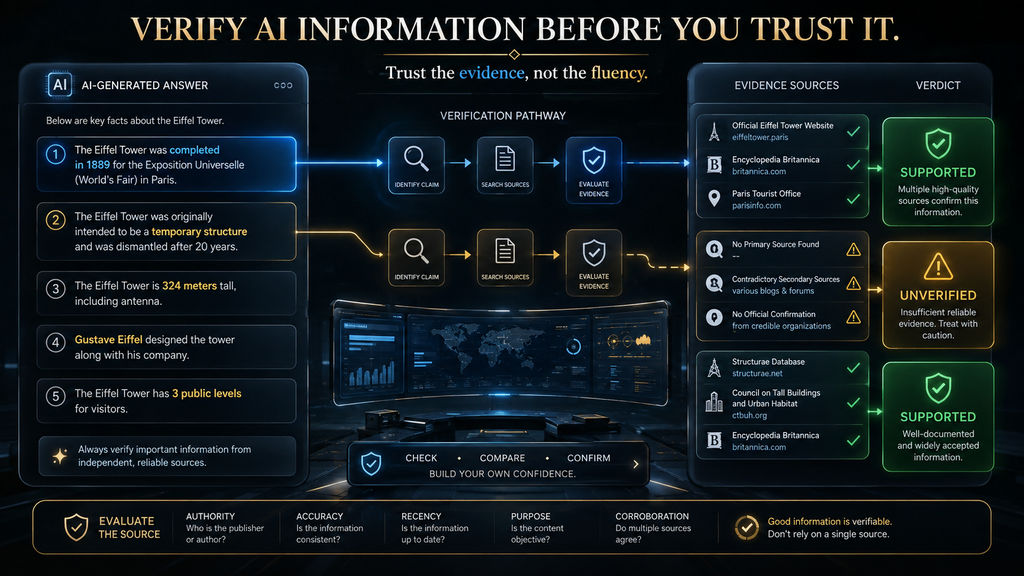
To verify AI information, break the answer into individual claims, find the strongest source for each claim that matters, and check that the source supports the exact wording. Then inspect the date and scope of that evidence, and mark each claim as verified, partly supported, contradicted, outdated or unresolved before you rely on it.
That process sounds slow, but most of the time it takes minutes. You do not need to check every sentence an AI writes. You need to check the claims that would change a decision, mislead a reader or cause harm if they were wrong. A casual question needs a quick look. A published article, client report or legal filing needs a careful, documented check.
The difficult cases are rarely the obviously wrong answers. If an AI says Dhaka is in Europe, you notice. The harder problem is the answer that is mostly correct but includes one outdated statistic, a real paper cited for something it never said, or a cautious official statement turned into a firm rule. Those answers pass a quick read because they look complete and confident.
This guide gives you a repeatable workflow for that problem. You will learn the CLAIM framework, an evidence status system, a simple evidence ledger, how to check statistics and citations, and how to match the depth of checking to the risk of the task. It also covers recent real cases where unchecked AI citations caused professional and public embarrassment.
What It Means to Verify an AI Answer
Verifying an AI answer means checking its important factual claims against suitable evidence and deciding whether each one is supported, contradicted, outdated, incomplete or still unresolved. It is a judgment about evidence, not about writing quality. A well-written paragraph can still contain a false number, and a clumsy one can be entirely correct.
Verification is different from proofreading. Proofreading asks whether a sentence is written correctly. Verification asks whether the statement in that sentence is justified by evidence. You can fix every comma in an AI draft and still publish a claim that no source supports, which is why editing and fact-checking should be treated as separate steps in any workflow.
It is also different from asking a second AI whether the first one was right. Another model can flag suspicious claims or suggest where to look, which is useful. But it is still producing its own interpretation from patterns, and it can repeat the same mistake with equal confidence. In a sound workflow, the original evidence remains the final reference point for every claim that matters.
A simple example shows why this matters. An AI says a study found a 40% productivity increase and gives a real-looking citation. You now have four questions: does the paper exist, does it contain that number, did it measure productivity the way the answer implies, and does the finding apply to your situation? A citation can be genuine while the claim attached to it is still wrong.
Why Fluent AI Answers Still Need Checking
Large language models generate text by predicting likely continuations based on patterns learned in training and the context you provide. That makes them excellent at producing fluent, well-organized answers. It does not guarantee that every statement matches the world, because fluency and factual accuracy come from different things. Our guide to how large language models work explains this in more detail.
The National Institute of Standards and Technology calls this risk confabulation. Its Generative AI Profile (NIST AI 600-1) describes systems that confidently present false or erroneous content, including invented logic and citations. NIST stresses that the risk grows when people act on that output in consequential settings, such as health, finance or law, where errors have real costs.
This is why confidence is a poor signal. AI tools tend to use the same calm, authoritative tone whether a claim is well established or invented. Our explainer on why AI hallucinates covers the causes, from gaps in training data to the pressure to give some answer instead of admitting uncertainty. The practical lesson is that tone tells you nothing about truth.
Retrieval and web search reduce some of these problems but do not remove them. A tool can retrieve a correct source and still summarize it badly, mix it with an outdated page, or attach the right citation to the wrong sentence. Techniques such as retrieval-augmented generation improve grounding, yet a human still needs to confirm that the evidence supports the specific claim being made.
Check the Claims, Not the Paragraph
A long AI answer can contain dozens of separate statements, and they do not deserve equal effort. Take one sentence from an AI-written product summary: “The software launched in 2024, supports five integrations, has more than 200,000 users, cuts reporting time by 40% and is especially popular with small businesses.” That single line carries at least five distinct claims.
Each of those claims could need a different source, carry a different level of confidence and have a different consequence if wrong. The launch date might be on the vendor’s site. The user count may be a marketing figure. The 40% reduction could come from one customer case study. The popularity claim may be pure interpretation. Treating the sentence as one unit hides all of those differences from you.
So the first step is to extract the claims. Once you can see them as a list, verification becomes a manageable research task instead of a vague feeling that the whole answer “needs checking.” You can sort them by importance, skip the trivial ones and spend your time on the few statements that carry the weight of the conclusion. That focus is what keeps the process fast.
AI can help with this mechanical step. A prompt such as the one below turns the model into a verification assistant rather than the final judge. It produces a checklist you can work through, and it often surfaces claims you would have read past. Our guide to asking AI better questions has more prompt patterns like this for everyday research work.
Extract every factual claim from the answer below. Separate factual claims from opinions, predictions and recommendations. Flag the claims that would change the conclusion if they were wrong.
The CLAIM Verification Framework
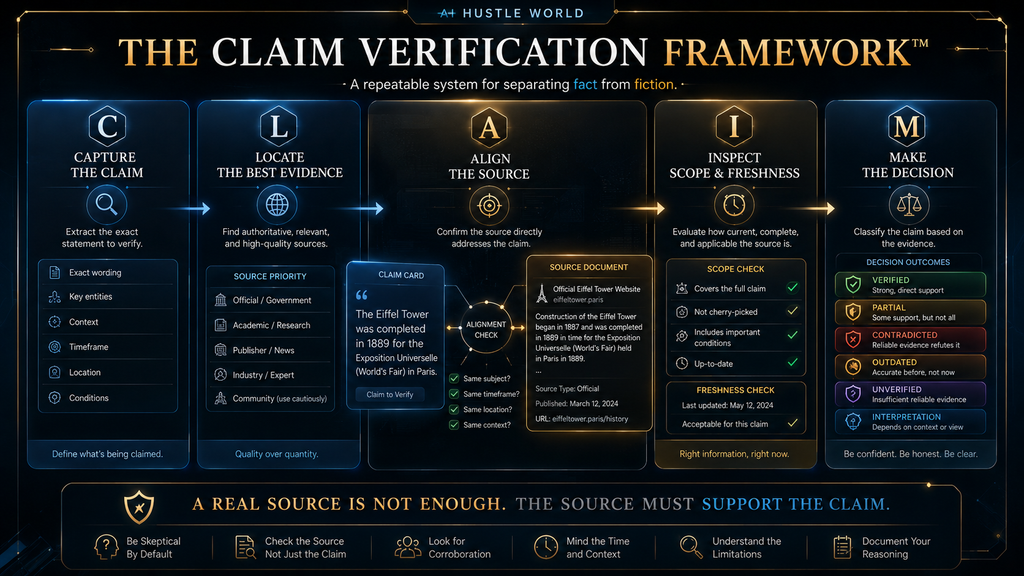
To make the process repeatable, AI Hustle World uses a five-step editorial framework called CLAIM. It is our own working method for operationalizing verification, not an official industry standard or a regulator’s framework. Each letter stands for one step, and the steps run in order for every claim that matters to your decision, article or report.
- C: Capture the claim. Copy the exact statement you want to check.
- L: Locate the best evidence. Find the strongest source that could prove or disprove it.
- A: Align the source with the claim. Confirm the source supports the exact wording.
- I: Inspect scope and freshness. Check date, version, place, population and conditions.
- M: Make the decision. Assign a clear evidence status and revise or remove the claim.
The central idea is that verification is not finished when you find a credible website. It is finished when you know what the source proves, what it does not prove, and whether that evidence is current and relevant to your situation. Many errors slip through because people stop at the first step that feels like confirmation, usually the moment a plausible source appears in the results.
C: Capture the Exact Claim
Start by copying the exact statement you want to verify, word for word. Do not paraphrase it yet. If the AI says “the policy requires companies to retain customer records for seven years,” that is the claim you capture. Paraphrasing too early is risky, because your wording can quietly become weaker or stronger than the original while you research.
If you search a simplified version such as “customer record retention rules,” you may find related material that never addresses the original statement. You will then feel that the claim is confirmed because the topic looks familiar, when no source has said anything about seven years. Capturing the exact wording keeps you honest about what you are checking and what you still need to find.
Capturing claims also exposes compound statements. “The tool is cheaper, faster, more accurate and more secure than its competitors” sounds like one claim, but it is at least four, and each needs different evidence. Price can be checked on a pricing page. Speed and accuracy need tests. Security needs documentation or an audit. Splitting the sentence shows you how much work it hides.
A useful habit is to write each captured claim on its own line, with a short note on why it matters. That note forces you to decide whether the claim is central or incidental. If removing it would not change your conclusion, it may only need a light check. If the whole recommendation rests on it, it moves to the top of your list for primary evidence.
L: Locate the Best Evidence
Once you know what you are checking, find the strongest source that could prove or disprove it. Source quality should match the type of claim. For a product feature, the vendor’s current documentation is usually best. For a regulation, use the regulator or the legal text. For a scientific finding, read the original paper, not a blog post that summarizes it.
For a government statistic, go to the agency or the original dataset. For a company’s revenue or ownership, look for filings and official reports. The table below is a practical guide to which kinds of sources suit which jobs. It is a working hierarchy for decisions, not a judgment that one tier is always right and another always wrong.
| Source level | Best use | Typical examples |
|---|---|---|
| Primary or official | Final verification | Regulators, agencies, original studies, vendor documentation |
| High-quality secondary | Context and corroboration | Major news outlets, universities, research institutes |
| Aggregators | Discovery | Industry databases, comparison sites, summaries |
| Unverified or anonymous | Leads only | Social posts, unsourced blogs, copied AI content |
Not every secondary source is weak, and not every official page is correct. The point is to pick the source that is appropriate for the claim you are testing. A well-written blog can explain a technology clearly, yet it is the wrong evidence for a legal requirement. A regulator’s page settles the requirement but may not explain how it works in practice.
If an AI tool gave you sources, treat them as leads, not as evidence. Open each one yourself. Our comparison of AI research assistants shows which tools make this easier by linking claims to specific passages. Even the best of them still expect you to read the source before you rely on what it is said to contain.
A Real Source Is Not Automatically Good Evidence
This is one of the easiest mistakes to make. An AI cites a genuine academic paper, you open it, and the paper exists. Relief sets in. But when you read the relevant section, it says the study “observed a modest improvement under controlled conditions,” while the AI described it as proving “a large productivity increase.” The citation was real, and the claim was still wrong.
Research published in 2026 targets exactly this gap. The CiteCheck study describes a system that checks whether a citation matches a real scholarly work and whether its details are faithful to that work. Its benchmark covers both fully invented references and subtler corruption of authors, years and other metadata, because both kinds of error appear in AI-generated reports.
That leads to a rule worth memorizing: source existence and source support are two different checks. The first asks whether the paper, page or document is real. The second asks whether it says what the AI claims it says, in the context the AI implies. Most people do the first check and stop, which is how fabricated or misused citations end up in published work.
The second check takes longer, because you have to read the relevant passage instead of skimming the title. Use the find function to jump to the number or phrase the AI quoted. If you cannot find it, that is a strong signal of trouble. If you find it but the surrounding sentences add conditions, those conditions belong in your final wording too.
A: Align the Source With the Exact Claim
After opening a source, ask a narrow question: where exactly does this source support what the AI said? Do not settle for the broader question of whether the source discusses the same topic. Topic overlap feels like confirmation, but it often hides a mismatch between what the evidence says and what the AI wrote in its answer.
Suppose the AI says, “The company offers this feature on all paid plans,” and the documentation says, “The feature is available on Enterprise plans.” The source is relevant, but it also shows that the AI’s statement was too broad. This pattern is common with product features, pricing tiers, legal requirements, eligibility rules and study results, where conditions matter.
A good alignment check compares the wording of the claim with the wording of the source, phrase by phrase. Look for qualifiers the AI dropped, such as “may,” “in some cases,” “up to” or “for eligible users.” Look for numbers that changed during summarizing. Look for a narrow population in the source that became “everyone” in the answer. These small shifts are where most errors live.
When the wording does not line up, rewrite the claim to match the evidence rather than hunting for a different source that agrees with the original. That habit protects you from confirmation bias. Your goal is an accurate statement, not a defended one, and a narrower claim that you can prove is far more useful than a broad claim you hope is true.
Partial Support Is a Valid Result
Verification is not always a yes or no answer. Sometimes a source supports part of a claim. If the AI says a tool “supports PDF, Word and Excel files” and the documentation confirms PDF and Word but never mentions Excel, the claim is neither simply true nor simply false. The honest label is partly supported, with the unconfirmed part noted.
The editorial fix is to write what you can stand behind: “The documentation confirms PDF and Word support; Excel support could not be verified.” That sentence is more useful to readers than a confident claim that might be wrong, and it is more useful than deleting the topic entirely. It also tells future editors exactly where the gap is if they want to check again later.
Partial support appears constantly in AI output because models compress information. They merge similar features, round numbers, generalize from one example and drop the edge cases. Expecting partial support makes you read more carefully. Instead of asking “is this right?”, you start asking “which part of this is right, and what would it take to confirm the rest?”
I: Inspect Scope and Freshness
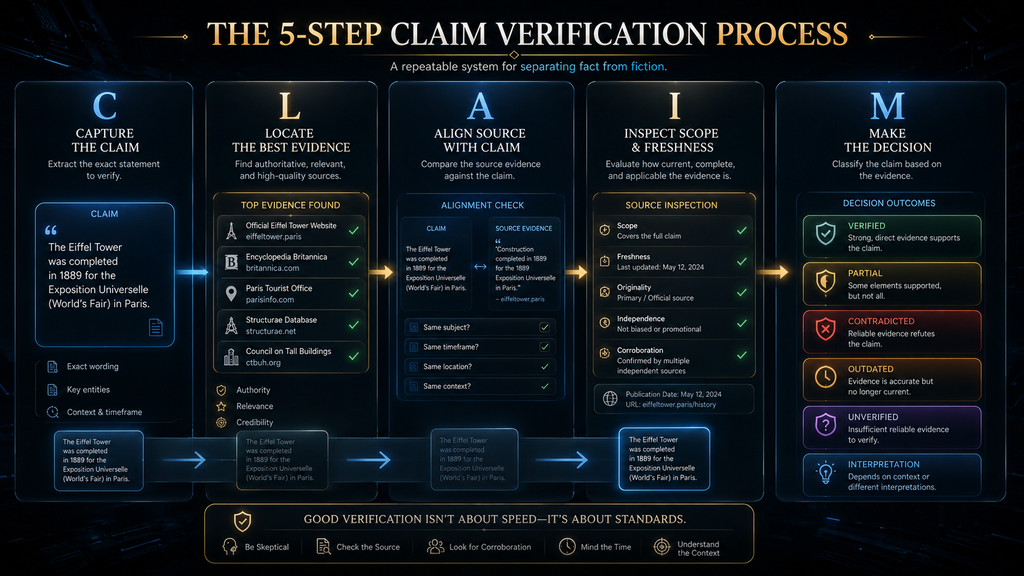
Even a source that supports a claim word for word can be the wrong evidence for your situation, because facts have scope. Before you accept a claim, check the publication date, the version or edition, the country or jurisdiction, the population studied, the plan or product tier, and any conditions or exceptions. Each of these can change whether the fact applies to you.
Here is a common case. The AI says a software feature is available, and the official documentation confirms it. But that documentation dates from 2024, and the feature was removed in 2026. The old page was accurate when it was written. The current claim is still wrong. Without checking the date, you would have published an error backed by a real source.
Scope errors work the same way. The feature may exist, but only on the Enterprise plan. The law may apply, but only in one state. The study may hold, but only for experienced users. In each case the underlying fact is real while the AI’s framing is too wide. A useful test question is not only “is this true?” but “is this true here, now and under the conditions that matter?”
Dates Are Part of the Evidence
Freshness matters most for fast-moving information, and AI is one of the fastest-moving fields there is. Features appear and disappear, prices change, models are replaced, usage limits shift and companies revise their policies. Regulations evolve too. A six-month-old source can be perfectly credible and still fail to describe the current situation for your readers.
For stable facts, such as historical dates or basic science, older sources remain useful. For fast-changing facts, the date of the source is part of the evidence itself. When you record a verified claim, note when you checked it as well as where. That date tells you, and anyone who inherits your work, when the claim should be checked again.
A practical way to decide how fresh your source must be is to ask how costly it would be if the fact changed after the source was published. If the answer is “not very,” a reasonably recent source is fine. If the answer is “very costly,” such as a price in a contract or a legal deadline, look for the most current authoritative evidence available before you act on it.
Scope Matters as Much as Date
Consider the claim “this law allows AI-generated content.” It sounds complete but leaves out almost everything that matters: which country, which kind of content, for what purpose, as of which date and with what exceptions. A claim like that cannot be verified as written. It has to be made specific before any source can confirm or contradict it.
The same problem appears in product research. “The app includes unlimited AI generations” invites several follow-up questions. Unlimited on which plan? Under which fair-use policy? For text only, or also for images? Per month, or only during a promotional period? Vendors often attach conditions in footnotes, and AI summaries tend to drop footnotes first.
AI systems often compress a conditional statement into an absolute one, because absolute statements read more smoothly. Your job during verification is to restore the conditions. When you do, the claim usually becomes narrower and more useful. “Unlimited text generations on the Pro plan, subject to fair use” is less exciting than “unlimited AI,” but readers can rely on it.
M: Make the Verification Decision
Once you have checked a claim, give it a clear status instead of forcing it into true or false. AI Hustle World uses six labels, which keep uncertainty visible instead of letting it disappear behind a confident sentence. The status then tells you what to do with the claim: keep it, narrow it, date it, flag it or delete it from the draft.
| Status | Meaning | Typical action |
|---|---|---|
| Verified | Strong evidence directly supports the claim | Keep and cite |
| Partly supported | Evidence supports only part of it | Narrow the wording |
| Contradicted | Reliable evidence conflicts with it | Remove or correct |
| Outdated | It was true but is no longer current | Update or add a date |
| Unverified | No credible evidence could be found | Qualify or remove |
| Judgment | It is an opinion or inference | Label as analysis |
This system makes the final article, report or decision more honest. Readers can trust a piece more when it clearly separates what is established from what is analysis. It also makes your own decisions easier, because a claim labeled “unverified” cannot quietly become a fact just because it was phrased confidently in a draft that someone else wrote.
How to Verify AI-Generated Statistics
Numbers look trustworthy because they are precise, which is exactly why they need a separate pass. If an AI says “AI improves employee productivity by 35%,” do not just search for “AI productivity 35%.” That search will often find pages repeating the number without telling you where it came from or what it measured. Break the claim into its parts first.
- The number: Is it 35%, and is it a mean, a median or a best case?
- What was measured: Output, speed, quality or self-reported feelings?
- Who was studied: Which workers, in which industry and country?
- The comparison: Before and after, or against a control group?
- The period and sample: How long, and how many participants?
- The method: Experiment, survey, case study or vendor estimate?
This guards against a common pattern where an AI takes a real percentage from one context and reuses it in another. A statistic without its population, period and method can be technically correct and still misleading. A 35% gain for junior support agents on simple tickets says very little about senior engineers on complex projects, even though the headline number is identical.
Survey statistics need special care. “70% of businesses use AI” could mean 70% of respondents in one vendor survey, 70% of large firms in one country, or 70% who have tried AI once rather than deployed it. The number alone is not the fact. The measurement context is part of the fact, and it belongs in your sentence whenever the number appears.
Reproduce Calculations When the Number Matters
If an AI gives you a calculation that affects a decision, do not just look for a similar number online. Reproduce the calculation yourself. When a model says “the annual cost is $18,400,” ask what inputs produced that result, whether it mixed monthly and annual rates, and whether it counted something twice or skipped a fee entirely.
For simple arithmetic, a calculator is enough. For financial models, rebuild the main assumptions in a spreadsheet so you can see each step. For statistical claims, look at the method behind the figure. Language models are known to make arithmetic slips, especially across several steps, so a quick independent calculation catches errors that careful reading would miss.
Verification here means recreating the chain that produced the conclusion, not finding another page that shows a similar figure. Two wrong calculations can agree by accident, and a matching number on a random website proves nothing about where it came from. If you cannot reproduce the result from stated inputs, treat the figure as unverified until someone can explain it.
Follow the Source Chain Upstream
AI tools often cite a secondary source that itself cites another source. A typical chain runs from the AI answer to an industry blog, then to a news article, then to a research paper. The AI may have summarized the blog, the blog may have summarized the article, and the article may have interpreted the paper. Each step adds a chance for distortion.
By the time the claim reaches you, it may sit several interpretations away from the underlying evidence. When a claim matters, follow the chain upstream as far as practical. Find the paper behind the scientific claim, the regulation behind the legal one, the current documentation behind the feature and the original dataset behind the statistic.
The further upstream you go, the less likely you are to inherit someone else’s misreading. You will also often discover that the original source is more cautious than the summaries. Research papers usually describe limits, small samples and conditions that disappear as findings travel through headlines, social posts and AI answers built on top of them.
Independent Sources vs Repeated Claims
Many websites repeating the same claim can look like strong corroboration, but often it is not. Ten articles may all have copied one original report. In that case you do not have ten confirmations. You have one claim repeated ten times, and if the original is wrong, every copy is wrong in the same way, which means the repetition adds no evidence at all.
Real corroboration comes from independent evidence. A product feature could be confirmed by the official documentation plus a recent hands-on review from a reputable outlet. A statistical claim could be checked against the original research plus a separate dataset or study. Independence matters more than volume, because each independent source is a separate chance to catch an error.
When you see a surprising statistic everywhere, trace a few of the citations back. If they all lead to the same report, check that report carefully and judge it on its own merits. Repeated claims can create the illusion of consensus, and AI systems trained on the web absorb that illusion and repeat it with even more confidence.
How Many Sources Do You Need?
There is no fixed number. For a low-risk factual detail, one strong primary source is often enough. For a moderately important claim, one primary source plus an independent confirmation is a sensible standard. For a high-consequence claim, you may need primary evidence, independent corroboration and review by someone with the right expertise before you act.
Verification should be risk-based rather than ritualistic. You do not need ten minutes and three sources to confirm a film’s release date when the studio’s own page settles it in seconds. You do need more time for the source behind a medical recommendation, a financial projection or a legal claim, because the cost of being wrong is so much higher in those areas.
A good rule is to scale the number and quality of sources with two factors: how much depends on the claim, and how surprising it is. Ordinary claims from authoritative sources need little extra support. Surprising claims, or claims that would change an important decision, deserve independent confirmation even when the first source looks solid.
The Evidence Ledger
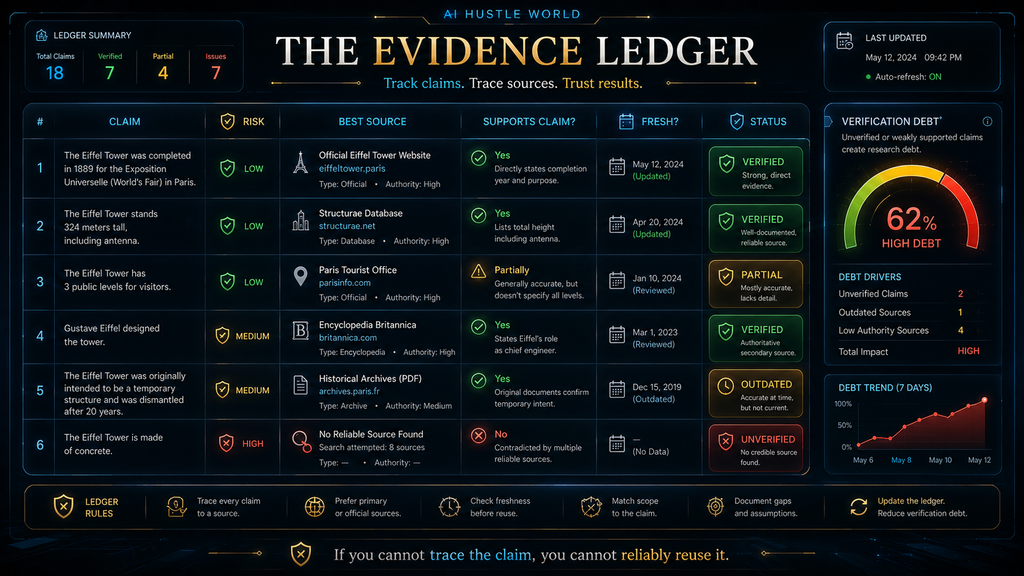
For serious research, keep a small evidence ledger instead of relying on memory. Once an article contains 20 or 30 factual claims, it is hard to remember which ones you checked, where you found support and how current that support was. A ledger turns verification into an audit trail you can revisit, share with an editor or update later.
| Claim | Risk | Best source | Supports wording? | Current? | Status |
|---|---|---|---|---|---|
| Claim A | Medium | Official source | Yes | Yes | Verified |
| Claim B | High | Research paper | Partly | Yes | Revise |
| Claim C | Medium | Vendor docs | Yes | No | Outdated |
| Claim D | High | None found | No | Not applicable | Unverified |
The ledger is an AI Hustle World working tool, not an official standard. A spreadsheet is enough. Add the date you checked each claim and a link to the exact page or section. That small extra step pays off when a reader questions a number months later, because you can show your evidence in minutes instead of redoing the research from scratch.
How to Verify an AI-Generated Citation
Citations deserve their own routine, because they fail in specific ways. Start by confirming that the source exists: search the exact title, check the journal or publisher, and test any DOI or link. Then confirm the details match. Authors, year, title, volume and page numbers are all places where AI tools introduce small but telling errors.
Next, confirm that the source supports the specific claim. Find the passage that contains the number, quote or finding. If the AI attributed a statistic to a paper, the statistic should appear in that paper with the same meaning. If you cannot find it after a reasonable search of the text, mark the citation as unsupported and remove it until you can locate a real source.
Finally, check that the source is current and relevant. A real, accurate citation to a 2019 study may not support a claim about 2026 tools. A correct citation to a study of one country may not support a global claim. Legal citations need an extra step, because cases can be overturned or limited, which is why lawyers use citator services before relying on any authority.
Using AI to Help Verify Without Letting It Decide
AI is useful for the mechanical parts of verification. Give it a long draft and ask it to extract every claim involving statistics, dates, names, prices or specific facts. Then ask it to group those claims by risk and list which ones need primary-source checks. That step alone can save a lot of time on long documents with many factual statements.
You can also use a second model to challenge the first, asking it to find claims that may be unsupported, outdated, ambiguous or overconfident. This often surfaces problems a tired human reader would miss. Our guide to prompts for more accurate and reliable answers shows how to ask models to state uncertainty and show their sources.
But a second AI is still an AI. It may miss the same problem, create a new one, or simply agree with the first model’s framing. The working rule is simple: use AI to discover what should be checked, and use evidence to decide what is supported. That division keeps AI in the role it handles well while leaving the final call on facts with sources and people.
Case Study: A California Court and Delegated Citation Checks
One clear warning comes from California. As reported on Reuters on August 20, 2026, the California Court of Appeal in Del Biaggio v. Bansen sanctioned an attorney after briefs contained fictitious AI-generated citations and checking had been left to a paralegal who believed the lawyer had already verified them.
The attorney argued that his office had protocols requiring human verification of AI output using primary sources. The court was not persuaded, ordered him to pay $1,500 in sanctions and directed that the opinion be sent to the State Bar. The message was plain: responsibility for the authorities in a filing stays with the attorney who signs it, whatever process sits behind it.
The lesson goes beyond law. This lawyer had a verification process on paper, and the process still failed because nobody performed the check itself. A checkbox called “verified” is not the same as verifying. For any team using AI, the useful question is always what exactly was checked, by whom, and against which source. Our guide to AI legal research covers this risk in depth.
Case Study: Citation Errors in an Australian Government Report
A second warning comes from Australia. In August 2026, The Guardian reported that a $3.48 million age assurance technology trial report, used to support the country’s under-16 social media ban, contained citation errors raised at a Senate inquiry. The authors conceded ChatGPT had been used in editing but denied the errors came from AI.
Guardian Australia’s own analysis found six faulty references in one section. They included DOIs pointing to papers that do not exist, DOIs pointing to the wrong papers, author and journal combinations that match no known article, and links to papers that did not say what the report claimed. A later list of corrected references also contained mismatched details.
Whatever the cause, the case shows how a handful of citation errors can undermine trust in a large and mostly sound document. AI does not need to invent every sentence to make a report unreliable. A few bad references in a key chapter are enough. Citation checking should therefore be a distinct research step, never a side effect of editing or formatting a draft.
What Research Says About Automated Citation Checking
Researchers are testing whether AI can catch its own citation errors, with mixed results. A 2026 benchmark, Who Checks the Citations?, found more than 1,000 court filings containing fabricated citations, with the number growing year over year. Its authors built a dataset of 1,300 brief excerpts with injected errors to test detection tools.
The best system they tested reached 84.4% recall but only a 55.0% F1 score in an agentic setup, and every model struggled with subtle error types. Checking was also resource-intensive, averaging more than 15 steps per excerpt. The authors noted that limited access to commercial legal databases weakened even the best agents, which matters for small firms and self-represented litigants.
The practical takeaway is that automated checkers help but do not close the gap. They are good at catching obvious fabrications and poor at subtle misuse, such as a real case cited for a point it does not support. Use them as a first filter, then send anything that matters to a human who reads the source. That combination is more reliable than either one working alone.
Match Verification Depth to Risk
NIST’s Generative AI Profile warns that confident false output can lead people to act on wrong information, with greater concern in consequential settings such as healthcare. That supports a simple principle: spend verification effort where being wrong is expensive. Our guide to building an AI risk management framework applies the same idea across a whole business.
| Risk level | Example | Verification depth |
|---|---|---|
| Low | Creative ideas, casual wording | Quick human review |
| Moderate | Blog research, product comparison | Verify the important factual claims |
| High | Business decisions, published research | Primary evidence plus corroboration |
| Very high | Legal, medical, financial, security | Authoritative evidence plus expert review |
The goal is not to make every AI interaction slow. Brainstorming, rewording and summarizing your own notes need very little checking. The goal is to avoid treating a legal claim, a drug interaction or a financial projection with the same casual trust you give a list of headline ideas. Matching effort to stakes keeps verification practical enough to do every time.
For the highest-risk work, the final step is a qualified person. When a decision affects someone’s health, money, legal position or safety, AI verification alone is not enough. Our explainer on human-in-the-loop AI covers how to design that review step so it catches real problems rather than becoming a rubber stamp.
A 60-Second Verification Workflow
For everyday AI use, you often need a quick screen, not a research project. First, identify the one or two claims that matter for what you plan to do. Then ask whether each one is time-sensitive, unusually specific or consequential. If none of those apply and the stakes are low, a quick sense check against what you already know may be enough.
If a claim is time-sensitive, specific or consequential, open an authoritative source and check the exact statement, not just whether the source exists. A current pricing page, an official help article or a government page usually settles the question in under a minute. Make sure the date on that page is recent enough for your purpose before you accept it.
Finally, scan for warning signs: oddly precise numbers with no source, citations you cannot find, dates that look old, missing conditions, or a confident answer on a topic where experts disagree. If none of these appear and the consequence is low, your quick check is complete. The aim is proportional checking, not permanent suspicion of every answer an AI gives you.
A Deep Verification Workflow for Publishing
For articles, reports, academic work or important business material, use a fuller sequence. Start by extracting every factual statement that matters to the reader’s understanding or the conclusion. Then rank those claims by consequence and uncertainty, so you spend most of your time on the few that carry the argument and the least on background detail.
- Extract every claim that matters to the conclusion.
- Rank the claims by consequence and uncertainty.
- Locate primary evidence instead of stopping at a convenient summary.
- Check support so the exact wording is justified by the source.
- Inspect scope for date, version, place, population and conditions.
- Corroborate important or contested claims with independent evidence.
- Record each status and source in your evidence ledger.
- Approve, revise or remove each claim before publishing.
That last step deserves emphasis. You do not have to publish every interesting claim an AI produces. Deleting an unsupported statement is a successful outcome, not a failure. Bloggers using AI drafting tools face this choice constantly, and our guide to using ChatGPT for blogging shows how to build the check into a writing routine.
Separate Facts, Inferences and Recommendations
Many AI statements mix facts with interpretation. “Because the company’s revenue grew 30%, its strategy is clearly working” contains one checkable fact and one judgment. Evidence can confirm the revenue figure without proving anything about the strategy. Growth could come from a price rise, an acquisition or a strong market, none of which the sentence mentions.
Likewise, “the product costs $20 per month, so it is the best option for freelancers” pairs a verifiable price with a judgment that depends on criteria the AI never stated. Which freelancers? Compared with what? Valued for speed, quality or cost? You can verify every number in a sentence and still fail to evaluate the conclusion that sentence is pushing you toward.
The fix is to separate each statement into three layers: fact, inference and recommendation. Verify the facts with evidence. Test the inferences by asking what else could explain the facts. Treat recommendations as opinions that depend on goals and constraints. Our everyday AI decision framework uses the same separation for personal decisions.
Recommendations deserve extra scrutiny because they hide assumptions. “Tool A is the best choice for a five-person marketing team” may depend on beliefs about pricing, integrations, learning curve and support. If one of those assumptions is wrong, the recommendation can flip even when every product detail is correct. Ask the AI to list its assumptions, then check the ones that matter most.
Using Search Engines and AI Search to Verify
Search engines are essential verification tools, but the top result is not automatically the best evidence. Ranking reflects relevance, popularity, freshness and many other signals, and none of those certify truth. Use search to find candidate evidence, then judge each candidate on its own merits before relying on it for anything important.
AI search tools add convenience and new risks. They retrieve sources quickly and summarize them in one answer, but the summary can still misstate what a source says. Our guide to how AI search engines find and rank information explains why an answer can look well-sourced while leaning on weak or outdated pages.
For high-stakes claims, go directly to the authoritative source whenever you can, instead of trusting a search summary or an AI overview. Type the regulator’s or vendor’s site into your search, or navigate there yourself. That extra step removes a layer of interpretation and protects you from pages that are optimized for search rather than accuracy.
A Reusable Verification Prompt
When you want AI to help structure a check, a clear prompt makes the output far more useful. The prompt below asks the model to work claim by claim, to separate evidence from interpretation and to avoid treating citations as proof. It works with most general AI assistants and research tools that can browse or read attached documents.
Review the following AI answer for factual reliability. Extract the major factual claims. For each claim, identify the strongest primary or authoritative source, check whether it supports the exact wording, and check date, scope and conditions. Label each claim verified, partly supported, contradicted, outdated or unresolved. Do not treat a citation as proof.
For high-consequence work, add one more instruction asking the model to flag any claim that needs qualified human review before action. This prompt will not guarantee correctness, because the model can still misread sources. What it does is produce a structured checklist, which makes your own review faster and much harder to skip under deadline pressure.
Common AI Verification Mistakes
Most verification failures come from a small set of habits. Knowing them makes them easier to catch in your own work. The most common is checking only whether a citation exists, without reading whether it supports the claim. Close behind is trusting the first search result, as if ranking were a measure of evidence quality instead of a mix of popularity and relevance.
- Verifying the topic, not the claim: a source on the same subject is not support.
- Ignoring dates: old information can be wrong for a current decision.
- Ignoring scope: a fact may apply only to one plan, place or group.
- Stopping at a second AI: another model is interpretation, not evidence.
- Trusting precision: exact numbers can make invented data look convincing.
- Checking everything equally: effort should follow consequence.
- Refusing to delete: sometimes the best outcome is removing the claim.
Another frequent mistake is treating verification as a final step done in a rush before publishing. By then, unsupported claims may have shaped the structure and conclusion of the piece. Checking key claims early, while the draft is still flexible, is easier and cheaper. It also stops you from building an argument on a foundation you later discover is weak.
Where Verification Itself Can Fail
Fact-checking is not infallible. A careful checker can still choose the wrong source, trust an outdated official page, misread a table or accept a summary without opening the original. A second AI can make the same errors, and so can a busy human. Verification should be designed as a chain of evidence, not a single moment of confidence that a claim looks fine.
For high-risk information, several layers work better than one. Primary evidence comes first. Independent corroboration catches errors in that evidence. Expert review catches errors of interpretation that a generalist would miss. A documented record lets someone else retrace your steps. The right combination depends on the stakes, but more than one layer is almost always worth it.
Fact-checking organizations follow similar principles. The International Fact-Checking Network’s Code of Principles commits signatories to transparency about sources and methods and to open, honest corrections. Those ideas translate well to any team using AI: show your sources, explain how you checked, and fix errors visibly when they are found.
Verification Debt and the Cost of Skipping Checks
When you use AI-generated information without checking it, you build up what we call verification debt. Each unverified claim becomes a future liability. A writer with 100 unchecked claims in a draft feels fast at first, but once someone questions one figure, the whole piece becomes hard to audit because nobody knows which other claims rest on equally weak ground.
The comparison is with technical debt in software. Skipping a check saves time today and can cost far more later, especially when the error spreads into downstream work. A wrong figure can move from an article into a sales deck, then a client proposal, then a strategy document. By then, finding and correcting every copy is far harder than checking the claim once would have been.
The economics are straightforward. If five minutes of checking prevents a misleading client report, that is a good trade. If thirty minutes goes into a trivial fact with no consequence, the time is probably wasted. Verification has a cost, and so does error. The higher the expected cost of being wrong, the more checking becomes the cheaper option.
Verified claims also become reusable assets. If you check a figure once and record the source and date, you can reuse it in an article, a newsletter, a presentation and a client email without repeating the work. Over time, a shared evidence ledger becomes part of a team’s knowledge base. That turns verification from a pure cost into an investment.
Who Should Use This Framework
This workflow suits anyone who turns AI output into something other people will rely on. That includes bloggers, students, researchers, marketers, analysts, consultants, support teams and managers. It matters most when AI output moves from private brainstorming into published, customer-facing or decision-support material that others will act on without seeing your process.
People in high-consequence fields need more than a checklist. Legal professionals need legal authority, medical decisions need qualified clinical judgment, financial decisions need reliable data and professional advice, and security decisions need technical testing. The framework can help these users organize evidence, but it does not replace their domain expertise.
Students and early-career professionals benefit in a different way. Building the habit of checking claims now makes it automatic later, when the stakes rise. Our learning path for using AI tools safely places verification alongside privacy and access control as one of the core skills every regular AI user needs.
Teams that publish AI-assisted content at scale should also think about provenance and disclosure, not only accuracy. Our comparison of AI content provenance and detection tools covers ways to record how content was produced. Paired with an evidence ledger, that gives readers and editors a clear picture of what was checked and how.
How We Researched This Guide
This guide is based on published sources, not hands-on testing of verification software. In October 2026 we reviewed NIST’s Generative AI Profile and AI Risk Management Framework pages, Reuters’ August 2026 coverage of Del Biaggio v. Bansen, The Guardian’s August 2026 report on the Australian age assurance trial, and the IFCN Code of Principles.
We also read the abstracts and methods of two 2026 research papers on citation checking, CiteCheck and Who Checks the Citations?, and confirmed the figures quoted here against their arXiv pages. The CLAIM framework, the evidence status labels, the evidence ledger and the risk table are AI Hustle World editorial tools, not official standards from any regulator or standards body.
Final Thoughts
AI makes producing information dramatically faster, but it does not make verification unnecessary. The easier it becomes to generate convincing text, the more important it becomes to know which statements deserve trust. The most useful shift is to stop asking whether an AI answer looks correct and to start asking what claims it makes and what evidence would justify each one.
That shift turns verification from a vague feeling into a process. Capture the claim. Find the best evidence. Check that it supports the exact wording. Inspect its date and scope. Corroborate when the stakes justify it. Record uncertainty instead of hiding it, and bring in a qualified person when the consequences are serious. The process is deliberately boring, and that is a strength.
A trustworthy AI workflow is not one where every answer is accepted. It is one where important claims cannot quietly become facts without passing an evidence check. If you want to reduce errors before they reach the checking stage, our guide to reducing hallucinations with RAG shows how grounding improves the raw material you start from.
Want More Reliable AI Results?
Verification is one part of a reliable AI workflow. Learn why AI can produce confident but incorrect information and how to reduce that risk before it reaches your work.
Understand Why AI Hallucinates →Frequently Asked Questions
How do you verify AI information?
Break the answer into claims, find the strongest source for each important one, confirm it supports the exact wording, check its date and scope, then label the claim verified, partly supported, contradicted, outdated or unresolved.
How do I know if an AI answer is accurate?
You cannot judge accuracy from writing quality or confidence. Check the important claims against authoritative sources and read the original evidence, not just the citation.
Can I ask another AI to fact-check an AI answer?
Yes, as a first pass. A second AI can flag suspicious claims and suggest sources, but it is not the final authority. Verify claims that matter against original evidence.
Should I verify every sentence AI writes?
No. Match the effort to the stakes. Low-risk creative work needs little checking, while legal, medical, financial and published factual claims need strong evidence.
How do I verify an AI-generated citation?
Confirm the source exists, check that the title, authors, year and identifier match, then find the passage that supports the claim. A real citation can still be misused.
What if a source is real but does not say what the AI claimed?
Mark the claim as partly supported, contradicted or unsupported, then rewrite it to match what the source establishes. Do not hunt for a new source to rescue the original wording.
How do I check AI-generated statistics?
Find the original study or dataset, then check what was measured, who was studied, the comparison, the period, the sample size and the method behind the number.
Why does the date of a source matter?
A fact can be historically correct but wrong today. Dates matter most for prices, product features, laws, policies, software versions and market data.
Is one source enough?
Sometimes. One strong primary source can settle a simple, low-risk fact. Important, surprising or contested claims deserve independent confirmation as well.
When should a human expert take over?
When being wrong would be costly or the evidence needs specialist reading. Legal, medical, financial, security and safety decisions should never rest on AI checks alone.
Related Guides
- How AI Search Engines Find and Rank Information: A Beginner’s Guide
- How to Write AI Prompts for More Accurate and Reliable Answers
- Best AI Research Assistants (Free & Paid): Top 10 Tools Compared
- AI Legal Research: How Lawyers Use AI Without Delegating Legal Judgment
Written by
Muntasir Ahmad Chowdhury
Founder, AI Hustle World
Muntasir Ahmad Chowdhury is the Founder of AI Hustle World, an independent publication dedicated to making Artificial Intelligence practical, trustworthy, and easy to understand. He researches AI tools, automation, customer service, productivity, and real-world business applications, helping readers make smarter technology decisions through research-driven, experience-backed content.
Expertise:
AI Tools • AI Automation • AI Customer Service • AI Productivity • Generative AI • AI Workflows
Get Smarter With AI
Enjoyed this guide? Get practical AI tools, tutorials, and honest reviews delivered to your inbox.