Evidence: Documentation reviewed
Last checked: September 2026
What was done: Written from official documentation and the published sources linked in this article. Not hands-on tested.
Files: None
Affiliate links: No
Best AI Lead Scraping & Data Enrichment Tools in 2026
Finding B2B prospects is no longer the hardest part of outbound sales. The harder problem is turning scattered information from websites, databases, directories, company pages, and other sources into a prospect record that a sales team can actually trust.
That distinction matters because “lead scraping” and “data enrichment” are often treated as if they were the same job. They are not. Scraping is primarily about extracting information from a source; enrichment is about adding missing information to an existing record; verification is about determining whether that information can be trusted; and qualification is about deciding whether the resulting record is actually worth pursuing.
The best AI lead scraping and data enrichment tools in 2026 therefore should not be judged simply by how many contacts they can produce. A tool that returns 100,000 records with missing emails, stale job titles, duplicate companies, weak source provenance, or unverifiable phone numbers can create more operational work than value. A smaller dataset that is current, structured, verified, and connected to the right workflow can be considerably more valuable.
That is the central idea behind this comparison: the best tool is the one that moves prospect data from source to sales-ready with the least combination of missing information, manual cleanup, unverifiable records, and unnecessary cost.
Quick Answer: What Are the Best AI Lead Scraping and Data Enrichment Tools in 2026?
For most B2B teams, there is no single winner because the leading platforms solve different parts of the prospect-data problem. Clay is particularly strong when you need multi-source enrichment, AI research, waterfall logic, and custom workflows; Apollo is a strong all-in-one option when you want a prospect database combined with enrichment and sales execution; FullEnrich is designed around waterfall contact enrichment; Apify is better suited to programmable web extraction; Browse AI is useful for no-code website extraction; Hunter is more focused on email discovery and verification; Cognism targets high-quality B2B intelligence with particular strength in international markets; and ZoomInfo remains an enterprise-oriented option for organizations that want a large proprietary intelligence layer.
The important qualification is that these tools should not be treated as eight interchangeable versions of the same product. Clay and FullEnrich, for example, can both participate in an enrichment workflow, but their architectures and use cases are different. Apify and Browse AI can both extract web data, but one is much more oriented toward programmable scraping infrastructure while the other is designed around no-code extraction. Apollo and ZoomInfo both provide B2B data, yet the buying decision is fundamentally different because one is positioned as a broader sales platform while the other is built around enterprise intelligence.
Current 2026 comparisons increasingly reflect this architectural split. Modern enrichment platforms are moving toward multi-provider waterfalls, AI research, automated verification, and workflow orchestration rather than relying exclusively on one static database.
The Real Problem: You Do Not Need More Leads. You Need Better Prospect Data.
Imagine a sales team receives a spreadsheet containing 20,000 companies. Each row has a company name, website, industry, employee count, contact name, email address, and perhaps a LinkedIn URL.
At first glance, that looks like a prospecting asset. In reality, it is only the beginning.
Some companies may no longer exist. Some may have changed domains. Several contacts may have moved to different organizations. Job titles may have changed. Emails may bounce. Phone numbers may belong to reception desks rather than decision-makers. Employee counts may be outdated. Technology information may be missing entirely. And a company that appears to fit the ideal customer profile based on industry and headcount may have no reason to buy your product.
This is why the modern prospecting stack has gradually moved beyond simple list building. The job is no longer just finding records. It is constructing reliable records from imperfect information.
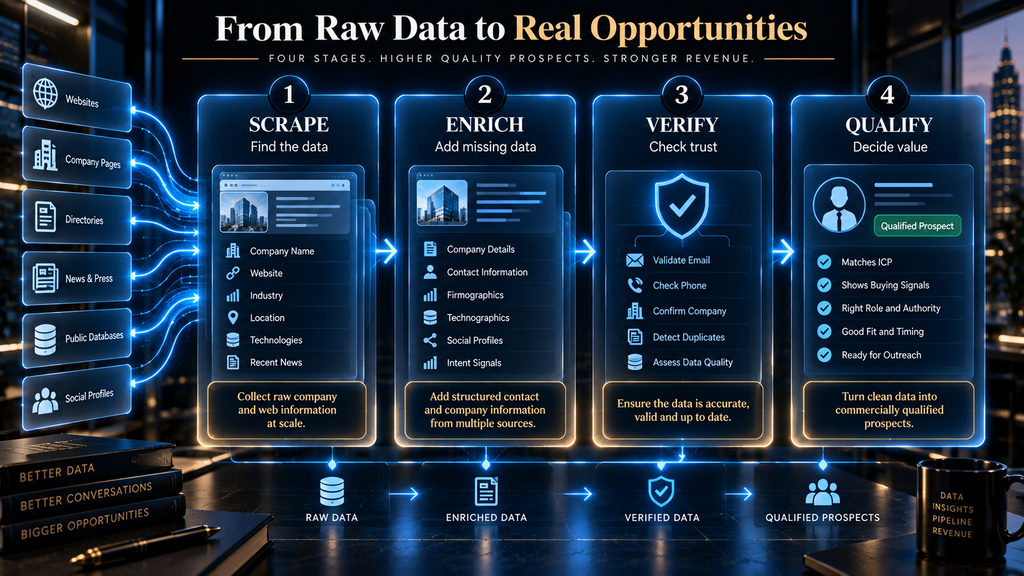
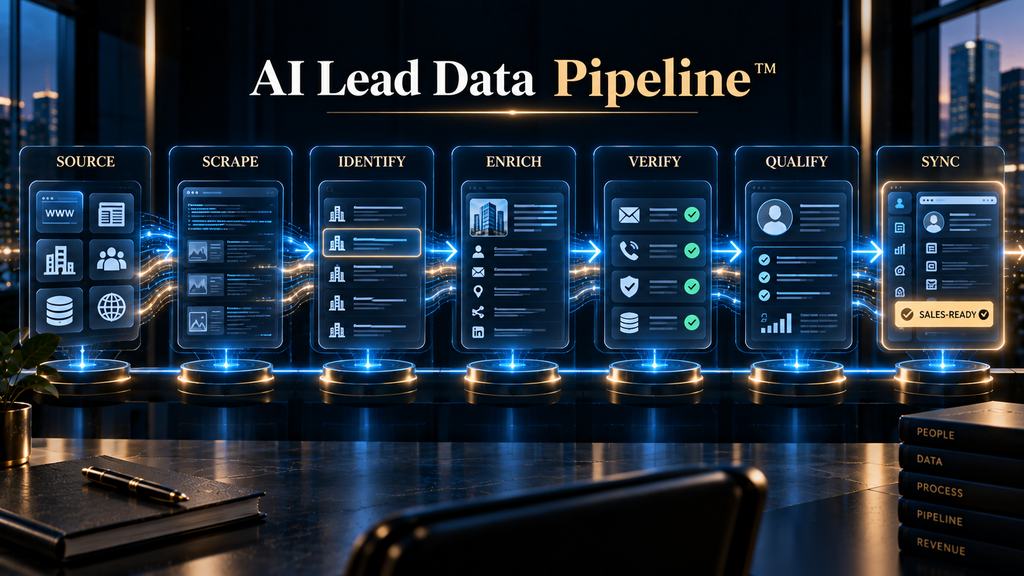
A useful way to understand the entire process is the AI Lead Data Pipeline: Source → Scrape → Identify → Enrich → Verify → Qualify → Sync.
Each stage solves a different problem. If the source is wrong, scraping more efficiently does not fix the problem. If the contact cannot be identified correctly, adding more company information does not make the record trustworthy. If the email is never verified, enrichment can simply produce a more detailed version of an unreliable lead.
This is also why tool comparisons based only on “database size” are increasingly misleading. The useful question is not how much data a vendor claims to have. The useful question is how much reliable, relevant, actionable data the system can produce for your particular ICP and workflow.
Scraping, Enrichment, Verification and Qualification Are Different Jobs
Before comparing tools, it is worth separating four concepts that are frequently bundled together in marketing.
Lead scraping
Lead scraping is the extraction layer. A scraper collects information from a website, directory, public page, database interface, or other accessible source and converts it into structured information.
For example, suppose you want to build a list of independent accounting firms in Texas. A scraping system might visit directories or websites and extract company names, URLs, locations, service categories, employee information, or other publicly available fields.
Scraping answers: “Where can I find the information?” It does not automatically answer whether the information is complete, accurate, current, or commercially useful.
Data enrichment
Enrichment starts with a record you already possess and attempts to add missing information. You might have:
Company: Example SaaS
Website: example.com
Contact: Sarah Ahmed
Title: VP Sales
An enrichment system might add a verified work email, phone number, company size, headquarters, industry, technology stack, funding information, social profiles, or other relevant attributes. Enrichment answers: “What else can we learn about this record?”
This is why enrichment is often more valuable after you already have a well-defined target list. If your real problem is discovering the right companies in the first place, buying a sophisticated enrichment platform may solve the wrong problem.
Verification
Verification asks whether the information should be trusted.
An email finder can return an address. That does not automatically mean the address is deliverable. A database can provide a phone number. That does not automatically mean the number belongs to the intended decision-maker.
Verification therefore sits between information collection and activation. It reduces the probability that inaccurate records enter downstream systems and sales campaigns.
Qualification
Qualification is the final commercial layer. It asks whether the prospect is worth pursuing.
A company can have a valid email, accurate firmographics, and a real decision-maker while still being a terrible prospect. This distinction is critical because data quality and lead quality are not the same thing. A perfect record for the wrong company is still a bad lead.
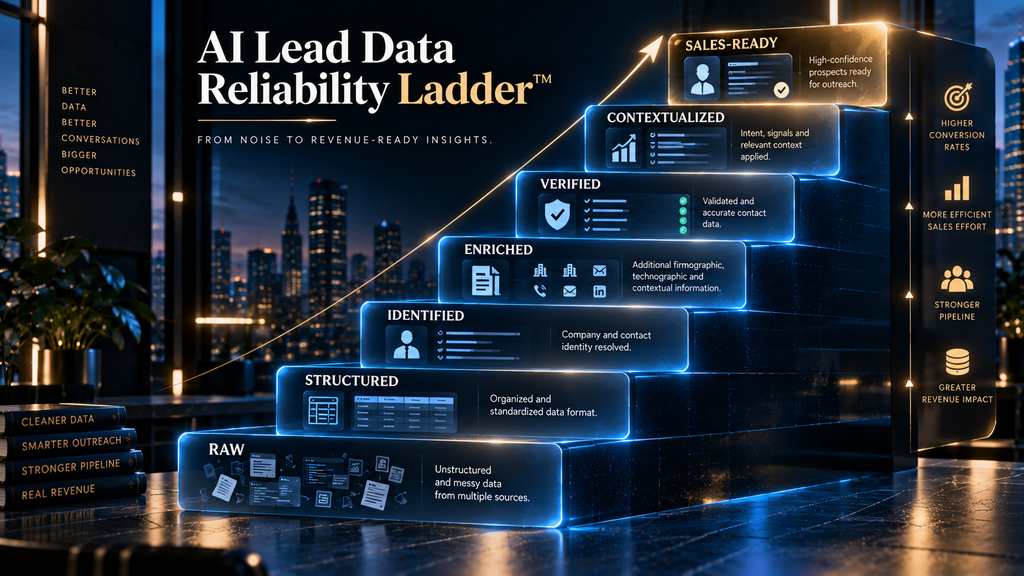
The AI Lead Data Reliability Ladder
One of the easiest ways to understand modern prospecting infrastructure is to stop thinking about a lead as a single object and instead think about its progression through several reliability states.
RAW
The system has discovered an unstructured piece of information. This could be a company website, directory entry, article, social profile, or scraped page.
STRUCTURED
The raw information has been converted into usable fields such as company name, domain, location, employee count, or contact name.
IDENTIFIED
The system has established who the company or individual actually is and connected the relevant records.
ENRICHED
Additional attributes have been added, such as email, phone, industry, revenue, technology stack, funding, or organizational information.
VERIFIED
Important fields have passed a verification process or have sufficient evidence to justify operational use.
CONTEXTUALIZED
The record contains information that helps explain why the prospect might matter. This could include hiring activity, technology changes, expansion, product launches, funding, leadership changes, or other business signals.
SALES-READY
The record is sufficiently reliable and relevant to enter the sales workflow.
The important lesson is that more fields do not automatically mean a higher-quality record. Adding twenty uncertain attributes to a prospect does not necessarily improve the record. Sometimes it simply creates twenty additional opportunities for inaccurate information to enter the CRM.
The objective should therefore be to climb the reliability ladder only as far as the sales process actually requires.
The Best AI Lead Scraping & Data Enrichment Tools in 2026
The following tools are not ranked simply by feature count. They are evaluated according to the role they play in the prospect-data architecture, because comparing fundamentally different tool types on a single “best” scale creates a misleading result.
1. Clay — Best for Multi-Source Enrichment and AI Research
Clay is one of the strongest choices when your problem is not merely finding a database record but building a flexible data-enrichment system around multiple sources.
Its architecture is particularly useful for teams that want to combine enrichment providers, waterfall logic, AI research, conditional workflows, and downstream CRM or sales-tool actions. Clay’s current documentation describes the platform as GTM infrastructure that can pull data from more than 200 providers while combining enrichment, research, scoring, and workflow orchestration.
The key advantage is flexibility. Instead of asking one provider to know everything about a prospect, a workflow can use different sources for different fields and continue looking when one provider cannot return a useful result.
That changes the economics of enrichment. Imagine that Provider A has excellent company coverage but weak phone coverage, while Provider B has stronger phone data and Provider C is better for a particular geographic market. A waterfall approach can treat these providers as complementary rather than forcing the entire workflow to depend on one database.
Clay becomes particularly compelling when the information you need is not a standard database field. AI research can investigate company websites or other sources to answer questions such as whether a company sells a particular type of product, whether its business model matches your ICP, or whether a particular trigger is present. Clay itself describes this AI research layer as a way to investigate information that conventional data providers may not expose as standard fields.
The trade-off is complexity. Clay gives you a great deal of control, but control creates configuration decisions, credit considerations, workflow design, and a learning curve. It is therefore not automatically the best choice for a small team that simply wants a contact database and a straightforward outbound workflow.
Best for: RevOps teams, growth teams, agencies, GTM engineers, sophisticated outbound teams, and businesses that need custom enrichment logic. Avoid if: You only need occasional contact lookups and do not want to build or maintain enrichment workflows.
2. Apollo — Best All-in-One Prospecting and Enrichment Platform
Apollo approaches the problem differently. Instead of acting primarily as an orchestration layer between many external data providers, it combines a large prospect database with enrichment, prospecting, outreach, and sales workflow capabilities.
That makes Apollo attractive to teams that do not want to assemble a separate data layer before they can start prospecting. Current third-party comparisons continue to position Apollo as an all-in-one prospecting option, while its own materials emphasize the role of enrichment in filling gaps in CRM and prospect data.
The strategic advantage is simplicity. If your workflow is essentially “find companies → identify contacts → enrich records → send outreach,” Apollo can cover much of that journey inside one environment.
That convenience also explains one of its limitations. A platform that bundles database access, enrichment, prospecting and outreach can be extremely useful, but it is less flexible than an architecture designed specifically around assembling data from many independent sources. If your competitive advantage depends on highly customized enrichment or unusual web research, you may eventually need a more modular approach.
Apollo is particularly sensible for smaller and mid-sized sales teams that want to get from zero to outbound operation without engineering an elaborate data stack first. Best for: SMB and mid-market sales teams, founders, lean outbound teams, and businesses wanting one platform for prospecting and sales execution. Avoid if: Your primary requirement is highly customized multi-source data orchestration rather than an integrated sales platform.
3. FullEnrich — Best for Waterfall Contact Enrichment
FullEnrich is focused much more narrowly on the enrichment problem, particularly when the objective is finding additional contact information such as email addresses and phone numbers.
Its architecture is based around waterfall enrichment, meaning the system can work through multiple data sources rather than relying on a single provider. FullEnrich currently describes its system as aggregating data from more than 20 sources and sequentially checking providers to improve contact coverage.
This matters because no single B2B data provider has perfect coverage. A contact might exist in one source but not another, particularly across different countries, industries, company sizes, or job functions.
For a sales team that already has the companies and contacts but struggles to fill missing contact fields, this can be a much more direct solution than buying a complete prospecting platform.
The limitation is equally important: waterfall enrichment does not solve every prospecting problem. If you do not know which companies to target, or if your biggest issue is extracting a niche set of companies from the open web, a contact-enrichment platform may leave the most important part of your workflow untouched.
Best for: Existing prospect lists with missing email or phone information, agencies, outbound teams, and teams focused on contact-data coverage. Avoid if: Your primary challenge is discovering and scraping unique web-based prospect sources.
4. Apify — Best for Programmable Web Scraping at Scale
Apify belongs to a different category from Clay, Apollo, and FullEnrich. It is better understood as web-scraping infrastructure than as a traditional B2B sales database.
That distinction makes it powerful for organizations that need to extract structured information from sources that conventional B2B databases may not cover. Apify provides a platform for running web scrapers and automation workflows, including actors designed for particular websites and data-collection jobs.
The advantage is breadth and control. If your prospecting strategy depends on extracting information from directories, websites, marketplaces, public listings, or other web sources, programmable scraping can give you access to data that does not exist inside a conventional prospect database.
But this power comes with responsibility. Scraping infrastructure does not automatically produce clean, verified sales records. You still need to normalize the output, identify companies and contacts, enrich missing fields, verify critical information, remove duplicates, and determine whether the data can be used appropriately.
This is why Apify often makes more sense as the source layer in a larger prospecting architecture rather than as a complete replacement for enrichment and verification. Best for: Developers, technical growth teams, data teams, agencies, and businesses with unusual or custom web-data requirements. Avoid if: You want a simple plug-and-play sales database with minimal technical setup.
5. Browse AI — Best for No-Code Web Data Extraction
Browse AI takes the web-extraction problem in a more accessible direction. Rather than requiring a technical team to build scraping infrastructure, it is designed around no-code extraction and monitoring workflows.
That makes it particularly useful when a business knows exactly where the prospect information exists but does not want to build a custom scraper.
For example, a sales team might need to monitor a directory of companies, extract business information from a specific type of website, or turn a repetitive web research task into structured records. In those situations, a no-code extraction platform can be more practical than building a custom data pipeline.
The limitation is that extraction and enrichment remain different jobs. Pulling a company name and website from a directory does not automatically provide a verified decision-maker, accurate direct phone number, or current buying signal.
Browse AI therefore works best when the missing piece is structured web extraction, not when the entire prospecting operation needs to be solved inside one platform. Best for: Non-technical users, sales operations teams, researchers, and businesses extracting data from repeatable web sources. Avoid if: You need a full B2B intelligence database or sophisticated multi-provider enrichment architecture.
6. Hunter — Best for Email Discovery and Verification
Hunter occupies a narrower but useful position in the stack. Its core strength is helping users discover and verify professional email addresses rather than attempting to become the entire prospecting infrastructure.
Hunter says its systems use public web information for domain and email discovery, while its email-finding workflows can infer or identify professional addresses and verify them.
This focused approach can actually be an advantage. If your CRM already contains the companies and people you want to contact but lacks reliable work emails, paying for a full prospecting platform may be unnecessary.
The mistake would be expecting Hunter to replace a complete lead-generation system. Email discovery is an important part of prospecting, but it does not answer whether the company fits your ICP, whether the person is the correct decision-maker, or whether the prospect has a compelling reason to buy.
Best for: Email discovery, email verification, domain research, and teams that already have a prospect list. Avoid if: You need comprehensive company intelligence, web scraping, or end-to-end outbound automation.
7. Cognism — Best for International B2B Data and Contact Intelligence
Cognism is positioned toward B2B sales intelligence, with particular emphasis on contact data, international coverage, and verification.
Its Diamond Data offering emphasizes phone-verified contact information and multiple verification layers, while Cognism also highlights compliance-oriented processes and international coverage. These are vendor claims and should be evaluated against the geography and contact types that matter to your organization rather than treated as universal guarantees.
The important strategic point is that geography changes the data problem. A prospecting system that works extremely well in one market may perform differently in another because business directories, public records, phone systems, privacy regulations, company structures, and data availability vary significantly.
For organizations prospecting across Europe or other international markets, this makes coverage and compliance considerations more important than simply comparing database-size claims. Best for: International B2B sales, organizations with significant European or multinational prospecting requirements, and teams prioritizing contact verification. Avoid if: You only need simple email discovery or custom web scraping.
8. ZoomInfo — Best for Enterprise B2B Intelligence
ZoomInfo remains a major enterprise option because it approaches prospecting as a broader business-intelligence problem rather than simply an email-finding exercise. Its strength is the depth and breadth of its enterprise-oriented data ecosystem, including company intelligence, contact information, organizational information, and additional signals that can support sales and marketing operations.
The trade-off is cost and complexity. Enterprise data platforms make more sense when the value of accurate intelligence is high enough to justify the investment and when the organization has the processes needed to use that information effectively.
A smaller sales team may be better served by a simpler system. An enterprise with thousands of accounts, multiple revenue teams, established RevOps processes, and significant outbound economics may value the consistency and scale of a mature intelligence platform much more.
Best for: Enterprise sales organizations, large revenue teams, sophisticated RevOps environments, and businesses where data depth justifies enterprise investment. Avoid if: Your prospecting operation is small, highly experimental, or primarily needs inexpensive contact discovery.
The Tool Comparison That Actually Matters
Instead of asking which platform has the most features, evaluate the architecture against the actual problem your sales process is experiencing.
| Tool | Primary Role | Best Fit | Main Strength | Main Limitation |
|---|---|---|---|---|
| Clay | Enrichment + orchestration | Custom GTM workflows | Multi-source waterfall + AI research | Complexity and workflow overhead |
| Apollo | Database + sales platform | All-in-one prospecting | Prospecting, enrichment and outreach together | Less modular than a custom stack |
| FullEnrich | Contact enrichment | Existing prospect lists | Waterfall contact discovery | Not primarily a discovery/scraping platform |
| Apify | Web scraping infrastructure | Technical/custom extraction | Programmable web data collection | Requires downstream data processing |
| Browse AI | No-code scraping | Non-technical extraction | Easy repeatable web extraction | Extraction is not qualification |
| Hunter | Email discovery | Contact lookup | Email finding and verification | Narrower data scope |
| Cognism | B2B intelligence | International sales | Contact intelligence and verification | Enterprise-oriented |
| ZoomInfo | Enterprise intelligence | Large organizations | Broad proprietary intelligence layer | Cost and complexity |
The table reveals something that a conventional “Top 8 Tools” list often hides: these products are not all competing for the same job. That means your first buying decision should be architectural, not brand-based.
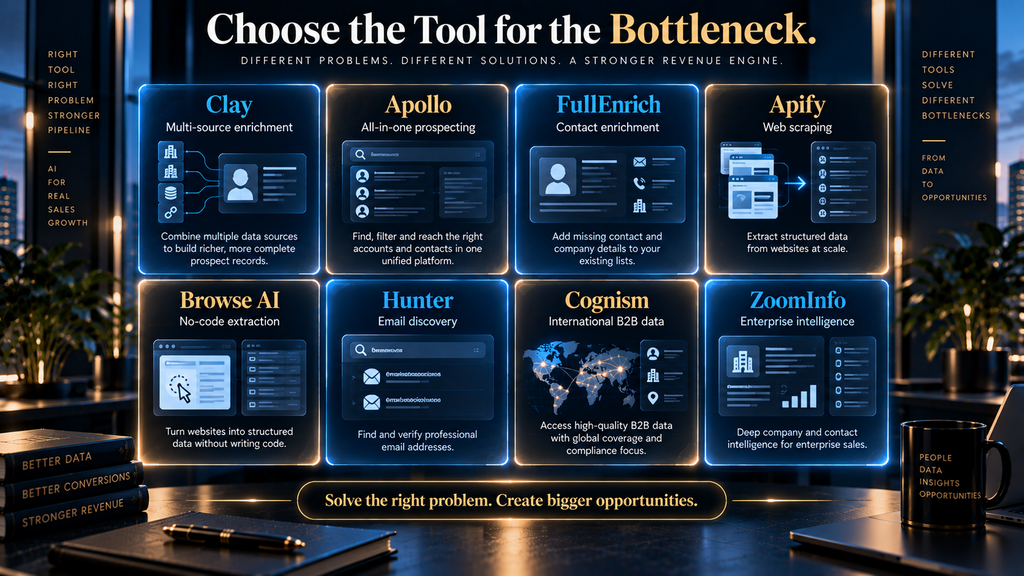
Scrape vs. Enrich vs. Verify: The Decision Matrix
A practical way to select the right tool is to identify the exact question your workflow cannot currently answer.
| Your Problem | Primary Question | Tool Category |
|---|---|---|
| You cannot find the companies | Where are the target companies? | Database / Web Scraping |
| You have companies but not people | Who works there? | Contact Discovery |
| You have contacts but missing fields | What else do we know? | Enrichment |
| You have several possible data sources | Which source can fill the gap? | Waterfall Enrichment |
| You have emails but uncertain validity | Can we trust this email? | Verification |
| You have raw web data | How do we structure it? | Web Extraction / Data Processing |
| You have prospects but not enough context | Why might this company matter? | AI Research / Signals |
| You have records but no sales process | What should happen next? | Qualification / Workflow |
This is where many buying decisions go wrong. A company sees a competitor using Clay and concludes that it needs Clay. Another sees a sales team using Apollo and concludes that Apollo must be the answer.
But the tool is only the answer when its architecture matches the bottleneck.
How to Build an AI Lead Data Pipeline
The strongest prospecting systems increasingly look less like a single database and more like a pipeline.
Start with Source. Decide where the initial prospect universe comes from. That could be a B2B database, your CRM, a website directory, a public company list, a manually defined account list, or a scraping workflow.
Next comes Scrape, where appropriate. This stage should exist only when the information you need must be extracted from a web source. If the database already provides the information reliably, scraping adds complexity without necessarily adding value.
Then Identify the company and person. Normalize names, domains, company identities, titles, and other identifiers so that different records referring to the same organization do not become separate prospects.
After identification comes Enrich. This is where the system fills missing information using one or more data providers. A waterfall becomes useful when no individual source has sufficient coverage.
Then Verify the fields that matter operationally. Do not necessarily verify every field equally. Email deliverability may be critical for an outbound campaign, while an approximate employee count may be sufficient for early account segmentation.
The next step is Qualify. Add the commercial context that determines whether the prospect is actually worth sales attention. This is where ICP fit, business signals, technology use, hiring activity, company growth, geography, and other criteria can become useful.
Finally, Sync the finished record into the CRM, sales engagement platform, spreadsheet, warehouse, or another operational system. The entire pipeline can be summarized as: SOURCE → SCRAPE → IDENTIFY → ENRICH → VERIFY → QUALIFY → SYNC.
The important design principle is that every stage should have a reason to exist. Automation is not automatically valuable simply because it removes human effort. If a stage creates low-quality information faster, it can increase the size of the problem.
Why Waterfall Enrichment Has Become So Important
The fundamental problem with single-source enrichment is simple: no database knows everyone equally well.
Coverage varies by geography, industry, company size, job function, company maturity, and data type. One provider may have excellent email coverage but weaker mobile-phone data. Another may have stronger European coverage. Another may be better for company-level information.
Waterfall enrichment addresses this by allowing multiple providers to participate in the same lookup. If the first source cannot return a reliable value, the system moves to another source rather than immediately marking the field as unavailable.
This can materially increase coverage, but it introduces a second problem: cost control.
If every record is sent through every available provider regardless of whether the field is already known, the enrichment system can become unnecessarily expensive. The better architecture is conditional. Start with the cheapest or most appropriate source, check whether the returned information meets the quality requirement, and only continue to another provider when the expected value justifies the additional cost.
That leads to another AI Hustle World principle:
The Marginal Data Value Rule
Continue enriching a record only while the expected value of another data point exceeds its acquisition, processing, and operational cost.
Suppose you already have a verified work email, company website, job title, and strong ICP match. Spending additional credits to discover five minor firmographic fields may not improve the sales outcome.
By contrast, discovering a verified direct phone number for a high-value enterprise account could materially change the economics of outreach. The correct enrichment depth therefore depends on the value of the prospect and the role of the missing field in the sales process.
More Data Can Actually Make Prospecting Worse
This is the uncomfortable part of modern data enrichment: more information does not necessarily produce better decisions.
A prospect record with 70 fields looks more sophisticated than a record with 15 fields. But if 20 of those fields are stale, inferred without sufficient evidence, or irrelevant to the buying decision, the larger record can create false confidence.
False confidence is particularly dangerous because bad data is easy to detect when it is obviously missing. It is much harder to detect when incorrect information looks authoritative inside a polished CRM.
Consider a sales rep who sees:
Company: 500 employees
Industry: SaaS
Contact: VP Sales
Revenue: $50M
Technology: Salesforce
Intent: High
The record appears excellent. But suppose the company actually downsized six months ago, the contact moved into a different role, the technology field was inferred from an outdated website, and the “intent” signal represents a weak behavioral correlation rather than an actual buying action.
The problem is no longer lack of data. It is misplaced confidence in data.
That is why verification method matters more than a vendor’s headline accuracy percentage. A credible buying process should ask where a field came from, how recently it was observed, whether it was directly verified or inferred, and whether it materially affects the sales decision.
What AI Actually Adds to Lead Scraping and Enrichment
AI is useful here, but not because it magically makes databases accurate. Its strongest role is in handling information that does not fit neatly into predefined database fields. Traditional enrichment might tell you:
Industry: Marketing Technology
Employees: 200
Location: London
AI research can potentially investigate a more nuanced question: “Does this company appear to sell an enterprise marketing platform to organizations with more than 1,000 employees?” That distinction is significant.
Many qualification criteria are semantic rather than purely structured. A company website may contain the information needed to answer the question, but it may not exist as a clean database field.
AI can therefore act as a research layer between raw information and qualification.
The limitation is that AI-generated research should not automatically be treated as verified fact. AI can misunderstand websites, interpret ambiguous language incorrectly, confuse similarly named companies, or infer conclusions that the source does not actually support.
For high-consequence decisions, the best architecture is therefore not: AI says it → CRM accepts it. It is: AI investigates → evidence is captured → confidence is assessed → human or rule-based validation occurs where necessary → decision is activated. That distinction is especially important when the data will drive thousands of automated outbound messages.
The Economics of Lead Data: Stop Comparing Tools by Monthly Price Alone
Pricing is one of the least useful parts of a tool comparison when viewed without workflow economics.
A platform that costs $200 per month can be cheaper than a $50 platform if it produces substantially more usable records with less manual work. Conversely, an expensive platform can become a poor investment if the organization buys more data than its sales process can actually use.
The metric that matters is closer to cost per usable prospect than cost per credit. Consider two hypothetical workflows.
Tool A costs $100 and produces 5,000 records, but only 40% meet your minimum quality requirements. Tool B costs $300 and produces 3,000 records, but 80% meet the same requirements.
Tool A appears cheaper based on headline price. Tool B produces 2,400 usable records compared with Tool A’s 2,000.
The calculation becomes even more important when human labor is included. If Tool A requires hours of spreadsheet cleanup, duplicate removal, email verification, and manual research, its real cost can be substantially higher than the software subscription suggests.
This is why pricing should be evaluated through: Total data cost + processing cost + human cleanup cost + wasted outreach cost ÷ usable sales-ready records. That is a much more meaningful number than “$49 per month” or “$185 per month.”
What Happens When You Choose the Wrong Tool Architecture?
The most common mistake is choosing a tool because it looks powerful rather than because it solves the actual bottleneck. If you need to discover companies from unusual web sources but buy a traditional B2B database, you may spend money on a huge contact universe while still lacking the companies you actually want. If you already have a strong account list but purchase a full prospecting platform simply to find missing emails, you may be paying for functionality your team barely uses.
If your organization needs international contact coverage but evaluates vendors using only North American examples, the benchmark may not reflect your actual operating environment. If you build a custom scraper when a reliable database already contains the required information, you inherit technical maintenance that provides little commercial advantage. And if you create a massive waterfall that enriches every field for every record, your data budget can grow faster than your pipeline.
The common failure is not choosing a “bad” tool. It is choosing a good tool for the wrong problem.
Common AI Lead Scraping and Enrichment Mistakes
Mistake 1: Treating scraping as lead generation
Scraping creates records. It does not automatically create qualified opportunities.
The difference becomes obvious when a team scrapes thousands of businesses from a directory and then discovers that most have no relevant decision-maker, no verified contact information, and no commercial reason to buy. The scraping stage should therefore be evaluated on extraction quality, not confused with the downstream quality of the leads.
Mistake 2: Assuming the largest database has the best coverage
A huge database can still have poor coverage for a specific niche, geography, or company segment. Your actual ICP is the dataset that matters.
Mistake 3: Enriching everything
Not every prospect deserves the same enrichment depth. High-value accounts justify more research; low-value prospects may require only enough information to determine whether they belong in the campaign.
Mistake 4: Treating inferred data as verified data
An AI system may infer a company uses a particular technology from a website or job posting. That can be useful, but inference and direct verification are not identical.
The distinction should remain visible in the workflow.
Mistake 5: Ignoring duplicates
When data comes from multiple sources, duplicate companies and contacts become a serious operational problem. Without normalization and identity resolution, the same prospect can appear several times with slightly different names, domains, titles, or contact details.
Mistake 6: Measuring records instead of outcomes
A team can celebrate scraping 100,000 leads while generating no meaningful pipeline. The more useful metrics are usable-record rate, verification rate, enrichment coverage, duplicate rate, bounce rate, positive reply rate, meeting rate, opportunity rate, and ultimately revenue generated per usable prospect.
How to Choose the Right Tool for Your Business
The decision becomes much easier when you begin with your existing data rather than with vendor websites.
Choose Clay when your problem is orchestration.
If you already understand your ICP and need to combine multiple data providers, AI research, conditional enrichment, scoring, and downstream actions, Clay is one of the strongest architectural fits.
Choose Apollo when your problem is getting an outbound system running quickly.
If you want prospect discovery, enrichment, sequencing, and sales execution in a relatively integrated environment, Apollo can reduce the number of systems you need to assemble.
Choose FullEnrich when your problem is missing contact information.
If you already have the companies and people but need stronger email and phone coverage, a dedicated waterfall enrichment platform can make more sense than purchasing a full sales platform.
Choose Apify when your problem is web-source discovery.
If your best prospects exist in directories, websites, public listings, or niche sources that traditional databases do not cover, programmable web extraction can become the missing layer.
Choose Browse AI when you need web extraction without building infrastructure.
For repeatable extraction tasks that do not justify custom development, a no-code scraper can be the more practical choice.
Choose Hunter when email is the bottleneck.
If the list is already good and the missing piece is professional email discovery or verification, a focused tool can be enough.
Choose Cognism when international contact intelligence is central.
If geography, phone verification, and international B2B coverage matter significantly to your sales operation, evaluate Cognism against the specific regions and contact types you target.
Choose ZoomInfo when enterprise intelligence justifies the investment.
For large organizations with complex RevOps infrastructure and substantial account values, enterprise intelligence can make economic sense where a smaller company would struggle to justify the cost.
Who Should Use AI Lead Scraping and Enrichment Tools?
These tools are most valuable when prospect data itself is a meaningful operational bottleneck.
B2B sales organizations with large outbound programs can benefit because manual research does not scale cleanly. RevOps teams can use enrichment to keep CRM records more complete and operationally useful. Lead-generation agencies can use scraping and enrichment to create repeatable research workflows across clients. Growth teams can use AI research to identify characteristics that traditional databases do not expose as standard fields.
The technology is also valuable for businesses with fragmented prospect data. If the organization already has information spread across spreadsheets, CRM records, websites, directories, and separate data providers, a structured enrichment workflow can turn those fragments into a more coherent system.
But there is a less obvious group that should probably not invest heavily in these tools: companies that have not yet defined who they want to sell to.
If your ICP is vague, better data will not necessarily create better leads. It may simply give you a larger list of people who do not clearly belong in your market.
Who Should Avoid Them?
A small business that needs ten highly targeted contacts may not need a sophisticated enrichment stack. Manual research can be faster, cheaper, and easier to validate.
Inbound-heavy companies may also receive less value if most qualified opportunities already arrive through organic search, referrals, partnerships, or existing customer channels.
And teams without a clear sales process should be cautious. Automating prospect discovery before defining qualification criteria can simply automate the creation of low-quality leads.
The right sequence is generally: Define the market → define the ICP → define qualification → identify the data required → choose the architecture → automate the workflow. Not the other way around.
How to Test an AI Lead Data Tool Before Buying It
Never evaluate a data platform exclusively through a polished demo.
Build a small test dataset that resembles your real prospect universe. Include companies from your core market, difficult edge cases, smaller accounts, international accounts if relevant, companies with incomplete information, and contacts that you already know well enough to validate.
Then run the same dataset through the shortlisted tools.
The objective is not to discover which vendor has the most impressive demo. It is to discover which system performs best on your records.
At minimum, evaluate:
| KPI | What It Tells You |
|---|---|
| Match rate | How often the system finds a record |
| Verified-email rate | How many returned emails are operationally usable |
| Phone coverage | How often useful phone data is available |
| Enrichment completeness | How many required fields are filled |
| Duplicate rate | How much cleanup the system creates |
| Freshness | How current the returned data appears |
| Cost per usable record | Real economic efficiency |
| Manual cleanup time | Operational burden |
| CRM sync quality | How easily the output enters your workflow |
| Positive response rate | Whether better data improves outreach |
| Meeting rate | Whether the data contributes to pipeline |
| Opportunity rate | Whether the prospects become meaningful sales opportunities |
This is much closer to a real procurement test than comparing feature checklists.
The AI Lead Data Reliability Ladder Changes How You Measure Success
A sophisticated prospecting operation should not measure success at the scraping stage alone.
Suppose your scraper extracts 50,000 companies. That is an extraction metric.
After identity resolution, perhaps 43,000 are unique companies. That is an identity metric. After enrichment, perhaps 31,000 have the required contact information. That is an enrichment metric.
After verification, perhaps 25,000 meet your operational quality threshold. That is a reliability metric. After ICP qualification, perhaps only 8,000 are actually worth pursuing. That is a commercial-quality metric.
Finally, perhaps 600 generate positive engagement and 120 become opportunities. The funnel becomes: 50,000 extracted → 43,000 unique → 31,000 enriched → 25,000 verified → 8,000 qualified → 600 engaged → 120 opportunities.
The original 50,000 number sounds impressive. The 120 opportunities are what the business actually cares about.
That is why AI lead scraping and enrichment should ultimately be evaluated as a pipeline-quality system, not a lead-counting system.
What the Traditional Prospecting Method Still Gets Right
It would be easy to conclude that AI should replace human prospect research entirely. That would be a mistake.
Traditional prospecting methods exist for a reason. Human researchers can recognize ambiguity, understand context, notice unusual business circumstances, and make judgments that are difficult to encode into a database field.
The real advantage of AI is not eliminating human judgment. It is allowing humans to spend that judgment where it has the highest value.
A researcher should not spend thirty minutes manually copying a company’s employee count, website URL, job title, and email address into a spreadsheet if a reliable system can do that in seconds. But a human may still be extremely valuable when deciding whether a complex company actually fits a nuanced ICP, whether a buying signal is meaningful, or whether an unusual organizational structure changes the sales approach.
The strongest system is therefore neither “AI only” nor “manual research only.” It is automation for repetition and human judgment for ambiguity.
What Happens If You Do Nothing?
The cost of staying with a weak data process is easy to underestimate because it rarely appears as a single line item.
Sales representatives spend time researching prospects manually. Duplicate records accumulate. Outreach is sent to outdated contacts. CRM reports become less trustworthy. Marketing and sales teams work from different versions of company information. High-value accounts receive the same shallow research as low-value accounts.
Over time, the organization begins making decisions based on a database that looks complete but becomes progressively less reliable.
That creates a second-order effect: once sales teams stop trusting the CRM, they begin maintaining private spreadsheets, browser tabs, notes, and personal research systems. The organization then loses the very centralization the CRM was supposed to provide.
A good enrichment architecture is therefore not merely a productivity improvement. It can become a form of data infrastructure for revenue operations.
The Future of AI Lead Scraping and Enrichment
The category is moving toward a more modular model. Instead of one database attempting to own every piece of prospect information, the emerging architecture combines multiple data sources, web extraction, AI research, verification, signals, and workflow automation.
That does not mean traditional databases disappear. They remain valuable because structured, normalized data is still extremely useful for scale. But the strongest systems increasingly treat databases as one component in a broader data pipeline rather than the entire pipeline.
AI will also make enrichment increasingly semantic. Instead of asking only for structured fields such as revenue or employee count, sales teams will ask systems to investigate questions that require interpretation.
For example: “Does this company appear to have recently expanded into the U.S. market?” “Is the company hiring for a role that suggests it is building an internal sales function?”
“Does its website indicate that it sells to enterprise customers?” “Has the company introduced a product that overlaps with our category?”
Those are not traditional database fields. They are research questions.
The long-term competitive advantage will therefore come less from possessing the largest static dataset and more from building a system that can assemble, verify, interpret, and activate information at the moment it is needed.
Final Thoughts
The best AI lead scraping and data enrichment tool in 2026 is not necessarily the one with the largest database, the most AI features, or the longest feature list. It is the tool—or combination of tools—that matches the exact point where your prospect-data process breaks.
If you need custom multi-source enrichment and AI research, Clay is a compelling choice. If you want an integrated prospecting and sales platform, Apollo is a strong option. If your existing lists simply need better contact coverage, FullEnrich can be more appropriate. If your prospects live in unusual web sources, Apify or Browse AI may solve the problem more directly. Hunter is useful when email discovery is the bottleneck, while Cognism and ZoomInfo make more sense when deeper B2B intelligence and organizational requirements justify them.
The bigger lesson is more important than the individual tool rankings.
Do not optimize for the number of leads you can collect. Optimize for the number of sales-ready prospects you can trust.
That shift changes everything: which tools you buy, how you design your enrichment workflow, how much data you collect, how you measure performance, and where you keep humans involved. A modern prospecting system should therefore be judged by the journey from source to sales-ready, not by the size of the spreadsheet it produces.
Turn Lead Data Into a Smarter Prospecting System
Finding and enriching leads is only the beginning. The real advantage comes from connecting discovery, enrichment, qualification, buying signals, and outreach.
Build the AI Prospecting Workflow →Frequently Asked Questions
What is the best AI lead scraping tool in 2026?
There is no universal winner because lead scraping covers different use cases. Apify is a strong option for programmable web scraping, while Browse AI is better suited to no-code extraction. If you want scraping combined with broader prospecting and enrichment capabilities, an integrated platform may be more appropriate than a dedicated scraper.
What is the best AI data enrichment tool in 2026?
Clay is one of the strongest choices for flexible multi-source enrichment, AI research, and workflow orchestration. FullEnrich is particularly relevant when the primary requirement is waterfall-based contact enrichment. The better choice depends on whether you need a customizable enrichment system or a more focused contact-data solution.
Is AI lead scraping the same as data enrichment?
No. Lead scraping extracts information from a source, while enrichment adds information to an existing record. Verification determines whether important information can be trusted, and qualification determines whether the prospect is commercially relevant.
Is Clay better than Apollo?
Neither is universally better because they solve different problems. Clay is particularly strong for custom enrichment, AI research, multi-provider workflows, and orchestration, while Apollo is attractive when you want prospect discovery, enrichment, and sales execution in a more integrated environment.
Is waterfall enrichment worth it?
Waterfall enrichment can be valuable when no single data provider offers sufficient coverage for your target audience. It allows multiple sources to contribute to the same record, but the additional coverage must be balanced against credit consumption, processing cost, and the value of the additional information.
Can AI lead scraping replace a sales development representative?
AI can automate significant portions of research, data collection, enrichment, qualification, and workflow execution, but it does not eliminate the need for human judgment in every sales environment. Complex qualification, ambiguous buying signals, strategic accounts, relationship building, and high-consequence decisions can still benefit substantially from experienced salespeople.
How accurate are AI lead scraping tools?
Accuracy varies by source, geography, data type, provider, and verification method. A vendor’s overall accuracy claim should therefore not be treated as a guarantee for your ICP. The best way to evaluate accuracy is to test the tool against a representative sample of your own prospect data.
How do I measure whether a lead enrichment tool is working?
Start with operational metrics such as match rate, verified-email rate, phone coverage, enrichment completeness, duplicate rate, freshness, cost per usable record, and manual cleanup time. Then connect those metrics to commercial outcomes such as positive replies, meetings, opportunities, and revenue.
Are AI-scraped leads safe to use for cold outreach?
Not automatically. The fact that information can be found online does not by itself answer whether it is appropriate to collect, process, store, or use for outreach in a particular jurisdiction or platform. Businesses should evaluate applicable privacy requirements, data-source restrictions, platform terms, consent requirements where relevant, and their own compliance obligations before deploying a scraping workflow at scale.
Should I build my own lead scraping system?
Build your own system when your prospect sources are unusual enough that existing platforms cannot provide the required data, or when custom extraction creates a meaningful strategic advantage. If a reliable commercial tool already solves the problem, building and maintaining custom infrastructure may create unnecessary technical and operational overhead.
What is more important: database size or data quality?
Data quality is generally more important once your prospect universe is large enough to support your sales process. A smaller set of accurate, verified, relevant prospects can be more valuable than a massive dataset filled with stale, duplicated, incomplete, or poorly matched records.
What is the biggest mistake companies make with AI lead enrichment?
The biggest mistake is treating enrichment as the objective instead of treating it as infrastructure for a commercial decision. Teams can spend heavily to add more and more fields without asking whether those fields improve qualification, personalization, outreach, or pipeline generation.
Written by
Muntasir Ahmad Chowdhury
Founder, AI Hustle World
Muntasir Ahmad Chowdhury is the Founder of AI Hustle World, an independent publication dedicated to making Artificial Intelligence practical, trustworthy, and easy to understand. He researches AI tools, automation, customer service, productivity, and real-world business applications, helping readers make smarter technology decisions through research-driven, experience-backed content.
Expertise:
AI Tools • AI Automation • AI Customer Service • AI Productivity • Generative AI • AI Workflows
Get Smarter With AI
Enjoyed this guide? Get practical AI tools, tutorials, and honest reviews delivered to your inbox.